Take 3: She Wore a Yellow Ribbon Review

I have been participating in the Legends of Western Cinema Week Blogathon since 2020. Because films from the western genre aren’t covered on 18 Cinema Lane often, this blogathon has given me a reason to seek out titles from the western genre to review. But when the Legends of Western Cinema Week ends, another blogathon begins; the Hit The Road Blogathon. Since I wanted to participate in both events, I decided to review one film for both blogathons. That film is 1949’s She Wore a Yellow Ribbon! The movie perfectly fits the themes of both events, as it is not only considered a “classical western” (according to IMDB), multiple characters travel by horse throughout the story. She Wore a Yellow Ribbon was also recommended to me by Eric Binford from Diary of a Movie Maniac. While this is the fourth movie of John Wayne’s I’ve seen, this is only the third one I’ve reviewed. The other two titles, El Dorado and Allegheny Uprising, were, in my opinion, just ok. How does She Wore a Yellow Ribbon compare to these other films? Keep reading my review to find out!

She Wore a Yellow Ribbon poster created by Argosy Pictures and RKO Radio Pictures

Things I liked about the film:

The acting: Whenever I discuss the acting in a given movie, I will usually talk about a scene that showcases the strength of the acting performances. My favorite example from She Wore a Yellow Ribbon takes place toward the beginning of the film. John Wayne portrays Captain Nathan Brittles, a man who goes on one last mission before he retires. During an evening visit to the local cemetery, Nathan talks to the graves of his wife, Mary, and his daughters, Elizabeth and Jane. While he talks to his deceased family, he consistently has a sad look in his eyes. Yet, the inflection of his voice changes depending on the type of news he has to share. Joanne Dru’s character, Olivia Dandridge, also visits the cemetery to give Nathan some potted flowers. Olivia’s persona is kind and gentle throughout this scene. Her conversation with Nathan perfectly displays the on-screen camaraderie between Joanne Dru and John Wayne. Because of this on-screen camaraderie and how strong John’s and Joanne’s acting performance was, I wish they shared more screen time.

The scenery: Most of She Wore a Yellow Ribbon takes place outdoors, with the movie being filmed in Utah and Arizona (according to IMDB). Looking back on the 1949 picture, I can definitely see why the film’s creative team would want to take advantage of the story’s natural landscape. Large, rustic red rocks impressively stood against a blue sky filled with white clouds. There were greens spots where foliage popped within the rocky terrain. The most memorable presentation of the scenery was during a storm. The bright, blue lighting blinked against the two-toned gray sky and the sand-colored ground provided a bright hue to the space. She Wore a Yellow Ribbon was a pretty looking film because of its scenery!

The dialogue: In She Wore a Yellow Ribbon, Corporal Quayne’s life is spared after being rescued from an attack. Olivia shares with Lieutenant Flint Cohill how happy she is Corporal Quayne survived. Lieutenant Cohill asks her why she cares about Corporal Quayne, especially since she doesn’t know him or is aware if he frequents the Lieutenant’s Bar. Olivia responds to this question by saying just because a man frequents the Lieutenant’s Bar doesn’t automatically make him a gentleman. Lieutenant Cohill then accuses Olivia of caring about Corporal Quayne’s well-being because his survival fits the happy ending she can write home about. This conversation between Olivia and Lieutenant Cohill was thought-provoking, as it addresses motivations for caring about others, as well as how someone’s personal situation can fuel another person’s narrative. That is just one example of the well-written nature of the dialogue!
The Legends of Western Cinema Week Blogathon banner created by Hamlette from Hamlette’s Soliloquy, Heidi from Along the Brandywine, and Olivia from Meanwhile, in Rivendell…

What I didn’t like about the film:

Limited amount of action: A movie from the western genre, especially one starring John Wayne, carries a set of expectations. One of those expectations is the amount of action within the story. Scenes of battles, duels, and even bar fights will typically be sprinkled through a western genre story to maintain the suspense and intrigue of what’s happening on screen. But in She Wore a Yellow Ribbon, the action was far and few between. The majority of the story consisted of characters either having conversations with one another or riding from place to place. When an action scene does happen, it lasts for a very short period of time. These creative decisions caused She Wore a Yellow Ribbon to lack intrigue and suspense.

Not truly getting to know the characters: So much of She Wore a Yellow Ribbon’s story focuses on Captain Nathan Brittles and his impending retirement. While the audience receives the opportunity to learn more about Captain Brittles and understand his motivations, it comes at the expense of getting to truly know the other characters. One character I felt was overlooked was Top Sergeant Quincannon. He was retiring around the same time as Captain Brittles. But the script never addresses how the story’s patrol mission impacted Top Sergeant Quincannon and his career. Instead, the film prioritizes his enjoyment of drinking alcohol. Because of this emphasis, I only became familiar with Top Sergeant Quincannon instead of truly getting to know him.

The run-time: She Wore a Yellow Ribbon has a run-time of an hour and forty-four minutes. As I watched the movie, however, it felt longer than this stated run-time. Part of this flaw stems from the insertion of scenes just for the sake of satisfying the film’s length. Toward the end of the movie, there is a bar fight involving Top Sergeant Quincannon. This scene lasts about five minutes and, in my opinion, feels out of place. That’s because the scene is intended to be comedic, even though She Wore a Yellow Ribbon is not a comedy or a light-hearted story. The movie’s run-time could have been shorter had the bar fight scene either been omitted or trimmed down.
The Hit The Road Blogathon banner created by Quiggy from The Midnite Drive-In

My overall impression:

She Wore a Yellow Ribbon is the third film I’ve reviewed this month where the scenery was a stand-out strength. In the case of the 1949 picture, the natural landscape of Utah and Arizona was presented through long and medium shots, capturing the grand scale of the desert’s rock formations and large expanse of rustic red and sand-colored land. But as I’ve said in past reviews, “the scenery can’t save you”. If a movie contains a weak script, there’s only so much the pretty landscape can do to salvage that script. In my opinion, She Wore a Yellow Ribbon is an underwhelming picture. What I expected to be an action-packed, suspenseful, and even intriguing story turned out to be a drawn-out tale that felt longer than necessary. It also doesn’t help how I wasn’t able to truly get to know the characters, but only become familiar with them. Even though the 1949 film does feature strengths, like the acting and the dialogue, there were times while watching the movie where I almost fell asleep. With a filmography of over one hundred projects, I’ll, hopefully, find a title of John Wayne’s I actually like.

Overall score: 5.2 out of 10

Have you seen She Wore a Yellow Ribbon? What film from John Wayne’s filmography do you like watching? Please tell me in the comment section!

Have fun at the movies!

Sally Silverscreen
Take 3: Blackbeard, the Pirate Review

Pirate films are rarely covered on 18 Cinema Lane. In fact, the only three I’ve reviewed are The Princess and the Pirate (which I liked), Captain Sabertooth and the Treasure of Lama Rama (which I found disappointing), and China Seas (which was just ok). This is one of the reasons why I chose to write about the 1952 movie, Blackbeard, the Pirate! The other reason is Linda Darnell’s involvement, as she is the subject of the Linda Darnell Centennial Blogathon, hosted by Musings of a Classic Film Addict! Blackbeard, the Pirate is the second film of Linda’s I covered on my blog. The first one was The Song of Bernadette, which was also reviewed for a blogathon. The 1943 film was one of the best I saw last year! But because Linda’s role was smaller in that movie, I had to remind myself which character she portrayed. Since her role in Blackbeard, the Pirate was bigger, it was easier for me to remember her performance!

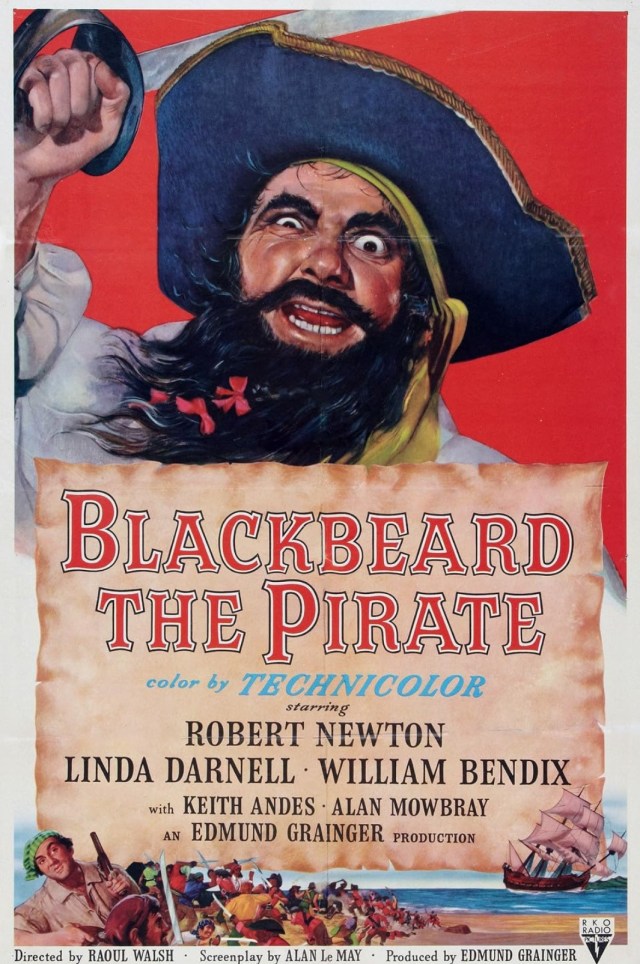
Blackbeard, the Pirate poster created by RKO Radio Pictures

Things I liked about the film:

The acting: Since Linda Darnell is one of the reasons why I reviewed Blackbeard, the Pirate, I’ll talk about her performance first. Linda was cast as the lead female protagonist, portraying a character named Edwina. Throughout the film, she consistently carried her character with confidence that radiated off the screen! Edwina was also a head-strong character, going toe-to-toe with characters like Blackbeard and sharing banter with them. Speaking of Blackbeard, Robert Newton shined in this role! What made his portrayal work was how animated and energetic it was. That consistent energy made Blackbeard interesting to watch! Linda shared a lot of scenes with Keith Andes, who portrayed Robert Maynard. I liked his performance for two reasons. The first reason is how calm Robert appeared while under pressure, a protagonist who didn’t let his feelings get the better of him. The second reason is how Keith’s on-screen chemistry with Linda was nice!

Clever dialogue: There were some moments in Blackbeard, the Pirate where I found the dialogue cleverly written! A great example is when Edwina meets Blackbeard for the first time. During this introductory encounter, Blackbeard asks Edwina what her name is. She then says Blackbeard’s name, in disbelief because she’s standing in his presence. Blackbeard replies by telling Edwina she can’t have the name ‘Blackbeard’, as that is his name. That scene was not only funny, it was also an interesting glimpse into Blackbeard’s perspective!

Historical accuracy: Most pirate films take place prior to the 19th century. This means the historical accuracy of the project can make or break that story. In the case of Blackbeard, the Pirate, it looked like the creative team cared about the presentation of their film! There are many ways historical accuracy can be featured in a movie. One way is through the cast’s wardrobe. While trying to escape from Blackbeard, Edwina asks Robert to untie her dress. This is so she can navigate around the ship in less layers. This scene reveals how Edwina was wearing a corset, an article of clothing that was common in the 17th century. Edwina’s outfit alone showed how much research was done to make this project look and feel historically accurate!

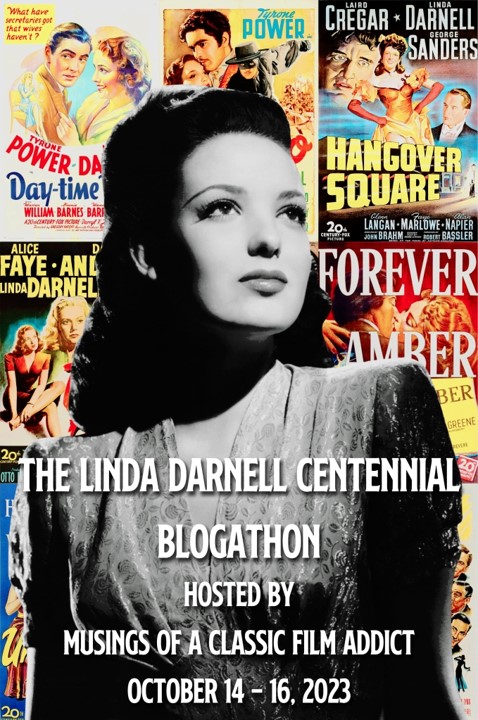
The Linda Darnell Centennial Blogathon poster created by Samantha from Musings of a Classic Film Addict

What I didn’t like about the film:

A misleading synopsis: According to a synopsis I read, Blackbeard, the Pirate is about Sir Henry Morgan’s attempt to capture Blackbeard and stop his pirating ways. This synopsis turns out to be a lie, as Henry doesn’t appear until fifty-seven minutes into this hour and thirty-eight-minute movie. Even while Henry is involved in the story, he isn’t given much to do. It made me wonder why Henry was included in the film in the first place?

An unclear story: Like any genre, there are several types of stories that can be told in a pirate film. But in Blackbeard, the Pirate, the movie’s creative team tried to tell several types of stories in one production. These include a quest for treasure, a “cat and mouse” chase between Henry and Blackbeard, and the hero rescuing the female protagonist from the villain. The creative team’s attempt to incorporate different types of stories prevented their movie from developing its own identity. The story itself isn’t clearly defined because of this creative choice.

A meandering protagonist: I’ve stated before how some Hallmark movies will center around a protagonist who says they’re going to do something, but spends most of the movie not doing the thing they said they were going to do. This isn’t just an issue in Hallmark films, as that was also an issue in Blackbeard, the Pirate. Through a voiceover toward the beginning of the movie, Robert claims he wants to bring Henry to the authorities, as he wants to receive the reward money. Unfortunately, Robert doesn’t make any attempts to capture Henry. In fact, he does everything but make Henry face accountability for his past actions. This meandering subplot is the result of the creative team trying to tell too many types of stories at once.

Ship steering wheel pattern image created by Jemastock at freepik.com. <a href=”https://www.freepik.com/free-photos-vectors/background”>Background vector created by jemastock – http://www.freepik.com</a>. Image found at freepik.com.

My overall impression:

I mentioned in my review’s introduction how I don’t talk about pirate films often. So, it’s disappointing when one of these movies turn out less than stellar. Blackbeard, the Pirate was, sadly, underwhelming. This was due to the weak screenwriting. Too many story ideas were incorporated into one script, preventing the film from adopting its own identity. That creative decision also caused the protagonist to not reach his goal. However, there were aspects of the movie I liked, such as the acting and the historical accuracy. But, in my opinion, the cast deserved better material. I’d like to check out more films from Linda’s filmography. Hopefully, I’ll find a movie better than Blackbeard, the Pirate.

Overall score: 5.3 out of 10

Have you seen Blackbeard, the Pirate? Are there any pirate films you like to watch? Let me know in the comment section!

Have fun at the movies!

Sally Silvrescreen

Take 3: In Name Only Review

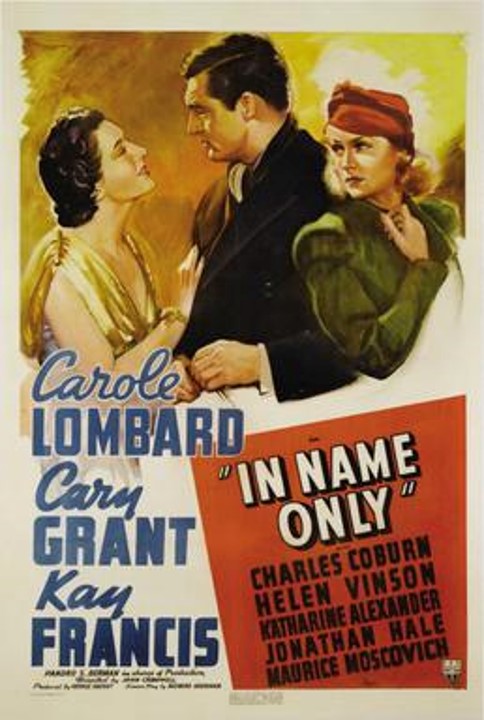
One of the reasons why I love participating in blogathons is because it gives me the opportunity to watch films I might have never seen otherwise. In Name Only is a fantastic example! Before signing up for The Carole Lombard Memorial Blogathon, I had no idea that this film existed. After searching Carole’s filmography on IMDB and discovering the ability to rent the movie, I felt that In Name Only was a good choice for this review. Even though I had heard of Carole Lombard before, I had never seen any of her films. My participation in this particular blogathon gave me the opportunity to finally check out her acting work! Another surprise I discovered was that the film is based on a book! The source material for the project is Memory of Love by Bessie Breuer. Similar to my discovery of the film, I was not aware of this book’s existence before I watched the movie. Maybe in the future, I’ll check this story out! But, for now, let’s check out this review of In Name Only!

In Name Only poster
In Name Only poster created by RKO Radio Pictures. Image found at en.wikipedia.org/wiki/File:In_Name_Only.jpg

Things I liked about the film:

The acting: Like I said in the introduction, this is the first film from Carole’s filmography I’ve ever seen. Despite this, I was impressed with her performance in this film! Her portrayal of Julie Eden showcased an on-screen personality that appeared down-to-earth. Whenever her character was frustrated by the divorce process, her performance became heart-breaking. Carole’s sad demeanor created the opportunity for audience members to sympathize with Julie. Prior to watching In Name Only, the only film from Cary Grant’s filmography I’d seen was The Philadelphia Story. Because that movie was a romantic-comedy, it gave me the chance to see Cary take on a more dramatic role in this picture. Throughout the story, Cary’s character, Alec Walker, embodied the serious and charming nature of a gentlemen. For more sad and heart-breaking moments, his performance was very captivating to watch. A great example is when Alec is staying at the hospital. Since his health is deteriorating, his mental health is also affected. This is portrayed very well by Cary, as he adopts a distant stare and disjointed speech pattern that reflect his character’s state.


The on-screen chemistry: I enjoyed watching the on-screen performances of Carole Lombard and Cary Grant! One reason is their on-screen chemistry. Every time they appeared in a scene together, there was always a sense of genuine sweetness between them. This allowed their characters to appear like they truly loved one another. It also makes viewers want to see this on-screen couple resolve their issues. For me, the quality of Carole and Cary’s on-screen chemistry helped me stay invested in their characters and their relationship!


How the topic of divorce was handled: In my review of Marriage on the Rocks, I talked about how the movie’s view on divorce made me feel uncomfortable. This was because of the one-sided perspective the movie presented. When it comes to In Name Only, the topic of divorce was handled with maturity and reverence to all the parties involved in the film’s story. While there was an antagonist, this creative choice was meant to show the audience that divorce can sometimes become messy and complicated. Unlike Marriage on the Rocks, In Name Only treats divorce as a realistic yet difficult situation. I’ve never read the book this movie is based on. However, I’m hoping the book handled the subject of divorce as well as the film did.

20191230_135329[1]
When I saw this postcard, I knew it had to make an appearance in this review! Screenshot taken by me, Sally Silverscreen.
What I didn’t like about the film:

A drawn-out conflict: I understand the divorce process can be very time-consuming. But within the context of the film’s story, this conflict was drawn-out for the majority of the run-time. It got to the point where I could see audience members becoming just as frustrated as the protagonists were. Now, I’m not sure if this shared frustration was intentional on the screenwriter’s or author’s part. However, I do know that because of this creative choice, it didn’t leave a lot of room for a pay-off.


Under-utilized characters: As I was watching this film, I came across some under-utilized characters. Maida’s friend, Suzanne, is just one example. The actress who portrayed this character, Helen Vinson, did a really good job with the role she was given. But her character wasn’t able to do much in the story. This caused Helen to have very little material to work with.


Run-time that was a little too long: IMDB says that In Name Only is an hour and thirty-four minutes. However, I feel some minutes could have been shaved off. Had this movie’s run-time been an hour and fifteen or twenty minutes, certain events in the movie could have happened sooner. It also could have gotten rid of scenes that felt like time-wasters. One of these scenes, to give you an example, was when Maida was talking to her in-laws during a car-ride.

Carole Lombard Blogathon banner
The Carole Lombard Memorial Blogathon banner created by Crystal from In The Good Old Days Of Classic Hollywood and Vincent from Carole & Co. Image found at https://crystalkalyana.wordpress.com/2019/09/25/announcing-the-carole-lombard-memorial-blogathon/

My overall impression:

Even though In Name Only is the first film of Carole Lombard’s I have seen, it is a film that I did like! There are aspects of the movie that could have made the overall project stronger. However, its merits overshadow them. The biggest highlight is how the story handles the subject of divorce. Throughout the story, I could sense the creative team knew exactly what they were doing. The screenwriting provided a sense of realism to the narrative, giving the characters thoughts and feelings that might emerge from a situation like this. The divorce itself was also taken very seriously. If you’re interested in watching a film about this topic, please pick In Name Only over something like Marriage on the Rocks. As I’ve said before, I feel that starting or ending a romantic relationship is not something that should be taken lightly. In Name Only not only recognizes that, but highlights that through the interactions of the characters.


Overall score: 7.4 out of 10


Have you ever seen Carole Lombard’s movies? If so, which one is your favorite? Share your thoughts in the comment section!


Have fun at the movies!

Sally Silverscreen
Take 3: The Sky’s the Limit Review + 135 Follower Thank You

Thank you to all of my followers that helped 18 Cinema Lane reach this milestone! If it weren’t for you, this blog would have never reached 135 followers in only one year! So, like before, it’s time for another blog follower dedication review! This time, I’m going to talk about a film that was released in September of 1943. The Sky’s the Limit is the only film from this time period that I was able to rent, so that’s the film that I have chosen. I have a confession to make: up until this point, I have never seen a movie where Fred Astaire made an on-screen appearance. I am familiar with who Fred is as a performer, so it’s hard to believe that this is the first of his films that I’ve seen. Choosing this film seems fitting for this particular review.

The Sky's the Limit poster
The Sky’s the Limit poster created by RKO Radio Pictures. Image found at https://www.imdb.com/title/tt0036363/?ref_=nv_sr_1?ref_=nv_sr_1.

Things I liked about the film:

The acting: Like I mentioned in the introduction, this was the first film of Fred Astaire’s that I’ve seen. Despite this, I was very impressed with his performance! His presentation was very natural and believable, helping him bring a certain amount of charm to his character. Before watching The Sky’s the Limit, I had no idea that Fred could sing. His singing and dancing talents added uniqueness to his on-screen presence. Another performance that I was impressed by was Joan Leslie’s! Joan made her character well-rounded because of the various emotions and behaviors she adopted. I was also pleasantly surprised by her singing and dancing abilities! By incorporating those elements to her role, it made her performance that much more enjoyable!


The on-screen chemistry: Not only did Fred and Joan deliver good performances individually, they also presented good performances as an on-screen pair! Throughout the film, their characters appeared to truly like each other. Moments where Fred and Joan spent time together represent the sweeter parts of the movie. While the relationship of the characters gradually developed, this aspect was portrayed in a way that felt believable. The fact that Fred and Joan’s acting talents were similar worked in their favor. It made their performances complement one another!


The dance numbers: Whenever Fred Astaire is cast in a movie, it’s almost guaranteed that there will be, at least, one dance number. In The Sky’s the Limit, Fred performed one dance solo and two dance duets with Joan Leslie. These performances were very well choreographed, appearing flawless and captivating. All of those hours of practice seemed to pay off. Fred and Joan also looked like they having fun during their performances! When a dancer looks like they’re enjoying what they’re doing, it helps the enjoyment factor of the dance number!

Six designs of military airplane
Military plane image created by Brgfx at freepik.com. <a href=”https://www.freepik.com/free-photos-vectors/background”>Background vector created by brgfx – http://www.freepik.com</a>. Image found at freepik.com.

What I didn’t like about the film:

The plot: You’re probably thinking, “If you didn’t like the plot, then why did you watch this movie?” The plot itself wasn’t bad, but it was too straight-forward for my liking. Before watching The Sky’s the Limit, I assumed that the protagonist would face one hilarious situation after another in order to resolve the conflict. However, no efforts were made to find a solution to the conflict. There were very few humorous moments in the film as well. This story took itself more seriously than I think it should have. It seemed to forget that “comedy” was a part of its identity.


The limited amount of dance numbers: When I found out that Fred Astaire would be starring in the film and that it was classified as a “musical”, I was expecting the movie to be filled with singing and dancing. In this hour and thirty-minute picture, there were only three dance numbers, with the first one appearing about forty minutes into the film. When a movie’s creative team hires an actor with more than one talent, they should help that actor use their talents to the fullest extent. This is especially true when the movie is labeled as a “musical”. If this doesn’t happen, it makes the actor appear under-utilized.


No consequences: As I said in the introduction, The Sky’s the Limit was released in 1943. This means that the film premiered during the Breen Code era. But when Fred Astaire’s character never faced any consequences for his actions and choices, I was shocked that the people behind the Breen Code would find this part of the story to be acceptable. One example is when Fred’s character is upset over a break-up. This causes him to destroy a restaurant’s bar by breaking drinking glasses and throwing a bar stool at the mirrored background. All that happens is Fred paying for his drink and acting as if nothing out of the ordinary had happened. Because he never owned up to his mistakes, I found it difficult to root for his character.

Dancing Pairs 2 Retro Cartoon Templates
Couple performing the waltz image created by Macrovector at freepik.com. <a href=”https://www.freepik.com/free-photos-vectors/background”>Background vector created by macrovector – http://www.freepik.com</a>. Image found at freepik.com.

My overall impression:

I can’t believe that I hadn’t seen any of Fred Astaire’s movies until now! That’s a great thing about this blog, as it gives me an excuse to introduce myself to films that I might not have seen otherwise. Now that I’ve shared what I liked and didn’t like about the movie, I can now tell you my honest opinion about it. Personally, I found the film to be just ok. It’s definitely not one of the worst films I’ve seen this year. But, it’s not one of the best films I’ve seen this year either, as it hasn’t aged as well as other projects from that decade. Despite this, I’m still glad I gave this movie a chance! Something that I have said before was how you never know if a film will be good or bad unless you watch it. This is certainly the case for my experience seeing The Sky’s the Limit. Once again, thank you to all of my followers! If it weren’t for you, this review wouldn’t exist.


Overall score: 6.1 out of 10


What are your thoughts on my review? Are you looking forward to my next movie review? Please tell me in the comment section!


Have fun at the movies!

Sally Silverscreen