Take 3: Days of Heaven Review

Have you ever stumbled upon a film that was “new to you” and think, “I’ve never even heard of this”? That was my experience discovering the 1978 movie, Days of Heaven. Prior to the Legends of Western Cinema Week Blogathon, I had never heard anyone talk about the aforementioned Western. With the blogathon fast approaching, Days of Heaven crossed my path at the right time! This is my fourth year participating in the Legends of Western Cinema Week. Looking back on the programs I reviewed for the event, I realized the stories fell into one of two categories: cowboys seeking justice or some aspect of farming. While Days of Heaven belongs in the latter category, the primary perspective focuses on the actual farming. This is different from a movie like O Pioneers!, where the story’s priority was the relationships between the characters. How does Days of Heaven rank among the films I reviewed for the Legends of Western Cinema Week? Before traveling on those “happy trails”, let’s read my review!
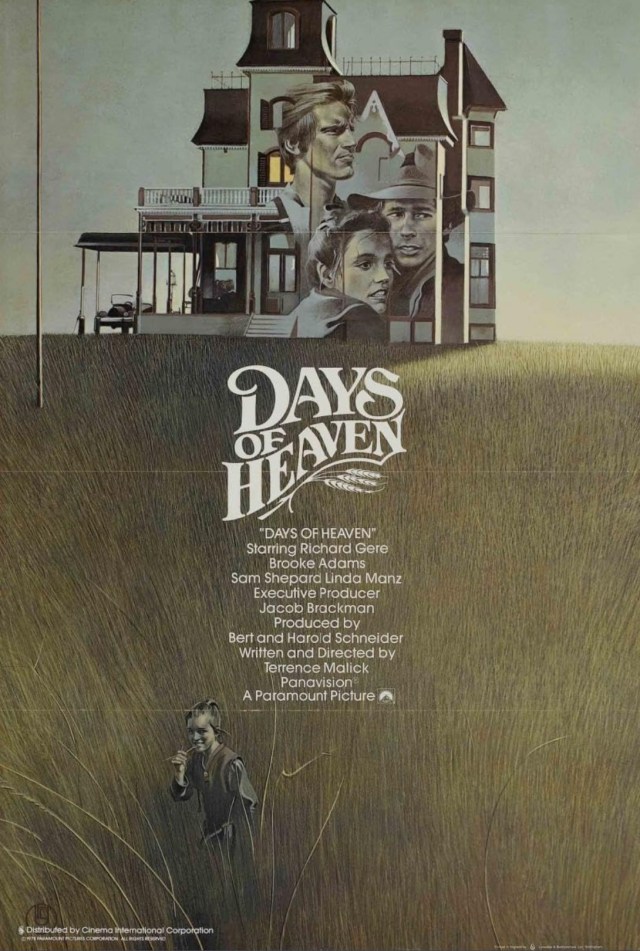
Days of Heaven poster created by Paramount Pictures

Things I liked about the film:

The scenery: The majority of Days of Heaven takes place in the wheat fields of Texas. Despite how monotonous that type of location may sound, the wheat fields offered up many glimpses of natural beauty! My favorite shot in the movie was when a storm cloud approached the story’s wheat fields. Large, gray clouds dominated the sky, appearing larger than life on screen. The presence of these clouds provided a small window into the blue sky above the fields. The golden yellow of the wheat was a pop of bright hue against the sky’s blue and gray palette. This shot was so beautifully captured, it, honestly, looked like a painting!

The historical accuracy: Days of Heaven is set in the 1910s. Like any historical period film, it’s important for the story to feel immersive due to its historical accuracy. Based on what the movie presented, the creative team behind Days of Heaven paid attention to how historically accurate their project looked! The finer details visually prove that point! In a scene where the story’s protagonists, Bill, Abby, and Linda, go swimming, their swimsuits are reflective of the clothing styles of the early 1900s. While Bill wore what would be described as a short-sleeved unitard, Linda and Abby wore swimming dresses, complete with stockings. When it came to transportation, the trains and tractors appeared to be coal powered. Even their exterior designs looked industrial, considered antique be the standards of today. The historical accuracy paired with the aforementioned scenery made Days of Heaven an appealing film to look at!

Richard Gere and Brooke Adams’ on-screen chemistry: As I mentioned in my previous point about the movie’s historical accuracy, Bill and Abby are two of the protagonists in Days of Heaven. Portrayed by Richard Gere and Brooke Adams, these characters are in a romantic relationship. When Abby and Bill are together in a romantic context, the on-screen chemistry between Brooke and Richard was sweet. It felt like the on-screen couple truly got along with one another. During their interactions, there was a gentleness shared and understood between them. Whether walking in the water or cuddling on top of a train, Abby and Bill’s relationship was pleasant to watch because of Brooke and Richard’s acting abilities. Without spoiling Days of Heaven, I will say Bill and Abby’s relationship was not consistent throughout the story. This is a shame, as I liked seeing these characters together.
Legends of Western Cinema Week 2023 banner created by Olivia from Meanwhile, in Rivendell, Heidi from Along the Brandywine, and Hamlette from Hamlette’s Soliloquy

What I didn’t like about the film:

An unclear motive: According to the film’s synopsis, Bill, his younger sister, Linda, and his girlfriend, Abby, plan to con a farmer out of his money and wheat fields. Throughout the movie, however, their motive for conning The Farmer (what Sam Shepard’s character is referred to) is not made clear. I understand Bill, Abby, and Linda don’t like working under someone’s thumb. But the man who they try to con doesn’t seem to deserve a comeuppance. In fact, The Farmer, more often than not, is respectful toward Abby, even going so far as to allow Bill and Linda to live in his house, in order to keep Abby’s “family” together. In a series of voice-overs, Linda claims The Farmer is dying of an unnamed illness. Later in the film, though, she states how The Farmer’s health is staying the same, neither improving or regressing. Yet again, it is never made clear if The Farmer’s health issues are the reason for the con. I wonder why I was supposed to care about Bill, Linda, and Abby’s conning scheme when I don’t even know why The Farmer was being conned in the first place?

A drawn-out story: Days of Heaven has a run-time of about an hour and thirty minutes. Yet the story itself was drawn-out longer than necessary. This issue was caused by establishing shots littered throughout the movie, which served as the production’s padding. I know establishing shots are meant to set up a given scene. But if the creative team of Days of Heaven had cut some of the film’s establishing shots, the run-time would have been trimmed down to about an hour and ten to twenty minutes.

Distance from characters: Through a combination of acting talent, screenwriting, and direction, a movie’s audience can not only be introduced to a character, they can also get to know that character as the story progresses. In Days of Heaven, however, it feels like the characters are kept at a distance from the audience. Sure, the characters share pieces of information about themselves. But this information only allows the audience to become familiar with them. Because of the aforementioned distance, the audience is prevented from connecting with the characters. That disconnection also prevents emotional investment in the story.

Image by Freepik

My overall impression:

The first movie I reviewed for a blogathon this year was Black Narcissus. In my review of the 1947 movie, I said that while Black Narcissus was a competently made film, it was one of the most confusing movies I’d ever seen, due to the story providing little to no explanations. I feel similarly about Days of Heaven. The film itself is very photogenic, from the scenery to the presentation of the story’s historical accuracy. But the story was confusing. No motive for why Bill, Abby, and Linda are conning The Farmer is made clear in the script. Emphasis on style over substance affected any connection the audience could have had with the characters. Throughout the movie, several questions arose that weren’t really answered, such as how The Farmer knew a group of circus performers who came to visit his home. This added to the story’s confusion. As a film, I thought it was just ok. But as a Western, it provides a perspective that is different from the typical cowboy or cattle farmer.

Overall score: 6 out of 10

Have you seen Days of Heaven? Which Westerns would you like to see me review? Tell me in the comment section!

Have fun in Texas!

Sally Silverscreen

Take 3: Red Corner Review

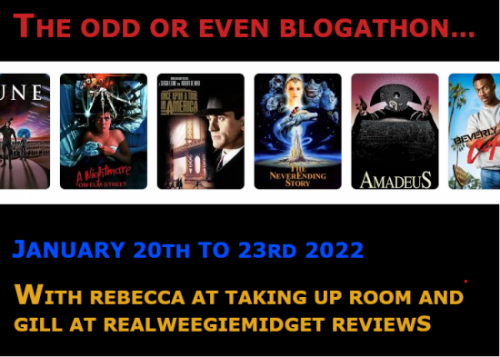
The theme of Gill’s, from Realweegiemidget Reviews, and Rebecca’s, from Taking Up Room, blogathon is one of the most creative! In The Odd Or Even Blogathon, a participant had to pick two movies; one released in a year ending in an odd number and one released in a year ending in an even number. The moderators then chose a movie for the participant out of those two options. One of my two options was the 1997 movie, Red Corner, which is the film I’m reviewing for the event. This isn’t the first time I’ve mentioned Red Corner. Last October, I reviewed the Touched by An Angel episode, ‘The Spirit of Liberty Moon’, in honor of Bai Ling’s birthday. While talking about that episode’s story, I mentioned how the episode was very reminiscent of the film due to topics discussed within the script. After watching ‘The Spirit of Liberty Moon’, I wondered how similar it was to Red Corner. Similar to the Touched by An Angel episode, curiosity got the best of me, which led to this review.

Red Corner poster created by Metro-Goldwyn-Mayer and Avnet/Kerner Productions

Things I liked about the film:

The acting: The cast of Red Corner was strong! But because the majority of the story revolves around Bai Ling’s and Richard Gere’s characters, I’ll focus on their performances in this review. The profession of a lawyer is typically presented in entertainment media as being serious. Therefore, when an actor or actress is cast as a lawyer, there aren’t many opportunities for them to be expressive in that role. Despite this, Bai found a way to bring expressive emotion to her portrayal of Shen Yuelin! Even when this emotion was displayed in a simple fashion, such as Shen looking at another character in a certain way, it was more than enough to prevent this character from becoming dull or forgettable. In my review of the Touched by An Angel episode, ‘The Spirit of Liberty Moon’, I talked about Bai’s strong sense of emotionality. While talking about this strength, I said it allowed Bai’s performance to contain depth. Once again, she uses her sense of emotionality to her advantage in Red Corner! But this time, Bai uses it to bring humanity to her character, allowing the audience to see Shen as more than just a lawyer. One example shows Shen and Jack visiting the nightclub where Jack first met the murder victim. During this scene, Jack recalls some of the events that led up to the crime. When he brings up something funny said by the murder victim, Shen giggles at the English translation of the murder victim’s comment.

Prior to watching and reviewing Red Corner, I had seen two of Richard Gere’s films; Pretty Woman and Hachi: A Dog’s Tale. What makes Richard’s role in Red Corner different from those in the two aforementioned films is how his character, Jack Moore, faced higher stakes. This gave me, as a viewer, an opportunity to see Richard work with different material. In Red Corner, he was very expressive in the lead role. Richard used a variety of emotions to show how a person in Jack’s situation might feel. While trying to obtain phone records, Shen explains to Jack how these records are unavailable. This causes Jack to feel frustrated. As his conversation with Shen continues, Jack becomes more agitated over the powerlessness of their situation. Tension grows between both characters because of the agitation.

The mystery: A large portion of Red Corner focuses on finding the truth behind a murder. This mystery is drawn out throughout the story, letting the audience see it unfold as the film goes on. While reflecting on this movie, I came to an interesting realization. When it comes to seeing “amateur” detectives in entertainment media, lawyers solving mysteries are not as common. Sure, there are series like Matlock, Perry Mason, and Darrow & Darrow. But these are the only lawyer led mystery stories I can think of off the top of my head. Having Shen play an integral role in Red Corner’s mystery was a good creative choice! This is one of the reasons why I enjoyed seeing the film’s mystery play out! The way Shen gathered clues and made discoveries was interesting to watch. Her professional interactions with Jack added to my enjoyment of the mystery. I was intrigued from start to finish, curious to see what happens!

The mise-en-scène: Good mise-en-scène seamlessly blends into a movie and effortlessly weaves within the story. Great mise-en-scène elevates a given scene to help it stand out for all the right reasons! When it comes to this part of Red Corner, I will talk about two scenes. The first one takes place at a fashion show, where Jack and a Chinese businessman named Dan attend. During the show, Jack and Dan are having a conversation, which is captured in a medium shot. When Dan is speaking to Jack, he is covered in a red light. Jack is also covered in this red light, but a faint blue light is shining on his head as well. Without spoiling the movie, I will say this was a good visual to foreshadow what is about to come. The second scene takes place at the prison. Jack and a group of soldiers are walking up a concrete staircase. This short journey is shown in a long to medium shot. The scene uses a limited amount of lighting, which sets a tense and suspenseful tone. Similar to the first scene I described, all of the elements in the second scene come together to indicate what is about to happen.

The Odd Or Even Blogathon banner created by Gill, from Realweegiemidget Reviews, and Rebecca, from Taking Up Room

What I didn’t like about the film:

Some held-back punches: As I said in my introduction, I saw the Touched by An Angel episode, ‘The Spirit of Liberty Moon’ If you read my review for that episode, you’d know I described it as being “emotionally intense” due to the nature of the story and the subject matter involved. Because Red Corner shares similar topics with the Touched by An Angel episode, I was expecting the film to be more emotionally intense, especially since it has an R rating. The brutality of the Chinese jail system and the strictness of the Chinese government are shown in this movie. However, the brutality I expected to frequently see was shown in glimpses. Meanwhile, the strictness was either confined to Jack’s court case or mentioned in passing. I understand there’s only so much you can include in an R rated film. But it seems like more emphasis was placed on figuring out “whodunit”.

Some characters talking over each other: Because Chinese is spoken by several characters, English translations are provided either through on-screen text or an official translator within the court and jail system. More often than not, I was able to understand what these characters were saying. But there were times when I had difficulty doing so. This is because some characters talked over one another. One good example is when Jack is first taken to jail. At the prison, a general is explaining to Jack, in Chinese, why he was arrested. An attending soldier provides necessary English translations to Jack and the audience. However, the soldier spoke at the same time as the general. I had to rewind the movie in order to catch what the soldier had said.

Some things left unexplained: Like I said earlier in my review, I liked seeing how the mystery in Red Corner played out! For the most part, I was able to follow along with the events happening on screen. But there were a few times where I wish explanations were given. During the murder investigation, Shen acquires a crucial piece of evidence that could impact Jack’s trial. But along the way, this piece goes missing. When Jack’s final trial arrives, Shen presents the aforementioned piece of evidence. This left me confused as to how she re-obtained it. While this is heavily implied, it isn’t thoroughly explained. As a viewer, I appreciate how the mystery’s information wasn’t spoon-fed. However, I think some of the connections within the mystery could have been stronger.

Courtroom image created by Macrovector at freepik.com. <a href=”https://www.freepik.com/free-photos-vectors/isometric”>Isometric vector created by macrovector – http://www.freepik.com</a>. Image found at freepik.com.

My overall impression:

Before watching Red Corner, I had come across a few reviews about the film. In those reviews, the general consensus was how the movie was predictable. While I respectfully disagree with this statement, I will say Red Corner left me wanting a little bit more. I was expecting the 1997 film to be ‘The Spirit of Liberty Moon’ times ten. As I said in this review, I thought Red Corner was going to be more brutal and emotionally intense. There was emotion to be found in this movie, with some brutality along the way. But I didn’t have the same reaction after watching this film like I did with the Touched by An Angel episode. Maybe I shouldn’t have set my expectations on the higher side. Just because two projects happen to share similar subjects and ideas doesn’t mean they will be executed in similar fashions. What I can say about Red Corner is it is an interesting and insightful picture that has something important to say. It is also somewhat educational, especially when it comes to international relations and law. If you are interested in seeing this movie, I’d recommend watching it as a companion piece to The Spirit of Liberty Moon. But if I were you, I would watch Red Corner first.

Overall score: 7.1 out of 10

Have you seen Red Corner? If so, what are your thoughts on the film? Please let me know in the comment section!

Have fun at the movies!

Sally Silverscreen

Take 3: Chicago Review

Hometowns to Hollywood’s Celluloid Road Trip Blogathon is about discussing films that revolve around a particular U.S. city. For my entry, I’ve chosen the 2002 film, Chicago. This movie has been on my DVR for three years, the longest a film has ever sat on the device. In fact, Chicago has spent the most time on my DVR, staying there since May of 2017. So, this was the perfect opportunity to finally see it! Even though it was my first time seeing the movie, it was a title I had heard of before. Whenever cinematic musicals of the 21st century are discussed, Chicago is usually brought up in the conversation. However, I never made time to check the film out. Now, in 2020, I am ready to review Chicago!

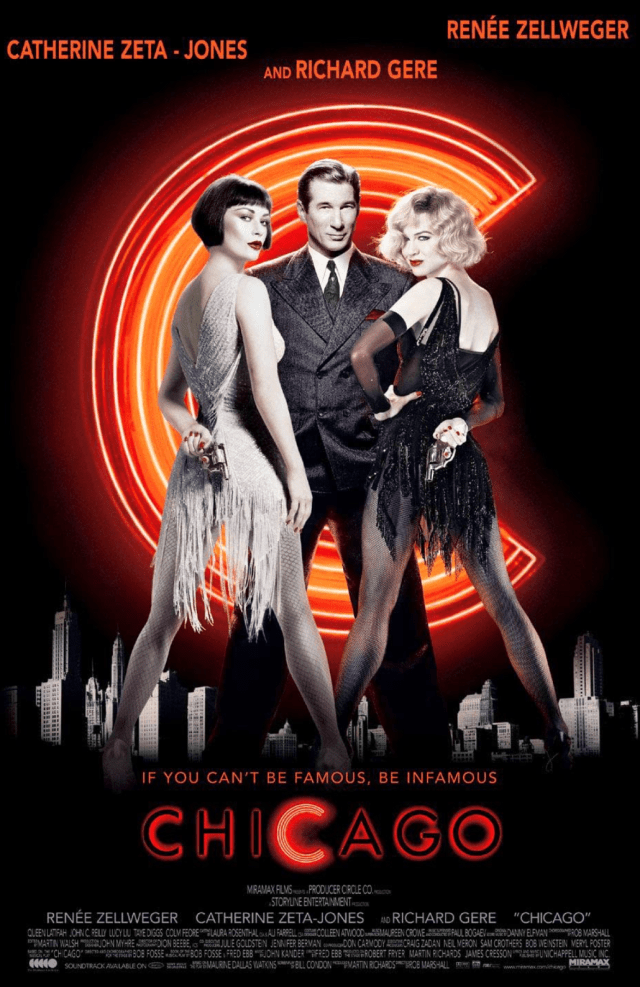
Chicago poster created by Miramax Films Producer Circle Co., Zadan/Meron Production, and Buena Vista Pictures.

Things I liked about the film:

The acting: Chicago is an ensemble film. Therefore, multiple actors pulled off a performance that was enjoyable to watch! Whenever I think about Queen Latifah’s portrayal of Matron “Mama” Morton, I think about how she carried her character with confidence! Even in the musical number, “When You’re Good to Mama”, she appeared comfortable performing in front of an audience. Through the use of music and theatrics, Queen Latifah was able to garner attention from the audience and create an effective on-screen presence! I have seen some of Richard Gere’s films prior to watching Chicago. However, most of those projects have leaned more toward the drama genre. His role, Billy Flynn, allowed him to step out of his comfort zone. Similar to what I said about Queen Latifah’s performance, Richard looked comfortable in his role! He even did a good job when it came to the musical numbers!  What I liked about Renée Zellweger and Catherine Zeta-Jones’ performances is how their on-screen personalities were so different from one another, yet complemented each other so well! It created such an interesting dynamic between these characters. Like I said about Richard Gere, Renée and Catherine did a good job pulling off the musical performances, as well as the portrayals of their characters!

The musical numbers: If you’re going to create a musical, you need to create musical numbers that are worth watching. When it comes to Chicago, the musical numbers were the highlight of this project! They are all presented as dream sequences, to show how Roxie views her world. I found this is to be an interesting creative choice, as most musicals include their musical numbers within the events of the plot. Chicago’s musical numbers were stylized, serving as visual spectacles. Bright colors and lights provide a consistent component, adding to their photogenic appeal. I also liked the creativity that could be found in these musical numbers. An example is “We Both Reached for the Gun”, where all the characters except for Billy are showcased as a puppet.

The historical accuracy: When I was watching Chicago, I noticed how the entire production appeared historically accurate! This film takes place in 1924, which is reflected in various ways. One of them is the hairstyles of the female characters. Both Roxie and Velma sport shorter hair-dos, showing women’s style choices of that time. The costumes, in Roxie’s world and the dream sequences, seemed to belong in that decade. Longer coats were worn by some of the female characters, with a millionaire named Kitty wearing a white one with embroidered flowers in a scene. Set designs and even vehicles showcased the historical accuracy I found in this film! It tells the audience that the creative team behind the project cared about their film’s presentation.

<a href="http://<a href='https://www.freepik.com/vectors/travel'>Travel vector created by pikisuperstar – http://www.freepik.com</a>&quot; data-type="URL" data-id="<a href='https://www.freepik.com/vectors/travel'>Travel vector created by pikisuperstar – http://www.freepik.comChicago neon sign image created by Pikisuperstar at freepik.com.

What I didn’t like about the film:

Too much burlesque: While there are plenty of musical numbers in Chicago, the majority of them featured burlesque. Personally, I am not a fan of this particular performance style. Therefore, I didn’t care for burlesque’s abundance. Aside from my personal opinion, the number of burlesque routines felt like they were rehashing the same idea. There was only so many times the movie could present a scantily clad dancer performing mature dance moves before the concept got old. Chicago is a film that, in my opinion, would have benefitted from having less burlesque.

Mixed messages: As I’ve said before, I watch movies to be entertained. However, I can appreciate a film that contains a good message. In Chicago’s case, there were mixed messages throughout the story. One good example revolves around Roxie’s quest for stardom. On more than one occasion, other women have gained more attention than her. This led me to believe the movie’s overarching message would be about how there will always be someone who has more than you no matter how much you strive for what you want. I won’t spoil the film for those who haven’t seen it. But what I will say is the film’s final outcome contradicts the message that seemed to be delivered.

Characters that are terrible people: When I reviewed Twentieth Century last month, I talked about how all the characters were awful individuals. This caused me to lose investment in them and their stories. Chicago has a similar flaw, with most of the characters being terrible people for different reasons. Toward the beginning of the film, Roxie is shown murdering a man, even though he was walking away when the crime was committed. The song, “Funny Honey”, highlights how Roxie is glad her husband, Amos, comes across as ignorant because she thinks that will help her cover up her crime. Out of all the characters in this film, the only one I cared about was Roxie’s husband, Amos. While he was a simple man, he was the only character who was a genuinely good person. I couldn’t help feeling sorry for him during the musical number, “Mister Cellophane”.

The Celluloid Road Trip Blogathon created by Annette from Hometowns to Hollywood.

My overall impression:

The way I feel about Chicago is the same way I feel about Moulin Rouge!: it was ok. The 2002 movie does have merit, which can be found in the acting performances and the musical numbers. But, similar to Moulin Rouge!, Chicago relies more on style than substance. Because the audience knows the protagonist committed a crime, there is no sense of intrigue. It also doesn’t help that the majority of the characters are terrible people. The mixed messages within the story are confusing, with the script saying one thing, but then being contradicted later on. If you’re not a fan of burlesque, then you probably won’t enjoy most of the film’s musical numbers, as they abundantly feature burlesque routines. However, the musical numbers in general were well-crafted, especially on a technical level. Therefore, I would recommend these parts of the film. As for the movie itself, this is one I don’t see myself revisiting.

Overall score: 6 out of 10

Have you checked out the other entries from the Celluloid Road Trip Blogathon? If so, which city that was addressed do you think is interesting? Share your thoughts in the comment section!

Have fun at the movies!

Sally Silverscreen