Take 3: Easter Parade Review

With today being Easter, I’m reviewing the 1948 musical, Easter Parade! But this is not the only reason why I’m writing about this movie. Since the protagonists would be considered a “mismatched couple”, the film was eligible for Realweegiemidget Reviews’ and Cinematic Catharsis’ Mismatched Couples Blogathon. Easter Parade was also recommended by Michaela from Love Letters to Old Hollywood. Prior to this year, the only Easter themed movie I wrote about was the Hallmark production, Easter Under Wraps. While I have reviewed faith-based films, those pictures were not about the Easter holiday. Because this was my first time watching Easter Parade, I was curious how Easter would play a role in this story. I was also curious how the film would compare to other musicals from the Breen Code era. So, without delay, let’s begin this review of Easter Parade!
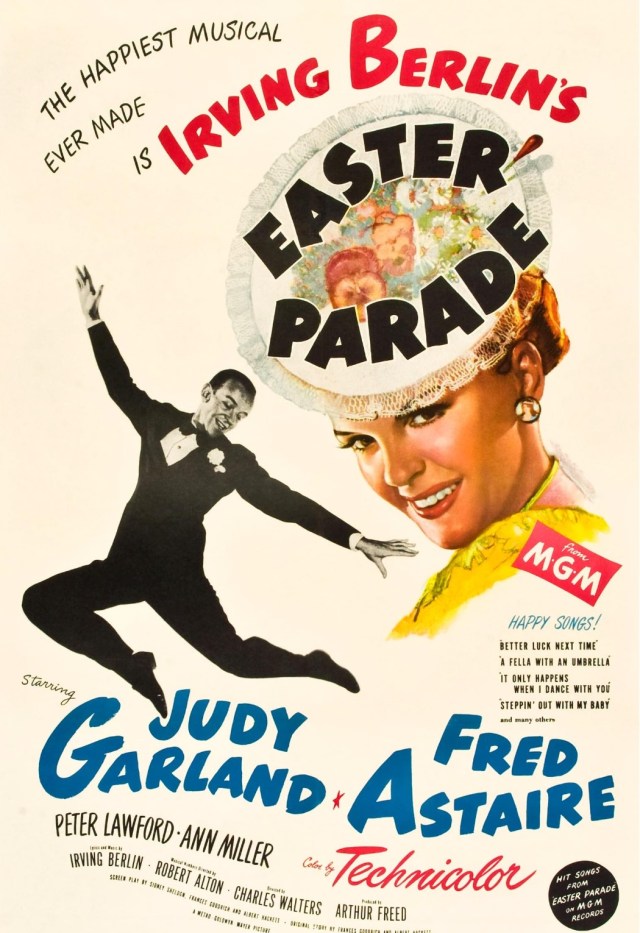
Easter Parade poster created by Metro-Goldwyn-Mayer and Loew’s, Inc.

Things I liked about the film:

The acting: Fred Astaire portrays Don Hewes in Easter Parade, a veteran dancer who is looking for a new dance partner. In this same movie, Judy Garland portrays Hannah Brown, a singer who is trying to make a name for herself in the entertainment industry. Together, Judy and Fred are an on-screen pair that not only works well together, but also dances well together! One of my favorite scenes is when Don mentions to Hannah how she doesn’t capture men’s attention. In an effort to prove Don wrong, Hannah walks in front of him, at first looking discouraged by her fruitless efforts. A few minutes later, Don sees men are taking notice of Hannah. He looks confused and even baffled at how Hannah could prove him wrong. When Don catches up with Hannah, he discovers she is making funny faces, explaining why men were noticing Hannah. This scene was hilarious because of Fred’s and Judy’s expressions and interactions!

Even though Judy and Fred worked well together, I think Judy and Peter Lawford had strong on-screen chemistry! Despite Hannah being from a small-town farm and Johnny being from the city, their interactions make it seem like they have a deep understanding for one another. While on a dinner date, Hannah confesses she dreams her true love will give her flowers and sweep her off her feet. When she reflects on her time with Don, she realizes Don only gives her flowers and sweeps her off her feet when it relates to dancing. During this reflection, Hannah looks defeated and sad by how she didn’t receive what she wanted the way she wanted it. Meanwhile, Johnny looks genuinely sympathetic toward Hannah. As I watched this scene, I wanted Johnny and Hannah to fall in love with each other!

The use of color: In Easter Parade’s opening credits, Technicolor was revealed to be incorporated into the production. I’m thankful Technicolor was used in this movie because capturing scenes in black-and-white would not have done this picture justice! Because parts of Easter Parade’s story take place around Easter, creative decisions such as costume designs and décor are very colorful. Toward the end of the film, Fred and a large group of dancers perform a number to “Steppin Out with My Baby”. Every performer’s costume boasted bright hues, from one dancer’s yellow shoes to another dancer’s blue gloves. At the beginning of the movie, during the musical number, “Happy Easter”, flowers in vibrant shades are present as Don makes his trip to the store. Though it’s a small detail, these flowers play a role in complimenting the colorful landscape of the story’s spring season!

The musical numbers: Musical numbers can make or break a given film. But in Easter Parade, the musical numbers are a major strength because of the choreography and delivery of the numbers themselves. One of the most creative numbers I’ve ever seen was Fred’s solo, “Drum Crazy”. This solo shows his character, Don, tap dancing and playing drums in an attempt to trick a child into giving him a stuffed bunny toy. The combination of dancing and instrument playing provides a captivating performance that not only highlights Fred’s signature talent, but also pairs dancing with other artistic mediums. Another strong solo was Ann Miller’s solo, “Shakin’ the Blues Away”. While portraying Don’s former dance partner, Nadine, Ann’s solo was a tap number that involved a lot of turning. What makes this musical number so memorable is how the cinematography closely follows Ann during her performance. This focus forces the audience to give their undivided attention to Ann and her number. The number itself is fast-paced and energetic, with Ann consistently delivering the choreography in precise and fluid movements!

Cute Easter image created by Freepik at freepik.com. <a href=”https://www.freepik.com/free-photos-vectors/background”>Background vector created by freepik – http://www.freepik.com</a>. Image found at freepik.com.

What I didn’t like about the film:

A premise-driven story: When I reviewed The National Tree last year, I explained the difference between a premise-driven story and a plot-driven story. After watching Easter Parade, I can confirm the movie has a premise-driven story. The premise of Don transforming Hannah into a star entices viewers to watch Fred and Judy acting and dancing together. But the film doesn’t really make the audience ask “and then what happened”? Even though the story is simpler and easier to follow, the story itself lacked a compelling hook, making it feel less intriguing. I wish the characters were given a conflict to resolve, similar to musicals like Singin’ in the Rain and Anchors Aweigh.

The “insta-love” trope: The romantic-comedy genre carries a collection of tropes and cliches. One of them is the “insta-love” trope, which features characters falling in love in a very short period of time. I understand there’s only so much story you can tell in an hour and forty-three minutes. But I thought Hannah and Don’s relationship progressed too quickly. I even thought the attraction between Hannah and Johnny happened too fast. The fast pace of these relationships made it seem like situations weren’t really resolved. Serious conversations and heart-felt discussions were either conveniently ignored or never brought up. The “insta-love” trope also affected how characters changed over the course of the story. Progressions in character development took place so quickly, it almost seemed too convenient.

Easter’s limited inclusion: With a movie called Easter Parade, I expected Easter to play a significant role in the story. While Easter is included enough to get the point across, I was disappointed by how limited its presence was. There were even scenes I could picture taking place within other holidays. Though the purpose of “Drum Crazy” was for Don to purchase a stuffed bunny toy, I found myself imagining this same musical number set during Christmas. Easter Parade is a story that could take place in almost any time of year and it wouldn’t make much difference.

The Mismatched Couples Blogathon banner created by Gill from Realweegiemidget Reviews and Barry from Cinematic Catharsis

My overall impression:

Some of the best, most iconic musicals were released during the Breen Code era. Their strong musical numbers and their overall timelessness have captured the hearts of viewers for decades. Easter Parade is one of these timeless musicals, showcasing its strengths through various creative departments! The colorful palette sprinkled throughout the story perfectly compliments the springtime atmosphere the film’s creative team was striving to present. Every musical number was well choreographed and performed, which definitely made the movie worth watching. Compared to other Breen Code era musicals, though, Easter Parade’s story was weaker. This flaw was due to the story being more premise-driven. Despite this and its other weaknesses, the 1948 film is an entertaining, mostly joyful production that is an appropriate selection for the Easter holiday!

Overall score: 7.6 out of 10

Have you seen Easter Parade? Is there an Easter themed movie you like to watch? Let me know in the comment section!

Have fun on Easter!

Sally Silverscreen
Take 3: The Picture of Dorian Gray (1945) Review

Whenever I think of Dorian Gray as a character, Stuart Townsend’s portrayal in The League of Extraordinary Gentlemen comes to mind. While I’ve never seen that film, I did watch a video review of it years ago. However, I know that, sometimes, no singular portrayal of a given character is the “end all, be all” when it comes to story-telling. This is one of the reasons why I chose to review the 1945 adaptation of The Picture of Dorian Gray. The other reason is Peter Lawford’s involvement in the project. Once again, I am participating in the Peter Lawford Blogathon, hosted by Kristen from Hoofers and Honeys of the Classic Movie Era/KN Winiarski Writes. Last year, I wrote about 1960’s Ocean’s Eleven. At the time, I was not familiar with Peter’s filmography. Now that I have seen at least one of his movies, I had a starting point for which film to choose next! Before Dorian’s portrait transforms on us, let’s get this review started!

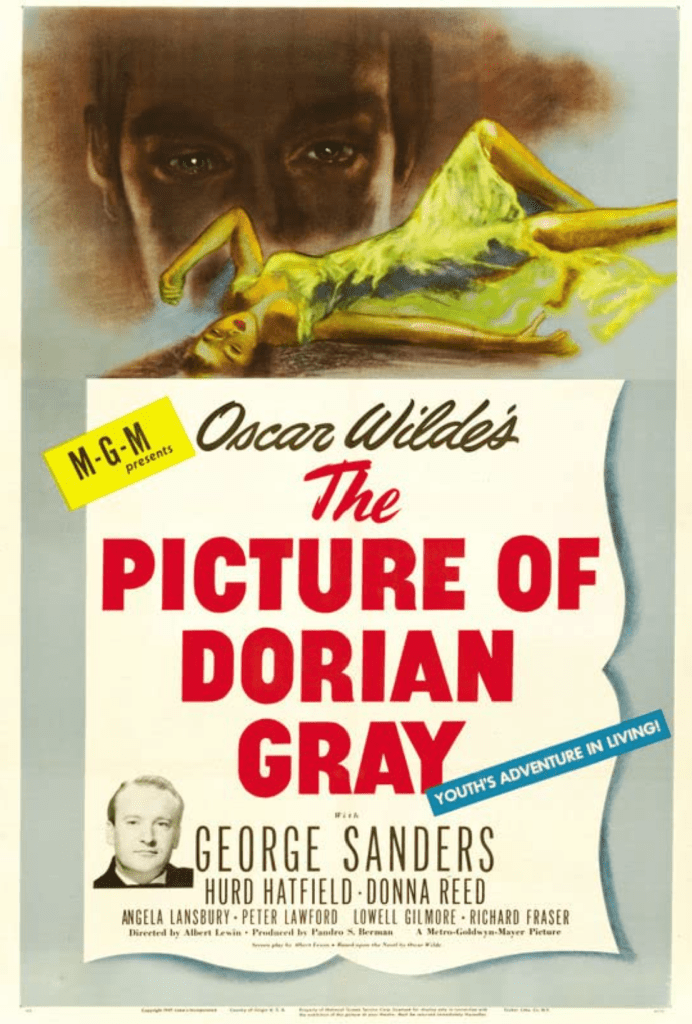
The Picture of Dorian Gray (1945) poster created by Metro-Goldwyn-Mayer and Loew’s Inc.

Things I liked about the film:

The acting: I haven’t seen many of Peter Lawford’s films. But based on 1960’s Ocean’s Eleven and 1945’s The Picture of Dorian Gray, it seems like he can be found in movies with larger ensembles. When it comes to the 1945 title, I was disappointed by this, as I was hoping to see more of his performance. Nevertheless, Peter did do a good job with the material he was given! Portraying David Stone, a man interested in courting Gladys Hallward, he resembled the youth Dorian himself desperately sought after. Despite appearing in a handful of scenes, David’s concern of Gladys felt genuine. You can hear it in the inflection of Peter’s voice and the expressions on his face. In a way, these things made David seem like a “voice of reason”.

During the film’s opening credits, I was surprised to discover Angela Lansbury also starred in The Picture of Dorian Gray. But similar to Peter Lawford, she also appeared in a handful of scenes. Despite this, I enjoyed seeing her portrayal of Sibyl Vane! Within this film, she sang a song called “The Little Yellow Bird”. It was nice to hear a musical performance from Angela, as I feel her singing abilities are underrated. When it came to her acting performance, Angela carried her character with a youthfulness I haven’t noticed in her other roles I’ve seen. Her expressions were more subtle, but worked for her character. Another actor who had subtle expressions was Hurd Hatfield. I’m not familiar with his acting work. But based on his portrayal of the titular character, he carried himself with a sense of professionalism. Hurd did, however, have very expressive eyes. At one point during the story, Dorian makes a mistake. When he realizes what he did, his eyes grow wide with alarm. Meanwhile, Hurd still shows a composure that he partly gave to Dorian, which maintains consistency.

The lessons and morals: Since this film premiered in 1945, that means it had to follow the Breen Code guidelines. The Picture of Dorian Gray certainly obeys those guidelines, but it also serves up some good lessons and morals. Toward the beginning of the story, Lord Henry tells Dorian how lucky he is to be young and attractive. He also tells Dorian to not squander his youth. These pieces of conversation can be used as lessons to appreciate the things you have and to not take anything for granted. Certain events in Dorian’s life highlight these lessons well. Another idea that is addressed in this script is actions speaking louder than words. This can be seen throughout Dorian’s relationship with Sibyl. While I won’t spoil what happens, I will say something comes up that relates to the aforementioned idea.

The cinematography: A surprising element in The Picture of Dorian Gray was the cinematography. This is because of how creative and well filmed it was! My favorite use of cinematography was when Sibyl visits Dorian’s house. As Dorian is playing the piano, Sibyl enters his study. But before she walks through the doorway, you can only see Sibyl’s shadow. Even when she does appear in the doorway, Sibyl’s face isn’t shown until she reaches Dorian’s piano. That was a good way of building anticipation for Sibyl’s appearance. A filming technique that appeared in several moments of the film was framing a scene as if the camera was following a character or hiding from them. A great example is when Dorian was placing a letter in his fireplace. The camera is positioned inside the fireplace while he is burning the letter. It provides the illusion of the audience watching from the outside looking in.

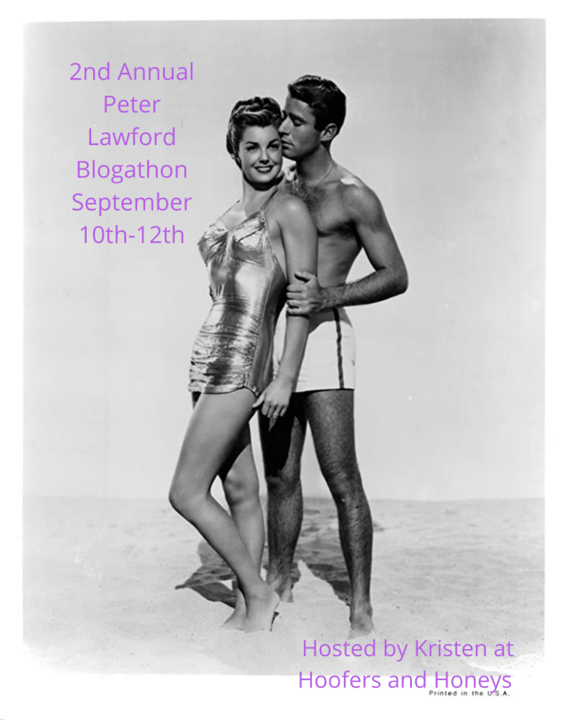
The 2nd Annual Peter Lawford Blogathon banner created by Kristen from Hoofers and Honeys of the Classic Movie Era/KN Winiarski Writes

What I didn’t like about the film:

Limited use of Technicolor: In the movie’s opening credits, it was mentioned that Technicolor was used in the movie. This made me excited to see how Technicolor would be utilized in the story. While I wasn’t expecting as much Technicolor as in The Wizard of Oz, I was hoping it would be consistently featured throughout the film. Unfortunately, that is not the case for The Picture of Dorian Gray. The Technicolor was applied to Dorian’s painting. But it was only used three times during the whole movie. I think if Dorian’s painting had been consistently presented in Technicolor, it would have highlighted the importance of the painting within the story.

The painting is kind of an afterthought: For those who don’t know, a MacGuffin can be an object that progresses a story forward. In the case of The Picture of Dorian Gray, Dorian’s painting is that story’s MacGuffin. However, its presence wasn’t as significant as I expected. In the script, the state of Dorian’s relationships is given more focus than the painting. In fact, the painting is sometimes not shown on-screen. This made the painting itself kind of seem like an afterthought.

Dorian’s confusing choices: There were times when Dorian made choices that left me confused. One of these choices took place during his relationship with Sibyl. Throughout that relationship, Dorian appears to truly love her. He even seriously considers marrying Sibyl. But, out of the blue, Dorian changes his mind. Even the build-up toward that moment was confusing, making it difficult to interpret what happened. I realize all of that connects with the lessons I mentioned earlier. However, Dorian’s sudden change in attitude and choices was, to me, confusing.

Paint palette image created by Freepik at freepik.com <a href=’https://www.freepik.com/free-vector/hand-drawn-artsy-tools_836777.htm’>Designed by Freepik</a> <a href=”https://www.freepik.com/free-photos-vectors/hand”>Hand vector created by Freepik</a> Image found at freepik.com

My overall impression:

There are movies that have fallen short of my expectations. Not all of these films have been bad. However, I was left desiring more from them. The Picture of Dorian Gray has now become one of those movies. Before watching this adaptation, I was familiar with the premise of this story. But that premise led me to believe the film would be more profound and thought-provoking than it was. The script did provide good lessons and morals. But I’m not left contemplating any deeper meaning on any particular theme. I was also disappointed by Peter Lawford’s limited appearance in the movie. Peter’s involvement in the project is one of the reasons why I chose to review it in the first place. Even though I liked his portrayal of David, I was expecting to see him receive a larger spotlight than in Ocean’s Eleven. If the Peter Lawford Blogathon returns for a third year, I’ll try to find a film where Peter was a leading actor.

Overall score: 7.2 out of 10

Have you seen any adaptation of The Picture of Dorian Gray? Would you like for me to read the book? Please let me know in the comment section!

Have fun at the movies!

Sally Silverscreen

Take 3: Ocean’s Eleven (1960) Review

Peter Lawford is an actor I was not familiar with prior to my participation in the 1st Annual Peter Lawford Blogathon. But, like I’ve said in past blogathons, I didn’t let this stop me to joining Kristen’s event! As I was looking through Peter’s filmography on IMDB, I discovered he had starred in the original Ocean’s Eleven. This is the movie I chose to review for the blogathon because of how rarely heist films are talked about on 18 Cinema Lane. Two years ago, I wrote a review for Logan Lucky when I participated in my very first blogathon. Anyone who has read that article would know how I did not like that film. Another point I’d like to make is how Frank Sinatra, Dean Martin, and Cesar Romero (who all appear in Ocean’s Eleven) starred in another movie I reviewed for a blogathon; Marriage on the Rocks. Like Logan Lucky, I was not a fan of the 1965 movie. With my review of Ocean’s Eleven, however, I’m hoping my luck will start to turn around!

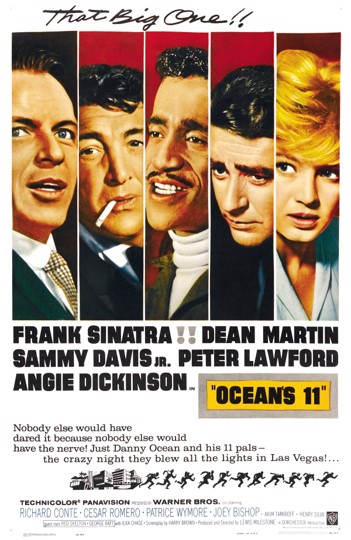
Ocean’s Eleven (1960) poster created by Warner Bros. Image found at http://www.tcm.com/tcmdb/title/18360/Ocean-s-Eleven/#tcmarcp-196918.

Things I liked about the films:

The acting: As I said in the introduction, I have seen and reviewed Marriage on the Rocks. Three of the film’s stars, Frank Sinatra, Dean Martin, and Cesar Romero, reunite in Ocean’s Eleven! The 1960 picture allowed Dean and Cesar to work with acting material that was different from Marriage on the Rocks, with their performances appearing more dramatic. Meanwhile, Frank’s portrayal of Danny Ocean contained the same ease he displayed in the aforementioned 1965 movie. Ocean’s Eleven also introduced me to talent that I had never seen before, such as Peter Lawford and Sammy Davis Jr. What I liked about Peter’s performance was how he was able to adapt to any situation placed in his character’s path. Even though this was the first time I’ve ever seen Sammy act, I was impressed with the smooth confidence he consistently carried throughout the story! One thing that stood out to me was the on-screen chemistry among the cast! Every actor appeared to work well with each other and compliment their co-stars.

The differentiation among the casinos: In a movie showcasing five casinos, it’s important to differentiate these locations for the audience. This choice avoids confusion and prevents the casinos from blending in with each other. The various New Year’s Eve parties feature creative ways these facilities were able to set themselves apart! At the party in the Flamingo casino, pink balloons served as party decorations. Down the street at the Sands casino, blue balloons could be seen. The costumes of the on-stage performers also highlighted the differences between each location. Dancers wearing burnt orange and white checkered costumes were found at the Desert Inn. Meanwhile, black costumes were worn by dancers at the Sands.

The dialogue: For the most part, the dialogue in Ocean’s Eleven was smartly written and sounded clever! One example takes place during a conversation between Danny’s ex-wife and Sam Harmon. When she is talking about her relationship with her ex-husband, Sam responds by saying how Cloud 9 must have been boring. Another example of smart writing happens when Josh Howard to talking with one of the members of Danny’s group. In their conversation, they talk about bravery. Josh shares that being brave doesn’t make someone invincible. These two examples I shared show how there was effort placed in the script.

The 1st Annual Peter Lawford Blogathon banner created by Kristen from KN Winiarski Writes. Image found at https://knwiniarski.com/peter-lawford-blogathon/.

What I didn’t like about the film:

A dialogue heavy first half: Every heist movie sets aside time to lay out the plans for the heist. While the first half of Ocean’s Eleven does feature these plans, it also included explanations of why the members of Danny’s group wanted to pull off the heist. The first half of the story featured explanations of the characters’ personal issues as well. This caused the movie’s entire first half to be dialogue heavy. If some of these explanations had been shortened or cut, it would have presented the heist sooner.

A “bait and switch” third act: With a movie titled Ocean’s Eleven, the audience expects a good portion of the story to focus on the heist itself. While the planning and execution of the heist was shown, the story transitions its focus to Duke Santos and his investigation after the heist takes place. This creative choice made the third act seem like a “bait and switch”. It also caused this part of the story to drag a little bit, preventing the film from ending earlier than it did.

Too many characters: Despite the film containing an all-star cast, I felt there were too many characters in this story. There were times when I had difficulty keeping track of who was who. The large number of cast members also caused some actors to receive less screen time than others, with Red Skelton being one of them. When I saw his name on a casino marquee, I was given the impression he would perform a comedy sketch on the casino’s stage. However, Red was briefly featured in one scene where he was seen arguing with a casino employee. I wondered why this film’s creative team would recruit such a well-known star for such a small part, especially when Red Skelton’s claim to fame, comedy, wasn’t utilized?

Money image created by Freepik at freepik.com. <a href=’https://www.freepik.com/free-vector/bills-and-coins-in-isometric-design_1065328.htm’>Designed by Freepik</a>. <a href=”https://www.freepik.com/free-photos-vectors/business”>Business vector created by Freepik</a>. Image found at freepik.com.

My overall impression:

Ocean’s Eleven is the first film of Peter Lawford’s I have ever seen. But I have not seen the “Ocean” movies from the 21st century, so I cannot make a comparison. Despite all this, I found the 1960 movie to be a fine first impression! Unlike Logan Lucky, Ocean’s Eleven showcased a heist that was interesting, exciting, and even suspenseful. Clever dialogue and creative set design at each casino were worth seeing and listening. Even the acting was solid, not just from Peter, but from the cast as a whole! However, there are factors that held Ocean’s Eleven back from being a stronger film. While I liked the dialogue, I found the movie’s first half very dialogue heavy. There were also too many characters and the third act felt like a “bait and switch”. But I still thought it was better than Logan Lucky and Marriage on the Rocks. If Kristen brings this blogathon back next year, it’ll be interesting to see what I choose!

Overall score: 7.2 out of 10

Have you seen any of the “Ocean” movies? Which film of Peter Lawford’s would you want to check out? Please share your thoughts in the comment section!

Have fun at the movies!

Sally Silverscreen