Take 3: Dr. Terror’s House of Horrors (1965) Review

I’d like to thank Gill (from Realweegiemidget Reviews) and Barry (from Cinematic Catharsis). If it wasn’t for the hosts of The Hammer-Amicus Blogathon V, I wouldn’t have been introduced to the cinematic world of Hammer-Amicus. Since my introduction in 2021 (when I participated in my first Hammer-Amicus Blogathon), I’ve covered three Hammer-Amicus movies on 18 Cinema Lane; Vampire Circus, The Curse of Frankenstein, and Let Me In. While Vampire Circus was ok and Let Me In was just fine, I found The Curse of Frankenstein underwhelming. Now, with a recommendation from Barry (from Cinematic Catharsis), I’ve selected 1965’s Dr. Terror’s House of Horrors as the next Hammer-Amicus presentation to review! I knew almost nothing about this movie prior to choosing it for the blogathon. But I was willing to watch the film with an open mind. Since I finally checked out Dr. Terror’s House of Horrors, it’s time to start my review and share my honest opinion!
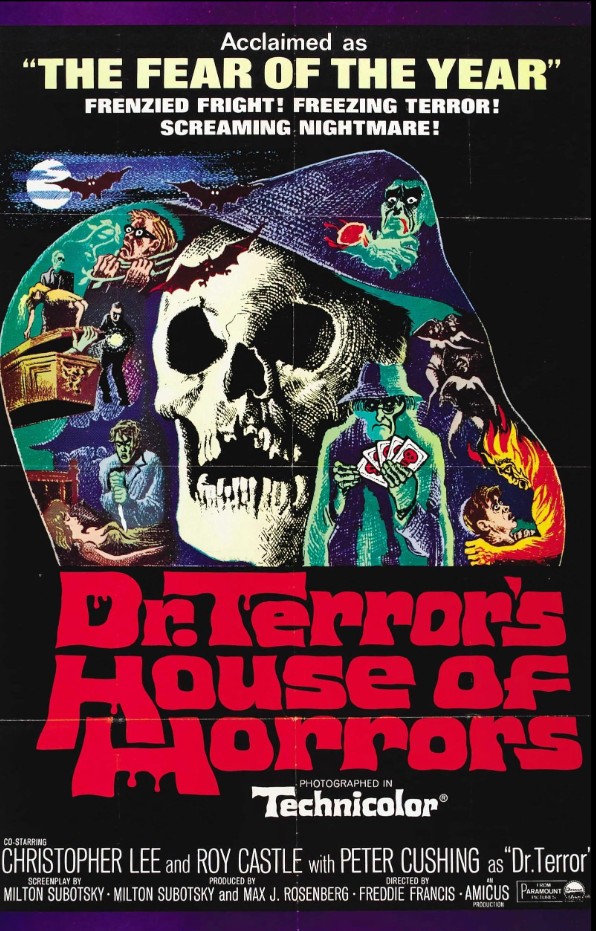
Dr. Terror’s House of Horrors (1965) poster created by Amicus Productions, Hollywood Classics International, Regal Films International, and Paramount Pictures

Things I liked about the film:

The interior design: Dr. Terror’s House of Horrors is presented like an anthology; five passengers learn their fate from Dr. Terror himself. Throughout the film, the audience takes a peek into each character’s life as well as their living/working space. These spaces featured interesting design choices that gave them their own distinctness. In the segments titled “Werewolf” and “Disembodied Hand”, a fireplace was the focal point in one room. The fireplace in “Werewolf” was covered in a glossy black paint, while the fireplace in “Disembodied Hand” shone in a glossy blue paint. Biff Bailey’s apartment in the segment titled “Voodoo” featured a zebra patterned couch, which actually complimented the black-and-white checkered floor and black-and-white striped walls. The design choices I described stood out due to the film’s creative team utilizing materials, patterns, and colors that were more unique. I can honestly say I’ve never seen a blue fireplace until I saw Dr. Terror’s House of Horrors!

Incorporation of music: In the segment titled “Werewolf”, Jim Dawson learns about a legendary werewolf buried in the basement of the home he’s remodeling. Any time this werewolf is brought up or poses a threat to the characters living and working in the home, drumbeats, the pattering of a xylophone, and other suspenseful musical sounds can be heard. This segment utilized music to emphasis the fear factor the werewolf contributed to the story. Because Biff Bailey is a musician, music plays a large role in the “Voodoo” segment. One of the songs featured in this specific segment is ‘Give Me Love’. Performed by Sammy Coin (portrayed by Kenny Lynch), the instrumentals provided a cheery jazz tune that can put any listener in a good mood. Kenny’s smooth vocals not only complimented the song itself, but also made me wonder what his vocals would sound like in a song with a more serious tone. ‘Give Me Love’ is one of those songs that is so memorable, I’ll listen to it long after the end of the movie!

The creativity of each story: As I mentioned earlier in this review, Dr. Terror’s House of Horrors is presented like an anthology. With the segments chronicling each of the five passengers, the creativity woven into the script highlighted the uniqueness every passenger brought to the train car! The segment, “Disembodied Hand”, revolves around Franklyn Marsh. An art critic who took his job a little too seriously, Franklyn carries guilt for how he mistreated a popular artist, with his guilt represented by the disembodied hand of that artist. Meanwhile, in the segment titled “Vampire”, Dr. Bob Carroll is confronted with the possibility his wife may be a vampire. This concept gave Bob an internal conflict between loving his wife and protecting his patients. In my review of 2010’s Let Me In, I said vampire stories can be as creative as film-makers want it to be. A similar statement can be said about the horror genre, with Dr. Terror’s House of Horrors presenting strong evidence.
The Hammer-Amicus Blogathon V banner created by Gill from Realweegiemidget Reviews and Barry from Cinematic Catharsis

What I didn’t like about the film:

No clear explanation for tarot cards: Throughout Dr. Terror’s House of Horrors, Dr. Terror (portrayed by Peter Cushing), predicts each passenger’s fate by selecting tarot cards. While the tarot cards themselves are shown on screen, no clear explanation for how exactly the cards correlate with the fates was given. Before the start of the “Werewolf” segment, Dr. Terror selects two cards called “Enchantress” and “Priestess”. But after watching that segment, I was confused by what werewolves had to do with those aforementioned cards? It seemed as if the creative team behind the movie assumed their audience would already know the meaning of the cards shown in the film.

Limited sense of urgency: Each segment in Dr. Terror’s House of Horrors incorporates a horror element that poses a threat to the passengers in Dr. Terror’s train car. These segments also contain a limited sense of urgency. Most of the time, the “slice of life” parts of the story were emphasized. When a suspenseful or horrifying moment was about to happen, the segment would end and move on to the next one. This flaw was the result of squeezing five separate stories into an hour and thirty-eight-minute film. I honestly think this script would have worked better as an anthology television series.

A frustrating ending: For this part of my review, I will be spoiling Dr. Terror’s House of Horrors. If you have not seen this film and are planning on watching it, skip ahead to the part of my review titled “My overall impression”.

Like I mentioned earlier in my review, Dr. Terror uses tarot cards to predict the fates of the five passengers. After these fates are revealed, he removes the death card from the deck. This implies all the passengers will eventually die. When the passengers get off the train, they learn through a newspaper article five passengers died in a train crash. That detail clarifies the passengers from Dr. Terror’s train car did, indeed, die, with Dr. Terror himself becoming a skeleton. Personally, I found this ending frustrating because it made the previous stories amount to nothing. While I recognize the movie’s creative team was trying to create the ultimate plot twist, with the death tarot card used as foreshadowing, this creative decision almost made me feel like I wasted my time watching Dr. Terror’s House of Horrors.
Scared audience image created by Katemangostar at freepik.com. <a href=’https://www.freepik.com/free-photo/terrified-friends-watching-horror-movie-in-cinema_1027311.htm’>Designed by Freepik</a>. <a href=”https://www.freepik.com/free-photos-vectors/people”>People image created by Katemangostar – Freepik.com</a>. Image found at freepik.com.

My overall impression:

Whenever I review a movie on 18 Cinema Lane, I present my opinion as honestly as possible. In my most honest opinion, Dr. Terror’s House of Horrors was such a mixed bag. On the one hand, I appreciate the creativity woven into each of the five segments. This creativity brought distinctness to the stories, interesting interior design choices, and good incorporation of music. But, on the other hand, the ending was too frustrating for my liking. I wish the script provided clear explanations for how the tarot cards correlated with each character’s fate. I also wish there was a stronger sense of urgency throughout the film. At best, Dr. Terror’s House of Horrors was just ok. But, at worst, it left me confused and frustrated. Though I’ve only seen (and reviewed) a few Hammer-Amicus films, I’m starting to wonder if I’ll find a title that is my cup of tea?

Overall score: 6 out of 10

Have you seen Dr. Terror’s House of Horrors? Which Hammer-Amicus film would you like to check out? Please tell me in the comment section!

Have fun at the movies!

Sally Silverscreen
Take 3: The End of the Affair (1955) Review

When you have a show as iconic and successful as I Love Lucy, well-known guest stars are likely to pay the show a visit. On the aforementioned show itself, a collection of guest stars graced the screen, crossing paths with Lucy, Ricky, and their friends. One of those stars was Van Johnson, an actor I’m familiar with due to reviewing some of his films and his episodes of Murder, She Wrote. Since I haven’t written about any project from Van’s filmography since 2022, I found the I Love Lucy Blogathon as the perfect opportunity to check out another of his movies! A film of Van’s I’ve been meaning to review for years is the 1955 presentation, The End of the Affair. Recommended by Maddy from Maddy Loves Her Classic Films, I was intrigued by the mystery woven into the synopsis. Who is this third man Deborah Kerr’s character may be having a relationship with? The only way I was going to find an answer to that question is by watching The End of the Affair and sharing my honest opinion about it!

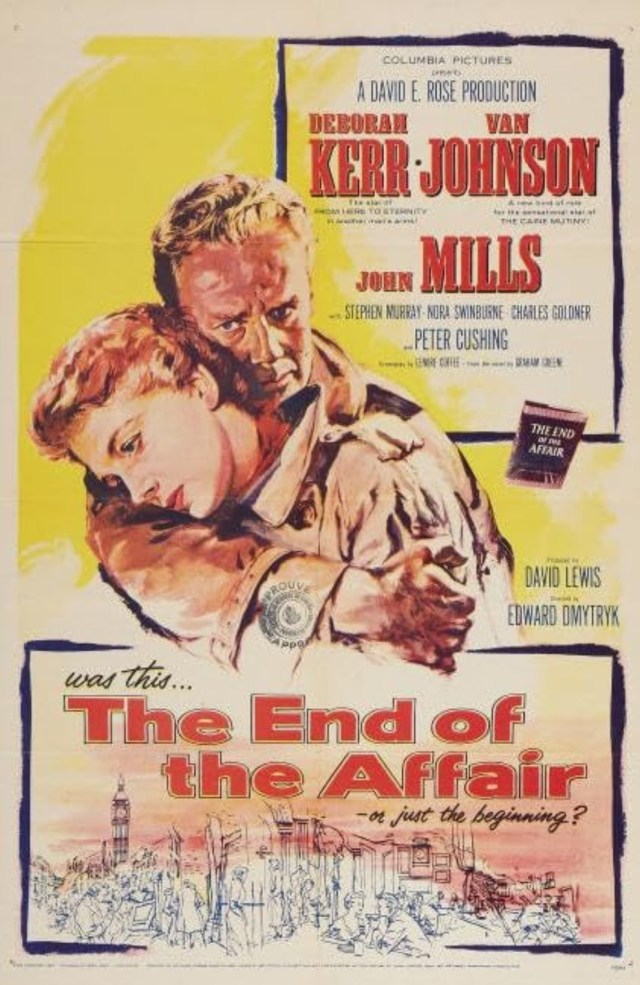
The End of the Affair (1955) poster created by Coronado Productions and Columbia Pictures

Things I liked about the film:

The acting: Like I mentioned in this review’s introduction, I have written about some of Van Johnson’s films as well as his episodes of Murder, She Wrote. What I’ve noticed from these projects is how Van has strong adaptability to his character’s experiences. This was also the case in The End of the Affair. While spending time with Deborah Kerr’s character, Sarah, Van’s character, Maurice, is all smiles and appears to be in a good mood. But when a neighbor named Mrs. Tomkins unexpectedly arrives to give Sarah some food, Maurice’s mood quickly changes. His eyes are downcast, not even looking at the neighbor. Maurice’s mouth displays a worried look as he frets over his secret relationship with Sarah being discovered. Even his tone of voice with Sarah is sharp, desperately trying to contain his feelings. This scene is just one example of Van’s versatility when it comes to his acting talents!

I was pleasantly surprised to discover Peter Cushing starred in The End of the Affair! Based on what I know about Peter’s career from his filmography, he either portrayed a character in a horror movie or he appeared for a limited period of time in a film. Comparing The End of the Affair with other projects of Peter’s I’ve seen, he was given a slightly larger role in the 1955 movie. My other observation is how his character, Henry, had a consistently friendly personality. Even when he suspects Sarah of having an affair, Henry’s demeanor is that of concern, with a worried look on his face. Speaking of Sarah, I want to discuss Deborah Kerr’s performance. In The End of the Affair, there were times when Deborah’s face said so much without the use of dialogue. A great example is when Sarah and Maurice reconnect after being apart for a year. During their walk together, fear shown through Sarah’s eyes. Her mouth was even tightly pursed, revealing little to no information to Maurice. In this scene, Sarah appears to keeping a secret, a secret she’s afraid might be discovered.

The mise-en-scène: Mise-en- scène is how a film’s scene is presented to the audience. One example from The End of the Affair is how mirrors were sometimes used as a form of foreshadowing. Toward the beginning of the film, Maurice spots Sarah hugging another man. She and the man can be seen through a near-by mirror. Because the creative team emphasized this interaction, Maurice’s suspicions of Sarah are hinted at. Later in the movie, when Sarah disappears from Maurice’s life, he calls her home, hoping she’ll pick up the phone. But every time Sarah is unavailable, the camera consistently shows a close-up of Maurice’s face, emphasizing his building frustration. This built-up frustration makes Maurice’s suspicions of Sarah grow even more. Because of how well mise-en-scène was utilized by the film’s creative team, the story was able to maintain a certain degree of intrigue.

The character of Albert Parkis: In movies like The End of the Affair, where serious topics are brought up, the detective character will usually carry a persona that matches the tone of the film. But in the 1955 movie, Albert Parkis provided a bright light to a darker story. Portrayed by John Mills, Albert was the private investigator hired by Maurice to solve the mystery of Sarah’s whereabouts. Any time he appeared on screen, Albert had such a cheerful, friendly personality. He sometimes brought his son along on investigations, in order to teach him how to solve mysteries. Albert’s interactions with Maurice were so lively, they were a joy to watch unfold. I wish Albert Parkis was given a larger role in The End of the Affair, as his involvement in the story was limited.

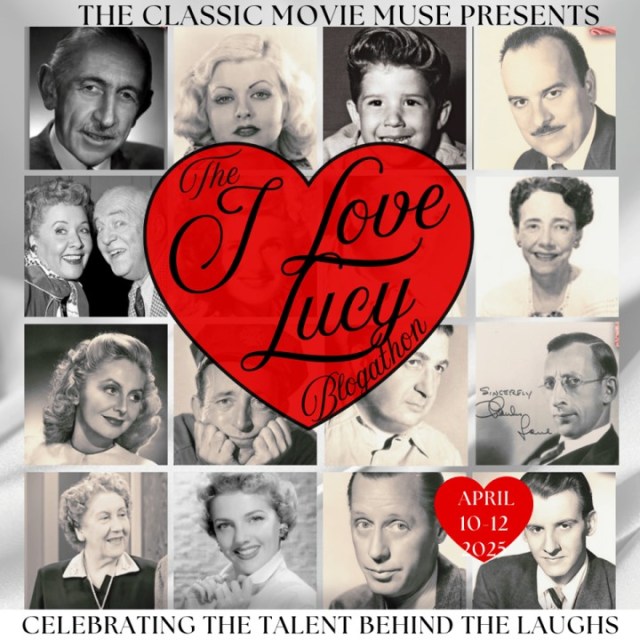
The I Love Lucy Blogathon banner created by Ari from The Classic Movie Muse

What I didn’t like about the film:

The “insta-love” trope: As I said earlier in this review, Maurice and Sarah share a secret romantic relationship. Their affair provides the basis for the film’s overarching conflict. But it was difficult for me to determine Van and Deborah’s on-screen chemistry. This flaw was due to the movie’s creative team choosing to adopt the “insta-love” trope. The beginning of the film shows Maurice being introduced to Sarah. In this introduction, Maurice hopes Sarah will provide insight to a book he’s writing. Several minutes later, they are starting to form their relationship. Sarah and Maurice even share a kiss within the first fifteen minutes of the story. With their relationship moving so quickly, I didn’t find myself as emotionally invested in Maurice and Sarah’s story as I could have been.

The underutilization of John Mills: When I talked about Albert Parkis, I said I wish he was given a larger role in The End of the Affair, as his involvement in the story was limited. This means the acting talents of John Mills were underutilized. On the film’s poster, you will see John Mills’ name listed as one of the top three billed actors in the production. However, this poster is somewhat misleading, as Peter Cushing receives more screen-time than John. After reviewing The Chalk Garden, I was looking forward to seeing another movie from John’s filmography. I was even curious about how John’s character’s story connected to Deborah’s character’s story. While I found out how these stories connected, I was disappointed by John’s limited involvement in the project.

A randomly produced reveal: The major conflict of The End of the Affair is figuring out the identity of the third man Sarah may be having a relationship with. I will not spoil this movie, in case any of my readers haven’t seen it yet. But what I will say is the mystery’s reveal was randomly produced. When Sarah’s secret is discovered, the answers are given toward the end of the story. Since there is no build-up leading into the reveal, the reveal itself almost feels like a major tonal shift. To prevent this flaw, information or clues related to the reveal should have been sprinkled throughout the movie. That way, the transition between the mystery and its reveal could have been smoother.

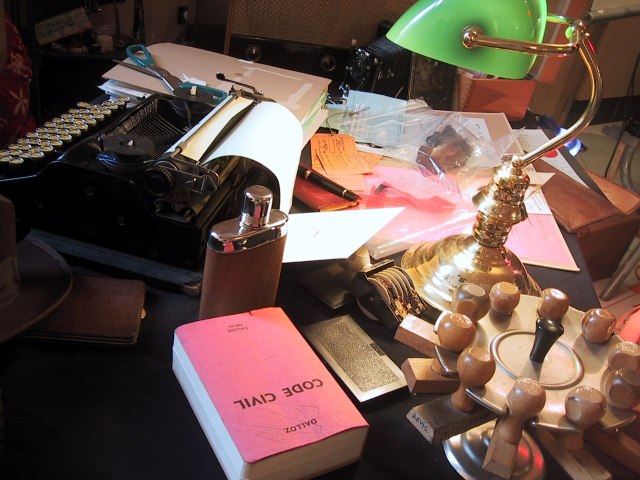
Vintage detective desk photo created by Olivier Bourgeois at freeimages.com. Photo by <a href=”/photographer/ornicar69-54520″>Olivier Bourgeois</a> from <a href=”https://freeimages.com/”>FreeImages</a&gt; Image found at freeimages.com.

My overall impression:

Van Johnson is one of the reasons why I selected The End of the Affair, as he was a guest star on I Love Lucy. When it comes to his movies, I thought those I saw were mostly ok. The 1955 project is no different. I was disappointed by the underutilization of John Mills’ acting talents, as well as the adoption of the “insta-love” trope. The mystery’s randomly produced reveal felt like a major tonal shift. However, The End of the Affair does have its strengths. The acting alone was one of the highlights of the film, from Van’s versatility to Deborah’s ability to convey ideas without using dialogue. The way mise-en-scène was used by the creative team allowed the story to maintain a certain degree of intrigue. I also liked Albert Parkis as a character. When it comes to character-driven stories involving serious topics, I find The Chalk Garden and Hallmark Hall of Fame’s A Tale of Two Cities as stronger titles. But, so far, I’ve only seen a handful of Van’s movies, so maybe I need to keep looking for a film of his I like.

Overall score: 6.1 out of 10

Have you seen The End of the Affair? Which is your favorite movie from Van Johnson’s filmography? Tell me in the comment section!

Have fun at the movies!

Sally Silverscreen
Take 3: The Curse of Frankenstein Review

When I was first introduced to the world of Hammer-Amicus films, it was through the Third Hammer-Amicus Blogathon, hosted by Gill and Barry, from Realweegiemidget Reviews and Cinematic Catharsis. For that event, I reviewed the 1972 movie, Vampire Circus, which I thought was just ok. With the return of the aforementioned blogathon, I’ve decided to choose a Hammer-Amicus production that was recommended to me. Back when I wrote about Vampire Circus, Barry, from Cinematic Catharsis, suggested I check out several films, with 1957’s The Curse of Frankenstein being one of them. In my review of Frankenweenie, I mentioned how I haven’t seen many adaptations of Mary Shelley’s Frankenstein. To make up for lost time, I selected The Curse of Frankenstein for the blogging event!

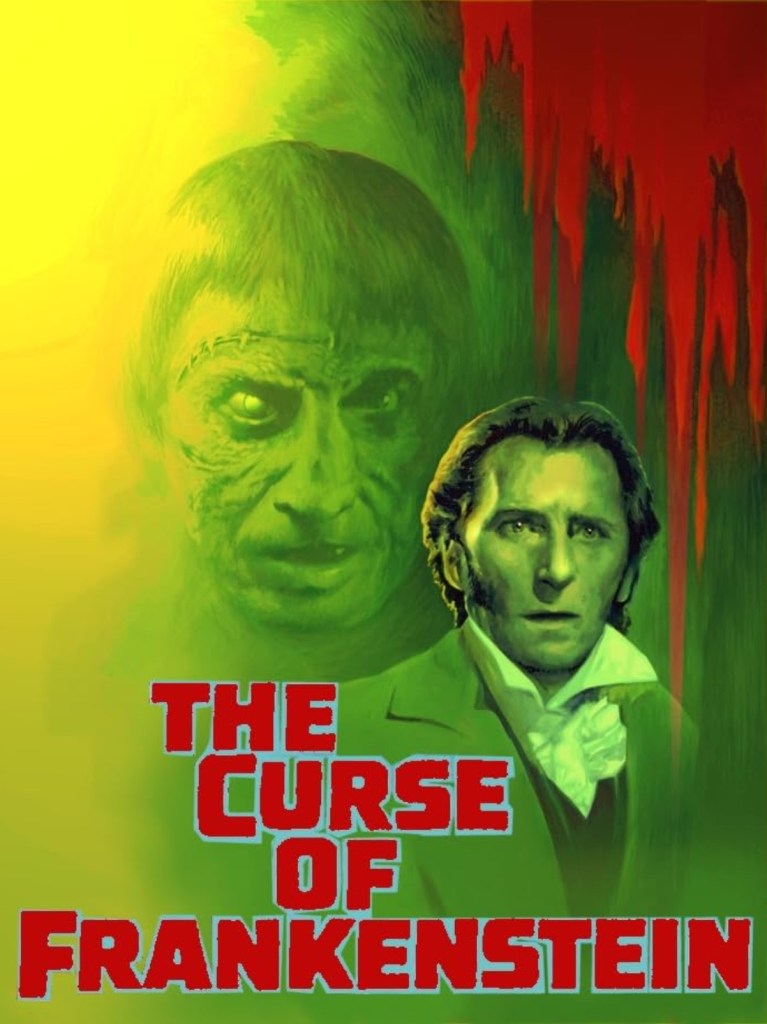
The Curse of Frankenstein poster created by Hammer Films and Warner Bros.

Things I liked about the film:

The use of WarnerColor: When discussing “classic” cinema, there has been a debate over whether a film should remain with black-and-white imagery or if it should receive the Technicolor treatment. In my opinion, I’m glad The Curse of Frankenstein was released in WarnerColor, which I believe was the studio’s version of Technicolor. This creative decision allowed certain elements within scenes to appear vibrant! In Victor’s laboratory, various jars and bottles were scattered throughout the room. Liquid filled these bottles and jars, boasting bright colors like red, blue, even purple. These hues provided a nice contrast to the gray walls of the laboratory. The incorporation of color worked in the favor of the film’s wardrobe department! While working on his experiment, Victor wore a beige three-piece suit. He also wore a maroon neck scarf, which gave his outfit a pop of color. Another character who wore a mostly beige outfit is Elizabeth, whose gown was covered in a silky beige material. Her dress featured a light blue bow and sash, providing the gown with a nice color combination!

Historical accuracy: Mary Shelley’s Frankenstein was published in 1818. Reflecting on The Curse of Frankenstein, it seems like the movie’s creative team kept this fact in mind as the project looked and felt historically accurate! Remember when I mentioned Victor wore a three-piece suit with a maroon neck tie? His friend, Paul, also wore a three-piece suit. Victor even wore a pocket watch, an accessory that he occasionally used. The attire of both Paul and Victor highlighted how men dressed in the 1800s. Home décor is also reflective of when a story takes place. In the upstairs hallway and in the sitting room of Victor’s house, the walls were covered in intricate wallpaper. The wallpaper, which featured elegant patterns, showcases the artistic details that homeowners in the 1800s favored.

The acting: From what I remember of Mary Shelley’s story, Elizabeth’s presence was very limited. Her appearances in the book were so small, readers only became familiar with her. In The Curse of Frankenstein, Elizabeth was given more appearances in the story. This allowed Hazel Court, the actress who portrayed Elizabeth, to present her character as a friendly woman with a likable personality! One scene I liked was when Elizabeth is having a debate with Victor and Professor Bernstein. Professor Bernstein warns Victor about being consumed by science, also reminding Victor of how he should use science for good. Elizabeth adds to the debate by stating it would be better for Victor to go outside and get some fresh air. The way she suggests this to Victor is of kind encourage. A pleasant smile is shown on her face and she is comfortably sitting in an armchair.

In order to bring his experiment to life, Victor recruits the help of his friend, Paul. Because of how often Paul interacts with Victor, Peter Cushing and Robert Urquhart share several scenes together. What Robert’s and Peter’s performance have in common is how effective they utilized emotion! As Victor is conducting his first experiment, bringing a puppy to life, Victor’s face is filled with curiosity. Realizing his experiment was a success, his face slowly transforms into happiness. Victor is so happy, even his eyebrows move. Anytime Paul is upset over Victor’s obsession with his experiment, Robert consistently presents his face with a stern look. His voice also sounds stern, with a hint of anger detected. Based on their performance in The Curse of Frankenstein, I was impressed by Peter and Robert’s acting talents!

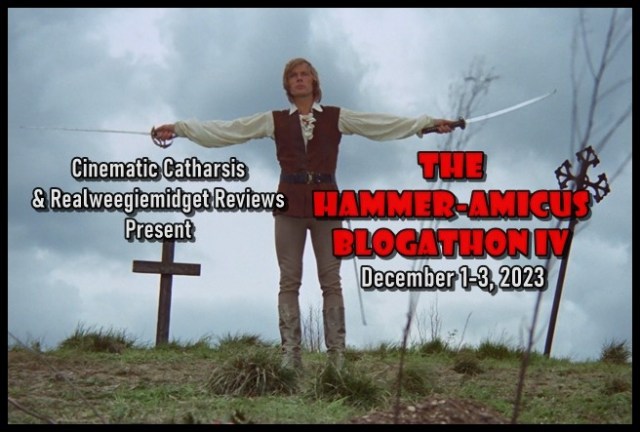
The Hammer-Amicus Blogathon IV banner created by Gill from Realweegiemidget Reviews and Barry from Cinematic Catharsis

What I didn’t like about the film:

A prolonged appearance of Frankenstein’s creature: Within Mary Shelley’s novel, a key character is Frankenstein’s creature himself. Through interactions between the creature and Victor Frankenstein, readers are reminded of how some good intentions can lead to bad results, a message that overarches Mary’s story. In The Curse of Frankenstein, however, so much time is spent showing Victor creating the creature to the point where the creature doesn’t become alive until almost fifty minutes into this hour and twenty-three-minute movie. Even when the creature, portrayed by Christopher Lee, appears in the film, he is only on screen for a handful of scenes. He also doesn’t have many interactions with Victor.

Changed context: After watching Oliver! from 1968, I read Charles Dickens’ novel. Comparing the book to the film, I discovered how the creative liberties made to the adaptation changed the context of certain parts of the story. Since I have read Mary Shelley’s novel before seeing The Curse of Frankenstein, I took notice of how the 1957 movie changed the context of certain narrative parts. A great example is Victor’s motivation for creating the creature. Mary Shelley’s book explains how the inspiration for Victor’s experiment came to him at college. Victor was curious about whether he could, from a scientific perspective, create a human being out of nothing. The adaptation shows Victor being encouraged by his tutor to bring people back from the dead, after Victor and his tutor bring a puppy back to life. Looking back on The Curse of Frankenstein, it seems like some of these creative liberties were made just for the sake of it.

Some inconsistent parts of the story: There were some parts of The Curse of Frankenstein that were inconsistent. One example is Victor’s quest to create the creature. When his tutor encourages him to bring people back to life, Victor declares he will set out to create “the perfect man”, using the “hands of an artist” and the “brain of a genius”. Several scenes later, when Victor shows his friend, Paul, his progress, Paul is disgusted by what he sees. Victor states how the looks don’t matter, but how he brought the creature to life at all. But when Paul criticizes Victor for the creature’s lack of intelligence, Victor blames Paul for destroying the creature’s brain. If Victor’s goal was to bring the creature to life at all, why would he be so upset over the creature’s brain? Victor’s motivation for creating the creature should have been consistent like it was in the book.

Scared audience image created by Katemangostar at freepik.com. <a href=’https://www.freepik.com/free-photo/terrified-friends-watching-horror-movie-in-cinema_1027311.htm’>Designed by Freepik</a>. <a href=”https://www.freepik.com/free-photos-vectors/people”>People image created by Katemangostar – Freepik.com</a>. Image found at freepik.com.

My overall impression:

When a book or pre-existing story is being adapted into a form of visual media, there are bound to be creative liberties included in the final product. Sometimes, these creative liberties can improve upon the source material, making the piece of visual media more entertaining. But there are times when creative liberties are incorporated just for the sake of it. When I chose to review The Curse of Frankenstein, I was hoping the creative team behind the 1957 film would display a stronger understanding for Mary Shelley’s story, especially after seeing Frankenweenie. Instead, the film’s creative team relied so much on creative liberties, I found it distracting. What also didn’t help was prolonging the appearance of Frankenstein’s creature. Based on the movie’s appearance, it looks like the creative team cared about how their project was presented. I not only liked the acting performances, I also appreciate the project’s historical accuracy and the use of WarnerColor. But, unfortunately, The Curse of Frankenstein is another movie that emphasizes style over substance.

Overall score: 5.1 out of 10

Have you seen The Curse of Frankenstein? Would you like to see me review more films from Peter Cushing’s or Christopher Lee’s filmography? Please tell me in the comment section!

Have fun at the movies!

Sally Silverscreen
Take 3: Hallmark Hall of Fame’s A Tale of Two Cities Review

For this year’s edition of the Broadway Bound Blogathon, I wanted to write about a Hallmark film based on a pre-existing Broadway play. My original plan was to read a play and then watch its adaptation, creating an editorial on how these works are similar or different. But, to my surprise, the films I wanted to talk about were based on plays that premiered off-Broadway. During my search for another option, I learned the Charles Dickens story, A Tale of Two Cities, was adapted into a Broadway musical in 2008. For this review, I’ve decided to write about the 1980 Hallmark Hall of Fame version of the aforementioned story. Though I haven’t read A Tale of Two Cities, I have enjoyed seeing the adaptations of Charles Dickens’ literary work. In fact, I liked 1968’s Oliver! so much, I ended up reading Oliver Twist after seeing the movie! So, where does this Hallmark Hall of Fame production stand among other stories by Charles Dickens? Turn the page on this review to find out!

Hallmark Hall of Fame’s A Tale of Two Cities poster created by Hallmark Hall of Fame Productions, Marble Arch Productions, Norman Rosemont Productions, and Columbia Broadcasting System (CBS)

Things I liked about the film:

The acting: One of the strongest scenes in A Tale of Two Cities is when Lucie (portrayed by Alice Krige) reunites with her father, Dr. Alexander Manette (portrayed by Peter Cushing), for the first time in over ten years. After mistaking Lucie as the jailer’s daughter, Alexander goes to his bed, in an attempt to avoid Lucie. As Lucie slowly approaches her father, Alexander’s voice is shaky and he is flinching, unsure of what to make of this visitor. But as soon as he discovers Lucie’s hair matches a lock of hair he kept for many years, Alexander realizes Lucie is, indeed, his daughter. Alexander’s expression changes from fear to shock, as he is in awe about seeing Lucie again. He even gives his daughter a hug. Meanwhile, Lucie is overcome with emotion, tears falling down her face and her voice quivering. Both Alice and Peter were able to effectively sell this on-screen relationship as believable and genuine. The emotions expressed felt realistic as well, which allowed this scene to be so strong!

In A Tale of Two Cities, Chris Sarandon portrays both Sydney Carton and Charles Darnay. Out of these two characters, my favorite was Sydney Carton! Throughout the story, Sydney carried himself with a laid-back confidence that made his personality appealing. Yet, more often than not, he displayed a sad look on his face. Even his eyes looked sad, giving the audience an idea of what he wasn’t saying. This made Sydney brooding and mysterious, making me want to know more about him and curious to see where his story would go. The likability of Sydney Carton can be attributed to Chris’ strong acting talents!

Attention to detail: What can make or break a historical drama is a creative team’s attention to detail. This element in the film-making process can make that story’s world feel immersive, transporting the audience to a specific period in time. The Hallmark Hall of Fame adaptation of A Tale of Two Cities takes place in the late 1700s. Jarvis Lorry’s office provides a great example of this film’s attention to detail when it comes to historical accuracy. On a nearby table, there is a large book, boasting a weathered brown cover. Rolled up paper documents and more brown covered books are scattered in the office’s foreground. In the background, Jarvis can be seen working at a desk similar to that of Ebenezer Scrooge. Though the room invites natural light through a dome shaped window, a small candle chandelier and a multi-candle candle stick provide the office with additional light.

The pacing: The Hallmark Hall of Fame adaptation of A Tale of Two Cities is two hours and thirty-six minutes. This is longer than a typical Hallmark production, which is about an hour and thirty to forty minutes. But A Tale of Two Cities never felt like a long movie to me. That’s because I was so invested in what the characters were doing, as well as the story itself. Though this is a character driven film, there was a satisfying amount of suspense, intrigue, even action. Where these elements were placed in the story made the movie feel evenly paced. The way scenes were filmed, written, and edited also contributed to the overall pace, never making parts of the story feel drawn out or wrapped up too quickly. I was so engaged watching A Tale of Two Cities, the run-time was the last thing on my mind!

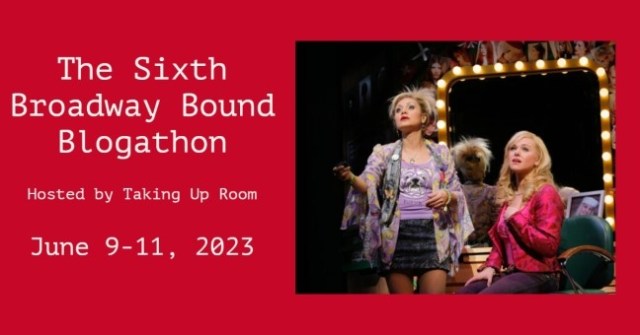
The Sixth Broadway Bound Blogathon banner created by Rebecca from Taking Up Room

What I didn’t like about the film:

Inconsistent inclusion of the French Revolution: An overarching conflict in A Tale of Two Cities is the rise of the French Revolution. In the first half of the movie, this conflict seemed like an afterthought, as the primary focus was placed on events happening in England, such as Charles’ court hearing. When a certain situation causes Charles to return to France, the French Revolution played a larger role in the film’s second half. The movie’s creative team built up to the event itself, visually presenting the harsh reality of the French public versus the upper-crust of French society. However, I wish this conflict had a more consistent presence within the story.

Lack of French accents: Because the French Revolution plays a role in A Tale of Two Cities, some of the story’s key characters are French. But the 1980 Hallmark Hall of Fame presentation is one of those films where every character speaks in a British accent, despite the cultural differences. After a while, I became used to the similarity in accents. I don’t blame the actors, as all I can expect from any actor or actress is for them to try their best with the material given. In my opinion, though, I fault the movie’s casting director for not encouraging the use of French accents.

Unexplained parts of the story: On a few occasions, there were parts of A Tale of Two Cities that confused me, due to their lack of explanations. One perfect example involves Monsieur Ernest Defarge’s wife, Therese. While a man is being guillotined, Therese tells her friend she has recorded the Evrémonde family in her stitching. After this scene takes place, Therese’s statement is never clarified. In fact, that particular stitching isn’t brought up again. Parts of the story like this one should have included explanations within the dialogue.

Hand-written letter image created by Veraholera at freepik.com. <a href=”https://www.freepik.com/free-photos-vectors/background”>Background vector created by Veraholera – Freepik.com</a>. <a href=’https://www.freepik.com/free-vector/love-letter-pattern_1292902.htm’>Designed by Freepik</a>. Image found at freepik.com.

My overall impression:

Most of Charles Dickens’ adaptations I’ve reviewed on 18 Cinema Lane have garnered favorable results. Both Oliver! and Nicholas Nickelby left such a good impression on me, they respectively found a place in my year-end best movies lists! Now that I have seen A Tale of Two Cities, I can honestly say that tradition will continue! The 1980 Hallmark Hall of Fame production tells an immersive story, taking the audience on a journey through time. What also adds to the experience is the strength of the characters, as the acting and the screenwriting worked well together. From the featured props to the costume design, the creative team’s attention to detail was on full display in this film, showing the care and effort that went into this project. Looking back on A Tale of Two Cities, I can see how the story could be adapted into a Broadway musical. As a matter of fact, I think a musical movie adaptation of A Tale of Two Cities would be very interesting to watch!

Overall score: 8.9 out of 10

Have you seen any adaptations of A Tale of Two Cities? Which story Charles Dickens’ is your favorite? Let me know in the comment section below!

Have fun on Broadway!

Sally Silverscreen