A Movie Blogger’s Ten “Hot Takes” on Film

Back in August, I published my review of the Hallmark Hall of Fame movie, Face to Face. That article became my 425th published movie review. Then, when I published my review of Kind Hearts and Coronets, it became my 950th published post. To honor these milestones, I’m creating a type of list I have never written before. Over the seven years 18 Cinema Lane has existed, I have shared some of my “hot takes” on film. However, I haven’t created a list exclusively about movie “hot takes”. That is why, for this list, I will address my film related “hot takes” I didn’t previously discuss on my blog. This decision was made to keep the list itself fresh and interesting. I will also organize each “hot take” based on how “hot” each take could be perceived. Before I begin this list, I’d like to state how my list is not intended to be mean-spirited or negative. It’s just simply a way to express my opinion.

Campfire with marshmellows and shooting stars image created by macrovector at freepik.com.

10. Sister Act 2: Back in the Habit Should Have Been a Christmas Movie

I’m not saying Sister Act 2: Back in the Habit is a bad movie. I’m not even saying it’s a bad sequel, as I respect how the script tries to tell a new story instead of attempting to recapture the magic of the first film. However, I do believe it was a huge missed opportunity not to have Sister Act 2: Back in the Habit set during Christmas. I can picture Saint Katherine’s Parish, the church featured in the first movie, beautifully decked out in Christmas adornments. And can you imagine what Christmas songs like ‘O Holy Night’, ‘Away in a Manger’, and ‘Joy to the World’ would have sounded like under Deloris’/Sister Mary Clarence’s leadership? If those versions were even half as good as the songs were in Sister Act, the audience would have been in for a musical treat! Though there’s no guarantee making Sister Act 2: Back in the Habit a Christmas movie would have made it better or just as good as its predecessor. Therefore, this is the mildest “hot take” on my list.

9. Calypso/Tia Dalma and Davy Jones Should Have Shared More Screen-Time Together in Pirates of the Caribbean: At World’s End

One of my favorite movie scenes of all time is Calypso/Tia Dalma and Davy Jones’ interaction in Pirates of the Caribbean: At World’s End. Not only does this scene recontextualize everything the audience knew about Calypso/Tia Dalma up until that point, Naomie Harris and Bill Nighy’s on-screen chemistry made the attraction between Calypso/Tia Dalma and Davy Jones believable. This attraction makes me wish they shared more screen-time together. Throughout Calypso/Tia Dalma and Davy Jones’ interaction, issues are left unresolved and words are left unspoken. Yet their love for each other is still evident. Calypso/Tia Dalma and Davy Jones should have received an opportunity to resolve their issues and honestly communicate with one another. But in a movie like Pirates of the Caribbean: At World’s End with so many moving parts to it, aspects of the story like Calypso/Tia Dalma and Davy Jones’ relationship were overlooked.

8. Wanda Maximoff/Scarlet Witch’s Story in the Marvel Cinematic Universe (MCU) Should Have Been an Adaptation of Scarlet Witch, Vol. 3: The Final Hex

For this year’s Eurovisionathon readathon, I read Scarlet Witch, Vol. 3: The Final Hex. As I read the graphic novel, I couldn’t help but feel the Marvel Cinematic Universe (MCU) missed a great opportunity to adapt this story. Based on what I know about the MCU, mentor figures aren’t common. Agatha Harkness could have provided mentorship to Wanda Maximoff/Scarlet Witch like she did in the graphic novel, helping guide her throughout Phase 2 and beyond. Adapting Scarlet Witch, Vol. 3: The Final Hex would have given the MCU a reason to weave Serbian and Roma culture into Wanda Maximoff/Scarlet Witch’s, as well as Pietro Maximoff/Quicksilver’s, narrative. Themes of family, identity, and what it truly means to be a superhero could have also been explored. While I haven’t seen any of the MCU’s projects after Avengers: Endgame, I have heard of the directions Wanda Maximoff/Scarlet Witch’s story have taken. Had Scarlet Witch, Vol. 3: The Final Hex been adapted, maybe her story would have been better than what the audience received.

7. Cheryl Frasier from Miss Congeniality is More Intelligent Than Most People Give Her Credit For

The “April 25th” scene from Miss Congeniality is one of the most quotable and meme-able moments in film history. This scene is how most people know Cheryl Frasier (a.k.a. Miss Rhode Island), one of the story’s key characters. The moment where Cheryl chooses “April 25th” as her answer for her idea of a perfect date is presented as giving the wrong answer. Though whenever I think of this scene, I see it very differently. In an interview/question segment of a pageant, contestants must utilize their time wisely to earn enough points to progress to the next segment. With that said, Cheryl utilized critical thinking skills, logic, and looking outside the box to not only select her iconic answer, but to also come up with an explanation for that answer all within a limited period of time. Plus, I can understand how she would describe a date on the calendar, as the question is vague enough to be interpreted in different ways. This is one of the best examples from Miss Congeniality of Cheryl being more intelligent than most people give her credit for.

6. Pennywise from Stephen King’s IT (1990) is More Annoying Than Scary

Years ago, I saw Stephen King’s IT for the first time. But I found the experience underwhelming. One contributor was how Pennywise was more annoying than scary. While there were horrifying moments involving Pennywise, these moments were far and few between. One scene that always comes to mind is when Pennywise is in a library. In this scene, he was so over-the-top, loud, and obnoxious, his act got old really fast. I couldn’t take Pennywise seriously as a horror movie villain, as his silliness made him less threatening. Even in the film’s climax, his role was such a let-down, sucking all the suspense out of that scene. Tim Curry, the actor who portrayed Pennywise, is not at fault because he tried his best with the acting material provided. The fault lies with the director and screenwriters of Stephen King’s IT.

Group of Christmas figures image created by Pikisuperstar at freepik.com. <a href=”https://www.freepik.com/free-photos-vectors/christmas”>Christmas vector created by Pikisuperstar – Freepik.com</a>. <a href=’https://www.freepik.com/free-vector/hand-drawn-cute-christmas-character_3188970.htm’>Designed by Pikisuperstar</a>. Image found at freepik.com.

5. Gabby Gabby from Toy Story 4 is a Poorly Written Character

When I saw Toy Story 4 in 2019, I thought Gabby Gabby was a poorly written character. Six years later, I still feel this way about her. It seemed like the creative team behind Toy Story 4 couldn’t decide if Gabby Gabby should be the story’s villain, anti-hero, or simply misunderstood. So, instead of giving her one role and sticking to that creative decision, the creative team gave her all three roles. When Gabby Gabby received a redemption arc, I didn’t feel that was earned. How am I supposed to root for her when I don’t even know what her true role in this story is supposed to be? Last year, when I published my list of ten movie trends I don’t understand, I explained how adopting the ‘villains receiving the spotlight’ trend gives the audience mixed messages and makes villainous characters less straight-forward. Reflecting on that list and Toy Story 4, I wonder if how Gabby Gabby was written is the result of that trend?

4. ‘Elizabeth’ is the Most Overused Name in Historical Fiction/Period Drama Movies and TV Shows

In 2019, I created a list of the top ten worst clichés from Hallmark movies. The clichés featured in that list were those that were poorly or overly used. If I created a similar list about the worst clichés from historical fiction/period drama movies, characters named ‘Elizabeth’ would be near the top of the list. Personally, I find it hard to believe directors, producers, and screenwriters would keep selecting ‘Elizabeth’ despite having thousands of names at their disposal. The name, ‘Elizabeth’, keeps finding its way into scripts no matter the story’s time period. Some examples include Felicity: An American Girl Adventure, the Pirates of the Caribbean series, any version of Pride and Prejudice, and When Calls the Heart’s Christmas/seasonal films. This specific cliché is also present among historical fiction/period drama tv shows, ranging from Emily of New Moon to The Waltons. I don’t know when the cliché started being utilized or if it will ever stop. But if someone is considering creating a historical fiction/period drama movie or tv show, I hope they think outside the box when it’s time to name their characters.

3. I Don’t Find National Lampoon’s Christmas Vacation Funny

I’ve only seen National Lampoon’s Christmas Vacation once. Though it’s been years since I’ve seen it, I didn’t find it funny. I don’t remember laughing at any joke. Even when I see clips of the movie in other pieces of media, it doesn’t get a reaction out of me. I’m aware how comedy, as well as film itself, is subjective. But I just don’t understand the hype around National Lampoon’s Christmas Vacation. If I revisited the movie, maybe I’d change my mind on it. For now, though, National Lampoon’s Christmas Vacation is not a must-watch title for me this Christmas season.

2. Bucky Barnes Should Have Received His Own Superhero Title Instead of Becoming the Next Captain America

Around the time Avengers: Infinity War was released, I was one of those fans who wanted to see Bucky Barnes become the next Captain America. I even expressed this wish in my very first movie blogger’s Christmas wish-list. But looking back almost ten years since Avengers: Infinity War and Avengers:Endgame premiered, I believe instead of becoming the next Captain America, Bucky should have received his own superhero title. As he grew into it over time, Bucky could have shaped this brand-new title to become truly his. So, when people think of that specific title, they’ll think of Bucky and vice versa. There would be no preconceived ideas or expectations due to the lack of comparisons to measure Bucky to. With his own superhero title, he could have received official Avenger status as well, which is why I wanted Bucky to become the next Captain America in the first place. I know he took up Captain America’s shield in Marvel’s comics. However, Bucky adopting his own, unique superhero identity would have added a fascinating chapter to Phases 4 and 5.

1. The Breakfast Club and Clue are Two of the Most Overrated Movies of the 1980s

It’s been years since I’ve seen The Breakfast Club or Clue. But from what I remember, I wasn’t a fan of either title. The Breakfast Club contained way too much swearing for my liking and I found its story too simplistic. When it came to Allison Reynolds’ reason for being in detention, the script was building up to what ended up being an underwhelming revelation. Meanwhile, in Clue, I laughed at only one joke throughout the entire film. The movie prioritized showing the characters running around and yelling/screaming at each other, which I find less hilarious and more headache-inducing. Having multiple endings based on when and where someone saw the film might work at the movie theater. Including all three endings in Clue, however, not only felt overwhelming, it also felt like the movie’s creative team couldn’t decide which ending best fit their script, leaving that ultimate decision to the audience. Perhaps if I revisited The Breakfast Club or Clue, my opinion on these titles might change. As of the publication of this list, though, I find Clue and The Breakfast Club overrated.

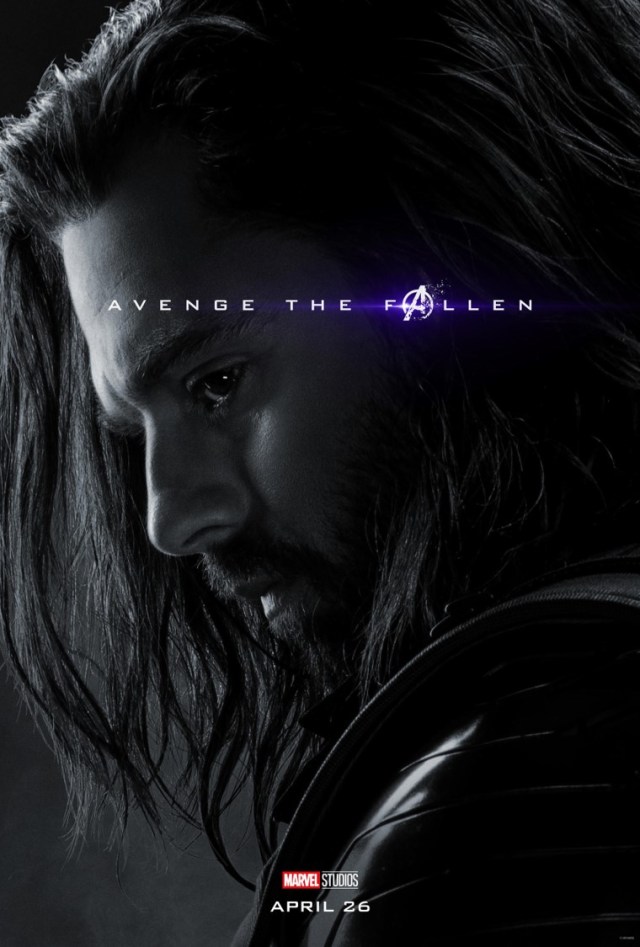
Avengers: Endgame Bucky Barnes poster created by The Walt Disney Company and Marvel Studios. © Disney•Pixar. All rights reserved. Marvel and Avengers Characters: ©2017 Marvel. Image found at https://www.marvel.com/articles/movies/mcu-heroes-unveil-avengers-endgame-character-posters

What are your thoughts on my movie “hot takes”? Do you have a film related “hot take” you’d like to share? Please tell me in the comment section below!

Have fun at the movies!

Sally Silverscreen
That’s a Wrap for my Second Chance Christmas Double Feature

Now we’ve come to the end of another double feature, as both chosen titles, Young at Heart and An Old Fashioned Christmas, have been watched and reviewed! In the introduction, I brought up the following question:

Did these two movies deserve a second chance?

For my answer, I’ll say Young at Heart was more deserving of a second chance than An Old Fashioned Christmas. With Young at Heart, I not only received an opportunity to check out more projects from Frank Sinatra’s and Alan Hale Jr.’s filmography, I was also given an official introduction to Doris Day’s movies. I found a good excuse to see more musicals, as well as films from the 1950s. Overall, I enjoyed Young at Heart more than Hallmark’s 2010 presentation. As someone who loves An Old Fashioned Thanksgiving, the sequel left a lot to be desired. Despite being titled An Old Fashioned Christmas, the film didn’t feel like a Christmas film. Instead of prioritizing the messages and themes of the holiday, the script primarily focused on stories that could have taken place any time of year. It also doesn’t help how so much of the story revolves around a love triangle. Looking back on An Old Fashioned Christmas, it makes me wonder if the sequel’s poorer quality, as well as becoming forgotten by time and Hallmark themselves, is the reason why I’ve, more often than not, seen DVD copies of the movie included in Christmas movie box sets?

Christmas themed movie tickets image created by Kraphix at freepik.com. <a href=’https://www.freepik.com/free-vector/movie-tickets-christmas_971544.htm’>Designed by Kraphix</a>. <a href=”https://www.freepik.com/free-photos-vectors/christmas”>Christmas vector created by Kraphix – Freepik.com</a>. Image found at freepik.com.

Have fun at the movies!

Sally Silverscreen
Take 3: An Old Fashioned Christmas Review (Second Chance Christmas Double Feature Part 2)

Thank you for joining me for the second part of my Second Chance Christmas Double Feature! Unlike my review of Hallmark’s Frankenstein, this review of An Old Fashioned Christmas will contain a few spoilers. If you’re curious about why I chose An Old Fashioned Christmas  for this double feature, you can check out the introduction in the link below.

Coming Soon to a Blog Near You; The Second Chance Christmas Double Feature!

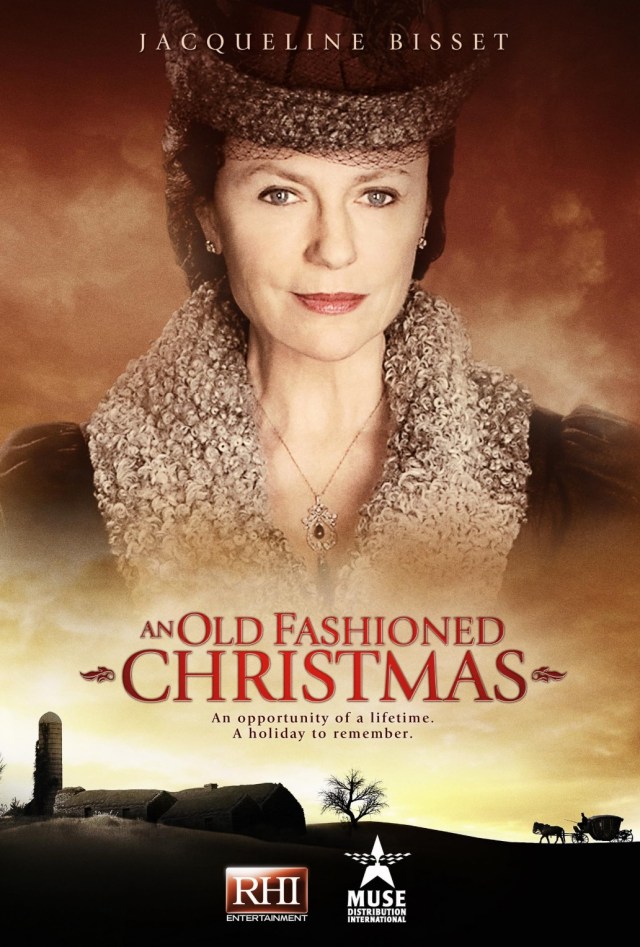
An Old Fashioned Christmas poster created by RHI Entertainment, The Government of Ireland, Parallel Film Productions, MNG Films, Muse Entertainment Enterprises, and Hallmark Channel

1. How were you introduced to An Old Fashioned Christmas and why was it selected for this double feature?

I have declared An Old Fashioned Thanksgiving as one of my favorite Hallmark movies. Years ago, when I discovered the 2008 film received a sequel, I was eager to check that movie out. But as time went on, Hallmark gave the sequel fewer airings during their Christmas line-ups, making it more difficult to watch the film. I’ve always looked for the right time to write about An Old Fashioned Christmas. I even included it on two lists; 2022’s top ten movies I’d love to review and 2023’s top ten Christmas movies I’d love to review. On both lists, I said I found a few DVD copies of the 2010 title. But, more often than not, these DVDs were included in Christmas movie box sets, which, typically, are expensive. Fortunately, An Old Fashioned Christmas was uploaded on Youtube, which is how I watched it.

2. You’ve mentioned An Old Fashioned Thanksgiving being one of your favorite Hallmark movies. Did An Old Fashioned Christmas contain any elements that made you like the 2008 film?

One of the reasons why I love An Old Fashioned Thanksgiving is how immersive the production is! The attention to detail and historical accuracy created the illusion of taking the audience to another time and place. This same strength was found in An Old Fashioned Christmas! One simple, yet effective, example were the props. Anytime Tilly and Isabella shared a meal with the Shannon family, the table was covered with fine china dishes, crystal goblet-style glasses, and even a shiny silver teapot. These specific props reflected the story’s time period, which appears to be the late 1800s. They also symbolized the prestigious family history of the Shannons.

3. Is the theme of “second chances” incorporated in An Old Fashioned Christmas’ story? If so, how?

One of the reasons why Tilly wanted to travel to Ireland was to meet her father’s side of the family. After she gets to know her paternal grandfather and uncle, Tilly writes a letter in the hopes Isabella will make amends with Sean (Tilly’s grandfather). So, in An Old Fashioned Christmas, not only is Tilly given a second chance to connect with her father’s side of the family, Isabella received a second chance to build a bridge between herself and Tilly’s grandfather.

4. Was there anything about An Old Fashioned Christmas you liked or didn’t like?

Similar to Young at Heart, the dialogue was one of the best parts of An Old Fashioned Christmas! Because of the thought and effort put into this film-making aspect, conversations between characters sounded intelligent and eloquent. During breakfast one morning, Lady Shannon asks, “Wouldn’t it be lovely for Americans to have titles”? This question relates to how her son, Cameron, will become an Earl someday. Isabella responds by saying, “Actually, we do. We all share the same title: American”. The way Isabella answered Lady Shannon’s question carried a sense of confidence and grace, simply stating a major difference between her world and the world of the Shannon family. I also thought Isabella’s response to Lady Shannon’s question was pretty clever.

Speaking of Lady Shannon’s son, Cameron, I found him to be the worst character in An Old Fashioned Christmas. He always acted like he had something to prove. Plus, Cameron attempted to get the last word in every argument or conversation. The longer I watched An Old Fashioned Christmas, the more annoying Cameron became. I recognize the film’s creative team was trying to create a male character different from Gad (Tilly’s fiancé). However, this goal can be achieved without making that male character completely unlikable.

Blue sparkly Christmas tree image created by Macrovector at freepik.com. <a href=”https://www.freepik.com/free-photos-vectors/frame”>Frame vector created by Macrovector – Freepik.com</a>. <a href=’https://www.freepik.com/free-vector/merry-christmas-card_2875396.htm’>Designed by Macrovector</a>. Image found at freepik.com.

5. On 18 Cinema Lane, you’ve covered plenty of Christmas films. How is An Old Fashioned Christmas similar to or different from other Christmas pictures written about on your blog?

As I answered for question number three, meeting her father’s side of the family was the reason Tilly wanted to travel to Ireland. Like I also answered for question number four, Isabella responded to Lady Shannon’s question by stating Americans share the same title: American. The story of an American protagonist traveling to Ireland to learn more about her father’s side of the family felt very reminiscent of Christmas at Castle Hart. Another similarity these films share is how a majority of their stories take place in an Irish castle.

6. Did you develop any thoughts and/or questions while watching this film?

What makes An Old Fashioned Thanksgiving such a great movie is how the story embraces the Thanksgiving holiday. The film boasts a Thanksgiving dinner and showcases themed decorations, like a handmade blanket. But the 2008 picture also weaves the messages and themes of the holiday into the story and dialogue, truly making An Old Fashioned Thanksgiving feel like a Thanksgiving movie. An Old Fashioned Christmas definitely looked like a Christmas movie, as decorations and themed activities were sprinkled throughout the film. However, it did not feel like a Christmas picture. That’s because the majority of the story emphasized the love triangle between Tilly, Gad, and Cameron. An Old Fashioned Christmas is a Hallmark presentation where the protagonist says they are going to do something, but spends the majority of the film not doing what they said they were going to do. One of the reasons for Tilly and Isabella’s trip to Ireland was for the Earl of Shannon to mentor Tilly in her writing, in the hopes of getting Tilly’s work published. But throughout the one hour and fifteen-minute movie, Tilly barely accomplishes any writing goals. In fact, the only writing Tilly does is composing letters to her mother.

7. How would the story of An Old Fashioned Christmas change if it revolved around another holiday?

I just mentioned for question number six how the majority of An Old Fashioned Christmas’ story emphasized the love triangle between Tilly, Gad, and Cameron. Other stories, such as the Earl of Shannon mentoring Tilly, didn’t really have anything to do with the Christmas holiday. Therefore, changing the plot of An Old Fashioned Christmas to another time of year wouldn’t make a difference.

8. Did An Old Fashioned Christmas deserve a second chance? If so, why?

Now that I have seen An Old Fashioned Christmas, this is, honestly, a tough question to answer. On the one hand, I received some closure for how the story continues after An Old Fashioned Thanksgiving. I also developed my own, honest opinion about the sequel. But, on the other hand, An Old Fashioned Christmas, kind of, let me down. The Christmas holiday almost seems like an afterthought in the 2010 title. There were underutilized aspects of the story, like Tilly pursuing her writing dreams. So, to answer this question, I’m thankful I received an opportunity to check out An Old Fashioned Christmas. However, I don’t think it was worth the wait.

9. After watching An Old Fashioned Christmas, is there anything you can take away from your movie viewing experience?

If you ignore the fact An Old Fashioned Christmas was created as a sequel to An Old Fashioned Thanksgiving, this is an ok film. The attention to detail and historical accuracy create a visually immersive experience. The dialogue was also well written and delivered. But if you intend to watch An Old Fashioned Christmas as a sequel to An Old Fashioned Thanksgiving, you will be underwhelmed. With Tilly, Gad, and Isabella as the only returning characters, the family dynamic between Tilly’s family and Isabella is absent. Like I said for questions number six and seven, the majority of An Old Fashioned Christmas’ story emphasizes the love triangle between Gad, Tilly, and Cameron. It did not help that Cameron was such an unlikable character. Honestly, this movie will likely be a one-time watch for me. Since I still love An Old Fashioned Thanksgiving, I’ll just stick with the 2008 picture.

Irish heart image created by Freepik at freepik.com. <a href=”https://www.freepik.com/free-photos-vectors/label”>Label vector created by freepik – http://www.freepik.com</a>. Image found at freepik.com.

Have fun at the movies!

Sally Silverscreen

Take 3: I Heard the Bells Review + 500 Follower Thank You

Six years ago, when 18 Cinema Lane was born, I never imagined my blog would receive five hundred followers. But because of these followers, the people who took the time to read what I had to say, this milestone became a reality! To express my gratitude, I’m, once again, thanking my blog’s followers by writing this Blog Follower Dedication Review. This time, however, I’m presenting this review in the style of an open letter to the chosen film. While visiting the blog, It’s a Wonderful Movie, I came across a post about the 2022 Christmas movie, I Heard the Bells. At first, I believed it was a new production from Great American Family. This belief piqued my interest, as I wanted to review one of the network’s Christmas films. Then, I discovered I Heard the Bells was, simply, airing on Great American Family. Instead of being deterred by this misunderstanding, I still selected the 2022 picture for my Blog Follower Dedication Review, as I never heard of this presentation before 2024. With the Christmas season in full swing, writing about I Heard the Bells felt like an appropriate choice. So, without further ado, let’s begin this open letter!

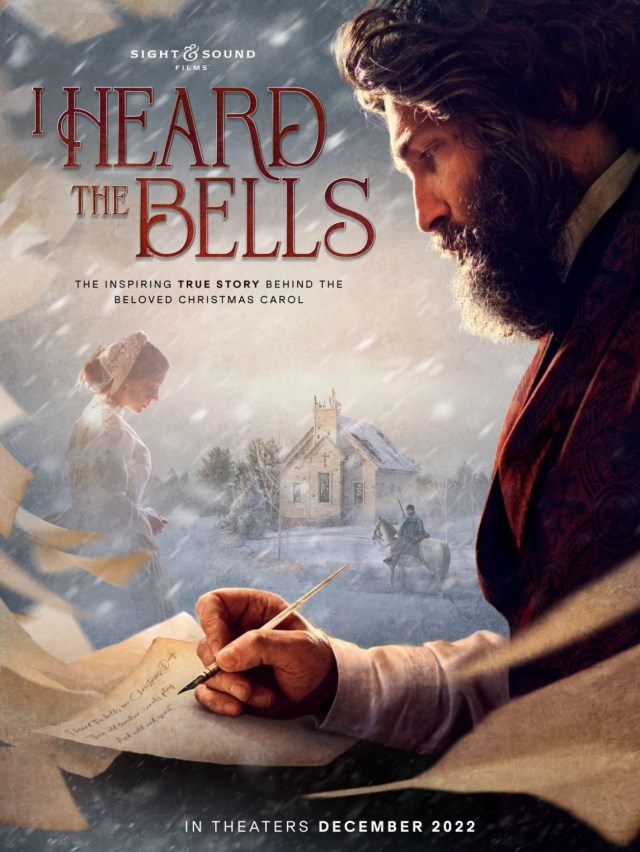
I Heard the Bells poster created by Sight & Sound Films

An open letter to I Heard the Bells:

As I write this letter, you remind me of another Christmas movie I know; Christmas on Division Street. That’s because you and the 1991 television film share one thing in common; meeting me by chance. If you hadn’t been featured on It’s a Wonderful Movie, I would never had heard about you. Then again, if I had paid closer attention, I would have known sooner you weren’t a Great American Family production. Despite that misunderstanding on my part, I still wanted to give you a fair chance. When it comes to writing about Christmas pictures, I root for every movie, including you, to be good. And that’s exactly what you are; good! With the seasonal entertainment landscape saturated with the same cliches, aesthetics, and story ideas, a Christmas movie needs to find a way to stand out from the competition. You, I Heard the Bells, succeeded in doing that!

Christmas Tree with boxes image created by Freepik at freepik.com. <a href=’https://www.freepik.com/free-vector/christmas-tree-out-of-gift-boxes_1448089.htm’>Designed by Freepik</a>. <a href=”https://www.freepik.com/free-photos-vectors/background”>Background vector created by Freepik</a>. Image found at freepik.com

In RKO 281 and Amadeus, Liev Schreiber and Tom Hulce brought humanity back to the names of Orson Welles and Amadeus. They also found the heart of the “genius” and put some genuine emotion behind it. Through his portrayal of Henry Wadsworth Longfellow, Stephen Atherholt followed in Liev and Tom’s footsteps. When it came to Stephen’s performance, however, he brought an emotional fire that helped make Henry a lively, well-rounded individual! Toward the beginning of the story, just hours before Christmas, Henry recites a poem. Combining facial expressions, vocal inflections, and body language, Henry was animated and captivating. He also spoke in a very poetic way, fitting for a man who had a way with words. Later in the story, after Henry experiences a tragedy, he gets into an argument with his son, Charley. At first, his eyes are downcast and he speaks in a softer tone, trying to avoid a conflict. But as Charley’s side of the argument becomes heated, Henry suddenly bursts with emotion. He quickly bolts from his seat and yells at his son, his anger spilling over. This reaction is so unexpected, Henry’s other children appear frightened.

Hand-written letter image created by Veraholera at freepik.com. <a href=”https://www.freepik.com/free-photos-vectors/background”>Background vector created by Veraholera – Freepik.com</a>. <a href=’https://www.freepik.com/free-vector/love-letter-pattern_1292902.htm’>Designed by Freepik</a>. Image found at freepik.com.

Through on-screen text, you made it known you were based on a true story. However, I still wish Stephen Atherholt and Rachel Day Hughes shared more scenes together. I already talked about Stephen’s portrayal of Henry Wadsworth Longfellow, explaining why it was good. Acting alongside Rachel, who portrayed Fanny Longfellow, Stephen shared strong on-screen chemistry with her! One of my favorite scenes is when Fanny and Henry dance together on Christmas. Their gentle waltz perfectly captures their romantic tenderness. Even in scenes taking place outside of Christmastime, this romantic tenderness was present between Henry and Fanny. At a dinner party, Henry is nervous about having his poetry recited in front of the party guests. During the poem’s introduction, Henry’s hand twitches. Fanny quickly puts her hand over his and even encourages him to lift up his eyes. Throughout this scene, Fanny’s encouragement is gentle, with her patience and kindness making Henry feel more comfortable in his situation. Though Rachel and Stephen shared only a few scenes together, they effectively showed how Fanny and Henry brought out the best in each other!

Envelope with hearts image created by Freepik at freepik.com. <a href=’https://www.freepik.com/free-photo/hearts-and-pink-envelope-for-mothers-day_1950691.htm’>Designed by Freepik</a>. <a href=”https://www.freepik.com/free-photos-vectors/love”>Love image created by Freepik</a>. Image found at freepik.com.

Bringing up RKO 281 and Amadeus again, these movies are historical pictures where attention to detail made their respective worlds feel visually immersive. It seems like you took another page out of Amadeus and RKO 281’s playbook by applying that attention to detail to Henry’s world! Watching this story unfold felt like traveling in time to the early 1860s. Whether it was the Civil War uniforms, the set design, or even a kite, every piece of this production appeared to be well-researched by your creative team. Remember when I brought up Henry reciting a poem hours before Christmas and the waltz between Henry and Fanny on Christmas? Those moments took place in the Longfellow home’s main sitting room, where era appropriate Christmas decorations can be seen. I noticed orange slices entwined on the garland above the fireplace, as well as candles illuminating the room. I even saw a Nativity set on a nearby table.

Adorable Christmas card image created by Rawpixel.com at freepik.com. <a href=’https://www.freepik.com/free-vector/christmas-greeting-card-vector_2824854.htm’>Designed by Rawpixel.com</a>. <a href=”https://www.freepik.com/free-photos-vectors/christmas”>Christmas vector created by Rawpixel.com – Freepik.com</a>. Image found at freepik.com.

While there was a lot to like about you, there were some things I didn’t like about you. One of them was how you were almost two hours long. I know you’re a fan of establishing shots, but did you really need that many? Personally, I think you could have either cut some of these shots or trimmed the establishing shots’ length. As I mentioned earlier in this letter, Henry experiences a tragedy. This event causes his appearance to change as time goes on. Even Charley’s hair looks different over time. Yet Henry’s daughters, Anne, Alice, and Edith, always looked the same despite the progression of years. For this flaw, I fault the director and casting director, as they should have been more mindful about how those in the story were presented. Speaking of those involved in the story, there are some people I wish were more involved in what was happening on-screen. Senator Charles Sumner, portrayed by Daniel Stargel, is one of Henry’s supporters. He even helps Charley find a respectable position in the military. But out of your almost two-hour story, Charles appears in only a handful of scenes. I remember how you’re based on a true story. However, that’s not going to change my mind on how Charles should have been given more appearances.

Do you remember at the beginning of this letter, when I said you reminded me of Christmas on Division Street? Well, there’s another Christmas movie you remind me of. That would be the classic It’s a Wonderful Life! For starters, you and the 1946 film are Christmas productions that are about more than just the Christmas holiday. Both of you focus on a man and his story, also exploring how that man’s relationships affect his existence. There’re also elements of faith in both stories. However, these elements are incorporated in different ways. Your delivery, as well as that of It’s a Wonderful Life, shows how much you cared about the overall presentation. In your case, your emphasis on attention to detail made the story look and feel so historically accurate, Henry’s world became immersive! Every acting performance was strong, especially Stephen’s and Rachel’s. Yes, you do have flaws. But I don’t think they will hold you back from, one day, becoming a classic! When I wrote about RKO 281 last year, I claimed good films leave a lasting impression. As I close this letter and move along on my blogging journey, I can honestly say you’ve done just that!

Sincerely,

Sally Silverscreen

P.S. I’ll give you a score of 7.6 out of 10.

Comparing with the Critics – Best of 1984 – Amadeus

This review is from my series, Comparing with the Critics. If you’d like to learn more about the series, click on the link below.

Introducing my new series, Comparing with the Critics!

I was intrigued to review Amadeus for a number of reasons. One of those reasons was the song, “Rock Me Amadeus” by Falco. For years, I thought the song was created to promote the movie, given the coincidence of two pieces of Amadeus related media debuting in the ‘80s. With the song released in 1985, a month before Amadeus won Best Picture at the 57th Academy Awards, I’d like to believe I was kind of right. In At The Movies’ ‘Best of 1984’ episode, both Gene Siskel and Roger Ebert liked the glamourous, musical biopic. Roger made the film his “personal choice for the best film of 1984”. Like Network and Harry & Son, I had never seen Amadeus, so I approached the movie with little to no expectations. Though I heard good things about the picture since its premiere in 1984. As I write this review after watching the movie, I can definitely see why Amadeus was, at least, nominated for an Oscar.

Amadeus poster created by The Saul Zaentz Company, AMLF, and Orion Pictures

When I reviewed RKO 281 last July, I complimented Liev Schreiber’s portrayal of Orson Welles. In that review, I said Liev brought humanity back to Orson’s name, finding the heart of the “genius” and putting some genuine emotion behind it. This is the same way I felt while witnessing Tom Hulce’s portrayal of the titular man. Reading about an iconic figure like Amadeus can make one wonder what his personality was like. Similar to Orson Welles, Amadeus can be thought of as more than just a man with a gift. Through good times and bad times, Tom shows the film’s audience how Amadeus was, simply, human. As his father comes to visit him in Vienna, Amadeus expresses pure joy when he sees his father at the top of the stairs. Amadeus’ smile alone showcases the happiness within his heart. One evening, when Amadeus is composing an opera, he slowly slips into exhaustion. His eyelids rise and fall, he sways out of rhythm, and his face looks as white as the lace on his shirt. Roger claimed Tom’s portrayal of Amadeus was “one of the year’s most engaging performances”. Tom’s performance serves as an example where Roger, the Academy, and I were on the same page.

F. Murray Abraham’s portrayal of Antonio Salieri reminded me of Gloria Swanson’s portrayal of Norma Desmond in Sunset Boulevard. What I mean by this is the character in question’s search for fame is so strong, it forces the character to become increasingly obsessive, even making questionable choices. Throughout Amadeus, Antonio reflects on his life and how it was impacted by the success of Amadeus. At the beginning of his story, wistfulness can sometimes be heard in Antonio’s voice as he shares his dream of making music for God. As his reflected encounters with Amadeus continue, the tone in Antonio’s voice evolves into bitterness, hinting at the frustration he bottled up over the years. This frustration can also be seen if one looks closely at Antonio’s facial expressions. Before a scene from the movie was shared in the ‘Best of 1984’ episode, Roger called F. Murray’s portrayal “a brilliant performance”. The Academy certainly agreed with Roger, as F. Murray won the Best Actor Oscar instead of Tom at 1985’s Academy Awards. Personally, I liked both F. Murray’s and Tom’s performance for various reasons. Through their portrayals, Tom and F. Murray displayed how fame can negatively impact the human soul.

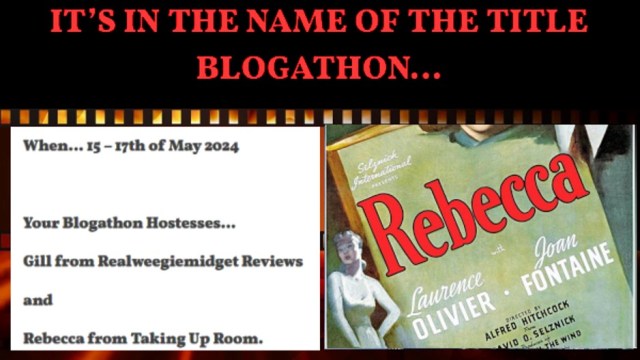
It’s In The Name Of The Title Blogathon banner created by Gill from Realweegiemidget Reviews and Rebecca from Taking Up Room

As I mentioned in this review’s introduction, Roger chose Amadeus as his “personal choice for the best film of 1984”. One reason why is how “this movie doesn’t contain one bit of the pretentious, solemnity that we usually associate with movie biographies of classical musicians”. To add to Roger’s comment, I’d like to point out how the film serves as an immersive, detail-oriented character study of how the music industry can be both rewarding and cruel. When Antonio shares his life story with a visiting priest, he emphasizes how he was the only member of his family who was interested in music. This organic talent and rise to prominence provide an opposite view of how Amadeus claimed his fame. Scenes and dialogue illustrate how Amadeus was raised to be a star, with his father providing both the music education and connections for a comfortable future. While discussing a new opera with the Emperor, Amadeus successfully argues why his opera should be performed. He states how he worked many hours on the project and how the opera’s lack of politics will prevent the audience from being alienated. The examples I provided in this paragraph show how, sometimes, talent isn’t enough when it comes to the music industry. It also highlights the effort that goes into making music, let alone one song.

String of musical notes image created by Freepik at freepik.com. <a href=’https://www.freepik.com/free-vector/pentagram-vector_710290.htm’>Designed by Freepik</a> <a href=”https://www.freepik.com/free-photos-vectors/background”>Background vector created by Freepik</a>. Image found at freepik.com. 

While sharing his thoughts on Amadeus, Roger stated how the film was “a cheerful, rambunctious, irreverent film”.  I disagree with his statement to an extent. There are cheerful moments within the movie. However, I wouldn’t claim the movie itself is “cheerful”. The overall story contains darker, sadder moments as well, especially toward the end of Amadeus’ life. One part of the story revolves around someone masquerading as a deceased loved one Amadeus knows. Due to his grief and unresolved issues, Amadeus truly believes the masquerading imposter is the loved one brought back from the dead. This imposter is so cruel to use Amadeus’ pain for their own personal gain. Another statement of Roger’s I disagree with is about how the movie views Amadeus himself. Roger claims how the film “doesn’t so much concern with the actual details of Mozart’s life as with its own feelings about his genius, his personality”. The movie allows the characters, including Amadeus, to be flawed. But there were a few instances where the story seemed one sided. After a successful opera performance, Antonio’s student is upset because she learned Amadeus was engaged to a woman named Constanze. This leads Antonio to believe Amadeus and the student had a relationship. However, the story never clarifies if Antonio’s belief was true. In fact, Antonio stated he didn’t know how his student and Amadeus met or how long they knew each other. To me, this goes against what a cinematic biography should do; introducing an audience to a historical figure through an unopinionated lens.

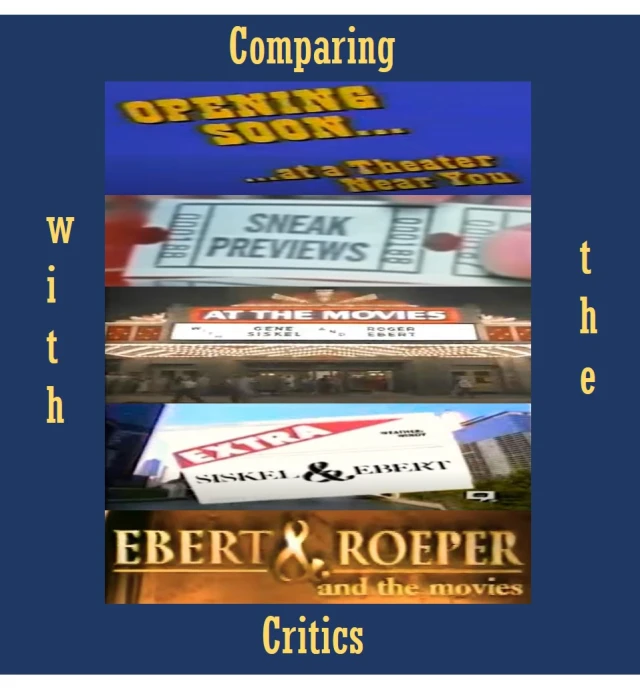
Comparing with the Critics banner created by me, Sally Silverscreen. TV show title cards created by WTTW National Productions, WTTW, Public Broadcasting Service (PBS), Lifetime Television, Tribune Entertainment, Buena Vista Television, and Disney-ABC Domestic Television

Before moving on to the next featured film in At The Movies’ ‘Best of 1984’ episode, Once Upon A Time in America, Gene tells Roger “what I love about the film is that it celebrates creativity and that is a subject that most Hollywood movies are simply not concerned with”. As I was about to disagree with Gene by bringing up RKO 281, I remembered that a) RKO 281 was an HBO made-for-TV movie and b) RKO 281 was released in 1999, a decade after Amadeus. But this review is not debating how much creativity is incorporated into Hollywood’s films, especially during the mid-80s. This article is simply an exploration of whether I agree or disagree with Roger and Gene’s thoughts on Amadeus. Earlier in this review, I mentioned how the film was an immersive, detail-oriented character study of how the music industry can be both rewarding and cruel. The movie’s immersion and focus on detail can be seen in the production’s costume and set design. These elements make the entire picture look and feel historically accurate. While Amadeus is a beautiful looking film, it also contains substance. The script provides thought-provoking material, exploring themes like how success can affect someone both positively and negatively. The glamourous and not-so-glamourous sides of the music industry are shown through the stories of both Amadeus and Antonio. Like I previously brought up in this review, Amadeus successfully argued why his opera should be performed. With everything I said, it makes me wonder how much Falco argued in favor of his song, “Rock Me Amadeus”?

This review was brought to you by

Sally Silverscreen
Take 3: Gilded Newport Mysteries: Murder at the Breakers Review

It’s been stated before on 18 Cinema Lane that my Hallmark related content is some of my most popular content. I’ve also mentioned how the mystery genre is the most popular one on my blog. Whenever Hallmark releases a mystery film through Hallmark Movies & Mysteries, that has, usually, been a recipe for success for my movie reviews. With all that said, I chose to write about the second Hallmark Movies & Mysteries film to premiere in 2024; Gilded Newport Mysteries: Murder at the Breakers! In my review of True Justice: Family Ties, I brought up how Hallmark’s newest mysteries boasted distinct identities. With Gilded Newport Mysteries: Murder at the Breakers, it is Hallmark’s first historical fiction mystery title! As I stated in my Word on the Street article about CrimeTime: Freefall, these new mystery movies from Hallmark Movies & Mysteries have the potential to start a new series. So, let’s take a carriage ride and solve a mystery, as I review Gilded Newport Mysteries: Murder at the Breakers!

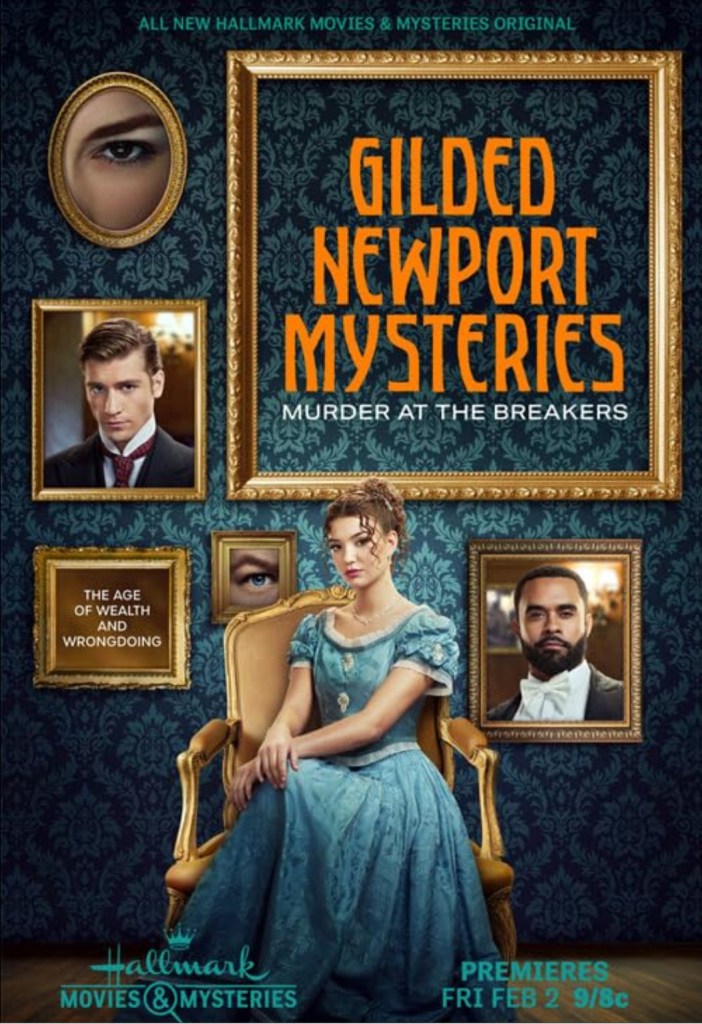
Gilded Newport Mysteries: Murder at the Breakers poster created by Front Street Pictures and Hallmark Movies & Mysteries

Things I liked about the film:

The acting: Once upon a time, Ali Skovbye starred on When Calls the Heart, portraying Abigail’s daughter, Becky. By appearing on the show, Ali was given the opportunity the work alongside various actors and actresses. While watching Gilded Newport Mysteries: Murder at the Breakers, I could tell Ali’s television experiences worked in her favor! Throughout the movie, Ali was able to maintain good on-screen chemistry and camaraderie with the other cast members! After Emma’s half-brother, Brady, is arrested, Emma visits Brady in jail. During their visit, Brady appears frightened, fear displayed in his eyes and concern woven into his speech. Not only is concern seen in Emma’s eyes, a mixture of concern and reassurance can be heard in her voice. Any time Brady and Emma interact, Ali Skovbye and James Drew Dean’s on-screen camaraderie shown through, thanks to their acting talents! In the film, Emma interacts with her friend, Harriet. Portrayed by Amira Anderson, Emma and Harriet’s friendship appears genuine, making the audience believe these characters were friends long before the events of the movie. Once again, the on-screen camaraderie worked because of Ali and Amira’s acting abilities!

The wardrobe: Attention to detail can make or break any movie, especially a historical/period film. One way attention to detail can be showcased is through the wardrobe. Emma is surrounded by elite society in Gilded Newport Mysteries: Murder at the Breakers. This social status is reflected in the characters’ attire. However, how wealthy a character is can be found in specific details. While Emma is connected to the Vanderbilt family, she doesn’t enjoy the financial benefits of being a Vanderbilt. At a debutante party, Emma wears a simple blue gown, displaying smaller details such as a lace collar, sparkly appliqués, and a little diamond necklace. Emma’s cousin, Gertrude, is also a wealthy relative. But her dress is a light pink gown covered in lace and featuring bigger puffy sleeves. Gertrude not only wore a bigger diamond necklace, she also wore a diamond tiara.

The set design: Wardrobe is not the only department where a film’s creative team can display attention to detail. In historical fiction or period specific movies, the set design can give the audience the illusion they traveled back in time. A creative team’s attention to detail can successfully pull off this illusion, as well as feature interesting design choices! In some of the homes in Gilded Newport Mysteries: Murder at the Breakers, stained-glass windows could either be seen in the background or in exterior shots. At Emma’s house, beautiful stained-glass windows featuring grapes were shown in the kitchen. Some homes also included fireplaces, boasting unique styles and designs. At Uncle Cornelius’ office, engraved wood patterns framed the fireplace. In another house, mosaic tiles surrounded the fireplace.

Hand-written letter image created by Veraholera at freepik.com. <a href=”https://www.freepik.com/free-photos-vectors/background”>Background vector created by Veraholera – Freepik.com</a>. <a href=’https://www.freepik.com/free-vector/love-letter-pattern_1292902.htm’>Designed by Freepik</a>. Image found at freepik.com.

What I didn’t like about the film:

Keeping track of who’s who: In any mystery story, there are a collection of characters. Most of these characters serve as potential suspects for the audience to speculate over. An abundance of characters were featured in Gilded Newport Mysteries: Murder at the Breakers. But some of these characters did not make frequent appearances in the film, with their names being brought up more than they were shown on screen. It should also be noted how this movie had a larger cast. All this made it difficult to keep track of who’s who.

A dialogue heavy story: Dialogue is an important component of any film. For the mystery genre, dialogue can contain clues and necessary information about the film’s case. In Gilded Newport Mysteries: Murder at the Breakers, there were few physical clues included in the story. This forced the characters to rely on dialogue to solve the mystery. The movie having a dialogue heavy story also forces the audience to pay attention to what the characters are saying. If an audience member misses one piece of dialogue, they will be confused by what is happening in the film.

A low sense of urgency: There is, typically, a sense of urgency in murder mystery stories. This is because the characters express desire to catch the guilty party quickly, in order to prevent more people from getting hurt. While there is a murder mystery included in Gilded Newport Mysteries: Murder at the Breakers, the overall sense of urgency was low. Emma’s involvement in elite society is prioritized throughout the story. The low sense of urgency in the movie also caused the story to feel a bit drawn out.

Magnifying glass image created by Freepik at freepik.com. <a href=’https://www.freepik.com/free-vector/magnifying-glass-with-fingerprint-in-flat-style_2034684.htm’>Designed by Freepik</a>. <a href=”https://www.freepik.com/free-photos-vectors/flat”>Flat vector created by Freepik</a>. Image found at freepik.com.

My overall impression:

Because Gilded Newport Mysteries: Murder at the Breakers is Hallmark’s first historical fiction mystery title, it allows the movie to stand out among the network’s other mystery programs. While this uniqueness can encourage viewers to check the movie out, the true question lies in if this uniqueness can serve a movie series. It’s unknown at this time if Gilded Newport Mysteries will inspire more than one film. But only speaking about Gilded Newport Mysteries: Murder at the Breakers, the 2024 release emphasizes style over substance. It’s obvious the creative team behind the movie cared about the presentation of their project. The finer details of the set and costume design allowed the film to feel immersive, giving the audience the illusion they traveled back in time. When it comes to the mystery itself, however, it could have been stronger. Keeping track of who’s who and a dialogue heavy story could leave some viewers confused as the movie moves along. The low sense of urgency within the story makes the film kind of feel drawn out. If there is another chapter given to Gilded Newport Mysteries, I’d like to see a crossover between Gilded Newport Mysteries and A Biltmore Christmas! Since both titles have some connection to Vanderbilt, it would be interesting to see the protagonists of both movies interacting with each other!

Overall score: 6-6.1 out of 10

Have you seen Gilded Newport Mysteries: Murder at the Breakers? Would you like to see Gilded Newport Mysteries develop into a series? Let me know in the comment section!

Have fun at the movies!

Sally Silverscreen
Take 3: Days of Heaven Review

Have you ever stumbled upon a film that was “new to you” and think, “I’ve never even heard of this”? That was my experience discovering the 1978 movie, Days of Heaven. Prior to the Legends of Western Cinema Week Blogathon, I had never heard anyone talk about the aforementioned Western. With the blogathon fast approaching, Days of Heaven crossed my path at the right time! This is my fourth year participating in the Legends of Western Cinema Week. Looking back on the programs I reviewed for the event, I realized the stories fell into one of two categories: cowboys seeking justice or some aspect of farming. While Days of Heaven belongs in the latter category, the primary perspective focuses on the actual farming. This is different from a movie like O Pioneers!, where the story’s priority was the relationships between the characters. How does Days of Heaven rank among the films I reviewed for the Legends of Western Cinema Week? Before traveling on those “happy trails”, let’s read my review!

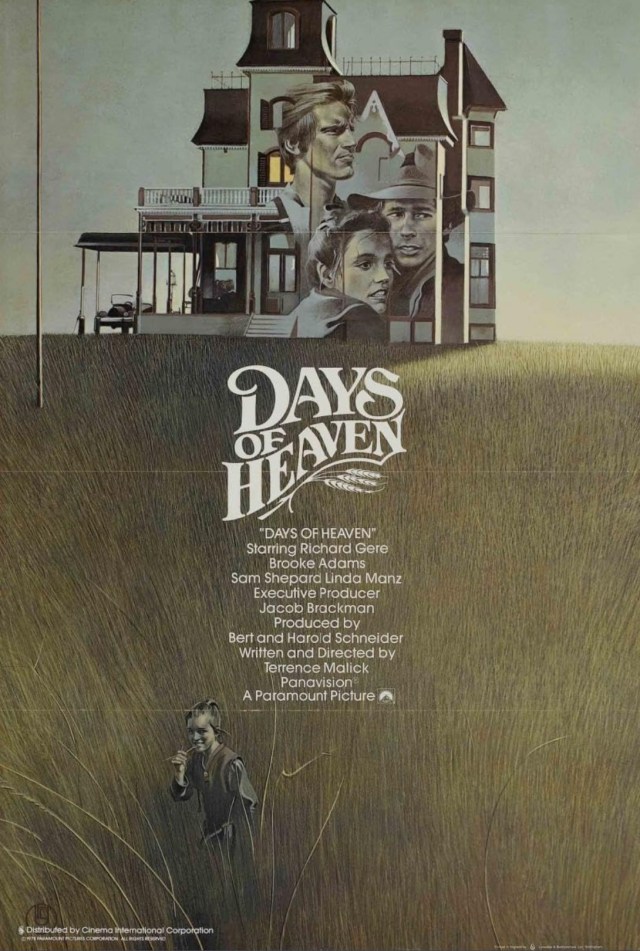
Days of Heaven poster created by Paramount Pictures

Things I liked about the film:

The scenery: The majority of Days of Heaven takes place in the wheat fields of Texas. Despite how monotonous that type of location may sound, the wheat fields offered up many glimpses of natural beauty! My favorite shot in the movie was when a storm cloud approached the story’s wheat fields. Large, gray clouds dominated the sky, appearing larger than life on screen. The presence of these clouds provided a small window into the blue sky above the fields. The golden yellow of the wheat was a pop of bright hue against the sky’s blue and gray palette. This shot was so beautifully captured, it, honestly, looked like a painting!

The historical accuracy: Days of Heaven is set in the 1910s. Like any historical period film, it’s important for the story to feel immersive due to its historical accuracy. Based on what the movie presented, the creative team behind Days of Heaven paid attention to how historically accurate their project looked! The finer details visually prove that point! In a scene where the story’s protagonists, Bill, Abby, and Linda, go swimming, their swimsuits are reflective of the clothing styles of the early 1900s. While Bill wore what would be described as a short-sleeved unitard, Linda and Abby wore swimming dresses, complete with stockings. When it came to transportation, the trains and tractors appeared to be coal powered. Even their exterior designs looked industrial, considered antique be the standards of today. The historical accuracy paired with the aforementioned scenery made Days of Heaven an appealing film to look at!

Richard Gere and Brooke Adams’ on-screen chemistry: As I mentioned in my previous point about the movie’s historical accuracy, Bill and Abby are two of the protagonists in Days of Heaven. Portrayed by Richard Gere and Brooke Adams, these characters are in a romantic relationship. When Abby and Bill are together in a romantic context, the on-screen chemistry between Brooke and Richard was sweet. It felt like the on-screen couple truly got along with one another. During their interactions, there was a gentleness shared and understood between them. Whether walking in the water or cuddling on top of a train, Abby and Bill’s relationship was pleasant to watch because of Brooke and Richard’s acting abilities. Without spoiling Days of Heaven, I will say Bill and Abby’s relationship was not consistent throughout the story. This is a shame, as I liked seeing these characters together.

Legends of Western Cinema Week 2023 banner created by Olivia from Meanwhile, in Rivendell, Heidi from Along the Brandywine, and Hamlette from Hamlette’s Soliloquy

What I didn’t like about the film:

An unclear motive: According to the film’s synopsis, Bill, his younger sister, Linda, and his girlfriend, Abby, plan to con a farmer out of his money and wheat fields. Throughout the movie, however, their motive for conning The Farmer (what Sam Shepard’s character is referred to) is not made clear. I understand Bill, Abby, and Linda don’t like working under someone’s thumb. But the man who they try to con doesn’t seem to deserve a comeuppance. In fact, The Farmer, more often than not, is respectful toward Abby, even going so far as to allow Bill and Linda to live in his house, in order to keep Abby’s “family” together. In a series of voice-overs, Linda claims The Farmer is dying of an unnamed illness. Later in the film, though, she states how The Farmer’s health is staying the same, neither improving or regressing. Yet again, it is never made clear if The Farmer’s health issues are the reason for the con. I wonder why I was supposed to care about Bill, Linda, and Abby’s conning scheme when I don’t even know why The Farmer was being conned in the first place?

A drawn-out story: Days of Heaven has a run-time of about an hour and thirty minutes. Yet the story itself was drawn-out longer than necessary. This issue was caused by establishing shots littered throughout the movie, which served as the production’s padding. I know establishing shots are meant to set up a given scene. But if the creative team of Days of Heaven had cut some of the film’s establishing shots, the run-time would have been trimmed down to about an hour and ten to twenty minutes.

Distance from characters: Through a combination of acting talent, screenwriting, and direction, a movie’s audience can not only be introduced to a character, they can also get to know that character as the story progresses. In Days of Heaven, however, it feels like the characters are kept at a distance from the audience. Sure, the characters share pieces of information about themselves. But this information only allows the audience to become familiar with them. Because of the aforementioned distance, the audience is prevented from connecting with the characters. That disconnection also prevents emotional investment in the story.

Image by Freepik

My overall impression:

The first movie I reviewed for a blogathon this year was Black Narcissus. In my review of the 1947 movie, I said that while Black Narcissus was a competently made film, it was one of the most confusing movies I’d ever seen, due to the story providing little to no explanations. I feel similarly about Days of Heaven. The film itself is very photogenic, from the scenery to the presentation of the story’s historical accuracy. But the story was confusing. No motive for why Bill, Abby, and Linda are conning The Farmer is made clear in the script. Emphasis on style over substance affected any connection the audience could have had with the characters. Throughout the movie, several questions arose that weren’t really answered, such as how The Farmer knew a group of circus performers who came to visit his home. This added to the story’s confusion. As a film, I thought it was just ok. But as a Western, it provides a perspective that is different from the typical cowboy or cattle farmer.

Overall score: 6 out of 10

Have you seen Days of Heaven? Which Westerns would you like to see me review? Tell me in the comment section!

Have fun in Texas!

Sally Silverscreen

Take 3: Hallmark Hall of Fame’s A Tale of Two Cities Review

For this year’s edition of the Broadway Bound Blogathon, I wanted to write about a Hallmark film based on a pre-existing Broadway play. My original plan was to read a play and then watch its adaptation, creating an editorial on how these works are similar or different. But, to my surprise, the films I wanted to talk about were based on plays that premiered off-Broadway. During my search for another option, I learned the Charles Dickens story, A Tale of Two Cities, was adapted into a Broadway musical in 2008. For this review, I’ve decided to write about the 1980 Hallmark Hall of Fame version of the aforementioned story. Though I haven’t read A Tale of Two Cities, I have enjoyed seeing the adaptations of Charles Dickens’ literary work. In fact, I liked 1968’s Oliver! so much, I ended up reading Oliver Twist after seeing the movie! So, where does this Hallmark Hall of Fame production stand among other stories by Charles Dickens? Turn the page on this review to find out!

Hallmark Hall of Fame’s A Tale of Two Cities poster created by Hallmark Hall of Fame Productions, Marble Arch Productions, Norman Rosemont Productions, and Columbia Broadcasting System (CBS)

Things I liked about the film:

The acting: One of the strongest scenes in A Tale of Two Cities is when Lucie (portrayed by Alice Krige) reunites with her father, Dr. Alexander Manette (portrayed by Peter Cushing), for the first time in over ten years. After mistaking Lucie as the jailer’s daughter, Alexander goes to his bed, in an attempt to avoid Lucie. As Lucie slowly approaches her father, Alexander’s voice is shaky and he is flinching, unsure of what to make of this visitor. But as soon as he discovers Lucie’s hair matches a lock of hair he kept for many years, Alexander realizes Lucie is, indeed, his daughter. Alexander’s expression changes from fear to shock, as he is in awe about seeing Lucie again. He even gives his daughter a hug. Meanwhile, Lucie is overcome with emotion, tears falling down her face and her voice quivering. Both Alice and Peter were able to effectively sell this on-screen relationship as believable and genuine. The emotions expressed felt realistic as well, which allowed this scene to be so strong!

In A Tale of Two Cities, Chris Sarandon portrays both Sydney Carton and Charles Darnay. Out of these two characters, my favorite was Sydney Carton! Throughout the story, Sydney carried himself with a laid-back confidence that made his personality appealing. Yet, more often than not, he displayed a sad look on his face. Even his eyes looked sad, giving the audience an idea of what he wasn’t saying. This made Sydney brooding and mysterious, making me want to know more about him and curious to see where his story would go. The likability of Sydney Carton can be attributed to Chris’ strong acting talents!

Attention to detail: What can make or break a historical drama is a creative team’s attention to detail. This element in the film-making process can make that story’s world feel immersive, transporting the audience to a specific period in time. The Hallmark Hall of Fame adaptation of A Tale of Two Cities takes place in the late 1700s. Jarvis Lorry’s office provides a great example of this film’s attention to detail when it comes to historical accuracy. On a nearby table, there is a large book, boasting a weathered brown cover. Rolled up paper documents and more brown covered books are scattered in the office’s foreground. In the background, Jarvis can be seen working at a desk similar to that of Ebenezer Scrooge. Though the room invites natural light through a dome shaped window, a small candle chandelier and a multi-candle candle stick provide the office with additional light.

The pacing: The Hallmark Hall of Fame adaptation of A Tale of Two Cities is two hours and thirty-six minutes. This is longer than a typical Hallmark production, which is about an hour and thirty to forty minutes. But A Tale of Two Cities never felt like a long movie to me. That’s because I was so invested in what the characters were doing, as well as the story itself. Though this is a character driven film, there was a satisfying amount of suspense, intrigue, even action. Where these elements were placed in the story made the movie feel evenly paced. The way scenes were filmed, written, and edited also contributed to the overall pace, never making parts of the story feel drawn out or wrapped up too quickly. I was so engaged watching A Tale of Two Cities, the run-time was the last thing on my mind!

The Sixth Broadway Bound Blogathon banner created by Rebecca from Taking Up Room

What I didn’t like about the film:

Inconsistent inclusion of the French Revolution: An overarching conflict in A Tale of Two Cities is the rise of the French Revolution. In the first half of the movie, this conflict seemed like an afterthought, as the primary focus was placed on events happening in England, such as Charles’ court hearing. When a certain situation causes Charles to return to France, the French Revolution played a larger role in the film’s second half. The movie’s creative team built up to the event itself, visually presenting the harsh reality of the French public versus the upper-crust of French society. However, I wish this conflict had a more consistent presence within the story.

Lack of French accents: Because the French Revolution plays a role in A Tale of Two Cities, some of the story’s key characters are French. But the 1980 Hallmark Hall of Fame presentation is one of those films where every character speaks in a British accent, despite the cultural differences. After a while, I became used to the similarity in accents. I don’t blame the actors, as all I can expect from any actor or actress is for them to try their best with the material given. In my opinion, though, I fault the movie’s casting director for not encouraging the use of French accents.

Unexplained parts of the story: On a few occasions, there were parts of A Tale of Two Cities that confused me, due to their lack of explanations. One perfect example involves Monsieur Ernest Defarge’s wife, Therese. While a man is being guillotined, Therese tells her friend she has recorded the Evrémonde family in her stitching. After this scene takes place, Therese’s statement is never clarified. In fact, that particular stitching isn’t brought up again. Parts of the story like this one should have included explanations within the dialogue.

Hand-written letter image created by Veraholera at freepik.com. <a href=”https://www.freepik.com/free-photos-vectors/background”>Background vector created by Veraholera – Freepik.com</a>. <a href=’https://www.freepik.com/free-vector/love-letter-pattern_1292902.htm’>Designed by Freepik</a>. Image found at freepik.com.

My overall impression:

Most of Charles Dickens’ adaptations I’ve reviewed on 18 Cinema Lane have garnered favorable results. Both Oliver! and Nicholas Nickelby left such a good impression on me, they respectively found a place in my year-end best movies lists! Now that I have seen A Tale of Two Cities, I can honestly say that tradition will continue! The 1980 Hallmark Hall of Fame production tells an immersive story, taking the audience on a journey through time. What also adds to the experience is the strength of the characters, as the acting and the screenwriting worked well together. From the featured props to the costume design, the creative team’s attention to detail was on full display in this film, showing the care and effort that went into this project. Looking back on A Tale of Two Cities, I can see how the story could be adapted into a Broadway musical. As a matter of fact, I think a musical movie adaptation of A Tale of Two Cities would be very interesting to watch!

Overall score: 8.9 out of 10

Have you seen any adaptations of A Tale of Two Cities? Which story Charles Dickens’ is your favorite? Let me know in the comment section below!

Have fun on Broadway!

Sally Silverscreen

A Movie Blogger Watches ‘Emily of New Moon’

For three years, I have participated in blogathons hosted by Hamlette, from Hamlette’s Soliloquy. This is because the themes of these events have been, in my opinion, creative. When Hamlette announced the We Love L. M. Montgomery Week Blogathon, I, at first, had no idea what to write about. The only story by L. M. Montgomery I was familiar with was Anne of Green Gables. But I knew that story was not the “end all, be all” when it came to L. M. Montgomery’s work. So, I wanted to select a story I had never read or seen before. In the past, I have reviewed tv shows that were new to me. These reviews have consisted of one to four episodes per article. With everything considered, I chose to review the first season of Emily of New Moon! Since I’m writing about more than a few episodes of this show, my review will be longer than my other posts about television shows. I will discuss three aspects of Emily of New Moon I like and don’t like. Then, I will share some of my thoughts on the show, similar to my “Some thoughts to consider” section of my tv show re-caps. Finally, I will provide my overall impression on the show’s first season. Since I’m talking about a whole season of Emily of New Moon, there will be spoilers in this review.

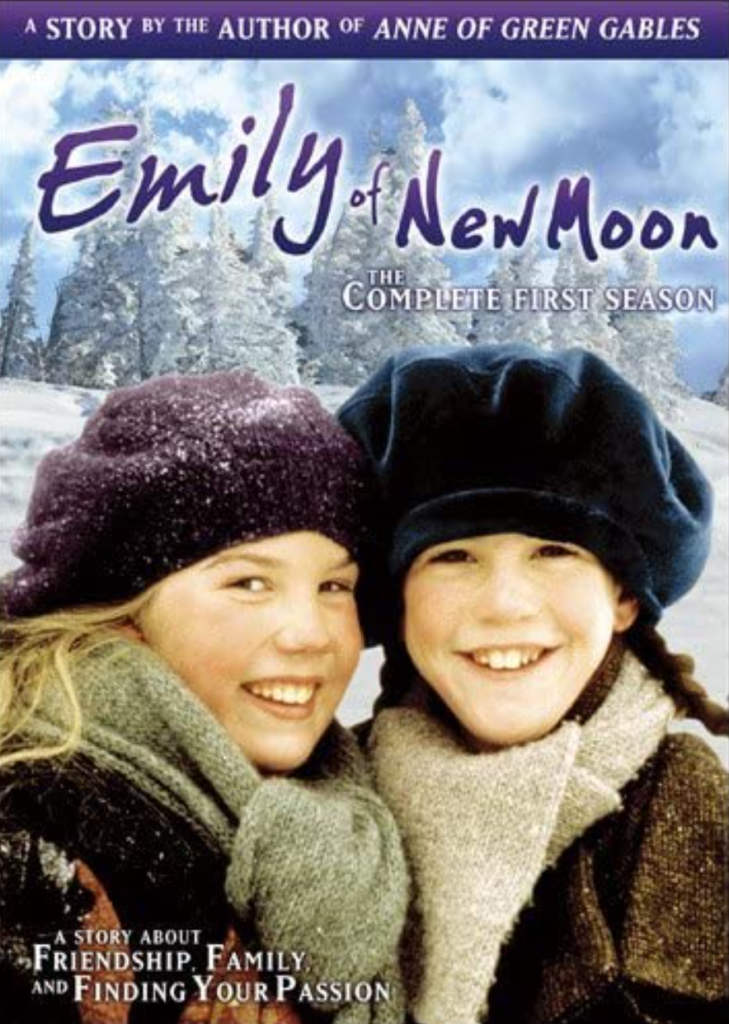
Emily of New Moon season one poster created by CINAR, Emily III Productions, Salter Street Films International, Canadian Broadcasting Corporation (CBC), and Echo Bridge Home Entertainment

What I liked about this show:

Emily, Perry, and Cousin Jimmy: As I watched Emily of New Moon, Emily, Perry, and Cousin Jimmy became my favorite characters for different reasons! When it comes to storytelling, creating a younger, precocious character can be hit or miss. This is because writers can run the risk of inventing a character that is greater than who they really are. Even though Emily has a gift for writing, she is never presented as a “genius”. Instead, Emily is simply a child who is passionate about creating stories and poems. While attempting to figure out how to break the curse in “The Disappointed House”, Ilse, Emily’s friend, suggests writing about the deceased couple as a way of immortalizing them. Despite how much Emily likes this idea, she doesn’t feel her writing is good enough to bring this idea to fruition. Within Emily of New Moon, Emily is allowed to make mistakes and learn from them. In the episode, “The Ghost of Whyther Grange”, Emily cuts her hair, as she thinks she needs a new hair-do to impress Great Aunt Nancy and Great Aunt Caroline. The hair-do turns out terrible, leaving Emily with an embarrassing result. Along with a photograph of herself with the hair-cut, she sends a portrait drawn by her friend, Teddy, and a letter explaining the situation to her Great Aunts. Through this experience, Emily learns the importance of being your authentic self as well as honesty.

While watching Emily of New Moon, Perry reminded me of Tom Thornton from When Calls the Heart. What I mean by this is Perry is more willing to work toward his goals and dreams. Perry reveals to Ilse, in “A Child Shall Lead Them”, how his father died and his mother is in prison. When he is first introduced toward the beginning of season one, the audience is given the impression Perry is running away from home. But with his backstory and how determined he is to improve his life, Perry is instead running toward his future. His desire to learn and refusal to give up are admirable qualities. Each little victory, such as choosing to attend school, feel like earned stepping stones in Perry’s journey of success!

In some stories, there is a character who serves as the “voice of reason”. This character can help others make better choices and steer them in the right direction. In Emily of New Moon, the “voice of reason” is Cousin Jimmy. He is not afraid to speak his mind. At the same time, he always has a piece of wisdom to share with those around him. One day, after school, Miss Brownell pays the Murray family a visit. During this visit, she shares with Aunt Elizabeth how Emily “misbehaved” in class. Aunt Elizabeth orders Emily to get on her knees and beg Miss Brownell for forgiveness. Cousin Jimmy, who just so happened to be in the same room, tells Aunt Elizabeth how you should only get on your knees for God. Not only did Cousin Jimmy stand up to Aunt Elizabeth, he also reminded her how there are things in this world that are greater than ourselves.

A smaller cast: I said in my review of A Room with a View how I find myself gravitating toward historical fiction/period drama stories with smaller casts. This creative decision prevents storylines from competing for attention, as there are less characters to keep track of. Emily of New Moon adopts this model of storytelling, with Emily, Aunt Elizabeth, and Aunt Laura as the main characters of the show who consistently appear in each episode. The rest of the characters are secondary, meaning their appearances are rotated in a cycle. Because the episode “The Tale of Duncan McHugh” features a character around Emily’s age, Perry makes more appearances, as he and Emily attend the same school. While Perry does appear in the next episode, “The Wild Rover”, more emphasis is given to Uncle Jimmy, as he is providing guidance to Mr. Carpenter, Blair Water School’s new teacher. Because of the smaller cast, each character’s story is told to a satisfying extent. It gives the audience a chance to truly get to know the characters!

Emily’s monologues: Because Emily is passionate about writing, each episode contains a short monologue from Emily’s perspective. These monologues are eloquently written and spoken, in the imaginative style that is consistent with Emily’s part of the story. They also relate to events that took place within a given episode. A baby is born in “Falling Angels”. This makes Emily contemplate how fragile life can be. After meeting Mr. Carpenter in “The Wild Rover”, Emily realizes how some people can come into our lives at the right place and time. Because these monologues usually take place toward the end of an episode, they add depth to the episode’s story, as well as provide departing pieces of wisdom to the audience.

Old-fashioned books image created by Macrovector at freepik.com. <a href=’https://www.freepik.com/free-vector/books-seamless-pattern_1539033.htm’>Designed by Macrovector</a>. <a href=”https://www.freepik.com/free-photos-vectors/background”>Background vector created by Macrovector – Freepik.com</a>. Image found at freepik.com.

What I didn’t like about this show:

Aunt Elizabeth: I recognize not every character is meant to be likable. A character’s unlikability can be the result of various factors. While I liked Susan Clark’s performance on Emily of New Moon, I was not a fan of her character, Aunt Elizabeth. The way she treated her family was horrid. In the very first episode, “Eye of Heaven”, Aunt Elizabeth expressed no empathy toward Emily after her father passed away. She dictates what Emily is and isn’t allowed to bring to New Moon. Aunt Elizabeth even throws Emily’s cat, Pandora, out of their carriage and leaves the cat on the side of the road to fend for herself. As the story progresses, Aunt Elizabeth does change some of her rigid ways. However, it seems like she wants to have her cake and eat it too. What I mean by this is, Aunt Elizabeth wants to continue controlling her household in a strict manner, yet is surprised when her family and even people not related to the Murray family turn on her as well as stand up to her. By the end of the first season, Aunt Elizabeth appears to be trying to turn over a new leaf. If I had to be honest, though, I’m not getting my hopes up.

Inclusion of ghosts and the supernatural: In the second episode, “Storms of the Heart”, Uncle Jimmy shares with Emily how her great-great grandmother had “the second sight”. This means she, as well as Emily, are able to see and communicate with spirits from the afterlife. The inclusion of ghosts and the supernatural provided a unique aspect to Emily of New Moon’s story, compared to L. M. Montgomery’s series, Anne of Green Gables. But the way this aspect was incorporated into the show was inconsistent and, as a result, confusing. The episode, “The Disappointed House”, included a curse on the titular location, an abandoned house built for a man and his fiancé. Due to a misunderstanding involving Aunt Laura, Emily’s second aunt, the man and his fiancé separate before ultimately passing away. After Emily finds a letter addressed to Aunt Laura and gives it to her, the couple is reunited in the afterlife, which lifts the curse. Three episodes later, in “Falling Angels”, Emily sees the spirit of a child wearing a red snowsuit. No explanations about who this child is or why Emily sees the child are provided.

Inconsistent storytelling: When I discussed the inclusion of ghosts and the supernatural on Emily of New Moon, I brought up how the delivery of this aspect was inconsistent. That’s not the only inconsistent part of the story, in my opinion. There are times when a secondary character is introduced in an episode, then disappears after that episode and isn’t heard from again. Duncan, a peer of Emily’s, goes to school for the first time in the episode, “The Tale of Duncan McHugh”. The very next episode, “The Wild Rover”, primarily takes place at Blair Water School. Yet, Duncan is nowhere to be found. At the end of “The Tale of Duncan McHugh”, Aunt Elizabeth agrees to make amends with Duncan’s mother, as they were friends in the past. Similar to Duncan, Duncan’s mother is never brought up again.

Canada postage stamp image created by Ibrandify at freepik.com <a href=’https://www.freepik.com/free-vector/canadian-flag-stamp-template_836872.htm’>Designed by Freepik</a> <a href=”https://www.freepik.com/free-photos-vectors/template”>Template vector created by Ibrandify – Freepik.com</a> Image found at freepik.com

Some thoughts to consider:

Why did Emily’s dad and Aunt Elizabeth not want Emily to read novels? I feel like the closest thing to an explanation provided in this season was Aunt Elizabeth believing novels were “fantastical”. To me, this wasn’t a satisfying answer. However, I did find the dissuasion of novels from both Emily’s dad and Aunt Elizabeth an interesting coincidence.

Out of all the episodes in season one, “Paradise Lost” was my least favorite. From a creative perspective, I can see what the show’s creative team was trying to accomplish; showcasing how some people are not who they seem. Compared to other stories with a similar concept, “Paradise Lost” was underwhelming. Personally, I didn’t feel like a conflict was resolved, especially in a way that felt satisfying. The inclusion of Lofty John’s mother’s spirit added to the inconsistency of ghosts and the supernatural.

In the 1990s, it seems like almost every scripted television show created at least one Christmas episode. So, I was surprised to discover Emily of New Moon didn’t acknowledge Christmas. Granted, I’ve only seen the first season of this show. Maybe a Christmas episode was created in another season?

The We Love L. M. Montgomery Week banner created by Hamlette from Hamlette Soliloquy

My overall impression:

I’d like to take the time to thank Hamlette for hosting the We Love L. M. Montgomery Week Blogathon. Because of this event, I was given the opportunity to check out Emily of New Moon! This is the first time I reviewed a full season of any television show, so this event also allowed me to have a new blogging experience! Looking back on Emily of New Moon, I am impressed with what I saw! Even though the show does have its flaws, I believe the overall production is solid! Each acting performance was strong, bringing to life characters the audience could become acquainted with as each episode carried to the next. The show’s historical accuracy gave viewers the illusion traveling back to a different time was possible. Having a smaller cast worked in the show’s favor, as it allowed each story to be told to a satisfying extent. Since I enjoyed watching season one, I do plan on checking out season two! Who knows? Maybe I’ll read L. M. Montgomery’s Emily trilogy someday?

Rating: A 4 out of 5

Have fun in New Moon!

Sally Silverscreen
Take 3: A Room with a View Review

My approach to February’s Genre Grandeur is similar to my approach for last month’s blogathon. As the theme this time around is ‘movies that take place or feature Italian settings’, I could have selected one of several Hallmark productions where Italy serves as the story’s backdrop. Instead, I overlooked the realm of Hallmark for a movie that happened to be on my DVR; 1985’s A Room with a View! When I discovered the film’s protagonist, Lucy, travels to Florence, Italy, I knew it would the perfect selection for this month’s Genre Grandeur. Because my choices for 2023’s blogathon have, so far, featured a female protagonist traveling abroad (A Room with a View and Black Narcissus), I saw this is as a very interesting coincidence. In my review of Black Narcissus, I thought the 1947 film was just ok, as the movie emphasized style over substance. Did I feel the same way about A Room with a View? Take a trip through this review to find out!

A Room with a View poster created by
Merchant Ivory Productions, Goldcrest Films, FilmFour International,
Curzon Film Distributors, and Metro-Goldwyn-Mayer

Things I liked about the film:

Interactions between characters: A Room with a View is an ensemble film, with the actors and actresses coming from all walks of life and journeys in their careers. The characters reflect this idea, as they travel to Italy for various reasons. Because of everything I just said, it was interesting to see each interaction between the characters unfold. One of the funniest scenes was shared between Charlotte, portrayed by Maggie Smith, and Eleanor, portrayed by Judi Dench. Eleanor is a writer, a woman who adopts a more romantic view of the world. Meanwhile, Charlotte is more of a realist, someone who views the world through a practical lens. As they explore Florence, Eleanor encourages Charlotte to breath in the scent of the city, in an attempt to make the most of their traveling experience. Instead, Charlotte puts a handkerchief over her nose, as she and Eleanor just walked past a group of smokers. Due to the screenwriting, as well as Judi’s and Maggie’s performance, this scene elaborates my aforementioned points!

The scenery: As I stated in the introduction, I chose to review A Room with a View because of Lucy’s trip to Florence. Therefore, my discussions about the movie’s scenery will focus on the Italian background. Toward the beginning of the film, Lucy visits a cathedral. In the interior of this massive structure, the main hall is surrounded in light gray stone. Symmetrical stone columns with matching hue and carved designs burst from the cathedral’s high ceiling. Filled with giant statues, a sprinkling of candles, and artwork within the cathedral’s alcoves, the large scale of this space was captured well through various camera angles!

During Lucy’s trip, she and several tourists visit Florence’s countryside. While enjoying their picnic, the characters sit on rolling green hills, coated in varying shades of green. Trees proudly stood among the guests, joining their event from a distance. A few red-orange poppies poked out of the sea of grass, providing the landscape with a pop of bright color. Wrapped up in a clear, sunny sky, Florence’s countryside looked postcard perfect!

Lucy’s wardrobe: Since this was my first time watching A Room with a View, I had no expectations when it came to Lucy’s wardrobe. But as the story progressed, I found myself adoring Lucy’s attire, as it was classy and elegant! An excellent example is what Lucy decided to wear to her piano recital. Lucy wore a cream-colored gown with puffed lace sleeves. The scooped neckline was surrounded by embroidered flowers. Sparkles covered the bodice of the dress, providing just enough twinkle. Paired with a jeweled belt, Lucy’s gown was simply beautiful!

Italian countryside image created by Bill Silvermintz at freeimages.com. “FreeImages.com/Bill Silvermintz.” Photo by <a href=”/photographer/edudflog-58908″>Bill Silvermintz</a> from <a href=”https://freeimages.com/”>FreeImages</a&gt;.

What I didn’t like about the film:

The drawn-out story: A Room with a View’s primary focus was Lucy’s growing attraction for George, who she met on her trip to Florence. But alongside that part of the story were situations involving the other characters from this ensemble. These situations were competing against one another for the audience’s attention. One situation happened after Lucy came home to England. She tries to recruit some of the trip’s guests to stay in a local cottage. Her fiancé, Cecil, recruits guests to the cottage, who just so happen to be George and his father. However, the emphasis on the cottage’s status is one of the reasons why Lucy’s attraction for George isn’t resolved until the last forty minutes of the movie. Because of these things and the film’s two hour run-time, the story itself felt drawn out.

Lack of on-screen chemistry: Helena Bonham Carter and Julian Sands, the actors who portrayed Lucy and George, did a good job with the material they were given. But when their characters were interacting together, I didn’t feel a strong sense of on-screen chemistry. A reason why is because of how infrequently George and Lucy crossed paths. Within the film’s first forty minutes, Lucy and George spend time together in about two or three scenes. Shortly after those first forty minutes, Lucy becomes engaged to Cecil, a character who a) was never brought up during the Florence trip and b)didn’t appear on screen until forty minutes into the film. Even after the engagement, George and Lucy’s time together isn’t consistent. This resulted in the missed opportunity to watch this relationship grow over time.

The title cards and on-screen text: At various moments in A Room with a View, title cards announced when a character was about to do something. On-screen text would sometimes replace these title cards. One example takes place when Lucy and several tourists travel to Florence’s countryside. Before their excursion, white text appeared on the screen, explaining what they were about to do. I was not a fan of this creative decision because these title cards and on-screen text told the audience what they could see or figure out for themselves. This creative decision was also not consistently featured in the movie.

Hand-written letter image created by Veraholera at freepik.com. <a href=”https://www.freepik.com/free-photos-vectors/background”>Background vector created by Veraholera – Freepik.com</a>. <a href=’https://www.freepik.com/free-vector/love-letter-pattern_1292902.htm’>Designed by Freepik</a>. Image found at freepik.com.

My overall impression:

When it comes to A Room with a View’s style, this movie excels! It’s a pretty looking film, as the scenery, set design, and even Lucy’s wardrobe made the production pleasant to the eye. But when it comes to the substance, the film falls short. I didn’t find the story compelling, which is caused by the story itself being drawn out. I also did not sense strong on-screen chemistry between Helena Bonham Carter and Julian Sands. The more historical fiction/period drama media I consume, I find myself, more often than not, gravitating toward stories whose casts are smaller. This creative decision prevents the stories from competing for attention, as there are less characters to keep track of. Because A Room with a View contained an ensemble cast, there were so many ideas brought up and so few time to address it all. As the saying goes “time flies when you’re having fun”.

Overall score: 6.1 out of 10

Have you seen A Room with a View? Do you prefer movies with bigger or smaller casts? Please tell me in the comment section below!

Have fun on your travels!

Sally Silverscreen