Take 3: Dr. Terror’s House of Horrors (1965) Review

I’d like to thank Gill (from Realweegiemidget Reviews) and Barry (from Cinematic Catharsis). If it wasn’t for the hosts of The Hammer-Amicus Blogathon V, I wouldn’t have been introduced to the cinematic world of Hammer-Amicus. Since my introduction in 2021 (when I participated in my first Hammer-Amicus Blogathon), I’ve covered three Hammer-Amicus movies on 18 Cinema Lane; Vampire Circus, The Curse of Frankenstein, and Let Me In. While Vampire Circus was ok and Let Me In was just fine, I found The Curse of Frankenstein underwhelming. Now, with a recommendation from Barry (from Cinematic Catharsis), I’ve selected 1965’s Dr. Terror’s House of Horrors as the next Hammer-Amicus presentation to review! I knew almost nothing about this movie prior to choosing it for the blogathon. But I was willing to watch the film with an open mind. Since I finally checked out Dr. Terror’s House of Horrors, it’s time to start my review and share my honest opinion!

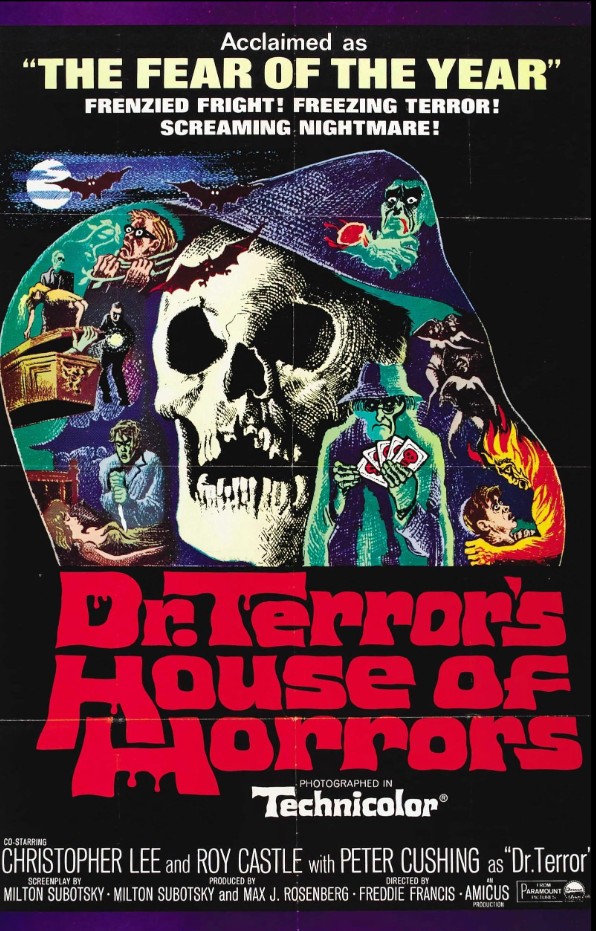
Dr. Terror’s House of Horrors (1965) poster created by Amicus Productions, Hollywood Classics International, Regal Films International, and Paramount Pictures

Things I liked about the film:

The interior design: Dr. Terror’s House of Horrors is presented like an anthology; five passengers learn their fate from Dr. Terror himself. Throughout the film, the audience takes a peek into each character’s life as well as their living/working space. These spaces featured interesting design choices that gave them their own distinctness. In the segments titled “Werewolf” and “Disembodied Hand”, a fireplace was the focal point in one room. The fireplace in “Werewolf” was covered in a glossy black paint, while the fireplace in “Disembodied Hand” shone in a glossy blue paint. Biff Bailey’s apartment in the segment titled “Voodoo” featured a zebra patterned couch, which actually complimented the black-and-white checkered floor and black-and-white striped walls. The design choices I described stood out due to the film’s creative team utilizing materials, patterns, and colors that were more unique. I can honestly say I’ve never seen a blue fireplace until I saw Dr. Terror’s House of Horrors!

Incorporation of music: In the segment titled “Werewolf”, Jim Dawson learns about a legendary werewolf buried in the basement of the home he’s remodeling. Any time this werewolf is brought up or poses a threat to the characters living and working in the home, drumbeats, the pattering of a xylophone, and other suspenseful musical sounds can be heard. This segment utilized music to emphasis the fear factor the werewolf contributed to the story. Because Biff Bailey is a musician, music plays a large role in the “Voodoo” segment. One of the songs featured in this specific segment is ‘Give Me Love’. Performed by Sammy Coin (portrayed by Kenny Lynch), the instrumentals provided a cheery jazz tune that can put any listener in a good mood. Kenny’s smooth vocals not only complimented the song itself, but also made me wonder what his vocals would sound like in a song with a more serious tone. ‘Give Me Love’ is one of those songs that is so memorable, I’ll listen to it long after the end of the movie!

The creativity of each story: As I mentioned earlier in this review, Dr. Terror’s House of Horrors is presented like an anthology. With the segments chronicling each of the five passengers, the creativity woven into the script highlighted the uniqueness every passenger brought to the train car! The segment, “Disembodied Hand”, revolves around Franklyn Marsh. An art critic who took his job a little too seriously, Franklyn carries guilt for how he mistreated a popular artist, with his guilt represented by the disembodied hand of that artist. Meanwhile, in the segment titled “Vampire”, Dr. Bob Carroll is confronted with the possibility his wife may be a vampire. This concept gave Bob an internal conflict between loving his wife and protecting his patients. In my review of 2010’s Let Me In, I said vampire stories can be as creative as film-makers want it to be. A similar statement can be said about the horror genre, with Dr. Terror’s House of Horrors presenting strong evidence.

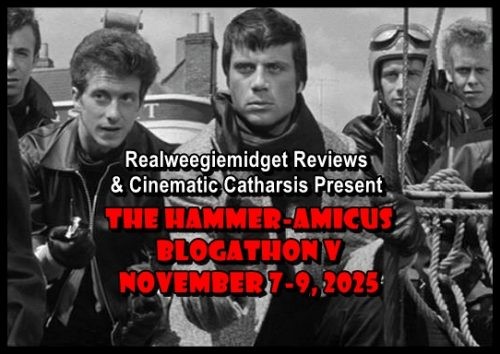
The Hammer-Amicus Blogathon V banner created by Gill from Realweegiemidget Reviews and Barry from Cinematic Catharsis

What I didn’t like about the film:

No clear explanation for tarot cards: Throughout Dr. Terror’s House of Horrors, Dr. Terror (portrayed by Peter Cushing), predicts each passenger’s fate by selecting tarot cards. While the tarot cards themselves are shown on screen, no clear explanation for how exactly the cards correlate with the fates was given. Before the start of the “Werewolf” segment, Dr. Terror selects two cards called “Enchantress” and “Priestess”. But after watching that segment, I was confused by what werewolves had to do with those aforementioned cards? It seemed as if the creative team behind the movie assumed their audience would already know the meaning of the cards shown in the film.

Limited sense of urgency: Each segment in Dr. Terror’s House of Horrors incorporates a horror element that poses a threat to the passengers in Dr. Terror’s train car. These segments also contain a limited sense of urgency. Most of the time, the “slice of life” parts of the story were emphasized. When a suspenseful or horrifying moment was about to happen, the segment would end and move on to the next one. This flaw was the result of squeezing five separate stories into an hour and thirty-eight-minute film. I honestly think this script would have worked better as an anthology television series.

A frustrating ending: For this part of my review, I will be spoiling Dr. Terror’s House of Horrors. If you have not seen this film and are planning on watching it, skip ahead to the part of my review titled “My overall impression”.

Like I mentioned earlier in my review, Dr. Terror uses tarot cards to predict the fates of the five passengers. After these fates are revealed, he removes the death card from the deck. This implies all the passengers will eventually die. When the passengers get off the train, they learn through a newspaper article five passengers died in a train crash. That detail clarifies the passengers from Dr. Terror’s train car did, indeed, die, with Dr. Terror himself becoming a skeleton. Personally, I found this ending frustrating because it made the previous stories amount to nothing. While I recognize the movie’s creative team was trying to create the ultimate plot twist, with the death tarot card used as foreshadowing, this creative decision almost made me feel like I wasted my time watching Dr. Terror’s House of Horrors.

Scared audience image created by Katemangostar at freepik.com. <a href=’https://www.freepik.com/free-photo/terrified-friends-watching-horror-movie-in-cinema_1027311.htm’>Designed by Freepik</a>. <a href=”https://www.freepik.com/free-photos-vectors/people”>People image created by Katemangostar – Freepik.com</a>. Image found at freepik.com.

My overall impression:

Whenever I review a movie on 18 Cinema Lane, I present my opinion as honestly as possible. In my most honest opinion, Dr. Terror’s House of Horrors was such a mixed bag. On the one hand, I appreciate the creativity woven into each of the five segments. This creativity brought distinctness to the stories, interesting interior design choices, and good incorporation of music. But, on the other hand, the ending was too frustrating for my liking. I wish the script provided clear explanations for how the tarot cards correlated with each character’s fate. I also wish there was a stronger sense of urgency throughout the film. At best, Dr. Terror’s House of Horrors was just ok. But, at worst, it left me confused and frustrated. Though I’ve only seen (and reviewed) a few Hammer-Amicus films, I’m starting to wonder if I’ll find a title that is my cup of tea?

Overall score: 6 out of 10

Have you seen Dr. Terror’s House of Horrors? Which Hammer-Amicus film would you like to check out? Please tell me in the comment section!

Have fun at the movies!

Sally Silverscreen

Take 3: Vertigo (1958) Review

Alfred Hitchcock is a man who needs no introduction. Director by choice and legend by chance, Alfred has single-handedly become a house-hold name in the world of cinema. While I have seen (and reviewed) some of his films, there are still plenty of titles I have yet to see. One of those films was 1958’s Vertigo, which was recommended by Charity from The Sacred in the Secular! This is a movie I had been meaning to write about for a while. With The 3rd Master Of Suspense Blogathon on its way, I found a great time to finally review Vertigo! As I already mentioned, I have reviewed some of Alfred’s films. While I still think Strangers on a Train is his best movie, The 39 Steps is one of my least favorite. Now, the time has come to share my thoughts on Alfred Hitchcock’s 1958 presentation!

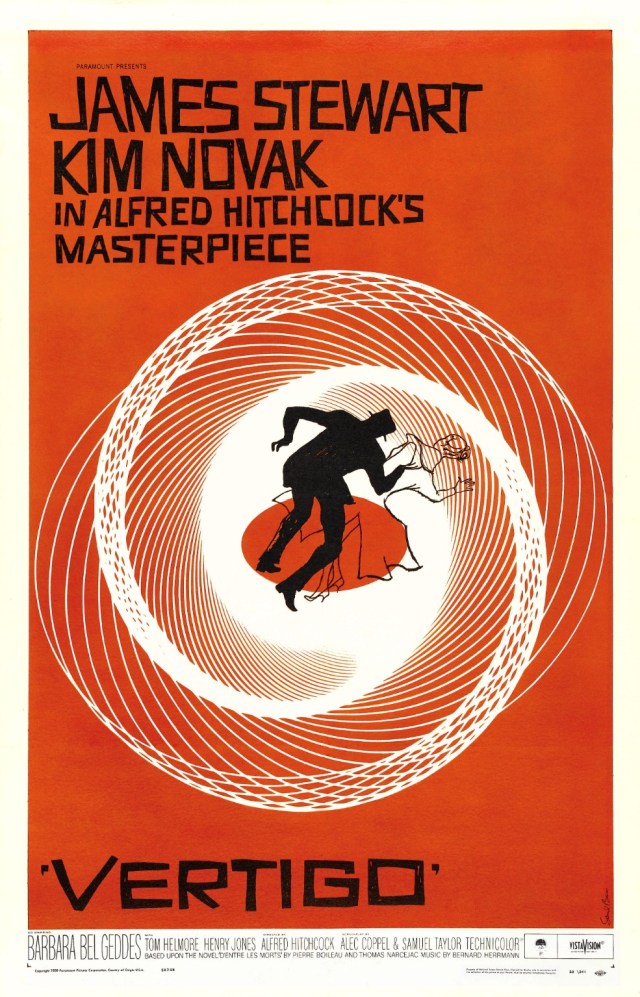
Vertigo (1958) poster created by Alfred J. Hitchcock Productions and Paramount Pictures

Things I liked about the film:

The use of music: Music can be a powerful film-making tool. Through a combination of sound, instrumentals, and even lyrics, music can elevate a scene’s mood, foreshadow parts of the story, or emphasize events happening in a scene. In Vertigo, music was utilized to compliment a scene’s given mood. A perfect example is when Scottie follows Madeleine to a flower shop. While he walks through a flower shop’s storage room, suspenseful orchestral music builds up to the moment Scottie reaches the flower shop’s door. This type of music acknowledges Scottie’s fear of the unknown, as he doesn’t know what he’ll find on the door’s other side. But once he opens the door, he discovers Madeleine is in a flower shop, purchasing a bouquet of flowers. This discovery causes calming, orchestral music to play in the background, stressing how Madeleine and the shop itself are nonthreatening to Scottie.

Incorporation of culture: The mystery in Vertigo revolves around Madeleine being obsessed with a woman named Carlotta Valdes. Scottie follows clues from art and local history in an attempt to solve the mystery. The “local history” in this movie is a fictionalized version of San Francisco’s history. However, the blending of these aforementioned cultural elements gave Vertigo a unique identity from other Hitchcock productions. The creative team’s incorporation of culture can also spark thought-provoking analysis about how culture can influence or even solve mysteries. As someone who reviews mystery films and even has a series called Sally Solves a Mystery, this aspect of Vertigo has made me look at the subject of mysteries somewhat differently.

The set design: There was some impressive set design in Vertigo! One of my favorite examples is Gavin’s office. Wood paneling covers every wall. The entire floor is covered in red carpeting, which actually compliments the wood paneling. A large, dark wood desk with intricate detailing becomes the showstopper of the space! Other design choices, such as a large model of a ship, red chairs, and a huge window overlooking the cargo ship dock emphasize Gavin’s importance in the company he inherited. Artwork and photographs covering every wall presents a glimpse into Gavin’s artistic taste.

The 3rd Master Of Suspense Blogathon banner created by Maddy from Classic Film And TV Corner

What I didn’t like about the film:

Questions left unanswered: For this part of my review, I will spoil Vertigo. If you have not seen this movie and are planning on watching it, skip to the part titled ‘The underutilization of Barbara Bel Geddes’.

After Madeleine dies, Scottie meets a woman named Judy, believing she looks like his deceased love. Shortly after Judy and Scottie meet for the first time, she writes a letter and confesses being Madeleine. In the letter, Judy claims parts of the story she and Gavin told Scottie were true. But she never specifies which parts of their story they were honest about. The creative team’s decision to leave questions unanswered frustrated me. This is because I was curious to see how the mystery of Madeleine’s psychological connection to Carlotta Valdes would be resolved.

The underutilization of Barbara Bel Geddes: In Vertigo, Barbara Bel Geddes portrays Marjorie ‘Midge’ Wood. A designer who is passionate about art, Midge was engaged to Scottie in the past. Even though their engagement didn’t last, they remain on friendly terms. Barbara’s on-screen chemistry with James was pleasant. Her performance effectively sold the idea Midge was good friends with Scottie. This made me hope Scottie and Midge would work together to solve Vertigo’s mystery. But that did not happen because Barbara was only in a handle of scenes. I think Midge is an interesting character, so this creative decision disappointed me. Not giving Barbara more material to work with was, in my opinion, a missed opportunity.

An unsolved mystery: For this part of my review, I will, once again, spoil Vertigo. If you have not seen this movie and are planning on watching it, skip to the part titled ‘My overall impression’.

At the beginning of Vertigo, Scottie is asked by Gavin to solve the mystery of why Madeleine is obsessed with a woman named Carlotta Valdes. This obsession gets to the point where Madeleine goes to places she has no memories of visiting. Because of how the fictionalized San Francisco culture and supernatural elements were combined in the mystery, I was curious to see how the mystery would be resolved. But, about halfway through Vertigo, Madeleine dies. Shortly after Madeleine passes away, the mystery of Judy’s identity begins. By the end of the movie, this new mystery is solved. If the screenwriters knew their script would contain more than one mystery, they should have resolved the first mystery before moving on the next one. The creative team’s decision to abandon Madeleine’s mystery left several questions unanswered.

Art tools image created by Freepik at freepik.com. <a href=’https://www.freepik.com/free-vector/flar-art-tools-pack_835368.htm’>Designed by Freepik</a>.  <a href=”https://www.freepik.com/free-photos-vectors/paint”>Paint vector created by Freepik</a>. Image found at freepik.com.

My overall impression:

Have you ever watched a movie where you found yourself deceived by the movie’s end? That’s how I felt after watching 1958’s Vertigo. Without spoiling the movie, I will say how even though the story contained two mysteries, only one of them is solved. This is one of the reasons why the script left questions unanswered. I also didn’t like how Barbara Bel Geddes’ acting talents were underutilized. However, there were aspects of Vertigo I liked. The film’s creative team displayed an understanding for how to effectively utilize music. Incorporating culture into the story gave Vertigo a unique identity among Hitchcock’s collection of films. I was impressed by the movie’s set design as well. But when it comes to titles created by Alfred Hitchcock, especially those starring James Stewart, I think Rear Window is stronger than Vertigo. Not only was the talent of Rear Window’s cast well utilized, the mystery was solved as well as prioritized.

Overall score: 6.5 out of 10

Have you seen Vertigo? Which film of Alfred Hitchcock’s is your favorite? Let me know in the comment section below!

Have fun at the movies!

Sally Silverscreen

Take 3: Orca (1977) Review

When I participated in the first ‘Favorite Stars in B movies’ Blogathon two years ago, I reviewed the 1963 film, The Raven. I found Vincent Price’s picture to be a fine, likable one, which left me amazed how a simple story from Edgar Allan Poe could be turned into a feature presentation. For this year’s Third ‘Favorite Stars in B movies’ Blogathon, there were plenty of movies from Vincent Price’s filmography for me to choose from. But this time, I decided to go in a different direction. As I looked back at the history of my blog, I came to realize none of Richard Harris’ films have been covered on 18 Cinema Lane. I also remembered how the 1977 movie, Orca, was recommended to me by Eric Binford (from Diary of a Movie Maniac). With these two facts in mind, I found the perfect title to write about for the Third ‘Favorite Stars in B movies’ Blogathon! When Eric suggested Orca to me, he said the film steals from Jaws. Because I’ve seen the 1975 blockbuster, I imagined Orca to be a knock-off/rip-off of the iconic movie. But is the 1977 picture a copy of Jaws? Let’s dive into this review and find out!

Orca (1977) poster created by Famous Films (II), Dino De Laurentiis, and Paramount Pictures

Things I liked about the film:

Richard Harris’ performance: Because Richard Harris is one of the reasons why I chose to review Orca, I will now take the time to highlight his performance. In the 1977 movie, Richard portrays Captain Nolan, a fisherman who desires catching a whale in order to receive a large sum of money. His versatile acting abilities helped create a multi-layered character, one that is both tragic and complicated. After killing a pregnant whale, Nolan is very remorseful of his actions. One evening, he confides with Rachel Bedford (portrayed by Charlotte Rampling) over how he’d apologize to the dead whale’s mate. During this confession, Nolan adopts a somber look on his face, his eyes on the verge of tears. He even boasts a long frown. Nolan’s tone of voice is serious, sounding like he’s pleading for forgiveness. This one exchange presents a perfect example of Richard using his acting talents to bring his character to life!

An introduction to Orca Whales: Toward the beginning of the movie, Rachel Bedford lectures a group of students (and the film’s audience) about Orca Whales. This lecture is packed with information, from an explanation of the word ‘orca’ in Latin to showing a picture of an Orca fetus. On Captain Nolan’s boat, Annie (portrayed by Bo Derek) shares with Nolan how Orca Whales stay with their mate for life. He even receives a book from Rachel about whales in mythology. While some of the movie’s information may be dated (due to what’s been discovered about Orcas since the film’s release), it does provide an introduction to Orca Whales. Including this information into the script feels like the creative team made an effort to educate their audience.

Tonal variety in music: One of the most iconic pieces of music in film history is the theme from Jaws. John Williams’ score and the image of the titular shark sneaking up on its victims created a perfect, memorable combination. But compared to Orca, this piece of music seems to sensationalize the shark itself, as the suspenseful tune is the only music heard whenever the shark comes around. The first shot of the 1977 picture shows a group of Orcas swimming in their natural habitat. Peaceful, orchestral music plays in the background anytime whales are, simply, gliding from place to place. The only time suspenseful music is heard is when the titular Orca is causing chaos and destruction. This creative choice emphasizes how the whale has been provoked. Tones between different pieces of music show that while Orca Whales can have dangerous behavior, they can also be a great source of fascination.

The Third ‘Favorite Stars in B movies’ Blogathon banner created by Brian from Filmsfrombeyond.com

What I didn’t like about the film:

Inconsistent voice-overs: In Orca, Rachel narrates what is happening in the story. I actually liked this creative decision, especially since she was one of the most educated characters when it came to Orca Whales. What I didn’t like was how Rachel’s voice-overs were inconsistent. In fact, she only narrated about three times throughout the one hour and thirty-two-minute film. Had these voice-overs been more consistent, they could have been used as a bridge between scenes.

The underutilization of Will Sampson: Another reason why I wanted to review Orca is Will Sampson’s involvement in the project. After seeing One Flew Over the Cuckoo’s Nest and The White Buffalo, I was looking forward to watching another movie from Will’s filmography. When I finally checked out Orca, I was disappointed by how Will’s acting talents were underutilized. Not only did he appear in the film for a limited amount of time, he also received very few lines in the script. I, honestly, wish Will’s character, Jacob, had played a larger in the story, especially since he shared great insight about Orca Whales.

Limited character development: The story of Orca primarily revolves around the battle between the titular whale and Nolan. Because of this creative decision, Nolan becomes the only (human) character to receive character development. Other characters are simply known by their profession or an experienced scenario. Rachel is characterized as the scientist who is educated about Orca Whales. Annie is known as the lady who broke her leg. I understand there is only so much story to tell in one hour and thirty-two-minutes. However, I still believe a little more character development should have been included in the script.

Orca Whale image created by Freepik at freepik.com. Label vector created by freepik – www.freepik.com. Image found at freepik.com.

My overall impression:

In the introduction of my review, I said I imagined Orca to be a knock-off/rip-off of Jaws. But now I have seen the 1977 picture, calling it that does the film a disservice. I never got the impression Orca’s creative team was intentionally trying to copy the 1975 blockbuster. Instead, the film serves as a cautionary tale of how one’s actions toward animals and their natural environment have consequences. As I said in my review, including information about Orca Whales into the script feels like the creative team made an effort to educate their audience. This is different from Jaws, where (as far as I remember) education about sharks was far and few between. With that said, I wonder what would have happened if Orca had received anywhere near as much attention as Jaws? On the one hand, society’s perspective and treatment of Orca Whales may have changed much sooner. More knowledge and awareness may have already been reached before the 21st century. But, seeing how much merchandising and commercialism Jaws has produced in a fifty-year timespan, maybe Orca’s intended message would have gotten lost among the shuffle.

Overall score: 6 out of 10

Have you seen Orca? What are some of your favorite films with animals in title roles? Let me know in the comment section!

Have fun at the movies!

Sally Silverscreen
Take 3: The Garage (1920) Review (Silent Pioneers Double Feature Part 1)

Before participating in the Silent Pioneers Blogathon, I had only seen, and even reviewed, four projects from Buster Keaton’s filmography. To, kind of, make up for lost time, I chose to review The Garage for the event. The other reason why I selected this movie was because it was recommended by Lea S. from Silent-ology. I will admit silent films are rarely covered on 18 Cinema Lane. In the seven years my blog has existed, I’ve only reviewed seven silent film titles. The last time I wrote about a silent picture was 1920’s Pollyanna back in 2021. So, reviewing another silent movie has been long overdue. So far, my experience with silent films has been pretty positive. But will that change with The Garage? Keep reading my review to find out!

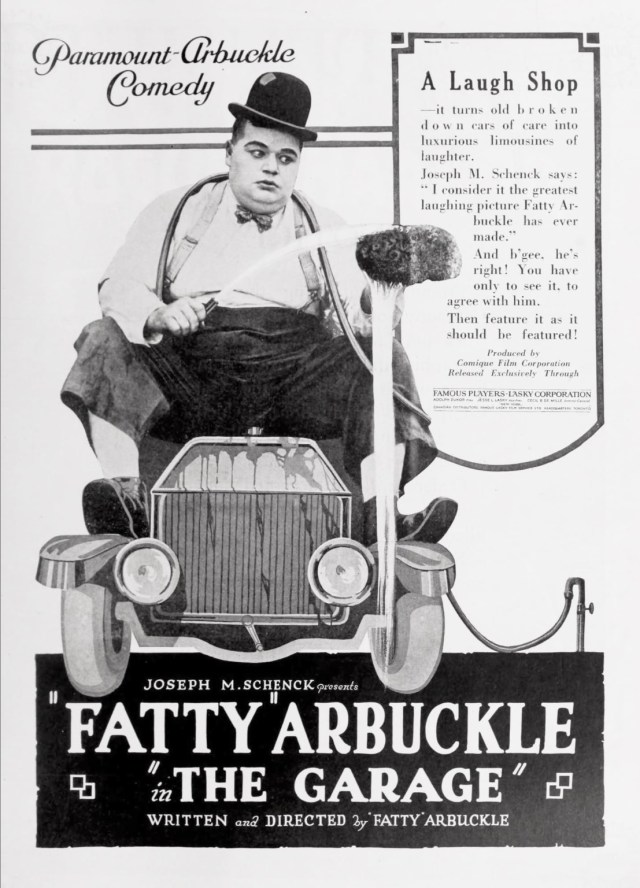
The Garage (1920) poster created by Comique Film Company and Paramount Pictures

Things I liked about the film:

The acting: In silent films, actors and actresses heavily rely on facial expressions, emotions, and body language to show what their characters are thinking and feeling. While on-screen text can help elaborate what is happening on screen, the way actresses and actors appear in a silent film can show what can’t be said. At the beginning of The Garage, Roscoe ‘Fatty’ Arbuckle is upset Buster Keaton made a car he just washed dirty. He gestured toward the spot of dirt on the car by repeatedly pointing toward it. Roscoe ‘Fatty’ Arbuckle even has a frown on his face, emphasizing how upset he is. Later in the film, Buster is chased by a dog. When he gets stuck in a fence, he appears scared as the dog is ripping up his pants. Fear is in Buster’s eyes as he looks to be screaming. Molly Malone is the only actress in The Garage. Any time she was included in a scene, she was just as expressive as her male co-stars! When Molly is first introduced in the story, she is so excited to see Jim. She is smiling the entire time, making her happiness clearly visible.

The slapstick comedy: When I reviewed The Twilight Zone episode, “Once Upon a Time”, I talked about a scene where Buster’s character, Woodrow, and a man named Rollo walk past a rack of suit pants. After Woodrow grabs a pair of pants, Rollo picks Woodrow up so he can put the pants on. When I saw this comedic trick in The Garage, I was happy to recognize it from The Twilight Zone! The trick was just as well performed in the movie as in the television episode! Another comedic trick utilized a piece of spinning floor. When Roscoe ‘Fatty’ Arbuckle walked on the spinning floor, he was able to effortlessly walk off the circle. But, when Buster got on the spinning floor, he stumbled and tumbled to the ground. The only way Buster could escape was when Roscoe ‘Fatty’ Arbuckle tumbled to the ground himself and pulled Buster to the circle’s edge. These two examples showcased the simplicity and creativity of The Garage’s slapstick comedy!

An overarching narrative: Earlier in this review, I brought up how excited Molly was to see Jim. This is because they are in a romantic relationship. In The Garage, Jim and Molly’s relationship served as an overarching narrative. It even intersected with the events taking place in and around the garage. For me, I looked forward to seeing what would happen next with Molly and Jim. The strong acting performances and nice on-screen chemistry kept me invested in their part of the story! There was also a sense of mystery to Jim and Molly’s relationship. A contributing factor was the couple experiencing situations as they took place in the film.

The Silent Pioneers Blogathon banner created by Maddy from Classic Film And TV Corner

What I didn’t like about the film:

Inconsistent slapstick comedy: The Garage consists of three separate stories: Roscoe ‘Fatty’ Arbuckle washing a customer’s car, Jim becoming covered in car grease, and the garage being set on fire. While there was plenty of slapstick comedy in the first and third stories, the slapstick comedy was limited in the second story. This is because so much of that story was focused on Jim and his relationship with Molly. Besides becoming dirty from car grease, Jim gets a dog to scare off Molly’s potential admirers. With everything I said, the emphasis on Jim and Molly’s relationship in the second story kind of overshadowed Roscoe ‘Fatty’ Arbuckle and Buster Keaton.

Tonally inappropriate music: Like I just said in this review, there are three stories in The Garage. The third story involves the garage being set on fire. During that story, cheery piano music can be heard in the background. Though this type of music plays throughout the movie, it felt tonally inappropriate in the third story. The reason is Jim and Molly’s lives being in danger, which raises the story’s stakes. Because the stakes are lower in the first and second stories, cheery music playing in the background makes sense.

A confusing timeline: So much is happening in The Garage due to the film consisting of three separate stories. In one story, customers either rent cars or have their cars washed. The residents from the garage’s neighborhood have a scheduled lunch-time. But the title-cards sprinkled throughout the film never clarify when events like the aforementioned two take place. Is The Garage set in a singular day or are the situations happening over an extended period of time? Had the title-cards mentioned when events were taking place, those title-cards could have provided transitions between stories.

Image of vintage movie camera created by Macrovector at freepik.com. <a href=”https://www.freepik.com/free-photos-vectors/background”>Background vector created by macrovector – http://www.freepik.com</a>. Image found at freepik.com.

My overall impression:

As I said in my review’s introduction, my experience with silent films has been pretty positive. This experience is, so far, remaining positive due to my thoughts on The Garage! For the most part, the 1920 picture is a fine, pleasant production. The strength of the acting and the creativity of the slapstick comedy led to an overall enjoyable time. I even liked how Molly and Jim’s relationship served as an overarching narrative. Even though the film itself was pleasant, it did contain some flaws. Without contextual information, I found the story’s timeline confusing. There was also one part of the movie where the music was tonally inappropriate. But like I said, I found The Garage a fine, pleasant title! This movie could be a good introduction to Buster Keaton’s filmography.

Overall score: 7.1 out of 10

Have you seen The Garage? Which film from Buster Keaton’s filmography would you like to see me review? Tell me in the comment section!

Have fun at the movies!

Sally Silverscreen

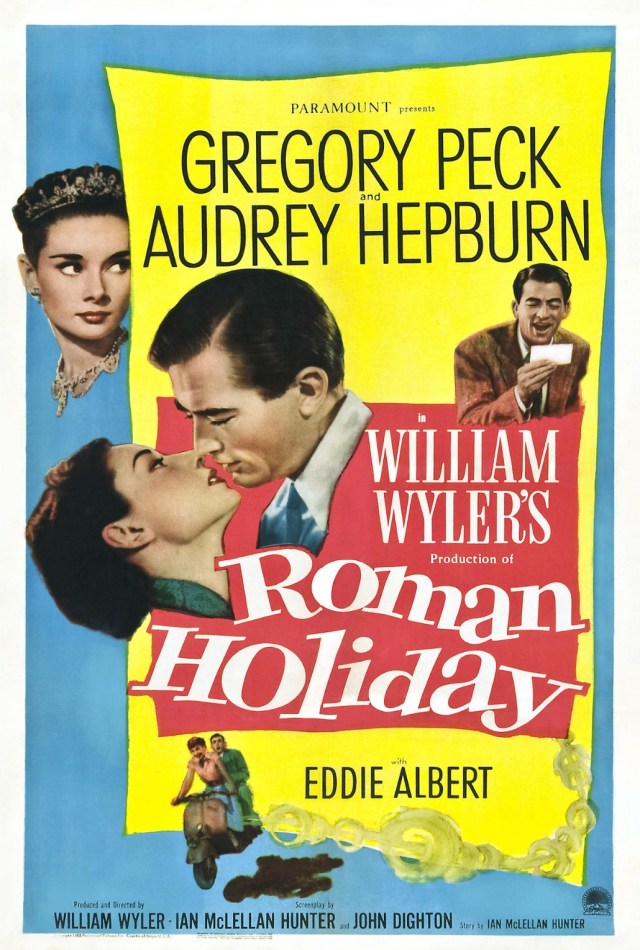
Take 3: Roman Holiday Review

Reviewing Roman Holiday is a full circle moment for me. Back in 2019, the Hallmark Channel movie, Rome in Love became one of the top three best films I saw that year. That movie was about a woman starring in a remake of Roman Holiday. I also read the book Rome in Love was based on. When I signed up for the Journey to Italy Blogathon, I was surprised no one had chosen the 1953 production. Because Roman Holiday is considered a “classic”, I would have expected the movie to be one of the first to be selected. So, I was grateful for the opportunity to check out the film! Audrey Hepburn and Gregory Peck are no strangers to 18 Cinema Lane. Some of their films have been covered on my blog. In fact, there’s been a few pictures I’ve liked; such as Funny Face, The Nun’s Story, and To Kill a Mockingbird. How does Roman Holiday compare to those movies? Find out in this review!

Roman Holiday poster created by Paramount Pictures

Things I liked about the film:

The acting: Roman Holiday introduced cinema’s audience to Audrey Hepburn as a lead actress. Not only that, the 1953 presentation earned Audrey an Oscar. Thinking about her portrayal of Princess Ann, I can understand why Audrey was, at least, nominated for an Academy Award! Even though this was her first starring role, Audrey proved her talents were strong enough to appear convincing. A great example happened when Princess Ann was sleepily wandering around Rome. Through her wanderings, Princess Ann meets Joe Bradley (portrayed by Gregory Peck). The stumbling and mumbling of Princess Ann make her look drunk. Even Joe thinks Princess Ann had too much to drink, due to her speech sounding slurred and her eyelids consistently rising and falling. In Audrey’s performance, Princess Ann proves looks can, indeed, be deceiving.

One of my favorite scenes in Roman Holiday takes place toward the beginning of the story. During a ball, Princess Ann’s shoe is visible on the floor. The shoe was noticed by Countess Vereberg (portrayed by Margaret Rawlings) and General Provno (portrayed by Tullio Carminati). But the way these characters looked at each other and the shoe communicated the shock and embarrassment they were feeling. With the use of eye movements and facial expressions, this exchange was such a hilarious moment! Another performance I liked was Gregory Peck’s portrayal of Joe Bradley! A newspaper reporter from the United States, Joe had a consistent confidence that made him sure of himself. His reactions appeared believable; from a surprised look at seeing Princess Ann’s portrait in the paper to the joy on his face while dancing on a boat. Gregory used a variety of emotions throughout the film. This is one of the reasons Joe became a likable character!

The Italian setting: During the opening credits of Roman Holiday, it’s revealed the production was filmed in Rome, Italy. Through the cinematography and screenwriting, Princess Ann’s time in Italy served as an introduction to the film’s audience. Several iconic landmarks were featured; including the Colosseum, the Trevi Fountain, and the Mouth of Truth. There were even some lesser-known areas from The Eternal City included in the story. During Princess Ann’s day in Rome, she and Joe visit a wall of granted wishes. As explained through dialogue, if someone’s wish came true, they must place a commemorative plaque on the wall. Unfortunately, I couldn’t find any confirmation this wall actually exists. But if it is real, I loved this tradition!

Avoiding the “it’s not what you think” cliché: In Roman Holiday, Joe Bradley makes a bet with his boss to conduct an interview with Princess Ann, including photos to prove the interview took place. This, along with Joe keeping his identity a secret, provided the perfect excuse to include the “it’s not what you think” cliché. However, the film’s creative team didn’t utilize this predictable piece of story-telling. Instead, Joe changes his mind about the bet, which gave him some character development. Even Joe’s friend, Irving Radovich, reconsiders submitting his photographs of Princess Ann’s adventure. After watching my fair share of rom-coms where the same tropes and clichés are incorporated, I appreciate Roman Holiday thinking outside the box!

The Journey to Italy Blogathon banner created by Gill from Realweegiemidget Reviews and Kristina from Speakeasy.

What I didn’t like about the film:

A drawn-out story: Roman Holiday has a run-time of one hour and fifty-eight minutes. While watching the movie, that run-time was felt. The story of Princess Ann running away to go on an adventure was drawn-out. One reason is how some moments are longer than necessary. A perfect example is when Princess Ann meets a group of reporters. Each introduction was a slow procession that seemed to last about a minute and a half. Another example is when Princess Ann’s governess reads an itinerary. She slowly reads each event listed on Princess Ann’s schedule, making that part of that scene feel like almost a minute had crawled. To avoid this flaw, the script needed to be tighter.

Little sense of urgency: As I already brought up in this review, Princess Ann runs away to go on an adventure. While Princess Ann was having the time of her life, those in her life were frantically trying to find her. But very few scenes stressed this point. In fact, only three scenes addressed the urgency of bringing Princess Ann home. By providing the story with little sense of urgency, the seriousness of Princess Ann going missing was downplayed. Though I recognize how Roman Holiday is primarily Princess Ann’s story, her actions having consequences were mostly ignored.

Almost no one recognizing Princess Ann: The reason Princess Ann spends time in Italy is because the country was included in her “goodwill tour”. Shortly after running away, Princess Ann’s portrait is printed in every Italian newspaper, according to Joe Bradley’s boss. However, throughout Princess Ann’s adventure, only two people recognize her; Joe and his friend, Irving Radovich. Even before Princess Ann receives a hair-cut, no one acknowledges her true identity. I know fictional stories like Roman Holiday require a suspension of disbelief. But I couldn’t take that part of the movie seriously.

Princess tiara image created by Freepik at freepik.com. <a href=’https://www.freepik.com/free-vector/ornamental-princess-crowns_1109199.htm’>Designed by Freepik</a>. <a href=”https://www.freepik.com/free-photos-vectors/gold”>Gold vector created by Freepik</a>. Image found at freepik.com.

My overall impression:

Before reviewing Roman Holiday, I had heard so many good things about the movie. As I said in the introduction, the film is considered a “classic”. This is definitely not a bad picture. But I wanted to like it more than I did. Roman Holiday’s run-time feels as long as it is. At almost two hours, the story is drawn-out, partly due to moments that last longer than necessary. Having little sense of urgency not only downplays the seriousness of Princess Ann running away, it also mostly ignored Princess Ann’s actions having consequences. However, I believe the 1953 production has merit. The acting was one of the strongest aspects of this movie. Like I said in my review, I can understand why Audrey was, at least, nominated for an Academy Award! I actually think Roman Holiday should have been included in American Film Institute’s 100 Movies list. According to IMDB, it was “the first American film to be made in its entirety in Italy”. While I’m thankful for the chance to have finally seen Roman Holiday, I prefer Audrey’s pictures like The Nun’s Story and Funny Face. For Gregory Peck, I still believe To Kill a Mockingbird is the stronger movie.

Overall score: 6.1 out of 10

Have you seen Roman Holiday? Which films from Audrey Hepburn’s or Gregory Peck’s filmography do you like? Please tell me in the comment section!

Have fun in Italy!

Sally Silverscreen
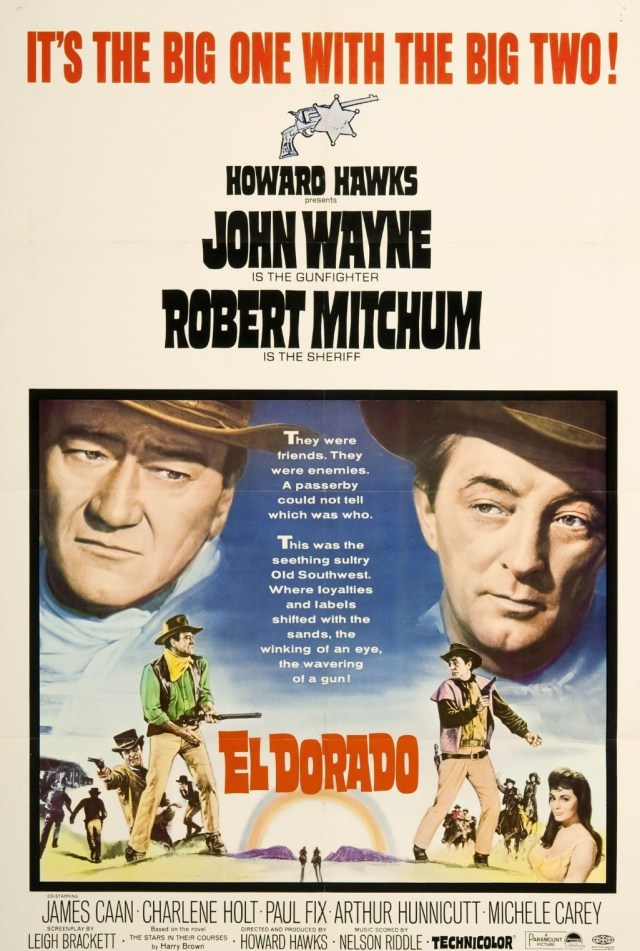
Take 3: El Dorado (1966) Review

Whenever I’ve participated in the Legends of Western Cinema Week Blogathon, I, more often than not, review a movie from the Western genre. Since I review Western genre films so infrequently, this blogathon serves as a good opportunity to expand my cinematic horizons. For the 2024 edition, I decided to select a title that has been recommended to me. Suggested by J-Dub from Dubsism, I am reviewing the 1966 film, El Dorado! Years ago, I saw pieces of this movie. At the time, I thought it was boring. But I was willing to give El Dorado a second chance, wondering if my perspective had changed. I also have seen very few films from John Wayne’s filmography. So, reviewing this film gave me a chance to check out more of his movies!

El Dorado (1966) poster created by Paramount Pictures, Laurel Productions, and Polyphony Digital

Things I liked about the film:

The on-screen chemistry: Relationships in movies, whether romantic or platonic, can come across believably on screen if there is a strong sense of chemistry between the actors. This is what happened in El Dorado! Toward the beginning of the movie, J.P., portrayed by Robert Mitchum, meets up with Cole, portrayed by John Wayne, to talk about a potential job opportunity. Cole and J.P. carry no-nonsense demeanors, but their cordialness to each other shows the respect between them. The scene’s mood becomes lighter when Maudie, portrayed by Charlene Holt, shows up. Her friendly, playfulness emphasizes the friendship these characters share. When Maudie talks about her late husband and Cole with J.P., the empathetic reflection indicates how much she cares about both Cole and J.P.. Not only was there strong on-screen chemistry among the actors, this strong on-screen chemistry was consistent throughout the film. The on-screen relationships were interesting to watch because of these factors!

The dialogue: One of the most important components of a movie’s script is the dialogue. Through dialogue, characters can memorably stand-out, important information can be shared, and characters’ problems can be solved. The quality of a script’s dialogue depends on how well written it is. While watching El Dorado, I took note of the cleverness of the dialogue. After a son from the MacDonald family dies, Cole visits the family to share the sad news. The patriarch of the family, Kevin, asks what happened, with Cole telling him how he got “a boy to do a man’s work”. Later, when Cole returns to El Dorado, he reconnects with J.P.. When J.P. asks Cole what he’s doing back in El Dorado, Cole tells his friend, “I’m lookin’ at a tin star with a…drunk pinned on it”. Dialogue like the two examples I provided show how cleverly words were used as well as the eloquent ways intended points were phrased.

Breen Code Era moments: As I’ve explained before on 18 Cinema Lane, the Breen Code was a series of guidelines studios had to follow between 1934 and 1954. El Dorado was released in 1966, a decade after the Breen Code Era ended. However, there were moments sprinkled throughout the movie that felt reminiscent of the Breen Code Era. Before Cole leaves El Dorado, he kisses Maudie. The kiss itself isn’t shown on-screen because Cole’s hat is blocking their faces. When Mississippi, portrayed by James Caan, is first introduced to the audience, he uses a knife in self-defense against a man he claims killed his friend. As Mississippi retrieves his knife, the aforementioned man is hidden behind a table to prevent some of the violence from being shown on screen. The way these moments were written and presented were thoughtful presentations of an era gone by.

Legends of Western Cinema Week Blogathon banner created by Hamlette from Hamlette’s Soliloquy, Heidi from Along the Brandywine, and Olivia from Meanwhile, in Rivendell

What I didn’t like about the film:

A prolonged conflict: Before watching El Dorado, I had seen two of John Wayne’s films: Stagecoach and Allegheny Uprising. In those movies, the story revolves around an overarching conflict some of the characters are consistently trying to resolve. While there was an overarching conflict in El Dorado, it primarily resided in the film’s second half. The first half of the movie consisted of a series of loosely connected vignettes. These vignettes, more often than not, contained low stakes. El Dorado’s first and second halves felt like they belonged in their own separate movies.

Inconsistent sense of urgency: Like I just said when talking about El Dorado’s prolonged conflict, the first half of the movie was a series of loosely connected vignettes, while the film’s overarching conflict resided in the story’s second half. Within the second half of the movie, scenes containing low stakes were woven into the production. One example is Cole addressing a back injury he received earlier in the story. El Dorado’s two halves and the low stakes scenes from the film’s second half are two reasons why this movie’s sense of urgency was inconsistent.

Enabling the Sheriff: J.P., the Sheriff of El Dorado, develops an alcohol addiction due to a romantic relationship gone wrong. When Cole and Mississippi go to El Dorado, they, as well as Bull, try to help J.P. overcome his addiction. Mississippi even creates a liquid concoction to sober J.P. up. But hours after receiving Mississippi’s concoction, J.P. is looking for alcohol. Bull tells J.P. exactly where a bottle of alcohol is located, in the upper left-hand drawer of his desk. Later that evening, Cole allows J.P. to go to the local saloon by himself, where he not only purchases a whole bottle of alcohol, he’s also laughed at by the film’s antagonists. J.P. does eventually become sober in order to help his friends. But toward the end of the movie, J.P. shares a shot of alcohol with Bull. If a screenwriter is going to incorporate a serious topic like addiction into their script, they need to be mindful about how that topic is included in the film. In my opinion, the way addiction was addressed in El Dorado could have been more thoughtful.

Sheriff badge image created by Freepik at freepik.com. <a href=’https://www.freepik.com/free-vector/brown-cowboy-label-set_1543252.htm’>Designed by Freepik</a>. <a href=”https://www.freepik.com/free-photos-vectors/vintage”>Vintage vector created by Freepik</a>. Image found at freepik.com.

My overall impression:

El Dorado is not only the third film of John Wayne’s I’ve seen, it’s the second film of John’s I’ve reviewed. Out of these three films, Stagecoach, Allegheny Uprising, and El Dorado, I haven’t found a title that’s left a strong impression on me. Looking back on Stagecoach, I think the movie is just fine. Allegheny Uprising was ok. Now that I’ve seen El Dorado in its entirety, I feel the 1966 project is also ok. The two halves of this movie and the low stakes scenes woven into the movie’s second half are likely the reason for El Dorado’s inconsistent sense of urgency. The topic of addiction could have been handled in a more thoughtful way. However, the movie does have its strengths. Some of these strengths are the on-screen chemistry among the cast and how well the dialogue was written. Personally, I found El Dorado to be a mixed bag. Hopefully, the next film of John’s I watch and review will be stronger than this one.

Overall score: 6 out of 10

Have you seen El Dorado? Which film from John Wayne’s filmography would you like me to review? Let me know in the comment section!

Have fun at the movies!

Sally Silverscreen
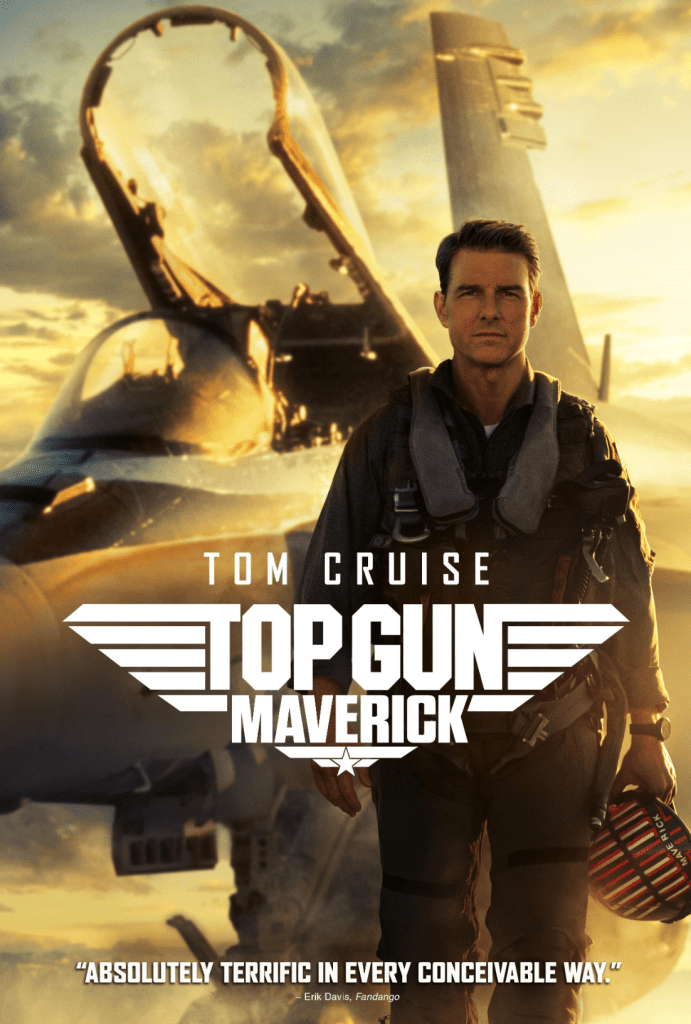
Take 3: Top Gun: Maverick Review + 450 Follower Thank You

A few days ago, 18 Cinema Lane received its 450th follower! With that achievement comes a Blog Follower Dedication Review! A few of my recent movie reviews were for films released in the 2020s. I recently saw Top Gun: Maverick, the sequel to Top Gun. Therefore, I will continue this momentum by writing about the 2022 blockbuster! While I’ve only seen pieces of Top Gun, I am familiar with its general premise. I’m also aware of how Top Gun: Maverick is the second film about the United States Navy I’ve reviewed this month. About a week ago, I wrote about the Hallmark Movies & Mysteries Christmas film, USS Christmas. In that review, I said the 2020 title was a nice, pleasant film. Even though USS Christmas was fine, it wasn’t an instant classic for me or a new favorite movie. How will Top Gun: Maverick compare to the aforementioned Hallmark project? Keep reading this review if you have a need, a need to find out the answer!

Top Gun: Maverick poster created by Skydance Media, Don Simpson/Jerry Bruckheimer Films, and Paramount Pictures

Things I liked about the film:

The acting: Jennifer Connelly portrayed Penny, a character who was not in Top Gun. Despite being a sequel exclusive character, it felt like Penny was always meant to be in the story. The on-screen chemistry between Jennifer and Tom Cruise is an example of this statement. When Maverick visits Penny’s bar for the first time in years, he reconnects with Penny. Their interactions are friendly, a camaraderie that appears natural between them. This on-screen chemistry was consistent, which allowed Maverick and Penny’s interactions to be pleasant to watch! Speaking of Maverick, let’s talk about Tom’s performance! Since the story of Top Gun: Maverick takes place over thirty years after its predecessor, Maverick’s personality has matured in that time. However, it still contained that “prove ‘em wrong” spirit that makes him such a beloved character. In a scene where Maverick is seeking advice from Iceman, he reflects on the loss of his friend, Goose. As the past collides with the present, Maverick becomes emotional, tears quickly filling his eyes and his bottom lip quivering. This scene shows how, even though Maverick carries himself with a sense of professionalism, emotion still shines through, thanks to Tom’s strong acting abilities!

I’m not familiar with Miles Teller’s filmography or acting talents. However, I really liked his performance in Top Gun: Maverick! Miles portrayed Rooster, Goose’s son. Rooster’s involvement with the Top Gun program causes tension between Rooster and Maverick. During a disagreement between these two characters, Rooster has a lot to get off his chest. He starts yelling at Maverick, the anger felt, seen, and heard in Rooster’s voice and face. Even though Rooster’s anger is explosive in this scene, Miles displays control over his character’s emotions. He also has potential to be the lead actor in a future film!

The cinematography: Sometimes, action films can be plagued with “shaky cam”. This causes the events on screen to be indistinguishable, which can impact an audience member’s enjoyment of a movie. Fortunately, this is not the case for Top Gun: Maverick! During the scenes where characters are flying, there are many shots of them within their respective planes. There are also shots of the planes in various positions, directions, and angles. These shots are captured with a steady camera, delivered with crisp precision and clarity. One of my favorite scenes was when Maverick is racing his motorcycle alongside a plane. Showcased in a medium shot, this race contains the spirit Maverick has exuded since the first film. With a steady camera, the shot is presented from Maverick’s right side, with Maverick in the fore-ground and the plane in the background.

Including a mission: From the pieces of Top Gun I’ve seen, I recall the story heavily revolving around the training within the Top Gun program. While there is training in Top Gun: Maverick, the story prioritized an overarching mission instead. Each step of the mission is presented with the use of modern technology, such as computerized images on a television monitor. The inclusion of this mission gave the characters something to work towards. It also gave them a conflict to resolve. From an audience perspective, the mission keeps them invested in the story as it unfolds.

Military plane image created by Brgfx at freepik.com. <a href=”https://www.freepik.com/free-photos-vectors/background”>Background vector created by brgfx – http://www.freepik.com</a>. Image found at freepik.com.

What I didn’t like about the film:

No inclusion of the quote, “I have a need, a need for speed”: One of the most iconic parts of Top Gun is the quote; “I have a need, a need for speed”. That quote is not only the most recognizable one from the 1986 movie, it’s one of the most famous quotes of all time. With the amount of respect given toward the predecessor in Top Gun: Maverick, I expected the aforementioned quote to be included somewhere in the 2022 film. Unfortunately, this quote was never spoken or referenced. I know this seems like a trivial flaw. But I think not including the quote is a missed opportunity.

Iceman’s fate: For this part of my review, I will spoil Top Gun: Maverick. If you have not seen this movie and plan on watching it, skip this portion and go straight to where it says “A limited distribution of character development”.

Iceman makes an appearance in Top Gun: Maverick. Even though he has become an Admiral and the commander of the U.S. Pacific Fleet, Iceman is dealing with medical related issues. These issues lead to his death around the film’s half-way point. I am aware the story needed a conflict. But having one of the “legacy” characters die felt, to me, like the film was giving mixed messages. As I already mentioned, Top Gun: Maverick was respectful toward its predecessor, emphasizing the idea of honoring the past and respecting what came before you. If this sentiment is true, then why would the movie’s creative team allow Iceman to be written out the way he was? Couldn’t Iceman be allowed to live his life as peacefully as possible? I know the Top Gun story wasn’t intended to become a franchise. However, I don’t believe Iceman should have died, especially since Goose already died in the first film.

A limited distribution of character development: When a story involves a group of people, it can, sometimes, be difficult to evenly distribute character development to every character in that group. In Top Gun: Maverick’s case, this flaw wasn’t avoided. Among the group of young lieutenants, the two that receive the most character development are Hangman and Rooster. Some of the lieutenants get a little bit of character development, while the rest don’t receive any. Besides Rooster and Hangman, I felt like I truly didn’t get to know the lieutenants, just simply became familiar with them. Like I’ve mentioned before in this review, I have only seen pieces of Top Gun. Therefore, I don’t know if this flaw was in that film. But since a part of Top Gun: Maverick’s story focuses on a team working together, I wish I had gotten to know more than just two lieutenants.

Children holding American flags during a sunset image created by rawpixel.com at freepik.com. <a href=”https://www.freepik.com/free-photos-vectors/people”>People photo created by rawpixel.com – http://www.freepik.com</a>. Image found at freepik.com.

My overall impression:

During the overarching mission in Top Gun: Maverick, there are two miracles that are discussed. While I won’t be revealing these miracles, as I don’t want to spoil the film, I will be talking about the two miracles this movie produced. The first miracle is the amount of reverence and respect Top Gun: Maverick displayed for its predecessor. Creating a sequel to a beloved movie, especially after a thirty plus year time frame, is a challenging feat. I can only speak for myself, but I think Top Gun: Maverick’s creative team pulled off this feat better than expected! The second miracle is how successful Top Gun: Maverick has become since its release. In a post-pandemic cinematic landscape, having a film garner over a billion dollars has become rarer than it was a decade ago. Even if a movie does acquire that much money, it may not receive critical praise. Top Gun: Maverick not only acquired a large profit, but also achieved critical acclaim. With all that said, this movie truly pulled off the impossible. Before I end this review, I’d like to point out how this review represents a miracle. That miracle is the success of 18 Cinema Lane, which would not be possible without my blog’s followers. Therefore, I would like to thank each and every one of them!

Overall score: 8.3 out of 10

Have you seen Top Gun and/or Top Gun: Maverick? Which movie do you think deserves a sequel? Please tell me in the comment section below!

Have fun at the movies!

Sally Silverscreen
Take 3: A Quiet Place Review + 445 Follower Thank You

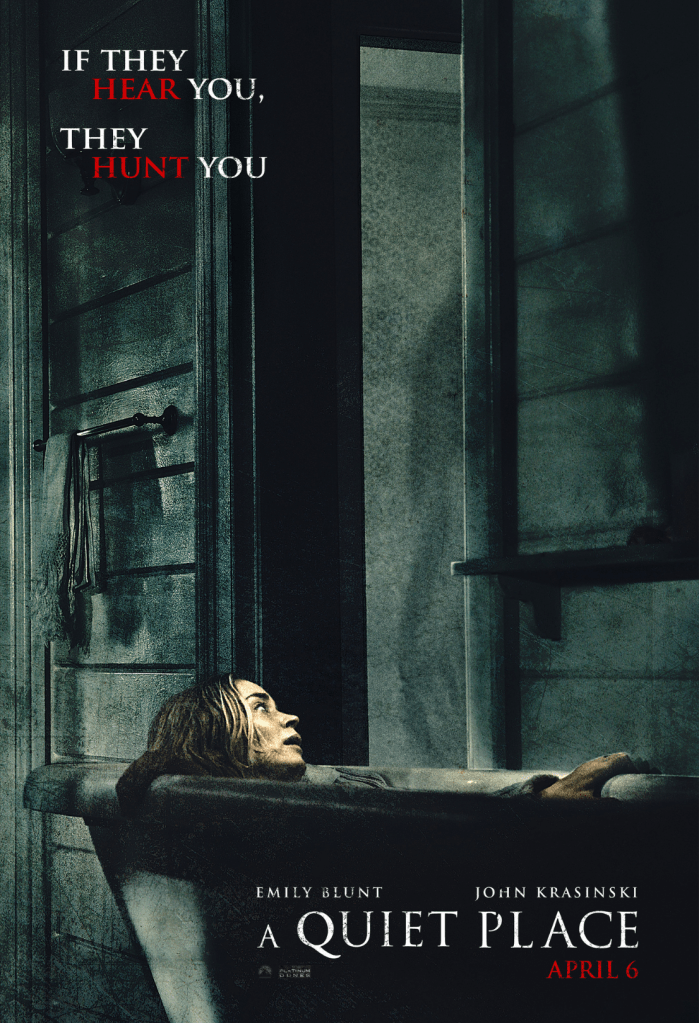
This month, 18 Cinema Lane received 445 followers! Therefore, a Blog Follower Dedication Review is in order! Since October is typically known as the Halloween season, I wanted to select a film that was appropriate for this time of year. But I’m also participating in Genre Grandeur, where the theme this month is ‘Movies Directed by the Main Actor/Actress’. So, as the title of this review says, I have chosen to write about A Quiet Place! Prior to this review, I had heard of the 2018 film. Mixed results are what I have heard; either viewers have loved the movie or they thought the story’s logistics didn’t make sense. I’ve also heard A Quiet Place is a horror film that thinks outside the box. This is another reason why I chose to review this movie, as I don’t often talk about titles from the horror genre.

A Quiet Place poster created by Platinum Dunes, Sunday Night Productions, and Paramount Pictures

Things I liked about the film:

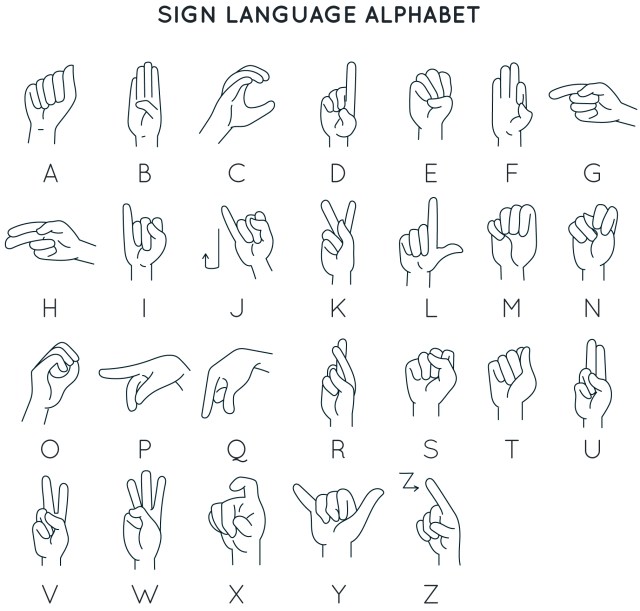
The family dynamic: John Krasinski and Emily Blunt are two actors I am familiar with, primarily for their comedic performances. With John, I have seen clips of The Office, while one of Emily’s most notable performances was in The Devil Wears Prada. As I’ve said before on 18 Cinema Lane, I’ve seen more comedic actors successfully transition to dramatic acting. John’s and Emily’s performance definitely stuck the landing, as they were both able to convey a variety of emotions through facial expressions and body language! Portraying John and Emily’s on-screen children were Noah Jupe, Millicent Simmonds, and Cade Woodward. Adding their strong performances, the Abbott family had a really good family dynamic that felt believable and genuine. Toward the beginning of the film, Cade’s character, Beau, really wants a toy space shuttle. However, the toy makes noise, which is a no-no within the Abbott family’s world. Through sign language and facial expressions, John’s character, Lee, explains how Beau can’t have the toy. Beau’s response was a look of pure sadness and confusion on his face. Another memorable scene was when Regan refused a new cochlear implant. Throughout the film, Lee attempts to create a functioning cochlear implant for his daughter. When he gives Regan the implant, Lee is optimistic it will work this time, wide eyes and even a smile conveying this optimism. Regan is not impressed with the new implant, as she’s frustrated at the idea of another implant not working. She not only expresses frustration on her face, she even pushes away her father’s hand.  

The atmosphere: As I mentioned in my point about the family dynamic, noise is a no-no in the Abbott family’s world. That’s because unidentified extraterrestrial creatures have taken over their environment, destroying anyone or anything that makes noise. Right in the very first scene, the audience can see how these creatures have driven people away from a small town. It looks like what most people would call a “ghost town”; cars frozen in the street and leaves slowly blowing through the air. The store where the Abbott family visits appears to be an urban explorer’s dream. Natural light from the store’s windows provides the facility’s only source of light. Products are strewn on the floor, waiting for someone to finally pick them up. Cinematography and inclusion of light help create a film that feels very atmospheric!

Use of sound: Even though the Abbott family try to create as little sound as possible, the film itself was not devoid of sound. At various moments in the story, natural sound could be heard whenever the family traveled from place to place. One notable example is when Noah’s character, Marcus, and Lee walk near a river. Sounds could also be heard through headphones or earbuds. In a scene where Lee and Emily’s character, Evelyn, are slow dancing, Evelyn puts one of her earbuds in Lee’s ear. Not only can the song be heard through the earbud, the song is amplified so the audience can hear it too. It serves as a reminder how sound, even noise, plays a role in our lives.

Sunny autumn landscape picture created by Kotkoa at freepik.com. <a href=’https://www.freepik.com/free-photo/autumn-forest_1436222.htm’>Designed by Kotkoa</a>. <a href=”https://www.freepik.com/free-photos-vectors/background”>Background image created by Kotkoa – Freepik.com</a>. Image found at freepik.com.

What I didn’t like about the film:

A film that doesn’t feel like a horror film: Like I said in my introduction, A Quiet Place is a horror film. Even the poster bears the hallmarks of a typical horror production. But, to me, A Quiet Place didn’t feel like a horror movie. Sure, there were terrifying moments in the story. But, if anything, the film felt like a dystopian/apocalyptic film with sci-fi elements. As I watched A Quiet Place, it reminded me of a more creative version of Signs.

Questions that are left unanswered: While I appreciate the film’s creative team respecting the audience’s intelligence, there were some questions I wish were answered. For instance, why did the Abbott family choose not to wear shoes? During Lee and Marcus’ hike, they cross paths with an elderly couple. Who were they and why did the elderly man want the creatures to capture him? Couldn’t the couple join the Abbott family and seek safety together?

The science’s confusing logic: As Marcus and Lee attempt to catch fish in a river, Lee explains how it’s ok to make small sounds. While big sounds are bad, they can be cancelled out with bigger sounds. With this logic in mind, why aren’t the extraterrestrial creatures congregating near the river? Why would they even bother trying to capture people, animals, and objects that make noise? Statements like Lee’s made the story somewhat confusing.

Sign language alphabet image created by Freepik at freepik.com. Hand sign vector created by freepik – www.freepik.com

My overall impression:

Before I share my overall impression of A Quiet Place, I’d like to thank all of 18 Cinema Lane’s followers! You are the reason why I continue to write and publish so many Blog Follower Dedication Reviews! Now, on to my thoughts on A Quiet Place. I will admit this is a fine, ambitious film that is one of the more unique titles of this nature. However, some aspects of the project could have been stronger. Like I said in my review of Night of the Comet, you need to explain the science in your science fiction story, especially in a way that satisfies the audience. While some of the science in A Quiet Place was explained, other parts of the story were confusing. The movie, to me, felt less like a horror movie and more like a dystopian/apocalyptic film with sci-fi elements. This makes the film’s marketing, as well as its horror classification, somewhat misleading. I am aware there is a sequel to A Quiet Place. Because I thought the movie was just fine, I’m not rushing to see the sequel anytime soon.

Overall score: 7 out of 10

Have you seen A Quiet Place? What movie do you like to watch around Halloween? Please tell me in the comment section below!

Have fun at the movies!

Sally Silverscreen

Take 3: Children of a Lesser God Review

May’s theme for Genre Grandeur is ‘Best Picture Nominated Movies that didn’t win’. As the Oscars have been around for more than fifty years, there were plenty of titles for me to choose from. But I knew the main-stream, bigger name films were going to get selected by other participants of Genre Grandeur. So, I decided to choose a movie that was not only off the beaten path, but also less talked about than other films. This is one of the reasons why I’m reviewing Children of a Lesser God. Eric Binford, from Diary of A Movie Maniac, is another reason why I chose to write about the 1986 project. While talking about non-preachy movies containing messages, I brought up the Hallmark Hall of Fame production, Sweet Nothing in My Ear. After Eric mentioned how he loves Marlee Matlin, I realized I have never reviewed any project from Marlee’s filmography. I have seen Sweet Nothing in My Ear, as well as a handful of Switched at Birth episodes. But I’ve never discussed the ABC Family show on 18 Cinema Lane and I didn’t review the 2008 Hallmark Hall of Fame film. It should also be noted how the last time I wrote about an ’80s movie was last September.

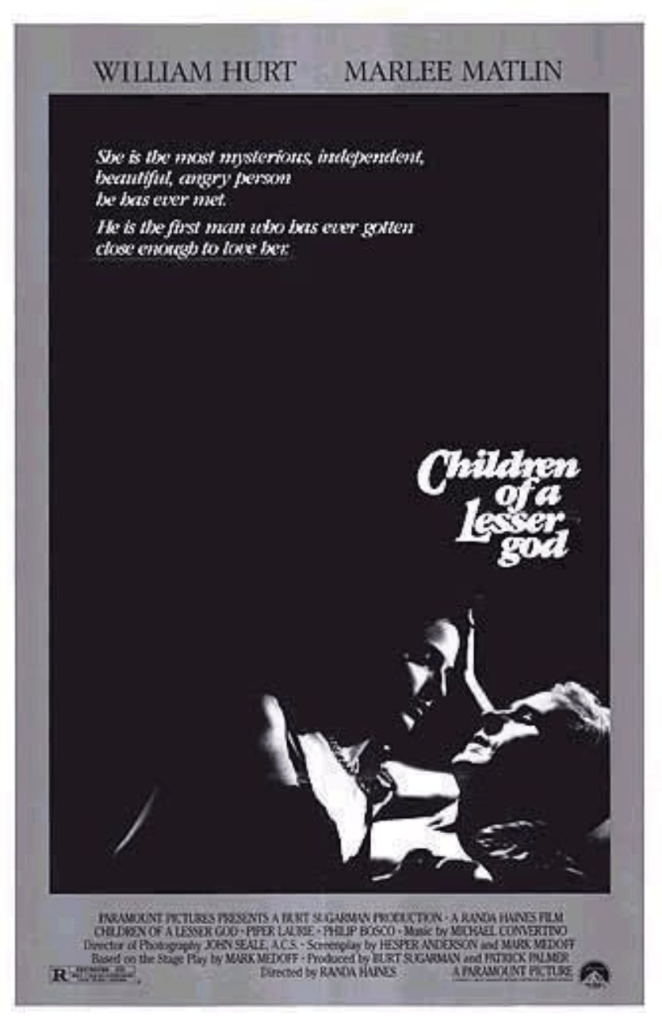
Children of a Lesser God poster created by Paramount Pictures

Things I liked about the film:

The acting: Since Marlee Matlin is one of the reasons why I chose to review Children of a Lesser God, I will talk about her performance first. While portraying Sarah, Marlee’s facial expressions and body language were expressive. They were also as fluid as her sign language. During an assembly, Sarah witnesses a performance from James’ students. At first, she appears content, not seeing any issue with the performance. But as the performance goes on, Sarah’s face progressively changes, appearing angry for reasons not yet revealed. In fact, Sarah becomes so upset by this performance, she ends up breaking a mirror. The strength of Marlee’s acting abilities not only allowed her to stand on her own, talent-wise, but also go toe-to-toe with William Hurt!

In Children of a Lesser God, William Hurt portrays James. The first thing I noticed about his acting performance was how he was able to balance the light-hearted and serious moments of the story! Toward the beginning of the film, James is explaining to his students why they should learn to speak. To demonstrate a likely scenario, James does a hand-stand, in an attempt to make his point. Later in the film, James learns more about Sarah. She explains how, in high school, her male peers would desire an intimate relationship with her, yet refuse to take the time to get to know her. During this conversation, James becomes frustrated over things he can’t change, such as Sarah’s past. Similar to what I said about Marlee’s performance, William was also expressive in his role. The expressive nature of his performance is what helped him maintain a consistent portrayal!

Several scenes show James interacting with the students in his speech class. These scenes are meant to serve as the more light-hearted moments of the film. One of the students in this class is Lydia. Portrayed by Allison Gompf, Lydia was not afraid to try new things. In fact, she was one of the first students to try speaking. What helped Allison and her character be memorable was her on-screen personality. It was so bubbly and up-beat, you can’t help but smile every time she appears on screen!

The on-screen chemistry: As I just mentioned, both Marlee and William gave solid performances individually. However, they also performed well together! The strength and expressiveness of their acting abilities worked in their favor and complimented one another. These aspects of their combined performance allowed them to showcase a relationship that felt realistic. One of my favorite scenes in Children of a Lesser God takes place when James wants to listen to one of his records. But shortly after he puts on a Bach record, he is overcome with guilt. James turns off the record, telling Sarah he can’t enjoy the music because she can’t hear it. A few moments later, Sarah puts the record back on, as she knows how much James enjoys the music. Through the acting, as well as the screenwriting, this scene is a great example of the sacrifices and compromises that can take place within a romantic relationship.

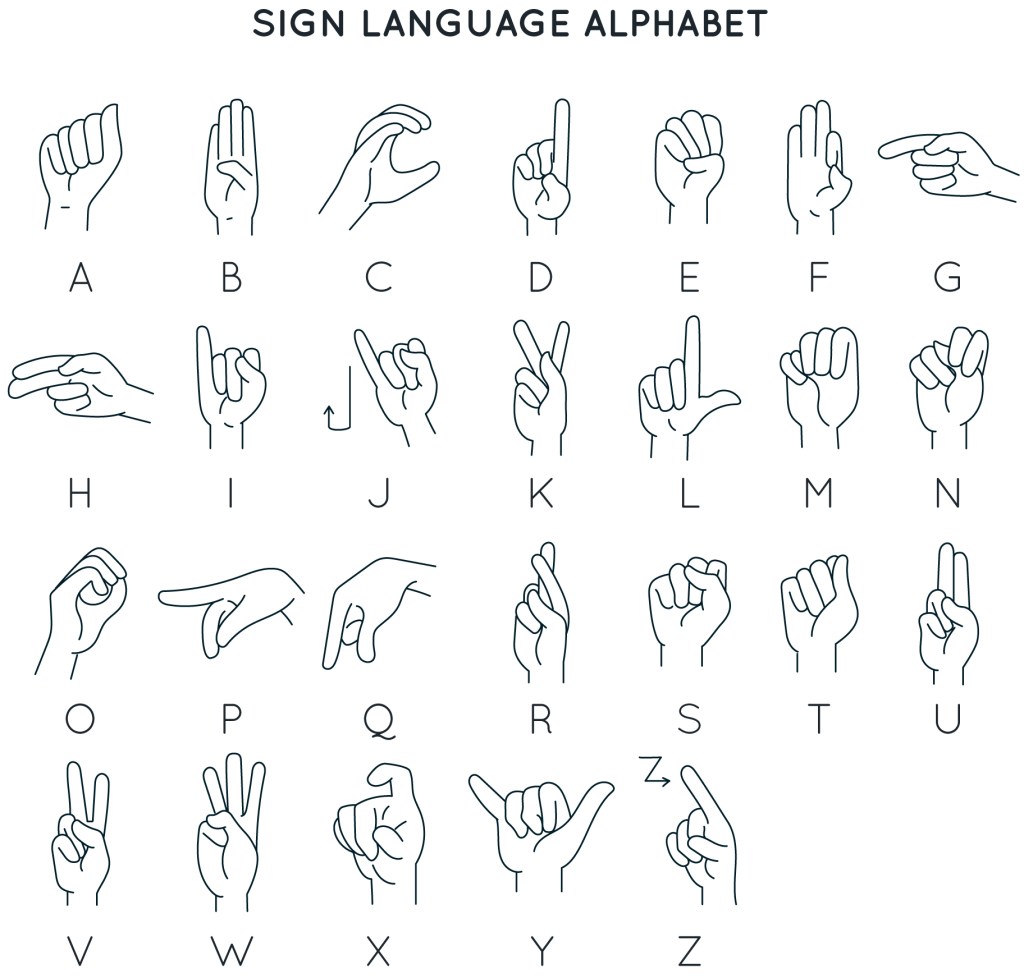
 An introduction to deaf culture: Whenever I talk about a movie highlighting a specific culture/community, I try to remind my readers that the film in question is not the “end all, be all” when it comes to discussing that culture/community. This is the case when talking about Children of a Lesser God. The students in James’ speech class are their own individuals, displaying distinct styles and expressing unique perspectives. These students, including Sarah, have their reasons why they either want or don’t want to speak. At one point in the film, James’ students perform in their school’s assembly. Throughout this performance, they sing, dance, and sign while on stage. The joy expressed by these characters can be seen and felt. This scene shows one can experience joy when they’ve found a place to belong.

Sign language alphabet image created by Freepik at freepik.com. Hand sign vector created by freepik – www.freepik.com

What I didn’t like about the film:

A confusing title: With a title like Children of a Lesser God, I’m going to safely assume “children” is referencing deaf people, with the title itself emphasizing how deaf people are just as important to society as hearing people. But in the movie, Sarah is the only deaf character the story revolves around. Yes, there are deaf characters featured throughout the film. However, these characters are shown as well-adjusted individuals who aren’t prejudiced or mistreated. As I mentioned before, Sarah recounts a situation that happened to her in high school. Sarah’s mother, portrayed by Piper Laurie, shares traumatic events Sarah experienced in her life. But all of these events happened prior to the film. With all this said, the title, Children of a Lesser God, seems confusing.

A limited presence of James’ students: As I said earlier in this review, the moments where James interacts with his students were meant to be the more light-hearted moments of the film. But throughout the movie, the presence of the students themselves were limited. I really liked the camaraderie between these characters, as it made their connection seem believable. Because of the student’s limited presence, it left few opportunities to get to know them. Sure, we learn about them through their experiences in James’ speech class. But compared to James and Sarah, I felt like I, as an audience member, only became familiar with James’ students. I kind of wish they had received their own subplot.

No appearances from Ruth: When Sarah’s mom is talking to James about Sarah’s past, she mentions her other daughter, Ruth. She also mentions how, in high school, Ruth’s male peers were more interested in Sarah. Despite Ruth getting brought up in the story, Sarah’s sister never appears in the film. Personally, I think this was a missed opportunity. It would have been interesting to hear the perspective of a sibling of someone with a disability. I also wanted to know how Ruth felt about what Sarah went through in high school. In the movie’s opening credits, I learned Children of a Lesser God was based on a Broadway play. I haven’t seen this play, so I don’t know if Ruth is a character that is meant to be in the story. But, like I said, it still feels like a missed opportunity.

Orange cat image created by Freestockcenter at freepik.com. <a href=’https://www.freepik.com/free-photo/ginger-cat_883376.htm’>Designed by Freestockcenter</a>. <a href=”https://www.freepik.com/free-photos-vectors/gold”>Gold image created by Freestockcenter – Freepik.com</a>. Image found at freepik.com.

My overall impression:

Children of a Lesser God is a character-driven movie. With these types of films, you need a cast that is so strong, it gives the audience a reason to stay invested in the overall story. That is exactly what this 1986 production achieved! Even though Children of a Lesser God primarily revolves around Sarah and James, the supporting cast was great to watch. Presenting an introduction to the deaf culture also helps. Though I liked this movie, there were some aspects of this project that could have been stronger. I wish James’ students had received their own subplot and Ruth had appeared in the story. But as I said in this review, Children of a Lesser God is based on a Broadway play. Therefore, I don’t know what was in the original source material. As I close this review, I’d like to say I can’t speak for whether Children of a Lesser God should have received the Best Picture award. That’s because I haven’t seen Platoon or the other films nominated in 1987.

Overall score: 7.7-7.8 out of 10

Have you seen Children of a Lesser God? Which movie do you think should have won Best Picture in 1987? Please let me know in the comment section below!

Have fun at the movies!

Sally Silverscreen

Word on the Street: ‘To Catch A Thief’ Remake and Film about Beanie Babies on the way

When I write a Word on the Street story, I sometimes talk about stories that were covered on the Youtube channel, Clownfish TV. I not only like Kneon and Geeky Sparkle’s commentary, but I also learn about subjects I never would have known about before. So, when I watched one of their newer videos, I figured it would be an interesting topic to discuss on 18 Cinema Lane! In the video, ‘Elizabeth Banks Doing a BEANIE BABIES Movie?!’, my initial assumption was the movie being similar in execution to the 2014 hit, The Lego Movie. But as I watched the video, I learned the film would revolve around the popularity of Beanie Babies in the ‘90s. While analyzing an article from The Hollywood Reporter, Kneon and Geeky share how actors Elizabeth Banks and Zach Galifianakis are going to headline a film based on The Great Beanie Baby Bubble: Mass Delusion and the Dark Side of Cute, a book written by Zac Bissonnette.  According to the original article, the movie will focus on the production and consumption of the classic stuffed animals, including “a celebration of the women who helped power Ty Warner’s success”.

Tiger stuffed animal image created by alesia17 at freeimages.com. “FreeImages.com/alesia17.”

While watching Kneon and Geeky’s video, ‘Elizabeth Banks Doing a BEANIE BABIES Movie?!’, they brought up a documentary titled Beanie Mania. In this documentary, the rise and fall of Beanie Babies are explored. From “a lot of drama” to “the one woman even has a rap song she wrote” (referring to a rap song dedicated to the Beanie Babies), Beanie Mania presents the perspectives of those heavily affected by the iconic toy. As I watched Kneon and Geeky’s video and listened to their commentary, I couldn’t help but feel Elizabeth and Zach’s project was a re-hash of the HBO Max documentary. When speculating which direction the film was headed, Geeky says “I think their take on it’s going to be very similar, cause I think the one guy that wrote the book they’re basing it on was in the documentary”. With this and everything else said, it makes me wonder what is the point of Elizabeth and Zach’s movie? What can they offer to the conversation that Beanie Mania didn’t? Personally, I’d like to see a documentary about Tickle Me Elmo, the coveted toy that dominated 1996.

Preschool classroom image created by Vectorpocket at freepik.com. <a href=”https://www.freepik.com/free-photos-vectors/background”>Background vector created by vectorpocket – http://www.freepik.com</a>. Image found at freepik.com.

Speaking of re-hashed ideas, this next story I found in Kneon and Geeky’s video, as it was an advertised article on Deadline’s website. According to the aforementioned site, Justin Kroll writes about a “remake of the classic thriller To Catch a Thief” in the pre-production stages. The Paramount Pictures project has recruited Gal Gadot to star in the film and produce it. Eileen Jones will pen the script, with Jaron Varsano and Neal Moritz also producing the movie. Similar to what I said about the Beanie Baby film, I wonder what the point of this remake is? I know you can ask that about any cinematic production. But what can this creative team bring to the table that Alfred Hitchcock and his team hasn’t already? Personally, I think the remake seems unnecessary.

Image of vintage movie camera created by Macrovector at freepik.com. <a href=”https://www.freepik.com/free-photos-vectors/background”>Background vector created by macrovector – http://www.freepik.com</a>. Image found at freepik.com.

What are your thoughts on these movie news stories? Are you anticipating any of the projects mentioned in this article? Let me know in the comment section!

Have fun at the movies!

Sally Silverscreen

Sources to articles referenced in this article:

https://www.hollywoodreporter.com/movies/movie-news/zach-galifianakis-elizabeth-banks-starring-in-apple-film-the-beanie-bubble-1235073361/

deadline.com/2022/01/eileen-jones-paramounts-to-catch-a-thief-reboot-gal-gadot-1234908113/