Take 3: Orca (1977) Review

When I participated in the first ‘Favorite Stars in B movies’ Blogathon two years ago, I reviewed the 1963 film, The Raven. I found Vincent Price’s picture to be a fine, likable one, which left me amazed how a simple story from Edgar Allan Poe could be turned into a feature presentation. For this year’s Third ‘Favorite Stars in B movies’ Blogathon, there were plenty of movies from Vincent Price’s filmography for me to choose from. But this time, I decided to go in a different direction. As I looked back at the history of my blog, I came to realize none of Richard Harris’ films have been covered on 18 Cinema Lane. I also remembered how the 1977 movie, Orca, was recommended to me by Eric Binford (from Diary of a Movie Maniac). With these two facts in mind, I found the perfect title to write about for the Third ‘Favorite Stars in B movies’ Blogathon! When Eric suggested Orca to me, he said the film steals from Jaws. Because I’ve seen the 1975 blockbuster, I imagined Orca to be a knock-off/rip-off of the iconic movie. But is the 1977 picture a copy of Jaws? Let’s dive into this review and find out!

Orca (1977) poster created by Famous Films (II), Dino De Laurentiis, and Paramount Pictures

Things I liked about the film:

Richard Harris’ performance: Because Richard Harris is one of the reasons why I chose to review Orca, I will now take the time to highlight his performance. In the 1977 movie, Richard portrays Captain Nolan, a fisherman who desires catching a whale in order to receive a large sum of money. His versatile acting abilities helped create a multi-layered character, one that is both tragic and complicated. After killing a pregnant whale, Nolan is very remorseful of his actions. One evening, he confides with Rachel Bedford (portrayed by Charlotte Rampling) over how he’d apologize to the dead whale’s mate. During this confession, Nolan adopts a somber look on his face, his eyes on the verge of tears. He even boasts a long frown. Nolan’s tone of voice is serious, sounding like he’s pleading for forgiveness. This one exchange presents a perfect example of Richard using his acting talents to bring his character to life!

An introduction to Orca Whales: Toward the beginning of the movie, Rachel Bedford lectures a group of students (and the film’s audience) about Orca Whales. This lecture is packed with information, from an explanation of the word ‘orca’ in Latin to showing a picture of an Orca fetus. On Captain Nolan’s boat, Annie (portrayed by Bo Derek) shares with Nolan how Orca Whales stay with their mate for life. He even receives a book from Rachel about whales in mythology. While some of the movie’s information may be dated (due to what’s been discovered about Orcas since the film’s release), it does provide an introduction to Orca Whales. Including this information into the script feels like the creative team made an effort to educate their audience.

Tonal variety in music: One of the most iconic pieces of music in film history is the theme from Jaws. John Williams’ score and the image of the titular shark sneaking up on its victims created a perfect, memorable combination. But compared to Orca, this piece of music seems to sensationalize the shark itself, as the suspenseful tune is the only music heard whenever the shark comes around. The first shot of the 1977 picture shows a group of Orcas swimming in their natural habitat. Peaceful, orchestral music plays in the background anytime whales are, simply, gliding from place to place. The only time suspenseful music is heard is when the titular Orca is causing chaos and destruction. This creative choice emphasizes how the whale has been provoked. Tones between different pieces of music show that while Orca Whales can have dangerous behavior, they can also be a great source of fascination.

The Third ‘Favorite Stars in B movies’ Blogathon banner created by Brian from Filmsfrombeyond.com

What I didn’t like about the film:

Inconsistent voice-overs: In Orca, Rachel narrates what is happening in the story. I actually liked this creative decision, especially since she was one of the most educated characters when it came to Orca Whales. What I didn’t like was how Rachel’s voice-overs were inconsistent. In fact, she only narrated about three times throughout the one hour and thirty-two-minute film. Had these voice-overs been more consistent, they could have been used as a bridge between scenes.

The underutilization of Will Sampson: Another reason why I wanted to review Orca is Will Sampson’s involvement in the project. After seeing One Flew Over the Cuckoo’s Nest and The White Buffalo, I was looking forward to watching another movie from Will’s filmography. When I finally checked out Orca, I was disappointed by how Will’s acting talents were underutilized. Not only did he appear in the film for a limited amount of time, he also received very few lines in the script. I, honestly, wish Will’s character, Jacob, had played a larger in the story, especially since he shared great insight about Orca Whales.

Limited character development: The story of Orca primarily revolves around the battle between the titular whale and Nolan. Because of this creative decision, Nolan becomes the only (human) character to receive character development. Other characters are simply known by their profession or an experienced scenario. Rachel is characterized as the scientist who is educated about Orca Whales. Annie is known as the lady who broke her leg. I understand there is only so much story to tell in one hour and thirty-two-minutes. However, I still believe a little more character development should have been included in the script.
Orca Whale image created by Freepik at freepik.com. Label vector created by freepik – www.freepik.com. Image found at freepik.com.

My overall impression:

In the introduction of my review, I said I imagined Orca to be a knock-off/rip-off of Jaws. But now I have seen the 1977 picture, calling it that does the film a disservice. I never got the impression Orca’s creative team was intentionally trying to copy the 1975 blockbuster. Instead, the film serves as a cautionary tale of how one’s actions toward animals and their natural environment have consequences. As I said in my review, including information about Orca Whales into the script feels like the creative team made an effort to educate their audience. This is different from Jaws, where (as far as I remember) education about sharks was far and few between. With that said, I wonder what would have happened if Orca had received anywhere near as much attention as Jaws? On the one hand, society’s perspective and treatment of Orca Whales may have changed much sooner. More knowledge and awareness may have already been reached before the 21st century. But, seeing how much merchandising and commercialism Jaws has produced in a fifty-year timespan, maybe Orca’s intended message would have gotten lost among the shuffle.

Overall score: 6 out of 10

Have you seen Orca? What are some of your favorite films with animals in title roles? Let me know in the comment section!

Have fun at the movies!

Sally Silverscreen
Take 3: Luna: Spirit of the Whale Review + 245 Follower Thank You

Four days ago, my blog received 245 followers! To everyone who helped 18 Cinema Lane become this successful, thank you! None of this could have been a reality without you. BYU-TV recently aired Luna: Spirit of the Whale on their network. Because I don’t get many opportunities to talk about films that feature Native American stories, I felt this film would make a good selection for this blog follower dedication review! The movie is one I had never heard of prior to this year. So, this was also a great chance to expand my cinematic horizons! As I’ve said on multiple occasions, I try to give lesser-known films a “standing ovation”. Luna: Spirit of the Whale is one of those films, as I didn’t see any other blogger on WordPress talk about this movie. By choosing to review this project at all, it will hopefully give this movie a little more recognition than it might be currently receiving.

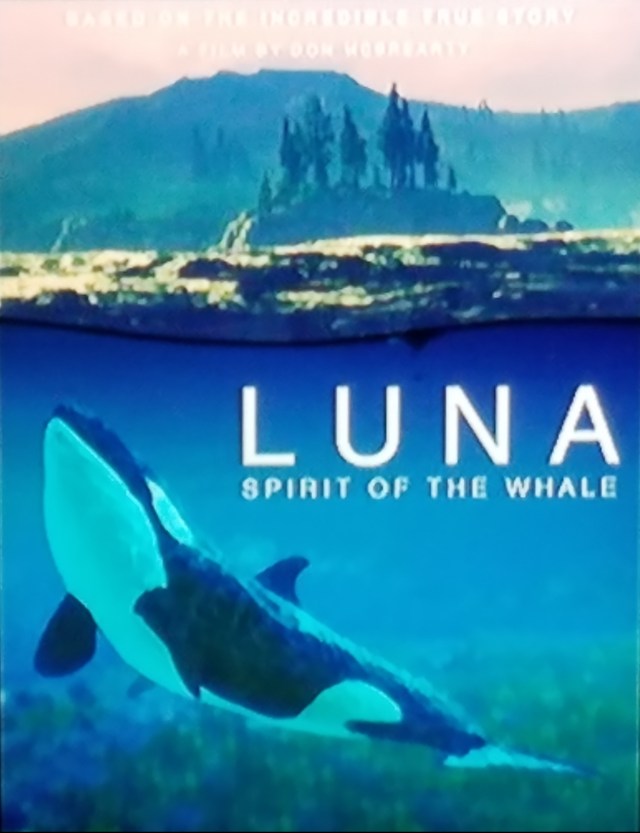
This is a screenshot of the poster for Luna: Spirit of the Whale that I took with my phone. Screenshot taken by me, Sally Silverscreen.

Things I liked about the film:

The acting: While watching Luna: Spirit of the Whale, I noticed strong performances within this cast! One of them came from Adam Beach, who portrayed the protagonist, Mike Maquinna! Throughout the film, Adam did a good job giving his character a wide range of emotions. In one scene, Mike is happy to take a youth named Adam on a short canoe trip. In another scene, Mike is tearfully reflecting on a regret from his past. These emotions helped make Adam’s character well-rounded! Speaking of the aforementioned youth, I also liked Aaron Miko’s portrayal of Adam! A sense of believability is what made this performance enjoyable to watch! With the emotions, facial expressions, and body language, Aaron was able to show the audience that his character had experienced so much in his young life. Prior to watching Luna: Spirit of the Whale, I have seen Erin Karpluk’s performances in Hallmark Movies & Mysteries’ Fixer Upper Mystery series. While she’s in the film for a certain amount of time, the acting material Erin was given in this film was different from the aforementioned series. This is because her performance was allowed to be more dramatic. Erin was able to use that opportunity to her advantage by creating a portrayal that was interesting to watch!

The scenery: As someone who has seen many Hallmark movies, I know that Canada has a reputation for showcasing great scenery! Luna: Spirit of the Whale is no exception to this. Most of the scenery revolves around the water, as the story focuses on a whale. Anytime these scenes appeared in the film, they were appealing to look at! The green hues of the surrounding trees compliment the blues and grays of the water. More often than not, a clear sky enveloped the entire space. Some scenes took place on the shore, an area that was also photogenic! The rocky edge and calm waters set the stage for an inviting place! It really did look like a backdrop you’d see in a Hallmark movie!

The incorporation of Native American culture: Because some of the characters in Luna: Spirit of the Whale are from a Native American/First Nations community, elements of Native American culture are found in this story. The way they are incorporated into the movie is not only educational, but also insightful. These elements are showcased in a reverent and respectful way. During Chief Ambrose Maquinna’s funeral, two men were dressed in wolf fur and crawled on the ground in front of the procession. Before this shot was shown in the film, Mike explains that this particular community believes a deceased chief will have his spirit carried through a wolf (protector of the land) or a whale (protector of the sea). Before any of the canoes go out into the water, a blessing is placed on them, complete with a series of chants. Traditional chants also play a role during the story’s climax.

Canada postage stamp image created by Ibrandify at freepik.com <a href=’https://www.freepik.com/free-vector/canadian-flag-stamp-template_836872.htm’>Designed by Freepik</a> <a href=”https://www.freepik.com/free-photos-vectors/template”>Template vector created by Ibrandify – Freepik.com</a> Image found at freepik.com

What I didn’t like about the film:

An unclear time period: According to IMDB, Luna: Spirit of the Whale was released in 2007. Erin Karpluk’s character, Jill, mentions that some people have discovered the story of Luna the whale through the internet. However, all of the televisions in this film look older than 2007. On a canoe trip, one of the youths pulls out a camcorder that appears to have been sold sometime in the 1990s. Everything I just said made it difficult to decipher when this story took place.

A somewhat meandering story: The movie’s main conflict is about a Native American/First Nations community’s attempt to protect a whale they believe physically embodies the spirit of their deceased chief. While this conflict was interesting to see unfold, it didn’t appear until about forty minutes into the film. Personally, I feel this conflict should have been introduced a lot sooner. This not only could have helped the narrative get straight-to-the-point, but it also could have shaved off some of the run-time.

Some scenes that lasted too long: There were some scenes in this film that felt longer than necessary. The scenes where the characters were in the canoes suffered the most from this flaw. Because these scenes emphasized the scenery surrounding the characters, it caused the plot to feel delayed. Scenes like these could have benefited by being shortened.

Orca Whale image created by Freepik at freepik.com. Label vector created by freepik – www.freepik.com. Image found at freepik.com.

My overall impression:

Native American stories are not often found in mainstream cinema. This fact can cause movie-goers to look beyond the surface and seek out titles located off the beaten path. Luna: Spirit of the Whale is a part of this discussion, as the film is not well-known. Despite this, I found it to be a fine, decent movie! The elements of Native American culture were incorporated in a reverent and respectful way, while also being educational and insightful. Watching the film’s main conflict unfold was interesting to see, even if it did start later than I would have liked. But if someone were looking for Native American stories told through a cinematic lens, I would recommend Luna: Spirit of the Whale! Finding likable films on BYU-TV is always a treat, so I do appreciate the network’s efforts to introduce their audience to various titles! If I hadn’t came across this film, I might never have discovered it.

Overall score: 7.2 out of 10

Do you have a favorite Native American story told through film? Are there any you’d like to recommend? Let me know in the comment section!

Have fun at the movies!

Sally Silverscreen