I will admit I was unfamiliar with who Vivian Blaine was when I found out about Taking Up Room’s Vivian Blaine Blogathon. This did not deter me, though, as I saw the event as an opportunity to expand my cinematic horizons. When I discovered Vivian had guest starred on an episode of Murder, She Wrote, I immediately signed up for the blogathon with the plan of covering another episode of the show! This is not the first time I’ve written about a specific actor’s or actress’s episode of Murder, She Wrote. Back in 2020, I reviewed all three episodes of Murder, She Wrote Van Johnson appeared on. This is also not the first episode of Murder, She Wrote’s first season I’ve covered on 18 Cinema Lane. Prior to this review, I wrote about ‘We’re Off to Kill the Wizard’, ‘Paint Me a Murder’, ‘Murder Takes the Bus’, and ‘Hit, Run and Homicide’. While I thought ‘We’re Off to Kill the Wizard’, ‘Paint Me a Murder’, and ‘Hit, Run and Homicide’ were fine, I didn’t like ‘Murder Takes the Bus’. Where will Vivian Blaine’s episode, ‘Broadway Malady’, rank among these episodes? To solve this mystery, you’ll have to read my review!
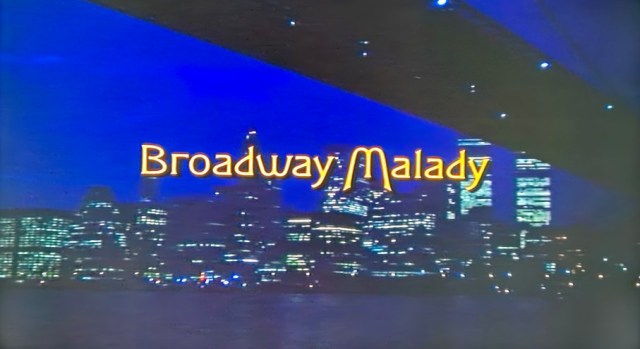
Screenshot of ‘Broadway Malady’ title card taken by me, Sally Silverscreen.
Name: Broadway Malady
Season 1, Episode 11
Premiere Date: January 13th, 1985
What I liked about this episode:
In ‘Broadway Malady’, an actress named Rita Bristol plans on making her comeback to the stage. But she’s not returning to Broadway alone. Rita’s daughter, Patti, is also starring in her show, with Rita’s son, Barry, working behind the scenes to make the show a reality. Throughout the episode, the dynamic of the Bristol family is on full display. Whether they are celebrating coming back to Broadway at all or concerned over a medical emergency, a close bond within the family radiates off the screen. The Bristol family’s dynamic appeared believable in ‘Broadway Malady’ because of the strong acting talents of Vivian Blaine, Lorna Luft, and Gregg Henry. What also worked in their favor was the strong chemistry between them, which shown brightly in this episode.
What I didn’t like about this episode:
With the show titled Murder, She Wrote, the creative team behind the program has given their audience a set of expectations. These expectations are not only will a murder mystery take place in an episode, the murder mystery will serve as the main focus within the story. But in ‘Broadway Malady’, the mystery of who shot Patti and why was prioritized. At one point while watching this episode, I honestly wondered if a murder mystery was written into the story at all. Even though there was a murder mystery in ‘Broadway Malady’, it took place within the episode’s last eight minutes. This creative decision goes against those aforementioned expectations Murder, She Wrote’s creative team knowingly crafted. There is an episode where there isn’t a murder mystery in the script. But this is an exception to the rule, not the rule itself.
Like I just talked about in this review, the story of ‘Broadway Malady’ prioritizes the mystery of who shot Patti and why, with the episode’s murder mystery taking place within the episode’s last eight minutes. When it came to the mystery involving Patti, Jessica started trying to solve the case about sixteen minutes into the episode. I point this out to address how Jessica’s involvement happened much sooner than other episodes of Murder, She Wrote. The clues for both mysteries are woven into the dialogue, with very few physical clues in the story. This means a viewer will have to actively pay attention to what the characters are saying in order not to miss important context. There is an effective plot twist that appears toward the end of the episode. But I will not spoil that plot twist, in case any of my readers haven’t seen ‘Broadway Malady’.
The other factors from this episode:
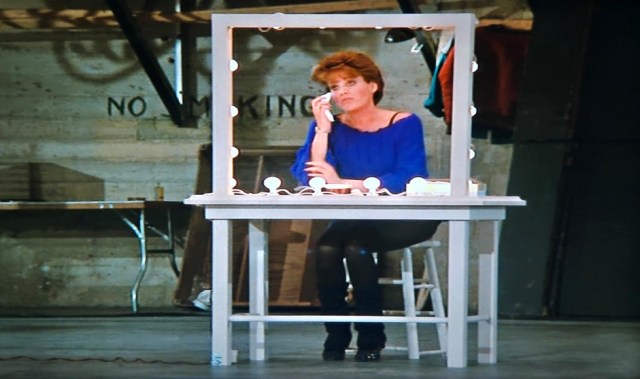
During rehearsal for Rita and Patti’s upcoming Broadway show, Patti sings a song called “Thanks, But I’ve Been There Before”. While she performs this song, Patti sits at a vanity without a mirror. This set piece created the illusion Patti was looking in a mirror, with her reflection looking back at her. This is the first time I’ve seen an individual performer attempt this illusion in their performance and succeed!
When I reviewed the season eleven episode of Murder, She Wrote, ‘The Dream Team’ (and even when I reviewed the movie, Murder, She Wrote: A Story to Die For), I chose the dialogue as a major strength because of how well-written it was. The dialogue is also a major strength in the season one episode, ‘Broadway Malady’, for the same reason! While rehearsals are underway for Patti and Rita’s Broadway show, there is obvious tension due to a disagreement between the show’s director and Rita. As they sit in the audience’s seats, one of the show’s writers tells the show’s other writer, “I thought we wrote a musical comedy”. The second writer responds to the first writer by saying, “I can’t wait for the funny stuff”. This is just one example of how cleverly written dialogue can leave a memorable impression!
At the beginning of ‘Broadway Malady’, Rita watches a scene from one of her movies. The scene in question shows a younger Rita through black-and-white film singing a song titled “Somewhere in the Night”. Fans of Vivian Blaine will recognize that scene from her 1946 movie, Three Little Girls in Blue. Even though I haven’t seen that movie, incorporating an actual movie into one of Murder, She Wrote’s stories felt reminiscent of the season three episode, ‘The Days Dwindle Down’, which served as a “sequel” to the 1949 film, Strange Bargain.
When talking to a talent agent named Lew Feldman, Jessica asks to see a particular actor’s credits. She receives these credits on a single piece of paper later in the episode. Seeing that prop reminded me how times have changed when it comes to recording an actor’s or actress’s credits. Film fans and movie bloggers like myself can take a trip to IMDB (Internet Movie Database) when we want to know more information about an actor’s or actress’s career. But in 1985 (when ‘Broadway Malady’ premiered), the internet was not as commonplace as it is today. Acting credits were not digitized either. So, for fans of a particular actor or actress, keeping track of which projects they appeared in was tricky yet possible.
I had to include a screenshot of Patti’s vanity set piece because it has to be seen to be believed! Screenshot taken by me, Sally Silverscreen.
My overall thoughts:
‘Broadway Malady’ will join the ranks of most of the season one episodes I’ve covered on 18 Cinema Lane. The first season’s eleventh episode is not only fine, it also possesses interesting and creative ideas. There certainly are strengths within ‘Broadway Malady’, from how well Vivian Blaine, Lorna Luft, and Gregg Henry created a believable family dynamic to cleverly written dialogue. I even liked the mirrorless vanity set piece and its effective illusion of Patti looking into a mirror. But ‘Broadway Malady’ has its flaws as well. The biggest flaw is how the episode’s murder mystery received less time in the story than the mystery of who shot Patti and why, which defeats the expectations Murder, She Wrote’s creative team intentionally created. However, the story contained a plot twist that, for me, worked. If you’re curious what this plot twist is, then check out ‘Broadway Malady’!
Rating: A 3.6-3.7 out of 5
What are your thoughts on this episode of Murder, She Wrote? Are there any episodes you’d like to see me review? Please tell me in the comment section!
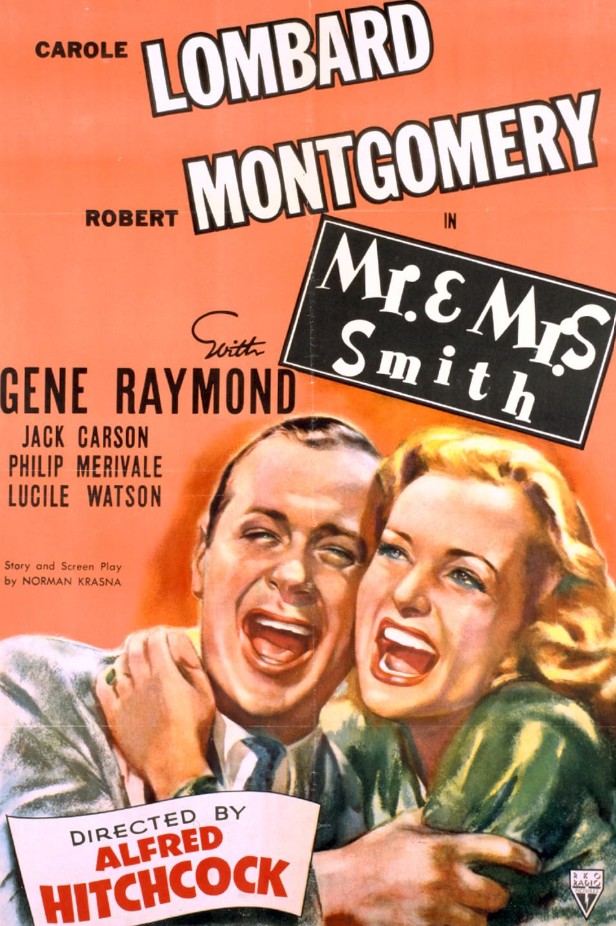
I am back from a two-week hiatus to deliver a brand-new review for The 4th Master of Suspense Blogathon! As a consistent participant in this event, I wanted to, once again, broaden my cinematic horizons by writing about another film from Alfred Hitchcock’s filmography. Before joining the blogathon, I remembered how Patricia (from Caftan Woman) recommended the 1941 movie, Mr. & Mrs. Smith, to me. This year’s edition of the Master of Suspense Blogathon gave me the perfect excuse to, finally, check the film out! Mr. & Mrs. Smith is now the seventh movie from Alfred’s filmography I’ve reviewed. However, most of his films covered on 18 Cinema Lane have been, in my opinion, just ok. Will the 1941 picture stand out among this aforementioned collection? Solve this mystery by reading my review!
The acting: In Mr. & Mrs. Smith, Carole Lombard portrays the titular Mrs. Smith, Ann Smith/Krausheimer. One aspect of Carole’s performance I liked was how expressive it was! A great example is present during a conversation Ann shares with her husband, David, toward the beginning of the movie. When Ann asks David if he’d marry her if he had a chance to do it again, she appears hopeful. A smile can be seen on Ann’s face and there’s a bright shine in her eyes, paired alongside her easy-going demeanor. But when David matter-of-factly answers Ann’s question by saying, “No”, Ann’s attitude completely changes. Not only do her eyes adopt a “thousand-yard stare”, her mouth is also slightly turned into a frown. Though Ann tries to mask her disappointment by bouncing back to her easy-going demeanor, her facial expressions perfectly capture what’s in her mind and heart.
Robert Montgomery portrays David Smith, the titular Mr. Smith in the 1941 movie. Similar to Carole’s performance, Robert effectively utilized facial expressions to convey emotions, feelings, and thoughts. While he’s at his office, David calls Ann about their upcoming dinner plans. During his conversation with Ann, the combination of David’s smile, playful glances, and a flirty hint in his voice showcases how much he loves his wife. Meanwhile, Jack Carson’s portrayal of Chuck “Chucky” Benson was a standout! Despite appearing in only three scenes, Chuck became memorable due to the consistent charisma and confidence Jack brought to his character. The scene where Chuck calls Gloria and Gertrude/Gertie is such a great example of how distinct Chuck’s personality is compared to David’s, as David’s awkward phone call emphasizes Chuck’s head-strong confidence.
The on-screen chemistry of Carole Lombard and Robert Montgomery: As I already mentioned in this review, David and Ann are the titular Mr. and Mrs. Smith. From the very beginning of the story, it is evident there is true love between them. This is because Robert and Carole’s on-screen chemistry successfully convinces the audience their characters are not only married, but also in love! When David and Ann cuddle together one morning, David holds Ann in a gentle embrace. Their relaxed body language perfectly captures the comfort they share in their relationship. As David asks her questions, Ann simply nods her head and moves her eyebrows. His tone of voice is calm, emphasizing the gentleness of David and Ann’s interaction. This is a very romantic moment because there’s a sense of tenderness, understanding, and respect between them. But because of the story’s conflict, Ann and David share so few romantic moments together, making me wish they had received more in the script.
Jeff’s apartment: One evening in Mr. & Mrs. Smith, David’s friend, Jeff, takes Ann to the 1939 New York World’s Fair. Due to the rain they endure, they go to Jeff’s apartment to escape the cold. When I first saw his apartment on screen, I did not expect it to look the way it did. Because Jeff is a lawyer who appears to enjoy the finer things in life, such as classy suits and fancy restaurants like The Florida Club, I imagined his apartment consisting of dark wood walls, richly upholstered furniture, and maybe a large painting of a horse. But when Jeff’s apartment appeared on screen, it was very bright. The space was surrounded in light colored wood walls. Not only were there light-colored curtains hanging by the windows, there was plenty of lighting featured throughout Jeff’s apartment. Table lamps, dark metal wall sconces, and a dark metal sconced chandelier contribute to the apartment’s brightness. A light-colored fireplace hearth is nicely paired with a darker marble. At least six built-in bookshelves compliment the space, adding a sense of coziness. These combined elements not only make Jeff’s apartment look like a visually appealing cozy cottage, the set design subverted my expectations as well!
Lack of open communication: Toward the beginning of Mr. & Mrs. Smith, David and Ann establish how they are honest with each other and respect one another, showcasing how open communication is a key component of their relationship. But the conflict of the 1941 movie revolves around how Ann and David aren’t officially married due to a misunderstanding with their marriage license. While David tries to persuade Ann to remarry him, Ann desires to move on and fall in love in another man. This difference in perspective was caused by Ann believing David wasn’t honest about the conflict with her. If they had openly communicated to each other similar to how they did toward the beginning of Mr. & Mrs. Smith, Ann and David would have saved so much time and frustration. David and Ann being unable to see eye to eye feels almost like part of their relationship was deceptive.
A prolonged conflict: I’ve mentioned in the past how I’m not a fan of Hallmark films where the story features a character who says they’re going to do something, but spends most of the story not doing the thing they said they were going to do. 1941’s Mr. & Mrs. Smith adopts this exact type of story. As I’ve already said in this review, the conflict revolves around how Ann and David aren’t officially married due to a misunderstanding with their marriage license. At first, David and Ann express a strong interest in getting remarried. But they spend most of the movie’s hour and thirty-five-minute run-time doing everything but that. Because Ann and David stopped prioritizing their desire to get remarried, Mr. & Mrs. Smith’s conflict felt prolonged. It also kind of felt like David and Ann took longer than necessary to reach the intended point.
A rushed ending: I’m not going to spoil 1941’s Mr. & Mrs. Smith, in case any of my readers haven’t seen this movie yet. But what I will say is the ending was, in my opinion, rushed. Like I just said in my review, Ann and David spend most of the movie’s hour and thirty-five-minute run-time doing everything but getting remarried. This creative decision made Mr. & Mrs. Smith’s conflict feel prolonged. While that conflict receives a resolution, it doesn’t happen until the last fifteen minutes of the film. Plus, it was wrapped up too quickly to the point it doesn’t feel satisfying or earned. In fact, I was caught off guard by how rushed the ending was, especially since Alfred Hitchcock is a director who, usually, knows how to conclude a story.
In my opinion, Alfred Hitchcock’s filmography fluctuates in quality. While I’d say Strangers on a Train is my favorite film directed by Alfred, I was not a fan of The 39 Steps. For me, Mr. & Mrs. Smith falls somewhere in the middle. The acting was solid from the entire cast, especially when it came to the performances of Carole Lombard, Robert Montgomery, and Jack Carson. I liked Robert and Carole’s on-screen chemistry so much, I wish David and Ann had received more romantic moments together. Not only did Jeff’s apartment look visually appealing, it also subverted my expectations. But what hurt Mr. & Mrs. Smith was prolonging the conflict to the point of rushing the ending. It didn’t help how, more often than not, Ann and David lacked open communication, contributing to the story’s prolonged conflict. However, I appreciate Alfred’s attempt at telling a type of story outside his claim to fame. While Mr. & Mrs. Smith wasn’t a suspenseful picture, it did hold my intrigue, as I wanted to know what would happen next.
Overall score: 6 out of 10
Have you seen 1941’s Mr. & Mrs. Smith? Which film from Alfred Hitchcock’s filmography do you wish I’d review? Please tell me in the comment section!
For this year’s Favourite TV Show Episode Blogathon, I decided to talk about a show I haven’t discussed in a while. Reflecting on the programs covered on 18 Cinema Lane, I made a surprising discovery. The last time I reviewed any episodes of Murder, She Wrote was all the way back in 2020, when I wrote about Van Johnson’s episodes of the show. To make up for lost time, I selected three episodes of Murder, She Wrote for the 12th Annual Favourite TV Show Episode Blogathon! But, for this year’s event, the episodes I chose correlate with the dates of the blogathon. In fact, each Murder, She Wrote episode is reviewed in order of the blogathon’s dates. Also, each episode review will cover what I liked about the episode, what I didn’t like about the episode, the mystery itself, the other factors from the episode, and my overall thoughts. So, now let’s begin this review of these episodes of Murder, She Wrote!
Name: The Dream Team
Season 11, Episode 18
Premiere Date: March 19th, 1995
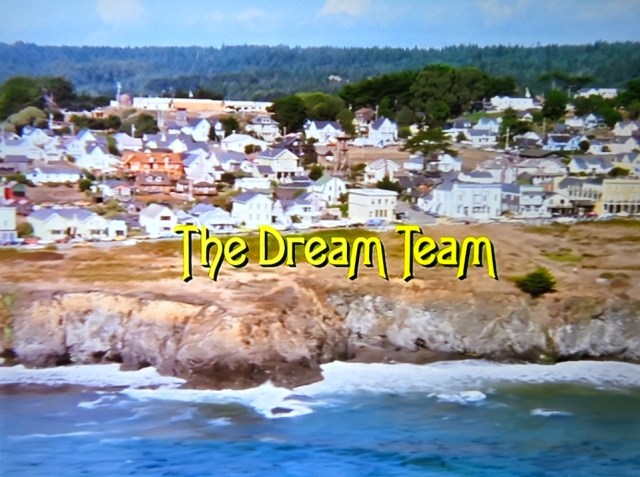
Screenshot of ‘The Dream Team’ title card taken by me, Sally Silverscreen.
What I liked about this episode:
Any time I’ve reviewed television show episodes, I have rarely addressed the dialogue as a strength of the episode. But in the case of this Murder, She Wrote episode, ‘The Dream Team’, the dialogue was cleverly written! Before attending a presentation about a development project from a company called Marina Americana, Jessica gives Seth some books about lighthouses. These books are intended to help Seth craft a strong argument for saving Cabot Cove’s lighthouse, which is an important landmark in the town. When Jessica brings up how the books could provide information for the hook of Seth’s argument, Seth says, “The hook I showed you last night will do just fine, thank you”. Sheriff Mort Metzger replies to Seth, “Maybe for the worm hanging from it”. At the presentation, Jessica’s nephew, Grady, reveals his colleague, J. Peter Carmody, plans to restore the lighthouse. Caught off-guard by this revelation, Metzger says, “Yeah, I think he [J. Peter Carmody] was rendered speechless by the Doc’s party trick; putting both feet in his mouth at the same time”. Along with being cleverly written, these quotes I brought up were hilarious!
What I didn’t like about this episode:
The beginning of a typical Murder, She Wrote episode will take the time to establish the characters and their potential motives. This creative decision gives the audience options in figuring out whodunit, as well as provide the story with red herrings. The establishment of characters and their motives in ‘The Dream Team’ took about half the episode. With the titular murder taking place at the episode’s halfway point, the audience is only given half the episode to help Jessica solve the case. Personally, I prefer stories that give viewers more time to figure the mystery out.
The mystery itself:
There are two interconnected stories in ‘The Dream Team’; the murder of a developer’s wife and the Marina Americana development project. But in this almost hour-long episode, more emphasis was placed on whether the development project would come to fruition. It also doesn’t help how, as I mentioned earlier, the audience was only given half the episode to figure the mystery out. In some Murder, She Wrote episodes, the guilty party will be revealed based on at least one small detail most viewers may miss. Though this was the case for ‘The Dream Team’, several smaller clues led up to the culprit’s reveal. Overall, I wish there was a balance between both stories and the audience was given more time to help Jessica solve the case.
The other factors from this episode:
As Seth explains his thoughts on the Marina Americana development project, Jessica expresses her impatience over how long Seth takes to get to his point. Seth then tells Jessica, “Now that you’re living in New York, you’re becoming as impatient as the rest of those people down there”. In several episodes of Murder, She Wrote, Jessica lived in New York, though this new living arrangement was only meant to be temporary. By having Seth address this part of Murder, She Wrote’s story, it was a good way to incorporate the show’s continuity.
While we’re on the subject of Seth, I want to address his desire to save Cabot Cove’s lighthouse. At the beginning of ‘The Dream Team’, Seth is against the Marina Americana development project because he fears the lighthouse will be destroyed. He goes so far as to create flyers in an attempt to make the developers feel guilty about risking the lighthouse’s future. However, the amount of time, money, and resources Seth puts toward those flyers could have gone toward actually restoring the lighthouse he claims to care about. If anything, Seth prioritizes talking about the problem instead of trying to solve it.
Grady is one of the developers of the Marina Americana development project. But when the fruition of the project is in jeopardy, so is Grady’s job. When he shares this information with Jessica, he says, “It’s so damn frustrating. I really believed in this project and, well obviously, so did a lot of other people”. What Grady said brings up an excellent point about how a neighborhood’s residents are not the only people impacted by any change within a neighborhood. In fact, I hadn’t come to this realization until I heard Grady’s quote.
My overall thoughts:
The way I feel about ‘The Dream Team’ is similar to how I feel about ‘The Legacy of Borbey House’; disappointment that Cabot Cove’s maintenance received precedence over the mystery itself. Also, like ‘The Legacy of Borbey House’, the entire first half of ‘The Dream Team’ was devoted to establishing characters and their potential motives. This left only half the episode for the audience to help Jessica solve the mystery. However, I did find the dialogue cleverly written. The examples I provided in this review were hilarious as well. I not only liked the inclusion of Murder, She Wrote’s continuity, I also found Grady’s quote thought-provoking. What I also found thought-provoking was the idea of Cabot Cove changing. As I watched ‘The Dream Team’, I thought about what would happen if Cabot Cove were a real town. Would it adapt with the times or would it stay frozen in time?
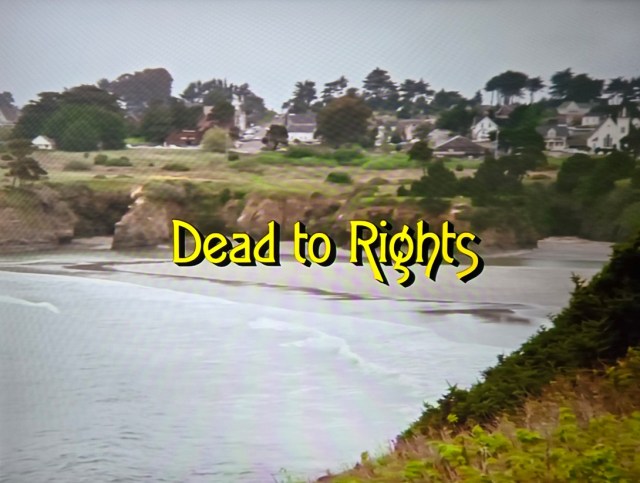
Screenshot of ‘Dead to Rights’ title card taken by me, Sally Silverscreen.
What I liked about this episode:
In this episode of Murder, She Wrote, ‘Dead to Rights’, Jessica’s former researcher, Dana Ballard, is accused of murdering her new boss. A major reason for this accusation is how she constantly lies. Dana goes so far as to impersonate Jessica, as well as change Jessica’s answering machine message, in order to be selected for a new job. But one person who sees past Dana’s lying is Missy, the wife of Dana’s new boss, Ethan. During a conversation between the two women, Dana shows off a sweet, even a bit naïve, personality, acting as if she’s oblivious of Missy’s suspicions. When Missy confronts Dana about her suspicions, Dana effortlessly transforms into an irritated, manipulative woman. Because of the screenwriting and Molly Hagan’s (the actress who portrayed Dana) performance, the creative team behind ‘Dead to Rights’ did a good job at establishing Dana as a potential suspect. However, I would like to point out the script provides a reason for Dana’s lying; “borderline psychosis” (as Jessica put it).
What I didn’t like about this episode:
As I just mentioned in this review, Dana is accused of murdering her new boss, Ethan. While this gave Jessica a personal reason for solving the case, the majority of the story focused on proving Dana’s innocence. ‘Dead to Rights’ did a good job at establishing characters and their potential motives. However, this build-up became an afterthought as the episode progressed due to the aforementioned focus on the truth about Dana. Similar to ‘The Dream Team’, the guilty party in ‘Dead to Rights’ was revealed based on a small detail. Had the script provided a balance between proving Dana’s innocence and figuring out who was guilty, the story might have been stronger.
The mystery itself:
Like I’ve already stated in my review, most of the story focused on proving Dana’s innocence. I also stated how the mystery’s guilty party was revealed based on a small detail. Another aspect of the mystery I’d like to bring up is how Jessica works with a lawyer named Vincent to solve the case. Typically, Murder, She Wrote shows Jessica collaborating with police officers, detectives, or investigators when it comes to catching whodunit. So, seeing Jessica engage with the more legal side of the mystery genre was a good change of pace for her!
The other factors from this episode:
Some scenes in ‘Dead to Rights’ show a large train display the length of the entire wall in Ethan’s office. This train display not only surrounds a miniature town, a large painted backdrop of a desert landscape covered the wall behind the train display. Even though the train display and everything surrounding it was impressive, its inclusion in ‘Dead to Rights’ was random. None of the characters acknowledged the display itself. Plus, Ethan’s reason for the display being in his office was never provided.
Toward the beginning of the episode, on-screen text reveals how most of the story takes place in Portland, Maine. But in an establishing shot of a hotel’s exterior (implying that’s the hotel Jessica is staying at), Maine’s state flag is not displayed on the hotel. Instead, the state flags for Maryland, Virginia, and Washington D.C. are prominently featured on the hotel’s exterior. In past reviews of Murder, She Wrote, I have complimented the show’s creative team for its location scouting because of how visually appealing the locations themselves have been. So, I’m surprised this film-making mistake went overlooked.
During Jessica’s and Vincent’s investigation, Vincent turns to a woman named Wanda for assistance. A few scenes show Vincent and Jessica visiting Wanda at her home. Her office/living room is filled with a collection of décor; from a cylindrical fish tank to a colorful pinball game. Because Wanda had such a quirky personality, the creative team behind ‘Dead to Rights’ did a good job utilizing these pieces of décor to paint a picture of who Wanda is. The décor itself also made Wanda’s home look like a cool space!
My overall thoughts:
At best, ‘Dead to Rights’ is an ok episode. But, at worst, the story was weaker than I had hoped. So much emphasis was placed on proving Dana’s innocence, the build-up of the characters and their potential motives became an afterthought as the episode went on. What I also found frustrating was how the guilty party was revealed based on a small detail I think most viewers might overlook. However, there are aspects of ‘Dead to Rights’ I liked. The combination of Molly Hagan’s performance and the screenwriting effectively established Dana Ballard as a potential suspect. The episode’s creative team did a good job showcasing Wanda’s personality through the set design. However, there were some questionable creative choices, like Ethan’s train display and the lack of Maine state flags on the hotel. Now I wonder what other production errors from Murder, She Wrote actually appeared on the show?
Rating: A 3 out of 5
As I point out in this screenshot, the on-screen text clearly states most of the story takes place in Portland, Maine. Screenshot taken by me, Sally Silverscreen.
In this establishing shot, these flags would indicate the hotel is not located near Maine. Screenshot taken by me, Sally Silverscreen.
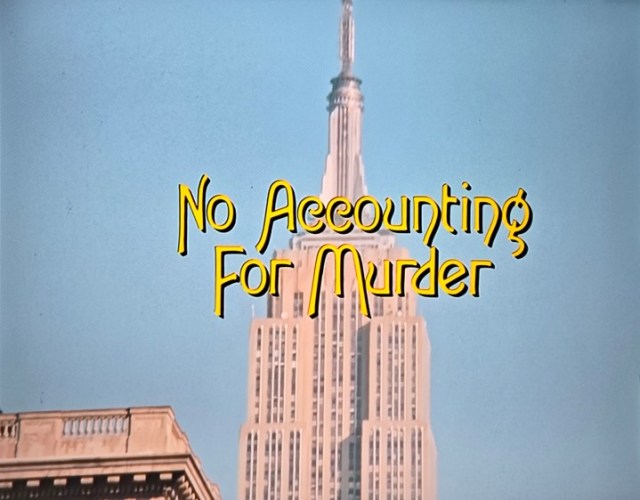
Name: No Accounting for Murder
Season 3, Episode 19
Premiere Date: March 22nd, 1987
Screenshot of ‘No Accounting for Murder’ title card taken by me, Sally Silverscreen.
What I liked about this episode:
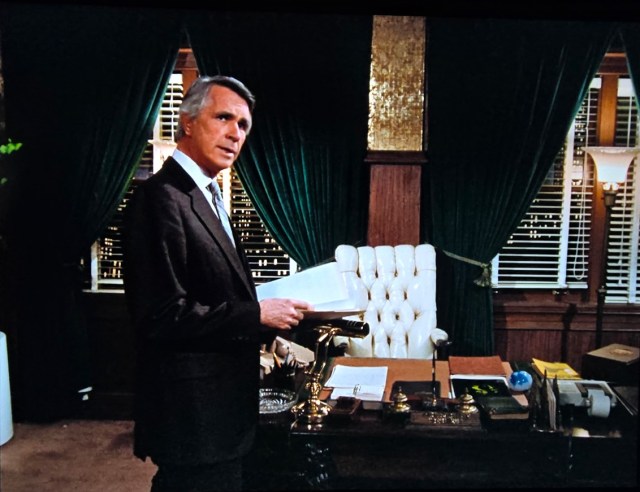
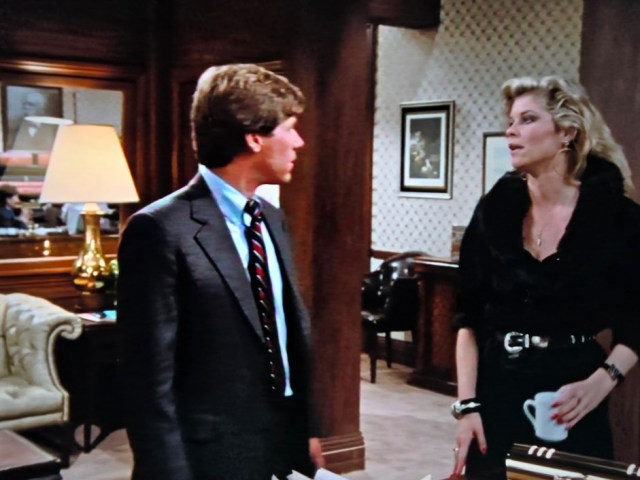
One of the strengths of Murder, She Wrote has been the set design. This episode, ‘No Accounting for Murder’ is a perfect example of this statement! The accounting firm Grady works for is one of the most opulent looking businesses I’ve ever seen in entertainment media. The office of a colleague named Paul Carlisle boasts stunning design choices, including gold wallpaper that sparkled in the light, a white upholstered office chair, and gold décor. Even the accounting firm’s lobby fit the opulent style found in Paul’s office! Deep wood pillars and window frames provide a nice contrast to the light-colored carpet and wallpaper. Similar to Paul’s office, the sofa in the lobby was also upholstered. A gold table lamp adds a touch of elegance to the space. Once again, the creative team behind Murder, She Wrote knew what they were doing when it came to designing this particular set!
What I didn’t like about this episode:
When I reviewed ‘The Dream Team’ and ‘Dead to Rights’, I talked about how the characters and their potential motives were established within the story. But in ‘No Accounting for Murder’, some of the characters aren’t given a potential motive. The characters that do have a potential motive receive it as the story went along instead of toward the beginning of the episode. What also didn’t help was how the culprit was revealed because of a small detail mentioned by one of the characters. The fact only some characters were given a potential motive caused the script to lack red herrings.
The mystery itself:
There are two mysteries within ‘No Accounting for Murder’; the murder of one of Grady’s colleagues, Ralph Whitman, and the “ghost” inhabiting the accounting firm. Unlike the stories in ‘The Dream Team’, the stories in ‘No Accounting for Murder’ didn’t feel connected. In fact, each story felt like it belonged in their own separate episode. Personally, I thought the “ghost” story was more intriguing, as there were more mysterious elements to it. By the episode’s conclusion, however, I was disappointed by the unsatisfactory resolution of that story.
The other factors from this episode:
In ‘No Accounting for Murder’, Jessica works alongside Lieutenant Timothy Hanratty while trying to solve the case. In a car ride through New York City, Timothy brings up some of Jessica’s past cases and even wonders why she hasn’t received a gold badge from her own police department yet. Jessica replies by saying, “It’s just a quirk of mine, really. The way I see things, you know?” When Jessica said this, I thought about other detectives, both amateur and professional, from entertainment media. They seem to possess a gift for observation, picking up on little details buried among facts, clues, and speculation. What these characters bring to their respective tables is just extraordinary. Any time I’ve watched Murder, She Wrote, I believed Jessica just happened to be that good at being a detective. But after watching ‘No Accounting for Murder’, I now see Jessica possessing a brilliance, similar to other detectives from television and film.
Last year, when I reviewed the Touched by An Angel episode, ‘Sympathy for the Devil’, I brought up one of the most unintentionally funny moments of the show; when Ty Duncan called his son “Chicken Boy” as an insult. In the Murder, She Wrote, episode, ‘No Accounting for Murder’, an unintentionally funny moment took place during a confrontation between Paul and the murder victim’s wife, Lana Whitman. As an insult, Lana calls Paul an “arrogant horse’s batootie”. Because of how goofy this insult sounded, I ended up bursting out laughing.
While watching ‘No Accounting for Murder’, I spotted a familiar face among the cast of characters. Ron Masak portrayed a salesman named Marty Giles, who happened to be a potential suspect. Fans of Murder, She Wrote would recognize Ron as Sheriff Mort Metzger, one of the most beloved residents of Cabot Cove. This discovery was such a surprise for me, as I didn’t know Ron had portrayed other characters on Murder, She Wrote besides Metzger. This makes me wonder how often actors and actresses portrayed more than one character on Murder, She Wrote?
My overall thoughts:
Like ‘The Dream Team’ and ‘Dead to Rights’, ‘No Accounting for Murder’ was just ok. Even though I liked the accounting firm’s set design, I didn’t like how some of the characters didn’t receive a potential motive. I also didn’t like how the mystery stories felt disconnected. However, the “ghost” story was intriguing enough to keep me invested in the episode, despite its resolution being unsatisfactory. ‘No Accounting for Murder’ has made me see Jessica in a slightly different way, leaving me appreciative of what she has to offer to the mystery genre’s table. It was nice to see Ron Masak appear in this episode as well. But as I look back on the episodes of Murder, She Wrote I’ve written about, ‘No Accounting for Murder’ will not be reflected on as fondly as other episodes.
Rating: A 3 out of 5
Design details like the sparkling gold wallpaper and the velvety green curtains add opulence to the set. Screenshot taken by me, Sally Silverscreen.
The opulence I mentioned while discussing Paul’s office is also reflected in the lobby of the accounting firm. Screenshot taken by me, Sally Silverscreen.
What are your thoughts on these episodes of Murder, She Wrote? Are there any episodes you’d like to see me review? Tell me in the comment section!
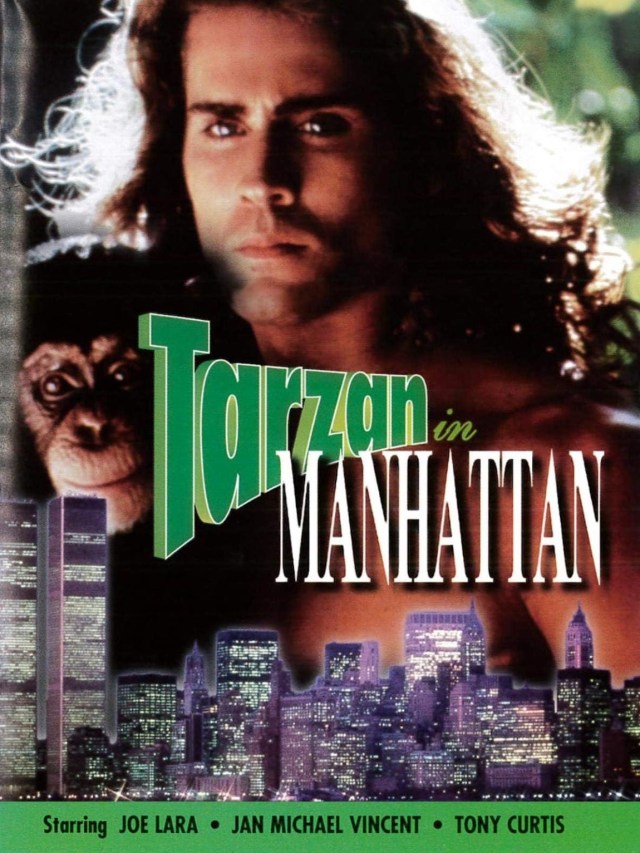
During my search for my “so bad, it’s good” movie, I’ve learned to find two things: a film that is built on a gimmick and a film that is unintentionally funny. Though these things have helped me get one step closer to finding my “so bad, it’s good” movie, a film has yet to earn that coveted title. For the annual So Bad It’s Good Blogathon, I had several selected movies to choose from. But, in the end, I picked the 1989 film, Tarzan in Manhattan! That title alone gives away the project’s gimmick; an iconic character existing in a more contemporary setting. Based on the movie’s synopsis, there seems to be elements that could be unintentionally funny, such as Jane becoming more street-smart when she’s usually known for being book-smart. But what made me ultimately select Tarzan in Manhattan for the So Bad It’s Good Blogathon were the reviews on IMDB. According to what I read, it seemed like the movie’s creative team didn’t take their project seriously because they acknowledged the film’s gimmick. With all of that said, let’s see if this movie could become my “so bad, it’s good” film!
The acting: When I reviewed The Chalk Garden earlier this month, I said I was invested in the story because of the acting performances’ quality. I also said each acting performance was good for different reasons. In Tarzan in Manhattan, the cast made a strong effort to make their performances as entertaining as possible. In my opinion, these efforts worked, as their performances kept me invested in the story! Joe Lara used emotion well while portraying the titular character. A great example comes from the first ten minutes of the movie. Tarzan experiences a tragedy, as he discovers someone close to him passed away. Upon making this discovery, Tarzan is understandably upset. His eyes are brimming with tears and his mouth presents a frown. Quickly realizing what possibly happened, Tarzan’s sadness turns into anger within seconds. He then grits his teeth and the rest of his facial features become tense.
Kim Crosby portrays Jane in Tarzan in Manhattan. In my review’s introduction, I pointed out how Jane became more street-smart. Because of this creative decision, Kim adopts a down-to-earth, laid-back personality she consistently carried throughout the movie. When Jane meets Tarzan, she’s unfazed by the situation. Her whole persona presented the idea she, as a cab driver, has seen it all. Portraying Jane’s father, Archimedes, is Tony Curtis. Similar to Kim’s performance, Tony’s on-screen no-nonsense attitude was consistent. What also worked in Tony’s favor was how believable his on-screen interactions were. Anytime Archimedes and Jane shared a conversation, it felt like a realistic discussion between father and daughter. The strength of Kim’s and Tony’s acting talents helped make that possible!
Respect toward the source material: While I haven’t read the book Tarzan in Manhattan is based on, I have seen another adaptation of the Tarzan story. Based on that experience, it appears the creative team of the 1989 film made efforts to respect the source material their project is based on. Remember when I said in this review’s introduction how Jane became more street-smart when she’s usually known for being book-smart? It is true she is street-smart in Tarzan in Manhattan. However, the book-smart aspect of her character actually worked in harmony with the street-smarts. Around the time she and Tarzan first meet, Jane shares how she has a Bachelor’s degree in Computer Science from NYU. Her book-smarts, along with problem-solving skills, help Tarzan find an important clue in figuring out Cheetah’s whereabouts. Throughout his New York City trip, Tarzan carries a bag of expensive jewelry as a form of currency. It is revealed the collection of jewelry belonged to Tarzan’s parents, the Lord and Lady of Greystone, before they passed away.
How humor was incorporated: I mentioned in my review’s introduction how Tarzan in Manhattan’s IMDB reviews were the reason I chose the film for the So Bad It’s Good Blogathon. Based on those reviews, it seemed the movie’s creative team didn’t take their project seriously because they acknowledged the film’s gimmick. As I watched the 1989 picture, I could detect a sense of self-awareness. From the dialogue to the “Easter Eggs”, it felt like the movie’s creative team recognized how much of a gimmick their project was built on. During the plane ride to New York City, Tarzan is reading a book about surviving in New York on five dollars a day. This “Easter Egg” calls out how expensive the Big Apple can be. After somersaulting his way into a locked room, Tarzan leaves that same room by escaping through an open window. This situation causes Archimedes to ask Jane why Tarzan can’t leave through the door like other people. The aforementioned self-awareness in Tarzan in Manhattan made comedic moments genuinely hilarious!
Things that don’t make sense: There were some parts of Tarzan in Manhattan that didn’t make sense. One example takes place toward the beginning of the film. Within the first five minutes of the story, Tarzan is shown living a secluded life from civilization, how Tarzan is usually portrayed in other adaptations. Then, all of a sudden, a man named Joseph shows up to give Tarzan and Cheetah a pair of books. Based on their interaction, it seems like Joseph and Tarzan’s friendship has lasted even before the events of the movie. If Tarzan lives close enough to civilization where walking to Joseph’s store is possible, why does he still live isolated in the jungle?
Inconsistent sense of urgency: A reason why Tarzan travels to New York City is to rescue Cheetah. This part of the film’s synopsis would warrant a sense of urgency throughout the story. But Tarzan, along with Jane and Archimedes, don’t figure out what likely happened to Cheetah until more than twenty minutes into an hour and thirty-four-minute film. While there is a sense of urgency in Tarzan in Manhattan, it appears at certain moments in the movie. These creative choices made the story’s sense of urgency inconsistent.
Part of the story that doesn’t lead anywhere: On more than one occasion, the audience is reminded how Tarzan is the son of the Lord and Lady of Greystone. Jane even purchases a book featuring his family’s portrait. I appreciate the creative team’s efforts to respect the source material their project is based on. However, the part of the film about Tarzan’s family history didn’t lead anywhere. The story’s main conflict had nothing to do with the Greystone estate. Tarzan’s family weren’t even featured in a subplot. I wish that part of Tarzan in Manhattan had a stronger connection to the overall story.
When I started this review, I said I learned to find two things when looking for my “so bad, it’s good” movie; a film that is built on a gimmick and a film that is unintentionally funny. Tarzan in Manhattan is definitely built a gimmick, with enough self-awareness in the movie to acknowledge this. But what the film isn’t is unintentionally funny. The way the story’s humor was written and delivered gave the audience a reason to laugh with the creative team, not at them. Humorous moments felt like they were intended to be comedic. This is one of the reasons why Tarzan in Manhattan was as entertaining as it was! Though there were flaws in the 1989 picture, there were aspects of the project I liked. A few examples are the acting performances and the on-screen chemistry between Joe Lara and Kim Crosby. Even though moments with high-stakes and a sense of urgency are sprinkled throughout the story, Tarzan in Manhattan is, for the most part, silly and goofy fun. Out of all the movies I reviewed for the So Bad It’s Good Blogathon, I’d say Tarzan in Manhattan is the best one. So, when it comes to finding my “so bad, it’s good” movie, I ended up taking a detour this time.
Overall score: 7 out of 10
Have you seen Tarzan in Manhattan? Which adaptation of the Tarzan story is your favorite? Please tell me in the comment section!
Days before Christmas, I reviewed I Heard the Bells for my 500 Blog Follower Dedication Review. But this is not the only honor the movie achieved. I Heard the Bells became my 400th published movie review! To commemorate this milestone, I decided to write my sixth list article of 2024. Trends, whether in fashion or when it comes to the most popular toy of the Christmas/holiday season, exist for a reason. This statement also applies to the world of cinema. Sometimes, however, there are film related trends that leave me confused, wondering why film-makers continuously use them in their projects. So, for this list, I will be discussing ten movie trends I don’t understand! The intent of this list is to gain a better understanding for why the listed trends either existed or still exist, as I am genuinely curious about their purpose.
From about the late ‘80s to the mid-2000s, children’s/family media, especially movies, were fond of food fights. From 1996’s Matilda (where the children at Crunchem Hall Elementary School hurl their lunches at Miss Trunchbull) to the Disney Channel film, Eddie’s Million Dollar Cook-Off (where I remember two food fights taking place), film-makers saw food fights as a way to add excitement and hilarity to their film. But long after the janitor has cleaned up the mess, what sinks in is the realization that these film-makers likely spent hundreds of dollars on large quantities of food only to waste it. This realization not only makes me wonder why food fights were once a staple of children’s/family media, I also question how often food fights happen in real life.
2. Keeping Secrets
Around the time the aforementioned food fight trend was common, another popular movie trend was younger characters being encouraged to keep secrets. When I reviewed 1985’s Return to Oz, I brought up Princess Ozma telling Dorothy that she can go back to Oz whenever she wants, as long as she keeps it a secret. By bringing up that part of the film, I addressed how Princess Ozma’s statement could be misinterpreted as damaging messages such as holding back on creativity helping one become “normal” and bottling up ideas and feelings being accepted. As I mentioned in my review of The Best Christmas Pageant Ever, bullying is not addressed in the script, including in Alice’s part of the story. One reason why is how Imogene forces Alice to keep the bullying a secret.If you’re going to create a story for a younger audience, you need to be mindful when it comes to addressing serious, real-world issues because of how impressionable a younger audience can be. With that said, I kind of find it concerning how common the trend of younger characters keeping secrets was in children’s/family media.
3. New York City as a Selling Point
I brought up this trend back in 2021, when I reviewed Sherlock Holmes in New York. As I shared my overall impression of the 1976 film, I talked about how movie studios used their project’s New York setting as a selling point. Clear examples show New York City or New York City locations included in a film’s title, like A Troll in Central Park, The Muppets Take Manhattan, and Home Alone 2: Lost in New York. I don’t understand this need to single out a story’s New York location. Personally, I think the movie should show instead of tell their story is set in New York. What I also don’t understand is why the trend of using New York as a selling point occurred between about the mid- ‘70s to the mid-2000s.
4. Villains Receiving the Spotlight
2024 started with the release of Madame Web (a Spider-verse villain movie without the presence of Spider-Man) and ended with the premiere of Kraven the Hunter (a Spider-verse villain movie without the presence of Spider-Man). I bring up these movies to highlight a trend I first noticed in the 2010s that carried over to the 2020s. This trend is villains receiving the spotlight; whether this means villains are given their own movie, villains are presented as more “sympathetic”, or villains make arguments with seemingly valid points. When a movie studio adopts this trend, it gives their audience mixed messages. Within Spider-Man’s comic books, Kraven is known as a villain. The tagline of Kraven the Hunter is “Villains aren’t born. They’re made”. But based on what I’ve heard about the film, Kraven is presented as more of an anti-hero. Not only does giving villains the spotlight confuse the audience, it also makes villainous characters less straight-forward.
5. “Thrown Together” Movie Posters
A “thrown together” movie poster is the contents of a movie (like cast photos, story locations, and even a scene from the film) thrown together on that movie’s poster. The collage I just described appears overwhelming and leaves the audience with little surprises. I first became aware of this trend when Disney/Marvel used this style for their Avengers: Age of Ultron poster. After that movie came to theaters in 2015, the “thrown together” movie poster trend became the go-to style of cinematic advertising. It even got to the point where Hallmark adopted this trend, as the posters for Christmas Everlasting and Love Takes Flight are notable examples. Based on what I’ve seen, it seems like the “thrown together” movie poster trend is fading in the 2020s, as studios and networks have chosen more artistic styles for their movie posters. But I still wonder why the “thrown together” movie poster trend was ever popular.
In Great American Family’s A Little Women’s Christmas, Fritz orders a black coffee at a café in Alcott Grove. At that same café, Jo orders a sugary, seasonal coffee drink. This scene made me realize how often I’ve seen men ordering and/or drinking black coffee in movies. Not only do they order/drink black coffee, they usually get criticized for doing it. Similar to the previously mentioned food fight trend, I wonder how the men drinking black coffee trend reflects real life.
7. Cabins & Bed and Breakfasts
These trends are specific to Lifetime and Hallmark movies. In the world of Hallmark films, it seems common for characters to either own a Bed and Breakfast or know someone who knows a Bed and Breakfast. These Bed and Breakfasts are usually found in small towns. Meanwhile, on Lifetime, it seems like many characters either own a cabin or know someone who owns a cabin. The cabins themselves are typically treated as a vacation destination. I know both networks share the same flaw; telling the same types of stories and reusing the same ideas. This makes me wonder if that flaw is the reason for the abundance of Bed and Breakfasts on Hallmark and cabins on Lifetime.
8. Rival Girl Scouting Troop
This trend isn’t as common as other trends on my list. But I’ve seen it happen enough times to point it out. Troop Beverly Hills, The Cookie Mobster, and Smart Cookies share something in common; the “underdog” girl scouting troop must face a “rival” girl scouting troop. The rival girl scouting troop is always presented as bratty, wealthy, and popular. Their only purpose in the aforementioned movies is to win cookie season. The rival girl scouting troop trend is, in my opinion, an unnecessary conflict. The main and only conflict should be the protagonist girl scouting troop trying to achieve a goal within their own troop (such as having a successful cookie season). The rival girl scouting troop trend is yet another movie trend that makes me wonder how often it happens in real life.
9. The Sound of a Baby Crying in an Apartment Building’s Hallway
When one of a movie’s scenes takes place in an apartment building’s hallway, the sound of a baby crying can be heard. This trend has been present in so many movies, I wonder why that particular sound has been the go-to sound for film-makers. All walks of life can live inside an apartment building. This fact provides film-makers with a variety of sounds; such as dogs barking, music, or noise from a television. So, it confuses me when film-makers continuously use the same sound over and over again.
10. Calling out “Hello” in an Empty Room
Out of all the movie trends on my list, the calling out “hello” in an empty room trend is the most common one. From theatrical pictures to made-for-TV films, a character will call out “hello” when they enter an empty room. Predictably, no one calls “hello” back. But the character who called out “hello” will be taken by surprise by another character. The calling out “hello” in an empty room trend can usually be found in mystery, action, or thriller movies. When film-makers select this trend, they make suspenseful moments more predictable. It also makes characters who call out “hello” look absent-minded.
Every so often, I try to review a movie that has been recommended by one of my readers or a fellow blogger. It’s a wonderful opportunity when I can write about a recommended film for a blogging event. This is what happened when I joined the Everything Is Copy Blogathon! When I learned Rebecca’s, from Taking Up Room’s, event centered around the Ephron family, I realized no one had chosen You’ve Got Mail as their blogathon entry. Since the movie was recommended by Janis from Momshie Diaries, I found the perfect excuse to finally see the film in its entirety! You’ve Got Mail is far from the first romantic comedy (rom-com) I’ve talked about on 18 Cinema Lane. Several Hallmark Channel films have received their own review, ranging from terrible to the best I’ve ever seen. So, where does You’ve Got Mail rank among those Hallmark titles? Log in to this review to find out!
Tom and Meg’s on-screen chemistry: An ingredient to a successful rom-com is casting an actor and actress who share strong on-screen chemistry. This ingredient creates an on-screen relationship that feels believable. In You’ve Got Mail, Tom Hanks and Meg Ryan portray Joe Fox and Kathleen Kelly; two literary business owners who have different perspectives on the world of bookselling. Yet, whenever they’re together, Kathleen and Joe share a spark between them, learning over time how they have more in common than they initially believed. The on-screen chemistry between Meg and Tom makes it feel like their characters have known each other for many years. It also helps how Tom and Meg brought a strong sense of likability to their characters. Even though Joe was a businessman who felt there was a time and a place for “big box stores”, his personality was more jovial than some of the businessmen who appear in a typical Hallmark Channel rom-com. Meanwhile, Kathleen’s personality was fun and fancy-free, trying to find a silver lining during autumn in New York City.
The set design: One of the conflicts in You’ve Got Mail was a bigger, chain bookstore affecting the business of a smaller, locally owned book shop. The interior design of the bigger bookstore was meant to imply how impersonal that store’s shopping experience was. But I actually liked the interior design of both stores! At the smaller book shop, the pale yellow walls paired nicely with warm wood shelves. With string lights circling near the store’s ceiling, the space itself felt cozy and quaint. At the bigger bookstore, white supporting columns, dark gray granite countertops, and shiny silver railings boasted a modern space that looked and felt heavenly. Quirky décor, such as a large, spinning silver globe and a replica of the Statue of Liberty reading a book prevented the store from being dull. Even the bookstore’s bakery section was promoted as a hip gathering space, a curved countertop with tall stools providing an area for readers to come together and enjoy each other’s company. Both spaces looked inviting and appeared photogenic!
The dialogue: The strength of dialogue can create or break a script. While the dialogue can be elevated through delivery, its believability and memorability lie in the writing talent. Within You’ve Got Mail, there was dialogue that I thought was cleverly written! One example was when Kathleen and Joe met each other at a restaurant. Using advice from her anonymous pen pal, Kathleen shared what was on her mind with Joe. Frustrated by Joe’s inability to see how his bookstore prevented other bookstores from thriving, Kathleen told Joe his brain was replaced by a cash register and his heart was taken over by the bottom line. While her statement was meant to be insulting, Kathleen’s quote was an eloquent way of illustrating how she saw Joe. Her quote also stressed how her love of literature helped her choose words that made her opinion sound mature and intelligent.
Forgettable secondary characters: In a rom-com, the main male and female character are not the only characters who can make a story work. A collection of secondary characters who interact with the protagonists can add humor, wit, and even thoughtful insight to the film. The story of You’ve Got Mail revolved so heavily around Kathleen and Joe, all of the movie’s secondary characters seemed like an afterthought. This group of actors and actresses did a good job with the material they were given. But the characters they portrayed weren’t as 3-dimensional as Joe and Kathleen. Some rom-coms will give at least one secondary character a subplot. However, no subplots were given to the secondary characters in You’ve Got Mail. Even when there was the possibility for a secondary character to receive their own piece of the story, this opportunity didn’t lead anywhere. It felt like You’ve Got Mail was the world according to Joe and Kathleen, where every other character was simply given permission to exist in it.
The protagonists’ love interests: I have seen some Hallmark rom-coms where the main male and female characters are already in a romantic relationship, only for these characters to end their previously established relationships in order to fall in love with each other. This trope is not limited to Hallmark’s films, as it appeared in You’ve Got Mail. At the beginning of the movie, the story established Kathleen is living with her boyfriend, Frank. Meanwhile, Joe is considering proposing to his girlfriend, Patricia. Because You’ve Got Mail is a rom-com, there is a greater likelihood Kathleen and Joe will fall in love. I’ve also mentioned in this review how, in my opinion, Tom and Meg had strong on-screen chemistry. Therefore, Joe and Kathleen’s previously established relationships feel pointless.
The run-time: You’ve Got Mail has a run-time of one hundred and twenty minutes. This is almost the same run-time as a typical Hallmark movie. Like I mentioned in this review, none of the story’s secondary characters were given a subplot, as the film revolved heavily around Joe and Kathleen. You’ve Got Mail’s plot includes anonymous pen pals desiring to connect in the real world. With the story being so simple and easier to follow, the movie’s run-time feels excessive. Some scenes are drawn out to likely satisfy the film’s run-time. In my opinion, You’ve Got Mail should have shown the anonymous pen pals meeting sooner. That way, they could not only help each other with their professional dilemmas, but the story itself could have become a contemporary retelling of Pride and Prejudice.
Before and after the release of You’ve Got Mail, rom-coms have found their place in the world of film. Like any genre, there’s a variety of titles, some good and some bad. For me, You’ve Got Mail falls somewhere in the middle. The main romance was well written, directed, and acted. This combination allowed the protagonists to form a relationship that felt believable and charming. While the dialogue and set design certainly helped this picture, it wasn’t enough to outweigh the film’s flaws. From none of the secondary characters receiving their own subplot to the run-time, these things held the movie back from being a stronger story. With the film titled, You’ve Got Mail, and with the anonymous pen pals exchanging emails and instant messages, I’m surprised none of the story’s bookstores brought up the possibility of selling their merchandise online. In fact, I’m shocked the internet wasn’t a bigger topic/theme in this movie! I would say that was a missed opportunity. But with the film itself being just fine, I guess I don’t have much to complain about.
Overall score: 7.2 out of 10
Have you seen You’ve Got Mail? What’s your favorite rom-com? Tell me in the comment section below!
While looking through some of my movie reviews from last year, I came to the realization I only wrote about two Christmas films. To make up for that, I will make a greater effort this year to review more Christmas movies. As it was Veteran’s Day two days ago, I decided the first Christmas film review of 2022 would be for USS Christmas! In the two years since its release, I’ve heard good things about this particular Hallmark picture. The network also has a pretty consistent track record when it comes to their military related Christmas titles. This is not the first time I’ve talked about USS Christmas. Back in 2020, I wrote a Word on the Street story about the project. I mentioned that the only Tiger Cruise movie I knew of was the 2004 Disney Channel movie, Tiger Cruise. Therefore, USS Christmas was filling a creative void that hadn’t been revisited in over ten years.
USS Christmasposter created by Crown Media Productions and Hallmark Movies & Mysteries
Things I liked about the film:
The acting: Jen Lilley portrays the protagonist, Maddie. Her reason for joining the Tiger Cruise was to spend Christmas with her sister, Amelia, who was portrayed by Stefanie Butler. I really liked the on-screen camaraderie between the sisters! While sharing breakfast at a local restaurant, Amelia and Maddie talk about a variety of subjects. Throughout their conversation, Jen’s and Stefanie’s facial expressions changed with fluidity. The actresses also had nice on-screen chemistry, giving the impression the sisters got along really well. It’s been a while since I’ve seen one of Trevor Donovan’s movies. However, I have always thought he was one of Hallmark’s strongest actors. In USS Christmas, Trevor portrayed Lt. Billy Jenkins. At the start of the story, Billy is distant with Maddie, maintaining a sense of professionalism. As the film continues, a kind hearted, more spontaneous side to Billy breaks forth. This progression in Billy’s personality was well executed through Trevor’s acting talents! The naturalness of this progression allowed Billy’s part of the story to be believable.
The set design: Like any Hallmark Christmas film, USS Christmas contained its fair share of seasonal décor. But it was the way this décor was incorporated into the set design that caught my eye. When Maddie’s family has their first dinner on the Tiger Cruise, the dining room is surrounded by white walls. White and blue Christmas decorations are placed in the background, from a blue garland to a white Christmas tree with blue ornaments. These complimentary hues added a sense of elegance to this space! Garland was a nice touch to other sets. A traditional green garland paired with red ornaments and bows was framed around the dark wood windows of the Jenkin family home. A similar looking garland framed the kitchen window of the Contino family home, a room that contained white cabinets. That garland shows how a simple Christmas decoration can complement various different spaces!
The mystery: Mysteries are uncommon in Hallmark’s Christmas films. So, the inclusion of a mystery in USS Christmas was a pleasant addition! In an effort to write a story about finding love on a Tiger Cruise, Maddie finds a journal written by a man named Sam. In this journal, Sam talks about falling in love with a woman named Dorothy. Maddie and Billy spend the rest of the movie searching for Dorothy and Sam, going on a journey to figure out what happened to this couple. While I won’t reveal what Billy and Maddie discover, I will say the mystery itself was intriguing! It gave me a reason to stay invested in the story.
The Tiger Cruise itself getting overshadowed: It’s been years since I’ve seen Tiger Cruise. From what I remember, the cruise itself was focused on to the point where it was its own character. With USS Christmas, I felt the cruise was overshadowed by the mystery of Sam and Dorothy. As I already said in this review, I liked the mystery in this story. However, that part was prioritized above everything else. When Maddie and Billy go to New York, I thought, “Wait, isn’t this movie supposed to be about the Tiger Cruise”?
Underutilized characters: On the Tiger Cruise, Charlotte is boarding alongside her brother, who is a member of the U.S.S. Polaris. Because Charlotte is also a writer, I assumed she would help Maddie in her quest to find Sam and Dorothy. Unfortunately, Charlotte and her brother briefly appeared in the film for about three scenes. These are just two characters I feel were underutilized.
Inconsistent use of Easter Eggs: The inclusion of Easter Eggs can be a nice treat for viewers and, if done right, can be cleverly woven into the story. There were some nice Easter Eggs in USS Christmas. But I was confused what the overarching direction for these Easter Eggs was. Toward the beginning of the movie, I found a few Easter Eggs related to It’s a Wonderful Life, as Maddie says that is her favorite Christmas film. Throughout the movie, there were at least two Easter Eggs referencing Top Gun. I even caught an Easter Egg connected to Hallmark itself. I wish the film’s creative team had chosen one topic for their Easter Eggs and consistently stuck with it.
As I said in the introduction, Hallmark has a pretty consistent track record when it comes to their military related Christmas titles. While some of these titles have been better than others, I haven’t seen a military related Hallmark Christmas movie that was bad or disappointing. With USS Christmas, it was a nice, pleasant film. It isn’t an instant classic for me or a new favorite movie. But, for what it was, USS Christmas was fine. Hallmark’s efforts to tell more creative stories seems to be an exception to the rule. So, I appreciate how the creative team behind USS Christmas strove to create a type of story that isn’t common in entertainment media. It also helps how a mystery was incorporated into the film, as mysteries aren’t often found in Hallmark’s Christmas offerings. I’ve heard Jen Lilley and Trevor Donovan have begun appearing in Great American Family’s (GAF) movies. I’ll have to check out their films from that network!
Overall score: 7.1 out of 10
Have you seen USS Christmas? Which military related Hallmark Christmas movie do you like? Let me know in the comment section!
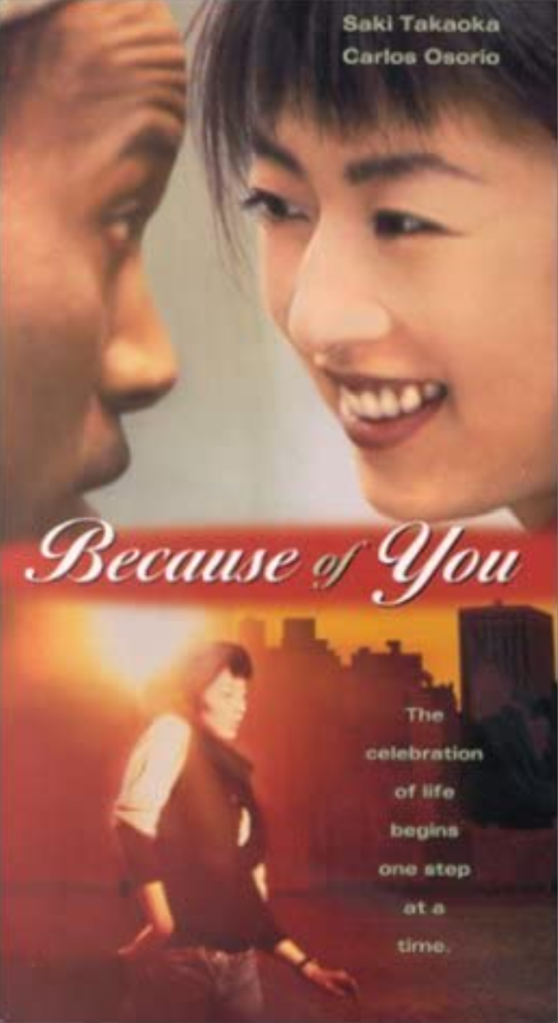
Kyoko/Because of You is a movie I first planned to review back in May. But as I explained in my review of The Pit and the Pendulum, my DVD copy of Kyoko/Because of You didn’t arrive in time for the blogathon I was participating in. Thanks to this month’s Genre Grandeur, I now have an excuse to finally check this movie out! ‘New York Films That Take Place Prior to 9/11’ was selected for September’s Genre Grandeurtheme. Not only wasKyoko/Because of You released in 1996, the protagonist takes a trip to New York. When I first came across this movie on IMDB, the synopsis immediately caught my attention. It sounded heartfelt, almost like a Hallmark Hall of Fame production. Since this movie is a lesser-known title, it gave me a chance to try to find a hidden gem!
The acting: I’m not familiar with Saki Takaoka’s filmography. Despite this, I thought her portrayal of the titular character was pleasant to watch! From scene to scene, Saki displayed genuine emotion. One great example is when Jose is telling her about a lampshade his mom loved. When the scene begins, Kyoko has a smile on her face, happy to be spending time with her mentor. But as Jose is sharing his story, Kyoko’s face slowly falls, highlighting just how sad his story is. At the end of Jose’s story, Kyoko smiles again and tells him she’ll help find this lampshade, making her response bittersweet.
Kyoko’s mentor, Jose, is portrayed by Carlos Osorio. For the majority of the film, Jose is dealing with the effects of not only AIDS, but also Dementia. Despite these struggles, the humanity of this character shown through, thanks to Carlos’ acting talents. Before Kyoko leaves to purchase a souvenir, Jose asks to keep the van door open, as he wants to feel the breeze. Jose’s face has a wistful look about it, like he is reminiscing on simpler times. When Kyoko returns, Jose is angry at a young man named Angel. He not only yells at Angel, Jose also uses his cane to protect himself.
While in New York, Kyoko meets a limousine driver named Ralph. Portrayed by Scott Whitehurst, Ralph was one of the best characters in this movie! He was so charismatic and such a good friend to Kyoko. During their first interaction, Ralph encourages Kyoko to take a ride in his limousine. Using charm to his advantage, Ralph’s encouragement sounded more like a sales pitch. Despite this, the pleasant demeanor and friendliness of Scott’s body language and facial expressions indicated his good intentions.
Various sides of New York: In any movie taking place in a well-known, beloved location, there are two angles a creative team can take their project: glamourize and glorify it or show the not-so-pretty sides of that location. When it came to New York in Kyoko/Because of You, the presentation of New York seemed balanced. Yes, there is a shot of Radio City Music Hall. But well-known landmarks were not the only places featured in this part of the story. While looking for Jose, Kyoko visits a dance studio and a local bar. While the dance studio visit was brief, the local bar is where Kyoko shows off her dance skills. Since New York is such a large city, it hosts a landscape of multiple restaurants and cultural hubs. The film shows how various communities can make their home in the Big Apple.
The soundtrack: Throughout the film, Latin tunes can be heard in the background. While the tunes themselves were pleasant, I liked how they contained a strong connection to the story. Jose is from Cuba, sharing through a voice-over how dancing plays a huge role in his culture. Both Jose and Kyoko are Latin dancers, with the music emphasizing their shared interest. What’s also good about the music is its consistency, as Latin music was the principal sound for this movie.
Dancing has a limited presence: In the synopsis for Kyoko/Because of You, it states Jose taught Kyoko to dance when she was younger. With that in mind, I was expecting dance to be one of the film’s key themes. Sadly, there wasn’t much dancing within the story. In this hour and twenty-five-minute movie, there were two dance solos and three duets. Even though this film wasn’t a musical, I still found this disappointing.
The bait-and-switch: Because Kyoko travels to New York and because the New York City skyline is featured on the film’s poster, I assumed the majority of the story would take place in New York City. Even though the Big Apple is featured in the movie, only about a third of the film is set there. The rest of the movie becomes a road trip story, with some shots of a moving vehicle used as padding. Since I watched this film partly because of its New York City backdrop, this was somewhat misleading.
Drawn out scenes: As I just mentioned, some shots of a moving vehicle were used as padding. They were also used to satisfy the film’s run-time. One example is when Kyoko is driving out of New York. In this shot, she is driving her vehicle on a bridge, which lasts for about thirty seconds. Scenes like that one should have been cut shorter, giving more time to the plot.
The story of someone reconnecting with their mentor could be heartwarming. While that potential was there for Kyoko/Because of You, it didn’t contain as much heart as I expected. The majority of this story focused on the road trip instead of the bond between Kyoko and Jose. Yes, I know Jose was experiencing Dementia. But it seems like the road trip, from a story-telling perspective, tried to make up for Jose’s disintegrating memory. The acting performances were nice to watch. I also enjoyed the dance routines. However, I wish dance had been a key theme in this movie. New York is such a diverse landscape, especially when it comes to dancing. Therefore, this felt, to me, like a missed opportunity. I’m glad I finally got a chance to review Kyoko/Because of You. But it’s not the hidden gem I thought it could be.
Overall score: 6.1 out of 10
Have you seen Kyoko/Because of You? Which ‘dance films’ do you like? Tell me in the comment section!
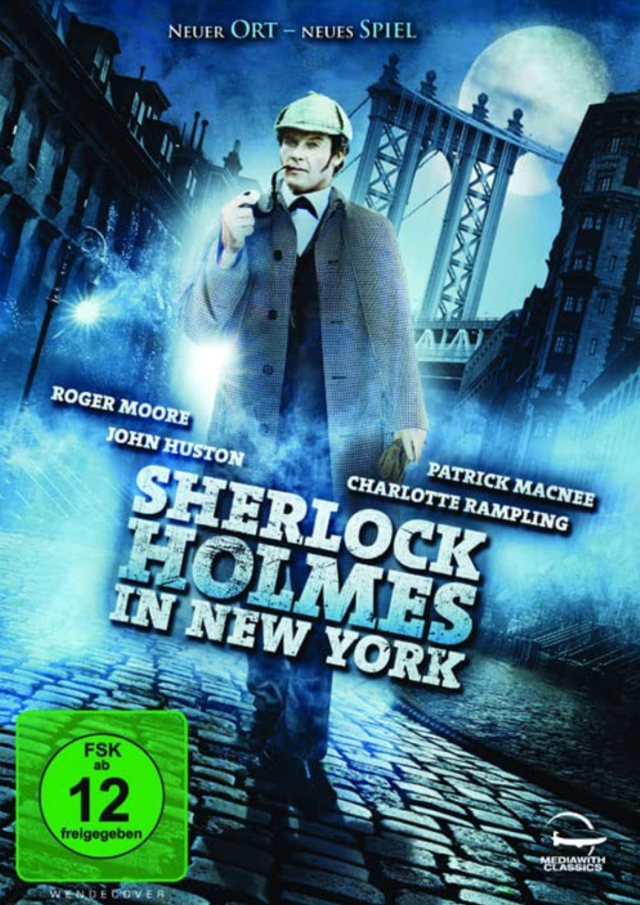
As of late 2021, there have been six actors who have portrayed one of the most iconic characters in cinematic history. Despite the fact I’m reviewing a Sherlock Holmes movie, the role I’m referring to is James Bond. Now, you’re probably wondering, “what does James Bond have to do with Sherlock Holmes”? Besides being British, both characters were portrayed by Roger Moore. When I was invited by Gill, from Realweegiemidget Reviews, to join the You Knew My Name: The Bond Not Bond Blogathon, I had to think about what film I wanted to write about. When I discovered Roger Moore starred in a Sherlock Holmes movie back in 1976, I thought it’d be an interesting title to cover. While I have reviewed my fair share of mystery films, including those that were made for television, I haven’t seen a lot of Sherlock Holmes related movies. Therefore, talking about Sherlock Holmes in New York will certainly make up for that!
Roger’s portrayal of Sherlock Holmes: While I haven’t seen any of Roger Moore’s films from the James Bond franchise, I have seen his performance in the 2011 Hallmark Channel movie, A Princess for Christmas. From what I remember, Roger carried his character, Edward Duke of Castlebury, with class and dignity. These same qualities were present in his portrayal of Sherlock Holmes. During Sherlock Holmes in New York, I could see some James Bond-esque qualities in the titular character. Roger’s ability to be suave as well as calm under pressure are just two examples. At certain moments in the story, Sherlock interacts with a woman named Irene Adler. Because there is history between these characters, Sherlock and Irene’s interactions contain a romantic flair. This is where the suaveness comes in, as Roger uses this to emphasize his on-screen chemistry with Charlotte Rampling. At the very beginning of the film, Sherlock faces off against Professor Moriarty. In this scene, Moriarty tries to hurt Sherlock at every chance he gets. But Sherlock never cracks under pressure. Instead, he consistently keeps his composure.
The historical accuracy: Recently, I reviewed the movie, Let Him Go. In that review, I talked about how the set design appeared to come from the ‘50s, despite the story taking place in the ‘60s. This caused the film’s time period to be unclear. Sherlock Holmes in New York takes place in March of 1901. Unlike Let Him Go, everything in the 1976 movie looked and felt like the 1900s! The costume design appeared historically accurate, with Sherlock Holmes’ outdoor wear serving as one example. Toward the beginning and end of the film, Sherlock sported the iconic plaid short cape and cap. But in New York, he wore a longer black cape and top hat. The historical accuracy was so on point, even the posters in The Empire State looked like it came from 1901. The font and basic design of these posters were just one detail that helped this movie’s creative team achieve the aesthetic they wanted for their project!
The presentation of New York City: When a movie or television show takes place in a beloved location, that place can be presented in two ways: an over-glamourized empire or a disgusting landscape covered by a glittering mask. With Sherlock Holmes in New York, the titular city was given to the audience “as is”. Even though the more polished areas of this destination could be seen, that was not the “end all, be all” in the story. In a handful of scenes, Sherlock Holmes explores the performance community of New York. He even goes undercover as a stage performer. The Big Apple is known for being one of the world’s entertainment hot-spots. While that part of this location was not emphasized, it did show some of the different components of one of America’s largest cities.
A pointless change of scenery: When a movie or television series chooses to change the location of their story, there needs to be a strong reason for that change. These reasons can range from expanding upon the overarching story to giving the protagonist(s) something interesting to do. With Sherlock Holmes in New York, though, none of these things happened. As a matter of fact, having Sherlock Holmes go to New York at all seemed unnecessary. If the mysteries in this film took place in England, it wouldn’t make much of a difference. That’s because none of the mysteries have any exclusive connection to New York itself. Having Sherlock solve the disappearances of immigrants from Ellis Island would have given him a stronger reason to be in New York, as Ellis Island is a part of New York and United States history. A child being kidnapped or a bank robbery can take place anytime and anywhere.
Not interactive enough: An appealing aspect of the mystery genre is the opportunity to solve the mystery alongside the protagonist. This allows the story to be interactive and engaging. I know one of Sherlock Holmes’ traits is his ability to figure out clues and possible scenarios in a short amount of time. But in Sherlock Holmes in New York, Sherlock figures things out so quickly, the audience doesn’t get a chance to engage with the mystery themselves. Instead, they’re forced to sit on the sidelines and watch the protagonist do everything, giving the audience a weak reason to stay invested in the story. Because of this, I found myself zoning out of the movie on a few occasions.
Lack of urgency: When a mystery takes place in current time, it gives that story a sense of urgency. The audience watches as the protagonist(s) races against the clock to solve a given mystery. While I won’t spoil Sherlock Holmes in New York, I will say a kidnapping takes place in the story. However, shortly after this crime takes place, Sherlock plays his violin in his hotel room. He then smokes his pipe all night. As I mentioned earlier, Sherlock Holmes is known for figuring out clues and scenarios in a short amount of time. That doesn’t give the story an excuse not to have urgency.
There was a time when having a movie take place in New York was the film’s selling point. From Friday the 13th Part VIII: Jason Takes Manhattan to A Troll in Central Park, movie studios wanted to take a bite out of The Big Apple for one reason or another. While I don’t know where or why this trend started, Sherlock Holmes in New York may have been one of the movies that caused this interesting ripple effect. Too bad the titular character didn’t have a stronger reason to visit The Empire State. The idea of Sherlock Holmes solving a mystery outside of England is not a bad one. But with the 1976 movie, the idea was better in theory than in practice. Add weak interactivity and a lack of urgency, this movie is not as strong as The Case of the Whitechapel Vampire, a Sherlock Holmes film I reviewed back in 2018. However, I did like Roger Moore’s portrayal of the famous detective. In fact, it’s a shame he didn’t receive more opportunities to appear in Sherlock Holmesstories. With this review completed, I need to make the time to see Roger’s filmsfrom the James Bond franchise. I just have to find the perfect opportunity to talk about them.
Overall score: 6-6.1 out of 10
Have you seen any Sherlock Holmes or James Bond films? If so, which one is your favorite? Let me know in the comment section below!
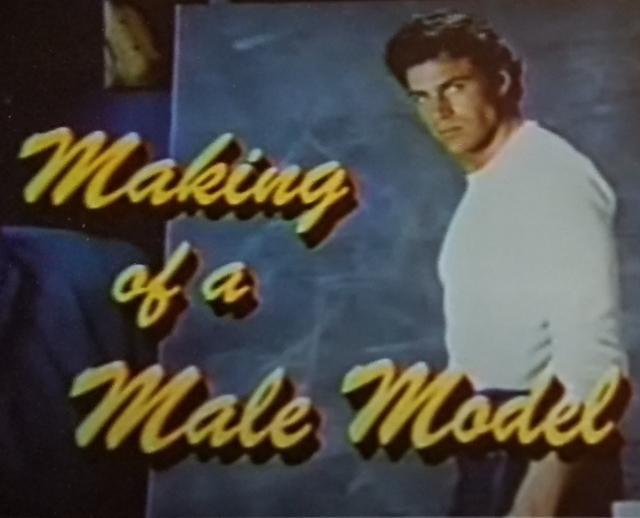
Any time I participate in a blogathon, I try to choose a film or topic that brings something different to the event. This allows my entry to stand out, as well as offer a sense of variety to the blogathon’s subject. When searching Joan Collins’ filmography, for Realweegiemedget Reviews’ Joan Collins Blogathon, I came across the 1983 television movie, Making of a Male Model. What intrigued me to the point of wanting to watch it was how it told a story from a completely different perspective. In films that revolve around modeling or the fashion industry, the story usually focuses on a female protagonist. With Making of a Male Model, a man is entering the modeling world. Out of the films I’ve seen involving modeling, the only one featuring a male model in the starring cast is the Disney movie, Model Behavior. Add the fact I’ve haven’t seen many of Joan’s projects, I am definitely eager to start this review!
Here is a screenshot I took with my phone of the movie’s opening title. Screenshot taken by me, Sally Silverscreen.
Things I liked about the film:
The acting: Because Joan Collins’ involvement in this movie is one of the reasons why I chose to review this film, I’ll talk about her performance first. In stories where the head of a fashion or modeling firm is one of the main characters, they either have an obvious self-centered personality or they come across as emotionally distant. With Joan’s portrayal of Kay Dillon, she brought something different to a role like this. For most of the film, Kay appeared genuinely kind-hearted and nurturing. The only times Kay sounds self-centered is when she is upset. When Kay and Tyler discuss their plans over lunch is a perfect example, as she explains how she can’t spend much time with him because she had spent ten years building her career. Speaking of Tyler, I enjoyed watching Jon-Erik Hexum’s performance! He did a good job portraying a character in his specific situation. At the beginning of the movie, Tyler is a “fish out of water”, overwhelmed by the modeling world and taken aback by some of the things that take place in that world. As the film progresses, Tyler gains more confidence and his perspective begins to change. I also liked Jeff Conaway’s portrayal of Chuck Lanyard! It was dramatic and emotional without being over-the-top. One of Jeff’s best scenes is when his character is comparing the modeling world to a stage play. That scene proved to me Jeff has the talents for a Broadway show!
The costume design: In one scene, Tyler and Kay attend a costume party. The costumes were so elaborate and detailed, I honestly thought they were going to the Met Gala! One of the party goers wore a large hat in the shape of eyes. The piece around the blue eyes appeared periwinkle, with the hat portion blending into a pretty purple. Kay’s dress was absolutely gorgeous! It was covered in sparkles, allowing the dress to shine whenever Joan moved. The top of the dress was gold, with the skirt adopting an ombre design of blue and purple. A clear jeweled collar completed the look. During a photo shoot, one of the models was wearing a hat with a bird on it. The bird was covered in purple jewels, sparkling anytime the model moved her head. It was such a cool piece that I’d love to have in my wardrobe!
An insightful look into the world of modeling/advertising: Out of the episodes of Murder, She Wrote I’ve seen, my favorite one is ‘Film Flam’. One of the reasons is the behind the scenes look at how a movie premiere is organized. Throughout Making of a Male Model, the world of modeling and advertising is explored. When Tyler goes to apply for a catalogue modeling job, he is turned down due to his appearance and his lack of a portfolio. This instance shows how fast-paced this particular world can be and how one must always be prepared to bring a good first impression. At one point in Tyler’s journey, Tyler takes part in television commercials. Before a commercial for cologne was filmed, the director conducted a practice run in order to help Tyler remember what to do. It was interesting to see how the sets were constructed, how far the crew was willing to go to create an image or an idea. It was also interesting to see the prep work that goes into creating a commercial.
What I didn’t like the film:
Lack of on-screen chemistry: During the film, Tyler and Kay form a romantic relationship. However, I never sensed a spark between them. Jon-Erik and Joan worked well together from an acting perspective. But when it came time for their characters to become intimate, it felt like they were following story points within a script instead of allowing their characters to form a connection. Tyler and Kay’s relationship comes to fruition after the costume party I mentioned earlier. But up until that moment, Tyler and Kay did not express any interest in falling in love with each other. So, the formation of their relationship, from a story telling perspective, felt forced and random.
Following the same beats: As I said in the introduction, I wanted to watch Making of a Male Model because it told a model’s story from a man’s perspective, which is not often explored in the world of cinema. Because of this, I was expecting the movie to tell a different kind of story from others of this nature. Sadly, it was just more of the same. The story followed a lot of the same beats as other modeling/seeking fame films. Making of a Male Model featured tropes such as “the two-faced boss”, “a cautionary tale about fame and fortune”, and “a friend in crisis”. This movie had an opportunity to take different avenues of the modeling or advertising world that either haven’t been or are rarely discussed in film. But that opportunity was not taken advantage of.
Telling more than showing: There were some moments in Making of a Male Model where characters told more than showed what was happening. As I already mentioned, Chuck compares the modeling world to a stage play. I did like Chuck’s monologue and Jeff’s performance. However, because this monologue was given before Tyler’s modeling career began, it denied the audience a chance of seeing Tyler’s journey firsthand, without being spoiled. At the costume party, a man named Ward accuses Kay of breaking a contract. It gets to the point where Ward starts causing a scene. Since this accusation is presented as hearsay, it is never determined who was telling the truth.
I apologize for the poorer quality of this photo, but it was one of the few complete shots of the dress this movie presented. Screenshot taken by me, Sally Silverscreen.
My overall impression:
I know that stories are bound to get repeated overtime. But there is a fine line between telling similar stories and rehashing material. Making of a Male Model fits into the latter category, as the same tropes are adopted from other films of this nature. Honestly, this disappoints me because I was expecting more from this movie. Despite finding Making of a Male Model to be just ok, there are aspects of the film I liked. One of them is the insightful look at the modeling/advertising world. This part of the story held my interest, as I found it to be a fascinating exploration. With that in mind, I think the concept of this movie would have worked better as a television show or documentary.
Before I finish this review, I’d like to let my readers know I did choose another book from my TBR Tin. For those who don’t know, I announced in January how I would choose which book to read next from a hot chocolate tin I won last year. My second TBR Tin book of the year is
(insert drumroll here)
Closed for the Season by Mary Downing Hahn!
Yes, this is a book I said I was going to read in 2019. But I’m glad to finally get around to reading it!
Overall score: 6.1 out of 10
Have you seen Making of a Male Model? Which projects of Joan Collins’ have you watched? Let me know in the comment section!