Before school begins in Hope Valley, Elizabeth states how she wants to create a routine for the students of Benson Hills so they can have a sense of normalcy in their lives. When I first heard what Elizabeth said, I remembered how When Calls the Heart has created their own routine. For Hearties, it’s the fact the show itself premieres each episode at a consistent time on a consistent day of the week. Behind the scenes, this routine looks like a block of days or months set aside for filming, screenwriting, and editing. These routines created by the show give the cast, crew, and Hearties expectations, a sense of predictability, but most importantly, something to look forward to. Even when this routine has become interrupted, the creative team behind When Calls the Heart has adapted to the best of their abilities so the routine carries on as smoothly as possible. Few television shows have survived past ten seasons like When Calls the Heart. What seems to have worked in When Calls the Heart’s favor is building a strong and stable routine.
Just a reminder: If you did not see this episode of When Calls the Heart, there will be spoilers within this re-cap.
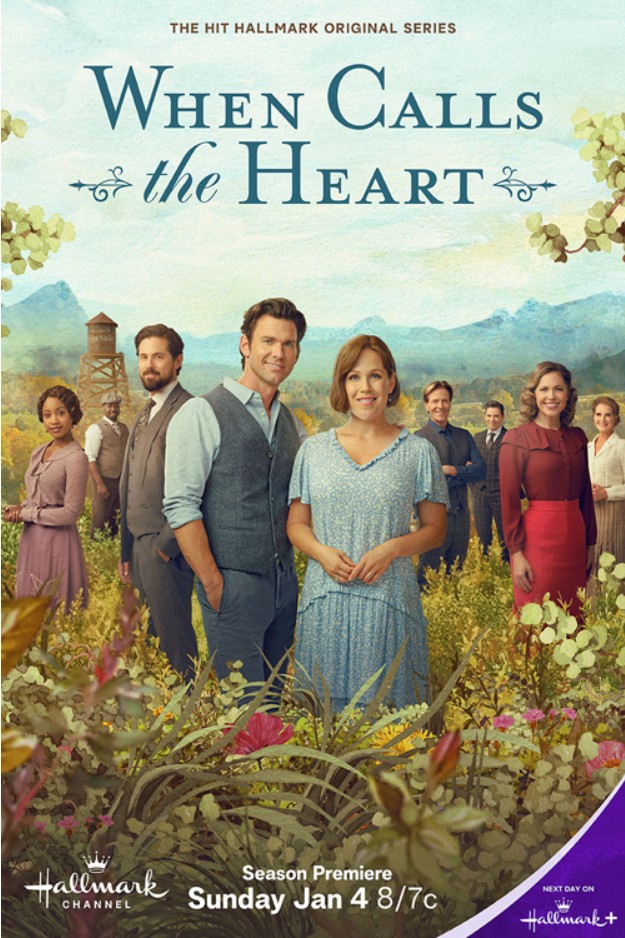
When Calls the Heartseason thirteen poster created by Hallmark Media, Crown Media Family Networks and Hallmark Channel
Season: 13
Episode: 3
Name: Back to School
Major stories:
The children of Hope Valley and Benson Hills are going back to school. But for the students of Benson Hills, they are having a difficult time adjusting to their new educational surroundings. One young girl tells Elizabeth how she’s tired of receiving people’s sad faces. Gwendolyn, who likes to be called Gwen, is carving into one of the desks with a fork belonging to Rosemary. Elizabeth encourages Hope Valley’s students to sit with the students from Benson Hills in an effort to integrate Benson Hills’ children into her class. But Elizabeth feels there is more she can do to make all her students feel like they are part of a community. Later in the episode, Elizabeth, Nathan, and Jack Jr. organize a field day. Everyone participates in the activities except for Cooper and Toby. They turn to Elizabeth toward the end of the episode to reveal they made a small cooking fire during their hike in the national park. However, Toby and Cooper reassure Elizabeth they put the fire out. As they reflect on what happened, they second guess if their fire was what caused the national park, Rosemary’s Playhouse, and Benson Hills to burn.
Lee is convinced someone intentionally started the fire in Goldie National Park. One day, at the saloon, Mollie confesses to Lee how, on the day of the fire, she saw an older gentleman entering the park carrying what looked like a kerosine can. Even though Bill and Nathan are currently conducting an investigation, Lee wants McGinty to be held accountable, as he believes McGinty is responsible for the fire. But when Lee confronts McGinty about the fire at the saloon, McGinty is appalled by Lee’s accusations. Nathan arrests Lee after Lee punched McGinty. When Rosemary picks up Lee from the jail, Lee shares how all he wants is for the guilty party to be held responsible for what they did. Rosemary reminds her husband how they don’t know all the answers yet.
The residents of Benson Hills are literally and figuratively picking up the pieces of their lives after the fire. Some of Hope Valley’s residents, including Mei, volunteer to take Benson Hills’ residents back to Benson Hills to reclaim their lost possessions. Maisie, Benson Hills’ mayor and Mike’s sister, is trying to acquire relief funds to rebuild Benson Hills. When Mei offers Maisie a place to stay at her and Mike’s apartment, Maisie turns down the offer at first because she doesn’t want Benson Hills’ residents to believe she gave up on them. But after Mei finds a baby portrait of Mike from what was Maisie’s house, Maisie realizes her family is just trying to support her. Meanwhile, Lucas agrees to appear at a meeting about insurance claims, organized by Edie and Maisie. But due to a scheduled dinner that runs longer than planned, Lucas ends up missing the meeting.
Like I mentioned in this re-cap post, Gwen carves into one of the desks with a fork belonging to Rosemary. Later in the episode, at the Coulter family’s house (where Gwen is currently residing), Gwen tries her hand at woodcarving under Lee’s guiding eye. The two instances I brought up make me wonder if Gwen will eventually take up woodcarving as a hobby? Maybe this new hobby will help Gwen pass the time and make new friends until she can be reunited with her father?
Rupert is one of Elizabeth’s newest students from Benson Hills. During class, he brings up his past studies about ancient Rome. Rupert even talks about a class project he made that became lost in the fire. In my list of the Thirteen Questions for When Calls the Heart’s 13th Season, I wondered if another student would receive the Hope Valley Scholarship. With Rupert’s expressed desire for learning, could Rupert be the next Hope Valley Scholarship recipient? Though he is one of Benson Hills’ students, perhaps he could be the exception to the rule.
In this episode of When Calls the Heart, Elizabeth brings up the idea of a poetry club, in order to encourage Oliver to read William Shakespeare’s work. Reflecting on Elizabeth’s idea, it would be great if Hope Valley had a book club! The library would be the club’s official meeting spot. Different stories and genres could be explored within the club. Maybe they could even solve mysteries like in the Ainsley McGregor Mysteries series! Since Hearties know a fourteenth season is on the horizon, perhaps Hope Valley could see its first book club come to fruition.
What are your thoughts on this episode of When Calls the Heart? What lessons do you hope Elizabeth’s students learn in their upcoming school year? Please tell me in the comment section!
2025 has been a strange year for 18 Cinema Lane. That’s because most of the movies I’ve seen and/or reviewed this year have been ok or fine. After seeing so few good or bad films in 2025, I wasn’t able to create separate top ten best and worst movies lists like in years past. So, instead, I wrote a combined list where I discuss the movies I saw this year that I liked and didn’t like. What’s also different about this year’s end of year list is how there are no Honorable Mentions, due to how few good movies I saw in 2025. But there are two Dishonorable Mentions; Recipe for Murder and Black Bag. The only reason why these films are considered Dishonorable Mentions is because I DNFed (did not finished) both of them. For this year’s list, I will start talking about 2025’s worst movies then end the list by talking about 2025’s best movies. If I reviewed any of the movies on my list, I will provide a link to those reviews.
Lifetime movies, like Hallmark movies, are not created equally. The 2024 film, Stalked by My Amish Boyfriend, is just one example of this statement. While it was interesting to see and hear how information about Amish culture was woven into the story, that part of the script couldn’t overshadow the major flaws of the movie. I was frustrated by how some characters would make dumb decisions simply for the sake of making dumb decisions. Stalked by My Amish Boyfriend was also, in my opinion, a mostly forgettable film. This is the reason why the 2024 picture is at the bottom of my list.
6. She Wore a Yellow Ribbon
As I said in my review of She Wore a Yellow Ribbon, I expected the 1949 movie to be an action-packed, suspenseful, and even intriguing story. What I got instead was an underwhelming film that prioritized presentation over product. I praised She Wore a Yellow Ribbon for its pretty looking scenery. But a photogenic background was unable to save the film from its weak script. A limited amount of action took away a lot of the story’s suspense and intrigue. It also doesn’t help how I only became familiar with most of the characters instead of truly getting to know them. She Wore a Yellow Ribbon is one of two movies I saw this year that almost made me fall asleep.
Kind Hearts and Coronets is the second film I saw in 2025 that almost made me fall asleep. But the flaws in this movie greatly differ from She Wore a Yellow Ribbon’s emphasis on scenery over substance. Despite Kind Hearts and Coronets being classified as a “comedy”, I didn’t laugh at all while watching the film. I also had no idea what the story’s moral was supposed to be, due to the moral being treated as an afterthought. Like I said in my Kind Hearts and Coronets review, I’m not entirely sure what this movie was trying to say. That lack of clarity not only makes the movie underwhelming, it also makes the movie confusing.
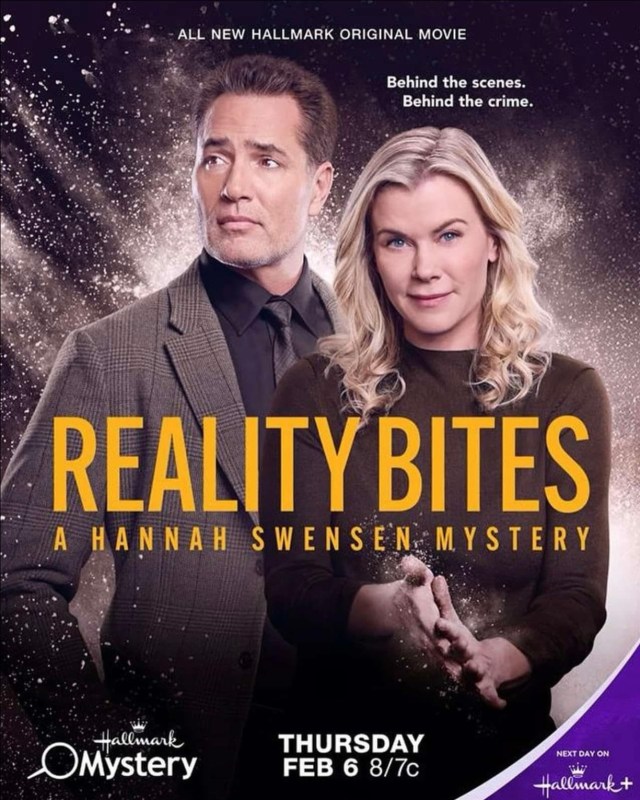
Having Reality Bites: A Hannah Swensen Mystery on my worst movies of the year list and finding Pie To Die For: A Hannah Swensen Mystery slightly better than its predecessor feels like déjà vu. That’s because One Bad Apple: A Hannah Swensen Mystery was placed on my worst of 2024 list, with its follow-up, A Sprinkle of Deceit: A Hannah Swensen Mystery, being slightly better. Though Reality Bites: A Hannah Swensen Mystery had its own set of flaws. Forced humor felt straight out of a sit-com, especially when Delores was involved in the story. As I said in my review, I wondered why a laugh track was missing. Both of the film’s mysteries contained such a small sense of urgency, the run-time felt a bit drawn-out. The story’s overall intrigue was weaker due to this flaw. If the Murder, She Baked/Hannah Swensen series continues in 2026, I’d like to see the quality become more consistent.
Perry Mason: The Case of the Heartbroken Bride is the most disappointing movie I saw in 2025. There were so many missed creative opportunities in this story, the film itself was under-cooked and uninspired. The movie was sometimes boring because of the lack of urgency. Seeing Perry, Della, and even Kevin meanderingly take their time building a legal case sucked the energy out of the story. I said in my review how any movie series boasting over ten titles was going to have at least one “bad day at the office”. I also said in my review how Perry Mason: The Case of the Heartbroken Bride was one of those days for the fictional detective.
This 2014 movie is a perfect example of Hallmark putting the cart before the horse. Instead of creating a solid stand-alone film that could have naturally led to more chapters, the network put more effort into trying to build the foundation for a potential series. Parts of this story didn’t make sense. One glaring example is when an itinerary shows the protagonist couple’s plans of going dancing at 11 p.m. on Saturday then going to church at 8 a.m. on Sunday, begging the question of when these characters were supposed to go to sleep. The on-screen chemistry between Cameron Mathison and Rachel Blanchard made their characters, Henry and Sunday, feel less like a married couple and more like a couple who are about to start dating. It’s, honestly, a shame My Gal Sunday wasn’t a stronger picture. Mystery stories about married couples are uncommon from Hallmark, so this 2014 story could have offered something unique to the network’s table.
1.Mystery by the Book
This film actually has two titles; Mystery by the Book and Key to Love. However, I saw the movie on Great American Family under the title, Mystery by the Book. Therefore, I will be referring to that title for the sake of my list. For a movie with the word ‘mystery’ in the title, the story’s mystery is an afterthought, which makes the title itself very misleading. Instead, the characters develop other priorities, like playing dress-up and tapping glasses four times during one dinner date. Parts of the script don’t make sense, like how the protagonists find a treasured antique key. Mystery by the Book is even so bad, it’s, at times, unintentionally funny. A perfect example is when Corey Sevier’s character, Josh, is looking for a set of keys, only to find a set of keys seconds later on a key hook labeled “Keys”. Thank goodness Great American Family’s Ainsley McGregor Mysteries series is growing stronger in quality. But if the network wants to expand their mystery library, they have a long road ahead of them.
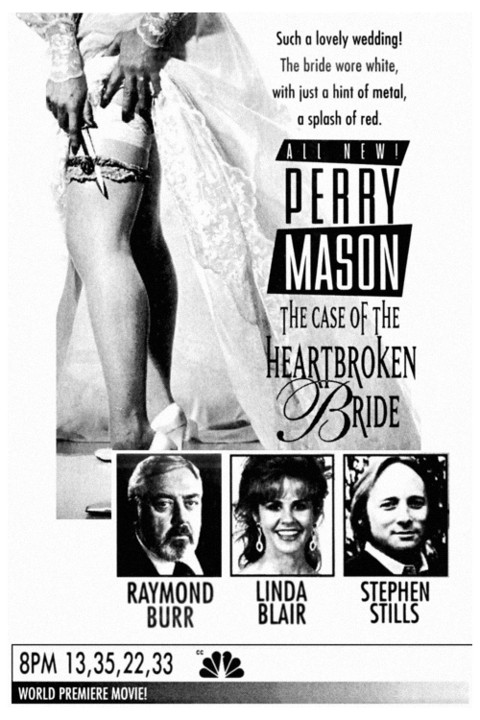
Perry Mason: The Case of the Heartbroken Bride poster created by Fred Silverman Company, Viacom Productions, Dean Hargrove Productions, National Broadcasting Company, and Viacom
I’m still shocked by how the 1925 version of The Phantom of the Opera was never included on any of American Film Institute’s 100 movies lists, even months after I reviewed the film. Looking at everything the movie has to offer, I believe there is an argument to be made for its inclusion on, at least, one of those lists. Lon Chaney’s performance alone highlights how make-up, body language, and even the eyes can enhance an acting performance. Each area of the Opera House was presented through color coded film, which gave the movie a unique identity. What also helps 1925’s The Phantom of the Opera standout is how the cinematic lens showed the audience the expansive nature of storytelling. This is why, in my opinion, the story of the Phantom and his opera house is better suited for film than the stage.
For an introduction to Bruce Lee’s filmography, I think Fist of Fury is a good one! The martial arts choreography was definitely one of the strengths of this film. But the movie contained other aspects I liked as well. Bruce’s portrayal of Chen is a reason why Fist of Fury was so memorable. Clever writing and higher stakes woven into the script create a story that was clever, suspenseful, and intriguing. Because of how much I enjoyed watching Fist of Fury, I hope to check out more of Bruce’s movies in 2026!
Even though I reviewed this film back in February, I still think about what Laurel said about not liking being told “good morning”. How well-written the dialogue was is one of the reasons why I remember Laurel saying, “what is a good morning to someone else is rarely a good morning to me”. Speaking of Laurel, Hayley Mills’ utilization of animated expressions and a variety of emotions helped the audience see how complex her character truly is. But Hayley is not the only actress whose performance was strong. The Chalk Garden is a movie where every actor and actress does a great job with the acting material they were given. The 1964 presentation is part character study, part mystery that works!
The Night Before the Night Before Christmas is another movie I saw (and reviewed) this year where it was difficult to choose a favorite acting performance. The strength of the cast’s acting abilities not only made watching the story unfold more enjoyable, it even helped characters become more likable. Emphasizing the theme of giving painted a portrait of Santa I hadn’t really thought of before; someone who has a reputation for giving. It was also a clever way to remind viewers of one of the Christmas season’s important components. How Christmas activities were included in the script was a breath of fresh air as well. As I said in my review, I wish Hallmark went back to creating titles that didn’t rely too much on a formula, tropes, and/or cliches.
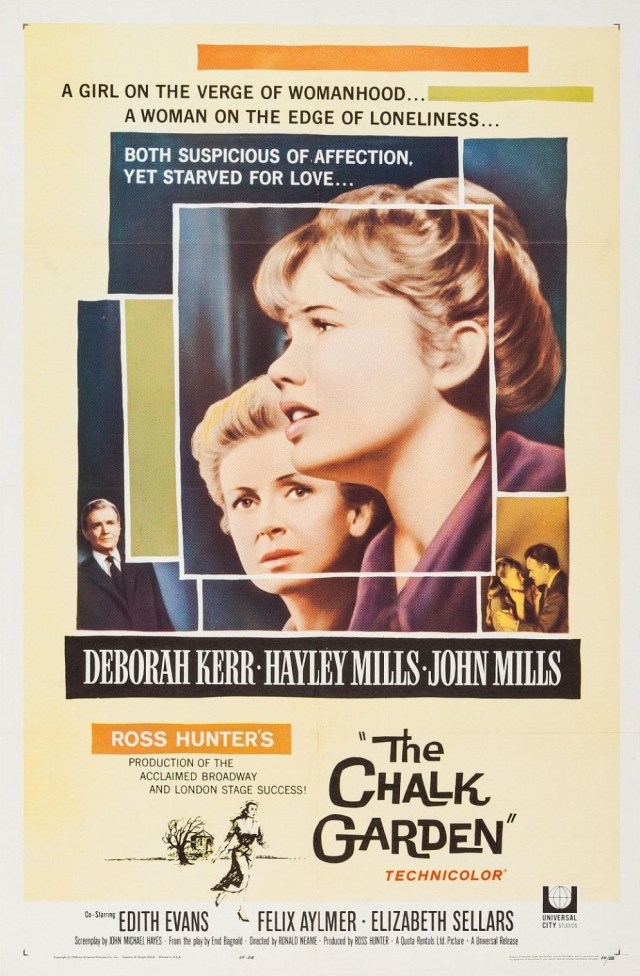
The Chalk Gardenposter created by Quota Rentals Limited, Ross Hunter Productions, and Universal Pictures
4. Ben-Hur: A Tale of the Christ (1925)
It’s amazing how two movies on this year’s best films list not only turned 100 years old, they also utilized color coded film to their advantage! But what sets Ben-Hur: A Tale of the Christ apart from The Phantom of the Opera is how title cards went above and beyond in Ben-Hur: A Tale of the Christ due to how well-written they were. Another aspect that distinguishes Ben-Hur: A Tale of the Christ is the cinematography’s capturing of the scope of the film. Long and medium shots effectively showcased a world that looked and felt larger than life. The visual presentation of the movie was certainly impressive. However, Ben-Hur: A Tale of the Christ found a balance between style and substance!
Despite being the most recently reviewed movie on my list, The Man Who Invented Christmas is one of the best biopics I’ve ever seen! How the creation of A Christmas Carol lent itself to exploring Charles Dickens’ life story brought a unique element to the biopic genre. Watching Charles’ iconic tale come to live, literally and figuratively, provided the film a creative and memorable identity. The “Easter Eggs” related to A Christmas Carol sprinkled throughout the story was an engaging way to stay invested in the movie. The Man Who Invented Christmas is a solid Christmas title that would make a good double feature with I Heard the Bells.
I first talked about The Wild Robot in my list of The Top Ten Best Stand-Alone Films. Even though I published that list back in March, the 2024 animated movie has still held up as one of the best titles I saw this year! Like I said in The Top Ten Best Stand-Alone Films list, the animation was gorgeous, appearing as a blend of paintings and priceless photographs. A pleasant surprise was how much emotional depth the story contained. What adds a sense of timelessness to the production was the abundance of good messages and themes. While it’s too early to say how The Wild Robot will stand in the test of time, I think it has potential.
1.An Old Fashioned Thanksgiving
I actually revisited this film in preparation for my review of An Old Fashioned Christmas. Watching An Old Fashioned Thanksgiving again after so many years reminded me why I love this movie! Attention to detail and historical accuracy created the illusion of taking the audience to another time and place. How the messages and themes of the Thanksgiving holiday were woven into the story allow An Old Fashioned Thanksgiving to truly embrace the holiday itself. The more I think about the 2008 movie, it makes me surprised it wasn’t a Hallmark Hall of Fame presentation. My belief is due to An Old Fashioned Thanksgiving containing elements that would likely be found in a Hallmark Hall of Fame project, such as strong acting performances and a historical fiction lens.
The Man Who Invented Christmasposter created by The Mazur Kaplan Company, The Mob Film Company, Ingenious Media, Nelly Films, Parallel Films, Rhombus Media, and Bleecker Street Media
Imagine: You’re scrolling through the forum department of the website, Lost Media Wiki. As you’re scrolling, you discover a piece of lost media related to one of your favorite movies. You don’t recall the lost media itself, but you’re bothered by what you read. Because of how much you love your favorite movie, you want that movie and material connected to that movie (such as merchandise, promotional content, or related media) to be accessible to everyone. This way, more people can discover the movie and may even enjoy it as much as you do. So, the idea of your favorite movie being associated with the world of lost media creates a spark of desire to find that piece of lost media in question. But when you search for that piece of lost media, you learn there is another piece of lost media related to your favorite movie. Instead of becoming discouraged or overwhelmed, you make it your mission to find that other piece of lost media too.
The 1997 film, Anastasia, had one major goal: take “the world by surprise” on November 21st. With a $140 million worldwide profit, the film not only accomplished that goal, it surpassed expectations. Looking back on our entertainment landscape, Anastasia’s pop cultural footprint seems small compared to other animated movies. But what its success proved was how other studios besides Disney could create animated films that were profitable and memorable for the right reasons. Like most feature presentations, Anastasia had its fair share of advertisements. But there is one teaser trailer believed to have been shown only in movie theaters, its existence neither confirmed or denied. Meanwhile, when Anastasia accomplished its goal of “taking the world by surprise”, an ice-skating show based on the movie debuted in 1998 to capitalize on this feat. However, the show itself has become so lost to time, only a small handful of footage has been archived. In this article, I will be discussing these two Anastasia related mysteries! Through the utilization of research, theories over why these pieces of lost media haven’t been found yet will also be addressed.
Anastasia (1997) title card image created by Twentieth Century Fox, Fox Animation Studios, Twentieth Century Fox Animation, Fox Family Films, and The Big Gun Project. Anastasia Mysteries image created by Sally Silverscreen.
Mystery #1: Anastasia’s Lost Theatrical Teaser Trailer
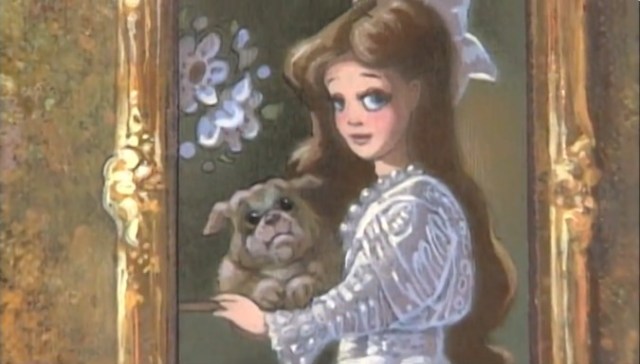
On the Reddit forum titled r/lostmedia, someone named NowheresNomad described a lost teaser trailer advertising Anastasia’s upcoming premiere. According to NowheresNomad, the teaser trailer primarily featured an “animated portrait, or one similar, of Anastasia as a child”. However, “there was no other person in it with her”. Anastasia’s “portrait appeared to be in a dark room as a thunderstorm roared in the background and lightning flashed, occasionally illuminating the painting as if there were a nearby window while slowly zooming in on her face”. This “30-second teaser” also featured the film’s title after the portrait’s presentation. NowheresNomad claims Anastasia’s teaser trailer not only “played in front of multiple family films”, they remember seeing it “in front of 101 Dalmatians (1996)”.
I discovered this specific piece of lost media on Lost Media Wiki’s forum department. A commenter named blipsycat first brought it up there on September 27th, 2023. The Lost Media Wiki discussion about the teaser trailer ended on February 8th, 2024, with the last commenter, beastboyrules52, coming up empty-handed. However, a chance visit to Lost Media Wiki led me to discover a theory that could explain why Anastasia’s teaser trailer hasn’t resurfaced yet, if it exists. On Lost Media Wiki, the only article related to Anastasia I could find was about the partially found live-action reference material featured in the 2005 documentary, ‘The Making of Anastasia’. The article itself included a video of the documentary from the Youtube channel, DVDXtras. Within the documentary, two pieces of concept art appeared to fit NowheresNomad’s description of Anastasia’s portrait in the teaser trailer.
Anastasia (1997) concept art found in the video, ‘The Making of Anastasia (1997)’ (from the Youtube channel, DVDXtras)
In this first portrait, Anastasia not only appears by herself, she also appears as a child.
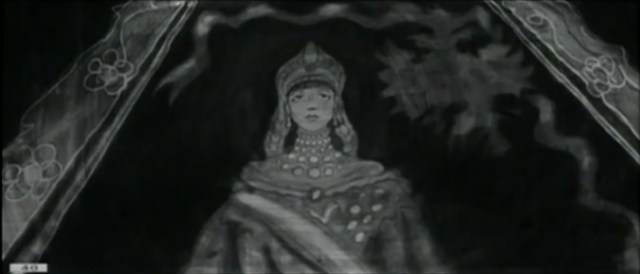
Anastasia (1997) concept art found in the video, ‘The Making of Anastasia (1997)’ (from the Youtube channel, DVDXtras)
In this second portrait, Anastasia appears older than NowheresNomad’s description. However, Anastasia is the only character in the portrait and the darker hues suggest the portrait itself is located in a dark room.
NowheresNomad speculated in the comment section of their Reddit post how Anastasia’s teaser trailer could have been “released in theaters for a brief time, tested poorly because it was genuinely creepy, and was pulled until they had some completed animation”. They also speculate the portrait “was a piece resembling the character in the film created specifically for this teaser”. Based on my findings and what NowheresNomad said, my theory is one of the portraits I brought up was featured in the teaser trailer. To create the illusion the portrait was placed in a dark room, lighting and sound effects were added over the piece of concept art. With the concept art not official footage from the movie, the teaser trailer was simply created as a placeholder until Anastasia’s creative team was ready to release official marketing that better reflected the true spirit of the film. If what I’m saying is correct, it would explain why the teaser trailer hasn’t been archived or made available on Anastasia’s DVD/Blu-Ray.
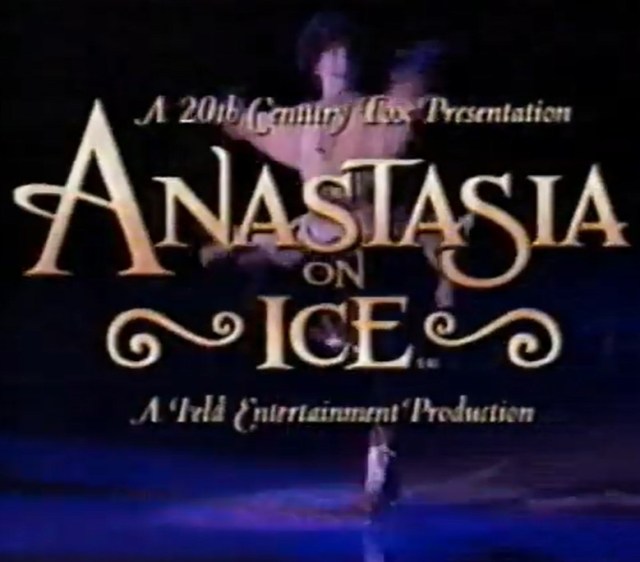
Promotional image for Anastasia On Ice found in the video, ‘Anastasia On Ice Commercial (1998)’ from the Youtube channel, Commerical Collections.
Mystery #2: Anastasia On Ice Full Show Footage
In 1998, Feld Entertainment debuted Anastasia On Ice, an ice-skating show based on the movie from 20th Century Fox. At the time, adapting animated films for the skating rink was nothing new for Feld Entertainment, as the company created Disney On Ice in 1981. While Anastasia On Ice is mentioned in the historical timeline on Feld Entertainment’s website, no videos or photos of the show are available on this same website. However, some videos on Youtube have kept the memory of Anastasia On Ice alive through archived footage. These videos are the following:
Anastasia On Ice – 1998 Today Show Feature (from the Youtube channel, Skate Guard Blog)
Anastasia On Ice Commercial (1998) (from the Youtube channel, Commercial Collections)
WFSB: Anastasia On Ice –Promo (1998) (from the Youtube channel, Archival WFSB-TV3)
Anastasia on Ice Ad- Buffalo, New York (1999) (from the Youtube channel, Classic90sfan)
Anastasia On Ice (from the Youtube channel, The Anastasia Archive) (This video only features photos from the show)
Even though footage of Anastasia On Ice has been archived, the full show has yet to surface. But based on my research, I’ve created three theories to explain why the full footage of Anastasia On Ice has likely not been preserved.
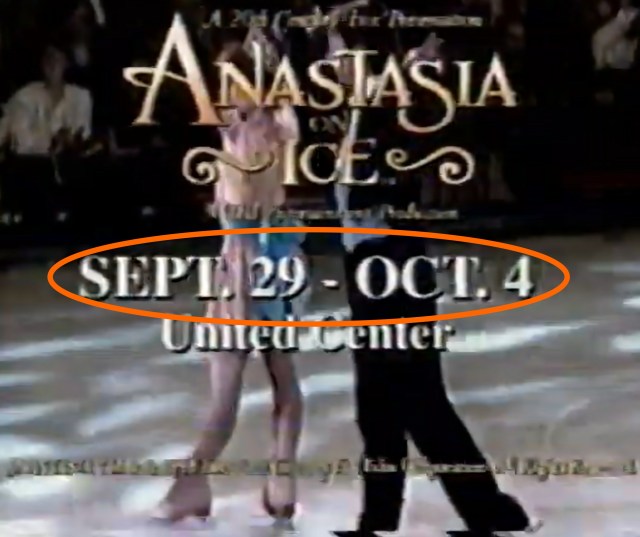
The dates for the Anastasia On Ice show are circled in this image to emphasize the short lifespan of the show itself. Promotional image for Anastasia On Ice found in the video, ‘Anastasia On Ice Commercial (1998)’ from the Youtube channel, Commerical Collections.
Theory #1: Limited Lifespan
According to the archived commercials for Anastasia On Ice, the show dates were the following:
September 23rd to 27th
September 29th to October 4th
January 7th to 10th
March 31st to April 4th
Anastasia On Ice was primarily held in 1998, according to my research. This greatly differs from a show like Disney On Ice, which premiered over the course of multiple years. While contrasting Anastasia On Ice and Disney On Ice, it should be noted that Anastasia On Ice is based on a singular movie. Meanwhile, Disney has a large collection of animated film titles, allowing Disney On Ice to host a variety of ice-skating shows. With all this said, the demand for repeat performances of Anastasia On Ice was probably low.
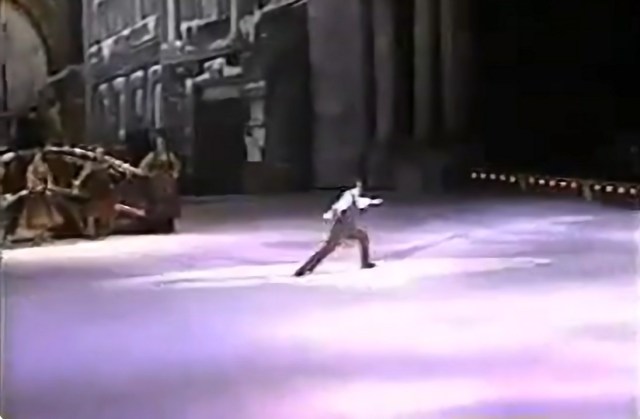
In this photo, from the ‘Anastasia On Ice – Primeira Parte – http://www.anastasiabrasil.com’, Emrah Polatoglu’s solo is captured through medium and long shots. Video found on the Youtube channel, anastasiabrasil.
Theory #2: Poor Visual Quality
In the video, ‘Anastasia On Ice – Primeira Parte – http://www.anastasiabrasil.com’, a skater named Emrah Polatoglu performs a solo in what appears to be the number, “A Rumor in St. Petersburg”. When I watched Emrah’s performance for the first time, I immediately took notice of the video’s poor visual quality. This is likely due to film-making technology (especially for sports programs involving a lot of motion) not being as advanced then as today. I noticed how poor visual quality was also a problem for the number, “Paris Holds the Key (To Your Heart)” in the video ‘Anastasia On Ice – 1998 Today Show Feature’. However, the “Paris Holds the Key (To Your Heart)” number was captured through medium and close-up shots, giving a television audience specific parts of the performance to focus on. Meanwhile, Emrah’s performance was presented through medium and long shots, emphasizing the scope of the live ice-skating show. Even though there is clearer footage of Anastasia On Ice in the show’s commercials, the intent of showcasing that footage is to entice a television audience to go see the live show, similar to the “Paris Holds the Key (To Your Heart)” number on Today Show. If Anastasia On Ice was never intended to be shown on television or even home media, recording and archiving the live performance was likely not a top priority.
This picure from video, ‘Anastasia On Ice – 1998 Today Show Feature’, the skaters are shown through medium and close-up shots. Video found on the Youtube channel, Skate Guard Blog.
Theory #3: Licensing Rights
A 2018 article from Playbill explains a lawsuit stating similarities between the Broadway version of Anastasia and the adaptations of the story from 1952 and 1956. The article says the “original play [from 1952] was licensed by Fox for the 1956 film adaptation of Anastasia, the agreement stipulated that the playwright and translator Guy Bolton retained “rights to the production on the spoken stage””. It is also stated in the article how “a retroactive license was obtained in 1998 for Anastasia On Ice”. But ever since Disney purchased 20th Century Fox, they hold the distribution rights to films from that studio, including Anastasia. However, the 1997 film hasn’t been utilized by Disney in any fashion since purchasing the studio. Therefore, Disney may not prioritize providing an opportunity to broadcast Anastasia On Ice.
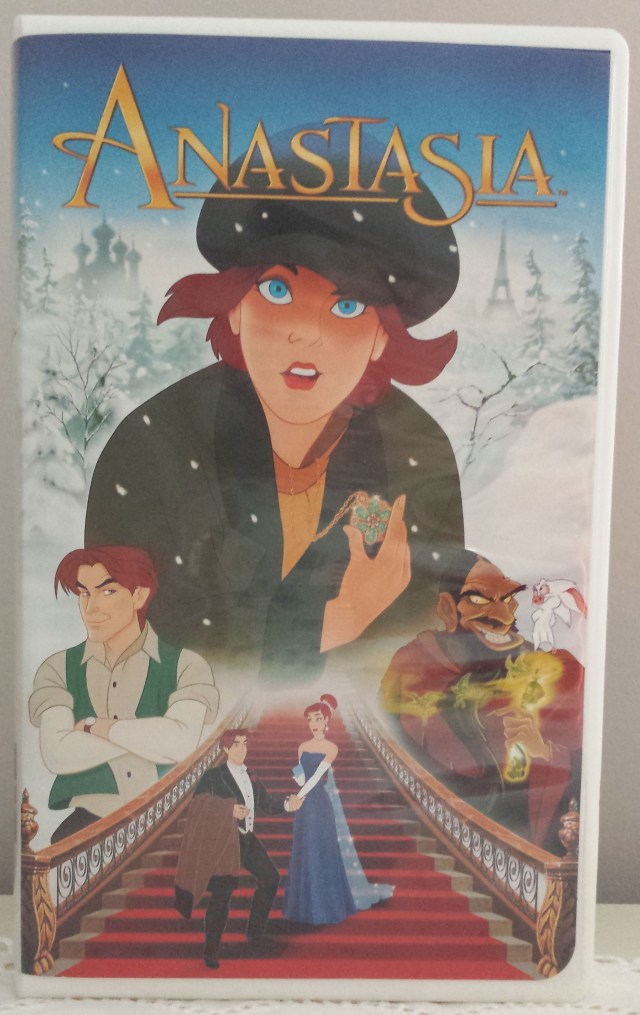
Since this edition of Sally Solves a Mystery revolves around 1997’s Anastasia, I thought including a picture of my VHS copy of the movie made sense. Screenshot taken by me, Sally Silverscreen.
Once upon a December (though the movie premiered in November), Anastasia literally and figuratively took “the world by surprise”. Its success showed animation studios besides Disney anything and everything that was possible at the box office. Well-liked and successful movies are going to have behind-the-scenes secrets, little known facts, and unanswered questions. They may even be associated with lost media, as is the case for Anastasia. At the time of this article’s publication, the full show footage of Anastasia On Ice and/or Anastasia’s theatrical teaser trailer has not been found. However, this doesn’t discourage me. I’d like to find these pieces of lost media by November 21st,2027, Anastasia’s 30th anniversary. I’m hoping by then, the “journey to the past” would have been worth it.
As Christmas is almost here, it’s time for my yearly Movie Blogger’s Christmas Wish-List! If you’re new to 18 Cinema Lane, this is an annual tradition where I share the movie related things I’d like to receive for Christmas. The list’s format follows the quote; “Something you want, something you need, something to wear, and something to read”. The items on this list, like in past years, are a combination of realistic requests and wishful thinking. So, let’s start 2025’s Christmas wish-list!
Puppies and hearts Christmas wish-list image created by Freepik at freepik.com.
Something You Want
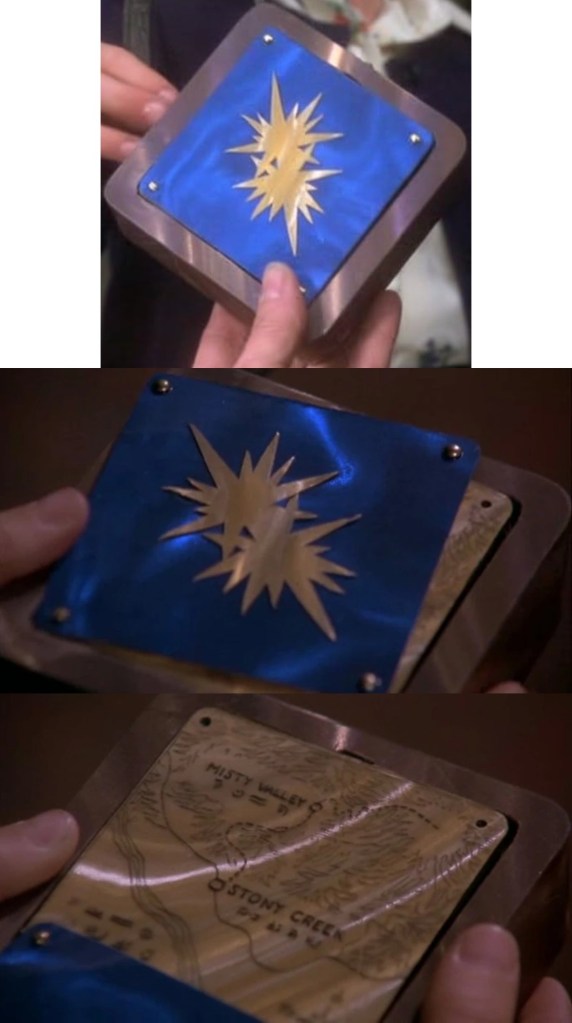
Back in 2018, I saw the 1975 movie, Escape to Witch Mountain. One of the most memorable aspects of that film was an object belonging to Tia, one of the story’s protagonists. Throughout Escape to Witch Mountain, Tia carries a Starcase. This box contains a map that helps her and her brother, Tony, find their way home. But ever since I saw the film, I’ve always felt the term “starcase” was misleading. That’s because I don’t recall seeing Tia putting anything into the case itself, like small toys or trinkets. Despite this, the Starcase is one of the most unique movie props I’ve seen. So, for this portion of my Christmas wish-list, I would like to receive a replica of Tia’s Starcase. But I want a replica that is truly a case where items can be placed inside. Plus, I would like the Starcase replica to feature a purse strap, so the Starcase can be carried either as a purse or a clutch.
Tia’s Starcase images created by Walt Disney Productions and Buena Vista Distribution Company
Something You Need to See
Two years ago, I started my series, Sally Solves a Mystery. In this annual series, I talk about television related mysteries in an attempt to solve them. For my upcoming Sally Solves a Mystery article, I will write about two mysteries related to the same movie. On the forum for Lost Media Wiki, I came across a post about a lost teaser trailer for the 1997 film, Anastasia. While I do love that movie, I personally don’t remember seeing the teaser trailer in question. Another piece of Anastasia media I don’t remember is Anastasia On Ice, an ice skating show based on the film. The only footage of the show I’ve seen are a few television commercials and a behind-the-scenes news segment about the show. Why these lost media mysteries are featured in this part of my Christmas wish-list is how much I’d love to see them solved by November 21st, 2027, which is Anastasia’s 30th anniversary.
Promotional image for Anastasia On Ice found on the Youtube channel, Commerical Collections.
A movie related piece of clothing or accessory I’d want to wear
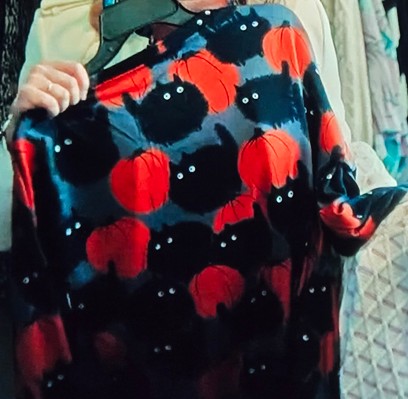
Looking back on past Christmas wish-lists, I haven’t selected a movie related piece of clothing or accessory that is holiday themed. But that is about to change with the Halloween themed sweater I will now discuss. In the Lifetime movie, Killing the Competition, my eye caught a gray sweater with pumpkins and black cats on it. Even though the sweater was featured very briefly in the film, it stuck in my memory, especially when it came time to create My Movie Blogger’s Christmas Wish-List. As I’m writing this article, I realized this is the second year in a row a sweater was chosen for this portion of my wish-list! With the Halloween sweater boasting a variety of colors, multiple outfits could be created around that sweater.
I apologize if this photo of the Halloween themed sweater isn’t the best. But as I explained in my Christmas wish-list, the sweater was featured very briefly in Killing the Competition. Screenshot taken by me, Sally Silverscreen.
A book I’ve read that I’d like to see adapted into a film
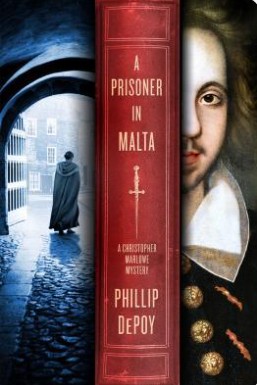
When I participated in the Eurovisionathon readathon, one of the books I read was A Prisoner in Malta by Phillip DePoy. It was, honestly, one of the better books I read for the event! A Prisoner in Malta is what would be considered a “page-turner”, as there was never a dull moment. The book contained other strengths like well-written banter between the characters, strong character development, and a mystery that was intriguing as well as complex. With all this said, I would be interested in seeing a film adaptation of A Prisoner in Malta! Based on what I’ve observed of the cinematic side of the mystery genre, historical mysteries seem far and few between. I also can’t think of many movies off the top of my head that are set in the 1580s. So, in my opinion, an adaptation of A Prisoner in Malta would offer something unique to the film-making table!
What are your thoughts on my Christmas wish list? Are there any movie related things you’d like to receive during the Christmas/holiday season? Tell me in the comment section!
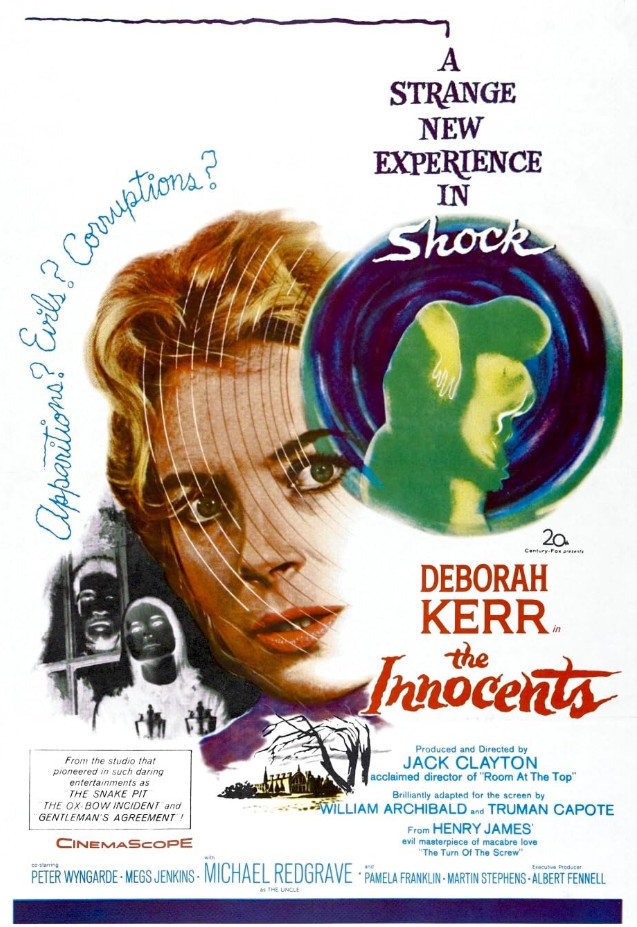
Film recommendations from my readers are welcomed here at 18 Cinema Lane. These suggestions are then placed on a Pinterest board, which I use as a reference for upcoming reviews. Some movies have been on the board for so long, they’re at the very bottom. One of these titles is 1961’s The Innocents. Recommended by Maddy (from Maddy Loves Her Classic Films), this is a Deborah Kerr starring production that is quite different from the other projects of hers I’ve reviewed on my blog. That’s because The Innocents is classified as a horror film. Because of this distinct, I’ve been trying to find the right opportunity to talk about the movie. Hoofers and Honeys’ 4th Annual Spooky Classic Movie Blogathon became that opportunity! Deborah’s films covered on 18 Cinema Lane have fluctuated in quality. While I liked titles like The Chalk Garden and The King and I, I wasn’t a fan of Marriage on the Rocks. What will my opinion be of The Innocents? Keep reading my review to find out!
The Innocents(1961) poster created by Achilles, Flair Communications, Twentieth Century Fox, and Twentieth Century Fox Film Company
Things I liked about the film:
The acting: A large portion of The Innocents prominently features two young characters: Miles and Flora, as Deborah’s character, Miss Giddens, believes they are in danger. In stories like this, where younger characters play a significant role, it’s important to cast actors and actresses that can, acting wise, carry some of the film. Flora reminded me somewhat of Eloise (from the 2003 adaptations, Eloise at the Plaza and Eloise at Christmastime), marching to the beat of her own drum with a bit of a mischievous spirit. Meanwhile, Miles possessed the precociousness of Cedric from Little Lord Fauntleroy and the sweetness of Tiny Tim from A Christmas Carol. These concepts were displayed well through Pamela Franklin’s and Martin Stephens’ performance! Vocal inflections, facial expressions, and even body language worked in their favor, making Miles and Flora captivating characters. Because of Martin’s and Pamela’s acting talents, their convincing portrayals kept me invested in their characters’ story!
As I mentioned before, Deborah Kerr portrays Miss Giddens, who becomes Flora and Miles’ new governess. Looking back on her films, including The Innocents, I’ve noticed how expressive Deborah’s performances have been. Specifically speaking about the 1961 film, Deborah uses her eyes to display thoughts and feelings instead of just relying on dialogue. In one scene, Miss Giddens learns the truth about Miss Jessel and Peter Quint, the governess and valet who worked at the estate before Miss Giddens’ arrival. While she discovers this information from a housekeeper named Mrs. Grose, Miss Giddens’ eyes show concern, sadness, and even fear. She also raises her eyebrows from time to time, emphasizing how shocking the information about Peter Quint and Miss Jessel is. This example of Deborah’s expressiveness elaborates Miss Giddens adapting to the strange things she’s been seeing and hearing during her time at the estate. Similar to Martin’s and Pamela’s performance, Deborah’s portrayal of Miss Giddens was convincing!
The set design: The Innocents mostly takes place at the Bly estate, which belongs to Flora and Miles’ uncle. Though this story was character-driven, the set design was an underrated yet impressive component of the movie. The fireplace in the main sitting room appeared marble with a carved design. Each room features tall windows, implying the large scope of the rooms themselves. Though shown during brief moments, a detailed tapestry hung on a wall near the main stairway. Elaborate tapestry even covered a long seat in one of the rooms. Details like the ones I described emphasized how financially well-off Miles and Flora’s family is. They also helped make Bly estate visually appealing!
Mise-en-scène: In my recent review of 2010’s Let Me In, I talked about how the movie’s mise-en- scène (the way a film’s scene is presented to the audience) was one of the strengths of the movie. This was also a strength in The Innocents, as some scenes’ presentation added intrigue to the story! One evening, Miles confesses to Miss Giddens how his uncle doesn’t have time for him and his sister. At first, the conversation is shown in a medium shot. The very next shot is a close-up of Miles’ face, with light shining on his cheek to reveal a tear rolling down. Through this visual presentation, the audience is told how his uncle’s lack of acknowledgement deeply troubles Miles. It also provides possible motivation for Miles’ actions later in the film.
Limited horror elements: I mentioned in my review’s introduction how The Innocents is classified as a horror film. Because of this classification, I expected the script to emphasize the horror elements within the story. But these elements, like potential ghost sightings and unexplained noises, had such a limited presence in the film, they were featured in “don’t blink or you’ll miss it” moments. In fact, the script placed more emphasis on the “slice-of-life” parts of the story. As a movie blogger who doesn’t review horror movies often, I found this creative decision disappointing. Some of my interest in The Innocents waned because I don’t really find “slice-of-life” stories compelling.
Scenes that feel like padding: One evening at Bly estate, Miss Giddens stays up in the middle of the night in order to discover the cause of the strange happenings throughout the home. The majority of the scene takes place in the upstairs hallway. But the overall scene lasts over five minutes. Moments when Miss Giddens attempts to open doors and walks through the hall seem repetitive due the how long the scene is. With The Innocents having a run-time of an hour and thirty-nine minutes, some of those five minutes could have been trimmed to make the movie about an hour and thirty-four minutes. This is just one example of scenes feeling like padding.
Conclusion with little to no evidence: For this part of my review, I will spoil The Innocents. If you haven’t seen this movie and are planning on watching it, skip ahead to the part of my review titled “My overall impression”.
After witnessing what she believes is the ghost of Miss Jessel, Miss Giddens comes to the conclusion Flora and Miles are possessed by the spirits of Miss Jessel and Peter Quint. She even comes up with a plan to make the children admit this is true. But up until that point, the film doesn’t show how Miss Giddens reaches her conclusion. Little to no evidence is presented, denying the audience an opportunity to see Miss Giddens putting the pieces together. I, personally, couldn’t take her conclusion too seriously because of the lack of evidence. Miss Giddens’ weaker conclusion also added confusion to the overall story, leaving me wondering what I had just watched.
I’m going to be brutally honest, The Innocents is one of the most confusing movies I’ve ever covered on 18 Cinema Lane. When the film ended, I audibly said, “What the heck did I just watch”? Without spoiling The Innocents, all I’ll say is I recognize how the movie’s creative team tried to give their project an ambiguous ending. But when the 1961 picture is also classified as a mystery film, that type of ending doesn’t work due to the genre being known for reaching definitive resolutions. Another flaw that contributes to The Innocents’ confusion is a conclusion with little to no evidence. That lack of evidence prevented me from taking the conclusion too seriously. Despite this confusion, the movie was intriguing enough to keep me invested in the story. The strength of the acting performances and the mise-en-scène are two factors that worked in the film’s favor. Out of Deborah’s films reviewed on 18 Cinema Lane, The Innocents was just ok. While there are things about the movie I liked, the overall execution could have (and should have) been stronger.
Overall score: 6.5 out of 10
Have you seen 1961’s The Innocents? What “classic” horror movies do you like watching? Let me know in the comment section!
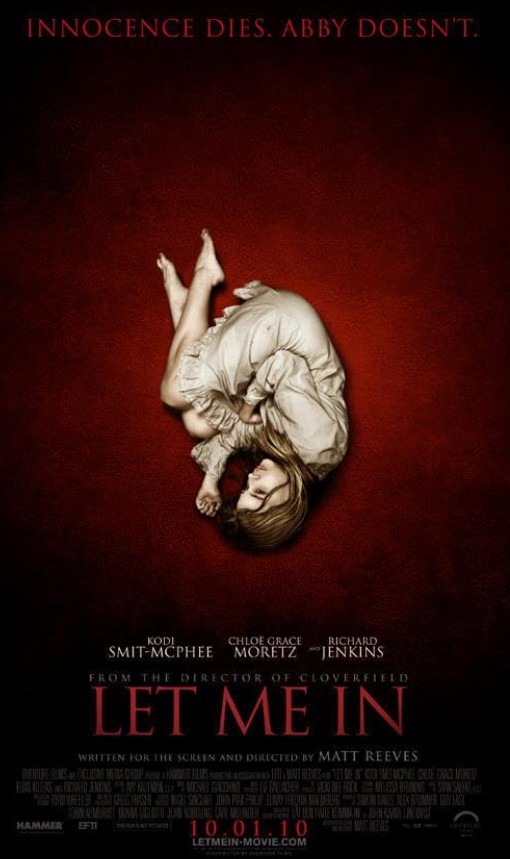
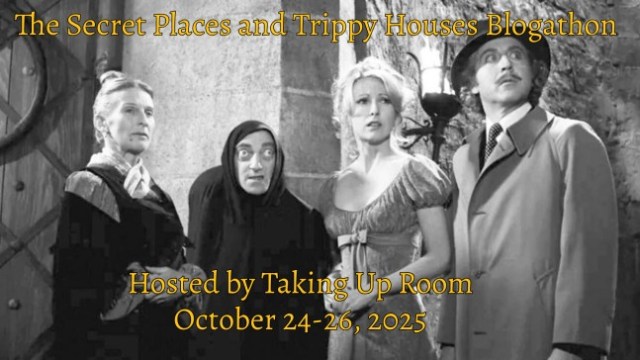
I apologize to my readers for my lack of blog posts these past two weeks. I’ve been working on an editorial I’m publishing on Halloween. Researching, writing, and curating that editorial has taken up a lot of time. But I wasn’t going to miss out on participating in Taking Up Room’s Secret Places and Trippy Houses Blogathon, especially since my selected film is a perfect choice for Halloween! When I learned one of the eligible subjects was “strange neighbors”, I was reminded how I was recommended the 2010 movie, Let Me In. Suggested by John L. Harmon, I had heard it was one of the better vampire films in the world of cinema. Since I had heard of the movie, but never saw it, I couldn’t agree or disagree with that statement. But now that I’ve finally seen Let Me In, I can now give my honest opinion about the film!
Let Me In(2010) poster created by Overture Films, Exclusive Media Group, Hammer Films, EFTI, and Relativity Media
Things I liked about the film:
The mise-en-scène: As I explained in my review of 1955’s The End of the Affair, mise-en- scène is how a film’s scene is presented to the audience. Throughout Let Me In, the way mise-en- scène was utilized presented scenes in visually creative ways. At the very beginning of the movie, a snowy forest was shown during the night. The only source of light comes from two police cars and an ambulance. A long shot slowly becomes a close-up shot, giving the audience a reason to focus on the bright vehicles. Anytime Owen and Abby look through the peephole of their apartment door, the shot is shown in a fish-eye lens. This film-making technique puts the audience in Abby and Owen’s perspective, allowing them to see what the children are seeing. It also emphasizes how, despite their differences, Owen and Abby have shared experiences like seeing who is at their door.
How music was incorporated: Music can be an effective component of film-making. It can elevate a scene’s emotions or set a scene’s tone. In Let Me In’s opening scene I just referenced in this review, a rhythmic drumbeat is one of the first sounds the audience can hear. That specific sound creates a sense of urgency, signifying danger is on the horizon. When Abby moves into Owen’s apartment building, gentle angelic-sounding singing can be heard. This is symbolic of how Owen sees Abby; an angel who will provide a light in his darkness. The two examples from Let Me In I discussed add additional context to the scenes themselves. How the film’s creative team incorporated music into the 2010 picture shows the understanding they had for how music can work in their project’s favor.
Disguising Abby’s vampire identity: Before watching Let Me In, I knew it was a vampire movie. But I was pleasantly surprised by how Abby’s vampire identity was disguised. Most of Abby and Owen’s interactions take place at night, at first seeming like just a coincidence. When Owen notices Abby isn’t wearing shoes, she states how she doesn’t feel cold. Abby even tells Owen she’s stronger than he thinks. These verbal and visual clues creatively signified how Abby was a vampire. But because of the clues’ subtlety, it leaves the audience guessing why, on the surface, Abby seems so strange. New twists on vampire cliches, like vampires avoiding sunlight, made Let Me In more unique from other vampire films.
The audio: When I reviewed Fist of Fury, I talked about the film’s audio being one of the major flaws. I had to turn up my television’s volume in order to hear what the characters were saying. Let Me In shares this same issue. Once again, I had to raise my television’s volume just to hear the dialogue, as the characters’ speech was quiet. As I suggested in my review of the Hallmark Hall of Fame movie, Face to Face, Let Me In’s creative team should have used ADR (automated dialog replacement).
The bullying subplot: One of the subplots in Let Me In involves Owen dealing with bullies. This subplot gave Owen a conflict to resolve, with the conflict eventually reaching a resolution. But because the script prioritized Abby and Owen’s friendship, the bullying subplot wasn’t consistently focused on. In fact, Owen stands up to his bullies about an hour into this hour and fifty-six minute movie. The inconsistency of the bullying subplot also drew that story out longer than necessary.
Underutilized religious undertones: In a scene taking place at a hospital, President Ronald Reagan is delivering a speech on television. During the speech, he talks about evil being present in the world and how people are joined together by Scripture. Owen’s mother says prayers during mealtime and features religious relics in her apartment. These are some examples of the religious undertones in Let Me In. With the movie set in early 1983, I thought the “Satanic Panic” was going to play a large role in this story, especially with Abby being a vampire. However, the religious undertones present in the script were underutilized, not providing any commentary or interesting perspective. In fact, it felt like this part of the film was there just for the sake of being there.
Vampires are no stranger to 18 Cinema Lane. Out of the vampire movies I’ve seen (and reviewed), these projects have shown that this type of story can be as creative as film-makers want it to be. 2010’s Let Me In is an interesting and creative vampire film! Abby’s vampire identity was disguised in very clever ways, even putting new twists on vampire cliches. How mise-en-scène and music were incorporated into the movie showcases the creative team’s more unique approach to a familiar type of story. While Let Me In has its merits, it also has its flaws. Religious undertones that could have provided commentary or an interesting perspective to the script were underutilized instead. Poor audio and an overshadowed subplot also didn’t help. But the 2010 project does stand out from other vampire titles. If you don’t mind a slow-burn story that primarily focuses on the power of friendship, then I’d say give Let Me In a chance.
Overall score: 7 out of 10
Have you seen Let Me In? What kinds of movies do you like to watch around Halloween? Let me know in the comment section!
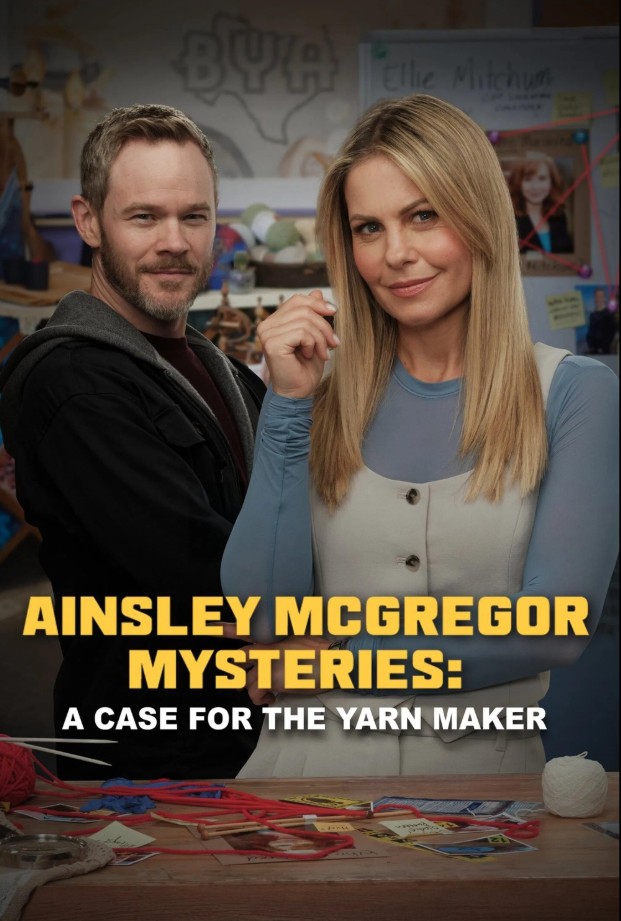
Last year, I reviewed Ainsley McGregor Mysteries: A Case for the Winemaker. At the time, I knew there would be people interested in the film, as Great American Family has found its audience over the past few years. But I was shocked by how popular that review became. In a year’s time, my review of Ainsley McGregor Mysteries: A Case for the Winemaker has garnered over 6,000 views and counting! When I learned a sequel was on the horizon, I immediately made plans to write about it. Now that review has come to fruition, as I have recently seen Ainsley McGregor Mysteries: A Case for the Yarn Maker! In my review of Ainsley McGregor Mysteries: A Case for the Winemaker, I said it looked like this series had the potential to tell many more stories. From exploring another artisan avenue to progressing Ainsley and Jake’s relationship, the sequel proved my statement right. But how does it compare to its predecessor? Keep reading my review to solve this mystery!
The chemistry among the cast: If you’re creating a book, tv, or movie series, it’s important to maintain chemistry among the characters. If this chemistry is believable, interactions and relationships between characters become more enjoyable to watch unfold. A lot of the same cast members from Ainsley McGregor Mysteries: A Case for the Winemaker returned in the sequel. That worked in Ainsley McGregor Mysteries: A Case for the Yarn Maker’s favor! The chemistry among the cast was so strong, it not only made every situation between the characters feel realistic, it also made their connections seem genuine! One of the best examples is the friendship of Jake and Ryan. Ainsley’s brother, Ryan, carries a serious, “business comes first” attitude due to being a police officer. Meanwhile, Jake’s personality is laid-back and a bit sillier. These characters’ differences allowed their friendship to be complimentary, especially when it came to Jake and Ryan’s comedic timing. This friendship was, honestly, one of the best parts of Ainsley McGregor Mysteries: A Case for the Yarn Maker!
Inclusion of humor: As I watched Ainsley McGregor Mysteries: A Case for the Yarn Maker, I took note of how the film’s creative team improved upon the flaws of the previous movie. One of those improvements was the inclusion of humor. Sprinkled throughout the story, humor was woven into the dialogue. How this humor was written and delivered prevented the story from becoming too dark. One great example is when Gladys, one of the members of the “book club”, is being questioned by the police. Because Gladys knew Ellie Mitchum (the murder victim), she is considered a potential suspect. During her interrogation, the police ask Gladys if she was aware of any allergies Ellie might have had, as allergies are ruled as a likely cause of death. In a sassy yet matter-of-fact way, Gladys tells the police, “She was allergic to being a nice person”. To me, this was one of the funniest lines in the movie, as it was a great comeback to the question!
Ellie Mitchum’s house: Ellie Mitchum is a successful businesswoman who visits her former school in Sweet River, Texas. But, unfortunately, she becomes the murder victim in Ainsley McGregor Mysteries: A Case for the Yarn Maker. Ellie’s funeral reception takes place at her house, where Ainsley, Jake, and Ryan attend. While not much of the house’s exterior is shown, it did contain an impressive stone porte-cochère (covered entryway). That entryway made the house look like a castle. One of the interior spaces presented in the movie was the foyer. This space was circular, featuring intricately designed stained-glass windows, stone railings with carved designs, and a deep cherry-stained wood floor under an ornate rug. Even the house’s deck, though only shown in one scene, had a stone arch framing a beautiful view of the luscious green backyard and what appeared to be a lake. I wish more scenes had taken place at Ellie Mitchum’s house, as it was so gorgeous.
Heart of yarn image create by macrovector at freepik.com.
What I didn’t like about the film:
Learning very little about the protagonist: In the second movie of a film series, the project’s creative team can present more information to help the audience learn more about the protagonist. Whether in the form of dialogue or flashbacks, this information can expand the protagonist’s backstory, give them extra motivation to solve a problem, or provide an overarching component of a story. But in Ainsley McGregor Mysteries: A Case for the Yarn Maker, very little new information was revealed about Ainsley McGregor herself. While her reason for leaving Chicago was given, Ainsley didn’t share this until almost an hour into the movie. That means the audience had to wait a long time to learn anything new about the titular character. Had more information been provided about Ainsley, the story would have become a bit more enriched.
Not enough George: When I reviewed Ainsley McGregor Mysteries: A Case for the Winemaker, I talked about how much I liked Ainsley’s dog, George. He played a larger role in the first movie, giving that film a more unique identity. While watching the sequel, Ainsley McGregor Mysteries: A Case for the Yarn Maker, I noticed George’s screen-time was reduced. Though I recognize how difficult it can be to incorporate an animal into a film production, I was disappointed by this creative decision. In my opinion, George steals every scene he’s in. Plus, times when Ainsley talks with George give the audience light-hearted moments that take a break from the heaviness of the murder mystery. Without George, the Ainsley McGregor Mysteries series wouldn’t be the same.
Limited time spent with the “book club”: I mentioned in my Ainsley McGregor Mysteries: A Case for the Winemaker review how Ainsley’s book club turns into an investigation club. The dynamic shared between Ainsley and these members is what encourages her to solve the mystery in the first film. Even though the “book club” still holds their meetings in Ainsley McGregor Mysteries: A Case for the Yarn Maker, Ainsley didn’t consult with them as much as she did in the first movie. In fact, there were only two scenes where a “book club” meeting was featured. In the sequel, Ainsley relied more on Ryan and Jake to help her solve the case. I hope Ainsley finds a balance between turning toward Jake and Ryan and discussing the mystery with the “book club” in future films, as each perspective makes a positive impact on the story.
In some film series, the second chapter is better than the first one. Ainsley McGregor Mysteries: A Case for the Yarn Maker is a movie where that statement holds true! The sequel improved upon some of the flaws of its predecessor, such as including humor. Strong chemistry among the cast has become a consistent strength of this series, with Jake and Ryan’s friendship being one of the best parts of chapter two. While I won’t spoil the second film, I will say I liked how there were no obvious choices for the mystery’s culprit. That creative decision leaves the audience guessing whodunit. Though I liked Ainsley McGregor Mysteries: A Case for the Yarn Maker more than the first chapter, there is still room to grow. I wish the sequel gave the audience more information about Ainsley and showed George in a few more scenes. This film series is based on a book series, with one of those books titled A Case for the Toy Maker. Perhaps we could get a Christmas mystery movie from Great American Family?
Overall score: 7 out of 10
Have you seen Ainsley McGregor Mysteries: A Case for the Yarn Maker? Would you like to see Great American Family create a Christmas mystery movie? Let me know in the comment section!
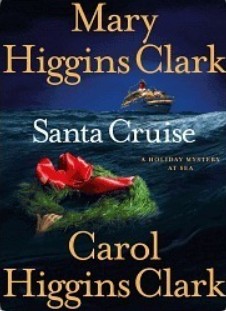
When I signed up for Midnite Drive-In’s Hit The Road Blogathon, one of the basic rules was to choose “a movie, TV show or book” that had something to do with travel. Since I figured I’d be one of the few participants selecting a book for the event, I found an opportunity to write a book review! On 18 Cinema Lane, I occasionally talk about books in an effort to bring a sense of variety to my blog’s content. My last book review was published last September, when I wrote about Murder, She Wrote: Dying to Retire by Jessica Fletcher and Donald Bain. This is ironic, as that book revolved around Jessica traveling to Florida.For theHit The Road Blogathon, I selected another mystery story; Santa Cruise: A Holiday Mystery at Sea by Mary Higgins Clark and Carol Higgins Clark! Years ago, I saw this book’s film adaptation, 2013’s The Mystery Cruise. Though I was not a fan of the film, I still wanted to read its source material, as I had heard of the book before seeing the movie. Is this a case where the book is better than the film? Keep reading my review to solve this mystery!
If you’re going to write a story that involves travel, the journey or destination needs to sound appealing. Whether the travels of characters are exciting or the characters arrive somewhere intriguing, the reader may stay invested in what is happening in the story. In Santa Cruise: A Holiday Mystery at Sea, the protagonist, Alvirah, won an all-expenses paid cruise through a charity auction. She, along with her husband, Willy, and their friends embark on an oceanic adventure where there is never a dull moment. Mary and Carol worked well together to create a setting that felt realistic. Descriptive imagery and attention to detail worked in the favor of the story’s world-building. One example is when rooms on the ship, Royal Mermaid, are described. While observing Alvirah and Willy’s room, one of their friends, Nora, states “The closet is practically a room unto itself”. This statement alone provides context for the size of the space. It also addresses the luxurious nature of not just the room itself, but the ship as a whole.
Mystery stories, sometimes, include a group of characters. If these characters are working together to solve a mystery, it’s important for them to maintain a sense of camaraderie. This way, genuineness can be felt as the characters come together to reach a common goal. Throughout Santa Cruise: A Holiday Mystery at Sea, solving mysteries was a team effort among Alvirah, Willy, and their friends, the Reillys. It helped how these characters possessed their own set of skills and life experiences, allowing them to bring something unique to the table. It also helps how they knew each other before the events of the story. Because of how well-written the dialogue was, readers can pick up on how Willy, Alvirah, and the Reillys got along. Toward the beginning of the book, Alvirah is encouraging her friends, Regan and Jack, to join her and Willy on the cruise. Bringing up the couple’s already known vacation plans, Alvirah says, “I just heard from Jack’s own lips that he’s on vacation for two weeks”. She addresses this in an effort to give them a once-in-a-lifetime experience, keeping the best interests of her friends in mind. Because she recognizes Alvirah’s good intentions, Regan replies to Jack, “we’ve never been on a cruise together. I think it would be fun”.
Two of the villains in Santa Cruise: A Holiday Mystery at Sea are Bull’s-Eye and Highbridge. These criminals are on the run to avoid being sentenced for their crimes. There were times while reading this book where I had difficulty telling these characters apart. That’s because their personalities were not distinct enough. Another flaw of Santa Cruise: A Holiday Mystery at Sea was how some mysteries were solved before the reader could figure it out for themselves. During the titular Santa Cruise, two Santa suits go missing, becoming one of the story’s overarching mysteries. But shortly after this mystery is introduced, the “whodunit” is already revealed. This felt reminiscent of an episode of Columbo, where the audience is forced to observe the protagonist solving the mystery themselves instead of interacting with the story by figuring out the mystery alongside the characters.
Santa Cruise: A Holiday Mystery at Sea is, in my opinion, a fine book that is interesting and entertaining enough. Carol and Mary use attention to detail and descriptive imagery in their favor to build a literary world that feels realistic. They also utilize dialogue to create strong camaraderie between the protagonists and their friends. However, I wish the story’s villains were given more distinct personalities, as it could have allowed them to stand out more. Having more interactive mysteries for the readers would have helped as well. There were parts of the story that were, sometimes, repetitive. Examples include referencing the number fifteen and the same events being brought up over and over again. Despite these flaws, the book does have a steady to faster pace, which makes Santa Cruise: A Holiday Mystery at Sea a quicker read.
Disclaimer: Santa Cruise: A Holiday Mystery at Sea is a mystery story that occasionally features violence and characters receiving injuries. There’s also brief references to grief.
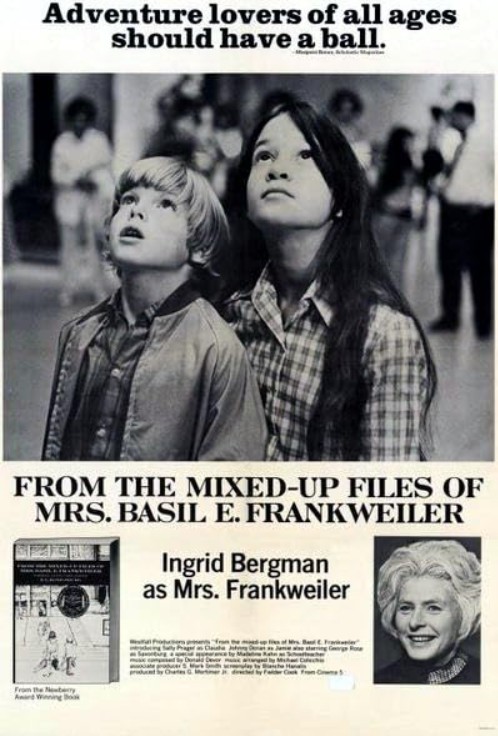
All the way back in 2019, I reviewed the 1995 adaptation of From the Mixed-Up Files of Mrs. Basil E. Frankweiler. After I shared my thoughts on the film, Gill, from Realweegiemidget Reviews, recommended the 1973 adaptation, which is sometimes titled The Hideaways. Whenever Virginie, from The Wonderful World of Cinema, has hosted the Ingrid Bergman Blogathon, I have wanted to check out the 1973 adaptation, due to Ingrid Bergman starring in the film. Now, for the 110 Years of Ingrid Bergman Blogathon, I finally received the opportunity to write about the movie! While I still haven’t read the book, I am familiar with the story because I covered the 1995 adaptation on 18 Cinema Lane. Back in 2019, I said the film was just ok, as one of my biggest criticisms was the underutilization of Lauren Bacall’s acting talents. Will I give similar criticisms to the 1973 adaptation of From the Mixed-Up Files of Mrs. Basil E. Frankweiler? To solve this mystery, keep reading my review!
Sally Prager’s and Johnny Doran’s acting performance: Starring in From the Mixed-Up Files of Mrs. Basil E. Frankweiler as the protagonists, Claudia and Jamie Kincaid, Sally Prager and Johnny Doran carry about 95% of the film. Because of how strong their performances were, they successfully carried the movie by presenting their characters believably! One example takes place toward the beginning of the film. Jamie is telling his sister, Claudia, about a movie he had recently seen. As he talks about the movie, his speech becomes increasingly animated. Even after Claudia kicks him out of her room, Jamie talks even louder, his excitement never faltering. After Jamie and Claudia arrive in New York City, they go to the Metropolitan Museum of Art. When Jamie asks her why she wants to go to the museum, Claudia enthusiastically describes the museum as a castle like the tales of King Arthur. This scene perfectly showcases how Sally effectively portrayed Claudia as precocious; containing enough self-awareness to know exactly what she wants, yet displaying that sense of wonder one would expect from a child her age.
The cinematography: When I reviewed the 1995 adaptation of From the Mixed-Up Files of Mrs. Basil E. Frankweiler, I complimented the film’s cinematography. That adaptation’s creative team made some interesting choices when presenting certain scenes, like using close-ups to present the museum’s artifacts. The 1973 adaptation of From the Mixed-Up Files of Mrs. Basil E. Frankweiler features good cinematography as well! Similar to the 1995 adaptation, some scenes were shown from Claudia and Jamie’s perspective. While hiding on the school bus, Jamie constantly peeks from behind the seat to see if the bus driver has spotted them. A few shots look like they’re from Jamie’s point of view, with the camera peering around the seat to catch a glimpse of the bus driver. When Jamie and Claudia are at the Metropolitan Museum of Art, they look over the railing at the museum’s employees and security guards in the lobby. Once again, the scene is presented from the point of view of the children. The camera peers over the museum’s railing, looking down at the security guards and employees. Shots like the ones I described make the audience feel like they’re with the characters, creating the illusion of immersion.
The dialogue: A pleasant surprise in 1973’s From the Mixed-Up Files of Mrs. Basil E. Frankweiler was the dialogue! Some lines were so well-written, they became a memorable part of the movie. In one scene, as Jamie navigates through the museum, a janitor asks him where he came from. Speaking confidently in a matter-of-fact way, Jamie tells the janitor, “My mother said I came from Heaven”. I not only found this response a clever comeback, it was also a creative way to answer the question. Another scene shows Jamie sharing with Claudia one of the reasons why he ran away with her. While spending a night in the museum, Jamie tells his sister how concerned he was by the thought of her traveling alone, as he believed she would be afraid. Claudia responds to her brother’s belief by saying, “Being self-sufficient doesn’t automatically make a person brave”. This quote showcases an eloquent way of addressing how anyone at any age can be afraid of something.
Angelic statue image created by Marcelo Gerpe at freeimages.com. “FreeImages.com/Marcelo Gerpe.”
What I didn’t like about the film:
Telling instead of showing: In both adaptations of From the Mixed-Up Files of Mrs. Basil E. Frankweiler, Jamie and Claudia go to Mrs. Basil E. Frankweiler’s house, searching for an angel statue’s legitimacy. From what I remember of the 1995 movie, a scene shows Claudia and Jamie looking for answers about the statue by rummaging through Mrs. Basil E. Frankweiler’s mixed-up files. The 1973 version, on the other hand, has Mrs. Basil E. Frankweiler telling the answer of the mystery instead of showing the children putting the mystery’s pieces together. Because the creative team behind the 1973 adaptation chose telling over showing, some of the excitement of seeing the protagonists achieve their goal was taken away.
Less emphasis on the mystery: An overarching part of From the Mixed-Up Files of Mrs. Basil E. Frankweiler’s story is the mystery surrounding an angelic statue. However, this mystery received less emphasis in both the 1973 and 1995 adaptations. Specifically speaking about the 1973 version, the story focused more on Claudia and Jamie’s adventures in New York City. In fact, the angel statue doesn’t make an appearance until 44 minutes in an hour and forty-five-minute film. Like I said in my review of the 1995 version, this creative decision took a lot of intrigue out of the film, causing the story not to be as engaging or interactive.
The underutilization of Ingrid Bergman: During this review’s introduction, I brought up one of my biggest criticisms of 1995’s From the Mixed-Up Files of Mrs. Basil E. Frankweiler; the underutilization of Lauren Bacall’s acting talents. Sadly, I have the same criticism for the 1973 version. Just like the 1995 adaptation, Ingrid Bergman is the top-billed actor in the adaptation from 1973. Yet she doesn’t appear in the story until an hour and fourteen minutes in an hour and forty-five-minute movie. I recognize the 1973 version of From the Mixed-Up Files of Mrs. Basil E. Frankweiler premiered toward the end of Ingrid’s career. I also acknowledge the story prioritizes the adventures of Claudia and Jamie Kincaid. But as I said about Lauren Bacall in my review of the 1995 movie, this underutilization not only does Ingrid’s acting talents a disservice, it also comes across as misleading.
For the 5th Annual Gold Sally Awards, I introduced the Nosferatu vs. Dracula Award. This award is given to two movies that feel like you’re watching the same one. Looking back on my experience watching the 1973 adaptation of From the Mixed-Up Files of Mrs. Basil E. Frankweiler and reflecting on my review of the 1995 adaptation, the Nosferatu vs. Dracula Award will likely be brought back for 2026’s edition of the Gold Sally Awards. The 1973 movie shares a lot of the same strengths and flaws as the 1995 version. These similarities made me feel like I was watching the same film twice. I knew what to expect from the story, due to seeing From the Mixed-Up Files of Mrs. Basil E. Frankweiler from 1995. However, I still wish both adaptations contained stronger differentiations between them. The films I’ve seen of Ingrid Bergman’s from the 1970s have, in my opinion, been underwhelming. While I found A Walk in the Spring Rain a flavorless picture, I think A Matter of Time and now From the Mixed-Up Files of Mrs. Basil E. Frankweiler are just ok.
Overall score: 6 out of 10
Have you seen 1973’s From the Mixed-Up Files of Mrs. Basil E. Frankweiler? Which book adaptation do you wish starred a “classic” film star? Tell me in the comment section!
As I looked at the blogathon schedule for the rest of 2025, I discovered how few events were announced. This includes my upcoming blogathon, The Food & Film Blogathon. Despite the limited amount of blogathons, I wanted to provide more blogathon related content to my readers. So, I have decided to participate in Genre Grandeur! I have written reviews for this year-long blogathon before. However, the last time I participated in Genre Grandeur was October 2023, when I reviewed Christmas at Castle Hart. With July’s theme being “Movies Featuring Weddings”, I knew there were a lot of options at my disposal. But I wanted to talk about a movie that was more off the beaten path. When I learned there was a Perry Mason film revolving around a wedding, I knew I found the perfect title! Some of the movies from the Perry Mason TV film series have been covered on 18 Cinema Lane. These pictures have received likable reviews, as I have enjoyed them to varying degrees. How will this film, Perry Mason: The Case of the Heartbroken Bride, compare to those other entries? Keep reading my review to solve this mystery!
Perry Mason: The Case of the Heartbroken Bride poster created by Fred Silverman Company, Viacom Productions, Dean Hargrove Productions, National Broadcasting Company, and Viacom
Things I liked about the film:
Stand-out performances: In a mystery film, there is sometimes that one actor or collection of actors whose performance shines the brightest. That kind of performance came from Merle Kennedy, Brian McNamara, and Heather McAdam in Perry Mason: The Case of the Heartbroken Bride! The film’s titular bride is a pop star named Kaitlynn Parrish. From her style to her songs and even her dance moves, everything about Kaitlynn’s celebrity persona feels very Madonna-esque. But throughout the movie and also at the wedding, Kaitlynn’s personality is quite different. Heather McAdam portrays her character as a sweet, down-to-earth woman who hasn’t let fame and fortune get to her head. Instead of becoming a self-centered “bridezilla”, Kaitlynn shows concern for her dad’s legal situation. When Kaitlynn’s dad receives a phone call from a commissioner, the smile she had on her face as she walks into the room immediately melts into a look of worry. As she talks to her dad about the commissioner’s call, Kaitlynn’s tone of voice is filled with concern and there’s even a sad look in her eyes. She also suggests asking Perry Mason for help. Kaitlynn eventually goes back to appearing happy when her dad is in a better mood. Scenes like the one I described present a good example of how, sometimes, an entertainer’s real-life persona is quite different from what they present in the spotlight.
Brian McNamara portrays Sam Wald, a groomsman in Kaitlynn Parrish’s wedding. Merle Kennedy stars in the movie as Suzy Richards, a fan of Kaitlynn’s. What both Merle and Brian have in common is how their performance was charismatic! It also helps how their ability to adapt from scene to scene was effortless! Because of how strong Brian’s and Merle’s performance was, it allowed Sam and Suzy to be more intriguing. These elements made me look forward to seeing the characters appear on screen. I honestly wish Merle and Brian were given more material to work with in this movie.
The wardrobe: The Perry Mason TV movies are “contemporary” mysteries grounded in reality. This means the characters’ wardrobe not only runs the risk of appearing mundane, it also runs the risk of becoming overlooked. In Perry Mason: The Case of the Heartbroken Bride, however, some of the female characters’ wardrobe stood out to me. One of my favorite outfits appeared toward the beginning of the film. When Suzy is first introduced in the movie, she wears a red suede jacket with matching shiny red Doc Martin boots. Her outfit also includes a white shirt, black shorts, and black knee-high socks. My favorite piece was a black, cross-body purse with a silver buckle and silver corners. From what I could see, the purse looked like a mini trunk. The outfit I described was not only a great contrast from the other characters’ wardrobe, it also wonderfully represented Suzy’s personality! These results helped outfits like Suzy’s be memorable!
The set design: When I reviewed Perry Mason Returns and Perry Mason: The Case of the Lost Love, I talked about the set design as one of the strengths of both films. The exterior and interior of the highlighted spaces effectively visualized how well-off the characters are.Kaitlynn and her fiancé, Gary’s, wedding in Perry Mason: The Case of the Heartbroken Bride takes place in a large mansion. This mansion appears built out of warm-stone brick with cream borders around the windows and main door. To the left of the mansion is a multi-paneled cylinder, making the building look like a castle. With manicured foliage in front of the mansion, one might mistake the structure as a dream out of a fairytale! Later in the film, the office of a music producer named Jake Lubin is shown on screen. This space has a high ceiling, large windows, and a massive indoor balcony. Metal support pillars and frosted glass railings give the office a modern industrial style. Platinum and gold framed records represent Jake’s success as well as compliment the cream, silver, and gold color palette. Once again, the set design of Perry Mason: The Case of the Heartbroken Bride provided visual clues for the characters’ social status.
Lack of urgency: The Perry Mason television film series doesn’t rely on suspense or adrenaline. But the mysteries provide intrigue to keep the viewers invested in what’s happening on screen. The mysteries also provide characters with a sense of urgency, as they race against the clock to solve the case. However, Perry Mason: The Case of the Heartbroken Bride lacks that sense of urgency. Perry, Della, and even Ken meanderingly take their time building a legal case and questioning suspects. These characters act as if they don’t have a deadline or limited time frame to work with. This lack of urgency sometimes made the movie boring, as well as sucked the energy out of the story.
Things that don’t make sense: Ken Malansky suspects he’s being followed. Yet he doesn’t lock his car doors when he leaves his car to follow a lead at a music club. As Ken questions the music club’s owner, someone plants a recording device inside Ken’s car phone. When Ken eventually drives away from the music club, the car that was following him can clearly be seen through the front window of Ken’s car. That’s because the car following Ken was parked a few feet away from Ken’s vehicle. Decisions like Ken leaving his car doors open and ignoring the suspicious car created parts of the story that didn’t make sense.
Missed creative opportunities: My reviews for the Perry Mason TV movies have addressed the creativity each story had to offer. These creative choices helped give the movies a unique identity that was memorable. But Perry Mason: The Case of the Heartbroken Bride was a lackluster film because of the creative opportunities that were missed. Gary, Kaitlynn’s fiancé, has a sister named Hannah. After her music career failed, Hannah decided to pursue a legal career. She even tells Perry how she will soon take the bar exam. This career shift could have provided a subplot where Hannah either assists Perry in solving the case or where the script explores the concept of a celebrity taking their career in a different direction. Sadly, Hannah’s new career plan has little to no bearing over the story of Perry Mason: The Case of the Heartbroken Bride.
As I mentioned in my review of Perry Mason: The Case of the Heartbroken Bride, some of the female characters’ wardrobe stood out to me. There were outfits I really liked, with Suzy’s aforementioned introductory attire being one of them. But similar to what I said in the past about a film’s scenery, this movie’s wardrobe couldn’t save the film. Out of the titles from the Perry Mason TV movie series I’ve seen and even reviewed, Perry Mason: The Case of the Heartbroken Bride was an under-cooked and uninspired entry. While there were stand-out acting performances, they weren’t truly given a chance to shine. That’s because the actors’ respective characters did not have consistent enough appearances in the story. The movie featured so many creative opportunities that were missed, not allowing the story to be memorable or unique. It also doesn’t help that the picture lacked a sense of urgency. With any movie series boasting over ten titles, there’s going to be at least one “bad day at the office”. Perry Mason: The Case of the Heartbroken Bride was one of those days for the fictional detective.
Overall score: 5 out of 10
Have you seen Perry Mason: The Case of the Heartbroken Bride? Are there any films from the Perry Mason television movie series you’d like to see me review? Let me know in the comment section below!