Take 3: El Dorado (1966) Review

Whenever I’ve participated in the Legends of Western Cinema Week Blogathon, I, more often than not, review a movie from the Western genre. Since I review Western genre films so infrequently, this blogathon serves as a good opportunity to expand my cinematic horizons. For the 2024 edition, I decided to select a title that has been recommended to me. Suggested by J-Dub from Dubsism, I am reviewing the 1966 film, El Dorado! Years ago, I saw pieces of this movie. At the time, I thought it was boring. But I was willing to give El Dorado a second chance, wondering if my perspective had changed. I also have seen very few films from John Wayne’s filmography. So, reviewing this film gave me a chance to check out more of his movies!

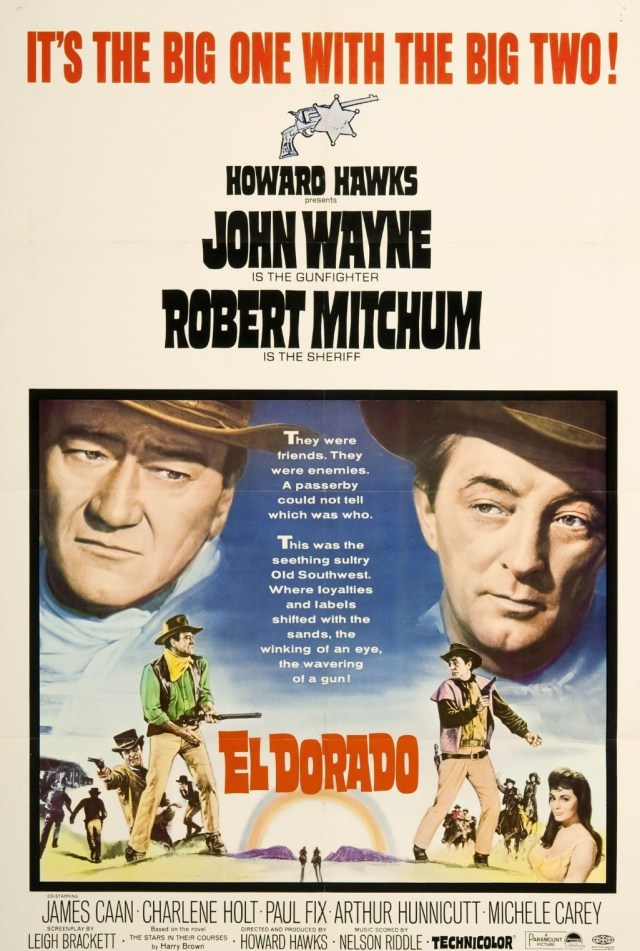
El Dorado (1966) poster created by Paramount Pictures, Laurel Productions, and Polyphony Digital

Things I liked about the film:

The on-screen chemistry: Relationships in movies, whether romantic or platonic, can come across believably on screen if there is a strong sense of chemistry between the actors. This is what happened in El Dorado! Toward the beginning of the movie, J.P., portrayed by Robert Mitchum, meets up with Cole, portrayed by John Wayne, to talk about a potential job opportunity. Cole and J.P. carry no-nonsense demeanors, but their cordialness to each other shows the respect between them. The scene’s mood becomes lighter when Maudie, portrayed by Charlene Holt, shows up. Her friendly, playfulness emphasizes the friendship these characters share. When Maudie talks about her late husband and Cole with J.P., the empathetic reflection indicates how much she cares about both Cole and J.P.. Not only was there strong on-screen chemistry among the actors, this strong on-screen chemistry was consistent throughout the film. The on-screen relationships were interesting to watch because of these factors!

The dialogue: One of the most important components of a movie’s script is the dialogue. Through dialogue, characters can memorably stand-out, important information can be shared, and characters’ problems can be solved. The quality of a script’s dialogue depends on how well written it is. While watching El Dorado, I took note of the cleverness of the dialogue. After a son from the MacDonald family dies, Cole visits the family to share the sad news. The patriarch of the family, Kevin, asks what happened, with Cole telling him how he got “a boy to do a man’s work”. Later, when Cole returns to El Dorado, he reconnects with J.P.. When J.P. asks Cole what he’s doing back in El Dorado, Cole tells his friend, “I’m lookin’ at a tin star with a…drunk pinned on it”. Dialogue like the two examples I provided show how cleverly words were used as well as the eloquent ways intended points were phrased.

Breen Code Era moments: As I’ve explained before on 18 Cinema Lane, the Breen Code was a series of guidelines studios had to follow between 1934 and 1954. El Dorado was released in 1966, a decade after the Breen Code Era ended. However, there were moments sprinkled throughout the movie that felt reminiscent of the Breen Code Era. Before Cole leaves El Dorado, he kisses Maudie. The kiss itself isn’t shown on-screen because Cole’s hat is blocking their faces. When Mississippi, portrayed by James Caan, is first introduced to the audience, he uses a knife in self-defense against a man he claims killed his friend. As Mississippi retrieves his knife, the aforementioned man is hidden behind a table to prevent some of the violence from being shown on screen. The way these moments were written and presented were thoughtful presentations of an era gone by.

Legends of Western Cinema Week Blogathon banner created by Hamlette from Hamlette’s Soliloquy, Heidi from Along the Brandywine, and Olivia from Meanwhile, in Rivendell

What I didn’t like about the film:

A prolonged conflict: Before watching El Dorado, I had seen two of John Wayne’s films: Stagecoach and Allegheny Uprising. In those movies, the story revolves around an overarching conflict some of the characters are consistently trying to resolve. While there was an overarching conflict in El Dorado, it primarily resided in the film’s second half. The first half of the movie consisted of a series of loosely connected vignettes. These vignettes, more often than not, contained low stakes. El Dorado’s first and second halves felt like they belonged in their own separate movies.

Inconsistent sense of urgency: Like I just said when talking about El Dorado’s prolonged conflict, the first half of the movie was a series of loosely connected vignettes, while the film’s overarching conflict resided in the story’s second half. Within the second half of the movie, scenes containing low stakes were woven into the production. One example is Cole addressing a back injury he received earlier in the story. El Dorado’s two halves and the low stakes scenes from the film’s second half are two reasons why this movie’s sense of urgency was inconsistent.

Enabling the Sheriff: J.P., the Sheriff of El Dorado, develops an alcohol addiction due to a romantic relationship gone wrong. When Cole and Mississippi go to El Dorado, they, as well as Bull, try to help J.P. overcome his addiction. Mississippi even creates a liquid concoction to sober J.P. up. But hours after receiving Mississippi’s concoction, J.P. is looking for alcohol. Bull tells J.P. exactly where a bottle of alcohol is located, in the upper left-hand drawer of his desk. Later that evening, Cole allows J.P. to go to the local saloon by himself, where he not only purchases a whole bottle of alcohol, he’s also laughed at by the film’s antagonists. J.P. does eventually become sober in order to help his friends. But toward the end of the movie, J.P. shares a shot of alcohol with Bull. If a screenwriter is going to incorporate a serious topic like addiction into their script, they need to be mindful about how that topic is included in the film. In my opinion, the way addiction was addressed in El Dorado could have been more thoughtful.

Sheriff badge image created by Freepik at freepik.com. <a href=’https://www.freepik.com/free-vector/brown-cowboy-label-set_1543252.htm’>Designed by Freepik</a>. <a href=”https://www.freepik.com/free-photos-vectors/vintage”>Vintage vector created by Freepik</a>. Image found at freepik.com.

My overall impression:

El Dorado is not only the third film of John Wayne’s I’ve seen, it’s the second film of John’s I’ve reviewed. Out of these three films, Stagecoach, Allegheny Uprising, and El Dorado, I haven’t found a title that’s left a strong impression on me. Looking back on Stagecoach, I think the movie is just fine. Allegheny Uprising was ok. Now that I’ve seen El Dorado in its entirety, I feel the 1966 project is also ok. The two halves of this movie and the low stakes scenes woven into the movie’s second half are likely the reason for El Dorado’s inconsistent sense of urgency. The topic of addiction could have been handled in a more thoughtful way. However, the movie does have its strengths. Some of these strengths are the on-screen chemistry among the cast and how well the dialogue was written. Personally, I found El Dorado to be a mixed bag. Hopefully, the next film of John’s I watch and review will be stronger than this one.

Overall score: 6 out of 10

Have you seen El Dorado? Which film from John Wayne’s filmography would you like me to review? Let me know in the comment section!

Have fun at the movies!

Sally Silverscreen
Take 3: In Country (1989) Review

One of the best parts about participating in blogathons is being introduced to movies that may be new to you. This is my experience with the 1989 film, In Country! For Taking Up Room’s Norman Jewison Blogathon, I wanted to choose a movie that was more underrated. While searching through Norman’s IMDB filmography, I came across the aforementioned ‘80s title. The synopsis reminded me of My Girl 2, where Vada is attempting to learn more about her mother. What sets In Country apart from the 1994 sequel is how the 1989 movie explores the aftermath of the Vietnam War by having the protagonist search for answers about her father. In 2024, I have reviewed four other films from the 1980s, so far. Similar to titles like Amadeus and Hallmark Hall of Fame’s Pack of Lies, In Country incorporates historical elements into the story. But will the 1989 movie be a pleasant surprise like Amadeus or a disappointment like Pack of Lies? Keep reading my review to find out!

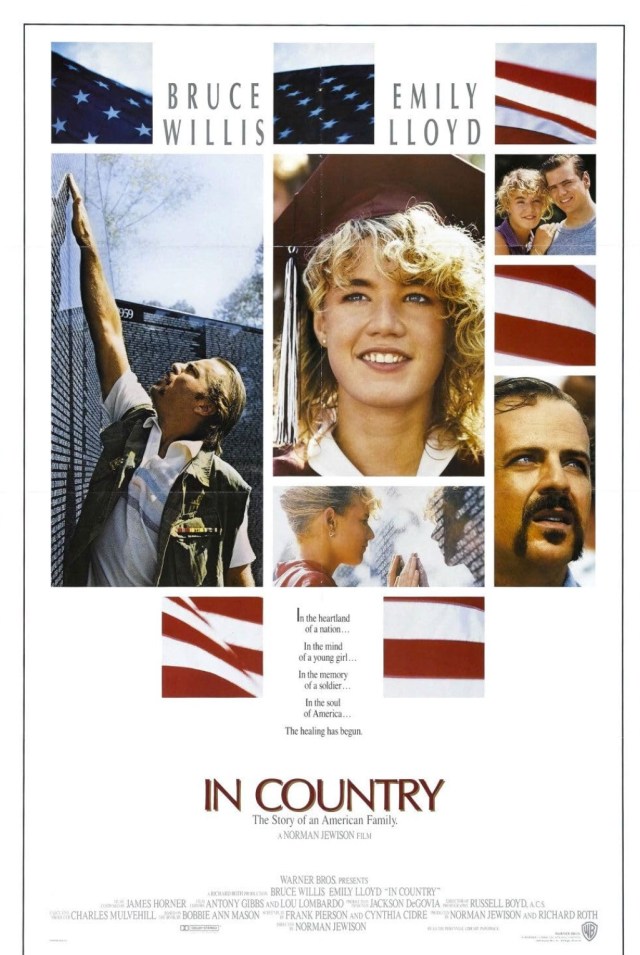
In Country (1989) poster created by Warner Bros. and Yorktown Productions

Things I liked about the film:

The acting: In any story, especially one that features a young protagonist, the main character’s likability can determine if the story is worth investing time in. I can only speak for myself, but I liked Samantha “Sam” Hughes’ personality! Though naïve at times, Sam was like a bright ray of sunshine, caring about the people in her life and trying to make her world a better place. What made Sam a likeable character was how genuine her emotions were. After finding a box of her father’s belongings in her mother’s room, Sam leaves a voice message on the phone explaining to her mother how upset she is by her mother’s silence about her father. When she hangs up the phone, the sad look in her eyes and the slight frown perfectly show how hurt Sam feels about her mother’s choices. This is just one example of Emily Lloyd bringing that genuineness to life, allowing her performance to be memorable!

Prior to watching and reviewing In Country, I had seen some of Bruce Willis’ films. His portrayal of Emmett Smith is different from some of his other roles, as he had to rely on emotion instead of action to carry his character through the story. A thunderstorm is causing chaos outside Emmett’s home one evening. Because of his time serving in the Vietnam War, he flinches whenever thunder strikes due to the flashbacks he is experiencing. At the same time, Emmett carries irritation in his voice because he wants the storm to stop and he wants to avoid Sam’s questions. Similar to what I said about Emily Lloyd’s performance, Bruce’s performance felt genuine. Beneath the tough exterior Emmett consistently displayed, he was a man who was trying to live a civilian life as best as he knew how.

Honesty about war and its impact on veterans: Like I just mentioned in this review, Emmett experiences flashbacks one stormy evening due to his time serving in the Vietnam War. These flashbacks not only cause Emmett to flinch every time thunder strikes, they also cause him to go outside, climb up a tree, and yell for someone to show their face. Throughout this scene, Sam asks Emmett questions about what is happening. Unfortunately for Sam, these questions are left unanswered. When Emmett goes outside, Sam calls for Emmett to come back in the house. As Emmett’s mind and heart are beyond the borders of his Kentucky home, Sam feels powerless, unsure of how to help Emmett. The scene I just wrote about is one example of the film’s honesty when discussing war and its impact on veterans. The candid way these subjects were talked about in the movie shows how the movie’s creative team understood the subjects’ significance.

The mise-en-scène: I’ve explained before that mise-en-scène is how a scene is presented in a movie. Mise-en-scène was utilized in several scenes’ favor in In Country. Toward the beginning of the film, a group of U.S. soldiers are wading through the swamps of Vietnam. This moment is presented as a long shot with the view appearing as if the camera is hiding behind the swamp’s foliage. How this scene is showcased to the audience emphasizes the soldiers’ need to stay unseen. Sam, Emmett, and Mamaw travel to Washington D.C. to visit the Vietnam Veterans Memorial. While walking past the monument, a close-up shot captured Mamaw as the names on the monument were gliding past her face. The visuals symbolized how the Vietnam veterans have touched the lives of not just their loved ones, but those in their communities as well.

The Norman Jewison Blogathon created by Rebecca from Taking Up Room

What I didn’t like about the film:

Sam’s attraction for Tom: While trying to learn more about her father, Sam turns to a veteran named Tom. At the Vietnam veterans’ dance, Sam invites Tom to share a slow-dance with her, where they get a little too close for comfort. After the dance, Sam spends the night at Tom’s house and has sex with him. Up until the slow-dance at the veterans’ dance, Sam never expressed any romantic interest in Tom. Plus, she just graduated from high school and Tom appears old enough to be her father. Not only was this part of the story random, its inclusion in the film was unnecessary, especially since it has no impact on the plot.

The “slice of life” parts of the story: As I’ve been saying in this review, Sam wants to learn more about her father who served and died in the Vietnam War. This part of the story, as well as the parts exploring the veterans’ perspective, was interesting. But those parts made up half the movie. The other half revolved around subplots that were more “slice of life”. When the story turned to the “slice of life” events, I found myself wishing the movie would go back to Sam learning more about her father or Emmett interacting with the other veterans. In fact, I think the movie should have primarily focused on those aforementioned parts of the story.

On-the-nose songs: The inclusion of songs in a movie can make or break a given scene. Sometimes, a song can be so on-the-nose, it doesn’t leave the intended emotional impact. This happened on more than one occasion in In Country. The opening lines of the Bruce Springsteen song, “I’m On Fire” are “Hey, little girl, is your daddy home? Did he go away and leave you all alone?”. This song can be heard on two occasions after Sam decides to learn more about her father, pointing out what the audience already knows. Earlier in this review, I brought up how Sam invites Tom to share a slow-dance with her, where they get a little too close for comfort. The song they dance to is Hank Williams Jr.’s “Ain’t Misbehavin’”, which narrates what’s happening on screen and foreshadows what’s about to come. That song paired with the events that unfold created a scene that left me uncomfortable.

Children holding American flags during a sunset image created by rawpixel.com at freepik.com. <a href=”https://www.freepik.com/free-photos-vectors/people”>People photo created by rawpixel.com – http://www.freepik.com</a>. Image found at freepik.com.

My overall impression:

When I watch a movie, I sometimes imagine how the story would turn out if it was presented in a different way. One recent example is how Hallmark Hall of Fame’s Brush with Fate would have, in my opinion, benefitted by being presented as a multi-part mini-series. I feel similarly about 1989’s In Country. For the most part, the creative team behind the movie appeared to have their hearts in the right place. The honesty about war and its impact on veterans was included in the story in such a candid way, it showed the movie’s creative team understanding the significance of the subjects woven into the script. But this aforementioned honesty, as well as Sam’s search for answers about her father, should have been the film’s primary focus. Therefore, I wish this story had been a road-trip movie, where Sam, Emmett, and Mamaw go to visit the Vietnam Veterans Memorial in Washington D.C., with Sam learning about her father and important life lessons along the way.

Overall score: 6.1 out of 10

Have you seen 1989’s In Country? What’s your favorite film from 1989? Tell me in the comment section!

Have fun at the movies!

Sally Silverscreen
Top 10 “Icks” from Hallmark Hall of Fame Movies

To address the elephant in the room (or on the blog in this case), the lack of blog posts this past week is due to how much time I’ve spent collecting research for my upcoming Sally Solves a Mystery article. While I have been working to solve a television-related mystery, the subject of Hallmark Hall of Fame movies came to mind. I’ve seen over fifty films from the Hallmark Hall of Fame collection. At this point, I, as a viewer, know what I like and don’t like when it comes to storytelling from this particular branch of Hallmark entertainment. These preferences are what inspired me to create this list of the top ten “icks” from Hallmark Hall of Fame movies! For my list, I will share which aspects of Hallmark Hall of Fame films I am not a fan of, providing examples from various titles in this collection. Before I begin the list, I want to address how this list is not meant to be mean-spirited or negative. My article is, simply, a way to express my opinion.

Taking out the trash photo created by Katemangostar at freepik.com. <a href=’https://www.freepik.com/free-photo/unhappy-woman-holding-trash-with-disgusting-smell_1305783.htm’>Designed by Freepik</a>. <a href=”https://www.freepik.com/free-photos-vectors/person”>Person image created by Katemangostar – Freepik.com</a>. Image found on freepik.com.

1. Underutilizing Talent

    In past movie reviews, I have pointed out when I felt an actor or actress’s talents were underutilized. What I’ve meant by this is an actress or actor’s talents not being incorporated into a film to the fullest extent. This can range from an actor or actress being miscast to an actor or actress having a limited presence in the movie, the latter serving two examples for this list. Marguerite Moreau’s involvement in 2002’s The Locket is one of the reasons why I wanted to check the film out. Because she was cast as the movie’s main supporting actress, I expected Marguerite to have a more consistent presence in the film than she actually did. As I said in my review of The Locket, Marguerite’s character barely appeared in the movie’s second half. Based on her performances I have seen from a variety of movies and television shows, I think Karina Arroyave’s acting talents could have lent themselves to a larger role in 2000’s Missing Pieces. Sadly, Karina’s on-screen appearances were so short, they seemed like “don’t blink or you’ll miss her” moments. While she was given a little more screen-time in the 1993 film, Blind Spot, I still feel Karina’s acting talents were underutilized.

    2. Films That Feel like Televised Plays

    When I choose to watch a Hallmark Hall of Fame movie, I expect to see a cinematic production of an original or pre-existing story. Some of these pre-existing stories happen to be plays. But there are times when a project’s creative team didn’t take advantage of how expansive film-making can be. Instead, they kept their adaptation as limited as the boundaries of the stages these plays came from. Like I pointed out in my review of the 1987 film, Foxfire, the cast is smaller and the story is condensed, forcing the characters to remain near or in Annie’s house. With the story surrounded by the natural beauty of Appalachia, I wish the movie’s emphasis had been placed on showcasing a variety of locations from this region. The 1972 remake of Harvey made similar creative choices, such as showing fewer locations throughout the story. This is different from the 1950 version of Harvey, where Elwood moves to multiple places.

    3. Oversimplifying Adoption/Foster Care

    Back in 2022, when I published my list of the top ten worst movies I saw that year, 1994’s A Place for Annie ended up as a Dishonorable Mention. One reason why I didn’t like this film is how the subject of adoption/foster care was oversimplified. For those who have never seen or heard of the movie, A Place for Annie is about a woman taking in a baby who is HIV positive. Over the course of the story, the woman, portrayed by Sissy Spacek, is in the process of adopting the baby. But she experiences an unexpected conflict when the baby’s biological mother shows up. The way Sissy’s and Mary-Louise Parker’s characters were portrayed and written presented a “good” mother vs. “bad” mother dynamic, even right down to the way each character dressed. Sissy’s character, Susan, becomes upset at the idea of Mary-Louise’s character, Linda, reuniting with her daughter, even though the intended purpose of foster care is for children to be reunited with their biological families. Because of the oversimplification of adoption/foster care in A Place for Annie, I couldn’t take the movie seriously.

    4. Characters Not Receiving Their Full Potential

    Speaking of articles from 2022, I’ll now bring up my list of top ten characters who didn’t reach their full potential. When I published this list, I explained when a character doesn’t receive their full potential, they aren’t given the opportunity to reach their goals, make their dreams come true, and allow their stories to be told to a satisfying extent. This list featured two characters from Hallmark Hall of Fame movies; Barry Klemper from The Boys Next Door and Amédée Chevalier from O Pioneers!. In the case of these characters, their stories were adapted from pre-existing source material. While I haven’t seen or read a stage version of The Boys Next Door, I have read O Pioneers!. I can understand why Willa Cather made certain creative decisions related to Amédée, as well as Hallmark Hall of Fame’s desire to keep the adaptation as close to the source material as possible. However, I still wish Amédée had received his full potential.

    5. Rehashed Stories

    For this part of my list, I am not talking about Hallmark Hall of Fame productions that are adapted from pre-existing plays or books. I am referring to Hallmark Hall of Fame movies that seem to copy stories from other films. Earlier in this list, I referenced the 1972 and 1950 versions of Harvey. After watching both versions, it feels like I watched the same movie twice, due to little variation between the two versions. I also felt this way about the 1996 film, The Summer of Ben Tyler. The movie seemed so similar to To Kill a Mockingbird, I wondered if Hallmark Hall of Fame was trying to remake the aforementioned film. I know story ideas are bound to get repeated over time. But, in my opinion, the Hallmark Hall of Fame productions should strive to create unique, distinct projects.

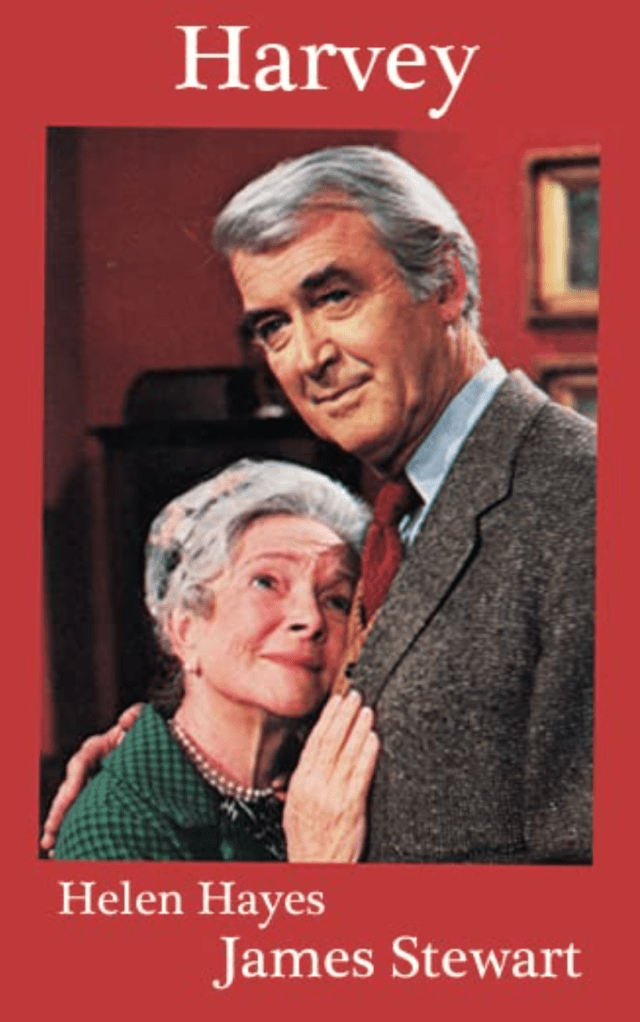
    Harvey (1972) poster created by Foote, Cone and Belding Productions, Hallmark Hall of Fame Productions, Talent Associates-Norton Simon, and National Broadcasting Company (NBC)

    6. Terrible Grandparents

    Grandparents, like any family member in a protagonist’s life, should, in my opinion, be a kind, friendly character that the audience can root for. Unfortunately, some protagonists aren’t so lucky. For the fifth annual Gold Sally Awards, when I created the inaugural Edwin P. Christy Award for most annoying character in film, I gave that award to Grandpa Marcus from 1995’s Journey. I explained how obsessed he became of his photography hobby, to the point where he became negligent of his grandchildren’s safety. In one scene, Grandpa Marcus makes his grandson, who doesn’t appear old enough to obtain a driver’s permit yet, drive a car so Grandpa Marcus can take pictures. The grandchildren make a joking comment about how their grandpa will photograph their car accident if something should happen to them, with the scene itself meant to be played as a wholesome, hilarious moment.

    Leonora Nelson is a bitter, mean-spirited woman in the 1997 film, Ellen Foster. At her daughter’s burial, Leonora blames her son-in-law for her daughter dying. She yells and screams at her son-in-law just seconds after her daughter’s casket was buried. As the story progresses, Leonora’s hatred for her son-in-law grows. Her actions range from smashing his Purple Heart medal with a hammer to telling her granddaughter, the titular Ellen Foster, she hates her because she looks like her father. I recognize Leonora is intended to be an awful character, serving as one of the many obstacles Ellen had to overcome. But that doesn’t take away from how, in my opinion, Leonora Nelson is one of the worst characters in Hallmark movie history.

    7. Productions That Feel Like Hallmark Channel Films

    Hallmark Hall of Fame movies began to premiere on Hallmark Channel in 2014. While there are films from this time period I like, such as Love Takes Flight and The Beach House, I am aware how, more often than not, these projects bear a formula similar to those from Hallmark Channel. One such example is how a romance is usually the center of a given story. The identities of films like The Beach House and Love Takes Flight are not as unique as Hallmark Hall of Fame movies from years past. Take, for instance, Missing Pieces and Caroline? from 1990. Both of these films revolve around mystery stories. However, each title presents its own distinct identity, with these two movies bringing something different to the Hallmark Hall of Fame collection.

    8. Unsupportive Parents

    Similar to what I said earlier about grandparents, parents of protagonists should, in my opinion, at least be supportive. Sadly, a protagonist’s parents may be unsupportive for a variety of reasons. In my list of top ten characters who didn’t reach their full potential, I mentioned how Barry Klemper’s father destroyed the momentum Barry had in The Boys Next Door. Long before his father showed up, Barry dreaded the meeting because of how unsupportive his father is. On the day of the meeting, Barry’s father intimidated and belittled his son, even making Barry feel incapable of performing a simple golf maneuver. There are times, however, when a protagonist’s unsupportive parents do not intend to be unsupportive. Heidi and Winston’s mother is a perfect example. In the 1990 movie, Caroline?, Winston and Heidi’s mother is overprotective due to Heidi having a disability. Her good intentions not only lead Heidi to be treated younger than her age, but also prevent Heidi’s academic needs from being met.

    9. Glossing Over Serious Subjects

    The Hallmark Hall of Fame collection has covered its fair share of serious subjects, ranging from the aforementioned adoption/foster care to terminal illnesses. But sometimes, a Hallmark Hall of Fame production will miss a good opportunity to address an important topic by glossing it over. The subject of racism is woven into the text of The Flamingo Rising book, with racism causing the protagonist, Abraham, to have self-image related issues. When the book was adapted into a Hallmark Hall of Fame movie in 2001, all mentions of racism were eliminated from the script. This decision was likely made to keep The Flamingo Rising movie “Hallmark appropriate”. At a very random moment in the 1996 film, Calm at Sunset, Russell Pfeiffer admits he has a drug addiction. There was no lead up to this revelation and the revelation itself was never addressed afterward. Calm at Sunset is based on a book I haven’t read. Therefore, I don’t know how the subject of addiction was addressed in the source material compared to the adaptation.

    10. A Dysfunctional Family for the Sake of It

      Six years ago, when I published my list of the top ten worst Hallmark movies of all time, I put the 2004 film, Back When We Were Grownups, at number one. As I mentioned in that list, the story’s family seems dysfunctional just for the sake of it. From what I remember, there was no clear reason for the family to be dysfunctional. This is very different from another Hallmark Hall of Fame production, 1998’s Saint Maybe. In that movie, a death in the family causes a ripple effect which leads to the family becoming dysfunctional. The dysfunctional nature of the family serves as motivation for various characters to make impactful changes in their lives. Comparing these two Hallmark Hall of Fame films, which are both adaptations of Anne Tyler’s books, I think Saint Maybe did a better job at showcasing how a dysfunctional family live their lives and work through their problems.

      Group of unhappy image created by Rawpixel.com at freepik.com. <a href=”https://www.freepik.com/free-photos-vectors/background”>Background vector created by rawpixel.com – http://www.freepik.com</a>. Image found at freepik.com.

      Have fun at the movies!

      Sally Silverscreen
      Take 3: Hallmark Hall of Fame’s Pack of Lies Review

      For last year’s Broadway Bound Blogathon, I reviewed the
      Hallmark Hall of Fame presentation, A Tale of Two Cities. This is an adaptation
      from 1980 I liked so much, it was one of the best movies I saw in 2023! While
      reflecting on that film, I realized it’s been a whole year since I reviewed a
      Hallmark Hall of Fame production. To make up for lost time, I chose to write
      about the 1987 Hallmark Hall of Fame film, Pack of Lies! Two years
      before this movie aired on television, Pack of Lies premiered on
      Broadway, making the Hallmark Hall of Fame movie a good choice for the
      blogathon. Pack of Lies is also a Hallmark Hall of Fame film from the ‘80s
      I haven’t seen before. One of my aspirations is to see as many Hallmark Hall of
      Fame movies as realistically possible. Out of the titles I have seen, I’ve
      noticed the mystery genre is rarely represented throughout the Hallmark Hall of
      Fame collection. That fact is another reason why I chose to review Pack of
      Lies
      !

      Hallmark Hall of Fame’s Pack of Lies poster created by Hallmark Hall of Fame Productions, Robert Halmi, and CBS

      Things I liked about the film:

      The acting: Ellen Burstyn and Teri Garr portray Barbara
      Jackson and Helen Schaefer in Pack of Lies. The friendship of these two
      characters highlights how different they are from one another. Helen has a very
      outgoing and bubbly personality, a talkative woman who’s willing to solve
      problems. Meanwhile, Barbara is more reserved, dressing more modestly and
      avoiding conflict whenever possible. Part of why the differences between these
      characters were achieved was through the acting abilities of both Ellen and
      Teri! They presented the uniqueness of their characters through various emotions
      and expressions. When creating a movie where actors portray friends, the believability
      of their performances can make or break that illusion. The aforementioned illusion
      was certainly created and maintained throughout Pack of Lies!


      In stories where a character has some degree of authority,
      their personality is usually serious. This can be a challenge for an actor or
      actress, as there are few opportunities to utilize a variety of expressions and
      emotions. That didn’t stop Alan Bates from portraying Stewart and making that
      performance memorable! When Mr. and Mrs. Jackson first meet Stewart, he leaves
      a trusting first impression. During this meeting, Alan incorporates eye movements,
      vocal inflections, and variations of mouth movements to create an interaction
      that appeared realistic. Because of the realistic nature of Stewart’s meeting,
      the scene itself contains a sense of realism. This realism is consistently
      carried in the movie through the acting performances!


      A mystery within a mystery: The meeting between Stewart and
      the Jacksons I previously referenced in this review is about how Stewart is
      looking for a man named Laurence. The main mystery in Pack of Lies is
      discovering who Laurence is and why Stewart is interested in finding him. At
      the same time, the legitimacy of Stewart and his mission serve as a second
      mystery. Because of the vagueness Stewart provides to the Jackson family, it
      leaves both the Jackson family and the audience wondering who Stweart really is
      and why he wants to confront Laurence so much. This second mystery provides an
      added layer of intrigue to the overall story!


      Providing books as gifts: While visiting their friends, Helen
      and Peter Schaefer, Barbara and Bob Jackson receive books as gifts from Peter.
      Barbara loves art so much, she and Helen take art classes regularly. Meanwhile,
      Bob is an employee in the aircraft industry. In the meeting between the Jackson
      family and Stewart, Stewart points out a model plane Bob built. From Peter, Barbara
      receives a book of drawings from the Clark Institute in Massachusetts. Peter gives
      Bob a book about the first flights across the Atlantic. These books were
      thoughtful presents Peter took the time and effort to find. Looking back on the
      Hallmark films I’ve seen, including those from Hallmark Hall of Fame,
      characters receiving books as gifts are rarely shown. Therefore, I appreciate
      this creative choice from Pack of Lies’s creative team to fill a
      creative void that is, more often than not, overlooked.

      The Seventh Broadway Bound Blogathon banner created by Rebecca from Taking Up Room

      What I didn’t like about the film:

      Telling instead of showing: In an ideal movie, it’s
      important to show and tell what’s happening on screen. But because film is a
      visual medium, showing should be emphasized. Unfortunately, in Pack of Lies,
      telling was preferred over showing. Throughout the movie, Stewart tells Mr. and
      Mrs. Jackson that a man named Laurence Powell is a man of interest. The reason for
      this interest is his possible connections to Russian communists. Dialogue is
      the only way the truth about Laurence and Stewart’s reason for recruiting the
      Jackson family is revealed. The subject of espionage in entertainment media isn’t
      always action-packed and adrenaline-fueled. If a creative team knows their
      story will have low energy, they should maintain a sense of suspense and
      intrigue by showing what’s going on.


      Little lapse in time: At the beginning of the movie, Stewart
      assures the Jackson family he’ll only observe Laurence for a day or two. As the
      story progresses, Stewart’s mission ends up lasting longer than the proposed
      one to two days. Like I just said in this review, Pack of Lies
      emphasized telling instead of showing. The little lapse in time throughout the
      movie is another example of this flaw. Christmas decorations in the Jackson
      house are the only indication a significant period of time took place. Prior to
      that part of the story, the film looks like events happened within a week.


      Things that don’t make sense: As I’ve been saying in this
      review, Stewart’s mission is to observe Laurence over a period of time. The more
      information revealed by Stewart, the more the Jacksons and the audience learn
      Stewart knew more about Laurence than he originally let on. I know the subject
      of espionage can be varied and complicated when included in entertainment
      media. However, with everything I just said, why didn’t Stewart just arrest
      Laurence instead of observing him over multiple days? Why did Stewart need to
      get the Jackson family involved in the first place? This is one example where Pack
      of Lies
      doesn’t make sense.

      Sketch of London image created by Archjoe at freepik.com. <a href=’https://www.freepik.com/free-vector/hand-drawn-houses-of-parliament_1133950.htm’>Designed by Archjoe</a>. <a href=”https://www.freepik.com/free-photos-vectors/background”>Background vector created by Archjoe – Freepik.com</a>. Image found at freepik.com.

      My overall impression:

      Hallmark Hall of Fame movies, like any creative endeavor, are
      not created equally. As I shared in this review’s introduction, I liked A
      Tale of Two Cities
      so much, it was one of the best movies I saw last year.
      Sadly, I can’t say the same about Pack of Lies. The 1987 presentation
      was a two hour slow and tedious build-up to a resolution that was underwhelming
      and anticlimactic. The cause of these flaws was the emphasis on telling instead
      of showing. This is not the first time a Hallmark Hall of Fame movie from the ‘80s
      let me down, as I also found 1985’s The Corsican Brothers disappointing.
      After watching Pack of Lies, I learned the movie was based on a true
      story. Now knowing this, I think the story would have benefitted more had it
      become a documentary instead. As I wrap up my review of Pack of Lies, I
      reflect on a Hallmark commercial I have seen. In this commercial, a man, whose
      first language is not English, is looking for the perfect card for his wife,
      who will soon arrive in the United States. When he goes to a Hallmark store,
      the man is assisted by an employee named Rose, who helps him find exactly what
      he is looking for. Another man who occasionally appears throughout the
      commercial reveals the events in the commercial are based on a true story.
      Honestly, the story behind that Hallmark commercial is a more fascinating movie
      idea than what was presented in this Hallmark Hall of Fame film.


      Overall score: 5 out of 10


      Have you seen Pack of Lies? Which Broadway show do
      you wish received a Hallmark Hall of Fame movie? Tell me in the comment
      section!


      Have fun on Broadway!

      Sally Silverscreen

      Word on the Street: Hallmark Releases Trailer for ‘Signed, Sealed, Delivered: A Tale of Three Letters’

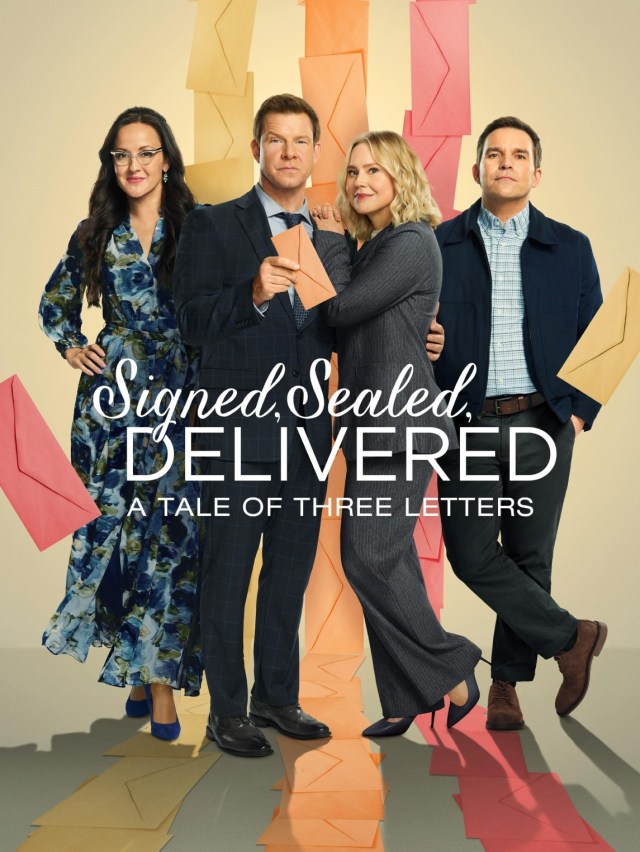
      I recently published an editorial speculating why I believed Signed, Sealed, Delivered: A Tale of Three Letters could be a Christmas movie. This speculation was not only based on the film’s premiere date, but on other factors like only one Christmas movie throughout the Signed, Sealed, Delivered series and how I thought the title could allude to the Nativity story or A Christmas Carol. At the time I published my editorial, Hallmark hadn’t released any promotional material for their upcoming production. During the premiere of Tipline Mysteries: Dial 1 for Murder, the trailer for Signed, Sealed, Delivered: A Tale of Three Letters aired on Hallmark Mystery. I wanted to write this Word on the Street article to own up to my error and dispel confusion for my readers, as the trailer proves the new Signed, Sealed, Delivered film is not a Christmas movie. I also wanted to write about this trailer because, after all, it is movie news.

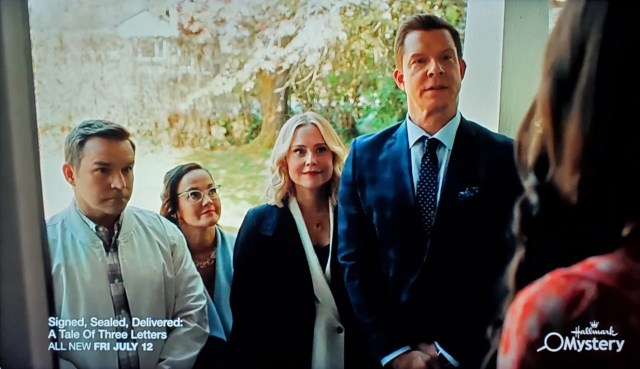
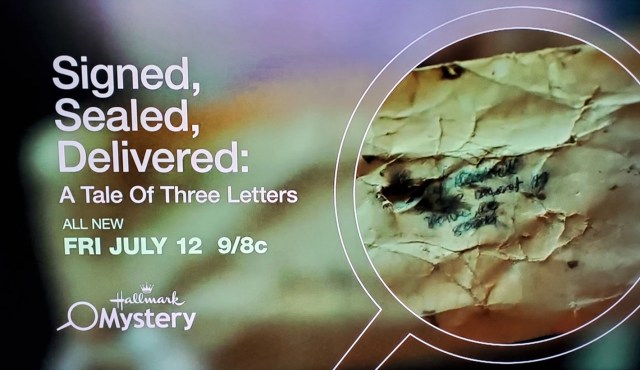
      The trailer for Signed, Sealed, Delivered: A Tale of Three Letters has been shown on Hallmark Mystery and is available on Hallmark Mystery’s website. However, as of the publication of this Word on the Street story, the trailer is not featured on the movie’s official page on Hallmark Mystery’s website. This screenshot, taken by me, Sally Silverscreen, is proof the trailer exists.

      I have always been honest about my thoughts on the Signed, Sealed, Delivered series. In my opinion, the overall quality of this series has been inconsistent. Based on the trailer alone, Signed, Sealed, Delivered: A Tale of Three Letters appears underwhelming. One reason is a story that seems recycled and predictable. As a Heartie, I’m over redemption stories because of how long Henry Gowen’s redemption arc was drawn out on When Calls the Heart. With the trailer’s voice-over stating “with a teacher trying to rewrite her wrong” and with the aforementioned teacher admitting sending a letter “in a very weak moment”, it looks like two out of the three titular letters will likely serve a redemption story.

      Hand-written letter image created by Veraholera at freepik.com. <a href=”https://www.freepik.com/free-photos-vectors/background”>Background vector created by Veraholera – Freepik.com</a>. <a href=’https://www.freepik.com/free-vector/love-letter-pattern_1292902.htm’>Designed by Freepik</a>. Image found at freepik.com.

      At the beginning of the trailer, Oliver brings up “the great mailbox breach of 2017”. The way this event is addressed in the trailer gives me the impression the POstables (Oliver, Shane, Rita, and Norman) have been working on this case for a long period of time. Signed, Sealed, Delivered is a series where the stories are given a contemporary setting. From 2017 to 2021, five Signed, Sealed, Delivered movies have been released. If the movies take place within the years of their release, how come this “great mailbox breach of 2017” is just now being brought up? I hope a logical explanation is provided in Signed, Sealed, Delivered: A Tale of Three Letters.

      Envelope with hearts image created by Freepik at freepik.com. <a href=’https://www.freepik.com/free-photo/hearts-and-pink-envelope-for-mothers-day_1950691.htm’>Designed by Freepik</a>. <a href=”https://www.freepik.com/free-photos-vectors/love”>Love image created by Freepik</a>. Image found at freepik.com.

      In my editorial about why Francesca Quinn: PI is the worst Hallmark movie I’ve ever seen, I talked about the importance of fictional detectives having “quirks”, something about that character that sets them apart from other fictional detectives. The POstables serve as a good example of characters possessing “quirks” and being unique from one another, like Rita being obsessed with owls or Norman having a memory that rivals an encyclopedia. Based on the trailer’s voice-over stating “and a delivery that hits closer to home” and Oliver telling Charley “we are here on official business”, I wonder if Charley will become a fifth member of the POstables? Charley was introduced in the last Signed, Sealed, Delivered chapter; Signed, Sealed, Delivered: The Vows We Have Made. Looking back on that film, the only aspect I remember about Charley was how she was pregnant. The lack of strong characterazation for Charley is one reason why I didn’t like the previous Signed, Sealed, Delivered film. So, if she does become a fifth member of the POstables, I wonder what “quirk” Charley will adopt?

      The trailer for Signed, Sealed, Delivered: A Tale of Three Letters has been shown on Hallmark Mystery and is available on Hallmark Mystery’s website. However, as of the publication of this Word on the Street story, the trailer is not featured on the movie’s official page on Hallmark Mystery’s website. This screenshot, taken by me, Sally Silverscreen, is proof the trailer exists.

      When I speculated Signed, Sealed, Delivered: A Tale of Three Letters being a Christmas movie, I wondered if the next movie, “Signed, Sealed, Delivered: To the Moon and Back” could serve a two-part story. This speculation was based on the belief of Signed, Sealed, Delivered: A Tale of Three Letters retelling A Christmas Carol and the rock star in “Signed, Sealed, Delivered: To the Moon and Back” as a Marley-like character. As the title suggests, three letters will be key elements in the film’s plot. But the trailer for Signed, Sealed, Delivered: A Tale of Three Letters shows only two letters; one from the teacher and one for someone named “Maria”. The synopsis for “Signed, Sealed, Delivered: To the Moon and Back” states how the POstables go “on a road trip” in an effort to “find the recipient of a lost letter”. This indicates only one letter serving as the story’s mystery. Maybe that letter is the titular third letter in Signed, Sealed, Delivered: A Tale of Three Letters, making that film and “Signed, Sealed, Delivered: To the Moon and Back” a two part story?

      What are your thoughts on this piece of movie news? Are you excited for Signed, Sealed, Delivered: A Tale of Three Letters? Please tell me in the comment section!

      Have fun at the movies!

      Sally Silverscreen

      Take 3: For Me and My Gal Review

      Looking back on Judy Garland’s movies I’ve seen, I can
      honestly say I haven’t seen a movie I didn’t like. Even though some pictures were
      better than others, I can’t say any of Judy’s films were “bad”. Hoping this
      streak will continue, I joined the Third Judy Garland Blogathon by reviewing For
      Me and My Gal
      ! This film was recommended by the Brannan sisters from Pure
      Entertainment Preservation Society. They not only introduced me to this film,
      they introduced me to the Breen Code era! Between 1934 to 1954, the Breen Code
      served as a set of guidelines for film-makers. These guidelines addressed the
      dos and don’ts of movie-making based on a series of morals. Within that period
      of time, Hollywood gave their audience films that have stood the test of time
      and even become “classics”. But will this statement hold true for For Me and
      My Gal
      ? Keeping reading my review to find out!

      For Me and My Gal poster created by Metro-Goldwyn-Mayer (MGM)

      Things I liked about the film:

      The on-screen chemistry: Since I chose to review this movie
      for the Third Judy Garland Blogathon, I want to discuss Judy’s performance in For
      Me and My Gal
      . However, I want to talk about her performance in relation to
      her on-screen chemistry with Gene Kelly. When a movie musical features a
      romantic relationship, the on-screen chemistry of the lead actor and actress
      can sell the idea their characters truly love one another. This is what Gene
      and Judy achieved through their portrayals of Harry Palmer and Jo Hayden! One
      perfect example is presented during the musical number, “For Me and My Gal”.
      Through facial expressions, the choreography, and their singing abilities, Jo
      and Harry realize they share the same dream, despite being complete strangers
      only hours ago. This musical number emphasizes how these characters were always
      meant to be together.


      How World War I was incorporated: For Me and My Gal takes place in the middle of the 1900s, the time when World War I took place. The story revolves around civilian perspectives; vaudeville
      performers trying to make their dreams come true. At the beginning of the
      movie, newspaper headlines broadcast events related to World War I. But the
      newspaper’s front page is turned away from the characters, as they are more
      concerned with how their performances were reviewed by the critics. As the
      story progresses, World War I starts to take center stage in their lives,
      affecting each character differently. This progression is steady and the
      changes happen more subtly. The way World War I was incorporated into For Me
      and My Gal
      felt realistic. Though fictional musical movies require a
      certain amount of disbelief to be suspended, it was refreshing for realism to
      be woven into the film.


      A story with stakes: Movie musicals, especially those from
      the Breen Code era, contain simpler stories. These stories range from looking
      for another member of a talent group or characters expressing their love for
      each other. In For Me and My Gal, the overarching
      story focuses on characters working toward their dreams. Throughout the movie,
      Jo and Harry experience obstacles and attempt to overcome them. At one point in
      the film, Harry receives an offer to perform at The Palace, a theatre in New
      York every vaudeville performer aspires to go. While the offer itself sounds
      amazing, the problem is Harry would no longer be able to perform with Jo. This
      is one example of For Me and My Gal containing a story with stakes. In
      the case of the aforementioned conflict, there were stakes not only for Harry’s
      career, but also for his relationship with Jo.

      The Third Judy Garland Blogathon banner created by Crystal from In The Good Old Days Of Classic Hollywood and Kristen from Hoofers and Honeys

      What I didn’t like about the film:

      The “insta-love” trope: In stories where a romantic
      relationship in included, part of the story is devoted to showcasing the
      progression of that relationship. If a story’s relationship moves too quickly,
      it may be difficult for the audience to become invested in that relationship or
      determine if the actors have on-screen chemistry. While Judy Garland and Gene
      Kelly had good on-screen chemistry, I found their characters’ initial attraction
      to happen too quickly. In fact, this attraction happened so quickly, it almost
      felt unbelievable. I recognize there’s only so much story to tell in an hour
      and forty-four minutes. However, I wish Harry and Jo’s attraction for one
      another had taken its time.


      An unresolved debt: Toward the beginning of For Me and My
      Gal
      , Jo’s brother, Danny, pays Jo a visit after one of her shows. During
      their conversation, Jo tells Danny she will pay him back after she becomes a
      big vaudeville star. But this is the only time throughout the movie where this
      debt is mentioned. The debt is not revisited or resolved as the story progresses.
      That part of the story ended up becoming a loose end that was left behind by
      the end of the movie.


      A confusing conflict: For this part of my review, I will
      spoil For Me and My Gal. If you have not seen this movie and are
      interested in watching it, skip this part of my review and continue reading where
      it says “My overall impression”.


      After Jo and Harry discover their love for each other, they
      receive a telegram congratulating them on their upcoming performance at The
      Palace, a theatre in New York they have dreamed about for so long. When they
      arrive at The Palace, Harry and Jo learn there was a misunderstanding. They
      received a gig at The Palace theatre in Newark, New Jersey. In the telegram, its
      sender stated The Palace was in New York. But any performer on the vaudeville
      scene would know there’s only one Palace theatre, the one in New York City.
      That quote in the telegram references how Eve Minard, a singer Jo and Harry met
      on a train trip, brought up the idea of more than one Palace theatre. For Me
      and My Gal
      was released during the Breen Code era. When a character makes a
      poor choice within a film from this time period, they either face accountability
      for that choice or learn from their mistake. However, Eve is never confronted
      about the telegram. This leaves me confused, wondering if Eve was intentionally
      ruining Harry and Jo’s plans or if she was genuinely trying to help, but her
      message became lost in translation?

      Children holding American flags during a sunset image created by rawpixel.com at freepik.com. <a href=”https://www.freepik.com/free-photos-vectors/people”>People photo created by rawpixel.com – http://www.freepik.com</a>. Image found at freepik.com.

      My overall impression:

      The term, “The Golden Age of Hollywood”, gets thrown around
      from time to time in conversations about the film industry. This term’s
      definition depends on who you ask, as film itself can be subjective. In my
      opinion, one of Hollywood’s “golden ages” was the Breen Code era. For Me and My Gal serves as one example to prove my point. The 1942 picture sets itself apart from other musical films by
      presenting a story with stakes. It also incorporates World War I in a realistic
      way. As I’ve stated in past reviews, the strength of a musical movie lies in
      its musical numbers. For the most part, For Me and My Gal features
      musical numbers that are pleasant to watch! This is the second Judy Garland
      production I reviewed this year I was not only recommended, but ended up liking
      as well. The streak of enjoyable Judy Garland movies I mentioned in this review’s
      introduction is still going strong!


      Overall score: 7.6 out of 10


      Have you seen For Me and My Gal? What is your
      favorite movie of Judy Garland’s? Please let me know in the comment section!


      Have fun at the movies!

      Sally Silverscreen



      Is Hallmark’s new ‘Signed, Sealed, Delivered’ movie a Christmas film?

      In one of my recent Sunset Over Hope Valley re-cap posts, I
      brought up two upcoming Signed, Sealed, Delivered movies. Originally
      reported by Net from It’s a Wonderful Movie, these films were given release
      years of 2024 and 2025. The first of these movies, Signed, Sealed, Delivered:
      A Tale of Three Letters
      , has just received a premiere date, airing much earlier
      than I expected. But the more I thought about this piece of movie news, the
      more I wondered why Hallmark would air this chapter of Signed, Sealed,
      Delivered
      in the middle of July? Then I came to the realization how Signed,
      Sealed, Delivered: A Tale of Three Letters
      could be a Christmas film. Besides
      the movie’s premiere date, there are other observations that support my claim.
      These observations will be discussed in this editorial. Before I begin
      explaining my claim in further detail, I want to remind my readers how Hallmark
      has provided very little information about these Signed, Sealed, Delivered
      movies, as of the publication of this editorial. As you read my article, take
      what I say with a reindeer sized grain of salt.

      Signed, Sealed, Delivered: To the Altar poster created by Crown Media Family Networks and Hallmark Movies & Mysteries. Image found at https://www.crownmediapress.com/Shows/PRShowDetail?SiteID=143&FeedBoxID=845&NodeID=302&ShowType=series&ShowTitle=Signed%2c+Sealed%2c+Delivered+To+the+Altar

      The Film’s
      Premiere Date

      As I stated in this
      editorial’s introduction, Signed, Sealed, Delivered: A Tale of Three Letters
      has received a premiere date, with July 12th being the specific
      day. As I also stated, this news led me to question why Hallmark would choose
      to air this movie so soon. A possible answer can be given in three words:
      Christmas in July. In recent years, Christmas in July marathons have become
      exclusive with Hallmark Channel. However, there was a time when Hallmark would devote
      the entire month of July with Christmas in July marathons among Hallmark Channel
      and Hallmark Mystery. In fact, the movie, Christmas Camp, premiered
      during 2019’s Christmas in July marathon on what was then known as Hallmark
      Movies & Mysteries.

      Cute Christmas image created by freepik at freepik.com. <a href=”https://www.freepik.com/free-photos-vectors/background”>Background vector created by freepik – http://www.freepik.com</a>. Image found at freepik.com.

      Hallmark Channel’s
      Viewership Numbers

      During the 2020s, Hallmark
      Channel’s viewership numbers have, so far, been declining. The network’s
      numbers are so bad that as of early June 2024, none of Hallmark Channel’s
      movies this year have garnered two million viewers or more. Hallmark Channel
      will host a Christmas in July marathon, premiering two new Christmas films
      during that event. These titles are Falling Like Snowflakes (premiering
      on June 29th) and A Very Vermont Christmas (premiering on
      July 20th). With a two-week gap between the aforementioned Christmas
      films and Hallmark desperate to raise their viewership numbers, the decision to
      air Signed, Sealed, Delivered: A Tale of Three Letters during the
      Christmas in July marathon could be made. The film could premiere on Hallmark
      Channel after it premieres on Hallmark Mystery or the film could air on both
      networks on the same day. In the past, Hallmark would simultaneously air movies
      on both of their networks. One notable example is A Bone to Pick: An Aurora
      Teagarden Mystery
      back in 2015.

      Christmas house created by Freepik at freepik.com. <a href=’https://www.freepik.com/free-vector/smiling-snowman-with-a-red-house-background_958592.htm’>Designed by Freepik</a>. <a href=”https://www.freepik.com/free-photos-vectors/background”>Background vector created by Freepik</a>. Image found at freepik.com.

      The Title

      Signed, Sealed, Delivered: A Tale of Three Letters is
      the title the series’ newest chapter is boasting. It should be noted how the
      number three is important within the Christmas season for two reasons. The
      number three references the Three Wise Men that play a significant role in the
      Nativity story. This would be on brand for Signed, Sealed, Delivered, as
      the series is known for incorporating elements of religion/faith into their films.
      One example is the inclusion of a Nativity play in Signed, Sealed, Delivered
      for Christmas. A Christmas Carol shows Ebenezer Scrooge being
      visited by three ghosts throughout the story. Perhaps Signed, Sealed,
      Delivered: A Tale of Three Letters
      is a retelling of Charles Dickens’ classic,
      where a Scrooge-like character is intended to receive letters from the past, present,
      and future?

      Three Wise Men themed wish list paper image created by Freepik at freepik.com. <a href=”https://www.freepik.com/free-photos-vectors/christmas”>Christmas vector created by freepik – http://www.freepik.com</a>. Image found at freepik.com.

      The Series Itself

      Since 2013, the Signed,
      Sealed, Delivered
      series has become a staple on Hallmark Mystery. But during
      the series’ eleven-year timeframe, Signed, Sealed, Delivered has
      received only one Christmas movie; 2014’s Signed, Sealed, Delivered for
      Christmas
      . By Hallmark choosing to create new films for this series, they
      are bringing Signed, Sealed, Delivered out of a three year hiatus, as
      the last title, Signed, Sealed, Delivered: The Vows We Have Made, was
      released in 2021. In a Word on the Street story from two years ago, I pointed
      out how Hallmark’s recent sequel efforts were continuations of movies that
      first aired in 2014. Like I just said, Signed, Sealed, Delivered for Christmas
      premiered ten years ago. If Signed, Sealed, Delivered: A Tale of Three
      Letters
      is indeed a Christmas film, these decisions would not only fit
      Hallmark’s aforementioned trend, but would also fill a creative void left barren
      for so long.

      Christmas book image created by Freepik at freepik.com. <a href=’https://www.freepik.com/free-psd/christmas-mockup-with-open-book_1482296.htm’>Designed by Freepik</a>. <a href=”https://www.freepik.com/free-photos-vectors/mockup”>Mockup psd created by Freepik</a>.  Image found at freepik.com.

      Like I told my
      readers in this editorial’s introduction, take what I say with a reindeer sized
      grain of salt, as my claim is based on speculation and observation. However, if
      Signed, Sealed, Delivered: A Tale of Three Letters will become a
      Christmas movie, this calls into question the other new chapter in the series; “Signed,
      Sealed, Delivered: To the Moon and Back”. Based on the title alone, it could be
      a reference to It’s a Wonderful Life. In the 1946 movie, George promises
      to give Mary the moon by saying “You want the moon? Just say the word and I’ll
      throw a lasso around it and pull it down. Hey. That’s a pretty good idea. I’ll
      give you the moon, Mary”. But if Signed, Sealed, Delivered: A Tale of Three
      Letters
      is a retelling of A Christmas Carol, the new character from “Signed,
      Sealed, Delivered: To the Moon and Back” could provide a clue. According to the
      movie’s synopsis, Oliver, Shane, Norman, and Rita are trying “to track down a
      rock star who holds the keys”. I remember how Marley’s ghost is shown holding
      keys in some adaptations of A Christmas Carol. Perhaps the rock star in “Signed,
      Sealed, Delivered: To the Moon and Back” is intended to be a Marley-like
      character meant to give the Scrooge-like character a lesson or moral?


      What do you think of
      my claim? Do you think Signed, Sealed, Delivered: A Tale of Three Letters
      could be a Christmas film? Let me know in the comment section below!


      Have fun at the
      movies!

      Sally Silverscreen

      Sources for this editorial:

      https://itsawonderfulmovie.blogspot.com/2024/04/hallmark-media-releases-new-titles-storylines-signed-sealed-delivered-movies-2024-2025.html

      https://www.hallmarkmystery.com/signed-sealed-delivered-a-tale-of-three-letters

      https://en.wikipedia.org/wiki/List_of_Hallmark_Channel_Original_Movies

      https://itsawonderfulmovie.blogspot.com/2015/01/candace-cameron-bure-stars-in-Aurora-Teagarden.html

      Word on the Street: Is Hallmark Already Planning a Christmas Movie for 2023?

      Word on the Street: Elite Dining Club from Disneyland Receives its Own Film

      Disney has had a history of adapting their theme park attractions into live action spectacles. Some of these movies have either made money at the box office or left a special place in people’s hearts, such as the Pirates of the Caribbean franchise or 1997’s Tower of Terror. Other titles have been forgotten by time or were poor performers at the cinema, like The Haunted Mansion and The Country Bears. What all the movies I mentioned have in common, besides the obvious, is how the selected attractions are those the majority of the movie-going audience has either heard of or has experienced themselves. Now Disney is breaking that track record by creating a film around their dining club, Club 33. In an article from The Hollywood Reporter, Borys Kit writes how a movie about Disneyland’s Club 33 is in the pre-production stage. The project even has a synopsis, which is the following:

      “…the story centers on a young aspiring detective who receives a mysterious invite to the highly secretive Club 33. In this case, it’s a magical and exclusive dining club whose members are the greatest and most iconic figures from across history. When a murder is committed on the premises, the patrons look to the young detective to solve it”.

      Attached to the production are Darren Lemke (who will write the film’s script), Emily Morris (the executive of the studio, 21 Laps Entertainment), as well as Shawn Levy, Dan Levine, and Dan Cohen.

      Restaurant waitress and guest image created by Freepik at freepik.com. <a href=”https://www.freepik.com/free-photos-vectors/food”>Food vector created by freepik – http://www.freepik.com</a>. Image found at freepik.com.

      If I could describe this piece of movie news in one word, it would be “odd”. As of the publication of this article, Disney’s reputation and finances are not as strong as they were in years past. The financial woes of movie theaters are directly connected to the financial woes of film studios, including Disney. So, Disney’s solution to these problems is to create a movie about a piece of their park’s fabric that the majority of the movie-going audience will never get to experience? Club 33 was founded in 1967 and it is “a dining area where Disney hosted celebrities, dignitaries, and friends”. Throughout Disneyland’s history, Club 33 has earned the reputation of being “an elite stealth club”. What isn’t mentioned in The Hollywood Reporter article is just how exclusive Club 33 is, from membership dues costing thousands of dollars to a several years long wait list.

      Carousel image created by Daviles at freepik.com. <a href=”https://www.freepik.com/free-photos-vectors/background”>Background image created by Daviles – Freepik.com</a>. <a href=’https://www.freepik.com/free-photo/carrousel-with-sky-background_954546.htm’>Designed by Freepik</a>. Image found at freepik.com.

      Making movies, from a business perspective, is about trying to get as many people as possible to see a given movie. This, hopefully, will lead to that given movie earning as much money as possible. One strategy is to weave a story or theme into a movie that could be relatable for the majority of theater attendants. In my recent review of the 1988 made-for-TV film, Dance ‘Til Dawn, I mentioned how the story’s prom party reminded me of the Disneyland attraction, Videopolis. Though most theater patrons have never experienced or even heard of Videopolis, many people have a sense of longing or nostalgia for theme park attractions, places, and times gone by. Therefore, a movie about one of Disney’s older attractions makes more sense, to me, than a film about Club 33.

      What are your thoughts on this piece of movie news? Which theme park attraction would you like to see adapted into a movie? Tell me in the comment section below!

      Have fun at the movies!

      Sally Silverscreen

      Referenced article in this post: https://www.hollywoodreporter.com/movies/movie-news/disney-club-33-movie-darren-lemke-shawn-levy-1235904632/

      Take 3: Dance ‘Til Dawn (1988) Review

      You probably saw the title of this review, read the film’s synopsis on IMDB, and wonder, “What does this made-for-TV movie from the ‘80s have to do with the subject of neighbors”? What if I asked you to think about the subject of neighbors from Mr. Rogers’ perspective? On the television show, Mister Rogers’ Neighborhood, the opening theme song was “Won’t You Be My Neighbor?” The show’s overarching theme of neighbors is more about community and a sense of belonging to it. With this perspective in mind, the 1988 made-for-TV production, Dance ‘Til Dawn, fits this definition of neighbors. The story revolves around students and their families belonging to the community of Hoover High School. Most of the movie focuses on Hoover High School’s Senior Prom, showing different points of view throughout the event. Whenever I participate in a blogathon, I try to approach a given topic from a more unique perspective. With Dance ‘Til Dawn reviewed for The Neighbors Blogathon, hosted by Rebecca from Taking Up Room and Quiggy from The Midnite Drive-In, my entry will definitely show a different side to the subject of neighbors!

      Dance ‘Til Dawn (1988) poster created by Konigsberg/Sanitsky Company and National Broadcasting Company (NBC)

      Things I liked about the film:

      The cast’s adaptability: One of the selling points of Dance ‘Til Dawn is the gathering of actors and actresses from television shows that were popular around the movie’s premiere. While television stars are used to working alongside a large group of talent, they grow accustomed to working with their cast from their respective show. They even become familiar with the character they portray, especially if a television show develops a long lifespan. In Dance ‘Til Dawn, the cast was not only given new material to work with, they also had to portray characters that were different from those they were used to. Alan Thicke and Tracey Gold represent everything I’ve been saying. Both actors starred as father and daughter on the sitcom, Growing Pains. Alan Thicke graced television screens as a kind yet fair soul who tried to set a good example for his children. Meanwhile, Tracey’s character, Carol, had a friendly personality (from what I remember), a good candidate for her high school’s welcoming committee. Though Tracey and Alan starred in the same film, they shared very few scenes together. Alan portrayed Dan’s father, Jack, an extroverted, over-confident man who wants his son to be just like him. Tracey portrayed Angela, a young lady who was more introverted and had little confidence to stand up for her dreams. Through Alan’s and Tracey’s performance, as well as the performances from the rest of the cast, every actor and actress sold the illusion of how this talent was always meant to work together. They also sold the idea these characters were always meant to co-exist.

      The costume design: A school’s prom provides an excuse for students to dress up in fancy attire and partake in glamour. This is no different for the characters in Dance ‘Til Dawn. The film’s costume designer was Taryn De Chellis and Gingiss FormalWear provided the movie’s prom attire. In collaboration with Patricia Wolfe (the movie’s costume supervisor) and Steve Hicke (the movie’s costumer), the Hoover High School prom attendants looked photogenic in their formal outfits. This was achieved by providing the cast with formalwear that complimented their natural features. Out of the actors portraying high school students, Christina Applegate was the only blonde actress. Wearing an off-the-shoulder gown in a shade that appears to be metallic cherry red, Christina’s blonde hair presents a nice contrast with the bold hue of her character’s prom dress. Though Tracey Gold and Alyssa Milano are brunettes, Tracey’s hair looks a shade lighter than Alyssa’s hair. Similar to Christina receiving a dress in a darker shade, Tracey wore a stunning black, sparkly, sleeveless gown. Meanwhile, Alyssa was given a strapless white dress, paired with white satin pump heels and a pink hair bow.

      Different ways of celebrating Prom: In films about Prom, so much focus is given to the party itself that one of two things happen; either prom alternatives are not presented or prom alternatives are frowned upon. But that was not the case in Dance ‘Til Dawn. While Hoover High School’s Prom party was highlighted throughout the story, not every student chooses to celebrate Prom this way. Angela’s original plan was to host a sleepover with her friend, Margaret, spending all night watching movies. No one criticizes or questions Margaret and Angela for wanting to commemorate Prom in this fashion. In fact, the film’s script celebrates the uniqueness of prom festivities. The idea of Prom being what you make it is rarely found in stories about this event, so I appreciate Dance ‘Til Dawn’s creative team making this one of the movie’s themes!

      The Neighbors Blogathon banner created by Quiggy from The Midnite Drive-In and Rebecca from Taking Up Room

      What I didn’t like about the film:

      Some cliched stories: Throughout Dance ‘Til Dawn, creative ideas were expressed, from the aforementioned uniqueness of prom festivities to several pieces of dialogue. However, there were some stories within the movie that were cliched. One example is Angela and Kevin’s story. Angela is asked to Prom by Kevin, who wants to date her for the wrong reasons. Before arriving at the prom party, Angela transforms from an introverted “geek” to a beautiful young lady worthy of being prom royalty. Attending an event under false pretenses, as well as a My Fair Lady-esque makeover, have become so common in stories about teenagers, they are cliches at this point. Personally, I wish Angela and/or Kevin’s story had taken a different route. A more unique story option would be having Angela asking an Italian exchange student to Prom, developing a friendship and a shared interest in Italian art.

      The underutilization of Tempestt Bledsoe: As I mentioned earlier in this review, Angela originally plans to host a sleepover with her friend, Margaret. Portrayed by Tempestt Bledsoe, Margaret was a character with her own style and not afraid to speak her mind. But compared to the other characters, Margaret appeared in only a handful of scenes. In fact, Margaret wasn’t given much to do in this story. Not only was Margaret an underutilized character, Tempestt’s acting talents were underutilized as well. Like I said about Angela and Kevin’s story, I wish Margaret’s story had been a bit more creative. An example would be Angela daring Margaret to go to Prom, with Margaret having a better time than she expected.

      Some things that don’t make sense: There were a few times in Dance ‘Til Dawn where things don’t make sense. A good example takes place in Shelley and Dan’s story. Because Shelley lacks a date for Prom, she spends most of the evening trying to avoid people from Hoover High School to prevent embarrassment. While in the drive-thru of a fast-food restaurant, Shelley recognizes the voice on the other end of the drive-thru menu; a student whose locker is next to Shelley’s. What didn’t make sense to me was how Shelley and Dan did not realize how close they were to the menu’s microphone, meaning the student on the other end would recognize Shelley’s voice. Maybe the screenwriters forgot how drive-thru menus worked?

      Image of high school students dancing at prom created by Jan Sundstedt at freeimages.com. Photo by <a href=”/photographer/jansun-33414″>Jan Sundstedt</a> from <a href=”https://freeimages.com/”>FreeImages</a&gt;. Image found at freeimages.com.

      My overall impression:

      Throughout this review, I’ve been using Dance ‘Til Dawn to elaborate on Mister Rogers’ perspective on neighbors. Learning more about the production after watching the movie, I realized some of the cast members would be considered neighbors, as their shows aired on the same network. With stars from other networks joining the aforementioned cast members, the group as a whole provides a blend of talents, personalities, and perspectives. The film’s behind-the-camera team also adds to this blend of people. When they came together, they created a made-for-TV film that, in my opinion, was just ok. The movie didn’t go above and beyond enough to be considered good or great. But at the same time, it wasn’t offensive enough to be bad or even disappointing. The on-camera talent worked together to sell the illusion that they were always meant to act together and their characters were always meant to co-exist. The behind-the-camera team, such as the costume department, collaborated to make the movie look photogenic and feel cohesive. Looking back on Dance ‘Til Dawn, I wonder why there was never a film about the Disneyland attraction, Videopolis. In fact, the prom party in the 1988 film made me think about that place in Disneyland. Now that I completed this review, I guess I have a new mystery to solve!

      Overall score: 6 out of 10

      Have you seen Dance ‘Til Dawn? Are there any stars you wish had appeared in the movie? Please let me know in the comment section!

      Have fun at the movies!

      Sally Silverscreen

      Comparing with the Critics – Best of 1984 – Amadeus

      This review is from my series, Comparing with the Critics. If you’d like to learn more about the series, click on the link below.

      Introducing my new series, Comparing with the Critics!

      I was intrigued to review Amadeus for a number of reasons. One of those reasons was the song, “Rock Me Amadeus” by Falco. For years, I thought the song was created to promote the movie, given the coincidence of two pieces of Amadeus related media debuting in the ‘80s. With the song released in 1985, a month before Amadeus won Best Picture at the 57th Academy Awards, I’d like to believe I was kind of right. In At The Movies’ ‘Best of 1984’ episode, both Gene Siskel and Roger Ebert liked the glamourous, musical biopic. Roger made the film his “personal choice for the best film of 1984”. Like Network and Harry & Son, I had never seen Amadeus, so I approached the movie with little to no expectations. Though I heard good things about the picture since its premiere in 1984. As I write this review after watching the movie, I can definitely see why Amadeus was, at least, nominated for an Oscar.

      Amadeus poster created by The Saul Zaentz Company, AMLF, and Orion Pictures

      When I reviewed RKO 281 last July, I complimented Liev Schreiber’s portrayal of Orson Welles. In that review, I said Liev brought humanity back to Orson’s name, finding the heart of the “genius” and putting some genuine emotion behind it. This is the same way I felt while witnessing Tom Hulce’s portrayal of the titular man. Reading about an iconic figure like Amadeus can make one wonder what his personality was like. Similar to Orson Welles, Amadeus can be thought of as more than just a man with a gift. Through good times and bad times, Tom shows the film’s audience how Amadeus was, simply, human. As his father comes to visit him in Vienna, Amadeus expresses pure joy when he sees his father at the top of the stairs. Amadeus’ smile alone showcases the happiness within his heart. One evening, when Amadeus is composing an opera, he slowly slips into exhaustion. His eyelids rise and fall, he sways out of rhythm, and his face looks as white as the lace on his shirt. Roger claimed Tom’s portrayal of Amadeus was “one of the year’s most engaging performances”. Tom’s performance serves as an example where Roger, the Academy, and I were on the same page.

      F. Murray Abraham’s portrayal of Antonio Salieri reminded me of Gloria Swanson’s portrayal of Norma Desmond in Sunset Boulevard. What I mean by this is the character in question’s search for fame is so strong, it forces the character to become increasingly obsessive, even making questionable choices. Throughout Amadeus, Antonio reflects on his life and how it was impacted by the success of Amadeus. At the beginning of his story, wistfulness can sometimes be heard in Antonio’s voice as he shares his dream of making music for God. As his reflected encounters with Amadeus continue, the tone in Antonio’s voice evolves into bitterness, hinting at the frustration he bottled up over the years. This frustration can also be seen if one looks closely at Antonio’s facial expressions. Before a scene from the movie was shared in the ‘Best of 1984’ episode, Roger called F. Murray’s portrayal “a brilliant performance”. The Academy certainly agreed with Roger, as F. Murray won the Best Actor Oscar instead of Tom at 1985’s Academy Awards. Personally, I liked both F. Murray’s and Tom’s performance for various reasons. Through their portrayals, Tom and F. Murray displayed how fame can negatively impact the human soul.

      It’s In The Name Of The Title Blogathon banner created by Gill from Realweegiemidget Reviews and Rebecca from Taking Up Room

      As I mentioned in this review’s introduction, Roger chose Amadeus as his “personal choice for the best film of 1984”. One reason why is how “this movie doesn’t contain one bit of the pretentious, solemnity that we usually associate with movie biographies of classical musicians”. To add to Roger’s comment, I’d like to point out how the film serves as an immersive, detail-oriented character study of how the music industry can be both rewarding and cruel. When Antonio shares his life story with a visiting priest, he emphasizes how he was the only member of his family who was interested in music. This organic talent and rise to prominence provide an opposite view of how Amadeus claimed his fame. Scenes and dialogue illustrate how Amadeus was raised to be a star, with his father providing both the music education and connections for a comfortable future. While discussing a new opera with the Emperor, Amadeus successfully argues why his opera should be performed. He states how he worked many hours on the project and how the opera’s lack of politics will prevent the audience from being alienated. The examples I provided in this paragraph show how, sometimes, talent isn’t enough when it comes to the music industry. It also highlights the effort that goes into making music, let alone one song.

      String of musical notes image created by Freepik at freepik.com. <a href=’https://www.freepik.com/free-vector/pentagram-vector_710290.htm’>Designed by Freepik</a> <a href=”https://www.freepik.com/free-photos-vectors/background”>Background vector created by Freepik</a>. Image found at freepik.com. 

      While sharing his thoughts on Amadeus, Roger stated how the film was “a cheerful, rambunctious, irreverent film”.  I disagree with his statement to an extent. There are cheerful moments within the movie. However, I wouldn’t claim the movie itself is “cheerful”. The overall story contains darker, sadder moments as well, especially toward the end of Amadeus’ life. One part of the story revolves around someone masquerading as a deceased loved one Amadeus knows. Due to his grief and unresolved issues, Amadeus truly believes the masquerading imposter is the loved one brought back from the dead. This imposter is so cruel to use Amadeus’ pain for their own personal gain. Another statement of Roger’s I disagree with is about how the movie views Amadeus himself. Roger claims how the film “doesn’t so much concern with the actual details of Mozart’s life as with its own feelings about his genius, his personality”. The movie allows the characters, including Amadeus, to be flawed. But there were a few instances where the story seemed one sided. After a successful opera performance, Antonio’s student is upset because she learned Amadeus was engaged to a woman named Constanze. This leads Antonio to believe Amadeus and the student had a relationship. However, the story never clarifies if Antonio’s belief was true. In fact, Antonio stated he didn’t know how his student and Amadeus met or how long they knew each other. To me, this goes against what a cinematic biography should do; introducing an audience to a historical figure through an unopinionated lens.

      Comparing with the Critics banner created by me, Sally Silverscreen. TV show title cards created by WTTW National Productions, WTTW, Public Broadcasting Service (PBS), Lifetime Television, Tribune Entertainment, Buena Vista Television, and Disney-ABC Domestic Television

      Before moving on to the next featured film in At The Movies’ ‘Best of 1984’ episode, Once Upon A Time in America, Gene tells Roger “what I love about the film is that it celebrates creativity and that is a subject that most Hollywood movies are simply not concerned with”. As I was about to disagree with Gene by bringing up RKO 281, I remembered that a) RKO 281 was an HBO made-for-TV movie and b) RKO 281 was released in 1999, a decade after Amadeus. But this review is not debating how much creativity is incorporated into Hollywood’s films, especially during the mid-80s. This article is simply an exploration of whether I agree or disagree with Roger and Gene’s thoughts on Amadeus. Earlier in this review, I mentioned how the film was an immersive, detail-oriented character study of how the music industry can be both rewarding and cruel. The movie’s immersion and focus on detail can be seen in the production’s costume and set design. These elements make the entire picture look and feel historically accurate. While Amadeus is a beautiful looking film, it also contains substance. The script provides thought-provoking material, exploring themes like how success can affect someone both positively and negatively. The glamourous and not-so-glamourous sides of the music industry are shown through the stories of both Amadeus and Antonio. Like I previously brought up in this review, Amadeus successfully argued why his opera should be performed. With everything I said, it makes me wonder how much Falco argued in favor of his song, “Rock Me Amadeus”?

      This review was brought to you by

      Sally Silverscreen