Take 3: House of Wax (1953) Review

For KN Winiarski’s 1st Annual Spooky Classic Movie Blogathon, I chose to write about a film that was recommended to me by one of my fellow bloggers. As the title states, I will be reviewing the 1953 film, House of Wax, which was suggested by Patricia from Caftan Woman. This is a movie I’ve heard of, but had never seen. Since the film was released between 1920 and 1960 (one of the blogathon’s requirements), it gave me a good excuse to check it out! Even though I have seen and reviewed three of Vincent Price’s movies, only one of them was released during the Breen Code era. Because House of Wax premiered in the early ‘50s, it allowed me to view more of his films from that time period. Based on the synopsis, House of Wax is considered a “revenge film”. It made me curious to see how this type of story would work within the Breen Code era. I was also interested in comparing House of Wax to a project like The Crow, which I reviewed back in May.

House of Wax poster created by Warner Bros.

The acting: House of Wax is the fourth film of Vincent Price’s I’ve seen. While I enjoyed his acting performances in The Whales of August, House of the Long Shadows, and Shock, I really liked his performance in the 1953 film! When his character, Henry, is talking about his wax figures, the passion he has for his craft can be seen on his face and in his eyes. Vincent makes the audience feel bad for Henry when these figures and the museum burn to the ground. As time moves forward, Henry evolves into a man of sophistication. Through the power of his acting talents, Vincent makes this transition feel believable. Prior to watching House of Wax, I was not familiar with Phyllis Kirk as an actress. However, I really liked her portrayal of Sue Allen! The emotional intensity Phyllis brought to her role is what made her performance stand out! When she is chased through the city by a murderous criminal, the audience can see and feel the fear Sue is experiencing. This helped raise the intensity of that scene. After she reaches the safety of a neighbor’s house, she immediately bursts into tears. Sue’s emotions show just how emotionally exhausted she is from constantly looking over her shoulder.

The wax figures: Because this film is called House of Wax, a showcase of various wax figures is to be expected. What was unexpected for me was the overall quality of these wax figures! All of them were so well-crafted, they looked like real-life individuals. In fact, there were times when I was waiting for at least one of them to start moving on their own. Throughout the film, facts about the people these figures were representing and the artistic process were shared within the dialogue. One example is when Henry is explaining how he created his Marie Antoinette figure. He tells a potential investor that Marie’s eyes are glass and were inserted through a hallow part of the head before it was attached to the neck. I found this part of the story fascinating! I also wish there was a documentary about this particular art form.

The historical accuracy: House of Wax takes place during the early 1900s, with the time period influencing every aspect of the film. What works in this movie’s favor is how the visuals looked and felt like the time period the film’s creative team was striving for! As Henry’s wax museum is burning, a fire truck appears to put the fire out. A noteworthy point is the model of the truck resembled one from the early 1900s. Another way the time period was reflected was through the set design! The exterior of the House of Wax museum looked like a movie palace from decades past, commanding the attention of passers-by. The beige and red marble alcove leading to the museum reminded me of an outdoor market, with the museum itself selling a form of entertainment to potential customers. These design choices made the overall film feel immersive!

Scared audience image created by Katemangostar at freepik.com. <a href=’https://www.freepik.com/free-photo/terrified-friends-watching-horror-movie-in-cinema_1027311.htm’>Designed by Freepik</a>. <a href=”https://www.freepik.com/free-photos-vectors/people”>People image created by Katemangostar – Freepik.com</a>. Image found at freepik.com.

What I didn’t like about the film:

The 3D effects: One of House of Wax’s claims to fame is featuring one of the earliest forms of 3D in cinematic history. Any poster of the film and the movie’s opening credits boast this detail enthusiastically. However, the 3D in this movie stayed in 1953. In the scene where Henry opens his House of Wax museum, a spokesperson uses paddle-balls to get patrons’ attention. During his routine, the spokesperson breaks the fourth wall and tells a man in the audience that he is trying to hit his popcorn bag with one of the paddle-balls. When the paddle-ball moved toward the audience, the moment itself looked like it was filmed in 2D. The 3D in House of Wax comes across as an outdated gimmick that felt awkward and out of place.

A protagonist I can’t root for: More often than not, “revenge films” feature a protagonist who represents the opposite of the horrors committed against them. Eric Draven from The Crow is a perfect example. While he kills the villains who have wronged him and his fiancé, Shelly, Eric is fighting fire with fire when his city’s justice system is ineffective. He also chooses to keep his moral compass intact by helping those who are innocent. I won’t spoil House of Wax for those who haven’t seen it yet. But all I’ll say is that as time goes on, Henry throws away his moral compass and takes his mission too far. Because of this, I couldn’t bring myself to root for this character.

Scares that aren’t consistent: There are several moments in House of Wax that are truly unsettling to watch. Seeing Henry’s wax figures burning is just one of them. However, I expected the film to be much scarier than it was. The most terrifying moments happened toward the beginning and end of the movie. Everything in-between felt like a juggling act of darker and lighter moments. Right after Henry’s wax museum burns down, a happy dance party is shown. This feels like a major tonal shift from the ominous tone that was set up in the film’s opening scene.

1st Annual Spooky Classic Movie Blogathon banner created by Kristen from KN Winiarski Writes.

My overall impression:

As a movie, House of Wax is good! It is a horror title that relies more on tone and atmosphere. But as a “revenge story”, I feel a film like The Crow does a better job at expressing that type of narrative. One major difference is how the character of Henry is not worth rooting for, as he abandons his moral compass within the course of the film. I found this to be a surprising choice for a Breen Code era film. While it doesn’t overpower the movie, the 3D aspect of the project did not work. It was obvious that 2D filmed moments were waiting for the 3D effect to kick in. Sadly, the 3D failed to show up. I would say House of Wax is an interesting choice for Halloween viewing, as it utilizes wax figures to provide elements of horror. It eliminates the use of blood/gore and has the ability to put the audience on edge.  

Overall score: 7.5 out of 10

Have you seen House of Wax? Which film of Vincent Price’s is your favorite? Share your thoughts in the comment section!

Have fun at the movies!

Sally Silverscreen

Take 3: The Wrong Cheerleader Coach Review

Anyone who has followed or read my blog would know that Lifetime movies are rarely reviewed. In fact, the last time I wrote about a film from Lifetime was Killer Prom back in May. This is because I don’t always find the time to include this network’s projects into my blogging schedule. But since I just watched The Wrong Cheerleader Coach, I decided to review this film before the 1st Annual Classic Movie Blogathon and Halloween. It seems like Lifetime has created a series where an unstable woman tries to bring chaos into the lives of those around her, with her occupation included in the film’s title. One of these films is The Wrong Wedding Planner, which I was not a fan of. Since cheerleading, a sport that I like, would play a role in the story of The Wrong Cheerleader Coach, I chose to watch this movie with an open mind. Cheer me on as I share my thoughts on one of Lifetime’s most recent titles!

The Wrong Cheerleader Coach poster created by Lifetime Entertainment Services. 

Things I liked about the film:

The acting: Johanna Liauw is an actress I’m not familiar with. Despite this, I thought she stole the show in The Wrong Cheerleader Coach! Portraying the assistant coach, Devan, Johanna’s emotions were very fluid. A scene where Devan is eating dinner at Jon and Hanna’s house shows a perfect example of this. While eating her meal, Devan is happily enjoying her food and comfortable with spending time in their home. When Jon forces her to leave, Devan’s demeanor quickly changes, anger and discontent bursting forth. Corin Nemec’s performance is another one I liked seeing! Certain behaviors his character, Jon, adopted highlight how he experienced certain situations. One of these behaviors is when he takes his glasses off and puts them back on. This action effectively shows the audience how the stress of moving cross-country, raising a daughter on his own, and being the bread-winner of the family is visualized through a nervous habit. Even though she was in the film for a short amount of time, I enjoyed Mea Wilkerson’s portrayal of Hanna’s new friend, Claire! Mea’s on-screen personality is what made her character likeable. It also helped that Claire was the “voice of reason”, displaying skepticism and concern when interacting with the other characters. These factors made me feel that Claire truly had Hanna’s best interests in mind throughout their friendship!

The on-screen chemistry: While Jon is at work at a construction site, he meets a fellow architect named Melissa, who is portrayed by Bailey Kai. Their similarities in occupation and other areas in life bring them together. While I liked Corin’s individual performance, I liked Bailey’s performance as well. I also feel they both had good on-screen chemistry! Corin and Bailey’s personalities paired nicely with one another, giving the audience the impression their characters truly enjoyed each other’s company. This on-screen relationship also contained a brightness that served happier moments within the plot’s darkness. Seeing Jon and Melissa’s relationship unfold gave the audience a break from the story’s suspenseful nature.

The music: In most Lifetime movies, I find the music to be unmemorable or average. This is not the case for The Wrong Cheerleader Coach! During cheerleading practices, pop-techno music can be heard in the background. These musical selections were not only good to listen to, but I honestly wouldn’t change the channel if they played on the radio! When Melissa and Jon are on a dinner date, soft piano served as the scene’s official tune. It set the tone for that moment and fit within the scene’s context. Suspenseful scenes were also given music, as dramatic tunes were heard anytime a scarier situation took place. It certainly added intensity to those moments.

Cheerleading squad image created by Macrovector at freepik.com. Background vector created by macrovector – www.freepik.com

What I didn’t like about the film:

Very little cheerleading: With a film called The Wrong Cheerleader Coach, you’d think there would be a significant amount of cheerleading shown in the movie. But, in reality, this title actually featured very little cheerleading. Sure, a few stunts and practices can be seen. However, the sport itself felt more like an afterthought than a prominent part of the story. This film could have featured almost any athletic extracurricular activity and it wouldn’t make much of a difference.

A somewhat misleading title: Because of the film’s title and because Vivica A. Fox is the only cast member shown on the movie’s poster, it gives the audience the idea that Vivica’s character is the one the title is referring to. When the audience sees the film, they discover the title is actually referring to Devan, the assistant coach. By definition, Devan’s role is to assist Coach Burke, who is the head coach of the cheerleading team. This led to the result of showing Devan doing very little coaching. These factors also cause the film’s title to seem somewhat misleading.

Vivica A. Fox’s limited presence: In my One Christmas review, I talk about how Katharine Hepburn appears in the movie for a short amount of time despite being the top billed actor of the project. It felt like this decision did a disservice to Katharine’s talents, as well as the overall movie. The same thing happens with The Wrong Cheerleader Coach. This time, Vivica A. Fox is the top billed actor of the film. However, the actress who portrays Devan, Johanna Liauw, receives more screen and story time than Vivica does. Vivica did a good job with the acting material she was given. But if it was always The Wrong Cheerleader Coach’s creative team’s plan to cast Vivica as their top billed actor, they should have given her more material to work with.

Breaking heart image created by Kjpargeter at freepik.com. <a href=’https://www.freepik.com/free-vector/broken-heart-valentine-background_1041991.htm’>Designed by Freepik</a>. <a href=”https://www.freepik.com/free-photos-vectors/background”>Background vector created by Kjpargeter – Freepik.com</a>. Image found at freepik.com.

My overall impression:

The Wrong Cheerleader Coach and Killer Prom share one thing in common: both films are given an interesting concept. However, because Lifetime creates so many movies in a given year, the network creatively sells themselves short. This causes these interesting concepts to not reach their full potential. The Wrong Cheerleader Coach could have incorporated a glimpse into the pressures of being “perfect” and/or a student athletic representative of a school. Instead, the story focused on Devan’s growing attraction for Jon. This type of narrative is very typical for Lifetime, even finding a place in Killer Prom. As I’ve said about Hallmark, I’d like to see Lifetime step out of their comfort zone and use different story-telling techniques for future movies. One example would be including thought-provoking ideas that encourage viewers to think about the film long after they’ve seen it. This would help these projects stand out for a longer period of time.

Overall score: 7 out of 10

Do you watch Lifetime movies? Is there one that has been your favorite? Please tell me in the comment section!

Have fun at the movies!

Sally Silverscreen

Word on the Street: Two New Chapters for Hallmark Movies & Mysteries Series’ Are on the Way

Even though Hallmark’s Christmas season has arrived, there are two mystery movies listed on Creative B.C. that are either currently in production or will soon be in production! The first one is ‘The Chronicle Mysteries 5 – Helped To Death’, which is filming until November 4th. This is exciting news, especially since all of the movies in this series, led by Alison Sweeney, aired in 2019! The second film is ‘Crossword Mysteries: Terminal Descent’. It will start filming on October 26th and end on November 13th. I’m happy to see Crossword Mysteries receive another chapter, as I enjoyed the previous film, Crossword Mysteries: Abracadaver! Based on their production schedules, both movies will likely premiere sometime in 2021.

Magnifying fingerprints image created by Balintseby at freepik.com. <a href=”https://www.freepik.com/free-photos-vectors/glass”>Glass vector created by Balintseby – Freepik.com</a>. <a href=’https://www.freepik.com/free-vector/fingerprint-investigation_789253.htm’>Designed by Freepik</a>. Image found at freepik.com.

Have you seen any movie from these series? If so, are you looking forward to the films I mentioned in this article? Let me know in the comment section!

Have fun at the movies!

Sally Silverscreen

Here is the link to the TV Movie ‘In Production’ page on Creative B.C.’s website (after November 4th and 13th, ‘The Chronicle Mysteries 5 – Helped To Death’ and ‘Crossword Mysteries: Terminal Descent’ will be removed from the page): https://www.creativebc.com/crbc-services/provincial-film-commission-services/in-production

Take 3: Aurora Teagarden Mysteries: Reunited and it Feels So Deadly Review

Hallmark Movies & Mysteries’ “Miracles of Christmas” line-up is just around the corner! But before that television event can begin, there is one more mystery film I need to talk about. Aurora Teagarden Mysteries: Reunited and it Feels So Deadly is the last new mystery movie to premiere until next year. Despite this, I was planning on reviewing the movie anyways, as I’ve seen this series since the very beginning. In the fourteenth film, a high school reunion is where the mystery takes place. While I did find this idea interesting, I said in a Word on the Street story that I was disappointed the story had nothing to do with Aurora’s ex, Martin. However, I didn’t let this affect my viewing experience!

Aurora Teagarden Mysteries: Reunited and it Feels So Deadly poster created by Crown Media Family Networks and Hallmark Movies & Mysteries.

Things I liked about the film:

The acting: One of the strengths of the Aurora Teagarden Mysteries series has always been the acting performances, with the actors’ and actresses’ expressive natures making these performances enjoyable to watch! Candace Cameron Bure’s portrayal of the titular character was definitely a highlight for this movie! A scene that was one of Candace’s best was when Aurora discovered the murder victim. The shocked expression on her face was very convincing and added suspense to that scene. Another actress that used facial expressions well was Tegan Moss. Portraying the wife of the murder victim, Tegan put a lot of emotion into her performance. This is especially the case in the scene where she is first questioned by the police, as she can be seen crying. Speaking of the murder victim, I was glad to see Toby Levins cast in this film as Jack Larsen! Even though he was in the movie for a short amount of time, Toby brought charisma to his role. This made his performance memorable, as well as make me wish he had stayed in the story a little bit longer.

The design of the high school reunion: This isn’t the first time Hallmark has included a high school reunion into one of their stories. However, the event in the latest Aurora Teagarden movie was the most memorable one I’ve seen! This is because some of the design choices were very creative! In several areas of the hotel’s banquet space, there were displays that represented different extracurricular activities. For example, a display titled “Memories of Cheerleading” featured pom-poms, a megaphone, and pictures of cheerleaders from the reunion’s graduating class. When attendees arrived at the reunion, they were given name tags that looked like school ID cards. The name tags even featured the attendees’ senior high school photos. These design decisions showed how the film’s creative team thought outside the box when it came to this specific story concept!

Aida stands up for Aurora: For most of the series, Aurora’s mother, Aida, has discouraged Aurora from solving mysteries and participating in the Real Murders Club. In Aurora Teagarden Mysteries: Reunited and it Feels So Deadly, however, Aida seems to have changed her tune a little bit. When visiting the mother of the murder victim, the mother shares her doubts about her son’s murder being solved. Aida takes the opportunity to stand up for her daughter. She tells Jack’s mother that even though she doesn’t approve of Aurora’s decisions, she knows that Aurora is the best at what she does. This was so refreshing to see after the “don’t-get-involved” cliché was placed in the series for so long!

Magnifying glass and fingerprint image created by Alvaro_Cabrera at freepik.com. <a href=’https://www.freepik.com/free-vector/loupe-over-a-fingerprint_853908.htm’>Designed by alvaro_cabrera</a>. <a href=”https://www.freepik.com/free-photos-vectors/glass”>Glass vector created by Alvaro_cabrera – Freepik.com</a>. Image found at freepik.com.

What I didn’t like about the film:

Details that don’t make sense: In this movie, Aurora and her friends attend their 20-year high school reunion. If this story takes place in 2020, it means that they graduated in 2000. Before the event, Aurora and Sally are looking through a memory box that Aurora put together after her graduation. When reflecting on music from their high school years, they bring up Britney Spears and Pink as their favorite artists, which makes sense from a chronological perspective. Shortly after this statement is made, Aurora takes out a Rubik’s Cube and a Walkman from the box, items that are typically associated with the ‘80s. Several scenes later, when the murder victim is discovered at the reunion, the police immediately come to the scene of the crime. During the initial investigation, the attendees of the reunion are not informed of the situation as they curiously wonder what happened to their missing friends. If a situation like this happened in real life, every attendee would be immediately notified of the crime.

No humor: Mystery films from Hallmark’s second network usually incorporate enough humor to prevent the story from becoming too dark. It also allows the actors to explore their dramatic and comedic talents. Aurora Teagarden Mysteries: Reunited and it Feels So Deadly did not contain this component. Lack of humorous or light-hearted moments caused the movie to adopt a more serious tone than previous entries. Audience members were also not given a break from the murder mystery.

Weaker audio: In my review of JL Family Ranch: The Wedding Gift, I mentioned how some of Hallmark’s recent films have experienced bad audio. While the audio in Aurora Teagarden Mysteries: Reunited and it Feels So Deadly was better than the audio in the aforementioned sequel, it did have its issues. Whenever a character talked loudly, my speakers produced a cracking sound. I’m not sure if this is a movie related or entertainment system related issue. But it is something I felt needed to be addressed.

Photo by Dave Di Biase from FreeImages.

My overall impression:

This chapter in the Aurora Teagarden Mysteries series made me feel similar to Picture Perfect Mysteries: Exit, Stage Death. At best, it is a fine mystery movie with strong elements. But, at worst, it seems like it just met a requirement. I did like the design of the film’s high school reunion, as well as the discussion on how people can change. However, this discussion could have served a greater importance within the overall story. One thing I didn’t like about the movie was how there was no humor to be found. Comedy is something that the mystery series on Hallmark Movies & Mysteries have in common, as this component helps the stories avoid being too dark. However, the overall tone in Aurora Teagarden Mysteries: Reunited and it Feels So Deadly was more serious because of the lack of humor. While I haven’t heard of any upcoming Aurora Teagarden Mysteries films, there was one commercial for a new Martha’s Vineyard Mysteries movie that will premiere in 2021! But if there are any new Aurora Teagarden Mysteries stories on the horizon, I hope they are stronger than Aurora Teagarden Mysteries: Reunited and it Feels So Deadly was.

Overall score: 7.1 out of 10

Did you see any of this year’s mystery films from Hallmark Movies & Mysteries? If so, which one was your favorite? Let me know in the comment section!

Have fun at the movies!

Sally Silverscreen

Take 3: The Sea of Grass Review

When I participated in last year’s Spencer Tracy & Katharine Hepburn Blogathon, I reviewed It’s a Mad, Mad, Mad, Mad, World and One Christmas. The first movie was not my cup of tea, but I found the second movie to be just ok. This time around, I decided to write about one movie starring both Spencer and Katharine. As I’ve mentioned before, I don’t watch films from the Western genre often. This is the reason why I chose to review The Sea of Grass. Looking back on the movies I’ve seen from Spencer and Katharine’s filmographies, this is the first time I’ve seen one of their titles where both actors were the leads. Spencer and Katharine are talented actors individually, so it was interesting to see them acting alongside one another!

The Sea of Grass poster created by Metro-Goldwyn-Mayer and Loew’s Inc.

Things I liked about the film:

The acting: In The Sea of Grass, Katharine Hepburn portrays Lutie Cameron, a St. Louis native who moves to the country in order to marry Colonel Jim Brewton. Toward the beginning of the film, Lutie comes across as naïve, as she is a romantic at heart. As she stays in the country, Lutie gains a sense of maturity and grows as a person. Throughout her character’s journey, Katharine was able to show this transition in her acting performance by adopting a variety of emotions. The “sea of grass” this film is named after is Colonel Jim Brewton’s favorite spot. While talking about it with Lutie, Jim describes the fields like a convincing salesman. His face contains a look of longing; reflecting on the past, present, and future of his prized field of grass. The way he talks about it shows how much he cares for this patch of earth. The facial expressions and tone of voice Spencer adopts persuade the audience of this location’s importance. Spencer’s expressions and vocal inflections also reveal the cracks in Jim’s foundation as the story continues. Brice Chamberlain, a local lawyer, is portrayed by Melvyn Douglas. Whenever his character interacted with Lutie, Melvyn was able to, talent-wise, go toe-to-toe with Katharine. He delivered thought-out remarks with a serious calm that one might expect from a respected lawyer. A professional composure was also present in Melvyn’s performance. Because his on-screen personality was different from Katharine’s, it created an interesting dynamic.

The scenery: The majority of The Sea of Grass takes place in the country. Because of this, the natural landscape of this environment is shown in several scenes! When characters travel through the desert, huge mountainous rocks illustrate just how small humans are compared to the large scope of nature. Long and medium shots are used to emphasis this idea. Even the “sea of grass” is featured in a few scenes, its beauty captured well on screen! Sweeping shots showed the vast size of this field. As the wind blew, the movements of the grass looked like the rippling of water. All of these components came together to create a calming space!

Katharine’s wardrobe: Throughout the movie, Katharine showcased an impressive wardrobe that complimented her well! This is because all of her outfits were simple, but elegant. When Lutie and Jim are sharing their first dinner after their wedding, she wears a white long-sleeved dress with a small set of flowers in the front of the dress’s top. Later in the movie, Katharine wears a black-and-white, over-the shoulder dress. This outfit was paired nicely with a dainty black choker and ponytail hair-do. What’s also worth pointing out is how Katharine’s wardrobe in The Sea of Grass appeared historically accurate with the film’s time period.

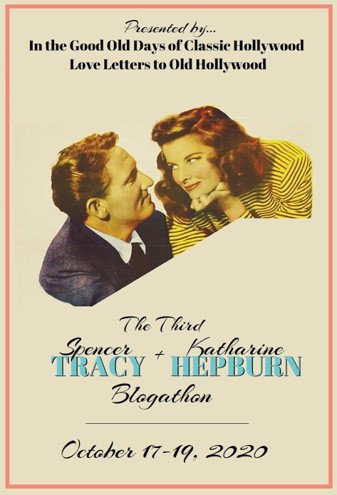
The Third Spencer Tracy & Katharine Hepburn Blogathon created by Crystal from In the Good Old Days of Classic Hollywood and Michaela from Love Letters to Old Hollywood.

What I didn’t like about the film:

More emphasis on telling: At the beginning of the movie, several people in Salt Fork inform Lutie about how awful of a person Jim is. He is, apparently, such a bad person, some compare him to a tyrant. While the audience can hear Jim say harmful things, they never get to see him do harmful actions. This creative decision gives the viewers only part of a bigger picture when it comes to Jim Brewton. Whenever the subject of people using the “sea of grass” is brought up, Jim is very specific about how the land should be used. If someone objects to these ideas, Jim tells others what he’s going to do instead of carrying out the deed.

No major conflict: Since the film is called The Sea of Grass, you’d think most of the story would revolve around the “sea of grass” itself. Instead, the film prioritizes the personal events of the characters. Stories that are character driven can work. But when you have an interesting conflict like how to utilize a field of grass, the character’s stories don’t seem as interesting. While the triumphs and tragedies of Lutie and company are highlighted, the “sea of grass” is relegated to a subplot.

Times moves too fast: In a movie where time progresses, there is usually some indicator that a jump in time has occurred. This is done through on-screen text or a voice-over. The Sea of Grass, unfortunately, doesn’t utilize any techniques to inform their audience that time has moved forward, causing changes to appear abruptly. A perfect example are the lives of Sara Beth and Brock. In one scene, Sara Beth is shown as a little girl, while Brock is a toddler. The very next scene shows Sara Beth and Brock as older children, appearing to be ten and eight.

Small, western town image created by Freepik at freepik.com. <a href=”https://www.freepik.com/free-photos-vectors/background”>Background vector created by freepik – http://www.freepik.com</a>. Image found at freepik.com.

My overall impression:

When I chose to review The Sea of Grass, I wanted to expand my Western genre horizons. This decision taught me that Western tragedies do exist. Despite seeing a handful of Westerns, the movie was quite different from other films I’ve seen in this genre. Even though I knew that this movie was about a rocky relationship, it was sadder than I expected. The Sea of Grass is a fine film with strong components, like the acting and scenery. However, it does have its flaws that shouldn’t be ignored. While the “sea of grass” is shown on screen, it isn’t as significant as the title would suggest. In fact, this location feels more like a glorified backdrop. I will say that Katharine Hepburn and Spencer Tracy do work well together as actors. As the years go by, I would like to see more of their films where they both star as the leads.

Overall score: 7.3 out of 10

Do you like watching Western films? Are there any Westerns you’d like to see me review? Let me know in the comment section below!

Have fun at the movies!

Sally Silverscreen

Take 3: Day for Night Review + 250 Follower Thank You

October’s theme for MovieRob’s Genre Grandeur is French New Wave Films. Because I’m not as familiar with this particular genre as I am with others, I had to look up potential titles for this review. One of the films that appeared in my internet search was the 1973 French film, Day for Night. When I read the movie’s tagline, “A movie for people who love movies”, I felt it was the perfect choice for the movie blogger I am! MovieRob’s Genre Grandeur is not the only reason why I’m reviewing this film. Day for Night is also my choice for Pure Entertainment Preservation Society’s 4th Annual Great Breening Blogathon! When I participated in this specific blogathon last year, I reviewed Vampyr, a movie released before the Breen Code was created. As I already said, Day for Night was released in 1973, two decades after the Breen Code era. Like my Vampyr review, this current article is going to be a blog follower dedication review. Last week, 18 Cinema Lane received 250 followers!

Day for Night poster created by Les Films du Carrosse
PECF, Produzione Internazionale Cinematografica, and Warner Bros.

Things I liked about the film:

The acting: I’ve said before one of my favorite Hallmark films is An Old Fashioned Thanksgiving. The acting performances are a great part of it, especially Jacqueline Bisset’s portrayal of Isabella. In Day for Night, Jacqueline portrayed American actress, Julie Baker. Her on-screen persona was a pleasant surprise, as it was down-to-earth and kind. This was very different from the “diva” attitude that some lead actress characters are given in stories of this nature. Valentina Cortese is another actress that gave a memorable performance in Day for Night! She portrays Severine, an older actress looking for a come-back. One scene shows Severine turning to drinking as a way to get through the scene and cope with personal issues. Valentina effectively showed the emotional transition her character was experiencing; starting out confident but slowly turning to sadness as the scene continues. Jean-Pierre Léaud portrays Alphonse, a fellow actor who works alongside Julie and Severine. His performance came across very natural on screen, making it look effortless. A scene that shows Alphonse having a bad evening is a good example of this, the look on his face appearing defeated and his body language showing the audience how he was walking aimlessly in a hotel hallway.

The film-making process: The story of Day for Night revolves around a director making a movie alongside his cast and crew. A behind the scenes lens is how the film is presented, with the production process being the primary focus. As someone who loves movies, I found this part of Day for Night fascinating! Seeing the different ways film-making related problems were solved was interesting to watch! The director of the film’s movie, Ferrand, is looking for a car for an upcoming scene. Because of the movie’s budget, he ends up using a car from one of the crew members. Later in the production of “Meet Pamela” (the movie being filmed in Day for Night), the cast and crew are struck with a tragedy. Ferrand decides to cut some scenes from the movie as a result of this event. He discusses these decisions with a script writer named Joëlle, as well as talking with investors.

The cat scene: While filming “Meet Pamela”, the cast and crew want to include a cat drinking milk from a food tray. At first, a kitten is placed in the scene. However, the kitten doesn’t take direction very well. After several failed attempts, the director decides to use a “studio cat” instead. To me, this scene was hilarious because it was a good use of the “comedy of errors” style of humor. It also highlights the idea of animals being difficult to work with in film.

The 4th Annual Great Breening Blogathon banner created by Tiffany and Rebekah Brannan from Pure Entertainment Preservation Society.

What I didn’t about the film:

Thinly written characters: Day for Night features an ensemble cast, showing their audience how multiple people are responsible for the creation of a single movie. However, all of these characters are thinly written, as they were defined by the main issue they were dealing with in the film’s story. For example, Julie experienced a breakdown prior to the events of Day for Night. Because of this, Julie is known as “the woman who experienced a breakdown”. Throughout the movie, she does talk about her marriage to her doctor and her working hours as an actress. But her personal situation is highlighted the most.

Too much going on: As I just mentioned, this movie has an ensemble cast. This means there are a lot of characters involved in the overall story. It also means Day for Night contains several subplots. Personally, I found it difficult to keep up with the characters, as I thought there were too many to focus on. Even though this happened briefly, there were moments when I forgot who was who. The subplots were not interesting to me, as they revolved around situations I just didn’t care about. It felt more like a bland soap opera than a compelling part of the behind the scenes of “Meet Pamela”. Honestly, I wish this movie had put more emphasis on the film-making aspect of the narrative.

The director’s dreams: On three separate occasions, the dreams of the director, Ferrand, are shown. These scenes are filmed in black-and-white and contain no dialogue. I thought the inclusion of the dreams were random, as they didn’t seem to have anything to do with the overarching story. It also doesn’t help that no explanations are provided for what these dreams could mean. If anything, they were simply there to satisfy the run-time.

Image of vintage movie camera created by Macrovector at freepik.com. <a href=”https://www.freepik.com/free-photos-vectors/background”>Background vector created by macrovector – http://www.freepik.com</a>. Image found at freepik.com.

My overall impression:

Like I said in the introduction, the tagline of Day for Night is “A movie for people who love movies”. While I do love movies, I did not love this film. Sure, there were things about it I liked, such as the acting and the film-making process shown. But if you’re going to make a movie, you need to provide your audience with interesting characters worth watching. The characters in Day for Night were thinly written, defined by their personal situations. Even though it can be intriguing to see how characters overcome their obstacles, they have to have other qualities about them. Because of the poor writing for the characters, their subplots were not interesting. Issues among them were basically at a stand-still, not really getting resolved to a satisfying degree. What would have helped this story is if it were presented in a mockumentary format, giving more emphasis to the behind the scenes aspect of film-making. Before I end this review, I want to thank all 250 of 18 Cinema Lane’s followers! The success this blog has received would never have happened without you!

Overall score: 6.2 out of 10

Have you seen Day for Night? Are there any movies about film-making you’ve seen? Please tell me in the comment section!

Have fun at the movies!

Sally Silverscreen

Take 3: Picture Perfect Mysteries: Exit, Stage Death Review

Even though I’ve been reviewing films from Hallmark Movies & Mysteries lately, I haven’t reviewed a mystery film from Hallmark’s second network since May. Because of this, I decided to review the newest movie in the Picture Perfect Mysteries series, especially since I have seen the first two installments. Like the other series on Hallmark Movies & Mysteries, Picture Perfect Mysteries has been an enjoyable collection of films. The series also has a distinct identity that sets it apart from the various current offerings on this particular channel. A mystery story featuring a murder mystery stage play is not new, as the Aurora Teagarden Mysteries series had a similar concept in the 2019 movie, Aurora Teagarden Mysteries: A Very Foul Play. In fact, there was a play poster in the background of Picture Perfect Mysteries: Exit, Stage Death that was titled “A Very Foul Play”. However, I was curious to see how a detective and photographer duo would approach this specific type of mystery.

Picture Perfect Mysteries: Exit, Stage Death poster created by Crown Media Family Networks and Hallmark Movies & Mysteries.

Thing I liked about the film:

The acting: In Picture Perfect Mysteries: Exit, Stage Death, the acting ranged from fine to good. However, there were some stand-out performances I’d like to bring up. One came from series regular, Trezzo Mahoro, who portrayed Allie’s friend Noah. What I liked about his performance was how lively and expressive it was. A good example is when Noah discovers Maya has figured out the password on his laptop. The look of shock on his face truly appeared genuine. Another note-worthy performance was Willie Aames’! As one of the characters said in this movie, Neil Kahn was “mild-mannered”. While this is true, Willie made this part of his character consistent. Because Neil is a director of mystery stories, this is a different yet interesting creative choice when it comes to acting. Speaking of Neil, I also enjoyed seeing April Telek’s performance! Throughout the film, her portrayal of Neil’s wife was very natural. This is evident in the scene where she and Neil are having an argument about their personal lives.

The interior and exterior design: In some scenes, Neil Kahn’s house was featured on screen. This is certainly one of the most photogenic houses shown in a Hallmark Movies & Mysteries film! The exterior was pale yellow Victorian, complete with a wrap around porch. Impressive interior designs added to the grand scale that is also shown on the house’s exterior. Dark wood was a consistent component of each room shown in the movie. The living room boasted a large wood fireplace paired beautifully with green marble. Neil’s library also featured wood, as seen in bookshelves covering the walls. An eye-catching design choice was how arches outlined the shelves, an element that isn’t often found. In one scene, the living room in Allie’s house can be seen in the background. A stone fireplace was illuminated with soft lights, with a complimentary bookshelf next to it. This shows how good interior and/or exterior design came from multiple locations!

The cinematography: There was some cinematography in Picture Perfect Mysteries: Exit, Stage Death that really surprised me in a good way! One notable example is when a suspect is being questioned at the police station. As the scene plays out, emphasis is placed on the clock and the suspect’s face. They were both zoomed in at various points in the scene, highlighting the suspense and fear a person might face in that situation. Another interesting use of cinematography is when Allie and Sam were having a conversation after the murder victim was discovered. When each character was speaking, they were given close-ups to help the audience focus on Sam’s or Allie’s part of the conversation. This specific area of film-making, cinematography, added intrigue to the overall project!

Masks of comedy and tragedy images created by freepik at freepik.com. <a href=”https://www.freepik.com/free-photos-vectors/background”>Background vector created by freepik – http://www.freepik.com</a>. Image found at freepik.com.

What I didn’t like about the film:

Story points that didn’t lead anywhere: Picture Perfect Mysteries: Exit, Stage Death contained story points that ended up not leading anywhere. One of them was the robberies that were taking place in Willow Brook, the small town featured in this series. During the movie, Sam was in charge of solving the film’s murder and a string of robberies. Unfortunately, this part of the film became an afterthought, as it had little to no connection to the main plot. Another story point involved a local loan shark. While he was shown and mentioned on a few occasions, the loan shark didn’t have a consistent enough presence to be a meaningful part of the story. If this character would have been given more importance, maybe he could have been a red herring.

Allie’s relationship with Daniel: Hallmark Movies & Mysteries series usually show the male and female protagonist forming a romantic relationship over time. Even though this is only the third Picture Perfect Mysteries movie, I feel Allie and Sam will likely become a couple. Because of this, I found Allie’s relationship with Daniel, a newspaper reporter, to be pointless. When Allie’s friend, Maya, suggests that Allie go on a date with Daniel, it felt like the screenwriter was trying to force a love triangle into the story. Allie and Daniel’s departure from their date came across as awkward, like they knew their relationship wasn’t going to last. To me, it seemed like this aspect of the movie was unnecessarily shoved into the narrative.

A choppy pace: I found the overall pace in Picture Perfect Mysteries: Exit, Stage Death to be choppy. This is because there wasn’t a good flow in-between scenes. In one scene, Allie and Sam are discussing color paint samples for Sam’s house. Shortly after, one of the murder suspects is giving Allie clues. Mysteries series from Hallmark Movies & Mysteries space out scenes that are not mystery related, as to not make the movie feel too dark. However, this installment in the Picture Perfect Mysteries series seemed to fill their script with as much content as possible with the intent to worrying about the overall flow later.

Tools of a writer image created by Freepik at freepik.com. <a href=’https://www.freepik.com/free-photo/camera-and-coffee-near-notebook-and-accessories_2399437.htm’>Designed by Freepik</a>. <a href=”https://www.freepik.com/free-photos-vectors/vintage”>Vintage image created by Freepik</a>. Image found at freepik.com.

My overall impression:

At best, Picture Perfect Mysteries: Exit, Stage Death was a fine film. It definitely had its strengths, such as some stand-out acting performances and interesting cinematography. But, in my opinion, the movie felt like it just met a requirement. As I mentioned in this review, this is the third chapter in the Picture Perfect Mysteries series. By this point, the question of how the overarching story arc can move forward should be answered. This film, however, does not answer that question. What it does instead is almost put the series in a stand-still, forcing it to stay in one place. Having story points that don’t lead anywhere is just one example of how this happened. Yes, the mystery was intriguing. But this is only a part of a mystery film. If there are other parts of the story that don’t work, the movie is going to have shortcomings. While it is unknown at this time whether the Picture Perfect Mysteries series will receive a fourth film, I just hope it’s stronger than this movie was.

Overall score: 7 out of 10

Have you seen the Picture Perfect Mysteries series? Would you like to see this series get a fourth film? Tell me in the comment section!

Have fun at the movies!

Sally Silverscreen

Take 3: Interrupted Melody Review

Prior to signing up for Maddy Loves Her Classic Films’ Eleanor Parker Blogathon, I had seen two of Eleanor’s films; The Sound of Music and Return to Peyton Place. However, both titles are ensemble films, leaving Eleanor to act in someone else’s shadow. My entry for the blogathon is a review of Interrupted Melody, a film that allows Eleanor’s acting talents to be the center of attention! The 1955 film is one I had never heard of until this year. Before 2020, I didn’t know who Marjorie Lawrence, the Australian opera singer, was. When I learned Marjorie was diagnosed with polio and overcame her illness, I was interested in seeing this part of Marjorie’s life depicted on film. This is because I, personally, haven’t seen many cinematic stories from the perspective of polio patients. I also don’t talk about Australians in cinema, as I don’t often receive an opportunity to do so. This is another reason why I chose to review Interrupted Melody.

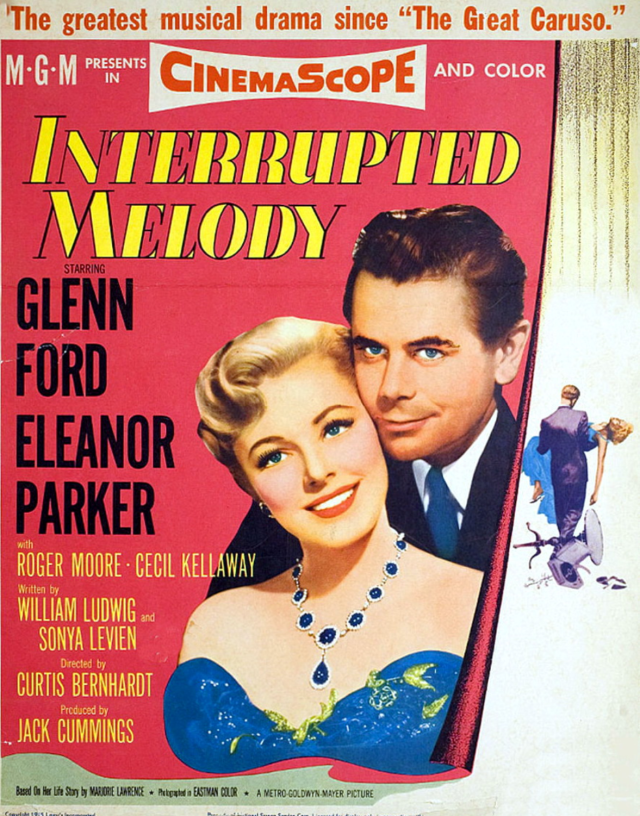
Interrupted Melody poster created by Metro-Goldwyn-Mayer.

Things I liked about the film:

The acting: This is the first movie I’ve seen where Eleanor Parker was the star of the show. I was not disappointed, as Eleanor gave a very strong performance! While Eileen Farrell served as the vocals for the role of Marjorie Lawrence, Eleanor provided the power, passion, and showmanship one can expect from an opera performance. Outside of the opera world, Marjorie experienced several heartbreaks and joys in her life. Through all of this, Eleanor brought forth a portrayal that was emotional, allowing her character to appear and feel realistic. A good example of this is when Marjorie is crawling toward the record player in an attempt to turn it off. One of the key players in Marjorie’s life is her husband, Dr. Thomas King. Portrayed by Glenn Ford, Thomas was her biggest supporter. With a variety of emotions, Glenn also gave a realistic performance! He was able to show the audience how much Thomas cared about Marjorie. Even the supporting actors in Interrupted Melody were strong, which provided strength to the overall cast! Cyril, portrayed by Roger Moore, is Marjorie’s brother and manager. The conversations between him and Marjorie were well performed by both actors, coming across as two siblings having different perspectives on a central topic. This allowed both on-screen personalities to shine as well as showcasing their distinct personas!

The set design: Because Marjorie is an opera star, several opera performances are shown in the film. The movie’s creative team didn’t skimp on the set design within these scenes, as they all felt so immersive. When Marjorie is performing in Madame Butterfly, the stage’s setting is a room from Japan. The window in the background features a large tree, appearing more like a realistic landscape than a painted image. Fine details helped make these spaces appealing to look at. In Marjorie’s first opera, the characters were placed on a Parisian street, with a set of string lights shown over their heads. A detail like this added a three-dimension aspect to the set. Even scenes that didn’t involve the opera looked really good! In one scene, Marjorie and Thomas are on a beach in Florida. While this movie was filmed in Culver City, California, according to IMDB, this was still a photogenic location!

The costumes: In Interrupted Melody, Eleanor Parker wore costumes that were absolutely gorgeous! It also helps that these costumes complimented her so well! In the aforementioned opera, Madame Butterfly, Eleanor’s kimono was light-pink with beautiful embroidery on the collar and sleeves. The embroidery featured flowers, which represented the tree that was featured in the scene’s background. While Marjorie is performing as Carmen in the opera of the same name, her outfit featured a color combination of blue and orange. This was paired nicely with Marjorie’s brown hair. Eleanor even wore some impressive costumes that were not worn during opera performances. Within the film’s second half, she wore a sparkly white gown that was one of my favorites! Eleanor looked beautiful in that dress and I wished she had worn it for a longer period of time.

The Eleanor Parker Blogathon banner created by Maddy from Maddy Loves Her Classic Films.

What I didn’t like about the film:

Missing context: There were areas of the story where I wish context was provided. For starters, how did Marjorie become a singer in the first place? Was this a dream she had since she was a child or a passion she discovered shortly before the events of the film? These questions certainly could have been answered within the script. For a portion of the movie, Cyril disappears from the story. While he eventually appears toward the end of the movie, it isn’t really explained where he went or why he was suddenly absent from the plot. This is something that could’ve been brought up in passing.

More emphasis on the opera world: Since opera played such a huge role in Marjorie’s life, it is going to have a place in the overall story. However, the film put so much emphasis on the glitz and glamour of the opera world, that it caused Marjorie’s polio diagnosis to, kind of, sit on the backburner. This part of Marjorie’s life didn’t come until an hour into the movie. From that point on, it felt like I was watching a highlight reel of Marjorie’s attempts to overcome her illness. I found this disappointing, as I was expecting that part of Marjorie’s story to have a larger presence in the film.

No Australian accents: Before watching Interrupted Melody, I was curious to see if Eleanor could carry an Australian accent. This was, sadly, not the case. In fact, an Australian accent was not consistently used by any of the actors who portrayed members of Marjorie’s family. Toward the beginning of the film, Roger Moore could be heard with an Australian accent. But as the movie goes on, his voice morphs into a British accent. This specific accent was also adopted by the other actors portraying Australians, including Eleanor. While I got used to the lack of Australian accents over time, it is still a flaw I noticed.

String of musical notes image created by Freepik at freepik.com. <a href=’https://www.freepik.com/free-vector/pentagram-vector_710290.htm’>Designed by Freepik</a> <a href=”https://www.freepik.com/free-photos-vectors/background”>Backgroundvector created by Freepik</a>. Image found at freepik.com.

My overall impression:

Like I said in my Follow Your Heart review, Interrupted Melody is not the “end all, be all” of Marjorie Lawrence’s story, as one should learn more about her in their own time. However, I do think this movie serves as a good introduction to this particular individual as well as to opera! Through music, set design, and costumes, Interrupted Melody effectively shows the heart and soul that go into this specific form of entertainment. Within Eleanor Parker’s performance, the audience can see just how resilient Marjorie Lawrence was. Speaking of Eleanor Parker, this movie made me appreciate her more! Strong acting talents and a beautiful presence help create a captivating portrayal that was thoroughly enjoyable to watch. An overarching flaw of Interrupted Melody is how the film becomes so caught up in the glitz and glamour of the opera world, it, at times, forgets its original purpose. In the end, though, the movie was a fine picture that I would recommend.

Overall score: 7.4 out of 10

Have you seen Interrupted Melody? Is there a film about a musician you like to watch? Share your thoughts in the comment section!

Have fun at the movies!

Sally Silverscreen

Word on the Street: Regal Cinemas to Temporarily Close Their Doors + 2019’s ‘The Lion King’ Will Receive a Second Film

For this month’s Word on the Street story, I was only going to talk about 2019’s ‘The Lion King’ receiving a second film. However, when I heard about Cineworld’s recent decision, I just had to talk about it. Yesterday, on October 4th, Chris Lindahl from IndieWire reported “a temporary suspension” is being placed on the United States and United Kingdom locations of Regal Cinemas. Chris also said this plan would start on October 8th. Cineworld, the parent company of Regal Cinemas, claimed in an official statement the closure “is not a decision we made lightly”. This closure being temporary is a silver lining. However, I do feel bad for Regal’s employees and patrons.

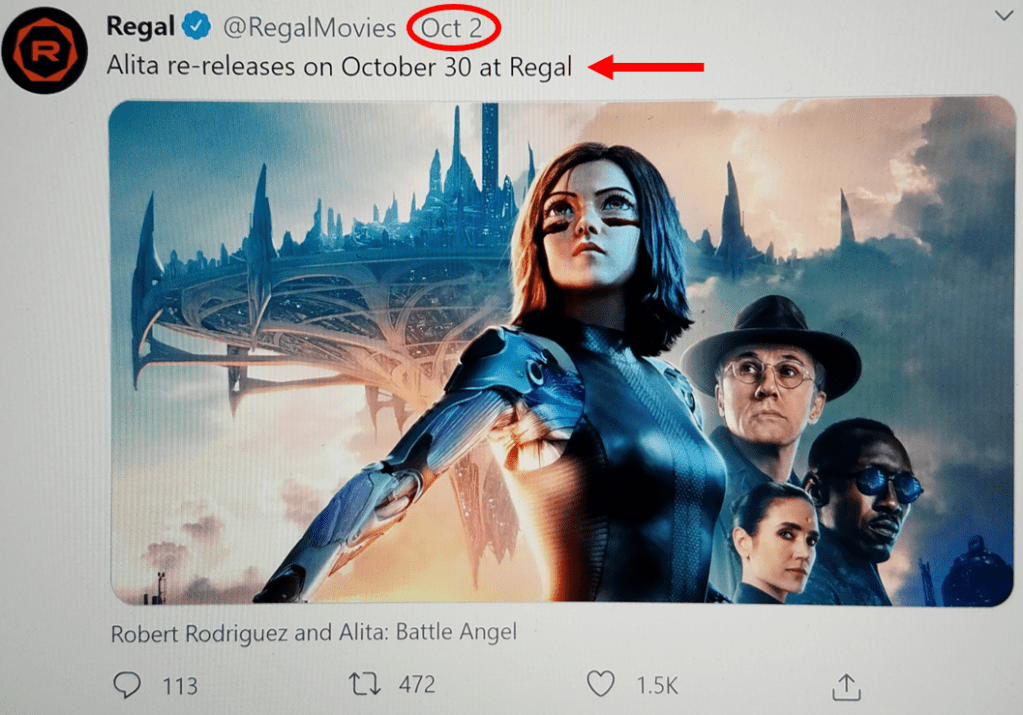
Others have also talked about this story, including Todd Russell from Movies, Movies, Movies, and Geeky and Kneon from Clownfish TV. Todd’s take on this piece of movie news brings up a good point. In his article, Todd questions Regal’s practices for new releases, asking the question, “if you temporarily ignore the theatrical window and embrace more direct to streaming titles you can show plenty of new movies, so why won’t you try that?” Here’s another question that should be asked; why would Regal decide to re-release Alita: Battle Angel if they had even the slightest concern of their theaters staying open? Until newer blockbuster titles can come back to the big screen, Regal could have shown older films to keep themselves afloat. While this idea has been adopted by other theaters, it seems like it would have been a win-win for Alita’s fans and Regal. According to Clownfish TV’s Kneon, an online campaign created by fans of Alita revolved around their effort to have Alita: Battle Angel re-released. Three days later, on October 3rd, Kneon announced the campaign was successful, with his video featuring a tweet from Regal Cinemas about the news. Regal’s tweet was posted on October 2nd, two days before IndieWire’s Chris Lindahl reported on Cineworld’s decision. Alita: Battle Angel was originally scheduled for an October 30th re-release.

Sources for this piece of movie news:

Clownfish TV’s videos (you can type these titles in the search bar on Youtube): ‘Alita: Battle Angel RE-RELEASED to Theaters? Fans Want #RereleaseAlita to Trend!’, ‘Alita Army VICTORIOUS! Theaters to #ReReleaseAlita Beginning this Month!’, and ‘Regal Cinemas SHUT DOWN! Hollywood Will Take YEARS to Recover!’ (these videos may contain language)

In this screenshot I took with my phone, Regal’s official tweet about Alita: Battle Angel‘s re-release is shown. The circle and arrow in the picture stress the dates of the tweet’s release and Alita: Battle Angel‘s planned re-release. Screenshot taken by me, Sally Silverscreen.

While this isn’t a recent piece of movie news, it’s one I haven’t seen a lot of people talk about. Last week, Rebecca Rubin and Brent Lang from Variety revealed the 2019 remake of Disney’s The Lion King will receive a second film. The two authors said “the new movie will partly focus on the early years of Mufasa”. The screenwriter from the 2019 movie, Jeff Nathanson, will join the team, with Barry Jenkins directing the film. Since we’re on the subject of The Lion King, I’d like to share one of Rafiki’s quotes from the 1994 film; “Oh yes, the past can hurt. But from the way I see it, you can either run from it, or…learn from it”. With this new creative decision, it seems like Disney is running from their past, especially when it features mistakes. Two years ago, the studio released Solo: A Star Wars Story, a movie that revolved around the early years of Han Solo. The film’s overall box office results were $393,151,347, making it one of the lowest grossing films in the franchise’s history. Solo: A Star Wars Story contributed to a problem Disney has had for years; choosing not to tell newer stories in favor of tried-and-true properties. Even though this new chapter of The Lion King is in pre-production, Disney’s choices show they are refusing to follow Simba’s lead by learning from their past.

Sources for this piece of movie news:

https://variety.com/2020/film/news/lion-king-sequel-director-barry-jenkins-1234786355/

https://www.the-numbers.com/movie/Solo-A-Star-Wars-Story#tab=box-office

https://www.the-numbers.com/movies/franchise/Star-Wars#tab=summary

Empty theater photo created by rawpixel.com at freepik.com. <a href=”https://www.freepik.com/free-photos-vectors/background”>Background photo created by rawpixel.com – http://www.freepik.com</a>. Image found at freepik.com.

What are your thoughts on these pieces of movie news? Is there a theater open near you? Let me know in the comment section.

Stay safe.

Sally Silverscreen

Take 3: Follow Your Heart Review

Last week, I reviewed JL Family Ranch: The Wedding Gift. While my Hallmark related content, especially from Hallmark Movies & Mysteries, has been well-received, my review of the 2020 sequel became more popular than I expected. As of early October, that post has acquired 6 likes and over 200 views! Because of this, I decided to review Follow Your Heart! Hallmark hasn’t released a movie about an Amish community since 2017’s An Uncommon Grace. When Follow Your Heart was added to Hallmark Movies & Mysteries’ Fall schedule, I found it to be a big deal, especially since a three-year creative void was being filled. On multiple occasions, I’ve said that I wished Hallmark would try new things when it came to their story-telling. From the looks of it, Follow Your Heart may be a step in that direction!

Follow Your Heart poster created by Crown Media Family Networks and Hallmark Movies & Mysteries.

Things I liked about the film:

The acting: I am familiar with Galadriel Stineman, as an actress, through her work on The Middle. It seems like her acting experiences on that show have paid off! A strength in Galadriel’s portrayal of Kathy Yoder was her transitions between different emotions. After Kathy and her boyfriend, Jack, leave the spa, Kathy received a voice message on her phone about her father’s passing. Galadriel’s facial expression and emotions quickly change from happily care-free to sadly guilty about missing the call. Madison Lawlor did a really good job with her portrayal of Kathy’s sister, Miriam! The consistency in her performance is what made it stand out. In Follow Your Heart, Miriam was upset at her sister for leaving the Amish community. Whenever she interacted with Kathy, the tension between these two characters could be felt. Another character that interacts with Kathy often is Isaac Mast, who was portrayed by Kevin Joy! Throughout the film, Isaac had a more easy-going personality. It also helped that Kevin and Galadriel shared good on-screen chemistry. These factors, along with quality acting talents, assisted Kevin in partially carrying this film!

Good audio: In my JL Family Ranch: The Wedding Gift review, I talked about Hallmark’s recent issue with poor audio. This was, fortunately, not the case for Follow Your Heart! All of the dialogue could be understood and heard clearly. Various sounds and music played in the background, making their existence known without overpowering scenes. While watching this film, I never felt the need to adjust the volume on my television. This definitely added to my movie-viewing experience!

New takes on tried-and-true cliches: As I also mentioned in my review of JL Family Ranch: The Wedding Gift, Hallmark loves adding cliches in their movies. What I liked about Follow Your Heart was how there were new takes on these cliches! The most overused one is the “woman from the city coming back to her small hometown”. In Follow Your Heart, Kathy comes back to her Amish community. She’s not only returning to a smaller town, but she’s also returning to a culture. Speaking of culture, a cultural misunderstanding influenced the “it’s not what you think” cliché found in this movie. I won’t spoil the story if you haven’t seen the film yet. But I will say this new creative approach presented a dynamic that isn’t often seen in Hallmark’s projects.

What I didn’t like about the film:

Very few explanations about Amish culture: When an Amish community is presented in a film, the film’s creative team devotes some time to explaining certain aspects of Amish culture. With Follow Your Heart, however, it felt like the movie’s creative team expected their audience to be mostly or completely educated about the lives of the Amish. While Kathy does explain that the Amish from Mountain View, her hometown, don’t believe in artistic expression, this is the only explanation about Amish culture the film provides. During one conversation, Miriam brings up the subject of Rumspringa. This is when teenagers or young adults temporarily leave their Amish communities in order to experience the English world. The short journey is meant to help these young men and women choose the course of their future. Sadly, this explanation was not presented in Follow Your Heart.

Incredibly rude friends: In a movie where a female protagonist has to choose between two male characters, the male protagonist is purposefully designed to appear as a better option. But in Follow Your Heart, Kathy’s boyfriend, Jack, was incredibly rude, even by Hallmark’s standards. While Kathy is mourning over her father’s death, all Jack seems to care about is whether she’ll agree to co-host a reality travel show. Even his views on Amish culture are closed minded, as he calls Isaac a “Renaissance man”. Kathy’s manager, Evelyn, is no better than Jack. She puts more emphasis on Kathy’s career than her client’s wellbeing. Evelyn also calls Isaac “sexy” because she likes his aesthetic and Kathy’s Amish attire a “costume”. The rudeness from Kathy’s manager and boyfriend were very off-putting.

Characters’ perspectives changing too quickly: Follow Your Heart featured a few occasions where characters’ perspectives changed too quickly. Kathy’s sister, Miriam, serves as one example. For most of the movie, Miriam is bitter about Kathy’s return to Mountain View. When Miriam comes across an object from the past, she immediately sees her sister in a new light. To me, this transition of beliefs didn’t feel realistic. What would have worked instead was seeing Miriam change over time.

My overall impression:

No movie featuring any Amish community should be the “end all, be all” when it comes to education about Amish culture. While film can introduce people to certain ideas and beliefs, thorough research needs to be done in one’s spare time. With that said, Follow Your Heart could have included more explanations about Amish customs and beliefs. I don’t think it was a good idea for the film’s creative team to assume their audience knew almost everything about a typical Amish community. Despite this, the movie was solid! The most notable aspect of Follow Your Heart was how tried-and-true cliches were presented in new ways. This gave the overall story a breath of fresh air while allowing unique perspectives to be showcased. I wish Hallmark would use this approach when making their films and tv shows; thinking outside the box and taking creative risks. If they did, maybe we wouldn’t see the same reused narratives that expect a different result.

Overall score: 7.8 out of 10

Did you see Follow Your Heart? If so, what are your thoughts on it? Leave your comments in the comment section below!

Have fun at the movies!

Sally Silverscreen