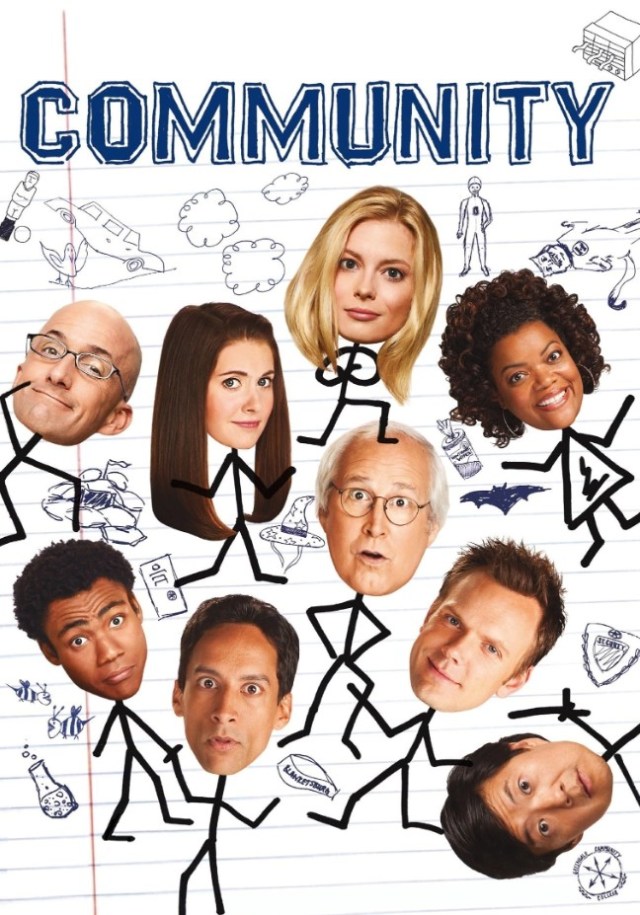
Anyone familiar with the television show, Community, will know the phrase “six seasons and a movie”. Ever since Abed (one of the show’s main characters) uttered the phrase in the show’s second season, the idea of any show receiving a movie and six seasons has become “the American dream” in the world of entertainment. While Community has indeed earned six seasons, the movie has been in development since 2022. But according to the film’s official IMDB page, it appears the movie may be on its way! ‘Community: The Movie’ (the movie’s current working title) is classified as “pre-production”. However, the release date is listed as “Expected 2026”. The page lists the majority of the show’s main cast, implying they will return for the film. Production companies working on the project are Sony Pictures Television, Universal Studio Group, and Universal Television. Peacock will, as of this article’s publication, distribute ‘Community: The Movie’.
Communityposter created by Krasnoff Foster Productions, Harmonious Claptrap, AGBO, Universal Media Studios (UMS), and Sony Pictures Television
This is the first time I’m talking about Community on 18 Cinema Lane. However, I wanted to cover this movie news story because the creative team behind the movie, as well as the show, is doing something that I appreciate; keeping a promise to the fans. Whether intentional or unintentional, “six seasons and a movie” became a promise, giving the fans something to hope for. So, when Community did get six seasons, it felt the show’s creative team stood by their word. Now, with the movie currently in development, the show’s creative team is, once again, staying by their word by giving the fans what they want. This makes me hope other television shows follow in Community’s footsteps.
What are your thoughts on this piece of movie news? Are you looking forward to ‘Community: The Movie’? Let me know in the comment section!
Are you looking for a fun blogathon that combines the subjects of food and film? Join my upcoming blogathon, The Food & Film Blogathon! Taking place from October 2nd to October 5th, there’s still time to join the event! With the connection between food and film providing a broad theme, plenty of topics are available to choose. If you’re interested in participating in The Food & Film Blogathon, click on the link below to learn more about the blogathon.
I have been participating in the Legends of Western Cinema Week Blogathon since 2020. Because films from the western genre aren’t covered on 18 Cinema Lane often, this blogathon has given me a reason to seek out titles from the western genre to review. But when the Legends of Western Cinema Week ends, another blogathon begins; the Hit The Road Blogathon. Since I wanted to participate in both events, I decided to review one film for both blogathons. That film is 1949’s She Wore a Yellow Ribbon! The movie perfectly fits the themes of both events, as it is not only considered a “classical western” (according to IMDB), multiple characters travel by horse throughout the story. She Wore a Yellow Ribbon was also recommended to me by Eric Binford from Diary of a Movie Maniac. While this is the fourth movie of John Wayne’s I’ve seen, this is only the third one I’ve reviewed. The other two titles, El Dorado and Allegheny Uprising, were, in my opinion, just ok. How does She Wore a Yellow Ribbon compare to these other films? Keep reading my review to find out!
The acting: Whenever I discuss the acting in a given movie, I will usually talk about a scene that showcases the strength of the acting performances. My favorite example from She Wore a Yellow Ribbon takes place toward the beginning of the film. John Wayne portrays Captain Nathan Brittles, a man who goes on one last mission before he retires. During an evening visit to the local cemetery, Nathan talks to the graves of his wife, Mary, and his daughters, Elizabeth and Jane. While he talks to his deceased family, he consistently has a sad look in his eyes. Yet, the inflection of his voice changes depending on the type of news he has to share. Joanne Dru’s character, Olivia Dandridge, also visits the cemetery to give Nathan some potted flowers. Olivia’s persona is kind and gentle throughout this scene. Her conversation with Nathan perfectly displays the on-screen camaraderie between Joanne Dru and John Wayne. Because of this on-screen camaraderie and how strong John’s and Joanne’s acting performance was, I wish they shared more screen time.
The scenery: Most of She Wore a Yellow Ribbon takes place outdoors, with the movie being filmed in Utah and Arizona (according to IMDB). Looking back on the 1949 picture, I can definitely see why the film’s creative team would want to take advantage of the story’s natural landscape. Large, rustic red rocks impressively stood against a blue sky filled with white clouds. There were greens spots where foliage popped within the rocky terrain. The most memorable presentation of the scenery was during a storm. The bright, blue lightning blinked against the two-toned gray sky and the sand-colored ground provided a bright hue to the space. She Wore a Yellow Ribbon was a pretty looking film because of its scenery!
The dialogue: In She Wore a Yellow Ribbon, Corporal Quayne’s life is spared after being rescued from an attack. Olivia shares with Lieutenant Flint Cohill how happy she is Corporal Quayne survived. Lieutenant Cohill asks her why she cares about Corporal Quayne, especially since she doesn’t know him or is aware if he frequents the Lieutenant’s Bar. Olivia responds to this question by saying just because a man frequents the Lieutenant’s Bar doesn’t automatically make him a gentleman. Lieutenant Cohill then accuses Olivia of caring about Corporal Quayne’s well-being because his survival fits the happy ending she can write home about. This conversation between Olivia and Lieutenant Cohill was thought-provoking, as it addresses motivations for caring about others, as well as how someone’s personal situation can fuel another person’s narrative. That is just one example of the well-written nature of the dialogue!
Limited amount of action: A movie from the western genre, especially one starring John Wayne, carries a set of expectations. One of those expectations is the amount of action within the story. Scenes of battles, duels, and even bar fights will typically be sprinkled through a western genre story to maintain the suspense and intrigue of what’s happening on screen. But in She Wore a Yellow Ribbon, the action was far and few between. The majority of the story consisted of characters either having conversations with one another or riding from place to place. When an action scene does happen, it lasts for a very short period of time. These creative decisions caused She Wore a Yellow Ribbon to lack intrigue and suspense.
Not truly getting to know the characters: So much of She Wore a Yellow Ribbon’s story focuses on Captain Nathan Brittles and his impending retirement. While the audience receives the opportunity to learn more about Captain Brittles and understand his motivations, it comes at the expense of getting to truly know the other characters. One character I felt was overlooked was Top Sergeant Quincannon. He was retiring around the same time as Captain Brittles. But the script never addresses how the story’s patrol mission impacted Top Sergeant Quincannon and his career. Instead, the film prioritizes his enjoyment of drinking alcohol. Because of this emphasis, I only became familiar with Top Sergeant Quincannon instead of truly getting to know him.
The run-time: She Wore a Yellow Ribbon has a run-time of an hour and forty-four minutes. As I watched the movie, however, it felt longer than this stated run-time. Part of this flaw stems from the insertion of scenes just for the sake of satisfying the film’s length. Toward the end of the movie, there is a bar fight involving Top Sergeant Quincannon. This scene lasts about five minutes and, in my opinion, feels out of place. That’s because the scene is intended to be comedic, even though She Wore a Yellow Ribbon is not a comedy or a light-hearted story. The movie’s run-time could have been shorter had the bar fight scene either been omitted or trimmed down.
She Wore a Yellow Ribbon is the third film I’ve reviewed this month where the scenery was a stand-out strength. In the case of the 1949 picture, the natural landscape of Utah and Arizona was presented through long and medium shots, capturing the grand scale of the desert’s rock formations and large expanse of rustic red and sand-colored land. But as I’ve said in past reviews, “the scenery can’t save you”. If a movie contains a weak script, there’s only so much the pretty landscape can do to salvage that script. In my opinion, She Wore a Yellow Ribbon is an underwhelming picture. What I expected to be an action-packed, suspenseful, and even intriguing story turned out to be a drawn-out tale that felt longer than necessary. It also doesn’t help how I wasn’t able to truly get to know the characters, but only become familiar with them. Even though the 1949 film does feature strengths, like the acting and the dialogue, there were times while watching the movie where I almost fell asleep. With a filmography of over one hundred projects, I’ll, hopefully, find a title of John Wayne’s I actually like.
Overall score: 5.2 out of 10
Have you seen She Wore a Yellow Ribbon? What film from John Wayne’s filmography do you like watching? Please tell me in the comment section!
August’s theme for Genre Grandeur is “Eastwood connected Movies (Clint or his progeny in any capacity)”. As soon I discovered this month’s selected theme, I immediately knew which movie I would choose! For years, I wanted to check out the1971 film, Play Misty for Me. This is because I had heard Play Misty for Me is the precursor to Fatal Attraction. Since I have seen the 1987 movie, I was curious to see how many similarities or differences Play Misty for Me and Fatal Attraction shared. With this month’s Genre Grandeur theme, I am finally getting that chance! By writing about Play Misty for Me, this is the first time I’m reviewing any of Clint Eastwood’s movies on 18 Cinema Lane. I am familiar with Clint as an actor, so I knew the types of roles he’s typically known for. Therefore, choosing to review Play Misty for Me as the first film of Clint’s covered on my blog is interesting, as it’s quite different from the westerns and action pictures he has usually starred in.
Play Misty for Meposter created by Universal Pictures, Jennings Lang, and The Malpaso Company
Things I liked about the film:
The acting: While I liked the acting as a whole in Play Misty for Me, I have to highlight Clint Eastwood’s and Jessica Walter’s performance. This is because their characters were given the most screen time. Throughout his film career, Clint has gained a reputation for portraying tough, unbreakable heroes. That reputation has been a result of starring in films from the western genre and in titles like Sudden Impact. But in Play Misty for Me, Clint’s character, Dave, adopted a very different persona. The radio disc jockey carries a suave personality with a hint of gentleness. In a great example when Jessica’s character, Evelyn, is restocking Dave’s refrigerator in preparation for dinner, Dave explains to Evelyn how he already has dinner plans. His explanation, however, is calm, which puts Evelyn at ease. Dave’s kind tone of voice, the understanding look in his eyes, and even the relaxed look on his face shows how he isn’t mad at Evelyn. Clint’s versatile acting abilities effectively portray how easy it is to fall in love with Dave!
As I just mentioned in this review, Jessica Walter portrays Evelyn. What I liked about her performance was her ability to seamlessly adopt different emotions. One perfect example is when Evelyn and Dave are having a conversation outside. Before Evelyn leaves Dave’s house, her attitude is friendly. A smile is painted on her face and her personality seems bubbly. But when a neighbor comes outside to complain about the noise, Evelyn immediately becomes very angry. She yells at the neighbor and her entire demeanor is tense. As soon as the neighbor leaves, Evelyn goes back to being friendly like nothing unusual had taken place. Jessica’s ability to seamlessly adopt different emotions was consistent throughout Play Misty for Me. This acting strength made Evelyn an unpredictable character.
The scenery: The biggest pleasant surprise in Play Misty for Me was the scenery! Filmed in Monterey and Carmel, California, the 1971 film features a lot of scenes showcasing the ocean and its surrounding landscape. A perfect example of how photogenic the scenery is can be seen when Dave and Tobie are on a date. One shot proudly displays the ocean at sunset. An orange and yellow sky is met with calm waters shimmering in blue, periwinkle, and lavender. In the foreground, a nearby tree, the edge of a cliff, and the characters’ silhouettes are shadowed, which are contrasted against the lighter colors of the sea. To me, this was one of the most beautiful shots in Play Misty for Me!
The incorporation of jazz music: In movies classified as “psychological thrillers”, the soundtrack primarily consists of suspenseful orchestral music to increase the suspense within that story. The creative team behind Play Misty for Me decided to take a different approach. Jazz tunes provide the main musical sound in the 1971 movie. This is not only because Dave works at a jazz radio station, he also attends a jazz concert. The sounds of this particular music genre invoke a sense of maturity and sophistication. That sophistication and maturity were woven into Play Misty for Me, which allowed the story to be taken seriously. Jazz music also pairs nicely with the oceanic scenery I talked about earlier in this review. The rhythmic movements of the waves and the steady notes of the music create a visual and auditory paradise!
A more annoying antagonist: Alex, from Fatal Attraction, is one of the scariest antagonistic characters in film history. While she is emotionally unstable, her attempts to infiltrate Dan’s life are calculated and intentional. A classic example is when Dan discovers the fate of his daughter’s pet rabbit. When I watched Play Misty for Me, Evelyn came across as more annoying than scary. That’s because her efforts to infiltrate Dave’s life are sporadic, whiny, and desperate. These factors caused me to not take Evelyn as seriously as Alex when it comes to being an antagonist.
Inconsistent suspense: Like I said in this review’s introduction, I have heard Play Misty for Me is the precursor to Fatal Attraction. Though it’s been years since I’ve seen the 1987 movie, I remember the story’s suspense being consistent. With all that said, I believed the suspense in Play Misty for Me would be consistent as well. Unfortunately, I was proven wrong. The suspense of Play Misty for Me was sparingly incorporated, only appearing in certain moments of the story. Most of the film features mundane moments with low energy, such as Tobie and Dave’s date, which lasts for about five minutes. That creative decision caused Play Misty for Me to lack a strong amount of adrenaline and intrigue.
A drawn-out film: According to IMDB, Play Misty for Me has a run-time of an hour and forty-two minutes. To me, though, the film felt longer than its run-time. This feeling was the result of some scenes being drawn out longer than necessary. Earlier in this review, I mentioned Dave attending a jazz concert. The scene featuring the concert lasted approximately five minutes. I mentioned Tobie and Dave’s date lasting about five minutes as well. Had these scenes been trimmed down to maybe three minutes or less, more time could have been spent providing Play Misty for Me with more suspenseful moments.
In my review’s introduction, I said I heard Play Misty for Me is the precursor to Fatal Attraction. Now that I’ve seen both movies, I can honestly say I’d prefer Fatal Attraction over Play Misty for Me. From what I remember of the 1987 film, the story’s suspense is consistent. Plus, Alex is a much scarier antagonist than Evelyn. Play Misty for Me contains flaws like inconsistent suspense and the film itself being drawn out. However, the 1971 movie does have its merits. I liked the acting performances, especially those from Clint Eastwood and Jessica Walter. The scenery was the biggest pleasant surprise of the film. Incorporating jazz music was an interesting approach to the psychological thriller genre, giving the story a sense of maturity and sophistication. With everything I’ve been saying, Play Misty for Me is, in my opinion, just ok.
Overall score: 6 out of 10
Have you seen Play Misty for Me? Are there any projects from Clint Eastwood’s or Jessica Walter’s IMDB filmography you’d like to see me cover on 18 Cinema Lane? Let me know in the comment section!
Any time I receive the opportunity to review a Hallmark Hall of Fame movie, I try to prioritize titles that are either VHS exclusive or harder to find. This decision has been made to help give those titles more recognition, as well as encourage more people to check those films out. One of these films is the 1990 picture, Face to Face! As far as I know, this Hallmark Hall of Fame presentation was not released on VHS or DVD. It also premiered months prior to the Hallmark Hall of Fame movie, Caroline?, which I have reviewed on 18 Cinema Lane. The synopsis is what intrigued me toward seeing Face to Face, as the story (according to IMDB) is about “an American paleontologist and a British miner get in a conflict over who has the rights to dig on a site in Kenya”. A conflict about two differing parties at odds over a shared problem isn’t often covered within the Hallmark Hall of Fame collection. In fact, the only movies I can think of that fit this description are The Summer of Ben Tyler and Sweet Nothing in My Ear. Face to Face’s Kenyan backdrop also provides a unique element to the movie. Africa is a setting that is rarely incorporated in Hallmark Hall of Fame’s films.
Hallmark Hall of Fame’s Face to Faceposter created by Hallmark Hall of Fame Productions, Robert Halmi, and CBS
Things I liked about the film:
The scenery: As I mentioned in this review’s introduction, Face to Face takes place in Kenya. The creative team behind the film took advantage of the Kenyan landscape by featuring long and medium shots of the story’s natural surroundings. One example is an establishing shot of a sunset. Half the shot is engulfed in an orange and yellow sky, with a grey mountain at the sunset’s root. Nearby trees adopt a black hue, standing out against the sky’s bright colors. The ground appears to be a mix of rustic red and brown, warmed by the light’s glow. This establishing shot is so gorgeous, I doubt pictures would do it justice.
The dialogue: In my recent review of 1973’s From the Mixed-Up Files of Mrs. Basil E. Frankweiler, I praised the film’s dialogue. I mentioned how some lines were so well-written, they became a memorable part of the movie. Hallmark Hall of Fame’s Face to Face shares the same strength! The film’s dialogue was not only witty and clever, it was also, at times, thought-provoking. During one evening, Face to Face’s protagonists, Diana and Tobias, are listening to the sound of a flute. This music is created by a young man named Enjoro, who works with Tobias. Impressed by Enjoro’s talent, Diana says “Just think what he could do with an education”. Tobias quickly replies by asking “Isn’t what he’s doing enough”? This conversation is a great example of how good intentions may be quite different from what a person wants or needs. Earlier in Face to Face, Diana’s arrival in Kenya is met by a colleague named Dr. Brinkman. On a nearby map, Dr. Brinkman is trying to locate Diana’s dig site. As he’s searching for the site, Diana says to Dr. Brinkman “You’re close”. When he asks her “How close”, she matter-of-factly tells him, “Got the right country”. The exchange between these two characters showcases the wittiness found in Face to Face’s script!
Enjoro’s subplot: Like I just said in this review, the flute music is created by a young man named Enjoro, who works with Tobias. But music is not his only passion. Enjoro is also a talented artist, with his drawings impressing Diana so much, she gives him an art set. Unfortunately, these artistic passions are frowned upon by his village, who would rather see Enjoro become a warrior. This personal struggle between village tradition and personal pursuits provides a subplot in Face to Face. A conflict like Enjoro’s is rarely incorporated in Hallmark Hall of Fame’s movies. In fact, I found Enjoro’s part of the story more interesting than the main plot. Had this film focused primarily on Enjoro’s personal conflict, I think the overall movie would have been more compelling.
An unlikable protagonist: I recognize the creative team behind Face to Face was trying to utilize the “enemies to lovers” troupe when it came to Tobias and Diana. I also acknowledge they were trying to give Diana and Tobias an “opposites attract” dynamic. Unfortunately, these parts of the story were not as effective as they could have been. One reason lies with how unlikable Diana was. For the majority of the movie, she was a static character; close-minded, stubborn, and entitled. When Tobias offered a compromise or tried to make peace with her, Diana shut down his offers and even saw him as beneath her. Even though Diana and Tobias eventually develop romantic feelings for each other, that attraction felt abrupt. If Diana’s change of heart had been more gradual, not only would she be a more likable character, the build up between her and Tobias’ attraction would have been stronger.
The audio: Face to Face premiered in 1990. Therefore, I’m aware of how film-making technology back then was not as advanced as it is today. But one of the signs of these times was the bad audio heard in the Hallmark Hall of Fame film. Most of Face to Face takes place outdoors. This means not only were the cast’s speech picked up by microphones, background noises were picked up as well. The collection of sounds sometimes made it difficult to understand what the characters were saying. Face to Face could have benefitted from using ADR (automated dialog replacement).
The “insta-love” troupe: When I talked about how unlikable Diana was, I brought up the “enemies to lovers” troupe Face to Face’s creative team tried to utilize. I also brought up how Diana and Tobias’ attraction for one another felt abrupt. This was caused by Tobias and Diana remaining “enemies” for more than half the movie. So much time was spent showing Diana and Tobias bickering, disagreeing, and being negative toward each other instead of the protagonists building a romantic bond over time. When Tobias and Diana eventually fall in love with one another, the “insta-love” troupe unnecessarily makes an appearance in Face to Face. Having the protagonists stay “enemies” for too long also made Elizabeth Montgomery and Robert Foxworth’s on-screen chemistry seem weak.
With the publication of my Face to Face review, I have now seen all three Hallmark Hall of Fame movies released in 1990. Out of these films, I find Caroline? the best one. As for Face to Face, I thought it was just ok. This is one of those movies where a better story idea was buried within the presentation Hallmark Hall of Fame gave its audience. I honestly wish Enjoro’s story had been chosen as the main plot. His personal conflict between village tradition and personal pursuits provided a compelling narrative. I also wish Tobias and Diana had spent more time developing a romantic relationship and working together to solve their shared problem. These creative decisions would have prevented flaws like the appearance of the “insta-love” troupe. Face to Face features merits such as the dialogue and the scenery. But I can think of better movies also featuring these merits. Though there are interesting ideas woven into the script, I can kind of see why Face to Face became lost to time.
Overall score: 6.1 out of 10
Have you seen Hallmark Hall of Fame’s Face to Face? Are there any Hallmark Hall of Fame films you’d like to see reviewed on 18 Cinema Lane? Please tell me in the comment section!
When it comes to the Titanic, the sinking of the “unsinkable” ship and the tragedy that followed are the two most emphasized parts of the watercraft’s history. During the one hundred and thirteen years since the infamous disaster, multiple survivors (either real or fictional) have shared their stories through various forms of media. However, I have observed how the majority of these recollections have been from the perspectives of the passengers. While the passengers’ point of view is important, it seems like the media rarely captures the perspective of Titanic’s employees. This is the reason I chose to review Saving the Titanic for The Titanic In Pop Culture Blogathon. Whenever I participate in a blogathon, I will sometimes review a made-for-TV film. This decision is made because television movies are rarely included in blogging events. I also try to write about a subject that presents a blogathon’s theme in a more unique way. As I already mentioned, Saving the Titanic addresses a point of view that seems less frequent. So, without further delay, let’s begin my review of the 2012 TV production.
Saving the Titanicposter created by Gebrueder Beetz Filmproduktion, Tile Films, and Public Broadcasting Service (PBS)
Things I liked about the film:
How the lower budget was utilized: Made-for-TV movies have historically received lower budgets. According to IMDB, the estimated budget for Saving the Titanic was €1,600,000 (or $1.8 million). Despite the limited funds, the creative team behind the 2012 television production saw this aspect as a challenge instead of a hinderance. The story revolves around the Titanic’s electricians, engineers, and “firemen” (those who feed fire to the ship’s boilers). Because their roles take place below deck, there’s only a few locations where the employees either reside or work. This allowed the movie’s creative team to recycle sets, featuring a handful of locations in multiple scenes. Medium and close-up shots of the employees and the ship’s machinery not only encourage the audience to focus on how the Titanic operated, they also show how frugal the creative team was with the space they were given. Because of the clever ways the budget was utilized in Saving the Titanic, it was easy to forget how low the budget was.
Use of mixed media: If I had to classify Saving the Titanic, I would call it a “docudrama”. While the majority of the film is a dramatization of the events surrounding the Titanic, the movie features mixed media, which is sometimes found in documentaries. From time to time, blueprints of the Titanic would appear onscreen as a voice-over explained the significance of each featured area. Real-life photographs emphasized how actual lives were impacted by every aspect of the ship. Even the Titanic’s first distress call was typed out on screen, giving the audience an idea of what nautical communication looked like in the 1910s. The inclusion of mixed media created an enriching viewing experience. That element highlights how the Titanic is as multi-faceted as the stories surrounding it.
Learning something new: Over the years, I’ve learned a lot about the Titanic. From discovering the ship did, indeed, have a swimming pool to what the last dinner was served in first class, I thought I knew a satisfying amount of information. But by watching Saving the Titanic, I learned even more about the titular ship, partly due to the perspective of the employees. The fourth funnel on the ship was fake. However, this design choice was a blessing in disguise for one of Titanic’s crew members. A greaser named Alfred White refuses to climb to the top of the fourth funnel due to his fear of heights. Later in the movie, he is ordered by Joseph Bell to report everything happening above deck. This order helps Alfred overcome his fear and accomplish his task, as he had to climb up the same funnel he refused to climb before. Had it not been for Alfred’s part of the story, I might have never known only three of Titanic’s funnels were functional.
No explanation for surviving crew members: Toward the beginning of Saving the Titanic, a small group of Titanic’s surviving crew members are at the White Star Line Office. Two of those crew members are featured throughout the film, Alfred White and Frederick Barrett. On screen text revealed the movie was “based on testimonies from surviving crew of RMS Titanic”. So, I was curious about what happened to Frederick and Alfred after they arrived in New York. Unfortunately, the film doesn’t address this information. Instead, the end of the film acknowledged the deceased crew members, such as Joseph Bell. Even though recognizing the crew members who persisted is important, I wish the crew members who survived were recognized as well.
Thick accents: When I reviewed Crimes of Fashion: Killer Clutch last year, I pointed out how difficult it was to understand characters who spoke with thick French accents. Saving the Titanic has a similar issue. A voice-over explains how the majority of Titanic’s employees came from Southampton. This means the ship’s crew members spoke to one another with English accents in varying degrees of thickness. For employees with thick accents, I, once again, found it difficult to understand what they were saying. While this wasn’t a consistent issue, it was enough for me to point it out.
Frederick Barrett’s “plot twist”: For this part of my review, I will spoil Saving the Titanic. If you have not seen this movie and are planning on watching it, skip ahead to the part of my review titled “My overall impression”.
Throughout his time on the Titanic, Frederick Barrett is very secretive about his past. When he is asked about his life before boarding the famous ship, his answers are vague. In a tense moment while the Titanic is sinking, Frederick explains to Joseph Bell how his wife cheated on him. He wanted to kill his wife and her lover, but chose to join the Titanic’s crew instead. As I mentioned earlier in this review, Saving the Titanic was “based on testimonies from surviving crew of RMS Titanic”. Therefore, the crew members featured in the film were actual people. The way the aforementioned part of Frederick’s story was presented felt like the movie’s creative team wanted to include a plot twist in a real-life story. Not only was this delivery unnecessary, I, personally, think there were better ways to write facts about Frederick’s life into the script.
Since I’m reviewing a movie about the Titanic and its history, I thought including a picture of That Fatal Night: The Titanic Diary of Dorothy Wilton was appropriate. Screenshot taken by me, Sally Silverscreen.
My overall impression:
At the beginning of Saving the Titanic, Frederick Barrett is being interviewed about the Titanic disaster. Members of White Star Line tell Frederick they want to reassure the public of White Star Line’s nautical quality by bringing up heroes who helped rescue lives on that infamous April night. But, later in the film, Frederick calls out White Star Line’s members for trying to find heroes to fit the company’s narrative. He also refers to himself as a survivor, not a hero. The story of the Titanic is wrapped in tragedy, fear, and cruel irony. So much emphasis is placed on these aspects of the Titanic’s history, it may be easy to forget there were, indeed, people boarding the ship who were heroes in someone else’s eyes. Whether they are known or not, these people guided someone toward a lifeboat, fetched a life vest for a passenger who might not have received one, or simply tried to ease a frightened crew member’s anxiety. Saving the Titanic brings up some of those names and allows their stories to be told. Like I mentioned in my review’s introduction, the 2012 television presentation addresses a point of view that seems less frequent, which is Titanic’s employees in this case. Though the movie is flawed, I am thankful a production like this exists. It not only teaches viewers about the Titanic from a different perspective, it also shares a side of the story that seems rarely covered in media.
Overall score: 7.1 out of 10
Have you seen Saving the Titanic? Are there aspects of the Titanic’s story you’d like to hear more from? Please tell me in the comment section.
As I looked at the blogathon schedule for the rest of 2025, I discovered how few events were announced. This includes my upcoming blogathon, The Food & Film Blogathon. Despite the limited amount of blogathons, I wanted to provide more blogathon related content to my readers. So, I have decided to participate in Genre Grandeur! I have written reviews for this year-long blogathon before. However, the last time I participated in Genre Grandeur was October 2023, when I reviewed Christmas at Castle Hart. With July’s theme being “Movies Featuring Weddings”, I knew there were a lot of options at my disposal. But I wanted to talk about a movie that was more off the beaten path. When I learned there was a Perry Mason film revolving around a wedding, I knew I found the perfect title! Some of the movies from the Perry Mason TV film series have been covered on 18 Cinema Lane. These pictures have received likable reviews, as I have enjoyed them to varying degrees. How will this film, Perry Mason: The Case of the Heartbroken Bride, compare to those other entries? Keep reading my review to solve this mystery!
Perry Mason: The Case of the Heartbroken Bride poster created by Fred Silverman Company, Viacom Productions, Dean Hargrove Productions, National Broadcasting Company, and Viacom
Things I liked about the film:
Stand-out performances: In a mystery film, there is sometimes that one actor or collection of actors whose performance shines the brightest. That kind of performance came from Merle Kennedy, Brian McNamara, and Heather McAdam in Perry Mason: The Case of the Heartbroken Bride! The film’s titular bride is a pop star named Kaitlynn Parrish. From her style to her songs and even her dance moves, everything about Kaitlynn’s celebrity persona feels very Madonna-esque. But throughout the movie and also at the wedding, Kaitlynn’s personality is quite different. Heather McAdam portrays her character as a sweet, down-to-earth woman who hasn’t let fame and fortune get to her head. Instead of becoming a self-centered “bridezilla”, Kaitlynn shows concern for her dad’s legal situation. When Kaitlynn’s dad receives a phone call from a commissioner, the smile she had on her face as she walks into the room immediately melts into a look of worry. As she talks to her dad about the commissioner’s call, Kaitlynn’s tone of voice is filled with concern and there’s even a sad look in her eyes. She also suggests asking Perry Mason for help. Kaitlynn eventually goes back to appearing happy when her dad is in a better mood. Scenes like the one I described present a good example of how, sometimes, an entertainer’s real-life persona is quite different from what they present in the spotlight.
Brian McNamara portrays Sam Wald, a groomsman in Kaitlynn Parrish’s wedding. Merle Kennedy stars in the movie as Suzy Richards, a fan of Kaitlynn’s. What both Merle and Brian have in common is how their performance was charismatic! It also helps how their ability to adapt from scene to scene was effortless! Because of how strong Brian’s and Merle’s performance was, it allowed Sam and Suzy to be more intriguing. These elements made me look forward to seeing the characters appear on screen. I honestly wish Merle and Brian were given more material to work with in this movie.
The wardrobe: The Perry Mason TV movies are “contemporary” mysteries grounded in reality. This means the characters’ wardrobe not only runs the risk of appearing mundane, it also runs the risk of becoming overlooked. In Perry Mason: The Case of the Heartbroken Bride, however, some of the female characters’ wardrobe stood out to me. One of my favorite outfits appeared toward the beginning of the film. When Suzy is first introduced in the movie, she wears a red suede jacket with matching shiny red Doc Martin boots. Her outfit also includes a white shirt, black shorts, and black knee-high socks. My favorite piece was a black, cross-body purse with a silver buckle and silver corners. From what I could see, the purse looked like a mini trunk. The outfit I described was not only a great contrast from the other characters’ wardrobe, it also wonderfully represented Suzy’s personality! These results helped outfits like Suzy’s be memorable!
The set design: When I reviewed Perry Mason Returns and Perry Mason: The Case of the Lost Love, I talked about the set design as one of the strengths of both films. The exterior and interior of the highlighted spaces effectively visualized how well-off the characters are.Kaitlynn and her fiancé, Gary’s, wedding in Perry Mason: The Case of the Heartbroken Bride takes place in a large mansion. This mansion appears built out of warm-stone brick with cream borders around the windows and main door. To the left of the mansion is a multi-paneled cylinder, making the building look like a castle. With manicured foliage in front of the mansion, one might mistake the structure as a dream out of a fairytale! Later in the film, the office of a music producer named Jake Lubin is shown on screen. This space has a high ceiling, large windows, and a massive indoor balcony. Metal support pillars and frosted glass railings give the office a modern industrial style. Platinum and gold framed records represent Jake’s success as well as compliment the cream, silver, and gold color palette. Once again, the set design of Perry Mason: The Case of the Heartbroken Bride provided visual clues for the characters’ social status.
Lack of urgency: The Perry Mason television film series doesn’t rely on suspense or adrenaline. But the mysteries provide intrigue to keep the viewers invested in what’s happening on screen. The mysteries also provide characters with a sense of urgency, as they race against the clock to solve the case. However, Perry Mason: The Case of the Heartbroken Bride lacks that sense of urgency. Perry, Della, and even Ken meanderingly take their time building a legal case and questioning suspects. These characters act as if they don’t have a deadline or limited time frame to work with. This lack of urgency sometimes made the movie boring, as well as sucked the energy out of the story.
Things that don’t make sense: Ken Malansky suspects he’s being followed. Yet he doesn’t lock his car doors when he leaves his car to follow a lead at a music club. As Ken questions the music club’s owner, someone plants a recording device inside Ken’s car phone. When Ken eventually drives away from the music club, the car that was following him can clearly be seen through the front window of Ken’s car. That’s because the car following Ken was parked a few feet away from Ken’s vehicle. Decisions like Ken leaving his car doors open and ignoring the suspicious car created parts of the story that didn’t make sense.
Missed creative opportunities: My reviews for the Perry Mason TV movies have addressed the creativity each story had to offer. These creative choices helped give the movies a unique identity that was memorable. But Perry Mason: The Case of the Heartbroken Bride was a lackluster film because of the creative opportunities that were missed. Gary, Kaitlynn’s fiancé, has a sister named Hannah. After her music career failed, Hannah decided to pursue a legal career. She even tells Perry how she will soon take the bar exam. This career shift could have provided a subplot where Hannah either assists Perry in solving the case or where the script explores the concept of a celebrity taking their career in a different direction. Sadly, Hannah’s new career plan has little to no bearing over the story of Perry Mason: The Case of the Heartbroken Bride.
As I mentioned in my review of Perry Mason: The Case of the Heartbroken Bride, some of the female characters’ wardrobe stood out to me. There were outfits I really liked, with Suzy’s aforementioned introductory attire being one of them. But similar to what I said in the past about a film’s scenery, this movie’s wardrobe couldn’t save the film. Out of the titles from the Perry Mason TV movie series I’ve seen and even reviewed, Perry Mason: The Case of the Heartbroken Bride was an under-cooked and uninspired entry. While there were stand-out acting performances, they weren’t truly given a chance to shine. That’s because the actors’ respective characters did not have consistent enough appearances in the story. The movie featured so many creative opportunities that were missed, not allowing the story to be memorable or unique. It also doesn’t help that the picture lacked a sense of urgency. With any movie series boasting over ten titles, there’s going to be at least one “bad day at the office”. Perry Mason: The Case of the Heartbroken Bride was one of those days for the fictional detective.
Overall score: 5 out of 10
Have you seen Perry Mason: The Case of the Heartbroken Bride? Are there any films from the Perry Mason television movie series you’d like to see me review? Let me know in the comment section below!
For this year’s blogathon, I had several potential topics within my reach. But as I sifted through those topics, my mind kept going back to one particular thought. There hasn’t been a time when film and food were not associated with one another. Think about it; have you ever been to a movie theater without a concession stand? Does your favorite movie feature a scene where characters share a meal together? Is the grey stuff from Beauty and the Beast truly edible? Food and film have been joined in a matrimony for many years, with this marriage taking on various forms. To celebrate this union, I am hosting the Food & Film Blogathon! While food themed movies typically come to mind, there is so much more to this theme. Here are some other ideas for those interested in participating in my event:
The Food & Film Blogathon banner created by me, Sally Silverscreen. Original pictures found on IMDB.
Food-related movie promotions
The relationship between movies and the concession stand
Favorite meals from movies
Dinner & a Movie (either the show or the concept)
Recipes of meals from movies or associated with movies
Movie related food products (lunchboxes, reuseable cups, etc.)
Movie scenes involving food
Dine-In Theatres
The Food & Film Blogathon banner created by me, Sally Silverscreen. Original pictures found in the video, “A Look at Bizarre Movie Tie-In Restaurant Foods”, from the Youtube channel, Seeker of The Lost.
If you’re joining The Food & Film Blogathon and found an idea you’re interested in writing about, please read the event’s official rules.
Please be respectful to the other participants and your chosen topic
Only new entries will be accepted
Participants can publish a maximum of three entries
Because of how broad this blogathon’s subject is, no duplicates are allowed
Creativity and fun are encouraged
Entries must be submitted between October 2nd-5th
If you plan on publishing your entry before or after the blogathon, please let me know as soon as possible
Share your entry idea in the comment section below!
Feature one of the four blogathon banners anywhere in your entry
The Food & Film Blogathon banner created by me, Sally Silverscreen. Original pictures found in the video, “Fast Food Movie Tie-Ins and the History of the Summer Blockbuster!”, from the Youtube channel, PNP Videocast.
Participants of The Food & Film Blogathon
— Sally from 18 Cinema Lane — (Editorial) Fixing Food Related Movie “Gimmicks”
— Rebecca from Taking Up Room — (Movie Review) Burnt (2015)
— Le from Crítica Retrô — (Movie Review) Tampopo (1985)
— Ruth from Silver Screenings — (Movie Review) If You Could Only Cook (1935)
— Hamlette from Hamlette’s Soliloquy — (Movie Review) Chocolat (2000)
— Quiggy from The Midnite Drive-In — (Movie Reviews) Attack of the Killer Tomatoes! (1978) and Attack of the Killer Donuts (2016)
— Virginie from The Wonderful World of Cinema— (Editorial) The Use of Food in Hitchcock Films
— Chloe the MovieCritic from Movies Meet Their Match — (Movie Review) Kung Fu Panda (2008)
The Food & Film Blogathon banner created by me, Sally Silverscreen. Original picture found on IMDB.
Looking back on 1985, one can see the abundance of stand-alone films released that year. While cinemas welcomed sequels, these movies were exceptions to the rule, compared to the box office of 2025. That’s because studios and film companies were more selective about which titles received another chapter. Mad Max Beyond Thunderdome joined this exclusive club. It even left such a good impression, it earned a place on Roger Ebert’s list of the top ten best films of 1985. As I mentioned earlier in this introduction, 1985 saw an abundance of stand-alone movies. However, these projects were not created equally. The Bride tried to find an answer to the infrequently asked question of what would happen if Victor Frankenstein’s female creation fell in love with him? Both Roger and Gene Siskel were so disinterested in finding an answer to this question, that the film was not only featured in At The Movies’ Worst Films of 1985 episode, it also made an appearance in the show’s Worst Movies of the Summer episode. At this point in the introduction, you probably think Mad Max Beyond Thunderdome and The Bride being singled out is purely a coincidence. But these titles were specifically chosen for Midnite Drive-in’s and Hamlette’s Soliloquy’s Back to 1985 Blogathon, where I’m reviewing The Bride as the Worst of 1985 and Mad Max Beyond Thunderdome as the Best of 1985!
Comparing with the Critics banner created by me, Sally Silverscreen. TV show title cards created by WTTW National Productions, WTTW, Public Broadcasting Service (PBS), Lifetime Television, Tribune Entertainment, Buena Vista Television, and Disney-ABC Domestic Television
For this Blog Follower Dedication Review, I wanted to write about an animated film. That’s because the last animated movie I reviewed was hoops&yoyo’s Haunted Halloween last October. As I was looking for the right title to choose, I realized I don’t often talk about animated films involving puppetry. Therefore, my Blog Follower Dedication Review will highlight 1982’s The Dark Crystal! On 18 Cinema Lane, the only projects of Jim Henson’s I’ve reviewed were 1981’s The Great Muppet Caper and 1985’s Follow That Bird. Choosing to write about The Dark Crystal has now become ironic, as all three of these movies were released in the 1980s. While I thought Follow That Bird was Sesame Street’s fine first attempt at making a movie, The Great Muppet Caper was a fun, joyful experience. Where will The Dark Crystal rank among these two pictures? Journey through this review to find out!
The Dark Crystalposter created by Incorporated Television Company (ITC), Henson Associates (HA), Henson Organisation, The Jim Henson Company, Associated Film Distribution (AFD), and Universal Pictures
Things I liked about the film:
The puppetry: Jim Henson has set the bar high when it comes to the art of puppetry! Through his work with The Muppets and on Sesame Street, Jim created characters that were fascinating to watch and were adoringly memorable. In The Dark Crystal, his craftmanship, direction, and artistic vision contribute to the quality his style of puppetry is known for. The way characters move provide just one example. Jen, the movie’s protagonist, goes on a quest to fulfill a prophecy by finding a crystal shard. This quest shows Jen walking, climbing, riding, and even jumping. The execution of these movements were so well-done, there were times I forgot I was watching a puppet. How Jen was able to blink and move his head was also impressive!
The scenery/set design: Films in the fantasy genre, like The Dark Crystal, have a reputation for presenting imaginative, fantastical worlds. Good movies in this particular genre will make these respective worlds immersive through an emphasis on attention to detail. I can honestly say the creative team behind The Dark Crystal truly cared about how the world surrounding the characters was showcased. An excellent example is when Kira and Jen meet for the first time. The location itself is a tropical oasis; complete with green plants, soft earth on the ground, and even a small body of water. It feels like an actual jungle because of the realistic appearance of the materials. More often than not, the tropical space is peaceful, which gives the audience a break from the tension of the film’s conflict. The tonal and visual pairing of the jungle helps the audience stay invested in the story.
Use of practical effects: In the 21st century, CGI (computer generated imagery) has become the go-to tool of film-making. The popularity and accessibility of CGI has caused a debate over whether this film-making tool is over-used. So, watching a film like The Dark Crystal in 2025 is refreshing, as the 1982 production utilizes practical effects. In one scene, the Skeksis Emperor dies. Instead of the Skeksis Emperor simply laying unconscious, the body literally crumbles like rocks being broken down. Another scene shows Jen and Kira rowing on a lake. The foliage surrounding the lake appeared life-like, as did the body of water itself. This is because the film’s creative team incorporated actual water and other related props to make the scene feel as realistic as possible.
An underutilized character: When the Skeksis General becomes the next Emperor, he shuns the Chamberlain from the Skeksis kingdom. The Chamberlain then tries to find ways to get back into the Emperor’s good graces. Despite these attempts, the Chamberlain was underutilized in The Dark Crystal. He appeared in only a handful of scenes and his role in the film’s plot was minimal as well. I was hoping the Chamberlain’s rejection would express the ideas of standing against group mentality and changing a person’s way of thinking. Sadly, these ideas were not incorporated into the Chamberlain’s story.
Scenes that became padding: The run-time of The Dark Crystal is an hour and thirty-three minutes. However, the movie’s run-time seemed longer because some scenes became padding. One example shows a group of Skeksis eating dinner. This scene features a medium shot of each dinner guest eating their meal, making the scene feel drawn out. If The Dark Crystal’s run-time had been less than an hour and thirty-three minutes, scenes like the Skeksis’ dinner would be trimmed.
A confusing resolution: For this part of my review, I will spoil The Dark Crystal. If you haven’t seen this movie and are planning on watching it, skip to the part of my review titled ‘My overall impression’.
A voice-over at the beginning of The Dark Crystal explains how the Skeksis and Mystics were at odds with each other after the titular crystal broke. The upcoming Great Conjunction will determine who will rule the land, with Jen’s quest to find a crystal shard playing a role in this decision. The way this conflict was explained made me believe the overall story was a battle of good versus evil. But when Jen reunites the crystal shard with the titular crystal, the resolution became confusing. As the Skeksis kingdom falls apart and the Skeksis themselves are running around in fear, the Mystics arrive and surround the titular crystal. The Mystics and Skeksis then merge to become one ghost-like being. The reunion between these groups was never explained throughout the movie. Maybe a scene explaining why this particular resolution was reached was left on the cutting-room floor?
When it comes to quality, the art of puppetry is a spectrum. On the higher end of this spectrum has always been the work of Jim Henson. The Dark Crystal provides a strong example for why that statement is true. The puppets’ artistry and execution were truly impressive, with their movements making me sometimes forget I was even watching puppets at all. Set design and scenery from the 1982 production looked like the film’s creative team truly cared about how the story’s world was presented. I also liked how practical effects were used, which brought a sense of realism to certain moments! Even though The Dark Crystal had its strengths, it had its flaws too. From a confusing resolution to an underutilized character, the film wasn’t perfect. But it was a fine, interesting presentation, definitely one of Jim Henson’s more ambitious projects. Before I conclude this review, I’d like to thank my blog’s followers for their support of 18 Cinema Lane! These articles always encourage me to expand my cinematic horizons!
Overall score: 7 out of 10
Have you seen The Dark Crystal? Which Jim Henson presentation would you like to see in a future Blog Follower Dedication Review? Please tell me in the comment section!