Take 3: The Reluctant Debutante Review

Out of all the decades covered on 18 Cinema Lane, the 1950s make such infrequent appearances. I did review the 1954 film, Dial M for Murder, last month. But my review before that was from last December, when I wrote about 1957’s The Curse of Frankenstein. This infrequency is one of the reasons why I’m reviewing the 1958 film, The Reluctant Debutante! Another reason is John Saxon’s involvement in the project. When I joined Realweegiemidget Reviews’ and Cinematic Catharsis’ blogathon, I wasn’t familiar with John Saxon as an actor. So, while exploring his filmography, I came across the 1958 movie. I was surprised to discover Angela Lansbury also starred in The Reluctant Debutante. Since I’ve seen few of Angela’s live-action films, there was yet another reason for me to review this production.

The Reluctant Debutante poster created by Avon Productions and Metro-Goldwyn-Mayer (MGM)

Things I liked about the film:

The acting: As I said in this review’s introduction, John Saxon is one of the reasons why I’m reviewing The Reluctant Debutante. Even though I wasn’t familiar with him as an actor, I liked his portrayal of David Parkson! Whenever he appeared in the movie, David always looked confident. Paired with that confidence was charisma, which helped David become such a memorable and likable character! What worked in John’s favor was the consistency of his performance. Having good on-screen camaraderie with Sandra Dee also worked in John’s favor. In the few scenes David and Jane, Sandra’s character, spent together, they appeared to get along so well. They also seemed to be on the same page when it came to several topics, such as the symbolism behind dancing and exploring the world. I, honestly, wish Sandra and John were given more appearances in The Reluctant Debutante because both of their performances were strong!

Like I also mentioned in this review’s introduction, Angela Lansbury’s involvement is another reason why I wrote about The Reluctant Debutante! Despite having limited appearances in the story, I really enjoyed watching Angela’s portrayal of Mabel Claremont! The best way I can describe this character is “the life of the party”. From the very first scene she appeared in, Mabel had such an exuberant personality. There was such a brightness to Mabel, I could understand why other characters might want to invite her to their events. Similar to John Saxon’s performance, Angela’s portrayal of Mabel was consistent. Mabel is another character I wish received more screen-time!

The on-screen chemistry: Rex Harrison and Kay Kendall portrayed Jane’s parents, Jimmy and Sheila, in The Reluctant Debutante. Shortly after these characters were introduced, I could immediately sense Kay and Rex’s on-screen chemistry! Throughout the story, Sheila and Jimmy’s marriage felt believable, like they were always meant to be together. When it came to the “debutante season”, Jimmy was the casual participant and Sheila became more involved in the process. Though they had their reasons for their “debutante season” beliefs, they still found a way to come together when it came to what was important, such as the well being of their daughter. Based on everything I said, Sheila and Jimmy displayed the “opposites attract” trope. With the strength of Kay and Rex’s acting abilities, both individually and together, this trope worked in Jimmy and Sheila’s favor!

The wardrobe: Debutante balls are known for showcasing exquisite fashion! When it came to the wardrobe department, The Reluctant Debutante did not disappoint! At a ball toward the beginning of the movie, Mabel wore a long-sleeved gown. This scoop-neck gown was covered in a lacy, deep-blue material, complimenting Angela’s light blonde hair. Adding extra sparkle was a large diamond necklace, a diamond tiara, and diamond earrings. One of my favorite dresses was Jane’s light-blue gown! Tiny bows found their place on the gown’s skirt. Sandra sometimes wore this dress with a light-blue satin cape and white gloves, which added elegance to the overall ensemble. Another outfit I liked is more casual in style. While at a restaurant with David Parkson, Jane wore a beige and brown plaid jumper dress over a beige blouse. Paired with this outfit was a khaki trench coat and a beige hat.

The John Saxon Blogathon banner created by Gill from Realweegiemidget Reviews and Barry from Cinematic Catharsis

What I didn’t like about the film:

A premise driven story: In the past, I’ve explained the difference between a premise driven and a plot driven story. In the case of The Reluctant Debutante, this story was premise driven. According to IMDB, the movie is about Jane and her parents participating in “Debutante season”. That part of the story was prioritized throughout the film. Taking a behind the scenes look at the debutante world is interesting. Halfway through the movie, though, I found myself asking, “Where’s the plot”? What The Reluctant Debutante was missing was a conflict, something to make the audience ask, “and then what happened”. This conflict could have ranged from Sheila and Jimmy organizing Jane’s debutante ball to Mabel convincing the Queen to continue the tradition of “debutante season”.

Drawn-out jokes: IMDB classifies The Reluctant Debutante as a comedy. Despite this label, I didn’t find myself laughing while watching the film. This weakness was due to the story’s jokes being drawn-out. A perfect example is how Sheila and Jimmy’s plans to overprotect Jane don’t go as expected. At one ball, Jimmy and Sheila are trying to find Jane. They race around the ballroom frantically looking for their daughter. Toward the end of the event, they discover Jane left with David Parkson. The very next scene revolves around Sheila and Jimmy worrying about Jane’s whereabouts, even going so far as to hiding in the kitchen and eavesdropping when Jane arrives home. I understand The Reluctant Debutante’s creative team was trying to tell a “comedy of errors” kind of story. In this movie, however, it took a long time for the errors to be resolved. In my aforementioned example, it took two whole scenes for Jane to be reunited with her parents. Watching The Reluctant Debutante felt like listening to a comedian spending too much time reaching their joke’s intended punchline.

Overlooked story ideas: While sightseeing in London, Mabel’s daughter, Clarissa, explains the “debutante season” to Jane. During this explanation, Clarissa tells Jane 1958 will be the last year for the “season” due to the Queen believing the practice outdated. Outside of Jane and Clarissa’s conversation, however, this detail isn’t brought up. Plus, none of the characters act as if the tradition of the “season” is ending anytime soon. I wish this part of the story had played a bigger role in The Reluctant Debutante. As I mentioned earlier in this review, it could have served as one of the story’s conflicts. It also would have given other characters, like Mabel and Clarissa, more involvement in the film.

Image of high school students dancing at prom created by Jan Sundstedt at freeimages.com. Photo by <a href=”/photographer/jansun-33414″>Jan Sundstedt</a> from <a href=”https://freeimages.com/”>FreeImages</a&gt;. Image found at freeimages.com.

My overall impression:

Movies from the 1950s are reviewed so infrequently on 18 Cinema Lane. So, when I find a film from the ‘50s to write about, I always root for that film to be good. With The Reluctant Debutante, however, I can’t say this movie is good. If anything, I was disappointed by it. The 1958 production was a premise driven story, a type of story that, in my opinion, contains less intrigue. The jokes lasted so long, it made the movie feel longer than one hour and thirty-four minutes. At one point, I almost fell asleep watching The Reluctant Debutante. Though I kept watching because the cast gave such strong performances. From Kay and Rex’s on-screen chemistry to Angela’s character being “the life of the party”, the acting was one of the few things I liked about the film. There’re even characters that should have received more screen-time, like David Parkson and Jane. During The Reluctant Debutante’s opening credits, I learned the movie was based on a play. What I also learned is how some plays were not meant to be adapted into a film.

Overall score: 5.5 out of 10

Have you seen The Reluctant Debutante? Which movie from the 1950s is your favorite? Let me know in the comment section!

Have fun at the movies!

Sally Silverscreen

Take 3: Cancel Christmas Review

When choosing to review a Hallmark Christmas film, I sometimes select an “older” production that isn’t featured during “Miracles of Christmas” or “Countdown to Christmas” as often as it used to. I figure if either Hallmark Channel or Hallmark Mystery continues to prioritize their “newer” movies, 18 Cinema Lane will take the time to give these “older” pictures their much-needed recognition. Cancel Christmas is one of these films. Premiering in the early 2010s, Cancel Christmas was released during a time when Hallmark Channel aired less than twenty movies during their “Countdown to Christmas” line-up. This movie was also released during a time when Hallmark’s Christmas projects weren’t mandated by the network’s brand, allowing each movie to be as creative as their respective creative team desired. When I wrote about hoops&yoyo’s Haunted Halloween, I mentioned how Hoops & Yoyo would appear in an article of things you can no longer find from Hallmark. If this article existed, Christmas movies featuring Santa would also be included. Comparing today’s Hallmark Channel with the network of yesteryear, Santa’s appearances in Christmas cinema have become rarer. So, similar to hoops&yoyo’s Haunted Halloween, Cancel Christmas serves as a time capsule of how different Hallmark Channel was over ten years ago.

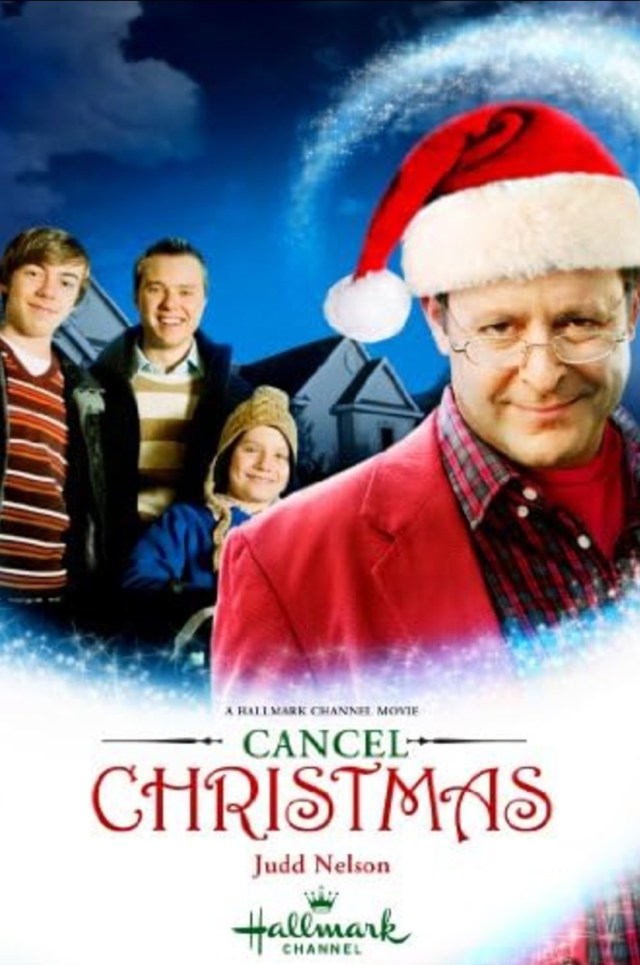
Cancel Christmas poster created by Chesler/Perlmutter Productions, Daro Film Distribution, and Hallmark Channel

Things I liked about the film:

The acting: Since the dawn of cinema, there have been countless portrayals of Santa. How Santa carries himself on screen depends on the actor, screenwriting, and director. In Cancel Christmas, Judd Nelson presented Santa in a way I don’t often see in the world of Christmas cinema. This movie shows Santa as softer-spoken, displaying jolliness through actions instead of just words. His overall demeanor was that of a “wise elder”; thoughtful, reflective, and willing to be a mentor when necessary. Judd’s portrayal of Santa stresses one of the themes of Cancel Christmas; it doesn’t matter what Santa looks like, what matters is the goodness in his heart. Working alongside Santa is an elf named Randal. Portrayed by Justin Landry, Randal ended up stealing the show! He was the perfect opposite to the character of Santa, being enthusiastically joyful and wearing a smile with an up-beat attitude. Randal’s laugh was infectious, making me laugh along with him. I, honestly, wish this movie had been about Randal!

If a Christmas movie features a “Scrooge” type character (a character whose heart changes over the course of the story), the character’s gradual change needs to feel genuine. The more genuine this transformation is, the more opportunities the audience receives to have empathy for that character. Sante Scaletta portrayed a “Scrooge” type character in Cancel Christmas. Farley Morgan is known as a bully at his school. Around his friend and authoritative figures, Farley carries an arrogant attitude. He presents himself as more invincible than he really is. But behind closed doors, the emotional walls surrounding Farley become dismantled. From happily playing with his dog, Kip, to tearfully sharing family memories with his father, Farley’s emotional range broadens. Because of Sante’s impressive performance, Farley’s gradual change in Cancel Christmas truly felt believably genuine!

The messages and themes: In a typical Christmas film, especially from Hallmark, important messages and themes are sprinkled throughout the story. These messages and themes serve as lessons for the audience to learn. They’re also ways for the audience to relate to the characters. As I mentioned earlier in this review, Farley is a bully at his school. Toward the beginning of Cancel Christmas, he and his friend, Steve, attempt to pull a prank on their teacher, Mrs. Claymore. However, Mrs. Claymore is spared from the prank because the prank ends up affecting someone else. At school one day, Mrs. Claymore tells Steve if she had been affected by the prank, it would have made her cry. She shares this to remind Steve how his and Farley’s actions have consequences.

The setting: On-screen text reveals how Cancel Christmas takes place in Atlanta, Georgia. This was a nice change of scenery from the backgrounds of most of Hallmark’s Christmas productions! Snowy, small towns have become a staple in the network’s Christmas cinema. The reality, though, is how not everyone’s environment reflects what Hallmark projects. By placing Cancel Christmas in Atlanta, Georgia, the movie’s creative team gives the audience an idea of what the Christmas season is like in one of America’s southern states. Relatable Christmas activities, such as making Christmas dinner and decorating the school, are emphasized throughout the story. Among Hallmark’s collection of Christmas films, southern states have rarely made an appearance. So, I appreciate Cancel Christmas’ creative team filling this particular creative void!

Adorable Santa image created by Freepik at freepik.com. <a href=’https://www.freepik.com/free-vector/christmas-background-with-funny-santa_1324597.htm’>Designed by Freepik</a>. <a href=”https://www.freepik.com/free-photos-vectors/background”>Background vector created by Freepik</a>. Image found at freepik.com.

What I didn’t like about the film:

A weak villain: Constance is introduced as the villain at the beginning of Cancel Christmas. She informs Santa his job is in jeopardy because of how spoiled the world’s children have become. While Santa speculates Constance’s motive for endangering his job, a clear explanation is never provided. Constance’s appearance in only three scenes prevented her from having a more intimidating presence. Jean Yoon, who portrayed Constance, gave a good performance with the provided script. But when it came to Constance being a weak villain, I fault the screenwriter.

Too many stories: Sometimes, a Hallmark Christmas movie will feature multiple stories within its script. The collection of stories can range from having one main plot and one or two sub-plots to a variety of characters crossing paths with one another. What makes some of these movies work is how all those stories are woven together. But, in Cancel Christmas, the threads between the stories were unimpressive, causing the script’s abundance of stories to be noticeable. Besides the main plot of Santa trying to save his job, there were about five sub-plots, from a news reporter trying to find the “real” Santa to Farley’s friend, Steve, organizing a fundraiser. There was creativity found within these sub-plots. In fact, some of them belonged in their own movie. However, all these stories ended up competing against each other in Cancel Christmas. It also doesn’t help how the film has a run-time of an hour and twenty-seven minutes. Having so many stories in one script made the movie feel kind of overwhelming.

Unnecessary clichés: I will commend the creative team behind Cancel Christmas for trying to incorporate as much creativity as possible into their project. But there were a few clichés that could have been left on the cutting room floor. As I mentioned in my list of the top ten worst clichés from Hallmark movies, the “business person is a jerk and/or out of touch” cliché has become one of the network’s more over-used clichés. It has, more often than not, been included in rom-coms, in order to make the businessman seem less desirable than the male protagonist. The “business person is a jerk and/or out of touch” cliché found a place in Cancel Christmas. In this movie, the cliché was connected to a story that has been adopted by a lot of entertainment media; the bully/antagonist having a tragic backstory and/or being misunderstood. To me, these parts of the story were more predictable than they needed to be. However, I understand their purpose in the movie was to instill compassion and empathy to the film’s audience.

Dog collection image created by Freepik at freepik.com. <a href=”https://www.freepik.com/free-photos-vectors/dog”>Dog vector created by freepik – http://www.freepik.com</a>. Image found at freepik.com.

My overall impression:

Hallmark Channel’s Christmas movies have changed since the network began in 2001. In the earlier years, these movies didn’t follow a pre-determined formula or adopt as many of the clichés viewers see today. Hallmark’s “older” productions were given more opportunities to find their respective audience because there were fewer Christmas films airing during the Christmas season. Like I said in my review, I commend the creative team behind Cancel Christmas for trying to incorporate as much creativity as possible into their project. From Judd Nelson’s portrayal of Santa to the story taking place in Atlanta, Georgia, these creative choices felt like a breath of fresh air compared to the network’s more recent offerings. Though there were things I liked about this film, it contained noticeable flaws. Not only was the villain weak, the movie featured too many stories. There were also some clichés that were, in my opinion, unnecessarily added to the film. I wish Hallmark would go back to making creativity the rule itself. So many stories and ideas could be told through the network’s programs. But with Hallmark making the same types of projects, the network seems content with creating repetitive and predictable presentations.

Overall score 7.1-7.2 out of 10

Have you seen Cancel Christmas? Are there any “older” Hallmark Christmas movies you enjoy watching? Please tell me in the comment section!

Have fun at the movies!

Sally Silverscreen
Take 3: Love at the Thanksgiving Day Parade Review

With Thanksgiving just around the corner, I decided to choose a Thanksgiving film as the first seasonal movie to review this Christmas/holiday season! While searching for options, the 2012 Hallmark presentation, Love at the Thanksgiving Day Parade, crossed my path. I hadn’t seen this film in its entirety prior to 2024. But over the years, I had heard good things about it. Within the Hallmark fan community, Love at the Thanksgiving Day Parade has received the title of “classic”. Because of that, I wanted to see for myself if the film’s hype was legitimate. Whenever a Hallmark movie becomes popular, I try to check out the movie in order to form my own opinion. Sometimes, I feel the hype was earned, like with the 2014 film, The Nine Lives of Christmas. But I have found myself disagreeing with popular opinion, such as with 2006’s The Christmas Card. What will be my thoughts on Love at the Thanksgiving Day Parade? If you want to know the answer, you have to keep reading my review!

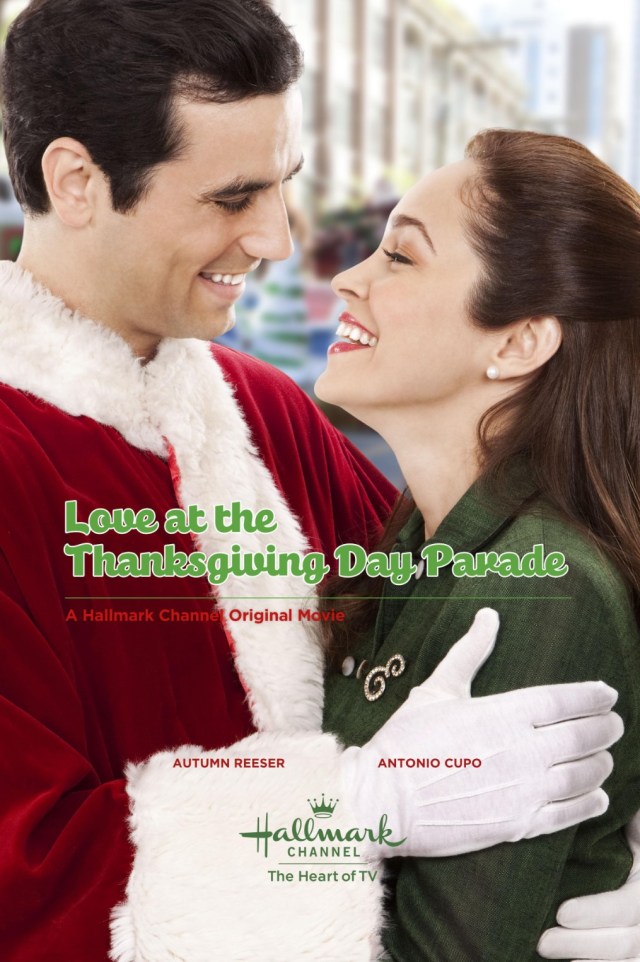
Love at the Thanksgiving Day Parade poster created by Hallmark Channel, Pitchblack Pictures, and LaCanada

Things I liked about the film:

The acting: In a story that primarily revolves around the male and female protagonist, the likability of those characters is determined by the performance of the lead actor and actress. With their portrayal of Emily and Henry, Autumn Reeser and Antonio Cupo effortlessly carried Love at the Thanksgiving Day Parade! Emily is a bright, energetic, and up-beat woman. Her enthusiasm for Chicago’s Thanksgiving parade is charming, with that charm radiating off the screen. Throughout the movie, Autumn displays an understanding for her character’s emotional range. Emily’s energetic bubbliness is showcased enough to keep the character likable. Meanwhile, Antonio’s character, Henry, boasts a more serious personality. This seriousness doesn’t prevent Henry’s suave charisma from shining through. What Autumn’s and Antonio’s performance share in common is how consistent they are. That consistency helped make Henry and Emily strong characters!

Antonio and Autumn are not the only actors giving consistent performances in Love at the Thanksgiving Day Parade! From time to time, Emily interacts with a co-worker named Donna. Similar to Emily, Donna has a bubbly personality. Because of April Telek’s acting strengths, I looked forward to seeing Donna show up in the story. In fact, I wish Donna received a larger role in the film. Another likable character was Emily’s friend, Jaclyn. Despite appearing in the movie for a limited period of time, Ali Liebert helped her character shine by presenting Jaclyn with a warm, friendly personality. I wish Jaclyn was given her own sub-plot to be more involved in the story.

The on-screen chemistry: As I just talked about in this review, Autumn Reeser and Antonio Cupo effortlessly carried Love at the Thanksgiving Day Parade. Another reason why I believe this statement is because of their on-screen chemistry. This movie uses the trope of “opposites attract”. Because of the aforementioned performances of Antonio and Autumn, the attraction of Henry and Emily felt believable! Their banter went back-and-forth like a ping-pong game, providing lively, even funny interactions. The more time they spent together, the more Emily and Henry’s feelings for each other naturally progressed. Despite being “opposites”, these characters found common ground and tried to get on the same page. Henry and Emily kind of reminded me of Oliver and Shane from the Signed, Sealed, Delivered series.

Emily’s wardrobe: Throughout Love at the Thanksgiving Day Parade, Emily consistently wears vintage attire. I liked this creative decision because Emily’s wardrobe not only complimented Autumn, it made Emily a unique character! One of these outfits was a pink dress with matching jacket. Paired with a pink pillbox hat, this outfit represents the classy and sophisticated way Emily presents herself. Even when she takes a simple trip to the grocery store, Emily sports a deep teal, long-sleeved dress with a pleated skirt. When Henry invites her to a basketball game, Emily stays true to herself by wearing a red, short-sleeved blouse, dark blue jeans, and a red belt. The only “modern” part of the ensemble is a Chicago Bulls cap.

Image of Thanksgiving dinner created by Freepik at freepik.com. <a href=”https://www.freepik.com/free-photos-vectors/background”>Background vector created by freepik – http://www.freepik.com</a>. Image found at freepik.com.

What I didn’t like about the film:

A secondary holiday and parade: Hallmark does not create Thanksgiving movies often, especially this decade. So, when I watch one of their Thanksgiving pictures, I hope the holiday is featured similarly to Christmas in their Christmas productions. As the story progressed in Love at the Thanksgiving Day Parade, however, I quickly took notice of how Emily and Henry’s relationship was prioritized over Thanksgiving and the titular parade. The Thanksgiving holiday was barely referenced in this movie. There were no Thanksgiving decorations to be seen and I don’t recall any of the characters saying the word “turkey”. While parade preparations were shown throughout the film, they were only featured in short segments. This is a shame because aspects of the parade, such as “parade camp” or a group of clowns visiting children at the hospital, could have served as the story of their own movie. I wish the parade and/or Thanksgiving had been more involved in the plot. With Emily sharing a brief history of the parade early in the film, Love at the Thanksgiving Day Parade could have had a story similar to A Biltmore Christmas.

The “it’s not what you think” cliché: Among Hallmark’s collection of clichés is the “it’s not what you think” cliché. This is when the protagonist sees or hears something out of context and automatically assumes the worst. Hallmark has sometimes used this cliché in a way that complements the story, like in Easter Under Wraps and Rome in Love. But there are times when this cliché has been included in a movie just for the sake of it. In the case of Love at the Thanksgiving Day Parade, I understand the “it’s not what you think” cliché was intended to create conflict between Henry and Emily. However, I don’t think the cliché’s inclusion in the story was necessary because it happened right after Emily experienced a difficult time in her life. To me, that part of the film seemed cruel and a bit mean-spirited toward Emily.

A rushed backstory: One of the themes of Love at the Thanksgiving Day Parade is “looks can be deceiving”. Despite this theme being utilized well at times, the overall utilization of this theme was not consistent. During the film’s climax, important pieces of a character’s backstory are presented in a rushed manner. That information helps another character change their perception of the character in question. Instead of rushing to deliver this information before the end of the movie, it should have been given over the course of the film. That way, the audience has time to digest and ponder the character’s backstory.

Group of clowns image created by Freepik at freepik.com. Image by Freepik

My overall impression:

Because Hallmark creates so few Thanksgiving movies, I’m always rooting for their Thanksgiving pictures to be good. But, like Hallmark’s Christmas productions, these films are not created equal. As I’ve mentioned in the past, An Old Fashioned Thanksgiving is one of my favorite Hallmark films. One reason why is how Thanksgiving is acknowledged throughout the story. Unfortunately, Love at the Thanksgiving Day Parade did not follow in the footsteps of the 2008 film. In fact, Thanksgiving and the titular parade were overshadowed by Emily and Henry’s relationship. This is one of those movies where a better story idea can be found within the script. But the reason why I kept watching the film is because of the acting performances! Autumn Reeser and Antonio Cupo shined bright together, carrying the movie with their acting talents and on-screen chemistry. The supporting cast was strong as well. I liked Emily’s wardrobe because it helped make her such a memorable character. The combination of Autumn’s performance and the screenwriting contributed to that too. Out of Hallmark’s Thanksgiving projects I’ve seen, Love at the Thanksgiving Day Parade falls somewhere in the middle. While the 2012 picture isn’t bad, it could’ve been stronger.

Overall score: 6.7 out of 10

Have you seen Love at the Thanksgiving Day Parade? Has Hallmark created a Thanksgiving movie you’d like to see me review? Share your thoughts in the comment section!

Have fun on Thanksgiving!

Sally Silverscreen

Take 3: Dial M for Murder Review

For this movie review, I chose to write about the 1954 film, Dial M for Murder, for two reasons. The first is how I selected this specific title for The 6th Wonderful Grace Kelly Blogathon, as Grace Kelly stars in the film. The second reason is how, prior to this review, I had never seen Dial M for Murder. Grace and Alfred are no strangers to 18 Cinema Lane. As of mid-November, 2024, I have reviewed two of Grace’s films; High Society (which I thought was fine) and To Catch a Thief (which I found just ok). Meanwhile, four of Alfred Hitchcock’s movies have been covered on my blog. Out of those titles, Strangers on a Train is, in my opinion, still the best one. But how does Dial M for Murder compare to any of Alfred’s films featured on 18 Cinema Lane? Find out by reading my review!

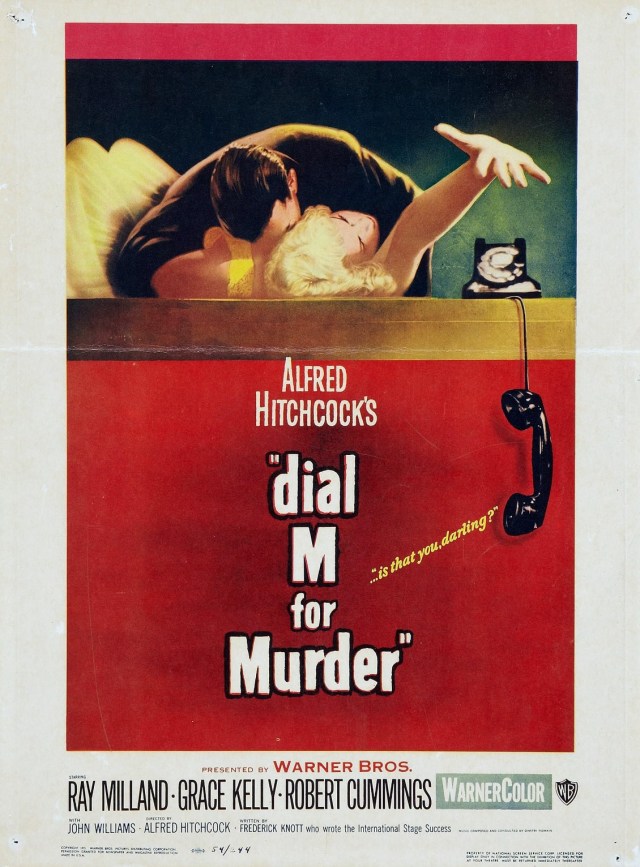
Dial M for Murder poster created by Warner Bros.

Things I liked about the film:

The acting: Since Grace Kelly is the reason why I chose to review Dial M for Murder, I will talk about her performance first. Out of her movies I’ve seen, I’ve noticed how her character portrayals have appeared at ease. Her performance in Dial M for Murder is no different, as her adopted mannerisms and reactions came across as realistic! While sharing a conversation with Mark (portrayed by Robert Cummings), Grace’s character, Margot, seems comfortable in his presence. She effortlessly moves around her apartment and, at times, stands close to him. But when she talks with Mark about how her husband, Tony, has changed, Margot appears to stare into the distance. The combination of her aforementioned stare and frown indicates how Tony’s behavior has troubled her. It also shows the audience how effective Grace’s acting talents are!

As I just said in this review, Robert Cummings portrays Mark, a close friend of Margot. Though they shared only a few scenes together, Grace and Robert displayed nice on-screen chemistry! The strength of Robert’s and Grace’s acting abilities helped their characters appear to truly get along with each other. While I liked Robert’s performance in Dial M for Murder, I was also impressed with Ray Milland’s performance! Similar to Grace’s portrayal of Margot, Ray’s portrayal of Tony showcases how adaptable his acting skills are. For example, Tony looks annoyed while at a restaurant with Mark. From the tone in his voice to constantly checking his watch, Tony clearly appears impatient. A few scenes later, as he’s on the phone with Margot, his demeanor quickly changes to concern due to what he hears over the phone. Throughout his performance, Ray effortlessly brought his character to life!

The use of lighting: Over the course of his career, Alfred Hitchcock has received the title of “Master of Suspense”. One reason why he was given this title is because of how he utilizes lighting to stir up a mood, present visually interesting concepts, or add suspense. In one scene, someone enters Margot and Tony’s apartment. This moment takes place at night, so the only light comes from the fireplace in the living room. An orange glow only providing light to certain areas of the room creates a suspenseful environment, giving the intruder places to hide. I brought up earlier in this review how Mark and Margot shared a conversation. Their conversation takes place in Tony and Margot’s apartment. Right before Tony returns home, Margot’s and Mark’s shadow departs from each other, keeping the closeness of their relationship a secret.

The use of color: Dial M for Murder’s opening credits reveal how the film’s creative team used “WarnerColor” in their project. I’m glad this movie was presented in color because it gave the creative team opportunities to utilize this visual technique to their advantage! Sometimes, the color red was incorporated into a character’s wardrobe. This ranged from Margot wearing a red dress at the beginning of the movie to Tony sporting deep red suspenders. One of the pieces of décor in Margot and Tony’s apartment were dark green curtains. In these examples, color was chosen to draw the audience’s attention to a person, object, or location in the room.

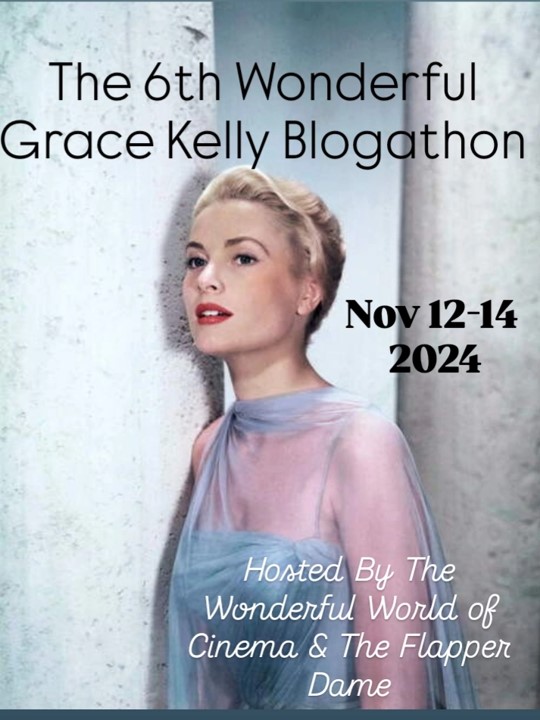
The 6th Wonderful Grace Kelly Blogathon banner created by Virginie from The Wonderful World of Cinema and Emily from The Flapper Dame

What I didn’t like about the film:

Exposition heavy: At the beginning of the movie, Margot shares with Mark how she recently lost her purse. She also tells him when her purse was returned, a letter Mark wrote her was missing. But shortly after Margot made this confession, an exposition heavy scene revealed the letter’s whereabouts, as well as who the story’s perpetrator was. Because this information was revealed so early in the movie, it took away a lot of the story’s suspense. So much exposition given within the film’s first ten minutes may also overwhelm the audience, possibly missing important information if they don’t actively pay attention to the dialogue.

A mystery that isn’t interactive: While talking about Dial M for Murder’s exposition heavy story, I said the perpetrator was revealed so early in the movie. This creative choice takes away the audience’s opportunity to solve the mystery of whodunit alongside the characters. What Dial M for Murder became was a story of how the perpetrator would get caught, similar to programs like Columbo and Diagnosis Murder. That creative decision forces the audience to simply watch the characters solve the story’s mystery. With everything I said, the mystery in Dial M for Murder wasn’t interactive.

A less intimidating antagonist: In some of Alfred Hitchcock’s movies, the antagonist is an intimidating person for a variety of reasons. Their intimidation can add suspense and intensity to a given film’s story. I will not spoil Dial M for Murder. However, I can honestly say I did not find the movie’s antagonist intimidating. Throughout the story, the antagonist kept making dumb decisions, which distracted from their attempts to be an intimidating character. It also didn’t help how the exposition heaviness of the film’s first ten minutes took away a lot of the story’s suspense. If anything, the antagonist in Dial M for Murder was annoying.

Colorful image of key created by orchidart at freepik.com. Flower vector created by orchidart – www.freepik.com

My overall impression:

As of the publication of this review, I have seen eight of Alfred Hitchcock’s films. While I was disappointed by The 39 Steps, I ended up liking Strangers on a Train. When it comes to Dial M for Murder, though, the movie lies somewhere in the middle. Grace Kelly’s performance was, once again, one of the best parts of the production! Her portrayal of Margot was so strong, her reactions and expressions appeared realistic! The use of lighting and color gave Alfred and his creative team ways to present visually creative ideas. But what held Dial M for Murder back from being a more intriguing project is how the first ten minutes of the story was exposition heavy, with this decision impacting the film’s suspense. The mystery not being interactive also takes away some of Dial M for Murder’s intrigue. Alfred’s film felt reminiscent of shows like Columbo and Diagnosis Murder, where the audience simply waits for the perpetrator to get caught. Personally, I prefer mystery stories where I’m left guessing whodunit.

Overall score: 6-6.1 out of 10

Have you seen Dial M for Murder? Which movie of Alfred Hitchcock’s would you like to see me review next? Tell me in the comment section!

Have fun at the movies!

Sally Silverscreen

Take 3: hoops&yoyo’s Haunted Halloween Review

For the recent We Are Family Blogathon, I had planned to review the Diagnosis Murder episode, “Guardian Angel”, and the 1964 movie, The Chalk Garden. While I wrote about the aforementioned television episode, I wasn’t able to discuss the movie due to those plans falling through at the last minute. I still want to review The Chalk Garden. It just didn’t happen as soon as I hoped or expected. So, to make it up to my readers who were anticipating a review of the 1964 film, I decided to write about a Halloween themed picture. I read an article on Business Insider about the thirty things you can’t find in malls anymore. One of the mentioned points was movies set in malls. As soon as I read this, I immediately thought of the 2012 Hallmark film, hoops&yoyo’s Haunted Halloween! I brought this movie up in my review of The Legend of Billie Jean, when a scene in the 1985 film was reminiscent of Hallmark’s production. In that review, I said I only saw pieces of the movie. That, paired with the fact the only other animated movie I’ve written about this year, so far, was Cricket on the Hearth, is the reason why I chose hoops&yoyo’s Haunted Halloween for this review! Is this film a trick or treat? Keep reading to find out!

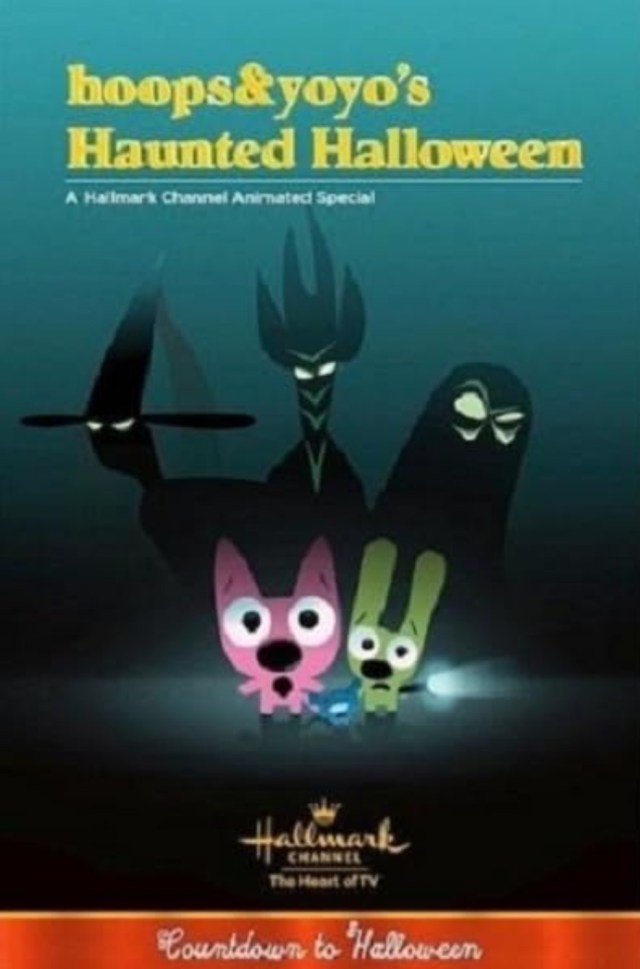
hoops&yoyo’s Haunted Halloween poster created by Bent Image Lab, Pershing Road Productions, and Hallmark Channel

Things I liked about the film:

The use of color: In my review of Cricket on the Hearth, I talked about how well color was used throughout that movie. I even mentioned how some of the best animated movies boast bright, colorful hues. hoops&yoyo’s Haunted Halloween followed Cricket on the Hearth’s footsteps by displaying a strong understanding for how to effectively incorporate color into their production. During their mall adventure, Hoops, Yoyo, and Piddles take advantage of the different shops and attractions at North Escapades Mall. One of these stores is called “bling you phone!”. The store’s sign and window frames are coated in a deep purple hue. This simple creative choice drew the audience’s attention to this particular location, especially since the colors surrounding the “bling you phone!” store are warm beige, faded brown, and cream. Later, at a sporting goods store, Hoops and Yoyo are camping in a big, orange tent. Surrounding the tent are products displaying shades of green, red, and yellow. Even in the smallest of details, the hoops&yoyo’s Haunted Halloween’s creative team took advantage of every opportunity to include color in their project!

Expressive characters: A strength of any animated movie is how expressive the characters are. Facial expressions, body language, and even the vocal inflections of the voice actors can show the audience how a character is feeling. Despite the simpler designs, the characters in hoops&yoyo’s Haunted Halloween were very expressive! This was achieved through the movement of eyes, mouths, and eyebrows. When Hoops, Yoyo, and Piddles discover their local store has sold out of Halloween costumes, they are shocked by the emptiness of the surrounding shelves. Hoops’ and Yoyo’s eyes are wide, with Hoops even looking at the top shelves. Piddles’, Yoyo’s, and Hoops’ mouth is in an open frown, emphasizing how shocked they are. Hoops’ and Yoyo’s eyebrows are shown in an upward curve, which adds to their feeling of shock. These simple movements allowed the characters to effectively display their emotions!

Self-awareness: Skilled screenwriters will weave self-awareness into a script to subtly and cleverly make jokes or present an interesting point. hoops&yoyo’s Haunted Halloween featured some moments of self-awareness through dialogue and “Easter eggs”. While Hoops, Yoyo, and Piddles are looking at a mall directory, a large Christmas advertisement is shown next to these characters. On this advertisement, a picture of Santa is next to a statement claiming “Santa Claus is coming”. Later, Piddles rides near an animatronic of Santa. Next to Santa is a sign saying “It’s Halloween! That means you’re already late for Christmas!” The placement of these “Easter eggs” addresses how early Christmas has been advertised. I found this piece of self-awareness ironic, as Hallmark now starts their Christmas movie line-ups weeks before Halloween.

Cute Halloween border created by Freepik at freepik.com. <a href=’https://www.freepik.com/free-vector/halloween-background-with-fun-style_1310632.htm’>Designed by Freepik</a>. <a href=”https://www.freepik.com/free-photos-vectors/background”>Background vector created by Freepik</a>. Image found at freepik.com.

What I didn’t like about the film:

An unclear demographic: Animation is typically associated with an audience of children or families. However, some animated programs were created with an older audience in mind. With that said, I’m still trying to figure out who was hoops&yoyo’s Haunted Halloween’s intended audience. Toward the beginning of the film, the reference to cinnamon buns sounds like a comparison to a smoking addiction. Hoops even reminds Yoyo how he’s wearing his “cinnamon bun patch”. After Hoops, Yoyo, and Piddles become trapped inside the mall, they are chased by ghosts. During the chase, Yoyo randomly screams “We need to find a bathroom”, leading to a scene where Hoops and Piddles wait for Yoyo outside of the mall’s bathrooms. This scene was one of two moments of “bathroom humor” throughout the film. Was hoops&yoyo’s Haunted Halloween created for a younger audience, with certain jokes going over their heads, or was this movie always intended for an older audience?

Parts of the story that don’t make sense: Earlier in this review, I mentioned the “bling you phone!” store at North Escapades Mall. The reason this store was featured in the movie was Piddles’ desire to decorate her phone case. Piddles’ phone can be seen a total of three times. This fact raises the question of why she didn’t call for help after she, Hoops, and Yoyo became trapped inside the mall? What also doesn’t make sense is how Piddles would easily agree to take advantage of the mall after hours, especially since, before the mall closed, she reminded Hoops and Yoyo of a Halloween party they needed to attend that night. I know fictional stories, including those from animated movies, require their audience to suspend a certain amount of disbelief. However, in the case of hoops&yoyo’s Haunted Halloween, that suspension of disbelief caused some parts of the story to not make sense.

Scenes that were too long: At the beginning of hoops&yoyo’s Haunted Halloween, Hoops is driving Yoyo and Piddles to the store. This scene establishes the reason for the trip and the date of the story. But Hoops’, Yoyo’s, and Piddles’ trip to the store takes up almost three minutes in a twenty-one-minute movie. Though I understand the scene’s purpose of setting up the story and providing exposition, I think it should have been trimmed shorter to under two minutes and thirty seconds. This is just one example of how some scenes were too long in hoops&yoyo’s Haunted Halloween.

Image by evening_tao on Freepik

My overall impression:

When explaining why I chose to review hoops&yoyo’s Haunted Halloween, I brought up the Business Insider article about the thirty things you can’t find in malls anymore. If there was an article of the things you can no longer find from Hallmark, Hoops & Yoyo would be included. This movie serves as a time capsule of how different Hallmark Channel was twelve years ago. As I mentioned in my review, the Christmas “Easter eggs” were ironic because, as of 2024, Hallmark starts their Christmas movie line-ups weeks before Halloween. The 2012 movie also provides a more unique story when it comes to Halloween cinema. The mall is a location not typically associated with the holiday. While I won’t spoil the reveal of what’s haunting North Escapades Mall, I will say this revelation paired with the chosen location is creative and well-written. Though Hallmark is not known for their efforts in animation, the simple creative decisions like knowing when and where to use color worked in the network’s favor. The expressiveness of the characters also helps. If you’re looking for a Hallmark movie that’s found off the beaten path, I’d suggest getting to know Hoops & Yoyo!

Overall score: 7.1 out of 10

Have you seen hoops&yoyo’s Haunted Halloween? Would you like to see me review hoops&yoyo Ruin Christmas during the Christmas season? Let me know in the comment section!

Have fun on Halloween!

Sally Silverscreen

Take 3: The Comedy of Terrors (1963) Review

In my review of the Diagnosis Murder episode, “Guardian Angel”, I mentioned how I’ve accepted movie recommendations from my readers. These recommendations have, sometimes, made great selections for blogathons. Four years ago, when I reviewed House of the Long Shadows, Patricia (from Caftan Woman) suggested several films starring Vincent Price. One of those titles was 1963’s The Comedy of Terrors. Since then, I have been waiting for the right time to create a review for this movie. With The Comedy of Terrors fitting the criteria for the 3rd Annual Spooky Classic Movie Blogathon, I knew I had found a perfect entry for the event!It’s become an unofficial tradition on 18 Cinema Lane to review at least one of Vincent’s movies every year. Since 2019, when I wrote about The Whales of August, eleven of Vincent’s films have received a review on my blog. While some of his movies have been more enjoyable than others, I can honestly say I haven’t seen a movie of his that I would consider “bad”. So, how does Comedy of Terrors compare to Vincent’s other films? Find out by reading my review!

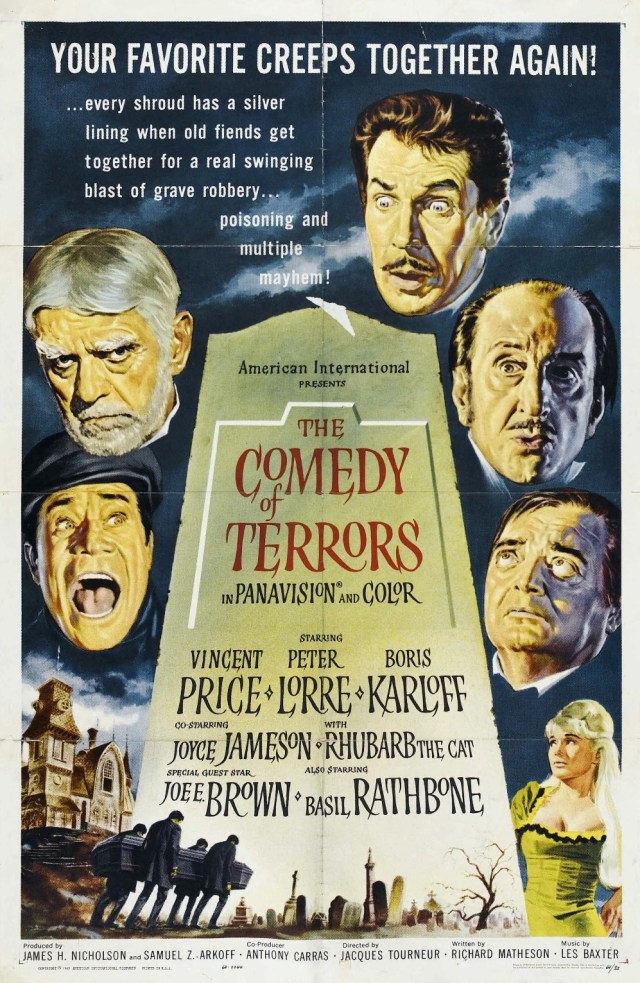
The Comedy of Terrors (1963) poster created by Alta Vista Productions and American International Pictures (AIP)

Things I liked about the film:

The acting: When you see Vincent Price’s name attached to a given film, there’s a chance you’re going to see Vincent give a solid acting performance. That was certainly the case in The Comedy of Terrors! What makes Vincent such a strong actor is his adaptability. Portraying an undertaker named Trumbull, Vincent successfully transformed his expressions and emotions based on his character’s situation. One evening, Trumbull was counting a large collection of coins. He displays a big smile on his face and also appears in a relaxed sitting position. When his wife, Amaryllis, comes into the room and asks him a question, Trumbull’s demeanor quickly changes. His sharp tone suggests deep irritation, with a disapproving frown to match. This change in attitude is consistent with Trumbull’s dislike for Amaryllis.

Prior to reviewing The Comedy of Terrors, I had seen two of Basil Rathbone’s movies; The Great Mouse Detective and Bathing Beauty. Because only one of these movies was a live-action production, I didn’t know what to expect from his portrayal of Mr. Black. However, I was impressed with Basil’s performance in The Comedy of Terrors! Some scenes show Mr. Black reciting one of Shakespeare’s plays. The first time the audience sees Mr. Black reciting Shakespeare’s work is when Felix (portrayed by Peter Lorre) breaks into Mr. Black’s home. In this particular scene, Mr. Black displays an animated demeanor throughout his reenactment. The way he confidently recited Shakespeare’s words gave this reenactment a sense of grandeur. Reflecting on Basil’s performance in The Comedy of Terrors and looking at his IMDB filmography, I wish he has starred in an adaptation of Shakespeare’s work.

An immersive world: A make-or-break factor of any movie is how that picture is presented. For period/historical fiction films, the accuracy and attention to detail can help that movie’s world feel immersive. Because The Comedy of Terrors takes place during the Victorian era, everything in the film has to appear accordingly. This was achieved in the 1963 film, as the aforementioned elements of attention to detail and accuracy were applied! When I talked about Vincent’s performance, I mentioned Trumbull was an undertaker. An ornate coffin was presented any time Trumbull hosted a funeral. The shiny, black coffin was constructed by sharp angles and was decorated with gold designs. This prop was a simple, yet visually appealing way of addressing the wealth of Trumbull’s clientele. One scene shows Trumbull and Felix breaking into someone’s home. Without meeting the homeowner, the audience can tell how this character lives a comfortable life. Decorative lamps and wall sconces are included in characters’ bedrooms. A series of statues make a strong appearance when Felix and Trumbull first walk into the house. There is even gold trim on one of the doors. From the set design to the costume design, the world within The Comedy of Terrors was immersive!

Peter Lorre and Joyce Jameson’s on-screen chemistry: Earlier in my review, I said Felix was portrayed by Peter Lorre. I also stated how Trumbull doesn’t like Amaryllis (portrayed by Joyce Jameson). Amaryllis is hurt by Trumbull’s negativity toward her. Meanwhile, Felix is upset by how Amaryllis is treated by Trumbull. The shared dislike Felix and Amaryllis have toward Trumbull create an affection for one another. Though they shared only a few scenes together, I was pleasantly surprised by Joyce and Peter’s on-screen chemistry! The warm, caring demeanor between Felix and Amaryllis came across as believable. This was made possible by the strength of Joyce’s and Peter’s performance. With that said, I think Peter and Joyce not receiving more scenes together was a missed opportunity.

The 3rd Annual Spooky Classic Movie Blogathon banner created by Kristen from Hoofers and Honeys

What I didn’t like about the film:

Jokes that are too long: Comedy, like film, is subjective. One aspect to this subjectivity is the length of the jokes. In my opinion, the jokes in The Comedy of Terrors were too long. It seems like the screenwriters had difficulty finding their intended punchline or realizing they reached their punchline long ago. A running joke in The Comedy of Terrors is how Amaryllis is a terrible singer, despite her claims of a possible opera career. Had she sung a portion of a song once or twice, it would have been enough to get the intended point across. But the fact Amaryllis almost sang whole songs three or four times caused the joke to last too long and quickly become old.

Parts of the story that don’t make sense: I mentioned earlier in this review how Felix broke into Mr. Black’s home. To get into Mr. Black’s house, Felix had to climb onto the roof and into an upstairs window. But during this excursion, a cat named Cleopatra joins Felix and Trumbull, watching Felix trespass into Mr. Black’s property. It’s explained in the film why Felix needed to find an alternative entrance. What isn’t explained is why Cleopatra didn’t enter the house. I’m not sure how Cleopatra could have assisted Trumbull and Felix. However, it would have been easier for a cat to climb on a roof and enter through a window. This is just one part of the story that, to me, didn’t make sense.

An underutilized cat: In past reviews, I have been critical when an actor or actress was underutilized. But in the case of The Comedy of Terrors, the creative team underutilized a cat. As I mentioned in my point about parts of the story that don’t make sense, a cat named Cleopatra joined Trumbull and Felix on their excursion. Even though Cleopatra was adorable, the cat was not a significant part of the overall story. There were even times when I wondered why a cat was included in the movie at all. Had Cleopatra been written out of The Comedy of Terrors, the story itself would not change much.

Orange cat image created by Freestockcenter at freepik.com. <a href=’https://www.freepik.com/free-photo/ginger-cat_883376.htm’>Designed by Freestockcenter</a>. <a href=”https://www.freepik.com/free-photos-vectors/gold”>Gold image created by Freestockcenter – Freepik.com</a>. Image found at freepik.com.

My overall impression:

In this review’s introduction, I said I haven’t seen a movie of Vincent Price’s that I would consider “bad”. While this statement is still true, The Comedy of Terrors is one of his weaker pictures. The flaws of the 1963 production include jokes that are too long and parts of the story that don’t make sense. But there are aspects of the movie I liked. The Comedy of Terrors is an immersive film, making viewers feel transported to the Victorian era. Attention to detail and historical accuracy helped the creative team achieve that illusion. Vincent’s performance was one of the strongest parts of this film! His adaptability made his portrayal of Trumbull captivating to watch. Now that I’ve finally seen The Comedy of Terrors, I can, honestly, say this picture emphasizes style more than substance. Out of Vincent’s eleven movies I’ve seen, this one is just ok.

Overall score: 6.1 out of 10

Have you seen The Comedy of Terrors? Which film of Vincent Price’s should I review next? Please tell me in the comment section below!

Have fun at the movies!

Sally Silverscreen
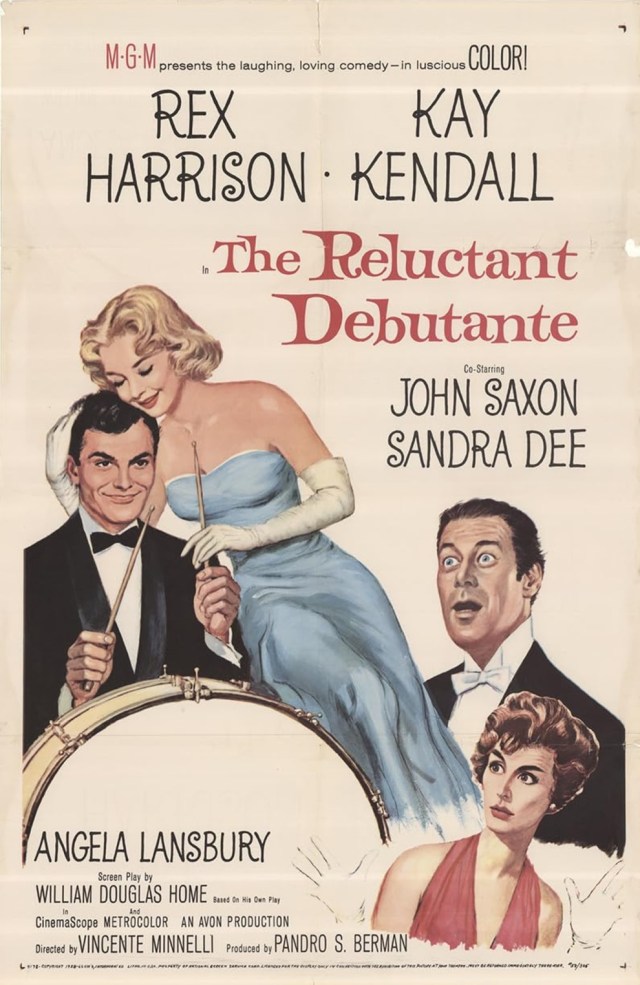
Take 3: Curious Caterer: Forbidden Fruit Review

When I reviewed Curious Caterer: Foiled Plans back in April, that movie became the best Hallmark mystery of 2024. Now six months later, Curious Caterer: Foiled Plans is still the best Hallmark mystery movie of the year! When I learned Curious Caterer: Forbidden Fruit was on the horizon, I was so excited for the film’s release. Part of my excitement was due to how much I liked Curious Caterer: Foiled Plans. The Curious Caterer series is one of the strongest series Hallmark has ever created. The strength of Nikki Deloach’s and Andrew W. Walker’s performances, as well as their on-screen chemistry, is one reason why Curious Caterer has been an enjoyable collection of films. It also helps how the movies have been well written. Can Curious Caterer: Forbidden Fruit be just as good as Curious Caterer: Foiled Plans? Keep reading my review to find out!

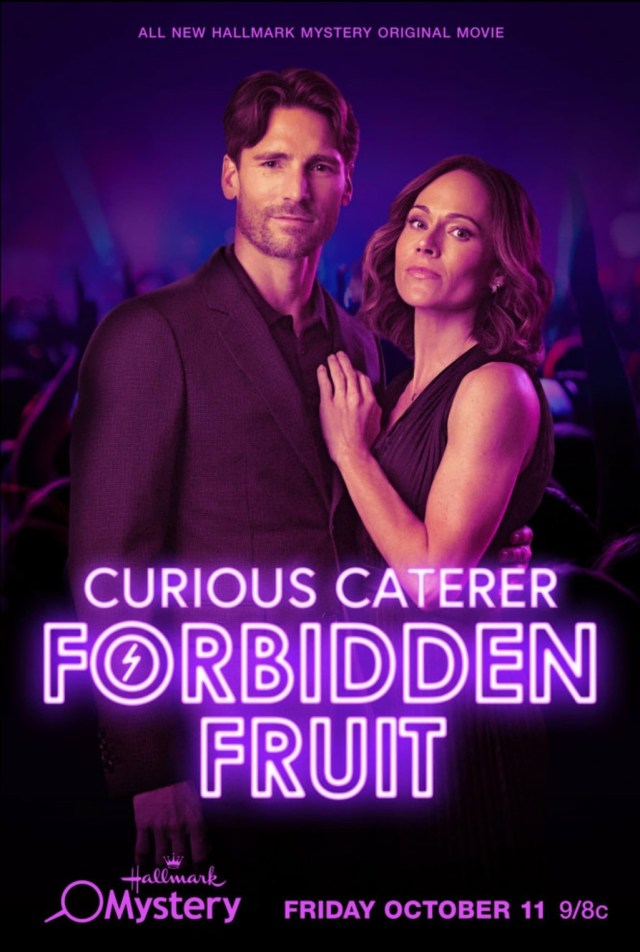
Curious Caterer: Forbidden Fruit poster created by Timeless Pictures and Hallmark Movies & Mysteries

Things I liked about the film:

The acting: As I said in my review of Ainsley McGregor Mysteries: A Case for the Winemaker, the strength of the cast can add to the story’s intrigue. Even though the acting has been consistently successful in the Curious Caterer series, this is impressive when you consider the series has utilized a rotating secondary cast! I have always liked Jaycie Dotin’s portrayal of Marla Maguire. I not only liked her performance in Curious Caterer: Forbidden Fruit, I also think she and Luke Camilleri had really nice on-chemistry! When Marla meets Jax backstage before the concert, he shares a memento from his late sister. His entire demeanor is sad, yet he appears appreciative when Marla asks about the memento. Marla’s tone of voice indicates she’s trying to be understanding of Jax’s situation. Later in the film, when Jaycie and Luke appear together in another scene, Jax and Marla are all smiles. They both look comfortable in each other’s company and seem to enjoy spending time with one another. I hope Luke and Jaycie star together in another Hallmark production!

Another strength of the Curious Caterer series is the strong on-chemistry of Nikki Deloach and Andrew W. Walker. Their portrayals of Goldy and Tom were, once again, one of the best parts of the movie! Now that these characters have an established, romantic relationship, they received more opportunities to spend time together in Curious Caterer: Forbidden Fruit. While observing Goldy’s mystery board, Tom asks why Selena would kiss her former band member, Derek. Goldy then proceeds to kiss Tom. After the kiss, Tom asks her if the kiss was meant to be evidence. Goldy happily replies she just wanted a reason to kiss him. Tom and Goldy’s interaction in this scene was not only sweet, it also felt genuine. Andew and Nikki’s acting abilities made their characters’ interactions enjoyable to watch!

A behind-the-scenes look at the music industry: The mystery in Curious Caterer: Forbidden Fruit revolves around the death of a band member during a live performance. Because the band and those surrounding them are consistently involved in the story, the movie’s creative team gave the audience a peek behind the music industry’s curtain. During a discussion between Tom and the band’s manager, Nicola, Tom learns each band member was insured in order to keep investors happy. This was new information to me, as I had never heard of musicians being insured before. Prior to the concert, Goldy and Marla were preparing to make their catered food. They were told by the band’s electrician, Sam, they could only use one electrical socket due to the older age of the venue and the other plugged-in electrical equipment. When people attend a concert or a live performance, they are so focused on what is happening on stage, details like a venue’s age or electrical power grids may not cross their minds. Curious Caterer: Forbidden Fruit showed what goes into planning and delivering a musical event.

Incorporating serious, real-world topics: Hallmark productions, whether it’s a Hallmark Hall of Fame movie or a Christmas film, sometimes include serious, real-world topics into their scripts. What can make or break a script is how these serious, real-world topics are incorporated into the story. The way these kinds of topics were included in Curious Caterer: Forbidden Fruit was more subtle, yet there was enough information for the audience to understand what was happening. As Goldy is serving drinks to the band members before the concert, she reassures Derek (a recovering alcoholic) there are no alcoholic ingredients in his drink. Because Derek’s drink and Jax’s drink appear similar, Goldy stops Derek from consuming Jax’s drink, which contains rum. This mistake causes Derek to accuse Jax of trying to break his sobriety. The scene I just described felt like a realistic interaction, with the subject of addiction naturally woven into the dialogue. This was made possible by the quality of the acting performances as well as the screenwriting.

Detective work image created by Photoroyalty at freepik.com. <a href=’https://www.freepik.com/free-vector/investigation-background-design_1041877.htm’>Designed by Freepik</a>. <a href=”https://www.freepik.com/free-photos-vectors/background”>Background vector created by Photoroyalty – Freepik.com</a>. Image found at freepik.com.

What I didn’t like about the film:

Miscast characters: Curious Caterer: Forbidden Fruit begins twenty years ago, with the band, The Faithfuls, celebrating the success of their single, “Love Me Always”. This opening scene implies the band members are in their early twenties, especially since they all share a bottle of champagne. Several scenes later, when Marla and Goldy explain to Olive who The Faithfuls are, Goldy and Marla claim they were high-schoolers twenty years ago. When the band members are reintroduced in the story, they appear to be the same age as Marla and Goldy. This creative flaw is not the fault of Garrett Black, Luke Camilleri, and Tammy Gillis, as they all did a good job with the provided acting material. However, I do fault the casting director for not recruiting actors who appeared older than Goldy and Marla.

Goldy’s limited involvement in the case: Throughout the Curious Caterer series, Goldy has worked alongside Tom to solve a given case. But in Curious Caterer: Forbidden Fruit, Goldy’s involvement in the case is limited. She still created a mystery board (which she and Marla called “Rhythm and Clues”) and helped Tom solve the mystery. Compared to the other films in the Curious Caterer series, Tom did the majority of the sleuthing. Goldy did not question potential suspects or gather clues as much as she has before. She and Tom seemed to be on separate pages when it came to catching the culprit.

Lack of food footage: In my reviews of other Curious Caterer films, I have either praised the creative team for their use of close-ups of appetizers or criticized the creative team for their lack of close-ups of food. Curious Caterer: Forbidden Fruit adopted the latter flaw, as there were barely any shots of Goldy’s catered food at the concert. In the greenroom, there were a few close-up shots of the band members’ drinks. A quick shot of vegan drumsticks was featured in a fan’s video. But other than these, the audience isn’t given a clear idea of what else Goldy served at the event. To me, this was a missed opportunity, especially since I was curious why Marla and Goldy needed to use an air fryer.

Music and stage image created by Topntp26 at freepik.com. <a href=’https://www.freepik.com/free-photo/music-sign_1179519.htm’>Designed by Topntp26</a>. <a href=”https://www.freepik.com/free-photos-vectors/vintage”>Vintage image created by Topntp26 – Freepik.com</a>. Image found at freepik.com.

My overall impression:

With Curious Caterer: Forbidden Fruit being the fifth movie in the series, this collection of films has found its rhythm (no pun intended) and understood what works for the overall story. Components like the acting, humor, and prioritizing the mystery have been consistently strong. There were even times when a Curious Caterer movie improved upon the flaws of the preceding chapter. I liked Curious Caterer: Forbidden Fruit! The peek behind the music industry’s curtain gave this film a unique identity. Serious, real-world topics, such as addiction, were thoughtfully incorporated into the script. Even though I thought the fifth movie in the Curious Caterer series was good, I still think Curious Caterer: Foiled Plans was slightly stronger. Goldy’s involvement in Curious Caterer: Forbidden Fruit’s case was limited, making it seem like she and Tom were on separate pages when it came to solving the mystery. I also believe the band members should have appeared older than Goldy and Marla. As of the publication of this review, Hallmark has not made any official announcements for movies premiering in 2025. But if there are more Curious Caterer films in the works, I would like to see a seasonal picture, such as a Christmas or Halloween themed Curious Caterer production!

Overall score: 7.6-7.7 out of 10

Have you seen Curious Caterer: Forbidden Fruit? Would you like to see more Curious Caterer films in 2025? Please tell me in the comment section!

Have fun at the movies!

Sally Silverscreen

Comparing with the Critics – Worst of 1988 – Willow

This review is from my series, Comparing with the Critics. If you’d like to learn more about the series, click on the link below.

Introducing my new series, Comparing with the Critics!

Siskel & Ebert and 18 Cinema Lane share one thing in common: the fantasy genre is underrepresented. This is a reason why I not only chose to participate in the Barbarians at the Gates Blogathon, it’s also a reason why I selected Willow for this review of Comparing with the Critics. But another reason why I picked Willow is how the film was featured in Siskel & Ebert’s Worst of 1988 episode. After hearing good things over the years about the movie, even some people giving it the coveted title of “classic”, I was shocked to see Willow included among the worst of 1988. But since I didn’t see the film before the Barbarians at the Gates Blogathon, I couldn’t agree or disagree with Siskel and Ebert. Film is subjective, with this subjectivity being the reason why I created the Comparing with the Critics series. So far, I disagreed with the critics on Network and Harry & Son, yet agreed with them on Amadeus. With that said, I’d have to say I disagree, yet again, with Ebert and Siskel. While Willow has its flaws, its placement in the Worst of 1988 episode is unjustified.

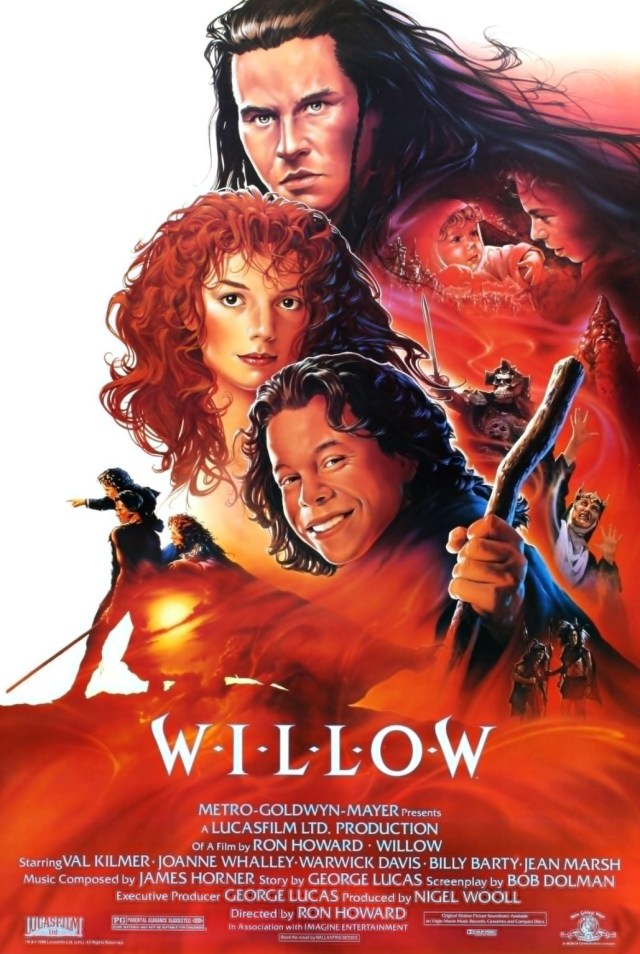
Willow poster created by Metro-Goldwyn-Mayer (MGM), Lucasfilm, and Imagine Entertainment

Before going over his complete list of the worst films from 1988, Gene Siskel introduces the episode’s segment on Willow. He calls the film “a heavy duty and quite dreary production”. I will admit there are darker moments within the story. However, the movie was more humorous than I expected it to be! Most of the humor came from Madmartigan, portrayed by Val Kilmer. Because of the screenwriting and Val’s versatile performance, the comedic timing was effectively executed. One of the funniest scenes in Willow is when Madmartigan and Willow are traveling on a sled down a snowy hill. During this trip, Madmartigan falls off the sled. But instead of being left behind, Madmartigan rolls down the hill, becoming a giant snow ball. When Madmartigan was introduced in Willow as the story’s comic relief, I knew he was going to be a character I would like. His personality, along with the dialogue shared between him and Willow, presented someone who captivated my attention and kept me invested in his story. It also helps that Madmartigan is hilarious, as he is the reason why I burst out laughing several times while watching Willow!

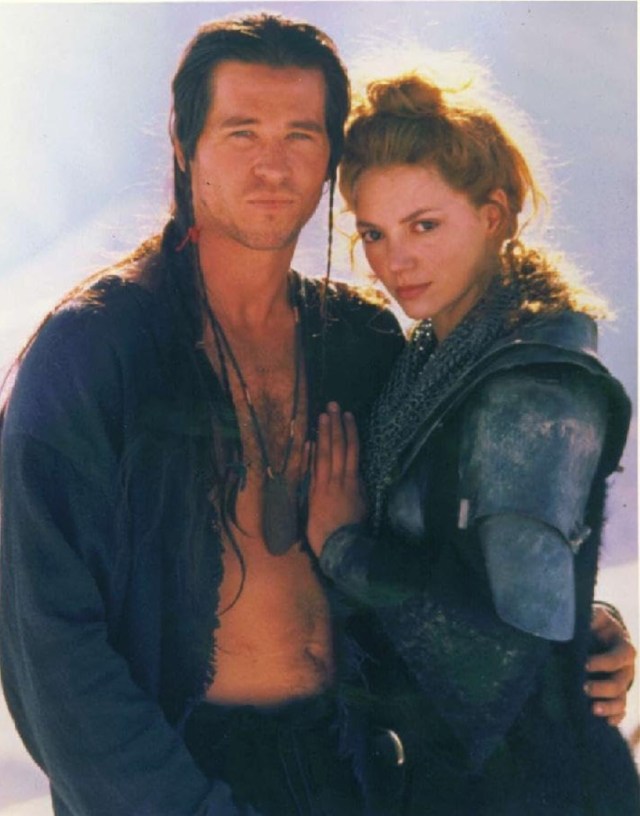
Madmartigan and Sorsha picture created by Metro-Goldwyn-Mayer (MGM), Lucasfilm, and Imagine Entertainment

Gene Siskel is not the only critic who disliked Willow. Though he didn’t put the movie on his list of the worst films of 1988, Roger Ebert expressed his disapproval over how the story seemed similar to Star Wars, claiming children who liked the movie “hadn’t seen it a hundred times before”. I can only speak for myself, but Star Wars never crossed my mind as I watched Willow. But some moments did feel reminiscent of The Wizard of Oz. The film clip included in the Worst of 1988 episode shows Cherlindrea, a fairy queen, revealing to Willow the purpose of his journey. She even gives him a wand to help him accomplish his mission. The scene reminded me of when Glinda explained to Dorothy how she could return home. The iconic ruby slippers became a tool to help Dorothy along her way to Emerald City. Story ideas are bound to get repeated over time. Therefore, moments in Willow feeling reminiscent of The Wizard of Oz didn’t bother me. Instead, it showed me how a film’s creative team can take a familiar story idea and add their own unique perspective on it!

The Barbarians at the Gates Blogathon banner created by Quiggy from The Midnite Drive-In and Hamlette from Hamlette’s Soliloquy

Another criticism Gene had about Willow was the film’s setting, stating “I’m tired of seeing epic pictures set in forests with lots of people running around and, uh, hitting each other over the head”. Personally, I was not bothered by this, as I felt the setting fit the story Willow’s creative team was trying to tell. What did bother me was how the build-up of Madmartigan and Sorsha going from enemies to lovers happened too quickly. Incorporating the “enemies to lovers” trope works in a fantasy story like Willow, where there is at least one battle and a major theme is good versus evil. It should be noted how Val Kilmer and Joanne Whalley had nice on-screen chemistry, as well as Sorsha and Madmartigan appearing photogenic together. I still wish the aforementioned build-up had been more gradual. As the story progressed, Sorsha evolved from villain to hero. Unfortunately, this evolution was too abrupt. While Sorsha’s change of heart gave her some character development, it left some questions unanswered. Perhaps a scene explaining this transformation didn’t find its way into the movie?

Snowy mountain image created by Freepik at freepik.com. <a href=’https://www.freepik.com/free-vector/landscape-background-of-snow-track-and-mountains_968656.htm’>Designed by Freepik</a>. <a href=”https://www.freepik.com/free-photos-vectors/background”>Background vector created by Freepik</a>. Image found at freepik.com.

In past reviews, I criticized films for containing parts of a story that didn’t make sense. Willow is a film that doesn’t avoid this flaw. Bavmorda is the villain of the story. When the heroes attempt to defeat Bavmorda, she uses a spell to transform the heroes into pigs, with Willow and a sorceress named Fin Raziel being the only exceptions. This spell takes place in a short amount of time, with the afflicted heroes becoming pigs all at once. When Fin Raziel reverses the spell, this proves to be a lengthy process, as she uses her magic on one person at a time. This creative choice left me wondering why Fin Raziel wouldn’t use her magic on all the heroes all at once similar to Bavmorda? To me, it didn’t make sense, especially since the heroes didn’t have the luxury of time.

Comparing with the Critics banner created by me, Sally Silverscreen. TV show title cards created by WTTW National Productions, WTTW, Public Broadcasting Service (PBS), Lifetime Television, Tribune Entertainment, Buena Vista Television, and Disney-ABC Domestic Television

During their discussion of Willow in Siskel & Ebert’s Worst of 1988 episode, Roger reminds Gene how, despite the movie’s bad reviews, it became the top selling video and was successful at the box office. Had I seen Willow sooner, I might have contributed to the movie’s statistics. This is another Comparing with the Critics review where I found myself disagreeing with Siskel and Ebert. That’s because I had a genuinely good time watching Willow! I brought up in this review how the project has its flaws. But the story was simplistic and straight-forward, which made it easier to follow what was happening on screen. Even though Willow was the movie’s protagonist, it was Madmartigan who stole the show! In fact, I’d say he was the MVP of this story, as his personality and comedic timing left a good impression. There were moments in the film that felt reminiscent of The Wizard of Oz. However, I saw those moments as ways for Willow’s creative team to bring their own unique perspective to familiar story ideas. I have to say I’m glad I chose to review Willow for this edition of Comparing with the Critics! Now if you’ll excuse me, I have to watch the Siskel & Ebert 1988 Holiday Video Gift Guide episode in the hopes something Willow related can be included in my Movie Blogger’s Christmas Wish List.

This review was brought to you by

Sally Silverscreen

Take 3: Heart of a Stranger Review + 495 Follower Thank You

Here at 18 Cinema Lane, some of my most popular content is Hallmark related. In fact, the top three most viewed articles are two of my Sunset Over Hope Valley re-cap posts and my list of the top ten worst Hallmark movies of all time. This popularity can sometimes overshadow other genres of film as well as other made-for-TV networks. One of those networks is Lifetime. Throughout my six years of blogging, I’ve reviewed Lifetime’s movies so infrequently. So, to kind of make up for that, I selected the 2002 picture, Heart of a Stranger, for this Blog Follower Dedication Review! While I had seen this film years ago, I had vague recollections of it. All I remembered was how the protagonist received heart surgery and that the protagonist and her daughter wanted to see The Nutcracker. Since my last two Blog Follower Dedication Reviews featured films that were new to me, I thought revisiting a picture from yesteryear would be a nice change. Let’s talk about Heart of a Stranger so we can get to the heart of this review!

Heart of a Stranger poster created by Fogwood Films, Von Zerneck-Sertner Films, and Lifetime Television

Things I liked about the film:

The acting: In the introduction of my review, I mentioned how Heart of a Stranger’s protagonist received heart surgery and that the protagonist and her daughter wanted to see The Nutcracker. This story revolves around a mother and daughter’s changing relationship after the mother receives a heart transplant. Jane Seymour’s and Maggie Lawson’s performance created a believable familial relationship. That is what made the crux of the story work. At a local restaurant, Maggie’s character, Amanda, is excited by how her violin performance turned out. Jane’s character, Jill, is proud of her daughter. Their big smiles and warm demeanor are soon followed by changed feelings when Amanda makes a confession to her mother. Jill’s initial confusion transforms into anger as she and her daughter get into an argument. During this argument, Amanda’s frustrations are on full display, from the sharp tone in her voice to her eyes intensely focusing on her mother. Maggie and Jane helped make the scene I just described feel realistic!

Not only did Jane and Maggie create a believable familial relationship, their individual performances are believable as well! A perfect example is when Jill goes to a local car wash. Before the car wash process begins, Jill excitedly tells her daughter over the phone how she’s about to do a mundane task like going to the car wash. The reason for Jill’s excitement is how, before her heart surgery, she used to be too sick to run errands. But as the car wash continues, Jill receives flashbacks she believes are from her heart donor. These flashbacks, along with being in a confined space, cause Jill to become nervous. Her eyes, filled with concern, quickly scan her surroundings. Jill also develops a frown out of worry. Eventually, her emotions get the better of her as she runs out of her car mid-car wash. The scene ends with Jill flinching from a car wash employee. The way Jane used her acting talents to adapt to the changing emotions in that scene was fluid and never missed a beat. Jane and Maggie worked as a team carrying this film!

Amanda’s subplot: Like I previously mentioned, Jill receives a heart transplant. The surgery is not only a success, it allows Jill’s view on life to change. Amanda’s perspective on life is also impacted because of her mother’s newfound health. In her subplot, Amanda is trying to apply for a music conservatory. To prevent burnout and fatigue, she learns a new musical style from performers at a local restaurant. Using music as a compass to guide Amanda’s new journey was, in my opinion, a smart creative choice. Through Maggie’s performance as well as the screenwriting, Amanda’s dedication for her craft turned into motivation to mold her own future! This subplot also gave Amanda character development as she slowly, but surely gained independence.

The honesty surrounding post-surgery: Made-for-TV movies about characters receiving transplants usually build up to the transplant surgery. Because the story’s climax is the aforementioned surgery, there is little to no time to highlight the characters’ life post-surgery. In Heart of a Stranger, Jill’s surgery takes place at the beginning of the movie, with the rest of the film showing Jill adapting to her new heart and health. Throughout the story, Amanda reminds her mother to take her medicine prescribed after surgery. Even though the surgery was successful, Jill follows doctor’s orders to prevent her body from rejecting her new heart. Later in the film, Jill attends a support group with other transplant patients. This part of the story addresses loneliness that could occur after experiencing a major medical transformation. Weaving honesty into Heart of a Stranger presents a more realistic depiction of patients receiving transplant organs. For viewers unfamiliar with this medical process, the movie may give them an idea of what transplant patients may experience.

Heartbeat image created by Freepik at freepik.com. <a href=’https://www.freepik.com/free-vector/medical-logo_763775.htm’>Designed by Freepik</a>. <a href=”https://www.freepik.com/free-photos-vectors/logo”>Logo vector created by Freepik</a>. Image found at freepik.com.

What I didn’t like about the film:

An overshadowed mystery: According to a synopsis I read for Heart of a Stranger, the movie is about Jill trying to solve the mystery of who donated her heart. This is what led me to believe the story would emphasize Jill’s search for her donor. But when I revisited this film, I discovered the creative team chose to prioritize Jill’s new perspective on life after heart transplant surgery. I recognize how important that part of the story is, especially how it connects to the theme of taking advantage of second chances. However, the emphasis on Jill’s new perspective on life not only caused the mystery of Jill’s donor to, sometimes, be overshadowed, it gave the mystery a lack of urgency. While the mystery did get solved, I wish that had been the story’s main focus.

Unresolved parts of the story: As I just said in my previous point, the mystery of Jill’s donor was, sometimes, overshadowed because Jill’s new perspective on life was prioritized. But the aforementioned mystery is not the only overlooked part of the story. After unsuccessfully searching for information on Jill’s donor, Beth, a friend of Jill’s, shares her disapproval with Jill over locating the donor and their family. The rest of the story does not revisit this disapproval, despite showing Beth sharing Thanksgiving dinner with Jill. Later in the movie, Amanda has a fight with her boyfriend, Billy. Since this situation took place toward the end of the movie, there is little to no time to resolve this conflict. The creative team should had taken the time to tie up these loose ends instead of putting most of their eggs in one basket.

Brian’s subplot: One of Jill’s friends is a restaurant manager named Brian. When she visits the restaurant he works for, Brian shares with Jill his dream of starting his own restaurant. He even encourages her to become co-owner of the establishment. Despite this subplot receiving a satisfying conclusion, it was ignored for most of the movie. Even Brian himself made very few appearances in the story. The emphasis of Jill’s new perspective on life prevented Brian’s subplot from receiving a bigger role in Heart of a Stranger.

Blue sparkly Christmas tree image created by Macrovector at freepik.com. <a href=”https://www.freepik.com/free-photos-vectors/frame”>Frame vector created by Macrovector – Freepik.com</a>. <a href=’https://www.freepik.com/free-vector/merry-christmas-card_2875396.htm’>Designed by Macrovector</a>. Image found at freepik.com.

My overall impression:

Before I share my thoughts on Heart of a Stranger, I want to thank all the followers of 18 Cinema Lane! Whenever it’s time to write a Blog Follower Dedication Review, I try to select movies that I feel good about recommending. I would actually suggest this 2002 made-for-TV production as an ‘alternative Christmas movie’. While the story leads up to Christmas, the holiday is not the story’s primary focus. Instead, the film prioritizes a mother and daughter’s life post heart transplant surgery, as well as the mother’s new perspective on life. At best, Heart of a Stranger is a fine, decent movie. The depiction of patients receiving transplant organs is more realistic due to the honesty woven into the story. Maggie’s and Jane’s performance helped create a believable familial relationship. But compared to the types of films Lifetime creates today, especially in the 2020s, Heart of a Stranger is more mundane and pedestrian. This would explain why the network has moved away from creating movies like this one.

Overall score: 7 out of 10

Have you seen Heart of a Stranger? Are there any older Lifetime movies you’d like to see me review? Let me know in the comment section!

Have fun at the movies!

Sally Silverscreen

Take 3: Nelly Knows Mysteries: A Fatal Engagement Review

This month, Hallmark Mystery premiered two new movies; Jazz Ramsey: A K-9 Mystery and Nelly Knows Mysteries: A Fatal Engagement. I did see Jazz Ramsey: A K-9 Mystery, but I found the film underwhelming, as the biggest flaw was how the titular K-9 was barely in the story. To make up for not reviewing that movie, I chose to write about Nelly Knows Mysteries: A Fatal Engagement instead. Months ago, before this film was announced as a Hallmark production, I stumbled upon the official synopsis for Nelly Knows Mysteries: A Fatal Engagement on IMDB. At the time, the story sounded generic. But I was willing to give the film a chance after learning Pascale Hutton and Kavan Smith were the project’s lead actors. Kavan and Pascale are two of the strongest actors in Hallmark’s community. Their on-screen chemistry has been so strong on When Calls the Heart, their characters, Rosemary and Lee, have become fan favorites. The idea of Pascale and Kavan working together on a mystery movie seems like a good idea. But did this good idea come to fruition or did this idea become wasted potential? The only way to find out is by reading my review!

Nelly Knows Mysteries: A Fatal Engagement poster created by Muse Entertainment Enterprises and Hallmark Mystery

Things I liked about the film:

The acting: When introducing a new series, it’s important to establish the relationships between the protagonist and the story’s other characters. These relationships could make or break that introductory film, with interest from the audience determining whether more chapters are created. What helps keep on-screen relationships interesting is the acting abilities of the cast. At the beginning of Nelly Knows Mysteries: A Fatal Engagement, Nelly, portrayed by Pascale Hutton, visits the diner of her friend, Helen, portrayed by Jill Morrison. The scene starts with the friends sharing happy greetings, their warm smiles and friendly tones in their voices express their excitement of seeing each other. But when Nelly sees someone she’s trying to avoid, her smile immediately drops to a look of concern with alertness in her eyes. Helen soon mirrors Nelly’s face with her own look of concern as she quickly gets on the same page as Nelly. Though this scene is short, the acting talents of Jill and Pascale create an on-screen friendship that feels believable!

Nelly Knows Mysteries: A Fatal Engagement adopts the “opposites attract” trope, showcasing Nelly with an energetic, joyful personality and Michael, portrayed by Kavan Smith, with a calmer, yet serious personality that leaves wiggle room for emotion. One scene that presents the “opposites attract” trope perfectly is when, as they’re sharing milkshakes at Helen’s diner, Michael asks Nelly what makes her happy. Nelly shares how she chooses to be happy as she reveals how one of her loved ones passed away. But before she tells Michael about this loved one’s passing, Nelly talks about a happy memory she has with that person. Using a tone of voice that sounds reflective and sometimes gesturing with her right hand, Nelly’s happiness appears gentler, with her smile coming and going. After giving Nelly his undivided attention, Michael looks sad and even a bit concerned. His frown and look in his eyes make Michael almost appear as if he’s adopting Nelly’s sadness.

Nelly’s wardrobe: Whether starring on When Calls the Heart as Rosemary Coulter or appearing alongside Kavan in The Perfect Bride films as Molly, Pascale Hutton’s characters have been given wardrobes that not only compliment Pascale herself, but are also stylishly presented on screen. Nelly’s wardrobe in Nelly Knows Mysteries: A Fatal Engagement is no different, as her attire is classy and sophisticated! When the audience is first introduced to Nelly, she wears a light pink short sleeved shirt paired with tailored navy pants boasting a blue and white pattern. A square-faced watch with a white band is the perfect accessory for this outfit! As she attends a party, Nelly wears another pink outfit. This time, she wears a bright pink tweed jacket with matching pink shirt. Light blue jeans, large gold earrings, and a simple gold heart necklace complete the look!

Addressing a flaw of an amateur detective: Amateur detectives from Hallmark Mystery movies may, sometimes, have a flaw that will either be brushed to the side or will turn into a blessing in disguise for the protagonist. This is one of the ways Hallmark has asked their audience to suspend their disbelief. In Nelly Knows Mysteries: A Fatal Engagement, however, Michael actually points out one of Nelly’s flaws to her. Nelly is upset when someone she knows is arrested. Michael then addresses how Nelly is unable to observe the case’s suspects from an objective perspective. Nelly ends up agreeing with Michael, as she knows she’s seen in her community as someone who looks out for her fellow neighbors. The honesty toward one of Nelly’s flaws added a sense of realism to Nelly Knows Mysteries: A Fatal Engagement!

Diner image created by Freepik at freepik.com. <a href=’https://www.freepik.com/free-vector/american-vintage-restaurant-hand-drawn_902205.htm’>Designed by Freepik</a>. <a href=”https://www.freepik.com/free-photos-vectors/food”>Food vector created by Freepik</a>. Image found at freepik.com.

What I didn’t like about the film:

The contradictions: Nelly Knows Mysteries: A Fatal Engagement incorporates the “everybody knows everyone in a small town” cliché; a story element that, in my opinion, is overused in Hallmark productions. Despite the presence of this cliché, there are some instances where the cliché is contradicted. While creating a mystery board, Nelly and her friend, Fiona, discover one of the residents of Babbleton (where this story takes place) is related to another resident of the town. If everyone in Babbleton knows each other, Fiona and Nelly shouldn’t be surprised by the familial connection of the aforementioned two characters. Earlier in the film, when questioned by Michael about the murder victim, Nelly tells him she’s known the murder victim for years. However, she’s unaware of how neat the murder victim kept their home. Again, if everyone knows each other in Babbleton, Nelly would have known the living conditions of the murder victim.

A misbalanced tone: It’s understandable why Hallmark would avoid making murder mystery stories too dark, as the network has gained a reputation for creating stories that exude coziness and heartwarming charm. In past Hallmark Mystery productions, a balance between tones was achieved by having a murder mystery serve as the film’s main plot while one or two subplots contained more lighthearted situations. The majority of Nelly Knows Mysteries: A Fatal Engagement is coated in a cheerful tone. Prioritizing this lighter tone caused the characters to seem like they didn’t take the story’s mystery seriously. It also created a lack of urgency. There were even times when the movie’s lighthearted tone felt inappropriate, such as when an up-beat jazz tune played while a character was arrested.

A dialogue-heavy story: Dialogue is an important component of any mystery movie, as it can contain clues and other important information. In the case of Nelly Knows Mysteries: A Fatal Engagement, the script was dialogue-heavy. The story was forced to rely on conversations and questioning from Michael to carry the mystery. Non-verbal clues, such as physical objects, were limited because of this creative decision. A dialogue-heavy story also made it difficult, at times, to keep track of characters.

Tools of a writer image created by Freepik at freepik.com. <a href=’https://www.freepik.com/free-photo/camera-and-coffee-near-notebook-and-accessories_2399437.htm’>Designed by Freepik</a>. <a href=”https://www.freepik.com/free-photos-vectors/vintage”>Vintage image created by Freepik</a>. Image found at freepik.com.

My overall impression:

If I could choose a movie that visually represents the concept of “having cake and eating it too”, it would be Nelly Knows Mysteries: A Fatal Engagement. The film’s creative team wanted to include a murder mystery in their story, yet they didn’t want their story’s tone to be too serious. By making their movie mostly lighthearted, the movie itself ended up being a little goofy for my liking. The creative team of Nelly Knows Mysteries: A Fatal Engagement wanted to utilize the “everybody knows everyone in a small town” cliché. At the same time, they didn’t want to commit to the cliché’s consistency. So, the script contradicted the cliché on more than one occasion. Despite these errors I discussed in my review, Pascale Hutton and Kavan Smith still shined bright together! The interactions throughout this movie felt believable, whether it was Nelly visiting Helen at her diner or Michael and Nelly discussing the story’s case. Addressing one of Nelly’s flaws as an amateur detective brought a sense of realism to the script. Within Hallmark’s library of films, there are worse titles than Nelly Knows Mysteries: A Fatal Engagement. However, this film doesn’t stand up to pictures like Curious Caterer: Foiled Plans.

Overall score 6 out of 10

Did you see Nelly Knows Mysteries: A Fatal Engagement? Would you like to see Kavan Smith and Pascale Hutton star in more mystery films together? Tell me in the comment section!

Have fun at the movies!

Sally Silverscreen