Take 3: Matinee Review + 220 Follower Thank You

If you’ve read my recent blog follower dedication reviews, you could tell that I’ve been trying to watch more films from my DVR. This has been a conscious decision, as there are several films that have been there for a year or more. One of those movies is Matinee, as it has been on my DVR since last February. What caused me to record it was how the movie revolved around a movie. Film is a topic that I am very passionate about. Because Matinee was about a subject I’m interested in, it gave me a reason to watch it. While looking back on the movies I’ve reviewed within the past month, I realized that the last film I talked about from the ‘90s was the 1990 adaptation of Cyrano de Bergerac. This is another reason why I chose Matinee for my 220-follower dedication review, as the movie was released in 1993. Before I start this review, I’d like to thank all of my followers! I’m incredibly grateful for the success this blog has achieved!

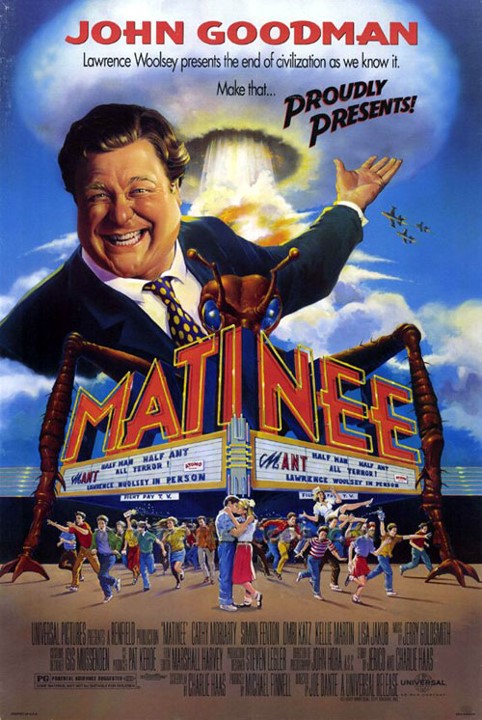
Matinee poster created by Universal Pictures. Image found at https://www.imdb.com/title/tt0107529/mediaviewer/rm2632269312.

Things I liked about this film:

The acting: Any time I have seen one of John Goodman’s movies, I have noticed how his character has a larger-than-life personality. Even when John was voice-acting as Sully from Monsters, Inc., that character’s personality was very jovial and memorable. When it comes to John’s performance in Matinee, Lawrence Woolsey also had a larger-than-life personality. The persona that John brought to his role was commanding, allowing the audience to focus on him whenever he came on screen. His performance was not only consistent in this film, but it also plays a consistent part in John’s acting career. It’s nice to see actors you recognize from one movie appear in another one. Omri Katz and Kellie Martin are two good examples of this. I’m familiar with Omri because of his performance in Hocus Pocus. Kellie Martin’s small-screen work is what I have seen from her filmography. Watching Omri and Kellie’s performance in Matinee was a joy to watch! They had good on-screen chemistry and both of their portrayals were convincing!

The historical accuracy: The story of Matinee takes places during the 1962 Cuban Missile Crisis. Because of this, the presentation of the film needs to reflects that moment in history. The historical accuracy in this movie was executed so well, I felt like I was transported to 1962. All of the costumes looked like the wardrobe you’d see on a typical episode of The Andy Griffith Show. Cars from that time period can be seen cruising down the street, sporting color palettes that are not often seen on today’s roads. Lawrence’s sea green convertible with matching interior is one example. Even the music set the tone for that environment. When Sherry’s ex-boyfriend, Harvey, returns to town, The Angels’ song, “My Boyfriend’s Back” is heard. Even though this song was released in 1963, the overall sound reflects the soundtrack of that period in time.

The special effects: I was not expecting the creative team behind Matinee to incorporate any special effects into their project. However, these special effects were impressive! They were mostly used during the presentation of Lawrence’s movie, Mant! At certain points in the fictional film, smoke and flashing lights could be seen. Matinee’s climax boasts even more eye-catching effects! In one scene, a section of the theater is being destroyed. During this moment, the theater rumbled as flames engulfed the background. The way these effects came together made this destruction look so real! They also looked very good for a movie released in 1993!

Relevant ideas: I was surprised to find ideas within this story that are just as relevant in 2020 as they were in the ‘90s or even the ‘60s. When Gene and Stan pass by their local grocery store, they see patrons shopping in panic. These patrons grab everything in sight, with one woman buying as much toilet paper as she can carry. While the Cuban Missile Crisis and the Coronavirus are two completely different events, both of them have caused a large group of people to panic. Toward the beginning of the Coronavirus, grocery stores were witnessing the fear their customers carried. The situation became so dire, there were reports about people fighting over toilet paper.

Theater seats image created by weatherbox at freeimages.com. “FreeImages.com/weatherbox.”

What I didn’t like about the film:

Under-utilized characters: I found some characters in Matinee to be under-utilized more than others. One of them was Gene’s brother, Dennis. From a historical fiction perspective, I understand that Dennis is meant to show how younger children might have responded to an event like the Cuban Missile Crisis. But from the perspective of Lawrence’s movie presentation, I asked myself why Dennis was in the story at all? This makes me wish this particular character had received his own subplot.

Weaker subplots: A few of Matinee’s subplots were either too straight-forward or didn’t lead anywhere. A perfect example involves two of Lawrence’s employees, who pose as a special interest group attempting to ban his movie. Like Dennis’ presence in Matinee, I understand that this part of the narrative contains historical context, showing how some people choose to publicly dislike something to the point of protest. But after they interact with Harvey, these employees disappeared from the film. They didn’t receive a satisfying resolution and were forgotten about as the movie progressed.

Coming soon movie image created by Macrovector at freepik.com. <a href=”https://www.freepik.com/free-photos-vectors/background”>Background vector created by macrovector – http://www.freepik.com</a>. Image found at freepik.com.

My overall impression:

Anyone who knows me knows that Phantom of the Megaplex is my favorite Disney Channel movie. It showed me how movies, as well as the movie-going experience, can be fun. Even though Matinee was released seven years prior, it reminded me a lot of the 2000 picture. They happen to share similar ideas, some of them beyond the subject of film. This is one of the reasons why I enjoyed Matinee so much! It was funny and, at times, clever, with relevant ideas woven into the story. The film also had solid components, like the acting and special effects. Most important is how Matinee was fun! In a year when so much has happened, movies can play a role in providing a form of escapism and making viewers feel like they can conquer something, even when events in their world are beyond their control. Before the presentation of Mant!, Lawrence explains to the theater employees why it’s important to release his movie at that given time. He tells them that, despite scary things appearing in his picture, he wants to remind his audience that everything is going to be ok. Lawrence also shares that he wants to remind his audience that his film’s villain can be defeated.

Overall score: 8.5 out of 10

Have you seen Matinee? What movies involving movies have you enjoyed watching? Let me know in the comment section!

Have fun at the movies!

Sally Silverscreen
Take 3: Alphaville Review

For July’s Genre Grandeur, the theme is “French Film Noir”. Originally, I was going to review a film released within the Breen Code Era, as I’ve been participating in Pure Entertainment Preservation Society’s Clean Movie Month. But anytime I searched for a French film noir title that premiered between 1934 and 1954, the movie was either too expensive to purchase or unavailable to rent. So instead, I chose to review the 1965 film, Alphaville, as I was able to rent it. In my review of Alice in the Cities, I said that out of all the movies I’ve seen and/or reviewed that were created outside of North America, most of them came from Europe. The majority of these films were released from France. While researching Alphaville, I learned that the movie is labeled as a science fiction story. As someone who has seen both film noir and sci-fi movies, I was curious to see what a story with this specific genre combination would look like.

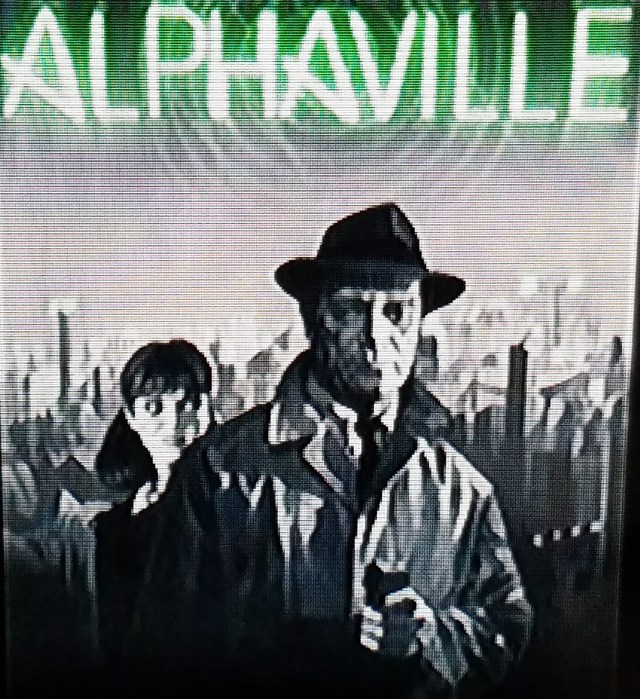
Since I saw a picture of the film’s poster on my television, I decided to take a screenshot of it. Screenshot taken by me, Sally Silverscreen.

Things I liked about the film:

The acting: Because I’ve seen a limited number of French films, I wasn’t familiar with these actors and actresses. However, I thought the acting performances in Alphaville were good! Eddie Constantine’s portrayal of Lemmy Caution reminded me of the performances I’ve seen from John Wayne. What I mean by this is Eddie presented his character with a tough and masculine exterior, but allowed emotion to break through that exterior. He also adopted a “no nonsense” attitude that worked for a story of this nature. Anna Karina also gave a performance that worked for this story! She incorporated a gentleness to her portrayal of Natacha von Braun. This can be heard through her soft-spoken voice and seen through her caring nature. Throughout her performance, Anna displayed emotions in a subtle way. In one scene, when Lemmy is being arrested, Natacha can be seen crying as silently as possible. Despite appearing in the film for less than five scenes, I liked watching Akim Tamiroff’s portrayal of Henri Dickson! The best part about it was how believable it was. A good example of this is any time Henri was experiencing a heart attack, as pain could be seen in his face.

The cinematography: There were some scenes in Alphaville that were shot in interesting ways! This was accomplished by applying various film-making techniques. When Lemmy was walking to a particular location, a continuous shot followed Lemmy to his destination. A perfect example can be found toward the beginning of the film, when Lemmy is being led toward his hotel room. For scene transitions, flashing lights were incorporated to signify a bridge between scenes. After Alphaville’s computer, Alpha 60, is finished explaining one of the city’s many beliefs, a neon sign of a math equation flashes until a scene involving Lemmy begins. Toward the end of the movie, some scenes were presented using an infrared light. This was to show a glitch in Alphaville’s technological system.

The film’s sci-fi world: When most people think of the science fiction genre, fantastical worlds with elaborate costumes, set designs, and makeup are usually what come to mind. For Alphaville, the creative team purposefully chose to film in real-life locations. This decision causes the titular city to appear grounded in reality. The science fiction elements of this story were woven into the behaviors of the citizens and the beliefs they hold. Using what they already had to create a science fiction narrative allowed the movie’s creative team to submit a film that goes against the genre’s norm.

Magnifying fingerprints image created by Balintseby at freepik.com. <a href=”https://www.freepik.com/free-photos-vectors/glass”>Glass vector created by Balintseby – Freepik.com</a>. <a href=’https://www.freepik.com/free-vector/fingerprint-investigation_789253.htm’>Designed by Freepik</a>. Image found at freepik.com.

What I didn’t like about the film:

The film’s science fiction ideas: In a typical science fiction film, the sci-fi ideas are presented as understandable enough for the audience to know what’s happening on screen. This was unfortunately not the case for Alphaville. The ideas associated with this story were so high-concept and complex, that I found myself not understanding what the characters were talking about most of the time. It also doesn’t help that the characters fail to provide clearer explanations for these ideas. This feels like the creative team expected the audience to know what was being discussed before they saw the movie.

Lack of context: In my review of The Crow, I talked about how questions emerged without an answer or an elaboration being provided. This is the exact same mistake that the creative team behind Alphaville made. The majority of female characters in the 1965 picture can be seen with number tattoos. No context is given for why they have this type of tattoo or the meaning behind the tattoo itself. In one scene, Lemmy and Natacha are attending a gathering where people who disobey Alphaville’s beliefs are being punished. Natacha explains how there are more men than women who get punished at these gatherings. She never gives further explanation for why this is the case. Because of the lack of context, it adds to the story’s overarching confusion.

No sense of urgency: Film noir movies usually have a slower pace. This is done on purpose to flesh out the overall story. However, there is an underlying sense of urgency. While watching Alphaville, I could not detect any amount of urgency in the story. For most of the film, Lemmy could be seen in his hotel room, roaming around the city, or visiting the Alpha 60 headquarters on rare occasions. Even though he resolves the film’s conflict, this doesn’t happen until about the last twenty minutes.

Colorful galaxy image created by Freepik at freepik.com. <a href=’https://www.freepik.com/free-vector/lovely-hand-drawn-galaxy-background_2943080.htm’>Designed by Freepik</a>. <a href=”https://www.freepik.com/free-photos-vectors/background”>Background vector created by Freepik</a>. Image found at freepik.com.

My overall impression:

I like participating in Movierob’s Genre Grandeur blogathon because it gives me an opportunity to see films that I may not have watched otherwise. This is certainly the case for this month’s selection, Alphaville. A combination of sci-fi and film noir was something I hadn’t seen before. But I found it to be an interesting contribution to both genres. The world presented in this story is not always found in sci-fi narratives. Bringing a newer idea to the table is what basing the world in a more realistic setting did. Cinematography was also a highlight of this project. It gave the film’s creative team a chance to experiment with different film-making techniques. However, the overall story was just ok. This was caused by confusing science fiction ideas and a lack of context. The majority of content from this story flew over my head, as I didn’t understand what the characters were talking about most of the time. I was frustrated by the overall project because I wasn’t able to grasp the concepts within Alphaville.

Overall score: 6.1 out of 10

Have you seen any French film noirs? Are there any movies from this specific genre you’d like to see me review? Please tell me in the comment section!

Have fun at the movies!

Sally Silverscreen
Take 3: Little House: Bless All the Dear Children Review

This movie review was written before July 12th

Last year, I participated in Drew’s Movie Reviews’ Christmas in July Blogathon for the first time. My submission was about the Hallmark film, Christmas Camp. Unfortunately, the film was not as good as I had hoped it would be. For this year’s Christmas in July Blogathon, I already had my film selected before the event was officially announced. But this time, I decided to step away from Hallmark and expand my cinematic horizons. Recently, UP Network aired Little House: Bless All the Dear Children. Since I hadn’t seen this movie before, but had seen the show on multiple occasions, I chose this film for the Blogathon! Little House on the Prairie is a show that my family has enjoyed watching. In fact, I’ve talked about my favorite episode, “The Wild Boy” Part 1 and 2, in the editorial, “Bucky Barnes and Matthew Rogers: Paralleling Stories of Disability”. After the show ended in March of 1983, the creative team behind Little House on the Prairie created three films to tie up loose ends and give beloved characters a proper send-off. Little House: Bless All the Dear Children was the last of these three to be released.

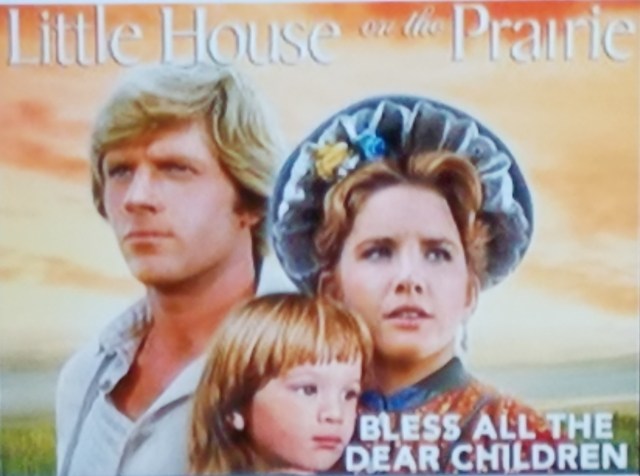
I tried to find a more Christmas-y poster for this movie, but was unsuccessful in my search. So, as the next best thing, I took a screenshot of the film’s poster from my television. Screenshot taken by me, Sally Silverscreen.

Things I liked about the film:

The acting: Throughout the show’s lifespan, Little House on the Prairie was blessed to receive a strong starring cast. Even as actors came and went, the quality in acting never faltered. Most of the main actors from the show also appear in Little House: Bless All the Dear Children. Because of this, the consistency in the acting quality was maintained. The regular actors from the show appeared comfortable in their roles. It was also nice to see familiar faces and fan favorites. While I enjoyed watching the performances from the main cast, there were two performances from newcomers of the show that I found to be the most memorable. The first one came from Patricia Pearcy. In the movie, she portrayed Elsa, a mother who is mourning the loss of her baby. What I liked about her performance was the emotional range that was found. Toward the beginning of the film, Elsa learns about the fate of her child. This ends up being one of the most powerful scenes, as Patricia brings the emotional weight a moment like that requires. The second performance was Joel Graves’. He portrayed Samuel, a young orphan from Mankato. Anytime he was on screen, Joel had a sweet personality, which gave his character a likable persona. Samuel brought so much joy to the story, as he was an adorable and kind-hearted child.

The messages and themes: Within their nine seasons, Little House on the Prairie has incorporated important messages and themes into their episodes. These messages and themes have come in various forms, from exploring the horrors of child abuse in “The Wild Boy” Part 1 and 2 to showcasing the value of human life in “Times Are Changing” Part 1 and 2. Little House: Bless All the Dear Children also contains messages and themes that not only fit in the context of the series, but also in the context of Christmas. When Mr. Edwards asks Mr. Montague if he’d like any Christmas presents, Mr. Montague declines this offer, as he feels that Christmas has become materialistic. The idea of the commercialization of Christmas is just as relevant today as it was in 1984, the year this film was released. It also reminds the audience of the holiday’s original purpose.

The humor: Even though there are moments on the show where serious situations take place, Little House on the Prairie also contains moments of joy and laughter. The humor on this program is both wholesome and well-written. It is not only consistent on the show, but it also finds a place in Little House: Bless All the Dear Children. During the Christmas season, Nancy is responsible for finding the perfect Christmas tree for her family. She eventually locates one in the front yard of her family’s property. The hilarious part of this situation is that Nancy chooses the tallest tree she can find, causing the tree to crash through a window into her family’s living room! This moment reminded me of when Stephanie, from Full House, crashed a car through her family’s kitchen because she thought the “R” on the car’s control pad meant “radio” instead of “reverse”.

Christmas in July Blogathon 2020 banner created by Drew from Drew’s Movie Reviews. Image found at https://drewreviewmovies.wordpress.com/2020/06/16/announcing-the-christmas-in-july-blogathon-2020/.

What I didn’t like about the film:

Christmas spirit’s inconsistency: In most Christmas films, the spirit of Christmas can be felt throughout the story. In fact, there are times when it radiates off the screen. With Little House: Bless All the Dear Children, however, the Christmas spirit doesn’t feel consistent in the overall story. Some parts of the movie contained a strong sense of this spirit, like the narrative involving Jason trying to spread Christmas cheer. But Christmas spirit felt like an after-thought in the majority of the main plot, where Mr. Edwards, Almanzo, and Laura search for Rose. This made the narrative seem like it could have taken place in any time of year without making much of a difference.

Too many narratives: Little House: Bless All the Dear Children featured a total of six narratives. I understand that an end-of-series movie is meant to tie up story-related loose ends. But because of the screen-writer’s decision to squeeze as many sub-plots into the film as possible, it caused some of the narratives to feel under-developed or there for the sake of being there. A good example is Mr. Montague’s narrative, where it revolved around his views on Christmas. While it wasn’t a bad idea for a sub-plot, it didn’t really lead anywhere. Another example is Nancy’s narrative, where she is put in charge of picking out the Oleson family Christmas tree. Like Mr. Montague’s sub-plot, it didn’t lead anywhere. It also didn’t do any favors for Nancy’s character development or serve the overall story. If anything, it seems like she received her own narrative because she had appeared on the show for two seasons.

A quick and easy resolution: The main conflict in Little House: Bless All the Dear Children has been featured on the show before. In the season four episode, “My Ellen”, Laura gets kidnapped by her grieving neighbor shortly after their daughter passes away. Personally, I think the situation was dealt with better in that episode than in this Christmas movie. During her escape in the aforementioned episode, Laura leads her neighbor to their daughter’s grave to help them face their grief and realize the reality of the situation. In Little House: Bless All the Dear Children, Elsa’s grief and the seriousness of Rose’s kidnapping are glossed over when the conflict is resolved. I know that whenever a conflict arises on Little House on the Prairie, it is dealt with in a wholesome way. But it seemed like the situation was handled as easily and quickly as possible just to move on to the next narrative. I was also surprised that Laura didn’t disclose her kidnapping in relation to her daughter’s predicament. Had she brought up this past experience, it would have promoted the show’s continuity and helped Elsa face her grief.

Adorable Christmas card image created by Rawpixel.com at freepik.com. <a href=’https://www.freepik.com/free-vector/christmas-greeting-card-vector_2824854.htm’>Designed by Rawpixel.com</a>. <a href=”https://www.freepik.com/free-photos-vectors/christmas”>Christmas vector created by Rawpixel.com – Freepik.com</a>. Image found at freepik.com.

My overall impression:

Little House on the Prairie is a show that has stood the test of time. Its wholesome programming, relatable messages, and memorable characters have won over the hearts of fans for decades. Little House: Bless All the Dear Children is an example of why people have fallen in love with this show. The consistency in acting and the lessons instilled on the audience help keep the tone of the show intact. Even though the movie had its strengths, I feel this particular story would have benefitted as a two-part episode. Smaller narratives, like Mr. Montague’s perspective on Christmas, could have been taken care of in one episode. The story of Rose’s kidnapping would have been the overarching narrative of both episodes. This choice would have also given the creative team more time to explore Elsa’s grief and reach a satisfying resolution to the episodes’ main conflict. Little House: Bless All the Dear Children is a fine and enjoyable film. Personally, I would have loved to see Matthew Rogers perform “O Holy Night” in sign language during Christmas Mass. But I guess we can’t always get what we want.

Now we’ve come to the part of this review where I select a guest for Drew’s Christmas Party. This year, I have selected Anjanette Abayari. I first became aware of her existence when I watched the music video for the Timmy T. song “One More Try”. I haven’t seen her other acting work and I don’t know much about her. But, based on what I read, it seems like she has experienced some serious situations in her life. The reason why I chose Anjanette for Drew’s Christmas Party is so she can, hopefully, receive more recognition than she may be currently receiving!

Overall score: 7.4 out of 10

Have you watched Little House on the Prairie? If so, what is your favorite episode? Share your thoughts in the comment section!

Have fun at the movies!

Sally Silverscreen

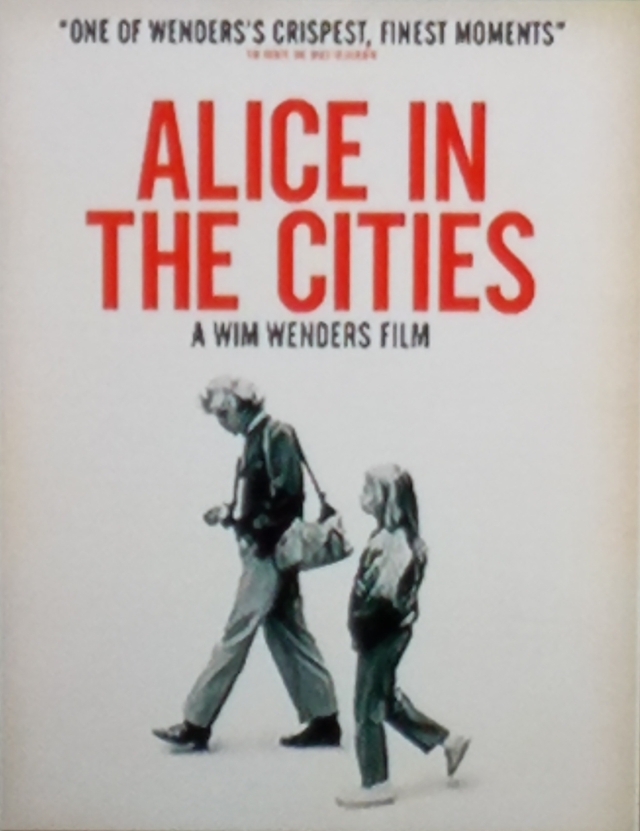
Take 3: Alice in the Cities Review + 210 & 215 Follower Thank You

Three weeks ago, 18 Cinema Lane received 210 followers! Because I was in the middle of coordinating my PB & J Double Feature and reviewing films for Pure Entertainment Preservation Society’s Clean Movie Month, I postponed my 210-follower dedication review. During that time, my blog also received 215 followers! This caused me to combine my 210 and 215 follower dedications into one review. Since last March, I’ve had a recording of Alice in the Cities on my DVR. As you can tell by the title of this post, this is the film I have chosen to write about. Every so often, I try to watch and/or review a movie that was created outside of North America. Most of these films have come from Europe. Prior to watching Alice in the Cities, the only German film I’ve written about on 18 Cinema Lane was Nosferatu. What’s interesting is how, like the 1922 movie, Alice in the Cities was restored as a result of two different versions of the project. According to a message at the beginning of the film, the movie was filmed in two separate millimeters.

This is a screenshot of the poster I took with my phone that happened to be featured on my television. Screenshot taken by me, Sally Silverscreen.

Things I liked about the film:

The acting: According to an article from Turner Classic Movies’ (TCM’s) website, Wim Wenders, the director of Alice in the Cities, was inspired to create this film after watching Rüdiger Vogler and Yella Rottländer perform together in a previous project. Having these two actors reunite for Alice in the Cities was a smart decision! I liked Rüdiger’s portrayal of Philip because it was consistent. Not only that, but he had a coolness about him as his character moved from one scene to the next. No matter what scenario was thrown in his path, Philip was calm and collected. This made Rüdiger’s performance appear effortless! Something that I noticed while watching Yella’s performance was how believable it was. Whether she was questioning Philip’s “scribbles” or asking for food, Yella’s body language, facial expressions, and overall demeanor appeared as one would expect from a child in Alice’s particular situation. It also helps that Yella worked with Wim and Rüdiger prior to this movie. Because of this, Yella appeared comfortable in the role she was given!

The cinematography: Alice in the Cities is filmed in black-and-white. This was done not only because of a personal decision by the director, but also to avoid having Alice in the Cities be compared to Paper Moon, a movie that was released a year before Wim’s project. When film fans think about black-and-white movies, productions that were released before 1965 will likely come to mind. However, it’s important to remember those titles were presented in black-and-white because filming in color was rarely an option. With Alice in the Cities, its presentation was purposefully chosen, which proved to be more interesting than I would have expected. It caused the story to be frozen in time, allowing the narrative to serve as a time-capsule. Having a few characters appear on screen at a given moment makes each interaction feel intimate, like the audience is directly a part of these verbal exchanges. I also liked how some scenes looked like the view came straight from Philip’s perspective. One great example is when Philip is boarding a train in Amsterdam.

Philip and Alice’s interactions: The majority of this story revolves around Philip’s search for Alice’s grandmother, which results in Philip and Alice spending a significant amount of time together. As I mentioned before, Rüdiger and Yella had worked together in a previous film. This helped their interactions come across as realistic. In the aforementioned TCM article, one of Wim’s inspirations for Alice in the Cities was his friend, who happened to be a single parent. This explains why Philip and Alice’s interactions feel like they are between father and daughter. Because of the quality of their acting abilities, Rüdiger and Yella were able to bring this idea to life in their performance! They were also able to equally carry the film.

Map of Germany image created by Macrovector at freepik.com. Background vector created by macrovector – www.freepik.com. Image found at freepik.com.

What I didn’t like the film:

Scenes feeling like padding: There were some scenes in Alice in the Cities that ended up feeling like padding. One example is when Philip and Alice go to an ice cream shop. Within this scene, a shorter scene of a child eating their ice cream next to a juke box is included. This scene didn’t serve the overall story and felt like it was there just to be there. Personally, I think scenes like the shorter one I mentioned should have been cut from the film.

The run-time: IMDB lists Alice in the Cities with a run-time of one hour and fifty minutes. To me, this caused the movie to feel a bit too long. Like I previously stated, there were scenes in this film that felt like padding. Their purpose seemed to be that of satisfying this run-time. The story itself was also straight-forward. These two factors made me believe that, at least, ten minutes of this movie could have been shaved off.

An inconsistent exploration of Philip’s beliefs: At certain points in Alice in the Cities, Philip expresses his beliefs about topics like his dislike toward television and why he takes photos. Philip presents an interesting way of looking at things that most people wouldn’t think twice about. Unfortunately, these beliefs were not explored to a satisfying extent. As the story places a primary emphasis on Philip’s search for Alice’s grandmother, this exploration gets lost in the shuffle. It also creates an inconsistent inclusion of this part of the story.

New York City skyline with letters image created by Freepik at freepik.com. <a href=’https://www.freepik.com/free-vector/new-york-skyline-typographic-silhouette_719554.htm’>Designed by Freepik</a>. <a href=”https://www.freepik.com/free-photos-vectors/background”>Background vector created by Freepik</a>. Image found at freepik.com.

My overall impression:

Turner Classic Movies (TCM) features an interesting article about Wim Wenders and the creation of Alice in the Cities. After reading about Wim’s personal struggles as a filmmaker and after learning about this film’s restoration efforts, it makes me glad that Alice in the Cities was able to see the light of day! Movies involving road trips usually don’t interest me. But because of Rüdiger Vogler and Yella Rottländer’s performance, I found myself invested in the journey of their characters! Creative cinematography and addressing Philip’s beliefs also help make this film likable and well-made. Even though Alice in the Cities is a fine film, there were things about it that prevented the overall project from being better. The main plot didn’t allow Philip’s beliefs to be explored to their fullest extent. It also doesn’t help that some scenes felt like padding. However, I’m thankful to have been given the opportunity to share this film with my followers! Thank you for helping 18 Cinema Lane reach these milestones! This blog would not be the same without you!

Overall score: 7.4 out of 10

Have you seen any movies created outside your home country? If so, what was your movie-viewing experience? Share your thoughts in the comment section below!

Have fun at the movies!

Sally Silverscreen
Here’s a link to the article from Turner Classic Movies that I mentioned in my review:

http://www.tcm.com/this-month/article/719889%7C0/Alice-in-the-Cities.html

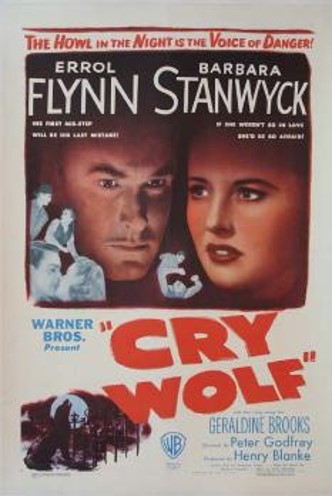
Take 3: Cry Wolf Review (Clean Movie Month #4)

When I joined Pale Writer’s Barbara Stanwyck Blogathon, I had never seen any of Barbara’s movies. Despite this, I had heard good things about her as an actress. For my submission, I knew I wanted to review one of Barbara’s films from the Breen Code Era. Because I signed up for this blogathon and the Clean Movie Month Blogathon, which both take place in July, I figured it’d be the best of both worlds! After searching through her filmography and seeing the choices of the other participants, I chose the 1947 picture Cry Wolf! It’s no secret that mysteries are a staple on 18 Cinema Lane. In fact, the most popular review on my blog is for Hailey Dean Mysteries: A Will to Kill, which has over a thousand views! When I read the synopsis for Cry Wolf, I knew I had to select it for the blogathons. It sounded like a mysterious retelling of Frankenstein, which would be an interesting concept to explore during the Breen Code Era. What did I think of this film? That mystery will be solved when you read this review!

Cry Wolf poster created by Warner Bros. and Thomson Production. Image found at en.wikipedia.org/wiki/File:Crywolf1947.jpg

Things I liked about the film:

The acting: As I said in the introduction, I had never seen any of Barbara’s films prior to Pale Writer’s blogathon. Therefore, I didn’t really know what to expect from her performance in Cry Wolf. What stood out in Barbara’s portrayal of Sandra was how confident she appeared! In every scene, she seemed sure of herself, never letting doubt stand in her way. When Sandra interacted with Julie, she took charge of the situation and displayed a sense of leadership. Speaking of Julie, I enjoyed seeing Geraldine Brooks’ portrayal of this character! It reminded me of the performances of Judy Garland, where she is presented as acting like her age with a dose of innocence. This can be seen when Julie meets Sandra for the first time. Errol Flynn’s performance was consistent throughout the film! His portrayal of Mark always had a sinister undertone, giving away the impression he was always enveloped in a cloud of suspicion. This character fit within the nature of the project because of what Errol brought, talent-wise, to the role.

The atmosphere: Because Cry Wolf is classified as a mystery film, the overall atmosphere is going to be darker in tone. It should also be noted that the atmosphere was consistent throughout the project. This was accomplished through a collection of film-making techniques. One of them is the use of shadows. In scenes that were more mysterious, shadows could be seen on the walls. The scene where Sandra and Julie make their initial trek to the lab is a great example of this, as the audience can see Sandra’s shadow on the wall in the hallway. Another technique involves music. Scenes with sinister undertones featured orchestral tunes that sounded ominous. It really matched the tone the movie’s creative team was striving for!

The interior design: The majority of this story takes place inside the Caldwell-Demarest family home, with the interior design effectively matching the wealth of the family. A noticeable design choice was the wrap around balcony overlooking the foyer. Some homes feature one balcony section that looks down on a particular room. The fact that the balcony in Cry Wolf was larger than one section showcases how expansive this space is. Wood was a prominent material found in the interior design. It not only served as wall paneling; it was also used as detailed crown molding in the library. Even though the kitchen was only in one scene, the detailed art on the walls made it a memorable space. The overall design within this location enhanced the visual appeal of the house!

The Queen of Sass: Barbara Stanwyck Blogathon banner created by Pale Writer from Pale Writer. https://palewriter2.home.blog/2020/06/20/announcing-the-queen-of-sass-barbara-stanwyck-blogathon/

What I didn’t like about the film:

Julie’s relationship with Ronnie: One of the components of Julie’s subplot involved a secret relationship with a young man named Ronnie. This part of her story was meant to correlate with her feelings of isolation and entrapment. However, it seemed like it was there for the sake of being there. The relationship didn’t lead anywhere and Ronnie was never mentioned again after Julie’s interaction with him while horse-riding. It makes wonder why it was included in the story at all?

Mark’s attempts to charm Sandra: There were a few moments in Cry Wolf where Mark attempts to charm Sandra. To me, these attempts felt out of character for him. Throughout the film, Mark uses influence and control to gain power. When it comes to Sandra, however, he ends up overstepping boundaries. During one conversation, Mark kisses Sandra. She responds appropriately by expressing displeasure and slapping him in the face. It’s as if he completely forgot that Sandra was still mourning her husband.

An unclear resolution: I’m not going to spoil Cry Wolf if you haven’t seen it. But I will say I found the mystery’s resolution to be unclear. The film presents one idea of what happened. Several scenes later, an unreliable source shares another idea of the mystery’s outcome. As the film wraps up, the resolution is not given any explanations. However, I’m not sure if this creative decision was intentional.

Clean Movie Month banner created by Tiffany and Rebekah Brannan from Pure Entertainment Preservation Society. Image found at https://pureentertainmentpreservationsociety.wordpress.com/2020/07/01/cleanmoviemonth2020-is-here/.

My overall impression:

I’m glad I chose Cry Wolf as my introduction to Barbara Stanwyck’s filmography! It was a good film that allowed me to stay invested from start to finish! This was helped by the inclusion of solid acting performances, a consistent atmosphere, and great interior design. While these are components that strengthened the project, the movie also had flaws that held it back from being better. One of these flaws is an unclear resolution, which was unexplained by the end of the film. But, as I said in my review, this choice might have been intentional. Like I said about Goodbye, Mr. Chips and The Wife of Monte Cristo, Cry Wolf is a Breen Code friendly film. However, there was one aspect I was surprised to see. In one scene, a deceased body was shown on screen. As I said in my review of The Wife of Monte Cristo, a death would usually be implied.

Overall score: 7.9 out of 10

Have you seen any of Barbara Stanwyck’s movies? If so, which one is your favorite? Let me know in the comment section!

Have fun at the movies!

Sally Silverscreen

Take 3: Little Lord Fauntleroy (1936) Review (Clean Movie Month #3)

When I signed up for Pure Entertainment Preservation Society’s Code Classics Blogathon in June, I hadn’t publicly submitted the film I wanted to review. That’s because I planned on reading the source material before watching the movie. Originally, I was going to read Black Beauty and then see the 1946 adaptation of this story. Unfortunately, I wasn’t able to set aside time to read the book. Also, the 1946 version of Black Beauty was unavailable for rent. I then decided to watch a version of The Count of Monte Cristo that was released during the Breen Code Era. However, the only adaptations that were available for rent were the 2002 and the 1975 version. Then I remembered how I’ve always wanted to read Little Lord Fauntleroy by Frances Hodgson Burnett. I was happy to discover I was able to rent the 1936 adaptation! In my life, I have read A Little Princess and The Secret Garden. Having enjoyed both books, I was interested in hearing a similar story from a male perspective. How different would Ceddie be from Sara and Mary? Would his story contain any similarities with the two aforementioned novels? While I haven’t read Little Lord Fauntleroy yet, I wasn’t going to miss out on seeing this story come to life on screen!

Little Lord Fauntleroy poster created by Selznick International Pictures, United Artists, and Walt Disney Studios Motion Pictures. ©Disney•Pixar. All rights reserved. Image found at en.wikipedia.org/wiki/File:Little-Lord-Fauntleroy-Poster.jpg

Things I liked about the film:

The acting: I’ve said before on 18 Cinema Lane that performances from young actors and actresses can be hit or miss. However, Freddie Bartholomew’s portrayal of Ceddie was a hit! The way this character carried himself was mature for his age without being too precocious. At the same time, Ceddie had the type of kind-heartedness you’d expect from a young character. The mannerisms and facial expressions Freddie adopted reminded me of Sara from A Little Princess, making me believe that Ceddie and Sara probably would have been good friends! Even though her presence in the film was limited, Dolores Costello Barrymore gave a memorable performance as Ceddie’s mom, Dearest! Her emotions gave the audience a glimpse of how her heart is always in the right place when it comes to looking out for her son. In one scene, Dearest is telling Ceddie that he’ll have to stay with his grandfather. This moment showcases how she continually shields her child from the animosity between her and the grandfather. Also, this scene highlights her ability to put Ceddie’s needs before her own, telling him she’ll place a candle in the window so the light will always guide his path.

The music: While watching Little Lord Fauntleroy, I noticed how the background music always fit the tone of its respective scene. One great example is when Ceddie receives a bicycle for his birthday. A tune from a music box could be heard, indicating how this is a happy occasion. Whenever Ceddie’s grandfather is mentioned, the audience can hear orchestral music. The music itself sounded regal, highlighting how important this character is. Somber music was found in sadder scenes, like when Mr. Hobbs and Dick are missing their friend, Ceddie. This consistent detail shows how the film’s creative team cared about what their audience saw and heard.

The messages and themes: The famous works of Frances Hodgson Burnett are known for having good messages and themes that audiences of all ages can appreciate. Little Lord Fauntleroy is no different. Throughout the movie, Ceddie always put others before himself. When his grandfather’s lawyer asked him how he’d use his newfound wealth, Ceddie tells him that he would purchase gifts for his friends, as a way to improve their lives. At a party, when one of his grandfather’s friends offers Ceddie a puppy, Ceddie turns the offer down by saying that he doesn’t want to hurt the feelings of his new K-9 friend, Duke. These examples display the messages of selflessness and staying true to yourself in any circumstance. Prejudice is an overarching theme that is found in this story. Ceddie’s grandfather does not like Americans, which created animosity between him and Dearest. The more time the grandfather spends with Ceddie, his negative beliefs begin to change. The grandfather’s part of the story shows how prejudice can hurt people, especially families.

Code Classics Blogathon banner created by Tiffany and Rebekah Brannan from Pure Entertainment Preservation Society. Image found at https://pureentertainmentpreservationsociety.wordpress.com/2020/06/06/announcing-the-code-classics-blogathon/

What I didn’t like about the film:

A thirty-minute set up: Setting up a story is a crucial component to any film. However, when the set-up process takes too long, it may be difficult to get invested in the story. In Little Lord Fauntleroy, it took thirty minutes to set up the plot. While this part of the narrative was meant to showcase character development and motives for future events, I don’t think it needed to last this long. Because of this creative choice, it took a while for Ceddie and Dearest to get to England.

Giving Ceddie almost nothing to do: Before watching Little Lord Fauntleroy, I had expected Ceddie to learn the ropes of being an Earl from his grandfather. Sadly, that’s not what happened. I understand that Ceddie is a child. But despite this, he wasn’t given much to do as an Earl-in-training. Sure, Ceddie helped his grandfather write a letter to a struggling farmer. However, it made me wonder why Ceddie was given this Earl title so young if he couldn’t utilize it.

The conflict between Dearest and the Earl of Dorincourt: As I mentioned earlier in this review, Ceddie’s grandfather does not like Americans. Because Dearest is American, there is tension between her and the grandfather. While the conflict itself explored the subject of prejudice, I feel it was resolved too quickly. There is only so much story that can be told in an hour and forty-two minutes. But the way Dearest and the Earl of Dorincourt dealt with their conflict felt rushed, as years of animosity was taken care of after one event.

Clean Movie Month banner created by Tiffany and Rebekah Brannan from Pure Entertainment Preservation Society. Image found at https://pureentertainmentpreservationsociety.wordpress.com/2020/07/01/cleanmoviemonth2020-is-here/.

My overall impression:

I have not read Little Lord Fauntleroy, as I mentioned in my introduction. Therefore, I don’t know what aspects of the book were translated to the screen. Despite this, I liked the 1936 adaptation of this story! It was a good and sweet picture that contained timeless messages and themes. The character of Ceddie reminded me a lot of Sara from A Little Princess. This didn’t surprise me, as both books were written by the same author. Yes, the movie did have flaws. However, I enjoyed the story and thought this was a well-made production. Because of how much I liked this film, it makes me want to read the book! Out of the three Breen Code Era films I’ve reviewed so far, Little Lord Fauntleroy is the most Code compliant! I didn’t find any offensive material in this project, which makes it a perfect movie for family viewing!

Overall score: 7.9 out of 10

Are you enjoying Clean Movie Month? What is your favorite literary adaptation from the Breen Code Era? Please tell me in the comment section!

Have fun at the movies!

Sally Silverscreen

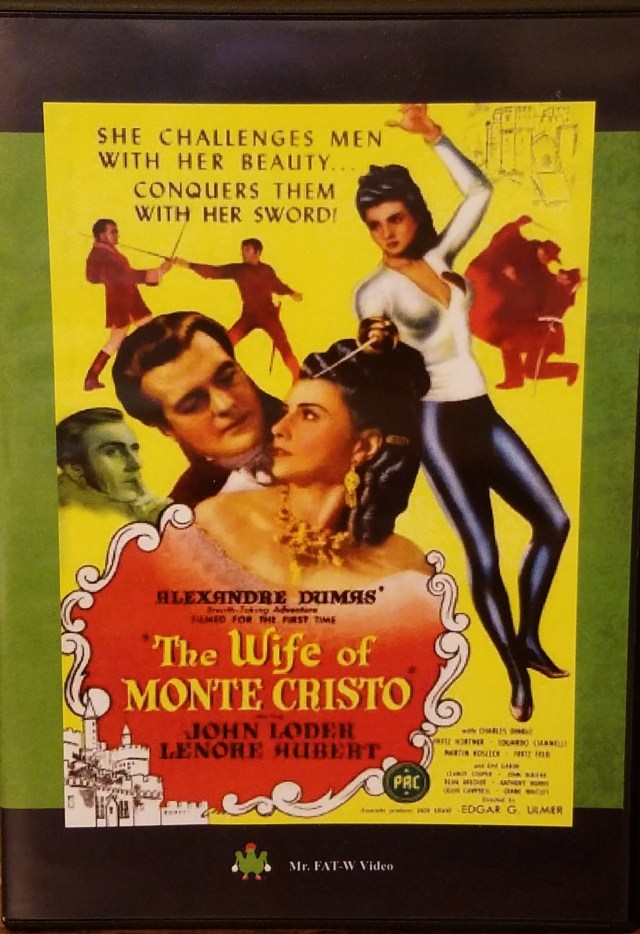
Take 3: The Wife of Monte Cristo Review (Clean Movie Month #2)

Last November, in my Movie Blogger’s Christmas Wish-List, I talked about how I wanted to see The Wife of Monte Cristo. My plan was to review the film for Pure Entertainment Preservation Society’s Clean Movie Month, as the movie was released in 1946. Based on the title of this post, it means my Christmas wish came true! Several months ago, I purchased a DVD copy of this film. I waited until July to watch it, so I could contribute to Clean Movie Month. Now that this blogathon has finally arrived, I can write about The Wife of Monte Cristo! In my aforementioned post, I shared how the movie’s story made me want to see it, as it seemed to focus on Monte and Haydée’s relationship, as well as allowing Haydée to become a more prominent character. Monte Cristo and Haydée are one of my favorite couples from pop culture. Unfortunately, their relationship is barely addressed in any film adaptation of The Count of Monte Cristo. These film adaptations also give Haydée a small amount or no amount of screen time. The Wife of Monte Cristo allows these two voids to be filled.

Here is a picture of the DVD I purchased for this review. Screenshot taken by me, Sally Silverscreen.

Things I liked about the film:

The acting: All of the acting performances in The Wife of Monte Cristo shared one common factor: they made every cast member appear natural in their role! Because of this and the believability that came from these performances, each interaction felt like it was taken directly from real-life. Haydée has a greater appearance in this film than Edmund/Count of Monte Cristo, so I’d like to mention Lenore Aubert’s portrayal of Haydée. Her on-screen personality was pleasant, making Haydée a character worth rooting for. Through body language and facial expressions, Lenore showed how Haydée can be intelligent, resourceful, and just a good person overall! I also liked watching John Loder’s performance! In The Wife of Monte Cristo, he portrayed De Villefort, the head of Paris’ police force. What impressed me was how he could adopt two different personas for the same character. Whenever he was socializing or interacting with Haydée, De Villefort was charismatic and had a certain amount of charm to him. But when he is with comrades, planning on catching “The Avenger”, De Villefort is cunning and sinister.

The historical accuracy: The Wife of Monte Cristo takes place in Paris of 1832. The story’s time period and the location within this time period can be seen in every aspect of the film. Characters’ wardrobes are a good example of this. Male characters wore solid colors, with wealthier men in society sporting some embellishment on their outfit. In one scene, De Villefort wore a dark jacket that featured white embroidery. The female characters, Haydée and Lucille, wore elegant dresses that boasted a simple pattern. During a meeting with one of De Villefort’s comrades, Haydée wore a black dress with consistent sparkly detailing. This outfit was eye-catching, but not over-the-top. Another indicator of this historical accuracy were the choices in the set design. In De Villefort’s office space, chandeliers with candles can be seen. Because light bulbs did not exist in 1832, this design choice fits the story’s time period.

The on-screen chemistry: As I already mentioned, Haydée has a greater presence in the film than Edmund/Count of Monte Cristo. This causes Haydée and Edmund to spend a limited amount of time together on screen. In the scenes where they are together, Lenore Aubert and Martin Kosleck displayed strong on-screen chemistry! The on-screen chemistry between Lenore and Martin allowed the audience to see how much Haydée and Edmond truly loved and cared about each other. Even when they were apart, the love between these two characters could still be felt. In one scene, Edmund visits the daughter of a supporter of “The Avenger”. During their conversation, Edmund explains how Haydée saved his life and helped him see the good in humanity after he escaped from prison. What Edmund tells this character is very telling of the love he feels for his wife.

Clean Movie Month banner created by Tiffany and Rebekah Brannan from Pure Entertainment Preservation Society. Image found at https://pureentertainmentpreservationsociety.wordpress.com/2020/07/01/cleanmoviemonth2020-is-here/.

What I didn’t like about the film:

The audio: In my review of The Boy Who Could Fly, I mentioned how the audio of the actors was on the quieter side. I noticed the same flaw when watching The Wife of Monte Cristo. The actors were so quiet, I had difficulty understanding what they were saying. I needed to turn up my television’s volume just to hear them. I’m not sure if this was an issue with the movie itself or with the audio on my entertainment system.

A somewhat misleading title: I said in the introduction that Haydée’s prominence in the story is what caused me to see the film. While she did have an important role in the overall narrative, she wasn’t the central focus. The majority of The Wife of Monte Cristo revolved around “The Avenger” and the villains’ attempts to foil his plans. Because of the title, I was led to believe the film would be a sequel to The Count of Monte Cristo, but from Haydée’s perspective. However, it was simply a sequel to The Count of Monte Cristo.

Edmond and Haydée’s limited interactions: Earlier in this review, I briefly mentioned how Edmond and Haydée spend a limited amount of time together on screen. This disappointed me, as I was hoping to witness the continual growth of their relationship. I was also hoping to see more adorable moments between them, especially since their relationship is barely shown in any film version of The Count of Monte Cristo. While I appreciate the times I did get to see these characters together, there was more to be desired in this department.

Illustration of Paris, France created by Freepik at freepik.com. <a href=”https://www.freepik.com/free-photos-vectors/travel”>Travel vector created by freepik – http://www.freepik.com</a>. Image found at freepik.com.

My overall impression:

Seeing and reviewing this movie is a Christmas wish come true! As someone who is a fan of Monte Cristo and Haydée’s relationship, I am thankful to have discovered this film! It was enjoyable and interesting, as it gives Haydée an opportunity to save the day. Through clever problem solving, teamwork, and wits, we see Haydée making a difference in her world and lending a hand when possible. Despite the film being titled The Wife of Monte Cristo, she is not the star of the film. She does serve an important role though, as she receives a bigger part in this story than she has in other versions of The Count of Monte Cristo. As a film released in the Breen Code Era, it is, for the most part, Breen Code friendly. However, there were two aspects of this movie that I was surprised to see in a Breen Code film. In some scenes, both Haydée and Lucille wear dresses with low necklines. While this style of dress was likely common in the 1830s, its presence would not be frequent in a Breen Code film. There is one scene where the deceased body of one of De Villefort’s comrades is briefly shown on screen. In Breen Code films, a death would usually be implied, not seen.

Overall score: 7.5 out of 10

What are your thoughts on my Clean Movie Month reviews so far? Are you looking forward to my next review? Tell me in the comment section!

Have fun at the movies!

Sally Silverscreen
Take 3: The Boy Who Could Fly Review (PB & J Double Feature Part 2)

Welcome to the second part of my PB & J Double Feature! This review may contain spoilers and here are the links to the double feature’s introduction and the first part:

My PB & J Double Feature’s Introduction

Take 3: The Last Full Measure Review (PB & J Double Feature Part 1)

The Boy Who Could Fly poster created by Lorimar Motion Pictures and 20th Century Fox. Image found at https://www.imdb.com/title/tt0090768/?ref_=nv_sr_srsg_0.

1. What is the purpose of Girl Scout fun patches? What is the significance of the PB & J patch that you talked about in the introduction?

I already explained this in my review for The Last Full Measure, so you can read that post if you want to learn more about Girl Scout fun patches and the PB & J patch.

2. How did you come across The Boy Who Could Fly?

I came across the poster for The Boy Who Could Fly while visiting Pinterest. After making this discovery, I read the film’s synopsis. I was curious to see how the subject of Autism would be discussed in a movie set in and released during the ‘80s. The possible meaning behind the title is also what sparked my interest.

3. You elaborated in the introduction how a PB & J sandwich represents a collection of ideas. Can any of these ideas be found in The Boy Who Could Fly?

One of these ideas that can be found in The Boy Who Could Fly relates to building connections. In this film, the audience learns that Mrs. Sherman, Milly and Eric’s teacher, has become one of Eric’s biggest advocates. It was her decision to place him in her class so he can interact with the other students. She also reveals to Milly that she protested against sending Eric to an institution so he could live in an environment that was familiar to him. Because of Mrs. Sherman’s encouragement and after she volunteered to be his gym class partner, Milly chooses to stay by Eric’s side and be his friend. Even when she experiences frustration and considers throwing in the towel, Milly perseveres in helping Eric be the best version of himself that he can be. It’s because of these connections that Eric is able to grow as a person and inspire the people around him.

As I mentioned in answer number one, the PB & J patch is earned by making peanut butter and jelly sandwiches. This activity is usually performed when feeding people in need. Volunteers who choose to serve others in this fashion build connections with other volunteers, as well as with the organizers of this activity. These connections help build a community of life-minded individuals who share a common goal. They may even form connections with the people they are serving.

4. Are there other patches you can think of that would complement The Boy Who Could Fly?

A patch related to Autism seems like an appropriate choice. It could be earned in a variety of ways, from participating in an Autism Walk to meeting members of a local Autism council. One of the major themes in The Boy Who Could Fly is believing in yourself. There is one patch from Mad About Fun Patches that would perfectly fit with this theme. On the website, there is a Dumbo themed patch that says “Believe You Can Fly & Soar”. In The Boy Who Could Fly, Milly reads a Dumbo picture book to Eric. She does this to help Eric communicate and connect with others by using a topic he loves: flight.

5. Is there anything about The Boy Who Could Fly that you liked or didn’t like?

I was surprised by how well this movie aged, especially when it comes to the subject of Autism. While there is language in the film that wouldn’t be used today, the way Eric is treated and viewed by the other characters is positive. A great example is the formation of Milly and Eric’s friendship. The movie presents the possibility of people with Autism successfully creating and maintaining meaningful relationships. This helps dispel stereotypes that could leave a negative impact for those on the Spectrum. While watching The Boy Who Could Fly, I noticed how the audio of the actors was on the quieter side. I had to turn up the volume on my television just to hear what the characters were saying.

Paper airplane image created by Freepik at freepik.com. <a href=’https://www.freepik.com/free-vector/paper-plane-in-cartoon-style_766478.htm’>Designed by Freepik</a>. <a href=”https://www.freepik.com/free-photos-vectors/paper”>Paper vector created by Freepik</a>. Image found at freepik.com. 

6. Did you develop any thoughts and/or questions while watching this film?

A thought I developed during my viewing of The Boy Who Could Fly is how some moments felt ahead of their time. In answer number four, I mentioned how Milly uses Eric’s favorite subject to help him communicate and connect with other people. I read a story several years ago about a woman whose autistic son loved bees, so she based his entire homeschool curricular around that subject. She did this in order to help him enjoy his lessons. The idea of helping someone with Autism based on their personal preferences and accommodations is a practice commonly known today than it might have been in the mid to late ‘80s. After suffering a minor concussion and experiencing a life-like dream, Milly has a conversation with a psychologist from the hospital. The interaction itself normalizes the use of therapy, with the psychologist hearing Milly’s side of the story without any judgement or criticism. Seeking therapy for those with mental health related situations is encouraged and accepted today that it could have been four decades ago.

7. As stated in answer number one, fun patches are earned by either completing an activity or reaching a goal. What goal or activity could correlate with this movie?

Similar to The Last Full Measure, most scouts would not be able to see The Boy Who Could Fly. This is due to language and a scene involving minors consuming alcohol. But, like The Last Full Measure, troops can participate in activities that relate to the movie. As I mentioned in answer number four, a Dumbo themed patch would correlate perfectly with The Boy Who Could Fly. Younger scouts can watch Dumbo and discuss the importance of self-esteem. Meanwhile, older scouts can learn about different forms of flight and discovering how their unique talents can play a vital role in their community.

8. Fun patches are about learning new skills or lessons. Are there any lessons one can learn from this film?

Like I said in answer number four, a major theme in The Boy Who Could Fly is believing in yourself. There are several occasions where characters are facing difficult situations in their lives. Instead of giving up, they persevere and discover a resolution to their conflict. In scouting, troops can face many obstacles. It could be as simple as last-minute changes to pre-set plans. Challenges may be bigger, causing troop leaders to search for an answer in a longer period of time. Despite this happening, it’s important for troop members to learn how to believe in themselves, especially since this lesson is a valuable one in preparation for the real world.

9. Sometimes, patches are created to tie in with a popular movie or IP (intellectual property). If given the opportunity to create a new patch, how would a patch for this movie look? What activity or goal would need to be met?

Because Eric likes creating paper planes, a patch that looks like a paper plane would definitely be a good choice. Maybe a quote from the movie could be featured on the patch. As for the activity, it would have something to do with flight. Making paper planes is a good place to start. Inviting a pilot to a meeting or talking about air travel are also good suggestions.

10. After watching this film, is there anything you can take away from your movie viewing experience?

The Boy Who Could Fly is, so far, the best movie I’ve seen this year! The messages and themes within this story are just as relevant today as they were back in the ‘80s. While I wasn’t expecting Eric to literally fly, it was a creative choice that worked in this narrative. The movie was an emotional rollercoaster and I was invested from start to finish. I’m grateful to have stumbled across this film on Pinterest.

Image of peanut butter and jelly sandwiches created by Katinka Kober at freeimages.com. Photo by Katinka Kober from FreeImages

Have fun at the movies!

Sally Silverscreen

Take 3: The Last Full Measure Review (PB & J Double Feature Part 1)

Welcome to the first part of my PB & J Double Feature! This review will contain spoilers and here is the link to the double feature’s introduction:

My PB & J Double Feature’s Introduction

The Last Full Measure poster created by BCL Finance Group, Boss Collaboration, Foresight Unlimited, Lightbox Pictures, Provocator, SSS Entertainment, SC Films Thailand Co, and Roadside Attractions. Image found at en.wikipedia.org/wiki/File:The_Last_Full_Measure_2019_poster.jpg

1. What is the purpose of Girl Scout fun patches? What is the significance of the PB & J patch that you talked about in the introduction?

Girl Scout Fun Patches are created to commemorate experiences where scouts either spend quality time with their troop or learn a new lesson/skill. They can also be earned by completing an activity or reaching a goal. One example is a Lock-In patch, given to a troop or a collection of troops after they spend the night at a local attraction, such as a zoo. The PB & J patch from my introduction is meant to recognize scout members who participate in the creation of peanut butter and jelly sandwiches. Some soup kitchens, food banks, or homeless shelters will serve these sandwiches to their patrons, with volunteers pitching in to help make the sandwiches and serve them. This experience can teach scouts about playing a vital role in their community and assisting those in need.

2. How did you come across The Last Full Measure?

I learned about The Last Full Measure when I stumbled across several production/behind-the-scenes photos for the movie on Pinterest. I’ve enjoyed watching Sebastian Stan’s portrayal of Bucky Barnes in the Marvel Cinematic Universe, so I was excited to hear he had been given a lead role in this picture. When I read the movie’s synopsis, it sounded like a story that was full of intrigue. I had heard this movie was supposed to be released in October of 2019. For reasons that are unknown to me, the film was pushed back to January of 2020. I was honestly surprised how little attention this project received. It got a small amount of marketing and was in theaters for about less than a month. I’ve also noticed how few movie bloggers have reviewed the film.

3. You elaborated in the introduction how a PB & J sandwich represents a collection of ideas. Can any of these ideas be found in The Last Full Measure?

Absolutely! When reflecting on the story of William H. Pitsenbarger, there are several ideas that come to mind. One of them is how one person can affect the lives of others. Throughout the film, the stories from veterans who fought alongside William are told to Scott Huffman, an employee from the Pentagon tasked with William’s Medal of Honor case. As the movie unfolds, the audience learns how William and his actions impacted the lives of the veterans, as well as William’s parents and Scott’s family. This point is highlighted at William’s Medal of Honor ceremony, where everyone is asked to stand up if they are either a veteran, a family member or spouse of a veteran, or had their life touched by a veteran.

When we think of a PB & J sandwich, it is a singular object that has one purpose: to feed the person that sandwich was created for. When giving the subject more thought, we realize the sandwich itself affects more than the person eating it. There are people who work in the companies creating the peanut butter and jelly. Farmers and agriculturalists grow the wheat to make the bread, as well as the peanuts and fruit to create the peanut butter and jelly. Someone or a group of people make the sandwich, making it whole or cutting it up into separate pieces. If the recipient is given more than one sandwich or has multiple pieces, they can give it to another person. A PB & J sandwich creates an interconnected web where each person plays a role.

4. Are there other patches you can think of that would complement The Last Full Measure?

The most obvious choice would have something to do with veterans. Whether that recognizes sending Valentines to veterans or hosting an Honor Flight, a patch of this nature reminds scouts of a veteran’s importance. Another good choice would be related to history. Events surrounding the Vietnam War are discussed in The Last Full Measure. Age appropriate lessons about a particular war-time era can teach scouts about the event itself and how moments from the past can be applied to the present.

5. Is there anything about The Last Full Measure that you liked or didn’t like?

One element that caught me by surprise was how good the scenery was! When Scott travels to Vietnam to speak with one of the veterans, he is taken to the spot where the battle took place. The place was transformed into a butterfly sanctuary. It was calming and serene to watch, as blue butterflies flew against bright green foliage. The cinematography captured this location well, as soft light radiated within the space. As for what I didn’t like about this film, I found Scott’s part of the story to be the weakest aspect of the narrative. This part wasn’t bad and Sebastian did a good job with the acting material he was given. But I found the veterans’ stories to be much more compelling than what Scott’s story had to offer.

Here is a screenshot I took of the patch from Mad About Fun Patches. I also provided credit to the people who created the patch. Screenshot taken by me, Sally Silverscreen.

6. Did you develop any thoughts and/or questions while watching this film?

I didn’t develop any questions, but two thoughts did come to mind. When William’s parents are remembering their son’s life, they reflect on small details, like the smell of fresh cut grass on his shoes after he mowed the lawn. This reminded me of when Eric Draven, from The Crow, said that “Nothing is trivial”. When we lose a loved one, little things that may seem insignificant to others are the pieces we use to hold on to that person. On Thanksgiving, William’s parents share with Scott and his wife how they try to keep their son’s memory alive. This reminded me of what Sarah said at the end of The Crow about continuing to love someone after they are gone.

7. As stated in answer number one, fun patches are earned by either completing an activity or reaching a goal. What goal or activity could correlate with this movie?

Because The Last Full Measure is rated R, most scouts would not be able to see the film. However, there are activities that troops can participate in that correlates with the movie. Like I mentioned in answer number four, a troop or multiple troops can organize an Honor Flight. This is a plane ride/trip meant to recognize the military contributions of veterans. Younger scouts can make signs and cheer for the veterans as they arrive at the airport. Older scouts can assist their leaders in the event’s organization, showing them how to build connections in their community and organizational skills.

8. Fun patches are about learning new skills or lessons. Are there any lessons one can learn from this film?

A major overarching lesson that can be found in The Last Full Measure is how our actions and choices can affect the people around us. During the Vietnam War, William’s choice to sacrifice his life for his fellow soldiers greatly affected those soldiers in that battle. It also affected those same soldiers, William’s parents, and even Scott’s family years after the event occurred. This lesson reminds viewers to put a great amount of thought into the things we do before we act on them.

9. Sometimes, patches are created to tie in with a popular movie or IP (intellectual property). If given the opportunity to create a new patch, how would a patch for this movie look? What activity or goal would need to be met?

A patch bearing a picture of William H. Pitsenbarger would be an appropriate choice. Another good choice would be an image of the Medal of Honor with William’s name surrounding it. Any activity involving the recognition of veterans would make sense. It could be a grand gesture, such as the aforementioned Honor Flight or decorating a float for a veteran who is a Grand Marshal at a local parade. The act could be smaller in scale, like raking leaves for a veteran during the autumn season or delivering meals for a veteran who may be home-bound. The patch’s goal would strive to help scouts learn about a veteran’s importance and appreciate their inclusion in society.

10. After watching this film, is there anything you can take away from your movie viewing experience?

While I found The Last Full Measure to be a fine, well-made film, I think the story itself would have benefited more in a documentary format. I said in answer number five how the veterans’ stories were the most compelling part of the overall narrative. If this story were presented in a documentary, it would have given the veterans themselves a chance to share their experiences, especially since The Last Full Measure was based on a true story. In my last double feature, I reviewed the film Over the Edge. I stated in that review how the film was based on true events. This is one of the reasons why I felt that story should have been told through a documentary.

Children holding American flags during a sunset image created by rawpixel.com at freepik.com. <a href=”https://www.freepik.com/free-photos-vectors/people”>People photo created by rawpixel.com – http://www.freepik.com</a>. Image found at freepik.com.

Have fun at the movies!

Sally Silverscreen

Take 3: Goodbye, Mr. Chips (1939) Review (Clean Movie Month #1)

1939; a year that many people have considered the “Golden Year of Film”. As I mentioned in my editorial, What the Code Means to Me: Breen, Hallmark, and Me, it seems like there was something for everyone at the cinema. Several films that are well known today were able to find success in the box office in 1939. One of those films was Goodbye, Mr. Chips. I had planned on reviewing this film exclusively for The Robert Donat Blogathon. But because July is Pure Entertainment Preservation Society’s Clean Movie Month, I decided to review Goodbye, Mr. Chips for that event as well. Like last year, I will be writing about films that were released during the Breen Code Era. Some of my other submissions for upcoming blogathons will also double as entries for Clean Movie Month. Now, it’s time to read this review of the 1939 movie, Goodbye, Mr. Chips!

Goodbye, Mr. Chips poster created by Metro-Goldwyn-Mayer and Denham Studios. Image found at http://www.tcm.com/tcmdb/title/76737/Goodbye-Mr–Chips/#.

Things I liked about the film:

The acting: This was my first time watching any of Robert Donat’s performances, so I didn’t know what to expect. However, I was impressed with what I saw! Robert did a good job using a multitude of emotions at various moments in the film. Even when he wasn’t speaking, his performance still carried emotional weight. A great example is anytime something bad happened to Mr. Chips, as his facial expressions alone show how emotionally exhausted he can become. Despite appearing in the film for a limited amount of time, Greer Garson gave a pleasant performance as Katherine Ellis! Not only did she have a good on-screen personality, but she also had good on-screen chemistry with Robert Donat. One of their best interactions took place on a mountain in Austria. As they exchange witty banter, it is obvious to see that both actors enjoy each other’s company. Because most of the story takes place at the Brookfield school, many young actors are present in various scenes. Even though the movie doesn’t favor one child or a small group of children, the acting from the young actors was very on-point for what those scenes called for. On April Fool’s Day, the students are excited at the idea of pranking their teacher. As soon as one of their fellow classmates shares some unfortunate news about Mr. Chips, their happy expressions quickly turn somber. This collective acting quality shows what these young actors are capable of talent-wise!

The set design: A visually appealing aspect of this film was definitely the set design! The Brookfield school alone boasted several eye-catching design choices. One of those was the ornate detailing found on wood surfaces, such as doors and walls. In the Headmaster’s office, you can even see these details over the marble fireplace. Exposed stone walls are a consistent feature at the school, bearing the old-world charm found in structures with a long life-span. These design elements reminded me of Hogwarts from the Harry Potter series. Brookfield is not the only place that highlights fine details. The ballroom in Vienna was a showstopper! Like the Headmaster’s office, there was ornate wood detailing found on the walls. It also showcased sparkling chandeliers and a spacious layout. All of the combined elements gave this room a grand and larger-than-life personality!

The dialogue: Throughout the movie, I was very impressed by the characters’ dialogue! As I mentioned before, the banter between Mr. Chips and Katherine was witty. But it’s also important to point out how the dialogue was written with care and thought. During a private gathering, one of the fellow teachers of Brookfield states that he read a book by H.G. Wells. Another teacher comments about H.G. Wells’ short-term success, saying that his works are too “fantastical” for a lasting career. Earlier in the film, Mr. Chips falls ill. When his housekeeper tells him to address his medical concerns to the doctor, Mr. Chips says he’ll give the doctor “a piece of his mind”. The film is based on a pre-existing novel, so I’m not sure if some of the dialogue can also be found in the book. However, the lines in the movie were memorable and, at times, thought provoking because they were crafted so well!

The Robert Donat Blogathon banner created by Maddy from Maddy Loves Her Classic Films. Image found at https://maddylovesherclassicfilms.wordpress.com/2020/02/29/announcing-the-robert-donat-blogathon/.

What I didn’t like about the film:

Little to no impact on the students: In stories about teachers playing a role in the lives of their students, the audience comes to know the students as characters while witnessing their growth as young scholars and individuals. Since there were so many students at Brookfield, there was no possibility for this to happen. Even when this opportunity arose in the story, it was not taken advantage of. When Mr. Chips reflects on his past, he remembers meeting a new student that was so upset, he ends up crying on the train. Several scenes and years later, this same student visits Mr. Chips to thank him for changing his life. This exchange would have been emotionally affective had we seen this character evolve from a scared child to an independent young man.

Some parts feeling rushed: I know there is only so much a movie can accomplish in an hour and fifty-four minutes. But this should not be an excuse to rush through important parts of a story. When Mr. Chips starts looking back on his past, he recalls his time as a new teacher at Brookfield. After a montage featuring students during various sporting activities, the story progresses by several years, making Mr. Chips a seasoned teacher. Personally, I don’t feel this was a smooth transition between the two points in time, as it made the story feel like it was in a hurry to reach its destination. What would have helped instead was showing a title card with the year before a new part of the story started.

A weaker plot: Before watching Goodbye, Mr. Chips, I knew the story would be about Mr. Chips’ life. While this was the case, it made the story straight-forward. The straight-forwardness of the narrative left little to no room for intrigue. Like I mentioned earlier in this review, the evolution of the students was not shown. This means that the ways Mr. Chips impacted his students or how his lessons affected the people around him wasn’t put on display. There was never an opportunity to wonder how Mr. Chips would accomplish his goals or what would happen to the students. Instead, the story put more emphasis on his private life than his career as a teacher.

Clean Movie Month banner created by Tiffany and Rebekah Brannan from Pure Entertainment Preservation Society. Image found at https://pureentertainmentpreservationsociety.wordpress.com/2020/07/01/cleanmoviemonth2020-is-here/.

My overall impression:

This is the first movie of Robert Donat’s I’ve ever seen. As I said in my review, I didn’t know what to expect, so I approached this film with an open mind. Now that I have seen Goodbye, Mr. Chips, I can honestly say that it was a fine film. There are definitely elements that help make the project a likeable picture. These are the strengths of the movie, from acting performances that come across as believable to dialogue that is clever and witty. But it does contain flaws that hold Goodbye, Mr. Chips back from being better than it was. Parts of the story were rushed and the plot was on the weaker side. This film is mostly Breen Code friendly. However, I was surprised by some of the language used in the movie. One example is when some of the students say the word “ass” as a swear word. I’m aware of how Gone with the Wind was able to include the word “damn” in their script. But I guess I was naïve to think that was the only exception in the Breen Code Era.

Overall score: 7 out of 10

Have you seen either version of Goodbye, Mr. Chips? Are you looking forward to my Clean Movie Month reviews? Let me know in the comment section!

Have fun at the movies!

Sally Silverscreen