Take 3: Day for Night Review + 250 Follower Thank You

October’s theme for MovieRob’s Genre Grandeur is French New Wave Films. Because I’m not as familiar with this particular genre as I am with others, I had to look up potential titles for this review. One of the films that appeared in my internet search was the 1973 French film, Day for Night. When I read the movie’s tagline, “A movie for people who love movies”, I felt it was the perfect choice for the movie blogger I am! MovieRob’s Genre Grandeur is not the only reason why I’m reviewing this film. Day for Night is also my choice for Pure Entertainment Preservation Society’s 4th Annual Great Breening Blogathon! When I participated in this specific blogathon last year, I reviewed Vampyr, a movie released before the Breen Code was created. As I already said, Day for Night was released in 1973, two decades after the Breen Code era. Like my Vampyr review, this current article is going to be a blog follower dedication review. Last week, 18 Cinema Lane received 250 followers!

Day for Night poster created by Les Films du Carrosse
PECF, Produzione Internazionale Cinematografica, and Warner Bros.

Things I liked about the film:

The acting: I’ve said before one of my favorite Hallmark films is An Old Fashioned Thanksgiving. The acting performances are a great part of it, especially Jacqueline Bisset’s portrayal of Isabella. In Day for Night, Jacqueline portrayed American actress, Julie Baker. Her on-screen persona was a pleasant surprise, as it was down-to-earth and kind. This was very different from the “diva” attitude that some lead actress characters are given in stories of this nature. Valentina Cortese is another actress that gave a memorable performance in Day for Night! She portrays Severine, an older actress looking for a come-back. One scene shows Severine turning to drinking as a way to get through the scene and cope with personal issues. Valentina effectively showed the emotional transition her character was experiencing; starting out confident but slowly turning to sadness as the scene continues. Jean-Pierre Léaud portrays Alphonse, a fellow actor who works alongside Julie and Severine. His performance came across very natural on screen, making it look effortless. A scene that shows Alphonse having a bad evening is a good example of this, the look on his face appearing defeated and his body language showing the audience how he was walking aimlessly in a hotel hallway.

The film-making process: The story of Day for Night revolves around a director making a movie alongside his cast and crew. A behind the scenes lens is how the film is presented, with the production process being the primary focus. As someone who loves movies, I found this part of Day for Night fascinating! Seeing the different ways film-making related problems were solved was interesting to watch! The director of the film’s movie, Ferrand, is looking for a car for an upcoming scene. Because of the movie’s budget, he ends up using a car from one of the crew members. Later in the production of “Meet Pamela” (the movie being filmed in Day for Night), the cast and crew are struck with a tragedy. Ferrand decides to cut some scenes from the movie as a result of this event. He discusses these decisions with a script writer named Joëlle, as well as talking with investors.

The cat scene: While filming “Meet Pamela”, the cast and crew want to include a cat drinking milk from a food tray. At first, a kitten is placed in the scene. However, the kitten doesn’t take direction very well. After several failed attempts, the director decides to use a “studio cat” instead. To me, this scene was hilarious because it was a good use of the “comedy of errors” style of humor. It also highlights the idea of animals being difficult to work with in film.

The 4th Annual Great Breening Blogathon banner created by Tiffany and Rebekah Brannan from Pure Entertainment Preservation Society.

What I didn’t about the film:

Thinly written characters: Day for Night features an ensemble cast, showing their audience how multiple people are responsible for the creation of a single movie. However, all of these characters are thinly written, as they were defined by the main issue they were dealing with in the film’s story. For example, Julie experienced a breakdown prior to the events of Day for Night. Because of this, Julie is known as “the woman who experienced a breakdown”. Throughout the movie, she does talk about her marriage to her doctor and her working hours as an actress. But her personal situation is highlighted the most.

Too much going on: As I just mentioned, this movie has an ensemble cast. This means there are a lot of characters involved in the overall story. It also means Day for Night contains several subplots. Personally, I found it difficult to keep up with the characters, as I thought there were too many to focus on. Even though this happened briefly, there were moments when I forgot who was who. The subplots were not interesting to me, as they revolved around situations I just didn’t care about. It felt more like a bland soap opera than a compelling part of the behind the scenes of “Meet Pamela”. Honestly, I wish this movie had put more emphasis on the film-making aspect of the narrative.

The director’s dreams: On three separate occasions, the dreams of the director, Ferrand, are shown. These scenes are filmed in black-and-white and contain no dialogue. I thought the inclusion of the dreams were random, as they didn’t seem to have anything to do with the overarching story. It also doesn’t help that no explanations are provided for what these dreams could mean. If anything, they were simply there to satisfy the run-time.

Image of vintage movie camera created by Macrovector at freepik.com. <a href=”https://www.freepik.com/free-photos-vectors/background”>Background vector created by macrovector – http://www.freepik.com</a>. Image found at freepik.com.

My overall impression:

Like I said in the introduction, the tagline of Day for Night is “A movie for people who love movies”. While I do love movies, I did not love this film. Sure, there were things about it I liked, such as the acting and the film-making process shown. But if you’re going to make a movie, you need to provide your audience with interesting characters worth watching. The characters in Day for Night were thinly written, defined by their personal situations. Even though it can be intriguing to see how characters overcome their obstacles, they have to have other qualities about them. Because of the poor writing for the characters, their subplots were not interesting. Issues among them were basically at a stand-still, not really getting resolved to a satisfying degree. What would have helped this story is if it were presented in a mockumentary format, giving more emphasis to the behind the scenes aspect of film-making. Before I end this review, I want to thank all 250 of 18 Cinema Lane’s followers! The success this blog has received would never have happened without you!

Overall score: 6.2 out of 10

Have you seen Day for Night? Are there any movies about film-making you’ve seen? Please tell me in the comment section!

Have fun at the movies!

Sally Silverscreen

Take 3: Picture Perfect Mysteries: Exit, Stage Death Review

Even though I’ve been reviewing films from Hallmark Movies & Mysteries lately, I haven’t reviewed a mystery film from Hallmark’s second network since May. Because of this, I decided to review the newest movie in the Picture Perfect Mysteries series, especially since I have seen the first two installments. Like the other series on Hallmark Movies & Mysteries, Picture Perfect Mysteries has been an enjoyable collection of films. The series also has a distinct identity that sets it apart from the various current offerings on this particular channel. A mystery story featuring a murder mystery stage play is not new, as the Aurora Teagarden Mysteries series had a similar concept in the 2019 movie, Aurora Teagarden Mysteries: A Very Foul Play. In fact, there was a play poster in the background of Picture Perfect Mysteries: Exit, Stage Death that was titled “A Very Foul Play”. However, I was curious to see how a detective and photographer duo would approach this specific type of mystery.

Picture Perfect Mysteries: Exit, Stage Death poster created by Crown Media Family Networks and Hallmark Movies & Mysteries.

Thing I liked about the film:

The acting: In Picture Perfect Mysteries: Exit, Stage Death, the acting ranged from fine to good. However, there were some stand-out performances I’d like to bring up. One came from series regular, Trezzo Mahoro, who portrayed Allie’s friend Noah. What I liked about his performance was how lively and expressive it was. A good example is when Noah discovers Maya has figured out the password on his laptop. The look of shock on his face truly appeared genuine. Another note-worthy performance was Willie Aames’! As one of the characters said in this movie, Neil Kahn was “mild-mannered”. While this is true, Willie made this part of his character consistent. Because Neil is a director of mystery stories, this is a different yet interesting creative choice when it comes to acting. Speaking of Neil, I also enjoyed seeing April Telek’s performance! Throughout the film, her portrayal of Neil’s wife was very natural. This is evident in the scene where she and Neil are having an argument about their personal lives.

The interior and exterior design: In some scenes, Neil Kahn’s house was featured on screen. This is certainly one of the most photogenic houses shown in a Hallmark Movies & Mysteries film! The exterior was pale yellow Victorian, complete with a wrap around porch. Impressive interior designs added to the grand scale that is also shown on the house’s exterior. Dark wood was a consistent component of each room shown in the movie. The living room boasted a large wood fireplace paired beautifully with green marble. Neil’s library also featured wood, as seen in bookshelves covering the walls. An eye-catching design choice was how arches outlined the shelves, an element that isn’t often found. In one scene, the living room in Allie’s house can be seen in the background. A stone fireplace was illuminated with soft lights, with a complimentary bookshelf next to it. This shows how good interior and/or exterior design came from multiple locations!

The cinematography: There was some cinematography in Picture Perfect Mysteries: Exit, Stage Death that really surprised me in a good way! One notable example is when a suspect is being questioned at the police station. As the scene plays out, emphasis is placed on the clock and the suspect’s face. They were both zoomed in at various points in the scene, highlighting the suspense and fear a person might face in that situation. Another interesting use of cinematography is when Allie and Sam were having a conversation after the murder victim was discovered. When each character was speaking, they were given close-ups to help the audience focus on Sam’s or Allie’s part of the conversation. This specific area of film-making, cinematography, added intrigue to the overall project!

Masks of comedy and tragedy images created by freepik at freepik.com. <a href=”https://www.freepik.com/free-photos-vectors/background”>Background vector created by freepik – http://www.freepik.com</a>. Image found at freepik.com.

What I didn’t like about the film:

Story points that didn’t lead anywhere: Picture Perfect Mysteries: Exit, Stage Death contained story points that ended up not leading anywhere. One of them was the robberies that were taking place in Willow Brook, the small town featured in this series. During the movie, Sam was in charge of solving the film’s murder and a string of robberies. Unfortunately, this part of the film became an afterthought, as it had little to no connection to the main plot. Another story point involved a local loan shark. While he was shown and mentioned on a few occasions, the loan shark didn’t have a consistent enough presence to be a meaningful part of the story. If this character would have been given more importance, maybe he could have been a red herring.

Allie’s relationship with Daniel: Hallmark Movies & Mysteries series usually show the male and female protagonist forming a romantic relationship over time. Even though this is only the third Picture Perfect Mysteries movie, I feel Allie and Sam will likely become a couple. Because of this, I found Allie’s relationship with Daniel, a newspaper reporter, to be pointless. When Allie’s friend, Maya, suggests that Allie go on a date with Daniel, it felt like the screenwriter was trying to force a love triangle into the story. Allie and Daniel’s departure from their date came across as awkward, like they knew their relationship wasn’t going to last. To me, it seemed like this aspect of the movie was unnecessarily shoved into the narrative.

A choppy pace: I found the overall pace in Picture Perfect Mysteries: Exit, Stage Death to be choppy. This is because there wasn’t a good flow in-between scenes. In one scene, Allie and Sam are discussing color paint samples for Sam’s house. Shortly after, one of the murder suspects is giving Allie clues. Mysteries series from Hallmark Movies & Mysteries space out scenes that are not mystery related, as to not make the movie feel too dark. However, this installment in the Picture Perfect Mysteries series seemed to fill their script with as much content as possible with the intent to worrying about the overall flow later.

Tools of a writer image created by Freepik at freepik.com. <a href=’https://www.freepik.com/free-photo/camera-and-coffee-near-notebook-and-accessories_2399437.htm’>Designed by Freepik</a>. <a href=”https://www.freepik.com/free-photos-vectors/vintage”>Vintage image created by Freepik</a>. Image found at freepik.com.

My overall impression:

At best, Picture Perfect Mysteries: Exit, Stage Death was a fine film. It definitely had its strengths, such as some stand-out acting performances and interesting cinematography. But, in my opinion, the movie felt like it just met a requirement. As I mentioned in this review, this is the third chapter in the Picture Perfect Mysteries series. By this point, the question of how the overarching story arc can move forward should be answered. This film, however, does not answer that question. What it does instead is almost put the series in a stand-still, forcing it to stay in one place. Having story points that don’t lead anywhere is just one example of how this happened. Yes, the mystery was intriguing. But this is only a part of a mystery film. If there are other parts of the story that don’t work, the movie is going to have shortcomings. While it is unknown at this time whether the Picture Perfect Mysteries series will receive a fourth film, I just hope it’s stronger than this movie was.

Overall score: 7 out of 10

Have you seen the Picture Perfect Mysteries series? Would you like to see this series get a fourth film? Tell me in the comment section!

Have fun at the movies!

Sally Silverscreen

Take 3: Interrupted Melody Review

Prior to signing up for Maddy Loves Her Classic Films’ Eleanor Parker Blogathon, I had seen two of Eleanor’s films; The Sound of Music and Return to Peyton Place. However, both titles are ensemble films, leaving Eleanor to act in someone else’s shadow. My entry for the blogathon is a review of Interrupted Melody, a film that allows Eleanor’s acting talents to be the center of attention! The 1955 film is one I had never heard of until this year. Before 2020, I didn’t know who Marjorie Lawrence, the Australian opera singer, was. When I learned Marjorie was diagnosed with polio and overcame her illness, I was interested in seeing this part of Marjorie’s life depicted on film. This is because I, personally, haven’t seen many cinematic stories from the perspective of polio patients. I also don’t talk about Australians in cinema, as I don’t often receive an opportunity to do so. This is another reason why I chose to review Interrupted Melody.

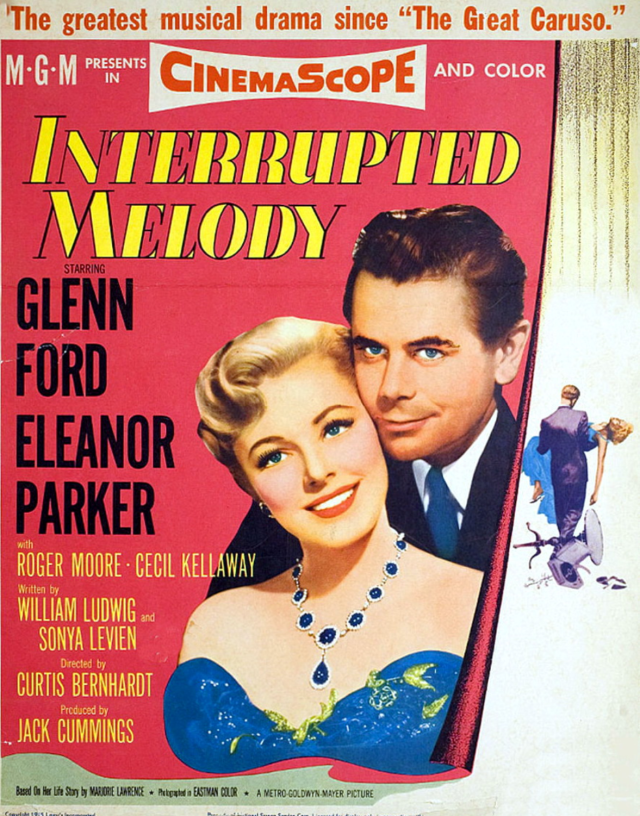
Interrupted Melody poster created by Metro-Goldwyn-Mayer.

Things I liked about the film:

The acting: This is the first movie I’ve seen where Eleanor Parker was the star of the show. I was not disappointed, as Eleanor gave a very strong performance! While Eileen Farrell served as the vocals for the role of Marjorie Lawrence, Eleanor provided the power, passion, and showmanship one can expect from an opera performance. Outside of the opera world, Marjorie experienced several heartbreaks and joys in her life. Through all of this, Eleanor brought forth a portrayal that was emotional, allowing her character to appear and feel realistic. A good example of this is when Marjorie is crawling toward the record player in an attempt to turn it off. One of the key players in Marjorie’s life is her husband, Dr. Thomas King. Portrayed by Glenn Ford, Thomas was her biggest supporter. With a variety of emotions, Glenn also gave a realistic performance! He was able to show the audience how much Thomas cared about Marjorie. Even the supporting actors in Interrupted Melody were strong, which provided strength to the overall cast! Cyril, portrayed by Roger Moore, is Marjorie’s brother and manager. The conversations between him and Marjorie were well performed by both actors, coming across as two siblings having different perspectives on a central topic. This allowed both on-screen personalities to shine as well as showcasing their distinct personas!

The set design: Because Marjorie is an opera star, several opera performances are shown in the film. The movie’s creative team didn’t skimp on the set design within these scenes, as they all felt so immersive. When Marjorie is performing in Madame Butterfly, the stage’s setting is a room from Japan. The window in the background features a large tree, appearing more like a realistic landscape than a painted image. Fine details helped make these spaces appealing to look at. In Marjorie’s first opera, the characters were placed on a Parisian street, with a set of string lights shown over their heads. A detail like this added a three-dimension aspect to the set. Even scenes that didn’t involve the opera looked really good! In one scene, Marjorie and Thomas are on a beach in Florida. While this movie was filmed in Culver City, California, according to IMDB, this was still a photogenic location!

The costumes: In Interrupted Melody, Eleanor Parker wore costumes that were absolutely gorgeous! It also helps that these costumes complimented her so well! In the aforementioned opera, Madame Butterfly, Eleanor’s kimono was light-pink with beautiful embroidery on the collar and sleeves. The embroidery featured flowers, which represented the tree that was featured in the scene’s background. While Marjorie is performing as Carmen in the opera of the same name, her outfit featured a color combination of blue and orange. This was paired nicely with Marjorie’s brown hair. Eleanor even wore some impressive costumes that were not worn during opera performances. Within the film’s second half, she wore a sparkly white gown that was one of my favorites! Eleanor looked beautiful in that dress and I wished she had worn it for a longer period of time.

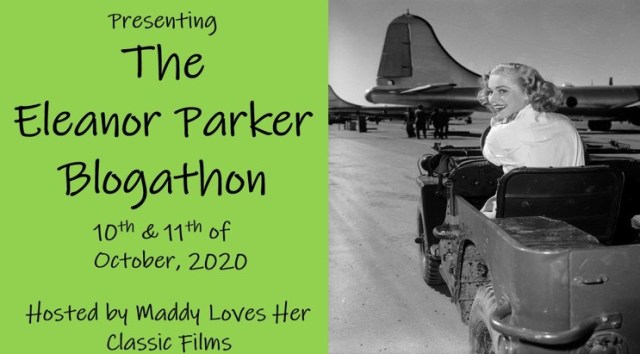
The Eleanor Parker Blogathon banner created by Maddy from Maddy Loves Her Classic Films.

What I didn’t like about the film:

Missing context: There were areas of the story where I wish context was provided. For starters, how did Marjorie become a singer in the first place? Was this a dream she had since she was a child or a passion she discovered shortly before the events of the film? These questions certainly could have been answered within the script. For a portion of the movie, Cyril disappears from the story. While he eventually appears toward the end of the movie, it isn’t really explained where he went or why he was suddenly absent from the plot. This is something that could’ve been brought up in passing.

More emphasis on the opera world: Since opera played such a huge role in Marjorie’s life, it is going to have a place in the overall story. However, the film put so much emphasis on the glitz and glamour of the opera world, that it caused Marjorie’s polio diagnosis to, kind of, sit on the backburner. This part of Marjorie’s life didn’t come until an hour into the movie. From that point on, it felt like I was watching a highlight reel of Marjorie’s attempts to overcome her illness. I found this disappointing, as I was expecting that part of Marjorie’s story to have a larger presence in the film.

No Australian accents: Before watching Interrupted Melody, I was curious to see if Eleanor could carry an Australian accent. This was, sadly, not the case. In fact, an Australian accent was not consistently used by any of the actors who portrayed members of Marjorie’s family. Toward the beginning of the film, Roger Moore could be heard with an Australian accent. But as the movie goes on, his voice morphs into a British accent. This specific accent was also adopted by the other actors portraying Australians, including Eleanor. While I got used to the lack of Australian accents over time, it is still a flaw I noticed.

String of musical notes image created by Freepik at freepik.com. <a href=’https://www.freepik.com/free-vector/pentagram-vector_710290.htm’>Designed by Freepik</a> <a href=”https://www.freepik.com/free-photos-vectors/background”>Backgroundvector created by Freepik</a>. Image found at freepik.com.

My overall impression:

Like I said in my Follow Your Heart review, Interrupted Melody is not the “end all, be all” of Marjorie Lawrence’s story, as one should learn more about her in their own time. However, I do think this movie serves as a good introduction to this particular individual as well as to opera! Through music, set design, and costumes, Interrupted Melody effectively shows the heart and soul that go into this specific form of entertainment. Within Eleanor Parker’s performance, the audience can see just how resilient Marjorie Lawrence was. Speaking of Eleanor Parker, this movie made me appreciate her more! Strong acting talents and a beautiful presence help create a captivating portrayal that was thoroughly enjoyable to watch. An overarching flaw of Interrupted Melody is how the film becomes so caught up in the glitz and glamour of the opera world, it, at times, forgets its original purpose. In the end, though, the movie was a fine picture that I would recommend.

Overall score: 7.4 out of 10

Have you seen Interrupted Melody? Is there a film about a musician you like to watch? Share your thoughts in the comment section!

Have fun at the movies!

Sally Silverscreen

Take 3: Follow Your Heart Review

Last week, I reviewed JL Family Ranch: The Wedding Gift. While my Hallmark related content, especially from Hallmark Movies & Mysteries, has been well-received, my review of the 2020 sequel became more popular than I expected. As of early October, that post has acquired 6 likes and over 200 views! Because of this, I decided to review Follow Your Heart! Hallmark hasn’t released a movie about an Amish community since 2017’s An Uncommon Grace. When Follow Your Heart was added to Hallmark Movies & Mysteries’ Fall schedule, I found it to be a big deal, especially since a three-year creative void was being filled. On multiple occasions, I’ve said that I wished Hallmark would try new things when it came to their story-telling. From the looks of it, Follow Your Heart may be a step in that direction!

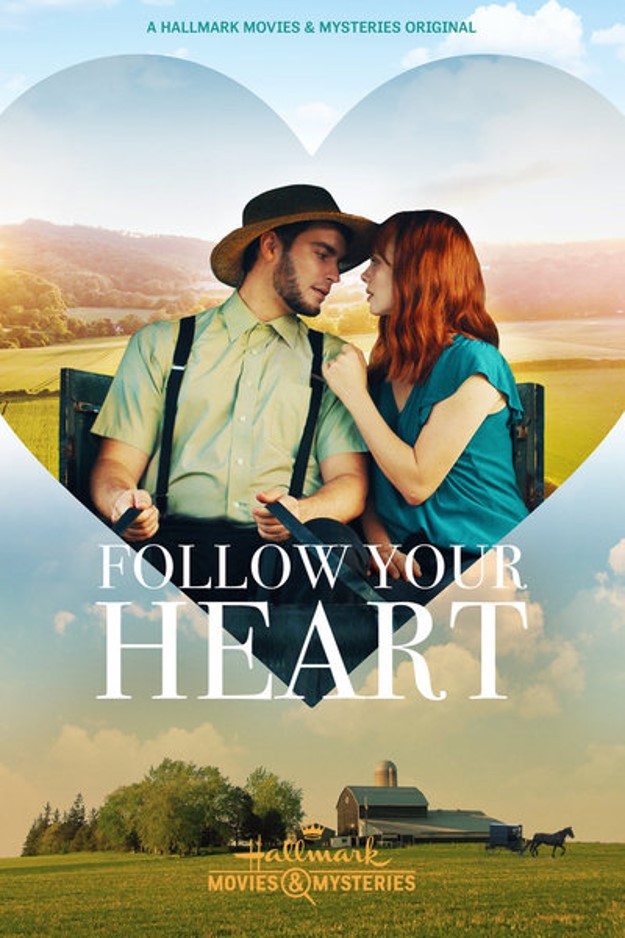
Follow Your Heart poster created by Crown Media Family Networks and Hallmark Movies & Mysteries.

Things I liked about the film:

The acting: I am familiar with Galadriel Stineman, as an actress, through her work on The Middle. It seems like her acting experiences on that show have paid off! A strength in Galadriel’s portrayal of Kathy Yoder was her transitions between different emotions. After Kathy and her boyfriend, Jack, leave the spa, Kathy received a voice message on her phone about her father’s passing. Galadriel’s facial expression and emotions quickly change from happily care-free to sadly guilty about missing the call. Madison Lawlor did a really good job with her portrayal of Kathy’s sister, Miriam! The consistency in her performance is what made it stand out. In Follow Your Heart, Miriam was upset at her sister for leaving the Amish community. Whenever she interacted with Kathy, the tension between these two characters could be felt. Another character that interacts with Kathy often is Isaac Mast, who was portrayed by Kevin Joy! Throughout the film, Isaac had a more easy-going personality. It also helped that Kevin and Galadriel shared good on-screen chemistry. These factors, along with quality acting talents, assisted Kevin in partially carrying this film!

Good audio: In my JL Family Ranch: The Wedding Gift review, I talked about Hallmark’s recent issue with poor audio. This was, fortunately, not the case for Follow Your Heart! All of the dialogue could be understood and heard clearly. Various sounds and music played in the background, making their existence known without overpowering scenes. While watching this film, I never felt the need to adjust the volume on my television. This definitely added to my movie-viewing experience!

New takes on tried-and-true cliches: As I also mentioned in my review of JL Family Ranch: The Wedding Gift, Hallmark loves adding cliches in their movies. What I liked about Follow Your Heart was how there were new takes on these cliches! The most overused one is the “woman from the city coming back to her small hometown”. In Follow Your Heart, Kathy comes back to her Amish community. She’s not only returning to a smaller town, but she’s also returning to a culture. Speaking of culture, a cultural misunderstanding influenced the “it’s not what you think” cliché found in this movie. I won’t spoil the story if you haven’t seen the film yet. But I will say this new creative approach presented a dynamic that isn’t often seen in Hallmark’s projects.

What I didn’t like about the film:

Very few explanations about Amish culture: When an Amish community is presented in a film, the film’s creative team devotes some time to explaining certain aspects of Amish culture. With Follow Your Heart, however, it felt like the movie’s creative team expected their audience to be mostly or completely educated about the lives of the Amish. While Kathy does explain that the Amish from Mountain View, her hometown, don’t believe in artistic expression, this is the only explanation about Amish culture the film provides. During one conversation, Miriam brings up the subject of Rumspringa. This is when teenagers or young adults temporarily leave their Amish communities in order to experience the English world. The short journey is meant to help these young men and women choose the course of their future. Sadly, this explanation was not presented in Follow Your Heart.

Incredibly rude friends: In a movie where a female protagonist has to choose between two male characters, the male protagonist is purposefully designed to appear as a better option. But in Follow Your Heart, Kathy’s boyfriend, Jack, was incredibly rude, even by Hallmark’s standards. While Kathy is mourning over her father’s death, all Jack seems to care about is whether she’ll agree to co-host a reality travel show. Even his views on Amish culture are closed minded, as he calls Isaac a “Renaissance man”. Kathy’s manager, Evelyn, is no better than Jack. She puts more emphasis on Kathy’s career than her client’s wellbeing. Evelyn also calls Isaac “sexy” because she likes his aesthetic and Kathy’s Amish attire a “costume”. The rudeness from Kathy’s manager and boyfriend were very off-putting.

Characters’ perspectives changing too quickly: Follow Your Heart featured a few occasions where characters’ perspectives changed too quickly. Kathy’s sister, Miriam, serves as one example. For most of the movie, Miriam is bitter about Kathy’s return to Mountain View. When Miriam comes across an object from the past, she immediately sees her sister in a new light. To me, this transition of beliefs didn’t feel realistic. What would have worked instead was seeing Miriam change over time.

My overall impression:

No movie featuring any Amish community should be the “end all, be all” when it comes to education about Amish culture. While film can introduce people to certain ideas and beliefs, thorough research needs to be done in one’s spare time. With that said, Follow Your Heart could have included more explanations about Amish customs and beliefs. I don’t think it was a good idea for the film’s creative team to assume their audience knew almost everything about a typical Amish community. Despite this, the movie was solid! The most notable aspect of Follow Your Heart was how tried-and-true cliches were presented in new ways. This gave the overall story a breath of fresh air while allowing unique perspectives to be showcased. I wish Hallmark would use this approach when making their films and tv shows; thinking outside the box and taking creative risks. If they did, maybe we wouldn’t see the same reused narratives that expect a different result.

Overall score: 7.8 out of 10

Did you see Follow Your Heart? If so, what are your thoughts on it? Leave your comments in the comment section below!

Have fun at the movies!

Sally Silverscreen

Take 3: The Terry Fox Story Review (Atticus and Boo Double Feature Part 1)

Back in April, I reviewed To Kill a Mockingbird for Silver Screen Classics’ Classic Literature On Film Blogathon. I also read the book earlier this year. When I discovered Rebecca from Taking Up Room was hosting the Atticus and Boo Blogathon, I just had to participate, as it was too good of a coincidence to pass up! Because this blogathon celebrates Gregory Peck and Robert Duvall, I decided to review one film from each of their filmographies. However, I purposefully chose two films that were not only released in the ‘80s, but also had something to do with athletics. For this double feature, I’ll start by reviewing the 1983 movie, The Terry Fox Story. I have to admit I like finding made-for-TV movies from years past. This specific film is an HBO presentation that I watched on Youtube. I will also admit that I knew very little about the true story that inspired the film. So, I was looking forward to being educated on Terry Fox’s story!

The Terry Fox Story poster created by HBO Premiere Films, HBO, and ITC.

Things I liked about the film:

The acting: I will talk about Robert Duvall’s performance first, as he is one of the reasons why I reviewed this film. In The Terry Fox Story, Robert portrays Bill Vigars, a member of the Cancer Society from Toronto. He doesn’t show up until fifty-nine minutes into the movie, but Robert is given more screen time than he had in To Kill A Mockingbird. With a performance that comes across as natural, Robert made his character feel like a real-life person. One is his best scenes was when Bill gives a pep talk to Terry about ignoring the press. It shows this particular character is trying to look out for Terry’s best interests. Speaking of Terry, Eric Fryer is one of the strongest members in this cast! No matter what scene he appeared in, his performance felt realistic. He displayed the frustrations a patient with cancer might experience, such as when Terry wants to quit his treatments and leave the hospital. There were even times when his character was emotionally guarded, protecting himself from experiencing more pain in his life. Terry stopping people from touching his hair is a good example of this. Despite all the on-screen hardships, Eric brought joy to his role, which helped create happier moments that felt earned. Rika Noda was a part of these happier moments, showing Terry how he can open his heart and allow his personal barriers to be broken down. Portrayed by Rosalind Chao, Rika was an endearing character who, more often than not, brought out the best in Terry. While she gave a good performance individually, Rosalind also had good on-screen chemistry with Eric Fryer. This made me invested in their on-screen relationship and want to see it succeed!

The scenery: Since this movie revolves around Terry’s marathon across Canada, the country’s landscapes serve as photogenic backdrops! When Terry starts his marathon in Newfoundland, he stands on the shores of Cape Spear. With the waves crashing against the rocky shores, this location created a powerful image of a warrior preparing for battle. This waterfront area was also appealing to look at. During his marathon, Terry runs past a city skyline. Behind that skyline was a beautiful sunset. Its pale orange hues illuminated the scene, bringing forth a peaceful picture. A variety of surroundings were featured throughout the marathon. This showed a good representation of the living environments that can be found in an individual country like Canada.

Showing heart-breaking and heart-warming moments: In my review of Nicholas Nickleby, I said one of the strengths of the movie was how there was a balance of despair and joy within the story. The Terry Fox Story had a similar strength, showing both the heart-breaking and heart-warming moments of Terry’s journey. While receiving treatments at the hospital, Terry meets another cancer patient named Bob. Several scenes later, Terry crosses paths with Bob again. This time, the treatments have taken their toll on Bob, making him appear unrecognizable. It was just one example of the ugliness cancer carries, showing the audience a more realistic depiction of the disease. My favorite scene in this film is when Terry’s family and friends are waiting for him to cross the finish line at the seventeen-mile marathon. It was such a heart-warming moment, it made me tear up. This is because it did a good job at displaying what happens when someone believes in another person. It was also a happy occasion that perfectly contrasted the scene’s dark and rainy background!

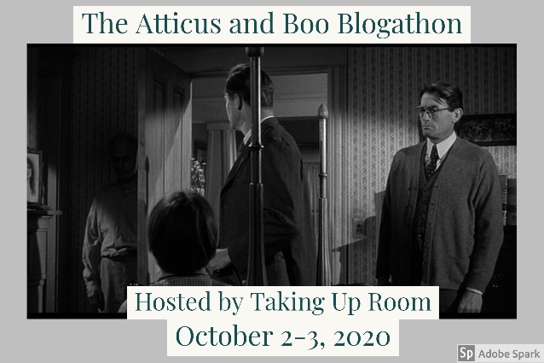
The Atticus and Boo Blogathon banner created by Rebecca from Taking Up Room.

What I didn’t like about the film:

A rushed beginning: I’m aware there’s only so much story that can be told in an hour and thirty-six minutes. However, the first thirty-eight minutesof The Terry Fox Story was rushed. Important events that led up to the marathon were shown in short segments. It felt like these moments were bullet points within a timeline. It also seemed like the film’s creative team tried to squeeze as much of Terry’s story into the script as they realistically could. Only focusing on some of the events would have benefitted the overall project, as the movie’s flow would be even and certain parts of the story could be fleshed out more.

Terry’s bad attitude: After watching The Terry Fox Story, I read Terry’s family was not a fan of the film “for depicting him as ill-tempered”. In the movie, I saw the character of Terry giving some of the people around him a bad attitude. Toward the beginning of the marathon, Terry complains to his friend, Doug, over the smallest of things. He even calls his friend hurtful names. In the few moments when this happened, it made me briefly question why I was rooting for this character. I know this creative decision was chosen to show how humans can be flawed and have their bad days. Eventually, Terry learns from his errors and apologizes to Doug. But when a movie presents a character they want me to root for and, for any reason, that character makes me wonder why I’m rooting for them, that is not a good thing.

Unresolved or under-resolved story points: There were a few story points in The Terry Fox Story that were either unresolved or under-resolved. As I mentioned earlier, Bob and Terry shared two scenes together. The second of these two scenes left an unresolved conclusion, as Bob is never seen again for the rest of the film. The story never explains if Bob beat his cancer diagnosis or if he passed away. Before the marathon, Rika and Terry’s relationship was traveling rocky waters. It wasn’t until the one hour and fifteen-minute mark when Rika’s voice-over could be heard, indicating her and Terry’s issues were resolved. While it was nice to receive this resolution, it could have been received a lot sooner in the story.

Canada postage stamp image created by Ibrandify at freepik.com <a href=’https://www.freepik.com/free-vector/canadian-flag-stamp-template_836872.htm’>Designed by Freepik</a> <a href=”https://www.freepik.com/free-photos-vectors/template”>Template vector created by Ibrandify – Freepik.com</a> Image found at freepik.com

My overall impression:

Before watching The Terry Fox Story, I only knew the bare minimum of Terry Fox’s story. Now, I feel like I’ve been educated on one of the most important pieces of Canadian history! While there are flaws within the project, the 1983 film did a good job showcasing the human spirit on film. Heart breaking and warming moments influence how people view their world, with the movie effectively showing that. The story also reminds the audience that humans are not invincible, as they all have their own limits. Terry Fox and his marathon teaches us what we are capable of when we believe in ourselves and others. As the character of Terry said in The Terry Fox Story, “it’s about reaching out to people and having them touch you back”. Another good lesson this film teaches is how, sometimes, our best is more than enough. Terry’s single act of attempting to run across Canada helped start a conversation we’re still having decades later. Awareness for various cancers are being raised year after year and multiple organizations have joined the fight against this horrible disease. Even though there’s still more work to do done, I’d like to think Terry’s dream is closer to coming true.

Overall score: 8.1 out of 10

Have you heard of Terry Fox’s story? Which “based on a true story” movie would you like to see me write about? Let me know in the comment section below!

Have fun at the movies!

Sally Silverscreen
Here’s the link to the quote I referenced in this review:

https://en.wikipedia.org/wiki/The_Terry_Fox_Story

Take 3: JL Family Ranch: The Wedding Gift Review

It’s been four months since I last reviewed a Hallmark Movies & Mysteries film. To fix this, I chose to write about the newest sequel, JL Family Ranch: The Wedding Gift! I saw the first movie when it premiered four years ago, which I thought was just ok. Therefore, I was not asking Hallmark to grant this title a second chapter. Despite not being a fan of JL Family Ranch, I wanted to watch the sequel with an open mind. Providing Hallmark Movies & Mysteries related content was also my intent. Earlier this month, in a Word on the Street story, I talked about JL Family Ranch: The Wedding Gift’s trailer. In that article, I said the trailer made the movie feel like it took a tonal shift from the first movie. But unless I watched the movie for myself, I wouldn’t know how this shift would affect my movie-viewing experience.

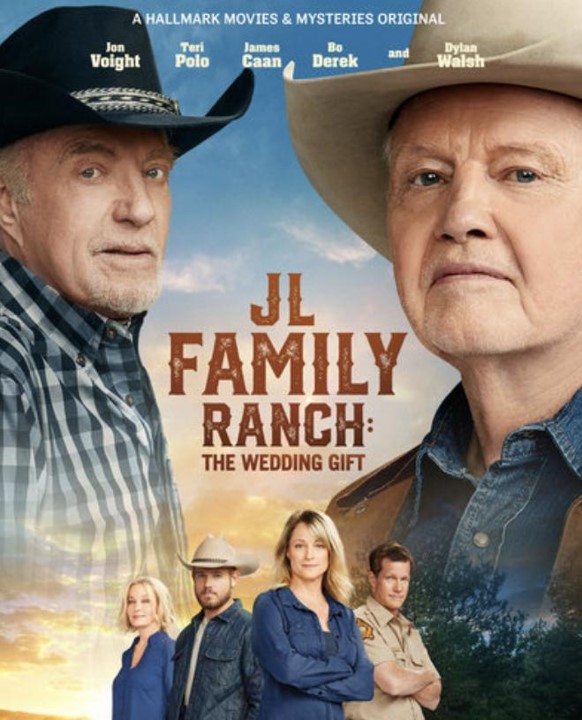
JL Family Ranch: The Wedding Gift poster created by Crown Media Family Networks and Hallmark Movies & Mysteries.

Things I liked about the film:

The acting: Most of the cast members from JL Family Ranch appeared in the sequel. This worked in the cast’s favor, as they knew what to expect from each other, talent-wise! Teri Polo had good on-screen chemistry with her co-stars, especially those that appeared in the first movie. She also gave her character, Rebecca Landsburg, a stoic persona. This creative choice allowed the audience to see how having so much on her plate really affected her. When James Caan’s character, Tap Peterson, appeared in the film, a sense of defeat could be seen and felt. This was caused by events that take place within Tap’s subplot. In a scene where he goes to the bank to ask for a large sum of money, facial expressions and body language effectively show what is going on in Tap’s mind. New faces in this cast also found their way to shine! Judson Mills is one example, portraying a new character named Caleb Peterson. Though he was only in select scenes, his performance still left a memorable impression on me. One scene showed Caleb on his phone, talking about an important matter. As the scene plays out, Caleb goes from looking concerned to being on the verge of tears.

The scenery: The scenery in JL Family Ranch: The Wedding Gift effectively reflected the characters’ rural lifestyle, presenting a stylized version of a ranch family. Sweeping establishing shots captured the green pastures surrounding the family’s bed and breakfast. Picturesque fields were shown in scenes where characters ride their horses. When Rebecca and her fiancé, Henry, are having a private picnic, they are sitting next to a river. The clear blue of the water paired with the surrounding grass nicely. These locations promoted the ideas of the calm and tranquility a rural setting can offer!

Tap Peterson’s house: There have been some gorgeous houses to grace the backgrounds of Hallmark’s productions. Tap Peterson’s house in JL Family Ranch: The Wedding Gift is one of them! Its white exterior boasts a traditional colonial style, complete with a manicured front yard. The interior design within the house displayed a well-to-do setting fit for the prominent rancher Tap is. In one room, the rich wood on the walls complimented a cream armchair with a red pattern. Another room contained white walls showcasing blue and green glass plates. Each design choice was elegant and classy, creating a timeless look in each room presented on screen!

Horse with saddle photo created by Topntp26 at freepik.com. <a href=’https://www.freepik.com/free-photo/stallion-black-equine-race-sky_1104246.htm’>Designed by Freepik</a>. <a href=”https://www.freepik.com/free-photos-vectors/background”>Background image created by Topntp26 – Freepik.com</a>. Image found at freepik.com.

What I didn’t like about the film:

Poor audio: While I haven’t seen Follow Me to Daisy Hills or Falling for Look Lodge, I have heard there are audio problems within these movies. It seems like poor audio has become commonplace in Hallmark’s productions lately, as JL Family Ranch: The Wedding Gift contained the same flaw. All of the characters sounded muffled whenever they spoke, especially when scenes took place outdoors. Because of this, it was difficult at times to understand what was being said. I’m not sure if music or microphone related issues are what caused the movie’s audio to be poor. What I am sure about is this problem was consistent throughout the film.

Too many cliches: I know Hallmark loves their cliches like Santa loves milk and cookies. But JL Family Ranch: The Wedding Gift incorporated too many cliches that have been featured in many other Hallmark films. Four of these cliches were discussed in my list of the top ten worst cliches from Hallmark movies: the “we’re not together” cliché, the “it’s not what you think” cliché, the “protagonist’s ex showing up unannounced” cliché, and the “planning a wedding in an unrealistic time period” cliché. JL Family Ranch: The Wedding Gift also showcased cliches that I’ve never talked about on my blog before, such as the “save the (insert establishment here)” cliché and the “owner of a bed & breakfast trying to impress a travel critic/writer” cliché. If Hallmark knew they were going to use any of these clichés in this movie, they should have put a new twist on them. One idea is to have the travel critic/writer be one of the character’s exes. This way, it creates a compelling conflict of interest dynamic.

Convenient resolutions: On multiple occasions, situations in JL Family Ranch: The Wedding Gift were resolved too conveniently. One example can be found toward the beginning of the film. After a surprise wedding proposal, two travel writers that had come to the bed and breakfast a day early decide to leave sooner than expected. When John tells them there will be an engagement brunch that same morning and when the writers discover all the food of the brunch are “farm to table”, the writers’ impression of the bed and breakfast quickly begins to change. The circumstances that caused these writers to change their perspective were placed at a convenient time in the story.  But because of how everything in that situation happened so quickly, it made the resolution seem like it was met too conveniently.

First wedding dance image created by Teksomolika at freepik.com. <a href=’https://www.freepik.com/free-photo/newlyweds-dancing-at-their-wedding_983404.htm’>Designed by Freepik</a>. <a href=”https://www.freepik.com/free-photos-vectors/wedding”>Wedding image created by Teksomolika – Freepik.com</a>. Image found at freepik.com.

My overall impression:

In 2018, I named Marrying Mr. Darcy the tenth worst movie I saw that year. My reason was how the film could have been better than its predecessor, but ended up being a disappointment. JL Family Ranch: The Wedding Gift made me feel the same way. The 2020 sequel was a disappointingly average film that never reached its full potential. Instead of receiving an exciting new chapter, the story was drowned in clichés and convenient resolutions. It also didn’t help that the project’s audio was poor. While there are things about this movie I liked, such as the talented cast and Tap Peterson’s house, the script itself didn’t hold up its end of the bargain. When it comes to movies, a story is what makes or breaks that project. In the case of JL Family Ranch: The Wedding Gift, the narrative didn’t do it a lot of favors. As a matter of fact, the movie itself is proof why its predecessor did not need a second part.

Overall score: 5.6 out of 10

Did you watch JL Family Ranch: The Wedding Gift? If so, what are your thoughts on it? Tell me in the comment section below!

Have fun at the movies!

Sally Silverscreen

Take 3: Nicholas Nickleby (2002) Review

For A Shroud of Thoughts’ 7th Annual Rule, Britannia Blogathon, I decided to choose a film that was already located on my DVR. Since last February, I have had a recording of the 2002 adaptation of Nicholas Nickleby. Because this story takes place in 19th century England and because this blogathon celebrates British cinema, reviewing the movie seemed like a perfect choice! Nicholas Nickleby is not the first adaptation based on a Charles Dickens novel I’ve written about. Within these two years, I have reviewed Oliver!, Oliver & Company, and The Death of Poor Joe. To tell you the truth, I didn’t even know Nicholas Nickleby was based on a book by Charles Dickens until I saw the film’s opening credits. This film selection is a blessing in disguise. It not only gives me an opportunity to watch more movies from my DVR, but it also allows me to expand my cinematic horizons!

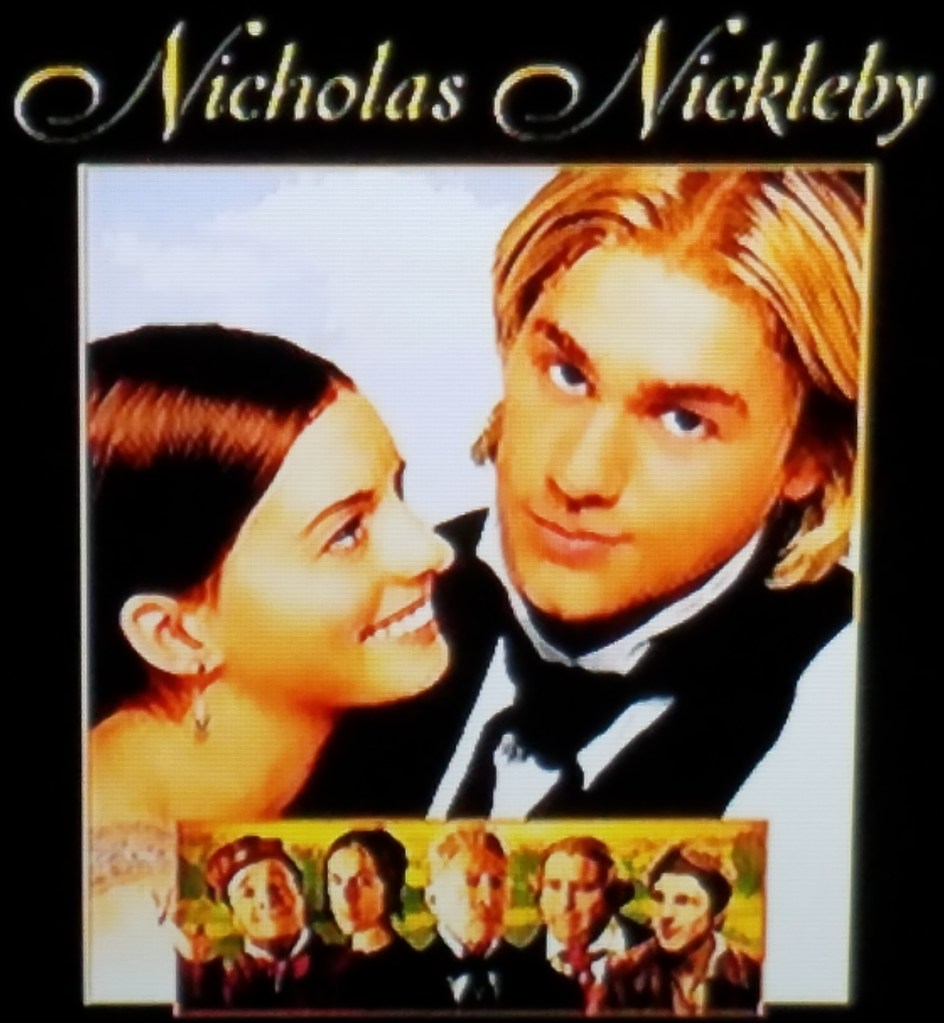
This is a screenshot I took with my phone of the movie’s poster that was displayed on my television. Screenshot taken by me, Sally Silverscreen.

Things I liked about the film:

The acting: Nicholas and Smike have one of the most beautiful friendships I’ve ever seen put on film! This is the result of good screen-writing and good acting! Charlie Hunnam and Jamie Bell put emotion and heart into their individual roles. Together, they display strong on-screen camaraderie. A great example is when Nicholas is trying to read a story to Smike at Dotheboys Hall. Nicholas Nickleby contained an ensemble cast. Each actor and actress worked well with one another, as the performances complimented and highlighted every talent shown on screen. From Anne Hathaway’s use of various emotions to Christopher Plummer’s consistency, all the interactions brought out the best in each cast member!

The dialogue: As I just mentioned, Nicholas and Smike’s friendship was partly the result of good screen-writing. The movie’s screen-writing is also what caused the dialogue to be so memorable! Every piece of conversation reflected this film’s time period. However, the dialogue sounded eloquent without being pretentious. It was also easy to understand, allowing the audience to make sense of what the characters are saying. In one scene, Nicholas is helping Smike escape his kidnapping. The way he told Smike to hurry out of his current location contained urgency and importance. Conversations like the one I just referenced were a consistent and present component of this film!

A balance of despair and joy: I haven’t read Nicholas Nickleby, but I have read Oliver Twist. From what I remember, Charles Dickens found a way to balance the ideas of despair and joy. This balance can be found in the 2002 film! In the movie’s darker moments, despair could be seen and felt. It showed how ugliness presented itself in Nicholas’ world. But there was not so much of this ugliness and despair to make the audience feel depressed. Moments of joy and happiness served to counteract the darker moments. When joyous scenes occurred, they felt earned by the characters. At the same time, they didn’t make it seem like the rest of the film couldn’t be taken seriously. Instead, the incorporation of joy showed how there was beauty in the world, especially if Nicholas searched for it.

The 7th Annual Rule, Britannia Blogathon banner created by Terence from A Shroud of Thoughts. Image found at http://mercurie.blogspot.com/2020/06/announcing-7th-annual-rule-britannia.html.

What I didn’t like about the film:

Lots of content in a limited time-frame: Having read two of Charles Dickens’ books, I know there is a lot of content in his stories. While watching Nicholas Nickleby, I could see there was a significant amount of content. The movie is two hours and twelve minutes. But because each plot point was seen as important, the run-time was bogged down by the large number of storylines. This caused the film to feel longer than its run-time. It makes me wonder if this particular narrative would have benefitted from a mini-series format?

Some unsmooth scene transitions: There were a few scene transitions in Nicholas Nickleby that weren’t given smooth transitions. When the story shows Kate’s, Nicholas’ sister’s, perspective, the chapter comes and ends more abruptly than other scenes. It almost feels like the plot temporarily shifts the protagonist role from Nicholas to Kate. Even though Kate plays an important role in Nicholas’ life, she is a supporting character, while her brother is the main character.

Hand-written letter image created by Veraholera at freepik.com. <a href=”https://www.freepik.com/free-photos-vectors/background”>Background vector created by Veraholera – Freepik.com</a>. <a href=’https://www.freepik.com/free-vector/love-letter-pattern_1292902.htm’>Designed by Freepik</a>. Image found at freepik.com.

My overall impression:

Nicholas Nickleby is the fourth adaptation of one of Charles Dickens’ works I’ve reviewed on 18 Cinema Lane. Out of these four, the best one is still the 1968 musical Oliver! Because I have read its source material, I know there was some content that was cut from the movie, likely for reasons relating to the run-time. Unlike Oliver!, Nicholas Nickleby contained a lot of content that effected its run-time. However, the story was understandable and the screen-writing was strong! Even though there were a few unsmooth scene transitions in Nicholas Nickleby, it never became a common occurrence. What was common was great acting performances, well-written dialogue, and relatable messages! Nicholas Nickleby does a good job at showing how there is both darkness and goodness in our world. In a year like 2020, where it seems like there is one conflict after another, it can be easy to forget the beauty this world can offer. Because of his bad and good experiences, Nicholas Nickleby always perseveres and never takes anything for granted. This is what we can learn from Nicholas’ story, whether or not Charles Dickens intended to teach his readers.

Overall score: 8.2 out of 10

Have you seen any adaptations from Charles Dickens’ work? Are there any British films you enjoy watching? Share your thoughts in the comment section!

Have fun at the movies!

Sally Silverscreen

Take 3: Date with an Angel Review

Teen movies from the ‘80s are September’s theme for Genre Grandeur! Since I knew some of the other participants would talk about more well-known movies from this particular selection, I decided to choose a film that doesn’t always get included in the conversation. On the website, Ranker, there was a list focusing on the greatest teen movies of the ‘80s. A film called Date with an Angel was placed on that list. I have not seen or heard of this title prior to this year. Based on its synopsis, Date with an Angel, shares a similar premise with the film, Splash. While I haven’t seen the 1984 movie in many years, I do remember enjoying it. Because of this, I believed there was a chance I might like Date with an Angel!

Date with an Angel poster created by De Laurentiis Entertainment Group. Image found at https://www.imdb.com/title/tt0092834/mediaviewer/rm1734887424

Things I liked about the film:

The acting: While I don’t watch soap operas, I am aware its actors and actresses are required to give a consistent performance in every episode. I was told Michael E. Knight starred on All My Children as Tad Martin. From what I could tell from his performance in Date with an Angel, his soap opera experiences seemed to have paid off! Michael’s portrayal of Jim felt genuine, as the different expressions he showcases appear believable! This is especially the case anytime Jim interacts with the Angel. When he first encounters her after his bachelor party, the shock and awe of the situation can be seen on his face. Very little dialogue is needed to express the feelings in a moment like that one. Speaking of little dialogue, the Angel herself barely has any lines in this movie. Portrayed by Emmanuelle Béart, she was able to use the lack of dialogue to her advantage by relying on facial expressions and body language. In a scene where Jim is determining if the Angel’s wing is healed, she winces and hides her face from him. The consistency of the performance is also what worked in Emmanuelle’s favor. Another actress that did a good job with the acting material she was given was Phoebe Cates! What I liked about her performance was how emotional it was. As the movie progresses, Phoebe’s character, Patty, transforms from a beloved socialite to a woman who let jealousy get the best of her. Similar to Michael and Emmanuelle, Phoebe effectively incorporated facial expressions into her portrayal.

The music: I was really impressed by the soundtrack found in Date with an Angel! One of the best uses of music in this film takes place in a scene where the Angel and Jim find a treehouse in the middle of the forest. When this happens, the song, ‘The Finer Things’ by Steve Winwood, plays in the background, emphasizing how the simpler things in life are, sometimes, the best. There were times when music highlighted the tone of a particular scene. Anytime Jim is with his friends, rock tunes are heard. Meanwhile, piano/music-box music softly plays in the scenes featuring Jim and the Angel. This musical collection definitely added enjoyment to the movie’s audio!

The use of light and fog: Anytime the Angel appears in Date with an Angel, she is highlighted through the use of light and fog. A great example is when the Angel first lands in Jim’s pool. The lights from the pool are the primary source of light in this scene. Fog wraps around the pool area, creating a mysterious oasis with its presence. These creative techniques emphasized how magical and otherworldly the Angel was. In the scenes where the Angel and Jim are in the forest, fog could be seen in the background. Because of its inclusion, it made this location feel secluded, almost like it was Heaven on earth.

String of musical notes image created by Freepik at freepik.com. <a href=’https://www.freepik.com/free-vector/pentagram-vector_710290.htm’>Designed by Freepik</a> <a href=”https://www.freepik.com/free-photos-vectors/background”>Backgroundvector created by Freepik</a>. Image found at freepik.com.

What I didn’t like about the film:

The Angel is not her own character: In Splash, having a mermaid engage with the human world was a phenomenon. However, Madison was not defined by her mermaid roots. Not only was this character given a name (Madison, in this case), but she was also given her own dialogue. This allowed Madison to play a significant contribution to Splash’s plot. The Angel in Date with an Angel was presented more as a phenomenon than a character. As I mentioned before, the Angel wasn’t given a lot of dialogue. She also didn’t receive a name, being simply referred to as “Angel”. The other characters viewed her as a rarity instead of another individual who happened to appear human. Seeing the Angel not be her own character was disappointing.

Jim’s insignificant composing dreams: Date with an Angel’s synopsis on IMDB reveals that Jim is “an aspiring composer”. Because this particular occupation is not often found in contemporary stories on film, I was curious to see how this would factor into the overall plot. While this detail was brought up on a few occasions, it never served an important part of the story. Music was not used to resolve any conflicts or make any personal discoveries. In retrospect, Jim could have held almost any occupation and it wouldn’t have made a difference.

The cosmetics campaign subplot: One of the subplots in Date with an Angel revolves around Patty’s father trying to salvage a cosmetics advertising campaign. He ultimately decides on finding the Angel so she can be the new face of the campaign. The subplot itself supplies an interesting concept to the overall story. But shortly after this subplot is introduced, it’s quickly dropped from the movie. I found this to be a shame because it could have provided commentary to the plot. One example is how natural beauty is more timeless than the power of any piece of make-up.

I found this angel in my house and I knew it’d be perfect for this review! Screenshot taken by me, Sally Silverscreen.

My overall impression:

Oscar Wilde once said, “Be yourself; everyone else is already taken”. This is a message Date with an Angel needed to hear. While its inevitable for stories to be repeated over time, this movie felt like an imitation of Splash. As I said in the introduction, I haven’t seen Splash in many years. Therefore, I can’t say if it is a better movie than Date with an Angel. What I can say is this imitation didn’t really allow Date with an Angel to be its own movie with its own identity. Looking back on this film, I’m having difficulty understanding why Ranker would put it on their list of ‘80s teen films. I will admit there are elements in the story that would likely be found in an ‘80s teen movie. A group of goofy, scheming friends and a hilarious misunderstanding are two examples. However, Date with an Angel is not an ‘80s teen film by definition, especially since the characters are adults. Maybe this specific premise, where a human crosses paths with an angel, would have worked better in an ‘80s teen movie. If that were the case, it might have had a better chance of being its own story.

Overall score: 6.4 out of 10

Have you seen any teen movies from the ‘80s? If so, which one is your favorite? Share your thoughts in the comment section!

Have fun at the movies!

Sally Silverscreen

Here is the link to the Ranker list I mentioned in this review (Date with an Angel is listed at number 107): https://www.ranker.com/list/best-80s-teen-movies/ranker-film

Take 3: Anchors Aweigh Review

This is it, my 200th movie review! It’s hard to believe I’ve reached this accomplishment in only two years! The recent occurrence and my participation in Pure Entertainment Preservation Society’s Joe Pasternak Blogathon caused me to choose Anchors Aweigh as the next movie to review! This film was recommended to me by The Classic Movie Muse from the blog, The Classic Movie Muse. Anchors Aweigh is also the fourth Frank Sinatra picture I’ve written about in 2020. When reading about Joe Pasternak in the announcement post for the blogathon, I learned that Joe put a lot of thought into the films he produced. Prior to joining the event, the only movie of his I’ve seen is The Unfinished Dance. Back in April, when I reviewed the project, I said it was a good, solid picture! I also mentioned how the movie did a good job at exploring thought-provoking ideas, such as the disappearance of truth. I’m looking forward to talking about Anchors Aweigh, as it is very different from The Unfinished Dance!

Anchors Aweigh poster created by Metro-Goldwyn-Mayer, M-G-M Cartoons, and Loew’s Inc. Image found at en.wikipedia.org/wiki/File:Anchors_aweigh.jpg

Things I liked about the film:

The acting: Anchors Aweigh is the fourth movie of Frank Sinatra’s I’ve seen, as I said in the introduction. His performance as Clarence “Brooklyn” Doolittle was different from his roles in Marriage on the Rocks, High Society, and Ocean’s Eleven. This is because his on-screen personality was sweet-natured. It was a good contrast to Gene Kelly’s character, Joseph “Joe” Brady. In Anchors Aweigh, Gene displayed a confident and headstrong personality. This set of opposites is what helped Gene and Frank become one of the best on-screen duos I’ve ever seen in film! Despite watching only one of Joe Pasternak’s films, I have noticed how the female characters are intelligent women who always hold their head up high. Kathryn Grayson’s character, Susan Abbott, is a great example! Even though she is a single parent, she never gives up on her dreams of being a singer. Because of a believable performance, Kathryn made Susan someone worth rooting for! While Pamela Britton appears in Anchors Aweigh for a limited time, I really liked her character! She not only had a good on-screen personality, but she also had good-screen chemistry with Frank Sinatra. Watching Pamela in Anchors Aweigh was a joy to watch, as her presence brought a bright light to any of her scenes!

The comedy: I found Anchors Aweigh to be a genuinely funny movie. That’s because the humor in this film was well-written and delivered! When Susan and Clarence are on their way to dinner, Clarence suggests that Joe join them. When Joe asks Clarence why he should go, Clarence tells him he won’t know what was said in Joe’s phone conversation. Not only was this conversation clever, but it was also executed well by Frank and Gene. Another funny scene involving Gene and Frank is when Joe is chasing Clarence around the service lodge. This moment was caused by Joe sleeping in, making him miss his meeting with Lola.

The musical numbers: In Anchors Aweigh, the musical numbers were definitely a highlight! There were so many good scenes, it is difficult to choose a favorite. Gene’s dancing talents were utilized to their fullest extent, from his duet with Jerry (the animated mouse) to his Latin inspired solo. These dance numbers were very colorful. The costumes and set design were bright and cheery, allowing the overall mood to be light-hearted and joyful. Frank’s singing abilities were also well incorporated into the story. His solos were slower, ballad pieces. This choice complimented the more romantic moments of the narrative. Having Frank and Gene perform together was a great decision! They were able to keep up with each other’s fortes as well as work well with one another. “I Begged Her” and “If You Knew Susie” showcases this creative partnership wonderfully!

The joining of animation and live-action: In one scene, Joe finds himself in a magical make-believe land where he interacts with animated animals. This is because he is telling a story to the children of Hollywood Day School how he earned his Silver Star. This part of the movie looked really good, especially for a film released in the mid-‘40s! It felt like Gene was actually in that world, as the technology of the time appeared top-notch. I also liked the quality of the animation! It contained bright colors and clear lines, reminding me of the older films from Disney.  Seeing Gene and Jerry dance together was impressive, as it seemed like they were in the same room. Before the actual dance routine, Gene led Jerry onto the ballroom floor by holding his hand. Because of how good the technology looked, this interaction between these two characters was convincing!

The Joe Pasternak Blogathon banner created by Tiffany and Rebekah Brannan from Pure Entertainment Preservation Society. Image found at https://pureentertainmentpreservationsociety.wordpress.com/2020/08/21/announcing-the-joe-pasternak-blogathon/.

What I didn’t like about the film:

A drawn-out conflict: The main conflict of Anchors Aweigh shows Joe and Clarence trying to set up an audition for Susan. While conflicts take time to be resolved, I wasn’t expecting the conflict in this film to last the entire story. Quality script-writing made the conflict itself interesting. But I honestly feel it could have been resolved sooner.

Less Tom, More Jerry: Tom and Jerry, the famous animated cat and mouse, are listed in the opening credits of Anchors Aweigh. I was not expecting this special guest appearance, so seeing these characters in the film was a pleasant surprise. Even though I liked Jerry’s duet with Gene, Tom showed up for only a few seconds. I found their cast listing misleading, as an equal amount of screen time is expected when Tom and Jerry are included in a program.

I had this patch lying around my house and thought it would be perfect to include in this review! Screenshot taken by me, Sally Silverscreen.

My overall impression:

For someone who had never seen any of Frank Sinatra’s films, I have really made up for lost time in 2020. By selecting Anchors Aweigh for the Joe Pasternak Blogathon, I gave myself an opportunity to watch one of Frank’s earlier works. It also gave me an excuse to see more of Joe’s films. I can honestly say Anchors Aweigh is, so far, the best movie I’ve watched this year! There is so much to like about this project and it was pleasantly joyful! I spent most of my time smiling and laughing, as the humor was one of the strengths of this story. The entire movie was well thought out, showcasing an engaging film that was also entertaining. Thank you, Classic Movie Muse, for suggesting this film to me. If not for your recommendation, I might have never seen this delightful movie!

Overall score: 8.9 out of 10

Have you seen any of Joe Pasternak’s films? If so, which one is your favorite? Share your thoughts in the comment section!

Have fun at the movies!

Sally Silverscreen

Take 3: Perry Mason: The Case of the Shooting Star Review

I am so close to publishing 200 movie reviews! Because of this, I have devoted this week to publishing my 199th and 200th movie reviews. Next week, I will publish a celebratory post to commemorate this accomplishment. Yesterday, I watched Perry Mason: The Case of the Shooting Star. When I posted my review of Perry Mason Returns last month, it ended up becoming more popular than I expected, with the article receiving nine likes! These factors are the reason why I chose to review Perry Mason: The Case of the Shooting Star. For the most part, I have enjoyed this particular series. While some films have been better than others, I haven’t come across an installment that was bad. What works in Perry Mason’s favor is having consistent elements, such as the acting performances. Because these elements have been, more often than not, strong, it has helped the memorability of the series!

While searching the internet for this film’s poster, I took a screenshot of this one, as I love the overall design! Screenshot taken by me, Sally Silverscreen.

Things I liked about the film:

The acting: Joe Penny is an actor I’m familiar with because of his performance in Hallmark’s Jane Doe series. What I liked about his portrayal of Robert McCay in Perry Mason: The Case of the Shooting Star is how he was given more opportunities to use emotion! A great example is when Robert is being questioned by Perry Mason at the police station. For most of this scene, the sadness and concern of the situation can be seen on Joe’s face. As the scene progresses, Robert’s anger explodes. Another actor that uses facial expressions well is Jennifer O’Neill! Portraying the murder victim’s wife, Alison Carr, Jennifer used her eyes to enhance the emotions her character was feeling. Her best scene was when Alison and Perry are having a conversation at a law library event. During this conversation, Alison tries to convince Perry that despite everything she has experienced, she is fine. But because her eyes contain so much pain, it appears that Alison is falling apart at the seams. Something I enjoy about the Perry Mason TV movie series is how new, memorable characters have been introduced in each story. Michelle Benti, portrayed by Wendy Crewson, is one of these characters. A photo journalist from New York City, Michelle plays an integral part of the story. She also had a great on-screen personality! Because of these things, it makes me wish Michelle became one of the series’ regulars.

The cinematography: There are times when a mystery movie offers visually appealing cinematography to their audience. Perry Mason: The Case of the Shooting Star is one of these films, as I noticed some interesting cinematography while watching the movie! In the scene where Robert is being questioned by Perry, light is pouring into the room through the blinds of the windows. Both the light and shadows reflect off of Robert’s face, highlighting his facial expressions. Toward the beginning of the film, Robert is walking through the city at night. Smoke could be seen at various moments in that scene. This element helped add to the mysterious nature of the story!

Scenes that tricked the audience: Throughout Perry Mason: The Case of the Shooting Star, Robert McCay is filming a movie in New York City. This caused a few scenes to be presented in a way that tricked the audience. In the aforementioned beginning scene, Robert finds himself in the city at night. At one point, he is surrounded by two sets of gang members. As the scene goes on, it is revealed that Robert and the gang members are in the middle of shooting a film scene. Later in the film, Robert and one of his co-stars, Kate, are seen having a conversation with each other. At first, it seems like they are gaining a mutual understanding of the murder case. But, like the previously mentioned scene, this moment is also revealed to be a part of Robert’s movie.

New York City skyline with letters image created by Freepik at freepik.com. <a href=’https://www.freepik.com/free-vector/new-york-skyline-typographic-silhouette_719554.htm’>Designed by Freepik</a>. <a href=”https://www.freepik.com/free-photos-vectors/background”>Background vector created by Freepik</a>. Image found at freepik.com.

What I didn’t like about the film:

Characters with wasted potential: While each character in Perry Mason: The Case of the Shooting Star gets their moment to shine, there are a few characters that could have had a greater significance in the story. The gang members from the very first scene serve as a good example. I understand these characters were meant to be extras in Robert’s movie. However, I feel at least one of them could have been given more lines and screen time. Who knows? Maybe they would have become a series regular.

The funeral/memorial dinner: When I reviewed the Murder, She Wrote episode, ‘Hannigan’s Wake’, I mentioned how one funeral visitation felt more like a light-hearted dinner party. There was one scene in this movie that made me feel similar to the aforementioned episode. In Perry Mason: The Case of the Shooting Star, the funeral/memorial dinner for the murder victim felt more like an award ceremony. This is because of two things; the fact that some characters don’t wear black attire and how one of the murder victim’s closest friends incorporated jokes during his speech. As I said in my review of ‘Hannigan’s Wake’, funeral services are unique to the family hosting that gathering. However, the two factors I brought up prevented this scene from displaying strong feelings of sadness and grief.

An unbelievable stunt scene: I am aware how fictional stories make their audience suspend their disbelief to varying degrees. But in Perry Mason: The Case of the Shooting Star, there was one scene involving a stunt that didn’t seem believable to me. The stunt itself is not what caused me to feel this way. This was brought on by the stunt coordinator’s decision to allow a civilian, Perry’s colleague Paul, to participate in a stunt without taking precautionary steps beforehand. I understand this particular scene was meant to serve as a comedic moment. But I just can’t believe any stunt coordinator would willingly overlook details like that, especially in a mystery movie that appears grounded in reality.

Magnifying glass image created by Freepik at freepik.com. <a href=’https://www.freepik.com/free-vector/magnifying-glass-with-fingerprint-in-flat-style_2034684.htm’>Designed by Freepik</a>. <a href=”https://www.freepik.com/free-photos-vectors/flat”>Flat vector created by Freepik</a>. Image found at freepik.com.

My overall impression:

As the eighth movie I’ve seen in the Perry Mason TV movie series, I’d say Perry Mason: The Case of the Shooting Star is the best one! Despite its flaws, this film did contain a mystery that was not only intriguing, but also captivating from start to finish! Almost every series features at least one chapter that revolves around show business. When this creative decision is chosen, Hollywood usually serves as that chapter’s backdrop. In Perry Mason: The Case of the Shooting Star, a movie was being filmed in New York City. This allows a nice change of scenery and a different perspective to this tried-and-true plot point. While watching the film, I couldn’t help being reminded of the Brandon Lee tragedy. It is due to the murder victim also being killed by a prop weapon in Perry Mason: The Case of the Shooting Star. There’s no denying the major differences between the real-life and fictional situations. But after watching Perry Mason: The Case of the Shooting Star, it does make me wonder if there would have been a heightened sense of awareness had someone working on the film or a person who knew a cast or crew member had seen the 1986 movie prior to production on The Crow?

Overall score: 7.8 out of 10

What are your thoughts on the Perry Mason TV movie series? Do you have a favorite mysteries series? Let me know in the comment section!

Have fun at the movies!

Sally Silverscreen