Take 3: The Trap (1959) Review

Back in August, The Classic Movie Muse invited me to join the Bernard Herrmann Blogathon! I immediately became interested, but wasn’t sure which film I would choose. While I am familiar with the movies Bernard’s music can be heard in, I’m not that familiar with Bernard as a composer. But with the blogathon taking place on Halloween weekend, I wanted to watch a film that fit the occasion. Originally, I was going to review 1962’s Cape Fear, the movie I wrote about for the 2nd Annual Spooky Classic Movie Blogathon. But, long story short, that didn’t work out. So instead, I chose to review The Trap from 1959! Based on the synopsis, it sounded like an exciting story involving gangsters, the law, and a whole lot of conflict. But did I find the movie enjoyable? If you want to know that answer, you’ll just have to keep reading my review!

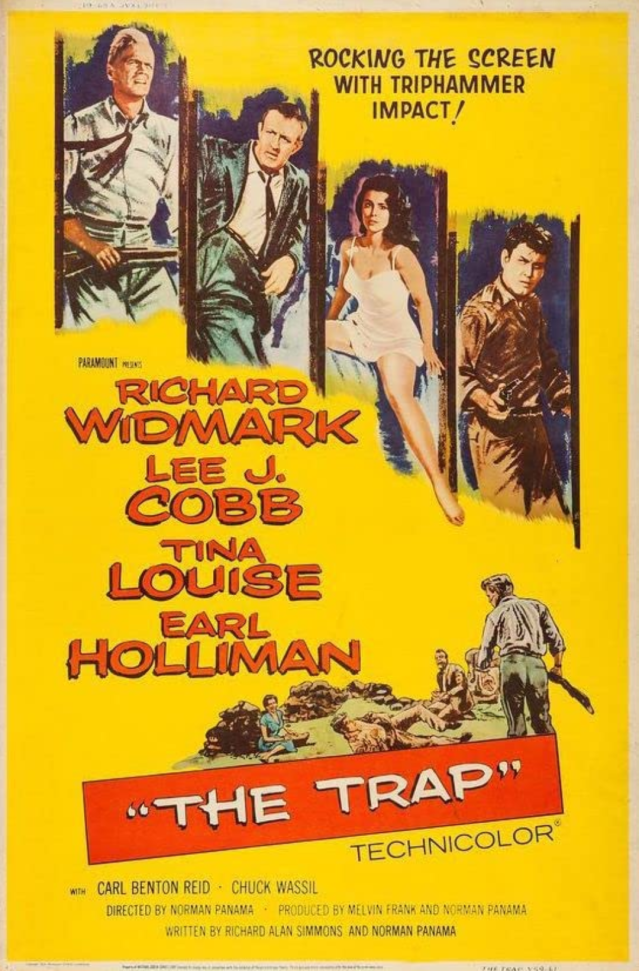
The Trap (1959) poster created by Paramount Pictures

Things I liked about the film:

The acting: I’m not familiar with Richard Widmark as an actor. However, I did like his performance in The Trap! The easy-going and suave persona Richard brought to his character, Ralph, reminded me of Frank Sinatra. His facial expressions and use of emotions were believable as well. When a tragic situation happens in his family, genuine fear was shown on Ralph’s face. Because he was in a dangerous circumstance in the story, Ralph became vulnerable both literally and emotionally. Another character that was vulnerable was Ralph’s brother, Tippy. At the beginning of the movie, Tippy’s alcohol dependency is apparent. With a relaxed body position, a pained look on his face, and a tired tone of voice, Earl Holliman effectively portrayed how this problem can take over someone’s personality. Starring alongside Earl and Richard was Tina Louise as Linda Anderson. This particular character was desperately trying to get by and hold on for dear life. But Linda never came across as desperate or frazzled. Instead, Tina brought a sense of charm and a likable personality to her role. Through the script and Tina’s performance, it highlights how Linda cared about how she presented herself.

The music: Despite being an uncredited composer on this project, I did like hearing Bernard Herrmann’s musical scores! Similar to Cape Fear, the music helped elevate a scene’s suspense. It also fit the emotion depicted in a specific scene. Anytime Ralph and Linda interacted with one another is a perfect example of this. A pleasant, dramatic tune could be heard in the background, the kind you’d hear in a romance movie. Because these characters have a history together, this type of music seemed fitting. It added memorability to those scenes as well.

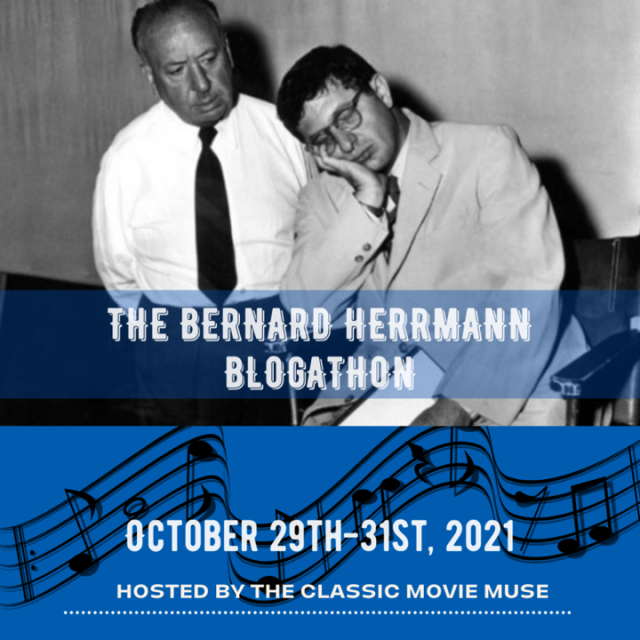
The Bernard Herrmann Blogathon banner created by The Classic Movie Muse from The Classic Movie Muse

What I didn’t like about the film:

Very little excitement: With a movie involving gangsters, the law, and conflict, you’d think it would be exciting. But unfortunately, this story was lacking in the excitement department. Sure, there was a gun fight and a car chase. But these moments were far and few between. The first half of the movie focused on the gangsters’ preparations, emphasizing telling over showing. A road trip that was mostly bland took over the film’s second half. While I continued to watch this movie in the hope some excitement would arrive, it sadly never came.

Emphasis on drama: On IMDB, The Trap is classified as a drama, as well as an action and crime movie. But the script placed more emphasis on the story’s drama. Most of this film focused on the strained relationships among the Anderson family. Even as Victor Massonetti (the leader of the movie’s gangster group) was attempting to escape the country, there was still time to feature Ralph having a conflict with one of his family members. While there’s nothing wrong with featuring drama in a story, it overshadowed the more exciting parts of The Trap. This certainly felt like the screenwriters had difficulty balancing these three genres.

The run-time: This movie has a run-time of an hour and twenty-four minutes. With the way the story focused on drama over action, I honestly think the run-time was too long. Some scenes were drawn out longer than necessary. For example, when Ralph was traveling in a car with Victor, those scenes felt like they were longer just for the sake of satisfying the run-time. The beginning of the movie also satisfied this run-time by maintaining a slower pace. With a shorter run-time, the story could have gotten straight to the point a lot sooner. It also would have prevented some scenes from feeling like they dragged on.

Antique car image created by Freepik at freepik.com. <a href=’https://www.freepik.com/free-vector/red-classic-car_803652.htm’>Designed by Freepik</a>. <a href=”https://www.freepik.com/free-photos-vectors/vintage”>Vintage vector created by Freepik</a>. Image found at freepik.com.

My overall impression:

On the movie poster for The Trap, it says “Rocking the screen with triphammer impact!”. The only impact this movie had on me was making me want to fall asleep on more than one occasion. Within the first half, the story was reminiscent of 1954’s Suddenly, a movie I thought was just ok. But when the second half rolled around, it felt like a boring road trip film. As I said in my review, there was a gun fight and car chase in The Trap. But these exciting moments had such a limited presence in the overall story. One of the flaws of this film was relying too much on the drama genre. When a movie features gangsters, you expect action and excitement. Tensions over which man Linda truly loved were certainly not as riveting as the screenwriters thought. The Trap was, for me, a disappointment. While I liked the acting and music, it wasn’t enough to present a recommendation.

Overall score: 5.1 out of 10

Have you seen The Trap? If so, what are your thoughts on the film? Please share how you feel in the comment section below!

Have fun at the movies!

Sally Silverscreen

Take 3: Cape Fear (1962) Review

Happy Halloween to all my followers and readers! Like last year, I am participating in the Spooky Classic Movie Blogathon! For the first event, I reviewed 1953’s House of Wax, a movie I enjoyed. This time around, I’m reviewing the 1962 film, Cape Fear! When it comes to choosing which movie to watch around Halloween-time, the usual selections with fictious monsters, ghost stories, and haunted tales are preferred. But in my opinion, the most effective “scary movies” are the ones that involve real-life situations. In Cape Fear, a former prisoner seeks revenge against the lawyer who testified against him. This synopsis alone sounds more realistic and terrifying than even those scary movies that are considered “classic”. But is this movie as terrifying as it sounds? The only way to find out is if you keep reading!

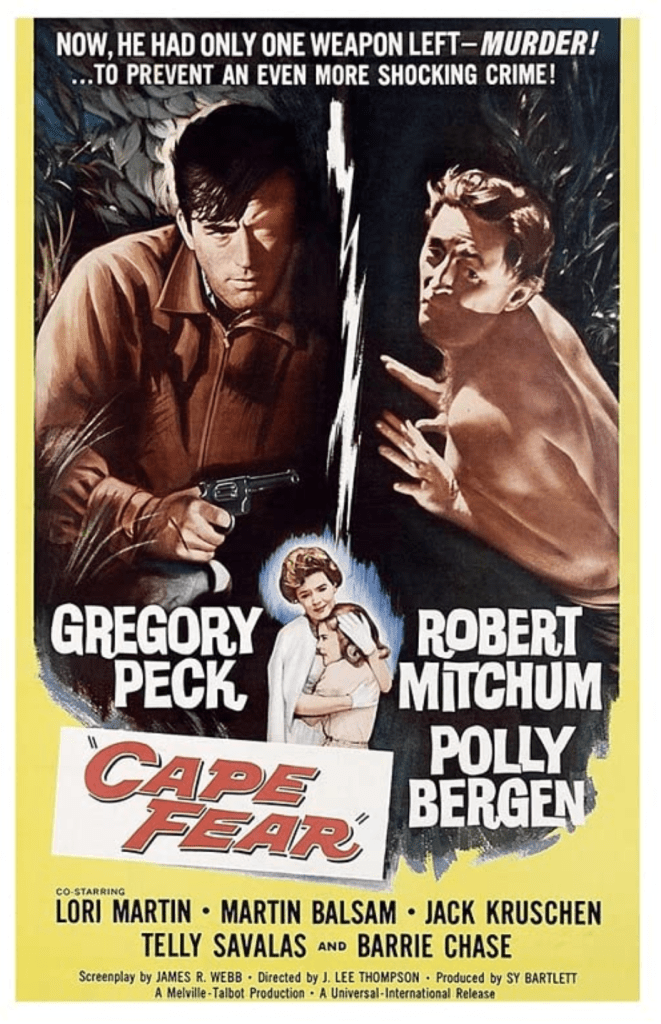
Cape Fear (1962) poster created by Melville Productions, Talbot Productions, and Universal Pictures

Things I liked about the film:

The acting: Before watching Cape Fear, I had seen and reviewed Heaven Knows, Mr. Allison. One of the best aspects of that film was Robert Mitchum’s performance. In the 1962 movie, Robert’s portrayal of Max Cady stole the show! As a character, Max was a creepy and gross fellow. This was made possible through Robert’s facial expressions, body language, and dialogue. In Max’s first scene with Sam, there is a twinge of anger in Max’s voice. But his demeanor was controlled by a sense of calm. The combination of anger and calm within Max Cady added to the character’s unsettling nature. Another actor that effectively balanced two emotions was Lori Martin! In a scene that takes place after a family emergency, Lori’s character, Nancy, appears calm. Yet, she can be seen crying as she talks to her mother in an angry tone. Without spoiling anything, Nancy did have a legitimate reason to be both sad and angry. But I found this performance impressive, especially for an actress so young!

I’ve seen and reviewed To Kill a Mockingbird and Amazing Grace and Chuck. Based on these two movies, it seems like Gregory Peck gets type-casted as either a lawyer or a politician. While he portrays a lawyer in Cape Fear, the script emphasized how his character is a family man. Like the aforementioned movies, Gregory carried his character, Sam, with professionalism and classiness. At the same time, he was given plenty of opportunity to express emotion. A great example is when Sam meets Max at a nearby restaurant. As Max is telling his story, Sam grows increasingly angry. This scene highlights the fierce protectiveness of a husband and a father. It also gave a sense of realism to Gregory’s character!

The music: Legendary composer Bernard Herrmann provided the music for Cape Fear. Throughout the film, his signature musical style could be consistently heard. Bernard’s strength is using music to elevate the suspense within a given scene.  At the very beginning of the movie, Max is walking through the town as an ominous tune can be heard in the background. This effectively clued the audience in of what would come later in the story.  It also let the audience know to pay attention to Max. With all that said, the music definitely added something special to the overall project!

The cinematography: I was not expecting the cinematography in Cape Fear to be as memorable as it was! It, honestly, reminded me of pictures directed by Alfred Hitchcock! One of my favorite scenes is when Peggy, Sam’s wife, has a dream about her and Sam. While Peggy is sleeping, ghostly images of her and Sam are presented over the main image. These images reveal their concerns over the movie’s events, as well as emphasize their desire for action. This way of presenting dialogue and character interactions was very interesting. It added a sense of spookiness to an already suspenseful story!

2nd Annual Spooky Classic Movie Blogathon banner created by Kristen of Hoofers and Honeys

What I didn’t like about the film:

An exposition heavy beginning: Within the first twelve minutes of Cape Fear, the audience learns about Sam Bowden, his family, Max Cady, his arrest, and why he was arrested. Personally, I felt this was too much information to present in the film’s beginning. In fact, I was disappointed Max’s secrets were revealed so soon. What the screenwriter should have done was sprinkle this information throughout the story. That way, the audience would have a greater reason to stay invested in the mystery.

Dumb decisions from the characters: After a family emergency involving a dog, Sam warns his wife and daughter of Max’s dangerous nature. He instructs his daughter, Nancy, to only leave school and home with either him or his wife, Peggy. But more often than not, Nancy is left by herself, with Sam and Peggy putting her in a vulnerable position. One example is when Nancy gets out of school to find her mother’s car empty. While waiting in the car, Nancy sees Max and attempts to get away from him. Even though she succeeds in this plan, she ends up getting hit by an oncoming car in the process. I know her parents are human and humans make mistakes. However, these mistakes felt unbelievable after some time.

An unrelated court case: Featured in a few scenes, a court case involving an arthritic patient receiving surgery was addressed in Cape Fear. But the only connection this case had with the rest of the story was Sam as one of the associated lawyers. I wish the case had a more significant reason to be in the film. Maybe it could have something to do with Max’s past crime, with two separate mysteries becoming one. I, honestly, wanted to learn more about that case, but was sadly not given the chance.

Scared audience image created by Katemangostar at freepik.com. <a href=’https://www.freepik.com/free-photo/terrified-friends-watching-horror-movie-in-cinema_1027311.htm’>Designed by Freepik</a>. <a href=”https://www.freepik.com/free-photos-vectors/people”>People image created by Katemangostar – Freepik.com</a>. Image found at freepik.com.

My overall impression:

As I said in my introduction, the most effective “scary movies” are the ones that involve real-life situations. Even though this is a fictional story, it is effective at being a scarier film! Max Cady is one of the most unsettling characters in film, with Robert Mitchum’s acting abilities highlighting the reason why. Come to think of it, this performance showed a different side to Robert’s talents. Bernard Herrmann’s music added to the scary nature of the story, emphasizing the suspense within the script. But the multiple dumb decisions of the characters took away some from the film’s believability. The beginning of the film was also exposition heavy. However, the overall production felt like an Alfred Hitchcock picture without actually being affiliated with Alfred Hitchcock. With this said, I’d recommend Cape Fear as your next pick for Halloween!

Overall score: 7.5 out of 10

Have you seen Cape Fear? Which movie would you watch on Halloween? Tell me in the comment section!

Have fun at the movies!

Sally Silverscreen

Take 3: Vampire Circus Review

Blogathons are a great opportunity to be introduced to new genres, films, and talents. For me, that has certainly been the case for The Third Hammer-Amicus Blogathon. Because this was my first time watching any Hammer-Amicus production, I had to research which title I would write about for the event. On Wikipedia, I stumbled across the 1972 film, Vampire Circus. The film’s title immediately caught my attention, as I’ve never seen a vampire led circus before. Movies revolving around vampires are no stranger to 18 Cinema Lane. As of October 2021, I have reviewed five vampire films, with Vampire Circus now being the sixth title. These projects have received favorable reviews, with each one being enjoyable to varying degrees. How will Vampire Circus fare among the other vampire films I’ve seen? Keep reading, as the show is about to begin!

Vampire Circus poster created by Rank Film Distributors and 20th Century Fox.

Things I liked about the film:

The acting: As I said in the introduction, this was my first time watching any Hammer-Amicus production. But during my experience viewing Vampire Circus, I could tell the actors and actresses involved were invested in their roles! Whenever a circus is incorporated into a story, the ringleader is usually a man. So, it was interesting to see a woman leading a circus in Vampire Circus. Confidence and a no-nonsense attitude are the traits I associate with a circus ringleader. While portraying the Gypsy Woman, Adrienne Corri effectively brought those traits to her character! Adrienne also had the ability to command attention from the audience. This is due to the strong on-screen personality she presented.

While watching Vampire Circus, I was impressed by the performances of the younger actors and actresses. Two of these stand-out performances came from John Moulder-Brown and Lynne Frederick! Portraying Anton Kersh and Dora Müller, these actors had surprisingly good on-screen chemistry. They also performed well together and individually. John and Lynne’s interactions felt believable, like their characters truly cared about each other. It made me wish they had starred in a production of Romeo and Juliet!

The historical accuracy: Vampire Circus takes place in the 19th century, which contains the years 1801 to 1900. As soon as the movie started, I noticed the creative team’s focus on making their production look historically accurate! Two of the characters, Anna Müller and Jenny Schilt, wear dresses that appear like they came directly from that time period, reminding me of stories like Pride and Prejudice and American Girl’s Caroline series. The costumes for the male characters are also reminiscent of these stories. The props and set designs were historically accurate as well! A good example were the circus wagons. Their structural build reflected the classic circus images seen on antique posters and art work. The signs for “Circus of Night” and the “Hall of Mirrors” presented an art style that was present during that time. With all these elements coming together, I felt transported to the 19th century!

Introducing the “photogenic vampire”: I have heard people give Anne Rice’s Vampire Chronicles series credit to creating the concept of “photogenic vampires”. But personally, I think Vampire Circus deserves that credit, as the movie was released before Interview with the Vampire was published. The vampires in Vampire Circus appeared beautiful, looking like potential supermodels. A perfect example is Emil, who was also a circus performer. One of the young women in the town of Stetl, Rosa, develops a crush on Emil after the circus’ first performance. When you take one look at Emil, it is easy to see why Rosa would be interested in him. This simple creative decision allowed Vampire Circus to make a significant contribution to the world of vampire stories!

The Third Hammer-Amicus Blogathon banner created by Gill from Realweegiemidget Reviews and Barry from Cinematic Catharsis

What I didn’t like about the film:

Confusing parts of the story: The Bürgermeister’s daughter, Rosa, is attracted to Emil, one of the circus performers. In one scene, she is telling her mother how Emil is not like other guys, as he has traveled the world and is more cultured because of it. But in earlier scenes, we don’t get to see these characters converse with one another. All that is provided to the audience is Emil and Rosa meeting at the circus for the first time and seeing them have intercourse shortly after they met. How would Rosa know all that information about Emil if she barely spoke with him? Did she and Emil talk with each other off-screen? This is just one part of the story that I feel needed context.

The underutilization of animals: When the circus comes to the town of Stetl, they bring three animals: a panther, a tiger, and a chimpanzee. Throughout the film, the chimpanzee and tiger stayed in their cages. Meanwhile, the panther was seen out of its cage about two or three times. In the world of film, animals are a part of a production to either be showcased as naturally as possible or to be shown doing something cool. In Vampire Circus, when there was an opportunity to prominently feature the tiger, a dancing woman painted as a tiger took its place. With all that said, it makes me wonder why there were animals in the movie at all?

Inconsistent traits among the vampires: In fiction, there are many different vampires who carry a variety of skills and traits. Within Vampire Circus, however, the traits of the vampires felt inconsistent. Two of the vampires in the story, Heinrich and Helga, are sensitive toward crucifixes. But when a crucifix is presented to the Strongman, he ends up crushing it with no sensitivities. Does this mean the Strongman wasn’t a vampire or was he simply not bothered by crucifixes? Over the course of the story, Emil is revealed to be a shapeshifter. At various moments in the film, he transforms into a panther, the same panther the circus brings to town. Meanwhile, as I mentioned before, the tiger and chimpanzee stayed in their cages. Was Emil the only shapeshifter in the circus? Were the animals simply animals?

Happy vampire image created by Freepik at freepik.com. <a href=’https://www.freepik.com/free-vector/several-vampires-ready-for-halloween_1317599.htm’>Designed by Freepik</a>. <a href=”https://www.freepik.com/free-photos-vectors/party”>Party vector created by Freepik</a>. Image found at freepik.com.

My overall impression:

Vampire Circus introduced the concept of “photogenic vampires”. For this, I will give the film credit where it is due. But when I think about this 1972 production, I’m confused of what its intention was. On the one hand, all the actors and actresses seemed invested in the roles they were given. But, on the other hand, a stuffed animal could be plainly seen during a scene where a group of characters were attacked in a forest. Was this movie supposed to be “so bad it’s good” or a horror movie with a pinch of humor? There were also parts of the story that I found confusing. However, the film was interesting enough to keep me invested in what was happening on screen. Therefore, I found Vampire Circus to be just ok.

Overall score: 6 out of 10

Have you seen any Hammer-Amicus films? Are there any vampire films you enjoy watching? Please tell me in the comment section!

Have fun at the movies!

Sally Silverscreen

Take 3: I Dream of Jeanie (1952) Review

I’m participating in two blogathons; the Musicals: With A Song And A Dance In My Heart Blogathon and The Biopic Blogathon. Because of this choice, I wanted to review a movie that was “the best of both worlds”. One day, while on Youtube, I came across the 1952 film, I Dream of Jeanie. After learning it was a musical biopic about the composer, Stephen Foster, I knew I had found the perfect entry! Prior to these events, I had never heard of I Dream of Jeanie. In fact, I was not familiar with Stephen Foster either. But I wanted to use my participation as an opportunity to learn more about him. I also wanted to be introduced to films that were newer to me. Did my plan work? Continue reading if you want to find out!

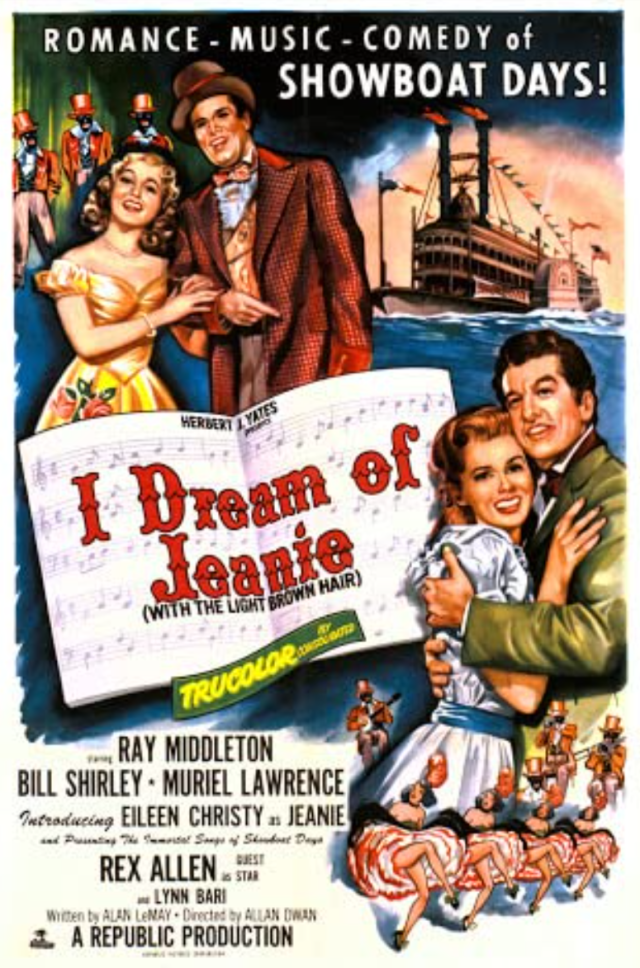
I Dream of Jeanie (1952) poster created by Republic Pictures

Things I liked about the film:

The acting: Bill Shirley is an actor I’m not familiar with. While I have seen Disney’s Sleeping Beauty, I have never seen any of his live-action films. Despite this, I did enjoy watching his acting performance! His mannerisms and line delivery reminded me of Jimmy Stewart. This is because of the tender-hearted nature Bill presented. His singing talents were amazing in this movie! One of his best performances was his solo, “Beautiful Dreamer”. With his deeper vocals and the heart-felt lyrics, there was emotion found in the song. He also sang beautifully with Eileen Christy, who portrayed Jeanie. Toward the beginning of the film, they sang a duet of “Oh! Susanna”. Bill and Eileen displayed good harmony during their performance. Having nice on-screen chemistry also worked in their favor.

While we’re on the subject of Jeanie, let’s talk about Eileen Christy’s performance. Throughout the film, she presented her character with a likable persona. Jeanie was sometimes the film’s “comic relief” as well. When a script adopts a “comic relief” character, that individual can either be goofy or be seen as dumber than the protagonist. With Jeanie, that was never the case. Even though she was silly, her intelligence never faltered. Another actress who gave a good performance is Muriel Lawrence. Portraying Jeanie’s sister, Inez, she provided an embodiment of a “diva”. Her strong will and determination to get her way made Inez one of the film’s more unlikable characters. But as an actress, Muriel had star qualities!  Whenever she appeared on screen, Muriel was able to garner the camera’s attention, even when her character wasn’t the focus of a scene. It also helps that she sang beautifully in this movie.

The musical numbers’ inclusion in the story: In some musicals, a musical number can make the story feel paused. With I Dream of Jeanie, the musical numbers pushed the story forward and made sense within the context of the story. A perfect example is Muriel’s solo, “Lo, Hear the Gentle Lark”. Toward the beginning of the movie, Inez and Stephen talk about an upcoming recital, where Stephen hopes Inez will agree to an engagement. When the event arrives, the performance is used to make Inez shine, showing how she craves attention. During the recital, unpublished songs by Stephen are introduced. The secret of Stephen’s involvement with “Oh! Susanna” is revealed at this event as well. Similar to “Lo, Hear the Gentle Lark”, the inclusion of these aforementioned songs also fit within the story.

A glimpse into the legal side of the music industry: One of the conflicts Stephen experiences is his lack of royalties from “Oh! Susanna’s” success. Whenever the song is performed, Stephen’s name is never mentioned. This surprises everyone in his life, including his brother. Stephen also faces legal threats due to the song’s copyright. This is because he presented the song to multiple publishers. Since I’m not well versed in the legalities of the music world, I found this brief exploration fascinating! That part of the story allowed me to learn something new. It also showed how different copyright laws and royalty agreements were in the 1840s.

The Musicals: With A Song And A Dance In My Heart Blogathon banner created by Neil from Thoughts From The Music(al) Man

What I didn’t like about the film:

Not really biographical: The purpose of a “biopic” is to provide some education to an audience about a particular individual. In the case of I Dream of Jeanie, this movie is meant to tell the story of Stephen Foster. But I ended up not learning much about the composer. While I discovered he wrote ‘Oh! Susanna’, I was expecting to learn more about Stephen. How did he become interested in music? Did he receive any professional training? This film doesn’t answer these questions. Instead, the script focuses more on other characters and events.

The characterization of Stephen Foster: No main individual in any “biopic” is meant to be seen as “perfect”. However, one of the staples of a “biopic” is to present the admirable aspects of a given individual. With I Dream of Jeanie, Stephen Foster, more often than not, came across as a desperate push-over. I don’t blame Bill Shirley for this, as he did a good job with the acting material he received. But I will put blame on the film’s screenwriter, Alan Le May. For the majority of the movie, Stephen loves a woman named Inez. She not only doesn’t like the type of music he makes, she also hates “Oh! Susanna”. In an attempt to win her love, Stephen announces how he’s trying to achieve a “redemption” by only playing classical music. He does this instead of standing up for himself or trying to compromise with Inez. This is, sadly, just one example of Stephen’s characterization.

The character of Edwin P. Christy: Not every character is meant to be likable. Sometimes, a character’s likability is based on personal preference. In my opinion, Edwin P. Christy was annoying. Once again, blame is given to Alan Le May. Edwin was a flamboyant and over-the-top showman. But what made him unlikable for me was how he used every opportunity to put the spotlight on himself. During Inez’s recital, Edwin disrupts the event by loudly playing one of Stephen’s songs at Stephen’s nearby stable. Edwin then crashes the recital and performs some of Stephen’s unpublished music, with no granted permission from Stephen. After some time, Edwin’s antics became unpleasant. It almost felt like Edwin tried to make the story about himself as well.

The Biopic Blogathon banner created by Annette from Hometowns to Hollywood

My overall impression:

In my introduction, I said I wanted to use my participation in these blogathons to learn more about Stephen Foster. Unfortunately, that’s not what happened. Don’t get me wrong, I did learn a few things about him and about some of the legalities of the music world’s early years. But it wasn’t enough to justify an hour and twenty-nine-minute movie. If anything, it almost seems like this film was about anything but Stephen. When characters like Edwin P. Christy try to take the spotlight for themselves, it makes the project look less biographical. As I mentioned in this review, some of the blame falls on the screenwriting. The quality of a project’s script is what makes or breaks it. If the script is weak, there’s only so much the other members of the creative team can do to salvage it. Now, as I wrap up this review, I must take a detour to Wikipedia.

Overall score: 5.6 out of 10

Have you seen any biopics? If so, which one is your favorite? Let me know in the comment section below!

Have fun at the movies!

Sally Silverscreen
Take 3: Pollyanna (1920) Review

When I discovered The Silent Movie Day Blogathon, hosted by In The Good Old Days Of Classic Hollywood and Silent-ology, I knew I had to take part in the event! As I mentioned in my review of The Cabinet of Dr. Caligari, silent movies are not often covered on 18 Cinema Lane due to their availability. Speaking of the aforementioned film, that review was published back in January. So, my blog was due for another article about a silent picture. I was fortunate to find 1920’s Pollyanna on Youtube. While choosing this movie for the blogathon, I realized this would be the first adaptation of Pollyanna I would see in its entirety. While I have seen the adaptation starring Hayley Mills, I only watched pieces of it. Therefore, I can’t give an honest opinion on that film. I am familiar with the general premise of Pollyanna, despite never reading the source material or seeing an entire film version. I also haven’t sought out any of Mary Pickford’s movies before. Because of everything I’ve said in this introduction, I knew watching 1920’s Pollyanna would be an exciting experience!

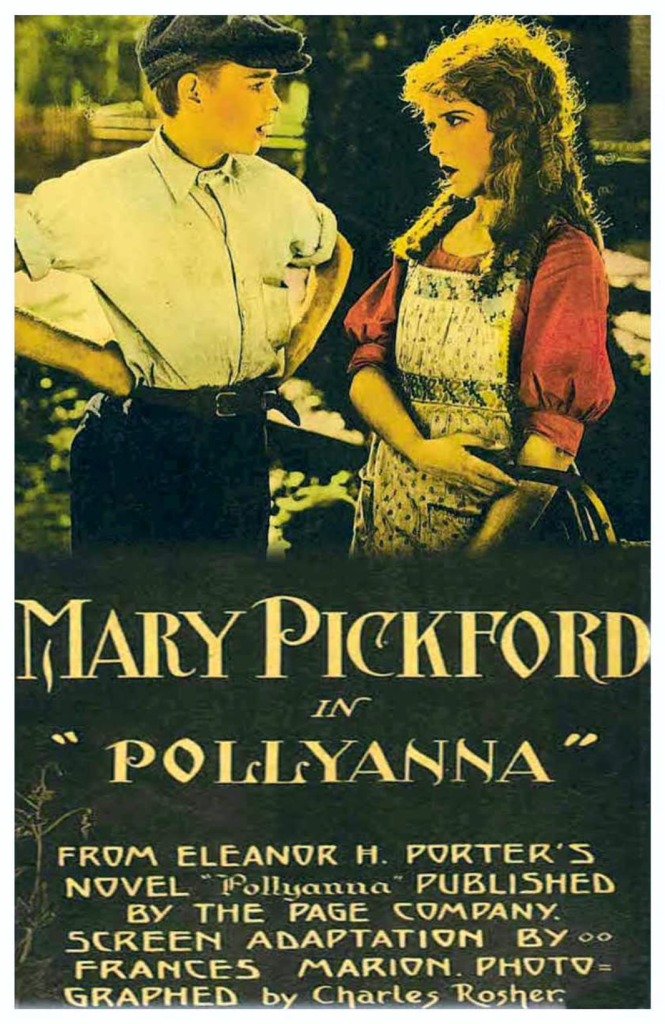
Pollyanna (1920) poster created by United Artists

Things I liked about the film:

Mary Pickford’s performance: I thought the cast of Pollyanna was solid. But the one actor that shined the brightest was Mary Pickford! As I’ve mentioned before, actors and actresses in silent films must rely on body language, facial expressions, and emotions to convey what a character is thinking and feeling. While portraying Pollyanna, Mary was so expressive, using the aforementioned acting components to her advantage. She was even able to quickly adapt to each situation very effortlessly! What I also liked about Mary’s performance was how she displayed feelings of sadness and frustration. Realistically, carrying a happy persona is tiring. You can only be happy for so long and so often until the feeling itself starts to wear off. Because of Mary expressing these emotions, she helps prevent her character from being one-dimensional.

Mary’s wardrobe: An element of this project that, surprisingly, stood out to me was Mary’s wardrobe. Even though these outfits appear age appropriate for her character, a more creative reason is what caught my eye. The majority of Mary’s wardrobe consisted of light-colored outfits. These outfits allowed Mary to stand out and become the focus of a given scene. This creative decision was a simple one that worked in the project’s favor. It shows how much thought was put into the film’s presentation.

The messages and lessons: Before watching this adaptation of Pollyanna, I knew the titular character’s purpose was to, simply, make people happy. While there is truth to this statement, making people happy only scratches at the surface. Pollyanna, more often than not, tries to find the “silver lining” that will help her move forward in life. This mentality allows her to see the good in everyone she meets, even her stubborn Aunt Polly. In the 21st century, it can sometimes be difficult to put ourselves in a good mood. Even in the world of movie blogging, it can be easier to talk about bad movies or unfavorable movie news. But Pollyanna shows the audience that it is possible to find the “silver lining” in our lives, even finding the good in ourselves. These are lessons and messages that are not only relatable, but timeless as well.

The Silent Movie Day Blogathon banner created by In The Good Old Days Of Classic Hollywood and Silent-ology

What I didn’t like about the film:

An unexplained scene: When Aunt Polly is first introduced, two small children dressed up as bunnies appeared on the table. They approach Aunt Polly with pitchforks in their hands, one of these “bunnies” even poking Aunt Polly with their pitchfork. After that scene, the “bunnies” never appeared again. They were never referenced by any of the characters either. It also doesn’t help that no title card provided context to the “bunnies”. This is a scene I wish was given more explanation.

Musical selections: To make up for the lack of dialogue, music is used to emphasis the tone of a given scene. While there were musical selections in Pollyanna that matched what was happening on screen, some of these musical selections felt out of place. In the second half of the film, Pollyanna deals with a difficult situation. This situation brought up feelings of sadness and low self-esteem. But the background music during this situation was a cheery, upbeat tune. Because of this musical choice, it kind of took me out of the film.

Pollyanna’s lack of uniqueness: Like I said in the introduction, I was familiar with the general premise of Pollyanna prior to watching this adaptation. Based on what I knew, I was expecting the titular character to magically make everyone feel happy, with the script making it seem like that was Pollyanna’s “magical power”. But as I watched the movie, Pollyanna reminded me of other characters; such as Anne Shirley, Heidi, and Annie. While I liked her promotion of the “glad game”, Pollyanna’s attempts at spreading joy to those around her didn’t feel much different from the attempts of the aforementioned characters. This discovery disappointed me because I expected Pollyanna and her story to be different from Annie, Heidi, and Anne of Green Gables.

Image of vintage movie camera created by Macrovector at freepik.com. <a href=”https://www.freepik.com/free-photos-vectors/background”>Background vector created by macrovector – http://www.freepik.com</a>. Image found at freepik.com.

My overall impression:

Mary Pickford is someone I’d like to call one of the “grandmothers of cinema”. A face of Hollywood’s early years, she helped play a role in showing what was possible for, at the time, a new medium. This particular film also shows what is possible when it comes to adaptations. 1920’s Pollyanna is a fine film. With strong acting, effective creative choices, and good messages, it contains likable qualities. However, the movie kind of felt like a copy of similar stories. Pollyanna herself reminded me of other young characters with shining personalities, like Anne Shirley or Ceddie. Even the older characters’ transformations in attitude were reminiscent of those such as Daddy Warbucks, Marilla Cuthbert, and Heidi’s grandfather. With all this said, the movie didn’t add much to the adaptation table. I am aware of two other adaptations of Pollyanna, including Hayley Mills’ version I mentioned in the introduction. One day, I’d like to check these films out and see which one I like best!

Overall score: 7.2 out of 10

Have you seen any silent films? If so, which one would you like to recommend? Let me know in the comment section!

Have fun at the movies!

Sally Silverscreen

Take 3: Kingdom of Heaven Review

This is my second year participating in the Rule, Britannia Blogathon. In 2020, I reviewed the 2002 adaptation of Nicholas Nickleby, a movie I ended up liking so much, I now want to read the source material. For the 8th annual event, I chose to write about another film from the 2000s; 2005’s Kingdom of Heaven. This is a movie I have heard about, but never got around to seeing. Until this blogathon, it had sat on my DVR for three years. Since the movie stars Orlando Bloom, a British actor, the Rule, Britannia Blogathon seemed like the perfect opportunity to finally check the film out. One of the few things I knew about this movie was that it had something to do with the Crusades. This is a time period I know very little about. However, this didn’t stop me from giving the film a fair chance. What did I think of this 2005 title? Keep reading if you want to find out!

Kingdom of Heaven poster created by Scott Free Productions, Inside Track, Studio Babelsberg Motion Pictures GmbH, 20th Century Fox, and  Warner Bros. Pictures

Things I liked about the film:

The acting: As I said in the introduction, Orlando Bloom’s involvement in this project is one of the reasons why I chose to review Kingdom of Heaven. Prior to watching the film, I had seen the Pirates of the Caribbean trilogy, where Orlando consistently portrayed Will Turner. While the character of Balian is similar to Will, each role is distinct. To an extent, Orlando’s performance in Kingdom of Heaven reminded me of Vincent Perez’s portrayal of Yanko from Swept from the Sea. While Balian is a masculine character, he also displayed a gentle charm. A good example is when Balian arrives in Jerusalem. He gives his prize horse to the servant of his opponent. When the servant asks why Balian would make this decision, Balian replies how he doesn’t want the horse to suffer.

In Kingdom of Heaven, Eva Green portrayed a queen named Sibylla. Despite appearing in the movie for a limited amount of time, I did enjoy watching her performance! I noticed how fluid Eva’s emotions were. This allowed her to adapt to any situation her character faced. It also helps that she was able to excel, acting wise, alongside her co-stars. Another character I wish appeared in the film more was King Baldwin IV. Portrayed by Edward Norton, this character was a leper. Therefore, he was completely covered and wore a mask. Edward’s use of body movement and expressive eyes make up for the lack of facial expressions. His approach to his role made King Baldwin IV a compelling character to watch!

The scenery: “Sword and sandal” movies are known for featuring breath-taking scenery. Kingdom of Heaven also brings beautiful scenery to the table, showcasing desert, oceanic, and forest landscapes. Toward the beginning of the movie, Balian resided in the French countryside. This area was surrounded by deep green forestry, the ground and trees lightly covered in snow. As Balian travels to Messina, the city is met with a clear, blue ocean. The hue of the water beautifully complimented the warm sandstone of the nearby buildings. While Jerusalem is in the middle of a desert, palm trees brought a pop of color to the environment. These plants helped make Jerusalem appear as an oasis.

The historical accuracy: I’m not familiar with this particular period in history. But based on the limited information I do know, the movie appeared to be historically accurate. Throughout the film, knight’s armor could be seen. Helmets, swords, and other related gear adopted an older style. Some of the swords boasted jewels, with Balian’s sword displaying a giant ruby. Even the attack towers from one of the film’s battles looked as if it came directly from the time of the Crusades. As I’ve said about other period films, details like the ones I mentioned show how much the creative team cared about the presentation of their project!

The 8th Annual Rule, Britannia Blogathon banner created by Terence from A Shroud of Thoughts.

What I didn’t like about film:

Sibylla’s unclear motives: During Balian’s time in Jerusalem, Sibylla becomes romantically interested in him. But she’s already married, a fact that Balian himself is aware of. Balian’s reason for going to Jerusalem was to seek forgiveness for his and his deceased wife’s sins. After meeting Sibylla, he, more often than not, doesn’t object to Sibylla’s romantic interest for him. I was left confused on what her motives were for wanting to be with Balian. At times, I wondered if Sibylla’s situation was similar to Rose’s from Titanic, simply stuck in a loveless relationship and desperately looking for a way out. Other times, I thought Sibylla was attempting to seduce Balian toward sin. I wish these motives were clarified in the script.

A limited incorporation of religion/faith: Because Kingdom of Heaven takes place around the time of the Crusades, I was expecting religion/faith to be one of the cornerstones of this story. While the topic is included in the film, its incorporation is very limited. Before watching this movie, I thought the story was going to be similar to 1959’s Ben-Hur, with the protagonist trying to live his life as a man of the people and of faith. But we never get to see Balian’s internal struggle with these responsibilities. Instead, the audience sees Balian resolve smaller non-religious conflicts which lead to a much bigger conflict. Even though people can be seen praying, there is more to religion/faith than prayer. The script relied more on who would rule Jerusalem than how religion/faith played a role within that world.

A more episodic story: When it comes to “sword and sandal” movies, there is usually an overarching conflict the characters work to resolve over the course of the story. But in Kingdom of Heaven, most of the story is episodic. As I said earlier, Balian wants to go to Jerusalem to seek forgiveness for his and his deceased wife’s sins. Once he has achieved his goal, he moves on to another conflict that is resolved within a short amount of time. This is how the story plays out for about the first half of the movie. There is a major conflict that receives a lot of attention in the film’s second half. However, it feels more like a climax than an event the characters are working towards.

White horse image created by Gabor Palla at freeimages.com. “FreeImages.com/Gabor Palla.”

My overall impression:

Two years ago, I reviewed 1959’s Ben-Hur, a classic “sword and sandal” film. Despite seeing it for the first time, I was over the moon by the strength of the movie’s quality. With Kingdom of Heaven, I didn’t feel the same way. Yes, the 2005 title is a fine, well-made production. But there were times I was confused as I followed along with the story. Like I mentioned in my review, Sibylla’s motives for being romantically interested in Balian were not made clear. However, this is one example of my confusion. Even though this movie was released over ten years ago, I won’t spoil it for anyone who hasn’t seen it. But I will say that something happens toward the end of the film that left me wondering if everything the characters worked for was worth it. As someone who knows very little about the Crusades, I was hoping to use my movie viewing experience as a learning opportunity. While I did learn some information, I feel there’s far more I need to discover. I’ve heard there is a director’s cut of Kingdom of Heaven. If this information is true, maybe I’ll check it out and see which version I like more.

Overall score: 7.2 out of 10

Have you seen Kingdom of Heaven? What is your favorite “sword and sandal” film? Tell me in the comment section!

Have fun at the movies!

Sally Silverscreen

Take 3: The Elephant Man Review

Two years ago, I reviewed It’s a Mad, Mad, Mad, Mad, World. I chose to re-watch this movie in an attempt to give it a second chance. For the Anne Bancroft: A 90th Birthday Celebration Blogathon, I decided to do something similar with another movie. This time, the film of choice is The Elephant Man. Many years prior, I saw about ten minutes of the 1980 title.  At the time, I thought the film was boring. Upon discovering Anne starred in The Elephant Man, I thought it would give me a good excuse to re-visit this movie. It also provided a good opportunity to check out more of Anne’s filmography. So, in honor of Anne’s birthday, let’s raise the curtain on this review of The Elephant Man!

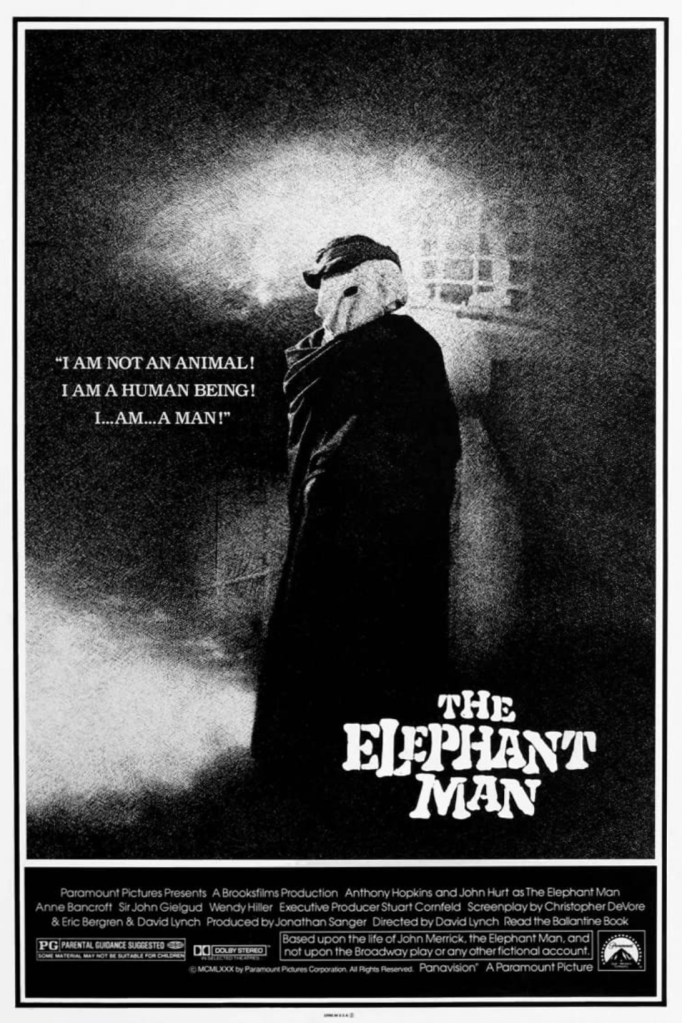
The Elephant Man poster created by Brooksfilms, Columbia-EMI-Warner Distributors, and Paramount Pictures

Things I liked about the film:

The acting: When I reviewed The Picture of Dorian Gray last week, I talked about how I was disappointed to see Peter Lawford in a smaller role, as he was one of the reasons why I watched the film in the first place. Anne Bancroft’s role in The Elephant Man made me feel similarly. She is one of the reasons why I chose to review the 1980 title. Like Peter Lawford, she appeared in the film for a short amount of time. However, I did like her acting performance! Portraying a stage actress named Mrs. Kendal, she brought a brightness to the story that was greatly needed. Her kind disposition is one of the reasons why I liked her interactions with John Merrick/ “The Elephant Man”. One of my favorite scenes is when Mrs. Kendal and John are reciting Romeo and Juliet. The way these actors conversed with one another helped create a genuinely sweet moment for both characters!

Speaking of John, I also liked John Hurt’s portrayal of the titular character! When it comes to historical figures or real-life people, it can, sometimes, be difficult to picture that person existing in the same world as us. That’s because we are, at times, so far removed from these individuals. With John’s performance, it made the realization of John Merrick’s/ “The Elephant Man’s” existence come alive. With the help of elaborate makeup, John was able to transform into another person. At the same time, he was able to bring the humanity out of his character. During the movie, John Merrick/ “The Elephant Man” builds a replica of a nearby cathedral. Even though this example is a simple one, it highlights John’s personality, as well as his desire to learn and dream.

Prior to re-watching The Elephant Man, I had seen some of Anthony Hopkins’ films. Out of the films I have seen, most of Anthony’s roles were a source of fear. For example, as I talked about in my review of Audrey Rose, his character seemed to have power over the situation. That’s because he carried the answers Ivy’s parents were desperately seeking. But in The Elephant Man, his character was not a source of fear. This gave Anthony different material to work with. While portraying Dr. Frederick Treves, he came across as charming. Frederick always had his heart in the right place, going to the ends of the earth for John Merrick/ “The Elephant Man”. But there was one scene when Frederick was angry for the right reasons. In that scene, he was truly scary, from angrily yelling to pushing someone across a room. However, this incident was meant to show how one’s suffering can cause another person to react.

The use of black-and-white imagery: Because this story takes place in the Victorian era, the creative team chose to present their project in black-and-white imagery. I found this to be an interesting choice, especially since the film was created during a time when color cinematic imagery was available. Whenever illustrations or pictures from the Victorian period are shown, they are typically in black-and-white. Therefore, the imagery gave the illusion of these illustrations and pictures coming to life. This creative choice allowed the audience to be transported back to that time. To me, I found the overall project immersive, thanks in part to the black-and-white imagery!

The cinematography: Another area of interest was the movie’s cinematography! At times, the camera was positioned as if the view is from John Merrick’s/ “The Elephant Man’s” perspective. When John first goes to Frederick’s office, he stands in a corner of the room. As Frederick is entering his office, the scene is presented from John’s corner, as if John himself is holding the camera. When it came to the cinematography, creative decisions were found. As John is entering the hospital for the first time, Frederick meets him at the front desk. During this interaction, a long shot looking down on John shows him walking around the front desk. This was an interesting way of presenting this scene, shown in a way I never would have considered.

Anne Bancroft: A 90th Birthday Celebration blogathon banner created by Crystal from In The Good Old Days of Classic Hollywood

What I didn’t like about the film:

Lots of establishing shots: Throughout the film, establishing shots built up to certain parts of the story. However, the abundance of these shots felt more like padding. A good example is when Frederick is on his way to see John/ “The Elephant Man” for the first time. Before Frederick arrives at his destination, scenes of him walking down streets and alleys are shown. But instead of the three or four establishing shots presented, there should have been only one. If some of these shots were cut, the movie would have a run-time of less than two hours.

Prolonging John’s/ “The Elephant Man’s” appearance: As the title suggests, The Elephant Man revolves around John Merrick/ The Elephant Man. The film is also based on an article titled The Elephant Man: A Study in Human Dignity by Ashley Montagu. With all that said, it appears the creative team tried to emphasize the idea of someone having different life experiences or medical conditions than ourselves. But instead of normalizing John’s appearance by showing him on-screen sooner, John’s presence was prolonged for the first thirty minutes of the movie. During that time, John was either shown very briefly or his appearance was hidden. One example is during a medical presentation, where only John’s shadow could be seen. Even the movie’s poster features John covered up by a mask and cape. These creative choices went against the team’s good intentions.

Missed opportunity for a mystery: While John is having tea at Frederick and Ann’s house, he mentions how he’d like to find his mother and meet her. As soon as John said this, I thought Frederick was going to solve the case. Sadly, this part of the story never came to fruition. This disappointed me because omitting this mystery felt like a missed opportunity. At the same time, I can understand why this mystery was, simply, a passing comment. As I mentioned before, The Elephant Man revolves around the true story of John Merrick/ The Elephant Man. If little to no information is known about his mother, then it wouldn’t be faithful to make up details for the sake of intrigue.

Theater seats image created by weatherbox at freeimages.com. “FreeImages.com/weatherbox.”

My overall impression:

In The Elephant Man, Mrs. Kendal tells John “the theater is the most beautiful place”. While the theater, both on screen and stage, can be beautiful, it can also be quite ugly. Throughout the 1980 film, the script presents both ugly and beautiful moments in John’s life. The story is told in a way that I’d refer to as a “slow burn”. Even though this movie is based on a true story, it is a character driven narrative. It is also presented in an interesting way. I’m glad I gave this film a second chance! Because of my choice, I got to see familiar actors take on different roles. I also got to see more films from the 1980s. Looking back, I realize both films I re-visited, The Elephant Man and It’s a Mad, Mad, Mad, Mad, World, were because I reviewed them for a blogathon. It will be interesting to see what film I plan to re-visit next.

Overall score: 7.4-7.5 out of 10

Have you seen The Elephant Man? Did you re-visit a film recently? Please tell me in the comment section!

Have fun at the movies!

Sally Silverscreen
Take 3: The Picture of Dorian Gray (1945) Review

Whenever I think of Dorian Gray as a character, Stuart Townsend’s portrayal in The League of Extraordinary Gentlemen comes to mind. While I’ve never seen that film, I did watch a video review of it years ago. However, I know that, sometimes, no singular portrayal of a given character is the “end all, be all” when it comes to story-telling. This is one of the reasons why I chose to review the 1945 adaptation of The Picture of Dorian Gray. The other reason is Peter Lawford’s involvement in the project. Once again, I am participating in the Peter Lawford Blogathon, hosted by Kristen from Hoofers and Honeys of the Classic Movie Era/KN Winiarski Writes. Last year, I wrote about 1960’s Ocean’s Eleven. At the time, I was not familiar with Peter’s filmography. Now that I have seen at least one of his movies, I had a starting point for which film to choose next! Before Dorian’s portrait transforms on us, let’s get this review started!

The Picture of Dorian Gray (1945) poster created by Metro-Goldwyn-Mayer and Loew’s Inc.

Things I liked about the film:

The acting: I haven’t seen many of Peter Lawford’s films. But based on 1960’s Ocean’s Eleven and 1945’s The Picture of Dorian Gray, it seems like he can be found in movies with larger ensembles. When it comes to the 1945 title, I was disappointed by this, as I was hoping to see more of his performance. Nevertheless, Peter did do a good job with the material he was given! Portraying David Stone, a man interested in courting Gladys Hallward, he resembled the youth Dorian himself desperately sought after. Despite appearing in a handful of scenes, David’s concern of Gladys felt genuine. You can hear it in the inflection of Peter’s voice and the expressions on his face. In a way, these things made David seem like a “voice of reason”.

During the film’s opening credits, I was surprised to discover Angela Lansbury also starred in The Picture of Dorian Gray. But similar to Peter Lawford, she also appeared in a handful of scenes. Despite this, I enjoyed seeing her portrayal of Sibyl Vane! Within this film, she sang a song called “The Little Yellow Bird”. It was nice to hear a musical performance from Angela, as I feel her singing abilities are underrated. When it came to her acting performance, Angela carried her character with a youthfulness I haven’t noticed in her other roles I’ve seen. Her expressions were more subtle, but worked for her character. Another actor who had subtle expressions was Hurd Hatfield. I’m not familiar with his acting work. But based on his portrayal of the titular character, he carried himself with a sense of professionalism. Hurd did, however, have very expressive eyes. At one point during the story, Dorian makes a mistake. When he realizes what he did, his eyes grow wide with alarm. Meanwhile, Hurd still shows a composure that he partly gave to Dorian, which maintains consistency.

The lessons and morals: Since this film premiered in 1945, that means it had to follow the Breen Code guidelines. The Picture of Dorian Gray certainly obeys those guidelines, but it also serves up some good lessons and morals. Toward the beginning of the story, Lord Henry tells Dorian how lucky he is to be young and attractive. He also tells Dorian to not squander his youth. These pieces of conversation can be used as lessons to appreciate the things you have and to not take anything for granted. Certain events in Dorian’s life highlight these lessons well. Another idea that is addressed in this script is actions speaking louder than words. This can be seen throughout Dorian’s relationship with Sibyl. While I won’t spoil what happens, I will say something comes up that relates to the aforementioned idea.

The cinematography: A surprising element in The Picture of Dorian Gray was the cinematography. This is because of how creative and well filmed it was! My favorite use of cinematography was when Sibyl visits Dorian’s house. As Dorian is playing the piano, Sibyl enters his study. But before she walks through the doorway, you can only see Sibyl’s shadow. Even when she does appear in the doorway, Sibyl’s face isn’t shown until she reaches Dorian’s piano. That was a good way of building anticipation for Sibyl’s appearance. A filming technique that appeared in several moments of the film was framing a scene as if the camera was following a character or hiding from them. A great example is when Dorian was placing a letter in his fireplace. The camera is positioned inside the fireplace while he is burning the letter. It provides the illusion of the audience watching from the outside looking in.

The 2nd Annual Peter Lawford Blogathon banner created by Kristen from Hoofers and Honeys of the Classic Movie Era/KN Winiarski Writes

What I didn’t like about the film:

Limited use of Technicolor: In the movie’s opening credits, it was mentioned that Technicolor was used in the movie. This made me excited to see how Technicolor would be utilized in the story. While I wasn’t expecting as much Technicolor as in The Wizard of Oz, I was hoping it would be consistently featured throughout the film. Unfortunately, that is not the case for The Picture of Dorian Gray. The Technicolor was applied to Dorian’s painting. But it was only used three times during the whole movie. I think if Dorian’s painting had been consistently presented in Technicolor, it would have highlighted the importance of the painting within the story.

The painting is kind of an afterthought: For those who don’t know, a MacGuffin can be an object that progresses a story forward. In the case of The Picture of Dorian Gray, Dorian’s painting is that story’s MacGuffin. However, its presence wasn’t as significant as I expected. In the script, the state of Dorian’s relationships is given more focus than the painting. In fact, the painting is sometimes not shown on-screen. This made the painting itself kind of seem like an afterthought.

Dorian’s confusing choices: There were times when Dorian made choices that left me confused. One of these choices took place during his relationship with Sibyl. Throughout that relationship, Dorian appears to truly love her. He even seriously considers marrying Sibyl. But, out of the blue, Dorian changes his mind. Even the build-up toward that moment was confusing, making it difficult to interpret what happened. I realize all of that connects with the lessons I mentioned earlier. However, Dorian’s sudden change in attitude and choices was, to me, confusing.

Paint palette image created by Freepik at freepik.com <a href=’https://www.freepik.com/free-vector/hand-drawn-artsy-tools_836777.htm’>Designed by Freepik</a> <a href=”https://www.freepik.com/free-photos-vectors/hand”>Hand vector created by Freepik</a> Image found at freepik.com

My overall impression:

There are movies that have fallen short of my expectations. Not all of these films have been bad. However, I was left desiring more from them. The Picture of Dorian Gray has now become one of those movies. Before watching this adaptation, I was familiar with the premise of this story. But that premise led me to believe the film would be more profound and thought-provoking than it was. The script did provide good lessons and morals. But I’m not left contemplating any deeper meaning on any particular theme. I was also disappointed by Peter Lawford’s limited appearance in the movie. Peter’s involvement in the project is one of the reasons why I chose to review it in the first place. Even though I liked his portrayal of David, I was expecting to see him receive a larger spotlight than in Ocean’s Eleven. If the Peter Lawford Blogathon returns for a third year, I’ll try to find a film where Peter was a leading actor.

Overall score: 7.2 out of 10

Have you seen any adaptation of The Picture of Dorian Gray? Would you like for me to read the book? Please let me know in the comment section!

Have fun at the movies!

Sally Silverscreen
Take 3: Brave Review

When Gill from Realweegiemidget Reviews announced the No True Scotsman Blogathon, there was a list of recommendations on the announcement post. On that list, the Disney Pixar film, Brave, was mentioned. At the time I signed up for the event, no other participant had chosen that movie to review. This surprised me, as Brave is a well-known title. Since I happen to own a copy of this film on DVD, I chose to write about it for the event. This DVD was given to my family as a gift several years ago. But until this blogathon, I never got around to watching it. Animated films are also not reviewed on my blog often. This is because I’ve already seen most of animation’s beloved titles. But there are times when there is that one movie that I skipped over on my journey as a movie blogger. Brave is one of those movies, so now it’s time to finally talk about it.

My picture of my DVD copy of Brave. Screenshot taken by me, Sally Silverscreen.

Things I liked about the film:

The animation: Disney Pixar has a reputation for framing their stories in impressive technology. Brave certainly carries that tradition, as the animation looks realistic! In one scene, a close-up of an archery target board is shown. The rough texture was captured through animated technology, making it easy to forget the board wasn’t real. Many scenes took place in a forest at different parts of the day. The natural greens and browns were appealing to the eye, adding depth to the world around the characters. Speaking of hues, I really liked the use of color in this movie! Merida’s hair is a perfect example! No matter where she went, her bright orange hair provided a great contrast. There was one scene where Merida was in a forest at night. Since black was the primary hue in the forest, Merida’s hair gave a pop of color to that scene.

The humor: I haven’t seen a Disney Pixar film in a while. But, from what I remember, humor is a consistent component among these types of projects. When it comes to Brave, the humor was spontaneous, the type of humor I’m a fan of. After a successful day of exploring, Merida is talking to her horse, Angus. Then, out of nowhere, Angus hits Merida with his tail in a silly way. Later in the film, Merida’s suitors are being introduced. The father from one of the clans appears to be talking about a very muscular young man. As the introduction continues, the audience learns the father’s son was hiding behind the muscular young man, actually being much smaller in size.

The writing’s cleverness: While watching this movie, I was able to pick up on the cleverness within the script. When the various clans arrive in Merida’s kingdom, Merida’s mother, Elinor, is making a speech. During that speech, Merida discovers a loop hole that she can use in her favor, as she doesn’t want to get married yet. While we’re talking about the clans, let’s talk about one of the suitor’s fathers. Throughout the story, this character was known as Macintosh. At first, this sounds like a typical Scottish name. However, Brave was dedicated to Steve Jobs, who passed away a year prior to the movie’s release. One of Apple’s products was a Macintosh computer, so naming one of the characters after something related to Steve’s company makes sense.

No True Scotsman Blogathon banner created by Gill from RealWeegiemidget Reviews

What I didn’t like about the film:

Inconsistent characters: At the beginning of the movie, Elinor is introduced as a caring, protective mother. During her interactions with her daughter, she didn’t come across as overbearing in her protectiveness. But as Merida grows up, Elinor’s personality becomes a “bait and switch”. While she states in the story how she means well, she is overbearing in her protectiveness. At times, Elinor’s change in personality felt over-the-top. Merida herself is another character I found inconsistent. There were times where her clever and critical thinking skills shined, showing how she is an intelligent explorer. However, there are also times when Merida acts like a stereotypical teenager. I understand Merida is a young character and is not meant to be “perfect”. To me, though, it seems like the writers couldn’t decide which aspects of this character they wanted to emphasize.

Things happening too quickly: There were parts of the story that, to me, happened too quickly. As I mentioned earlier in this review, Merida doesn’t want to get married yet. This causes a conflict between her and her mother. While I won’t spoil the movie, I will say the resolution for this conflict was reached with little build-up. The bridge from Point A to B wasn’t as strong as it could have been. In fact, so much time was spent with Elinor and Merida fighting or both of them working to resolve another conflict, that the marriage conflict was somewhat overshadowed.

Parts of the story that didn’t make sense: Toward the beginning of the film, Merida’s father, Fergus, lost one of his legs while attempting to fight an evil bear. While that part of the story is simple to understand, it’s what can be seen in his castle that didn’t make sense to me. At one point, at least one taxidermic bear is found standing against a wall. After going through such a traumatizing experience, why would Fergus want any association with the animal that severely injured him? While we’re on the subject of bears, there is a witch in the story who is a woodcarver, with her work resembling bears. It is never explained why she chooses bears as her artistic focus. Therefore, her emphasis on this specific type of animal kind of felt random.

Essentials of Scotland image created by macrovector_official at freepik.com. <a href=”https://www.freepik.com/free-photos-vectors/background”>Background vector created by macrovector_official – http://www.freepik.com</a>. Image found at freepik.com.

My overall impression:

After sitting in a cabinet still wrapped in the manufacturing plastic, my DVD of Brave has finally gotten some use out of it. Now, you’re wondering what my opinion on the film is. Well, I thought it was just fine. There is good effort that was put into this project, as the animation itself shows. But I can think of other Disney/Disney Pixar titles that are stronger than Brave. While I liked the cleverness found in the script, there was more to be desired from the story. Structural issues, like weaker bridges from Point A to B, hurt the script. Also, it didn’t help how some parts of the story didn’t make sense. Despite all of this, Brave does bring something unique to the table. It’s also nice to see Scottish culture/heritage receive more recognition in the world of cinema.

Overall score: 7.2 out of 10

Have you seen Brave? If so, what are your thoughts on it? Tell me in the comment section!

Have fun at the movies!

Sally Silverscreen

Take 3: At Home in Mitford Review (National Read a Book Day Double Feature Part 2)

Happy National Read a Book Day! I want to let you know there will be spoilers for both the book and movie in this review. If you want to check out this double feature’s introduction, you can visit this link:

The National Read a Book Day’s Double Feature Introduction

At Home in Mitford poster created by Crown Media Family Networks and Hallmark Channel
1. How did you come to know of this film?

I remember when Hallmark’s adaptation was announced four years ago. The biggest news associated with the project was the casting of Cameron Mathison and Andie MacDowell as Father Tim Kavanagh and Cynthia Coppersmith. This news made fans upset, due to the fact both Andie and Cameron were younger than their characters were described in the book. Their disapproval of the casting led the movie to be one of the lowest viewed films on Hallmark Channel that year, with 1.34 million viewers. I also remember the movie didn’t receive an encore presentation, as is customary for the majority of Hallmark productions. While I’m not sure if this information is accurate, I have heard Jan Karon, the author of the Mitford series, didn’t promote the film.

2. How did you acquire this movie’s respective source material?

Two years ago, I purchased a used copy of At Home in Mitford at a library book sale. I became interested in reading the series before the adaptation’s premiere, as I heard so many good things about it. Since I never got to read any of the books before the movie aired, I was curious to see how different the book was from the film. At the sale, they had the whole series available for purchase. But since I didn’t know if I would like the series, I just bought the first book.

3. Have you read Jan Karon‘s work before? What are your thoughts on her writing?

Like I mentioned in the introduction, I have never read anything by Jan Karon before. So, I didn’t know what to expect from the book. Jan’s emphasis on detail was one of At Home in Mitford’s strengths! An example is when things are being listed off. In the book, Father Tim and Cynthia go to the movies. Within a paragraph, Jan takes the time to mention the snacks they purchased, saying “they went into the empty row with a box of popcorn, a Diet Sprite, a Coke, and a box of Milk Duds”. It’s details like these that make the characters and the story itself feel realistic.

Similar to Saint Maybe, At Home in Mitford is mostly a “slice of life” story. But there are a series of mysteries that are drawn out throughout the text. Because this book has elements of mystery, but is not a mystery novel, the overall sense of urgency was low. At times, it felt like there were too many characters and storylines. Mitford seemed like any other small town I’ve seen in Hallmark’s programming. While reading this book, I kept asking myself, “How is Mitford any different from Cedar Cove? Or Chesapeake Shores?” Maybe if I had read At Home in Mitford before watching any of those programs, I would think differently. But, at the end of the day, I thought this book was a fine, wholesome story.

4. Was the movie different from its source material? If so, how?

Even though there were some similarities between the movie and the book, At Home in Mitford’s film adaptation contained more differences. Some characters were either omitted or changed from the text. One of these characters was Olivia Davenport. In the film, she was a parishioner who was seeking Tim’s guidance for her rocky marriage. Her presence in the movie was very limited, which is different from the book. In the novel, Olivia was a part of At Home in Mitford’s ensemble cast of characters. Her storyline was one of the most important, as she desperately needed a heart transplant. Olivia also helped Mitford’s doctor, Hoppy Harper, move forward from the loss of his deceased wife. As I said in answer number three, I, at times, felt like there were too many characters and storylines in the book. Therefore, I don’t fault Hallmark for leaving out certain parts of the source material. However, if the adaptation’s creative team knew they were going to include one of the book’s characters in their script, then they should have given Olivia a greater significance in the film.

Despite the film adaptation’s differences from the book, some of them had purpose. The novel and film featured a character named Marge Owen. While she became pregnant in both versions of the story, she was given a greater importance in the movie. The book never revealed her occupation, where the film shows Marge owning her own bookstore. She also provides friendship and guidance to Cynthia in the adaptation. As a way to overcome her writer’s block, Cynthia volunteers to restore the church’s paintings. In Jan Karon’s book, Cynthia wasn’t involved with the church. She does attend church services, but she doesn’t go the extra mile for the parish. The movie version of Cynthia tells Tim that she wants to give back. Cynthia’s decision not only gives her a stronger connection to the church, but it also shows how someone living their faith can come in different forms.

This is the copy of At Home in Mitford I purchased two years ago. Screenshot taken by me, Sally Silverscreen.
5. Do you think the movie was better than the book or was the book better than the movie?

When it comes to At Home in Mitford, I can’t give a yes or no answer. So, I’ll say it like this: As a movie, At Home in Mitford is a fine, run-of-the-mill Hallmark Channel production, with some of the film’s changes improving upon the book. But as an adaptation, it feels like the network was trying to fit a round peg into a square hole. The first book in Jar Karon’s series was published before Hallmark Channel came into existence. By the time the adaptation was filmed, Hallmark was already well versed in their formula. Because the adaptation’s creative team tried so hard to fit At Home in Mitford into Hallmark’s brand of film-making, the story was watered down. If Hallmark were serious about faithfully adapting At Home in Mitford, they should have adapted it into a television show, as that is how the book read to me. I also think Jan Karon herself should have been one of the movie’s screen-writers.

6. Saint Maybe and At Home in Mitford share some similarities, such as how both books are written by women. Are there any other similarities you can think of?

Like I said in answer number three, At Home in Mitford is mostly a “slice of life” story. While there are mysteries within the text, the mysteries themselves feel lower in stakes. In the book, Father Tim finds some stolen jewels in an urn. Even though these jewels were connected to an international crime, Jan finds a way to connect this crime directly to Mitford. Father Tim wonders if his antique shop owner friend, Andrew Gregory, may have imported the jewels by hiding them in antique furniture. However, the culprit was a man named George Gaynor, a criminal on-the-run who found solace in Father Tim’s religious wisdom. Though George was arrested for his crime, he received the opportunity to become baptized. Father Tim even kept in touch with George after he left Mitford.

Saint Maybe is also a “slice of life” story featuring several mysteries. Similar to At Home in Mitford, the stakes of these mysteries were lower. Back in my review of Saint Maybe’s film adaptation, I mentioned how Ian discovered the identity of Agatha and Thomas’ father. Because this information was discovered long after Ian agreed to help raise Agatha and Thomas, there wasn’t a strong sense of urgency to do anything about the situation. He doesn’t even tell his family what he found. In fact, after speaking with Agatha and Thomas’ maternal grandmother, the movie version of Ian says to himself, “Thank goodness I didn’t find this information sooner”.

7. Should Hallmark adapt Jan Karon‘s other work? If so, why?

If At Home in Mitford’s film adaptation had received better reception from the viewers, then I’d be curious to see Hallmark adapt the other books in the Mitford series. Because that didn’t happen, Hallmark would have difficulty adapting Jan Karon’s other work, as most of her books are Mitford related. But since Hallmark created a few animated films in the past, I could honestly see them adapting Miss Fannie’s Hat or Jeremy: The Tale of An Honest Bunny. Similar to properties like Hoops and Yo-yo, Hallmark could create merchandise related to these stories as well. I’ve never read Miss Fannie’s Hat or Jeremy: The Tale of An Honest Bunny. But as long as Jan herself is involved with the project, I’d be fine with Hallmark adapting these books.

8. Is there anything about At Home in Mitford you liked or didn’t like?

I’ve heard complaints from Mitford fans about how different Dooley is in the film compared to the book.  While I do agree about Dooley being very different in the movie, I actually liked the movie version of his character. Dooley was sometimes the comic-relief in the story. His grandfather, Russell, even called him “a prankster”. My favorite scene was when Dooley removed the ‘Dog Found’ posters almost immediately after Father Tim posted them. Throughout the film, Father Tim actively sought out Barnabas’ former pet parent. He spreads the word about the dog’s current whereabouts by posting ‘Dog Found’ posters throughout Mitford. Since Dooley doesn’t want to see Barnabas go away, he removes these posters behind Father Tim’s back. This scene was hilarious because of its believability.

Compared to the book, At Home in Mitford’s film adaptation felt formulaic. Like I said in answer number five, the movie’s creative team tried so hard to fit At Home in Mitford into Hallmark’s brand of film-making. Instead, the story followed the same beats and tropes/cliches as other Hallmark titles. The film included an adaptation exclusive character named Jack Emery. Throughout the story, he embodied the “business person is a jerk and/or out of touch” cliché, with his sole purpose being the worse datable candidate compared to Father Tim. At Home in Mitford’s film adaptation was released in 2017, two years after All of My Heart. The 2015 movie was one of the network’s most notable films to challenge the aforementioned cliché. Therefore, it made At Home in Mitford kind of seem outdated by comparison.

Old-fashioned books image created by Macrovector at freepik.com. <a href=’https://www.freepik.com/free-vector/books-seamless-pattern_1539033.htm’>Designed by Macrovector</a>. <a href=”https://www.freepik.com/free-photos-vectors/background”>Background vector created by Macrovector – Freepik.com</a>. Image found at freepik.com.
9. Did you develop any thoughts and/or questions while watching this film?

Similar to Saint Maybe, religion/faith was downplayed in At Home in Mitford’s film adaptation. Both Father Tim and Cynthia mentioned they were Episcopalian. In answer number four, I talked about how Cynthia volunteers to restore the church’s paintings. Even though several scenes took place inside the church, we don’t see any characters worshipping within its walls. The tail end of Father Tim’s sermon was shown as well. The book showed how religion/faith played a role in Father Tim’s everyday life. He quoted a Scripture passage to fit almost any situation, even using Scripture to discipline Barnabas. Father Tim also turned toward everyday life to find inspiration for his sermons. Because Hallmark gave us Signed, Sealed, Delivered and has incorporated faith into When Calls the Heart, I’m surprised the network chose to tone down the religion/faith in the At Home in Mitford movie. But, once again, it feels like a missed opportunity.

10. Would At Home in Mitford encourage viewers to read either its source material or any other book?

Because of how many differences are found in the adaptation, I think it might encourage some viewers to check the book out. I can only speak for myself, but this is what inspired me to read the first book in the Mitford series. When I started reading At Home in Mitford, I could immediately tell how different each story was. I said in answer number five that the book read more like a television show. This is because the story was abundant with characters and storylines, as well as storylines being drawn-out. If viewers find themselves watching more tv series than movies, then the book might be for them.

11. After watching this movie, is there anything you can take away from your movie viewing experience?

Because the stories in At Home in Mitford revolve around the citizens of a small town, I can see why Hallmark would want to adapt Jan Karon’s series. At the time of the film adaptation’s release, small towns were an exhausted backdrop in Hallmark’s productions, with most of their characters being former or current small-town residents. But it seems like the network was so eager to potentially start a new series, that they lost sight of who this project was intended for. Excluding Jan Karon from the creative process doesn’t help Hallmark’s case. Their inability to adapt pre-existing material, At Home in Mitford in this case, shows how creatively dependent they’ve become on the rom-com genre. In my honest opinion, this movie was made a decade or two too late. Since Hallmark spent so much time showing how every small town was special, Mitford wasn’t given the opportunity to stand out. This movie should have been released either as a Hallmark Hall of Fame production prior to 2010 or on Hallmark Channel between 2001 to 2007.

Have fun at the movies!

Sally Silverscreen