Take 3: Ben-Hur: A Tale of the Christ (1925) Review

Back in March, I reviewed 1925’s The Phantom of the Opera in honor of the film’s one hundredth anniversary. But this is not the only movie celebrating this particular milestone. When I discovered Ben-Hur: A Tale of the Christ was also turning one hundred this year, I wanted to write about the film on 18 Cinema Lane. With “Silent Films” the theme of September’s Genre Grandeur, I found a good reason to check out this movie! Another reason why I wanted to write about Ben-Hur: A Tale of the Christ is because of how much I liked 1959’s Ben-Hur. I reviewed this version in 2019, which I ended up really liking. It was not only covered in a Blog Follower Dedication Review, it was also included on my list of ten classic movies I watched because of my blog. So, how does the original compare to the remake? Keep reading to find out!

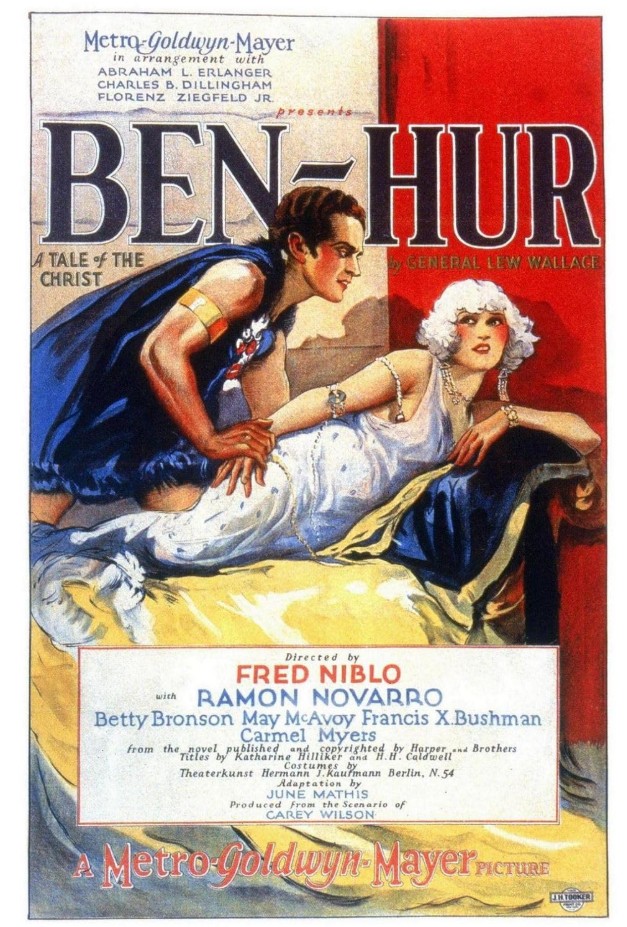
Ben-Hur: A Tale of the Christ (1925) poster created by Metro-Goldwyn-Mayer (MGM)

Things I liked about the film:

The acting: Actors in silent films are forced to rely on the physical appearance of their performance. This means they must utilize body language, facial expressions, and emotions to express what their characters are thinking and feeling. As I write this review, it’s difficult for me to choose a favorite performance in Ben-Hur: A Tale of the Christ. Each portrayal was so captivating, watching this movie was an engaging experience! When Judah Ben-Hur is sharing drinks with Messala, he displays a relaxed smile and sits in a comfortable position, believing Messala has his best interests at heart. But after learning he and Messala can no longer put their differences aside, Judah quickly becomes saddened by this reality. His eyes express the pain of losing a friend. He also adopts a slight frown, wondering why his friend would change. Because Ramon Novarro’s performance was so strong, it was able to speak where dialogue couldn’t.

In Ben-Hur: A Tale of the Christ, May McAvoy portrays Esther, the daughter of Simonides. What I loved about her performance was how expressive it was! During a conversation with her father, Esther learns some shocking information. Her eyes become wide as a horrified expression is painted on her face. The more information she learns, the more shocked Esther appears. This consistent portrayal shows concern on her face as well. Similar to what I said about Ramon Novarro’s performance, May’s performance said so much while saying so little.

Color coded film: When I reviewed 1925’s The Phantom of the Opera, I talked about how much I liked the movie’s color coded film. Color coding this presentation gave each part of the story its own distinct significance. Ben-Hur: A Tale of the Christ utilizes color coded film as well. The way the film-making technique was incorporated into the movie signified the time of day in the story. Parts of The Nativity were shown in blue tinted film, indicating these parts were set at night. Jerusalem is covered in a light-yellow tinted film, meaning Judah and Esther first meet in the daytime. Most of the scenes that were fully in color depicted Biblical events. The creative team behind Ben-Hur: A Tale of the Christ used color coded film in very clever and visually interesting ways!

The scope: “Sword and sandal” films have been known for large set pieces and presenting them in grand ways. This was accomplished in Ben-Hur: A Tale of the Christ through the use of long and medium shots. Through the streets of Jerusalem, soldiers from various countries march together in a parade. Some long shots show off a massive stone structure that makes the people look like toy figurines. Both long and medium shots capture the magnitude of the crowds, emphasizing how many people came to see the spectacle. There were even shots that showed each group of soldiers, presenting how the groups were great in size. Because of the cinematography, Ben-Hur: A Tale of the Christ looked and felt larger than life!

The title cards: A staple of silent films is the inclusion of title cards. Without the use of dialogue, these title cards feature conversations between characters and describe what was happening in the story. But what impressed me about the title cards in Ben-Hur: A Tale of the Christ is how some of them were written. Reflecting on his conversation with Messala, an accompanying title card shares Judah’s thoughts and states “In outward seeming you are the same. But in spirit – you are a stranger”. In my opinion, this was an eloquent way of stating how Messala has changed. Later in the film, Judah proclaims “I am revenged indeed, but to what profit!” This quote on the title card addresses how, to Judah, success isn’t everything. These are just two examples of how this aspect of Ben-Hur: A Tale of the Christ went above and beyond!

White horse image created by Gabor Palla at freeimages.com. “FreeImages.com/Gabor Palla.”

What I didn’t like about the film:

The randomness of Iras: Within the second half of Ben-Hur: A Tale of the Christ, the movie introduces a character named Iras. While I liked Carmel Myers’ performance, I found Iras’ inclusion in the story random. The film establishes she is in a romantic relationship with Messala. But this relationship doesn’t really lead anywhere, as these two characters only share one scene together. A scene later, Iras flirts with Judah. Even though he is initially attracted to Iras, Judah pursues his feelings for Esther. Looking back on Ben-Hur: A Tale of the Christ, I wonder what Iras’ significance in the story was supposed to be? Was she intended to represent temptation or did she originally have a bigger role in the film, only for some of her scenes to be left on the cutting room floor?

The downplaying of Christianity/faith: I talked about liking the incorporation of Christianity/faith when I reviewed 1959’s Ben-Hur. In that review, I discuss how certain Biblical events were included into the overall story and how faith affected the characters and their actions. There were Biblical events depicted in 1925’s Ben-Hur: A Tale of the Christ as well. But unlike the 1959 movie, Christianity/faith was more downplayed in the 1925 film. The story places emphasis on Judah’s quest for revenge instead of how faith guided his life. From what I remember, Balthasar (one of The Three Wise Men) plays a greater role in the 1959 movie. This creative decision was, in my opinion, disappointing, especially since Ben-Hur is one of the better faith-based films.

Chariot statue from the Roman Empire image created by Michel Meynsbrughen at freeimages.com. “FreeImages.com/Michel Meynsbrughen.”

My overall impression:

When it comes to cinema, a lot can happen in one hundred years. Trends come and go, technology changes, and color film becomes commonly used. But in those one hundred years, there are movies that stood the test of time. They achieved this by bringing something new to the table, finding their audience, or being at the right place at the right time. Ben-Hur: A Tale of the Christ from 1925 is one of these movies. It showed what “sword and sandal” films could and should be. Through cinematography, the scope of the project created a world that feels larger than life. The way some of the film’s title cards were written went above and beyond, showing how Ben-Hur: A Tale of the Christ’s creative team put thought and effort into their presentation. Though the movie has more flaws than its 1959 remake, the 1925 movie is a solid silent film! It was entertaining and engaging, due to the strengths of the project, like the acting and how color coded film was used. I’m also incredibly grateful for the restoration and preservation efforts made for Ben-Hur: A Tale of the Christ, especially since silent films have become less common in these one hundred years.

Overall score: 8.1-8.2 out of 10

Have you seen 1925’s Ben-Hur: A Tale of the Christ? Which silent films would you like to check out? Please tell me in the comment section!

Have fun at the movies!

Sally Silverscreen

Take 3: Speak Easily Review

When I participated in the 10th Annual Buster Keaton Blogathon last year, I reviewed Buster’s episode of The Twilight Zone; “Once Upon a Time”. In that review, I stated how his episode would be a good place to start if one were introduced to the show, partly due to the story’s light-hearted nature. For this year’s event, hosted by Lea from Silent-ology, I wanted to check out one of Buster’s films. After taking a trip to his IMDB filmography, I selected the 1932 picture, Speak Easily! One of the reasons why I chose this movie for the blogathon was the story itself. According to the Internet Movie Data Base, “a timid professor inherits a large sum of money and decides to fund a terrible musical”. Another reason for choosing Speak Easily is how Buster starred in a “talking picture” (movies with sound). Because he’s known as a silent screen legend, I was curious to see how he’d perform in a film with audible dialogue. So, with all that said, let’s begin this review of the 1932 presentation!

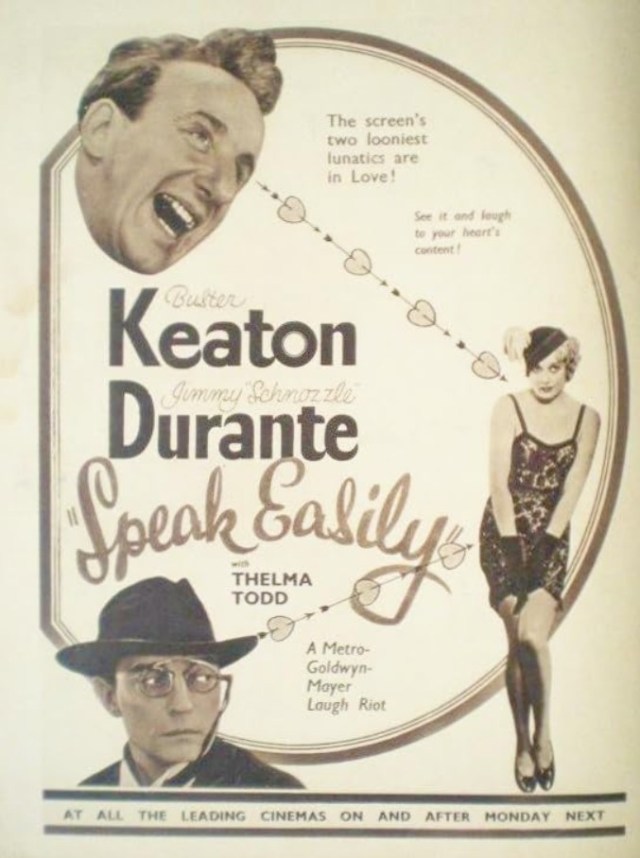
Speak Easily poster created by Metro-Goldwyn-Mayer

Things I liked about the film:

The acting: As I mentioned in the introduction, Buster Keaton is known as a silent screen legend. His forte was “slapstick” comedy, which worked in the format of silent films. With Speak Easily, Buster had to incorporate both physical movement and dialogue in order to help tell the story. Honestly, I think he did a good job with the provided material! In the 1932 production, Buster portrays Professor Post, an intelligent yet isolated man. This allowed Buster to adopt eloquent words, a sense of awkwardness, and responses that are too literal. Add his signature “slapstick” comedy for good measure and you have a character that was charming in his own right! Along the way, Professor Post becomes friends with a theater performer named James Dodge. Portrayed by Jimmy Durante, James had a big personality, brighter than all the lights of Broadway. This vibrancy was consistent throughout the movie, a strength of Jimmy’s performance! Ruth Selwyn and Thelma Todd join the cast as Pansy Peets and Eleanor Espere. Both actresses did a good job making their characters feel distinct from each other. During Speak Easily, Ruth displayed a gentle persona and was more soft spoken. Meanwhile, Eleanor adopted a flirtatious personality.

The dialogue: Prior to reviewing Speak Easily, I have seen a few of Buster’s “talking pictures”. However, his roles in these movies were smaller, meaning he was given fewer lines to work with. Though Buster received more opportunities to incorporate dialogue in Speak Easily, I was more impressed with the dialogue itself. Throughout the film, I caught on to how well-written the dialogue was. One good example can be heard toward the beginning of the film. Professor Post doesn’t go to a local event at his college because he claims he wasn’t invited. His colleague, Jenkins, thinks this is an excuse for Professor Post to stay in his comfort zone. During a visit to Professor Post’s office, Jenkins tells Professor Post, “if you only go out and find life, you’ll enjoy living it”. This line serves as a friendly yet firm reminder how life is too short to miss out on.

The messages and themes: Like I said earlier in this review, Professor Post is an intelligent yet isolated man. After he receives a large sum of money, Professor Post chooses to travel to New York and, eventually, funds a musical. As the story progresses, he tries to form connections with his peers. Eventually, Professor Post successfully finds friends by staying true to himself. The trials and triumphs of forming relationships, whether romantic or platonic, is a relatable subject. What’s also relatable is having a genuine persona/personality and doing the right thing. The incorporation of these messages and themes was one of the things I liked about Speak Easily!

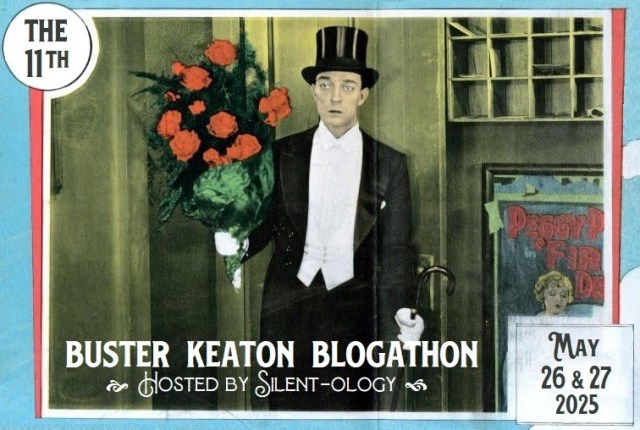
The 11th Buster Keaton Blogathon banner created by Lea from Silent-ology

What I didn’t like about the film:

A drawn-out film: Speak Easily has a run-time of an hour and twenty-one minutes. However, the movie’s run-time felt longer. This is because parts of the story were drawn-out. As Professor Post boards a train, there’s a running joke about how he forgot his trunk. The joke then transforms into a couple forgetting their baby. That entire joke lasts for about four minutes. Had the joke just focused on Professor Post forgetting his trunk, maybe some of Speak Easily’s run-time could have trimmed.

An overshadowed musical: I’ve mentioned twice in this review how Professor Post funds a musical after receiving a large sum of money. This concept made me curious how Professor Post’s involvement would influence the musical. While the musical was featured in the movie, you have to wait over fifty minutes into an hour and twenty-one minute story just to see the musical come to life. Preparations for the musical were shown, but only in two scenes. The majority of the story focuses on Professor Post’s relationships with the other characters. That focus causes the musical to be over-shadowed.

Limited amount of “slapstick” comedy: I said earlier in my review how “slapstick” comedy was Buster’s forte. This part of his career has been incorporated into his “talking picture” projects, such as The Twilight Zone episode; “Once Upon a Time” and Speak Easily. But in the 1932 production, Buster’s “slapstick” comedy was used sparingly. That creative decision was the result of the film’s run-time, as Buster’s silent films were, more often than not, shorter. The limited amount of “slapstick” comedy felt like the movie was missing something. I wish Speak Easily’s creative team had capitalized on Buster’s forte a bit more.

String of musical notes image created by Freepik at freepik.com. <a href=’https://www.freepik.com/free-vector/pentagram-vector_710290.htm’>Designed by Freepik</a> <a href=”https://www.freepik.com/free-photos-vectors/background”>Background vector created by Freepik</a>. Image found at freepik.com. 

My overall impression:

In Speak Easily, Professor Post sees working on a musical as trying something new. By moving out of his comfort zone, he was able to make new friends, find success, and travel beyond the walls of his office. By starring in this film, Buster Keaton was, in a way, trying new things. This time, he had to rely on more than just physical movement and “slapstick” comedy to carry the story. Even though I liked Buster’s performance in the 1932 presentation, the project itself was, in my opinion, just ok. I was pleasantly surprised by how well-written the dialogue was! The acting, as well as the messages and themes, were Speak Easily’s other strengths. But there were aspects of the movie I didn’t like, from the drawn-out nature of the film to the musical becoming overshadowed. By reviewing this project, I found an excuse to write about a pre-Breen Code era title. Since the only pre-Breen Code era movies I’ve reviewed this year, so far, were The Garage and 1925’s Phantom of the Opera, Speak Easily will easily fill that void!

Overall score: 6-6.1 out of 10

Have you seen Speak Easily? Which “talking picture” from Buster Keaton’s filmography would you like to see me review? Let me know in the comment section!

Have fun at the movies!

Sally Silverscreen

Take 3: Million Dollar Mermaid Review

From Esther Williams’ filmography, I’ve only seen (and reviewed) three of her pictures; Take Me Out to the Ball Game, Bathing Beauty, and Easy to Wed. When it comes to the aqua musical, one of Esther’s claims to fame, that component was far and few between in those movies. Wanting to see an Esther Williams production where the aqua musical was more center stage (no pun intended), I selected Million Dollar Mermaid to review for the We Love Musicals Week Blogathon! The 1952 presentation was recommended by The Classic Movie Muse. Before researching titles to write about for Hamlette’s (from Hamlette’s Soliloquy) event, I had no idea the movie was a biopic. As I made this discovery, I was reminded how much luck I had finding good biopics last year. On my list of the best movies I saw in 2024, three biopics earned a spot on my list, with two of those films ending up in my top five. Could Million Dollar Mermaid find a place on 2025’s best movies list? Read my review to find out!

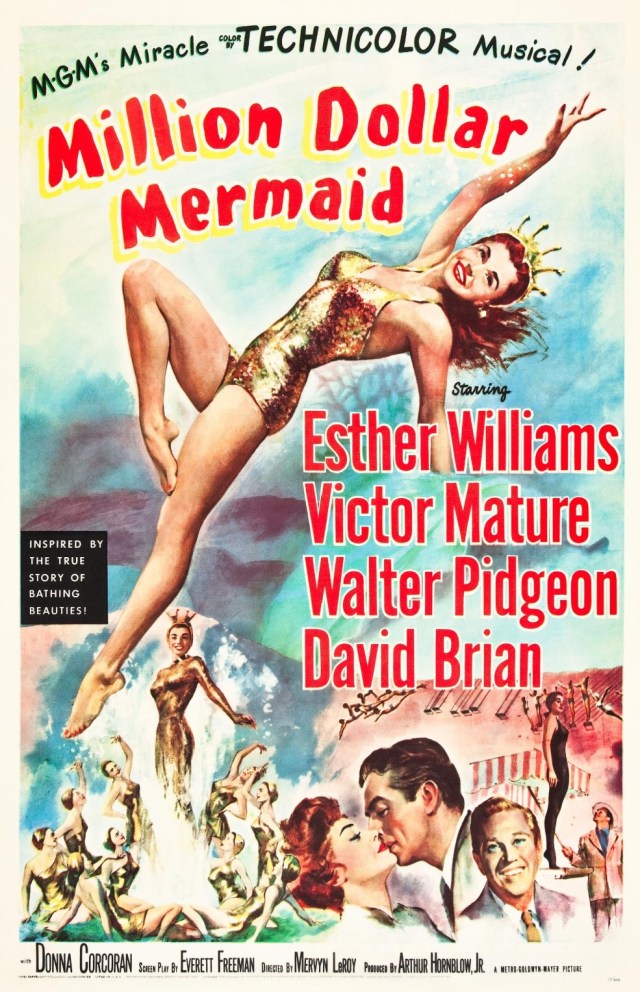
Million Dollar Mermaid poster created by Metro-Goldwyn-Mayer (MGM)

Things I liked about the film:

The acting: As I said in this review’s introduction, I’ve seen (and reviewed) three of Esther Williams’ films; Easy to Wed, Take Me Out to the Ball Game, and Bathing Beauty. What these titles have in common is how Esther’s on-screen personality has been consistently friendly and warm. Her performance in Million Dollar Mermaid maintains that consistency in personality! Esther portrays Annette Kellerman, an Australian swimmer who defied the odds and created a successful career. Through the ups and downs of Annette’s life, Esther’s on-screen personality highlighted how Annette saw the glass half full. However, there were times when Annette became frustrated. In one scene, she is understandably upset because she was falsely accused of indecent exposure (due to the style of her swimsuit). At first, Annette tearfully refuses to speak with any newspaper reporter. But after receiving advice from her father and James Sullivan, courage rises in Annette’s voice as she not only agrees to be interviewed, she decides to be interviewed while wearing her swimsuit. With Esther adopting a variety of emotions and expressions throughout her performance, she brought humanity back to Annette’s name!

Speaking of Annette’s father, let’s talk about Walter Pidgeon’s character, Frederick Kellerman! Frederick was one of Annette’s biggest cheerleaders. Though he had his reasons for wanting to protect his daughter, Frederick led by example when it came to following dreams. But Annette’s father had his fair share of struggles. While waiting for Annette and James’ meeting to end, Frederick becomes exhausted. His eyelids continuously rise and fall as he sometimes slumps toward the ground. Visibly concerned, James’ associate, Doc (portrayed by Jesse White) suggests they return home. Scenes like this one showed how Walter brought believability to his role! Similar to Esther’s on-screen personality, Walter made the likability of his character consistent. This was achieved through a strong acting performance!

Victor Mature portrays James Sullivan in Million Dollar Mermaid. When he is first introduced on a boat ride to London, James’ showmanship is on full display. Quick witted and having a way with words, James knew an opportunity when he saw one. Though he had the charisma of a circus ring leader, James also had a caring side to him. In order to promote a new show, Annette agrees to swim through the Thames River. During the swim, James and Doc row alongside Annette. Toward the end of the swim, James notices how tired Annette appears. He’s also aware of an incoming current, which could push Annette back. A sharp tone in his voice, furrowed eyebrows, and an intense look in his eyes perfectly show how concerned James is for Annette’s wellbeing. These emotional elements emphasize James’ sense of urgency for protecting Annette as well. This scene is just one example of how Victor’s acting talents helped create a memorable portrayal of James Sullivan!

The dialogue: One of the challenges Annette had to overcome was polio. As a child, Annette wished she could dance with her peers inside of staying at home practicing the piano. To cheer his daughter up, Frederick says how music should be a source of joy. The way this line was written and spoken seemed so profound, it made me wonder if Frederick’s belief is the reason why some musicals are joyful in nature? Years later, Frederick accepts a job at a music conservatory. But once he and Annette move to London, they discover the conservatory is actually closed. Looking at the glass half full, Annette reminds her father how the conservatory’s gate is only one closed gate. While she was talking about the literal gate, she was also speaking figuratively, seeing it as yet another puzzle to solve. These are just two examples of how well-written the dialogue was in Million Dollar Mermaid!

The aqua musical numbers: I stated in the introduction of my Million Dollar Mermaid review how one of Esther’s claims to fame is the aqua musical. This type of unique musical presentation is another reason why I chose this film for the We Love Musicals Week Blogathon, as I wanted to bring something different to the event’s table. The aqua musical numbers in Million Dollar Mermaid were captivating! The blend of pyrotechnics, color, and aquatic choreography created musical spectacles that were close to perfection. In one number, Esther emerges from the water on a giant pillar covered with sparks. Another number shows Esther performing a ballet routine under water. My favorite number boasted a color scheme of red and yellow. A memorable part of that number was when swimmers jumped into the water from various swings. The aqua musical numbers were certainly one of the strengths of Million Dollar Mermaid!

We Love Musicals Week Blogathon banner created by Hamlette from Hamlette’s Soliloquy

What I didn’t like about the film:

Limited presence of aqua musicals: Like I mentioned in my review’s introduction, I wanted to watch an Esther Williams movie where the aqua musical was more center stage (again, no pun intended). This component received more inclusion in Million Dollar Mermaid than in Esther’s other three movies I’ve seen (and reviewed). However, the overall presence of aqua musicals seemed limited. In the 1952 film, there were three aqua musical numbers. Only one of them was shown in its entirety. It also doesn’t help how the first aqua musical number appears a little over an hour into an hour and fifty-five-minute movie. I recognize the film’s creative team tried their best to find a balance between providing musical spectacle and telling Annette’s story. But as someone who came to Million Dollar Mermaid for the aqua musical, I was, kind of, disappointed.

An open-ended finish: The intended purpose of a biopic is to tell the story of a historical or public figure. In the case of Million Dollar Mermaid, that figure is Annette Kellerman. Toward the end of a typical biopic, that story will either reach the conclusion of that figure’s life or explain what happened to the people involved in the story, through a voice-over or on-screen text. But Million Dollar Mermaid didn’t adopt any of these examples. Within the last ten minutes of the movie, a major conflict takes place. Because there’s not enough time to reach a resolution to this conflict, a resolution is not provided on screen. An explanation if a resolution was reached at all is not provided as well. These creative choices left some questions unanswered.

A confusing interaction: For this part of my review, I will spoil Million Dollar Mermaid. If you have not seen this movie and are planning on watching it, please skip ahead to the part of this review titled “my overall impression”.

James Sullivan becomes Annette’s manager in Million Dollar Mermaid. Over time, Annette and James develop romantic feelings for each other. But their relationship doesn’t last, as Annette ends up marrying a man named Alfred. Toward the end of the film, James visits Annette in the hospital after she experiences an accident on a movie set. He gives her the engagement ring he intended to give her years prior. Annette not only accepts the ring, she and James share a kiss. I was confused by this romantic exchange because Annette and Alfred already got married. I was also surprised Million Dollar Mermaid would include this romantic interaction, as it was released during the Breen Code era, where the reverence toward martial vows is upheld. But, like I said when talking about the film’s open-ended finish, some questions were left unanswered.

Sketch of London image created by Archjoe at freepik.com. <a href=’https://www.freepik.com/free-vector/hand-drawn-houses-of-parliament_1133950.htm’>Designed by Archjoe</a>. <a href=”https://www.freepik.com/free-photos-vectors/background”>Background vector created by Archjoe – Freepik.com</a>. Image found at freepik.com.

My overall impression:

Biopics are not created equally. Some of them are solid productions, like 1984’s Amadeus. But there have been biopics that left me underwhelmed, such as I Dream of Jeanie from 1952. With Million Dollar Mermaid, I thought it was just fine. The aqua musical numbers were a highlight of this presentation! As I said in my review, the blend of pyrotechnics, color, and aquatic choreography created musical spectacles that were close to perfection. However, I didn’t like how these aqua musical numbers had such a limited presence in the movie. I will admit I had no idea who Annette Kellerman was before watching Million Dollar Mermaid. Through the acting performances, screenwriting, and the story itself, I was introduced to this incredible woman and the world according to her. I do wish the ending hadn’t been so open-ended. Though I guess that’s what Wikipedia is for, finding answers that weren’t provided in the film. Prior to participating in the We Love Musicals Week Blogathon, the last time I reviewed one of Esther Williams’ films was back in 2022. So, re-visiting her filmography was long overdue.

Overall score: 7.1-7.2 out of 10

Have you seen Million Dollar Mermaid? What are your thoughts on aqua musicals? Let me know in the comment section!

Have fun at the movies!

Sally Silverscreen

Take 3: The Reluctant Debutante Review

Out of all the decades covered on 18 Cinema Lane, the 1950s make such infrequent appearances. I did review the 1954 film, Dial M for Murder, last month. But my review before that was from last December, when I wrote about 1957’s The Curse of Frankenstein. This infrequency is one of the reasons why I’m reviewing the 1958 film, The Reluctant Debutante! Another reason is John Saxon’s involvement in the project. When I joined Realweegiemidget Reviews’ and Cinematic Catharsis’ blogathon, I wasn’t familiar with John Saxon as an actor. So, while exploring his filmography, I came across the 1958 movie. I was surprised to discover Angela Lansbury also starred in The Reluctant Debutante. Since I’ve seen few of Angela’s live-action films, there was yet another reason for me to review this production.

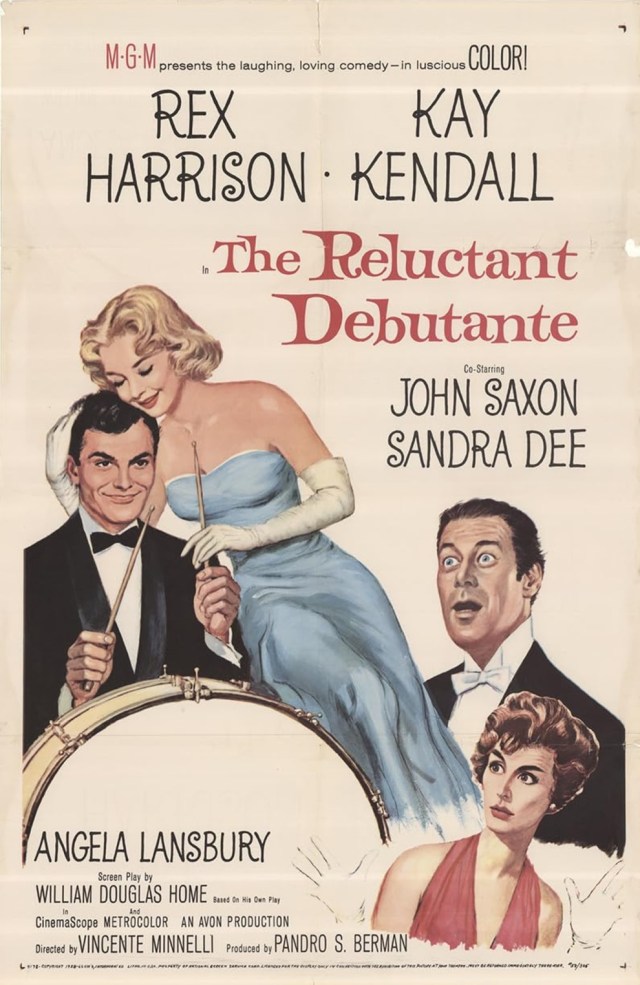
The Reluctant Debutante poster created by Avon Productions and Metro-Goldwyn-Mayer (MGM)

Things I liked about the film:

The acting: As I said in this review’s introduction, John Saxon is one of the reasons why I’m reviewing The Reluctant Debutante. Even though I wasn’t familiar with him as an actor, I liked his portrayal of David Parkson! Whenever he appeared in the movie, David always looked confident. Paired with that confidence was charisma, which helped David become such a memorable and likable character! What worked in John’s favor was the consistency of his performance. Having good on-screen camaraderie with Sandra Dee also worked in John’s favor. In the few scenes David and Jane, Sandra’s character, spent together, they appeared to get along so well. They also seemed to be on the same page when it came to several topics, such as the symbolism behind dancing and exploring the world. I, honestly, wish Sandra and John were given more appearances in The Reluctant Debutante because both of their performances were strong!

Like I also mentioned in this review’s introduction, Angela Lansbury’s involvement is another reason why I wrote about The Reluctant Debutante! Despite having limited appearances in the story, I really enjoyed watching Angela’s portrayal of Mabel Claremont! The best way I can describe this character is “the life of the party”. From the very first scene she appeared in, Mabel had such an exuberant personality. There was such a brightness to Mabel, I could understand why other characters might want to invite her to their events. Similar to John Saxon’s performance, Angela’s portrayal of Mabel was consistent. Mabel is another character I wish received more screen-time!

The on-screen chemistry: Rex Harrison and Kay Kendall portrayed Jane’s parents, Jimmy and Sheila, in The Reluctant Debutante. Shortly after these characters were introduced, I could immediately sense Kay and Rex’s on-screen chemistry! Throughout the story, Sheila and Jimmy’s marriage felt believable, like they were always meant to be together. When it came to the “debutante season”, Jimmy was the casual participant and Sheila became more involved in the process. Though they had their reasons for their “debutante season” beliefs, they still found a way to come together when it came to what was important, such as the well being of their daughter. Based on everything I said, Sheila and Jimmy displayed the “opposites attract” trope. With the strength of Kay and Rex’s acting abilities, both individually and together, this trope worked in Jimmy and Sheila’s favor!

The wardrobe: Debutante balls are known for showcasing exquisite fashion! When it came to the wardrobe department, The Reluctant Debutante did not disappoint! At a ball toward the beginning of the movie, Mabel wore a long-sleeved gown. This scoop-neck gown was covered in a lacy, deep-blue material, complimenting Angela’s light blonde hair. Adding extra sparkle was a large diamond necklace, a diamond tiara, and diamond earrings. One of my favorite dresses was Jane’s light-blue gown! Tiny bows found their place on the gown’s skirt. Sandra sometimes wore this dress with a light-blue satin cape and white gloves, which added elegance to the overall ensemble. Another outfit I liked is more casual in style. While at a restaurant with David Parkson, Jane wore a beige and brown plaid jumper dress over a beige blouse. Paired with this outfit was a khaki trench coat and a beige hat.

The John Saxon Blogathon banner created by Gill from Realweegiemidget Reviews and Barry from Cinematic Catharsis

What I didn’t like about the film:

A premise driven story: In the past, I’ve explained the difference between a premise driven and a plot driven story. In the case of The Reluctant Debutante, this story was premise driven. According to IMDB, the movie is about Jane and her parents participating in “Debutante season”. That part of the story was prioritized throughout the film. Taking a behind the scenes look at the debutante world is interesting. Halfway through the movie, though, I found myself asking, “Where’s the plot”? What The Reluctant Debutante was missing was a conflict, something to make the audience ask, “and then what happened”. This conflict could have ranged from Sheila and Jimmy organizing Jane’s debutante ball to Mabel convincing the Queen to continue the tradition of “debutante season”.

Drawn-out jokes: IMDB classifies The Reluctant Debutante as a comedy. Despite this label, I didn’t find myself laughing while watching the film. This weakness was due to the story’s jokes being drawn-out. A perfect example is how Sheila and Jimmy’s plans to overprotect Jane don’t go as expected. At one ball, Jimmy and Sheila are trying to find Jane. They race around the ballroom frantically looking for their daughter. Toward the end of the event, they discover Jane left with David Parkson. The very next scene revolves around Sheila and Jimmy worrying about Jane’s whereabouts, even going so far as to hiding in the kitchen and eavesdropping when Jane arrives home. I understand The Reluctant Debutante’s creative team was trying to tell a “comedy of errors” kind of story. In this movie, however, it took a long time for the errors to be resolved. In my aforementioned example, it took two whole scenes for Jane to be reunited with her parents. Watching The Reluctant Debutante felt like listening to a comedian spending too much time reaching their joke’s intended punchline.

Overlooked story ideas: While sightseeing in London, Mabel’s daughter, Clarissa, explains the “debutante season” to Jane. During this explanation, Clarissa tells Jane 1958 will be the last year for the “season” due to the Queen believing the practice outdated. Outside of Jane and Clarissa’s conversation, however, this detail isn’t brought up. Plus, none of the characters act as if the tradition of the “season” is ending anytime soon. I wish this part of the story had played a bigger role in The Reluctant Debutante. As I mentioned earlier in this review, it could have served as one of the story’s conflicts. It also would have given other characters, like Mabel and Clarissa, more involvement in the film.

Image of high school students dancing at prom created by Jan Sundstedt at freeimages.com. Photo by <a href=”/photographer/jansun-33414″>Jan Sundstedt</a> from <a href=”https://freeimages.com/”>FreeImages</a&gt;. Image found at freeimages.com.

My overall impression:

Movies from the 1950s are reviewed so infrequently on 18 Cinema Lane. So, when I find a film from the ‘50s to write about, I always root for that film to be good. With The Reluctant Debutante, however, I can’t say this movie is good. If anything, I was disappointed by it. The 1958 production was a premise driven story, a type of story that, in my opinion, contains less intrigue. The jokes lasted so long, it made the movie feel longer than one hour and thirty-four minutes. At one point, I almost fell asleep watching The Reluctant Debutante. Though I kept watching because the cast gave such strong performances. From Kay and Rex’s on-screen chemistry to Angela’s character being “the life of the party”, the acting was one of the few things I liked about the film. There’re even characters that should have received more screen-time, like David Parkson and Jane. During The Reluctant Debutante’s opening credits, I learned the movie was based on a play. What I also learned is how some plays were not meant to be adapted into a film.

Overall score: 5.5 out of 10

Have you seen The Reluctant Debutante? Which movie from the 1950s is your favorite? Let me know in the comment section!

Have fun at the movies!

Sally Silverscreen
Comparing with the Critics – Worst of 1988 – Willow

This review is from my series, Comparing with the Critics. If you’d like to learn more about the series, click on the link below.

Introducing my new series, Comparing with the Critics!

Siskel & Ebert and 18 Cinema Lane share one thing in common: the fantasy genre is underrepresented. This is a reason why I not only chose to participate in the Barbarians at the Gates Blogathon, it’s also a reason why I selected Willow for this review of Comparing with the Critics. But another reason why I picked Willow is how the film was featured in Siskel & Ebert’s Worst of 1988 episode. After hearing good things over the years about the movie, even some people giving it the coveted title of “classic”, I was shocked to see Willow included among the worst of 1988. But since I didn’t see the film before the Barbarians at the Gates Blogathon, I couldn’t agree or disagree with Siskel and Ebert. Film is subjective, with this subjectivity being the reason why I created the Comparing with the Critics series. So far, I disagreed with the critics on Network and Harry & Son, yet agreed with them on Amadeus. With that said, I’d have to say I disagree, yet again, with Ebert and Siskel. While Willow has its flaws, its placement in the Worst of 1988 episode is unjustified.

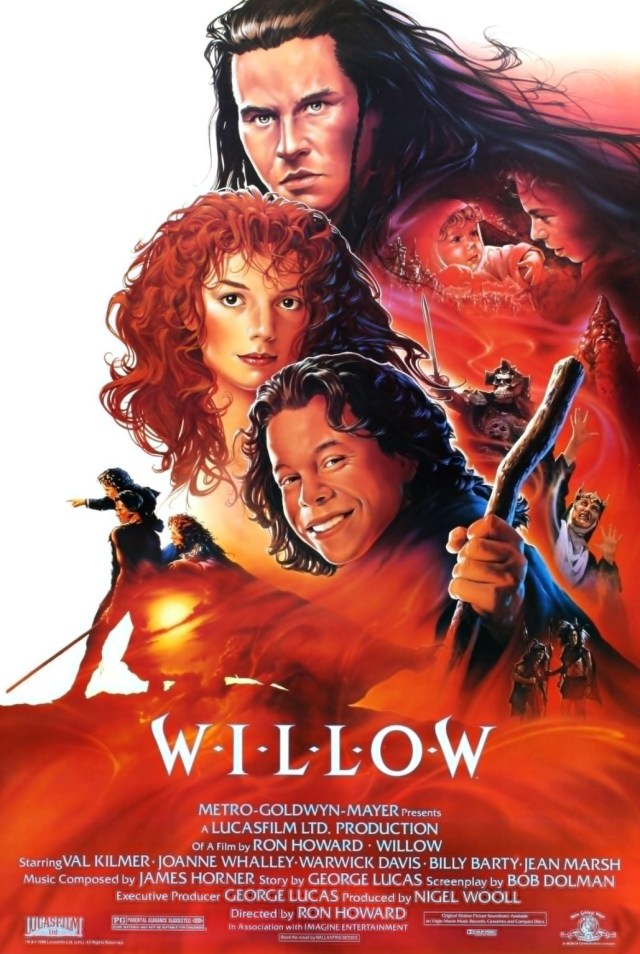
Willow poster created by Metro-Goldwyn-Mayer (MGM), Lucasfilm, and Imagine Entertainment

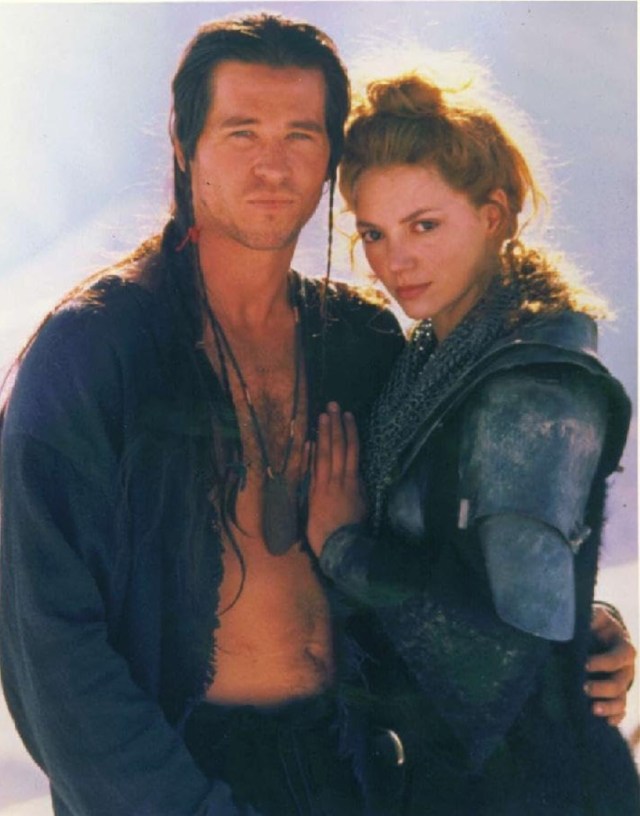
Before going over his complete list of the worst films from 1988, Gene Siskel introduces the episode’s segment on Willow. He calls the film “a heavy duty and quite dreary production”. I will admit there are darker moments within the story. However, the movie was more humorous than I expected it to be! Most of the humor came from Madmartigan, portrayed by Val Kilmer. Because of the screenwriting and Val’s versatile performance, the comedic timing was effectively executed. One of the funniest scenes in Willow is when Madmartigan and Willow are traveling on a sled down a snowy hill. During this trip, Madmartigan falls off the sled. But instead of being left behind, Madmartigan rolls down the hill, becoming a giant snow ball. When Madmartigan was introduced in Willow as the story’s comic relief, I knew he was going to be a character I would like. His personality, along with the dialogue shared between him and Willow, presented someone who captivated my attention and kept me invested in his story. It also helps that Madmartigan is hilarious, as he is the reason why I burst out laughing several times while watching Willow!

Madmartigan and Sorsha picture created by Metro-Goldwyn-Mayer (MGM), Lucasfilm, and Imagine Entertainment

Gene Siskel is not the only critic who disliked Willow. Though he didn’t put the movie on his list of the worst films of 1988, Roger Ebert expressed his disapproval over how the story seemed similar to Star Wars, claiming children who liked the movie “hadn’t seen it a hundred times before”. I can only speak for myself, but Star Wars never crossed my mind as I watched Willow. But some moments did feel reminiscent of The Wizard of Oz. The film clip included in the Worst of 1988 episode shows Cherlindrea, a fairy queen, revealing to Willow the purpose of his journey. She even gives him a wand to help him accomplish his mission. The scene reminded me of when Glinda explained to Dorothy how she could return home. The iconic ruby slippers became a tool to help Dorothy along her way to Emerald City. Story ideas are bound to get repeated over time. Therefore, moments in Willow feeling reminiscent of The Wizard of Oz didn’t bother me. Instead, it showed me how a film’s creative team can take a familiar story idea and add their own unique perspective on it!

The Barbarians at the Gates Blogathon banner created by Quiggy from The Midnite Drive-In and Hamlette from Hamlette’s Soliloquy

Another criticism Gene had about Willow was the film’s setting, stating “I’m tired of seeing epic pictures set in forests with lots of people running around and, uh, hitting each other over the head”. Personally, I was not bothered by this, as I felt the setting fit the story Willow’s creative team was trying to tell. What did bother me was how the build-up of Madmartigan and Sorsha going from enemies to lovers happened too quickly. Incorporating the “enemies to lovers” trope works in a fantasy story like Willow, where there is at least one battle and a major theme is good versus evil. It should be noted how Val Kilmer and Joanne Whalley had nice on-screen chemistry, as well as Sorsha and Madmartigan appearing photogenic together. I still wish the aforementioned build-up had been more gradual. As the story progressed, Sorsha evolved from villain to hero. Unfortunately, this evolution was too abrupt. While Sorsha’s change of heart gave her some character development, it left some questions unanswered. Perhaps a scene explaining this transformation didn’t find its way into the movie?

Snowy mountain image created by Freepik at freepik.com. <a href=’https://www.freepik.com/free-vector/landscape-background-of-snow-track-and-mountains_968656.htm’>Designed by Freepik</a>. <a href=”https://www.freepik.com/free-photos-vectors/background”>Background vector created by Freepik</a>. Image found at freepik.com.

In past reviews, I criticized films for containing parts of a story that didn’t make sense. Willow is a film that doesn’t avoid this flaw. Bavmorda is the villain of the story. When the heroes attempt to defeat Bavmorda, she uses a spell to transform the heroes into pigs, with Willow and a sorceress named Fin Raziel being the only exceptions. This spell takes place in a short amount of time, with the afflicted heroes becoming pigs all at once. When Fin Raziel reverses the spell, this proves to be a lengthy process, as she uses her magic on one person at a time. This creative choice left me wondering why Fin Raziel wouldn’t use her magic on all the heroes all at once similar to Bavmorda? To me, it didn’t make sense, especially since the heroes didn’t have the luxury of time.

Comparing with the Critics banner created by me, Sally Silverscreen. TV show title cards created by WTTW National Productions, WTTW, Public Broadcasting Service (PBS), Lifetime Television, Tribune Entertainment, Buena Vista Television, and Disney-ABC Domestic Television

During their discussion of Willow in Siskel & Ebert’s Worst of 1988 episode, Roger reminds Gene how, despite the movie’s bad reviews, it became the top selling video and was successful at the box office. Had I seen Willow sooner, I might have contributed to the movie’s statistics. This is another Comparing with the Critics review where I found myself disagreeing with Siskel and Ebert. That’s because I had a genuinely good time watching Willow! I brought up in this review how the project has its flaws. But the story was simplistic and straight-forward, which made it easier to follow what was happening on screen. Even though Willow was the movie’s protagonist, it was Madmartigan who stole the show! In fact, I’d say he was the MVP of this story, as his personality and comedic timing left a good impression. There were moments in the film that felt reminiscent of The Wizard of Oz. However, I saw those moments as ways for Willow’s creative team to bring their own unique perspective to familiar story ideas. I have to say I’m glad I chose to review Willow for this edition of Comparing with the Critics! Now if you’ll excuse me, I have to watch the Siskel & Ebert 1988 Holiday Video Gift Guide episode in the hopes something Willow related can be included in my Movie Blogger’s Christmas Wish List.

This review was brought to you by

Sally Silverscreen

Take 3: For Me and My Gal Review

Looking back on Judy Garland’s movies I’ve seen, I can
honestly say I haven’t seen a movie I didn’t like. Even though some pictures were
better than others, I can’t say any of Judy’s films were “bad”. Hoping this
streak will continue, I joined the Third Judy Garland Blogathon by reviewing For
Me and My Gal
! This film was recommended by the Brannan sisters from Pure
Entertainment Preservation Society. They not only introduced me to this film,
they introduced me to the Breen Code era! Between 1934 to 1954, the Breen Code
served as a set of guidelines for film-makers. These guidelines addressed the
dos and don’ts of movie-making based on a series of morals. Within that period
of time, Hollywood gave their audience films that have stood the test of time
and even become “classics”. But will this statement hold true for For Me and
My Gal
? Keeping reading my review to find out!

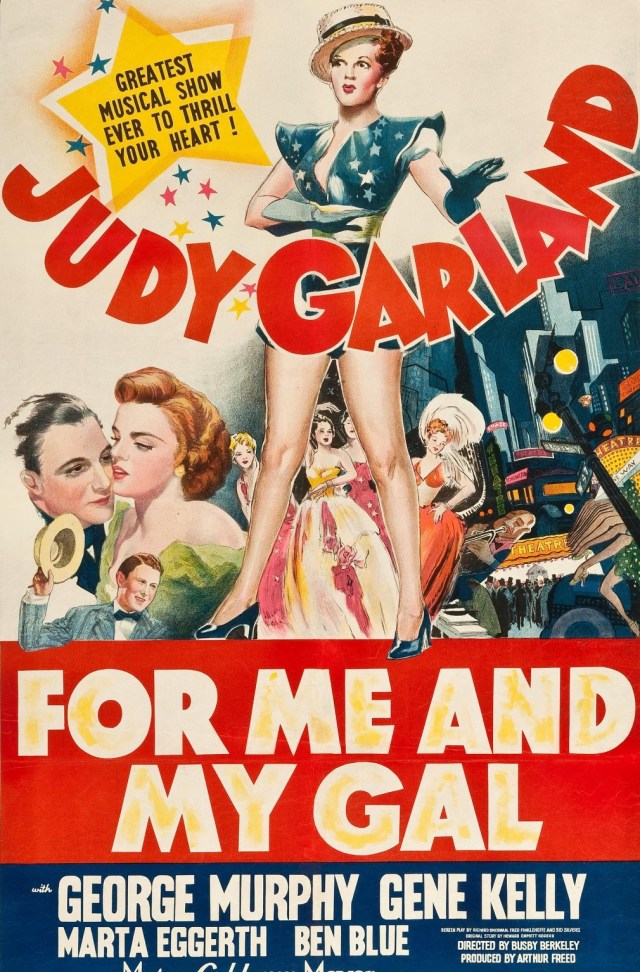
For Me and My Gal poster created by Metro-Goldwyn-Mayer (MGM)

Things I liked about the film:

The on-screen chemistry: Since I chose to review this movie
for the Third Judy Garland Blogathon, I want to discuss Judy’s performance in For
Me and My Gal
. However, I want to talk about her performance in relation to
her on-screen chemistry with Gene Kelly. When a movie musical features a
romantic relationship, the on-screen chemistry of the lead actor and actress
can sell the idea their characters truly love one another. This is what Gene
and Judy achieved through their portrayals of Harry Palmer and Jo Hayden! One
perfect example is presented during the musical number, “For Me and My Gal”.
Through facial expressions, the choreography, and their singing abilities, Jo
and Harry realize they share the same dream, despite being complete strangers
only hours ago. This musical number emphasizes how these characters were always
meant to be together.


How World War I was incorporated: For Me and My Gal takes place in the middle of the 1900s, the time when World War I took place. The story revolves around civilian perspectives; vaudeville
performers trying to make their dreams come true. At the beginning of the
movie, newspaper headlines broadcast events related to World War I. But the
newspaper’s front page is turned away from the characters, as they are more
concerned with how their performances were reviewed by the critics. As the
story progresses, World War I starts to take center stage in their lives,
affecting each character differently. This progression is steady and the
changes happen more subtly. The way World War I was incorporated into For Me
and My Gal
felt realistic. Though fictional musical movies require a
certain amount of disbelief to be suspended, it was refreshing for realism to
be woven into the film.


A story with stakes: Movie musicals, especially those from
the Breen Code era, contain simpler stories. These stories range from looking
for another member of a talent group or characters expressing their love for
each other. In For Me and My Gal, the overarching
story focuses on characters working toward their dreams. Throughout the movie,
Jo and Harry experience obstacles and attempt to overcome them. At one point in
the film, Harry receives an offer to perform at The Palace, a theatre in New
York every vaudeville performer aspires to go. While the offer itself sounds
amazing, the problem is Harry would no longer be able to perform with Jo. This
is one example of For Me and My Gal containing a story with stakes. In
the case of the aforementioned conflict, there were stakes not only for Harry’s
career, but also for his relationship with Jo.

The Third Judy Garland Blogathon banner created by Crystal from In The Good Old Days Of Classic Hollywood and Kristen from Hoofers and Honeys

What I didn’t like about the film:

The “insta-love” trope: In stories where a romantic
relationship in included, part of the story is devoted to showcasing the
progression of that relationship. If a story’s relationship moves too quickly,
it may be difficult for the audience to become invested in that relationship or
determine if the actors have on-screen chemistry. While Judy Garland and Gene
Kelly had good on-screen chemistry, I found their characters’ initial attraction
to happen too quickly. In fact, this attraction happened so quickly, it almost
felt unbelievable. I recognize there’s only so much story to tell in an hour
and forty-four minutes. However, I wish Harry and Jo’s attraction for one
another had taken its time.


An unresolved debt: Toward the beginning of For Me and My
Gal
, Jo’s brother, Danny, pays Jo a visit after one of her shows. During
their conversation, Jo tells Danny she will pay him back after she becomes a
big vaudeville star. But this is the only time throughout the movie where this
debt is mentioned. The debt is not revisited or resolved as the story progresses.
That part of the story ended up becoming a loose end that was left behind by
the end of the movie.


A confusing conflict: For this part of my review, I will
spoil For Me and My Gal. If you have not seen this movie and are
interested in watching it, skip this part of my review and continue reading where
it says “My overall impression”.


After Jo and Harry discover their love for each other, they
receive a telegram congratulating them on their upcoming performance at The
Palace, a theatre in New York they have dreamed about for so long. When they
arrive at The Palace, Harry and Jo learn there was a misunderstanding. They
received a gig at The Palace theatre in Newark, New Jersey. In the telegram, its
sender stated The Palace was in New York. But any performer on the vaudeville
scene would know there’s only one Palace theatre, the one in New York City.
That quote in the telegram references how Eve Minard, a singer Jo and Harry met
on a train trip, brought up the idea of more than one Palace theatre. For Me
and My Gal
was released during the Breen Code era. When a character makes a
poor choice within a film from this time period, they either face accountability
for that choice or learn from their mistake. However, Eve is never confronted
about the telegram. This leaves me confused, wondering if Eve was intentionally
ruining Harry and Jo’s plans or if she was genuinely trying to help, but her
message became lost in translation?

Children holding American flags during a sunset image created by rawpixel.com at freepik.com. <a href=”https://www.freepik.com/free-photos-vectors/people”>People photo created by rawpixel.com – http://www.freepik.com</a>. Image found at freepik.com.

My overall impression:

The term, “The Golden Age of Hollywood”, gets thrown around
from time to time in conversations about the film industry. This term’s
definition depends on who you ask, as film itself can be subjective. In my
opinion, one of Hollywood’s “golden ages” was the Breen Code era. For Me and My Gal serves as one example to prove my point. The 1942 picture sets itself apart from other musical films by
presenting a story with stakes. It also incorporates World War I in a realistic
way. As I’ve stated in past reviews, the strength of a musical movie lies in
its musical numbers. For the most part, For Me and My Gal features
musical numbers that are pleasant to watch! This is the second Judy Garland
production I reviewed this year I was not only recommended, but ended up liking
as well. The streak of enjoyable Judy Garland movies I mentioned in this review’s
introduction is still going strong!


Overall score: 7.6 out of 10


Have you seen For Me and My Gal? What is your
favorite movie of Judy Garland’s? Please let me know in the comment section!


Have fun at the movies!

Sally Silverscreen


Comparing with the Critics – Best of 1976 – Network

This review is from my series, Comparing with the Critics. If you’d like to learn more about the series, click on the link below.

Introducing my new series, Comparing with the Critics!

There are two reasons why I chose Network for my first review of Comparing with the Critics. The first reason is how the movie is an appropriate title for The 6th Golden Boy Blogathon: A William Holden Celebration, hosted by Virginie and Emily from The Wonderful World of Cinema and The Flapper Dame. Network appearing on Gene Siskel’s and Roger Ebert’s list of the top five films from 1976 is the second reason. When I looked through William Holden’s IMDB filmography in preparation for the blogathon, I remembered how Ebert and Siskel liked Network. In fact, it was one of the few films they agreed on. I was aware of Network prior to the Comparing with the Critics series because I had heard it was adapted into a stage play. Toward the beginning of the ‘Best Films of 1976’ episode, Siskel proclaimed how “1976 was a pretty lousy year for movies”. I can’t speak on the cinematic year of 1976 as a whole. But based on my thoughts on Network, this movie would fit Siskel’s argument about the state of 1976 when it comes to film.

Network poster created by Metro-Goldwyn-Mayer (MGM) and United Artists


When it’s his turn to talk about Network, Siskel says
“I think she’s gonna win an Oscar for this picture”, referring to Faye Dunaway’s
performance in the film. Siskel got his wish when Faye did win the Best Actress
award at the 49th Academy Awards. While I can’t compare her portrayal
of Diana Christensen to the other performances that were nominated that year, I
can comment on how interesting some of Faye’s interactions were with William
Holden’s character, Max Schumacher. While having dinner one evening, Diana asks
Max a series of questions, in order to learn more about her co-worker. The more
personal the questions become, the more reserved Max appears. This reserved demeanor
is consistently carried by William throughout the movie, using emotion more
subtly. When Max does become more emotional, it happens at certain moments,
such as when he’s recalling a story about his first broadcasting job. Meanwhile,
Diana expresses her emotions more openly. She’s more honest when it comes to
her perspective, believing no subject is off limits. The pairing of Max and Diana,
portrayed by William and Faye, represents the “old school” and “new school”
mentality of the world of broadcast television. It also represents “old” and “new”
Hollywood.

News reporter being filmed image created by Macrovector at freepik.com. <a href=’https://www.freepik.com/free-vector/journalist-reporter-profession-isometric-banner_2875517.htm’>Designed by Macrovector</a>. <a href=”https://www.freepik.com/free-photos-vectors/banner”>Banner vector created by Macrovector – Freepik.com</a>, Image found at freepik.com.

Some of Hallmark’s movies have pulled back the curtain on
certain industries. One great example, Cooking with Love, shows a
behind-the-scenes look at how to create a television show. As you’re reading
this editorial, you’re probably wondering what a film such as Cooking with
Love
has to do with Network. Similar to the 2018 aforementioned production,
the 1976 film explores the behind-the-scenes operations of network television. Network shows the various steps that are needed
to make network television run as smoothly as possible. The movie also
addresses how television programs are brought to the screen. During a typical
work day, Diana was presented with a set of tv pilots. Hearing the premise of these
pilots makes her realize how similar they all sound. This revelation inspires Diana
to create a program that is drastically different. While talking about Network,
Siskel shares how “I also like movies that deal with what’s really going on in
the world”. Because the movie, more often than not, grounds itself in reality,
the realistic presentation of network television’s behind-the-scenes are
insightful and even educational for the audience.

The 6th Golden Boy Blogathon: A William Holden Celebration banner created by Virginie and Emily from The Wonderful World of Cinema and The Flapper Dame

As I just wrote about in this editorial, Network explores
the behind-the-scenes operations of network television. While I liked this
aspect of the movie, there were times when I felt the movie’s creative team
expected their audience to know what they were talking about. The mention of “shares”
is just one example. The term “shares” was thrown around like confetti on New
Year’s Eve. Diana even dreams about creating a show that will earn a certain number
of shares. Trying to figure out what this part of network television was, I was
confused if the characters were referencing the Stock Market or a program’s
viewership. According to Wikipedia, Network is considered a “satirical
drama”. I could tell when moments were intended to be satire. But, in my
opinion, effective satire is when a story’s creative team knows when to play it
straight and when to acknowledge the joke. Network’s creative team
played it a little too straight, taking their production too seriously. All of
this led to a movie that was pretentious.

Newspaper image created by Zlatko_plamenov at freepik.com. <a href=’https://www.freepik.com/free-psd/newspaper-mockup_1386098.htm’>Designed by Freepik</a>. <a href=”https://www.freepik.com/free-photos-vectors/mockup”>Mockup psd created by Zlatko_plamenov – Freepik.com</a>. Image found at freepik.com.

In this review’s introduction, I mentioned how Network was one of the few films Ebert and Siskel agreed on. They both stated how comedic Network was. While Ebert called the film “funny”, Siskel said “I laughed a lot at Network”. Comedy, like cinema, is subjective. With that said, the only time I giggled during the film was when Max Schumacher suggests hiring a psychic to report the weather. The story overall was not only dry, it took itself too seriously, as I already mentioned in this review. Network’s first half was a drawn-out search for a resolution to the story’s conflict. The movie’s second half turned into a contest to figure out which character could yell the loudest and angriest. To me, this was a recipe for a headache and not a hilarious two hours. Then again, I don’t find characters yelling and screaming at each other funny.

Comparing with the Critics banner created by me, Sally Silverscreen. TV show title cards created by WTTW National Productions, WTTW, Public Broadcasting Service (PBS), Lifetime Television, Tribune Entertainment, Buena Vista Television, and Disney-ABC Domestic Television


Network was one of the films featured in the ‘Best Films
of 1976’ episode of Opening Soon…at a Theater Near You. As stated in
this review’s introduction, the movie appeared on Gene Siskel’s and Roger Ebert’s
list of the top five films of 1976. If I made a guest appearance on the show, Network
would not be on my top five or even top ten films list of that year. In fact, I’d
consider the movie as one of the “Dogs of the Year”. Network, for me,
was an endurance test that almost made me fall asleep. Taking itself too
seriously by expecting too much from the audience and telling a dry, boring
story didn’t help Network’s case. Though comedy is subjective, I didn’t
find the film very funny. However, there were aspects of the film I liked, such
as the acting and the peek behind network television’s curtain. But, like
network television itself, there are many parts needed to make a movie work. As
I wrap up this review for Comparing with the Critics, I’d like to respond to
the film’s overarching quote; I’m bored as heck, and I wish Network used
its indoor voice.


This review was brought to you by

Sally Silverscreen



Take 3: Easter Parade Review

With today being Easter, I’m reviewing the 1948 musical, Easter Parade! But this is not the only reason why I’m writing about this movie. Since the protagonists would be considered a “mismatched couple”, the film was eligible for Realweegiemidget Reviews’ and Cinematic Catharsis’ Mismatched Couples Blogathon. Easter Parade was also recommended by Michaela from Love Letters to Old Hollywood. Prior to this year, the only Easter themed movie I wrote about was the Hallmark production, Easter Under Wraps. While I have reviewed faith-based films, those pictures were not about the Easter holiday. Because this was my first time watching Easter Parade, I was curious how Easter would play a role in this story. I was also curious how the film would compare to other musicals from the Breen Code era. So, without delay, let’s begin this review of Easter Parade!

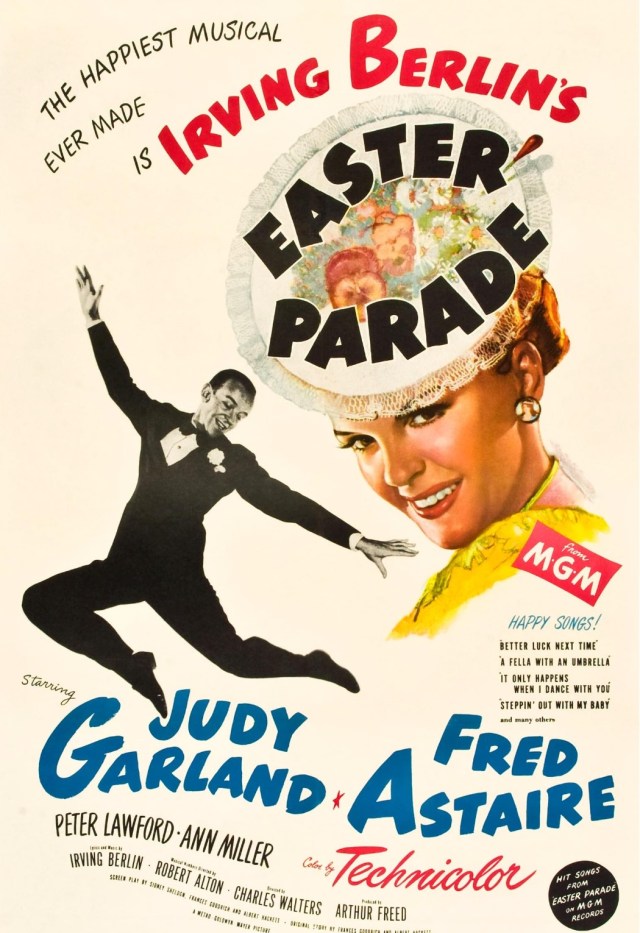
Easter Parade poster created by Metro-Goldwyn-Mayer and Loew’s, Inc.

Things I liked about the film:

The acting: Fred Astaire portrays Don Hewes in Easter Parade, a veteran dancer who is looking for a new dance partner. In this same movie, Judy Garland portrays Hannah Brown, a singer who is trying to make a name for herself in the entertainment industry. Together, Judy and Fred are an on-screen pair that not only works well together, but also dances well together! One of my favorite scenes is when Don mentions to Hannah how she doesn’t capture men’s attention. In an effort to prove Don wrong, Hannah walks in front of him, at first looking discouraged by her fruitless efforts. A few minutes later, Don sees men are taking notice of Hannah. He looks confused and even baffled at how Hannah could prove him wrong. When Don catches up with Hannah, he discovers she is making funny faces, explaining why men were noticing Hannah. This scene was hilarious because of Fred’s and Judy’s expressions and interactions!

Even though Judy and Fred worked well together, I think Judy and Peter Lawford had strong on-screen chemistry! Despite Hannah being from a small-town farm and Johnny being from the city, their interactions make it seem like they have a deep understanding for one another. While on a dinner date, Hannah confesses she dreams her true love will give her flowers and sweep her off her feet. When she reflects on her time with Don, she realizes Don only gives her flowers and sweeps her off her feet when it relates to dancing. During this reflection, Hannah looks defeated and sad by how she didn’t receive what she wanted the way she wanted it. Meanwhile, Johnny looks genuinely sympathetic toward Hannah. As I watched this scene, I wanted Johnny and Hannah to fall in love with each other!

The use of color: In Easter Parade’s opening credits, Technicolor was revealed to be incorporated into the production. I’m thankful Technicolor was used in this movie because capturing scenes in black-and-white would not have done this picture justice! Because parts of Easter Parade’s story take place around Easter, creative decisions such as costume designs and décor are very colorful. Toward the end of the film, Fred and a large group of dancers perform a number to “Steppin Out with My Baby”. Every performer’s costume boasted bright hues, from one dancer’s yellow shoes to another dancer’s blue gloves. At the beginning of the movie, during the musical number, “Happy Easter”, flowers in vibrant shades are present as Don makes his trip to the store. Though it’s a small detail, these flowers play a role in complimenting the colorful landscape of the story’s spring season!

The musical numbers: Musical numbers can make or break a given film. But in Easter Parade, the musical numbers are a major strength because of the choreography and delivery of the numbers themselves. One of the most creative numbers I’ve ever seen was Fred’s solo, “Drum Crazy”. This solo shows his character, Don, tap dancing and playing drums in an attempt to trick a child into giving him a stuffed bunny toy. The combination of dancing and instrument playing provides a captivating performance that not only highlights Fred’s signature talent, but also pairs dancing with other artistic mediums. Another strong solo was Ann Miller’s solo, “Shakin’ the Blues Away”. While portraying Don’s former dance partner, Nadine, Ann’s solo was a tap number that involved a lot of turning. What makes this musical number so memorable is how the cinematography closely follows Ann during her performance. This focus forces the audience to give their undivided attention to Ann and her number. The number itself is fast-paced and energetic, with Ann consistently delivering the choreography in precise and fluid movements!

Cute Easter image created by Freepik at freepik.com. <a href=”https://www.freepik.com/free-photos-vectors/background”>Background vector created by freepik – http://www.freepik.com</a>. Image found at freepik.com.

What I didn’t like about the film:

A premise-driven story: When I reviewed The National Tree last year, I explained the difference between a premise-driven story and a plot-driven story. After watching Easter Parade, I can confirm the movie has a premise-driven story. The premise of Don transforming Hannah into a star entices viewers to watch Fred and Judy acting and dancing together. But the film doesn’t really make the audience ask “and then what happened”? Even though the story is simpler and easier to follow, the story itself lacked a compelling hook, making it feel less intriguing. I wish the characters were given a conflict to resolve, similar to musicals like Singin’ in the Rain and Anchors Aweigh.

The “insta-love” trope: The romantic-comedy genre carries a collection of tropes and cliches. One of them is the “insta-love” trope, which features characters falling in love in a very short period of time. I understand there’s only so much story you can tell in an hour and forty-three minutes. But I thought Hannah and Don’s relationship progressed too quickly. I even thought the attraction between Hannah and Johnny happened too fast. The fast pace of these relationships made it seem like situations weren’t really resolved. Serious conversations and heart-felt discussions were either conveniently ignored or never brought up. The “insta-love” trope also affected how characters changed over the course of the story. Progressions in character development took place so quickly, it almost seemed too convenient.

Easter’s limited inclusion: With a movie called Easter Parade, I expected Easter to play a significant role in the story. While Easter is included enough to get the point across, I was disappointed by how limited its presence was. There were even scenes I could picture taking place within other holidays. Though the purpose of “Drum Crazy” was for Don to purchase a stuffed bunny toy, I found myself imagining this same musical number set during Christmas. Easter Parade is a story that could take place in almost any time of year and it wouldn’t make much difference.

The Mismatched Couples Blogathon banner created by Gill from Realweegiemidget Reviews and Barry from Cinematic Catharsis

My overall impression:

Some of the best, most iconic musicals were released during the Breen Code era. Their strong musical numbers and their overall timelessness have captured the hearts of viewers for decades. Easter Parade is one of these timeless musicals, showcasing its strengths through various creative departments! The colorful palette sprinkled throughout the story perfectly compliments the springtime atmosphere the film’s creative team was striving to present. Every musical number was well choreographed and performed, which definitely made the movie worth watching. Compared to other Breen Code era musicals, though, Easter Parade’s story was weaker. This flaw was due to the story being more premise-driven. Despite this and its other weaknesses, the 1948 film is an entertaining, mostly joyful production that is an appropriate selection for the Easter holiday!

Overall score: 7.6 out of 10

Have you seen Easter Parade? Is there an Easter themed movie you like to watch? Let me know in the comment section!

Have fun on Easter!

Sally Silverscreen

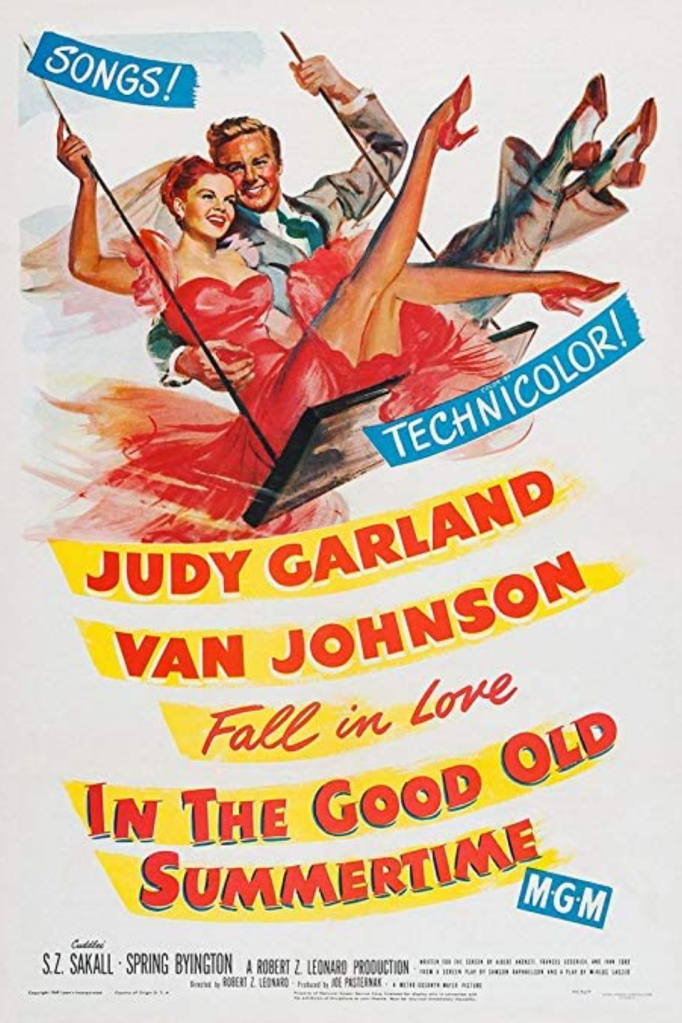
Take 3: In The Good Old Summertime Review

Earlier this month, I said I would review In The Good Old Summertime for the Van Johnson Blogathon. Now, with the arrival of the aforementioned event, it’s time to talk about this film! There are two reasons why I selected the 1949 movie. The first is it was recommended to me by Becky, the same reader who suggested Easy to Wed. The second was how the summer season is winding down. Because the movie is titled, In The Good Old Summertime, I figured it would serve as a sort of last hurrah. As of 2022, the 1949 title is the fourth one of Van Johnson’s I’ve seen. While I found both Plymouth Adventure and Easy to Wed just ok, I was not a fan of Where Angels Go, Trouble Follows. Therefore, it’ll be interesting to see what I thought of In The Good Old Summertime!

In The Good Old Summertime poster created by
Metro-Goldwyn-Mayer

Things I liked about the film:

The acting: As I said in the introduction, In The Good Old Summertime is the fourth film of Van Johnson’s I have seen. Therefore, I knew what to expect from Van, talent wise. While portraying Andrew, Van utilized emotions well. A great example is when Andrew and Veronica are attempting to sell some sheet music to a customer. The sheet music in question was “Put Your Arms Around Me, Honey”. During this song, Andrew looks threatened, like he knows Veronica is doing a better job at selling the music than he would have. Because of the quality of his acting talents, Van was able to make scenes like this one feel believable.

In The Good Old Summertime is the fifth movie of Judy Garland’s I have watched. Looking back on those films, I have noticed how Judy is a more versatile actress than I feel she gets credit for. While waiting for her secret admirer, Veronica, Judy’s character, appears visibly nervous. She’s glancing around the restaurant and constantly readjusting her flower and poetry book. When Andrew arrives, Veronica’s unpleasant feelings toward her co-worker grow stronger. Her face appears troubled, frustrated over the fact he won’t leave. At some points during this interaction, Veronica raises her voice. When she eventually returns home, Veronica appears deflated, her night not going as she expected.

I am not familiar with Spring Byington as an actress. Despite this, I enjoyed her portrayal of Nellie Burke! Her on-screen personality was so pleasant. Even when she was upset at Otto Oberkugen, she was still a character worth rooting for. Spring and S.Z. Sakall had good on-screen chemistry. One good example is when Nellie is trying to explain a misunderstanding. During this conversation, Otto reveals his insecurities as a musician. This explanation comes across as genuine, as a businessman trying to save face. Meanwhile, through gentleness and kind words, Nellie reassures Otto he is the only man she cares about. It was nice to see two older characters fall in love, especially since this type of romance story doesn’t seem as common as those featuring younger couples. Through the acting performances and screenwriting, Spring and S.Z. brought forth a couple that was interesting to watch!

The musical numbers: At Otto’s music store, a harp is introduced among the instrumental stock. In order to sell the harp to a potential customer, Veronica plays the harp to a song called “Meet Me Tonight in Dreamland”. With the combination of Judy’s vocals and the harp instrumental sound, the song exuded the dreamlike tone the film’s creative team was striving for. Even with the inclusion of a piano, these sounds complimented one another. The aforementioned song, “Put Your Arms Around Me, Honey”, was performed in two tempos. At Veronica’s suggestion, the first tempo is slower, providing a romantic tone. But with the second, faster tempo, a jollier tone is presented. Because of this musical, creative decision, it was interesting to hear how one change can make a song sound so different.

The historical accuracy: In The Good Old Summertime takes place around the late 1800s to early 1900s. With that said, there are many aspects of this movie that appeared historically accurate! One of these areas was the wardrobe. Louise Parkson, portrayed by Marcia Van Dyke, is Andrew’s friend. She is attempting to win a prestigious audition. When this audition arrives, Louise wore a white dress with a full, floor length skirt. The sleeves are medium length, covering Louise’s upper arms. The dress also had a higher neckline. These design choices represented modesty in women’s fashion from that time.

The Sixth Van Johnson Blogathon banner created by Michaela from Love Letters to Old Hollywood

What I didn’t like about the film:

The underutilization of Buster Keaton: I haven’t seen many of Buster Keaton’s films. But based on what I know about his filmography, he seems like he’s a comedic actor who utilizes physical comedy. In In The Good Old Summertime, however, Buster wasn’t given much material to work with. There were two scenes where Buster’s character, Hickey, trips and falls. But these felt like weak attempts at giving Buster something to do. If anything, it seems like Buster was cast in the film just for the sake of it.

A drawn-out plot: The story of In The Good Old Summertime revolves around Veronica’s and Andrew’s search for their respective pen-pals. While this plot can lend itself to a good story, it was drawn-out throughout the entire movie. It got to the point where, after Veronica’s secret admirer was revealed, she was being manipulated into believing the secret admirer is someone else. This was likely done to keep the plot going. But it just felt too cruel for my liking.

No strong subplots: So much time was given to the aforementioned main plot in In The Good Old Summertime. As a result, there were no strong subplots. Some aspects of the narrative could have lent themselves to good side stories. But because the script focused so much on the main plot, these ideas weren’t able to reach their full potential. For example, Otto is experiencing difficulty selling some harps. This felt like a running joke that didn’t lead anywhere. An interesting story idea would have been if a wealthy customer was looking for a specific harp. Otto would then spend the rest of the movie trying to locate this instrument.

String of musical notes image created by Freepik at freepik.com. <a href=’https://www.freepik.com/free-vector/pentagram-vector_710290.htm’>Designed by Freepik</a> <a href=”https://www.freepik.com/free-photos-vectors/background”>Backgroundvector created by Freepik</a>. Image found at freepik.com.

My overall impression:

This is the third time I have participated in the Van Johnson Blogathon. While I reviewed Van’s episodes of Murder, She Wrote the first time around, I wrote about Plymouth Adventure last year. Both Plymouth Adventure and In The Good Old Summertime have one thing in common: there were ok. With the 1949 film, I enjoyed the musical numbers. They were not only entertaining, but creative as well. But there were times where I felt more effort was placed in the musical numbers than the script. This movie adopted the “enemies to lovers” trope, which could work in a story. Unfortunately, this part of the script was drawn-out. While watching In The Good Old Summertime, I kept thinking back to Meet Me in St. Louis. The 1944 musical not only takes place in the early 1900s, but also stars Judy Garland. Personally, I think In The Good Old Summertime is a weaker version of Meet Me in St. Louis.

Overall score: 6.9 out of 10

Have you seen any of Van Johnson’s films? If so, which one is your favorite? Let me know in the comment section!

Have fun at the movies!

Sally Silverscreen
Take 3: Easy to Wed Review

As the dawn of August arrives, so does the Esther Williams blogathon! Like last year, I have decided to review another movie from Esther’s filmography. But this time, I selected the 1946 title, Easy to Wed! Similar to the previous year, Easy to Wed was recommended to me. However, this film was suggested by a reader named Becky. That’s not the only reason why I’m reviewing the movie. I’m also participating in The Sixth Van Johnson Blogathon. Since Van happens to star in Easy to Wed, this is a good segue to that event. In the 1946 film, the characters’ trip to Mexico contained the “summer vibes” one would expect from the season. This is an interesting coincidence, as the movie I’m reviewing for the Van Johnson Blogathon is In The Good Old Summertime! My readers will have to wait a little while for that review. For now, though, it’s time to talk about Easy to Wed!

Easy to Wed poster created by Metro-Goldwyn-Mayer and Loew’s Inc.

Things I liked about the film:

The acting: In Easy to Wed, Esther portrayed Connie, a socialite who is wrongly accused of stealing another woman’s husband. Before she meets Van’s character, Bill, the employees at the New York newspaper that accused Connie label her as “spoiled” and “arrogant”. But when Bill meets Connie, he, and the audience, sees she is the complete opposite. In fact, Esther’s on-screen personality was very sweet! I enjoyed watching Connie and Bill’s interactions. The gentle sweetness of Connie’s personality and the charming yet cunning personality of Bill worked, as opposites attracted. Connie’s wittiness also helped this relationship’s favor. One of my favorite scenes is when Bill is riding on an inflatable raft in Connie’s pool. In an attempt to get him to join her in the pool, Connie tries to deflate the raft. Since she wants to catch Bill off guard, she deflates the raft with her foot during their conversation. Not only do Esther’s and Van’s acting abilities add to this on-screen relationship, so does their on-screen chemistry!

When it comes to Lucille Ball’s filmography, I’ve, so far, stuck with I Love Lucy. Therefore, I had an idea of what to expect in her portrayal of Gladys, the fiancé of Warren. Expectations aside, Lucille’s performance was enjoyable to watch! Not only did she work well with the other cast members, she used comedy to her advantage. During Bill’s stay in Mexico, he learns how to use a duck call whistle. While attempting to make a duck call, Gladys opens the door to Bill’s main sitting room and loudly yells “Happy New Year”. Personally, I found this scene hilarious, as the moment itself was unexpected. Speaking of Warren, let’s talk about Keenan Wynn’s performance. His portrayal reminded me of a more dramatic version of “Rooster” from the 1982 adaptation of Annie. What I mean by that is Warren was a cunning man who had a way with words. Another scene I liked was when Warren visited Bill about the newspaper’s libel suit. Because of how cunning both Warren and Bill are, they went toe-to-toe with each other, never missing a beat. What also helped was the quality of both Van’s and Keenan’s talents!

Lucille’s and Esther’s wardrobe: I loved Lucille’s and Esther’s wardrobe in Easy to Wed! However, there were three outfits that absolutely stole the show! Lucille wore the first outfit in the aforementioned duck call scene. A shiny gold top was covered by a velvety blue suit jacket. Deep blue slacks match the jacket, with the outfit complimented by shiny gold shoes. The blue and gold color palette paired beautifully with Lucille’s red hair and blue eyes! During a hunting trip, Connie wore fishing boots over a pair of black pants. A gray turtleneck shirt is under a red and orange plaid jacket. Finished with a maroon cap, the outfit is a classy ensemble that reminded me of the fall season. A few scenes later, Esther wore a light green sweater with cattails on them. A medium length black skirt compliments the cattails on the sweater, as well as Esther’s headband. A pair of brown boots helps pull off a look that would look great during fall or winter.

The “Boneca de Pixe” musical number: Toward the end of Easy to Wed, Connie and Bill perform in a musical number at a party. This number reflected their time together in Mexico. Both Esther and Van sung in Portuguese, dancing alongside each other and a large ensemble of dancers. The dancers’ costumes are so vibrant and colorful, boasting shades of red, yellow, and green. A small orchestra provided the sound, teaming up with Ethel Smith on the organ. Leading into this musical number, Ethel performed an organ solo that was fun to watch! This solo added the energy and excitement this piece needed. Overall, this number made me wish Easy to Wed was a musical.

The Third Esther Williams Blogathon banner created by by Michaela from Love Letters to Old Hollywood

What I didn’t like about the film:

A drawn-out conflict: Easy to Wed’s conflict revolves around Warren and Bill’s plan to prevent the libel suit from going to court. While it was interesting to see this plan unfold, it was drawn out for most of the story. In fact, this conflict was drawn out for so long, its resolution was delivered in a rapid-fire style within the last ten minutes of the movie. Had this script been a little bit tighter, the resolution’s delivery could have been more satisfying.

An inconsistent use of music: As I’ve said before, music can elevate the mood or tone of a given scene. It can also help make a scene more memorable. The film’s first half featured less music than its second half. Because of this, the memorability of some scenes was weaker. One example is when Bill is hosting a dinner party in his hotel’s sitting room. If music had been playing in the background, it would have heightened the anticipation of Connie’s arrival. The accompanying melody would highlight the growing feelings Bill and Connie have for one another as well. Instead, the scene felt mundane, slogging along to the next part in the story.

No subplots: Like I already mentioned, the conflict in Easy to Wed was drawn out for most of the movie. There are no subplots in this film, as the script focuses on the aforementioned conflict. Personally, I wish the story received a subplot. It would have given the audience additional intrigue to carry them through the film. The newspaper’s photographer could have formed a romantic relationship with the female organist. Maybe his camera goes missing and he has to find it. To me, the lack of subplots felt like a missed opportunity.

Since I loved the outfits described in this review, I decided to share screenshots of them, so my readers could see how great these outfits are! Screenshot taken by me, Sally Silverscreen.
Screenshot taken by me, Sally Silverscreen.

My overall impression:

In my opinion, Easy to Wed is a mixed bag. On the one hand, there are things about the movie I liked. The acting was strong, the “Boneca de Pixe” musical number was great, and I loved Lucille’s and Esther’s wardrobe. On the other hand, the script could have been stronger. Tighter writing might have helped the conflict reach a satisfying resolution. The conflict could have also been paired with at least one subplot. As I watched Easy to Wed, I was reminded of another movie with a drawn-out conflict: Anchors Aweigh. Because that movie’s musical numbers were more consistent, the audience had something to occupy their time until the conflict could be resolved. As I mentioned in this review, the music was inconsistent in Easy to Wed. Therefore, parts of the story felt longer than necessary. So far, I’ve seen three of Esther Williams’ films. Out of those titles, Easy to Wed is my least favorite. Hopefully, the next picture of Esther’s I watch will be better.

Overall score: 6.1 out of 10

Have you seen any of the Esther Williams’ films? Are you looking forward to my review of In The Good Old Summertime? Let me know in the comment section!

Have fun at the movies!

Sally Silverscreen