Take 3: Heart of a Stranger Review + 495 Follower Thank You

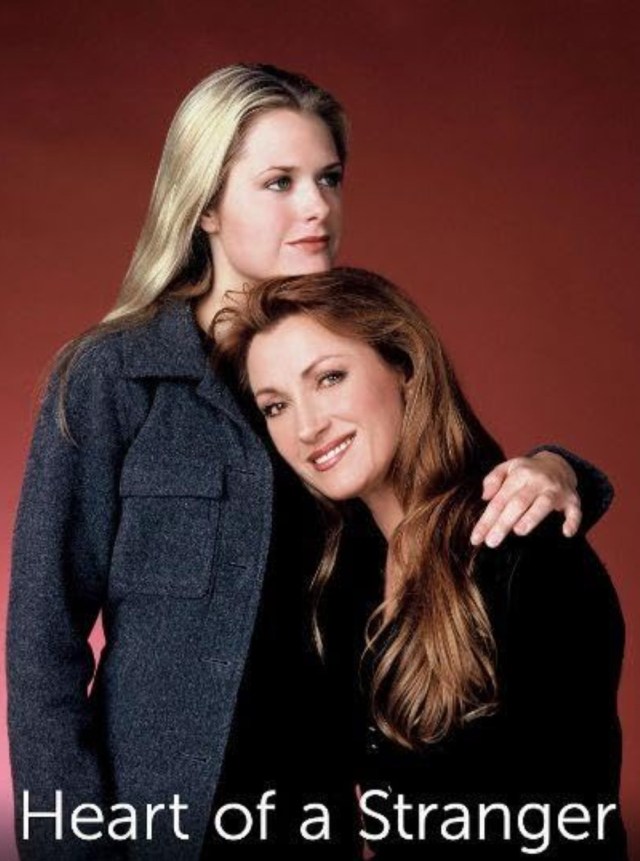
Here at 18 Cinema Lane, some of my most popular content is Hallmark related. In fact, the top three most viewed articles are two of my Sunset Over Hope Valley re-cap posts and my list of the top ten worst Hallmark movies of all time. This popularity can sometimes overshadow other genres of film as well as other made-for-TV networks. One of those networks is Lifetime. Throughout my six years of blogging, I’ve reviewed Lifetime’s movies so infrequently. So, to kind of make up for that, I selected the 2002 picture, Heart of a Stranger, for this Blog Follower Dedication Review! While I had seen this film years ago, I had vague recollections of it. All I remembered was how the protagonist received heart surgery and that the protagonist and her daughter wanted to see The Nutcracker. Since my last two Blog Follower Dedication Reviews featured films that were new to me, I thought revisiting a picture from yesteryear would be a nice change. Let’s talk about Heart of a Stranger so we can get to the heart of this review!

Heart of a Stranger poster created by Fogwood Films, Von Zerneck-Sertner Films, and Lifetime Television

Things I liked about the film:

The acting: In the introduction of my review, I mentioned how Heart of a Stranger’s protagonist received heart surgery and that the protagonist and her daughter wanted to see The Nutcracker. This story revolves around a mother and daughter’s changing relationship after the mother receives a heart transplant. Jane Seymour’s and Maggie Lawson’s performance created a believable familial relationship. That is what made the crux of the story work. At a local restaurant, Maggie’s character, Amanda, is excited by how her violin performance turned out. Jane’s character, Jill, is proud of her daughter. Their big smiles and warm demeanor are soon followed by changed feelings when Amanda makes a confession to her mother. Jill’s initial confusion transforms into anger as she and her daughter get into an argument. During this argument, Amanda’s frustrations are on full display, from the sharp tone in her voice to her eyes intensely focusing on her mother. Maggie and Jane helped make the scene I just described feel realistic!

Not only did Jane and Maggie create a believable familial relationship, their individual performances are believable as well! A perfect example is when Jill goes to a local car wash. Before the car wash process begins, Jill excitedly tells her daughter over the phone how she’s about to do a mundane task like going to the car wash. The reason for Jill’s excitement is how, before her heart surgery, she used to be too sick to run errands. But as the car wash continues, Jill receives flashbacks she believes are from her heart donor. These flashbacks, along with being in a confined space, cause Jill to become nervous. Her eyes, filled with concern, quickly scan her surroundings. Jill also develops a frown out of worry. Eventually, her emotions get the better of her as she runs out of her car mid-car wash. The scene ends with Jill flinching from a car wash employee. The way Jane used her acting talents to adapt to the changing emotions in that scene was fluid and never missed a beat. Jane and Maggie worked as a team carrying this film!

Amanda’s subplot: Like I previously mentioned, Jill receives a heart transplant. The surgery is not only a success, it allows Jill’s view on life to change. Amanda’s perspective on life is also impacted because of her mother’s newfound health. In her subplot, Amanda is trying to apply for a music conservatory. To prevent burnout and fatigue, she learns a new musical style from performers at a local restaurant. Using music as a compass to guide Amanda’s new journey was, in my opinion, a smart creative choice. Through Maggie’s performance as well as the screenwriting, Amanda’s dedication for her craft turned into motivation to mold her own future! This subplot also gave Amanda character development as she slowly, but surely gained independence.

The honesty surrounding post-surgery: Made-for-TV movies about characters receiving transplants usually build up to the transplant surgery. Because the story’s climax is the aforementioned surgery, there is little to no time to highlight the characters’ life post-surgery. In Heart of a Stranger, Jill’s surgery takes place at the beginning of the movie, with the rest of the film showing Jill adapting to her new heart and health. Throughout the story, Amanda reminds her mother to take her medicine prescribed after surgery. Even though the surgery was successful, Jill follows doctor’s orders to prevent her body from rejecting her new heart. Later in the film, Jill attends a support group with other transplant patients. This part of the story addresses loneliness that could occur after experiencing a major medical transformation. Weaving honesty into Heart of a Stranger presents a more realistic depiction of patients receiving transplant organs. For viewers unfamiliar with this medical process, the movie may give them an idea of what transplant patients may experience.

Heartbeat image created by Freepik at freepik.com. <a href=’https://www.freepik.com/free-vector/medical-logo_763775.htm’>Designed by Freepik</a>. <a href=”https://www.freepik.com/free-photos-vectors/logo”>Logo vector created by Freepik</a>. Image found at freepik.com.

What I didn’t like about the film:

An overshadowed mystery: According to a synopsis I read for Heart of a Stranger, the movie is about Jill trying to solve the mystery of who donated her heart. This is what led me to believe the story would emphasize Jill’s search for her donor. But when I revisited this film, I discovered the creative team chose to prioritize Jill’s new perspective on life after heart transplant surgery. I recognize how important that part of the story is, especially how it connects to the theme of taking advantage of second chances. However, the emphasis on Jill’s new perspective on life not only caused the mystery of Jill’s donor to, sometimes, be overshadowed, it gave the mystery a lack of urgency. While the mystery did get solved, I wish that had been the story’s main focus.

Unresolved parts of the story: As I just said in my previous point, the mystery of Jill’s donor was, sometimes, overshadowed because Jill’s new perspective on life was prioritized. But the aforementioned mystery is not the only overlooked part of the story. After unsuccessfully searching for information on Jill’s donor, Beth, a friend of Jill’s, shares her disapproval with Jill over locating the donor and their family. The rest of the story does not revisit this disapproval, despite showing Beth sharing Thanksgiving dinner with Jill. Later in the movie, Amanda has a fight with her boyfriend, Billy. Since this situation took place toward the end of the movie, there is little to no time to resolve this conflict. The creative team should had taken the time to tie up these loose ends instead of putting most of their eggs in one basket.

Brian’s subplot: One of Jill’s friends is a restaurant manager named Brian. When she visits the restaurant he works for, Brian shares with Jill his dream of starting his own restaurant. He even encourages her to become co-owner of the establishment. Despite this subplot receiving a satisfying conclusion, it was ignored for most of the movie. Even Brian himself made very few appearances in the story. The emphasis of Jill’s new perspective on life prevented Brian’s subplot from receiving a bigger role in Heart of a Stranger.

Blue sparkly Christmas tree image created by Macrovector at freepik.com. <a href=”https://www.freepik.com/free-photos-vectors/frame”>Frame vector created by Macrovector – Freepik.com</a>. <a href=’https://www.freepik.com/free-vector/merry-christmas-card_2875396.htm’>Designed by Macrovector</a>. Image found at freepik.com.

My overall impression:

Before I share my thoughts on Heart of a Stranger, I want to thank all the followers of 18 Cinema Lane! Whenever it’s time to write a Blog Follower Dedication Review, I try to select movies that I feel good about recommending. I would actually suggest this 2002 made-for-TV production as an ‘alternative Christmas movie’. While the story leads up to Christmas, the holiday is not the story’s primary focus. Instead, the film prioritizes a mother and daughter’s life post heart transplant surgery, as well as the mother’s new perspective on life. At best, Heart of a Stranger is a fine, decent movie. The depiction of patients receiving transplant organs is more realistic due to the honesty woven into the story. Maggie’s and Jane’s performance helped create a believable familial relationship. But compared to the types of films Lifetime creates today, especially in the 2020s, Heart of a Stranger is more mundane and pedestrian. This would explain why the network has moved away from creating movies like this one.

Overall score: 7 out of 10

Have you seen Heart of a Stranger? Are there any older Lifetime movies you’d like to see me review? Let me know in the comment section!

Have fun at the movies!

Sally Silverscreen

Take 3: Nelly Knows Mysteries: A Fatal Engagement Review

This month, Hallmark Mystery premiered two new movies; Jazz Ramsey: A K-9 Mystery and Nelly Knows Mysteries: A Fatal Engagement. I did see Jazz Ramsey: A K-9 Mystery, but I found the film underwhelming, as the biggest flaw was how the titular K-9 was barely in the story. To make up for not reviewing that movie, I chose to write about Nelly Knows Mysteries: A Fatal Engagement instead. Months ago, before this film was announced as a Hallmark production, I stumbled upon the official synopsis for Nelly Knows Mysteries: A Fatal Engagement on IMDB. At the time, the story sounded generic. But I was willing to give the film a chance after learning Pascale Hutton and Kavan Smith were the project’s lead actors. Kavan and Pascale are two of the strongest actors in Hallmark’s community. Their on-screen chemistry has been so strong on When Calls the Heart, their characters, Rosemary and Lee, have become fan favorites. The idea of Pascale and Kavan working together on a mystery movie seems like a good idea. But did this good idea come to fruition or did this idea become wasted potential? The only way to find out is by reading my review!

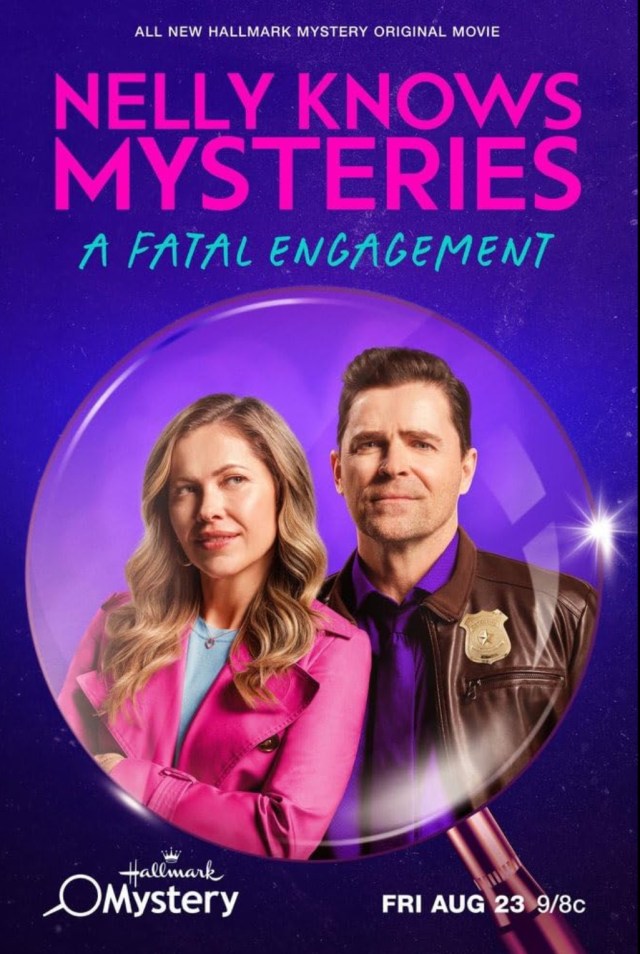
Nelly Knows Mysteries: A Fatal Engagement poster created by Muse Entertainment Enterprises and Hallmark Mystery

Things I liked about the film:

The acting: When introducing a new series, it’s important to establish the relationships between the protagonist and the story’s other characters. These relationships could make or break that introductory film, with interest from the audience determining whether more chapters are created. What helps keep on-screen relationships interesting is the acting abilities of the cast. At the beginning of Nelly Knows Mysteries: A Fatal Engagement, Nelly, portrayed by Pascale Hutton, visits the diner of her friend, Helen, portrayed by Jill Morrison. The scene starts with the friends sharing happy greetings, their warm smiles and friendly tones in their voices express their excitement of seeing each other. But when Nelly sees someone she’s trying to avoid, her smile immediately drops to a look of concern with alertness in her eyes. Helen soon mirrors Nelly’s face with her own look of concern as she quickly gets on the same page as Nelly. Though this scene is short, the acting talents of Jill and Pascale create an on-screen friendship that feels believable!

Nelly Knows Mysteries: A Fatal Engagement adopts the “opposites attract” trope, showcasing Nelly with an energetic, joyful personality and Michael, portrayed by Kavan Smith, with a calmer, yet serious personality that leaves wiggle room for emotion. One scene that presents the “opposites attract” trope perfectly is when, as they’re sharing milkshakes at Helen’s diner, Michael asks Nelly what makes her happy. Nelly shares how she chooses to be happy as she reveals how one of her loved ones passed away. But before she tells Michael about this loved one’s passing, Nelly talks about a happy memory she has with that person. Using a tone of voice that sounds reflective and sometimes gesturing with her right hand, Nelly’s happiness appears gentler, with her smile coming and going. After giving Nelly his undivided attention, Michael looks sad and even a bit concerned. His frown and look in his eyes make Michael almost appear as if he’s adopting Nelly’s sadness.

Nelly’s wardrobe: Whether starring on When Calls the Heart as Rosemary Coulter or appearing alongside Kavan in The Perfect Bride films as Molly, Pascale Hutton’s characters have been given wardrobes that not only compliment Pascale herself, but are also stylishly presented on screen. Nelly’s wardrobe in Nelly Knows Mysteries: A Fatal Engagement is no different, as her attire is classy and sophisticated! When the audience is first introduced to Nelly, she wears a light pink short sleeved shirt paired with tailored navy pants boasting a blue and white pattern. A square-faced watch with a white band is the perfect accessory for this outfit! As she attends a party, Nelly wears another pink outfit. This time, she wears a bright pink tweed jacket with matching pink shirt. Light blue jeans, large gold earrings, and a simple gold heart necklace complete the look!

Addressing a flaw of an amateur detective: Amateur detectives from Hallmark Mystery movies may, sometimes, have a flaw that will either be brushed to the side or will turn into a blessing in disguise for the protagonist. This is one of the ways Hallmark has asked their audience to suspend their disbelief. In Nelly Knows Mysteries: A Fatal Engagement, however, Michael actually points out one of Nelly’s flaws to her. Nelly is upset when someone she knows is arrested. Michael then addresses how Nelly is unable to observe the case’s suspects from an objective perspective. Nelly ends up agreeing with Michael, as she knows she’s seen in her community as someone who looks out for her fellow neighbors. The honesty toward one of Nelly’s flaws added a sense of realism to Nelly Knows Mysteries: A Fatal Engagement!

Diner image created by Freepik at freepik.com. <a href=’https://www.freepik.com/free-vector/american-vintage-restaurant-hand-drawn_902205.htm’>Designed by Freepik</a>. <a href=”https://www.freepik.com/free-photos-vectors/food”>Food vector created by Freepik</a>. Image found at freepik.com.

What I didn’t like about the film:

The contradictions: Nelly Knows Mysteries: A Fatal Engagement incorporates the “everybody knows everyone in a small town” cliché; a story element that, in my opinion, is overused in Hallmark productions. Despite the presence of this cliché, there are some instances where the cliché is contradicted. While creating a mystery board, Nelly and her friend, Fiona, discover one of the residents of Babbleton (where this story takes place) is related to another resident of the town. If everyone in Babbleton knows each other, Fiona and Nelly shouldn’t be surprised by the familial connection of the aforementioned two characters. Earlier in the film, when questioned by Michael about the murder victim, Nelly tells him she’s known the murder victim for years. However, she’s unaware of how neat the murder victim kept their home. Again, if everyone knows each other in Babbleton, Nelly would have known the living conditions of the murder victim.

A misbalanced tone: It’s understandable why Hallmark would avoid making murder mystery stories too dark, as the network has gained a reputation for creating stories that exude coziness and heartwarming charm. In past Hallmark Mystery productions, a balance between tones was achieved by having a murder mystery serve as the film’s main plot while one or two subplots contained more lighthearted situations. The majority of Nelly Knows Mysteries: A Fatal Engagement is coated in a cheerful tone. Prioritizing this lighter tone caused the characters to seem like they didn’t take the story’s mystery seriously. It also created a lack of urgency. There were even times when the movie’s lighthearted tone felt inappropriate, such as when an up-beat jazz tune played while a character was arrested.

A dialogue-heavy story: Dialogue is an important component of any mystery movie, as it can contain clues and other important information. In the case of Nelly Knows Mysteries: A Fatal Engagement, the script was dialogue-heavy. The story was forced to rely on conversations and questioning from Michael to carry the mystery. Non-verbal clues, such as physical objects, were limited because of this creative decision. A dialogue-heavy story also made it difficult, at times, to keep track of characters.

Tools of a writer image created by Freepik at freepik.com. <a href=’https://www.freepik.com/free-photo/camera-and-coffee-near-notebook-and-accessories_2399437.htm’>Designed by Freepik</a>. <a href=”https://www.freepik.com/free-photos-vectors/vintage”>Vintage image created by Freepik</a>. Image found at freepik.com.

My overall impression:

If I could choose a movie that visually represents the concept of “having cake and eating it too”, it would be Nelly Knows Mysteries: A Fatal Engagement. The film’s creative team wanted to include a murder mystery in their story, yet they didn’t want their story’s tone to be too serious. By making their movie mostly lighthearted, the movie itself ended up being a little goofy for my liking. The creative team of Nelly Knows Mysteries: A Fatal Engagement wanted to utilize the “everybody knows everyone in a small town” cliché. At the same time, they didn’t want to commit to the cliché’s consistency. So, the script contradicted the cliché on more than one occasion. Despite these errors I discussed in my review, Pascale Hutton and Kavan Smith still shined bright together! The interactions throughout this movie felt believable, whether it was Nelly visiting Helen at her diner or Michael and Nelly discussing the story’s case. Addressing one of Nelly’s flaws as an amateur detective brought a sense of realism to the script. Within Hallmark’s library of films, there are worse titles than Nelly Knows Mysteries: A Fatal Engagement. However, this film doesn’t stand up to pictures like Curious Caterer: Foiled Plans.

Overall score 6 out of 10

Did you see Nelly Knows Mysteries: A Fatal Engagement? Would you like to see Kavan Smith and Pascale Hutton star in more mystery films together? Tell me in the comment section!

Have fun at the movies!

Sally Silverscreen
Take 3: Cricket on the Hearth (1967) Review

You probably think it’s strange how, after a week and a half long hiatus, my first review back on my blog would be for a Christmas film (in the middle of August). However, I have a very good explanation for this choice. The first reason is how the 1967 animated movie, Cricket on the Hearth, is what I selected for Realweegiemidget Reviews’ (Aaron) Spellingverse Blogathon, as Aaron Spelling was one of the film’s executive producers. The second reason is how animated movies are reviewed so infrequently on my blog. In fact, Cricket on the Hearth is the first animated film to be reviewed on 18 Cinema Lane in 2024. When I chose to participate in the (Aaron) Spellingverse Blogathon, I knew I wanted to write about a made-for-tv movie. So, when I discovered the 1967 film on Aaron’s IMDB filmography, I felt I found the perfect movie for the blogathon, especially for the previously mentioned reasons! But did Cricket on the Hearth end up being the perfect choice to write about? Keep reading my review to find out!

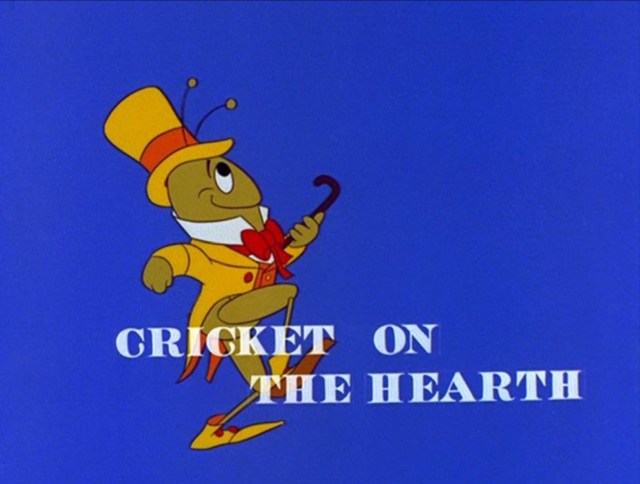
Cricket on the Hearth (1967) title card created by Rankin/Bass Productions, Thomas/Spelling Productions, and National Broadcasting Company (NBC)

Things I liked about the film:

The animation: Some of the best animated movies boast bright, colorful hues. These hues can be utilized in various ways, from creating imaginative worlds to providing interesting visual contrasts. Cricket on the Hearth was a very kaleidoscopic production! Scenes either burst with a bundle of color or at least one bold color sparkled against a darker background. Presenting Cricket Crocket in a mustard yellow suit jacket and shoes, paired with an orange vest and a red bowtie, was a smart creative decision. It forces the audience to focus on Cricket Crocket, especially when he’s standing on a dark wood table or a deep green top hat. The toys in Caleb’s toy shop come to life during the song, ‘Smiles Go With Tears’. Despite the title’s contraction, the song’s tone is joyful because the song is about someone shedding tears due to being happy. The joyful nature of ‘Smiles Go With Tears’ is wonderfully depicted in the presentation of the toys. From a doll’s bubble-gum pink dress and bonnet to a pair of bright yellow and blue elephants, this scene was great to look at!

While looking for a place to live, Caleb considers moving into a poor house. Because Cricket Crocket is perched on Caleb’s top hat, Cricket Crocket hangs upside down in order to face Caleb. While looking upside down, Cricket Crocket sees a nearby toy factory. As he is readjusting himself, the image of the toy factory flips from appearing upside down to becoming right-side up. Animated films from the 1960s, especially those that were made-for-tv productions, were created with limited resources compared to animated pictures from the twenty-first century. Therefore, scenes like the one I just described seem ahead of its time.

The songs: Before reviewing Cricket on the Hearth, I had never seen the 1967 movie. So, I was pleasantly surprised when I discovered the movie was a musical! The songs featured in this film sounded like relics of the late ‘60s, the time when Cricket on the Hearth was released. But these sounds, from emotional ballads to cheery tunes, felt nostalgic. Danny Thomas, who voices Caleb, sings a ballad titled ‘Through My Eyes’. Throughout this song, Caleb expresses his desire for his daughter, Bertha, to see the world how he wishes he could present it to her. The combination of Danny’s vocals and the orchestral music felt reminiscent of Judy Garland’s ‘Somewhere Over the Rainbow’ and Louis Armstrong’s ‘What a Wonderful World’, songs that exude a sense of hope and contain timeless elements. Another song of Danny’s I liked was ‘The First Christmas’! Before this song, Caleb wonders how he will provide the kind of Christmas Bertha hopes for. He learns how to resolve his conflict as the song carries on. The lyrics of ‘The First Christmas’ illustrate how Christmas doesn’t have to look the same for those who celebrate the holiday. The inclusion of the Norman Luboff Chorus added gravitas to this song!

The religious aspects of Christmas: Based on what I know about Charles Dickens and his stories, A Christmas Carol, one of his most well-known pieces of literature, is typically not known for addressing the religious aspects of Christmas. Though it was briefly incorporated in Cricket on the Hearth, I was pleasantly surprised by the recognition of Christmas’ religious aspects! As I previously said while talking about ‘The First Christmas’, the lyrics of the song illustrate how Christmas doesn’t have to look the same for those who celebrate the holiday. This point is emphasized by reminding the audience how Jesus had very little in terms of decorations and presents during the First Christmas. By the end of the song, the message is made clear; it’s not about what you have, but who you spend Christmas with that’s important. Before closing out the movie, Danny quotes a poem by Edmund Cooke. The quote itself goes “Tis not the weight of jewel or plate, or the fondle of silk or fur, ‘tis the spirit in which the gift is rich, as the gifts of the Wise Men were. And we are not told whose gift was gold or whose was the gift of myrrh”. Edmund’s poem brings up an excellent point, as the Nativity story does not specify which gift came from which Wise Man. This quote also highlights the point made earlier about Christmas being about who you spend the holiday with.

The (Aaron) Spellingverse Blogathon banner created by Gill from Realweegiemidget Reviews

What I didn’t like about the film:

Scenes that serve as padding: In order to satisfy a film’s run-time, a film’s creative team will, sometimes, choose to pad the story out by incorporating additional scenes or establishing shots. This creative decision was utilized in Cricket on the Hearth, mostly in between songs. During the song, ‘Through My Eyes’, a scene of Bertha dancing in a ballgown lasts for almost thirty seconds. The song itself takes up two minutes and twenty-three seconds of the movie’s run-time. I don’t think Cricket on the Hearth needed padding, especially since it lasted a little over forty-nine minutes.

The randomness of the ‘Fish and Chips’ song: I liked the featured songs in Cricket on the Hearth. However, there is one song that, in the context of the story, felt random. A cat named Moll, voiced by Abbe Lane, sings a song about the finer things in life called ‘Fish and Chips’. This song is sung to a jazzy, ragtime tune. During the performance, Moll dances in a red, low-cut, sleeveless dress and even attempts to flirt with the male characters in her audience. The animation in this scene didn’t look bad. Abbe Lane also did a good job with the material given to her. But the story appearing to take place somewhere in the 1800s and with the movie’s tone being mostly heartwarmingly gentle, Moll’s ‘Fish and Chips’ song feels out of place in Cricket on the Hearth.

Parts of the story that don’t make sense: For this part of my review, I will spoil Cricket on the Hearth. If you have not seen the 1967 film and are interested in watching it, please skip ahead to the part of my review titled ‘My overall impression’.

Cricket on the Hearth’s antagonist, Tackleton, has a pet bird named Uriah. More often than not, Tackleton and Uriah are inseparable. After Tackleton orders Uriah to get rid of Cricket Crocket, Uriah and two of his friends kidnap Cricket Crocket and try to sell him to a sea captain. During the scene of Uriah’s attempted business transaction, it is heavily implied Uriah and his friends died. Fast forward toward the end of the movie, Tackleton is upset by Bertha’s rejection of his marriage proposal. In fact, he’s more upset about Bertha’s rejection than the absence of his bird. If Tackleton and Uriah were as inseparable as they appeared to be earlier in the movie, wouldn’t Tackleton wonder what happened to Uriah? Wouldn’t Tackleton ask the other characters if they know where Uriah is? This is just one part of Cricket on the Hearth that, to me, didn’t make sense.

Three Wise Men themed wish list paper image created by Freepik at freepik.com. <a href=”https://www.freepik.com/free-photos-vectors/christmas”>Christmas vector created by freepik – http://www.freepik.com</a>. Image found at freepik.com.

My overall impression:

As I watched Cricket on the Hearth, I was reminded of The Best Christmas Pageant Ever, the 1983 Christmas movie I reviewed last December. Both films are not only made-for-tv productions, they both feel more like television specials than movies. It’s expected to suspend some disbelief in stories from animated films. But Cricket on the Hearth tried to suspend disbelief to the point parts of the story didn’t make sense. Despite the movie being under an hour long, some scenes, including those in between songs, served as unnecessary padding. Throughout Cricket on the Hearth, however, I could tell the movie’s creative team tried their best to make their project as special as possible. The songs were not only well performed, the music and visuals provided a good combination for the song itself. Though briefly incorporated, I also liked the recognition of Christmas’ religious aspects. I have not read Cricket on the Hearth’s source material. But based on what I know about Charles Dickens’ work, this story seems different from his other adaptations, as Cricket on the Hearth relies more on elements of fantasy and magical realism.

Overall score: 6.5 out of 10

Have you seen or read Cricket on the Hearth? Which adaptation of Charles Dickens’ stories would you like to see me review? Please tell me in the comment section!

Have fun at the movies!

Sally Silverscreen

Take 3: Signed, Sealed, Delivered: A Tale of Three Letters Review

Now that 2024 is at the halfway point, I can share my honest thoughts on Hallmark Mystery’s programming. As of late July 2024, the best mystery movie is still Curious Caterer: Foiled Plans! I also thought Tipline Mysteries: Dial 1 for Murder has potential to start a series. But other than those titles, most of Hallmark’s mystery films, so far, have either been ok, disappointing, or (in the case of CrimeTime: Freefall) unwatchable. This emphasizes what I’ve been saying since I published my editorial about why Francesca Quinn, PI is the worst Hallmark movie I’ve ever seen; the network no longer prioritizes the mystery genre. However, I watch as many of Hallmark’s mystery projects as possible hoping they are good. With that said, I have decided to review Signed, Sealed, Delivered: A Tale of Three Letters. In an editorial as well as a Word on the Street story, I speculated what the movie could be about based on quotes and scenes from the trailer and even past creative decisions from Hallmark themselves. While some of these speculations were proven wrong, it was interesting to see how these creative choices differed from my own ideas. I also approached this newest chapter in the Signed, Sealed, Delivered series hoping it was good, as the overall quality of the series, in my opinion, has been inconsistent. Did Signed, Sealed, Delivered: A Tale of Three Letters raise my hopes or fall short of my expectations? Keep reading my review to find out!

Signed, Sealed, Delivered: A Tale of Three Letters poster created by Hallmark Mystery, MoonWater Productions, and Hallmark Movies & Mysteries

Things I liked about the film:

The overarching theme: When I shared my thoughts on the Signed, Sealed, Delivered: A Tale of Three Letters trailer last month, I talked about how the film’s main plot seemed like a redemption story based on the featured scenes and quotes. As I watched the movie, I was proven wrong on what the story was about. Instead, the overarching theme of Signed, Sealed, Delivered: A Tale of Three Letters discussed when to get involved in someone’s life as well as their problems. This was an interesting creative choice because this is the first time in the series’ eleven-year history the POstables have questioned their work at the Dead Letter Office. The creative decision also highlights how the POstables’ actions have consequences. The thought-provoking nature of the overarching theme, plus its relatability, gives the audience something to think about not only during the movie, but after the story ends.

Recognition of therapy: Therapy can be a useful resource for people who genuinely need it. Though in the twenty-year history of Hallmark Mystery, this idea is rarely included in their programming. Signed, Sealed, Delivered: A Tale of Three Letters shows both POstable couples utilizing therapy for personal reasons. For Norman and Rita, therapy is a part of the process toward starting a family. Meanwhile, Oliver and Shane attend therapy in order to solve a problem. The incorporation of therapy in the newest Signed, Sealed, Delivered movie addresses how multifaceted therapy can be. It also acknowledges a topic typically overlooked by Hallmark. Therapy’s inclusion in Signed, Sealed, Delivered: A Tale of Three Letters gave this story a more unique identity within the series!

Charley’s subplot: In my Word on the Street story about the trailer for Signed, Sealed, Delivered: A Tale of Three Letters, I speculated if Rhiannon Fish’s character, Charley, would become a fifth member of the POstables. This speculation was based on quotes and scenes directly from the trailer. Charley does not become an official member of the POstables in Signed, Sealed, Delivered: A Tale of Three Letters. However, she did receive her own subplot! Charley’s part of the story shared a connection to the film’s main plot. Plus, Charley received more character development, which allowed the audience to learn more about her and her backstory. Because of this creative decision, Charley became more involved in the overall story of the movie. It also gave Rhiannon more acting material to work with!

Since I included screenshots of the Signed, Sealed, Delivered: A Tale of Three Letters trailer in my aforementiond Word on the Street story, I will also include them in my review of the movie. This screenshot is taken by me, Sally Silverscreen.

What I didn’t like about the film:

Shane and Oliver’s relationship problems: Throughout the eleven-year lifespan of the Signed, Sealed, Delivered series, Oliver and Shane have embodied the “opposites attract” trope sometimes adopted in romance or “rom-com” stories. Despite their differences, the couple was able to find common ground to help and love each other. Sadly, this previously established aspect of Shane and Oliver’s relationship was lacking in Signed, Sealed, Delivered: A Tale of Three Letters. For most of the story, the couple were either arguing with each other or were bitter toward one another. Their problems got to the point where Oliver and Shane didn’t seem compatible like in past films. Though the couple did go to therapy to resolve these problems, Shane and Oliver’s relationship woes soured the movie’s overall tone.

Predictable parts of the story: The Signed, Sealed, Delivered series has a more unique identity compared to Hallmark Mystery’s other movie series. One reason is the exclusion of murder mysteries. But no matter the mystery a movie series adopts, the mystery itself has to be intriguing enough for the audience to stay invested in the program. An approach to this idea is not making the story too predictable. Unfortunately, there were predictable parts of Signed, Sealed, Delivered: A Tale of Three Letters’ story. Charley knows exactly how the Great Mailbox Breach of 2017 started. Seconds after I predicted the reason, she ended up proving my prediction right when she shared this revelation with Shane and Oliver. Speaking of Shane, she has a surprise to share in this film. The surprise wasn’t effective for me because I correctly guessed the surprise within the movie’s first twenty minutes based on presented clues. These predictable parts of the story caused the film’s intrigue to decrease.

Too convenient situations: Earlier in this review, I mentioned Rita and Norman going to therapy as part of the process toward starting a family. Their part of Signed, Sealed, Delivered: A Tale of Three Letters’ story revolved around their desire to adopt a child. At one point, Rita even mentions having to deal with a lot of paperwork. But along the way, the POstables meet someone who, conveniently, finds the perfect solution for Norman and Rita. This causes their conflict to be resolved by the end of the movie. Situations happening too conveniently is another reason for the film’s decreased intrigue.

Since I included screenshots of the Signed, Sealed, Delivered: A Tale of Three Letters trailer in my aforementiond Word on the Street story, I will also include them in my review of the movie. This screenshot is taken by me, Sally Silverscreen.

My overall impression:

Hallmark brought the Signed, Sealed, Delivered series out of a three year hiatus to air Signed, Sealed, Delivered: A Tale of Three Letters on Hallmark Mystery. While it’s good to see Hallmark continuing a mystery series instead of cancelling or abandoning it, the newest Signed, Sealed, Delivered chapter needed more time to develop a stronger story. This movie did improve upon some of the flaws of the predecessor, Signed, Sealed, Delivered: The Vows We Have Made, such as providing Charley with more character development. Good creative decisions were expressed on screen, like the overarching theme and the recognition of therapy. But as I watched Signed, Sealed, Delivered: A Tale of Three Letters, I realized what the film was missing was the cozy charm that helped create Signed, Sealed, Delivered’s brand. The elements of religion/faith Signed, Sealed, Delivered has been known for was lacking, with God being referenced only once. Even Stevie Wonder’s song, which has become the unofficial theme song of the series, was nowhere to be heard. In all honesty, I have seen films in the Signed, Sealed, Delivered series that were weaker than Signed, Sealed, Delivered: A Tale of Three Letters. At the same time, there were stronger films in this series than Signed, Sealed, Delivered’s newest installment. Hopefully, next year’s chapter, “Signed, Sealed, Delivered: To the Moon and Back” is a better movie.

Overall score: 6 out of 10

Have you seen Signed, Sealed, Delivered: A Tale of Three Letters? Are you looking forward to “Signed, Sealed, Delivered: To the Moon and Back”? Please tell me in the comment section!

Have fun at the movies!

Sally Silverscreen
Take 3: Hallmark Hall of Fame’s Brush with Fate Review + 490 Follower Thank You

Recently, I published a list of the top ten “icks” from Hallmark
Hall of Fame movies. The list consisted of ten aspects of Hallmark Hall of Fame
films I don’t like. One of these “icks” is when a movie from this collection
glosses over a serious subject. Shortly after I published my list, I found I wasn’t
the only blogger to not like this particular “ick”. A fellow blogger,
Ospreyshire, brought up the 2003 Hallmark Hall of Fame production, Brush with
Fate
, as an example of how Hallmark Hall of Fame can incorporate serious
issues into their stories. Since I hadn’t seen the film yet, I chose Brush with
Fate
for this Blog Follower Dedication Review! This is only the second project
from the Hallmark Hall of Fame collection I’ve reviewed this year, so far. A
month ago, I wrote about the 1987 movie, Pack of Lies. Unfortunately, I
found the film disappointing, as the story was a two-hour build-up to an
underwhelming resolution. So, here’s hoping Brush with Fate is a more
enjoyable picture!

Hallmark Hall of Fame’s Brush with Fate poster created by CBS and Hallmark Hall of Fame Productions

Things I liked about the film:

An immersive experience: A movie’s creative team has the potential
to provide an immersive experience for their audience. To achieve this, attention
to detail must be emphasized. That piece of advice can work in the favor of a
historical period film. Brush with Fate explores several time periods and how a
valuable painting exists within a given period. Each time period represented
looked and felt historically accurate! Not only does every featured period
appear well researched, every detail was tended to. From the architecture to
the machinery, even right down to the characters’ shoes, the aforementioned attention
to detail was adopted by Brush with Fate’s creative team. The effort the
creative team took to make each part of the story appear authentic helped
create an immersive experience for the viewer!


Visual transitions: When a story moves from one point to
another, scenes will transition using visual cues to let the audience know when
the story is moving forward. Because Brush with Fate explores several
time periods, there are multiple transitions throughout the movie. These transitions
are creative and use visually interesting parallels. Toward the beginning of
the story, Cornelia puts her hand on her family’s
prized painting. As she begins to share the history of the painting, the next
part of the story begins with Laurens putting his hand on the same painting,
signaling a change in time periods. The transitions during Brush with Fate were also seamless, allowing
the story to maintain a steady flow.


Lessons taught by the painting: More often than not,
Hallmark Hall of Fame movies weave important lessons into their stories. While Brush
with Fate
is no different, the way the story’s lessons were incorporated was
unique compared to other Hallmark Hall of Fame titles. In the 2003 film, different
characters learn a different lesson based on their experience with the
painting. In one part of the story, a woman from 1717 struggles to feed her
family. At the same time, she adores a painting she and her husband found.
Turning to her mother for advice, the woman is reminded how the painting is not
a blessing. This statement expresses that paintings are replaceable luxuries
compared to irreplaceable things like family.

Paint palette image created by Freepik at freepik.com <a href=’https://www.freepik.com/free-vector/hand-drawn-artsy-tools_836777.htm’>Designed by Freepik</a> <a href=”https://www.freepik.com/free-photos-vectors/hand”>Hand vector created by Freepik</a> Image found at freepik.com

What I didn’t like about the film:

Characters touching the painting with their bare hands: Fictional
movies typically make their audience suspend their disbelief. Sometimes, though,
audiences are asked to suspend more disbelief than they bargained for. Brush
with Fate
revolves around a Vermeer painting that is known for being valuable
in historical and monetary importance. But throughout the movie, multiple
characters touch the painting with their bare hands, including Cornelia , who is well aware of the painting’s value. It
may seem petty of me to critique the movie for this small detail. However, this
happened enough times in the movie that I couldn’t look past it.


An unchronological story: As I mentioned earlier in this
review, Brush with Fate explores several time periods and how a valuable
painting exists within a given period. However, this story is not told in
chronological order. Instead, Cornelia shares the painting’s history by bouncing
around between time, going backwards and then forwards. Not telling the story
in chronological order raises unanswered questions, such as what happened to
the baby from the family in 1717 and who acquired the painting after Laurens’
daughter and her fiancé. Without spoiling the movie, I will say I know why this
creative decision was made. But I still wish Brush with Fate was told in
chronological order.

An abrupt ending:  Most
Hallmark Hall of Fame movies are stand-alone stories where the conclusions are
definitive. However, there are exceptions to the rule, such as Sweet Nothing
in My Ear
and A Painted House. Brush with Fate is one of these exceptions. But, in my opinion, I don’t think this
movie should have received an open ending. The purpose of showcasing the
painting in multiple time periods is to elaborate how the painting’s history is
long-lasting. With the rather abrupt ending, this purpose seems defeated, like
the painting’s history has stopped short. It also leaves some unresolved loose
ends.

Art tools image created by Freepik at freepik.com. <a href=’https://www.freepik.com/free-vector/flar-art-tools-pack_835368.htm’>Designed by Freepik</a>.  <a href=”https://www.freepik.com/free-photos-vectors/paint”>Paint vector created by Freepik</a>. Image found at freepik.com.

My overall impression:

Before I share my thoughts on Brush with Fate, I want
to thank every follower of 18 Cinema Lane! With each movie review, including
these Blog Follower Dedication Reviews, I try to find films I can recommend to
my readers. Looking back on this Hallmark Hall of Fame picture, I think I could
recommend it. This is a project where attention to detail was emphasized so
much, some parts of the movie felt theatrical. The creative team behind Brush
with Fate
allowed their production to be an immersive experience for their
audience. However, I think this story would be benefitted by being presented as
a multi-part mini-series. With several time periods being explored, as well as
many heavy subjects woven into the script, there’s only so much story to tell
in two hours. By giving each time period their own episode, more time could be
spent getting to know the characters and receiving answers to certain
questions. Like many Hallmark Hall of Fame movies, Brush with Fate is
based on a pre-existing book I haven’t read yet. Therefore, I can only review
this film as a film and not an adaptation.


Overall score: 7.1-7.2 out of 10


Have you seen Brush with Fate? Which book do you
think should have been adapted into a Hallmark Hall of Fame movie? Let me know
in the comment section!


Have fun at the movies!

Sally Silverscreen

Top 10 “Icks” from Hallmark Hall of Fame Movies

To address the elephant in the room (or on the blog in this case), the lack of blog posts this past week is due to how much time I’ve spent collecting research for my upcoming Sally Solves a Mystery article. While I have been working to solve a television-related mystery, the subject of Hallmark Hall of Fame movies came to mind. I’ve seen over fifty films from the Hallmark Hall of Fame collection. At this point, I, as a viewer, know what I like and don’t like when it comes to storytelling from this particular branch of Hallmark entertainment. These preferences are what inspired me to create this list of the top ten “icks” from Hallmark Hall of Fame movies! For my list, I will share which aspects of Hallmark Hall of Fame films I am not a fan of, providing examples from various titles in this collection. Before I begin the list, I want to address how this list is not meant to be mean-spirited or negative. My article is, simply, a way to express my opinion.

Taking out the trash photo created by Katemangostar at freepik.com. <a href=’https://www.freepik.com/free-photo/unhappy-woman-holding-trash-with-disgusting-smell_1305783.htm’>Designed by Freepik</a>. <a href=”https://www.freepik.com/free-photos-vectors/person”>Person image created by Katemangostar – Freepik.com</a>. Image found on freepik.com.

1. Underutilizing Talent

    In past movie reviews, I have pointed out when I felt an actor or actress’s talents were underutilized. What I’ve meant by this is an actress or actor’s talents not being incorporated into a film to the fullest extent. This can range from an actor or actress being miscast to an actor or actress having a limited presence in the movie, the latter serving two examples for this list. Marguerite Moreau’s involvement in 2002’s The Locket is one of the reasons why I wanted to check the film out. Because she was cast as the movie’s main supporting actress, I expected Marguerite to have a more consistent presence in the film than she actually did. As I said in my review of The Locket, Marguerite’s character barely appeared in the movie’s second half. Based on her performances I have seen from a variety of movies and television shows, I think Karina Arroyave’s acting talents could have lent themselves to a larger role in 2000’s Missing Pieces. Sadly, Karina’s on-screen appearances were so short, they seemed like “don’t blink or you’ll miss her” moments. While she was given a little more screen-time in the 1993 film, Blind Spot, I still feel Karina’s acting talents were underutilized.

    2. Films That Feel like Televised Plays

    When I choose to watch a Hallmark Hall of Fame movie, I expect to see a cinematic production of an original or pre-existing story. Some of these pre-existing stories happen to be plays. But there are times when a project’s creative team didn’t take advantage of how expansive film-making can be. Instead, they kept their adaptation as limited as the boundaries of the stages these plays came from. Like I pointed out in my review of the 1987 film, Foxfire, the cast is smaller and the story is condensed, forcing the characters to remain near or in Annie’s house. With the story surrounded by the natural beauty of Appalachia, I wish the movie’s emphasis had been placed on showcasing a variety of locations from this region. The 1972 remake of Harvey made similar creative choices, such as showing fewer locations throughout the story. This is different from the 1950 version of Harvey, where Elwood moves to multiple places.

    3. Oversimplifying Adoption/Foster Care

    Back in 2022, when I published my list of the top ten worst movies I saw that year, 1994’s A Place for Annie ended up as a Dishonorable Mention. One reason why I didn’t like this film is how the subject of adoption/foster care was oversimplified. For those who have never seen or heard of the movie, A Place for Annie is about a woman taking in a baby who is HIV positive. Over the course of the story, the woman, portrayed by Sissy Spacek, is in the process of adopting the baby. But she experiences an unexpected conflict when the baby’s biological mother shows up. The way Sissy’s and Mary-Louise Parker’s characters were portrayed and written presented a “good” mother vs. “bad” mother dynamic, even right down to the way each character dressed. Sissy’s character, Susan, becomes upset at the idea of Mary-Louise’s character, Linda, reuniting with her daughter, even though the intended purpose of foster care is for children to be reunited with their biological families. Because of the oversimplification of adoption/foster care in A Place for Annie, I couldn’t take the movie seriously.

    4. Characters Not Receiving Their Full Potential

    Speaking of articles from 2022, I’ll now bring up my list of top ten characters who didn’t reach their full potential. When I published this list, I explained when a character doesn’t receive their full potential, they aren’t given the opportunity to reach their goals, make their dreams come true, and allow their stories to be told to a satisfying extent. This list featured two characters from Hallmark Hall of Fame movies; Barry Klemper from The Boys Next Door and Amédée Chevalier from O Pioneers!. In the case of these characters, their stories were adapted from pre-existing source material. While I haven’t seen or read a stage version of The Boys Next Door, I have read O Pioneers!. I can understand why Willa Cather made certain creative decisions related to Amédée, as well as Hallmark Hall of Fame’s desire to keep the adaptation as close to the source material as possible. However, I still wish Amédée had received his full potential.

    5. Rehashed Stories

    For this part of my list, I am not talking about Hallmark Hall of Fame productions that are adapted from pre-existing plays or books. I am referring to Hallmark Hall of Fame movies that seem to copy stories from other films. Earlier in this list, I referenced the 1972 and 1950 versions of Harvey. After watching both versions, it feels like I watched the same movie twice, due to little variation between the two versions. I also felt this way about the 1996 film, The Summer of Ben Tyler. The movie seemed so similar to To Kill a Mockingbird, I wondered if Hallmark Hall of Fame was trying to remake the aforementioned film. I know story ideas are bound to get repeated over time. But, in my opinion, the Hallmark Hall of Fame productions should strive to create unique, distinct projects.

    Harvey (1972) poster created by Foote, Cone and Belding Productions, Hallmark Hall of Fame Productions, Talent Associates-Norton Simon, and National Broadcasting Company (NBC)

    6. Terrible Grandparents

    Grandparents, like any family member in a protagonist’s life, should, in my opinion, be a kind, friendly character that the audience can root for. Unfortunately, some protagonists aren’t so lucky. For the fifth annual Gold Sally Awards, when I created the inaugural Edwin P. Christy Award for most annoying character in film, I gave that award to Grandpa Marcus from 1995’s Journey. I explained how obsessed he became of his photography hobby, to the point where he became negligent of his grandchildren’s safety. In one scene, Grandpa Marcus makes his grandson, who doesn’t appear old enough to obtain a driver’s permit yet, drive a car so Grandpa Marcus can take pictures. The grandchildren make a joking comment about how their grandpa will photograph their car accident if something should happen to them, with the scene itself meant to be played as a wholesome, hilarious moment.

    Leonora Nelson is a bitter, mean-spirited woman in the 1997 film, Ellen Foster. At her daughter’s burial, Leonora blames her son-in-law for her daughter dying. She yells and screams at her son-in-law just seconds after her daughter’s casket was buried. As the story progresses, Leonora’s hatred for her son-in-law grows. Her actions range from smashing his Purple Heart medal with a hammer to telling her granddaughter, the titular Ellen Foster, she hates her because she looks like her father. I recognize Leonora is intended to be an awful character, serving as one of the many obstacles Ellen had to overcome. But that doesn’t take away from how, in my opinion, Leonora Nelson is one of the worst characters in Hallmark movie history.

    7. Productions That Feel Like Hallmark Channel Films

    Hallmark Hall of Fame movies began to premiere on Hallmark Channel in 2014. While there are films from this time period I like, such as Love Takes Flight and The Beach House, I am aware how, more often than not, these projects bear a formula similar to those from Hallmark Channel. One such example is how a romance is usually the center of a given story. The identities of films like The Beach House and Love Takes Flight are not as unique as Hallmark Hall of Fame movies from years past. Take, for instance, Missing Pieces and Caroline? from 1990. Both of these films revolve around mystery stories. However, each title presents its own distinct identity, with these two movies bringing something different to the Hallmark Hall of Fame collection.

    8. Unsupportive Parents

    Similar to what I said earlier about grandparents, parents of protagonists should, in my opinion, at least be supportive. Sadly, a protagonist’s parents may be unsupportive for a variety of reasons. In my list of top ten characters who didn’t reach their full potential, I mentioned how Barry Klemper’s father destroyed the momentum Barry had in The Boys Next Door. Long before his father showed up, Barry dreaded the meeting because of how unsupportive his father is. On the day of the meeting, Barry’s father intimidated and belittled his son, even making Barry feel incapable of performing a simple golf maneuver. There are times, however, when a protagonist’s unsupportive parents do not intend to be unsupportive. Heidi and Winston’s mother is a perfect example. In the 1990 movie, Caroline?, Winston and Heidi’s mother is overprotective due to Heidi having a disability. Her good intentions not only lead Heidi to be treated younger than her age, but also prevent Heidi’s academic needs from being met.

    9. Glossing Over Serious Subjects

    The Hallmark Hall of Fame collection has covered its fair share of serious subjects, ranging from the aforementioned adoption/foster care to terminal illnesses. But sometimes, a Hallmark Hall of Fame production will miss a good opportunity to address an important topic by glossing it over. The subject of racism is woven into the text of The Flamingo Rising book, with racism causing the protagonist, Abraham, to have self-image related issues. When the book was adapted into a Hallmark Hall of Fame movie in 2001, all mentions of racism were eliminated from the script. This decision was likely made to keep The Flamingo Rising movie “Hallmark appropriate”. At a very random moment in the 1996 film, Calm at Sunset, Russell Pfeiffer admits he has a drug addiction. There was no lead up to this revelation and the revelation itself was never addressed afterward. Calm at Sunset is based on a book I haven’t read. Therefore, I don’t know how the subject of addiction was addressed in the source material compared to the adaptation.

    10. A Dysfunctional Family for the Sake of It

      Six years ago, when I published my list of the top ten worst Hallmark movies of all time, I put the 2004 film, Back When We Were Grownups, at number one. As I mentioned in that list, the story’s family seems dysfunctional just for the sake of it. From what I remember, there was no clear reason for the family to be dysfunctional. This is very different from another Hallmark Hall of Fame production, 1998’s Saint Maybe. In that movie, a death in the family causes a ripple effect which leads to the family becoming dysfunctional. The dysfunctional nature of the family serves as motivation for various characters to make impactful changes in their lives. Comparing these two Hallmark Hall of Fame films, which are both adaptations of Anne Tyler’s books, I think Saint Maybe did a better job at showcasing how a dysfunctional family live their lives and work through their problems.

      Group of unhappy image created by Rawpixel.com at freepik.com. <a href=”https://www.freepik.com/free-photos-vectors/background”>Background vector created by rawpixel.com – http://www.freepik.com</a>. Image found at freepik.com.

      Have fun at the movies!

      Sally Silverscreen

      Take 3: Hallmark Hall of Fame’s Pack of Lies Review

      For last year’s Broadway Bound Blogathon, I reviewed the
      Hallmark Hall of Fame presentation, A Tale of Two Cities. This is an adaptation
      from 1980 I liked so much, it was one of the best movies I saw in 2023! While
      reflecting on that film, I realized it’s been a whole year since I reviewed a
      Hallmark Hall of Fame production. To make up for lost time, I chose to write
      about the 1987 Hallmark Hall of Fame film, Pack of Lies! Two years
      before this movie aired on television, Pack of Lies premiered on
      Broadway, making the Hallmark Hall of Fame movie a good choice for the
      blogathon. Pack of Lies is also a Hallmark Hall of Fame film from the ‘80s
      I haven’t seen before. One of my aspirations is to see as many Hallmark Hall of
      Fame movies as realistically possible. Out of the titles I have seen, I’ve
      noticed the mystery genre is rarely represented throughout the Hallmark Hall of
      Fame collection. That fact is another reason why I chose to review Pack of
      Lies
      !

      Hallmark Hall of Fame’s Pack of Lies poster created by Hallmark Hall of Fame Productions, Robert Halmi, and CBS

      Things I liked about the film:

      The acting: Ellen Burstyn and Teri Garr portray Barbara
      Jackson and Helen Schaefer in Pack of Lies. The friendship of these two
      characters highlights how different they are from one another. Helen has a very
      outgoing and bubbly personality, a talkative woman who’s willing to solve
      problems. Meanwhile, Barbara is more reserved, dressing more modestly and
      avoiding conflict whenever possible. Part of why the differences between these
      characters were achieved was through the acting abilities of both Ellen and
      Teri! They presented the uniqueness of their characters through various emotions
      and expressions. When creating a movie where actors portray friends, the believability
      of their performances can make or break that illusion. The aforementioned illusion
      was certainly created and maintained throughout Pack of Lies!


      In stories where a character has some degree of authority,
      their personality is usually serious. This can be a challenge for an actor or
      actress, as there are few opportunities to utilize a variety of expressions and
      emotions. That didn’t stop Alan Bates from portraying Stewart and making that
      performance memorable! When Mr. and Mrs. Jackson first meet Stewart, he leaves
      a trusting first impression. During this meeting, Alan incorporates eye movements,
      vocal inflections, and variations of mouth movements to create an interaction
      that appeared realistic. Because of the realistic nature of Stewart’s meeting,
      the scene itself contains a sense of realism. This realism is consistently
      carried in the movie through the acting performances!


      A mystery within a mystery: The meeting between Stewart and
      the Jacksons I previously referenced in this review is about how Stewart is
      looking for a man named Laurence. The main mystery in Pack of Lies is
      discovering who Laurence is and why Stewart is interested in finding him. At
      the same time, the legitimacy of Stewart and his mission serve as a second
      mystery. Because of the vagueness Stewart provides to the Jackson family, it
      leaves both the Jackson family and the audience wondering who Stweart really is
      and why he wants to confront Laurence so much. This second mystery provides an
      added layer of intrigue to the overall story!


      Providing books as gifts: While visiting their friends, Helen
      and Peter Schaefer, Barbara and Bob Jackson receive books as gifts from Peter.
      Barbara loves art so much, she and Helen take art classes regularly. Meanwhile,
      Bob is an employee in the aircraft industry. In the meeting between the Jackson
      family and Stewart, Stewart points out a model plane Bob built. From Peter, Barbara
      receives a book of drawings from the Clark Institute in Massachusetts. Peter gives
      Bob a book about the first flights across the Atlantic. These books were
      thoughtful presents Peter took the time and effort to find. Looking back on the
      Hallmark films I’ve seen, including those from Hallmark Hall of Fame,
      characters receiving books as gifts are rarely shown. Therefore, I appreciate
      this creative choice from Pack of Lies’s creative team to fill a
      creative void that is, more often than not, overlooked.

      The Seventh Broadway Bound Blogathon banner created by Rebecca from Taking Up Room

      What I didn’t like about the film:

      Telling instead of showing: In an ideal movie, it’s
      important to show and tell what’s happening on screen. But because film is a
      visual medium, showing should be emphasized. Unfortunately, in Pack of Lies,
      telling was preferred over showing. Throughout the movie, Stewart tells Mr. and
      Mrs. Jackson that a man named Laurence Powell is a man of interest. The reason for
      this interest is his possible connections to Russian communists. Dialogue is
      the only way the truth about Laurence and Stewart’s reason for recruiting the
      Jackson family is revealed. The subject of espionage in entertainment media isn’t
      always action-packed and adrenaline-fueled. If a creative team knows their
      story will have low energy, they should maintain a sense of suspense and
      intrigue by showing what’s going on.


      Little lapse in time: At the beginning of the movie, Stewart
      assures the Jackson family he’ll only observe Laurence for a day or two. As the
      story progresses, Stewart’s mission ends up lasting longer than the proposed
      one to two days. Like I just said in this review, Pack of Lies
      emphasized telling instead of showing. The little lapse in time throughout the
      movie is another example of this flaw. Christmas decorations in the Jackson
      house are the only indication a significant period of time took place. Prior to
      that part of the story, the film looks like events happened within a week.


      Things that don’t make sense: As I’ve been saying in this
      review, Stewart’s mission is to observe Laurence over a period of time. The more
      information revealed by Stewart, the more the Jacksons and the audience learn
      Stewart knew more about Laurence than he originally let on. I know the subject
      of espionage can be varied and complicated when included in entertainment
      media. However, with everything I just said, why didn’t Stewart just arrest
      Laurence instead of observing him over multiple days? Why did Stewart need to
      get the Jackson family involved in the first place? This is one example where Pack
      of Lies
      doesn’t make sense.

      Sketch of London image created by Archjoe at freepik.com. <a href=’https://www.freepik.com/free-vector/hand-drawn-houses-of-parliament_1133950.htm’>Designed by Archjoe</a>. <a href=”https://www.freepik.com/free-photos-vectors/background”>Background vector created by Archjoe – Freepik.com</a>. Image found at freepik.com.

      My overall impression:

      Hallmark Hall of Fame movies, like any creative endeavor, are
      not created equally. As I shared in this review’s introduction, I liked A
      Tale of Two Cities
      so much, it was one of the best movies I saw last year.
      Sadly, I can’t say the same about Pack of Lies. The 1987 presentation
      was a two hour slow and tedious build-up to a resolution that was underwhelming
      and anticlimactic. The cause of these flaws was the emphasis on telling instead
      of showing. This is not the first time a Hallmark Hall of Fame movie from the ‘80s
      let me down, as I also found 1985’s The Corsican Brothers disappointing.
      After watching Pack of Lies, I learned the movie was based on a true
      story. Now knowing this, I think the story would have benefitted more had it
      become a documentary instead. As I wrap up my review of Pack of Lies, I
      reflect on a Hallmark commercial I have seen. In this commercial, a man, whose
      first language is not English, is looking for the perfect card for his wife,
      who will soon arrive in the United States. When he goes to a Hallmark store,
      the man is assisted by an employee named Rose, who helps him find exactly what
      he is looking for. Another man who occasionally appears throughout the
      commercial reveals the events in the commercial are based on a true story.
      Honestly, the story behind that Hallmark commercial is a more fascinating movie
      idea than what was presented in this Hallmark Hall of Fame film.


      Overall score: 5 out of 10


      Have you seen Pack of Lies? Which Broadway show do
      you wish received a Hallmark Hall of Fame movie? Tell me in the comment
      section!


      Have fun on Broadway!

      Sally Silverscreen

      Word on the Street: Hallmark Releases Trailer for ‘Signed, Sealed, Delivered: A Tale of Three Letters’

      I recently published an editorial speculating why I believed Signed, Sealed, Delivered: A Tale of Three Letters could be a Christmas movie. This speculation was not only based on the film’s premiere date, but on other factors like only one Christmas movie throughout the Signed, Sealed, Delivered series and how I thought the title could allude to the Nativity story or A Christmas Carol. At the time I published my editorial, Hallmark hadn’t released any promotional material for their upcoming production. During the premiere of Tipline Mysteries: Dial 1 for Murder, the trailer for Signed, Sealed, Delivered: A Tale of Three Letters aired on Hallmark Mystery. I wanted to write this Word on the Street article to own up to my error and dispel confusion for my readers, as the trailer proves the new Signed, Sealed, Delivered film is not a Christmas movie. I also wanted to write about this trailer because, after all, it is movie news.

      The trailer for Signed, Sealed, Delivered: A Tale of Three Letters has been shown on Hallmark Mystery and is available on Hallmark Mystery’s website. However, as of the publication of this Word on the Street story, the trailer is not featured on the movie’s official page on Hallmark Mystery’s website. This screenshot, taken by me, Sally Silverscreen, is proof the trailer exists.

      I have always been honest about my thoughts on the Signed, Sealed, Delivered series. In my opinion, the overall quality of this series has been inconsistent. Based on the trailer alone, Signed, Sealed, Delivered: A Tale of Three Letters appears underwhelming. One reason is a story that seems recycled and predictable. As a Heartie, I’m over redemption stories because of how long Henry Gowen’s redemption arc was drawn out on When Calls the Heart. With the trailer’s voice-over stating “with a teacher trying to rewrite her wrong” and with the aforementioned teacher admitting sending a letter “in a very weak moment”, it looks like two out of the three titular letters will likely serve a redemption story.

      Hand-written letter image created by Veraholera at freepik.com. <a href=”https://www.freepik.com/free-photos-vectors/background”>Background vector created by Veraholera – Freepik.com</a>. <a href=’https://www.freepik.com/free-vector/love-letter-pattern_1292902.htm’>Designed by Freepik</a>. Image found at freepik.com.

      At the beginning of the trailer, Oliver brings up “the great mailbox breach of 2017”. The way this event is addressed in the trailer gives me the impression the POstables (Oliver, Shane, Rita, and Norman) have been working on this case for a long period of time. Signed, Sealed, Delivered is a series where the stories are given a contemporary setting. From 2017 to 2021, five Signed, Sealed, Delivered movies have been released. If the movies take place within the years of their release, how come this “great mailbox breach of 2017” is just now being brought up? I hope a logical explanation is provided in Signed, Sealed, Delivered: A Tale of Three Letters.

      Envelope with hearts image created by Freepik at freepik.com. <a href=’https://www.freepik.com/free-photo/hearts-and-pink-envelope-for-mothers-day_1950691.htm’>Designed by Freepik</a>. <a href=”https://www.freepik.com/free-photos-vectors/love”>Love image created by Freepik</a>. Image found at freepik.com.

      In my editorial about why Francesca Quinn: PI is the worst Hallmark movie I’ve ever seen, I talked about the importance of fictional detectives having “quirks”, something about that character that sets them apart from other fictional detectives. The POstables serve as a good example of characters possessing “quirks” and being unique from one another, like Rita being obsessed with owls or Norman having a memory that rivals an encyclopedia. Based on the trailer’s voice-over stating “and a delivery that hits closer to home” and Oliver telling Charley “we are here on official business”, I wonder if Charley will become a fifth member of the POstables? Charley was introduced in the last Signed, Sealed, Delivered chapter; Signed, Sealed, Delivered: The Vows We Have Made. Looking back on that film, the only aspect I remember about Charley was how she was pregnant. The lack of strong characterazation for Charley is one reason why I didn’t like the previous Signed, Sealed, Delivered film. So, if she does become a fifth member of the POstables, I wonder what “quirk” Charley will adopt?

      The trailer for Signed, Sealed, Delivered: A Tale of Three Letters has been shown on Hallmark Mystery and is available on Hallmark Mystery’s website. However, as of the publication of this Word on the Street story, the trailer is not featured on the movie’s official page on Hallmark Mystery’s website. This screenshot, taken by me, Sally Silverscreen, is proof the trailer exists.

      When I speculated Signed, Sealed, Delivered: A Tale of Three Letters being a Christmas movie, I wondered if the next movie, “Signed, Sealed, Delivered: To the Moon and Back” could serve a two-part story. This speculation was based on the belief of Signed, Sealed, Delivered: A Tale of Three Letters retelling A Christmas Carol and the rock star in “Signed, Sealed, Delivered: To the Moon and Back” as a Marley-like character. As the title suggests, three letters will be key elements in the film’s plot. But the trailer for Signed, Sealed, Delivered: A Tale of Three Letters shows only two letters; one from the teacher and one for someone named “Maria”. The synopsis for “Signed, Sealed, Delivered: To the Moon and Back” states how the POstables go “on a road trip” in an effort to “find the recipient of a lost letter”. This indicates only one letter serving as the story’s mystery. Maybe that letter is the titular third letter in Signed, Sealed, Delivered: A Tale of Three Letters, making that film and “Signed, Sealed, Delivered: To the Moon and Back” a two part story?

      What are your thoughts on this piece of movie news? Are you excited for Signed, Sealed, Delivered: A Tale of Three Letters? Please tell me in the comment section!

      Have fun at the movies!

      Sally Silverscreen

      Is Hallmark’s new ‘Signed, Sealed, Delivered’ movie a Christmas film?

      In one of my recent Sunset Over Hope Valley re-cap posts, I
      brought up two upcoming Signed, Sealed, Delivered movies. Originally
      reported by Net from It’s a Wonderful Movie, these films were given release
      years of 2024 and 2025. The first of these movies, Signed, Sealed, Delivered:
      A Tale of Three Letters
      , has just received a premiere date, airing much earlier
      than I expected. But the more I thought about this piece of movie news, the
      more I wondered why Hallmark would air this chapter of Signed, Sealed,
      Delivered
      in the middle of July? Then I came to the realization how Signed,
      Sealed, Delivered: A Tale of Three Letters
      could be a Christmas film. Besides
      the movie’s premiere date, there are other observations that support my claim.
      These observations will be discussed in this editorial. Before I begin
      explaining my claim in further detail, I want to remind my readers how Hallmark
      has provided very little information about these Signed, Sealed, Delivered
      movies, as of the publication of this editorial. As you read my article, take
      what I say with a reindeer sized grain of salt.

      Signed, Sealed, Delivered: To the Altar poster created by Crown Media Family Networks and Hallmark Movies & Mysteries. Image found at https://www.crownmediapress.com/Shows/PRShowDetail?SiteID=143&FeedBoxID=845&NodeID=302&ShowType=series&ShowTitle=Signed%2c+Sealed%2c+Delivered+To+the+Altar

      The Film’s
      Premiere Date

      As I stated in this
      editorial’s introduction, Signed, Sealed, Delivered: A Tale of Three Letters
      has received a premiere date, with July 12th being the specific
      day. As I also stated, this news led me to question why Hallmark would choose
      to air this movie so soon. A possible answer can be given in three words:
      Christmas in July. In recent years, Christmas in July marathons have become
      exclusive with Hallmark Channel. However, there was a time when Hallmark would devote
      the entire month of July with Christmas in July marathons among Hallmark Channel
      and Hallmark Mystery. In fact, the movie, Christmas Camp, premiered
      during 2019’s Christmas in July marathon on what was then known as Hallmark
      Movies & Mysteries.

      Cute Christmas image created by freepik at freepik.com. <a href=”https://www.freepik.com/free-photos-vectors/background”>Background vector created by freepik – http://www.freepik.com</a>. Image found at freepik.com.

      Hallmark Channel’s
      Viewership Numbers

      During the 2020s, Hallmark
      Channel’s viewership numbers have, so far, been declining. The network’s
      numbers are so bad that as of early June 2024, none of Hallmark Channel’s
      movies this year have garnered two million viewers or more. Hallmark Channel
      will host a Christmas in July marathon, premiering two new Christmas films
      during that event. These titles are Falling Like Snowflakes (premiering
      on June 29th) and A Very Vermont Christmas (premiering on
      July 20th). With a two-week gap between the aforementioned Christmas
      films and Hallmark desperate to raise their viewership numbers, the decision to
      air Signed, Sealed, Delivered: A Tale of Three Letters during the
      Christmas in July marathon could be made. The film could premiere on Hallmark
      Channel after it premieres on Hallmark Mystery or the film could air on both
      networks on the same day. In the past, Hallmark would simultaneously air movies
      on both of their networks. One notable example is A Bone to Pick: An Aurora
      Teagarden Mystery
      back in 2015.

      Christmas house created by Freepik at freepik.com. <a href=’https://www.freepik.com/free-vector/smiling-snowman-with-a-red-house-background_958592.htm’>Designed by Freepik</a>. <a href=”https://www.freepik.com/free-photos-vectors/background”>Background vector created by Freepik</a>. Image found at freepik.com.

      The Title

      Signed, Sealed, Delivered: A Tale of Three Letters is
      the title the series’ newest chapter is boasting. It should be noted how the
      number three is important within the Christmas season for two reasons. The
      number three references the Three Wise Men that play a significant role in the
      Nativity story. This would be on brand for Signed, Sealed, Delivered, as
      the series is known for incorporating elements of religion/faith into their films.
      One example is the inclusion of a Nativity play in Signed, Sealed, Delivered
      for Christmas. A Christmas Carol shows Ebenezer Scrooge being
      visited by three ghosts throughout the story. Perhaps Signed, Sealed,
      Delivered: A Tale of Three Letters
      is a retelling of Charles Dickens’ classic,
      where a Scrooge-like character is intended to receive letters from the past, present,
      and future?

      Three Wise Men themed wish list paper image created by Freepik at freepik.com. <a href=”https://www.freepik.com/free-photos-vectors/christmas”>Christmas vector created by freepik – http://www.freepik.com</a>. Image found at freepik.com.

      The Series Itself

      Since 2013, the Signed,
      Sealed, Delivered
      series has become a staple on Hallmark Mystery. But during
      the series’ eleven-year timeframe, Signed, Sealed, Delivered has
      received only one Christmas movie; 2014’s Signed, Sealed, Delivered for
      Christmas
      . By Hallmark choosing to create new films for this series, they
      are bringing Signed, Sealed, Delivered out of a three year hiatus, as
      the last title, Signed, Sealed, Delivered: The Vows We Have Made, was
      released in 2021. In a Word on the Street story from two years ago, I pointed
      out how Hallmark’s recent sequel efforts were continuations of movies that
      first aired in 2014. Like I just said, Signed, Sealed, Delivered for Christmas
      premiered ten years ago. If Signed, Sealed, Delivered: A Tale of Three
      Letters
      is indeed a Christmas film, these decisions would not only fit
      Hallmark’s aforementioned trend, but would also fill a creative void left barren
      for so long.

      Christmas book image created by Freepik at freepik.com. <a href=’https://www.freepik.com/free-psd/christmas-mockup-with-open-book_1482296.htm’>Designed by Freepik</a>. <a href=”https://www.freepik.com/free-photos-vectors/mockup”>Mockup psd created by Freepik</a>.  Image found at freepik.com.

      Like I told my
      readers in this editorial’s introduction, take what I say with a reindeer sized
      grain of salt, as my claim is based on speculation and observation. However, if
      Signed, Sealed, Delivered: A Tale of Three Letters will become a
      Christmas movie, this calls into question the other new chapter in the series; “Signed,
      Sealed, Delivered: To the Moon and Back”. Based on the title alone, it could be
      a reference to It’s a Wonderful Life. In the 1946 movie, George promises
      to give Mary the moon by saying “You want the moon? Just say the word and I’ll
      throw a lasso around it and pull it down. Hey. That’s a pretty good idea. I’ll
      give you the moon, Mary”. But if Signed, Sealed, Delivered: A Tale of Three
      Letters
      is a retelling of A Christmas Carol, the new character from “Signed,
      Sealed, Delivered: To the Moon and Back” could provide a clue. According to the
      movie’s synopsis, Oliver, Shane, Norman, and Rita are trying “to track down a
      rock star who holds the keys”. I remember how Marley’s ghost is shown holding
      keys in some adaptations of A Christmas Carol. Perhaps the rock star in “Signed,
      Sealed, Delivered: To the Moon and Back” is intended to be a Marley-like
      character meant to give the Scrooge-like character a lesson or moral?


      What do you think of
      my claim? Do you think Signed, Sealed, Delivered: A Tale of Three Letters
      could be a Christmas film? Let me know in the comment section below!


      Have fun at the
      movies!

      Sally Silverscreen


      Sources for this editorial:

      https://itsawonderfulmovie.blogspot.com/2024/04/hallmark-media-releases-new-titles-storylines-signed-sealed-delivered-movies-2024-2025.html

      https://www.hallmarkmystery.com/signed-sealed-delivered-a-tale-of-three-letters

      https://en.wikipedia.org/wiki/List_of_Hallmark_Channel_Original_Movies

      https://itsawonderfulmovie.blogspot.com/2015/01/candace-cameron-bure-stars-in-Aurora-Teagarden.html

      Word on the Street: Is Hallmark Already Planning a Christmas Movie for 2023?

      Take 3: Dance ‘Til Dawn (1988) Review

      You probably saw the title of this review, read the film’s synopsis on IMDB, and wonder, “What does this made-for-TV movie from the ‘80s have to do with the subject of neighbors”? What if I asked you to think about the subject of neighbors from Mr. Rogers’ perspective? On the television show, Mister Rogers’ Neighborhood, the opening theme song was “Won’t You Be My Neighbor?” The show’s overarching theme of neighbors is more about community and a sense of belonging to it. With this perspective in mind, the 1988 made-for-TV production, Dance ‘Til Dawn, fits this definition of neighbors. The story revolves around students and their families belonging to the community of Hoover High School. Most of the movie focuses on Hoover High School’s Senior Prom, showing different points of view throughout the event. Whenever I participate in a blogathon, I try to approach a given topic from a more unique perspective. With Dance ‘Til Dawn reviewed for The Neighbors Blogathon, hosted by Rebecca from Taking Up Room and Quiggy from The Midnite Drive-In, my entry will definitely show a different side to the subject of neighbors!

      Dance ‘Til Dawn (1988) poster created by Konigsberg/Sanitsky Company and National Broadcasting Company (NBC)

      Things I liked about the film:

      The cast’s adaptability: One of the selling points of Dance ‘Til Dawn is the gathering of actors and actresses from television shows that were popular around the movie’s premiere. While television stars are used to working alongside a large group of talent, they grow accustomed to working with their cast from their respective show. They even become familiar with the character they portray, especially if a television show develops a long lifespan. In Dance ‘Til Dawn, the cast was not only given new material to work with, they also had to portray characters that were different from those they were used to. Alan Thicke and Tracey Gold represent everything I’ve been saying. Both actors starred as father and daughter on the sitcom, Growing Pains. Alan Thicke graced television screens as a kind yet fair soul who tried to set a good example for his children. Meanwhile, Tracey’s character, Carol, had a friendly personality (from what I remember), a good candidate for her high school’s welcoming committee. Though Tracey and Alan starred in the same film, they shared very few scenes together. Alan portrayed Dan’s father, Jack, an extroverted, over-confident man who wants his son to be just like him. Tracey portrayed Angela, a young lady who was more introverted and had little confidence to stand up for her dreams. Through Alan’s and Tracey’s performance, as well as the performances from the rest of the cast, every actor and actress sold the illusion of how this talent was always meant to work together. They also sold the idea these characters were always meant to co-exist.

      The costume design: A school’s prom provides an excuse for students to dress up in fancy attire and partake in glamour. This is no different for the characters in Dance ‘Til Dawn. The film’s costume designer was Taryn De Chellis and Gingiss FormalWear provided the movie’s prom attire. In collaboration with Patricia Wolfe (the movie’s costume supervisor) and Steve Hicke (the movie’s costumer), the Hoover High School prom attendants looked photogenic in their formal outfits. This was achieved by providing the cast with formalwear that complimented their natural features. Out of the actors portraying high school students, Christina Applegate was the only blonde actress. Wearing an off-the-shoulder gown in a shade that appears to be metallic cherry red, Christina’s blonde hair presents a nice contrast with the bold hue of her character’s prom dress. Though Tracey Gold and Alyssa Milano are brunettes, Tracey’s hair looks a shade lighter than Alyssa’s hair. Similar to Christina receiving a dress in a darker shade, Tracey wore a stunning black, sparkly, sleeveless gown. Meanwhile, Alyssa was given a strapless white dress, paired with white satin pump heels and a pink hair bow.

      Different ways of celebrating Prom: In films about Prom, so much focus is given to the party itself that one of two things happen; either prom alternatives are not presented or prom alternatives are frowned upon. But that was not the case in Dance ‘Til Dawn. While Hoover High School’s Prom party was highlighted throughout the story, not every student chooses to celebrate Prom this way. Angela’s original plan was to host a sleepover with her friend, Margaret, spending all night watching movies. No one criticizes or questions Margaret and Angela for wanting to commemorate Prom in this fashion. In fact, the film’s script celebrates the uniqueness of prom festivities. The idea of Prom being what you make it is rarely found in stories about this event, so I appreciate Dance ‘Til Dawn’s creative team making this one of the movie’s themes!

      The Neighbors Blogathon banner created by Quiggy from The Midnite Drive-In and Rebecca from Taking Up Room

      What I didn’t like about the film:

      Some cliched stories: Throughout Dance ‘Til Dawn, creative ideas were expressed, from the aforementioned uniqueness of prom festivities to several pieces of dialogue. However, there were some stories within the movie that were cliched. One example is Angela and Kevin’s story. Angela is asked to Prom by Kevin, who wants to date her for the wrong reasons. Before arriving at the prom party, Angela transforms from an introverted “geek” to a beautiful young lady worthy of being prom royalty. Attending an event under false pretenses, as well as a My Fair Lady-esque makeover, have become so common in stories about teenagers, they are cliches at this point. Personally, I wish Angela and/or Kevin’s story had taken a different route. A more unique story option would be having Angela asking an Italian exchange student to Prom, developing a friendship and a shared interest in Italian art.

      The underutilization of Tempestt Bledsoe: As I mentioned earlier in this review, Angela originally plans to host a sleepover with her friend, Margaret. Portrayed by Tempestt Bledsoe, Margaret was a character with her own style and not afraid to speak her mind. But compared to the other characters, Margaret appeared in only a handful of scenes. In fact, Margaret wasn’t given much to do in this story. Not only was Margaret an underutilized character, Tempestt’s acting talents were underutilized as well. Like I said about Angela and Kevin’s story, I wish Margaret’s story had been a bit more creative. An example would be Angela daring Margaret to go to Prom, with Margaret having a better time than she expected.

      Some things that don’t make sense: There were a few times in Dance ‘Til Dawn where things don’t make sense. A good example takes place in Shelley and Dan’s story. Because Shelley lacks a date for Prom, she spends most of the evening trying to avoid people from Hoover High School to prevent embarrassment. While in the drive-thru of a fast-food restaurant, Shelley recognizes the voice on the other end of the drive-thru menu; a student whose locker is next to Shelley’s. What didn’t make sense to me was how Shelley and Dan did not realize how close they were to the menu’s microphone, meaning the student on the other end would recognize Shelley’s voice. Maybe the screenwriters forgot how drive-thru menus worked?

      Image of high school students dancing at prom created by Jan Sundstedt at freeimages.com. Photo by <a href=”/photographer/jansun-33414″>Jan Sundstedt</a> from <a href=”https://freeimages.com/”>FreeImages</a&gt;. Image found at freeimages.com.

      My overall impression:

      Throughout this review, I’ve been using Dance ‘Til Dawn to elaborate on Mister Rogers’ perspective on neighbors. Learning more about the production after watching the movie, I realized some of the cast members would be considered neighbors, as their shows aired on the same network. With stars from other networks joining the aforementioned cast members, the group as a whole provides a blend of talents, personalities, and perspectives. The film’s behind-the-camera team also adds to this blend of people. When they came together, they created a made-for-TV film that, in my opinion, was just ok. The movie didn’t go above and beyond enough to be considered good or great. But at the same time, it wasn’t offensive enough to be bad or even disappointing. The on-camera talent worked together to sell the illusion that they were always meant to act together and their characters were always meant to co-exist. The behind-the-camera team, such as the costume department, collaborated to make the movie look photogenic and feel cohesive. Looking back on Dance ‘Til Dawn, I wonder why there was never a film about the Disneyland attraction, Videopolis. In fact, the prom party in the 1988 film made me think about that place in Disneyland. Now that I completed this review, I guess I have a new mystery to solve!

      Overall score: 6 out of 10

      Have you seen Dance ‘Til Dawn? Are there any stars you wish had appeared in the movie? Please let me know in the comment section!

      Have fun at the movies!

      Sally Silverscreen