
This review is from my series, Comparing with the Critics. If you’d like to learn more about the series, click on the link below.
Introducing my new series, Comparing with the Critics!
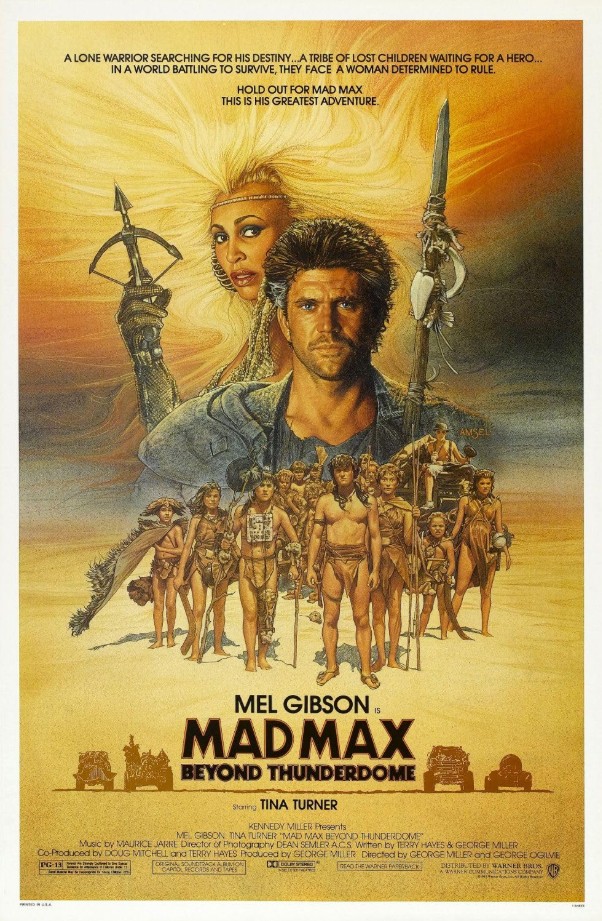
In my Comparing with the Critics review of Amadeus, I mentioned the Falco song, “Rock Me Amadeus”, being one of the reasons why I was intrigued to review the movie. I actually have a similar experience with Mad Max Beyond Thunderdome. Every time I think of this film, I think of the Tina Turner song, “We Don’t Need Another Hero (Thunderdome)”. This is an ironic coincidence, as “We Don’t Need Another Hero (Thunderdome)” and “Rock Me Amadeus” were released in 1985. Another ironic coincidence is how, for the Comparing with the Critics series, I, once again, selected an ‘80s film both Roger Ebert and Gene Siskel liked. Though Mad Max Beyond Thunderdome only appeared on Roger’s list of the top ten best films of 1985, each critic gave the movie a thumbs-up when they reviewed it on an episode of At The Movies. Before this Comparing with the Critics review, I had never seen any of the Mad Max movies, let alone Mad Max Beyond Thunderdome. Therefore, I couldn’t agree or disagree when Roger stated that Mad Max Beyond Thunderdome was “the best of the Road Warrior movies” or when Gene declared it was “a great, violent, fun picture”. Now that I have seen the film, I can honestly say I don’t agree with Gene’s and Roger’s praise. It’s not that Mad Max Beyond Thunderdome is a bad movie, I just didn’t like or love it as much as the critics did.
While sharing his opinion on Mad Max Beyond Thunderdome in an episode of At The Movies, Gene complements the directors, George Miller and George Ogilvie, as both of them “successfully creates a complete alien world on film”. To add to Gene’s statement, Roger commented how the film’s “world is as rich as Casablanca or as rich as Oz”. I admit one of the strengths of Mad Max Beyond Thunderdome was its set design, as the movie’s creative team presented an atmosphere that felt immersive! One of the conflicts in the story is Max battling in a duel against a character named Blaster, in order to retrieve his stolen items. They fight within the titular Thunderdome, a circular caged structure built out of steel-like material. What adds to the scene’s immersion is the medium and close-up shots captured within the Thunderdome. The combination of these creative choices helps the audience feel like they are right in the middle of the excitement! Even the sign advertising the Thunderdome is a blend of color, light, and dirt. This specific prop captures the thrill of the dueling action while also consistently displays the film’s aesthetic.

As I said in this review’s introduction, Mad Max Beyond Thunderdome ended up on Roger’s list of the top ten best films of 1985. One of his reasons was how he “was overwhelmed by the wealth of new ideas they came up with in the third picture”. Specifically speaking about Max and Blaster’s aforementioned duel, Roger explains how this scene presents two new ideas; “a new place to put the audience, which is over the top of the dome, and a new way to fight by putting the people on elastic bands so they have a three or a four dimensional, if you will, fight instead of regular punching it out”. Adding to Roger’s explanation, both Max and Blaster were given more freedom to move around the Thunderdome because of their elastic harnesses. While there was fist-fighting in the duel, flips and large jumps were incorporated in the fight choreography. Blaster and Max were presented with a variety of weapons, which added to the duel’s unpredictability. It also shows how the duel itself was a battle of strategy. This scene is definitely one of the most memorable from Mad Max Beyond Thunderdome!
While Gene and Roger sang the praises of Mad Max Beyond Thunderdome, I was disappointed they ignored Tina Turner’s portrayal of Aunty Entity. Personally, I think Tina is a better actress than some people give her credit for. Her performance in this film proves that. A great example is when Master confronts Aunty Entity about the true leadership of Bartertown. Before this confrontation, Aunty Entity is confident in her ability to rule over this little community. Master calls her out by questioning who’s in charge. Aunty’s confidence gradually turns into anger. She develops a stern look on her face, the anger itself filling her eyes. There’s even a point where Aunty’s bottled-up anger causes her to shake. This scene shows how Tina’s performance was able to say so much while utilizing very little dialogue.
Like I brought up in my review’s introduction, I didn’t like or love Mad Max Beyond Thunderdome as much as Roger and Gene did. A reason for my opinion is how the script left several questions unanswered. When Max meets the children of the Planet Erf tribe, the children believe he is Captain Walker. They describe Captain Walker as a plane pilot who will lead them to a better land. Because Jedediah was introduced in Mad Max Beyond Thunderdome as a man who could successfully fly a plane, I thought he could be Captain Walker, connecting him to the Planet Erf tribe’s part of the story. But this wasn’t the case, leaving questions about Captain Walker’s whereabouts. I was also not a fan of the creative team’s decision to prioritize telling over showing. A good example is when Blaster is about to be defeated in his and Max’s duel. Master begs Max not to kill Blaster, as he has a lot of respect for Blaster. However, this respect isn’t shown leading up to that scene. The only interactions with Master and Blaster are Master simply using Blaster as a means of transportation. Had the respect and camaraderie between Blaster and Master been better displayed, the duel itself and even its aftermath would have carried more emotional weight.
When Roger Ebert placed Mad Max Beyond Thunderdome on his list of the top ten best films of 1985, he called it “a great looking, high styled thriller”. Gene Siskel even claimed that “kids are gonna want toys out of this film” and “people are gonna dress like out of this film”. I can only speak for myself, but I wouldn’t go out of my way to seek out merchandise related to this movie or even revisit this movie. That’s because I thought Mad Max Beyond Thunderdome was just a fine, well-made picture. I couldn’t become fully invested in this story because of the collection of unanswered questions, which left me confused. I did not like the creative team’s decision to emphasize telling over showing as well. But the movie does have its merits. The world-building was one of the strongest aspects of the production, as the directors helped create an on-screen world that felt immersive. I not only liked the acting, I also believe the Thunderdome duel was one of the film’s most memorable scenes. So, this is yet another review where I didn’t agree with the critics. Now, if you’ll excuse me, I’ve got to go sing along to Tina Turner’s song, “We Don’t Need Another Hero (Thunderdome)”!
This review was brought to you by
Sally Silverscreen
 18 Cinema Lane