
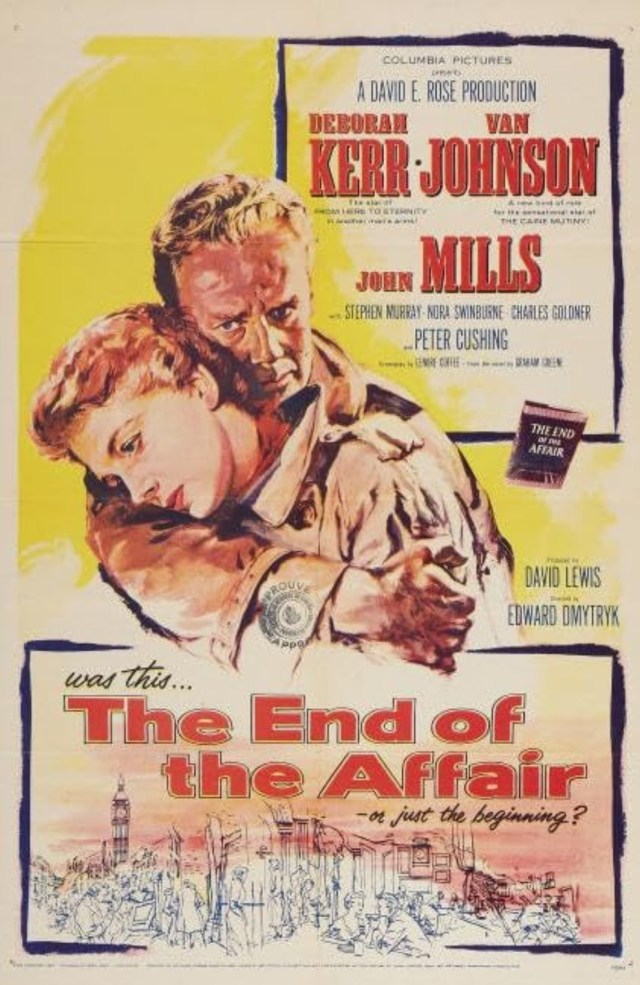
When you have a show as iconic and successful as I Love Lucy, well-known guest stars are likely to pay the show a visit. On the aforementioned show itself, a collection of guest stars graced the screen, crossing paths with Lucy, Ricky, and their friends. One of those stars was Van Johnson, an actor I’m familiar with due to reviewing some of his films and his episodes of Murder, She Wrote. Since I haven’t written about any project from Van’s filmography since 2022, I found the I Love Lucy Blogathon as the perfect opportunity to check out another of his movies! A film of Van’s I’ve been meaning to review for years is the 1955 presentation, The End of the Affair. Recommended by Maddy from Maddy Loves Her Classic Films, I was intrigued by the mystery woven into the synopsis. Who is this third man Deborah Kerr’s character may be having a relationship with? The only way I was going to find an answer to that question is by watching The End of the Affair and sharing my honest opinion about it!
Things I liked about the film:
The acting: Like I mentioned in this review’s introduction, I have written about some of Van Johnson’s films as well as his episodes of Murder, She Wrote. What I’ve noticed from these projects is how Van has strong adaptability to his character’s experiences. This was also the case in The End of the Affair. While spending time with Deborah Kerr’s character, Sarah, Van’s character, Maurice, is all smiles and appears to be in a good mood. But when a neighbor named Mrs. Tomkins unexpectedly arrives to give Sarah some food, Maurice’s mood quickly changes. His eyes are downcast, not even looking at the neighbor. Maurice’s mouth displays a worried look as he frets over his secret relationship with Sarah being discovered. Even his tone of voice with Sarah is sharp, desperately trying to contain his feelings. This scene is just one example of Van’s versatility when it comes to his acting talents!
I was pleasantly surprised to discover Peter Cushing starred in The End of the Affair! Based on what I know about Peter’s career from his filmography, he either portrayed a character in a horror movie or he appeared for a limited period of time in a film. Comparing The End of the Affair with other projects of Peter’s I’ve seen, he was given a slightly larger role in the 1955 movie. My other observation is how his character, Henry, had a consistently friendly personality. Even when he suspects Sarah of having an affair, Henry’s demeanor is that of concern, with a worried look on his face. Speaking of Sarah, I want to discuss Deborah Kerr’s performance. In The End of the Affair, there were times when Deborah’s face said so much without the use of dialogue. A great example is when Sarah and Maurice reconnect after being apart for a year. During their walk together, fear shown through Sarah’s eyes. Her mouth was even tightly pursed, revealing little to no information to Maurice. In this scene, Sarah appears to keeping a secret, a secret she’s afraid might be discovered.
The mise-en-scène: Mise-en- scène is how a film’s scene is presented to the audience. One example from The End of the Affair is how mirrors were sometimes used as a form of foreshadowing. Toward the beginning of the film, Maurice spots Sarah hugging another man. She and the man can be seen through a near-by mirror. Because the creative team emphasized this interaction, Maurice’s suspicions of Sarah are hinted at. Later in the movie, when Sarah disappears from Maurice’s life, he calls her home, hoping she’ll pick up the phone. But every time Sarah is unavailable, the camera consistently shows a close-up of Maurice’s face, emphasizing his building frustration. This built-up frustration makes Maurice’s suspicions of Sarah grow even more. Because of how well mise-en-scène was utilized by the film’s creative team, the story was able to maintain a certain degree of intrigue.
The character of Albert Parkis: In movies like The End of the Affair, where serious topics are brought up, the detective character will usually carry a persona that matches the tone of the film. But in the 1955 movie, Albert Parkis provided a bright light to a darker story. Portrayed by John Mills, Albert was the private investigator hired by Maurice to solve the mystery of Sarah’s whereabouts. Any time he appeared on screen, Albert had such a cheerful, friendly personality. He sometimes brought his son along on investigations, in order to teach him how to solve mysteries. Albert’s interactions with Maurice were so lively, they were a joy to watch unfold. I wish Albert Parkis was given a larger role in The End of the Affair, as his involvement in the story was limited.
What I didn’t like about the film:
The “insta-love” trope: As I said earlier in this review, Maurice and Sarah share a secret romantic relationship. Their affair provides the basis for the film’s overarching conflict. But it was difficult for me to determine Van and Deborah’s on-screen chemistry. This flaw was due to the movie’s creative team choosing to adopt the “insta-love” trope. The beginning of the film shows Maurice being introduced to Sarah. In this introduction, Maurice hopes Sarah will provide insight to a book he’s writing. Several minutes later, they are starting to form their relationship. Sarah and Maurice even share a kiss within the first fifteen minutes of the story. With their relationship moving so quickly, I didn’t find myself as emotionally invested in Maurice and Sarah’s story as I could have been.
The underutilization of John Mills: When I talked about Albert Parkis, I said I wish he was given a larger role in The End of the Affair, as his involvement in the story was limited. This means the acting talents of John Mills were underutilized. On the film’s poster, you will see John Mills’ name listed as one of the top three billed actors in the production. However, this poster is somewhat misleading, as Peter Cushing receives more screen-time than John. After reviewing The Chalk Garden, I was looking forward to seeing another movie from John’s filmography. I was even curious about how John’s character’s story connected to Deborah’s character’s story. While I found out how these stories connected, I was disappointed by John’s limited involvement in the project.
A randomly produced reveal: The major conflict of The End of the Affair is figuring out the identity of the third man Sarah may be having a relationship with. I will not spoil this movie, in case any of my readers haven’t seen it yet. But what I will say is the mystery’s reveal was randomly produced. When Sarah’s secret is discovered, the answers are given toward the end of the story. Since there is no build-up leading into the reveal, the reveal itself almost feels like a major tonal shift. To prevent this flaw, information or clues related to the reveal should have been sprinkled throughout the movie. That way, the transition between the mystery and its reveal could have been smoother.
My overall impression:
Van Johnson is one of the reasons why I selected The End of the Affair, as he was a guest star on I Love Lucy. When it comes to his movies, I thought those I saw were mostly ok. The 1955 project is no different. I was disappointed by the underutilization of John Mills’ acting talents, as well as the adoption of the “insta-love” trope. The mystery’s randomly produced reveal felt like a major tonal shift. However, The End of the Affair does have its strengths. The acting alone was one of the highlights of the film, from Van’s versatility to Deborah’s ability to convey ideas without using dialogue. The way mise-en-scène was used by the creative team allowed the story to maintain a certain degree of intrigue. I also liked Albert Parkis as a character. When it comes to character-driven stories involving serious topics, I find The Chalk Garden and Hallmark Hall of Fame’s A Tale of Two Cities as stronger titles. But, so far, I’ve only seen a handful of Van’s movies, so maybe I need to keep looking for a film of his I like.
Overall score: 6.1 out of 10
Have you seen The End of the Affair? Which is your favorite movie from Van Johnson’s filmography? Tell me in the comment section!
Have fun at the movies!
Sally Silverscreen















 18 Cinema Lane