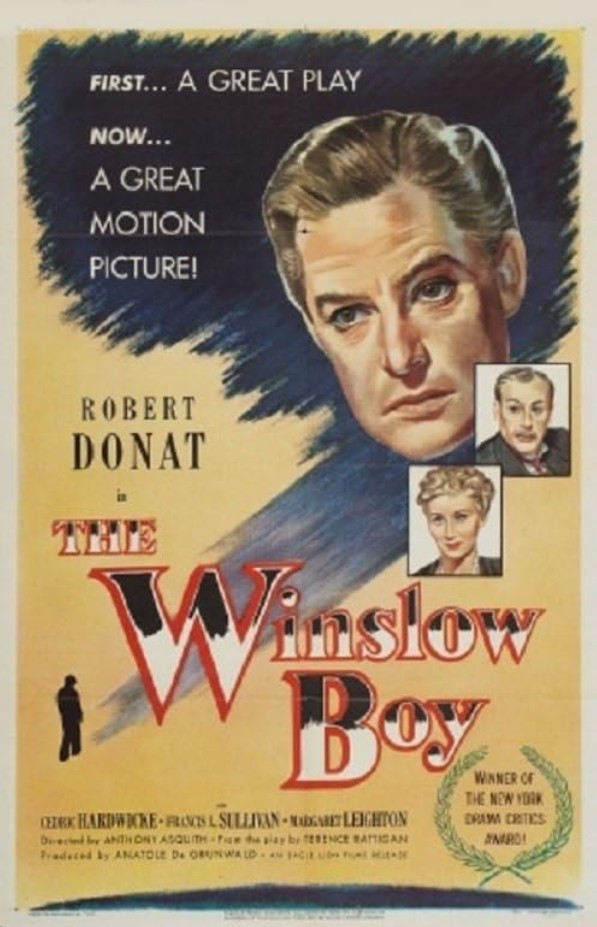
Prior to participating in this year’s edition of the Rule, Britannia Blogathon, I have seen (and reviewed) two of Robert Donat’s movies; Goodbye, Mr. Chips and The 39 Steps. While I thought Goodbye, Mr. Chips was a fine film, The 39 Steps was, in my opinion, underwhelming. Since writing about these titles, other movies from Robert’s filmography have been recommended to me. But out of the suggested films of Robert’s, 1948’s The Winslow Boy has been on my Pinterest recommendation board the longest. Because the movie fit the criteria for The 13th Annual Rule, Britannia Blogathon, I thought it was finally time to check it out! Suggested by Maddy (from Maddy Loves Her Classic Films), I discovered The Winslow Boy is an adaptation of a play of the same name. I also discovered another movie adaptation of the play was released in 1999. Speaking specifically about the 1948 picture, how will it compare to Robert’s aforementioned movies, The 39 Steps and Goodbye, Mr. Chips? Let’s continue this review to find out!
Things I liked about the film:
The acting: When it comes to acting, the best scene in The Winslow Boy is when Sir Robert Morton questions Ronnie Winslow about what really happened leading to him getting expelled from school. Throughout the questioning, Sir Robert consistently maintains serious professionalism. He looks at Ronnie with sharp focus, speaking to him with an even sharper and quicker tongue. Yet, Sir Robert remains calm and confident during his interaction with Ronnie, displaying how he clearly knows what he’s doing. Meanwhile, Ronnie’s smiling confidence at the beginning of his conversation with Sir Robert crumbles as the conversation continues. His face eventually adopts a quivering lip, tears in his eyes, and fear painted on his face as he claims his innocence. Even though he was present in The Winslow Boy for a very limited period of time, Neil North and his portrayal of Ronnie was one of best aspects of the film! He successfully went toe-to-toe with Robert Donat, who also gave a solid performance as Sir Robert Morton!
Another great scene, acting wise, is when Ronnie’s father, Arthur, learns Ronnie arrived home earlier than expected. Arthur’s daughter, Catherine, had just become engaged to a man named John Watherstone. With the Winslow family gathered in their living room, there is cheerfulness in the air, emphasized by the smiles on each character’s face and the warm, friendly interactions between the characters. But when the Winslow family’s maid named Violet enters the room, she joyfully reveals Ronnie is outside in the garden, home earlier than his initial arrival date. The cheerful air in the room becomes completely deflated, as the smiles on the characters’ faces slowly fall. Even Catherine and Ronnie’s mother, Grace, puts her hand on Catherine’s shoulder as a sign of needing support and strength from her daughter. Because of how strong the acting performances were, from the bubbly personality Kathleen Harrison brought to her character, Violet, to the fluidity of Margaret Leighton’s portrayal of Catherine, and even Cedric Hardwicke’s captivating performance as Arthur, my investment in the story remained throughout The Winslow Boy!
Attention to detail: Whenever I’ve talked about a movie’s set design, I have brought up how a creative team’s attention to detail has contributed to their film’s “illusion of immersion”. While the illusion of immersion was achieved through attention to detail in The Winslow Boy, the attention to detail, especially when it came to the set design, helped illustrate the characters and the world around them! A collection of thoughtfully curated décor emphasized specific roles, from an impressive model of a ship in the background of the Royal Naval College’s principal’s office to a massive bookshelf in an office at the courthouse. Décor pieces were also selected based on a character’s lifestyle. On the mantle of the Winslow family’s fireplace, fragile figurines and ornately decorated vases are proudly displayed. These pretty trinkets represent how the Winslow family lives a financially comfortable life. Even the cinematography took the time to capture design choices, like intricate carvings in crown molding, fireplace mantles, and columns. The creative team’s attention to detail definitely added visual appeal to The Winslow Boy!
Use of music: London Film Symphony Orchestra contributed some musical pieces to The Winslow Boy. These contributions actually added emotional depth to certain scenes. A great example is when Ronnie arrives home unannounced. Though he appears excited to see Violet again, his later behavior implies he’s hiding a secret. Ronnie balls up his fists and looks terrified before reading a letter he was carrying that whole time. As this scene plays out, suspenseful orchestral music is heard, building crescendo as Ronnie’s fear grows. The music becomes more prominent in the scene when the Winslow family returns home. Not wanting to be discovered, Ronnie runs away, providing a visual and musical cue to the end of that moment. This specific musical piece did such a great job illustrating Ronnie’s feelings without utilizing dialogue!

What I didn’t like about the film:
Robert Donat’s limited utilization: Earlier in this review, I praised Robert Donat’s portrayal of Sir Robert Morton. If fact, Robert is the top billed actor in The Winslow Boy. This gave me the impression he would receive a significant amount of screen-time throughout the movie. But when I watched the 1948 picture, Robert didn’t appear in the film until about forty-one minutes into the hour and fifty-three-minute story. Contextually, I recognize why Robert’s character, Sir Robert Morton, was in the movie was a limited period of time. However, because he is the top billed actor in The Winslow Boy, it was disappointing seeing Robert’s acting abilities utilized in a limited capacity.
Lack of urgency: The Winslow Boy is about Arthur trying to prove Ronnie’s innocence, as Ronnie is accused of theft and forgery. On paper, this sounds like a story that would warrant a sense of urgency, especially since Arthur is seeking justice so he and his family can return to normalcy as soon as possible. But the film ends up lacking a sense of urgency. Ronnie’s trial and a petition to hold a trial doesn’t happen until about the last forty minutes of the movie. Prior to that, it seems like the characters are taking their time building a case at all. Contextually speaking, I recognize the creative team was addressing how some court cases are prioritized than others. However, when there’s only so much time to tell a story, adding a sense of urgency could have incorporated more intrigue and suspense.
The run-time: Like I mentioned earlier in this review, The Winslow Boy possesses an hour and fifty-three-minute run-time. While this run-time didn’t make the story feel too long, it gave the film’s creative team an excuse to not prioritize the sense of urgency I just talked about in this review. So much of the story was spent showing how the Winslow family changed as a result of Ronnie’s expulsion. Though Arthur is shown trying to find ways to prove his son’s innocence, getting the ball rolling toward the reality of a trial happens slowly. When a trial does take place, it appears in the story within the last forty minutes of the movie, as I also mentioned in this review. If The Winslow Boy’s run-time had been trimmed, I think it would have improved the story’s sense of urgency.
My overall impression:
In the introduction of this review, I brought up how I have seen (and reviewed) Goodbye, Mr. Chips and The 39 Steps. Compared to those two titles, The Winslow Boy is slightly more intriguing than Goodbye, Mr. Chips. The 1948 adaptation approaches the courtroom drama genre from a more unique angle; emphasizing the trial’s toll on the titular Winslow boy and his family. This angle provided the story with its strengths, such as the acting performances. While the acting as a whole was solid, the two best performances came from Robert Donat and Neil North! Other strengths included the utilization of London Film Symphony Orchestra’s music and the attention to detail through the set design. But the aforementioned angle gave The Winslow Boy its flaws as well. Not only did the story lack a sense of urgency, the run-time encouraged the film’s creative team not to prioritize a sense of urgency. Utilizing Robert Donat’s acting abilities in a limited capacity didn’t help either, especially since he’s The Winslow Boy’s top billed actor. However, if you are interested in seeking out a courtroom drama that tries to tell a different type of story, then give The Winslow Boy a chance.
Overall score: 7.2 out of 10
Have you seen 1948’s The Winslow Boy? Are there any courtroom dramas you’d want to check out? Tell me in the comment section!
Have fun at the movies!
Sally Silverscreen