
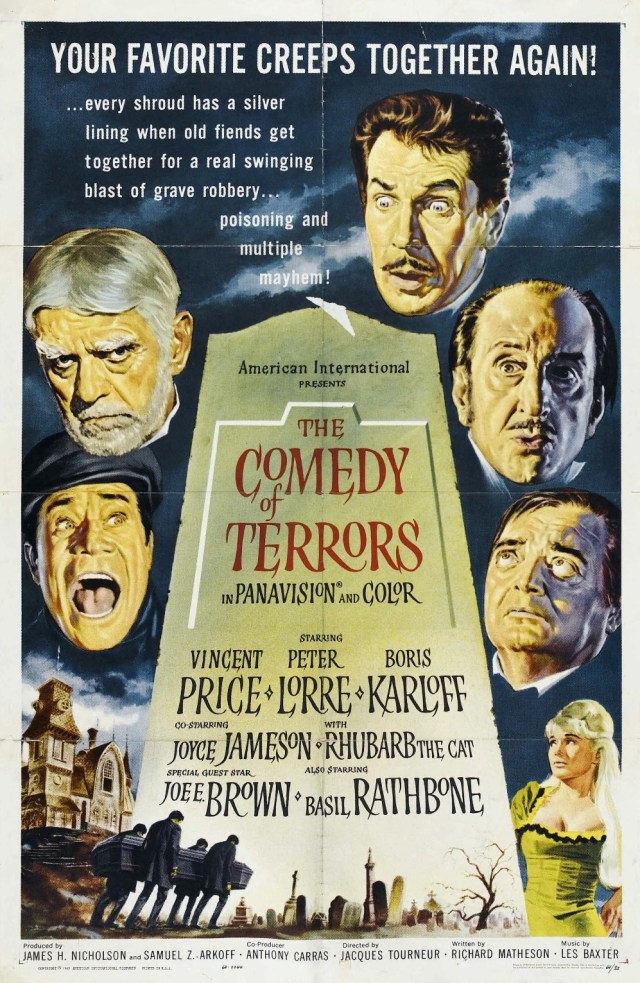
In my review of the Diagnosis Murder episode, “Guardian Angel”, I mentioned how I’ve accepted movie recommendations from my readers. These recommendations have, sometimes, made great selections for blogathons. Four years ago, when I reviewed House of the Long Shadows, Patricia (from Caftan Woman) suggested several films starring Vincent Price. One of those titles was 1963’s The Comedy of Terrors. Since then, I have been waiting for the right time to create a review for this movie. With The Comedy of Terrors fitting the criteria for the 3rd Annual Spooky Classic Movie Blogathon, I knew I had found a perfect entry for the event!It’s become an unofficial tradition on 18 Cinema Lane to review at least one of Vincent’s movies every year. Since 2019, when I wrote about The Whales of August, eleven of Vincent’s films have received a review on my blog. While some of his movies have been more enjoyable than others, I can honestly say I haven’t seen a movie of his that I would consider “bad”. So, how does Comedy of Terrors compare to Vincent’s other films? Find out by reading my review!
Things I liked about the film:
The acting: When you see Vincent Price’s name attached to a given film, there’s a chance you’re going to see Vincent give a solid acting performance. That was certainly the case in The Comedy of Terrors! What makes Vincent such a strong actor is his adaptability. Portraying an undertaker named Trumbull, Vincent successfully transformed his expressions and emotions based on his character’s situation. One evening, Trumbull was counting a large collection of coins. He displays a big smile on his face and also appears in a relaxed sitting position. When his wife, Amaryllis, comes into the room and asks him a question, Trumbull’s demeanor quickly changes. His sharp tone suggests deep irritation, with a disapproving frown to match. This change in attitude is consistent with Trumbull’s dislike for Amaryllis.
Prior to reviewing The Comedy of Terrors, I had seen two of Basil Rathbone’s movies; The Great Mouse Detective and Bathing Beauty. Because only one of these movies was a live-action production, I didn’t know what to expect from his portrayal of Mr. Black. However, I was impressed with Basil’s performance in The Comedy of Terrors! Some scenes show Mr. Black reciting one of Shakespeare’s plays. The first time the audience sees Mr. Black reciting Shakespeare’s work is when Felix (portrayed by Peter Lorre) breaks into Mr. Black’s home. In this particular scene, Mr. Black displays an animated demeanor throughout his reenactment. The way he confidently recited Shakespeare’s words gave this reenactment a sense of grandeur. Reflecting on Basil’s performance in The Comedy of Terrors and looking at his IMDB filmography, I wish he has starred in an adaptation of Shakespeare’s work.
An immersive world: A make-or-break factor of any movie is how that picture is presented. For period/historical fiction films, the accuracy and attention to detail can help that movie’s world feel immersive. Because The Comedy of Terrors takes place during the Victorian era, everything in the film has to appear accordingly. This was achieved in the 1963 film, as the aforementioned elements of attention to detail and accuracy were applied! When I talked about Vincent’s performance, I mentioned Trumbull was an undertaker. An ornate coffin was presented any time Trumbull hosted a funeral. The shiny, black coffin was constructed by sharp angles and was decorated with gold designs. This prop was a simple, yet visually appealing way of addressing the wealth of Trumbull’s clientele. One scene shows Trumbull and Felix breaking into someone’s home. Without meeting the homeowner, the audience can tell how this character lives a comfortable life. Decorative lamps and wall sconces are included in characters’ bedrooms. A series of statues make a strong appearance when Felix and Trumbull first walk into the house. There is even gold trim on one of the doors. From the set design to the costume design, the world within The Comedy of Terrors was immersive!
Peter Lorre and Joyce Jameson’s on-screen chemistry: Earlier in my review, I said Felix was portrayed by Peter Lorre. I also stated how Trumbull doesn’t like Amaryllis (portrayed by Joyce Jameson). Amaryllis is hurt by Trumbull’s negativity toward her. Meanwhile, Felix is upset by how Amaryllis is treated by Trumbull. The shared dislike Felix and Amaryllis have toward Trumbull create an affection for one another. Though they shared only a few scenes together, I was pleasantly surprised by Joyce and Peter’s on-screen chemistry! The warm, caring demeanor between Felix and Amaryllis came across as believable. This was made possible by the strength of Joyce’s and Peter’s performance. With that said, I think Peter and Joyce not receiving more scenes together was a missed opportunity.
What I didn’t like about the film:
Jokes that are too long: Comedy, like film, is subjective. One aspect to this subjectivity is the length of the jokes. In my opinion, the jokes in The Comedy of Terrors were too long. It seems like the screenwriters had difficulty finding their intended punchline or realizing they reached their punchline long ago. A running joke in The Comedy of Terrors is how Amaryllis is a terrible singer, despite her claims of a possible opera career. Had she sung a portion of a song once or twice, it would have been enough to get the intended point across. But the fact Amaryllis almost sang whole songs three or four times caused the joke to last too long and quickly become old.
Parts of the story that don’t make sense: I mentioned earlier in this review how Felix broke into Mr. Black’s home. To get into Mr. Black’s house, Felix had to climb onto the roof and into an upstairs window. But during this excursion, a cat named Cleopatra joins Felix and Trumbull, watching Felix trespass into Mr. Black’s property. It’s explained in the film why Felix needed to find an alternative entrance. What isn’t explained is why Cleopatra didn’t enter the house. I’m not sure how Cleopatra could have assisted Trumbull and Felix. However, it would have been easier for a cat to climb on a roof and enter through a window. This is just one part of the story that, to me, didn’t make sense.
An underutilized cat: In past reviews, I have been critical when an actor or actress was underutilized. But in the case of The Comedy of Terrors, the creative team underutilized a cat. As I mentioned in my point about parts of the story that don’t make sense, a cat named Cleopatra joined Trumbull and Felix on their excursion. Even though Cleopatra was adorable, the cat was not a significant part of the overall story. There were even times when I wondered why a cat was included in the movie at all. Had Cleopatra been written out of The Comedy of Terrors, the story itself would not change much.
My overall impression:
In this review’s introduction, I said I haven’t seen a movie of Vincent Price’s that I would consider “bad”. While this statement is still true, The Comedy of Terrors is one of his weaker pictures. The flaws of the 1963 production include jokes that are too long and parts of the story that don’t make sense. But there are aspects of the movie I liked. The Comedy of Terrors is an immersive film, making viewers feel transported to the Victorian era. Attention to detail and historical accuracy helped the creative team achieve that illusion. Vincent’s performance was one of the strongest parts of this film! His adaptability made his portrayal of Trumbull captivating to watch. Now that I’ve finally seen The Comedy of Terrors, I can, honestly, say this picture emphasizes style more than substance. Out of Vincent’s eleven movies I’ve seen, this one is just ok.
Overall score: 6.1 out of 10
Have you seen The Comedy of Terrors? Which film of Vincent Price’s should I review next? Please tell me in the comment section below!
Have fun at the movies!
Sally Silverscreen
 18 Cinema Lane