Take 3: She Wore a Yellow Ribbon Review

I have been participating in the Legends of Western Cinema Week Blogathon since 2020. Because films from the western genre aren’t covered on 18 Cinema Lane often, this blogathon has given me a reason to seek out titles from the western genre to review. But when the Legends of Western Cinema Week ends, another blogathon begins; the Hit The Road Blogathon. Since I wanted to participate in both events, I decided to review one film for both blogathons. That film is 1949’s She Wore a Yellow Ribbon! The movie perfectly fits the themes of both events, as it is not only considered a “classical western” (according to IMDB), multiple characters travel by horse throughout the story. She Wore a Yellow Ribbon was also recommended to me by Eric Binford from Diary of a Movie Maniac. While this is the fourth movie of John Wayne’s I’ve seen, this is only the third one I’ve reviewed. The other two titles, El Dorado and Allegheny Uprising, were, in my opinion, just ok. How does She Wore a Yellow Ribbon compare to these other films? Keep reading my review to find out!

She Wore a Yellow Ribbon poster created by Argosy Pictures and RKO Radio Pictures

Things I liked about the film:

The acting: Whenever I discuss the acting in a given movie, I will usually talk about a scene that showcases the strength of the acting performances. My favorite example from She Wore a Yellow Ribbon takes place toward the beginning of the film. John Wayne portrays Captain Nathan Brittles, a man who goes on one last mission before he retires. During an evening visit to the local cemetery, Nathan talks to the graves of his wife, Mary, and his daughters, Elizabeth and Jane. While he talks to his deceased family, he consistently has a sad look in his eyes. Yet, the inflection of his voice changes depending on the type of news he has to share. Joanne Dru’s character, Olivia Dandridge, also visits the cemetery to give Nathan some potted flowers. Olivia’s persona is kind and gentle throughout this scene. Her conversation with Nathan perfectly displays the on-screen camaraderie between Joanne Dru and John Wayne. Because of this on-screen camaraderie and how strong John’s and Joanne’s acting performance was, I wish they shared more screen time.

The scenery: Most of She Wore a Yellow Ribbon takes place outdoors, with the movie being filmed in Utah and Arizona (according to IMDB). Looking back on the 1949 picture, I can definitely see why the film’s creative team would want to take advantage of the story’s natural landscape. Large, rustic red rocks impressively stood against a blue sky filled with white clouds. There were greens spots where foliage popped within the rocky terrain. The most memorable presentation of the scenery was during a storm. The bright, blue lighting blinked against the two-toned gray sky and the sand-colored ground provided a bright hue to the space. She Wore a Yellow Ribbon was a pretty looking film because of its scenery!

The dialogue: In She Wore a Yellow Ribbon, Corporal Quayne’s life is spared after being rescued from an attack. Olivia shares with Lieutenant Flint Cohill how happy she is Corporal Quayne survived. Lieutenant Cohill asks her why she cares about Corporal Quayne, especially since she doesn’t know him or is aware if he frequents the Lieutenant’s Bar. Olivia responds to this question by saying just because a man frequents the Lieutenant’s Bar doesn’t automatically make him a gentleman. Lieutenant Cohill then accuses Olivia of caring about Corporal Quayne’s well-being because his survival fits the happy ending she can write home about. This conversation between Olivia and Lieutenant Cohill was thought-provoking, as it addresses motivations for caring about others, as well as how someone’s personal situation can fuel another person’s narrative. That is just one example of the well-written nature of the dialogue!
The Legends of Western Cinema Week Blogathon banner created by Hamlette from Hamlette’s Soliloquy, Heidi from Along the Brandywine, and Olivia from Meanwhile, in Rivendell…

What I didn’t like about the film:

Limited amount of action: A movie from the western genre, especially one starring John Wayne, carries a set of expectations. One of those expectations is the amount of action within the story. Scenes of battles, duels, and even bar fights will typically be sprinkled through a western genre story to maintain the suspense and intrigue of what’s happening on screen. But in She Wore a Yellow Ribbon, the action was far and few between. The majority of the story consisted of characters either having conversations with one another or riding from place to place. When an action scene does happen, it lasts for a very short period of time. These creative decisions caused She Wore a Yellow Ribbon to lack intrigue and suspense.

Not truly getting to know the characters: So much of She Wore a Yellow Ribbon’s story focuses on Captain Nathan Brittles and his impending retirement. While the audience receives the opportunity to learn more about Captain Brittles and understand his motivations, it comes at the expense of getting to truly know the other characters. One character I felt was overlooked was Top Sergeant Quincannon. He was retiring around the same time as Captain Brittles. But the script never addresses how the story’s patrol mission impacted Top Sergeant Quincannon and his career. Instead, the film prioritizes his enjoyment of drinking alcohol. Because of this emphasis, I only became familiar with Top Sergeant Quincannon instead of truly getting to know him.

The run-time: She Wore a Yellow Ribbon has a run-time of an hour and forty-four minutes. As I watched the movie, however, it felt longer than this stated run-time. Part of this flaw stems from the insertion of scenes just for the sake of satisfying the film’s length. Toward the end of the movie, there is a bar fight involving Top Sergeant Quincannon. This scene lasts about five minutes and, in my opinion, feels out of place. That’s because the scene is intended to be comedic, even though She Wore a Yellow Ribbon is not a comedy or a light-hearted story. The movie’s run-time could have been shorter had the bar fight scene either been omitted or trimmed down.
The Hit The Road Blogathon banner created by Quiggy from The Midnite Drive-In

My overall impression:

She Wore a Yellow Ribbon is the third film I’ve reviewed this month where the scenery was a stand-out strength. In the case of the 1949 picture, the natural landscape of Utah and Arizona was presented through long and medium shots, capturing the grand scale of the desert’s rock formations and large expanse of rustic red and sand-colored land. But as I’ve said in past reviews, “the scenery can’t save you”. If a movie contains a weak script, there’s only so much the pretty landscape can do to salvage that script. In my opinion, She Wore a Yellow Ribbon is an underwhelming picture. What I expected to be an action-packed, suspenseful, and even intriguing story turned out to be a drawn-out tale that felt longer than necessary. It also doesn’t help how I wasn’t able to truly get to know the characters, but only become familiar with them. Even though the 1949 film does feature strengths, like the acting and the dialogue, there were times while watching the movie where I almost fell asleep. With a filmography of over one hundred projects, I’ll, hopefully, find a title of John Wayne’s I actually like.

Overall score: 5.2 out of 10

Have you seen She Wore a Yellow Ribbon? What film from John Wayne’s filmography do you like watching? Please tell me in the comment section!

Have fun at the movies!

Sally Silverscreen
Take 3: El Dorado (1966) Review

Whenever I’ve participated in the Legends of Western Cinema Week Blogathon, I, more often than not, review a movie from the Western genre. Since I review Western genre films so infrequently, this blogathon serves as a good opportunity to expand my cinematic horizons. For the 2024 edition, I decided to select a title that has been recommended to me. Suggested by J-Dub from Dubsism, I am reviewing the 1966 film, El Dorado! Years ago, I saw pieces of this movie. At the time, I thought it was boring. But I was willing to give El Dorado a second chance, wondering if my perspective had changed. I also have seen very few films from John Wayne’s filmography. So, reviewing this film gave me a chance to check out more of his movies!

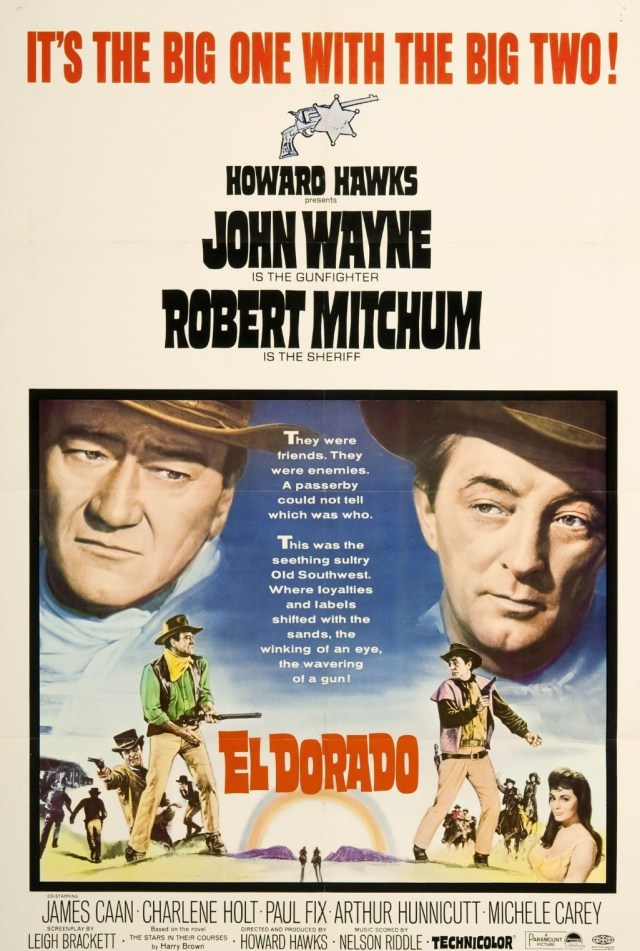
El Dorado (1966) poster created by Paramount Pictures, Laurel Productions, and Polyphony Digital

Things I liked about the film:

The on-screen chemistry: Relationships in movies, whether romantic or platonic, can come across believably on screen if there is a strong sense of chemistry between the actors. This is what happened in El Dorado! Toward the beginning of the movie, J.P., portrayed by Robert Mitchum, meets up with Cole, portrayed by John Wayne, to talk about a potential job opportunity. Cole and J.P. carry no-nonsense demeanors, but their cordialness to each other shows the respect between them. The scene’s mood becomes lighter when Maudie, portrayed by Charlene Holt, shows up. Her friendly, playfulness emphasizes the friendship these characters share. When Maudie talks about her late husband and Cole with J.P., the empathetic reflection indicates how much she cares about both Cole and J.P.. Not only was there strong on-screen chemistry among the actors, this strong on-screen chemistry was consistent throughout the film. The on-screen relationships were interesting to watch because of these factors!

The dialogue: One of the most important components of a movie’s script is the dialogue. Through dialogue, characters can memorably stand-out, important information can be shared, and characters’ problems can be solved. The quality of a script’s dialogue depends on how well written it is. While watching El Dorado, I took note of the cleverness of the dialogue. After a son from the MacDonald family dies, Cole visits the family to share the sad news. The patriarch of the family, Kevin, asks what happened, with Cole telling him how he got “a boy to do a man’s work”. Later, when Cole returns to El Dorado, he reconnects with J.P.. When J.P. asks Cole what he’s doing back in El Dorado, Cole tells his friend, “I’m lookin’ at a tin star with a…drunk pinned on it”. Dialogue like the two examples I provided show how cleverly words were used as well as the eloquent ways intended points were phrased.

Breen Code Era moments: As I’ve explained before on 18 Cinema Lane, the Breen Code was a series of guidelines studios had to follow between 1934 and 1954. El Dorado was released in 1966, a decade after the Breen Code Era ended. However, there were moments sprinkled throughout the movie that felt reminiscent of the Breen Code Era. Before Cole leaves El Dorado, he kisses Maudie. The kiss itself isn’t shown on-screen because Cole’s hat is blocking their faces. When Mississippi, portrayed by James Caan, is first introduced to the audience, he uses a knife in self-defense against a man he claims killed his friend. As Mississippi retrieves his knife, the aforementioned man is hidden behind a table to prevent some of the violence from being shown on screen. The way these moments were written and presented were thoughtful presentations of an era gone by.

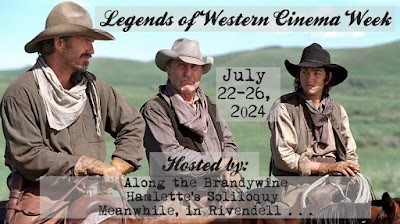
Legends of Western Cinema Week Blogathon banner created by Hamlette from Hamlette’s Soliloquy, Heidi from Along the Brandywine, and Olivia from Meanwhile, in Rivendell

What I didn’t like about the film:

A prolonged conflict: Before watching El Dorado, I had seen two of John Wayne’s films: Stagecoach and Allegheny Uprising. In those movies, the story revolves around an overarching conflict some of the characters are consistently trying to resolve. While there was an overarching conflict in El Dorado, it primarily resided in the film’s second half. The first half of the movie consisted of a series of loosely connected vignettes. These vignettes, more often than not, contained low stakes. El Dorado’s first and second halves felt like they belonged in their own separate movies.

Inconsistent sense of urgency: Like I just said when talking about El Dorado’s prolonged conflict, the first half of the movie was a series of loosely connected vignettes, while the film’s overarching conflict resided in the story’s second half. Within the second half of the movie, scenes containing low stakes were woven into the production. One example is Cole addressing a back injury he received earlier in the story. El Dorado’s two halves and the low stakes scenes from the film’s second half are two reasons why this movie’s sense of urgency was inconsistent.

Enabling the Sheriff: J.P., the Sheriff of El Dorado, develops an alcohol addiction due to a romantic relationship gone wrong. When Cole and Mississippi go to El Dorado, they, as well as Bull, try to help J.P. overcome his addiction. Mississippi even creates a liquid concoction to sober J.P. up. But hours after receiving Mississippi’s concoction, J.P. is looking for alcohol. Bull tells J.P. exactly where a bottle of alcohol is located, in the upper left-hand drawer of his desk. Later that evening, Cole allows J.P. to go to the local saloon by himself, where he not only purchases a whole bottle of alcohol, he’s also laughed at by the film’s antagonists. J.P. does eventually become sober in order to help his friends. But toward the end of the movie, J.P. shares a shot of alcohol with Bull. If a screenwriter is going to incorporate a serious topic like addiction into their script, they need to be mindful about how that topic is included in the film. In my opinion, the way addiction was addressed in El Dorado could have been more thoughtful.

Sheriff badge image created by Freepik at freepik.com. <a href=’https://www.freepik.com/free-vector/brown-cowboy-label-set_1543252.htm’>Designed by Freepik</a>. <a href=”https://www.freepik.com/free-photos-vectors/vintage”>Vintage vector created by Freepik</a>. Image found at freepik.com.

My overall impression:

El Dorado is not only the third film of John Wayne’s I’ve seen, it’s the second film of John’s I’ve reviewed. Out of these three films, Stagecoach, Allegheny Uprising, and El Dorado, I haven’t found a title that’s left a strong impression on me. Looking back on Stagecoach, I think the movie is just fine. Allegheny Uprising was ok. Now that I’ve seen El Dorado in its entirety, I feel the 1966 project is also ok. The two halves of this movie and the low stakes scenes woven into the movie’s second half are likely the reason for El Dorado’s inconsistent sense of urgency. The topic of addiction could have been handled in a more thoughtful way. However, the movie does have its strengths. Some of these strengths are the on-screen chemistry among the cast and how well the dialogue was written. Personally, I found El Dorado to be a mixed bag. Hopefully, the next film of John’s I watch and review will be stronger than this one.

Overall score: 6 out of 10

Have you seen El Dorado? Which film from John Wayne’s filmography would you like me to review? Let me know in the comment section!

Have fun at the movies!

Sally Silverscreen
Take 3: Allegheny Uprising Review + 80 Follower Thank You

Last week, 18 Cinema Lane received 80 followers! I was going to post this review last weekend. However, because of the Gold Sally Awards and the unexpected success of my Book Adaptation Tag post, I chose to postpone my 80 follower dedication review to this week. Since this post is a celebration of achieving 80 followers, I will review a film that was released 80 years ago (in 1939). Before this accomplishment became a reality, I was contemplating which movie I should review; Allegheny Uprising or No Place to Go. In the end, I chose Allegheny Uprising because, prior to this review, the only movie of John Wayne’s that I’ve ever seen was Stagecoach. I’m always excited when I create movie reviews because it gives me a chance to watch films that I probably would have never seen otherwise. Before this review officially begins, I wanted to say thank you to all my 80 followers! If it weren’t for you, this post would have never been a reality.

Allegheny Uprising poster
Allegheny Uprising poster created by RKO Radio Pictures. Image found at https://en.wikipedia.org/wiki/File:AlleghenyUprisingposter.jpg

Things I liked about the film:

  • The acting: I thought the cast of Allegheny Uprising was good! Everyone’s performance came across on-screen very believably. Throughout this film, the camaraderie between Jim Smith, MacDougall, and Professor was very well portrayed. This is because John Wayne’s, Wilfrid Lawson’s, and John F. Hamilton’s performance had the right amount of versatility and sincerity. Even though Claire Trevor was the only starring actress in this entire cast, she definitely finds a way with shine within this film! Her portrayal of Janie MacDougall had a good amount of versatility. Claire’s performance also appeared very convincing. The acting within this film was definitely a highlight!


  • The historical accuracy: I was very impressed with the amount of historical accuracy within this movie. From the costumes to the sets, everything looked and felt like it came straight from the 1700s. The dialogue between the characters was also very reflective of the film’s time period. These details show how much the creative team behind this project cared about the story they chose to tell. This amount of care was also present within the overall quality of the film.


  • The educational aspect: It was surprising to find some educational aspects in this specific story. Allegheny Uprising is inspired by true events, so I received a little bit of a history lesson while watching this movie. Also, in this film, there was a scene where Jim Smith goes on trial for a crime he didn’t commit. Within this scene, it was interesting and informative to see how court trials, specifically in film, were depicted in the 1700s compared to today. Seeing these similarities and differences made me think about the significance of the court system within cinema.

horse saddle - soft focus with film filter
Horse with saddle photo created by Topntp26 at freepik.com. <a href=’https://www.freepik.com/free-photo/stallion-black-equine-race-sky_1104246.htm’>Designed by Freepik</a>. <a href=”https://www.freepik.com/free-photos-vectors/background”>Background image created by Topntp26 – Freepik.com</a>. Image found at freepik.com.

What I didn’t like about the film:

  • No “big battles”: Whenever I think about John Wayne’s movies, I think of a story that features at least one climatic battle led by John Wayne’s character. In Allegheny Uprising, however, there wasn’t really a climax. Because of this, there weren’t any large-scale battles within this narrative. All of the action scenes lasted for a few minutes. This caused the majority of the film to be dialogue heavy.


  • The character of Janie MacDougall: While Claire Trevor gave a good acting performance, I was not a fan of her character. Janie MacDougall was not only poorly written, she was also one-dimensional. During her time on-screen, Janie either whines, complains, or talks about how much she loves Jim Smith. The only time Janie serves a legitimate purpose within the overall narrative is in the last twenty minutes of the film. Honestly, I think this is too bad because she could have been a really good character.


  • The subplot including the kidnapped children: Toward the beginning of Allegheny Uprising, there was a subplot about Native Americans kidnapping two children from a nearby neighborhood. Within the context of the overall narrative, this subplot didn’t seem to go anywhere. It also wasn’t referenced in any other moment of the film. During this subplot, as well as in another scene, it was never explained why Jim Smith and his comrades chose to disguise themselves as Native Americans. All of this made me wonder why this subplot was featured in the story at all.

Colonial horse and carriage picture
Colonial horse and carriage image created by Lee Adcock at freeimages.com. “FreeImages.com/Lee Adcock.”

My overall impression:

In the grand scheme of things, Allegheny Uprising was just ok. I don’t think it was John Wayne’s worst movie, but it wasn’t his best movie either. Personally, I’m glad I chose this movie for this blog follower dedication review because I was able to expand my cinematic horizons. I was also able to add another John Wayne film to my personal movie repertoire. What’s so great about these movie reviews is that, with the support of my followers, I get the chance to watch movies that I probably would have never seen before. This helps me become the best movie blogger I can be as well as make 18 Cinema Lane the best movie blog it can realistically be.


Overall score: 6.1 out of 10


What are your thoughts on my review? Have you seen any of John Wayne’s films? Let me know in the comment section!


Have fun at the movies!

Sally Silverscreen