Take 3: The End of the Affair (1955) Review

When you have a show as iconic and successful as I Love Lucy, well-known guest stars are likely to pay the show a visit. On the aforementioned show itself, a collection of guest stars graced the screen, crossing paths with Lucy, Ricky, and their friends. One of those stars was Van Johnson, an actor I’m familiar with due to reviewing some of his films and his episodes of Murder, She Wrote. Since I haven’t written about any project from Van’s filmography since 2022, I found the I Love Lucy Blogathon as the perfect opportunity to check out another of his movies! A film of Van’s I’ve been meaning to review for years is the 1955 presentation, The End of the Affair. Recommended by Maddy from Maddy Loves Her Classic Films, I was intrigued by the mystery woven into the synopsis. Who is this third man Deborah Kerr’s character may be having a relationship with? The only way I was going to find an answer to that question is by watching The End of the Affair and sharing my honest opinion about it!
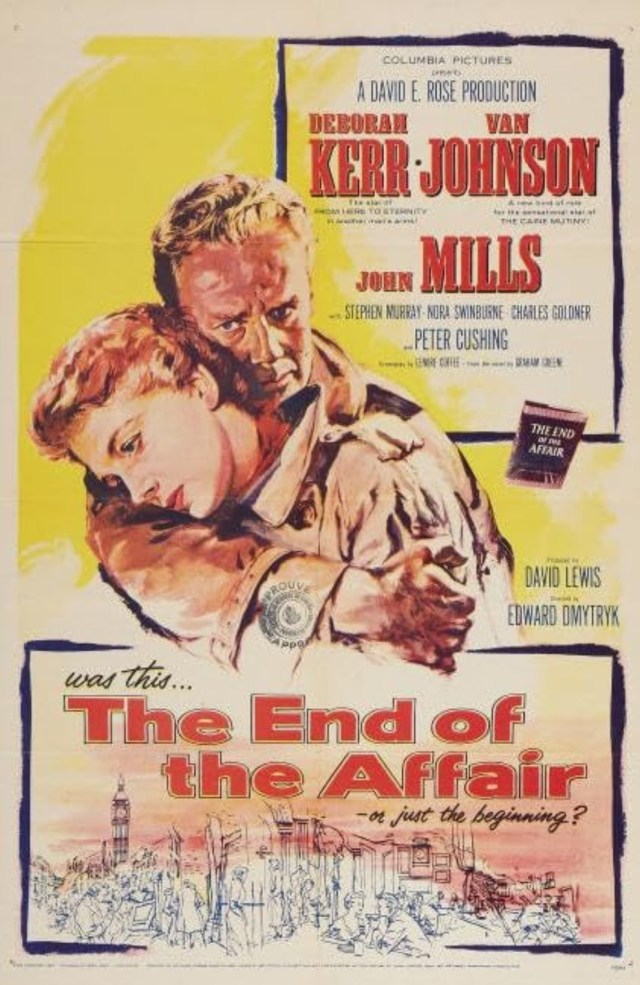
The End of the Affair (1955) poster created by Coronado Productions and Columbia Pictures

Things I liked about the film:

The acting: Like I mentioned in this review’s introduction, I have written about some of Van Johnson’s films as well as his episodes of Murder, She Wrote. What I’ve noticed from these projects is how Van has strong adaptability to his character’s experiences. This was also the case in The End of the Affair. While spending time with Deborah Kerr’s character, Sarah, Van’s character, Maurice, is all smiles and appears to be in a good mood. But when a neighbor named Mrs. Tomkins unexpectedly arrives to give Sarah some food, Maurice’s mood quickly changes. His eyes are downcast, not even looking at the neighbor. Maurice’s mouth displays a worried look as he frets over his secret relationship with Sarah being discovered. Even his tone of voice with Sarah is sharp, desperately trying to contain his feelings. This scene is just one example of Van’s versatility when it comes to his acting talents!

I was pleasantly surprised to discover Peter Cushing starred in The End of the Affair! Based on what I know about Peter’s career from his filmography, he either portrayed a character in a horror movie or he appeared for a limited period of time in a film. Comparing The End of the Affair with other projects of Peter’s I’ve seen, he was given a slightly larger role in the 1955 movie. My other observation is how his character, Henry, had a consistently friendly personality. Even when he suspects Sarah of having an affair, Henry’s demeanor is that of concern, with a worried look on his face. Speaking of Sarah, I want to discuss Deborah Kerr’s performance. In The End of the Affair, there were times when Deborah’s face said so much without the use of dialogue. A great example is when Sarah and Maurice reconnect after being apart for a year. During their walk together, fear shown through Sarah’s eyes. Her mouth was even tightly pursed, revealing little to no information to Maurice. In this scene, Sarah appears to keeping a secret, a secret she’s afraid might be discovered.

The mise-en-scène: Mise-en- scène is how a film’s scene is presented to the audience. One example from The End of the Affair is how mirrors were sometimes used as a form of foreshadowing. Toward the beginning of the film, Maurice spots Sarah hugging another man. She and the man can be seen through a near-by mirror. Because the creative team emphasized this interaction, Maurice’s suspicions of Sarah are hinted at. Later in the movie, when Sarah disappears from Maurice’s life, he calls her home, hoping she’ll pick up the phone. But every time Sarah is unavailable, the camera consistently shows a close-up of Maurice’s face, emphasizing his building frustration. This built-up frustration makes Maurice’s suspicions of Sarah grow even more. Because of how well mise-en-scène was utilized by the film’s creative team, the story was able to maintain a certain degree of intrigue.

The character of Albert Parkis: In movies like The End of the Affair, where serious topics are brought up, the detective character will usually carry a persona that matches the tone of the film. But in the 1955 movie, Albert Parkis provided a bright light to a darker story. Portrayed by John Mills, Albert was the private investigator hired by Maurice to solve the mystery of Sarah’s whereabouts. Any time he appeared on screen, Albert had such a cheerful, friendly personality. He sometimes brought his son along on investigations, in order to teach him how to solve mysteries. Albert’s interactions with Maurice were so lively, they were a joy to watch unfold. I wish Albert Parkis was given a larger role in The End of the Affair, as his involvement in the story was limited.
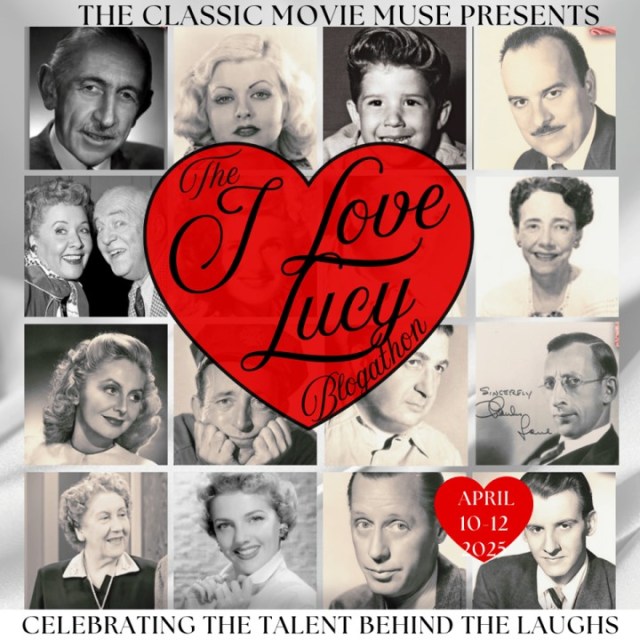
The I Love Lucy Blogathon banner created by Ari from The Classic Movie Muse

What I didn’t like about the film:

The “insta-love” trope: As I said earlier in this review, Maurice and Sarah share a secret romantic relationship. Their affair provides the basis for the film’s overarching conflict. But it was difficult for me to determine Van and Deborah’s on-screen chemistry. This flaw was due to the movie’s creative team choosing to adopt the “insta-love” trope. The beginning of the film shows Maurice being introduced to Sarah. In this introduction, Maurice hopes Sarah will provide insight to a book he’s writing. Several minutes later, they are starting to form their relationship. Sarah and Maurice even share a kiss within the first fifteen minutes of the story. With their relationship moving so quickly, I didn’t find myself as emotionally invested in Maurice and Sarah’s story as I could have been.

The underutilization of John Mills: When I talked about Albert Parkis, I said I wish he was given a larger role in The End of the Affair, as his involvement in the story was limited. This means the acting talents of John Mills were underutilized. On the film’s poster, you will see John Mills’ name listed as one of the top three billed actors in the production. However, this poster is somewhat misleading, as Peter Cushing receives more screen-time than John. After reviewing The Chalk Garden, I was looking forward to seeing another movie from John’s filmography. I was even curious about how John’s character’s story connected to Deborah’s character’s story. While I found out how these stories connected, I was disappointed by John’s limited involvement in the project.

A randomly produced reveal: The major conflict of The End of the Affair is figuring out the identity of the third man Sarah may be having a relationship with. I will not spoil this movie, in case any of my readers haven’t seen it yet. But what I will say is the mystery’s reveal was randomly produced. When Sarah’s secret is discovered, the answers are given toward the end of the story. Since there is no build-up leading into the reveal, the reveal itself almost feels like a major tonal shift. To prevent this flaw, information or clues related to the reveal should have been sprinkled throughout the movie. That way, the transition between the mystery and its reveal could have been smoother.
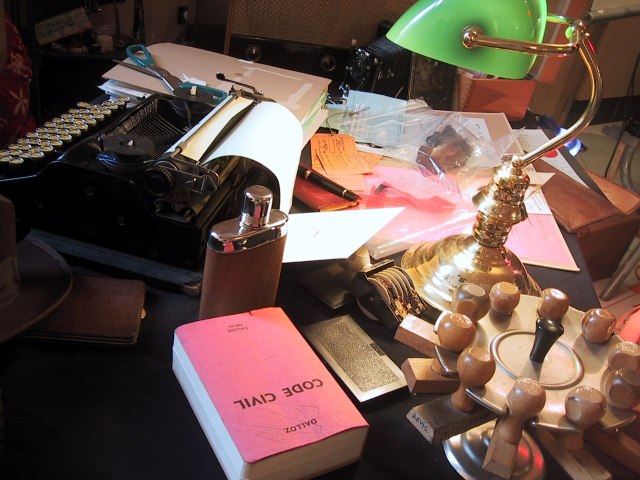
Vintage detective desk photo created by Olivier Bourgeois at freeimages.com. Photo by <a href=”/photographer/ornicar69-54520″>Olivier Bourgeois</a> from <a href=”https://freeimages.com/”>FreeImages</a&gt; Image found at freeimages.com.

My overall impression:

Van Johnson is one of the reasons why I selected The End of the Affair, as he was a guest star on I Love Lucy. When it comes to his movies, I thought those I saw were mostly ok. The 1955 project is no different. I was disappointed by the underutilization of John Mills’ acting talents, as well as the adoption of the “insta-love” trope. The mystery’s randomly produced reveal felt like a major tonal shift. However, The End of the Affair does have its strengths. The acting alone was one of the highlights of the film, from Van’s versatility to Deborah’s ability to convey ideas without using dialogue. The way mise-en-scène was used by the creative team allowed the story to maintain a certain degree of intrigue. I also liked Albert Parkis as a character. When it comes to character-driven stories involving serious topics, I find The Chalk Garden and Hallmark Hall of Fame’s A Tale of Two Cities as stronger titles. But, so far, I’ve only seen a handful of Van’s movies, so maybe I need to keep looking for a film of his I like.

Overall score: 6.1 out of 10

Have you seen The End of the Affair? Which is your favorite movie from Van Johnson’s filmography? Tell me in the comment section!

Have fun at the movies!

Sally Silverscreen
Take 3: The Chalk Garden Review + 505 Follower Thank You

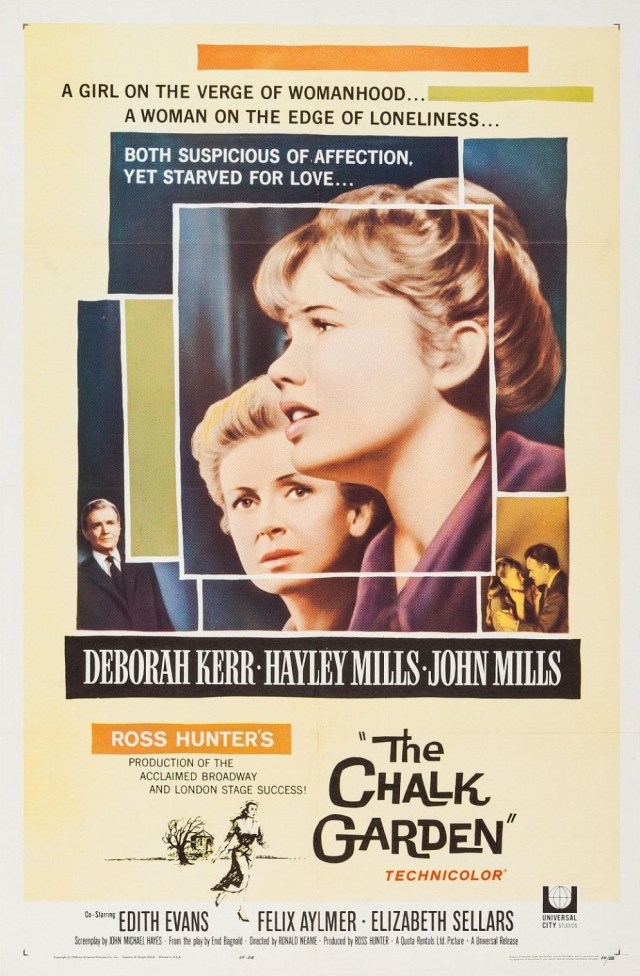
For last year’s We Are Family Blogathon, my original plan was to write about both the Diagnosis Murder episode, “Guardian Angel” and 1964’s The Chalk Garden. But as I explained in my review of hoops&yoyo’s Haunted Halloween, my plan to discuss the movie fell through. Despite this setback, I had always wanted to feature The Chalk Garden on my blog. Recently, I received a second chance to review the film! So for the first Blog Follower Dedication Review of 2025, I thought the 1964 production was the perfect title for this occasion! The Chalk Garden was recommended by Maddy (from Maddy Loves Her Classic Films) when I reviewed Marriage on the Rocks five years ago. In total, I have written about seven of Deborah Kerr’s films, with her best picture being The King and I. How will this eighth movie compare to those seven? Keep reading to find out!

The Chalk Garden poster created by Quota Rentals Limited, Ross Hunter Productions, and Universal Pictures

Things I liked about the film:

The acting: The Chalk Garden is a character-driven story where part of the script serves as a character study. For these types of movies, it’s important to recruit a cast whose talents are strong enough to help make the characters interesting. While watching the 1964 film, I was invested in the story from beginning to end. One reason why is the quality of the acting performances! This is a movie where it’s difficult to choose a favorite performance, as each one was good for different reasons. Hayley Mills’ portrayal of Laurel incorporates a variety of emotions and animated expressions. These aspects of her performance showcase just how complex Laurel is. Meanwhile, Deborah Kerr’s character, Miss Madrigal, was a no-nonsense woman who subtly expressed emotion. Through her acting talents, Deborah found a way to present her character as nurturing and a promoter of “tough love”. As for John Mills’ portrayal of Maitland, his character’s consistently welcoming persona put the other characters at ease. Maitland’s laid-back personality and calm way of approaching situations reminded me of Mr. Rogers from Mister Rogers’ Neighborhood.

Mrs. St. Maugham’s residence: The story of The Chalk Garden takes place at Mrs. St. Maugham’s house. Since Mrs. St. Maugham was a woman with a financially comfortable life, her house perfectly reflected this. The sunroom was introduced in the movie’s first five minutes. Wrap-around windows looked out to a view of a large grassy hill. Plants filled the inside of the sunroom. In the center of the area, four white metal chairs were set around a smaller table. The furniture looked like it came straight out of an old-fashioned ice-cream parlor. On Mrs. St. Maugham’s property was her backyard shed. Though this space was not frequently shown in The Chalk Garden, I really liked its interior design! Underneath a window was a white wicker desk housing some potted plants. A wicker table was surrounded by wicker chairs of varying sizes. The white stone walls and differently shaped windows helped make the backyard shed a quaint and classy space! These finer details successfully captured Mrs. St. Maugham’s sophisticated taste!

The dialogue: Toward the beginning of The Chalk Garden, Miss Madrigal arrives at Mrs. St. Maugham’s house to be interviewed for the available governess job. When Maitland greets her at the door, he asks Miss Madrigal if she’s worked as a governess before. She cleverly replies with a question of her own, asking “do you usually interview applicants in the doorway”? This was the funniest moment in The Chalk Garden because of how well-written and delivered this exchange was! After Miss Madrigal accepts the governess job, she moves in to Mrs. St. Maugham’s house. While Miss Madrigal unpacks her belongings, Laurel explains how she doesn’t like to be told “good morning”. Her reasoning is “what is a good morning to someone else is rarely a good morning to me”. When people tell each other “good morning”, they are typically saying that in the hopes the other person has a good morning. But unless we consider things from the other person’s point of view (yes, that To Kill a Mockingbird reference was intentional), we don’t know if that person has, indeed, had a good morning. So, I found Laurel’s quote to be thought-provoking. The examples of dialogue I provided display the quality screenwriting within The Chalk Garden! How memorable the dialogue was is a result of that quality!

Good sailing day image created by Freepik at freepik.com. <a href=’https://www.freepik.com/free-vector/summer-landscape-with-a-houselight-and-a-boat_866882.htm’>Designed by Freepik</a>. <a href=”https://www.freepik.com/free-photos-vectors/design”>Design vector created by Freepik</a>. Image found at freepik.com.

What I didn’t like about the film:

A quickly resolved conflict: Throughout The Chalk Garden, Mrs. St. Maugham is at odds with her daughter, Olivia. Their relationship is so strained, Mrs. St. Maugham wants to obtain sole custody of her granddaughter, Laurel. This conflict lasts the entire movie. While I will not spoil The Chalk Garden, I will say the conflict was resolved within the film’s last ten minutes. The way it was resolved was too abrupt. As a result of this abrupt resolution, Laurel’s change in attitude and behavior happened too quickly. The reason for these flaws is how the second half of the story focuses on unearthing secrets.

Unanswered questions: There were times in The Chalk Garden when characters would make a claim, only for that claim to not be met with confirmation or denial. One example shows Laurel telling Miss Madrigal about the aftermath of when she was attacked in the park. Laurel says even though the police never got involved, it was an “open and shut case”. Before this conversation, however, Maitland warns Miss Madrigal how Laurel has a penchant for lying and fabricating the truth. Did the incident in the park actually take place or was Laurel bending the truth to get a reaction? This is one of the claims in The Chalk Garden that should have been clarified.

An unresolved metaphor: Along with being Laurel’s governess, Miss Madrigal is the resident gardener. This is because Mrs. St. Maugham lacks a “green thumb”. Miss Madrigal uses Mrs. St. Maugham’s garden as a metaphor for Laurel, even referring to it as “a chalk garden”. In order for the metaphor to work, the garden’s growth should have paralleled Laurel’s personal journey. Unfortunately, the garden itself makes infrequent appearances in the film. It also doesn’t help how Mrs. St. Maugham never puts Miss Madrigal’s words into practice, making the metaphor seem unresolved.

Paint palette image created by Freepik at freepik.com <a href=’https://www.freepik.com/free-vector/hand-drawn-artsy-tools_836777.htm’>Designed by Freepik</a> <a href=”https://www.freepik.com/free-photos-vectors/hand”>Hand vector created by Freepik</a> Image found at freepik.com

My overall impression:

Before I share my overall impression on The Chalk Garden, I want to take the time to thank the followers of 18 Cinema Lane. The support my blog receives still amazes me, even seven years after 18 Cinema Lane began! While I appreciate 18 Cinema Lane’s followers, I also appreciate when my blog’s readers provide film recommendations. This is why I try to write about these recommendations whenever possible. As I mentioned in this review’s introduction, The Chalk Garden was suggested by Maddy (from Maddy Loves Her Classic Films). I’m thankful to have not only been recommended the movie, but to also have finally checked it out! The 1964 production is part character study, part mystery. Because of the strength of the acting performances and screenwriting, this story worked! Liked I said in my review, I was invested in the story from beginning to end. The characters were interesting and the mysterious elements were intriguing. Though I wish some questions had been answered and a major conflict hadn’t been resolved so quickly, The Chalk Garden did more things right when it came to film-making. I can, honestly, say I would recommend this movie for those looking for a good cinematic story!

Overall score: 7.8 out of 10

Have you seen The Chalk Garden? What is the best movie you’ve been recommended? Let me know in the comment section!

Have fun at the movies!

Sally Silverscreen

Take 3: The Truth About Spring Review

It’s been a while since I last wrote a movie review. As I just wrote about a Hallmark Hall of Fame film, I wanted to talk about something beyond the realm of Hallmark. I recently remembered a movie I had heard good things about for years. That movie is 1965’s The Truth About Spring! I have covered some of Hayley Mills’ films in past reviews on my blog. These titles are Summer Magic, The Moonspinners, and The Trouble with Angels. While I found Summer Magic to be just ok, I did like The Trouble with Angels and The Moonspinners. Since The Truth About Spring revolves around Hayley’s character traveling, I wondered if I’d like this film as much as The Moonspinners. That answer will be discovered as we sail through this review of The Truth About Spring!

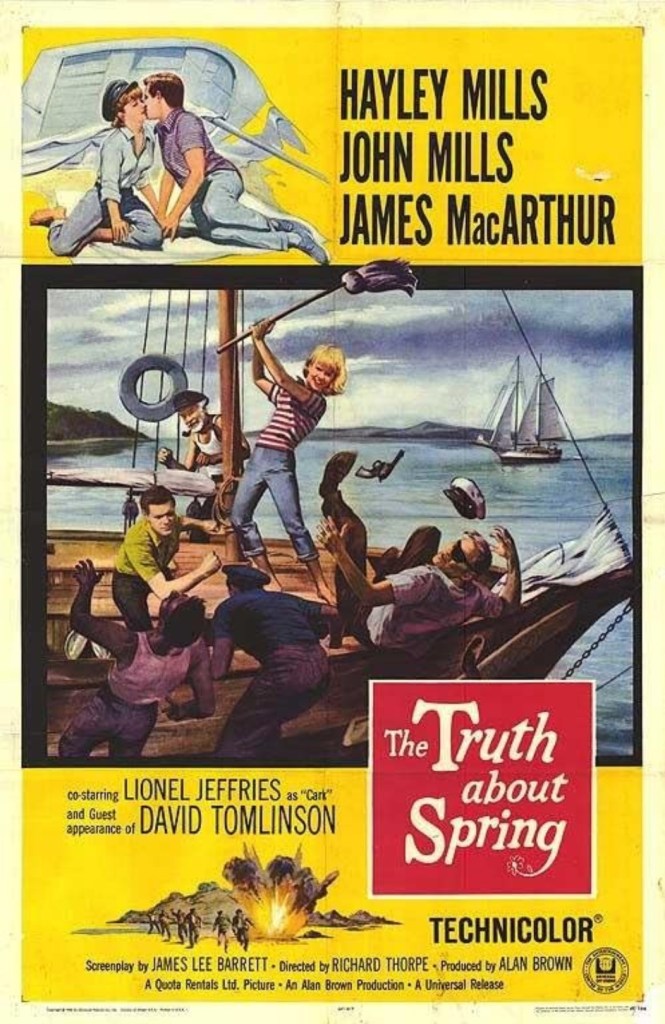
The Truth About Spring poster created by Quota Rentals Limited and Universal Pictures

Things I liked about the film:

The acting: In The Truth About Spring, Hayley portrays the protagonist, Spring Tyler. One of the few characters she interacts with is William Ashton, portrayed by James MacArthur. When William prepares for his voyage on Tommy’s ship, Spring is curious about an outfit William packed. After she asks about the outfit in question, William explains it is a set of pajamas, which he wears for sleep. Spring’s face goes from inquisitiveness to sad realization, as she confesses how she doesn’t own pajamas. This subtle change in facial expressions shows how Spring is being exposed to a different way of living life. Because of Hayley’s acting abilities, the aforementioned realization appeared realistic!

Spring is not the only character William interacts with. Another key character in The Truth About Spring is Spring’s father, Tommy, portrayed by John Mills. During their voyage, Tommy witnesses William in his pajamas for the first time. Because Tommy is also not used to the idea of pajamas, he gives William a confused look. Meanwhile, William displays an embarrassed facial expression, as he wasn’t expecting Tommy to walk into the room. The interaction between these characters creates a moment that is awkward for both of them. John’s and William’s acting talents allow this awkwardness to radiate off the screen, making the scene feel believable!

The interior design: The majority of The Truth About Spring takes place outdoors, as the characters sail to various locations. However, there are a few scenes featuring the interior design of the characters’ ships. The sitting room in the yacht of William’s uncle is surrounded in bleached wood. Paired with beige chairs and a large painting of flowers, this room is reflective of the affluent lifestyle of the Ashton family. On Tommy’s ship, the cabin has dark wood walls. Tommy, Spring, and William sit around a table covered in a red and white checkered pattern. The small windows are gifted with green curtains. These combined design details showcase the humbleness of Tommy and Spring’s surroundings.

The discussion of educational experiences: A consistent topic between Spring and William is education. During one of their discussions, Spring learns there are different types of lawyers. This lesson came after William told her and Tommy he had graduated from law school and passed his bar exam. On a trip to the beach, Spring explains to William how it is the seagulls’ nesting season. She knows this information because of her experiences at sea. These conversations highlight how these characters’ life experiences shaped their educational foundations. I hadn’t thought about this concept until I saw The Truth About Spring!

Sailing on the sea image created by Michele L at freeimages.com. “FreeImages.com/Michele L.”

What I didn’t like about the film:

A missed opportunity: Throughout The Truth About Spring, the characters engage in a treasure hunt. This treasure hunt was, unfortunately, not emphasized in the story. Instead, the movie splits its time between the interactions of Spring and William, as well as Tommy’s conning schemes. For me, this was disappointing because a treasure hunt can give a story intrigue, suspense, and a sense of adventure. Not emphasizing the treasure hunt is, in my opinion, a missed opportunity.

A limited amount of urgency: As I mentioned in my previous point, the film’s treasure hunt wasn’t emphasized. That creative decision caused The Truth About Spring to contain a limited amount of urgency. Within the movie’s hour and forty-two-minute run-time, a strong sense of urgency was featured in only three scenes. Most of the movie ended up feeling like an unexciting journey.

A drawn-out story: Like I said in this review, The Truth About Spring is an hour and forty-two-minutes. But the story itself was straight-forward, primarily focusing on three key characters. Therefore, this combination made the film feel drawn-out. Personally, I feel the movie should have been given a run-time of an hour and ten to fifteen minutes. That way, the script would been tighter.

Tropical island image created by Brgfx at freepik.com. <a href=’https://www.freepik.com/free-vector/island-background-design_1020626.htm’>Designed by Freepik</a>. <a href=”https://www.freepik.com/free-photos-vectors/background”>Background vector created by Brgfx – Freepik.com</a>. Image found at freepik.com.

My overall impression:

As I stated in the introduction, I have reviewed some of Hayley Mills’ films. These films range from ok to enjoyable. When it comes to The Truth About Spring, I thought it was just ok. There are aspects of the 1965 movie I like, such as the discussion of educational experiences between Spring and William. However, I didn’t find the story itself very interesting. Instead of emphasizing the treasure hunt, more focus is given to Tommy’s conning schemes. Giving this simplistic story a run-time of almost two hours didn’t help either. If you’re looking for a movie where Hayley’s character falls in love and goes on an adventure, I’d recommend The Moonspinners over The Truth About Spring. The Moonspinners contains suspense and intrigue, as well as a tighter script.

Overall score: 6 out of 10

Have you seen The Truth About Spring? What is your favorite movie starring Hayley Mills? Please tell me in the comment section!

Have fun at the movies!

Sally Silverscreen