It’s Time for the 7th Annual Gold Sally Awards!

Here at 18 Cinema Lane, I maintain several annual traditions to give my readers something to look forward to. One of those traditions is the Gold Sally Awards, which commemorates my blog’s anniversary! The award categories are created by me and based on topics I’ve brought up on my blog. With two new awards in 2025, I’ll explain the significance of those categories. Like in 2024, I will discuss why I chose each recipient. Now, let the 7th Annual Gold Sally Awards begin!

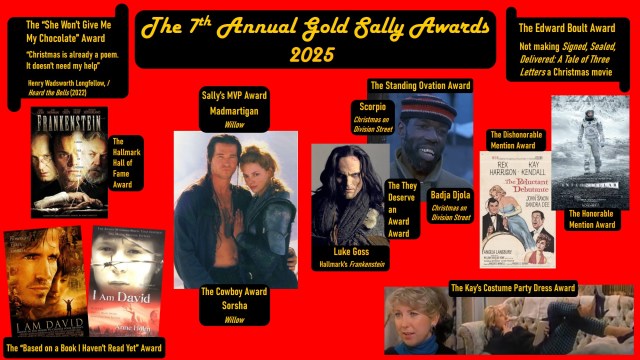
7th Annual Gold Sally Awards Winners created by me, Sally Silverscreen.

The Kay’s Costume Party Dress Award

(Best Outfit from a Movie)

Helen’s Christmastime Outfit from Hallmark Hall of Fame’s Pack of Lies

When I thought about the various categories of the Gold Sally Awards, I realized there was no category recognizing the wardrobe department of the movie industry. To fix that, I created the Kay’s Costume Party Dress Award! The name of this award references the dress Kay (Joan Collins’ character) wore at a costume party in the 1983 tv movie, Making of a Male Model. I loved this dress so much, it was featured in 2021’s Movie Blogger’s Christmas Wish-List! From the films I saw in 2024, there were several outfits I really liked. The one that was the most memorable, however, came from the Hallmark Hall of Fame presentation, Pack of Lies! The outfit in question was featured in my Movie Blogger’s Christmas Wish-List from last year; the black and blue ensemble Helen (portrayed by Teri Garr) wore during Christmastime. This timeless outfit was worn in only one scene. That fact is why Helen’s outfit earned the inaugural Kay’s Costume Party Dress Award!

The Edward Boult Award

(Missed Opportunity in Cinema)

Not making Signed, Sealed, Delivered: A Tale of Three Letters a Christmas movie

Last June, I speculated how Signed, Sealed, Delivered: A Tale of Three Letters could be a Christmas film. In my editorial about my speculation, I explained how the movie’s title could be a reference to either the Nativity story or A Christmas Carol. I also wondered if Signed, Sealed, Delivered: A Tale of Three Letters and “Signed, Sealed, Delivered: To the Moon and Back” could be a two-part adaptation of A Christmas Carol, with the rock star character intended to be a Marley-like character. The official marketing for Signed, Sealed, Delivered: A Tale of Three Letters proved my speculation wrong. But the more I think about how this movie could have been a Christmas picture, the more I wish it had been a Christmas production. As of early February, 2025, the Signed, Sealed, Delivered series has received only one Christmas movie. Plus, my aforementioned editorial provided ideas for a potential Christmas script. With Hallmark Mystery’s ‘Miracles of Christmas’ viewership numbers lower in 2024 than 2023, maybe the network will consider creating another Signed, Sealed, Delivered Christmas film.

The They Deserve an Award Award

(An Actor or Actress Who Deserves Recognition)

Luke Goss (for his performance in Hallmark’s Frankenstein) and Badja Djola (for his performance in Christmas on Division Street)

There were several good acting performances I saw in 2024. So, it was difficult to choose just one recipient for this year’s Gold Sally Awards. Both Luke Goss’ and Badja Djola’s performance was so impressive! In Hallmark’s Frankenstein, Luke’s use of emotion allowed The Creature to speak without actually speaking. An example I used in my review of the 2004 television film was when The Creature bursts into tears while seeking refuge in a barn. Luke’s acting skills made his character as complicated as he was in Mary Shelley’s source material. Badja made his character, Scorpio, so memorable, despite having limited appearances in Christmas on Division Street. With a consistently commanding presence, Scorpio was a character I looked forward to seeing on screen. That’s because Badja used his acting talents to give Scorpio captivating interactions with other characters. The scene where Scorpio shares some of his backstory with Cleveland is the example I used in my Christmas on Division Street review.

The Cowboy Award

(Character Who Makes an Unnecessary, Drastic Change)

Sorsha from Willow

You’re probably wondering why I gave Sorsha the Cowboy Award, even though I grew to like her as a character. While I found her transformation from villain to hero necessary, it was drastic. In my Comparing with the Critics review of Willow, I shared how Sorsha’s aforementioned evolution was too abrupt. The transformation gave Sorsha some character development, but it left some questions unanswered. For this flaw, blame lies in the screenwriting.

Sally’s MVP Award

(Character Who Left a Memorable, Showstopping Impression)

Madmartigan from Willow

When I watch a movie, there is, sometimes, a character who leaves such a memorable impression on me, they end up stealing the show. I have called these types of characters “MVP”. To acknowledge the “MVPs” of 18 Cinema Lane, I created the new Sally’s MVP Award! One of these “MVPs” was Madmartigan from Willow. In my Comparing with the Critics review of the 1988 film, I talked about how Madmartigan was the story’s comic relief. His personality and comedic timing captivated my attention and kept me invested in his story. What helped Madmartigan become the “MVP” of Willow was the screenwriting and Val’s performance.

The “She Won’t Give Me My Chocolate” Award

(Best Quote from a Movie)

“Christmas is already a poem. It doesn’t need my help” – Henry Wadsworth Longfellow, I Heard the Bells (2022)

In the 2022 movie, I Heard the Bells, Fanny (portrayed by Rachel Day Hughes) encourages her husband, Henry, to create a Christmas themed poem. Henry (portrayed by Stephen Atherholt) told his wife, “Christmas is already a poem. It doesn’t need my help”. When Henry said this, I started to think about what his quote meant. Poems require planning and putting the right pieces together, in order for that poem to have good flow and writing structure. Christmas festivities require a certain amount of planning, whether it’s a local church’s Nativity play or a family’s Christmas party. Using these two examples, finding the right pieces is important, such as who will portray the Three Wise Men or what will be the entrée of Christmas dinner. Poems can also tell stories. One classic example is ‘‘Twas the Night Before Christmas’. Christmastime is filled with stories, from the Nativity story to A Christmas Carol. Henry’s aforementioned quote made me see Christmas in a completely different way! Plus, a quote from a Christmas movie has never won the “She Won’t Give Me My Chocolate” Award before.

The Honorable and Dishonorable Mention Award

(Best and Worst Movie from the Honorable and Dishonorable Mention Category)

Best – Interstellar

Worst — The Reluctant Debutante

For last year’s Gold Sally Awards, there was only the Dishonorable Mention Award. That’s because I didn’t see enough movies to include an honorable mention category. With the honorable mention category returning in 2024, the Honorable Mention Award is also coming back! Science fiction stories about space exploration will typically emphasize the thrills and wonder of the galaxy. This can make it easy for a movie’s audience to get caught up in how adventurous and exciting outer space can seem. In Interstellar, a major focus is space travel’s effect on human beings. So, themes of family, sacrifice, and the price of scientific achievement are woven into the script. That, along with quality acting performances and impressive special effects, is why I liked Interstellar!

Out of all the movies that ended up in the dishonorable mention category, I had the highest expectations for The Reluctant Debutante. This is because I not only reviewed the film for The John Saxon Blogathon, there was some well-known talent involved with the project. Unfortunately, the 1958 movie fell short of those expectations. The Reluctant Debutante was a premise driven story that felt longer than one hour and thirty-four minutes, due to the jokes being drawn-out. It also didn’t help how some story ideas were overlooked. When I reviewed the 1958 film, I shared how movies from the 1950s are covered so infrequently on 18 Cinema Lane. So, it’s disappointing when a production from the ‘50s is weaker than expected.

The Hallmark Hall of Fame Award

(Movie That Feels Like It Belongs in the Hallmark Hall of Fame Collection)

Hallmark’s Frankenstein

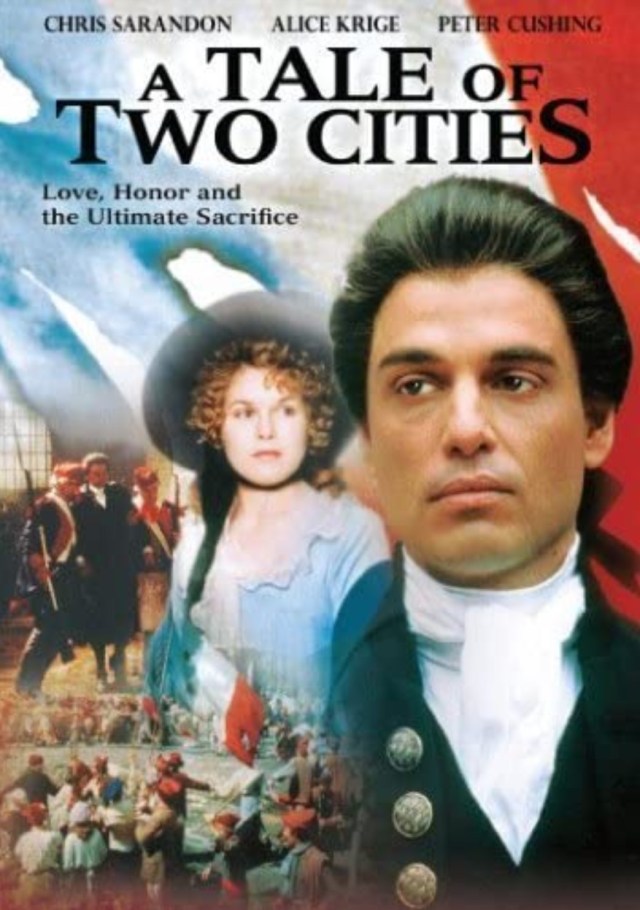
There are different kinds of stories in the Hallmark Hall of Fame collection. One kind of story is adaptations of pre-existing literature. Sometimes, “classic” literature became Hallmark Hall of Fame presentations, like The Secret Garden and A Tale of Two Cities. When these adaptations are good, they can be an immersive experience. This is how I would describe Hallmark’s Frankenstein! Due to the combination of screenwriting, acting performances, set design, and costume design, the movie made me feel like I was transported to another time and place. I also appreciate how close to the source material the 2004 television film is. Looking back on Hallmark’s Frankenstein and the Hallmark Hall of Fame collection, I’m actually surprised Mary Shelley’s novel wasn’t adapted into a Hallmark Hall of Fame project. Everything I said is why I chose Hallmark’s Frankenstein for the Hallmark Hall of Fame Award!

The “Based on a Book I Haven’t Read Yet” Award

(Movie Based on Source Material I Have Not Yet Read)

I Am David

Movies that won the “Based on a Book I Haven’t Read Yet” Award were first placed on a best films of the year list. I Am David is continuing that tradition! The 2004 film earned the top spot on my best movies list of 2024. This is the second time a number one movie of the year received the “Based on a Book I Haven’t Read Yet” Award! After I reviewed I Am David, I learned the movie was based on a book. I’m not sure how affective the story’s plot twists will be, as I already know what they are because I saw the film. However, I’d still be interested in reading I Am David someday!

The Standing Ovation Award

(Character Most Deserving of Receiving Their Full Potential)

Scorpio from Christmas on Division Street

When the Gold Sally Awards presented the Standing Ovation Award, the recipients were characters who should have received their “standing ovation”, but were denied that for various reasons. Scorpio (from Christmas on Division Street) actively worked toward getting where he wanted to go. As I said during the They Deserve an Award Award, Scorpio had limited appearances in the 1991 made-for-TV movie. Despite that, the audience learned enough about him to know what he had gone through. During this limited period of time, Scorpio attempts to overcome his obstacles. While I won’t spoil Christmas on Division Street, I will say those attempts earned Scorpio the Standing Ovation Award!

Have fun at the movies!

Sally Silverscreen
Comparing with the Critics – Worst of 1988 – Willow

This review is from my series, Comparing with the Critics. If you’d like to learn more about the series, click on the link below.

Introducing my new series, Comparing with the Critics!

Siskel & Ebert and 18 Cinema Lane share one thing in common: the fantasy genre is underrepresented. This is a reason why I not only chose to participate in the Barbarians at the Gates Blogathon, it’s also a reason why I selected Willow for this review of Comparing with the Critics. But another reason why I picked Willow is how the film was featured in Siskel & Ebert’s Worst of 1988 episode. After hearing good things over the years about the movie, even some people giving it the coveted title of “classic”, I was shocked to see Willow included among the worst of 1988. But since I didn’t see the film before the Barbarians at the Gates Blogathon, I couldn’t agree or disagree with Siskel and Ebert. Film is subjective, with this subjectivity being the reason why I created the Comparing with the Critics series. So far, I disagreed with the critics on Network and Harry & Son, yet agreed with them on Amadeus. With that said, I’d have to say I disagree, yet again, with Ebert and Siskel. While Willow has its flaws, its placement in the Worst of 1988 episode is unjustified.

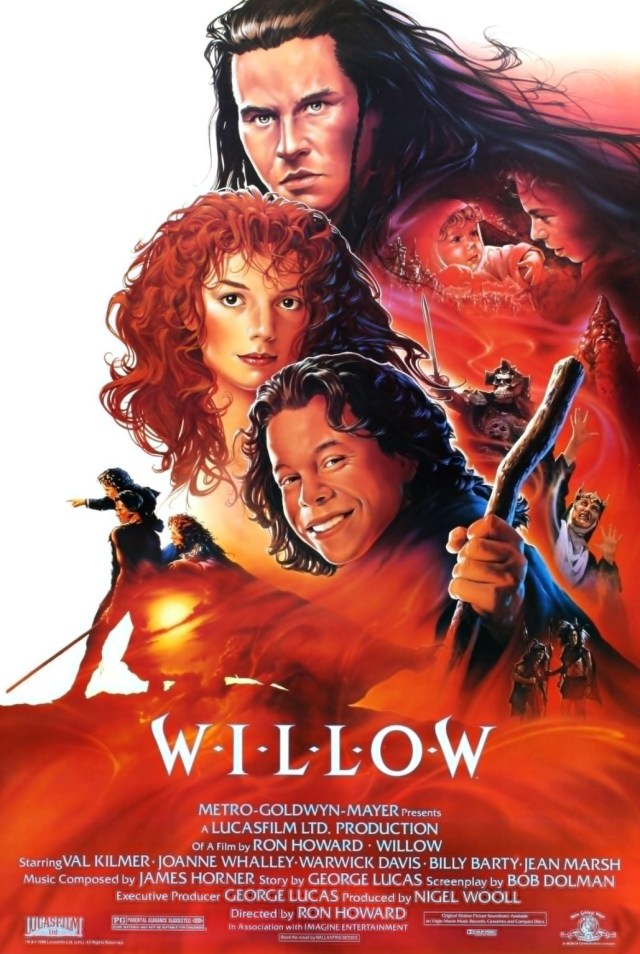
Willow poster created by Metro-Goldwyn-Mayer (MGM), Lucasfilm, and Imagine Entertainment

Before going over his complete list of the worst films from 1988, Gene Siskel introduces the episode’s segment on Willow. He calls the film “a heavy duty and quite dreary production”. I will admit there are darker moments within the story. However, the movie was more humorous than I expected it to be! Most of the humor came from Madmartigan, portrayed by Val Kilmer. Because of the screenwriting and Val’s versatile performance, the comedic timing was effectively executed. One of the funniest scenes in Willow is when Madmartigan and Willow are traveling on a sled down a snowy hill. During this trip, Madmartigan falls off the sled. But instead of being left behind, Madmartigan rolls down the hill, becoming a giant snow ball. When Madmartigan was introduced in Willow as the story’s comic relief, I knew he was going to be a character I would like. His personality, along with the dialogue shared between him and Willow, presented someone who captivated my attention and kept me invested in his story. It also helps that Madmartigan is hilarious, as he is the reason why I burst out laughing several times while watching Willow!

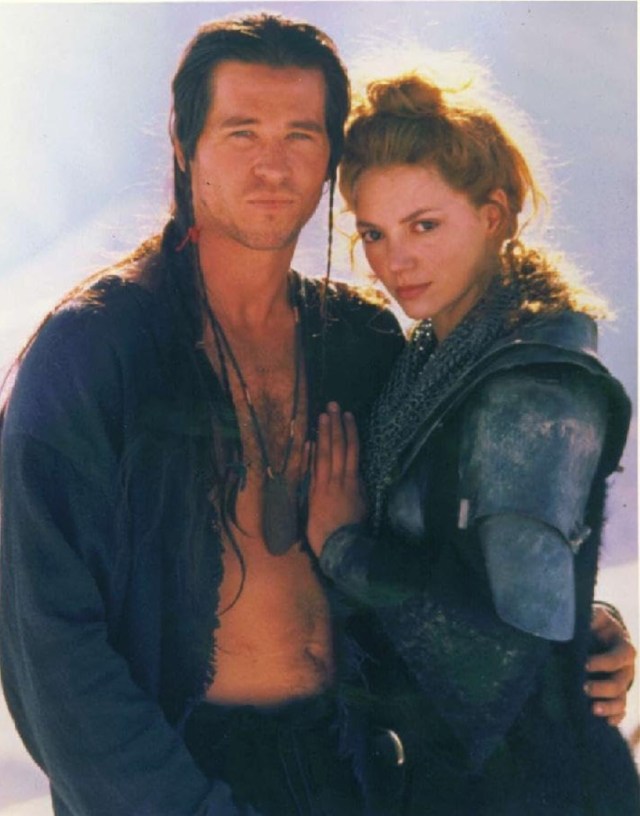
Madmartigan and Sorsha picture created by Metro-Goldwyn-Mayer (MGM), Lucasfilm, and Imagine Entertainment

Gene Siskel is not the only critic who disliked Willow. Though he didn’t put the movie on his list of the worst films of 1988, Roger Ebert expressed his disapproval over how the story seemed similar to Star Wars, claiming children who liked the movie “hadn’t seen it a hundred times before”. I can only speak for myself, but Star Wars never crossed my mind as I watched Willow. But some moments did feel reminiscent of The Wizard of Oz. The film clip included in the Worst of 1988 episode shows Cherlindrea, a fairy queen, revealing to Willow the purpose of his journey. She even gives him a wand to help him accomplish his mission. The scene reminded me of when Glinda explained to Dorothy how she could return home. The iconic ruby slippers became a tool to help Dorothy along her way to Emerald City. Story ideas are bound to get repeated over time. Therefore, moments in Willow feeling reminiscent of The Wizard of Oz didn’t bother me. Instead, it showed me how a film’s creative team can take a familiar story idea and add their own unique perspective on it!

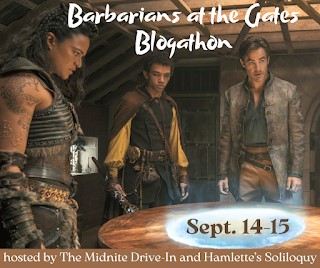
The Barbarians at the Gates Blogathon banner created by Quiggy from The Midnite Drive-In and Hamlette from Hamlette’s Soliloquy

Another criticism Gene had about Willow was the film’s setting, stating “I’m tired of seeing epic pictures set in forests with lots of people running around and, uh, hitting each other over the head”. Personally, I was not bothered by this, as I felt the setting fit the story Willow’s creative team was trying to tell. What did bother me was how the build-up of Madmartigan and Sorsha going from enemies to lovers happened too quickly. Incorporating the “enemies to lovers” trope works in a fantasy story like Willow, where there is at least one battle and a major theme is good versus evil. It should be noted how Val Kilmer and Joanne Whalley had nice on-screen chemistry, as well as Sorsha and Madmartigan appearing photogenic together. I still wish the aforementioned build-up had been more gradual. As the story progressed, Sorsha evolved from villain to hero. Unfortunately, this evolution was too abrupt. While Sorsha’s change of heart gave her some character development, it left some questions unanswered. Perhaps a scene explaining this transformation didn’t find its way into the movie?

Snowy mountain image created by Freepik at freepik.com. <a href=’https://www.freepik.com/free-vector/landscape-background-of-snow-track-and-mountains_968656.htm’>Designed by Freepik</a>. <a href=”https://www.freepik.com/free-photos-vectors/background”>Background vector created by Freepik</a>. Image found at freepik.com.

In past reviews, I criticized films for containing parts of a story that didn’t make sense. Willow is a film that doesn’t avoid this flaw. Bavmorda is the villain of the story. When the heroes attempt to defeat Bavmorda, she uses a spell to transform the heroes into pigs, with Willow and a sorceress named Fin Raziel being the only exceptions. This spell takes place in a short amount of time, with the afflicted heroes becoming pigs all at once. When Fin Raziel reverses the spell, this proves to be a lengthy process, as she uses her magic on one person at a time. This creative choice left me wondering why Fin Raziel wouldn’t use her magic on all the heroes all at once similar to Bavmorda? To me, it didn’t make sense, especially since the heroes didn’t have the luxury of time.

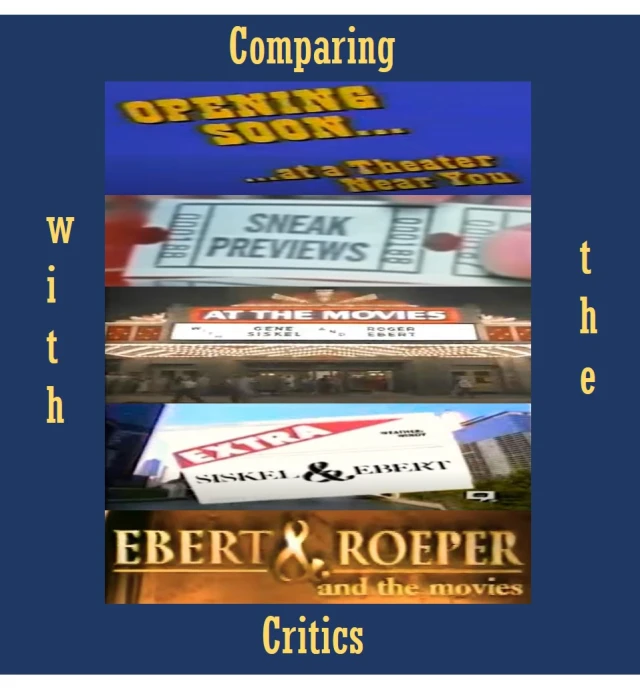
Comparing with the Critics banner created by me, Sally Silverscreen. TV show title cards created by WTTW National Productions, WTTW, Public Broadcasting Service (PBS), Lifetime Television, Tribune Entertainment, Buena Vista Television, and Disney-ABC Domestic Television

During their discussion of Willow in Siskel & Ebert’s Worst of 1988 episode, Roger reminds Gene how, despite the movie’s bad reviews, it became the top selling video and was successful at the box office. Had I seen Willow sooner, I might have contributed to the movie’s statistics. This is another Comparing with the Critics review where I found myself disagreeing with Siskel and Ebert. That’s because I had a genuinely good time watching Willow! I brought up in this review how the project has its flaws. But the story was simplistic and straight-forward, which made it easier to follow what was happening on screen. Even though Willow was the movie’s protagonist, it was Madmartigan who stole the show! In fact, I’d say he was the MVP of this story, as his personality and comedic timing left a good impression. There were moments in the film that felt reminiscent of The Wizard of Oz. However, I saw those moments as ways for Willow’s creative team to bring their own unique perspective to familiar story ideas. I have to say I’m glad I chose to review Willow for this edition of Comparing with the Critics! Now if you’ll excuse me, I have to watch the Siskel & Ebert 1988 Holiday Video Gift Guide episode in the hopes something Willow related can be included in my Movie Blogger’s Christmas Wish List.

This review was brought to you by

Sally Silverscreen

Take 3: Scarlett Review

Originally, I was going to review a different movie for the 3rd Annual So Bad It’s Good Blogathon. But when I found a DVD copy of Scarlett at a local consignment store, I couldn’t pass up an opportunity to review the film! Last year, I discovered Gone with the Wind received a sequel many years after its release. While I’m not a fan of the sequel’s predecessor, I thought the 1994 film would be perfect content for the aforementioned event. According to IMDB, Scarlett premiered as a TV mini-series. This gives the sequel a run-time of six hours, which is even longer than the first movie. I never thought Gone with the Wind needed another chapter, as everything ended on a definitive note. However, curiosity got the best of me, as I wanted to find out if this could finally be the “so bad it’s good” movie I’ve been looking for!

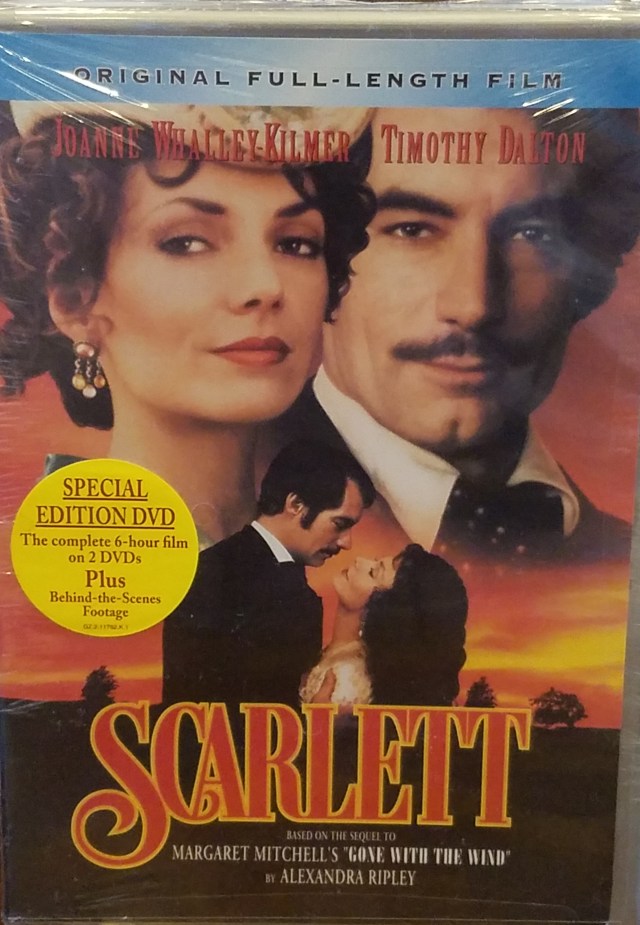
This is the DVD I purchased from a local consignment store. Even the packaging calls Scarlett a six hour film. Screenshot taken by me, Sally Silverscreen.

Things I liked about the film:

The acting: While I like the acting overall, there were three performances that were stand-outs. The first one came from Sean Bean. I haven’t seen much from his filmography, but I remember his portrayal of Ian Howe from National Treasure. Based on these two movies, it seems Sean is very talented when it comes to portraying on-screen villains!  Without spoiling the film, I will say Lord Richard Fenton is a despicable individual. However, it was interesting to see how Sean carried his character in each scene he appeared in. Whenever in public or around Scarlett, Richard comes across as a dashing gentleman. But behind closed doors, he reveals himself to be selfish and controlling, which makes Richard’s overall persona very ugly. In all my years of watching movies, I’ve seen few actors effectively portray characters that had likable and unlikable qualities. Within the film, Scarlett, Sean single-handedly accomplished this; making the audience despise Richard, but appreciate Sean’s acting abilities! The second stand-out performance was Annabeth Gish’s! In historical fiction/period stories, few female characters from a wealthier background contain a personality that is gentler in nature. With the way Annabeth approached her character, Anne, she brought something to the table that isn’t seen often. This not only provided a contrast to Scarlett, but allowed Anne to be her own character. Anne’s gentleness came across on screen very naturally as well! Tina Kellegher’s portrayal of Mary Boyle is the third stand-out performance! A strong sense of emotionality worked in Tina’s favor. This component to her performance presented her character as a believable individual, as if Mary had actually existed at some point in time. Miss Boyle experiences some difficult situations throughout the movie. However, Tina pulled off a performance that appeared flawless!

The costumes: In period films, one of the notable aspects is the costumes. They are one example of a physical representation of the story’s respective time period. The costumes in Scarlett not only looked historically accurate, but also impressive! It also helps how the costumes compliment the actors wearing them. Scarlett’s wardrobe was amazing! It featured a color palette that never appeared over-the-top. Each piece featured patterns and textures that felt fitting for the 1870s, with color combinations working well together. I honestly can’t choose a favorite outfit, as it was fun to discover what outfit Scarlet would wear next! While I realistically don’t have any place to wear one of Scarlett’s outfits, it’s nice to think about which piece I’d like to own in real-life.

The conflict between the British and Irish: Within the overall story, there was an ongoing conflict between the British and Irish. According to the Irish characters, this was due to the British wanting to take over Ireland. I’m not familiar with this particular period in world history. Despite that, I found this part of the story to be fascinating! Because of Scarlett’s Irish heritage and the fact she had family living in Ireland, it gave Scarlett a reason to be aware of the political and social environment around her. Her interactions with Richard also highlight the different sides of the conflict itself. There were other people in this story who were directly connected to this conflict as well. One of Scarlett’s cousin’s, Colum, is a priest. However, he is also a member of a group of Irish people fighting for freedom against the British. It was interesting to see how Colum navigated his own struggles of religious duty and standing up for his people.

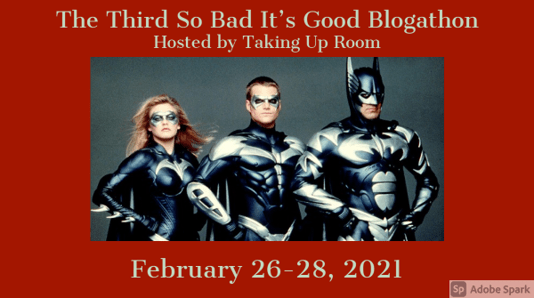
The Third So Bad It’s Good Blogathon banner created by Rebecca from Taking Up Room.

What I didn’t like about the film:

Scarlett and Rhett’s on-again/off-again relationship: I am not a fan of Scarlett and Rhett’s relationship. Even when I try to give it a fair chance and watch it with an open mind, I still do not like their relationship in this movie. One of the reasons why is how it was continually on-again/off-again. This was so repetitive, it became tiresome. It was also difficult to determine if Joanne Whalley and Timothy Dalton, the actor and actress who portrayed Scarlett and Rhett, had any on-screen chemistry. Scarlett and Rhett’s relationship problems did not need to be explored, especially after Gone with the Wind’s ending. In fact, seeing Scarlett and Rhett’s on-again/off-again relationship diminishes one of the most famous scenes and quotes in cinematic history, where Rhett says “Frankly, my dear, I don’t give a damn”. In my opinion, this situation took place simply to justify the sequel’s existence.

Unnecessary stories: As I already mentioned in my previous point, Scarlett and Rhett’s on-again/off-again relationship felt like it was taking place simply to justify the sequel’s existence. This wasn’t the only story within the film to make me feel this way. In the first half of Scarlett, Ashley is struggling to keep his business afloat. Scarlett recruits Sam, a former slave of the O’Hara household, to assist Ashley in building more homes, in order to save Ashley’s business. That storyline is one I found myself not caring about. It also didn’t lead anywhere, as it didn’t have a consistent presence in the overall film. Scarlett’s feud with her sister was another story I thought was unnecessary. Throughout the film, they refused to see eye-to-eye about the future of Tara. While Scarlett’s sister was still living in the house, Scarlett was considering selling it. I thought it was odd for Scarlett to think about selling Tara. In the first movie, she loved Tara so much, Scarlett slapped a woman in the face for expressing her opinion against the place. For Scarlett to completely change her mind without any explanation seemed random.

Choppy scene transitions: At some points in the movie, there were scene transitions that were so abrupt, it caused the film’s overall flow to feel choppy. When visiting a family member, Scarlett is about to share how she became so wealthy. Right as she was about to tell her story, the next scene started, showing another family member walking toward his house. It seemed like parts of the movie were missing. Some of these scene transitions were so jarring because the change of tone was so drastic. One scene showed Colum speaking with an Irish neighbor about their plans to fight the British. This dramatic and serious moment was met with a light-hearted scene where Scarlett goes to a horse fair. The journey from point A to point B needed a bridge.

Irish heart image created by Freepik at freepik.com. <a href=”https://www.freepik.com/free-photos-vectors/label”>Label vector created by freepik – http://www.freepik.com</a>. Image found at freepik.com.

My overall impression:

I can’t call Scarlett “so bad it’s good”. In fact, I would never consider it a bad movie. Objectively, this is a competently made project, where the creative team behind it clearly knew what they were doing. Subjectively, Scarlett is a mixed bag. The conflict between the British and Irish was the best part of this story! It was fascinating to see it unfold and discover how the characters were involved. With the parts of the story directly referencing Gone with the Wind, I found those to exist simply to justify the sequel. Until Scarlett went to Ireland, I was questioning why the movie was made. Personally, I would rather watch a miniseries about the British and Irish conflict over the one I just did. As I wrap up this review, I realize I still haven’t found my “so bad it’s good” movie. Time to go back to square one.

Overall score: 6.1 out of 10

Do you have a movie in your life that you’d consider “so bad it’s good”? If so, what is it? Let me know in the comment section!

Have fun at the movies!

Sally Silverscreen