Take 3: A Little Romance (1979) Review

Back in 2022, I wrote a list of the top ten movies I’d love to review. One of the films on that list was 1979’s A Little Romance. Since publishing that article three years ago, I haven’t gotten around to reviewing the movie. But Gill’s (from Realweegiemidget Reviews) and Barry’s (from Cinematic Catharsis) blogathon, Adventure-A-Thon, finally gave me an opportunity to check A Little Romance out! When it comes to “adventure” in cinema, that term can have different meanings depending on who you ask. For me, an “adventure” movie is when the story’s characters go on a journey to achieve something. In the case of A Little Romance, the protagonists, Daniel and Lauren, travel to Italy to prove the legitimacy of a legend. The 1979 film is not the only picture I’ve reviewed this year involving Italian travel. I wrote about Roman Holiday back in January. In my opinion, the movie was just ok, as I wanted to like it more than I did. Was A Little Romance ok like Roman Holiday? Let’s start the adventure of this review!
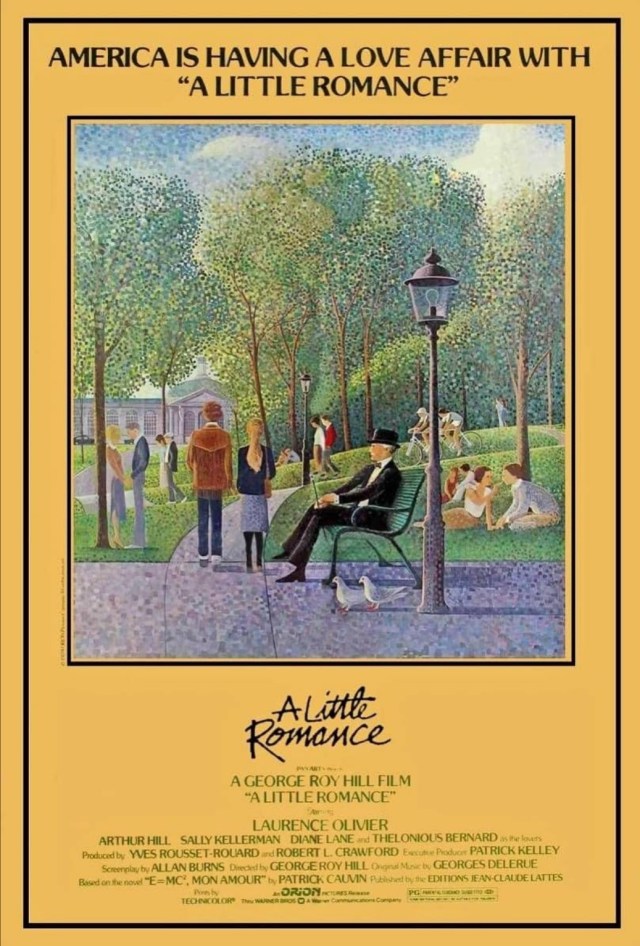
A Little Romance (1979) poster created by Orion Pictures, Pan Arts, Trinacra Films, and Warner Bros.

Things I liked about the film:

The acting: When it comes to teenagers in movies, it can be easy for a creative team to present those characters stereotypically. If written or directed to adopt certain behaviors and attitudes, teenage characters could even come across as caricatures. Fortunately, this was not the case in A Little Romance! Though there are only four teenage characters in the movie, their interactions didn’t feel scripted, making the characters themselves seem realistic. One example shows Lauren (portrayed by Diane Lane) and her friend, Natalie (portrayed by Ashby Semple), looking at sculptures during a class trip. As they observe the sculptures, Lauren nonchalantly tells tall tales about her time spent with Daniel. Natalie naively believes Lauren, her eyes becoming wide and her tone of voice revealing how shocked she is. Lauren, with a casual smile on her face and a giggle in her voice, then shares with Natalie how her tall tales were fabricated. This exchange between the two friends illustrates how teenagers can sometimes tease and joke with each other.

In this review’s introduction, I mentioned how the protagonists, Daniel and Lauren, travel to Italy to prove the legitimacy of a legend. Their journey was enjoyable to watch because of how strong Diane Lane and Thelonious Bernard’s on-screen chemistry was! Every time Lauren and Daniel interacted with one another, they always looked like they got along so well. There was a sweetness to their relationship that was wholesome and charming. It also helps how both Daniel and Lauren had likable personalities that complimented each other. While Thelonious and Diane deserve credit for their performances, credit should also be given to the screenwriting.

An appreciation for film: Before watching A Little Romance, I knew what the basic premise was about. But when I finally saw the 1979 picture, I was pleasantly surprised by the appreciation for film woven into the script! As soon as the movie starts, the audience sees Daniel watching a collection of films in a local cinema. As the story progresses, he sometimes quotes the movies he sees and even wants Lauren to call him “Boggie”, as he believes Humphrey Bogart and Lauren Bacall were meant to be together. Daniel’s decisions and perspectives are also influenced by the world of film. When Daniel receives rude comments about his relationship with Lauren from a movie director named George de Marco, Daniel punches George. Not only does Daniel strongly dislike George’s films, Daniel believes George’s comments cheapen the meaning of love he’s learned from movies.

The dialogue: In some of the movies I’ve reviewed this year, one of the strengths was the dialogue. The way it was written and delivered allowed this film-making component to be memorable for the right reasons. The dialogue was also a strength in A Little Romance! Through the screenwriting, the audience can tell how much thought was put into this aspect of the 1979 production. While Lauren talks about her family, Daniel asks her why she calls her stepfather ‘Richard’. Lauren replies by saying “It’s easier to lose a Richard than a dad”. From that one quote, Lauren is able to express how her mother’s multiple marriages have affected the family dynamic. In order to make enough money for their trip to Italy, Daniel and Lauren plan to bet on race horses. They want to figure out the betting odds to increase their chances of choosing a winning horse. When Lauren suggests using a computer to get these numbers, Daniel says “I am not a computer”. This simple quote stresses how humans, as well as betting odds, don’t always provide the correct answers.
The Adventure-A-Thon banner created by Gill from Realweegiemidget Reviews and Barry from Cinematic Catharsis

What I didn’t like about the film:

The adventure’s prolonged delay: Like I said in this introduction, Daniel and Lauren travel to Italy to prove the legitimacy of a legend. But their Italian journey doesn’t begin until a little over an hour into an hour and fifty-minute story. That’s because the first half of the movie is devoted to setting up the motives for the journey and building up to the trip itself. It’s important for any creative team to set up their movie’s premise and provide build up to significant parts of the presentation. For A Little Romance, however, that set up/build up took a little too long.

Lack of subtitles: About half of A Little Romance takes place in France. This means some scenes feature characters speaking in French to one another. But when the story presented French dialogue, subtitles did not appear on screen. For viewers who are not fluent in French, they may feel like the creative team is withholding context from them. Even though clues such as body language can help the audience assume what is happening in the story, I still wish subtitles had been included in A Little Romance.

An absence of Daniel’s father: At the beginning of A Little Romance, the audience is introduced to Daniel and his father, Michel. According to Daniel, Michel is a taxi driver who watches horse races from time to time. Throughout the movie, however, Michel’s appearances are so far and few between, I almost forgot he was in the movie. Meanwhile, Lauren’s parents, Richard and Kay, are consistently involved in the story. I recognize A Little Romance revolves around Daniel and Lauren’s relationship and adventure. But I still think Michel should have received a larger role in the film. Perhaps his involvement in the story could have related to one of the movie’s central themes.

Colorful travel suitcase image created by Pikisuperstar at freepik.com. <a href=’https://www.freepik.com/free-vector/beautiful-illustration-of-travel_2686674.htm’>Designed by Freepik</a>. <a href=”https://www.freepik.com/free-photos-vectors/watercolor”>Watercolor vector created by Pikisuperstar – Freepik.com</a>. Image found at freepik.com.

My overall impression:

When I first brought up A Little Romance in 2022, I said the story seemed like a light-hearted version of Rich Kids. While there is some truth to this statement, my initial claim now seems a bit too simplistic. Both Rich Kids and A Little Romance revolve around adolescent characters relying on themselves and each other to navigate the world around them. But unlike Rich Kids, there’s a hopeful optimism in A Little Romance! Because the story emphasizes Daniel and Lauren’s Italian journey, the audience witnesses Lauren and Daniel’s relationship grow throughout the story. The acting performances and screenwriting allow these characters to share meaningful and heart-felt moments together. Strong messages and themes are sprinkled into the script, from the importance of being your authentic self to having the courage to achieve dreams. Though it took a little over an hour for the journey to begin, A Little Romance is a delightful, pleasant film! A significant point the film makes is how adventure can come in different forms. The 1979 picture can also cause viewers to think about what it truly means to be a “legend”.

Overall score: 7.3 out of 10

Have you seen A Little Romance? What does the term “adventure movie” mean to you? Let me know in the comment section!

Have fun at the movies!

Sally Silverscreen
Take 3: Roman Holiday Review

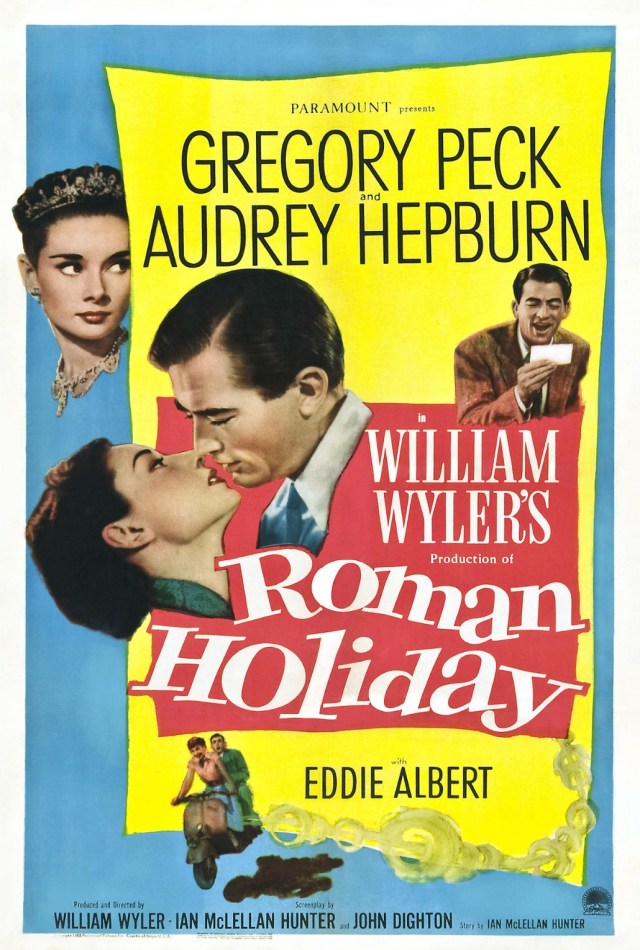
Reviewing Roman Holiday is a full circle moment for me. Back in 2019, the Hallmark Channel movie, Rome in Love became one of the top three best films I saw that year. That movie was about a woman starring in a remake of Roman Holiday. I also read the book Rome in Love was based on. When I signed up for the Journey to Italy Blogathon, I was surprised no one had chosen the 1953 production. Because Roman Holiday is considered a “classic”, I would have expected the movie to be one of the first to be selected. So, I was grateful for the opportunity to check out the film! Audrey Hepburn and Gregory Peck are no strangers to 18 Cinema Lane. Some of their films have been covered on my blog. In fact, there’s been a few pictures I’ve liked; such as Funny Face, The Nun’s Story, and To Kill a Mockingbird. How does Roman Holiday compare to those movies? Find out in this review!

Roman Holiday poster created by Paramount Pictures

Things I liked about the film:

The acting: Roman Holiday introduced cinema’s audience to Audrey Hepburn as a lead actress. Not only that, the 1953 presentation earned Audrey an Oscar. Thinking about her portrayal of Princess Ann, I can understand why Audrey was, at least, nominated for an Academy Award! Even though this was her first starring role, Audrey proved her talents were strong enough to appear convincing. A great example happened when Princess Ann was sleepily wandering around Rome. Through her wanderings, Princess Ann meets Joe Bradley (portrayed by Gregory Peck). The stumbling and mumbling of Princess Ann make her look drunk. Even Joe thinks Princess Ann had too much to drink, due to her speech sounding slurred and her eyelids consistently rising and falling. In Audrey’s performance, Princess Ann proves looks can, indeed, be deceiving.

One of my favorite scenes in Roman Holiday takes place toward the beginning of the story. During a ball, Princess Ann’s shoe is visible on the floor. The shoe was noticed by Countess Vereberg (portrayed by Margaret Rawlings) and General Provno (portrayed by Tullio Carminati). But the way these characters looked at each other and the shoe communicated the shock and embarrassment they were feeling. With the use of eye movements and facial expressions, this exchange was such a hilarious moment! Another performance I liked was Gregory Peck’s portrayal of Joe Bradley! A newspaper reporter from the United States, Joe had a consistent confidence that made him sure of himself. His reactions appeared believable; from a surprised look at seeing Princess Ann’s portrait in the paper to the joy on his face while dancing on a boat. Gregory used a variety of emotions throughout the film. This is one of the reasons Joe became a likable character!

The Italian setting: During the opening credits of Roman Holiday, it’s revealed the production was filmed in Rome, Italy. Through the cinematography and screenwriting, Princess Ann’s time in Italy served as an introduction to the film’s audience. Several iconic landmarks were featured; including the Colosseum, the Trevi Fountain, and the Mouth of Truth. There were even some lesser-known areas from The Eternal City included in the story. During Princess Ann’s day in Rome, she and Joe visit a wall of granted wishes. As explained through dialogue, if someone’s wish came true, they must place a commemorative plaque on the wall. Unfortunately, I couldn’t find any confirmation this wall actually exists. But if it is real, I loved this tradition!

Avoiding the “it’s not what you think” cliché: In Roman Holiday, Joe Bradley makes a bet with his boss to conduct an interview with Princess Ann, including photos to prove the interview took place. This, along with Joe keeping his identity a secret, provided the perfect excuse to include the “it’s not what you think” cliché. However, the film’s creative team didn’t utilize this predictable piece of story-telling. Instead, Joe changes his mind about the bet, which gave him some character development. Even Joe’s friend, Irving Radovich, reconsiders submitting his photographs of Princess Ann’s adventure. After watching my fair share of rom-coms where the same tropes and clichés are incorporated, I appreciate Roman Holiday thinking outside the box!

The Journey to Italy Blogathon banner created by Gill from Realweegiemidget Reviews and Kristina from Speakeasy.

What I didn’t like about the film:

A drawn-out story: Roman Holiday has a run-time of one hour and fifty-eight minutes. While watching the movie, that run-time was felt. The story of Princess Ann running away to go on an adventure was drawn-out. One reason is how some moments are longer than necessary. A perfect example is when Princess Ann meets a group of reporters. Each introduction was a slow procession that seemed to last about a minute and a half. Another example is when Princess Ann’s governess reads an itinerary. She slowly reads each event listed on Princess Ann’s schedule, making that part of that scene feel like almost a minute had crawled. To avoid this flaw, the script needed to be tighter.

Little sense of urgency: As I already brought up in this review, Princess Ann runs away to go on an adventure. While Princess Ann was having the time of her life, those in her life were frantically trying to find her. But very few scenes stressed this point. In fact, only three scenes addressed the urgency of bringing Princess Ann home. By providing the story with little sense of urgency, the seriousness of Princess Ann going missing was downplayed. Though I recognize how Roman Holiday is primarily Princess Ann’s story, her actions having consequences were mostly ignored.

Almost no one recognizing Princess Ann: The reason Princess Ann spends time in Italy is because the country was included in her “goodwill tour”. Shortly after running away, Princess Ann’s portrait is printed in every Italian newspaper, according to Joe Bradley’s boss. However, throughout Princess Ann’s adventure, only two people recognize her; Joe and his friend, Irving Radovich. Even before Princess Ann receives a hair-cut, no one acknowledges her true identity. I know fictional stories like Roman Holiday require a suspension of disbelief. But I couldn’t take that part of the movie seriously.

Princess tiara image created by Freepik at freepik.com. <a href=’https://www.freepik.com/free-vector/ornamental-princess-crowns_1109199.htm’>Designed by Freepik</a>. <a href=”https://www.freepik.com/free-photos-vectors/gold”>Gold vector created by Freepik</a>. Image found at freepik.com.

My overall impression:

Before reviewing Roman Holiday, I had heard so many good things about the movie. As I said in the introduction, the film is considered a “classic”. This is definitely not a bad picture. But I wanted to like it more than I did. Roman Holiday’s run-time feels as long as it is. At almost two hours, the story is drawn-out, partly due to moments that last longer than necessary. Having little sense of urgency not only downplays the seriousness of Princess Ann running away, it also mostly ignored Princess Ann’s actions having consequences. However, I believe the 1953 production has merit. The acting was one of the strongest aspects of this movie. Like I said in my review, I can understand why Audrey was, at least, nominated for an Academy Award! I actually think Roman Holiday should have been included in American Film Institute’s 100 Movies list. According to IMDB, it was “the first American film to be made in its entirety in Italy”. While I’m thankful for the chance to have finally seen Roman Holiday, I prefer Audrey’s pictures like The Nun’s Story and Funny Face. For Gregory Peck, I still believe To Kill a Mockingbird is the stronger movie.

Overall score: 6.1 out of 10

Have you seen Roman Holiday? Which films from Audrey Hepburn’s or Gregory Peck’s filmography do you like? Please tell me in the comment section!

Have fun in Italy!

Sally Silverscreen

Take 3: A Room with a View Review

My approach to February’s Genre Grandeur is similar to my approach for last month’s blogathon. As the theme this time around is ‘movies that take place or feature Italian settings’, I could have selected one of several Hallmark productions where Italy serves as the story’s backdrop. Instead, I overlooked the realm of Hallmark for a movie that happened to be on my DVR; 1985’s A Room with a View! When I discovered the film’s protagonist, Lucy, travels to Florence, Italy, I knew it would the perfect selection for this month’s Genre Grandeur. Because my choices for 2023’s blogathon have, so far, featured a female protagonist traveling abroad (A Room with a View and Black Narcissus), I saw this is as a very interesting coincidence. In my review of Black Narcissus, I thought the 1947 film was just ok, as the movie emphasized style over substance. Did I feel the same way about A Room with a View? Take a trip through this review to find out!

A Room with a View poster created by
Merchant Ivory Productions, Goldcrest Films, FilmFour International,
Curzon Film Distributors, and Metro-Goldwyn-Mayer

Things I liked about the film:

Interactions between characters: A Room with a View is an ensemble film, with the actors and actresses coming from all walks of life and journeys in their careers. The characters reflect this idea, as they travel to Italy for various reasons. Because of everything I just said, it was interesting to see each interaction between the characters unfold. One of the funniest scenes was shared between Charlotte, portrayed by Maggie Smith, and Eleanor, portrayed by Judi Dench. Eleanor is a writer, a woman who adopts a more romantic view of the world. Meanwhile, Charlotte is more of a realist, someone who views the world through a practical lens. As they explore Florence, Eleanor encourages Charlotte to breath in the scent of the city, in an attempt to make the most of their traveling experience. Instead, Charlotte puts a handkerchief over her nose, as she and Eleanor just walked past a group of smokers. Due to the screenwriting, as well as Judi’s and Maggie’s performance, this scene elaborates my aforementioned points!

The scenery: As I stated in the introduction, I chose to review A Room with a View because of Lucy’s trip to Florence. Therefore, my discussions about the movie’s scenery will focus on the Italian background. Toward the beginning of the film, Lucy visits a cathedral. In the interior of this massive structure, the main hall is surrounded in light gray stone. Symmetrical stone columns with matching hue and carved designs burst from the cathedral’s high ceiling. Filled with giant statues, a sprinkling of candles, and artwork within the cathedral’s alcoves, the large scale of this space was captured well through various camera angles!

During Lucy’s trip, she and several tourists visit Florence’s countryside. While enjoying their picnic, the characters sit on rolling green hills, coated in varying shades of green. Trees proudly stood among the guests, joining their event from a distance. A few red-orange poppies poked out of the sea of grass, providing the landscape with a pop of bright color. Wrapped up in a clear, sunny sky, Florence’s countryside looked postcard perfect!

Lucy’s wardrobe: Since this was my first time watching A Room with a View, I had no expectations when it came to Lucy’s wardrobe. But as the story progressed, I found myself adoring Lucy’s attire, as it was classy and elegant! An excellent example is what Lucy decided to wear to her piano recital. Lucy wore a cream-colored gown with puffed lace sleeves. The scooped neckline was surrounded by embroidered flowers. Sparkles covered the bodice of the dress, providing just enough twinkle. Paired with a jeweled belt, Lucy’s gown was simply beautiful!

Italian countryside image created by Bill Silvermintz at freeimages.com. “FreeImages.com/Bill Silvermintz.” Photo by <a href=”/photographer/edudflog-58908″>Bill Silvermintz</a> from <a href=”https://freeimages.com/”>FreeImages</a&gt;.

What I didn’t like about the film:

The drawn-out story: A Room with a View’s primary focus was Lucy’s growing attraction for George, who she met on her trip to Florence. But alongside that part of the story were situations involving the other characters from this ensemble. These situations were competing against one another for the audience’s attention. One situation happened after Lucy came home to England. She tries to recruit some of the trip’s guests to stay in a local cottage. Her fiancé, Cecil, recruits guests to the cottage, who just so happen to be George and his father. However, the emphasis on the cottage’s status is one of the reasons why Lucy’s attraction for George isn’t resolved until the last forty minutes of the movie. Because of these things and the film’s two hour run-time, the story itself felt drawn out.

Lack of on-screen chemistry: Helena Bonham Carter and Julian Sands, the actors who portrayed Lucy and George, did a good job with the material they were given. But when their characters were interacting together, I didn’t feel a strong sense of on-screen chemistry. A reason why is because of how infrequently George and Lucy crossed paths. Within the film’s first forty minutes, Lucy and George spend time together in about two or three scenes. Shortly after those first forty minutes, Lucy becomes engaged to Cecil, a character who a) was never brought up during the Florence trip and b)didn’t appear on screen until forty minutes into the film. Even after the engagement, George and Lucy’s time together isn’t consistent. This resulted in the missed opportunity to watch this relationship grow over time.

The title cards and on-screen text: At various moments in A Room with a View, title cards announced when a character was about to do something. On-screen text would sometimes replace these title cards. One example takes place when Lucy and several tourists travel to Florence’s countryside. Before their excursion, white text appeared on the screen, explaining what they were about to do. I was not a fan of this creative decision because these title cards and on-screen text told the audience what they could see or figure out for themselves. This creative decision was also not consistently featured in the movie.

Hand-written letter image created by Veraholera at freepik.com. <a href=”https://www.freepik.com/free-photos-vectors/background”>Background vector created by Veraholera – Freepik.com</a>. <a href=’https://www.freepik.com/free-vector/love-letter-pattern_1292902.htm’>Designed by Freepik</a>. Image found at freepik.com.

My overall impression:

When it comes to A Room with a View’s style, this movie excels! It’s a pretty looking film, as the scenery, set design, and even Lucy’s wardrobe made the production pleasant to the eye. But when it comes to the substance, the film falls short. I didn’t find the story compelling, which is caused by the story itself being drawn out. I also did not sense strong on-screen chemistry between Helena Bonham Carter and Julian Sands. The more historical fiction/period drama media I consume, I find myself, more often than not, gravitating toward stories whose casts are smaller. This creative decision prevents the stories from competing for attention, as there are less characters to keep track of. Because A Room with a View contained an ensemble cast, there were so many ideas brought up and so few time to address it all. As the saying goes “time flies when you’re having fun”.

Overall score: 6.1 out of 10

Have you seen A Room with a View? Do you prefer movies with bigger or smaller casts? Please tell me in the comment section below!

Have fun on your travels!

Sally Silverscreen

Take 3: A Matter of Time Review (A Month Without the Code #4)

Because I’m participating in Pure Entertainment Preservation Society’s A Month Without the Code and the 5th Wonderful Ingrid Bergman Blogathon, I wanted to review one of Ingrid’s films from outside the Breen Code era. On her IMDB filmography, the 1976 movie, A Matter of Time caught my eye. After reading the synopsis, I chose this film as my submission for the blogathon! I was able to watch the movie through a series of videos from the Youtube channel, BroadwaytoRio. The film was broken down into ten parts, each video about ten minutes long. Prior to these blogathons, the only movies of Ingrid Bergman’s I have seen are Casablanca and Gaslight. Both of these films were not only released in the ‘40s, they were also released in the Breen Code era. As this is the first time I’m reviewing a post-1954 movie of Ingrid’s, it’ll be interesting to see how A Matter of Time differs from her two previously mentioned films!

A Mater of Time poster created by American International Pictures. Image found at https://www.imdb.com/title/tt0074878/mediaviewer/rm3625653248.

Things I liked about the film:

The acting: Since I chose to review this movie for the Ingrid Bergman Blogathon, I’m going to talk about her performance first. Ingrid’s role in A Matter of Time is different from her other roles I’ve seen so far. In this film, she carried herself with a sense of power and authority, demanding the audience to focus their attention on her. At the same time, she held mystery and sorrow close to her character’s heart. In the scene where Ingrid’s character, the Contessa, is talking to her ex-husband, she brings so much emotion during the conversation, that the scene itself feels earth-shaking. Even toward the end of her acting career, Ingrid still had what it took, acting wise, to carry a film! Last October, I reviewed the 1991 film, Stepping Out. While watching A Matter of Time, I immediately noticed how Liza’s character was different from the one she portrayed in the aforementioned ‘90s film. Nina, the protagonist of this story, grew as a person over time. She transformed from a timid young woman to someone who knew what she wanted in life. One scene shows Nina having a disagreement about the Contessa with a screenwriter. During this scene, she breaks out of her timid shell to defend her friend. It causes a fire to break forth from Nina, something the audience hadn’t seen up until that point. Similar to Ingrid’s performance, Liza’s portrayal of Nina in that scene was so powerful, it made this character a force to be reckoned with. The emotionality was very strong in Liza’s performance!

The scenery: Even though most of this movie takes place indoors, it did feature some nice scenery! A scene where Nina travels to the city showcases some of the sights of Rome and Venice, where A Matter of Time was filmed. Through her bus window, monuments and mammoth sized buildings are set against a clear, blue sky. Earth tone limestone covered some of the facilities, contrasting the black concrete roads leading to them. More sights from Rome and Venice could be seen in a montage where Nina goes sightseeing. Shots of the city’s landscape emphasis the large scope of this particular location. Statues served as everlasting art that patrons could enjoy in any season. Even some foliage was included in this montage, with red-ish trees located near a ledge and around a town center. These shots highlighted some of the most photogenic parts of these cities, potentially encouraging some viewers to plan their next vacation!

The messages and themes: While I wasn’t expecting A Matter of Time to contain relatable messages and themes, I appreciate their inclusion in this story. They were timeless and felt just as relevant now as they did in the mid to late ‘70s. One message revolved around being yourself. Even though this particular message has been shared on numerous occasions, it was nice to hear it coming from the Contessa. It was given as wisdom to Nina, in an effort to help her create her own path in life. An unexpected theme in A Matter of Time was mortality. Throughout the movie, the Contessa refuses to share her life story, saying, “My life belongs to me alone. I tell it only to myself”. She also says, “No one is dead. No one dies unless we wish them to”. These quotes speak volumes about the importance of a life story and the effort of keeping a person’s memory alive. It also reminds viewers how long life can feel, even when time seems so short.

The 5th Wonderful Ingrid Bergman Blogathon banner created by Virginie from The Wonderful World of Cinema. Image found at https://thewonderfulworldofcinema.wordpress.com/2020/06/12/announcing-the-5th-wonderful-ingrid-bergman-blogathon/.

What I didn’t like about the film:

Lack of magic: There was a crawling text at the beginning of the film. In this text, it says “What you are about to see may appear like a fairy tale…as we all know some fairy tales come true”. The text also says that Nina experienced a “magic moment”. This gave me the impression that A Matter of Time would be a modern fairy tale, similar to a film like the Hallmark production, Midnight Masquerade. If that was the creative team’s intention for the 1976 movie, they forgot one important ingredient: magic. In a modern fairy tale story, there needs to be a sense of whimsy or magic included in the narrative. The Halloween party in Midnight Masquerade showcases how a feeling of magic can be incorporated into a modern setting. A Matter of Time does not contain that feeling. If anything, it feels more like a drama than a fantasy. The movie makes it seem like Nina was conveniently at the right place and time instead of stumbling across a bit of magic.

The dream sequences:  Dream sequences appeared at certain points in the movie. These sequences were elaborate in nature, showing Nina living a life of glamour and luxury. While the dream sequences looked nice, I found them confusing. There was no distinction if they were dreams or future events from Nina’s life. Smooth transitions were not given to these scenes, making it feel like they were plunked into the story. I understand the dream sequences were meant to add some pizzazz to the overall picture. But their randomness prevented them from making a significant impression.

Grainy film quality: I know the quality of film from the 1970s is going to be different by today’s standards. Since that time period, technology and film-making have progressed tremendously. The presentation of A Matter of Time was grainy, making the production look like it hasn’t aged as well as other movies from the ‘70s. Because of the overall film quality, there were times when I had difficulty seeing characters’ facial expressions. I’m not sure if the videos I watched were recorded from a VHS tape or if that was the movie’s original presentation. But it’s not a good sign if I have trouble seeing what’s on screen.

A Month Without the Code Blogathon banner created by Tiffany and Rebekah Brannan from Pure Entertainment Preservation Society. Image found at https://pureentertainmentpreservationsociety.wordpress.com/2020/07/27/announcing-amonthwithoutthecode2020/.

My overall impression:

To me, A Matter of Time is an ok film. It has components of value; which are strong acting performances, nice scenery, and relatable messages and themes. However, the story is one that audiences have heard before and after the film’s 1976 release. Stories are inevitably going to get repeated over the course of time. When this happens, it’s important for a film’s creative team to find something that sets their project apart. With A Matter of Time, nothing new or unique is offered to the table. It feels like the overall production is ignoring their own message of being yourself. Even though this was a theatrically released project, it came across like a made-for-TV movie with a slightly higher budget. This statement is not made to disrespect television films, as there have been some good ones created over the years. What I mean is the presentation of this movie didn’t justify a theater release. Even though A Matter of Time has a PG rating, there are some pieces that would not appear in a Breen Code era film. These pieces are the following:

  • Some of the language in this script would be objectionable by Breen Code standards. There were times when the characters either swore or used God’s name in vain.
  • Some sexual references were made throughout the story, from Nina referring to a specific body part to a screenwriter wanting to create a violent scene for his upcoming movie.
  • A screenwriter named Mario attacks Nina while she is cleaning his room. Though he is acting out a scene from his script, the act itself would never appear in a Breen Code era movie.
  • Nina wears three dresses that have a low neckline. Even though one of these dresses is paired with a sweater, the sweater is never buttoned up.
  • There are two scenes where it is implied that Nina is not wearing any clothes. One of these scenes is briefly shown during a montage, showing a profile of Nina from her shoulders upward. The second scene shows Nina changing from one outfit to another. Only her back and her shoulders are visible.

Overall score: 6 out of 10

Have you seen any movie from Ingrid Bergman’s filmography? Which actress would you like to see receive their own blogathon? Feel free to share your thoughts in the comment section!

Have fun at the movies!

Sally Silverscreen

Take 3: Hallmark Hall of Fame’s In Love and War Review

For The World War II Blogathon, I wanted to talk about a film that no one else had chosen. With this idea in mind, I figured that if anyone was going to review a Hallmark movie, I knew it was, highly likely, going to be me. More often than not, Hallmark Hall of Fame films have told cinematic stories surrounding World War II. Out of all the Hallmark Hall of Fame movies that would be eligible for this blogathon, In Love and War is one that I hadn’t seen. This particular film is based on a true story, using a memoir by Eric Newby as the basis for the cinematic narrative. Within the past five years, true stories are rarely found in Hallmark Hall of Fame presentations. Since this is the first Hallmark Hall of Fame movie I’ve reviewed that does feature a true story, I knew it would a treat for my readers and followers!

20190901_174811[1]
Yes, I purchased a copy of this film so I could write an honest review about it. Screenshot taken by me, Sally Silverscreen.
Things I liked about the film:

The acting: More often than not, Hallmark Hall of Fame movies are known for having talented casts. In Love and War is no exception to this tradition! Callum Blue did a really good job portraying Eric Newby. With believability and versatility, his character was awestruck by the beauty within his surroundings, while not being fazed by reality. Callum effectively portrayed a soldier who hadn’t been too hardened by war and tragedy. I also enjoyed seeing Barbora Bobulova’s performance! She portrayed Wanda, the woman who stole Eric’s heart. Barbora had a very pleasant on-screen presence and flawlessly pulled off an Italian accent. She also used a wide range of emotions, making her character seem as realistic as possible. These are just some of the reasons why her performance was very memorable.

The scenery: The Italian countryside is the only location featured in this film. Despite that fact, the movie’s creative team used this environment to their advantage, especially when it came to story-telling. Even though war had cast a shadow on Wanda’s town, it never lost its quaint charm on screen. This picturesque setting showed that restoring peace in the world could be possible. Seeing the fields and farmlands in the film showed a different perspective of this particular country. When the Italian countryside is incorporated into cinematic stories, it seems like it is, more often than not, romanticized. It also makes it feel like this location can never be touched by the harshness of reality. In Love and War’s scenery was pretty to look at, but it also shows that no space is safe from such a catastrophic event.

The on-screen chemistry: Even though Callum and Barbora were not on screen together for very long, they did have good on-screen chemistry. Eric and Wanda’s relationship was very sweet, containing the amount of sentimentality that makes sense for a Hallmark production. Whenever they spent time together, these characters seemed to truly care about one another. Despite coming from two different backgrounds, their love for each other was able to help them find a common ground. Through communication and understanding, Eric and Wanda were able to learn about the other person as well as about themselves. Because Callum and Barbora’s acting performances were good, they were successfully able to bring these elements to their characters.

italian-villa-in-winter-1221097-1280x960
Italian countryside image created by Bill Silvermintz at freeimages.com. “FreeImages.com/Bill Silvermintz.” Photo by <a href=”/photographer/edudflog-58908″>Bill Silvermintz</a> from <a href=”https://freeimages.com/”>FreeImages</a&gt;.

What I didn’t like about the film:
Low stakes: Throughout the film, Eric becomes  a Prisoner of War and tries to escape from the clutches of the Nazis. However, all of the stakes in this movie felt low. When Eric and his team become prisoners, their situation doesn’t appear or feel harsh. Even when Eric did experience a harsh condition, the effects were temporary. The clear and present danger, which were the Nazis, appeared in the film when it was convenient for the plot. It seemed like Eric wasn’t in as much danger as the movie wanted us, the audience, to think.

An imbalance between peace and conflict: Hallmark films are known for containing a good amount of positivity and making their audience feel good about the film they’re watching. But because In Love and War largely focused on the movie’s more peaceful moments, it made the moments involving conflict seem sparse. This flaw contributes to the previous problem that I just talked about: lower stakes. It also doesn’t create a healthy balance between the two ideas. The imbalance between peace and conflict made the “war” part of In Love and War seem like a distant aspect of the story.

No action: Everyone’s story from the time of  World War II is going to be different. Since the film’s story is about a member of the military who entered enemy territory, having no action in the film makes it feel like something is missing. Not only were there no battles, but there was no fighting in sight. The only scene that involved any amount of military action was when an enemy plane flew over Eric and his comrades. However, this scene ended up being very brief.

World War II on Film Blogathon
The World War II Blogathon banner created by Jay from Cinema Essentials & Maddy from Maddy Loves Her Classic Films. Image found at https://maddylovesherclassicfilms.wordpress.com/2019/04/29/announcing-the-ww2-blogathon/.

My overall impression:

The two most common cinematic stories surrounding World War II involve the American perspective and the Holocaust. While these stories are important, it can feel like other World War II related stories get overshadowed. In Love and War takes a unique approach to this subject, focusing on the British and Italian perspectives. Through these perspectives, interesting ideas get the chance to be expressed. Some examples are standing against group mentality, relying on the kindness of strangers, and changing a person’s way of thinking. As a film about this particular time-period, I liked In Love and War for what it was. At best, this is a decent movie that has its strengths. But, as a Hallmark Hall of Fame production, it didn’t leave as big of an emotional impact as other films from this collection have. I will say that this film is a good introduction to not only Hallmark Hall of Fame, but also to Hallmark movies in general. If someone likes a particular aspect of the movie, they will be able to find other Hallmark films that share similarities.


Overall score: 7 out of 10


What are your thoughts on World War II in film? Which Hallmark Hall of Fame movie do you like? Share your thoughts in the comment section!


Have fun at the movies!

Sally Silverscreen