Take 3: RKO 281 (1999) Review

Once upon a time, in 2019, I saw Citizen Kane for the first time. In my review of the film, and even in my list of ten classic movies I watched because of my blog, I stated how, in my opinion, Citizen Kane is not the flawless masterpiece almost everyone has made it out to be. As you’re reading this introduction, you’re probably wondering, “What does Citizen Kane have to do with July’s theme of Genre Grandeur? That movie isn’t about making movies”. No, it’s not. But the 1999 HBO movie, RKO 281, is. While looking for a title to review for the aforementioned blogathon, I stumbled upon RKO 281, a film I had never heard of prior to the event. When I learned the movie was about the creation of Citizen Kane, I knew I’d appreciate the 1999 project, especially since I saw and wrote about the 1941 film. It also gave me a reason to check out one of HBO’s made-for-tv titles. So, without any delay, let’s start this show of my RKO 281 review!
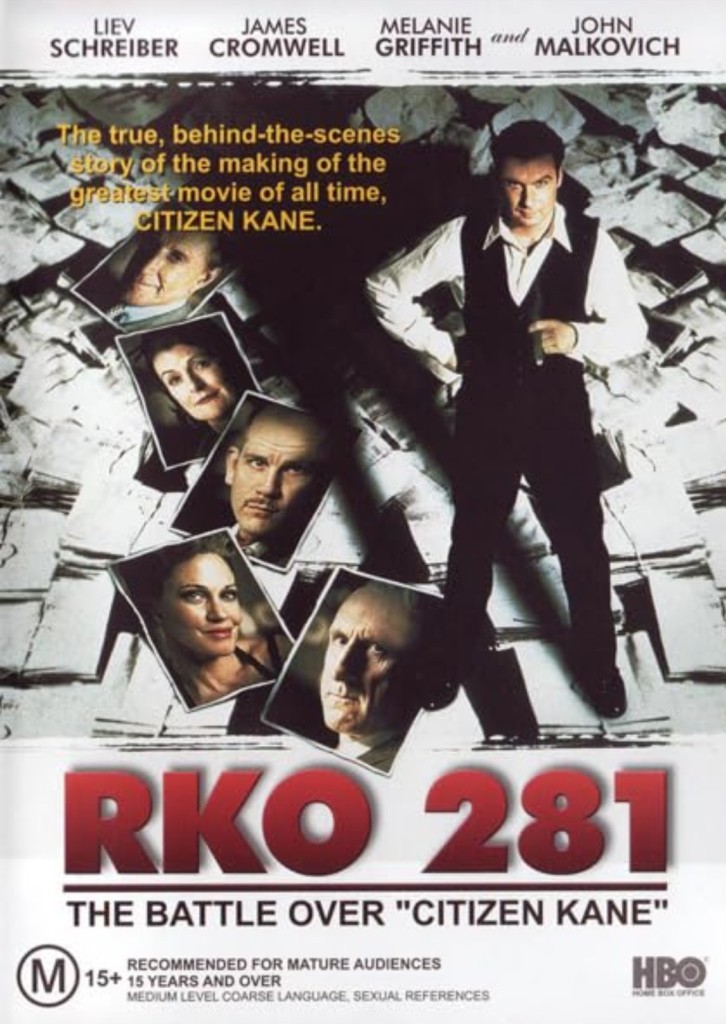
RKO 281 (1999) poster creatd by HBO Pictures, WGBH, Scott Free Productions, Labrador Films, BBC Films, and Home Box Office (HBO)

Things I liked about the film:

The acting: When we think about a name like Orson Welles, it can sometimes be easy to think of him as more than just a man with a dream. As Orson’s name became a staple of cinematic history, it also became what legends are made of. But Liev Schreiber, the actor portraying Orson, brought humanity back to that name, finding the heart of the “genius” and putting some genuine emotion behind it. While apologizing to Herman Mankiewicz after a falling-out between them, Orson shares a personal recollection about his father. After sharing a part of his soul with his friend, a smile appears on Orson’s face, relieved Herman has agreed to work on Citizen Kane. At the same time, you can see a tear has escaped Orson’s eye. This gives another meaning to Orson’s relief; the burdens of guilt and regret have lifted off his shoulders.

Liev Schreiber is not the only actor to use facial expressions and emotion to their advantage. Portraying William Randolph Hearst, James Cromwell was able to use these tools of acting to present William as more than just the story’s antagonist. When he finds out Citizen Kane is based on him, William is upset by this news. While talking about the situation with a woman named Louella, there is a sharpness to his voice, clearly indicating his bitterness toward the film. But the look in his eyes is that of defeat, questioning how someone was able to successfully build a bridge across the moat of his castle. In this scene, William’s face told more than dialogue could share; a man who gave everyone the impression he was in control, but was really unsure of what the future held.

Marion Davies was the mistress of William Randolph Hearst. Introduced to the audience in a party scene, Marion carried herself with a bubbly personality, almost being mistaken for “ditzy”. But Melanie Griffith prevented Marion from becoming a stereotype or caricature. With a variety of emotions, body language, and facial expressions, Melanie showed Marion as, simply, a woman in a complicated situation. One of my favorite scenes in RKO 281 was when Marion confronted William about his spending habits. Though in a drunken state, Marion addresses some excellent points. As she faces William, her voice is pleading. The desperation in Marion’s voice contains brutal honesty, giving her tone of voice some depth. She never breaks eye contact with William, showing how she isn’t afraid of standing up to “Pops”. Even though she does raise her voice, she only does this to emphasis her points. This scene elaborates how easily someone like Marion could be underestimated. While William saw Marion’s part of their conversation as “excessively theatrical”, I saw it as a woman who knew more about the situation than others were led to believe.

The set design: I’ve heard Hollywood referred to as the “Land of Dreams”. If that’s true, then the set design in RKO 281 was meant to visually represent a fairy tale! William Randolph Hearst’s castle is one of the most divine sets I’ve ever seen! So many details went into this location, it makes every space of the castle feel larger than life. From the marble fireplace held up by carved marble statues, to the large stained-glass windows boasting intricate colorful designs, to even a bath room with blue and green hued walls, William’s castle is a place beyond imagination. While the castle certainly stole the show, there were other sets that looked great on camera. During RKO 281, Orson travels to New York. In a scene showcasing Orson’s hotel room, his large, wooden bed was smartly paired with a red and beige blanket. The bed isn’t the only wooden piece of furniture in the room, as the desk, matching bedside tables, and even the walls display a warm shade of wood. Because of the tall window, the illusion of the room having a high ceiling is given to the audience. Filling the room with warm light from the lamps and the wall sconces, this high-end hotel room gave off a cozy atmosphere!

The film-making process: One of my favorite episodes of Murder, She Wrote is ‘Film Flam’. Watching the process of premiering a film is what made that episode fascinating to me. RKO 281 showed a similar process in their story. But this time, the entire film-making process was revealed. Glimpses of how Citizen Kane was made were woven into RKO 281. I learned some things about Citizen Kane because the film-making process was shown. For instance, I didn’t know Orson dug a hole into the floor just to get the shot he wanted. I also didn’t know that filming of Citizen Kane started two days ahead of schedule. It was interesting to see the various components that go into creating a film, especially during a time when technology wasn’t at a film-maker’s disposal. This peek behind Hollywood’s curtain can make one appreciate the work that goes into making a movie.

The dialogue: There is a lot of work that goes into writing a script. One important area of any script is the creation and delivery of dialogue. As I’ve said in past reviews, dialogue can be hit or miss, especially in a made-for-tv movie. In RKO 281, you can tell there was thought put into the dialogue of the script. In fact, I would go so far as to say the dialogue was, at times, profound. Remember when I said one of my favorite scenes was when Marion confronted William about his spending habits? One of the reasons why I like that scene is because of how well the dialogue was written and delivered. During the confrontation between Marion and William, Marion reminds him of the difference between wanting and needing something. She elaborates on this point by questioning how much a nearby statue cost, not caring about details such as where it was made or the style of the statue, details only William would bring up. Even at the very beginning of this scene, when Marion says, “Millions of dollars a year on art and statues, and there is nothing to explain” illustrates how Marion recognizes the severity of the situation. Meanwhile, as William responds to Marion by stating, “We are in no pickle, as you so euphemistically put it”, the script emphasizes William’s choice to use big words to not only belittle Marion’s intelligence, but also brush his problems under the rug.

Image of vintage movie camera created by Macrovector at freepik.com. <a href=”https://www.freepik.com/free-photos-vectors/background”>Background vector created by macrovector – http://www.freepik.com</a>. Image found at freepik.com.

What I didn’t like about the film:

The omission of the Breen Code: If you’ve read my movie reviews, you’d sometimes see the term ‘Breen Code’ mentioned in the text. For those unfamiliar with this concept, the Breen Code is a set of moral guidelines that had to be applied to film-making. Movies released between 1934 and 1954 formed the Breen Code era. Because Citizen Kane was released in 1941, I was hoping the Breen Code would play a role in the process of Citizen Kane’s creation. Unfortunately, the Breen Code wasn’t even mentioned. To me, the Breen Code is an underrated component in cinematic history. It would have been nice to hear it referenced in RKO 281’s dialogue.

Some parts of the story not receiving closure: Louella Parsons works for William Randolph Hearst as his “eyes and ears of Hollywood”. After she sees a rough cut of Citizen Kane, she informs William about the film resembling his life. Louella vows to get revenge against Orson for creating the movie, even going so far as to use blackmail in an attempt to cancel the film. But when William’s financial troubles come to light, her role in William’s life seems to have diminished. What happened to Louella after William’s financial situation was made public? Did she still work for him or did she end up working for someone else? This is just one part of RKO 281 that didn’t receive closure.

Keeping track of who’s who: As I mentioned in this review’s introduction, RKO 281 chronicles the creation of Citizen Kane. Therefore, the story follows those individuals connected to the project itself. Throughout the movie, though, members of the film industry from the late 1930s to the early 1940s were brought up in the dialogue. While I was familiar with some of these people, other names I did not recognize. It almost felt like RKO 281’s creative team expected the audience to know the film industry scene of that time. When I watch a film, I want to be told a story. If I end up learning something valuable by watching a movie, I feel that is time well spent. However, I don’t want to feel like I need to do homework prior to watching the film.
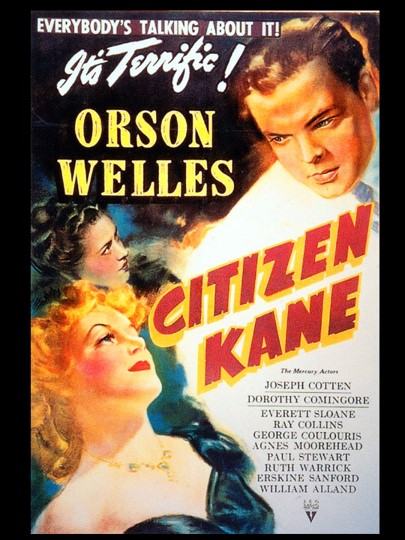
Citizen Kane poster created by Mercury Productions and RKO Radio Pictures. Image found at http://www.tcm.com/tcmdb/title/89/Citizen-Kane/#.

My overall impression:

Not all made-for-tv movies are created equal. Sometimes, a low amount of effort will be given to a made-for-tv production, making a presentation look and feel cheap. But there are made-for-tv projects that are solid, despite the limited resources and finances. RKO 281 is so well-made, it is easy to forget this is an HBO film, as this movie looked and felt theatrical! The creative team behind RKO 281 went above and beyond to make their project the best it could be! From the actors and the screenwriters to the set designers, every person involved with the 1999 movie stepped up their A game and it shows. The style and substance of RKO 281 go hand in hand. While I still don’t believe Citizen Kane is a flawless masterpiece, I’ve gained an appreciation for the efforts it took to make this film exist at all. Toward the end of RKO 281, Orson says “Pretty speeches make history”. If that’s true, then good films leave a lasting impression.

Overall score: 8 out of 10

Have you seen RKO 281 or Citizen Kane? Are there any HBO movies you’d like to see me review? Tell me in the comment section below!

Have fun at the movies!

Sally Silverscreen

Watching ‘Singin in the Rain’ for the First Time

Throughout my years of movie viewing (and blogging), I have received the opportunity to check out films boasting a “classic” status. This status has, in my opinion, been earned on some occasions, as I gained an understanding for why a particular movie was granted its praise. However, there were certain titles I found myself unable to figure out why it is considered a “classic”. Out of all these “classic” films, I have been meaning to see one specific picture. That title is Singin in the Rain. The 1952 production needs no introduction. From the song, “Good Morning”, being featured in an orange juice commercial to a replica of Gene Kelly’s umbrella in Disney MGM/Hollywood Studios, Singin in the Rain has carved out a slice in America’s pop culture pie. But for someone, like me, who hasn’t seen this iconic film before, these references are going to seem like a company, individual, or creative team is, simply, taking advantage of the movie’s 50+ year popularity. That replica is just used for tourists to have their photo taken. That song was just an appropriate selection to promote a beverage primarily found at breakfast-time. With the arrival and fruition of the Singin in the Rain Blogathon, I finally have a wonderful excuse to watch Singin in the Rain. It also gives me an opportunity to gain more context of the film’s respective songs, images, and quotes.

Singin in the Rain poster created by
Metro-Goldwyn-Mayer and Loew’s Inc.

Creative Musical Numbers

Singin in the Rain is not just one of the most iconic movies of all time, it’s one of the most iconic musicals of all time! A musical with a “classic” status will bring something unique and creative to the table. The Wizard of Oz took on the power of Technicolor, in a time when that specific technology was more of a luxury. Xanadu showed the world roller skating can be magical. When it comes to Singin in the Rain, the creativity lies in the musical numbers themselves, presenting performances that hadn’t really been seen before 1952. Toward the beginning of the film, Gene and Donald perform a duet, “Fit as a Fiddle (And Ready for Love)”, at a vaudeville show. Throughout this musical number, Donald and Gene not only tap danced, but played the fiddle as well. For the 21st century viewer, dancing and playing an instrument at the same time doesn’t seem like a new concept, as Lindsey Stirling has capitalized on those talents. Within the realm of cinematic musicals, however, a routine like Gene and Donald’s isn’t often included.

Gene Kelly’s famous solo isn’t the first musical number featuring rain. Two decades prior, in Just Around the Corner, Shirley Temple performed “I Love to Walk in the Rain”, her film’s big musical number that represented the spirit of the movie. Looking back on “Singin in the Rain”, I, personally, feel Shirley’s number walked (no pun intended) so Gene’s solo could soar! The solo from the 1952 production takes place after Gene’s character, Don, takes Kathy home. Despite it raining outdoors, Don is head-over-heels in love with Kathy. Gene tap danced in his solo. But unlike “I Love to Walk in the Rain”, “Singin in the Rain” felt more immersive, as it wasn’t just a performative routine. Because the number takes place within the story’s context, it feels grounded in reality, a downtown street replacing a glamourized stage. Watching Gene jumping and splashing in puddles added uniqueness to the routine. Even though “Singin in the Rain” wasn’t the big musical number for its respective movie, it represents the film’s spirit, reminding the audience to see the good in a not-so-good situation.

String of musical notes image created by Freepik at freepik.com. <a href=’https://www.freepik.com/free-vector/pentagram-vector_710290.htm’>Designed by Freepik</a> <a href=”https://www.freepik.com/free-photos-vectors/background”>Background vector created by Freepik</a>. Image found at freepik.com. 

Strong Camaraderie

In most of my reviews, I talk about the acting. I will choose a few performances to discuss and write about what I liked about them. For this review, I want to talk about a different acting component. While the overall acting in Singin in the Rain was strong, what stood out to me more was the on-screen camaraderie between Gene Kelly, Debbie Reynolds, and Donald O’Connor! One of my favorite scenes is when Don, Kathy, and Cosmo are concocting a plan to save Don’s film. Each character’s personality shines through during this brainstorming session. Cosmo encourages Don to turn the film into a musical, as he spontaneously breaks out into song. Meanwhile, Kathy attempts to keep the group’s good spirits lifted, her kind demeanor certainly helping the situation. After hearing Cosmo’s idea, Don is open-minded about it, joyously realizing he can use his talents to his advantage. This scene, as well as the “Good Morning” musical number, is just one example of Gene, Debbie, and Donald’s on-screen camaraderie. Through their interactions, it felt like Don, Kathy, and Cosmo had been friends all along. This on-screen bond was so pleasant, I looked forward to each time these characters crossed paths!

Couple performing the waltz image created by Macrovector at freepik.com. <a href=”https://www.freepik.com/free-photos-vectors/background”>Background vector created by macrovector – http://www.freepik.com</a>. Image found at freepik.com.

Learning about Cinema’s Early Years

Singin in the Rain takes place in the 1920s, during the transitional period between silent films and “talkies” (movies with sound). Even though the 1952 film is a musical that takes time to focus on its numbers, it lifts the figurative curtain enough to educate the audience on how film-making was executed in that time period. Don’s respective studio, Monumental Pictures, adopted sound after Warner Bros. took a chance with their film, The Jazz Singer, a high risk that was met with high rewards. Because of that one creative decision, it forever changed the cinematic landscape. As emphasized in the musical number, “Moses Supposes”, actors had to not only memorize their lines, they also had to remember to annunciate those lines. Singin in the Rain also shows the audience how dialogue is incorporated into a movie. As someone who appreciates the film-making process, it was nice to see this part of movie-making shown in steps. This step-to-step process was a good introduction to some of the work that goes on behind the camera.

Image of vintage movie camera created by Macrovector at freepik.com. <a href=”https://www.freepik.com/free-photos-vectors/background”>Background vector created by macrovector – http://www.freepik.com</a>. Image found at freepik.com.

The Context of “Broadway Melody” in Don’s Film

While working to adapt his film, The Dancing Cavalier, into a musical, Don proposes the movie’s new opening scene. This scene is presented as the musical number “Broadway Melody”. As a musical number in Singin in the Rain, I liked this performance! It had colorful set and costume design, as well as strong choreography. But as an opening scene in The Dancing Cavalier, the musical number, in my opinion, doesn’t work. “Broadway Melody” is too long, my guess is ten minutes. The number itself kind of feels like an extension of Don’s past, as his journey to Hollywood came from simpler beginnings. Based on what the characters said about The Dancing Cavalier, Don’s proposed opening scene seems to have little connection to that film’s story. If Don’s movie were a real picture, some audience members might become bored with the film before the story began.

New York City skyline with letters image created by Freepik at freepik.com. <a href=’https://www.freepik.com/free-vector/new-york-skyline-typographic-silhouette_719554.htm’>Designed by Freepik</a>. <a href=”https://www.freepik.com/free-photos-vectors/background”>Background vector created by Freepik</a>. Image found at freepik.com.

No Subplot for Cosmo

As I mentioned earlier in this review, I liked the on-screen camaraderie of Gene, Debbie, and Donald. In fact, I liked Donald’s character, Cosmo! Not only was he hilarious and charming, but he was talented as well! The story of Singin in the Rain primarily revolved around the main plot; Monumental Pictures attempting to save their latest film. There is a subplot in the movie, but it mostly focuses on Lina, Don’s co-star. I would have loved to see Cosmo receive his own subplot. Since his contribution to the studio is musical, Cosmo’s part of the story would have pulled back that figurative curtain a little further to show the audience cinematic work behind the camera. I’ve said in previous reviews how important music is in film. Without it, there isn’t an opportunity for viewers to become emotionally affected by a given scene. Because Cosmo is a musician, that aspect of film-making could have been explored.

Masks of comedy and tragedy images created by freepik at freepik.com. <a href=”https://www.freepik.com/free-photos-vectors/background”>Background vector created by freepik – http://www.freepik.com</a>. Image found at freepik.com.

A Love Interest That Wasn’t Meant to be

In my point about Cosmo not receiving a subplot, I mentioned how Singin in the Rain’s subplot mostly focused on Don’s co-star, Lina. Personally, I think more of that time should have been given to Cosmo. I know Lina is meant to be the film’s antagonist. I also know her actions and choices are intended to fuel the movie’s conflict. But why would Lina receive so much time when she and Don were never meant to be? Before and after the premiere of The Royal Rascal, people speculate about Lina and Don’s relationship. Even Lina carries the assumption she and Don are romantically involved with one another. But Don makes it pretty clear he is not romantically interested in Lina. This part of the story reminded me of a Hallmark movie cliché I’ve talked about in the past: the “protagonist’s ex showing up unannounced” cliché.

The Singin in the Rain Blogathon banner created by Ari from The Classic Movie Muse

In Conclusion

Before the Singin in the Rain Blogathon, I had never seen the event’s namesake. That means if someone were to tell me one of the movie’s quotes or if I heard one of the film’s songs, I wouldn’t have thought much of it. Now that I have finally seen Singin in the Rain, I have gained an understanding and appreciation for it! When Kathy first meets Don, she claims, when referring to films, that “when you’ve seen one, you’ve seen them all”. However, I’d argue the 1952 musical built a solid identity that affords it a distinction from other musical movies. Even though Singin in the Rain was released within the Breen Code era, I was pleasantly surprised by the good messages and themes in the story. When I talked about the movie’s on-screen camaraderie, I shared one of my favorite scenes; where Kathy, Don, and Cosmo were figuring out how to save Don’s film. Through this interaction, the message of being one’s self is stressed. This message also allowed Don to use his talents in his favor. When I reviewed The Bridge on the River Kwai, I wondered what the criteria was for lists such as AFI’s 100 Greatest  American  Movies of All Time. One of my speculations was titles that brought something new to the cinematic table. It should be noted that Singin in the Rain is on AFI’s list. While I don’t know for certain how it got there, I think I have a pretty good idea why it’s there.

Have fun at the movies!

Sally Silverscreen

Take 3: A Star Is Born (1937) Review

Prior to Pure Entertainment Preservation Society’s Fredric March Blogathon, I had never heard of Fredric March himself. But, as with any blogathon, it gave me a good opportunity to introduce myself to new films and talents! While exploring Fredric’s IMDB filmography, I discovered he starred in the 1937 version of A Star Is Born. This is a title I am familiar with because of its multiple remakes. However, this is my first time watching any version of the story. Based on what I’ve heard, A Star Is Born covers some heavier topics. Since the version I’m reviewing was released during The Breen Code era, it will be interesting to see how these topics are presented in the script. But this will never get discovered unless we read my article about A Star Is Born!

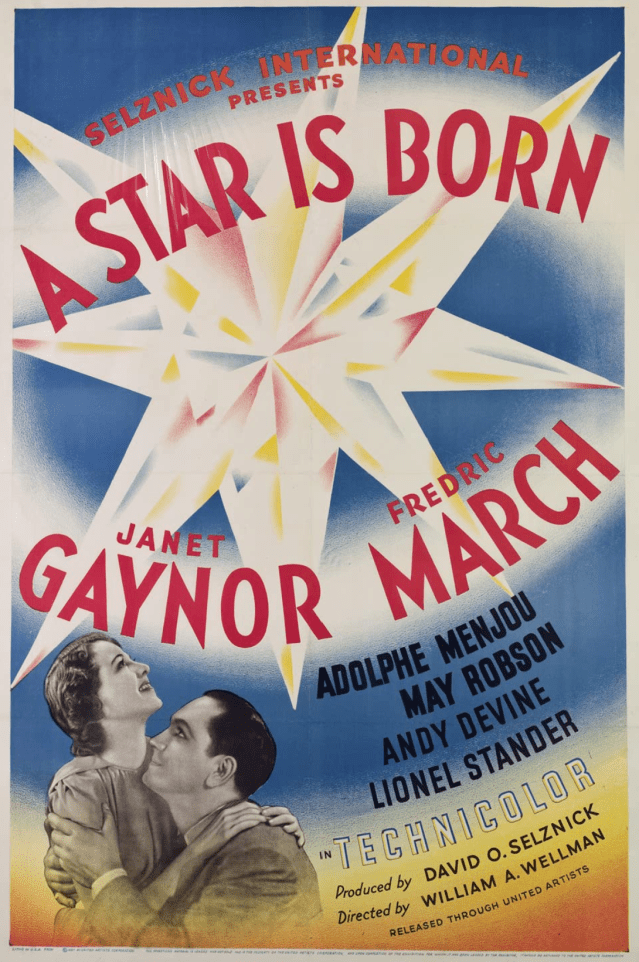
A Star Is Born (1937) poster created by Selznick International Pictures and United Artists

Things I liked about the film:

The acting: I’ll talk about Fredric March’s performance first, as is customary for a blogathon revolving around an actor or actress. Like I mentioned in the introduction, I had never heard of him prior to the event. However, I was really impressed with Fredric’s portrayal of Norman Maine! He did a good job of showing the delicate balance his character was walking; a public figure dealing with an addiction. His acting abilities were also expansive, ranging from dramatic to comedic. At a dinner party, Norman made funny faces when asking the bar-tender for a second drink. Moments later, he angrily threw plates on the floor, upset that Esther/Vicki was disappointed in meeting him. This is a good example of how Fredric can pull off a performance in both styles of acting!

Speaking of Esther/Vicki, I liked Janet Gaynor’s performance! Similar to Fredric March, she was very versatile while portraying the film’s leading lady. Her performance allowed the audience to witness Esther’s/Vicki’s growth as a character. At the beginning of the movie, Esther/Vicki started as a bright-eyed, hopeful young woman who wanted to jump into the world of show-business. As the story progresses, Esther/Vicki gains experience and wisdom, growing up along the way. Since Esther/Vicki and Norman spend most of the movie together, the audience is treated to the banter between Janet and Fredric! A perfect example is during a boxing match, when Norman asks Esther/Vicki to marry him. Both actors never missed a beat and complimented each other so well.

It was nice to see Esther’s/Vicki’s friendship with Danny McGuire. Portrayed by Andy Devine, Danny and Esther’s/Vicki’s friendship provided a bright spot among the film’s heavier moments. Despite being surrounded by the unpredictability of Hollywood, Danny had such a kind heart and was always in Esther’s/Vicki’s corner. This friendship was one of my favorite parts of A Star Is Born and I wish it had featured in the story more.

Showing how tough industry entry is: When Hollywood/show business is featured in a film’s script, the more serious or honest parts of the industry are sometimes glossed over, sugar-coated, or omitted. With A Star Is Born, the creative team wasn’t afraid to show how difficult it is to find success in entertainment. While waiting to apply for a casting agency, Esther/Vicki sees a poster on a wall. This poster stated the number of extras represented by that casting agency. Even though it was a simple moment, it illustrated how so many people shared the same dream as Esther/Vicki. While working a waitress job, Esther/Vicki uses that opportunity to impress the guests with her acting skills. Despite her best efforts, the majority of the guests don’t pay her much attention. Networking is important when it comes to finding employment. But Esther’s/Vicki’s experience shows how it’s not the “end all, be all” in any job search.

The use of mixed-media: Throughout A Star Is Born, different forms of media were shown on-screen. For a movie released in 1937, this was not only ahead of its time, but also a pleasant surprise! At the beginning and end of the movie, pieces of a script were featured. These pieces bookended the story, presenting the film as if it were a potential biographic movie. I thought this was a creative way to visually deliver this narrative. When Esther/Vicki finally gets a studio acting job, a close-up of her contract signature can be seen. Even though it was on-screen for a few seconds, it highlighted the reality of Esther’s/Vicki’s next step in her career. The film’s use of mixed-media provided additional context to the story, as well as emphasized important events within the plot.

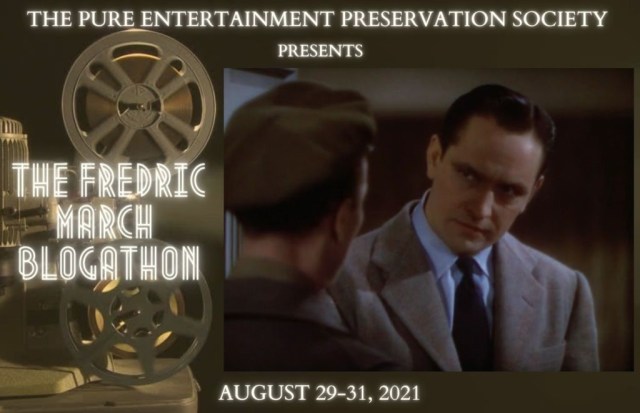
The Fredric March Blogathon banner created by the Brannan sisters from Pure Entertainment Preservation Society

What I didn’t like about the film:

Limited use of lighting: A Star Is Born featured some scenes that took place at night. But because of the limited lighting in these scenes, it was difficult to see characters’ faces. A great example is when Esther’s/Vicki’s grandmother is giving her granddaughter necessary advice. Throughout this scene, I was only able to see the side of Grandmother Lettie’s face or her face was completely hidden by the darkness. This ended up being a somewhat distracting part of the film. I know the aforementioned scene was supposed to take place while Esther’s/Vicki’s other family members were asleep. However, I think at least one lamp should have been kept on in the room.

Some rushed parts of the story: I understand there’s only so much story one can tell in an hour and fifty minutes. However, there were parts of A Star Is Born that, to me, felt rushed. After Esther’s/Vicki’s studio acceptance, she receives her first job: a small, walk-on role. While practicing her lines for this job, Norman recruits her for the lead role in one of his movies. This part of the story skipped over Esther/Vicki building her resume and earning that lead role. Instead of showing themes of hard work and perseverance, the rushed nature of this plot-point simply showed Esther/Vicki being lucky. Because of how rushed some parts of the story were, it, sometimes, felt like things were moving too fast. Norman and Esther’s/Vicki’s relationship serves as one example, with them getting married after knowing each other for a short period of time.

Omitted components: At the beginning of A Star Is Born, one of Esther’s/Vicki’s biggest doubters is Aunt Mattie. She feels that Esther/Vicki is wasting her time dreaming about something that, she feels, will likely not come true. But Esther/Vicki ends up proving her wrong, becoming a star in Hollywood. Unfortunately, we never see Aunt Mattie realize she was wrong or apologize for not supporting Esther’s/Vicki’s dream. If this had been included in the script, it would have provided an important component. I was surprised that The Great Depression was not mentioned during this story. Considering A Star Is Born took place during 1935 to 1937, I think it should have been brought up in context to the box office. In a newspaper article, it was mentioned how movie theaters were relieved of showing Norman Maine’s pictures due to a cancelled contract. But because The Great Depression could have directly impacted ticket sales, this should have also been considered by the characters.

Movie award essentials image created by Freepik at freepik.com. <a href=”https://www.freepik.com/free-photos-vectors/background”>Background psd created by freepik – http://www.freepik.com</a>. Image found at freepik.com. 

My overall impression:

If you had asked me a month ago who Fredric March was, I honestly wouldn’t have been able to give you an answer. Now that I have seen at least one of his films, I want to actively seek out more of his projects! Fredric’s performance in A Star Is Born was so strong, I was blown away by its versatility. I also liked seeing him perform alongside Janet Gaynor, as they not only worked well together, but they also had really good banter. While this movie does contain heavier subjects, they were handled in a reverent and mature way. At the same time, these subjects, like Norman’s alcohol addiction, were only brought up enough for the audience to get the point. In my three years of movie blogging, I’ve seen a number of Breen Code era titles. However, this version of A Star Is Born is definitely one of the better ones! As I mentioned in my review, it does have its flaws. Despite that, there’s a lot this movie gets right, making it worthy of a recommendation!

Overall score: 7.7 out of 10

Have you seen A Star Is Born? If so, which version is your favorite? Please let me know in the comment section!

Have fun at the movies!

Sally Silverscreen