Take 3: Dr. Terror’s House of Horrors (1965) Review

I’d like to thank Gill (from Realweegiemidget Reviews) and Barry (from Cinematic Catharsis). If it wasn’t for the hosts of The Hammer-Amicus Blogathon V, I wouldn’t have been introduced to the cinematic world of Hammer-Amicus. Since my introduction in 2021 (when I participated in my first Hammer-Amicus Blogathon), I’ve covered three Hammer-Amicus movies on 18 Cinema Lane; Vampire Circus, The Curse of Frankenstein, and Let Me In. While Vampire Circus was ok and Let Me In was just fine, I found The Curse of Frankenstein underwhelming. Now, with a recommendation from Barry (from Cinematic Catharsis), I’ve selected 1965’s Dr. Terror’s House of Horrors as the next Hammer-Amicus presentation to review! I knew almost nothing about this movie prior to choosing it for the blogathon. But I was willing to watch the film with an open mind. Since I finally checked out Dr. Terror’s House of Horrors, it’s time to start my review and share my honest opinion!
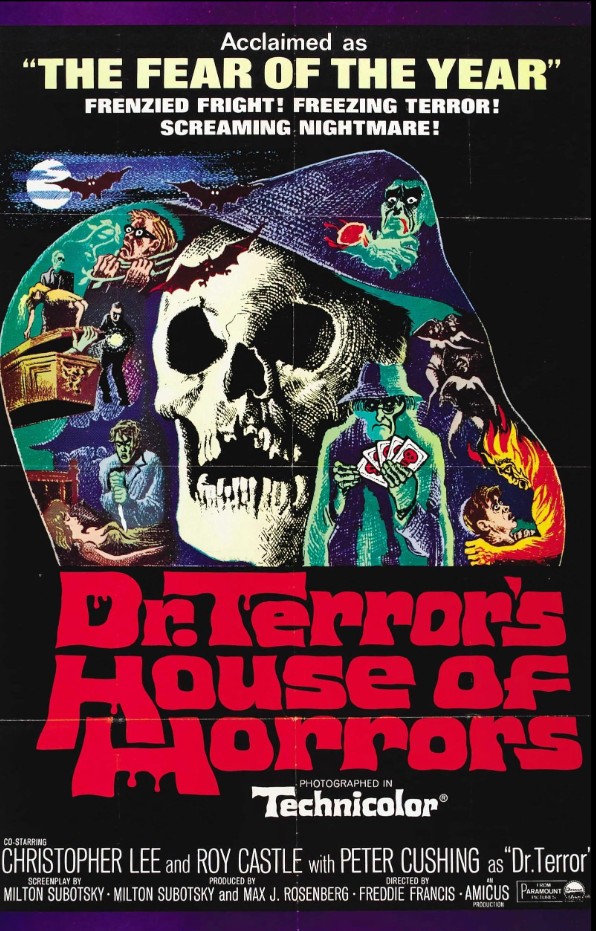
Dr. Terror’s House of Horrors (1965) poster created by Amicus Productions, Hollywood Classics International, Regal Films International, and Paramount Pictures

Things I liked about the film:

The interior design: Dr. Terror’s House of Horrors is presented like an anthology; five passengers learn their fate from Dr. Terror himself. Throughout the film, the audience takes a peek into each character’s life as well as their living/working space. These spaces featured interesting design choices that gave them their own distinctness. In the segments titled “Werewolf” and “Disembodied Hand”, a fireplace was the focal point in one room. The fireplace in “Werewolf” was covered in a glossy black paint, while the fireplace in “Disembodied Hand” shone in a glossy blue paint. Biff Bailey’s apartment in the segment titled “Voodoo” featured a zebra patterned couch, which actually complimented the black-and-white checkered floor and black-and-white striped walls. The design choices I described stood out due to the film’s creative team utilizing materials, patterns, and colors that were more unique. I can honestly say I’ve never seen a blue fireplace until I saw Dr. Terror’s House of Horrors!

Incorporation of music: In the segment titled “Werewolf”, Jim Dawson learns about a legendary werewolf buried in the basement of the home he’s remodeling. Any time this werewolf is brought up or poses a threat to the characters living and working in the home, drumbeats, the pattering of a xylophone, and other suspenseful musical sounds can be heard. This segment utilized music to emphasis the fear factor the werewolf contributed to the story. Because Biff Bailey is a musician, music plays a large role in the “Voodoo” segment. One of the songs featured in this specific segment is ‘Give Me Love’. Performed by Sammy Coin (portrayed by Kenny Lynch), the instrumentals provided a cheery jazz tune that can put any listener in a good mood. Kenny’s smooth vocals not only complimented the song itself, but also made me wonder what his vocals would sound like in a song with a more serious tone. ‘Give Me Love’ is one of those songs that is so memorable, I’ll listen to it long after the end of the movie!

The creativity of each story: As I mentioned earlier in this review, Dr. Terror’s House of Horrors is presented like an anthology. With the segments chronicling each of the five passengers, the creativity woven into the script highlighted the uniqueness every passenger brought to the train car! The segment, “Disembodied Hand”, revolves around Franklyn Marsh. An art critic who took his job a little too seriously, Franklyn carries guilt for how he mistreated a popular artist, with his guilt represented by the disembodied hand of that artist. Meanwhile, in the segment titled “Vampire”, Dr. Bob Carroll is confronted with the possibility his wife may be a vampire. This concept gave Bob an internal conflict between loving his wife and protecting his patients. In my review of 2010’s Let Me In, I said vampire stories can be as creative as film-makers want it to be. A similar statement can be said about the horror genre, with Dr. Terror’s House of Horrors presenting strong evidence.
The Hammer-Amicus Blogathon V banner created by Gill from Realweegiemidget Reviews and Barry from Cinematic Catharsis

What I didn’t like about the film:

No clear explanation for tarot cards: Throughout Dr. Terror’s House of Horrors, Dr. Terror (portrayed by Peter Cushing), predicts each passenger’s fate by selecting tarot cards. While the tarot cards themselves are shown on screen, no clear explanation for how exactly the cards correlate with the fates was given. Before the start of the “Werewolf” segment, Dr. Terror selects two cards called “Enchantress” and “Priestess”. But after watching that segment, I was confused by what werewolves had to do with those aforementioned cards? It seemed as if the creative team behind the movie assumed their audience would already know the meaning of the cards shown in the film.

Limited sense of urgency: Each segment in Dr. Terror’s House of Horrors incorporates a horror element that poses a threat to the passengers in Dr. Terror’s train car. These segments also contain a limited sense of urgency. Most of the time, the “slice of life” parts of the story were emphasized. When a suspenseful or horrifying moment was about to happen, the segment would end and move on to the next one. This flaw was the result of squeezing five separate stories into an hour and thirty-eight-minute film. I honestly think this script would have worked better as an anthology television series.

A frustrating ending: For this part of my review, I will be spoiling Dr. Terror’s House of Horrors. If you have not seen this film and are planning on watching it, skip ahead to the part of my review titled “My overall impression”.

Like I mentioned earlier in my review, Dr. Terror uses tarot cards to predict the fates of the five passengers. After these fates are revealed, he removes the death card from the deck. This implies all the passengers will eventually die. When the passengers get off the train, they learn through a newspaper article five passengers died in a train crash. That detail clarifies the passengers from Dr. Terror’s train car did, indeed, die, with Dr. Terror himself becoming a skeleton. Personally, I found this ending frustrating because it made the previous stories amount to nothing. While I recognize the movie’s creative team was trying to create the ultimate plot twist, with the death tarot card used as foreshadowing, this creative decision almost made me feel like I wasted my time watching Dr. Terror’s House of Horrors.
Scared audience image created by Katemangostar at freepik.com. <a href=’https://www.freepik.com/free-photo/terrified-friends-watching-horror-movie-in-cinema_1027311.htm’>Designed by Freepik</a>. <a href=”https://www.freepik.com/free-photos-vectors/people”>People image created by Katemangostar – Freepik.com</a>. Image found at freepik.com.

My overall impression:

Whenever I review a movie on 18 Cinema Lane, I present my opinion as honestly as possible. In my most honest opinion, Dr. Terror’s House of Horrors was such a mixed bag. On the one hand, I appreciate the creativity woven into each of the five segments. This creativity brought distinctness to the stories, interesting interior design choices, and good incorporation of music. But, on the other hand, the ending was too frustrating for my liking. I wish the script provided clear explanations for how the tarot cards correlated with each character’s fate. I also wish there was a stronger sense of urgency throughout the film. At best, Dr. Terror’s House of Horrors was just ok. But, at worst, it left me confused and frustrated. Though I’ve only seen (and reviewed) a few Hammer-Amicus films, I’m starting to wonder if I’ll find a title that is my cup of tea?

Overall score: 6 out of 10

Have you seen Dr. Terror’s House of Horrors? Which Hammer-Amicus film would you like to check out? Please tell me in the comment section!

Have fun at the movies!

Sally Silverscreen
Take 3: The Curse of Frankenstein Review

When I was first introduced to the world of Hammer-Amicus films, it was through the Third Hammer-Amicus Blogathon, hosted by Gill and Barry, from Realweegiemidget Reviews and Cinematic Catharsis. For that event, I reviewed the 1972 movie, Vampire Circus, which I thought was just ok. With the return of the aforementioned blogathon, I’ve decided to choose a Hammer-Amicus production that was recommended to me. Back when I wrote about Vampire Circus, Barry, from Cinematic Catharsis, suggested I check out several films, with 1957’s The Curse of Frankenstein being one of them. In my review of Frankenweenie, I mentioned how I haven’t seen many adaptations of Mary Shelley’s Frankenstein. To make up for lost time, I selected The Curse of Frankenstein for the blogging event!

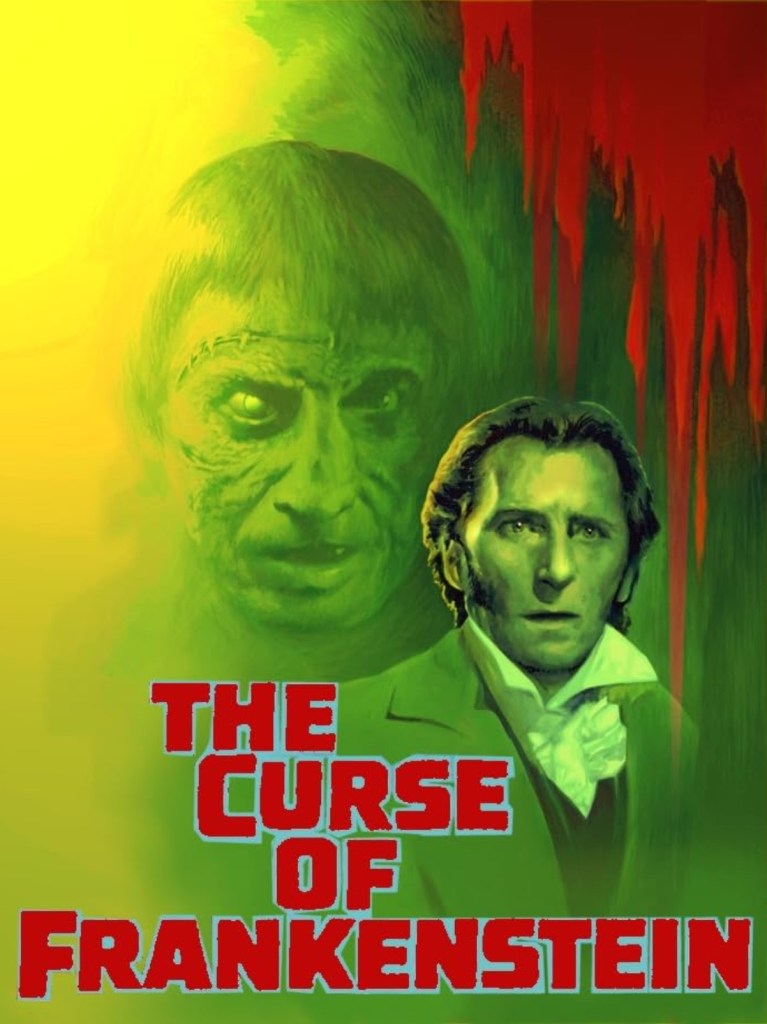
The Curse of Frankenstein poster created by Hammer Films and Warner Bros.

Things I liked about the film:

The use of WarnerColor: When discussing “classic” cinema, there has been a debate over whether a film should remain with black-and-white imagery or if it should receive the Technicolor treatment. In my opinion, I’m glad The Curse of Frankenstein was released in WarnerColor, which I believe was the studio’s version of Technicolor. This creative decision allowed certain elements within scenes to appear vibrant! In Victor’s laboratory, various jars and bottles were scattered throughout the room. Liquid filled these bottles and jars, boasting bright colors like red, blue, even purple. These hues provided a nice contrast to the gray walls of the laboratory. The incorporation of color worked in the favor of the film’s wardrobe department! While working on his experiment, Victor wore a beige three-piece suit. He also wore a maroon neck scarf, which gave his outfit a pop of color. Another character who wore a mostly beige outfit is Elizabeth, whose gown was covered in a silky beige material. Her dress featured a light blue bow and sash, providing the gown with a nice color combination!

Historical accuracy: Mary Shelley’s Frankenstein was published in 1818. Reflecting on The Curse of Frankenstein, it seems like the movie’s creative team kept this fact in mind as the project looked and felt historically accurate! Remember when I mentioned Victor wore a three-piece suit with a maroon neck tie? His friend, Paul, also wore a three-piece suit. Victor even wore a pocket watch, an accessory that he occasionally used. The attire of both Paul and Victor highlighted how men dressed in the 1800s. Home décor is also reflective of when a story takes place. In the upstairs hallway and in the sitting room of Victor’s house, the walls were covered in intricate wallpaper. The wallpaper, which featured elegant patterns, showcases the artistic details that homeowners in the 1800s favored.

The acting: From what I remember of Mary Shelley’s story, Elizabeth’s presence was very limited. Her appearances in the book were so small, readers only became familiar with her. In The Curse of Frankenstein, Elizabeth was given more appearances in the story. This allowed Hazel Court, the actress who portrayed Elizabeth, to present her character as a friendly woman with a likable personality! One scene I liked was when Elizabeth is having a debate with Victor and Professor Bernstein. Professor Bernstein warns Victor about being consumed by science, also reminding Victor of how he should use science for good. Elizabeth adds to the debate by stating it would be better for Victor to go outside and get some fresh air. The way she suggests this to Victor is of kind encourage. A pleasant smile is shown on her face and she is comfortably sitting in an armchair.

In order to bring his experiment to life, Victor recruits the help of his friend, Paul. Because of how often Paul interacts with Victor, Peter Cushing and Robert Urquhart share several scenes together. What Robert’s and Peter’s performance have in common is how effective they utilized emotion! As Victor is conducting his first experiment, bringing a puppy to life, Victor’s face is filled with curiosity. Realizing his experiment was a success, his face slowly transforms into happiness. Victor is so happy, even his eyebrows move. Anytime Paul is upset over Victor’s obsession with his experiment, Robert consistently presents his face with a stern look. His voice also sounds stern, with a hint of anger detected. Based on their performance in The Curse of Frankenstein, I was impressed by Peter and Robert’s acting talents!

The Hammer-Amicus Blogathon IV banner created by Gill from Realweegiemidget Reviews and Barry from Cinematic Catharsis

What I didn’t like about the film:

A prolonged appearance of Frankenstein’s creature: Within Mary Shelley’s novel, a key character is Frankenstein’s creature himself. Through interactions between the creature and Victor Frankenstein, readers are reminded of how some good intentions can lead to bad results, a message that overarches Mary’s story. In The Curse of Frankenstein, however, so much time is spent showing Victor creating the creature to the point where the creature doesn’t become alive until almost fifty minutes into this hour and twenty-three-minute movie. Even when the creature, portrayed by Christopher Lee, appears in the film, he is only on screen for a handful of scenes. He also doesn’t have many interactions with Victor.

Changed context: After watching Oliver! from 1968, I read Charles Dickens’ novel. Comparing the book to the film, I discovered how the creative liberties made to the adaptation changed the context of certain parts of the story. Since I have read Mary Shelley’s novel before seeing The Curse of Frankenstein, I took notice of how the 1957 movie changed the context of certain narrative parts. A great example is Victor’s motivation for creating the creature. Mary Shelley’s book explains how the inspiration for Victor’s experiment came to him at college. Victor was curious about whether he could, from a scientific perspective, create a human being out of nothing. The adaptation shows Victor being encouraged by his tutor to bring people back from the dead, after Victor and his tutor bring a puppy back to life. Looking back on The Curse of Frankenstein, it seems like some of these creative liberties were made just for the sake of it.

Some inconsistent parts of the story: There were some parts of The Curse of Frankenstein that were inconsistent. One example is Victor’s quest to create the creature. When his tutor encourages him to bring people back to life, Victor declares he will set out to create “the perfect man”, using the “hands of an artist” and the “brain of a genius”. Several scenes later, when Victor shows his friend, Paul, his progress, Paul is disgusted by what he sees. Victor states how the looks don’t matter, but how he brought the creature to life at all. But when Paul criticizes Victor for the creature’s lack of intelligence, Victor blames Paul for destroying the creature’s brain. If Victor’s goal was to bring the creature to life at all, why would he be so upset over the creature’s brain? Victor’s motivation for creating the creature should have been consistent like it was in the book.

Scared audience image created by Katemangostar at freepik.com. <a href=’https://www.freepik.com/free-photo/terrified-friends-watching-horror-movie-in-cinema_1027311.htm’>Designed by Freepik</a>. <a href=”https://www.freepik.com/free-photos-vectors/people”>People image created by Katemangostar – Freepik.com</a>. Image found at freepik.com.

My overall impression:

When a book or pre-existing story is being adapted into a form of visual media, there are bound to be creative liberties included in the final product. Sometimes, these creative liberties can improve upon the source material, making the piece of visual media more entertaining. But there are times when creative liberties are incorporated just for the sake of it. When I chose to review The Curse of Frankenstein, I was hoping the creative team behind the 1957 film would display a stronger understanding for Mary Shelley’s story, especially after seeing Frankenweenie. Instead, the film’s creative team relied so much on creative liberties, I found it distracting. What also didn’t help was prolonging the appearance of Frankenstein’s creature. Based on the movie’s appearance, it looks like the creative team cared about how their project was presented. I not only liked the acting performances, I also appreciate the project’s historical accuracy and the use of WarnerColor. But, unfortunately, The Curse of Frankenstein is another movie that emphasizes style over substance.

Overall score: 5.1 out of 10

Have you seen The Curse of Frankenstein? Would you like to see me review more films from Peter Cushing’s or Christopher Lee’s filmography? Please tell me in the comment section!

Have fun at the movies!

Sally Silverscreen
Take 3: Vampire Circus Review

Blogathons are a great opportunity to be introduced to new genres, films, and talents. For me, that has certainly been the case for The Third Hammer-Amicus Blogathon. Because this was my first time watching any Hammer-Amicus production, I had to research which title I would write about for the event. On Wikipedia, I stumbled across the 1972 film, Vampire Circus. The film’s title immediately caught my attention, as I’ve never seen a vampire led circus before. Movies revolving around vampires are no stranger to 18 Cinema Lane. As of October 2021, I have reviewed five vampire films, with Vampire Circus now being the sixth title. These projects have received favorable reviews, with each one being enjoyable to varying degrees. How will Vampire Circus fare among the other vampire films I’ve seen? Keep reading, as the show is about to begin!

Vampire Circus poster created by Rank Film Distributors and 20th Century Fox.

Things I liked about the film:

The acting: As I said in the introduction, this was my first time watching any Hammer-Amicus production. But during my experience viewing Vampire Circus, I could tell the actors and actresses involved were invested in their roles! Whenever a circus is incorporated into a story, the ringleader is usually a man. So, it was interesting to see a woman leading a circus in Vampire Circus. Confidence and a no-nonsense attitude are the traits I associate with a circus ringleader. While portraying the Gypsy Woman, Adrienne Corri effectively brought those traits to her character! Adrienne also had the ability to command attention from the audience. This is due to the strong on-screen personality she presented.

While watching Vampire Circus, I was impressed by the performances of the younger actors and actresses. Two of these stand-out performances came from John Moulder-Brown and Lynne Frederick! Portraying Anton Kersh and Dora Müller, these actors had surprisingly good on-screen chemistry. They also performed well together and individually. John and Lynne’s interactions felt believable, like their characters truly cared about each other. It made me wish they had starred in a production of Romeo and Juliet!

The historical accuracy: Vampire Circus takes place in the 19th century, which contains the years 1801 to 1900. As soon as the movie started, I noticed the creative team’s focus on making their production look historically accurate! Two of the characters, Anna Müller and Jenny Schilt, wear dresses that appear like they came directly from that time period, reminding me of stories like Pride and Prejudice and American Girl’s Caroline series. The costumes for the male characters are also reminiscent of these stories. The props and set designs were historically accurate as well! A good example were the circus wagons. Their structural build reflected the classic circus images seen on antique posters and art work. The signs for “Circus of Night” and the “Hall of Mirrors” presented an art style that was present during that time. With all these elements coming together, I felt transported to the 19th century!

Introducing the “photogenic vampire”: I have heard people give Anne Rice’s Vampire Chronicles series credit to creating the concept of “photogenic vampires”. But personally, I think Vampire Circus deserves that credit, as the movie was released before Interview with the Vampire was published. The vampires in Vampire Circus appeared beautiful, looking like potential supermodels. A perfect example is Emil, who was also a circus performer. One of the young women in the town of Stetl, Rosa, develops a crush on Emil after the circus’ first performance. When you take one look at Emil, it is easy to see why Rosa would be interested in him. This simple creative decision allowed Vampire Circus to make a significant contribution to the world of vampire stories!

The Third Hammer-Amicus Blogathon banner created by Gill from Realweegiemidget Reviews and Barry from Cinematic Catharsis

What I didn’t like about the film:

Confusing parts of the story: The Bürgermeister’s daughter, Rosa, is attracted to Emil, one of the circus performers. In one scene, she is telling her mother how Emil is not like other guys, as he has traveled the world and is more cultured because of it. But in earlier scenes, we don’t get to see these characters converse with one another. All that is provided to the audience is Emil and Rosa meeting at the circus for the first time and seeing them have intercourse shortly after they met. How would Rosa know all that information about Emil if she barely spoke with him? Did she and Emil talk with each other off-screen? This is just one part of the story that I feel needed context.

The underutilization of animals: When the circus comes to the town of Stetl, they bring three animals: a panther, a tiger, and a chimpanzee. Throughout the film, the chimpanzee and tiger stayed in their cages. Meanwhile, the panther was seen out of its cage about two or three times. In the world of film, animals are a part of a production to either be showcased as naturally as possible or to be shown doing something cool. In Vampire Circus, when there was an opportunity to prominently feature the tiger, a dancing woman painted as a tiger took its place. With all that said, it makes me wonder why there were animals in the movie at all?

Inconsistent traits among the vampires: In fiction, there are many different vampires who carry a variety of skills and traits. Within Vampire Circus, however, the traits of the vampires felt inconsistent. Two of the vampires in the story, Heinrich and Helga, are sensitive toward crucifixes. But when a crucifix is presented to the Strongman, he ends up crushing it with no sensitivities. Does this mean the Strongman wasn’t a vampire or was he simply not bothered by crucifixes? Over the course of the story, Emil is revealed to be a shapeshifter. At various moments in the film, he transforms into a panther, the same panther the circus brings to town. Meanwhile, as I mentioned before, the tiger and chimpanzee stayed in their cages. Was Emil the only shapeshifter in the circus? Were the animals simply animals?

Happy vampire image created by Freepik at freepik.com. <a href=’https://www.freepik.com/free-vector/several-vampires-ready-for-halloween_1317599.htm’>Designed by Freepik</a>. <a href=”https://www.freepik.com/free-photos-vectors/party”>Party vector created by Freepik</a>. Image found at freepik.com.

My overall impression:

Vampire Circus introduced the concept of “photogenic vampires”. For this, I will give the film credit where it is due. But when I think about this 1972 production, I’m confused of what its intention was. On the one hand, all the actors and actresses seemed invested in the roles they were given. But, on the other hand, a stuffed animal could be plainly seen during a scene where a group of characters were attacked in a forest. Was this movie supposed to be “so bad it’s good” or a horror movie with a pinch of humor? There were also parts of the story that I found confusing. However, the film was interesting enough to keep me invested in what was happening on screen. Therefore, I found Vampire Circus to be just ok.

Overall score: 6 out of 10

Have you seen any Hammer-Amicus films? Are there any vampire films you enjoy watching? Please tell me in the comment section!

Have fun at the movies!

Sally Silverscreen