Comparing with the Critics – Worst of 1985 – The Bride

This review is from my series, Comparing with the Critics. If you’d like to learn more about the series, click on the link below.

Introducing my new series, Comparing with the Critics!

The summer of 1985 was a disappointing time for Gene Siskel and Roger Ebert. They were so let down by that particular time of the year, At The Movies dedicated an entire episode to discussing the worst movies of the summer. The Bride, which was released on August 16th, was the first film featured in this episode. It left such a bad impression on Roger and Gene, it also appeared on the ‘Worst of 1985’ episode of the show. In each of these episodes, Roger describes The Bride as “an ambitious film that lost it’s way” and a movie that “shot for the stars and failed miserably”. Because I hadn’t even heard of The Bride before starting my Comparing with the Critics series, I couldn’t agree or disagree with Roger’s sentiments. From the way the movie was described, it seemed to answer the question of what would happen if Victor Frankenstein’s female creation fell in love with him? This is a question that is infrequently asked in Frankenstein related media. As someone who has read Mary Shelley’s source material, I was curious to see how the film’s creative team would answer this question. But now that I have seen The Bride, I’m disappointed by how this question was approached. Unlike Gene and Roger, though, I wouldn’t go so far to say the movie is bad.
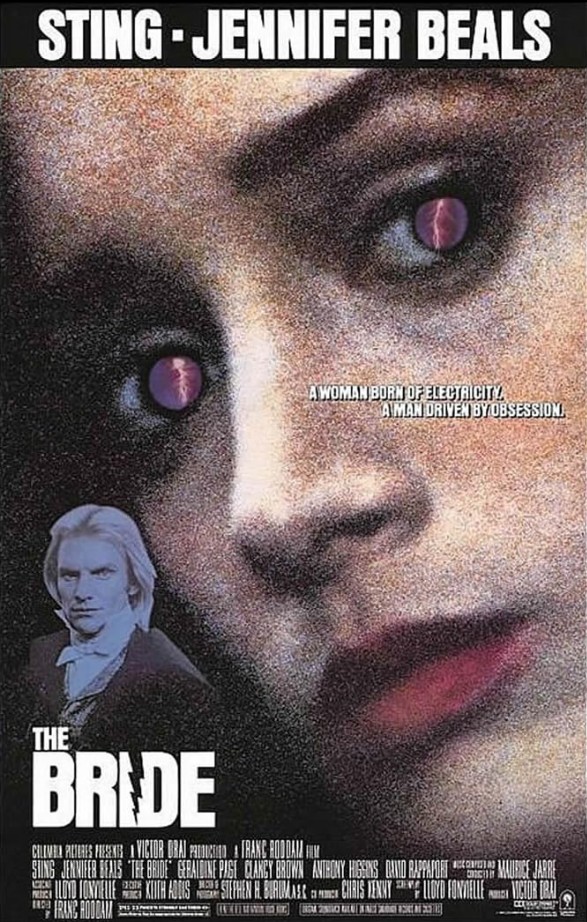
The Bride poster created by Colgems Productions Ltd., Delphi III Productions, Lee International Studios, and Columbia Pictures

After showing a clip from The Bride in At The Movies’ Worst Movies of the Summer episode, Roger claims the film “didn’t know whether it wanted to be a serious movie about the philosophical issues raised by the whole Frankenstein legend or whether it just wanted to be a glamourous, sleek remake”. I personally believe the movie’s creative team knew exactly what they were doing, accomplishing two goals in one picture. Throughout The Bride, there are two parallel stories; the first about Frankenstein and his female creation (Eva) and the second about Frankenstein’s male creation (Viktor) and Rinaldo. These stories show Viktor and Eva learning about the world around them as well as interacting with those they depend on. Every time Rinaldo introduces Viktor, he always refers to Viktor as “his friend”. Meanwhile, Frankenstein calls Eva “his ward”. The stories in The Bride were, in my opinion, intended to take a specific approach to the Nature vs. Nurture debate, presenting how two creations created by the same man could journey to the same outcome.

In Mary Shelley’s original source material, there aren’t really any heroes in that story. That’s because it focuses on the main message of some good intentions possibly leading to bad results. In The Bride, Viktor receives a “hero’s journey”, where he not only gets to fall in love, he also gets to save the day. His name, according to Rinaldo, even means “He will win”. As I mentioned in this review’s introduction, I have read Mary Shelley’s novel. From what I remember, Frankenstein destroys his female creation and his male creation is presented in the story as more of a cautionary tale. With that said, I think this creative liberty added an interesting dynamic to The Bride!
Hand-written letter image created by Veraholera at freepik.com. <a href=”https://www.freepik.com/free-photos-vectors/background”>Background vector created by Veraholera – Freepik.com</a>. <a href=’https://www.freepik.com/free-vector/love-letter-pattern_1292902.htm’>Designed by Freepik</a>. Image found at freepik.com.

While talking about The Bride’s two parallel stories, Gene says the story of Viktor and Rinaldo “was much more interesting than Frankenstein and the monster”. I find myself agreeing with Gene, especially since this story included a “hero’s journey” and a conflict that needed to be resolved. But another reason why I liked Rinaldo and Viktor’s story is David Rappaport’s portrayal of Rinaldo. When Rinaldo first meets Viktor, he’s surprisingly not intimidated by Viktor’s size. Instead, Rinaldo’s confidence helps Viktor find a sense of belonging as well as build a friendship between himself and Viktor. Rinaldo’s charisma shows the audience his good intentions, always striving to give Viktor a better life than Frankenstein did. As he’s giving Viktor a new shirt, Rinaldo is horrified by the scars on Viktor’s back. The sight immediately brings concern to Rinaldo’s face, his saddened tone of voice concluding how Viktor must have been mistreated. The scene I just described shows how David’s performance gave Rinaldo a genuineness that allowed him to be a likeable character. Though this film is titled The Bride, Rinaldo became this movie’s MVP!
Back to 1985 Blogathon banner created by Quiggy from The Midnite Drive-In and Hamlette from Hamlette’s Soliloquy

Both Roger and Gene agreed that Viktor and Eva should have spent more screen-time together. Roger proclaims “if we’re gonna have those parallel stories for two hours, let’s have a pay-off at the end”, with Gene adding “a pay-off for half an hour, not for five minutes”. Like I talked about earlier in this review, I believe the creative team’s intention for The Bride was to present a specific approach to the Nature vs. Nurture debate, as well as giving Viktor a “hero’s journey”. However, my biggest criticism with these parallel stories was the editing. The way these stories were sewn together made the movie feel disjointed. This is because some parts of the story were longer than others. One scene shows Eva studying a series of pictures by herself for only a few seconds. The very next scene shows Viktor and Rinaldo on their journey to the circus, with the scene itself lasting several minutes. Frankenstein and Eva receiving shorter screen-time sometimes prevented the audience from seeing interesting interactions between these two characters. This creative decision also gave Eva and Frankenstein’s story less intrigue.

Group of clowns image created by Freepik at freepik.com. Image by Freepik

When I was introduced to The Bride, I was given the impression the film was trying to answer the question of what if Victor Frankenstein’s female creation fell in love with him. This made me curious to see how the movie’s creative team would answer this question. But like I said in my review’s introduction, I’m disappointed by how this question was approached. That’s because the film’s creative team didn’t answer or explore the question at all. They bring up an equally interesting and infrequently asked question of what if Frankenstein fell in love with his female creation? However, so much time was spent focusing on Eva learning about the world around her, the aforementioned question was given little time for exploration or discussion. When it came to Frankenstein’s love for Eva, it simply came across as possessive and controlling. As I’ve been saying throughout this review, Viktor was given a “hero’s journey”. This means the story always intended to have Eva fall in love with Viktor, not Frankenstein. Even though I liked the creative decision of Viktor’s “hero’s journey”, I’m still disappointed by the potential questions that were left unanswered.
Comparing with the Critics banner created by me, Sally Silverscreen. TV show title cards created by WTTW National Productions, WTTW, Public Broadcasting Service (PBS), Lifetime Television, Tribune Entertainment, Buena Vista Television, and Disney-ABC Domestic Television

Toward the beginning of At The Movies’ Worst Movies of the Summer episode, Gene claims the summer of 1985 “happened to be one of the dullest, most juvenile, most homogenized summer movie seasons in recent memory”. Out of the movies that premiered during that time, I’ve only seen six pictures in their entirety, including The Bride. Personally, I didn’t find any of these films to be bad or disappointing. Specifically speaking about The Bride, I thought it was a fine, serviceable, interesting enough title. Though I was disappointed the movie’s creative team didn’t answer the question of what if Victor Frankenstein’s female creation fell in love with him, there were aspects of the film I liked. While the acting was one of the strengths of The Bride, David Rappaport’s portrayal of Rinaldo shined the brightest! Rinaldo was such a likable character, he became my favorite! Another strength of this film was Viktor receiving a “hero’s journey”. Even though it was a creative liberty, it added an interesting dynamic to The Bride’s story. It was also interesting to see the creative team’s approach to the Nature vs. Nurture debate. I apologize for sounding like a broken record, but this is yet another Comparing with the Critics review where I disagreed with Roger and Gene. As I continue with my series, I have to wonder how often this will keep happening?

This review was brought to you by

Sally Silverscreen
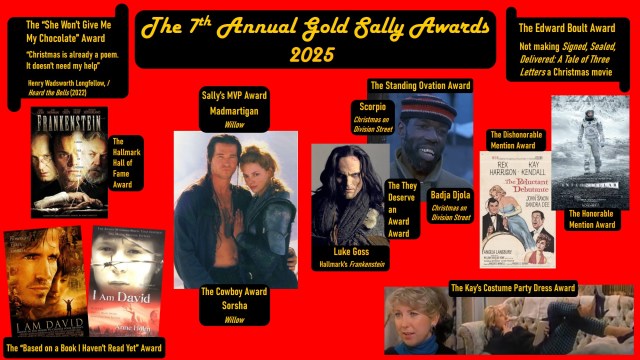
It’s Time for the 7th Annual Gold Sally Awards!

Here at 18 Cinema Lane, I maintain several annual traditions to give my readers something to look forward to. One of those traditions is the Gold Sally Awards, which commemorates my blog’s anniversary! The award categories are created by me and based on topics I’ve brought up on my blog. With two new awards in 2025, I’ll explain the significance of those categories. Like in 2024, I will discuss why I chose each recipient. Now, let the 7th Annual Gold Sally Awards begin!

7th Annual Gold Sally Awards Winners created by me, Sally Silverscreen.

The Kay’s Costume Party Dress Award

(Best Outfit from a Movie)

Helen’s Christmastime Outfit from Hallmark Hall of Fame’s Pack of Lies

When I thought about the various categories of the Gold Sally Awards, I realized there was no category recognizing the wardrobe department of the movie industry. To fix that, I created the Kay’s Costume Party Dress Award! The name of this award references the dress Kay (Joan Collins’ character) wore at a costume party in the 1983 tv movie, Making of a Male Model. I loved this dress so much, it was featured in 2021’s Movie Blogger’s Christmas Wish-List! From the films I saw in 2024, there were several outfits I really liked. The one that was the most memorable, however, came from the Hallmark Hall of Fame presentation, Pack of Lies! The outfit in question was featured in my Movie Blogger’s Christmas Wish-List from last year; the black and blue ensemble Helen (portrayed by Teri Garr) wore during Christmastime. This timeless outfit was worn in only one scene. That fact is why Helen’s outfit earned the inaugural Kay’s Costume Party Dress Award!

The Edward Boult Award

(Missed Opportunity in Cinema)

Not making Signed, Sealed, Delivered: A Tale of Three Letters a Christmas movie

Last June, I speculated how Signed, Sealed, Delivered: A Tale of Three Letters could be a Christmas film. In my editorial about my speculation, I explained how the movie’s title could be a reference to either the Nativity story or A Christmas Carol. I also wondered if Signed, Sealed, Delivered: A Tale of Three Letters and “Signed, Sealed, Delivered: To the Moon and Back” could be a two-part adaptation of A Christmas Carol, with the rock star character intended to be a Marley-like character. The official marketing for Signed, Sealed, Delivered: A Tale of Three Letters proved my speculation wrong. But the more I think about how this movie could have been a Christmas picture, the more I wish it had been a Christmas production. As of early February, 2025, the Signed, Sealed, Delivered series has received only one Christmas movie. Plus, my aforementioned editorial provided ideas for a potential Christmas script. With Hallmark Mystery’s ‘Miracles of Christmas’ viewership numbers lower in 2024 than 2023, maybe the network will consider creating another Signed, Sealed, Delivered Christmas film.

The They Deserve an Award Award

(An Actor or Actress Who Deserves Recognition)

Luke Goss (for his performance in Hallmark’s Frankenstein) and Badja Djola (for his performance in Christmas on Division Street)

There were several good acting performances I saw in 2024. So, it was difficult to choose just one recipient for this year’s Gold Sally Awards. Both Luke Goss’ and Badja Djola’s performance was so impressive! In Hallmark’s Frankenstein, Luke’s use of emotion allowed The Creature to speak without actually speaking. An example I used in my review of the 2004 television film was when The Creature bursts into tears while seeking refuge in a barn. Luke’s acting skills made his character as complicated as he was in Mary Shelley’s source material. Badja made his character, Scorpio, so memorable, despite having limited appearances in Christmas on Division Street. With a consistently commanding presence, Scorpio was a character I looked forward to seeing on screen. That’s because Badja used his acting talents to give Scorpio captivating interactions with other characters. The scene where Scorpio shares some of his backstory with Cleveland is the example I used in my Christmas on Division Street review.

The Cowboy Award

(Character Who Makes an Unnecessary, Drastic Change)

Sorsha from Willow

You’re probably wondering why I gave Sorsha the Cowboy Award, even though I grew to like her as a character. While I found her transformation from villain to hero necessary, it was drastic. In my Comparing with the Critics review of Willow, I shared how Sorsha’s aforementioned evolution was too abrupt. The transformation gave Sorsha some character development, but it left some questions unanswered. For this flaw, blame lies in the screenwriting.

Sally’s MVP Award

(Character Who Left a Memorable, Showstopping Impression)

Madmartigan from Willow

When I watch a movie, there is, sometimes, a character who leaves such a memorable impression on me, they end up stealing the show. I have called these types of characters “MVP”. To acknowledge the “MVPs” of 18 Cinema Lane, I created the new Sally’s MVP Award! One of these “MVPs” was Madmartigan from Willow. In my Comparing with the Critics review of the 1988 film, I talked about how Madmartigan was the story’s comic relief. His personality and comedic timing captivated my attention and kept me invested in his story. What helped Madmartigan become the “MVP” of Willow was the screenwriting and Val’s performance.

The “She Won’t Give Me My Chocolate” Award

(Best Quote from a Movie)

“Christmas is already a poem. It doesn’t need my help” – Henry Wadsworth Longfellow, I Heard the Bells (2022)

In the 2022 movie, I Heard the Bells, Fanny (portrayed by Rachel Day Hughes) encourages her husband, Henry, to create a Christmas themed poem. Henry (portrayed by Stephen Atherholt) told his wife, “Christmas is already a poem. It doesn’t need my help”. When Henry said this, I started to think about what his quote meant. Poems require planning and putting the right pieces together, in order for that poem to have good flow and writing structure. Christmas festivities require a certain amount of planning, whether it’s a local church’s Nativity play or a family’s Christmas party. Using these two examples, finding the right pieces is important, such as who will portray the Three Wise Men or what will be the entrée of Christmas dinner. Poems can also tell stories. One classic example is ‘‘Twas the Night Before Christmas’. Christmastime is filled with stories, from the Nativity story to A Christmas Carol. Henry’s aforementioned quote made me see Christmas in a completely different way! Plus, a quote from a Christmas movie has never won the “She Won’t Give Me My Chocolate” Award before.

The Honorable and Dishonorable Mention Award

(Best and Worst Movie from the Honorable and Dishonorable Mention Category)

Best – Interstellar

Worst — The Reluctant Debutante

For last year’s Gold Sally Awards, there was only the Dishonorable Mention Award. That’s because I didn’t see enough movies to include an honorable mention category. With the honorable mention category returning in 2024, the Honorable Mention Award is also coming back! Science fiction stories about space exploration will typically emphasize the thrills and wonder of the galaxy. This can make it easy for a movie’s audience to get caught up in how adventurous and exciting outer space can seem. In Interstellar, a major focus is space travel’s effect on human beings. So, themes of family, sacrifice, and the price of scientific achievement are woven into the script. That, along with quality acting performances and impressive special effects, is why I liked Interstellar!

Out of all the movies that ended up in the dishonorable mention category, I had the highest expectations for The Reluctant Debutante. This is because I not only reviewed the film for The John Saxon Blogathon, there was some well-known talent involved with the project. Unfortunately, the 1958 movie fell short of those expectations. The Reluctant Debutante was a premise driven story that felt longer than one hour and thirty-four minutes, due to the jokes being drawn-out. It also didn’t help how some story ideas were overlooked. When I reviewed the 1958 film, I shared how movies from the 1950s are covered so infrequently on 18 Cinema Lane. So, it’s disappointing when a production from the ‘50s is weaker than expected.

The Hallmark Hall of Fame Award

(Movie That Feels Like It Belongs in the Hallmark Hall of Fame Collection)

Hallmark’s Frankenstein

There are different kinds of stories in the Hallmark Hall of Fame collection. One kind of story is adaptations of pre-existing literature. Sometimes, “classic” literature became Hallmark Hall of Fame presentations, like The Secret Garden and A Tale of Two Cities. When these adaptations are good, they can be an immersive experience. This is how I would describe Hallmark’s Frankenstein! Due to the combination of screenwriting, acting performances, set design, and costume design, the movie made me feel like I was transported to another time and place. I also appreciate how close to the source material the 2004 television film is. Looking back on Hallmark’s Frankenstein and the Hallmark Hall of Fame collection, I’m actually surprised Mary Shelley’s novel wasn’t adapted into a Hallmark Hall of Fame project. Everything I said is why I chose Hallmark’s Frankenstein for the Hallmark Hall of Fame Award!

The “Based on a Book I Haven’t Read Yet” Award

(Movie Based on Source Material I Have Not Yet Read)

I Am David

Movies that won the “Based on a Book I Haven’t Read Yet” Award were first placed on a best films of the year list. I Am David is continuing that tradition! The 2004 film earned the top spot on my best movies list of 2024. This is the second time a number one movie of the year received the “Based on a Book I Haven’t Read Yet” Award! After I reviewed I Am David, I learned the movie was based on a book. I’m not sure how affective the story’s plot twists will be, as I already know what they are because I saw the film. However, I’d still be interested in reading I Am David someday!

The Standing Ovation Award

(Character Most Deserving of Receiving Their Full Potential)

Scorpio from Christmas on Division Street

When the Gold Sally Awards presented the Standing Ovation Award, the recipients were characters who should have received their “standing ovation”, but were denied that for various reasons. Scorpio (from Christmas on Division Street) actively worked toward getting where he wanted to go. As I said during the They Deserve an Award Award, Scorpio had limited appearances in the 1991 made-for-TV movie. Despite that, the audience learned enough about him to know what he had gone through. During this limited period of time, Scorpio attempts to overcome his obstacles. While I won’t spoil Christmas on Division Street, I will say those attempts earned Scorpio the Standing Ovation Award!

Have fun at the movies!

Sally Silverscreen

The Top Ten Worst Movies I Saw in 2024

While 2024 was, for me, a better year for movies, I still saw some movies I didn’t like. Similar to my worst movies list of 2023, most of the films on this year’s list were disappointing or average. But, unlike 2023, the top four titles are from different genres. The dishonorable mentions section has returned! This time, however, there are more DNFs (did not finish). Like I have said in past lists, my top ten worst movies I saw in 2024 list is not intended to be mean-spirited, negative, or disrespectful. It’s just a list of my own, honest opinion. Since I reviewed some of the movies on my list, I will provide the links to those reviews in this article.

Dishonorable Mentions

The Reluctant Debutante, The Gambler: Luck of the Draw, Jazz Ramsey: A K-9 Mystery, Million Dollar Lethal Listing, CrimeTime: Freefall (I turned it off after about forty minutes), Mermaid Down (I turned off this movie after about twenty minutes), Blood, Sweat and Cheer (I turned it off after about eighteen minutes), and Temptation Under the Sun (I turned off this movie after about twenty-two minutes)

Image by starline on Freepik

10. Crimes of Fashion: Killer Clutch

In the 2020s, Hallmark has come up with story ideas that worked well enough for a stand-alone mystery movie, but unsustainable for a multi-chapter series. One of these ideas came from Crimes of Fashion: Killer Clutch. This film made the same mistake as Mystery Island: not allowing the protagonist to use her skills to solve the case. For Lauren, the main character in Crimes of Fashion: Killer Clutch, her psychology skills were so underutilized, she seemed more like an over glorified intern. Thick French accents making several characters difficult to understand is another major flaw of the film. It prevented me from being fully invested in the story. Crimes of Fashion: Killer Clutch was, in my opinion, a disappointing movie. But compared to the other titles on 2024’s worst of the year list, Hallmark’s production was, simply, ‘underwhelming’.

Take 3: Crimes of Fashion: Killer Clutch Review

9. Boy in the Walls

When I first read the synopsis for Boy in the Walls, I thought the film would be a spookier version of 2016’s Boy in the Attic. Sadly, this was not the case. The 2023 Lifetime presentation contained a mystery that was drawn out for too long. It also doesn’t help how the protagonist made one dumb decision after another. Without spoiling the film, all I’ll say is the title is misleading. If you haven’t watched either referenced movie, I’d recommend Boy in the Attic.

8. The 39 Steps

In my review of The 39 Steps, I said the 1935 picture was the most “meh” title from Alfred Hitchcock’s filmography. This statement was made due to the limited sense of urgency and intrigue within the story. As I also said in my review, The 39 Steps seems longer than an hour and twenty-six minutes. The drawn-out nature of the movie created a slow and boring build-up to a reveal that feels kind of ridiculous and anti-climactic. While romance has been incorporated in some of Alfred’s films, it didn’t work in The 39 Steps. Richard and Pamela’s attraction for one another was too abrupt, welcoming the presence of the “insta-love” trope. Even though The 39 Steps was a disappointing movie, I gave it a lower placement on my list. Comparing the 1935 film to Alfred’s other productions, Hitchcock’s filmography shows how much he improved as a director.

Take 3: The 39 Steps Review

7. Hallmark Hall of Fame’s Pack of Lies

There are some movies that, in my opinion, should have been documentaries instead. The 1987 Hallmark Hall of Fame presentation, Pack of Lies, is just one example. This film in the Hallmark Hall of Fame collection is based on a true story. While “based on a true story” movies can be engaging, intriguing, and even thought-provoking, Pack of Lies was disappointing. Like I said in my review of the 1987 production, the film was a two hour slow and tedious build-up to a resolution that was underwhelming and anti-climactic. The creative team’s decision to choose telling over showing caused other flaws, from little lapse in time to things not making sense. Pack of Lies proves Hallmark Hall of Fame movies are not created equally. However, there are other Hallmark Hall of Fame presentations from the 1980s I like, such as the adaptations of The Secret Garden and A Tale of Two Cities.

Take 3: Hallmark Hall of Fame’s Pack of Lies Review

6. One Bad Apple: A Hannah Swensen Mystery

While A Sprinkle of Deceit: A Hannah Swensen Mystery was slightly better than One Bad Apple: A Hannah Swensen Mystery, I was still disappointed in the latter film. For starters, Victor Webster and Alison Sweeney had no on-screen chemistry. A character (not Hannah) solves the mystery by making an assumption about the case and being conveniently correct. But the worst part about One Bad Apple: A Hannah Swensen Mystery was Delores’ subplot. Up until this film, Delores was very against Hannah getting involved in cases, as well as dating Mike. So, for Delores to become a private investigator and seem to treat her new job as a joke completely went against her character. In fact, this was such a bad creative idea, Delores’ private investigating career was barely mentioned in A Sprinkle of Deceit: A Hannah Swensen Mystery. If there are more Hannah Swensen films in the works, I really hope Delores receives better story ideas.

Hallmark Hall of Fame’s Pack of Lies poster created by Hallmark Hall of Fame Productions, Robert Halmi, and CBS

5. My Life Is on the Line

This Lifetime movie had one of the network’s most creative story ideas. The 2024 picture was about a woman who tried to solve a mystery on her computer at her office cubicle. But the longer I watched this movie, the sooner I realized that aforementioned idea wasn’t sustainable for a feature-length production. Instead, the novelty of how the mystery was solved got old very quickly. My Life Is on the Line is yet another Lifetime film where the protagonist makes a collection of dumb choices. Her decision-making is so bad, other characters in the story, including her boss, call her out for it. Lifetime’s 2024 presentation was, for me, the most disappointing movie of the year.

4. Network

Network holds the honor of not only being the first film I reviewed for my Comparing with the Critics series, it’s also the first film I disagreed with the critics on. Even though Gene Siskel and Roger Ebert placed the movie in their list of the top five films from 1976, I would call Network one of the “Dogs of the Year”. For me, it was more of an endurance test, where the story’s first half was a drawn-out search for a resolution to the movie’s conflict and the second half was a yelling contest. Being a pretentious picture by taking itself too seriously and telling a dry, boring story didn’t work in Network’s favor. There are movies from the 1970s I like. Unfortunately, Network isn’t one of them.

Comparing with the Critics – Best of 1976 – Network

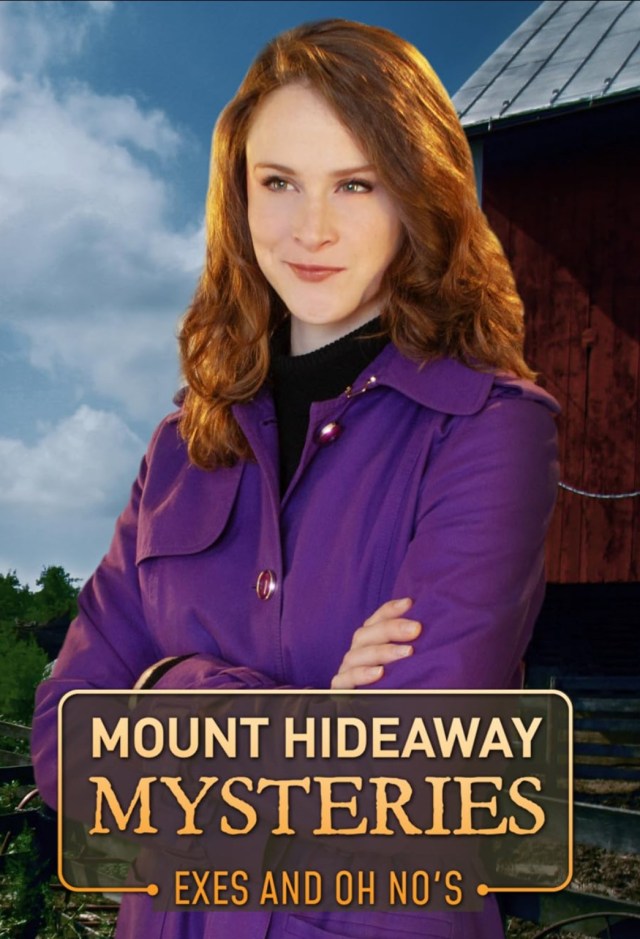
3. Mount Hideaway Mysteries: Exes and Oh No’s

It’s ironic that Mount Hideaway Mysteries: Heartache and Homecoming became the third worst movie of 2023 and now Mount Hideaway Mysteries: Exes and Oh No’s became the third worst movie of 2024. When you look past this irony, you’ll see how Mount Hideaway Mysteries: Exes and Oh No’s shares some of the same flaws as its sequel, like not understanding how technology works. Mount Hideaway Mysteries: Exes and Oh No’s contains its own flaws, with poor special effects as one example. While this movie is so bad, it’s, at times, unintentionally funny, I do acknowledge how challenging it can be to create a cinematic project. In fact, the best way to sum up Mount Hideaway Mysteries: Exes and Oh No’s is the quote, “Mistakes are proof that you are trying”.

Take 3: Mount Hideaway Mysteries: Exes and Oh No’s Review

2. Revenge Best Served Chilled

This Lifetime movie from 2022 had a very misleading title and synopsis. Not only is there no revenge in the story, there’s also nothing being chilled throughout the film. According to a plot summary I read, Revenge Best Served Chilled is about a series of murder mysteries taking place at a wine expert competition, with the protagonist trying to clear her name and solve the mysteries. The movie actually emphasizes the wine expert competition to the point where there is little to no mystery involved. Like Boy in the Walls and My Life Is on The Line, the protagonist, Emily, makes so many dumb decisions. I, honestly, should have turned this movie off after Emily doesn’t lock her family’s restaurant’s front doors as she’s spending the night at the restaurant. But I naively thought Revenge Best Served Chilled was going to be a better movie.

1. Frankenstein (2004)

I referenced this movie while reviewing the Hallmark adaptation of Frankenstein, as I was pointing out a technical error on Wikipedia. When I saw the version of Frankenstein starring Vincent Perez, I immediately knew it was going to be the worst movie I saw in 2024. While this movie contains some interesting ideas, those ideas are bogged down by other ideas. The excessive number of ideas made the story feel like a series of vignettes either loosely connected to each other or not connected at all. What also makes the overall story weak is how nothing is explained. The ending is one of the most “sequel bait” endings I’ve seen in a long time. I would strongly discourage readers from checking out this version of Frankenstein. More time will be spent being frustrated than entertained.

Mount Hideaway Mysteries: Exes and Oh No’s poster created by Glass House Distribution

Have fun in 2025!

Sally Silverscreen

The Top Ten Best Movies I Saw in 2024

For me, 2024 was a better year for movies. That’s because I saw more movies I liked, compared to 2023! Another difference from 2023 is how, on 2024’s list, more movies are theatrical pictures. However, there are still some made-for-TV productions that found a spot on my list. With more likable movies comes the return of the honorable mentions section! In that part of my list, most of the films are television projects. Since I reviewed almost all the movies on this year’s list, I will provide links to those reviews in this post. So, with 2025 on the horizon, let’s begin my list of the top ten best movies I saw in 2024!

Honorable Mentions

Legend of the Lost Locket, My Baby Is Missing, My Mother’s Split Personalities, Christmas on Division Street, and Interstellar

Image by starline on Freepik

10. I Heard the Bells

I Heard the Bells achieved so much in a short amount of time. The 2022 movie was chosen for my 500 Blog Follower Dedication Review. Then, I Heard the Bells became my 400th published movie review, as I recently revealed in my list of the ten movie trends I don’t understand. Now, the film is the only Christmas picture to earn a place on 2024’s best movies of the year list! When I wrote about I Heard the Bells, I compared it to It’s a Wonderful Life. Both titles are not only about more than just the Christmas holiday, they also cared about their overall presentation. I Heard the Bells was a visually immersive movie because of the attention to detail placed on historical accuracy. The strength of the acting performances allowed the story to be engaging. While it’s too early to say right now, I think I Heard the Bells could be a Christmas classic!

Take 3: I Heard the Bells Review + 500 Follower Thank You

9. Easter Parade

If I could choose one word to describe Easter Parade, it would be “colorful”. With the movie’s creative team taking advantage of Technicolor, costumes and décor boasted vibrant hues that complimented the story’s spring season! The musical numbers provide another strength in Easter Parade. From Fred’s festive and creative solo, “Drum Crazy”, to Ann’s energetic and fast-paced solo, “Shakin’ the Blues Away”, the movie’s musical numbers were enjoyable because of their choreography and delivery. The reason the 1948 film is placed lower on my list is due to the premise-driven story and the limited inclusion of Easter. However, Easter Parade’s positives outweigh the negatives!

Take 3: Easter Parade Review

8. For Me and My Gal

In my review of For Me and My Gal, I mentioned how Breen Code era movie musicals contain simpler stories. These simpler stories will typically feature lower stakes. But in For Me and My Gal, the story of Harry and Jo included stakes that were higher. The story wasn’t afraid to show Jo and Harry making difficult decisions when it came to their dreams. Along their journey, the duo even deals with regret and heartbreak. The way World War I was incorporated into For Me and My Gal gave the script a sense of realism. Creative decisions like that one gave the 1942 picture emotional depth!

Take 3: For Me and My Gal Review

7. Willow

When I started my Comparing with the Critics series, I knew there were some movies I would disagree with the critics on. What I didn’t know was how much I would like Willow. Now that I’ve seen the 1988 film, I can understand why some people have given it the coveted title of “classic”. Likable elements, such as humor and unique perspectives on familiar story ideas, provide arguments for the aforementioned claim. The simplistic and straight-forward nature of the story made it easier to follow what was happening on screen. For me, Madmartigan stole the show! Movies like Willow make me thankful for my Comparing with the Critics series.

Comparing with the Critics – Worst of 1988 – Willow

6. Curious Caterer: Forbidden Fruit

2024 saw the premiere of two Curious Caterer films; Curious Caterer: Foiled Plans and Curious Caterer: Forbidden Fruit. Though I liked Curious Caterer: Foiled Plans more than Curious Caterer: Forbidden Fruit, Curious Caterer: Forbidden Fruit was still a good movie. The fifth chapter in the series consistently carried the strong components of the Curious Caterer story, like the acting, humor, and prioritizing the mystery. A peek behind the music industry’s curtain and the incorporation of serious, real-world topics helped make the identity of Curious Caterer: Forbidden Fruit unique. As of the publication of this list, Hallmark has not provided any 2025 dates to the Curious Caterer series. If there are going to be more Curious Caterer films, I hope at least one of them is a seasonal picture.

Take 3: Curious Caterer: Forbidden Fruit Review

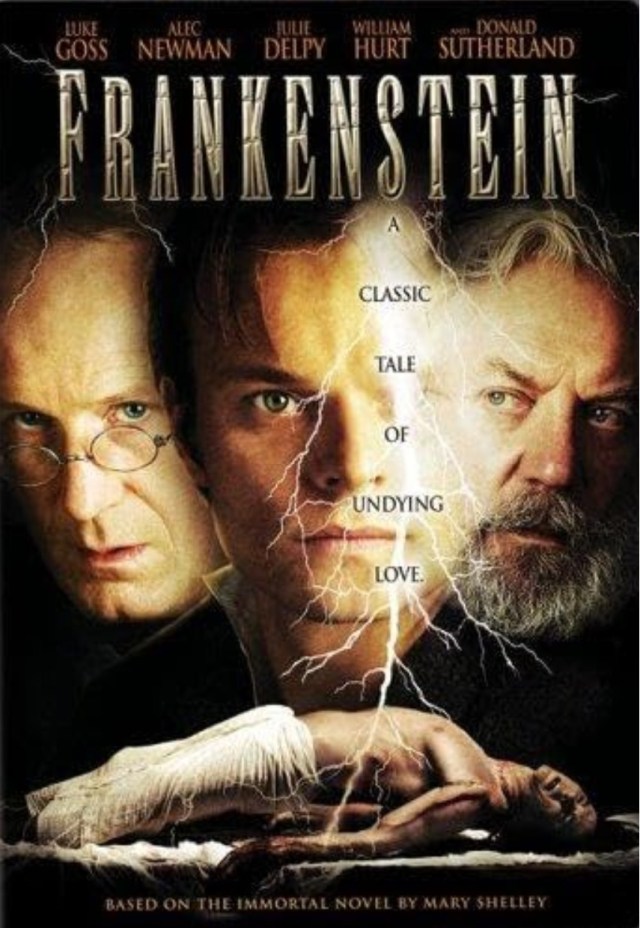
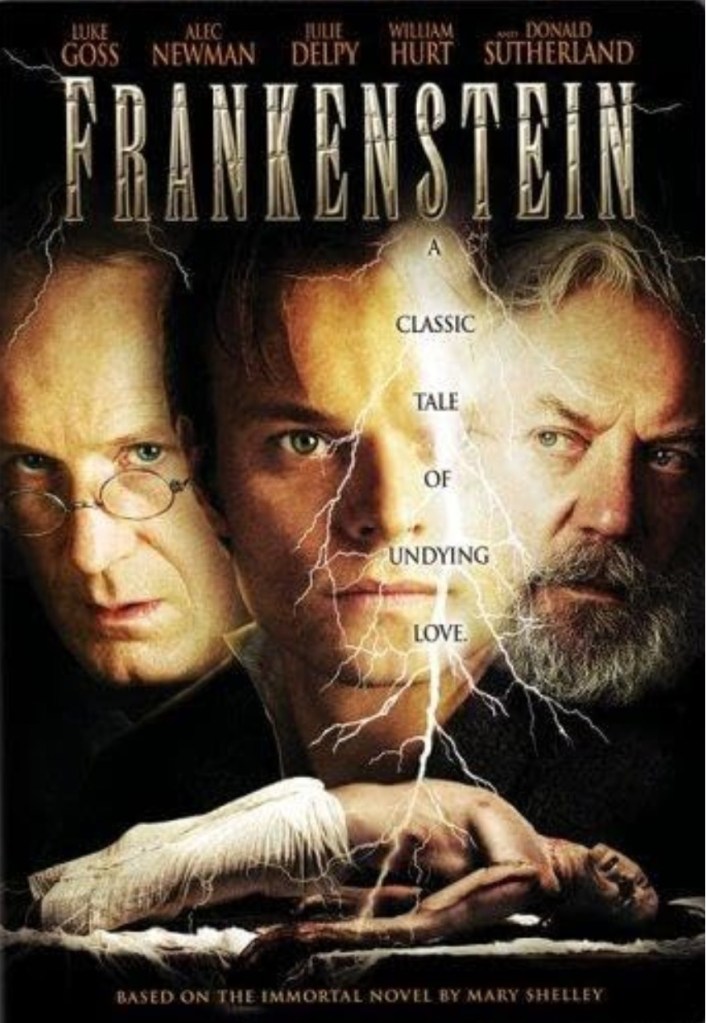
Hallmark’s Frankenstein poster created by Hallmark Entertainment, Hallmark Channel, Silverstar Ltd., Larry Levinson Productions, and RTL

5. Hallmark’s Frankenstein (2004)

Back in March, I called Hallmark’s adaptation of Frankenstein a “hidden gem”. This claim was based on my observation of how a good movie was not only forgotten by time, but also overshadowed by other titles released in 2004. What makes this version of Frankenstein a good movie, in my opinion, is how respectful it was toward Mary Shelley’s novel. One great example is Luke Goss’ portrayal of The Creature, as the way emotion was utilized throughout Luke’s performance highlighted how complicated The Creature is. Hallmark’s adaptation of Frankenstein is another movie where the visual presentation created an immersive experience. Combining set design, costume design, and attention to historical accuracy, the movie made me feel like I was transported to another time and place.

Take 3: Hallmark’s Frankenstein (2004) Review (Double Feature: 2004 Edition Part 2)

4. The Boys in the Boat

If you’re going to create a sports movie involving a team sport, it’s important to make the camaraderie among the team believable. An on-screen team with believable camaraderie helps the audience stay invested in the story, as well as the team’s journey. Because the acting performances were strong in The Boys in the Boat, the camaraderie within the team dynamic felt genuine. The 2023 film also makes rowing look exciting! This was accomplished through cinematography, editing, and music selection. The Boys in the Boat is a “based on a true story” film that, in my opinion, is worth the time! This is yet another production where historical accuracy was a top priority.

3. Amadeus

Out of all the movies I reviewed for my Comparing with the Critics series, Amadeus is, so far, the only movie I agreed with the critics on. While the biopic is a glamourous spectacle, it also contains substance. Thought-provoking material can be found in the script, such as how fame can negatively impact the human soul. The story is an immersive, detail-oriented character study that explores the good and bad sides of the music industry. The creative team’s focus on detail made Amadeus look and feel historically accurate, as can be seen in the costume and set design. F. Murray Abraham and Tom Hulce each gave a strong performance. I can, honestly, say the 1984 movie is one of the best biopics I’ve ever seen!

Comparing with the Critics – Best of 1984 – Amadeus

2. Curious Caterer: Foiled Plans

Remember when I said I liked Curious Caterer: Foiled Plans more than Curious Caterer: Forbidden Fruit? One reason why I said this is Goldy’s consistent involvement in Curious Caterer: Foiled Plans’ case. Other reasons why I liked the fourth chapter in the series are the creativity of the mystery, the quality of the acting performances, and how humor was written into the story. Looking back on Hallmark’s mystery films I saw in 2024, this Curious Caterer movie is pretty unique. That’s because, as I mentioned in my review, it’s a locked room mystery revolving around a costume party. In 2023’s best movies of the year list, I claimed Curious Caterer: Grilling Season was the best film in the series. I certainly changed my mind after I saw Curious Caterer: Foiled Plans!

Take 3: Curious Caterer: Foiled Plans Review

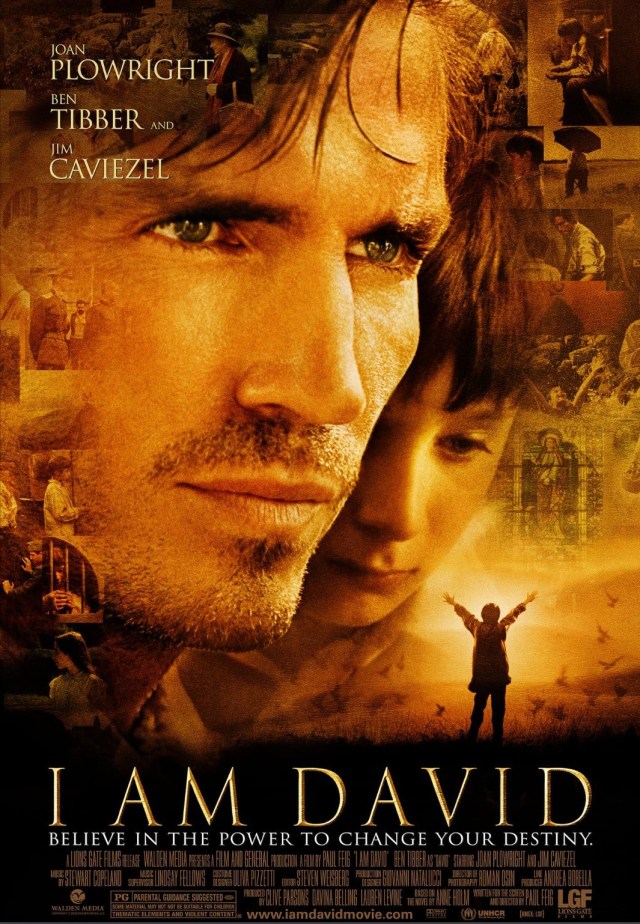
1. I Am David

It’s amazing how I Am David became 2024’s best movie in March and clung on to the number one spot all these months later! This impressive film allowed the story of David and his journey to be told with genuine emotion and sincerity. This was achieved through every aspect of the production, like the acting performances and the screenwriting. Exploring light and darkness, as well as showcasing Europe’s natural landscape, gave the production visual depth. Timeless, universal messages were also woven into the script. As I said in my review, I wish more people knew about this movie. Hopefully, my review or maybe this list can encourage someone to check out I Am David!

Take 3: I Am David Review (Double Feature: 2004 Edition Part 1)

I Am David poster created by Walden Media, Film and General Productions, Lionsgate Films, Artisan Entertainment, and David Productions Ltd.

Have fun in 2025!

Sally Silverscreen

Concluding my Double Feature: 2004 Edition

It’s time to wrap up another double feature, as both chosen titles, Hallmark’s Frankenstein and I Am David, have now been watched and reviewed! In the introduction, I brought up the following question:

Based on these two movies, how has the cinematic landscape changed in twenty years?

Looking back on each movie, a realization came to me. One thing I Am David and Hallmark’s Frankenstein have in common is the timelessness each story contains. It also helps how these stories are more straight-forward, which makes it easier for the audience to understand what is happening on screen. Realizing these statements could also be applied to The Polar Express, my answer to the aforementioned question is how, back in 2004, it seems like there was a desire on the cinematic landscape to create timeless entertainment. Now, twenty years later, studios and film companies are competing with one another to make the most relevant titles possible. On the current cinematic landscape, it’s all about capitalizing on trends and fads, creating titles for the here and the now. The problem with this film-making approach is how five, even ten plus years from that movie’s release, that movie will be dated on arrival. This film-making approach also makes movies seem more disposable instead of a long-lasting product with more opportunities to be revisited.

Popcorn and movie ticket image created by Freepik at freepik.com. <a href=’https://www.freepik.com/free-photo/cinema-tickets-in-bucket-with-popcorn_2303439.htm’>Designed by Freepik</a>. <a href=”https://www.freepik.com/free-photos-vectors/layout”>Layout image created by Freepik</a>. Image found at freepik.com.

Have fun at the movies!

Sally Silverscreen

Take 3: Hallmark’s Frankenstein (2004) Review (Double Feature: 2004 Edition Part 2)

Thank you for joining me for the second part of Double Feature: 2004 Edition! Similar to my review of Sesame Street Presents: Follow That Bird, this review of Hallmark’s Frankenstein will be spoiler-free. If you’re curious about why I chose Hallmark’s Frankenstein for this double feature, you can check out the introduction in the link below.

Introducing my Double Feature: 2004 Edition!

Hallmark’s Frankenstein poster created by Hallmark Entertainment, Hallmark Channel, Silverstar Ltd., Larry Levinson Productions, and RTL

Before I start this review, I need to explain why I’m referring
to this version of Frankenstein as ‘Hallmark’s Frankenstein’. On
Wikipedia, there is a page chronicling all the Hallmark Channel movies released
between 2000 to 2015. In the section listing Hallmark Channel’s films from
2004, Vincent Perez is listed as one of the stars of Hallmark’s version of Frankenstein.
But if you click on the italicized title of Frankenstein, the link goes
directly to Wikipedia’s page about the Hallmark movie starring Alec Newman. While
Vincent did star in an adaptation of Frankenstein released in 2004, it
is not the Hallmark version. I didn’t discover this error until after I had
seen Vincent’s film.

The reason why I included this screenshot in my review is to show my readers how Hallmark’s Frankenstein is listed on Wikipedia. Screenshot taken by me, Sally Silverscreen.

1. What are your thoughts on 2004 as a cinematic year?

2004 was a year where “event entertainment” took place. When I say “event entertainment”, I mean television or movie premieres that are popular enough to become anticipated events. I remember when full print ads would boast a new Hallmark Hall of Fame production, marking the movie itself as “must see television”. Four sequels for popular predecessors were released in 2004, earning a spot among the top ten highest grossing films of the year. Twenty years later, consumers have more options when it comes to entertainment. This provides fewer opportunities for “event entertainment” to take place. Even events that have always been considered “event television” are struggling to capture audience’s attention.

2. Frankenstein premiered on Hallmark Channel on October 5th and 6th, 2004. How has the network evolved since the movie’s release?

When Hallmark’s adaptation of Frankenstein premiered, Hallmark Channel was three years old. At the time, the network didn’t have the distinct identity it does today.  This allowed content to be less restrictive when it comes to creativity. 2004 saw the debut of Hallmark’s second network, Hallmark Movie Channel. On that network, a lot of Hallmark Channel’s previously aired programming made up Hallmark Movie Channel’s catalogue, as well as Hallmark Hall of Fame titles and acquired content. But in the twenty years this second network has existed, the channel’s name has changed twice, with the network now known as Hallmark Mystery. With Hallmark creating two channels, it provided more opportunities to create movies. As time passed, both networks adopted a more distinguishable identity.

3. Is there anything about Frankenstein you liked or didn’t like?

While I think the acting was one of the strengths of this movie, the two strongest performances came from Alec Newman and Luke Goss! Alec’s portrayal of Victor Frankenstein was so captivating because of the wide range of emotions incorporated into the role. His versatility made Victor feel like an authentic human being. From crying over the loss of a loved one to playfully teasing Elizabeth, Alec’s performance allowed Victor’s interactions with other characters to be interesting, with each interaction appearing genuine. Meanwhile, Luke utilized emotion to make The Creature a complicated character like he was in the novel. In fact, Luke’s emotionality spoke volumes in scenes where dialogue wasn’t required. One example shows The Creature after he escapes from Victor’s laboratory. When he seeks refuge in a barn, The Creature bursts into tears, overwhelmed by the fear and rejection directed toward him.

When Frankenstein premiered on Hallmark Channel, it was released as a two-part mini-series. The first part revolved around Victor’s desire to create life, leading up to The Creature coming to fruition. But the second part was more drawn out, with scenes either longer than necessary or completely unnecessary. Frankenstein’s second part features a wedding reception that lasts about five minutes. I understand why that scene was included in the adaptation. In my opinion, though, the wedding reception should have been cut shorter or omitted from the script.

4. In your Word on the Street story about a potential sequel for The Polar Express, you talked about the technology applied to that film. Could you detect any technology incorporated into Frankenstein?

There were a few scenes where it appears CGI (computer generated images) was included in the film. Other than that, it didn’t look like technology (besides cinematography, sound editing, etc.) was relied on to create this adaptation.

Snowy mountain image created by Freepik at freepik.com. <a href=’https://www.freepik.com/free-vector/landscape-background-of-snow-track-and-mountains_968656.htm’>Designed by Freepik</a>. <a href=”https://www.freepik.com/free-photos-vectors/background”>Background vector created by Freepik</a>. Image found at freepik.com.

5. Did you develop any thoughts and/or questions while watching this film?

In one of Victor’s science classes, Victor claims the brain is the most important body part because of its electrical connections between nerves and other body parts. As he is attempting to create life, Victor collects various body parts from the morgue and the graveyard. When The Creature is awakened, wouldn’t he remember his life and identity prior to passing away? Wouldn’t The Creature recognize the body Victor gave him is not the body he was born with? With Victor’s statement about the brain, wouldn’t the nerves in The Creature’s brain not connect with the rest of his body? I never thought of these questions until I saw Hallmark’s adaptation of Frankenstein.

6. You’ve mentioned reading Frankenstein, but seeing few adaptations of the story. How does Hallmark’s version compare or contrast to the Frankenstein related movies you’ve seen?

Besides Hallmark’s adaptation of Frankenstein, I’ve seen three films that incorporate elements of Mary Shelley’s story. But because The Curse of Frankenstein follows the source material closer than the other two films, I’ll be discussing that movie alongside Hallmark’s version of Frankenstein. When I reviewed The Curse of Frankenstein last year, I was disappointed by the creative liberties the film’s creative team adopted. One of these creative liberties was presenting The Creature as a bumbling, destructive machine. As I mentioned in answer number three, The Creature was a complicated character in the novel. While he was destructive, The Creature’s actions were not always impulsive. In Hallmark’s adaptation of Frankenstein, Luke’s performance and the screenwriting illustrated how complicated The Creature is. The Creature’s intelligence was also highlighted in this adaptation, adding to The Creature’s complexity. Shortly after he escapes from Victor’s laboratory, the audience can hear how The Creature already understands the English language, grasping concepts like God and Heaven, as well as reading Paradise Lost.

7. Hallmark’s adaptation of Frankenstein is a made-for-TV production. Has there been a change in small screen cinema from 2004 to now?

In the same year Hallmark Channel premiered their version of Frankenstein, Hallmark Hall of Fame movies debuted on major networks. But fast forward to 2024, Hallmark Hall of Fame is no longer utilized by Hallmark, even after moving to Hallmark Channel in 2014. These decisions are examples of how made-for-TV programming has become more exclusive. Since 2004, Hallmark Channel has grown into one of the biggest creators of made-for-TV content. In fact, Hallmark Channel and its two networks, Hallmark Mystery and Hallmark Family, are three of the few places creating and/or distributing made-for-TV movies today. Rewinding to twenty years ago, major networks were still willing to include made-for-TV programs in their schedules. With the changing television landscape, including the invention of streaming services, major networks are just trying to stay afloat.

8. Now that it’s been twenty years since Frankenstein premiered, has it stood the test of time or become a product of its time?

For the most part, Hallmark’s adaptation of Frankenstein stands the test of time! It helps how this project is bringing to life a story that is iconic and timeless. I mentioned in my review of The Curse of Frankenstein how an overarching message in Mary Shelley’s novel is some good intentions possibly leading to bad results. This message also overarches Hallmark’s adaptation of Frankenstein, as Victor strives to do the impossible. There are other timeless messages in this version of Mary’s story, such as prioritizing what is irreplaceable.

9. After watching Frankenstein, is there anything you can take away from your movie viewing experience?

Similar to my review of I Am David, I will describe Hallmark’s version of Frankenstein in one word. That word would be ‘immersive’. This production made me feel like I was transported to another time and place. A combination of the acting performances, set design, costume design, and screenwriting achieved the illusion of an immersive experience. As someone who has read Mary Shelley’s novel, I appreciate how close to the source material Hallmark’s project is. From what I remember, the majority of the book’s key events and elements were included in the script. With that said, I understand why Hallmark chose to split Frankenstein into two parts. But, in my opinion, the second part was weaker than the first part. Looking back on Hallmark’s adaptation and I Am David, Frankenstein is a more underrated film that was not only forgotten by time, but also overshadowed by other titles released in 2004, like A Boyfriend for Christmas and Love’s Enduring Promise. I’m hoping my review inspires other fans of Hallmark to discover this hidden gem!

Popcorn and movie ticket image created by Freepik at freepik.com. <a href=’https://www.freepik.com/free-photo/cinema-tickets-in-bucket-with-popcorn_2303439.htm’>Designed by Freepik</a>. <a href=”https://www.freepik.com/free-photos-vectors/layout”>Layout image created by Freepik</a>. Image found at freepik.com.

Have fun at the movies!

Sally Silverscreen


Take 3: The Curse of Frankenstein Review

When I was first introduced to the world of Hammer-Amicus films, it was through the Third Hammer-Amicus Blogathon, hosted by Gill and Barry, from Realweegiemidget Reviews and Cinematic Catharsis. For that event, I reviewed the 1972 movie, Vampire Circus, which I thought was just ok. With the return of the aforementioned blogathon, I’ve decided to choose a Hammer-Amicus production that was recommended to me. Back when I wrote about Vampire Circus, Barry, from Cinematic Catharsis, suggested I check out several films, with 1957’s The Curse of Frankenstein being one of them. In my review of Frankenweenie, I mentioned how I haven’t seen many adaptations of Mary Shelley’s Frankenstein. To make up for lost time, I selected The Curse of Frankenstein for the blogging event!

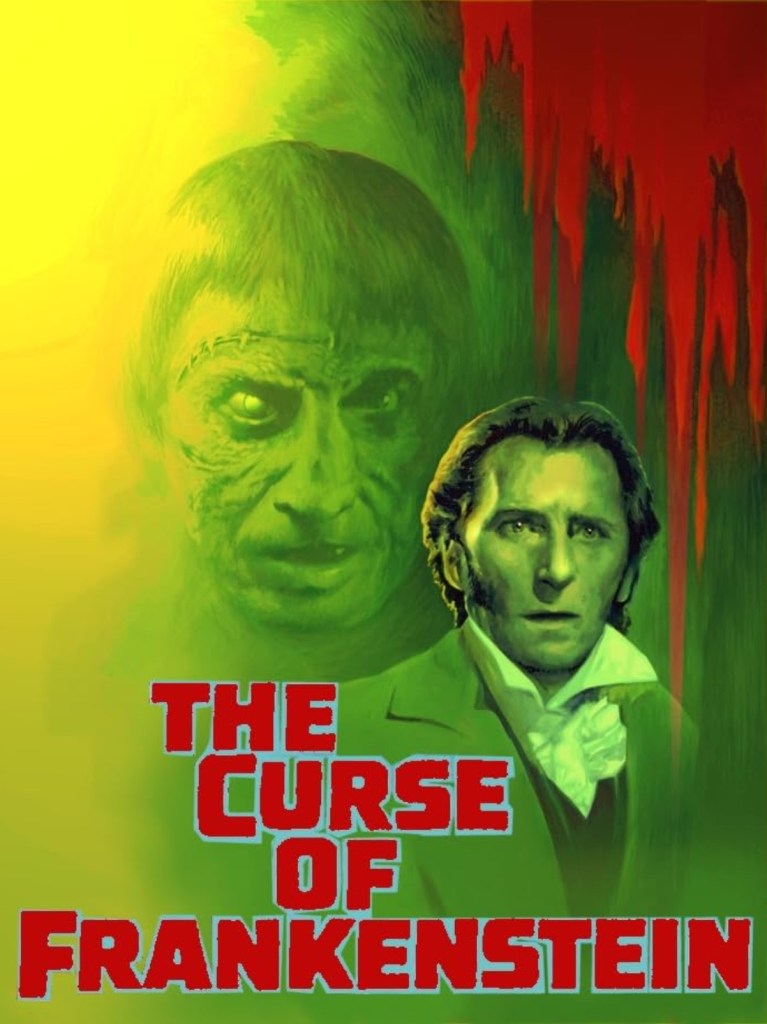
The Curse of Frankenstein poster created by Hammer Films and Warner Bros.

Things I liked about the film:

The use of WarnerColor: When discussing “classic” cinema, there has been a debate over whether a film should remain with black-and-white imagery or if it should receive the Technicolor treatment. In my opinion, I’m glad The Curse of Frankenstein was released in WarnerColor, which I believe was the studio’s version of Technicolor. This creative decision allowed certain elements within scenes to appear vibrant! In Victor’s laboratory, various jars and bottles were scattered throughout the room. Liquid filled these bottles and jars, boasting bright colors like red, blue, even purple. These hues provided a nice contrast to the gray walls of the laboratory. The incorporation of color worked in the favor of the film’s wardrobe department! While working on his experiment, Victor wore a beige three-piece suit. He also wore a maroon neck scarf, which gave his outfit a pop of color. Another character who wore a mostly beige outfit is Elizabeth, whose gown was covered in a silky beige material. Her dress featured a light blue bow and sash, providing the gown with a nice color combination!

Historical accuracy: Mary Shelley’s Frankenstein was published in 1818. Reflecting on The Curse of Frankenstein, it seems like the movie’s creative team kept this fact in mind as the project looked and felt historically accurate! Remember when I mentioned Victor wore a three-piece suit with a maroon neck tie? His friend, Paul, also wore a three-piece suit. Victor even wore a pocket watch, an accessory that he occasionally used. The attire of both Paul and Victor highlighted how men dressed in the 1800s. Home décor is also reflective of when a story takes place. In the upstairs hallway and in the sitting room of Victor’s house, the walls were covered in intricate wallpaper. The wallpaper, which featured elegant patterns, showcases the artistic details that homeowners in the 1800s favored.

The acting: From what I remember of Mary Shelley’s story, Elizabeth’s presence was very limited. Her appearances in the book were so small, readers only became familiar with her. In The Curse of Frankenstein, Elizabeth was given more appearances in the story. This allowed Hazel Court, the actress who portrayed Elizabeth, to present her character as a friendly woman with a likable personality! One scene I liked was when Elizabeth is having a debate with Victor and Professor Bernstein. Professor Bernstein warns Victor about being consumed by science, also reminding Victor of how he should use science for good. Elizabeth adds to the debate by stating it would be better for Victor to go outside and get some fresh air. The way she suggests this to Victor is of kind encourage. A pleasant smile is shown on her face and she is comfortably sitting in an armchair.

In order to bring his experiment to life, Victor recruits the help of his friend, Paul. Because of how often Paul interacts with Victor, Peter Cushing and Robert Urquhart share several scenes together. What Robert’s and Peter’s performance have in common is how effective they utilized emotion! As Victor is conducting his first experiment, bringing a puppy to life, Victor’s face is filled with curiosity. Realizing his experiment was a success, his face slowly transforms into happiness. Victor is so happy, even his eyebrows move. Anytime Paul is upset over Victor’s obsession with his experiment, Robert consistently presents his face with a stern look. His voice also sounds stern, with a hint of anger detected. Based on their performance in The Curse of Frankenstein, I was impressed by Peter and Robert’s acting talents!

The Hammer-Amicus Blogathon IV banner created by Gill from Realweegiemidget Reviews and Barry from Cinematic Catharsis

What I didn’t like about the film:

A prolonged appearance of Frankenstein’s creature: Within Mary Shelley’s novel, a key character is Frankenstein’s creature himself. Through interactions between the creature and Victor Frankenstein, readers are reminded of how some good intentions can lead to bad results, a message that overarches Mary’s story. In The Curse of Frankenstein, however, so much time is spent showing Victor creating the creature to the point where the creature doesn’t become alive until almost fifty minutes into this hour and twenty-three-minute movie. Even when the creature, portrayed by Christopher Lee, appears in the film, he is only on screen for a handful of scenes. He also doesn’t have many interactions with Victor.

Changed context: After watching Oliver! from 1968, I read Charles Dickens’ novel. Comparing the book to the film, I discovered how the creative liberties made to the adaptation changed the context of certain parts of the story. Since I have read Mary Shelley’s novel before seeing The Curse of Frankenstein, I took notice of how the 1957 movie changed the context of certain narrative parts. A great example is Victor’s motivation for creating the creature. Mary Shelley’s book explains how the inspiration for Victor’s experiment came to him at college. Victor was curious about whether he could, from a scientific perspective, create a human being out of nothing. The adaptation shows Victor being encouraged by his tutor to bring people back from the dead, after Victor and his tutor bring a puppy back to life. Looking back on The Curse of Frankenstein, it seems like some of these creative liberties were made just for the sake of it.

Some inconsistent parts of the story: There were some parts of The Curse of Frankenstein that were inconsistent. One example is Victor’s quest to create the creature. When his tutor encourages him to bring people back to life, Victor declares he will set out to create “the perfect man”, using the “hands of an artist” and the “brain of a genius”. Several scenes later, when Victor shows his friend, Paul, his progress, Paul is disgusted by what he sees. Victor states how the looks don’t matter, but how he brought the creature to life at all. But when Paul criticizes Victor for the creature’s lack of intelligence, Victor blames Paul for destroying the creature’s brain. If Victor’s goal was to bring the creature to life at all, why would he be so upset over the creature’s brain? Victor’s motivation for creating the creature should have been consistent like it was in the book.

Scared audience image created by Katemangostar at freepik.com. <a href=’https://www.freepik.com/free-photo/terrified-friends-watching-horror-movie-in-cinema_1027311.htm’>Designed by Freepik</a>. <a href=”https://www.freepik.com/free-photos-vectors/people”>People image created by Katemangostar – Freepik.com</a>. Image found at freepik.com.

My overall impression:

When a book or pre-existing story is being adapted into a form of visual media, there are bound to be creative liberties included in the final product. Sometimes, these creative liberties can improve upon the source material, making the piece of visual media more entertaining. But there are times when creative liberties are incorporated just for the sake of it. When I chose to review The Curse of Frankenstein, I was hoping the creative team behind the 1957 film would display a stronger understanding for Mary Shelley’s story, especially after seeing Frankenweenie. Instead, the film’s creative team relied so much on creative liberties, I found it distracting. What also didn’t help was prolonging the appearance of Frankenstein’s creature. Based on the movie’s appearance, it looks like the creative team cared about how their project was presented. I not only liked the acting performances, I also appreciate the project’s historical accuracy and the use of WarnerColor. But, unfortunately, The Curse of Frankenstein is another movie that emphasizes style over substance.

Overall score: 5.1 out of 10

Have you seen The Curse of Frankenstein? Would you like to see me review more films from Peter Cushing’s or Christopher Lee’s filmography? Please tell me in the comment section!

Have fun at the movies!

Sally Silverscreen

Take 3: Frankenweenie (2012) Review + 470 Follower Thank You

Before I start this review, I would like to say thank you to each and every follower of 18 Cinema Lane! This blog would not be the success it is today without you, so I appreciate your support! For this Blog Follower Dedication Review, I wanted to choose a film that was Halloween themed, as the holiday is just around the corner. I also recognize how animated films are rarely covered on my blog. Combining the two concepts, I selected the 2012 Disney movie, Frankenweenie! While I have read Mary Shelley’s classic novel, I haven’t seen many adaptations of Frankenstein. Yes, I did review Jesse James Meets Frankenstein’s Daughter. But there were very few traces of Mary’s source material woven into that film. When it comes to Halloween fare, vampires, including Dracula himself, have made their home on 18 Cinema Lane. So, Frankenweenie serves as a nice change! Put on your costumes and grab your Trick-or-Treat buckets, it’s time for this Blog Follower Dedication Review!

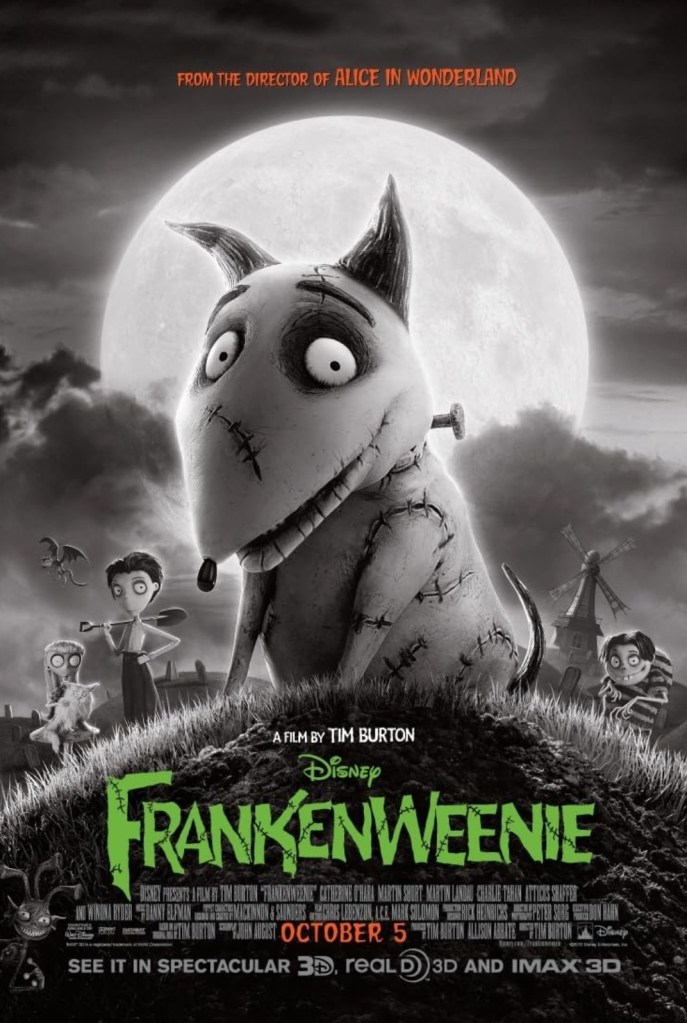
Frankenweenie (2012) poster created by Walt Disney Pictures, Tim Burton Productions, and Walt Disney Studios Motion Pictures

Things I liked about the film:

The animation: When it comes to animation, Tim Burton has a very distinct style. While this style shines in Frankenweenie, I want to talk about how the characters express emotion. Throughout the story, emotions are expressed through the mouth and eyelids. This prevented the characters from appearing static. One example is when Victor is working on his science experiment for the first time. After performing the experiment, Victor is curious about its effectiveness. When he thinks the experiment didn’t work, Victor’s mouth is turned in a frown and his eyelids are lowered. That combination created a facial expression that showcased Victor’s sadness and disappointment.

Creative ideas are typically found in Tim Burton’s animated films. In Frankenweenie, this creativity is found in the creatures who appear in the story! When Victor’s peers try to recreate his experiment, they receive unexpected results. A turtle comes back to life as a hybrid between a turtle and a dinosaur. Due to a mix-up, one girl’s cat turns into a combination of cat, werewolf, and bat. These creatures were so unique, as I have never heard or seen them in media before. Frankenweenie serves as an example of how imaginative the animation genre can be!

The “Easter Eggs”: “Easter Eggs” are references that are subtly woven into a piece of entertainment media. Disney and Tim Burton related “Easter Eggs” can be found in Frankenweenie! During Victor’s science experiment, he flies two kites in an attempt to capture lightening. One of these kites is shaped like a bat, a nod to when Tim directed Batman from 1989. In Victor’s room, there is a poster of 20,000 Leagues Under the Sea. This is a reference to when Disney adapted that story in 1954. I love when a film scatters “Easter Eggs” throughout the story, as it keeps the audience engaged in what they’re watching!

The messages and themes: Frankenweenie included several good messages and themes into the story! One of them appeared when Victor is interacting with his science teacher, Mr. Rzykruski. During this conversation, Victor explains how his science experiment worked the first time, but not the second time. Mr. Rzykruski helps Victor understand his dilemma by stressing how he should do science experiments for the right reasons. This message becomes an overarching theme in Frankenweenie, as characters’ intentions determine an outcome.

Group of puppies image created by Rawpixel.com at freepik.com. <a href=”https://www.freepik.com/free-photos-vectors/background”>Background photo created by rawpixel.com – http://www.freepik.com</a>. Image found at freepik.com.

What I didn’t like about the film:

No pops of color: Frankenweenie is presented in black-and-white imagery. This creative choice allowed the movie to boast a distinctive aesthetic. But what would have made the visuals even more interesting is if pops of color were included. Whenever lightening appears, a bright yellow flash could have graced the screen. If a character were holding a Sea Monkey packet, that packet could have delivered vibrant hues of blue and purple. Adding color to certain elements or objects would have emphasized important parts of the story. Those pops of color would have also stood out nicely against the black-and-white background.

An underutilized antagonist: In stories created for children/families, there will sometimes be a grown-up character as the main antagonist. A perfect example is Miss Trunchbull from Matilda. There is a grown-up antagonistic character in Frankenweenie, Mr. Burgermeister, the mayor of New Holland. But unlike Miss Trunchbull, Mr. Burgermeister was underutilized in the story. Victor faced more conflicts with his peers than with Mr. Burgermeister. Plus, the mayor’s appearances in the movie were far and few between. This makes me wish Victor’s peers had been the only antagonists in the film.

Parts of the story that are unexplained: For this part of my review, I will include a spoiler for Frankenweenie. If you have not seen this film and are interested in watching it, please skip this part and continue where it says “My overall impression”.

As I mentioned earlier, Victor’s peers receive unexpected results after they try to recreate his experiment. When these creatures cause chaos throughout the town, Victor helps his peers reverse the effects of their experiments. With the use of electricity, Victor is able to reverse the effects of the turtle/dinosaur hybrid, with the turtle becoming dead again. Yet, when Victor uses electricity on his dog, Sparky, the dog stays alive. Because the science wasn’t explained, this part of the story felt inconsistent.

Cute Halloween border created by Freepik at freepik.com. <a href=’https://www.freepik.com/free-vector/halloween-background-with-fun-style_1310632.htm’>Designed by Freepik</a>. <a href=”https://www.freepik.com/free-photos-vectors/background”>Background vector created by Freepik</a>. Image found at freepik.com.

My overall impression:

Disney has a history of re-telling pre-established stories. When re-telling these stories, whether it’s The Hunchback of Notre Dame or Oliver Twist, the delivery of these projects has adopted distinct identities and aesthetics, making the movie feel unique and creative. With Frankenweenie, it is a cute, unique take on Frankenstein! The combination of stop-motion animation and black-and-white imagery allow the movie to stand out among other versions of Mary Shelley’s story. “Easter Eggs” related to Tim Burton and Disney keep viewers engaged in the film they are watching. Yes, there are flaws within Frankenweenie, like unexplained parts of the story and an underutilized antagonist. However, this is a good choice for Halloween entertainment!

Overall score: 7.8 out of 10

Have you seen Frankenweenie? Are there any animated films you like watching during the Halloween season? Let me know in the comment section below!

Have fun during Halloween!

Sally Silverscreen