Word on the Street: Television show, ‘Community’ Will Soon Get Their “Six Seasons and a Movie”

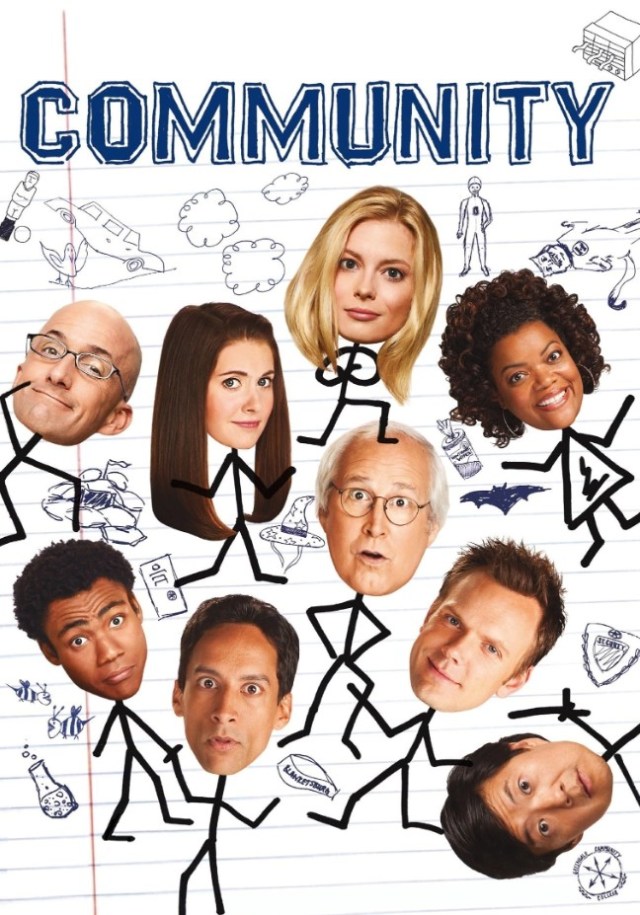
Anyone familiar with the television show, Community, will know the phrase “six seasons and a movie”. Ever since Abed (one of the show’s main characters) uttered the phrase in the show’s second season, the idea of any show receiving a movie and six seasons has become “the American dream” in the world of entertainment. While Community has indeed earned six seasons, the movie has been in development since 2022. But according to the film’s official IMDB page, it appears the movie may be on its way! ‘Community: The Movie’ (the movie’s current working title) is classified as “pre-production”. However, the release date is listed as “Expected 2026”. The page lists the majority of the show’s main cast, implying they will return for the film. Production companies working on the project are Sony Pictures Television, Universal Studio Group, and Universal Television. Peacock will, as of this article’s publication, distribute ‘Community: The Movie’.

Community poster created by Krasnoff Foster Productions, Harmonious Claptrap, AGBO, Universal Media Studios (UMS), and Sony Pictures Television

This is the first time I’m talking about Community on 18 Cinema Lane. However, I wanted to cover this movie news story because the creative team behind the movie, as well as the show, is doing something that I appreciate; keeping a promise to the fans. Whether intentional or unintentional, “six seasons and a movie” became a promise, giving the fans something to hope for. So, when Community did get six seasons, it felt the show’s creative team stood by their word. Now, with the movie currently in development, the show’s creative team is, once again, staying by their word by giving the fans what they want. This makes me hope other television shows follow in Community’s footsteps.

What are your thoughts on this piece of movie news? Are you looking forward to ‘Community: The Movie’? Let me know in the comment section!

Have fun at the movies!

Sally Silverscreen

References:

Official IMDB page for ‘Community: The Movie’: https://www.imdb.com/title/tt21958386/?ref_=ttco_ov_bk

Article explaining the origin of “six seasons and a movie”: https://www.nbc.com/nbc-insider/the-origin-of-six-seasons-and-a-movie-viral-community-phrase

Ten Movie Trends I Don’t Understand

Days before Christmas, I reviewed I Heard the Bells for my 500 Blog Follower Dedication Review. But this is not the only honor the movie achieved. I Heard the Bells became my 400th published movie review! To commemorate this milestone, I decided to write my sixth list article of 2024. Trends, whether in fashion or when it comes to the most popular toy of the Christmas/holiday season, exist for a reason. This statement also applies to the world of cinema. Sometimes, however, there are film related trends that leave me confused, wondering why film-makers continuously use them in their projects. So, for this list, I will be discussing ten movie trends I don’t understand! The intent of this list is to gain a better understanding for why the listed trends either existed or still exist, as I am genuinely curious about their purpose.

Image of 2010 and 2020 on chart created by Macrovector at freepik.com. Infographic vector created by macrovector – www.freepik.com

1. Food Fights

From about the late ‘80s to the mid-2000s, children’s/family media, especially movies, were fond of food fights. From 1996’s Matilda (where the children at Crunchem Hall Elementary School hurl their lunches at Miss Trunchbull) to the Disney Channel film, Eddie’s Million Dollar Cook-Off (where I remember two food fights taking place), film-makers saw food fights as a way to add excitement and hilarity to their film. But long after the janitor has cleaned up the mess, what sinks in is the realization that these film-makers likely spent hundreds of dollars on large quantities of food only to waste it. This realization not only makes me wonder why food fights were once a staple of children’s/family media, I also question how often food fights happen in real life.

2. Keeping Secrets

Around the time the aforementioned food fight trend was common, another popular movie trend was younger characters being encouraged to keep secrets. When I reviewed 1985’s Return to Oz, I brought up Princess Ozma telling Dorothy that she can go back to Oz whenever she wants, as long as she keeps it a secret. By bringing up that part of the film, I addressed how Princess Ozma’s statement could be misinterpreted as damaging messages such as holding back on creativity helping one become “normal” and bottling up ideas and feelings being accepted. As I mentioned in my review of The Best Christmas Pageant Ever, bullying is not addressed in the script, including in Alice’s part of the story. One reason why is how Imogene forces Alice to keep the bullying a secret. If you’re going to create a story for a younger audience, you need to be mindful when it comes to addressing serious, real-world issues because of how impressionable a younger audience can be. With that said, I kind of find it concerning how common the trend of younger characters keeping secrets was in children’s/family media.

3. New York City as a Selling Point

I brought up this trend back in 2021, when I reviewed Sherlock Holmes in New York. As I shared my overall impression of the 1976 film, I talked about how movie studios used their project’s New York setting as a selling point. Clear examples show New York City or New York City locations included in a film’s title, like A Troll in Central Park, The Muppets Take Manhattan, and Home Alone 2: Lost in New York. I don’t understand this need to single out a story’s New York location. Personally, I think the movie should show instead of tell their story is set in New York. What I also don’t understand is why the trend of using New York as a selling point occurred between about the mid- ‘70s to the mid-2000s.

4. Villains Receiving the Spotlight

2024 started with the release of Madame Web (a Spider-verse villain movie without the presence of Spider-Man) and ended with the premiere of Kraven the Hunter (a Spider-verse villain movie without the presence of Spider-Man). I bring up these movies to highlight a trend I first noticed in the 2010s that carried over to the 2020s. This trend is villains receiving the spotlight; whether this means villains are given their own movie, villains are presented as more “sympathetic”, or villains make arguments with seemingly valid points. When a movie studio adopts this trend, it gives their audience mixed messages. Within Spider-Man’s comic books, Kraven is known as a villain. The tagline of Kraven the Hunter is “Villains aren’t born. They’re made”. But based on what I’ve heard about the film, Kraven is presented as more of an anti-hero. Not only does giving villains the spotlight confuse the audience, it also makes villainous characters less straight-forward.

5. “Thrown Together” Movie Posters

A “thrown together” movie poster is the contents of a movie (like cast photos, story locations, and even a scene from the film) thrown together on that movie’s poster. The collage I just described appears overwhelming and leaves the audience with little surprises. I first became aware of this trend when Disney/Marvel used this style for their Avengers: Age of Ultron poster. After that movie came to theaters in 2015, the “thrown together” movie poster trend became the go-to style of cinematic advertising. It even got to the point where Hallmark adopted this trend, as the posters for Christmas Everlasting and Love Takes Flight are notable examples. Based on what I’ve seen, it seems like the “thrown together” movie poster trend is fading in the 2020s, as studios and networks have chosen more artistic styles for their movie posters. But I still wonder why the “thrown together” movie poster trend was ever popular.

New York City skyline with letters image created by Freepik at freepik.com. <a href=’https://www.freepik.com/free-vector/new-york-skyline-typographic-silhouette_719554.htm’>Designed by Freepik</a>. <a href=”https://www.freepik.com/free-photos-vectors/background”>Background vector created by Freepik</a>. Image found at freepik.com.

6. Men Drinking Black Coffee

In Great American Family’s A Little Women’s Christmas, Fritz orders a black coffee at a café in Alcott Grove. At that same café, Jo orders a sugary, seasonal coffee drink. This scene made me realize how often I’ve seen men ordering and/or drinking black coffee in movies. Not only do they order/drink black coffee, they usually get criticized for doing it. Similar to the previously mentioned food fight trend, I wonder how the men drinking black coffee trend reflects real life.

7. Cabins & Bed and Breakfasts

These trends are specific to Lifetime and Hallmark movies. In the world of Hallmark films, it seems common for characters to either own a Bed and Breakfast or know someone who knows a Bed and Breakfast. These Bed and Breakfasts are usually found in small towns. Meanwhile, on Lifetime, it seems like many characters either own a cabin or know someone who owns a cabin. The cabins themselves are typically treated as a vacation destination. I know both networks share the same flaw; telling the same types of stories and reusing the same ideas. This makes me wonder if that flaw is the reason for the abundance of Bed and Breakfasts on Hallmark and cabins on Lifetime.

8. Rival Girl Scouting Troop

This trend isn’t as common as other trends on my list. But I’ve seen it happen enough times to point it out. Troop Beverly Hills, The Cookie Mobster, and Smart Cookies share something in common; the “underdog” girl scouting troop must face a “rival” girl scouting troop. The rival girl scouting troop is always presented as bratty, wealthy, and popular. Their only purpose in the aforementioned movies is to win cookie season. The rival girl scouting troop trend is, in my opinion, an unnecessary conflict. The main and only conflict should be the protagonist girl scouting troop trying to achieve a goal within their own troop (such as having a successful cookie season). The rival girl scouting troop trend is yet another movie trend that makes me wonder how often it happens in real life.

9. The Sound of a Baby Crying in an Apartment Building’s Hallway

When one of a movie’s scenes takes place in an apartment building’s hallway, the sound of a baby crying can be heard. This trend has been present in so many movies, I wonder why that particular sound has been the go-to sound for film-makers. All walks of life can live inside an apartment building. This fact provides film-makers with a variety of sounds; such as dogs barking, music, or noise from a television. So, it confuses me when film-makers continuously use the same sound over and over again.

10. Calling out “Hello” in an Empty Room

Out of all the movie trends on my list, the calling out “hello” in an empty room trend is the most common one. From theatrical pictures to made-for-TV films, a character will call out “hello” when they enter an empty room. Predictably, no one calls “hello” back. But the character who called out “hello” will be taken by surprise by another character. The calling out “hello” in an empty room trend can usually be found in mystery, action, or thriller movies. When film-makers select this trend, they make suspenseful moments more predictable. It also makes characters who call out “hello” look absent-minded.

Coffee cup drawing image created by Valeria_aksakova at freepik.com. <a href=”https://www.freepik.com/free-photos-vectors/background”>Background image created by Valeria_aksakova – Freepik.com</a>. <a href=’https://www.freepik.com/free-photo/painted-cup-of-coffee-with-natural-coffee-beans-on-a-chalkboard_1013935.htm’>Designed by Freepik</a>. Image found at freepik.com.

Have fun at the movies!

Sally Silverscreen

Take 3: RKO 281 (1999) Review

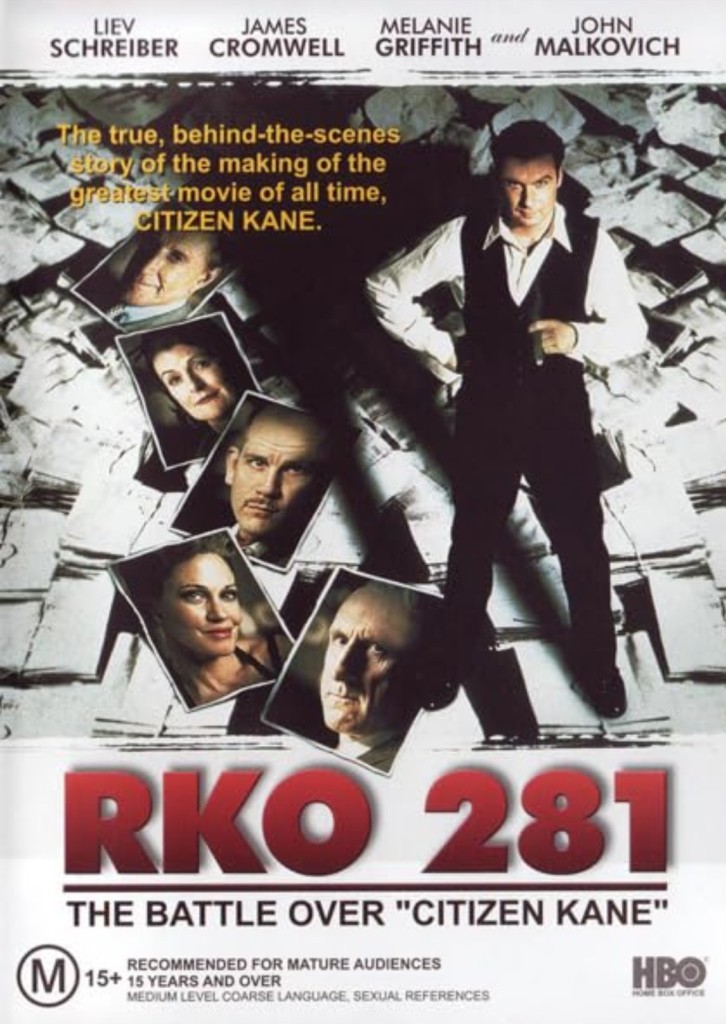
Once upon a time, in 2019, I saw Citizen Kane for the first time. In my review of the film, and even in my list of ten classic movies I watched because of my blog, I stated how, in my opinion, Citizen Kane is not the flawless masterpiece almost everyone has made it out to be. As you’re reading this introduction, you’re probably wondering, “What does Citizen Kane have to do with July’s theme of Genre Grandeur? That movie isn’t about making movies”. No, it’s not. But the 1999 HBO movie, RKO 281, is. While looking for a title to review for the aforementioned blogathon, I stumbled upon RKO 281, a film I had never heard of prior to the event. When I learned the movie was about the creation of Citizen Kane, I knew I’d appreciate the 1999 project, especially since I saw and wrote about the 1941 film. It also gave me a reason to check out one of HBO’s made-for-tv titles. So, without any delay, let’s start this show of my RKO 281 review!

RKO 281 (1999) poster creatd by HBO Pictures, WGBH, Scott Free Productions, Labrador Films, BBC Films, and Home Box Office (HBO)

Things I liked about the film:

The acting: When we think about a name like Orson Welles, it can sometimes be easy to think of him as more than just a man with a dream. As Orson’s name became a staple of cinematic history, it also became what legends are made of. But Liev Schreiber, the actor portraying Orson, brought humanity back to that name, finding the heart of the “genius” and putting some genuine emotion behind it. While apologizing to Herman Mankiewicz after a falling-out between them, Orson shares a personal recollection about his father. After sharing a part of his soul with his friend, a smile appears on Orson’s face, relieved Herman has agreed to work on Citizen Kane. At the same time, you can see a tear has escaped Orson’s eye. This gives another meaning to Orson’s relief; the burdens of guilt and regret have lifted off his shoulders.

Liev Schreiber is not the only actor to use facial expressions and emotion to their advantage. Portraying William Randolph Hearst, James Cromwell was able to use these tools of acting to present William as more than just the story’s antagonist. When he finds out Citizen Kane is based on him, William is upset by this news. While talking about the situation with a woman named Louella, there is a sharpness to his voice, clearly indicating his bitterness toward the film. But the look in his eyes is that of defeat, questioning how someone was able to successfully build a bridge across the moat of his castle. In this scene, William’s face told more than dialogue could share; a man who gave everyone the impression he was in control, but was really unsure of what the future held.

Marion Davies was the mistress of William Randolph Hearst. Introduced to the audience in a party scene, Marion carried herself with a bubbly personality, almost being mistaken for “ditzy”. But Melanie Griffith prevented Marion from becoming a stereotype or caricature. With a variety of emotions, body language, and facial expressions, Melanie showed Marion as, simply, a woman in a complicated situation. One of my favorite scenes in RKO 281 was when Marion confronted William about his spending habits. Though in a drunken state, Marion addresses some excellent points. As she faces William, her voice is pleading. The desperation in Marion’s voice contains brutal honesty, giving her tone of voice some depth. She never breaks eye contact with William, showing how she isn’t afraid of standing up to “Pops”. Even though she does raise her voice, she only does this to emphasis her points. This scene elaborates how easily someone like Marion could be underestimated. While William saw Marion’s part of their conversation as “excessively theatrical”, I saw it as a woman who knew more about the situation than others were led to believe.

The set design: I’ve heard Hollywood referred to as the “Land of Dreams”. If that’s true, then the set design in RKO 281 was meant to visually represent a fairy tale! William Randolph Hearst’s castle is one of the most divine sets I’ve ever seen! So many details went into this location, it makes every space of the castle feel larger than life. From the marble fireplace held up by carved marble statues, to the large stained-glass windows boasting intricate colorful designs, to even a bath room with blue and green hued walls, William’s castle is a place beyond imagination. While the castle certainly stole the show, there were other sets that looked great on camera. During RKO 281, Orson travels to New York. In a scene showcasing Orson’s hotel room, his large, wooden bed was smartly paired with a red and beige blanket. The bed isn’t the only wooden piece of furniture in the room, as the desk, matching bedside tables, and even the walls display a warm shade of wood. Because of the tall window, the illusion of the room having a high ceiling is given to the audience. Filling the room with warm light from the lamps and the wall sconces, this high-end hotel room gave off a cozy atmosphere!

The film-making process: One of my favorite episodes of Murder, She Wrote is ‘Film Flam’. Watching the process of premiering a film is what made that episode fascinating to me. RKO 281 showed a similar process in their story. But this time, the entire film-making process was revealed. Glimpses of how Citizen Kane was made were woven into RKO 281. I learned some things about Citizen Kane because the film-making process was shown. For instance, I didn’t know Orson dug a hole into the floor just to get the shot he wanted. I also didn’t know that filming of Citizen Kane started two days ahead of schedule. It was interesting to see the various components that go into creating a film, especially during a time when technology wasn’t at a film-maker’s disposal. This peek behind Hollywood’s curtain can make one appreciate the work that goes into making a movie.

The dialogue: There is a lot of work that goes into writing a script. One important area of any script is the creation and delivery of dialogue. As I’ve said in past reviews, dialogue can be hit or miss, especially in a made-for-tv movie. In RKO 281, you can tell there was thought put into the dialogue of the script. In fact, I would go so far as to say the dialogue was, at times, profound. Remember when I said one of my favorite scenes was when Marion confronted William about his spending habits? One of the reasons why I like that scene is because of how well the dialogue was written and delivered. During the confrontation between Marion and William, Marion reminds him of the difference between wanting and needing something. She elaborates on this point by questioning how much a nearby statue cost, not caring about details such as where it was made or the style of the statue, details only William would bring up. Even at the very beginning of this scene, when Marion says, “Millions of dollars a year on art and statues, and there is nothing to explain” illustrates how Marion recognizes the severity of the situation. Meanwhile, as William responds to Marion by stating, “We are in no pickle, as you so euphemistically put it”, the script emphasizes William’s choice to use big words to not only belittle Marion’s intelligence, but also brush his problems under the rug.

Image of vintage movie camera created by Macrovector at freepik.com. <a href=”https://www.freepik.com/free-photos-vectors/background”>Background vector created by macrovector – http://www.freepik.com</a>. Image found at freepik.com.

What I didn’t like about the film:

The omission of the Breen Code: If you’ve read my movie reviews, you’d sometimes see the term ‘Breen Code’ mentioned in the text. For those unfamiliar with this concept, the Breen Code is a set of moral guidelines that had to be applied to film-making. Movies released between 1934 and 1954 formed the Breen Code era. Because Citizen Kane was released in 1941, I was hoping the Breen Code would play a role in the process of Citizen Kane’s creation. Unfortunately, the Breen Code wasn’t even mentioned. To me, the Breen Code is an underrated component in cinematic history. It would have been nice to hear it referenced in RKO 281’s dialogue.

Some parts of the story not receiving closure: Louella Parsons works for William Randolph Hearst as his “eyes and ears of Hollywood”. After she sees a rough cut of Citizen Kane, she informs William about the film resembling his life. Louella vows to get revenge against Orson for creating the movie, even going so far as to use blackmail in an attempt to cancel the film. But when William’s financial troubles come to light, her role in William’s life seems to have diminished. What happened to Louella after William’s financial situation was made public? Did she still work for him or did she end up working for someone else? This is just one part of RKO 281 that didn’t receive closure.

Keeping track of who’s who: As I mentioned in this review’s introduction, RKO 281 chronicles the creation of Citizen Kane. Therefore, the story follows those individuals connected to the project itself. Throughout the movie, though, members of the film industry from the late 1930s to the early 1940s were brought up in the dialogue. While I was familiar with some of these people, other names I did not recognize. It almost felt like RKO 281’s creative team expected the audience to know the film industry scene of that time. When I watch a film, I want to be told a story. If I end up learning something valuable by watching a movie, I feel that is time well spent. However, I don’t want to feel like I need to do homework prior to watching the film.

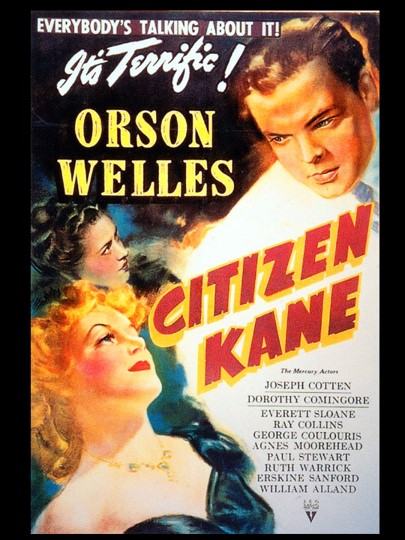
Citizen Kane poster created by Mercury Productions and RKO Radio Pictures. Image found at http://www.tcm.com/tcmdb/title/89/Citizen-Kane/#.

My overall impression:

Not all made-for-tv movies are created equal. Sometimes, a low amount of effort will be given to a made-for-tv production, making a presentation look and feel cheap. But there are made-for-tv projects that are solid, despite the limited resources and finances. RKO 281 is so well-made, it is easy to forget this is an HBO film, as this movie looked and felt theatrical! The creative team behind RKO 281 went above and beyond to make their project the best it could be! From the actors and the screenwriters to the set designers, every person involved with the 1999 movie stepped up their A game and it shows. The style and substance of RKO 281 go hand in hand. While I still don’t believe Citizen Kane is a flawless masterpiece, I’ve gained an appreciation for the efforts it took to make this film exist at all. Toward the end of RKO 281, Orson says “Pretty speeches make history”. If that’s true, then good films leave a lasting impression.

Overall score: 8 out of 10

Have you seen RKO 281 or Citizen Kane? Are there any HBO movies you’d like to see me review? Tell me in the comment section below!

Have fun at the movies!

Sally Silverscreen

Take 3: Anna and the King Review

I know what you’re thinking, “What does Anna and the King have to do with the number five”? Well, I’m glad you asked! As Rebecca has stated in the announcement post for the Fifth Broadway Bound Blogathon, all entries had to have something to do with the number five, to commemorate the event’s fifth anniversary. For my selection, Anna and the King, which stars Bai Ling, was released in 1999, five years after The Crow premiered. From what I’ve heard, The Crow was Bai Ling’s first American/English film. Last year, when I reviewed the 1956 adaptation of The King and I, I mentioned Anna and the King was a non-musical version of the story. As I write this review, I realize I haven’t seen many non-musical film adaptations of musicals. Sure, I’ve heard of these types of productions. But, off the top of my head, a non-musical adaptation doesn’t immediately come to mind. So, with this review, I will expand my cinematic horizons!

Anna and the King poster created by Fox 2000 Pictures, Lawrence Bender Productions, and 20th Century Fox

Things I liked about the film:

The acting: Anna and the King is a drama film with a more serious tone. Therefore, Jodie Foster’s portrayal of Anna is sterner in nature. However, Anna also comes across as being fair. A great example of this is when she is disciplining both her son and King Mongkut’s eldest son. In the evening, when the royal family is bringing Anna dinner, Jodie presents a mild-mannered sweetness that feels genuine. As she’s realizing the dinner is for her and not King Mongkut’s son, Anna never displays any meanness toward her student, as she truly wants to teach him a valuable lesson. King Mongkut himself is also a stern, yet fair character. Chow Yun-fat balances the seriousness and loving sides of his character consistently throughout the film. In one of their many conversations, King Mongkut is asked by Anna if his wives ever get jealous of one another. Even though this question is a personal one, King Mongkut never appears offended. Instead, his calm, collected, and approachable demeanor make the conversation less awkward than it could have gotten. One of these aforementioned wives is Tuptim. Portrayed by Bai Ling, Tuptim is an emotional character that expresses herself in subtle ways. It’s not until she faces a life-or-death moment where more of her emotions are drawn forward. While I won’t spoil Anna and the King for those of my readers who might be interested in seeing it, Bai delivers on the emotional intensity needed for a moment like the one I just mentioned. But even outside of that moment, Bai knows how to use emotion in her and her character’s favor.

The set design: Anna and the King is a beautiful looking film! One of the reasons why is its set design. Everywhere you look, exquisite detail and impressive structure helped elevate the world around Anna and King Mongkut. The royal family takes a trip in a massive river boat. This boat was a deep blue with gold etched artwork. At the head of the boat, a set of giant golden dragons adorn this beautiful mode of transportation. On the walls of King Mongkut’s palace, a full-length mural consistently coats the interior perimeter of rooms and even a hallway. The mural itself appears painted, depicting the natural landscape of Siam. Smaller elements like the ones I mentioned added to the overall beauty of the set design!

The costume design: Similar to the 1956 adaptation, the costume design in Anna and the King was simply elegant! One notable example was Anna’s reception gown. At this event, Anna wore a full length, white gown. The off the shoulder bodice and sparkly skirt was not only eye-catching, it also felt reminiscent of Belle’s gown from the 1991 animated film, Beauty and the Beast. At this same reception, King Mongkut’s wives also wear beautiful gowns. Tuptim’s was especially pretty, a simple yet classy red dress. What also complimented Tuptim’s ensemble was a sparkly gold and bronze crown that adorned her dark hair. The exquisiteness of the costume design carried the spirit of The King and I story!

The Fifth Broadway Bound Blogathon banner created by Rebecca from Taking Up Room

What I didn’t like about the film:

The war story-line: Because Anna and the King is a non-musical version of The King and I, there needs to be something to replace the musical numbers. In the 1999 adaptation, that replacement was a subplot about a war between the Siamese and the Burmese. While it was interesting to explore the tense side of ruling a country, I found this subplot to be the weakest one. That subplot was drawn-out, getting resolved at the very end of the movie. With the run-time being two hours and twenty-eight minutes, the war story-line felt longer than it really was.

Under-utilized characters: Anna and the King contains a larger cast of characters. Therefore, some of them are bound to receive less screen-time than others. Tuptim was, once again, one of those characters. After seeing how under-utilized Rita Moreno’s talents were in the 1956 adaptation, I was hoping Bai Ling would receive more screen time. Sadly, she only appeared in a handful of scenes. In the 1956 adaptation, Tuptim created a play based on Uncle Tom’s Cabin, giving her a reason to stay on screen a little bit longer. Because there is no Uncle Tom’s Cabin play in the 1999 adaptation and because only King Mongkut’s oldest son reads Uncle Tom’s Cabin, Tuptim, in Anna and the King, has less reasons to stay on screen.

No musical Easter eggs: Before I wrote this review, I was well aware Anna and the King was not a musical film. But because the film is an adaptation of a musical, it was a missed opportunity to not include musical related Easter eggs. In the 1956 adaptation, King Mongkut says “Et cetera, et cetera, et cetera” on multiple occasions, whenever he had something important to say. In the 1999 adaptation, however, King Mongkut never says the aforementioned quote. One of the songs from the 1956 adaptation is ‘Shall We Dance?’. During both versions of this story, King Mongkut and Anna dance with one another. However, it would have been nice to hear one of them say “shall we dance.”

Hand-written letter image created by Veraholera at freepik.com. <a href=”https://www.freepik.com/free-photos-vectors/background”>Background vector created by Veraholera – Freepik.com</a>. <a href=’https://www.freepik.com/free-vector/love-letter-pattern_1292902.htm’>Designed by Freepik</a>. Image found at freepik.com.

My overall impression:

Anna and the King is a fine, competently made film. The movie’s creative team clearly knew what they doing, displaying the clear direction they wanted to take their adaptation. But compared to the 1956 musical, I find myself liking the musical more. Without the musical numbers, it feels like the story is missing something. Even though the 1999 adaptation found a replacement for the lack of musical numbers, I was wishing they hadn’t been omitted. I would have even accepted Easter eggs related to the musical, such as quotes from the songs woven into the dialogue. But despite its shortcomings, Anna and the King does attempt to make meaningful changes that were not in the 1956 musical. One of these changes is giving Anna’s son, Louis, and some of King Mongkut’s children their own unique personalities and a little more involvement in the overall story. As for Bai Ling’s involvement in the film, I wish she was given more on-screen appearances. But because Anna and the King is based on The King and I, which also showed Tuptim in only a handful of scenes, maybe I was naïve to think more material was available?

Overall score: 7.2 out of 10

Have you seen Anna and the King or The King and I? Can you think of any musicals that received a non-musical adaptation? Let me know in the comment section!

Have fun at the movies!

Sally Silverscreen

Watching ‘Singin in the Rain’ for the First Time

Throughout my years of movie viewing (and blogging), I have received the opportunity to check out films boasting a “classic” status. This status has, in my opinion, been earned on some occasions, as I gained an understanding for why a particular movie was granted its praise. However, there were certain titles I found myself unable to figure out why it is considered a “classic”. Out of all these “classic” films, I have been meaning to see one specific picture. That title is Singin in the Rain. The 1952 production needs no introduction. From the song, “Good Morning”, being featured in an orange juice commercial to a replica of Gene Kelly’s umbrella in Disney MGM/Hollywood Studios, Singin in the Rain has carved out a slice in America’s pop culture pie. But for someone, like me, who hasn’t seen this iconic film before, these references are going to seem like a company, individual, or creative team is, simply, taking advantage of the movie’s 50+ year popularity. That replica is just used for tourists to have their photo taken. That song was just an appropriate selection to promote a beverage primarily found at breakfast-time. With the arrival and fruition of the Singin in the Rain Blogathon, I finally have a wonderful excuse to watch Singin in the Rain. It also gives me an opportunity to gain more context of the film’s respective songs, images, and quotes.

Singin in the Rain poster created by
Metro-Goldwyn-Mayer and Loew’s Inc.

Creative Musical Numbers

Singin in the Rain is not just one of the most iconic movies of all time, it’s one of the most iconic musicals of all time! A musical with a “classic” status will bring something unique and creative to the table. The Wizard of Oz took on the power of Technicolor, in a time when that specific technology was more of a luxury. Xanadu showed the world roller skating can be magical. When it comes to Singin in the Rain, the creativity lies in the musical numbers themselves, presenting performances that hadn’t really been seen before 1952. Toward the beginning of the film, Gene and Donald perform a duet, “Fit as a Fiddle (And Ready for Love)”, at a vaudeville show. Throughout this musical number, Donald and Gene not only tap danced, but played the fiddle as well. For the 21st century viewer, dancing and playing an instrument at the same time doesn’t seem like a new concept, as Lindsey Stirling has capitalized on those talents. Within the realm of cinematic musicals, however, a routine like Gene and Donald’s isn’t often included.

Gene Kelly’s famous solo isn’t the first musical number featuring rain. Two decades prior, in Just Around the Corner, Shirley Temple performed “I Love to Walk in the Rain”, her film’s big musical number that represented the spirit of the movie. Looking back on “Singin in the Rain”, I, personally, feel Shirley’s number walked (no pun intended) so Gene’s solo could soar! The solo from the 1952 production takes place after Gene’s character, Don, takes Kathy home. Despite it raining outdoors, Don is head-over-heels in love with Kathy. Gene tap danced in his solo. But unlike “I Love to Walk in the Rain”, “Singin in the Rain” felt more immersive, as it wasn’t just a performative routine. Because the number takes place within the story’s context, it feels grounded in reality, a downtown street replacing a glamourized stage. Watching Gene jumping and splashing in puddles added uniqueness to the routine. Even though “Singin in the Rain” wasn’t the big musical number for its respective movie, it represents the film’s spirit, reminding the audience to see the good in a not-so-good situation.

String of musical notes image created by Freepik at freepik.com. <a href=’https://www.freepik.com/free-vector/pentagram-vector_710290.htm’>Designed by Freepik</a> <a href=”https://www.freepik.com/free-photos-vectors/background”>Background vector created by Freepik</a>. Image found at freepik.com. 

Strong Camaraderie

In most of my reviews, I talk about the acting. I will choose a few performances to discuss and write about what I liked about them. For this review, I want to talk about a different acting component. While the overall acting in Singin in the Rain was strong, what stood out to me more was the on-screen camaraderie between Gene Kelly, Debbie Reynolds, and Donald O’Connor! One of my favorite scenes is when Don, Kathy, and Cosmo are concocting a plan to save Don’s film. Each character’s personality shines through during this brainstorming session. Cosmo encourages Don to turn the film into a musical, as he spontaneously breaks out into song. Meanwhile, Kathy attempts to keep the group’s good spirits lifted, her kind demeanor certainly helping the situation. After hearing Cosmo’s idea, Don is open-minded about it, joyously realizing he can use his talents to his advantage. This scene, as well as the “Good Morning” musical number, is just one example of Gene, Debbie, and Donald’s on-screen camaraderie. Through their interactions, it felt like Don, Kathy, and Cosmo had been friends all along. This on-screen bond was so pleasant, I looked forward to each time these characters crossed paths!

Couple performing the waltz image created by Macrovector at freepik.com. <a href=”https://www.freepik.com/free-photos-vectors/background”>Background vector created by macrovector – http://www.freepik.com</a>. Image found at freepik.com.

Learning about Cinema’s Early Years

Singin in the Rain takes place in the 1920s, during the transitional period between silent films and “talkies” (movies with sound). Even though the 1952 film is a musical that takes time to focus on its numbers, it lifts the figurative curtain enough to educate the audience on how film-making was executed in that time period. Don’s respective studio, Monumental Pictures, adopted sound after Warner Bros. took a chance with their film, The Jazz Singer, a high risk that was met with high rewards. Because of that one creative decision, it forever changed the cinematic landscape. As emphasized in the musical number, “Moses Supposes”, actors had to not only memorize their lines, they also had to remember to annunciate those lines. Singin in the Rain also shows the audience how dialogue is incorporated into a movie. As someone who appreciates the film-making process, it was nice to see this part of movie-making shown in steps. This step-to-step process was a good introduction to some of the work that goes on behind the camera.

Image of vintage movie camera created by Macrovector at freepik.com. <a href=”https://www.freepik.com/free-photos-vectors/background”>Background vector created by macrovector – http://www.freepik.com</a>. Image found at freepik.com.

The Context of “Broadway Melody” in Don’s Film

While working to adapt his film, The Dancing Cavalier, into a musical, Don proposes the movie’s new opening scene. This scene is presented as the musical number “Broadway Melody”. As a musical number in Singin in the Rain, I liked this performance! It had colorful set and costume design, as well as strong choreography. But as an opening scene in The Dancing Cavalier, the musical number, in my opinion, doesn’t work. “Broadway Melody” is too long, my guess is ten minutes. The number itself kind of feels like an extension of Don’s past, as his journey to Hollywood came from simpler beginnings. Based on what the characters said about The Dancing Cavalier, Don’s proposed opening scene seems to have little connection to that film’s story. If Don’s movie were a real picture, some audience members might become bored with the film before the story began.

New York City skyline with letters image created by Freepik at freepik.com. <a href=’https://www.freepik.com/free-vector/new-york-skyline-typographic-silhouette_719554.htm’>Designed by Freepik</a>. <a href=”https://www.freepik.com/free-photos-vectors/background”>Background vector created by Freepik</a>. Image found at freepik.com.

No Subplot for Cosmo

As I mentioned earlier in this review, I liked the on-screen camaraderie of Gene, Debbie, and Donald. In fact, I liked Donald’s character, Cosmo! Not only was he hilarious and charming, but he was talented as well! The story of Singin in the Rain primarily revolved around the main plot; Monumental Pictures attempting to save their latest film. There is a subplot in the movie, but it mostly focuses on Lina, Don’s co-star. I would have loved to see Cosmo receive his own subplot. Since his contribution to the studio is musical, Cosmo’s part of the story would have pulled back that figurative curtain a little further to show the audience cinematic work behind the camera. I’ve said in previous reviews how important music is in film. Without it, there isn’t an opportunity for viewers to become emotionally affected by a given scene. Because Cosmo is a musician, that aspect of film-making could have been explored.

Masks of comedy and tragedy images created by freepik at freepik.com. <a href=”https://www.freepik.com/free-photos-vectors/background”>Background vector created by freepik – http://www.freepik.com</a>. Image found at freepik.com.

A Love Interest That Wasn’t Meant to be

In my point about Cosmo not receiving a subplot, I mentioned how Singin in the Rain’s subplot mostly focused on Don’s co-star, Lina. Personally, I think more of that time should have been given to Cosmo. I know Lina is meant to be the film’s antagonist. I also know her actions and choices are intended to fuel the movie’s conflict. But why would Lina receive so much time when she and Don were never meant to be? Before and after the premiere of The Royal Rascal, people speculate about Lina and Don’s relationship. Even Lina carries the assumption she and Don are romantically involved with one another. But Don makes it pretty clear he is not romantically interested in Lina. This part of the story reminded me of a Hallmark movie cliché I’ve talked about in the past: the “protagonist’s ex showing up unannounced” cliché.

The Singin in the Rain Blogathon banner created by Ari from The Classic Movie Muse

In Conclusion

Before the Singin in the Rain Blogathon, I had never seen the event’s namesake. That means if someone were to tell me one of the movie’s quotes or if I heard one of the film’s songs, I wouldn’t have thought much of it. Now that I have finally seen Singin in the Rain, I have gained an understanding and appreciation for it! When Kathy first meets Don, she claims, when referring to films, that “when you’ve seen one, you’ve seen them all”. However, I’d argue the 1952 musical built a solid identity that affords it a distinction from other musical movies. Even though Singin in the Rain was released within the Breen Code era, I was pleasantly surprised by the good messages and themes in the story. When I talked about the movie’s on-screen camaraderie, I shared one of my favorite scenes; where Kathy, Don, and Cosmo were figuring out how to save Don’s film. Through this interaction, the message of being one’s self is stressed. This message also allowed Don to use his talents in his favor. When I reviewed The Bridge on the River Kwai, I wondered what the criteria was for lists such as AFI’s 100 Greatest  American  Movies of All Time. One of my speculations was titles that brought something new to the cinematic table. It should be noted that Singin in the Rain is on AFI’s list. While I don’t know for certain how it got there, I think I have a pretty good idea why it’s there.

Have fun at the movies!

Sally Silverscreen

Take 3: Hallmark Hall of Fame’s Foxfire Review

Because yesterday was 4th of July, I wanted to review a movie that took place somewhere in the United States. While I wanted to publish this article on 4th of July, my day ended up being busier than expected. So, this review is published a day later than I had hoped. Recently, Hallmark Drama was airing several Hallmark Hall of Fame movies I had never seen before. One of these films was 1987’s Foxfire. Years ago, Hallmark’s stores sold select Hallmark Hall of Fame films on DVD for $20 apiece (yes, you read that price right), with Foxfire being one of the titles offered. Before recording it on my DVR, I didn’t know much about the movie. In fact, all I knew was that it was one of Hallmark Hall of Fame’s older titles. When I discovered the film took place in Appalachia, I thought it would be an interesting choice for this time of year. So, would I buy a DVD copy of Foxfire if I saw it at the store for $20? Before we head to the store’s checkout line, let’s start this review!

Like I’ve done in the past, I have taken a screenshot of Foxfire‘s poster that was featured on my TV. Screenshot taken by me, Sally Silverscreen.

Things I liked about the film:

The acting: I’m not familiar with Jessica Tandy’s acting abilities. While I have seen The Birds, I don’t remember her performance in that movie. Despite this, I did like her portrayal of Annie Nations in Foxfire! It was very expressive, using a variety of expressions and emotions throughout the film. When Annie receives an art project from her grandchildren, she appears genuinely overjoyed to receive the gift. A big smile is on Annie’s face and her demeanor is pleasant. At her son’s, Dillard’s, concert, Annie looks truly concerned as he sings a song about a broken relationship. Worry is in her eyes and she never lets Dillard out of her sight. Another actor whose career I’m not familiar with is John Denver. I have heard of his songs, but I didn’t know who he was. In fact, I thought John portrayed one of the brothers on The Waltons. This is because of the mannerisms he carried in Foxfire. When his character, Dillard, was happy, there was a youthful spirit about him. It highlighted how you can take the Appalachian man out of the mountains, but you can’t take the Appalachian culture and heritage out of the man. One of John’s strongest scenes was when, in Annie’s home, Dillard is reminding his mother about her age and potential risks of living alone. As he is talking to her, his eyes look like they are desperately searching for answers to his problems. Even the tone of his voice sounds concerned. A character that is close to both Annie and Dillard is Holly. Portrayed by Harriet Hall, this character kind of reminded me of Baby from Dirty Dancing. This is because when Holly cares about someone, she cares about them with her whole heart. What makes Holly differ from Baby is how her personality was gentler. Because she is a teacher, she chooses to put her students first. When Holly is talking to Dillard about her students, her mannerisms and tone of voice seem motherly. This gives the audience the impression that she truly cares about them.

The scenery: I haven’t seen many films that take place in Appalachia. In fact, I didn’t know Foxfire took place in this location until I read the synopsis. To my pleasant surprise, the scenery was very nice to look at! The Nation family house was surrounded by forestry, with the tall trees providing cozy seclusion and privacy. When Dillard wakes up one morning, he is greeted by the sight of rolling hills on a bright sunny day. These rolling hills could also be seen on a car ride Annie took. When a real estate agent named Prince gives Annie a trip to the market, he takes a scenic route. The aforementioned rolling hills steal the show, but are accompanied by a lake at the bottom and surrounding colonial style vacation homes that can be seen from the road. The locations in Foxfire appeared quaint, similar to the small towns in most of Hallmark’s films.

John Denver’s music: Before watching Foxfire, I had heard a few of John Denver’s songs. Even though I don’t listen to country music much, the songs I have heard were nice to listen to. Within Foxfire, John performed four songs. Most of them were slower, more soulful pieces. This fit the overall tone of the film. As I mentioned earlier in this review, Dillard performs a song about a broken relationship. After his concert, he performs an acoustic version of the song. What I’ve gathered about some country music is how emotional it can be. In that acoustic version of Dillard’s song, his heart and spirit sounded wounded. This can be heard in his voice.

Children holding American flags during a sunset image created by rawpixel.com at freepik.com. <a href=”https://www.freepik.com/free-photos-vectors/people”>People photo created by rawpixel.com – http://www.freepik.com</a>. Image found at freepik.com.

What I didn’t like about the film:

A televised play: Hallmark Hall of Fame has a history of adapting stage plays into movies. One of these titles I really like is the 1996 film, The Boys Next Door. However, what sets the 1996 production apart from Foxfire is how the overall project was executed. Because The Boys Next Door contains more key characters and locations within the story, the way this adaptation was delivered to the audience looked and felt like a movie. Foxfire, on the other hand, contained a smaller cast and had a condensed story, as most of the film takes places at Annie’s house. Even some of the scenes were drawn-out and isolated, like a stage production. While the project was shot like a movie, it felt more like a televised play.

Re-created moments from the past: Throughout Foxfire, Annie brings up several memories from her and her family’s past. Instead of providing flashbacks, four scenes were dedicated to showing the characters re-creating some of these moments. For example, a current day Annie and her late husband, Hector, are reenacting when he first proposed to her. Watching grown adults act like teenagers was a bit jarring, as this prevented me from getting fully investing in these scenes. If anything, the scenes made it look like the film’s creative team didn’t have enough room in their budget to hire additional actors.

Inconsistent elements: At the beginning of the movie, Hector provides a voice-over, explaining the significance of his family and their land. Thinking Foxfire would be from his perspective, I thought this was an interesting way to tell the story. But this was the only time any voice-overs were provided. The end of the film showed Hector breaking the fourth wall for one scene. Not only was the inclusion of this element random, but it made me wonder why it wasn’t consistently woven into the movie.

Oranges in tree image created by Jose Luis Navarro at freeimages.com. “FreeImages.com/Jose Luis Navarro.”

My overall impression:

Whenever I watch and/or review a Hallmark Hall of Fame movie, I always ask myself this: “if this movie were sold on DVD for $20, would it be worth my money”? When it comes to Foxfire, that answer would be no. At best, the movie was ok. I appreciate the film’s positive light that was shone on Appalachia. While I haven’t been there myself and while I personally don’t know anyone from there, I have heard of the hardships that the members of the community face. But despite the good will this film seemed to give, the biggest flaw was its overall execution. If I choose to watch a Hallmark Hall of Fame title, I expect to watch a movie. With Foxfire, it felt more like a televised play. Also, I wasn’t a fan of the re-created moments from the past. I couldn’t get past the adult characters acting younger than they were in the “current day”. Now that I’ve seen another Hallmark Hall of Fame movie, I can add it to my Tier Rank List! Last year, I created a tier rank list of every Hallmark Hall of Fame film I have seen so far. While I’d like to revisit this list, I will focus on adding more titles for now.

Overall score: 6.2 out of 10

Have you seen Hallmark Hall of Fame’s Foxfire? Are there any Hallmark Hall of Fame titles you’d like to see me review? Please let me know in the comment section!

Have fun at the movies!

Sally Silverscreen

Take 3: The King and I (1956) Review

For the Fourth Broadway Bound Blogathon, I chose to review the 1956 version of The King and I! Years ago, I had seen the 1999 animated adaptation of the musical. Since I vaguely remember it, I can’t provide an honest opinion of that movie. Because I had only seen pieces of the 1956 film and because it was recommended to me by Maddy from Maddy Loves Her Classic Films, I now found a good excuse to finally check the film out! While I knew the play itself was successful, I was surprised to discover it had won a Tony award. As this year’s blogathon focuses on Tony winners, it gave me an opportunity to learn something new. This is one of the reasons why I love participating in blogathons! Now, let’s start this review of 1956’s The King and I!

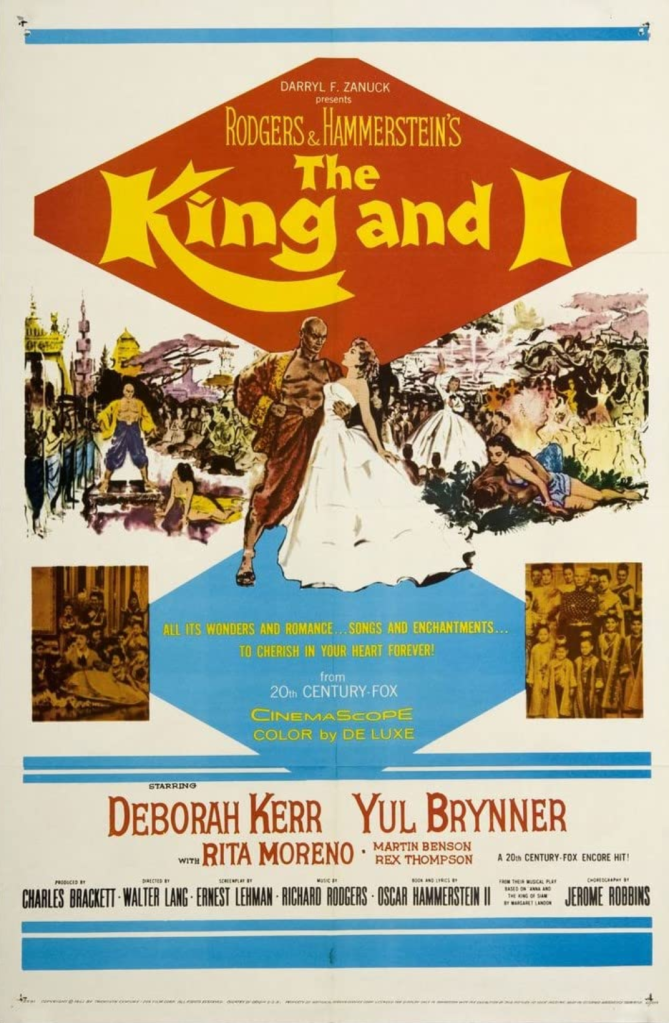
The King and I (1956) poster created by 20th Century-Fox.

Things I liked about the film:

The acting: Deborah Kerr is a dramatic actress, as her strengths can be seen in drama films. Because there were plenty of dramatic moments in The King and I, this allowed the best of Deborah’s acting abilities to be placed on display! In scenes that allowed Anna to stand up to King Mongkut, Deborah adopts a serious persona without any sarcasm. Her tone of voice is stern, while also standing up straight and looking directly at King Mongkut. Because there were light-hearted moments as well, it gave Deborah an opportunity to incorporate humor into her performance. This balance made the role suit Deborah well! This is the first time I had ever seen any of Yul Brynner’s performances. However, I was quite impressed by his portrayal of King Mongkut of Siam! Similar to Deborah Kerr’s role, there was a good balance of drama and comedy. In a scene where King Mongkut is talking to his son about what he learned in school, Yul speaks with a serious tone of voice. He also moved around the set with a posture that reflects his character’s royal power. However, when he introduced Anna to his children, King Mongkut would make silly faces in order to get them to smile. Before watching The King and I, the only film of Rita Moreno’s I had seen is West Side Story. Because of this, it was interesting to see Rita work with different material. While Anita, Rita’s character in West Side Story, is sassy and confident, Tuptim is more reserved and sensitive. When Rita didn’t have speaking lines, facial expressions and body language helped convey what Tuptim was thinking. As I liked her portrayal of Tuptim, it makes me wish Rita had appeared in more scenes.

The musical numbers: A musical is only as good as its musical numbers. With The King and I, I found the musical numbers to be entertaining! The most interesting one is the Siamese interpretation of Uncle Tom’s Cabin. Because Tuptim is reading a copy Anna gave her, she decides to write a play based on her own version of the novel. This particular number features traditional dancing, stylized face masks, and practical effects, such as a white sheet representing ice. It served as a good example of how everyone can view a text differently. The rest of the musical numbers in The King and I ranged from dramatic to comedic. One of them is ‘Getting to Know You’. In this scene, Anna dances with one of King Mongkut’s wives. Some of the children circled around their mother in order to mimic Anna’s skirt. This was a simple way humor was incorporated into some of the musical numbers.

The costume design: The King and I is known for being an elaborate musical, with elegance being found within the costume design. Bright colors were worn by almost all the characters. In a scene where Anna is introduced to King Mongkut’s children, the children’s outfits featured hues of pink, red, and green. The members of the royal family sometimes wore plaid, which complimented the rich color palette of the movie. Metals like gold could also be seen in the royal family’s attire. Some of King Mongkut’s jackets featured gold embroidery, a reminder of his wealth and affluence. Bronze coated the children’s headpieces as well. With the costume design being so exquisite, I wonder how much of this movie’s budget was devoted to it?

The Fourth Broadway Bound Blogathon banner created by Rebecca from Taking Up Room.

What I didn’t like about the film:

The under-utilization of Rita Moreno: As I mentioned earlier, the only film of Rita’s I had seen is West Side Story. Therefore, I was looking forward to seeing her performance in The King and I. I was disappointed to see Rita’s talents under-utilized. In this two hour and thirteen-minute movie, Rita appeared in a handful of scenes. While she did participate in the story’s musical components, she was only given one duet and the narration during the Uncle Tom’s Cabin play. I understand The King and I was released five years before West Side Story. But if the 1961 film has taught me anything, it’s how Rita is, talent wise, capable of so much more.

Drawn out storylines: The storylines in The King and I were drawn out because of the film’s two hour and thirteen-minute run-time. King Mongkut’s story, where he attempts to save his reputation, is one example. For about half the movie, King Mongkut wants to prevent other world leaders from thinking he is “barbaric”. Since this particular storyline lasted for so long, the resolution/payoff was fine, but somewhat anti-climactic. Lun Tha and Tuptim’s storyline took place throughout the whole movie. However, by the end of the film, it was left unresolved. It makes me wonder if it would have been resolved if The King and I’s run-time had been shorter?

Songs interrupting the story: In a typical musical, the musical numbers help progress the story forward. But in The King and I, the musical numbers interrupt the over-arching story, causing the transition between story and song to feel less seamless. After an elegant party at the palace, King Mongkut discovers Tuptim is missing. King Mongkut’s search is disrupted by Anna singing ‘Shall We Dance?’. This then turns into a private dance between Anna and King Mongkut, which is interrupted by a guard. The guard informs King Mongkut that Tuptim has been found. Moments like this one cause the story to pause for the sake of a musical number.

String of musical notes image created by Freepik at freepik.com. <a href=’https://www.freepik.com/free-vector/pentagram-vector_710290.htm’>Designed by Freepik</a> <a href=”https://www.freepik.com/free-photos-vectors/background”>Backgroundvector created by Freepik</a>. Image found at freepik.com.

My overall impression:

So far, I have seen four of Deborah Kerr’s movies. Out of those titles, I’d say The King and I is her best one! As I said in my review, the material complimented her acting abilities. There was enough drama to show off her strengths, while also having enough comedy to let Deborah have fun with the role. The film gave me a chance to see interesting performances and musical numbers, from Rita’s portrayal of Tuptim to a Siamese interpretation of Uncle Tom’s Cabin. The exquisite costume design and sets are definitely photogenic, highlighting the wealth and power within the royal family. Even though the movie as a whole is good, there are musicals I would choose over it. The songs interrupting the story instead of progressing it forward is one reason why I feel this way. I’ve heard Anna and the King is a non-musical version of this particular story, so I’d be interested in seeing how lack of musical numbers affects the overall story-telling. I’d also be interested in watching Deborah Kerr and Yul Brynner’s other film, The Journey.

Overall score: 7.7 out of 10

What are your thoughts on The King and I? Which version is your favorite? Let me know in the comment section!

Have fun on Broadway!

Sally Silverscreen

It’s time to vote for the Gold Sally Awards’ Best Story

The Gold Sally Awards recognizes the crucial role screenwriting plays in the filmmaking process. Among the best movies I saw in 2020, you can choose which film contained the best story! Even though you can only vote once per person, you are able to vote for more than one nominee. As I’ve said before, the link to the poll is featured under the list of nominees. This poll starts today, March 15th, and ends on March 21st.

In case you’re wondering, this is a screenshot from the Murder, She Wrote episode, ‘The Legacy of Borbey House’. Screenshot taken by me, Sally Silverscreen.

Which film from 2020 had the Best Story?


Nicholas Nickleby (2002)
The Unfinished Dance
If You Believe
Sweet Nothing in my Ear
From Up on Poppy Hill
Batman: Mask of the Phantasm
Grace & Glorie
Matinee
The Boy Who Could Fly
Anchors Aweigh


Created with Poll Maker

Have fun voting!

Sally Silverscreen

Word on the Street: Willy Wonka to Receive a Prequel + Hallmark’s ‘One Winter Wedding’ will Finally Go into Production

As I said in a Word on the Street post last September, it hasn’t been easy finding movie news stories to write about these days. So, when I stumbled across this story on Twitter, I thought it would make a perfect topic for the first Word on the Street article of 2021! According to Aaron Couch from The Hollywood Reporter, Warner Bros. is creating a new film titled Wonka. The movie “hails from Paddington director Paul King and Harry Potter producer David Heyman”. Aaron also says of the script that “Simon Rich wrote the original draft, with Simon Farnaby and King penning the current draft”. As of January 2021, the film is scheduled for a March 17th, 2023 release. It is also about Willy Wonka’s life before his beloved candy factory came into the picture.

While everyone involved with this project is busy creating their next cinematic project, they are forgetting one major detail. Back in the 2005 film, Charlie and the Chocolate Factory, Willy Wonka’s backstory was revealed. Through a series of flashbacks, the audience learns that Willy created his candy factory in spite of his strict father, who forbade the chocolatier from eating sweets when he was younger. Because of this, it makes Wonka seem like it is using rehashed material and trying to pass it off as new. What would have been more interesting is a movie about Ronald Dahl and how he created one of his most iconic stories.

Bakery image created by Freepik at freepik.com. <a href=”https://www.freepik.com/free-photos-vectors/pattern”>Pattern photo created by freepik – http://www.freepik.com</a>. Image found at freepik.com.

Back in 2019, I mentioned that Taylor Cole announced a third film in Hallmark’s One Winter series; One Winter Wedding. However, the reality of the project seemed distant at the time. This was because two of the series’ stars, Jack Turner and Taylor Cole, were working on separate film projects. Now, two years after Taylor made the aforementioned announcement, One Winter Wedding is finally going into production! On the website for UBCP/ACTRA (Union of British Columbia Performers/Alliance of Canadian Cinema, Television and Radio Artists), the movie will start filming on February 1st and end on February 20th. With this production schedule, I predict One Winter Wedding will either be a Christmas film or a 2022 ‘New Year New Movies’ presentation.

Ski lodge during winter-time image created by Freepik at freepik.com. <a href=’https://www.freepik.com/free-vector/ski-station-background_3423830.htm’>Designed by Freepik</a>. <a href=”https://www.freepik.com/free-photos-vectors/background”>Background vector created by Freepik</a>. Image found at freepik.com.

What are your thoughts on these movie news stories? Do you plan on seeing any of the films I mentioned? Let me know in the comment section!

Have fun at the movies!

Sally Silverscreen

Here are the links to the articles I referenced in my post:

https://www.ubcpactra.ca/whats-shooting/ (click on the words “Current Film and TV Production List”)

Word on the Street: Hallmark’s ‘Aurora Teagarden’ and ‘Mystery 101’ series will receive a new movie!

Originally, I was going to publish my 255 blog follower dedication review. While I still plan on posting this review, I decided to publish a Word on the Street story instead. In one of last month’s Word on the Street articles, I announced two Hallmark Movies & Mysteries series, Crossword Mysteries and Chronicle Mysteries, were either filming a new chapter or were about to film a new chapter. It looks like these two series are not the only ones to receive a new movie. On Creative B.C., the filming schedule for an upcoming Aurora Teagarden Mysteries and Mystery 101 film were posted! ‘Aurora Teagarden Mysteries: How To Con A Con’ will start filming on November 6th and end on November 24th. Even though the movie’s synopsis is not known at this time, I hope it is about comic conventions, based on the listed title. Meanwhile, ‘Mystery 101: Movie 6 – Killer Timing’ just started filming on November 2nd and will conclude on November 20th. Like I said about Crossword Mysteries and Chronicle Mysteries in October, these films in the Aurora Teagarden Mysteries and Mystery 101 series will likely premiere in 2021, based on their filming schedules.

Female detective image created by Brgfx at freepik.com. <a href=’https://www.freepik.com/free-vector/female-detective-with-magnifying-glass_1250814.htm’>Designed by Freepik</a>. <a href=”https://www.freepik.com/free-photos-vectors/background”>Background vector created by Brgfx – Freepik.com</a>. Image found at freepik.com.

What are your thoughts on this announcement? Are you looking forward to any of these films? Tell me in the comment section!

Have fun at the movies!

Sally Silverscreen

Here is the link to the TV Movie ‘In Production’ page on Creative B.C.’s website (after November 20th and 24th, ‘Aurora Teagarden Mysteries: How To Con A Con’ and ‘Mystery 101: Movie 6 – Killer Timing’ will be removed from the page): https://www.creativebc.com/crbc-services/provincial-film-commission-services/in-production