Take 3: Kind Hearts and Coronets Review

2025 is my fourth year participating in the Rule, Britannia Blogathon. Two of my previously chosen films, Nicholas Nickleby and Kingdom of Heaven, were released in the 2000s. Meanwhile, Tommy premiered in 1975. For this year’s event, I selected a film that is much older than the ones I mentioned. That movie is 1949’s Kind Hearts and Coronets! I was recommended the film by Eric Binford from Diary of a Movie Maniac. Reflecting on my blogathon participation this year, so far, I have made a stronger effort to select films that were recommendations from my readers. Most of the recommended titles I selected for these blogging events were ok or fine. The only exception was She Wore a Yellow Ribbon, which I found disappointing. How will Kind Hearts and Coronets compare with the other titles? Keep reading my review to find out!
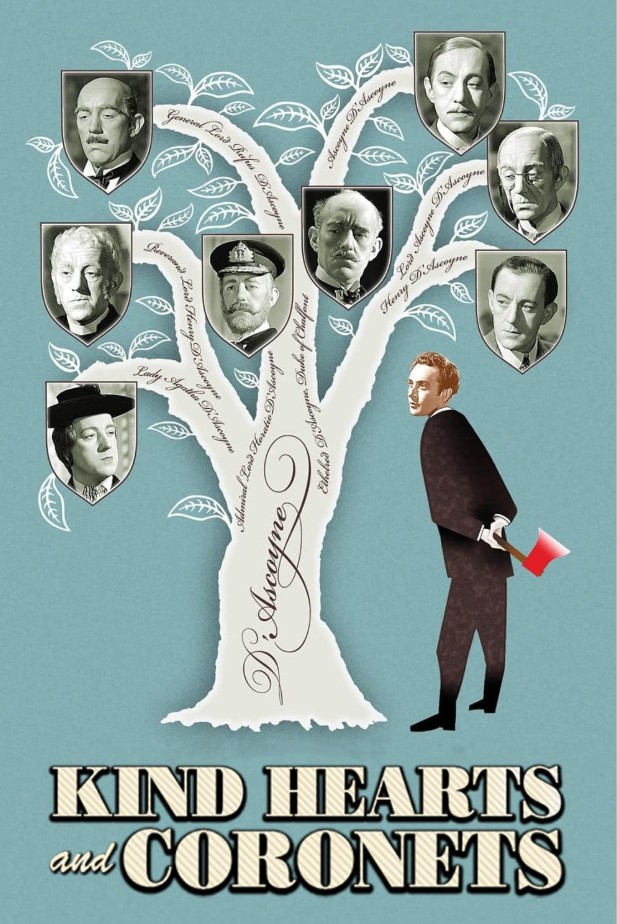
Kind Hearts and Coronets poster created by Ealing Studios, Michael Balcon Productions, General Film Distributors (GFD), and Eagle-Lion Films

Things I liked about the film:

The acting: Dennis Price portrays Louis in Kind Hearts and Coronets. Throughout the story, Louis consistently carries a calm, collected persona. Even a prison warden points out how calm Louis is before his execution. Along with the aforementioned persona, Louis possesses a certain charm that allows his true intentions to be undetected. These qualities fool the other characters into welcoming him into their lives and giving him exactly what he wants. The strength of Dennis’ acting abilities effectively showed how Louis could fake it until he made it. One of the characters fooled by Louis was Edith. Despite becoming a widow, she never let grief consume her. Instead, Edith had a gentle persona and was kind to everyone. During a conversation she shares with Louis, she sympathizes with his estrangement from his family. The tone in her voice indicates how hurt she is to learn this about Louis’ life. Even the look on her face shows sadness and concern. Similar to Dennis’ performance, Valerie Hobson (the actress who portrayed Edith) presented a consistent portrayal of Edith. However, the acting overall was well done!

The dialogue: When the dialogue in a script is good, it can make conversations between characters sound natural. But when the dialogue is really good, it can leave a memorable impression on the audience. In Kind Hearts and Coronets, there was some dialogue that I thought was well-written! One example is when Edith learns how Louis and his mother were estranged from the D’Ascoyne family. Disgusted to discover Louis’ rejection, Edith says “they think too much of the rights of the nobility and too little of its duties”. Through that quote, she eloquently stated how family connections should have been a top priority. In another scene, Louis is giving his friend, Sibella, compliments. He tells her she has “a face that a man could see in his dreams for the whole of his life”. During this conversation, Louis could have simply said Sibella had a beautiful or pretty face. The creative team’s effort to provide some of the dialogue with quality, however, made Louis’ compliment sound like genuine thought was put into it.

Historical accuracy: Kind Hearts and Coronets takes place in England during the Edwardian era. This means the film’s creative team needed to adopt attention to detail in order to make their production look as historically accurate as possible. Through the set and costume design, that goal was achieved, making the movie feel immersive! The women’s wardrobe serves as one example. Sometimes, Edith and Sibella wear hats when out in public. These hats are larger in size and boast intricate designs. Using materials like flowers, ribbon, and even lace, the hats symbolize the wealth Sibella and Edith possess. They also perfectly represent the fashion in the world of Kind Hearts and Coronets.
The 12th Annual Rule, Britannia Blogathon banner created by Terence from A Shroud of Thoughts

What I didn’t like the film:

Lack of suspense and intrigue: According to IMDB, Kind Hearts and Coronets is about “a distant poor relative of the Duke D’Ascoyne plots to inherit the title by murdering the eight other heirs who stand ahead of him in the line of succession”. Keeping this synopsis in mind, I expected a story where Louis’ scheme provided suspense and intrigue came from how Louis would face accountability for his actions. But as I watched the 1949 movie, I found the story lacking these elements. What the script focused on instead was the “slice of life”, mundane parts of Louis’ life. In fact, so much emphasis was placed on this aspect of the story, potential suspense and intrigue were an afterthought.

Little emphasis on the story’s moral: In Kind Hearts and Coronets, Edith quotes Lord Tennyson by stating “Kind hearts are more than coronets, and simple faith than Norman blood?” Based on that quote, I thought the moral of the film would be if Louis had just chosen kindness, maybe he could have enjoyed a duke title instead of facing repercussions for his choices. Sadly, this assumed moral was barely referenced throughout the story. Such little focus was placed on the moral of practicing kindness, I don’t even know what the moral of this story was supposed to be. Looking back on Kind Hearts and Coronets, I’m not entirely sure what this movie was trying to say.

The cliffhanger ending: For this part of my review, I will spoil Kind Hearts and Coronets. If you haven’t seen this movie and are planning on watching it, skip ahead to the part of my review titled “My overall impression”.

Louis is charged for the murder of Sibella’s husband, Lionel. Before his scheduled execution, Louis is told Lionel actually committed suicide, leaving behind a note. This discovery leads Louis to be released from prison. Upon leaving the prison, a writer approaches Louis with an offer to publish his memoir. This is when Louis realizes in horror he left his self-written life story, including his murder confessions, back in his jail cell. Then the movie ends. Louis’ realization was suspenseful, providing intrigue for who will discover Louis’ story. This suspense and intrigue could have been overarching elements throughout the movie. Therefore, I found the cliffhanger ending frustrating.

Sketch of London image created by Archjoe at freepik.com. <a href=’https://www.freepik.com/free-vector/hand-drawn-houses-of-parliament_1133950.htm’>Designed by Archjoe</a>. <a href=”https://www.freepik.com/free-photos-vectors/background”>Background vector created by Archjoe – Freepik.com</a>. Image found at freepik.com.

My overall impression:

As a movie blogger, I have reviewed films I tried to like, only to be met with disappointment. Sadly, Kind Hearts and Coronets is one of those films. IMDB classifies the 1949 movie as a “comedy”. But I didn’t laugh at all while watching it. In fact, I almost fell asleep as I watched Kind Hearts and Coronets. I was let down by the story’s lack of intrigue and suspense. What doesn’t help either is how little focus was placed on the moral to the point where I didn’t know what the moral was supposed to be. While I won’t spoil the ending, I will say it left me frustrated. There were strengths within Kind Hearts and Coronets, however. The acting overall was well-done, some of the dialogue was well-written, and I liked the film’s historical accuracy. When the script is weak, though, there’s only so much these strengths can do to save the film.

Overall score: 5.2 out of 10

Have you seen Kind Hearts and Coronets? What productions from the United Kingdom would like to check out? Let me know in the comment section!

Have fun at the movies!

Sally Silverscreen
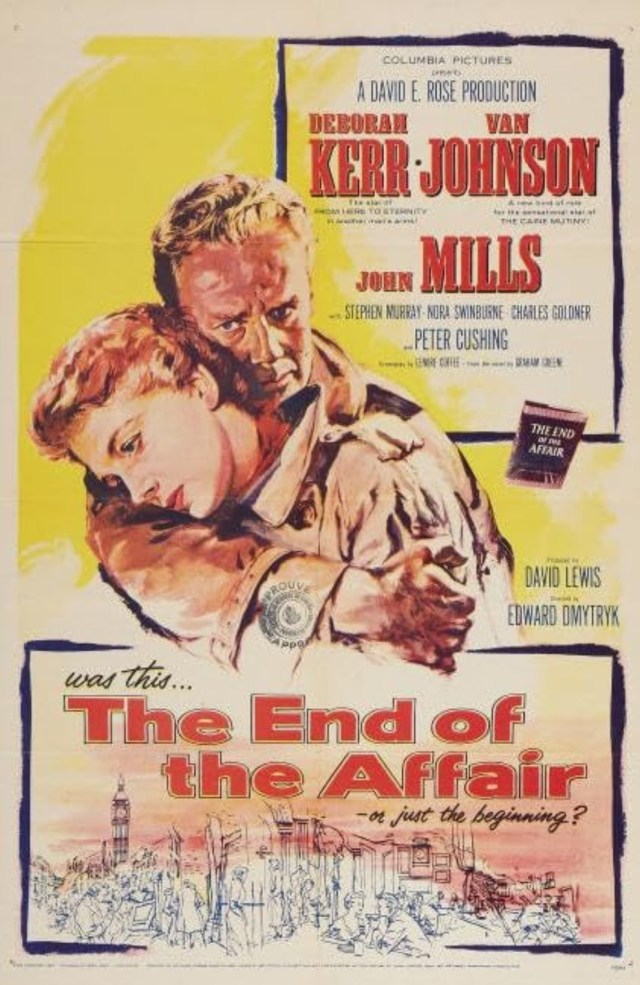
Take 3: The End of the Affair (1955) Review

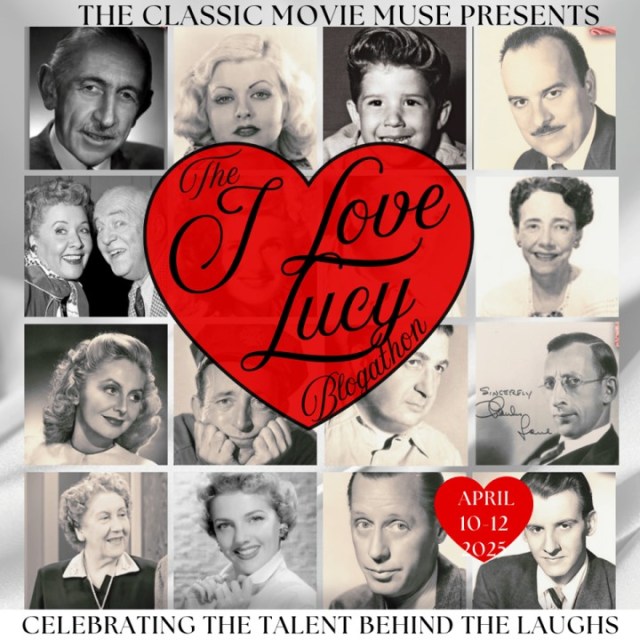
When you have a show as iconic and successful as I Love Lucy, well-known guest stars are likely to pay the show a visit. On the aforementioned show itself, a collection of guest stars graced the screen, crossing paths with Lucy, Ricky, and their friends. One of those stars was Van Johnson, an actor I’m familiar with due to reviewing some of his films and his episodes of Murder, She Wrote. Since I haven’t written about any project from Van’s filmography since 2022, I found the I Love Lucy Blogathon as the perfect opportunity to check out another of his movies! A film of Van’s I’ve been meaning to review for years is the 1955 presentation, The End of the Affair. Recommended by Maddy from Maddy Loves Her Classic Films, I was intrigued by the mystery woven into the synopsis. Who is this third man Deborah Kerr’s character may be having a relationship with? The only way I was going to find an answer to that question is by watching The End of the Affair and sharing my honest opinion about it!

The End of the Affair (1955) poster created by Coronado Productions and Columbia Pictures

Things I liked about the film:

The acting: Like I mentioned in this review’s introduction, I have written about some of Van Johnson’s films as well as his episodes of Murder, She Wrote. What I’ve noticed from these projects is how Van has strong adaptability to his character’s experiences. This was also the case in The End of the Affair. While spending time with Deborah Kerr’s character, Sarah, Van’s character, Maurice, is all smiles and appears to be in a good mood. But when a neighbor named Mrs. Tomkins unexpectedly arrives to give Sarah some food, Maurice’s mood quickly changes. His eyes are downcast, not even looking at the neighbor. Maurice’s mouth displays a worried look as he frets over his secret relationship with Sarah being discovered. Even his tone of voice with Sarah is sharp, desperately trying to contain his feelings. This scene is just one example of Van’s versatility when it comes to his acting talents!

I was pleasantly surprised to discover Peter Cushing starred in The End of the Affair! Based on what I know about Peter’s career from his filmography, he either portrayed a character in a horror movie or he appeared for a limited period of time in a film. Comparing The End of the Affair with other projects of Peter’s I’ve seen, he was given a slightly larger role in the 1955 movie. My other observation is how his character, Henry, had a consistently friendly personality. Even when he suspects Sarah of having an affair, Henry’s demeanor is that of concern, with a worried look on his face. Speaking of Sarah, I want to discuss Deborah Kerr’s performance. In The End of the Affair, there were times when Deborah’s face said so much without the use of dialogue. A great example is when Sarah and Maurice reconnect after being apart for a year. During their walk together, fear shown through Sarah’s eyes. Her mouth was even tightly pursed, revealing little to no information to Maurice. In this scene, Sarah appears to keeping a secret, a secret she’s afraid might be discovered.

The mise-en-scène: Mise-en- scène is how a film’s scene is presented to the audience. One example from The End of the Affair is how mirrors were sometimes used as a form of foreshadowing. Toward the beginning of the film, Maurice spots Sarah hugging another man. She and the man can be seen through a near-by mirror. Because the creative team emphasized this interaction, Maurice’s suspicions of Sarah are hinted at. Later in the movie, when Sarah disappears from Maurice’s life, he calls her home, hoping she’ll pick up the phone. But every time Sarah is unavailable, the camera consistently shows a close-up of Maurice’s face, emphasizing his building frustration. This built-up frustration makes Maurice’s suspicions of Sarah grow even more. Because of how well mise-en-scène was utilized by the film’s creative team, the story was able to maintain a certain degree of intrigue.

The character of Albert Parkis: In movies like The End of the Affair, where serious topics are brought up, the detective character will usually carry a persona that matches the tone of the film. But in the 1955 movie, Albert Parkis provided a bright light to a darker story. Portrayed by John Mills, Albert was the private investigator hired by Maurice to solve the mystery of Sarah’s whereabouts. Any time he appeared on screen, Albert had such a cheerful, friendly personality. He sometimes brought his son along on investigations, in order to teach him how to solve mysteries. Albert’s interactions with Maurice were so lively, they were a joy to watch unfold. I wish Albert Parkis was given a larger role in The End of the Affair, as his involvement in the story was limited.

The I Love Lucy Blogathon banner created by Ari from The Classic Movie Muse

What I didn’t like about the film:

The “insta-love” trope: As I said earlier in this review, Maurice and Sarah share a secret romantic relationship. Their affair provides the basis for the film’s overarching conflict. But it was difficult for me to determine Van and Deborah’s on-screen chemistry. This flaw was due to the movie’s creative team choosing to adopt the “insta-love” trope. The beginning of the film shows Maurice being introduced to Sarah. In this introduction, Maurice hopes Sarah will provide insight to a book he’s writing. Several minutes later, they are starting to form their relationship. Sarah and Maurice even share a kiss within the first fifteen minutes of the story. With their relationship moving so quickly, I didn’t find myself as emotionally invested in Maurice and Sarah’s story as I could have been.

The underutilization of John Mills: When I talked about Albert Parkis, I said I wish he was given a larger role in The End of the Affair, as his involvement in the story was limited. This means the acting talents of John Mills were underutilized. On the film’s poster, you will see John Mills’ name listed as one of the top three billed actors in the production. However, this poster is somewhat misleading, as Peter Cushing receives more screen-time than John. After reviewing The Chalk Garden, I was looking forward to seeing another movie from John’s filmography. I was even curious about how John’s character’s story connected to Deborah’s character’s story. While I found out how these stories connected, I was disappointed by John’s limited involvement in the project.

A randomly produced reveal: The major conflict of The End of the Affair is figuring out the identity of the third man Sarah may be having a relationship with. I will not spoil this movie, in case any of my readers haven’t seen it yet. But what I will say is the mystery’s reveal was randomly produced. When Sarah’s secret is discovered, the answers are given toward the end of the story. Since there is no build-up leading into the reveal, the reveal itself almost feels like a major tonal shift. To prevent this flaw, information or clues related to the reveal should have been sprinkled throughout the movie. That way, the transition between the mystery and its reveal could have been smoother.

Vintage detective desk photo created by Olivier Bourgeois at freeimages.com. Photo by <a href=”/photographer/ornicar69-54520″>Olivier Bourgeois</a> from <a href=”https://freeimages.com/”>FreeImages</a&gt; Image found at freeimages.com.

My overall impression:

Van Johnson is one of the reasons why I selected The End of the Affair, as he was a guest star on I Love Lucy. When it comes to his movies, I thought those I saw were mostly ok. The 1955 project is no different. I was disappointed by the underutilization of John Mills’ acting talents, as well as the adoption of the “insta-love” trope. The mystery’s randomly produced reveal felt like a major tonal shift. However, The End of the Affair does have its strengths. The acting alone was one of the highlights of the film, from Van’s versatility to Deborah’s ability to convey ideas without using dialogue. The way mise-en-scène was used by the creative team allowed the story to maintain a certain degree of intrigue. I also liked Albert Parkis as a character. When it comes to character-driven stories involving serious topics, I find The Chalk Garden and Hallmark Hall of Fame’s A Tale of Two Cities as stronger titles. But, so far, I’ve only seen a handful of Van’s movies, so maybe I need to keep looking for a film of his I like.

Overall score: 6.1 out of 10

Have you seen The End of the Affair? Which is your favorite movie from Van Johnson’s filmography? Tell me in the comment section!

Have fun at the movies!

Sally Silverscreen
Take 3: The Reluctant Debutante Review

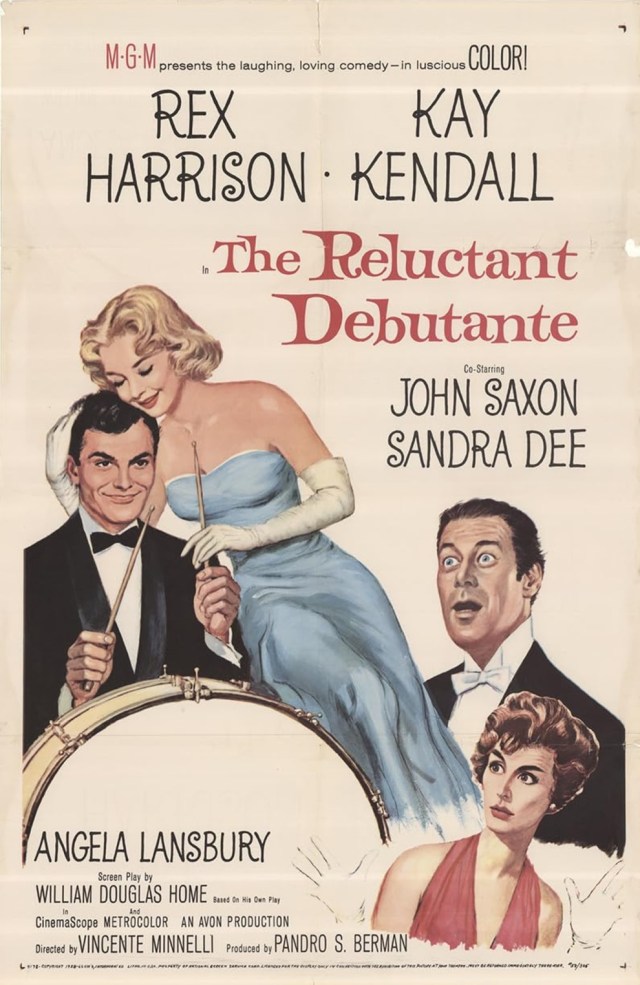
Out of all the decades covered on 18 Cinema Lane, the 1950s make such infrequent appearances. I did review the 1954 film, Dial M for Murder, last month. But my review before that was from last December, when I wrote about 1957’s The Curse of Frankenstein. This infrequency is one of the reasons why I’m reviewing the 1958 film, The Reluctant Debutante! Another reason is John Saxon’s involvement in the project. When I joined Realweegiemidget Reviews’ and Cinematic Catharsis’ blogathon, I wasn’t familiar with John Saxon as an actor. So, while exploring his filmography, I came across the 1958 movie. I was surprised to discover Angela Lansbury also starred in The Reluctant Debutante. Since I’ve seen few of Angela’s live-action films, there was yet another reason for me to review this production.

The Reluctant Debutante poster created by Avon Productions and Metro-Goldwyn-Mayer (MGM)

Things I liked about the film:

The acting: As I said in this review’s introduction, John Saxon is one of the reasons why I’m reviewing The Reluctant Debutante. Even though I wasn’t familiar with him as an actor, I liked his portrayal of David Parkson! Whenever he appeared in the movie, David always looked confident. Paired with that confidence was charisma, which helped David become such a memorable and likable character! What worked in John’s favor was the consistency of his performance. Having good on-screen camaraderie with Sandra Dee also worked in John’s favor. In the few scenes David and Jane, Sandra’s character, spent together, they appeared to get along so well. They also seemed to be on the same page when it came to several topics, such as the symbolism behind dancing and exploring the world. I, honestly, wish Sandra and John were given more appearances in The Reluctant Debutante because both of their performances were strong!

Like I also mentioned in this review’s introduction, Angela Lansbury’s involvement is another reason why I wrote about The Reluctant Debutante! Despite having limited appearances in the story, I really enjoyed watching Angela’s portrayal of Mabel Claremont! The best way I can describe this character is “the life of the party”. From the very first scene she appeared in, Mabel had such an exuberant personality. There was such a brightness to Mabel, I could understand why other characters might want to invite her to their events. Similar to John Saxon’s performance, Angela’s portrayal of Mabel was consistent. Mabel is another character I wish received more screen-time!

The on-screen chemistry: Rex Harrison and Kay Kendall portrayed Jane’s parents, Jimmy and Sheila, in The Reluctant Debutante. Shortly after these characters were introduced, I could immediately sense Kay and Rex’s on-screen chemistry! Throughout the story, Sheila and Jimmy’s marriage felt believable, like they were always meant to be together. When it came to the “debutante season”, Jimmy was the casual participant and Sheila became more involved in the process. Though they had their reasons for their “debutante season” beliefs, they still found a way to come together when it came to what was important, such as the well being of their daughter. Based on everything I said, Sheila and Jimmy displayed the “opposites attract” trope. With the strength of Kay and Rex’s acting abilities, both individually and together, this trope worked in Jimmy and Sheila’s favor!

The wardrobe: Debutante balls are known for showcasing exquisite fashion! When it came to the wardrobe department, The Reluctant Debutante did not disappoint! At a ball toward the beginning of the movie, Mabel wore a long-sleeved gown. This scoop-neck gown was covered in a lacy, deep-blue material, complimenting Angela’s light blonde hair. Adding extra sparkle was a large diamond necklace, a diamond tiara, and diamond earrings. One of my favorite dresses was Jane’s light-blue gown! Tiny bows found their place on the gown’s skirt. Sandra sometimes wore this dress with a light-blue satin cape and white gloves, which added elegance to the overall ensemble. Another outfit I liked is more casual in style. While at a restaurant with David Parkson, Jane wore a beige and brown plaid jumper dress over a beige blouse. Paired with this outfit was a khaki trench coat and a beige hat.

The John Saxon Blogathon banner created by Gill from Realweegiemidget Reviews and Barry from Cinematic Catharsis

What I didn’t like about the film:

A premise driven story: In the past, I’ve explained the difference between a premise driven and a plot driven story. In the case of The Reluctant Debutante, this story was premise driven. According to IMDB, the movie is about Jane and her parents participating in “Debutante season”. That part of the story was prioritized throughout the film. Taking a behind the scenes look at the debutante world is interesting. Halfway through the movie, though, I found myself asking, “Where’s the plot”? What The Reluctant Debutante was missing was a conflict, something to make the audience ask, “and then what happened”. This conflict could have ranged from Sheila and Jimmy organizing Jane’s debutante ball to Mabel convincing the Queen to continue the tradition of “debutante season”.

Drawn-out jokes: IMDB classifies The Reluctant Debutante as a comedy. Despite this label, I didn’t find myself laughing while watching the film. This weakness was due to the story’s jokes being drawn-out. A perfect example is how Sheila and Jimmy’s plans to overprotect Jane don’t go as expected. At one ball, Jimmy and Sheila are trying to find Jane. They race around the ballroom frantically looking for their daughter. Toward the end of the event, they discover Jane left with David Parkson. The very next scene revolves around Sheila and Jimmy worrying about Jane’s whereabouts, even going so far as to hiding in the kitchen and eavesdropping when Jane arrives home. I understand The Reluctant Debutante’s creative team was trying to tell a “comedy of errors” kind of story. In this movie, however, it took a long time for the errors to be resolved. In my aforementioned example, it took two whole scenes for Jane to be reunited with her parents. Watching The Reluctant Debutante felt like listening to a comedian spending too much time reaching their joke’s intended punchline.

Overlooked story ideas: While sightseeing in London, Mabel’s daughter, Clarissa, explains the “debutante season” to Jane. During this explanation, Clarissa tells Jane 1958 will be the last year for the “season” due to the Queen believing the practice outdated. Outside of Jane and Clarissa’s conversation, however, this detail isn’t brought up. Plus, none of the characters act as if the tradition of the “season” is ending anytime soon. I wish this part of the story had played a bigger role in The Reluctant Debutante. As I mentioned earlier in this review, it could have served as one of the story’s conflicts. It also would have given other characters, like Mabel and Clarissa, more involvement in the film.

Image of high school students dancing at prom created by Jan Sundstedt at freeimages.com. Photo by <a href=”/photographer/jansun-33414″>Jan Sundstedt</a> from <a href=”https://freeimages.com/”>FreeImages</a&gt;. Image found at freeimages.com.

My overall impression:

Movies from the 1950s are reviewed so infrequently on 18 Cinema Lane. So, when I find a film from the ‘50s to write about, I always root for that film to be good. With The Reluctant Debutante, however, I can’t say this movie is good. If anything, I was disappointed by it. The 1958 production was a premise driven story, a type of story that, in my opinion, contains less intrigue. The jokes lasted so long, it made the movie feel longer than one hour and thirty-four minutes. At one point, I almost fell asleep watching The Reluctant Debutante. Though I kept watching because the cast gave such strong performances. From Kay and Rex’s on-screen chemistry to Angela’s character being “the life of the party”, the acting was one of the few things I liked about the film. There’re even characters that should have received more screen-time, like David Parkson and Jane. During The Reluctant Debutante’s opening credits, I learned the movie was based on a play. What I also learned is how some plays were not meant to be adapted into a film.

Overall score: 5.5 out of 10

Have you seen The Reluctant Debutante? Which movie from the 1950s is your favorite? Let me know in the comment section!

Have fun at the movies!

Sally Silverscreen
Take 3: Hallmark Hall of Fame’s Pack of Lies Review

For last year’s Broadway Bound Blogathon, I reviewed the
Hallmark Hall of Fame presentation, A Tale of Two Cities. This is an adaptation
from 1980 I liked so much, it was one of the best movies I saw in 2023! While
reflecting on that film, I realized it’s been a whole year since I reviewed a
Hallmark Hall of Fame production. To make up for lost time, I chose to write
about the 1987 Hallmark Hall of Fame film, Pack of Lies! Two years
before this movie aired on television, Pack of Lies premiered on
Broadway, making the Hallmark Hall of Fame movie a good choice for the
blogathon. Pack of Lies is also a Hallmark Hall of Fame film from the ‘80s
I haven’t seen before. One of my aspirations is to see as many Hallmark Hall of
Fame movies as realistically possible. Out of the titles I have seen, I’ve
noticed the mystery genre is rarely represented throughout the Hallmark Hall of
Fame collection. That fact is another reason why I chose to review Pack of
Lies
!

Hallmark Hall of Fame’s Pack of Lies poster created by Hallmark Hall of Fame Productions, Robert Halmi, and CBS

Things I liked about the film:

The acting: Ellen Burstyn and Teri Garr portray Barbara
Jackson and Helen Schaefer in Pack of Lies. The friendship of these two
characters highlights how different they are from one another. Helen has a very
outgoing and bubbly personality, a talkative woman who’s willing to solve
problems. Meanwhile, Barbara is more reserved, dressing more modestly and
avoiding conflict whenever possible. Part of why the differences between these
characters were achieved was through the acting abilities of both Ellen and
Teri! They presented the uniqueness of their characters through various emotions
and expressions. When creating a movie where actors portray friends, the believability
of their performances can make or break that illusion. The aforementioned illusion
was certainly created and maintained throughout Pack of Lies!


In stories where a character has some degree of authority,
their personality is usually serious. This can be a challenge for an actor or
actress, as there are few opportunities to utilize a variety of expressions and
emotions. That didn’t stop Alan Bates from portraying Stewart and making that
performance memorable! When Mr. and Mrs. Jackson first meet Stewart, he leaves
a trusting first impression. During this meeting, Alan incorporates eye movements,
vocal inflections, and variations of mouth movements to create an interaction
that appeared realistic. Because of the realistic nature of Stewart’s meeting,
the scene itself contains a sense of realism. This realism is consistently
carried in the movie through the acting performances!


A mystery within a mystery: The meeting between Stewart and
the Jacksons I previously referenced in this review is about how Stewart is
looking for a man named Laurence. The main mystery in Pack of Lies is
discovering who Laurence is and why Stewart is interested in finding him. At
the same time, the legitimacy of Stewart and his mission serve as a second
mystery. Because of the vagueness Stewart provides to the Jackson family, it
leaves both the Jackson family and the audience wondering who Stweart really is
and why he wants to confront Laurence so much. This second mystery provides an
added layer of intrigue to the overall story!


Providing books as gifts: While visiting their friends, Helen
and Peter Schaefer, Barbara and Bob Jackson receive books as gifts from Peter.
Barbara loves art so much, she and Helen take art classes regularly. Meanwhile,
Bob is an employee in the aircraft industry. In the meeting between the Jackson
family and Stewart, Stewart points out a model plane Bob built. From Peter, Barbara
receives a book of drawings from the Clark Institute in Massachusetts. Peter gives
Bob a book about the first flights across the Atlantic. These books were
thoughtful presents Peter took the time and effort to find. Looking back on the
Hallmark films I’ve seen, including those from Hallmark Hall of Fame,
characters receiving books as gifts are rarely shown. Therefore, I appreciate
this creative choice from Pack of Lies’s creative team to fill a
creative void that is, more often than not, overlooked.

The Seventh Broadway Bound Blogathon banner created by Rebecca from Taking Up Room

What I didn’t like about the film:

Telling instead of showing: In an ideal movie, it’s
important to show and tell what’s happening on screen. But because film is a
visual medium, showing should be emphasized. Unfortunately, in Pack of Lies,
telling was preferred over showing. Throughout the movie, Stewart tells Mr. and
Mrs. Jackson that a man named Laurence Powell is a man of interest. The reason for
this interest is his possible connections to Russian communists. Dialogue is
the only way the truth about Laurence and Stewart’s reason for recruiting the
Jackson family is revealed. The subject of espionage in entertainment media isn’t
always action-packed and adrenaline-fueled. If a creative team knows their
story will have low energy, they should maintain a sense of suspense and
intrigue by showing what’s going on.


Little lapse in time: At the beginning of the movie, Stewart
assures the Jackson family he’ll only observe Laurence for a day or two. As the
story progresses, Stewart’s mission ends up lasting longer than the proposed
one to two days. Like I just said in this review, Pack of Lies
emphasized telling instead of showing. The little lapse in time throughout the
movie is another example of this flaw. Christmas decorations in the Jackson
house are the only indication a significant period of time took place. Prior to
that part of the story, the film looks like events happened within a week.


Things that don’t make sense: As I’ve been saying in this
review, Stewart’s mission is to observe Laurence over a period of time. The more
information revealed by Stewart, the more the Jacksons and the audience learn
Stewart knew more about Laurence than he originally let on. I know the subject
of espionage can be varied and complicated when included in entertainment
media. However, with everything I just said, why didn’t Stewart just arrest
Laurence instead of observing him over multiple days? Why did Stewart need to
get the Jackson family involved in the first place? This is one example where Pack
of Lies
doesn’t make sense.

Sketch of London image created by Archjoe at freepik.com. <a href=’https://www.freepik.com/free-vector/hand-drawn-houses-of-parliament_1133950.htm’>Designed by Archjoe</a>. <a href=”https://www.freepik.com/free-photos-vectors/background”>Background vector created by Archjoe – Freepik.com</a>. Image found at freepik.com.

My overall impression:

Hallmark Hall of Fame movies, like any creative endeavor, are
not created equally. As I shared in this review’s introduction, I liked A
Tale of Two Cities
so much, it was one of the best movies I saw last year.
Sadly, I can’t say the same about Pack of Lies. The 1987 presentation
was a two hour slow and tedious build-up to a resolution that was underwhelming
and anticlimactic. The cause of these flaws was the emphasis on telling instead
of showing. This is not the first time a Hallmark Hall of Fame movie from the ‘80s
let me down, as I also found 1985’s The Corsican Brothers disappointing.
After watching Pack of Lies, I learned the movie was based on a true
story. Now knowing this, I think the story would have benefitted more had it
become a documentary instead. As I wrap up my review of Pack of Lies, I
reflect on a Hallmark commercial I have seen. In this commercial, a man, whose
first language is not English, is looking for the perfect card for his wife,
who will soon arrive in the United States. When he goes to a Hallmark store,
the man is assisted by an employee named Rose, who helps him find exactly what
he is looking for. Another man who occasionally appears throughout the
commercial reveals the events in the commercial are based on a true story.
Honestly, the story behind that Hallmark commercial is a more fascinating movie
idea than what was presented in this Hallmark Hall of Fame film.


Overall score: 5 out of 10


Have you seen Pack of Lies? Which Broadway show do
you wish received a Hallmark Hall of Fame movie? Tell me in the comment
section!


Have fun on Broadway!

Sally Silverscreen

Take 3: Shadowlands (1985) Review

Films are a way to visually tell a story. The subjects can range from the fictional to the historical. With movies belonging in the non-fiction genre, that story can introduce viewers to a particular person, event, or time period. This is the case for the 1985 made-for-TV film, Shadowlands! I will admit I knew very little about C.S. Lewis prior to The Two Jacks Blogathon, hosted by Taking Up Room. While I was aware of his contribution to literature, creating the Chronicles of Narnia series, my knowledge of the author was surface-level. By participating in this blogathon and by choosing to review Shadowlands, I hoped to learn more about C.S. Lewis and the literary world he created! Now, it’s time to open the wardrobe door and step into this review!

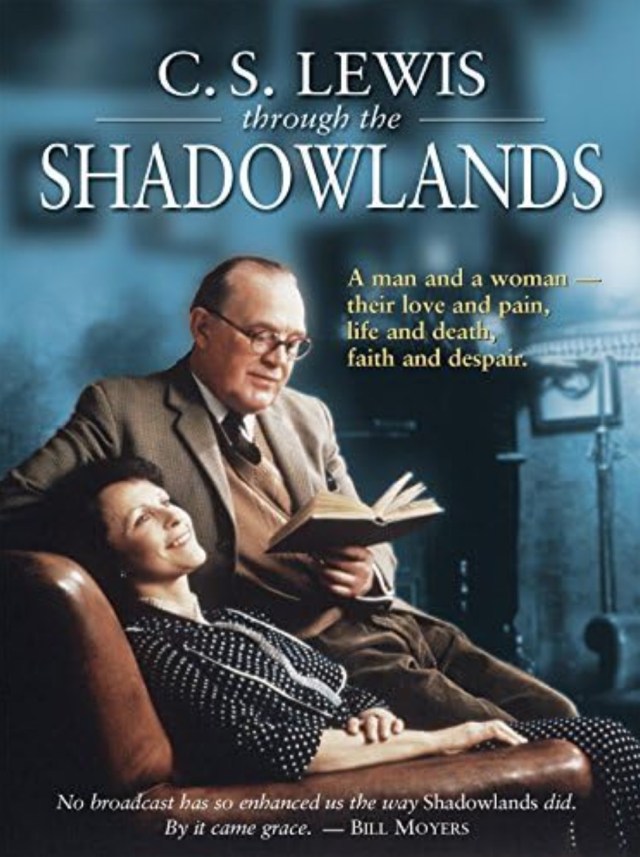
For some reason, Shadowlands has two titles: Shadowlands and C.S. Lewis Through the Shadowlands. Because the movie doesn’t have an offical poster on IMDB, I chose this poster for my review. Shadowlands (1985) poster created by British Broadcasting Corporation (BBC) and BBC Enterprises.

Things I liked about the film:

The acting: In past reviews, when I talked about a movie’s acting performances, I’ve mentioned the believability of those portrayals. This believability comes from the actors displaying an understanding for their roles, as well as for the talents of their co-stars. As I watched Shadowlands, I could sense the believability from the cast. This element was so strong, it allowed the interactions to come across as realistic. Whenever C.S. Lewis and Joy Gresham shared conversations with one another, it seemed like they shared a mutual connection, being on the same page and even on the same paragraph. The combination of Joss Ackland and Claire Bloom’s talents allowed these performances to compliment each other! There were other interactions that appeared realistic in Shadowlands. When a medical situation takes place in the family, Douglas, portrayed by Rupert Baderman, asks C.S. Lewis about the situation itself. Douglas’ eyes display a longing look, desperate for things to get better. As C.S. Lewis reveals the answer, he has a serious expression on his face. These emotional expressions from both actors brought a sense of honesty to the interaction.

C.S. Lewis’ perspective: Because Shadowlands is based on a part of C.S. Lewis’ life, some of his perspectives are included in the script. The delivery of these perspectives and how they were incorporated into the story was insightful and thought-provoking. In a letter to Joy, C.S. Lewis explains how Narnia is a part of something bigger. From how I interpreted this statement, C.S. Lewis is pointing out how Narnia is a key component of the overarching story. It was interesting to hear Narnia referenced this way, as that world plays such a large role in its series, it seems like the star of the show. Amongst a group of colleagues during Christmastime, C.S. Lewis acknowledges how the birth of Jesus is considered a miracle. But he also points out how Springtime is a miracle, when plants are reborn and the world around the characters comes alive. Looking back on C.S. Lewis’ statement, it can be easy to take Springtime for granted, as it is a natural occurrence that happens on its own.

Historical accuracy: The historical accuracy in a historical/period drama can be found in the visual details. These details can also provide clues for the specific time a story takes place. Several scenes of Shadowlands show a rotary dial phone on a desk or on a table. The phones in the film are black, even though these types of phones can boast any colorful hue. In a scene where one of the characters is in the hospital, the bed is built with a silver metal frame. Even the knobs on a medical machine feature a simplistic design and make a loud, clicking sound. With these observations in mind, it appears that Shadowlands takes place in the 1950s or 1960s.

The Two Jacks Blogathon banner created by Rebecca from Taking Up Room

What I didn’t like about the film:

Sudden jumps in time: Shadowlands has a run-time of an hour and thirty-two minutes. This means progression of time is forced to be condensed for the sake of satisfying the run-time. Within the film’s first thirty minutes, however, the condensation of time was jarring, causing events to happen too quickly. After C.S. Lewis and Joy Gresham first become acquainted with each other, she tells him that she’ll return to England with her sons, in order for them to meet C.S. Lewis. In the very next scene, Joy has returned to England with her children. Several scenes later, Joy makes plans with C.S. Lewis about spending Christmas with him. A scene after that, Christmastime was already arrived.

An overshadowed brother: When I talked about this film’s sudden jumps in time, I mentioned Joy having two sons. These sons, David and Douglas, travel with their mother to England and eventually make England their permanent residence. Throughout the story, Douglas’ perspective is the one that is prioritized, as he is a fan of the Chronicles of Narnia series. The audience even sees how Douglas deals with a tragic situation. David’s thoughts about this tragic situation are referenced, but never showcased. I know there is only so much story to tell in an hour and thirty-two minutes. But I wish David’s perspective hadn’t been ignored.

Things left unexplained: In my review’s introduction, I said I hoped to learn more about C.S. Lewis by watching Shadowlands. While I did learn some things about the famous author, the story assumed the viewer already had basic knowledge about him. One example of this is how some things were left unexplained. There is a scene where C.S. Lewis is lecturing a group of students in a classroom. No explanations were provided for why he was lecturing these students or why he was teaching in the first place. It wasn’t until after I saw the movie that I learned C.S. Lewis was a professor at Oxford.

Sketch of London image created by Archjoe at freepik.com. <a href=’https://www.freepik.com/free-vector/hand-drawn-houses-of-parliament_1133950.htm’>Designed by Archjoe</a>. <a href=”https://www.freepik.com/free-photos-vectors/background”>Background vector created by Archjoe – Freepik.com</a>. Image found at freepik.com.

My overall impression:

A person or event featured in a movie may be so fascinating, they deserve their own documentary. Some examples are the events that inspired Over the Edge and Evel Knievel. C.S. Lewis is one of these people that deserves a documentary, as he is an interesting literary figure. In fact, I think the story of Shadowlands should have been a documentary instead of a film. Even though I learned some information about the famous author, the movie assumed the audience already knew about him. This was the cause of things within the story not being explained. If the story of Shadowlands had been a documentary, important events could be discussed and prioritized without the program’s run-time being a concern. But reflecting on Shadowlands as a film, there are aspects of the project I can appreciate, such as the acting performances and hearing about C.S. Lewis’ perspective. With all that said, I thought the movie was just ok.

Overall score: 6 out of 10

Have you seen 1985’s Shadowlands? Would you like to see me talk about C.S. Lewis’ stories on my blog? Please tell me in the comment section!

Have fun in Narnia!

Sally Silverscreen

Take 3: Hallmark Hall of Fame’s A Tale of Two Cities Review

For this year’s edition of the Broadway Bound Blogathon, I wanted to write about a Hallmark film based on a pre-existing Broadway play. My original plan was to read a play and then watch its adaptation, creating an editorial on how these works are similar or different. But, to my surprise, the films I wanted to talk about were based on plays that premiered off-Broadway. During my search for another option, I learned the Charles Dickens story, A Tale of Two Cities, was adapted into a Broadway musical in 2008. For this review, I’ve decided to write about the 1980 Hallmark Hall of Fame version of the aforementioned story. Though I haven’t read A Tale of Two Cities, I have enjoyed seeing the adaptations of Charles Dickens’ literary work. In fact, I liked 1968’s Oliver! so much, I ended up reading Oliver Twist after seeing the movie! So, where does this Hallmark Hall of Fame production stand among other stories by Charles Dickens? Turn the page on this review to find out!

Hallmark Hall of Fame’s A Tale of Two Cities poster created by Hallmark Hall of Fame Productions, Marble Arch Productions, Norman Rosemont Productions, and Columbia Broadcasting System (CBS)

Things I liked about the film:

The acting: One of the strongest scenes in A Tale of Two Cities is when Lucie (portrayed by Alice Krige) reunites with her father, Dr. Alexander Manette (portrayed by Peter Cushing), for the first time in over ten years. After mistaking Lucie as the jailer’s daughter, Alexander goes to his bed, in an attempt to avoid Lucie. As Lucie slowly approaches her father, Alexander’s voice is shaky and he is flinching, unsure of what to make of this visitor. But as soon as he discovers Lucie’s hair matches a lock of hair he kept for many years, Alexander realizes Lucie is, indeed, his daughter. Alexander’s expression changes from fear to shock, as he is in awe about seeing Lucie again. He even gives his daughter a hug. Meanwhile, Lucie is overcome with emotion, tears falling down her face and her voice quivering. Both Alice and Peter were able to effectively sell this on-screen relationship as believable and genuine. The emotions expressed felt realistic as well, which allowed this scene to be so strong!

In A Tale of Two Cities, Chris Sarandon portrays both Sydney Carton and Charles Darnay. Out of these two characters, my favorite was Sydney Carton! Throughout the story, Sydney carried himself with a laid-back confidence that made his personality appealing. Yet, more often than not, he displayed a sad look on his face. Even his eyes looked sad, giving the audience an idea of what he wasn’t saying. This made Sydney brooding and mysterious, making me want to know more about him and curious to see where his story would go. The likability of Sydney Carton can be attributed to Chris’ strong acting talents!

Attention to detail: What can make or break a historical drama is a creative team’s attention to detail. This element in the film-making process can make that story’s world feel immersive, transporting the audience to a specific period in time. The Hallmark Hall of Fame adaptation of A Tale of Two Cities takes place in the late 1700s. Jarvis Lorry’s office provides a great example of this film’s attention to detail when it comes to historical accuracy. On a nearby table, there is a large book, boasting a weathered brown cover. Rolled up paper documents and more brown covered books are scattered in the office’s foreground. In the background, Jarvis can be seen working at a desk similar to that of Ebenezer Scrooge. Though the room invites natural light through a dome shaped window, a small candle chandelier and a multi-candle candle stick provide the office with additional light.

The pacing: The Hallmark Hall of Fame adaptation of A Tale of Two Cities is two hours and thirty-six minutes. This is longer than a typical Hallmark production, which is about an hour and thirty to forty minutes. But A Tale of Two Cities never felt like a long movie to me. That’s because I was so invested in what the characters were doing, as well as the story itself. Though this is a character driven film, there was a satisfying amount of suspense, intrigue, even action. Where these elements were placed in the story made the movie feel evenly paced. The way scenes were filmed, written, and edited also contributed to the overall pace, never making parts of the story feel drawn out or wrapped up too quickly. I was so engaged watching A Tale of Two Cities, the run-time was the last thing on my mind!

The Sixth Broadway Bound Blogathon banner created by Rebecca from Taking Up Room

What I didn’t like about the film:

Inconsistent inclusion of the French Revolution: An overarching conflict in A Tale of Two Cities is the rise of the French Revolution. In the first half of the movie, this conflict seemed like an afterthought, as the primary focus was placed on events happening in England, such as Charles’ court hearing. When a certain situation causes Charles to return to France, the French Revolution played a larger role in the film’s second half. The movie’s creative team built up to the event itself, visually presenting the harsh reality of the French public versus the upper-crust of French society. However, I wish this conflict had a more consistent presence within the story.

Lack of French accents: Because the French Revolution plays a role in A Tale of Two Cities, some of the story’s key characters are French. But the 1980 Hallmark Hall of Fame presentation is one of those films where every character speaks in a British accent, despite the cultural differences. After a while, I became used to the similarity in accents. I don’t blame the actors, as all I can expect from any actor or actress is for them to try their best with the material given. In my opinion, though, I fault the movie’s casting director for not encouraging the use of French accents.

Unexplained parts of the story: On a few occasions, there were parts of A Tale of Two Cities that confused me, due to their lack of explanations. One perfect example involves Monsieur Ernest Defarge’s wife, Therese. While a man is being guillotined, Therese tells her friend she has recorded the Evrémonde family in her stitching. After this scene takes place, Therese’s statement is never clarified. In fact, that particular stitching isn’t brought up again. Parts of the story like this one should have included explanations within the dialogue.

Hand-written letter image created by Veraholera at freepik.com. <a href=”https://www.freepik.com/free-photos-vectors/background”>Background vector created by Veraholera – Freepik.com</a>. <a href=’https://www.freepik.com/free-vector/love-letter-pattern_1292902.htm’>Designed by Freepik</a>. Image found at freepik.com.

My overall impression:

Most of Charles Dickens’ adaptations I’ve reviewed on 18 Cinema Lane have garnered favorable results. Both Oliver! and Nicholas Nickelby left such a good impression on me, they respectively found a place in my year-end best movies lists! Now that I have seen A Tale of Two Cities, I can honestly say that tradition will continue! The 1980 Hallmark Hall of Fame production tells an immersive story, taking the audience on a journey through time. What also adds to the experience is the strength of the characters, as the acting and the screenwriting worked well together. From the featured props to the costume design, the creative team’s attention to detail was on full display in this film, showing the care and effort that went into this project. Looking back on A Tale of Two Cities, I can see how the story could be adapted into a Broadway musical. As a matter of fact, I think a musical movie adaptation of A Tale of Two Cities would be very interesting to watch!

Overall score: 8.9 out of 10

Have you seen any adaptations of A Tale of Two Cities? Which story Charles Dickens’ is your favorite? Let me know in the comment section below!

Have fun on Broadway!

Sally Silverscreen

Take 3: Tommy Review

For my third year participating in the Rule, Britannia Blogathon, I, at first, considered reviewing an adaptation based on a book I’ve read. This would be similar to when I wrote about the 2002 adaptation of Nicholas Nickleby. But the more I thought about it, the more I realized I had a perfect opportunity on my hands. That opportunity was the chance to review the 1975 film, Tommy! Years ago, long before I became a movie blogger, I saw a trailer for Tommy on Turner Classic Movies (TCM). On the one hand, the story itself seemed interesting; a man with disabilities living his best life and making his dreams come true. But, on the other hand, the visuals within this trailer appeared “bonkers”, making the movie seem intimidating. After reading some reviews, I came to the conclusion Tommy is a polarizing film. This isn’t the first time I have written about a movie that received mixed reviews. Two years ago, for another blogathon, I reviewed the 2011 Hallmark film, The Cabin. Historically, this is considered one of the most polarizing titles the network has ever created. When I got around to seeing it, I found The Cabin so bad, it was disappointing.

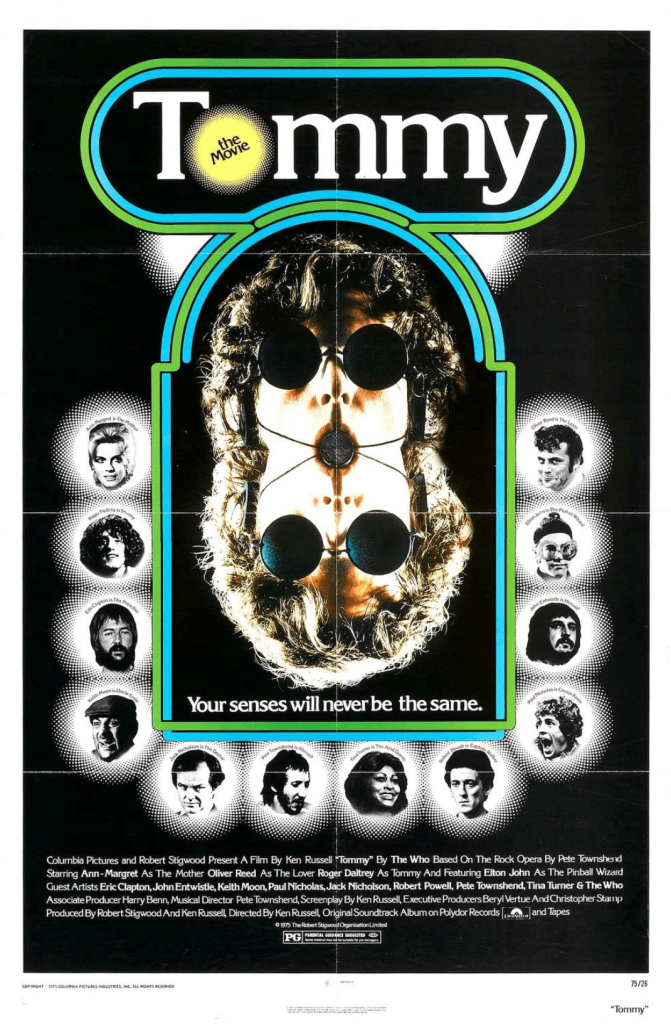
Tommy poster created by Robert Stigwood, Organization Ltd., Hemdale Film Corporation, and Columbia Pictures

Things I liked about the film:

The acting: Prior to watching Tommy, I had seen Bye Bye Birdie. In the 1963 film, Ann-Margret gave an expressive portrayal of Kim MacAfee. The 1975 movie shows Ann-Margret in a completely different role, which allowed her to expand her acting abilities. Portraying the titular character’s mother, Nora, Ann-Margret gave a well-rounded performance! Because this story incorporates heavier subjects, her portrayal contains the emotional intensity required for a story of this nature. While watching television, Nora sees her son on TV. As she’s watching, a sense of guilt grows within her. This guilt causes Nora to appear disgusted, a grimace slowly overcoming her face. She attempts to change the channel in order not to see Tommy, only for the TV to magically switch to Tommy’s image. Angry about her plan not working, Nora throws her champagne bottle at the television, which results in a flood of laundry detergent, beans, and chocolate. Relieved to instantly receive the items she just saw in television commercials, Nora suddenly is taken over by pleasure. A smile appears on her face as she rolls around on the floor in the commercial materials.

When discussing a movie heavily revolving around a titular character, it’s important to talk about the actor or actress portraying that character. In the case of Tommy, that role was given to Roger Daltrey. Based on some reviews I’ve read of Tommy, it seems like Roger had little to no acting experience prior to working on this movie. Despite this, his performance was such a strong addition to the story! Roger’s portrayal had the emotionality and versatility to make Tommy a character worth rooting for. These aspects also held my interest in Tommy’s journey. In one scene, Tommy stays over at Cousin Kevin’s house. During his stay, Kevin tries to burn Tommy with a cigarette. As Tommy is sitting tied up in a chair, his face instantly changes from exhaustion and writhing in pain. This change in facial expressions is seamless, Roger never missing an emotional beat.

While I have heard good things about Tina Turner’s acting performances, this was the first time I had seen any of them. Tommy shows Tina portraying The Acid Queen. Even though her performance was limited to one scene, she gave so much energy to her role. While her portrayal was over-the-top, it fit the tone and vibe the movie was going for. With all that said, I honestly wish Tina had received more appearances in this film.

Ann-Margret’s wardrobe: Even though I knew Ann-Margret would be starring in Tommy, I was pleasantly surprised by how much I liked her wardrobe! Each outfit she wore complimented her so well, while also looking great on-screen! Toward the beginning of the movie, as Nora and her husband, Captain Walker, are running through the war-torn streets of England, she wore an asymmetrical, sky-blue gown. The dress itself was simple, but it was elegant enough to not be plain. Ann-Margret’s strawberry blonde hair paired beautifully with the color of the dress. Later in the movie, Nora wears a silver, mesh pant suit. Accompanied by shiny, silver sandals and a white furry cape, this ensemble boasted a posh look. While the outfit felt very reflective of the 1970s, it was a divine version of that type of outfit. Ann-Margret definitely pulled off this film’s wardrobe in style!

The symbolism: In some reviews I read about Tommy, it was mentioned how there was symbolism found among the over-the-top, flashier imagery. Since I knew before watching the movie there was going to be this type of imagery, it allowed me to focus on what the film’s creative team was trying to say through their story. In a desperate attempt to cure her son, Nora takes Tommy to The Church of Marilyn Monroe. Other patrons with disabilities are also in attendance, from a woman with a guide dog to multiple people utilizing wheelchairs. Marilyn’s likeness can be seen throughout the facility, with the most notable being a giant statue of Marilyn in the iconic flown skirt pose. I interpreted the scene as a piece of commentary on how people who claim to be religious and/or contain the ability to cure everyone with anything can, sometimes, take advantage of those in vulnerable positions. Those people could be considered “false prophets”. So, choosing Marilyn as the film’s church icon is interesting, as Marilyn’s name and image were all a fabricated version of Norma Jean.

The 9th Annual Rule, Britannia Blogathon banner created by Terence from A Shroud of Thoughts

What I didn’t like about the film:

Some villains not receiving their comeuppance: There were several characters in Tommy’s life that failed him. While a few of these characters did receive their comeuppance, most of them did not. Whenever Tommy went to stay at Cousin Kevin’s house, Kevin would physically abuse and torment Tommy. Kevin only appeared in a sequence of scenes showing Tommy mistreated by him. Because of this, Kevin’s comeuppance was never shown. I’m not sure if this creative decision was made because there wasn’t enough time to show each character’s comeuppance or if it was meant to show how unfair life can be.

Some confusing parts of the story: At one point in Tommy’s story, his parents take him to see The Specialist, in an attempt to figure out why Tommy has several disabilities. During this appointment, Nora and The Specialist continuously flirt with each other. After this scene, this interaction and The Specialist himself are not brought up again. I was unsure if Nora planned on leaving Frank to start a relationship with The Specialist or if she was flirting with The Specialist simply to encourage him to lower her son’s medical bills. Either way, the movie does not provide a clear explanation.

An unclear time-line: This story starts during and shortly after World War II. The script heavily implies Tommy was born sometime in 1945. Most of this story takes place when Tommy is an adult. If Tommy were, say, twenty during the film’s events, that would mean the story takes place in 1965. With that said, why do the wardrobe, set design, and special effects look like they came straight out of the 1970s? I know this film was released in 1975. But because Tommy’s age is not specified, the movie’s time-line is unclear.

Music and stage image created by Topntp26 at freepik.com. <a href=’https://www.freepik.com/free-photo/music-sign_1179519.htm’>Designed by Topntp26</a>. <a href=”https://www.freepik.com/free-photos-vectors/vintage”>Vintage image created by Topntp26 – Freepik.com</a>. Image found at freepik.com.

My overall impression:

The way I feel about Tommy is similar to how I feel about Queen of the Damned. Is this one of my favorite films? No. Is it one of the best movies I’ve seen this year? Also, no. But, for what it was, I enjoyed it. Yes, the visuals can be “bonkers”. When you look past all of that, though, you will see the film’s creative team had something interesting to say. The story itself was easier to follow. The symbolism and messages associated with it appeared to be given a lot of thought and effort. Therefore, artistic merit can be found in this movie. The story of Tommy is a heartbreaking one. However, it is also a somewhat uplifting story. I won’t spoil the film for those who may be interested in seeing it. I will say when a climatic event happens, the moment itself feels earned.

Overall score: 7.3 out of 10

Have you seen Tommy? Are there any musical films you’d like to see me review? Let me know in the comment section below!

Have fun at the movies!

Sally Silverscreen
Buzzwordathon 2022: Review of ‘Murder, She Wrote: The Queen’s Jewels’ by Jessica Fletcher & Donald Bain + Blogathon Annoucement

For August’s Buzzwordathon, the theme is ‘Items/Objects’. Originally, I was going to read Redwood Curtain by Lanford Wilson. This is because a) a curtain could be considered an item/object and b) I already own a copy of Lanford Wilson’s play. But I ended up watching the film adaptation of Redwood Curtain earlier than expected. Therefore, I decided to write an editorial on how similar and different Redwood Curtain’s adaptation is from its source material. That editorial will be published during The Fifth Broadway Bound Blogathon. In the meantime, I have selected Murder, She Wrote: The Queen’s Jewels for this month’s Buzzwordathon, especially since ‘jewels’ could also be considered an item/object! I have blogathon news of my own as well, so keep reading to find out what’s to come!

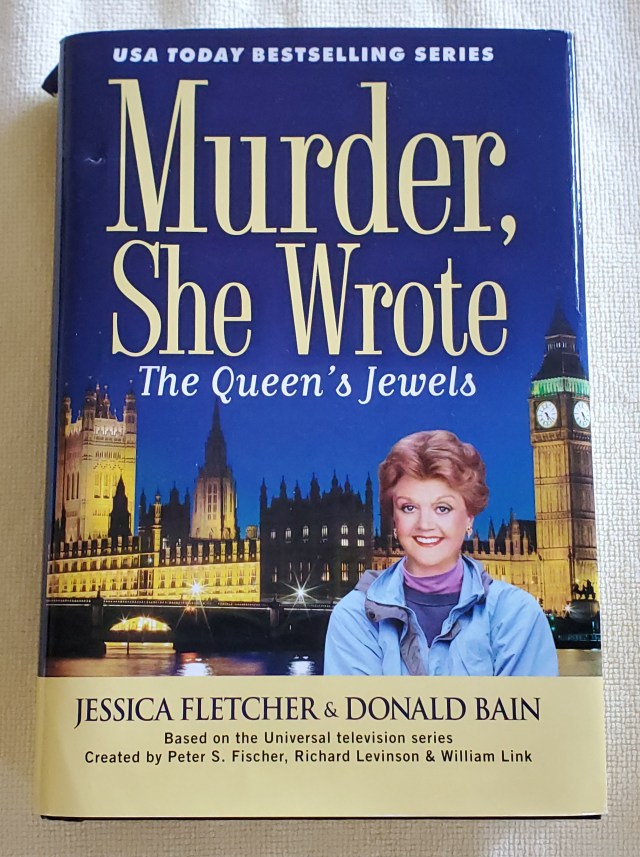
Here is a photo of my copy of Murder, She Wrote: The Queen’s Jewels. Screenshot taken by me, Sally Silverscreen.

Back in 2019, I reviewed Murder, She Wrote: The Highland Fling Murders. One of the favorite aspects of that book was how distinctive each character was, as there were a lot of characters in the story. Murder, She Wrote: The Queen’s Jewels contains the same strength. Whether in Cabot Cove or on the Queen Mary 2, each character was unique from one another. At the beginning of the book, the readers are introduced to Maniram, Cabot Cove’s newest resident. He is a jeweler who owns his own jewelry store, sharing his knowledge of valuable gems with Jessica and her friends. Also in this story is Maniram’s cousin, Rupesh. He is a man of many talents, from being a skilled karate athlete to being very knowledgeable with computers. Murder, She Wrote: The Queen’s Jewels presents him as a room steward on the Queen Mary 2. But as the story progresses, readers find out just how different Rupesh is from Maniram.

Cruise ship near an island image created by Freepik at freepik.com. <a href=’https://www.freepik.com/free-vector/holiday-background-on-a-cruise_1182003.htm’>Designed by Freepik</a>. <a href=”https://www.freepik.com/free-photos-vectors/background”>Background vector created by Freepik</a>. Image found at freepik.com.

Out of the Murder, She Wrote episodes I’ve seen so far, my favorite one is “Film Flam”. What makes this episode great is its educational and insightful approach to the movie premiere process. In Murder, She Wrote: The Queen’s Jewels, part of the book takes place in London. Instead of bringing up locales that many readers would be familiar with, locations that aren’t often talked about are included in the text. One of them was Grosvenor Square. According to the book, this area was known as “Little America”. A reason is General Eisenhower’s headquarters were located in the Square. During her London adventure, Jessica has dinner at a restaurant called The Ivy. This establishment does exist, boasting a fine dining experience, according to The Ivy’s website. In the book, Jessica describes the restaurant as a “celebrity-driven restaurant that has long been a favorite of London’s theatrical and motion picture crowd”. Meanwhile, The Ivy’s website states “With an enduring celebration of the arts and culture that have defined it since its naissance, The Ivy remains part of the fabric of London life, and a home away from home for its many loyal guests”. Because of reading Murder, She Wrote: The Queen’s Jewels, I learned more about London’s landscape that I didn’t know before.

Sketch of London image created by Archjoe at freepik.com. <a href=’https://www.freepik.com/free-vector/hand-drawn-houses-of-parliament_1133950.htm’>Designed by Archjoe</a>. <a href=”https://www.freepik.com/free-photos-vectors/background”>Background vector created by Archjoe – Freepik.com</a>. Image found at freepik.com.

What I like about the Murder, She Wrote books is how the stories aren’t novelizations of pre-existing episodes. While this is the case for Murder, She Wrote: The Queen’s Jewels, it didn’t really feel like the show. That’s because so few characters from the show and previous books were featured. In Murder, She Wrote: The Highland Fling Murders, a Scotland Yard agent and friend of Jessica’s, George Sutherland, was working alongside Jessica to solve that book’s mystery. When I found out George would be in Murder, She Wrote: The Queen’s Jewels, I was excited to read about his and Jessica’s reunion. But as I read this book, I discovered George only made a handful of appearances. Compared to other mystery books I’ve read, the sense of urgency in Murder, She Wrote: The Queen’s Jewels was weaker. What contributed to this flaw was how most of the story focused on Jessica’s trip instead of the mystery. Another contributor was how two intelligence agents were responsible for solving the case. That creative decision made the mystery seem like it was out of Jessica’s reach. It affected her ability of getting involved with the book’s case, especially compared to the show.

Magnifying fingerprints image created by Balintseby at freepik.com. <a href=”https://www.freepik.com/free-photos-vectors/glass”>Glass vector created by Balintseby – Freepik.com</a>. <a href=’https://www.freepik.com/free-vector/fingerprint-investigation_789253.htm’>Designed by Freepik</a>. Image found at freepik.com.

I haven’t read many of the books in the Murder, She Wrote series. But out of those I have read, Murder, She Wrote: The Queen’s Jewels is my least favorite. This book was fine, interesting enough to keep me invested in the story. However, I was expecting more. There was a short period of time where I lost motivation to read this book. Not wanting to experience another Buzzwordathon fail, I finished the story, especially since I wanted to find out what happens. I do plan to read more Murder, She Wrote books. One of them will be reviewed for my upcoming blogathon. As I stated in the introduction, I had blogathon news to share. That news is I’m hosting a blogathon this November! The theme is ‘World Television Day’. More details about the event will follow…

Overall score: 3.6 out of 5 stars

Have fun during Buzzwordathon!

Sally Silverscreen

Disclaimer: Because Murder, She Wrote: The Queen’s Jewels is a murder mystery story, the subject of murder is brought up on more than one occasion. A suicide is also briefly mentioned and swearing does occur a few times.

Take 3: Hallmark Hall of Fame’s Witness for the Prosecution (1982) Review

In my list of the Top 10 Movies I’d Love to Review, I mentioned finding Oliver 2: Let’s Twist Again on Diana Rigg’s IMDB filmography. During that trip on IMDB, I found another film I could review for the Other Than A Bond Girl Blogathon. As the title of this review says, that movie is the 1982 Hallmark Hall of Fame presentation, Witness for the Prosecution! I’ve gone on record to state how I’d like to watch as many Hallmark Hall of Fame titles as realistically possible. If I’m going to be honest, I didn’t think I would ever see Witness for the Prosecution. That’s because the film not only didn’t receive a DVD release, but it doesn’t seem to have received a VHS release either. So, imagine my shock when I found the full movie on Youtube! Mysteries are, arguably, the most popular genre on my blog. This is also not the first time I’ve reviewed an Agatha Christie adaptation. Back in April, I wrote about the 2022 film, Death on the Nile. In that review, I said the movie had a weaker execution than its 2017 predecessor, Murder on the Orient Express. How will Witness for the Prosecution fare against these aforementioned adaptations? All rise, as this review is now in session!

Hallmark Hall of Fame’s Witness for the Prosecution poster created by CBS Entertainment Production, Hallmark Hall of Fame Productions, Rosemont Productions, and United Artists Television

Things I liked about the film:

The acting: Diana Rigg is one of the eligible Bond Girls for the Other Than A Bond Girl Blogathon. Therefore, I will talk about her performance first. In Witness for the Prosecution, Diana portrayed Christine Vole, the wife of the accused party. Throughout the film, she carried her character as a woman from stories in the 1920s. What I mean by this is Christine held her own with confidence, never shaken by the probing of those involved in the legal side of the case. Even when she took the stand, Christine adopted a serious demeanor, as if putting on a “poker face” and refusing to show her deck of cards too early. These acting choices and the consistency of her performance allowed Diana to pull off a captivating and memorable portrayal!

Deborah Kerr is an actress I’ve talked about before on 18 Cinema Lane. While I have seen and reviewed five of her films, none of them were from the mystery genre. Despite this, Deborah held her own, acting wise, among the cast! She portrays Nurse Plimsoll in Witness for the Prosecution. While watching the 1982 production, her performance reminded me a bit of Donna Reed’s portrayal of Mary from It’s a Wonderful Life. Nurse Plimsoll cares about the health and well-being of the film’s protagonist, Sir Wilfred Robarts. Though Wilfred finds her overall nursing approach annoying, Nurse Plimsoll doesn’t give up on her mission. Even though she is stricter than other on-screen nurses, her heart is always in the right place. This can be seen through Deborah’s facial expressions, body language, and emotions.

Even though the cast as a whole was strong, there was one performance that stole the show. This came from Beau Bridges! Witness for the Prosecution shows Beau portraying an American named Leonard. Because his case is presented in a British/U.K. court system, he is a “fish out of water”. The situation itself provides an interesting dynamic for the cast, including Beau, to work with. It also gave Beau an opportunity to utilize a variety of emotions. During the case, one of the witnesses causes Leonard to have an emotional reaction. At the start of the witness’ questioning, Leonard presents a calm “resting face”. But as the questioning continues, he slowly becomes sadder, adopting a growing frown and his eyes filling with tears. This transformation was gradual, allowing Beau to adapt to the on-screen situation.

The set design: The majority of Witness for the Prosecution takes place within a British/U.K. court room. Despite the limited locations, there were some examples of set design that I liked! Inside the court room, the ceiling was domed, with clear glass exposing a view of the sky. Surrounding the dome are etched, white arches. With a green light shown on these arches, they gave the appearance of boasting an antique limestone material, which complimented the dark wood of the court room’s walls and furniture. In the lobby of the court room, painted murals are shown near the ceiling. The lobby’s walls appear to be covered in a two-tone marble material, with the floor revealing a black-and-white tile design. My favorite set in Witness for the Prosecution was Wilfred’s office! The room’s color scheme was brown, beige, and red. When this set was first introduced, a large, dark wood bookcase proudly stood. It was guarded by a dark wood table and two dark brown armchairs. While the walls were beige, the curtains on the window were red, giving the room a pop of color. The more time Wilfred spent in this space, the more the sophisticated, professional, and intelligent appearance of the office complimented his personality.

An in-depth look at the British/U.K. court system: As I mentioned in my point about the film’s set design, the majority of this story takes place in a British/U.K. court room. That part of the movie exposed the audience to the British/U.K. court system. Even though Witness for the Prosecution is not the “end all, be all” when it comes to this specific court system’s portrayal in entertainment media, it gives viewers a chance to compare and contrast it to other court systems in other productions. The layout of the court room itself provides one example. Toward the front of the court room, the witness stand is located at the judge’s right-hand side. This part of the court room is separate from the judge’s stand. Meanwhile, in court room productions taking place in the United States, the witness stand can either be located at the judge’s left or right-hand side. It is also connected to the judge’s stand.  

The Other Than A Bond Girl Blogathon banner created by Gabriela from Pale Writer and Gill from Realweegiemidget Reviews

What I didn’t like about the film:

The magical monocle: While working on the case, Wilfred wore a monocle when he was questioning the accused party and his wife. As he questioned them, a light shone through the monocle and directly landed on Leonard and Christine. But these were the only two times Wilfred used the magical monocle. The purpose of the monocle or Wilfred’s reason for using it was never explained. Was this monocle truly magical or was the monocle used as foreshadowing? I wish this part of Wilfred’s character was more consistent.

A dialogue heavy story: With any movie or tv show episode featuring a court case, there’s going to be a certain amount of dialogue within the story. But because Witness for the Prosecution mostly revolved around a court case, the 1982 production feels more dialogue heavy compared to Death on the Nile and Murder on the Orient Express. Before watching Witness for the Prosecution, I had expected more showing than telling when it came to the mystery. Instead of watching the characters making discoveries related to the mystery, I heard about it through the questioning in court. Because of this creative decision, I didn’t find the movie’s mystery as engaging as it could have been.

An inactive detective: In a story where a detective, amateur or professional, is the protagonist, the audience expects to see this character actively solve their respective film’s mystery. Sadly, the viewers won’t witness that in Witness for the Prosecution. Wilfred is a lawyer defending Leonard in his case. However, Wilfred places more emphasis in resolving the case than playing detective. Even though this movie’s mystery was solved, it felt like Wilfred was served the answer on a silver platter instead of discovering it himself. Similar to what I said about the dialogue-heavy story, I didn’t find the mystery engaging because of Wilfred’s inactive detective role.

Sketch of London image created by Archjoe at freepik.com. <a href=’https://www.freepik.com/free-vector/hand-drawn-houses-of-parliament_1133950.htm’>Designed by Archjoe</a>. <a href=”https://www.freepik.com/free-photos-vectors/background”>Background vector created by Archjoe – Freepik.com</a>. Image found at freepik.com.

My overall impression:

Hallmark Hall of Fame’s Witness for the Prosecution shares a similar plot with 1997’s Red Corner: an American man is accused of murder, with his case in a court system outside of the United States. But where Red Corner succeeded and Witness for the Prosecution didn’t is how Shen, Jack’s lawyer in Red Corner, not only played a role in the court case, but also went above and beyond in attempting to solve the mystery surrounding the case. This allowed Red Corner’s story to be intriguing and engaging for the audience. With the 1982 production, Wilfred spends more time on the court case than the mystery wrapped around it. This decreases the audience’s engagement. The dialogue heavy nature of Witness for the Prosecution’s story also affected the mystery’s intrigue. Hallmark Hall of Fame’s presentation is the third Agatha Christie adaptation I’ve seen, which I wasn’t overly thrilled with. I still want to, one day, read her literary work. But based on my reactions to the three adaptations I have watched so far, I’m starting to wonder if I’ll find an Agatha Christie story I like?

Overall score: 6.1-6.2 out of 10

Have you seen any of Agatha Christie’s adaptations? Do you have a favorite Agatha Christie story? Let me know in the comment section!

Have fun at the movies!

Sally Silverscreen

Buzzwordathon 2022 – Review of ‘A Little Princess’ by Frances Hodgson Burnett

With my Travel Gone Wrong Blogathon underway and the start of May around the corner, it’s time for another Buzzwordathon book review! For April, the theme is ‘Big & Little’. Participants had one of two options: 1. Read a book that has the word ‘big’ or ‘little’ in the title or 2. The title has to feature a word associated with ‘big’ or ‘little’. Because I happen to own a beautiful copy of A Little Princess and because ‘little’ is in the middle of that book’s title, I decided to read Frances Hodgson Burnett’s classic! The 1905 story has been a favorite of mine for a very long time. However, this is the first time I read it in a novel format.

Here is a screenshot of my copy of A Little Princess. Sorry if the cover’s bottom half appears blurry. I tried to capture how sparkly the cover is. Screenshot taken by me, Sally Silverscreen.

While reading A Little Princess, I became nostalgic of the 1995 adaptation, as I have loved that film since its release. So, it was interesting to read how similar and different the movie was from its respective source material. One major difference is how Frances provides explanations for character motivations and situations. I haven’t seen the 1995 adaptation of A Little Princess in years. From what I remember, though, Sara’s dad goes missing during battle and is assumed dead. This provides the catalyst for Sara’s struggles and lost fortune. Looking back on the film, it never made sense, to me, for Sara to lose everything simply because her father was missing in action. If her dad knew there was a chance he could be in danger, wouldn’t he have created a will for Sara? The source material provided a stronger explanation for the lost fortune, as Sara’s father invested in diamond mines, but his money was mishandled. Even though this situation is resolved by the book’s end, the inclusion of these explanations was a strength for the book itself!

Princess tiara image created by Freepik at freepik.com. <a href=’https://www.freepik.com/free-vector/ornamental-princess-crowns_1109199.htm’>Designed by Freepik</a>. <a href=”https://www.freepik.com/free-photos-vectors/gold”>Gold vector created by Freepik</a>. Image found at freepik.com.

Another strength of the book is how Frances used descriptions to flesh out the characters and their world. At the beginning of the story, Sara is referred to as “wise beyond her years”. She’s also described as “intelligent”, “imaginative”, and “courageous”. Interactions between characters and narrations from an anonymous narrator provide proof of those statements. On the first day of class, Miss Minchin gives Sara a French textbook in preparation for an upcoming French lesson. Throughout this scene, Sara tries to explain to the headmistress that she already knows basic French, as she grew up learning the language from her dad. It’s not until the French teacher arrives that he and Miss Minchin discover how advanced Sara is in French. In the 1995 adaptation, important and timeless messages and themes can be found throughout the story. That is also true for the source material! Because Sara imagines she is a princess, she assumes how a princess would behave. This includes assuming how a princess would treat others. After finding some money on the ground, Sara plans to buy some food from a nearby bakery. But just before she enters the bakery, Sara sees a girl who appears to be worse off than herself. With the found money, Sara purchases a set of rolls. But she ends up giving most of the rolls to the aforementioned girl.

Here is one of the full page illustrations that is featured in my copy of A Little Princess. Artwork created by Ethel Franklin Betts and found on https://en.wikisource.org/wiki/A_Little_Princess.

Even though A Little Princess has been near and dear to my heart, I’ll be one of the first readers to admit it is not a perfect or near perfect book. Though this flaw wasn’t consistent throughout the text, there were times when parts of the story were repetitive. A portion of the book’s last chapter provides a great example, as it re-caps almost everything that happened prior to that point. As a reader, I don’t like longer chapters. This can, sometimes, cause a book’s pace to be slower. While A Little Princess’ pace was steady, the book contained longer chapters, with thirteen pages given to the longest chapter. In my copy of the book, there are full page illustrations that bring to life certain parts of the story. I honestly wish these illustrations had a more consistent presence, as they could have broken up some of the chapters. Other than that, though, I still enjoyed reading A Little Princess all these years later! I’m so glad I was given the opportunity to read it again!

Overall score: 4.1 – 4.2 out of 5 stars

Have fun during Buzzwordathon!

Sally Silverscreen
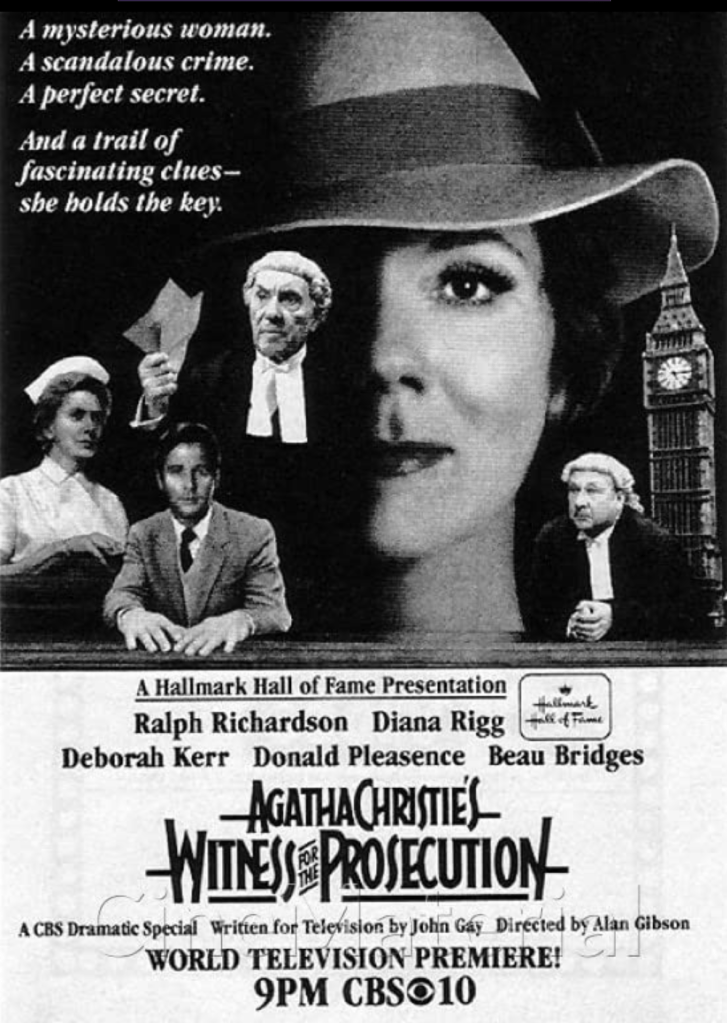
Disclaimer: Because A Little Princess was published in 1905, some of the words and phrases are reflective of that time, with their context different from today. A few of these words are “queer”, “gay”, “fat”, and “chubby”. At one point in the story, a man from India is referred to as “oriental”. There is also a stereotype about Chinese people included in the text. Again, these parts of the story are reflective of the book’s time; 1905.