Take 3: Hallmark Hall of Fame’s Face to Face Review

Any time I receive the opportunity to review a Hallmark Hall of Fame movie, I try to prioritize titles that are either VHS exclusive or harder to find. This decision has been made to help give those titles more recognition, as well as encourage more people to check those films out. One of these films is the 1990 picture, Face to Face! As far as I know, this Hallmark Hall of Fame presentation was not released on VHS or DVD. It also premiered months prior to the Hallmark Hall of Fame movie, Caroline?, which I have reviewed on 18 Cinema Lane. The synopsis is what intrigued me toward seeing Face to Face, as the story (according to IMDB) is about “an American paleontologist and a British miner get in a conflict over who has the rights to dig on a site in Kenya”. A conflict about two differing parties at odds over a shared problem isn’t often covered within the Hallmark Hall of Fame collection. In fact, the only movies I can think of that fit this description are The Summer of Ben Tyler and Sweet Nothing in My Ear. Face to Face’s Kenyan backdrop also provides a unique element to the movie. Africa is a setting that is rarely incorporated in Hallmark Hall of Fame’s films.
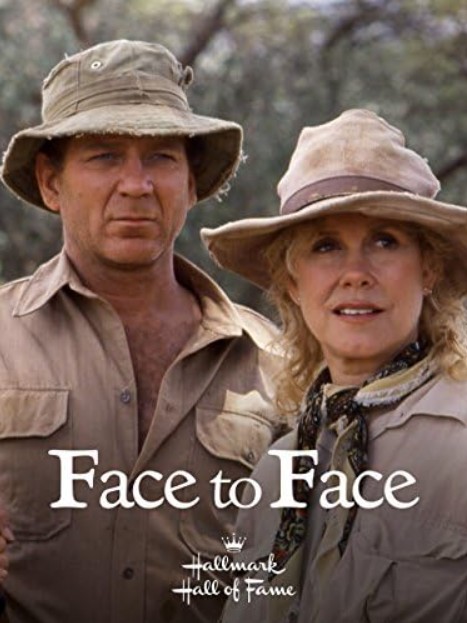
Hallmark Hall of Fame’s Face to Face poster created by Hallmark Hall of Fame Productions, Robert Halmi, and CBS

Things I liked about the film:

The scenery: As I mentioned in this review’s introduction, Face to Face takes place in Kenya. The creative team behind the film took advantage of the Kenyan landscape by featuring long and medium shots of the story’s natural surroundings. One example is an establishing shot of a sunset. Half the shot is engulfed in an orange and yellow sky, with a grey mountain at the sunset’s root. Nearby trees adopt a black hue, standing out against the sky’s bright colors. The ground appears to be a mix of rustic red and brown, warmed by the light’s glow. This establishing shot is so gorgeous, I doubt pictures would do it justice.

The dialogue: In my recent review of 1973’s From the Mixed-Up Files of Mrs. Basil E. Frankweiler, I praised the film’s dialogue. I mentioned how some lines were so well-written, they became a memorable part of the movie. Hallmark Hall of Fame’s Face to Face shares the same strength! The film’s dialogue was not only witty and clever, it was also, at times, thought-provoking. During one evening, Face to Face’s protagonists, Diana and Tobias, are listening to the sound of a flute. This music is created by a young man named Enjoro, who works with Tobias. Impressed by Enjoro’s talent, Diana says “Just think what he could do with an education”. Tobias quickly replies by asking “Isn’t what he’s doing enough”? This conversation is a great example of how good intentions may be quite different from what a person wants or needs. Earlier in Face to Face, Diana’s arrival in Kenya is met by a colleague named Dr. Brinkman. On a nearby map, Dr. Brinkman is trying to locate Diana’s dig site. As he’s searching for the site, Diana says to Dr. Brinkman “You’re close”. When he asks her “How close”, she matter-of-factly tells him, “Got the right country”. The exchange between these two characters showcases the wittiness found in Face to Face’s script!

Enjoro’s subplot: Like I just said in this review, the flute music is created by a young man named Enjoro, who works with Tobias. But music is not his only passion. Enjoro is also a talented artist, with his drawings impressing Diana so much, she gives him an art set. Unfortunately, these artistic passions are frowned upon by his village, who would rather see Enjoro become a warrior. This personal struggle between village tradition and personal pursuits provides a subplot in Face to Face. A conflict like Enjoro’s is rarely incorporated in Hallmark Hall of Fame’s movies. In fact, I found Enjoro’s part of the story more interesting than the main plot. Had this film focused primarily on Enjoro’s personal conflict, I think the overall movie would have been more compelling.

Illustrated African landscape image created by Macrovector at freepik.com. Background vector created by macrovector – www.freepik.com

What I didn’t like about the film:

An unlikable protagonist: I recognize the creative team behind Face to Face was trying to utilize the “enemies to lovers” troupe when it came to Tobias and Diana. I also acknowledge they were trying to give Diana and Tobias an “opposites attract” dynamic. Unfortunately, these parts of the story were not as effective as they could have been. One reason lies with how unlikable Diana was. For the majority of the movie, she was a static character; close-minded, stubborn, and entitled. When Tobias offered a compromise or tried to make peace with her, Diana shut down his offers and even saw him as beneath her. Even though Diana and Tobias eventually develop romantic feelings for each other, that attraction felt abrupt. If Diana’s change of heart had been more gradual, not only would she be a more likable character, the build up between her and Tobias’ attraction would have been stronger.

The audio: Face to Face premiered in 1990. Therefore, I’m aware of how film-making technology back then was not as advanced as it is today. But one of the signs of these times was the bad audio heard in the Hallmark Hall of Fame film. Most of Face to Face takes place outdoors. This means not only were the cast’s speech picked up by microphones, background noises were picked up as well. The collection of sounds sometimes made it difficult to understand what the characters were saying. Face to Face could have benefitted from using ADR (automated dialog replacement).

The “insta-love” troupe: When I talked about how unlikable Diana was, I brought up the “enemies to lovers” troupe Face to Face’s creative team tried to utilize. I also brought up how Diana and Tobias’ attraction for one another felt abrupt. This was caused by Tobias and Diana remaining “enemies” for more than half the movie. So much time was spent showing Diana and Tobias bickering, disagreeing, and being negative toward each other instead of the protagonists building a romantic bond over time. When Tobias and Diana eventually fall in love with one another, the “insta-love” troupe unnecessarily makes an appearance in Face to Face. Having the protagonists stay “enemies” for too long also made Elizabeth Montgomery and Robert Foxworth’s on-screen chemistry seem weak.

Image of male lion created by Wirestock at freepik.com. Animals photo created by wirestock – www.freepik.com

My overall impression:

With the publication of my Face to Face review, I have now seen all three Hallmark Hall of Fame movies released in 1990. Out of these films, I find Caroline? the best one. As for Face to Face, I thought it was just ok. This is one of those movies where a better story idea was buried within the presentation Hallmark Hall of Fame gave its audience. I honestly wish Enjoro’s story had been chosen as the main plot. His personal conflict between village tradition and personal pursuits provided a compelling narrative. I also wish Tobias and Diana had spent more time developing a romantic relationship and working together to solve their shared problem. These creative decisions would have prevented flaws like the appearance of the “insta-love” troupe. Face to Face features merits such as the dialogue and the scenery. But I can think of better movies also featuring these merits. Though there are interesting ideas woven into the script, I can kind of see why Face to Face became lost to time.

Overall score: 6.1 out of 10

Have you seen Hallmark Hall of Fame’s Face to Face? Are there any Hallmark Hall of Fame films you’d like to see reviewed on 18 Cinema Lane? Please tell me in the comment section!

Have fun at the movies!

Sally Silverscreen

Take 3: When the Circus Came to Town Review

For many film fans, Christopher Plummer will best be remembered as Captain von Trapp, from The Sound of Music. A poised and serious man, Captain von Trapp is a leader who stood his ground, even if that meant leaving behind everything he and his family have ever known. In the 1981, made-for-TV movie, When the Circus Came to Town, Christopher portrays a character who is seen as a leader. But this time, the leadership role is much different. For The Charismatic Christopher Plummer Blogathon, I wanted to go off the beaten path when it came to Christopher’s filmography. If it wasn’t for this event, I never would have heard of this television film. When I read the synopsis for When the Circus Came to Town, the story sounded heart-felt and somewhat inspirational, as it revolves around a woman who joins a circus in order to seek a change in her life. But is my entry for the blogathon as “razzle-dazzle” as the circus appears to be? Keep reading the greatest review on earth in order to find out!

When the Circus Came to Town advisement created by Entheos Unlimited Productions, Meteor Films, and CBS 

Things I liked about the film:

The acting: While watching When the Circus Came to Town, I kept wondering if Christopher Plummer had ever been cast in a Western. That’s because his portrayal of Duke, the circus ringmaster, felt reminiscent of the cowboys who are unfazed by their lifestyle. When Duke and Mary, portrayed by Elizabeth Montgomery, meet for the first time, Christopher’s tone of voice and the way his character speaks to Mary are nonchalant and matter-of-fact. His whole demeanor exudes a “been there, done there” attitude, a man who has been on the road for far too long. But when Christopher needed to turn on the charm, he effectively brought showmanship to his character. The film’s very first scene is a perfect example of this, as Christopher carries his character with charm and confidence.

As I mentioned in the introduction, When the Circus Came to Town revolves around Mary, a woman who joins a circus in order to seek a change in her life. Elizabeth portrayed this character, showcasing Mary’s transformation from a quiet woman who tried not make waves to a confident lady who was not afraid to take a leap of faith. At her father’s funeral, some of the attendants were asking Mary questions. Overwhelmed by the uncertainty of her future and frustrated by other people answering questions for her, she excuses herself from the conversation. But before she leaves, Mary answers every question given to her at the reception. The way she answers these questions is matter-of-fact, with a sharpness in her tone of voice. This scene seemed like foreshadowing, confidence ready to burst forth in Mary’s heart.

When Mary was interested in joining the circus, she met Louie, one of the circus’ clowns. Portrayed by Tommy Madden, Louie had a charismatic and easy-going personality. He even had a good sense of humor, allowing nothing to stand in his way. Louie was the kind of friend an audience member would wish they could have in their life, a one-in-a-million kind of person. Tommy’s on-screen chemistry with Elizabeth was pleasant! This made me look forward to Louie and Mary’s interactions, as these characters appeared to get along well with each other.

The dialogue: Dialogue in made-for-TV movies can be hit or miss. Sometimes, characters’ conversations sound like they came directly from real-life. Other times, the dialogue can make viewers think, “No one talks like that”. In When the Circus Came to Town, there were times when the dialogue was more profound than I expected. When Mary first meets Louie, she confesses how she ran away from home. After Louie jokingly asks her if she’s too old to run away, Mary says in a sad, serious tone, “I had to wait for everybody to die so I could do it”. Up until this point in the story, Mary has felt she hasn’t lived life on her own terms. She has either put the needs of others before her own or she, simply, went through life’s motions. This has made Mary question who she really is and what she truly wants out of life. Her aforementioned quote, to me, spoke volumes. It also showed how much thought went into the dialogue.

A peek behind the circus’ curtain: When any industry is prominently featured in a story, a film’s creative team has an opportunity to give the audience a chance to glimpse some of its realities. One of these realities is showing a behind the scenes look at what it takes to make that industry work. The titular circus in When the Circus Came to Town sometimes displays the practice, care, and determination it takes to make something like a circus appear effortless. Mary’s first job was cleaning the animals’ cages. While the job itself wasn’t showstopping, it was an important one. This also highlights how every role is a necessary one, especially since it takes so many people to put on a show.

The Charismatic Christopher Plummer Blogathon created by Gill from Realweegiemidget Reviews and Gabriela from Pale Writer

What I didn’t like about the film:

Christopher Plummer and Elizabeth Montgomery’s on-screen chemistry: Elizabeth and Christopher did a good job with the acting material they were given, as their individual performances were strong. Unfortunately, their on-screen chemistry was weak. The way Duke was written was part of this problem. The circus’ ringmaster was a womanizer who was a little too friendly with the alcohol. Duke was also a more static character, not displaying a strong desire to change his ways. This left me wondering why Mary would try to attract Duke’s attention, especially since Louie had the better personality?

No overarching plot: Like I said in the introduction, When the Circus Came to Town’s story revolved around Mary joining the circus. However, that part of the story is the hook, the part that encourages the audience to become interested in the film. What this movie was missing was an overarching plot, the part of the story that keeps the audience invested. Once Mary joined the circus, the script bounced around between Mary, Louie, Duke, and Jessy, the circus’ accountant. There was one part of the story that addressed the circus’ financial woes. Even though this could have served as an overarching conflict/plot, it was introduced in the last twenty-eight minutes of the movie. To me, this was a missed opportunity.

A limited distribution of character development: When the Circus Came to Town had the same flaw Top Gun: Maverick did: there was a limited supply of character development. In my point where I talked about no overarching plot, I said the story bounced around between Mary, Louie, Duke, and Jessy. These four characters received the most character development in the story. The other characters, especially those from the circus, either didn’t receive any character development or just enough for the audience to become familiar with them. When a film has a larger cast, I know it can be difficult to give each cast member and their character attention. Personally, I think there was not enough time to address all these characters and stories.

Group of clowns image created by Freepik at freepik.com. Image by Freepik

My overall impression:

Ringmasters have, sometimes, referred to their circus as “the greatest show on earth”. This bold statement has signified the circus company’s confidence and satisfaction in their final product; the show itself. That aforementioned quote can’t be said about When the Circus Came to Town. This is not a bad film, as it does contain strengths. Some of these are the acting performances and the profound dialogue. If I had to be honest, though, this story would have worked better as either a multi-part mini-series or a television show. The 1981, made-for-TV production featured so many moving parts. An hour and thirty six minutes is, in my opinion, not enough time to address all of that. Reflecting on When the Circus Came to Town and The Sound of Music, Christopher Plummer was cast as a leader. Out of his projects I’ve seen, this seems like pure coincidence. However, I’d like to point out Christopher’s portrayals in both When the Circus Came to Town and The Sound of Music highlight his acting versatility.

Overall score: 6 out of 10

Have you seen any of Christopher Plummer’s films? Are there any you’d like me to review? Please tell me in the comment section!

Have fun at the movies!

Sally Silverscreen