Take 3: The Naked Jungle (1954) Review

This is my third time participating in the Luso World Cinema Blogathon. Back in 2021, I wrote about the 2005 film, Ladies in Lavender, which I thought was just ok. Then last year, I reviewed Jasmine Guy’s episodes of Touched by An Angel. While the episodes, “Sympathy for the Devil” and “Lost and Found”, were fine, “Clipped Wings” became my least favorite Touched by An Angel episode reviewed on 18 Cinema Lane, so far. But these previous entries for the Luso World Cinema Blogathon were chosen based on a particular actor’s or actress’s involvement in a project. For this year’s event, I decided to select a movie based on its location. Therefore, I picked the 1954 film, The Naked Jungle! According to the criteria for the Luso World Cinema Blogathon, The Naked Jungle takes place in Brazil. The movie was also recommended to me by Maddy (from Maddy Loves Her Classic Films). Both Charlton Heston and Eleanor Parker are no strangers to 18 Cinema Lane. Not only have I covered 1959’s Ben-Hur, I’ve also written about Interrupted Melody, The Man with the Golden Arm, and Return to Peyton Place!
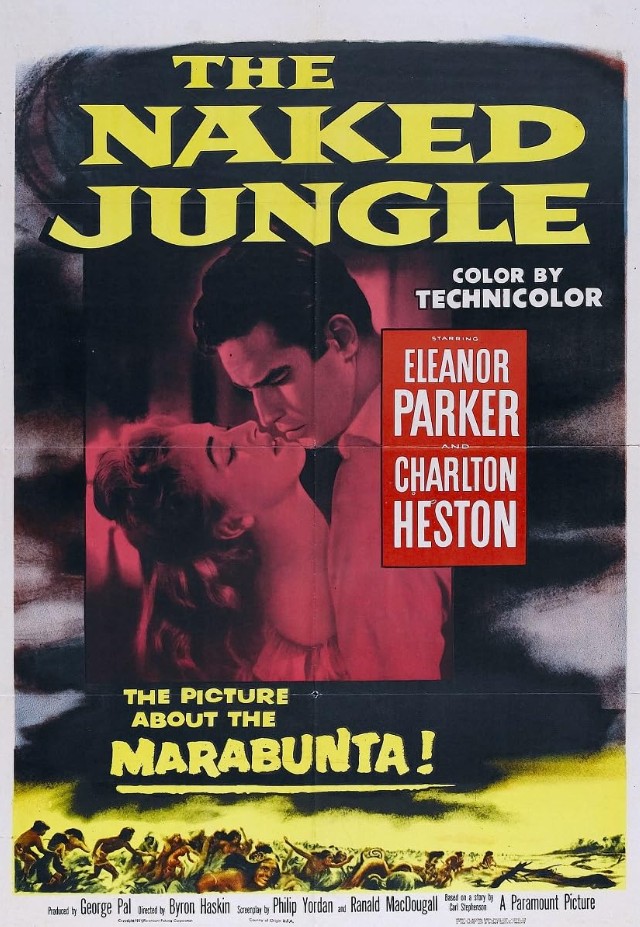
The Naked Jungle (1954) poster created by Paramount Pictures

Things I liked about the film:

The acting: In this review’s introduction, I stated how both Charlton Heston and Eleanor Parker are no strangers to 18 Cinema Lane. After reviewing three of Eleanor’s movies, what I’ve noticed is how Eleanor uses emotion to her advantage. Despite only writing about one of Charlton’s films, Ben-Hur, I can appreciate the consistency of his acting strengths. These compliments can be applied to Eleanor’s and Charlton’s portrayal of Joanna and Christopher in The Naked Jungle! Throughout the 1954 picture, Christopher is a stoic man who prioritizes his plantation. So, when Joanna comes into his life, he carries frustration, pride, and even entitlement in his eyes, through his voice, as well as his body language. Meanwhile, Joanna is a sweet and gentle woman who is open-minded to her new life with Christopher. But when Christopher becomes argumentative with her, Joanna shows little to no fear, effortlessly replacing sweetness with fierce confidence. Because of how strong both Charlton’s and Eleanor’s performance was, their characters were interesting to watch! One of my favorite scenes in The Naked Jungle is when Joanna meets a Commissioner who happened to board the same boat as her. Portrayed by William Conrad, the Commissioner had the charisma and friendly personality to brighten up a room. I could even sense nice on-screen chemistry between William and Eleanor. These factors made me look forward to scenes featuring the Commissioner!

The set design: When it comes to set design, sometimes less is more. This was definitely the case for The Naked Jungle! My favorite set was Joanna’s room because of how pops of color were incorporated into the space. Standing out against the white walls and shutters were gold sconces, dark wood furniture, and bright hued chairs. The vanity area was, in my opinion, the most impressive! An ornate, gold mirror proudly hung on the wall. Right underneath the mirror was a dark wood vanity table, nicely complimenting the mirror’s shiny frame. A chair with green cushions provided a visually appealing bridge between the darker and brighter hues. Though all the pieces of décor were simplistic in design, the overall room presented an elegant, classy, and timeless space!

The dialogue: I sometimes come across films where some of the dialogue is so clever, it sticks in my memory. The Naked Jungle happens to be one of those films! An example of memorably clever dialogue is when Joanna arrives in Brazil for the first time. As Christopher’s “number one man”, Incacha, introduces himself, even bringing up his title, Joanna addresses herself as Christopher’s “number one wife”, as she desperately wants to know where her husband is. The quick response and immediate play on words make this response cordial and somewhat hilarious. Another great example arrives after Joanna and Christopher meet. When Christopher tells Joanna how the tropics have their own schedule, Joanna asks, “What time is bedtime”? Christopher replies by saying, “Whenever you wish, madam”. Joanna then tells Christopher with a hint of playful sarcasm, “I wouldn’t want to upset your schedule”. This comeback works because of the screenwriting and Eleanor’s performance!

6th Luso World Cinema Blogathon banner created by Le from Crítica Retro and Beth Ann from Spellbound With Beth Ann

What I didn’t like about the film:

Lack of on-screen chemistry: As I previously talked about in this review, I liked the acting performances of Charlton Heston and Eleanor Parker. But what I didn’t like about their portrayals of Christopher and Joanna was their lack of on-screen chemistry. In this case, the fault lies in the screenwriters. Not only was the relationship between Joanna and Christopher tense, this tension between them lasted the majority of the movie. By the time Christopher and Joanna finally got around to appreciating the other’s company, this renewal of chemistry came too little too late. That writing choice made it difficult, for me, to determine if Charlton and Eleanor truly possessed any on-screen chemistry.

The “locals” as background characters: “Locals” of the story’s Brazilian setting make appearances throughout The Naked Jungle. But these “locals” aren’t given much to do in the story. Among them was a gentleman who not only possessed Mayan ancestry within his family tree, he also carried around a small head known as his “treasure”. Because of these details, I thought he’d make a fascinating addition to The Naked Jungle’s script, using his family history and maybe even his “treasure” to help resolve the film’s overarching conflict. Unfortunately, this gentleman barely said anything in the one scene he was featured in. Even Incacha, the “number one man” of Christopher, receives a smaller role within the script. Despite dealing with a personal conflict of his own, that conflict has little bearing over the movie’s plot. I was disappointed by the creative decision to turn the “locals” into background characters. This is because their inclusion in the film made me want to learn more about their culture and perspective.

A somewhat misleading title and synopsis: According to The Naked Jungle’s synopsis on IMDB, “a 2-mile-wide, 20-mile-long column of army ants” plan to destroy anything in their path, including Christopher’s plantation. With a movie titled, The Naked Jungle, one would think the titular jungle would play a significant role in the story. But the jungle doesn’t actually appear in the movie until about the last forty minutes. Meanwhile, the “army ants” I previously brought up aren’t shown on screen until about the last thirty minutes of the movie. Keeping in mind The Naked Jungle has a run-time of an hour and thirty-five minutes, this means the majority of the script prioritizes the tension between Christopher and Joanna. These creative choices I talked about make the title and synopsis seem kind of misleading.

String of musical notes image created by Freepik at freepik.com. <a href=’https://www.freepik.com/free-vector/pentagram-vector_710290.htm’>Designed by Freepik</a> <a href=”https://www.freepik.com/free-photos-vectors/background”>Background vector created by Freepik</a>. Image found at freepik.com. 

My overall impression:

Have you ever seen a movie where it wasn’t bad, but it just didn’t meet or exceed your expectations? That’s how I felt after watching The Naked Jungle. Before reviewing the 1954 film, I expected a story where a husband and wife worked together to solve the problem of an ant infestation. But what I got instead was a movie that prioritized the tense relationship of Joanna and Christopher, the aforementioned husband and wife. While there was an ant infestation and the titular jungle did play a role in the story, these parts of the script didn’t arrive until toward the end of the movie. But as I waited for these arrivals, I came to appreciate certain aspects of The Naked Jungle. Not only did I like the “less is more” approach to the set design, I also liked how clever some of the dialogue was. I even liked the acting performances, including those from Eleanor and Charlton. When it comes to The Naked Jungle, however, I was left desiring more. Maybe I’ll review a film where the “locals” are given center stage.

Overall score: 6 out of 10

Have you seen The Naked Jungle? Is there a movie from Charlton Heston’s and/or Eleanor Parker’s filmography you’d like to see me review next? Please tell me in the comment section!

Have fun at the movies!

Sally Silverscreen
Take 3: The Man with the Golden Arm Review

On my Movie Recommendations board on Pinterest, I have 107 films listed. The Man with the Golden Arm is one of those films. Maddy, from Maddy Loves Her Classic Films, recommended the 1955 movie to me years ago. With all my movie recommendations, I try to find the perfect opportunity to review them, as a way to show respect to the people who suggested those movies. When the Kim Novak Blogathon was announced, I immediately went to my aforementioned Pinterest board, to see if any of Kim’s films were on there. Sure enough, I came across the poster for The Man with the Golden Arm! This is not the first time I’ve reviewed one of Kim’s films. Back in 2019, I wrote about the 1954 title, Phffft, a movie I thought was just ok. How will the 1955 film compare to Phffft? The only way to find out to keep reading my review!

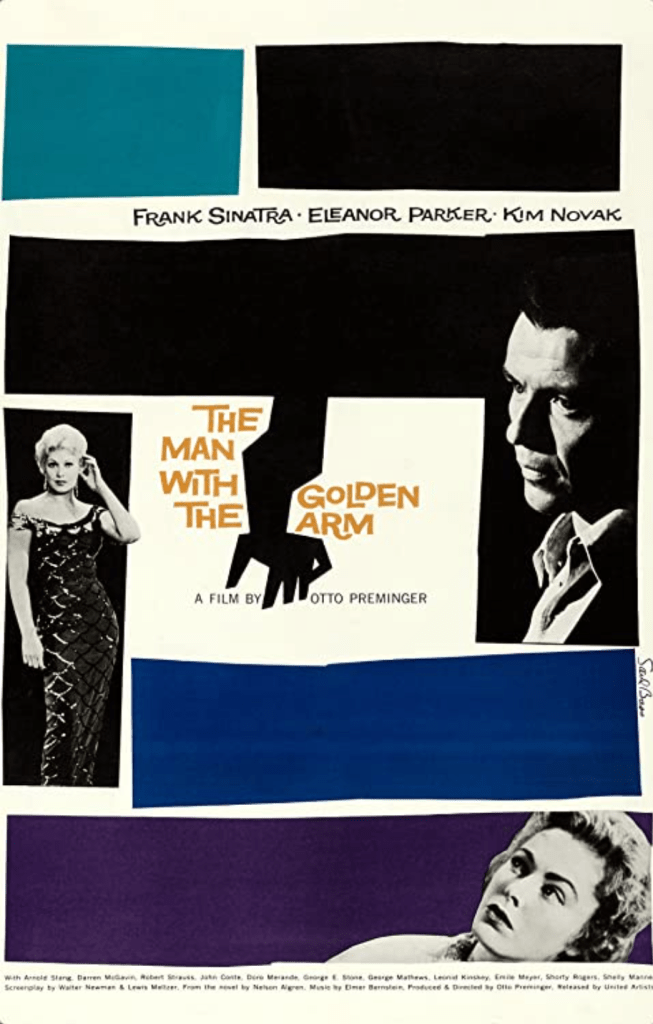
The Man with the Golden Arm poster created by Carlyle Productions and United Artists

Things I liked about the film:

The acting: Because Kim Novak is one of the reasons why I’m reviewing this movie, I’ll talk about her performance first. Portraying Frankie’s lover, Molly, Kim adopted a different persona from her role in Phffft. In The Man with the Golden Arm, she traded flirty for headstrong! Molly is a woman who knows what she wants and finds a way to get it. One of these things is for Frankie to get clean. She says it likes it is by telling Frankie what he needs to hear instead of what he wants to hear. Whenever this happens, Kim uses a tone of voice that is stern enough to be taken seriously. Her approach to emotions in The Man with the Golden Arm is more subtle. However, Kim’s facial expressions and body language perfectly showed the audience what was on her character’s mind. While working at a nightclub, Molly is disappointed by Frankie’s lateness. Her eyes are more downcast, like she doesn’t want Frankie to see her disappointment. Also, her face carries a serious expression, as if she’s tired of being let down.

Most of Kim’s scenes show Molly interacting with Frankie. These scenes presented an on-screen chemistry between Kim Novak and Frank Sinatra I liked seeing! This on-screen chemistry was a strong friendship where both parties seemed to have a deep understanding for one another. It kind of reminded me of the on-screen chemistry between Mercedes Ruehl and Jamey Sheridan in the Hallmark Hall of Fame movie, The Lost Child. While we’re on the subject of Frank Sinatra, let me talk about his performance next! The Man with the Golden Arm is the seventh movie of Frank’s I’m reviewing. In the previous six, he carries this suave charisma that presents an illusion of his character having an effortless existence. While his character, Frankie, does have charisma, it is toned down. What overshadows it is a persona that is more downtrodden and beaten. This makes sense for this particular story, as Frankie is attempting to overcome a drug addiction. Despite the change in acting material, Frank effortlessly pulls it off! His performance was versatile, allowing Frank to adapt to whatever his character faced. His performance was also consistent.

Another consistent performance came from Eleanor Parker! Prior to watching this movie, I had seen and reviewed Interrupted Melody. In that review, I said Eleanor’s portrayal of Marjorie Lawrence was emotional. I can also say that about her portrayal of Zosh, but for different reasons. Zosh is a woman who became paralyzed due to a car accident. While she also wants to see Frankie get clean, she has her own reasons why. Because of the emotionality Eleanor possesses, her portrayal of Zosh caused a ripple affect among the characters. The best example of Eleanor’s emotionality can be seen when Frankie returns from rehab. As their interaction carries on, Eleanor’s demeanor changes over time. It starts with Zosh being excited about Frankie’s return, then leads to concern and frustration over his and her future. Zosh’s reactions ripple through Frankie, presenting some obstacles on his journey to recovery.

Showing the negative effects of drug use: The subject of drug use/drug addictions is one that requires a certain amount of seriousness. Not only is that seriousness found within the story of The Man with the Golden Arm, but it can also be seen in Frank’s performance. When Frankie experiences a relapse, his right hand shakes. Shortly before he relapses, his pupils change in size. Frankie’s attitude changes to agitation, as he attempts to get the “monkey” of his back. He even becomes desperate to appease this “monkey”, putting himself, Zosh, and Molly in danger. Besides being referred to as a “monkey”, Frankie’s addiction is also compared to sugar by a member of the card dealing world. He tells Frankie giving up the addiction is like giving up sugar for the rest of his life, giving Frankie the illusion he can quit whenever he wants. However, these words cause more harm than good. It was interesting to hear the characters in this film talk about drug addictions in a more open sense. The Man with the Golden Arm was released in 1955, a time when drug addictions/drug use wasn’t talked about as openly as today. Therefore, this subject’s inclusion in the script felt ahead of its time.

The use of music: Throughout The Man with the Golden Arm, I noticed how music was used to elaborate on a scene’s particular tone. The music also built up to a tense filled moment. A great example is when Frankie relapses. While on his way to consume drugs, an orchestral tune can be quietly heard in the background. When he gets closer to his destination, the background music gets louder, stopping once Frankie gets what he wants. This specific tune plays every time Frankie relapses, serving as an indicator to the audience what’s to come. A big band tune could be heard when Frankie is looking for Molly later in the film. This tune highlighted Frankie’s urgency to find Molly. It also reflected Frankie’s musical desires and Molly’s place of employment. The use of music I described in this paragraph shows the cleverness incorporated into the movie!

The Kim Novak Blogathon banner created by Classic Movie Muse from The Classic Movie Muse

What I didn’t like about the film:

The underutilization of Kim Novak: Earlier in this review, I talked about how I enjoyed watching Kim’s performance. While I still stand by this statement, I feel her talents were underutilized. Kim appeared in a handful of scenes. Even though she was cast as a main supporting actress and she was one of the few actresses in the film, I was disappointed by how limited Kim’s on-screen appearances were. The Man with the Golden Arm is Frankie’s story, as he is the titular character. Therefore, I knew Frank Sinatra’s character would be focused on the most in this movie. But Eleanor Parker had much more screen time than Kim did. If you’re planning on watching this film specifically for Kim’s performance, like I did, you may be a bit let down.

Too many plots: The Man with the Golden Arm contained five plots, each having something important to say. Because there was no distinction of focus between these plots, they ended up spending the movie’s run-time competing against one another. The competition among the five plots caused them to be resolved in an unsatisfactory way or too conveniently. One example involves a secret Zosh carries throughout the story. This secret will not be shared in this review, in an effort to prevent the film from being spoiled. But when the secret is revealed to the rest of the characters, the timing of this reveal feels presented simply to tie up loose ends. Had some of these plots either been written out or relegated to subplot status, maybe Zosh’s secret would have been revealed sooner.

Limited inclusion of musical talents: I don’t believe there is an unspoken rule that Frank Sinatra has to sing and/or have a musical number whenever he stars in a film. But I do feel there was a missed musical opportunity in The Man with the Golden Arm. At the beginning of the movie, Frankie shares how, while in rehab, he learned how to play the drums. He even plans on joining a band. After these words were spoken, I was so excited to see Frank step out of his comfort zone and try his hand at playing an instrument that may have been new to him. But as the story progressed, Frank was shown playing the drums for a handful of seconds. In one of these scenes, it seemed like Frank was playing the drums alongside the radio, which made it difficult to discern what sounds truly came from the radio. The other two scenes presented a force that prevented me from seeing Frank perform a full drum solo.  That excitement I felt toward the beginning of the movie slowing but surely fizzled.

Poker neon sign image created by Freepik at freepik.com. <a href=’https://www.freepik.com/free-vector/poker-neon-lights-background_1137542.htm’>Designed by Freepik</a>. <a href=”https://www.freepik.com/free-photos-vectors/background”>Background vector created by Freepik</a>. Image found at freepik.com.

My overall impression:

Throughout my years of movie blogging, I have seen films that tried to say so much, but ended up saying so little. The Man with the Golden Arm is one of those films. I recognize the important messages the creative team wanted to share with the audience. But because the movie had five plots, these messages did not have a strong delivery. I can, however, commend the production for addressing a serious issue in a time when that issue was not openly talked about. The strong acting performances and use of music can be acknowledged as well. Kim Novak’s performance was one of the strongest in this film. So, it was disappointing to see Kim receive a limited amount of screen-time, especially since she was one of the reasons why I chose to watch this movie. In the future, I want to seek out Kim’s other film work. I’d also like to watch Frank’s and Eleanor’s other work too.

Overall score: 6.1 out of 10

Have you seen any of Kim Novak’s films? If so, which one would you recommend I review next? Tell me in the comment section below!

Have fun at the movies!

Sally Silverscreen

Take 3: Interrupted Melody Review

Prior to signing up for Maddy Loves Her Classic Films’ Eleanor Parker Blogathon, I had seen two of Eleanor’s films; The Sound of Music and Return to Peyton Place. However, both titles are ensemble films, leaving Eleanor to act in someone else’s shadow. My entry for the blogathon is a review of Interrupted Melody, a film that allows Eleanor’s acting talents to be the center of attention! The 1955 film is one I had never heard of until this year. Before 2020, I didn’t know who Marjorie Lawrence, the Australian opera singer, was. When I learned Marjorie was diagnosed with polio and overcame her illness, I was interested in seeing this part of Marjorie’s life depicted on film. This is because I, personally, haven’t seen many cinematic stories from the perspective of polio patients. I also don’t talk about Australians in cinema, as I don’t often receive an opportunity to do so. This is another reason why I chose to review Interrupted Melody.

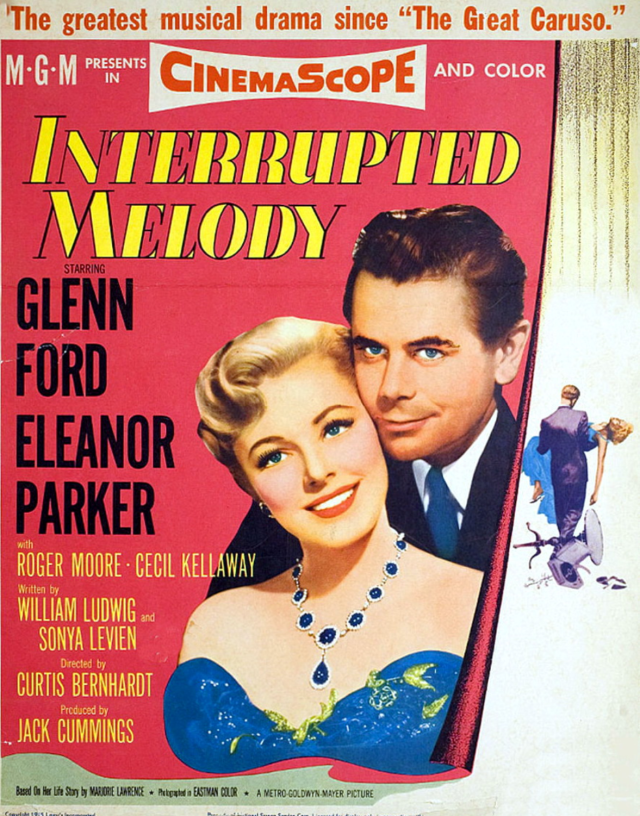
Interrupted Melody poster created by Metro-Goldwyn-Mayer.

Things I liked about the film:

The acting: This is the first movie I’ve seen where Eleanor Parker was the star of the show. I was not disappointed, as Eleanor gave a very strong performance! While Eileen Farrell served as the vocals for the role of Marjorie Lawrence, Eleanor provided the power, passion, and showmanship one can expect from an opera performance. Outside of the opera world, Marjorie experienced several heartbreaks and joys in her life. Through all of this, Eleanor brought forth a portrayal that was emotional, allowing her character to appear and feel realistic. A good example of this is when Marjorie is crawling toward the record player in an attempt to turn it off. One of the key players in Marjorie’s life is her husband, Dr. Thomas King. Portrayed by Glenn Ford, Thomas was her biggest supporter. With a variety of emotions, Glenn also gave a realistic performance! He was able to show the audience how much Thomas cared about Marjorie. Even the supporting actors in Interrupted Melody were strong, which provided strength to the overall cast! Cyril, portrayed by Roger Moore, is Marjorie’s brother and manager. The conversations between him and Marjorie were well performed by both actors, coming across as two siblings having different perspectives on a central topic. This allowed both on-screen personalities to shine as well as showcasing their distinct personas!

The set design: Because Marjorie is an opera star, several opera performances are shown in the film. The movie’s creative team didn’t skimp on the set design within these scenes, as they all felt so immersive. When Marjorie is performing in Madame Butterfly, the stage’s setting is a room from Japan. The window in the background features a large tree, appearing more like a realistic landscape than a painted image. Fine details helped make these spaces appealing to look at. In Marjorie’s first opera, the characters were placed on a Parisian street, with a set of string lights shown over their heads. A detail like this added a three-dimension aspect to the set. Even scenes that didn’t involve the opera looked really good! In one scene, Marjorie and Thomas are on a beach in Florida. While this movie was filmed in Culver City, California, according to IMDB, this was still a photogenic location!

The costumes: In Interrupted Melody, Eleanor Parker wore costumes that were absolutely gorgeous! It also helps that these costumes complimented her so well! In the aforementioned opera, Madame Butterfly, Eleanor’s kimono was light-pink with beautiful embroidery on the collar and sleeves. The embroidery featured flowers, which represented the tree that was featured in the scene’s background. While Marjorie is performing as Carmen in the opera of the same name, her outfit featured a color combination of blue and orange. This was paired nicely with Marjorie’s brown hair. Eleanor even wore some impressive costumes that were not worn during opera performances. Within the film’s second half, she wore a sparkly white gown that was one of my favorites! Eleanor looked beautiful in that dress and I wished she had worn it for a longer period of time.

The Eleanor Parker Blogathon banner created by Maddy from Maddy Loves Her Classic Films.

What I didn’t like about the film:

Missing context: There were areas of the story where I wish context was provided. For starters, how did Marjorie become a singer in the first place? Was this a dream she had since she was a child or a passion she discovered shortly before the events of the film? These questions certainly could have been answered within the script. For a portion of the movie, Cyril disappears from the story. While he eventually appears toward the end of the movie, it isn’t really explained where he went or why he was suddenly absent from the plot. This is something that could’ve been brought up in passing.

More emphasis on the opera world: Since opera played such a huge role in Marjorie’s life, it is going to have a place in the overall story. However, the film put so much emphasis on the glitz and glamour of the opera world, that it caused Marjorie’s polio diagnosis to, kind of, sit on the backburner. This part of Marjorie’s life didn’t come until an hour into the movie. From that point on, it felt like I was watching a highlight reel of Marjorie’s attempts to overcome her illness. I found this disappointing, as I was expecting that part of Marjorie’s story to have a larger presence in the film.

No Australian accents: Before watching Interrupted Melody, I was curious to see if Eleanor could carry an Australian accent. This was, sadly, not the case. In fact, an Australian accent was not consistently used by any of the actors who portrayed members of Marjorie’s family. Toward the beginning of the film, Roger Moore could be heard with an Australian accent. But as the movie goes on, his voice morphs into a British accent. This specific accent was also adopted by the other actors portraying Australians, including Eleanor. While I got used to the lack of Australian accents over time, it is still a flaw I noticed.

String of musical notes image created by Freepik at freepik.com. <a href=’https://www.freepik.com/free-vector/pentagram-vector_710290.htm’>Designed by Freepik</a> <a href=”https://www.freepik.com/free-photos-vectors/background”>Backgroundvector created by Freepik</a>. Image found at freepik.com.

My overall impression:

Like I said in my Follow Your Heart review, Interrupted Melody is not the “end all, be all” of Marjorie Lawrence’s story, as one should learn more about her in their own time. However, I do think this movie serves as a good introduction to this particular individual as well as to opera! Through music, set design, and costumes, Interrupted Melody effectively shows the heart and soul that go into this specific form of entertainment. Within Eleanor Parker’s performance, the audience can see just how resilient Marjorie Lawrence was. Speaking of Eleanor Parker, this movie made me appreciate her more! Strong acting talents and a beautiful presence help create a captivating portrayal that was thoroughly enjoyable to watch. An overarching flaw of Interrupted Melody is how the film becomes so caught up in the glitz and glamour of the opera world, it, at times, forgets its original purpose. In the end, though, the movie was a fine picture that I would recommend.

Overall score: 7.4 out of 10

Have you seen Interrupted Melody? Is there a film about a musician you like to watch? Share your thoughts in the comment section!

Have fun at the movies!

Sally Silverscreen