Take 3: The Great Muppet Caper Review (The Great Muppet Guest Star Caper Double Feature Part 1)

Welcome to part one of The Great Muppet Guest Star Caper Double Feature! Unlike past double feature reviews, my review of The Great Muppet Caper is spoiler-free. If you’re wondering why I chose this movie for the blogathon, you can check out this double feature’s introduction at the link below.

The Great Muppet Guest Star Caper Double Feature is On Its Way!
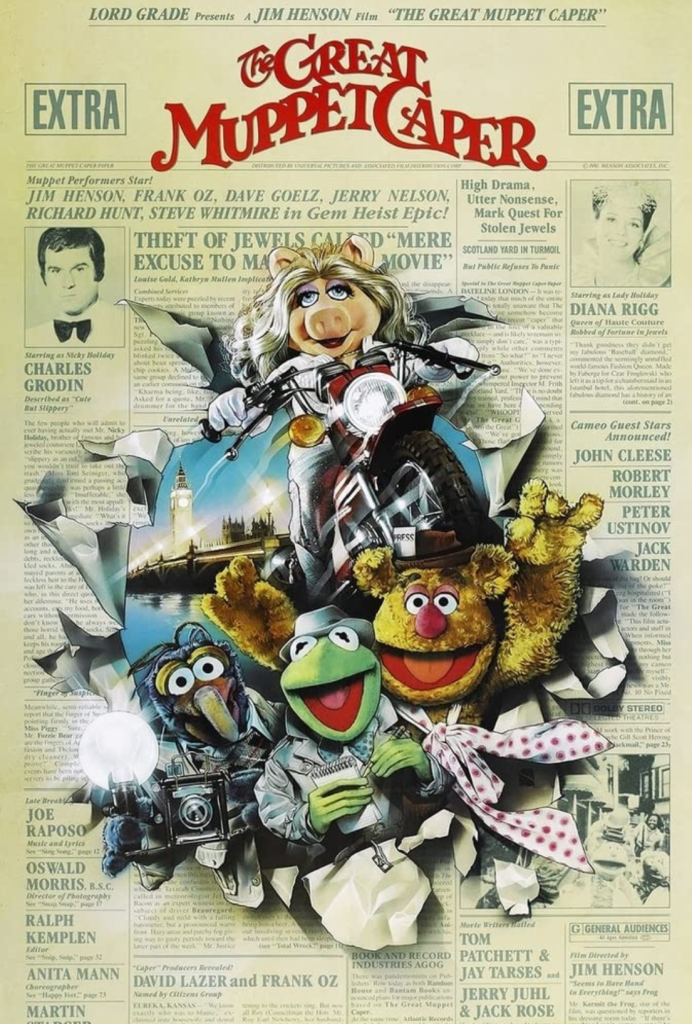
The Great Muppet Caper poster created by
ITC Entertainment, Henson Associates, and
Universal Pictures

1. Were you familiar with The Great Muppet Caper before The Great Muppet Guest Star Caper Blogathon?

I had heard of The Great Muppet Caper prior to being invited to the blogathon. One reason why I’m familiar with the 1981 film is Christine Elizabeth Nelson’s cameo. Christine is the daughter of Jerry Nelson, who was not only a member of The Muppets cast, he also worked on The Great Muppet Caper. Christine’s mother, Jacquie Gordon, wrote a book about her, titled Give Me One Wish: A True Story of Courage and Love, which chronicled Christine’s young life with a Cystic Fibrosis diagnosis. When I sought out her cameo, before seeing The Great Muppet Caper, I admit I was confused why Christine referred to Kermit as a bear. But as I watched the movie, I realized her line was part of a running joke where Kermit and Fozzie Bear are mistaken for twins, as they wear similar looking hats.

2. Who was the featured guest star in The Great Muppet Caper?

That would be John Cleese! He portrayed a character named Neville, a wealthy British resident. John and Joan Sanderson were featured in the scene where Miss Piggy breaks into a high-end home in an attempt to portray her boss, Lady Holiday.

3. If Neville was portrayed by a different actor, how would his role in The Great Muppet Caper change?

The Great Muppet Caper is similar to It’s a Mad, Mad, Mad, Mad, World in that the majority of the cast is given smaller roles, which results in a shorter amount of time on-screen. This surprised me, as I expected John to have more appearances in the movie. While John did a good job with the limited material given, I don’t think the role of Neville would change no matter who portrayed him. This is because The Muppets were the stars of the show, which is expected for this particular title.

4. Did you develop any thoughts and/or questions while watching this film?

In the film’s opening number, “Hey A Movie!”, a city landscape served as the number’s backdrop. From what I could tell, the city didn’t look like the background on Sesame Street. I was surprised by this creative decision, as both The Muppets and Sesame Street were created by Jim Henson. Because of this fact, I expected more cross-overs between the two intellectual properties (IPs). But the only Sesame Street reference I could find in The Great Muppet Caper was a cameo appearance from Oscar the Grouch. Personally, I think having Sesame Street serve as the backdrop for “Hey A Movie!” would have been a nice nod to that show. With both Sesame Street and The Muppets containing their own large cast of characters and their own specific stories, it makes sense why The Great Muppet Caper featured little acknowledgement of Sesame Street.

The inclusion and exclusion of certain Muppet characters also surprised me. Looking back on The Great Muppet Caper, I remember Pepe the King Prawn was nowhere to be found. In my recollections of The Muppets, Pepe and The Great Gonzo have been good friends. So, I was a bit confused why Pepe wasn’t featured in the story. After doing some research about the character, I learned he joined The Muppets family in 1996, a decade after The Great Muppet Caper premiered. Had Pepe starred in this movie, he likely would have worked with Lady Holiday’s fashion label.

The Great Muppet Guest Star Caper banner created by Rebecca from Taking Up Room and Gill from Realweegiemidget Reviews

5. The Great Muppet Caper was not only the second Muppet movie created, it was also released at the end of The Muppet Show’s run. Why do you think the creative team behind the Muppets chose to make and premiere this film toward the end of the show’s lifespan?

If you want to create a movie, especially a good one, there is a lot of time, dedication, creative energy, and resources needed to make that a reality. This can also be said for the creation of a television show. Many cast members from The Muppet Show also worked on The Great Muppet Caper. Had both of these programs been created around the same time, this creative team would have run the risk of their talent being spread too thin as well as creative burn-out.

6. Is there anything about The Great Muppet Caper you liked or didn’t like?

One of the overarching jokes in this story was the characters’ knowledge of being in a movie. The way this knowledge was written and delivered felt like the film’s creative team was winking at the audience. One example is when Lady Holiday, portrayed by Diana Rigg, tells Miss Piggy about her brother, Nicky, and why she doesn’t like him. After Miss Piggy asks Lady Holiday why she’s telling her this information, Lady Holiday responds, in a nonchalant and matter-of-fact way, that what she said is exposition and it needs to go somewhere. I liked this part of the story because of how it was cleverly incorporated into the script. The quality of the screen-writing made this overarching joke feel like it fit within the movie’s world.

The plot of The Great Muppet Caper revolves around Kermit, Fozzie Bear, and The Great Gonzo solving the mystery of stolen jewels. As someone who seeks out media from the mystery genre, I was intrigued by the idea of a mystery story starring The Muppets. But when I watched the movie, I quickly learned the musical numbers were given more emphasis than the mystery. Because I enjoyed watching and hearing these numbers, I didn’t mind this creative decision too much. However, I still wish the mystery itself was given a little more focus.

7. Could a new Muppets movie work in 2023?

In the short term, I believe a new Muppet movie could work, purely based on nostalgia. The Muppets is an IP (intellectual property) many people are fond of, so the movie itself might have a huge draw on opening weekend. But for long term success, meaning memorability, merchandising, and home entertainment sales, the story needs to be able to stand the test of time. To achieve that, the script has to be timeless and straight-forward.

8. What does The Muppet Show mean to you?

When I think of The Muppet Show, the word “tradition” comes to mind. It’s one of those shows the family can watch together, sitting around the television every weekend and enjoying the program, as well as each other’s company. With the large cast of characters, a variety of guest stars, and plenty of musical numbers, there seems to be something for everyone. Sadly, I can’t think of many shows today like The Muppet Show, a show that brings families together.

9. After watching The Great Muppet Caper, is there anything you can take away from your movie viewing experience?

When it comes to movies, especially musicals, sometimes the simplest, most straight-forward stories are the ones that work the best. As I reflect on The Great Muppet Caper, I am reminded of Singin in the Rain and Anchors Aweigh. These three films contain stories that are easier to follow. But the strength of the talent, pleasant musical numbers, and execution of the final product worked in the story’s favor, making each title so enjoyable to watch! Seeing The Great Muppet Caper was such a fun experience! I found myself laughing and smiling during the film, as it exuded so much joy. That joy will carry in my heart long after the end credits roll. Then again, how can you not feel joy when The Muppets come around?

Sketch of London image created by Archjoe at freepik.com. <a href=’https://www.freepik.com/free-vector/hand-drawn-houses-of-parliament_1133950.htm’>Designed by Archjoe</a>. <a href=”https://www.freepik.com/free-photos-vectors/background”>Background vector created by Archjoe – Freepik.com</a>. Image found at freepik.com.

Have fun at the blogathon!

Sally Silverscreen
Take 3: Hallmark Hall of Fame’s Witness for the Prosecution (1982) Review

In my list of the Top 10 Movies I’d Love to Review, I mentioned finding Oliver 2: Let’s Twist Again on Diana Rigg’s IMDB filmography. During that trip on IMDB, I found another film I could review for the Other Than A Bond Girl Blogathon. As the title of this review says, that movie is the 1982 Hallmark Hall of Fame presentation, Witness for the Prosecution! I’ve gone on record to state how I’d like to watch as many Hallmark Hall of Fame titles as realistically possible. If I’m going to be honest, I didn’t think I would ever see Witness for the Prosecution. That’s because the film not only didn’t receive a DVD release, but it doesn’t seem to have received a VHS release either. So, imagine my shock when I found the full movie on Youtube! Mysteries are, arguably, the most popular genre on my blog. This is also not the first time I’ve reviewed an Agatha Christie adaptation. Back in April, I wrote about the 2022 film, Death on the Nile. In that review, I said the movie had a weaker execution than its 2017 predecessor, Murder on the Orient Express. How will Witness for the Prosecution fare against these aforementioned adaptations? All rise, as this review is now in session!

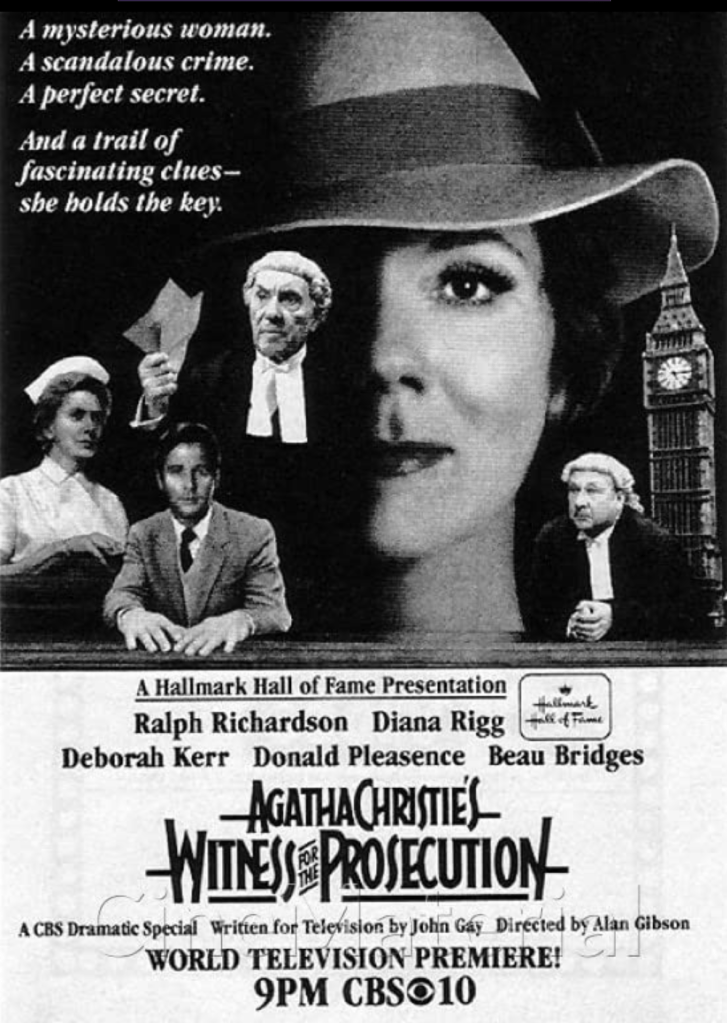
Hallmark Hall of Fame’s Witness for the Prosecution poster created by CBS Entertainment Production, Hallmark Hall of Fame Productions, Rosemont Productions, and United Artists Television

Things I liked about the film:

The acting: Diana Rigg is one of the eligible Bond Girls for the Other Than A Bond Girl Blogathon. Therefore, I will talk about her performance first. In Witness for the Prosecution, Diana portrayed Christine Vole, the wife of the accused party. Throughout the film, she carried her character as a woman from stories in the 1920s. What I mean by this is Christine held her own with confidence, never shaken by the probing of those involved in the legal side of the case. Even when she took the stand, Christine adopted a serious demeanor, as if putting on a “poker face” and refusing to show her deck of cards too early. These acting choices and the consistency of her performance allowed Diana to pull off a captivating and memorable portrayal!

Deborah Kerr is an actress I’ve talked about before on 18 Cinema Lane. While I have seen and reviewed five of her films, none of them were from the mystery genre. Despite this, Deborah held her own, acting wise, among the cast! She portrays Nurse Plimsoll in Witness for the Prosecution. While watching the 1982 production, her performance reminded me a bit of Donna Reed’s portrayal of Mary from It’s a Wonderful Life. Nurse Plimsoll cares about the health and well-being of the film’s protagonist, Sir Wilfred Robarts. Though Wilfred finds her overall nursing approach annoying, Nurse Plimsoll doesn’t give up on her mission. Even though she is stricter than other on-screen nurses, her heart is always in the right place. This can be seen through Deborah’s facial expressions, body language, and emotions.

Even though the cast as a whole was strong, there was one performance that stole the show. This came from Beau Bridges! Witness for the Prosecution shows Beau portraying an American named Leonard. Because his case is presented in a British/U.K. court system, he is a “fish out of water”. The situation itself provides an interesting dynamic for the cast, including Beau, to work with. It also gave Beau an opportunity to utilize a variety of emotions. During the case, one of the witnesses causes Leonard to have an emotional reaction. At the start of the witness’ questioning, Leonard presents a calm “resting face”. But as the questioning continues, he slowly becomes sadder, adopting a growing frown and his eyes filling with tears. This transformation was gradual, allowing Beau to adapt to the on-screen situation.

The set design: The majority of Witness for the Prosecution takes place within a British/U.K. court room. Despite the limited locations, there were some examples of set design that I liked! Inside the court room, the ceiling was domed, with clear glass exposing a view of the sky. Surrounding the dome are etched, white arches. With a green light shown on these arches, they gave the appearance of boasting an antique limestone material, which complimented the dark wood of the court room’s walls and furniture. In the lobby of the court room, painted murals are shown near the ceiling. The lobby’s walls appear to be covered in a two-tone marble material, with the floor revealing a black-and-white tile design. My favorite set in Witness for the Prosecution was Wilfred’s office! The room’s color scheme was brown, beige, and red. When this set was first introduced, a large, dark wood bookcase proudly stood. It was guarded by a dark wood table and two dark brown armchairs. While the walls were beige, the curtains on the window were red, giving the room a pop of color. The more time Wilfred spent in this space, the more the sophisticated, professional, and intelligent appearance of the office complimented his personality.

An in-depth look at the British/U.K. court system: As I mentioned in my point about the film’s set design, the majority of this story takes place in a British/U.K. court room. That part of the movie exposed the audience to the British/U.K. court system. Even though Witness for the Prosecution is not the “end all, be all” when it comes to this specific court system’s portrayal in entertainment media, it gives viewers a chance to compare and contrast it to other court systems in other productions. The layout of the court room itself provides one example. Toward the front of the court room, the witness stand is located at the judge’s right-hand side. This part of the court room is separate from the judge’s stand. Meanwhile, in court room productions taking place in the United States, the witness stand can either be located at the judge’s left or right-hand side. It is also connected to the judge’s stand.  

The Other Than A Bond Girl Blogathon banner created by Gabriela from Pale Writer and Gill from Realweegiemidget Reviews

What I didn’t like about the film:

The magical monocle: While working on the case, Wilfred wore a monocle when he was questioning the accused party and his wife. As he questioned them, a light shone through the monocle and directly landed on Leonard and Christine. But these were the only two times Wilfred used the magical monocle. The purpose of the monocle or Wilfred’s reason for using it was never explained. Was this monocle truly magical or was the monocle used as foreshadowing? I wish this part of Wilfred’s character was more consistent.

A dialogue heavy story: With any movie or tv show episode featuring a court case, there’s going to be a certain amount of dialogue within the story. But because Witness for the Prosecution mostly revolved around a court case, the 1982 production feels more dialogue heavy compared to Death on the Nile and Murder on the Orient Express. Before watching Witness for the Prosecution, I had expected more showing than telling when it came to the mystery. Instead of watching the characters making discoveries related to the mystery, I heard about it through the questioning in court. Because of this creative decision, I didn’t find the movie’s mystery as engaging as it could have been.

An inactive detective: In a story where a detective, amateur or professional, is the protagonist, the audience expects to see this character actively solve their respective film’s mystery. Sadly, the viewers won’t witness that in Witness for the Prosecution. Wilfred is a lawyer defending Leonard in his case. However, Wilfred places more emphasis in resolving the case than playing detective. Even though this movie’s mystery was solved, it felt like Wilfred was served the answer on a silver platter instead of discovering it himself. Similar to what I said about the dialogue-heavy story, I didn’t find the mystery engaging because of Wilfred’s inactive detective role.

Sketch of London image created by Archjoe at freepik.com. <a href=’https://www.freepik.com/free-vector/hand-drawn-houses-of-parliament_1133950.htm’>Designed by Archjoe</a>. <a href=”https://www.freepik.com/free-photos-vectors/background”>Background vector created by Archjoe – Freepik.com</a>. Image found at freepik.com.

My overall impression:

Hallmark Hall of Fame’s Witness for the Prosecution shares a similar plot with 1997’s Red Corner: an American man is accused of murder, with his case in a court system outside of the United States. But where Red Corner succeeded and Witness for the Prosecution didn’t is how Shen, Jack’s lawyer in Red Corner, not only played a role in the court case, but also went above and beyond in attempting to solve the mystery surrounding the case. This allowed Red Corner’s story to be intriguing and engaging for the audience. With the 1982 production, Wilfred spends more time on the court case than the mystery wrapped around it. This decreases the audience’s engagement. The dialogue heavy nature of Witness for the Prosecution’s story also affected the mystery’s intrigue. Hallmark Hall of Fame’s presentation is the third Agatha Christie adaptation I’ve seen, which I wasn’t overly thrilled with. I still want to, one day, read her literary work. But based on my reactions to the three adaptations I have watched so far, I’m starting to wonder if I’ll find an Agatha Christie story I like?

Overall score: 6.1-6.2 out of 10

Have you seen any of Agatha Christie’s adaptations? Do you have a favorite Agatha Christie story? Let me know in the comment section!

Have fun at the movies!

Sally Silverscreen