Take 3: Best Served Cold: A Hannah Swensen Mystery Review

Since 2023, when I reviewed Carrot Cake Murder: A Hannah Swensen Mystery, I have expressed my frustrations over the re-brand of the Murder, She Baked/Hannah Swensen series. It got to the point where, by the time I wrote about Reality Bites: A Hannah Swensen Mystery, I wasn’t looking forward to future installments. But that started to change when I saw Pie To Die For: A Hannah Swensen Mystery. Even though the movie was just ok, it was slightly better than its predecessor. Then, when I reviewed Sugar & Vice: A Hannah Swensen Mystery, I found that film ok as well. As I learned about another chapter in the series, Best Served Cold: A Hannah Swensen Mystery, I was ready to discuss the film with an open mind! Would that movie be ok like the previous two chapters? Keep reading my review to find out!

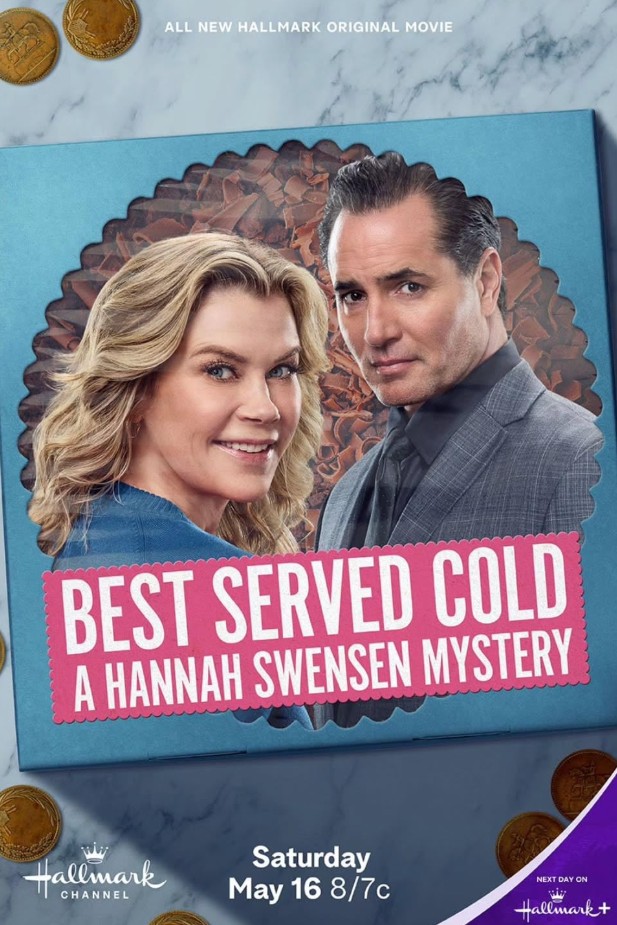
Best Served Cold: A Hannah Swensen Mystery poster created by Hallmark Media and Hallmark Channel

Things I liked about the film:

Incorporation of Delores’ private investigation business: When I talked about One Bad Apple: A Hannah Swensen Mystery in my list of the worst movies I saw in 2024, I criticized the creative decision of allowing Delores to become a private investigator. At the time, I believed this creative choice went against Delores’ character, especially after spending years objecting to Hannah getting involved in cases. But in Best Served Cold: A Hannah Swensen Mystery, Delores’ role as a private investigator made sense within the context of the story. One of the plots of this chapter is a court case involving fraudulent coins. Not only did Chad use Delores’ evidence in the case, Delores also testified during the case’s trial. Along with making sense, incorporating Delores’ private investigation business into Best Served Cold: A Hannah Swensen Mystery gave Delores more involvement in, at least, one area of the script.

Michelle’s wardrobe: Since her debut in Sweet Revenge: A Hannah Swensen Mystery, Hannah’s younger sister, Michelle, has been known for being a free-spirited and creative woman. These personality traits have been reflected through her wardrobe, with Michelle’s wardrobe in Best Served Cold: A Hannah Swensen Mystery being no exception! When Michelle visits The Cookie Jar (Hannah’s bakery), she wears an outfit consisting of a black shirt, black leather jacket, a short yellow plaid skirt, black tights, and black boots. Michelle even wore a pair of yellow smiley face earrings, providing a nice bridge between the black and yellow hues of the outfit. During another trip to The Cookie Jar, Michelle’s outfit boasts a brown and white color combination. But this time, she wears an ensemble made up of a long brown and white cow print skirt, a white shirt, brown sweater, and brown boots. Earrings were, once again, the statement accessory. However, Michelle’s earrings looked like cowgirl boots. Kelsey Baran, the costume designer of Best Served Cold: A Hannah Swensen Mystery, did a great job putting together attire that complements both Michelle and the actress who portrays her, Tess Atkins!

Utilizing Hannah’s “quirk”: I’ve mentioned in the past how detectives in pop culture, especially those that are more well-known, have a “quirk”. This “quirk” helps set fictional detectives apart from other fictional detectives, whether it’s a catchphrase, special interest, or having a signature style. However, a “quirk” isn’t always utilized in solving cases. Hannah has gained a reputation for being a respected baker, as well as the successful proprietor of her bakery, The Cookie Jar, setting the Murder, She Baked/Hannah Swensen series apart from other Hallmark mystery series. From what I remember, though, I don’t recall Hannah using her baking skills to solve a case. But in Best Served Cold: A Hannah Swensen Mystery, Hannah was able to use her baking skills in her favor! I can’t say exactly the role Hannah’s skills played in the film’s mystery, as I don’t want to spoil the film. What I will say is the way they were written into the story was not only clever, but also unique for the series. Sometimes, a fictional detective’s “quirk” can contribute to their perspective, especially when approaching a case. Hannah’s baking skills certainly achieved this, as she was able to notice details overlooked by other characters! The utilization of Hannah’s “quirk” was refreshing, especially compared to a movie like One Bad Apple: A Hannah Swensen Mystery, where Hannah didn’t even solve the mystery.

Silver coin image created by Welcomia at freepik.com. <a href=’https://www.freepik.com/free-photo/american-one-dollar-coin_1180385.htm’>Designed by Freepik</a>. <a href=”https://www.freepik.com/free-photos-vectors/money”>Money image created by Welcomia – Freepik.com</a>. Image found at freepik.com.

What I didn’t like about the film:

Lack of urgency: I brought up earlier in this review how one of the plots of Best Served Cold: A Hannah Swensen Mystery is a court case involving fraudulent coins. The other two plots were a murder mystery and a missing person case. While these three plots interconnected with one another, the court case was prioritized in the script. This creative decision caused the story to lack urgency, which seems to be a consistent flaw in the more recent Murder, She Baked/Hannah Swensen movies. With so much emphasis on the court case, it felt like characters were taking their time solving both the missing person case and the murder mystery. Intrigue was decreased because of the lack of urgency.

Limited number of suspects: Like I just mentioned in my review, the script of Best Served Cold: A Hannah Swensen Mystery emphasized the fraudulent coin court case. Few key characters were involved in the court case, which provided a limited number of suspects. When a mystery story features a collection of suspects, it can add to the fun of trying to figure out “whodunit”, as the audience plays an engaging guessing game. It can also maintain a sense of intrigue to help viewers hold their interest in the film. Sadly, these elements were absent due to how few suspects were in Best Served Cold: A Hannah Swensen Mystery. This creative decision made the mystery’s reveal feel a bit predictable as well.

Underutilized part of the story: Toward the beginning of Best Served Cold: A Hannah Swensen Mystery, Hannah is testing new recipes for an upcoming baking contest. She even offers one of her new pastries to Delores. But other than being brought up in two scenes, this baking contest barely plays a role in the script. In fact, it’s never revealed which pastry Hannah will submit to the contest. I found this underutilized part of the story disappointing because of its wasted potential. I recall the baking contest being international, which could have served either an interesting subplot or main plot. Looking back on Best Served Cold: A Hannah Swensen Mystery, as well as the more recent Murder, She Baked/Hannah Swensen movies, it seems like underutilizing elements of the story is a trend within this series.

Interior image of detective’s office created by Vectorpocket at freepik.com. <a href=”https://www.freepik.com/free-photos-vectors/vintage”>Vintage vector created by vectorpocket – http://www.freepik.com</a>. Image found at freepik.com.

My overall impression:

When I talked about Reality Bites: A Hannah Swensen Mystery in my list of the best and worst movies I saw in 2025, I said if the Murder, She Baked/Hannah Swensen series continues in 2026, I’d like to see the quality become more consistent. Reflecting on Best Served Cold: A Hannah Swensen Mystery (as well as Pie To Die For: A Hannah Swensen Mystery and Sugar & Vice: A Hannah Swensen Mystery), I would say this consistency was achieved! Best Served Cold: A Hannah Swensen Mystery was, in my opinion, just ok. However, this movie improved upon some of the series’ flaws. Not only was Delores’ antics toned down again, her private investigation business was incorporated into the story in a way that made sense. This latest chapter in the Murder, She Baked/Hannah Swensen series contributed its own set of strengths, such as Hannah’s “quirk” becoming utilized within the script. But there are weaknesses in this series, including in Best Served Cold: A Hannah Swensen Mystery, I wish were not consistent, like the lack of urgency and underutilizing parts of the story. According to IMDB, ‘Cooked to Death: A Hannah Swensen Mystery’ is currently in pre-production. There also appears to be an Alison Sweeney and Ashley Williams project in development. Even though no official word has been made about the future of the Murder, She Baked/Hannah Swensen series, it’ll be interesting to see where this story goes from here.

Overall score: 6-6.1 out of 10

Have you seen Best Served Cold: A Hannah Swensen Mystery? Would you like to see the Murder, She Baked/Hannah Swensen series continue? Please tell me in the comment section!

Have fun at The Cookie Jar!

Sally Silverscreen

IMDB pages I referenced in this review: https://www.imdb.com/title/tt40629979/?ref_=tt_mlt_t_1, https://www.imdb.com/title/tt34094007/?ref_=tt_mlt_t_7

Take 3: Witness for the Prosecution (1957) Review

April’s theme for the Genre Grandeur blogathon is “Courtroom Dramas”. Upon researching eligible titles for this review, I came across one I have heard of before. That title was 1957’s Witness for the Prosecution! Though this adaptation was recommended to me by Emily (from The Flapper Dame) and Eric Binford (from Diary of a Movie Maniac), it’s not the first time I’ve seen (and reviewed) any Witness for the Prosecution adaptation. Back in 2022, I wrote about 1982’s version from the Hallmark Hall of Fame collection. In that review, I criticized Wilfred (the film’s protagonist) spending more time on the story’s court case than the mystery wrapped around it. I believed that creative decision decreased the audience’s engagement. This is one of the reasons why I thought Hallmark Hall of Fame’s adaptation of Witness for the Prosecution was just ok. But will I feel similarly about the 1957 version of this story? In order to solve this mystery, you’ll have to read my review!

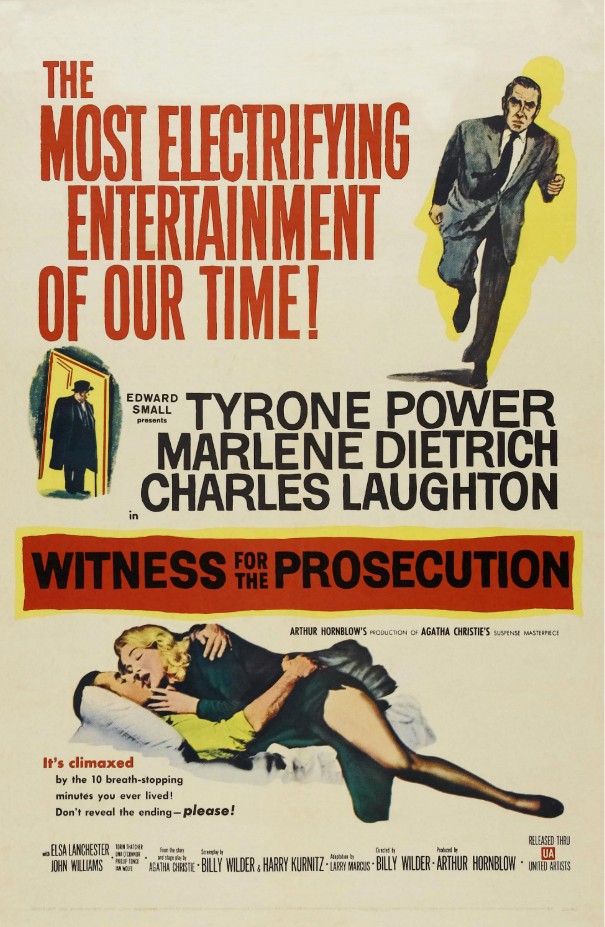
Witness for the Prosecution (1957) poster created by Edward Small Productions and United Artists

Things I liked about the film:

The acting: When I wrote about the Hallmark Hall of Fame presentation of Witness for the Prosecution, I praised the acting performances of Diana Rigg, Deborah Kerr, and Beau Bridges. Not only did Beau and Deborah utilize a variety of expressions and emotions, Diana’s portrayal of Christine was consistent. The acting performances in the 1957 adaptation of Witness for the Prosecution were also a highlight! But if I could use one word to describe them, it would be “animated”. Throughout 1957’s Witness for the Prosecution, Wilfrid (the movie’s protagonist) is a grumpy man who stubbornly likes to do things his way. However, the strength of Charles Laughton’s portrayal prevented Wilfrid from becoming a one-dimensional character. In a scene where Wilfrid rides on an elevating stair chair, Wilfrid smiles with a sneaky look in his eyes, scheming a way to foil Miss Plimsoll’s plans. Meanwhile, Tyrone Power gave a very well-rounded portrayal of Leonard Vole! One of the best examples of this statement is when Leonard finds out about his inheritance from the murder victim, Emily Jane French. Leonard’s eyes become very wide as he excitedly reacts to his new-found wealth. This excitement can also be heard in his voice. Then, without hesitation, Leonard’s face falls as he realizes this recently discovered information gives him a motive for murder. Concern replaced excitement in Leonard’s voice and fear even found a reason to exist in his eyes.

As I just mentioned in this review, Diana Rigg’s portrayal of Christine in Hallmark Hall of Fame’s Witness for the Prosecution was consistent. This was also the case for Marlene Dietrich’s portrayal of Christine in 1957’s Witness for the Prosecution. But like I said in this review, the cast’s performances in the 1957 movie were “animated”. That animation was woven into Marlene’s portrayal as well. Throughout Witness for the Prosecution, Christine carried herself with a poised confidence, refusing to let anything get to her. A perfect example is when she outsmarted Wilfrid’s “monocle test”. During Leonard’s trial, however, Christine’s emotions burst into the courtroom. Sometimes, she yelled out her answers with an intensely serious look on her face. There was even a scene where tears spilled from her eyes. Marlene’s performance added enjoyment to my movie-viewing experience!

The set design: One of the strengths from 1982’s Witness for the Prosecution was the set design. In my review of that film, I described the court room as well as Wilfred’s office, with the latter being my favorite set in the Hallmark Hall of Fame presentation. But in the 1957 version of Witness for the Prosecution, my favorite set was Emily Jane French’s living room! The room consisted of two closely situated spaces; a sitting area by a large window and a sitting area by a fireplace. The sitting area by the window featured at least one wicker chair, a hanging plant, and a magazine rack. Meanwhile, the sitting area by the fireplace proudly displayed African artifacts on the walls. The white walls surrounding the living room and the décor’s lighter hues helped the artifacts stand out. Mosaic tiles with a flower design added daintiness to the fireplace itself. Two matching wicker cabinets and a transparent shelf provided storage to the living room. The lower ceiling in the living room helped incorporate a sense of coziness. With everything I described, I wish Emily’s living room was featured more in 1957’s Witness for the Prosecution.

Showing as well as telling: A flaw I talked about in my review for Hallmark Hall of Fame’s Witness for the Prosecution was how dialogue heavy the story was. The emphasis of telling over showing left me disappointed. But this flaw was remedied in Witness for the Prosecution from 1957! Flashbacks presented how Leonard met Emily and Christine, which added context to the dialogue. Later in 1957’s Witness for the Prosecution, Wilfrid discovers evidence that could impact Leonard’s case. This discovery is actually shown on screen, with the mystery surrounding who gave Wilfrid the evidence and where that person got the evidence from providing intrigue. A handful of Wilfrid’s pills cleverly show the progression of time during Leonard’s case. Though the 1957 version of Witness for the Prosecution relies on dialogue, the creative decision to show and tell made the movie more engaging than Hallmark Hall of Fame’s adaptation!

Sketch of London image created by Archjoe at freepik.com. <a href=’https://www.freepik.com/free-vector/hand-drawn-houses-of-parliament_1133950.htm’>Designed by Archjoe</a>. <a href=”https://www.freepik.com/free-photos-vectors/background”>Background vector created by Archjoe – Freepik.com</a>. Image found at freepik.com.

What I didn’t like about the film:

Prolonged involvement: In my review of Hallmark Hall of Fame’s adaptation of Witness for the Prosecution, I was critical of Wilfred’s inactive detective role. The 1982 film placed more emphasis on showing Wilfred resolving Leonard’s case than solving the mystery surrounding the case. Witness for the Prosecution from 1957 still places emphasis on showing Wilfrid resolving Leonard’s case. But this time, he doesn’t officially get involved in Leonard’s case until about forty minutes into the hour and fifty-six-minute film. I understand any mystery movie, let alone a courtroom drama, requires build-up. However, in my opinion, the build-up in 1957’s Witness for the Prosecution lasted too long.

An underutilized character: Before Wilfrid officially becomes Leonard’s solicitor, Leonard meets Wilfrid with his solicitor, Mr. Mayhew. If Mr. Mayhew hadn’t given Wilfrid the information about Leonard’s case, Wilfrid would have never known about Leonard’s case. But after Wilfrid becomes Leonard’s solicitor, Mr. Mayhew disappears from the story. I was disappointed by his underutilization because he could have, somehow, continued contributing to Leonard’s case. This underutilization also does a disservice to the actor who portrayed Mr. Mayhew, Henry Daniell.

A predictable detail: Leonard is questioned about Christine when he first meets Wilfrid. During this questioning, Leonard shares an important detail about her that affects the movie’s later events. But as soon as Leonard brought this detail up, I knew how it would impact the story’s outcome. In fact, I saw a plot twist coming because that aforementioned detail about Christine was revealed earlier in the movie. Due to how soon Wilfrid (and the audience) found out about Christine’s detail, it kind of made the movie’s ending predictable.

Courtroom image created by Macrovector at freepik.com. <a href=”https://www.freepik.com/free-photos-vectors/isometric”>Isometric vector created by macrovector – http://www.freepik.com</a>. Image found at freepik.com.

My overall impression:

In the introduction of this review, I asked if I’d feel similarly about 1957’s Witness for the Prosecution as I did Hallmark Hall of Fame’s version of the story. Now that I’ve seen (and reviewed) both adaptations, I can honestly say I like the 1957 film over the one from 1982! One improvement was the creative decision to show as well as tell, which added intrigue and engagement to the movie. It also helps how the purpose of Wilfrid’s “magical monocle” was brought up in the dialogue. Witness for the Prosecution from 1957 shares some of the same strengths as the Hallmark Hall of Fame presentation, such as the acting performances and the set design. However, the 1957 version of the story has its flaws. Because of how soon a detail about Christine was revealed, it kind of made the film’s ending predictable. I not only wasn’t a fan of how underutilized Mr. Mayhew became, I also didn’t like how Wilfrid got involved in Leonard’s case about forty minutes into the hour and fifty-six-minute movie. I’m glad I was recommended the 1957 production of Witness for the Prosecution! It gave me another chance to witness a different approach to one of Agatha Christie’s stories.

Overall score: 7.3-7.4 out of 10

Have you seen 1957’s Witness for the Prosecution? Are there any adaptations of Agatha Christie’s work you’d like to see me review? Please tell me in the comment section!

Have fun at the movies!

Sally Silverscreen
Take 3: Hallmark Hall of Fame’s Witness for the Prosecution (1982) Review

In my list of the Top 10 Movies I’d Love to Review, I mentioned finding Oliver 2: Let’s Twist Again on Diana Rigg’s IMDB filmography. During that trip on IMDB, I found another film I could review for the Other Than A Bond Girl Blogathon. As the title of this review says, that movie is the 1982 Hallmark Hall of Fame presentation, Witness for the Prosecution! I’ve gone on record to state how I’d like to watch as many Hallmark Hall of Fame titles as realistically possible. If I’m going to be honest, I didn’t think I would ever see Witness for the Prosecution. That’s because the film not only didn’t receive a DVD release, but it doesn’t seem to have received a VHS release either. So, imagine my shock when I found the full movie on Youtube! Mysteries are, arguably, the most popular genre on my blog. This is also not the first time I’ve reviewed an Agatha Christie adaptation. Back in April, I wrote about the 2022 film, Death on the Nile. In that review, I said the movie had a weaker execution than its 2017 predecessor, Murder on the Orient Express. How will Witness for the Prosecution fare against these aforementioned adaptations? All rise, as this review is now in session!

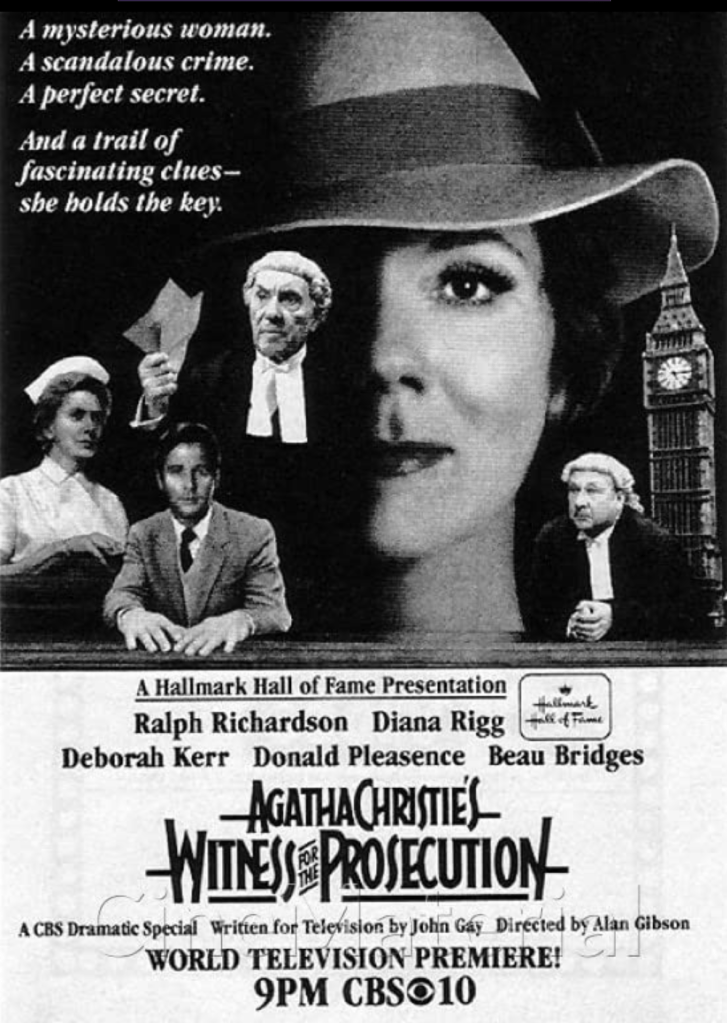
Hallmark Hall of Fame’s Witness for the Prosecution poster created by CBS Entertainment Production, Hallmark Hall of Fame Productions, Rosemont Productions, and United Artists Television

Things I liked about the film:

The acting: Diana Rigg is one of the eligible Bond Girls for the Other Than A Bond Girl Blogathon. Therefore, I will talk about her performance first. In Witness for the Prosecution, Diana portrayed Christine Vole, the wife of the accused party. Throughout the film, she carried her character as a woman from stories in the 1920s. What I mean by this is Christine held her own with confidence, never shaken by the probing of those involved in the legal side of the case. Even when she took the stand, Christine adopted a serious demeanor, as if putting on a “poker face” and refusing to show her deck of cards too early. These acting choices and the consistency of her performance allowed Diana to pull off a captivating and memorable portrayal!

Deborah Kerr is an actress I’ve talked about before on 18 Cinema Lane. While I have seen and reviewed five of her films, none of them were from the mystery genre. Despite this, Deborah held her own, acting wise, among the cast! She portrays Nurse Plimsoll in Witness for the Prosecution. While watching the 1982 production, her performance reminded me a bit of Donna Reed’s portrayal of Mary from It’s a Wonderful Life. Nurse Plimsoll cares about the health and well-being of the film’s protagonist, Sir Wilfred Robarts. Though Wilfred finds her overall nursing approach annoying, Nurse Plimsoll doesn’t give up on her mission. Even though she is stricter than other on-screen nurses, her heart is always in the right place. This can be seen through Deborah’s facial expressions, body language, and emotions.

Even though the cast as a whole was strong, there was one performance that stole the show. This came from Beau Bridges! Witness for the Prosecution shows Beau portraying an American named Leonard. Because his case is presented in a British/U.K. court system, he is a “fish out of water”. The situation itself provides an interesting dynamic for the cast, including Beau, to work with. It also gave Beau an opportunity to utilize a variety of emotions. During the case, one of the witnesses causes Leonard to have an emotional reaction. At the start of the witness’ questioning, Leonard presents a calm “resting face”. But as the questioning continues, he slowly becomes sadder, adopting a growing frown and his eyes filling with tears. This transformation was gradual, allowing Beau to adapt to the on-screen situation.

The set design: The majority of Witness for the Prosecution takes place within a British/U.K. court room. Despite the limited locations, there were some examples of set design that I liked! Inside the court room, the ceiling was domed, with clear glass exposing a view of the sky. Surrounding the dome are etched, white arches. With a green light shown on these arches, they gave the appearance of boasting an antique limestone material, which complimented the dark wood of the court room’s walls and furniture. In the lobby of the court room, painted murals are shown near the ceiling. The lobby’s walls appear to be covered in a two-tone marble material, with the floor revealing a black-and-white tile design. My favorite set in Witness for the Prosecution was Wilfred’s office! The room’s color scheme was brown, beige, and red. When this set was first introduced, a large, dark wood bookcase proudly stood. It was guarded by a dark wood table and two dark brown armchairs. While the walls were beige, the curtains on the window were red, giving the room a pop of color. The more time Wilfred spent in this space, the more the sophisticated, professional, and intelligent appearance of the office complimented his personality.

An in-depth look at the British/U.K. court system: As I mentioned in my point about the film’s set design, the majority of this story takes place in a British/U.K. court room. That part of the movie exposed the audience to the British/U.K. court system. Even though Witness for the Prosecution is not the “end all, be all” when it comes to this specific court system’s portrayal in entertainment media, it gives viewers a chance to compare and contrast it to other court systems in other productions. The layout of the court room itself provides one example. Toward the front of the court room, the witness stand is located at the judge’s right-hand side. This part of the court room is separate from the judge’s stand. Meanwhile, in court room productions taking place in the United States, the witness stand can either be located at the judge’s left or right-hand side. It is also connected to the judge’s stand.  

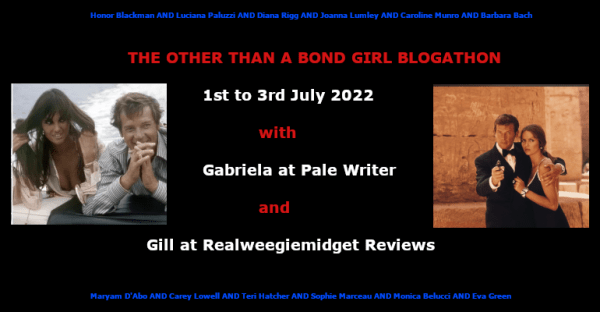
The Other Than A Bond Girl Blogathon banner created by Gabriela from Pale Writer and Gill from Realweegiemidget Reviews

What I didn’t like about the film:

The magical monocle: While working on the case, Wilfred wore a monocle when he was questioning the accused party and his wife. As he questioned them, a light shone through the monocle and directly landed on Leonard and Christine. But these were the only two times Wilfred used the magical monocle. The purpose of the monocle or Wilfred’s reason for using it was never explained. Was this monocle truly magical or was the monocle used as foreshadowing? I wish this part of Wilfred’s character was more consistent.

A dialogue heavy story: With any movie or tv show episode featuring a court case, there’s going to be a certain amount of dialogue within the story. But because Witness for the Prosecution mostly revolved around a court case, the 1982 production feels more dialogue heavy compared to Death on the Nile and Murder on the Orient Express. Before watching Witness for the Prosecution, I had expected more showing than telling when it came to the mystery. Instead of watching the characters making discoveries related to the mystery, I heard about it through the questioning in court. Because of this creative decision, I didn’t find the movie’s mystery as engaging as it could have been.

An inactive detective: In a story where a detective, amateur or professional, is the protagonist, the audience expects to see this character actively solve their respective film’s mystery. Sadly, the viewers won’t witness that in Witness for the Prosecution. Wilfred is a lawyer defending Leonard in his case. However, Wilfred places more emphasis in resolving the case than playing detective. Even though this movie’s mystery was solved, it felt like Wilfred was served the answer on a silver platter instead of discovering it himself. Similar to what I said about the dialogue-heavy story, I didn’t find the mystery engaging because of Wilfred’s inactive detective role.

Sketch of London image created by Archjoe at freepik.com. <a href=’https://www.freepik.com/free-vector/hand-drawn-houses-of-parliament_1133950.htm’>Designed by Archjoe</a>. <a href=”https://www.freepik.com/free-photos-vectors/background”>Background vector created by Archjoe – Freepik.com</a>. Image found at freepik.com.

My overall impression:

Hallmark Hall of Fame’s Witness for the Prosecution shares a similar plot with 1997’s Red Corner: an American man is accused of murder, with his case in a court system outside of the United States. But where Red Corner succeeded and Witness for the Prosecution didn’t is how Shen, Jack’s lawyer in Red Corner, not only played a role in the court case, but also went above and beyond in attempting to solve the mystery surrounding the case. This allowed Red Corner’s story to be intriguing and engaging for the audience. With the 1982 production, Wilfred spends more time on the court case than the mystery wrapped around it. This decreases the audience’s engagement. The dialogue heavy nature of Witness for the Prosecution’s story also affected the mystery’s intrigue. Hallmark Hall of Fame’s presentation is the third Agatha Christie adaptation I’ve seen, which I wasn’t overly thrilled with. I still want to, one day, read her literary work. But based on my reactions to the three adaptations I have watched so far, I’m starting to wonder if I’ll find an Agatha Christie story I like?

Overall score: 6.1-6.2 out of 10

Have you seen any of Agatha Christie’s adaptations? Do you have a favorite Agatha Christie story? Let me know in the comment section!

Have fun at the movies!

Sally Silverscreen

Take 3: Twilight of Honor Review

When Tiffany from Pure Entertainment Preservation Society invited me to join The Second Annual Claude Rains Blogathon, I was familiar with Claude as an actor. I’ve seen five of his movies, as I reviewed Caesar and Cleopatra back in September. While looking through his filmography on IMDB, I discovered that Claude starred in a film called Twilight of Honor. Because I happened to have this movie on my DVR, I figured it would be a great choice for the blogathon. This isn’t the first time I’ve talked about a courtroom film. Last year, I reviewed two movies from Hallmark Movies & Mysteries’ Darrow Mystery series. What I enjoy about those films is the mystery component featured within the narrative. It creates an intriguing and interactive experience for the audience. Will I find a mystery in Twilight of Honor? Keep reading if you want to find out!

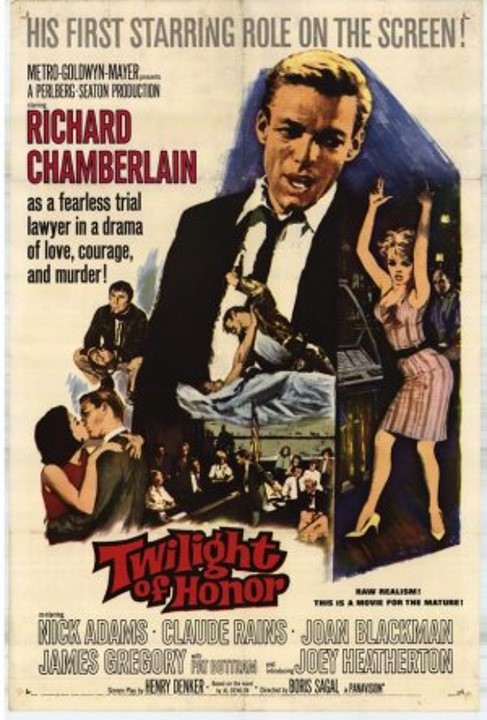
Twilight of Honor poster
Twilight of Honor poster created by Metro-Goldwyn-Mayer. Image found at commons.wikimedia.org/wiki/File:Twilight_of_Honor_FilmPoster.jpeg.

Things I liked about the film:

The acting: The overall cast in this film was pretty good! Everyone’s performance appeared believable, especially for their character’s situation. Even though Claude Rains was in the film for a limited amount of time, his portrayal of Art Harper was memorable! He brought a pleasant persona to his character and was a joy to watch on screen. The lead star, Richard Chamberlain, also gave a good acting performance! His character, David Mitchell, had a healthy balance between the seriousness of a lawyer and the charm of a gentleman. That’s because his acting abilities were well-rounded enough to pull off this specific kind of portrayal. The supporting cast was just as talented as the starring cast! Joey Heatherton was a standout in this film as Laura-Mae Brown! With an on-screen personality that was feisty and bold, Joey found a way to shine among her co-stars. Her character certainly brought an interesting element to the story.


The dual screen special effect: Whenever one of the characters shared their perspective on the case, the screen was split to show the flashback on one side of the screen while the character was speaking. After this was shown, the flashback was presented in a full-screen format. This element made the project appear ahead of its time. Because the ‘60s weren’t known for experimentation with technology in film, it makes the creative team behind this movie appear innovative. I respect their decision to try something new. They took a creative risk and it worked in their favor.


The Clinton house: At one point in the movie, David visits the widow of the murder victim, Mrs. Clinton, at her house. Despite this location being featured on screen for a short amount of time, this house looked very appealing on film! The way it was staged and decorated gave the impression that the creative team was going for: the living environment of an affluent family. From the winding staircase to the large door-frame, everything about it spoke volumes about the characters that lived there. It was also just a nice-looking place in general. I’m not sure if this was a real location or a set, but the people associated with bringing this place to life did a good job in doing so.

Claude Rains Blogathon banner
The Second Annual Claude Rains Blogathon banner created by Tiffany and Rebekah Brannan from Pure Entertainment Preservation Society. Image found at https://pureentertainmentpreservationsociety.wordpress.com/2019/10/18/round-up-the-usual-suspects-the-second-annual-claude-rains-blogathon-is-coming/.

What I didn’t like about the film:

The run-time: Twilight of Honor is almost two hours. Because of this, it makes the story feel drawn out and some scenes last longer than they need to. One example is some of the courtroom scenes. I understand that court cases in film take time to be explored and discussed. But, personally, I don’t think this particular story needed to be as long as it was. If this movie was an hour and ten or twenty minutes, then the script could have been a little bit tighter and the run-time would be more condensed.


Very little intrigue: When I first heard about this movie, I was expecting the story to have a mystery element. Similar to programs such as Matlock, Perry Mason, and Hallmark’s Darrow Mystery series, I was ready to figure out whodunit. Sadly, that’s not the kind of story Twilight of Honor is. It’s a courtroom drama with a surface level narrative that’s “cut and dry”. Because the story was so basic, I found the final verdict to be anti-climactic. It wasn’t a boring story, but it wasn’t exciting either.


David and Susan’s relationship: I have nothing against David and Susan’s relationship. The issue I have with it is how little emphasis it was given in the film. David and Susan’s relationship feels rushed and under-developed. They are seen spending so little time with each other that when their relationship does progress, it just comes out of nowhere. There’s no build-up to where this relationship ends up. It just seems like it was placed in the movie just for the sake of being there.

286520-P6QACV-178
Scales of Justice image created by Freepik at freepik.com. <a href=”https://www.freepik.com/free-photos-vectors/background”>Background vector created by freepik – http://www.freepik.com</a>. Image found at freepik.com.

My overall impression:

Twilight of Honor is not what I expected it to be. That intriguing, courtroom mystery that I was looking to ended up becoming a straight-forward drama with a simplistic story. Because of that, I found the movie to be just ok. While there were things about it that I liked, the story itself could have been stronger. But that doesn’t mean that the movie is void of purpose. Twilight of Honor does have its place in film history with the use of the dual screen special effect that was featured in the movie. It also gives people a good excuse to watch Claude Rains perform on screen. This isn’t one of the best movies I’ve seen this year, so far. But it’s definitely not one of the worst films I’ve seen either. I’m glad that I saw Twilight of Honor, though, because now I can have an honest opinion about it.


Overall score: 6 out of 10


What do you think of this review? Which movie from Claude Rains’ filmography is your favorite? Share your thoughts in the comment section!


Have fun at the movies!

Sally Silverscreen