Take 3: Let Me In (2010) Review

I apologize to my readers for my lack of blog posts these past two weeks. I’ve been working on an editorial I’m publishing on Halloween. Researching, writing, and curating that editorial has taken up a lot of time. But I wasn’t going to miss out on participating in Taking Up Room’s Secret Places and Trippy Houses Blogathon, especially since my selected film is a perfect choice for Halloween! When I learned one of the eligible subjects was “strange neighbors”, I was reminded how I was recommended the 2010 movie, Let Me In. Suggested by John L. Harmon, I had heard it was one of the better vampire films in the world of cinema. Since I had heard of the movie, but never saw it, I couldn’t agree or disagree with that statement. But now that I’ve finally seen Let Me In, I can now give my honest opinion about the film!
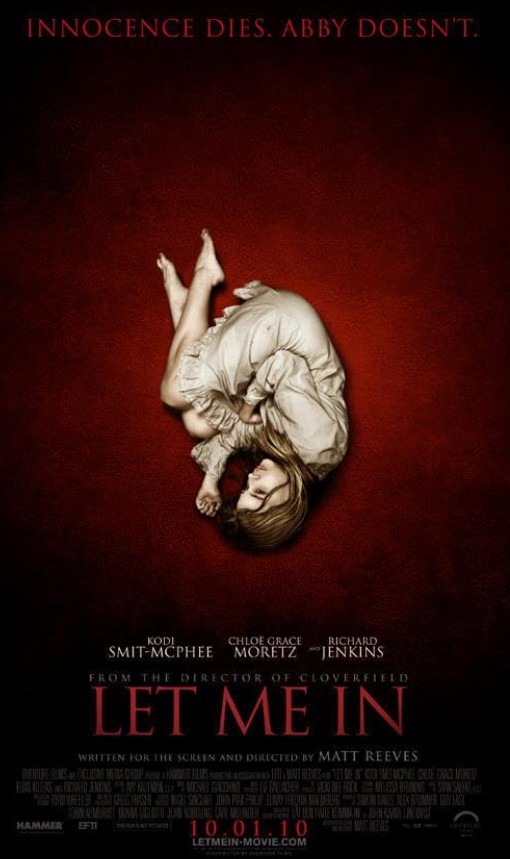
Let Me In (2010) poster created by Overture Films, Exclusive Media Group, Hammer Films, EFTI, and Relativity Media

Things I liked about the film:

The mise-en-scène: As I explained in my review of 1955’s The End of the Affair, mise-en- scène is how a film’s scene is presented to the audience. Throughout Let Me In, the way mise-en- scène was utilized presented scenes in visually creative ways. At the very beginning of the movie, a snowy forest was shown during the night. The only source of light comes from two police cars and an ambulance. A long shot slowly becomes a close-up shot, giving the audience a reason to focus on the bright vehicles. Anytime Owen and Abby look through the peephole of their apartment door, the shot is shown in a fish-eye lens. This film-making technique puts the audience in Abby and Owen’s perspective, allowing them to see what the children are seeing. It also emphasizes how, despite their differences, Owen and Abby have shared experiences like seeing who is at their door.

How music was incorporated: Music can be an effective component of film-making. It can elevate a scene’s emotions or set a scene’s tone. In Let Me In’s opening scene I just referenced in this review, a rhythmic drumbeat is one of the first sounds the audience can hear. That specific sound creates a sense of urgency, signifying danger is on the horizon. When Abby moves into Owen’s apartment building, gentle angelic-sounding singing can be heard. This is symbolic of how Owen sees Abby; an angel who will provide a light in his darkness. The two examples from Let Me In I discussed add additional context to the scenes themselves. How the film’s creative team incorporated music into the 2010 picture shows the understanding they had for how music can work in their project’s favor.

Disguising Abby’s vampire identity: Before watching Let Me In, I knew it was a vampire movie. But I was pleasantly surprised by how Abby’s vampire identity was disguised. Most of Abby and Owen’s interactions take place at night, at first seeming like just a coincidence. When Owen notices Abby isn’t wearing shoes, she states how she doesn’t feel cold. Abby even tells Owen she’s stronger than he thinks. These verbal and visual clues creatively signified how Abby was a vampire. But because of the clues’ subtlety, it leaves the audience guessing why, on the surface, Abby seems so strange. New twists on vampire cliches, like vampires avoiding sunlight, made Let Me In more unique from other vampire films.
The Secret Places and Trippy Houses Blogathon banner created by Rebecca from Taking Up Room

What I didn’t like about the film:

The audio: When I reviewed Fist of Fury, I talked about the film’s audio being one of the major flaws. I had to turn up my television’s volume in order to hear what the characters were saying. Let Me In shares this same issue. Once again, I had to raise my television’s volume just to hear the dialogue, as the characters’ speech was quiet. As I suggested in my review of the Hallmark Hall of Fame movie, Face to Face, Let Me In’s creative team should have used ADR (automated dialog replacement).

The bullying subplot: One of the subplots in Let Me In involves Owen dealing with bullies. This subplot gave Owen a conflict to resolve, with the conflict eventually reaching a resolution. But because the script prioritized Abby and Owen’s friendship, the bullying subplot wasn’t consistently focused on. In fact, Owen stands up to his bullies about an hour into this hour and fifty-six minute movie. The inconsistency of the bullying subplot also drew that story out longer than necessary.

Underutilized religious undertones: In a scene taking place at a hospital, President Ronald Reagan is delivering a speech on television. During the speech, he talks about evil being present in the world and how people are joined together by Scripture. Owen’s mother says prayers during mealtime and features religious relics in her apartment. These are some examples of the religious undertones in Let Me In. With the movie set in early 1983, I thought the “Satanic Panic” was going to play a large role in this story, especially with Abby being a vampire. However, the religious undertones present in the script were underutilized, not providing any commentary or interesting perspective. In fact, it felt like this part of the film was there just for the sake of being there.

Happy vampire image created by Freepik at freepik.com. <a href=’https://www.freepik.com/free-vector/several-vampires-ready-for-halloween_1317599.htm’>Designed by Freepik</a>. <a href=”https://www.freepik.com/free-photos-vectors/party”>Party vector created by Freepik</a>. Image found at freepik.com.

My overall impression:

Vampires are no stranger to 18 Cinema Lane. Out of the vampire movies I’ve seen (and reviewed), these projects have shown that this type of story can be as creative as film-makers want it to be. 2010’s Let Me In is an interesting and creative vampire film! Abby’s vampire identity was disguised in very clever ways, even putting new twists on vampire cliches. How mise-en-scène and music were incorporated into the movie showcases the creative team’s more unique approach to a familiar type of story. While Let Me In has its merits, it also has its flaws. Religious undertones that could have provided commentary or an interesting perspective to the script were underutilized instead. Poor audio and an overshadowed subplot also didn’t help. But the 2010 project does stand out from other vampire titles. If you don’t mind a slow-burn story that primarily focuses on the power of friendship, then I’d say give Let Me In a chance.

Overall score: 7 out of 10

Have you seen Let Me In? What kinds of movies do you like to watch around Halloween? Let me know in the comment section!

Have fun at the movies!

Sally Silverscreen

The Conclusion to my 80s-tastic Mall-tacular Double Feature!

The films I reviewed in this double feature, The Legend of Billie Jean and Night of the Comet, were referenced by Dan, from the Youtube channel, This is Dan Bell. Because both movies were classified as “mall movies”, I assumed at least one of these titles would primarily take place in a mall. But after I watched The Legend of Billie Jean and Night of the Comet, I discovered this was not the case, as both stories featured a mall for a very short amount of time. This made me reflect on the idea of movies being defined by a singular location and the inconsistency of that idea. As I’ve already said, Night of the Comet and The Legend of Billie Jean are labeled “mall movies”, despite their respective malls not being the story’s primary setting. Yet, I have never heard anyone call Phantom of the Megaplex a “movie theater movie”, even though more than fifty percent of that film takes place at the Megaplex movie theater. This can also be said about the “destination film”. Whenever a protagonist in a Hallmark movie travels to somewhere other than their small hometown, “destination film” is the distinction these titles are given. But by Hallmark’s logic, wouldn’t the Fast & Furious films be considered “destination films”, especially since, more often than not, the characters are shown traveling to destinations outside the United States? The idea of movies being defined by a singular location and its inconsistency is a fascinating one that might be covered in a future editorial or double feature!

Have fun at the movies!

Sally Silverscreen
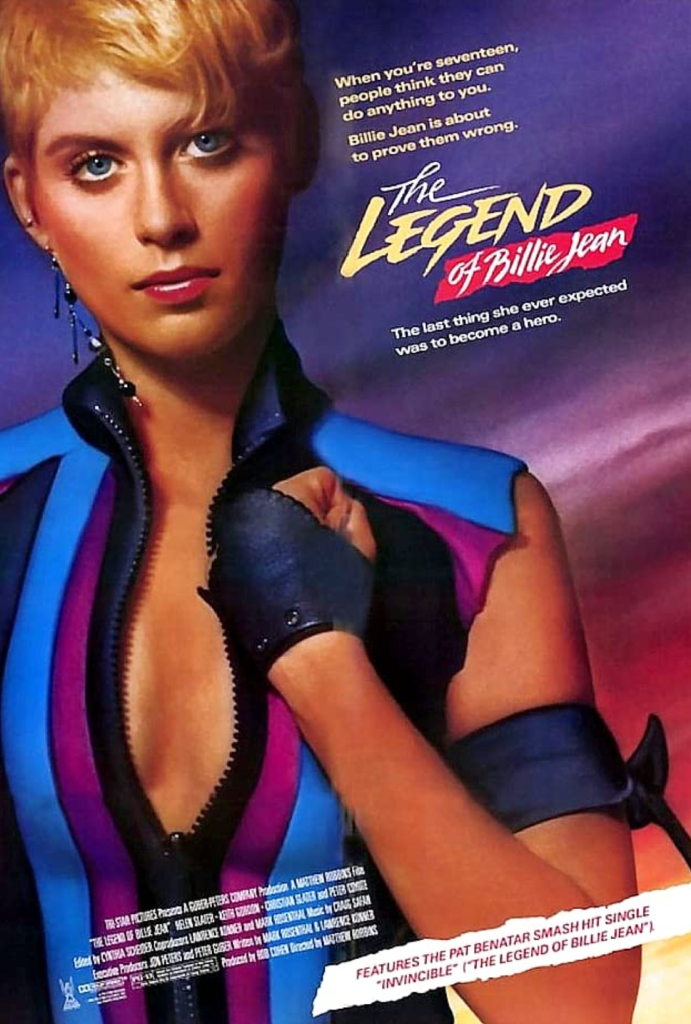
Image by Freepik

If you want to read the other articles associated with this double feature, I’ll provide the links here:

The 80s-tastic Mall-tacular Double Feature Introduction!

Take 3: Night of the Comet Review (80s-tastic Mall-tacular Double Feature Part 1)

Take 3: The Legend of Billie Jean Review (80s-tastic Mall-tacular Double Feature Part 2)

Take 3: The Legend of Billie Jean Review (80s-tastic Mall-tacular Double Feature Part 2)

Hello and welcome to the second part of the 80s-tastic Mall-tacular Double Feature! Before this review begins, I’d like to remind my readers there will be spoilers for The Legend of Billie Jean. If you’re interested, you can check out the double feature’s introduction and first part at these links:

The 80s-tastic Mall-tacular Double Feature Introduction!

Take 3: Night of the Comet Review (80s-tastic Mall-tacular Double Feature Part 1)

The Legend of Billie Jean poster created by Delphi III Productions, The Guber-Peters Company, and Tri-Star Pictures

1. How were you introduced to The Legend of Billie Jean?

Before I started watching Dan Bell’s Dead Mall series, I had heard of The Legend of Billie Jean. It wasn’t until I saw the video, ‘DEAD MALL SERIES : Tour of the SUNRISE MALL from THE LEGEND OF BILLIE JEAN (1985)’, that my interest in the film piqued. In this 2016 video, Dan uses clips from The Legend of Billie Jean to compare how Sunrise Mall looks in the 21st century. He even discusses the history of the mall itself.

2. As of 2022, what is the state of the Sunrise Mall?

The portions of the mall that were featured in Dan’s video permanently closed in 2019. Only three tenants are still standing, which are connected to the mall’s exterior.

3. What role did the Sunrise Mall play in The Legend of Billie Jean?

In The Legend of Billie Jean, the Sunrise Mall was called ‘Ocean Park Mall’. It was the place Billie Jean agreed to meet the police in order to accept the money. Prior to this arrangement, Billie Jean’s brother, Binx, had his scooter destroyed. Billie Jean and her friends turn to the police with little success. She even tries to acquire the money to repair Binx’s scooter. One thing leads to another, causing Billie Jean, Binx, and her friends to run from the law. When Billie Jean arrives at Ocean Park Mall, she thinks she’ll finally get the money. But those plans don’t work out, with a chase scene ensuing.

4. Why do you think the Sunrise Mall was in the film for a short amount of time?

The Legend of Billie Jean is an expansive narrative, similar to Night of the Comet. As I said in answer number three, Billie Jean, Binx, and her friends go on the run. Because of this, the characters are not going to stay in the same place for an extended period of time. Around the filming and release of The Legend of Billie Jean, the Sunrise Mall was a business that relied on daily revenue and foot traffic. Therefore, the mall could only allow filming to take place within a certain time period.

5. Besides including a mall and focusing on teenage characters, do The Legend of Billie Jean and Night of the Comet share a common theme, idea, or message?

Like I mentioned in answer number three, the film’s conflict started because Binx’s scooter was destroyed. After the scooter was stolen by a neighborhood bully named Hubie, Binx’s attempt to retrieve it resulted in him getting beaten up by Hubie and his friends. This is when Billie Jean decided more needed to be done to help her brother. Billie Jean and Binx reminded me of Regina and Samantha from Night of the Comet. Both pairs of siblings are prominently featured in their respective story, with each pair trying to make the best of a complicated situation. Throughout each film, both sibling pairs appear to get along well with each other, displaying a good sense of camaraderie.

Money image created by Freepik at freepik.com. <a href=’https://www.freepik.com/free-vector/bills-and-coins-in-isometric-design_1065328.htm’>Designed by Freepik</a>. <a href=”https://www.freepik.com/free-photos-vectors/business”>Business vector created by Freepik</a>. Image found at freepik.com.

6. Is there anything about The Legend of Billie Jean you liked or didn’t like?

A pleasant surprise while watching The Legend of Billie Jean was the discovery of mixed media! Throughout the film, voice-overs from a radio station were heard. A newspaper would appear in the story from time to time. Video footage of Billie Jean also made an appearance in the story. The inclusion of mixed media led to creative and interesting ways it was used in the movie. Radio station voice-overs featured calls from listeners, sharing their support for Billie Jean and her cause. Newspaper articles shared details to progress the story forward, from the health status of Hubie’s father to the identity of Lloyd. In an effort to clear her name, Billie Jean, Binx, and her friends create a video and give copies to the police and various tv stations. Mixed media allowed the movie to receive a unique and memorable identity!

The majority of this story focused on the conflict of how Billie Jean, Binx, and her friends would obtain the money to repair Binx’s scooter. Billie Jean received the most character development, as she is the titular character. While I thought the story was interesting and while I liked Billie Jean as a character, I wish some of the other characters had received more character development. Toward the beginning of the film, one of Billie Jean’s friends, Putter, is watching a female wrestling match on tv. When she learns of Billie Jean’s plan to report Binx’s stolen scooter, Putter eagerly looks forward to this excursion to the police station. As I was watching the movie, I was curious about Putter’s interest in going to the police station and watching wrestling on television.  Unfortunately, these parts of the story were not explained.

7. Did you develop any thoughts and/or questions while watching this film?

While I didn’t develop any questions, I did notice some interesting coincidences. During my viewing of The Legend of Billie Jean, I learned the movie was a “modern” Joan of Arc story. After Billie Jean, Binx, and her friends break into Lloyd’s house, Lloyd introduces them to the story of Joan of Arc. Billie Jean is so inspired by what Lloyd told her, she decides to cut her hair short to reflect Joan’s appearance. There’s even a parallel between Joan of Arc getting burned at the stake and a statue of Billie Jean getting burned in a fire toward the end of the movie. Now here’s where the interesting coincidences come in. Last year, I reviewed the Touched by an Angel episode, “The Spirit of Liberty Moon”. That episode was not only a “modern” Joan of Arc story, Bai Ling’s character was named Jean. Yes, I know the name, Jean, is Billie’s middle name. But according to Jean’s friend in “The Spirit of Liberty Moon”, Jean is the French version of Joan. Plus, I reviewed both the Touched by an Angel episode and The Legend of Billie Jean in October.

8. In your double feature for Rich Kids and Over the Edge, you discussed certain events from the ‘70s that likely influenced the creation of those films. Is there anything from the ‘80s that you think either affected The Legend of Billie Jean or teenagers from that time?

Imagine, once again, you’re a teenager in the 1980s. You have so much to be thankful for, from a family that loves and supports you to that new set of wheels you just got as a gift. But, sometimes, you think life can be a little unfair. On your way home from school, you see a homeless person on a street corner, asking for money or even a sandwich. A flyer appears in your family’s mailbox from time to time, asking for food bank donations. No matter how respectful you are to the homeless person on the street corner or how many donations you take to the food bank, you wonder if your efforts are enough to truly make a long-lasting impact. Then, you hear about an event called Hands Across America. Everyone is talking about it, from your next-door neighbor to the cashier at your local grocery store. There’s even an assembly at your school about the event. The more you think about Hands Across America, the more you realize there are other people that have the same thought as you do: try to make the world a better place than how you found it.

Hands Across America was not mentioned in The Legend of Billie Jean. In fact, the event took place a year after the film was released. But there was one scene that reminded me of this piece of ‘80s history. While Billie Jean, Binx, and her friends are on the run, a group of children ask for Billie Jean’s help. They lead her to a house where one of their friends is being physically abused by his father. The small group grows larger as Billie Jean makes her way to the house. Binx and Billie Jean’s friends eventually join the group, adding their support for Billie Jean’s mission. Now you’re probably wondering, “What does this scene have to do with Hands Across America”? Well, it’s the idea of people from all walks of life coming together to support a common goal. In the case of The Legend of Billie Jean, those children, plus Billie Jean, Binx, and her friends, shared the same idea: save the young boy from his abusive dad. Before Billie Jean succeeded in her rescue effort, the large group of children circled around the boy’s house, intimidating the boy’s father. The film itself, as well as Hands Across America, showed teenagers at that time there were other teens who shared their same goals and dreams.

9. A lot has changed since the release of The Legend of Billie Jean. Have you come across any recent pieces of media that prominently feature a mall?

After breaking into Lloyd’s house, Billie Jean discovers a room upstairs. In this room, there are Halloween masks, security monitors, even video equipment. The room itself could make any Halloween costume store jealous, with dim lighting, candles, and cobwebs adding to the room’s eerie atmosphere. Even the build-up to the room’s discovery was straight out of a horror movie, as a costumed Lloyd follows Billie Jean. Later in the film, it is discovered Lloyd is a member of his school’s drama club, explaining why the aforementioned room contained so many costumes.

The scene I just described reminded me of a Hallmark film titled hoops&yoyo’s Haunted Halloween. In this animated film, the protagonists, Hoops and Yoyo, along with their friend, Piddles, go Halloween costume shopping at their local mall. During their trip, they become locked inside the mall after hours. I’ve only seen pieces of this 2012 movie. But based on what I have seen, the film is more spooky than scary. However, I do think it’s an interesting coincidence how both hoops&yoyo’s Haunted Halloween and The Legend of Billie Jean feature a mall in their respective story.

10. After watching this movie, is there anything you can take away from your movie viewing experience?

Calling The Legend of Billie Jean a “mall movie” is, in my opinion, a bit of a stretch. Similar to Night of the Comet, the Sunrise Mall was featured in only a few scenes. If anything, The Legend of Billie Jean is a “coming of age” story, as Billie Jean, Binx, and her friends experience personal growth over the course of the film. I liked The Legend of Billie Jean more than Night of the Comet. The story in the 1985 movie was pretty straight forward, making the film easier to follow. It was also interesting how mixed media was incorporated into the story. The Legend of Billie Jean is a fine, competently made film, complete with its own merits and flaws. The film’s message of how “fair is fair” is just as relevant now as it was in 1985, allowing the movie to be a more timeless title.

Image by Freepik

Have fun at the mall!

Sally Silverscreen