Take 3: Jack and the Beanstalk (1952) Review

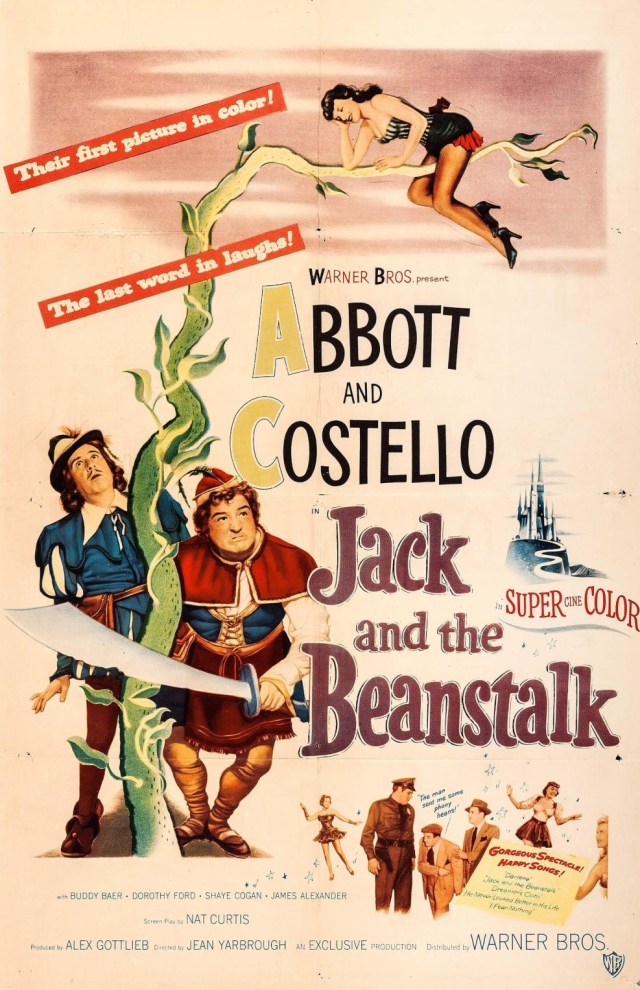
I need to make a confession: in the seven years 18 Cinema Lane has been around, I’ve never reviewed any of Abbott and Costello’s films. (insert shocked gasp here) But at 18 Cinema Lane, I am willing to expand my cinematic horizons. This is one of the reasons why I selected 1952’s Jack and the Beanstalk for the Once Upon A Time Blogathon. Another reason is how I don’t often get the opportunity to write about fantasy films. In fact, the last fantasy movie I reviewed was Cancel Christmas last December. When I came across the poster for Jack and the Beanstalk, I was surprised to read the tagline “Their first picture in color”! Abbott and Costello are household names in the world of comedy. Plus, this adaptation of the fairy tale was released thirteen years after The Wizard of Oz. So, is the movie worthy of such a historic milestone? Adventure through this review of Jack and the Beanstalk to find out!

Jack and the Beanstalk (1952) poster created by Exclusive Productions Inc., Legend Films, and Warner Bros.

Things I liked about the film:

The dialogue: Sometimes, a movie’s comedy will be woven into the dialogue. Words spoken between characters can not only be hilarious, but also clever and witty, especially if the screenwriting is strong. Dialogue was one of the best qualities of Jack and the Beanstalk! One example is from the beginning of the film. Arthur arrives at Eloise’s house to pick her up for play rehearsal. Her younger brother, Donald, answers the door, even setting up a trap that causes Arthur to fall. When Arthur asks Donald where Eloise is, Donald replies in a matter-of-fact manner, “putting on her lipstick so you can kiss off”. What makes this line so memorable is how it fits the character of Donald, who is portrayed as a precocious child. Another example happens during the ‘Jack and the Beanstalk’ story. Jack is heartbroken when his mother suggests they sell the family cow. After Jack’s mother urges him to take the cow to the market, Jack tells her, “Yes mother. You can depend on me. Whatever they bid, I’ll bid higher”. This is a line that is genuinely funny, as Jack says it with good intentions.

The use of color film: During the opening credits of Jack and the Beanstalk, it’s revealed parts of the film are presented in Super Cine Color. These parts are the ‘Jack and the Beanstalk’ story itself, while the “modern” parts of the movie are shown in black-and-white film. I actually liked this creative decision! It emphasized the magic and whimsy of the fairy tale. The use of color film also allowed the vibrant hues of the costume and set design to be visible. Overall, this production of Jack and the Beanstalk felt pleasantly reminiscent of 1939’s The Wizard of Oz!

Working as a pair: Bud Abbott and Lou Costello (also known as Abbott and Costello) have been acknowledged as one of the most beloved comedic duos in film history. So, I was curious how they would work together in Jack and the Beanstalk, since the heroic adventure typically involves only one character. Lou portrays Jack and Bud portrays Mr. Dinkelpuss (a local butcher). Even though both characters travel up the titular beanstalk, they each have their own motives. Mr. Dinkelpuss and Jack help each other escape The Giant’s castle as well. Through the acting performances and the screenwriting, this version of Jack and the Beanstalk feels like Jack was always meant to travel with a buddy.

Once Upon a Time Blogathon: Fairy Tales, Legends, & Myths banner created by Annette from Hometowns to Hollywood

What I didn’t like about the film:

Musical padding: The 1952 adaptation of Jack and the Beanstalk is a musical, with five musical numbers incorporated into the production. These numbers were very well choreographed and sounded good musically. However, they felt like padding, making the movie seem longer than its one hour and twenty-three-minute run-time. A few of the musical numbers feel drawn out, such as the almost three-minute dance between Jack and Polly. Had some of these numbers been trimmed down, the overall run-time could have been under an hour and twenty minutes.

Forgotten details: Within Jack and the Beanstalk’s script, there were a few forgotten details. Jack’s cow, Henry, presents two examples. When Henry is first brought up in the movie, Jack refers to the cow as female. He even puts makeup on her to stress this fact. But before Jack says goodbye to Henry at Mr. Dinkelpuss’ shop, Jack tells the cow to “be a good boy”. Later in the movie, Jack climbs the beanstalk. One of his intentions is to rescue Henry from the clutches of The Giant. When Jack and his friends finally escape The Giant’s castle, however, Polly is the one who ends up saving Henry.

Patrick the Harp: In The Giant’s castle resides a harp named Patrick. Not only does music play every time he talks, he’s also very critical of Polly. Personally, I was not a fan of Patrick. He spoke with a thick accent, which sometimes made it difficult to understand what he was saying. His role in the story was quite minimal, offering little to the plot. If Patrick had been written out of Jack and the Beanstalk, not much would change.

Fairytale castle image created by Freepik at freepik.com. <a href=’https://www.freepik.com/free-vector/fairy-tale-castle_837803.htm’>Designed by Freepik</a>. <a href=”https://www.freepik.com/free-photos-vectors/design”>Design vector created by Freepik</a>. Image found at freepik.com.

My overall impression:

As I mentioned in the introduction of my review, Abbott and Costello are household names in the world of comedy. However, there is a reason why they achieved this honor. Using Jack and the Beanstalk to explain my point, Costello and Abbott work together as a team. Even in a fairy tale where a team dynamic doesn’t exist, they find a way, through acting and screenwriting, to create a story where they can both shine. The dialogue was one of the strongest aspects of the 1952 adaptation, as it was hilariously clever. It also helps that the dialogue was written and delivered well. Even the use of color film enhanced the whimsical charm one would expect from a fairy tale. While Jack and the Beanstalk does have its flaws, it is, indeed, a pleasant presentation! Now, if you’ll excuse me, I need to figure out who really is on first.

Overall score: 7.4 out of 10

Have you seen 1952’s Jack and the Beanstalk? What other fairy tales would you have liked to see Abott and Costello star in? Tell me in the comment below!

Have fun at the movies!

Sally Silverscreen
Take 3: The Garage (1920) Review (Silent Pioneers Double Feature Part 1)

Before participating in the Silent Pioneers Blogathon, I had only seen, and even reviewed, four projects from Buster Keaton’s filmography. To, kind of, make up for lost time, I chose to review The Garage for the event. The other reason why I selected this movie was because it was recommended by Lea S. from Silent-ology. I will admit silent films are rarely covered on 18 Cinema Lane. In the seven years my blog has existed, I’ve only reviewed seven silent film titles. The last time I wrote about a silent picture was 1920’s Pollyanna back in 2021. So, reviewing another silent movie has been long overdue. So far, my experience with silent films has been pretty positive. But will that change with The Garage? Keep reading my review to find out!

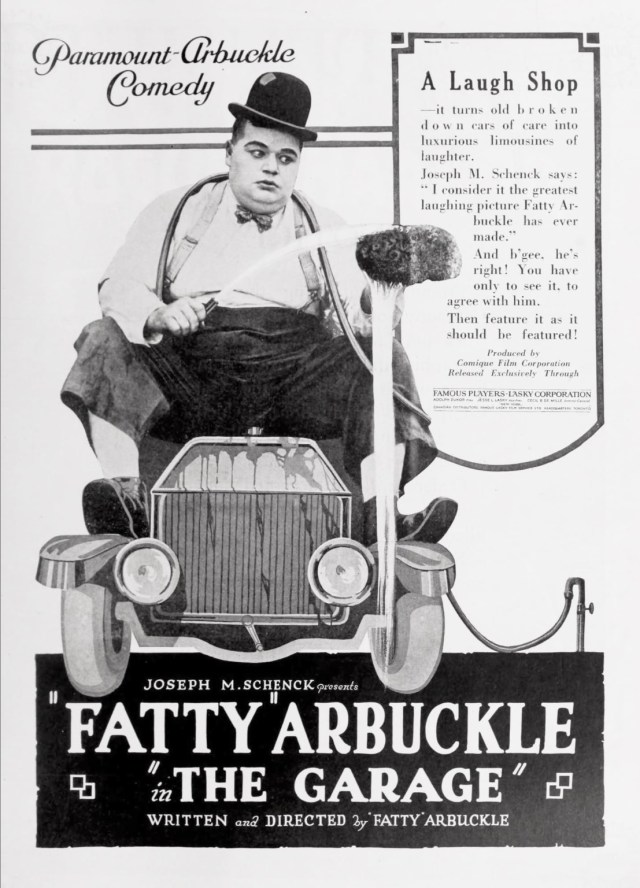
The Garage (1920) poster created by Comique Film Company and Paramount Pictures

Things I liked about the film:

The acting: In silent films, actors and actresses heavily rely on facial expressions, emotions, and body language to show what their characters are thinking and feeling. While on-screen text can help elaborate what is happening on screen, the way actresses and actors appear in a silent film can show what can’t be said. At the beginning of The Garage, Roscoe ‘Fatty’ Arbuckle is upset Buster Keaton made a car he just washed dirty. He gestured toward the spot of dirt on the car by repeatedly pointing toward it. Roscoe ‘Fatty’ Arbuckle even has a frown on his face, emphasizing how upset he is. Later in the film, Buster is chased by a dog. When he gets stuck in a fence, he appears scared as the dog is ripping up his pants. Fear is in Buster’s eyes as he looks to be screaming. Molly Malone is the only actress in The Garage. Any time she was included in a scene, she was just as expressive as her male co-stars! When Molly is first introduced in the story, she is so excited to see Jim. She is smiling the entire time, making her happiness clearly visible.

The slapstick comedy: When I reviewed The Twilight Zone episode, “Once Upon a Time”, I talked about a scene where Buster’s character, Woodrow, and a man named Rollo walk past a rack of suit pants. After Woodrow grabs a pair of pants, Rollo picks Woodrow up so he can put the pants on. When I saw this comedic trick in The Garage, I was happy to recognize it from The Twilight Zone! The trick was just as well performed in the movie as in the television episode! Another comedic trick utilized a piece of spinning floor. When Roscoe ‘Fatty’ Arbuckle walked on the spinning floor, he was able to effortlessly walk off the circle. But, when Buster got on the spinning floor, he stumbled and tumbled to the ground. The only way Buster could escape was when Roscoe ‘Fatty’ Arbuckle tumbled to the ground himself and pulled Buster to the circle’s edge. These two examples showcased the simplicity and creativity of The Garage’s slapstick comedy!

An overarching narrative: Earlier in this review, I brought up how excited Molly was to see Jim. This is because they are in a romantic relationship. In The Garage, Jim and Molly’s relationship served as an overarching narrative. It even intersected with the events taking place in and around the garage. For me, I looked forward to seeing what would happen next with Molly and Jim. The strong acting performances and nice on-screen chemistry kept me invested in their part of the story! There was also a sense of mystery to Jim and Molly’s relationship. A contributing factor was the couple experiencing situations as they took place in the film.

The Silent Pioneers Blogathon banner created by Maddy from Classic Film And TV Corner

What I didn’t like about the film:

Inconsistent slapstick comedy: The Garage consists of three separate stories: Roscoe ‘Fatty’ Arbuckle washing a customer’s car, Jim becoming covered in car grease, and the garage being set on fire. While there was plenty of slapstick comedy in the first and third stories, the slapstick comedy was limited in the second story. This is because so much of that story was focused on Jim and his relationship with Molly. Besides becoming dirty from car grease, Jim gets a dog to scare off Molly’s potential admirers. With everything I said, the emphasis on Jim and Molly’s relationship in the second story kind of overshadowed Roscoe ‘Fatty’ Arbuckle and Buster Keaton.

Tonally inappropriate music: Like I just said in this review, there are three stories in The Garage. The third story involves the garage being set on fire. During that story, cheery piano music can be heard in the background. Though this type of music plays throughout the movie, it felt tonally inappropriate in the third story. The reason is Jim and Molly’s lives being in danger, which raises the story’s stakes. Because the stakes are lower in the first and second stories, cheery music playing in the background makes sense.

A confusing timeline: So much is happening in The Garage due to the film consisting of three separate stories. In one story, customers either rent cars or have their cars washed. The residents from the garage’s neighborhood have a scheduled lunch-time. But the title-cards sprinkled throughout the film never clarify when events like the aforementioned two take place. Is The Garage set in a singular day or are the situations happening over an extended period of time? Had the title-cards mentioned when events were taking place, those title-cards could have provided transitions between stories.

Image of vintage movie camera created by Macrovector at freepik.com. <a href=”https://www.freepik.com/free-photos-vectors/background”>Background vector created by macrovector – http://www.freepik.com</a>. Image found at freepik.com.

My overall impression:

As I said in my review’s introduction, my experience with silent films has been pretty positive. This experience is, so far, remaining positive due to my thoughts on The Garage! For the most part, the 1920 picture is a fine, pleasant production. The strength of the acting and the creativity of the slapstick comedy led to an overall enjoyable time. I even liked how Molly and Jim’s relationship served as an overarching narrative. Even though the film itself was pleasant, it did contain some flaws. Without contextual information, I found the story’s timeline confusing. There was also one part of the movie where the music was tonally inappropriate. But like I said, I found The Garage a fine, pleasant title! This movie could be a good introduction to Buster Keaton’s filmography.

Overall score: 7.1 out of 10

Have you seen The Garage? Which film from Buster Keaton’s filmography would you like to see me review? Tell me in the comment section!

Have fun at the movies!

Sally Silverscreen
Take 3: The Reluctant Debutante Review

Out of all the decades covered on 18 Cinema Lane, the 1950s make such infrequent appearances. I did review the 1954 film, Dial M for Murder, last month. But my review before that was from last December, when I wrote about 1957’s The Curse of Frankenstein. This infrequency is one of the reasons why I’m reviewing the 1958 film, The Reluctant Debutante! Another reason is John Saxon’s involvement in the project. When I joined Realweegiemidget Reviews’ and Cinematic Catharsis’ blogathon, I wasn’t familiar with John Saxon as an actor. So, while exploring his filmography, I came across the 1958 movie. I was surprised to discover Angela Lansbury also starred in The Reluctant Debutante. Since I’ve seen few of Angela’s live-action films, there was yet another reason for me to review this production.

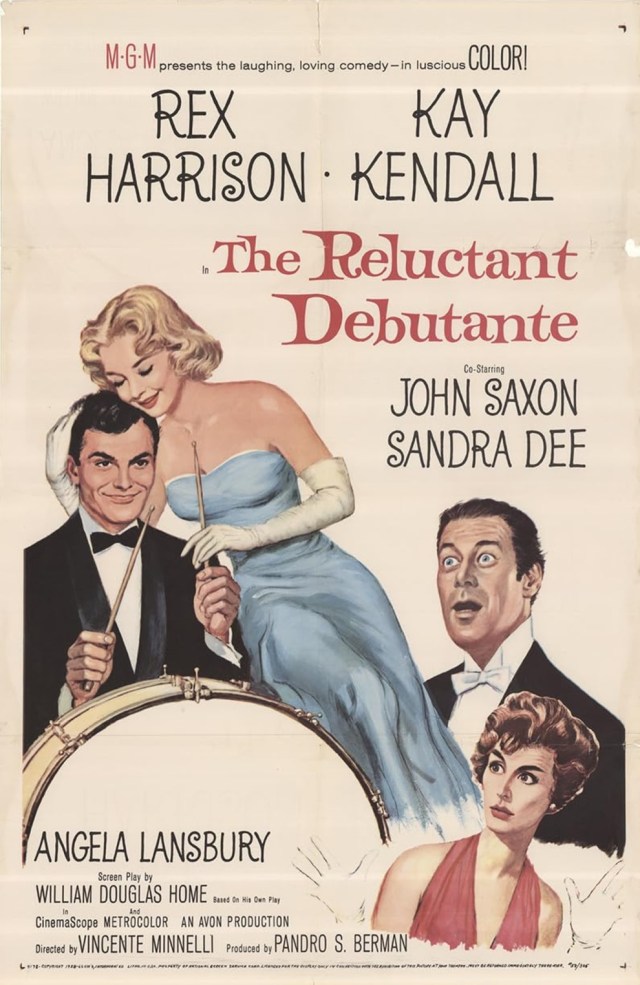
The Reluctant Debutante poster created by Avon Productions and Metro-Goldwyn-Mayer (MGM)

Things I liked about the film:

The acting: As I said in this review’s introduction, John Saxon is one of the reasons why I’m reviewing The Reluctant Debutante. Even though I wasn’t familiar with him as an actor, I liked his portrayal of David Parkson! Whenever he appeared in the movie, David always looked confident. Paired with that confidence was charisma, which helped David become such a memorable and likable character! What worked in John’s favor was the consistency of his performance. Having good on-screen camaraderie with Sandra Dee also worked in John’s favor. In the few scenes David and Jane, Sandra’s character, spent together, they appeared to get along so well. They also seemed to be on the same page when it came to several topics, such as the symbolism behind dancing and exploring the world. I, honestly, wish Sandra and John were given more appearances in The Reluctant Debutante because both of their performances were strong!

Like I also mentioned in this review’s introduction, Angela Lansbury’s involvement is another reason why I wrote about The Reluctant Debutante! Despite having limited appearances in the story, I really enjoyed watching Angela’s portrayal of Mabel Claremont! The best way I can describe this character is “the life of the party”. From the very first scene she appeared in, Mabel had such an exuberant personality. There was such a brightness to Mabel, I could understand why other characters might want to invite her to their events. Similar to John Saxon’s performance, Angela’s portrayal of Mabel was consistent. Mabel is another character I wish received more screen-time!

The on-screen chemistry: Rex Harrison and Kay Kendall portrayed Jane’s parents, Jimmy and Sheila, in The Reluctant Debutante. Shortly after these characters were introduced, I could immediately sense Kay and Rex’s on-screen chemistry! Throughout the story, Sheila and Jimmy’s marriage felt believable, like they were always meant to be together. When it came to the “debutante season”, Jimmy was the casual participant and Sheila became more involved in the process. Though they had their reasons for their “debutante season” beliefs, they still found a way to come together when it came to what was important, such as the well being of their daughter. Based on everything I said, Sheila and Jimmy displayed the “opposites attract” trope. With the strength of Kay and Rex’s acting abilities, both individually and together, this trope worked in Jimmy and Sheila’s favor!

The wardrobe: Debutante balls are known for showcasing exquisite fashion! When it came to the wardrobe department, The Reluctant Debutante did not disappoint! At a ball toward the beginning of the movie, Mabel wore a long-sleeved gown. This scoop-neck gown was covered in a lacy, deep-blue material, complimenting Angela’s light blonde hair. Adding extra sparkle was a large diamond necklace, a diamond tiara, and diamond earrings. One of my favorite dresses was Jane’s light-blue gown! Tiny bows found their place on the gown’s skirt. Sandra sometimes wore this dress with a light-blue satin cape and white gloves, which added elegance to the overall ensemble. Another outfit I liked is more casual in style. While at a restaurant with David Parkson, Jane wore a beige and brown plaid jumper dress over a beige blouse. Paired with this outfit was a khaki trench coat and a beige hat.

The John Saxon Blogathon banner created by Gill from Realweegiemidget Reviews and Barry from Cinematic Catharsis

What I didn’t like about the film:

A premise driven story: In the past, I’ve explained the difference between a premise driven and a plot driven story. In the case of The Reluctant Debutante, this story was premise driven. According to IMDB, the movie is about Jane and her parents participating in “Debutante season”. That part of the story was prioritized throughout the film. Taking a behind the scenes look at the debutante world is interesting. Halfway through the movie, though, I found myself asking, “Where’s the plot”? What The Reluctant Debutante was missing was a conflict, something to make the audience ask, “and then what happened”. This conflict could have ranged from Sheila and Jimmy organizing Jane’s debutante ball to Mabel convincing the Queen to continue the tradition of “debutante season”.

Drawn-out jokes: IMDB classifies The Reluctant Debutante as a comedy. Despite this label, I didn’t find myself laughing while watching the film. This weakness was due to the story’s jokes being drawn-out. A perfect example is how Sheila and Jimmy’s plans to overprotect Jane don’t go as expected. At one ball, Jimmy and Sheila are trying to find Jane. They race around the ballroom frantically looking for their daughter. Toward the end of the event, they discover Jane left with David Parkson. The very next scene revolves around Sheila and Jimmy worrying about Jane’s whereabouts, even going so far as to hiding in the kitchen and eavesdropping when Jane arrives home. I understand The Reluctant Debutante’s creative team was trying to tell a “comedy of errors” kind of story. In this movie, however, it took a long time for the errors to be resolved. In my aforementioned example, it took two whole scenes for Jane to be reunited with her parents. Watching The Reluctant Debutante felt like listening to a comedian spending too much time reaching their joke’s intended punchline.

Overlooked story ideas: While sightseeing in London, Mabel’s daughter, Clarissa, explains the “debutante season” to Jane. During this explanation, Clarissa tells Jane 1958 will be the last year for the “season” due to the Queen believing the practice outdated. Outside of Jane and Clarissa’s conversation, however, this detail isn’t brought up. Plus, none of the characters act as if the tradition of the “season” is ending anytime soon. I wish this part of the story had played a bigger role in The Reluctant Debutante. As I mentioned earlier in this review, it could have served as one of the story’s conflicts. It also would have given other characters, like Mabel and Clarissa, more involvement in the film.

Image of high school students dancing at prom created by Jan Sundstedt at freeimages.com. Photo by <a href=”/photographer/jansun-33414″>Jan Sundstedt</a> from <a href=”https://freeimages.com/”>FreeImages</a&gt;. Image found at freeimages.com.

My overall impression:

Movies from the 1950s are reviewed so infrequently on 18 Cinema Lane. So, when I find a film from the ‘50s to write about, I always root for that film to be good. With The Reluctant Debutante, however, I can’t say this movie is good. If anything, I was disappointed by it. The 1958 production was a premise driven story, a type of story that, in my opinion, contains less intrigue. The jokes lasted so long, it made the movie feel longer than one hour and thirty-four minutes. At one point, I almost fell asleep watching The Reluctant Debutante. Though I kept watching because the cast gave such strong performances. From Kay and Rex’s on-screen chemistry to Angela’s character being “the life of the party”, the acting was one of the few things I liked about the film. There’re even characters that should have received more screen-time, like David Parkson and Jane. During The Reluctant Debutante’s opening credits, I learned the movie was based on a play. What I also learned is how some plays were not meant to be adapted into a film.

Overall score: 5.5 out of 10

Have you seen The Reluctant Debutante? Which movie from the 1950s is your favorite? Let me know in the comment section!

Have fun at the movies!

Sally Silverscreen

Take 3: The Comedy of Terrors (1963) Review

In my review of the Diagnosis Murder episode, “Guardian Angel”, I mentioned how I’ve accepted movie recommendations from my readers. These recommendations have, sometimes, made great selections for blogathons. Four years ago, when I reviewed House of the Long Shadows, Patricia (from Caftan Woman) suggested several films starring Vincent Price. One of those titles was 1963’s The Comedy of Terrors. Since then, I have been waiting for the right time to create a review for this movie. With The Comedy of Terrors fitting the criteria for the 3rd Annual Spooky Classic Movie Blogathon, I knew I had found a perfect entry for the event!It’s become an unofficial tradition on 18 Cinema Lane to review at least one of Vincent’s movies every year. Since 2019, when I wrote about The Whales of August, eleven of Vincent’s films have received a review on my blog. While some of his movies have been more enjoyable than others, I can honestly say I haven’t seen a movie of his that I would consider “bad”. So, how does Comedy of Terrors compare to Vincent’s other films? Find out by reading my review!

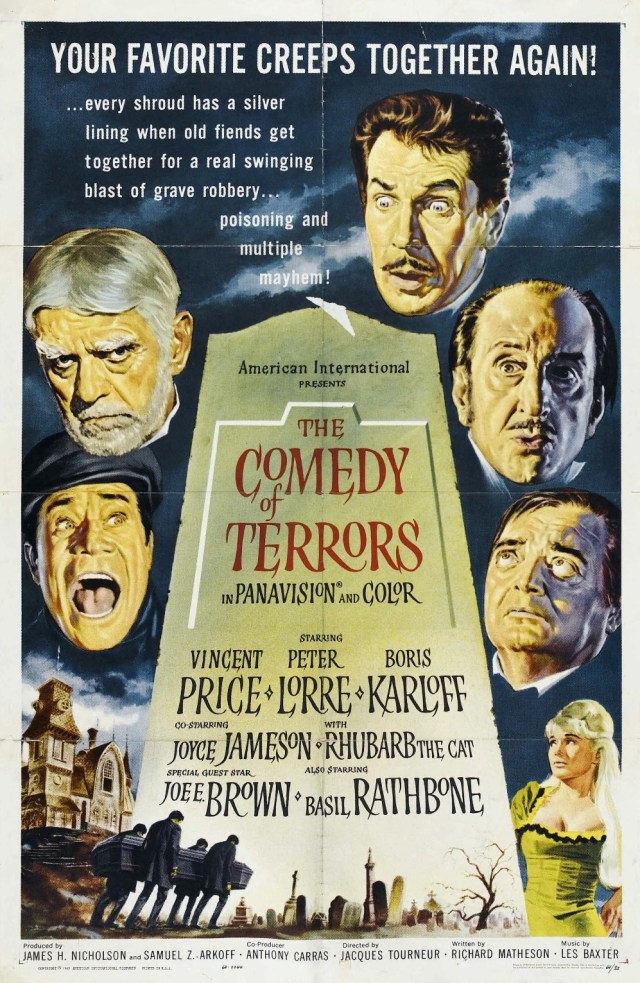
The Comedy of Terrors (1963) poster created by Alta Vista Productions and American International Pictures (AIP)

Things I liked about the film:

The acting: When you see Vincent Price’s name attached to a given film, there’s a chance you’re going to see Vincent give a solid acting performance. That was certainly the case in The Comedy of Terrors! What makes Vincent such a strong actor is his adaptability. Portraying an undertaker named Trumbull, Vincent successfully transformed his expressions and emotions based on his character’s situation. One evening, Trumbull was counting a large collection of coins. He displays a big smile on his face and also appears in a relaxed sitting position. When his wife, Amaryllis, comes into the room and asks him a question, Trumbull’s demeanor quickly changes. His sharp tone suggests deep irritation, with a disapproving frown to match. This change in attitude is consistent with Trumbull’s dislike for Amaryllis.

Prior to reviewing The Comedy of Terrors, I had seen two of Basil Rathbone’s movies; The Great Mouse Detective and Bathing Beauty. Because only one of these movies was a live-action production, I didn’t know what to expect from his portrayal of Mr. Black. However, I was impressed with Basil’s performance in The Comedy of Terrors! Some scenes show Mr. Black reciting one of Shakespeare’s plays. The first time the audience sees Mr. Black reciting Shakespeare’s work is when Felix (portrayed by Peter Lorre) breaks into Mr. Black’s home. In this particular scene, Mr. Black displays an animated demeanor throughout his reenactment. The way he confidently recited Shakespeare’s words gave this reenactment a sense of grandeur. Reflecting on Basil’s performance in The Comedy of Terrors and looking at his IMDB filmography, I wish he has starred in an adaptation of Shakespeare’s work.

An immersive world: A make-or-break factor of any movie is how that picture is presented. For period/historical fiction films, the accuracy and attention to detail can help that movie’s world feel immersive. Because The Comedy of Terrors takes place during the Victorian era, everything in the film has to appear accordingly. This was achieved in the 1963 film, as the aforementioned elements of attention to detail and accuracy were applied! When I talked about Vincent’s performance, I mentioned Trumbull was an undertaker. An ornate coffin was presented any time Trumbull hosted a funeral. The shiny, black coffin was constructed by sharp angles and was decorated with gold designs. This prop was a simple, yet visually appealing way of addressing the wealth of Trumbull’s clientele. One scene shows Trumbull and Felix breaking into someone’s home. Without meeting the homeowner, the audience can tell how this character lives a comfortable life. Decorative lamps and wall sconces are included in characters’ bedrooms. A series of statues make a strong appearance when Felix and Trumbull first walk into the house. There is even gold trim on one of the doors. From the set design to the costume design, the world within The Comedy of Terrors was immersive!

Peter Lorre and Joyce Jameson’s on-screen chemistry: Earlier in my review, I said Felix was portrayed by Peter Lorre. I also stated how Trumbull doesn’t like Amaryllis (portrayed by Joyce Jameson). Amaryllis is hurt by Trumbull’s negativity toward her. Meanwhile, Felix is upset by how Amaryllis is treated by Trumbull. The shared dislike Felix and Amaryllis have toward Trumbull create an affection for one another. Though they shared only a few scenes together, I was pleasantly surprised by Joyce and Peter’s on-screen chemistry! The warm, caring demeanor between Felix and Amaryllis came across as believable. This was made possible by the strength of Joyce’s and Peter’s performance. With that said, I think Peter and Joyce not receiving more scenes together was a missed opportunity.

The 3rd Annual Spooky Classic Movie Blogathon banner created by Kristen from Hoofers and Honeys

What I didn’t like about the film:

Jokes that are too long: Comedy, like film, is subjective. One aspect to this subjectivity is the length of the jokes. In my opinion, the jokes in The Comedy of Terrors were too long. It seems like the screenwriters had difficulty finding their intended punchline or realizing they reached their punchline long ago. A running joke in The Comedy of Terrors is how Amaryllis is a terrible singer, despite her claims of a possible opera career. Had she sung a portion of a song once or twice, it would have been enough to get the intended point across. But the fact Amaryllis almost sang whole songs three or four times caused the joke to last too long and quickly become old.

Parts of the story that don’t make sense: I mentioned earlier in this review how Felix broke into Mr. Black’s home. To get into Mr. Black’s house, Felix had to climb onto the roof and into an upstairs window. But during this excursion, a cat named Cleopatra joins Felix and Trumbull, watching Felix trespass into Mr. Black’s property. It’s explained in the film why Felix needed to find an alternative entrance. What isn’t explained is why Cleopatra didn’t enter the house. I’m not sure how Cleopatra could have assisted Trumbull and Felix. However, it would have been easier for a cat to climb on a roof and enter through a window. This is just one part of the story that, to me, didn’t make sense.

An underutilized cat: In past reviews, I have been critical when an actor or actress was underutilized. But in the case of The Comedy of Terrors, the creative team underutilized a cat. As I mentioned in my point about parts of the story that don’t make sense, a cat named Cleopatra joined Trumbull and Felix on their excursion. Even though Cleopatra was adorable, the cat was not a significant part of the overall story. There were even times when I wondered why a cat was included in the movie at all. Had Cleopatra been written out of The Comedy of Terrors, the story itself would not change much.

Orange cat image created by Freestockcenter at freepik.com. <a href=’https://www.freepik.com/free-photo/ginger-cat_883376.htm’>Designed by Freestockcenter</a>. <a href=”https://www.freepik.com/free-photos-vectors/gold”>Gold image created by Freestockcenter – Freepik.com</a>. Image found at freepik.com.

My overall impression:

In this review’s introduction, I said I haven’t seen a movie of Vincent Price’s that I would consider “bad”. While this statement is still true, The Comedy of Terrors is one of his weaker pictures. The flaws of the 1963 production include jokes that are too long and parts of the story that don’t make sense. But there are aspects of the movie I liked. The Comedy of Terrors is an immersive film, making viewers feel transported to the Victorian era. Attention to detail and historical accuracy helped the creative team achieve that illusion. Vincent’s performance was one of the strongest parts of this film! His adaptability made his portrayal of Trumbull captivating to watch. Now that I’ve finally seen The Comedy of Terrors, I can, honestly, say this picture emphasizes style more than substance. Out of Vincent’s eleven movies I’ve seen, this one is just ok.

Overall score: 6.1 out of 10

Have you seen The Comedy of Terrors? Which film of Vincent Price’s should I review next? Please tell me in the comment section below!

Have fun at the movies!

Sally Silverscreen

Take 3: The Raven (1963) Review

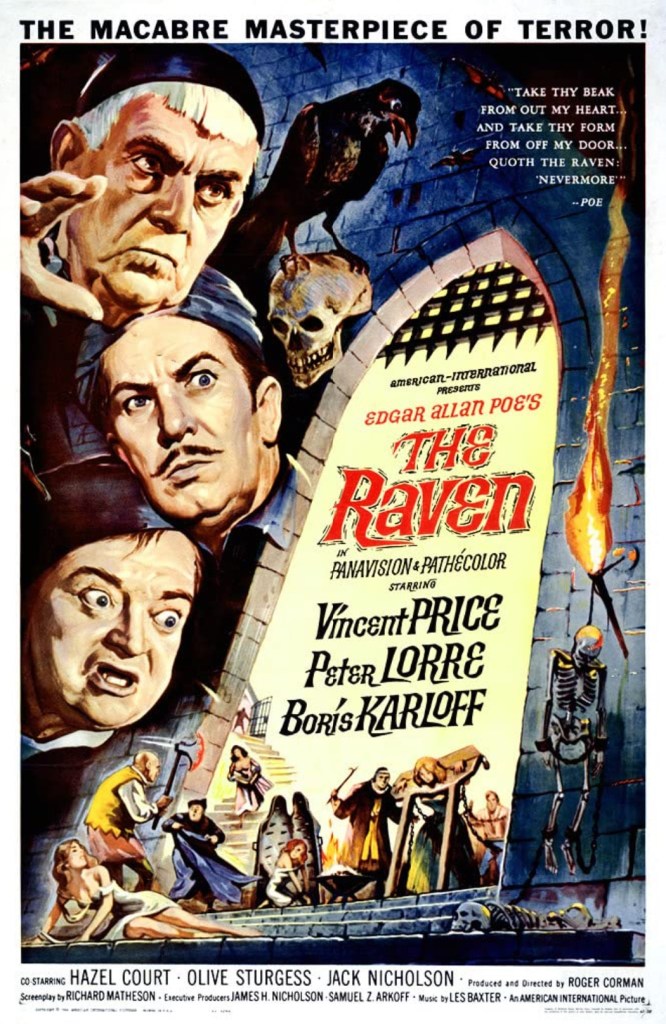
April Fool’s Day; a time for jokes, pranks, and laughter. On such a day, a comedic film would be most appropriate. Therefore, it’s time to introduce my selection for The ‘Favorite Stars in B movies’ Blogathon: 1963’s The Raven! Recommended by the late Patricia from Caftan Woman, I discovered this particular title was considered a “B movie” while searching for the perfect movie to write about. It just so happens to star an actor that is no stranger to 18 Cinema Lane; Vincent Price! The Raven is the tenth film of Vincent’s I have seen and reviewed. Most of his projects I have enjoyed to various degrees. But how will the 1963 title turn out? Don’t fly away from this review, as the review is about to begin!

The Raven (1963) poster created by Alta Vista Productions and American International Pictures

Things I liked about the film:

Interactions between characters: When creating a movie, it’s important to cast actors and actresses who not only perform well individually, but also within a group. If the quality among the cast is strong, the interactions between their characters will appear realistic to the audience. This is the impression I received as I watched The Raven. Scenes shared by Vincent Price and Peter Lorre serve as one great example. In one scene, Vincent’s character, Dr. Erasmus Craven, has attempted to reverse the spell placed on Dr. Adolphus Bedlo, Peter Lorre’s character. Unfortunately, Craven’s attempt doesn’t go according to plan. Bedlo is distraught at having wings for arms. His face bears a frown, eyes filled with a sad look. With disdain and concern is his voice, Bedlo is afraid the spell’s effects will be permanent. Meanwhile, Craven bears a look of concern on his face. But with a worried look in his eyes, Craven appears to care about the well-being of his friend. Through interactions like the one I described, Craven and Bedlo’s friendship felt believable. That was made possible with a combination of screen-writing and the performances of Vincent and Peter!

The humor: I knew The Raven was classified as a “horror-comedy” before I watched it. However, I was surprised by how the comedy was incorporated into the story! The humor in The Raven was mostly found within the dialogue. But the movie’s climax is where the humor really shines! In this scene, Craven and Dr. Scarabus, portrayed by Boris Karloff, participate in a magical duel. When it was Craven’s turn to use his magic, his responses to Scarabus became sillier as the duel continued. I won’t spoil this part of the story, for readers who haven’t seen this movie yet. All I will say is the humor was so well executed, I burst out laughing on numerous occasions.

Following the characters’ journey: The Raven is about Craven and his friend, Bedlo, traveling to Scarabus’ castle to reclaim Bedlo’s magic and save the spirit of Craven’s late wife, Lenore. As the story unfolds, the audience witnesses the steps Bedlo and Craven take in order to make the trip a reality. Seeing this step-by-step process allows viewers to feel like they are traveling alongside the characters. That creative decision adds interactivity to the story!

The ‘Favorite Stars in B movies’ Blogathon banner created by Brian from The Films from Beyond the Time Barrier

What I didn’t like about the film:

Inconsistent parts of the story: Within the The Raven, there were times when parts of the story were inconsistent. In one example, Craven and Bedlo need hair from a dead man. So, they take some hair from Craven’s deceased father. In order to open the casket of Craven’s father, Craven uses a knife to pry open the casket’s lid. A few scenes later, when Bedlo and Craven want to open Lenore’s casket, they are easily able to lift the lid. While these inconsistencies were not a common flaw, I believe this issue could have been avoided.

A drawn-out first half: As I already mentioned in this review, I liked how the characters’ journey allowed the audience to feel like they were traveling alongside the characters. But because of the movie’s hour and twenty-six-minute run-time, this journey was drawn out. Within the story’s first half, the sense of urgency was limited. There was also a small conflict that prolonged the journey. With those flaws addressed, it makes me wonder if this story would have worked better as a short film?

A random plot twist: For this part of my review, I will spoil a plot twist in The Raven. If you are interested in watching this movie, but have not seen it yet, please skip ahead to the section titled ‘My overall impression’.

While spending the night at Scarabus’ castle, Bedlo helps Scarabus trap Craven, his daughter, Estelle, and Bedlo’s son, Rexford. After Scarabus and Bedlo succeed, Bedlo confesses he tricked Craven into coming to Scarabus’ castle, in order to gain more magic from Scarabus. While this plot twist was unexpected, it felt random. There was no indication Bedlo would be that under-handed. Plus, this plot twist came right after another plot twist had been revealed. In my opinion, the plot twist involving Bedlo felt like it was included in the story just for the sake of it.

Image of crow at sunset created by Rayudu NVS at freeimages.com. Photo by <a href=”/photographer/rayudu238-57835″>rayudu NVS</a> from <a href=”https://freeimages.com/”>FreeImages</a&gt;. Image found at freeimages.com.

My overall impression:

As of early April, 2023, I have seen two Corman productions based on the works of Edgar Allan Poe; The Pit and the Pendulum and The Raven. A sense of wonder exudes from these two movies. What I mean by this is, I am amazed by how these creative teams were able to take simple stories and turn them into feature films! While I liked The Raven, I still prefer The Pit and the Pendulum. This is because of the movie’s flaws, such as the drawn-out first half and the random plot twist. However, there were strengths in The Raven, like the interactions between characters and the humor. I’m aware of Vincent Price’s other movies based on Edgar’s work. I’ll have to check those out another day!

Overall score: 7.3 out of 10

Have you seen or read The Raven? Are there any adaptations of Edgar Allan Poe’s work you’d like me to review? Let me know in the comment section below!

Have fun on April Fool’s Day!

Sally Silverscreen

Take 3: Easy to Wed Review

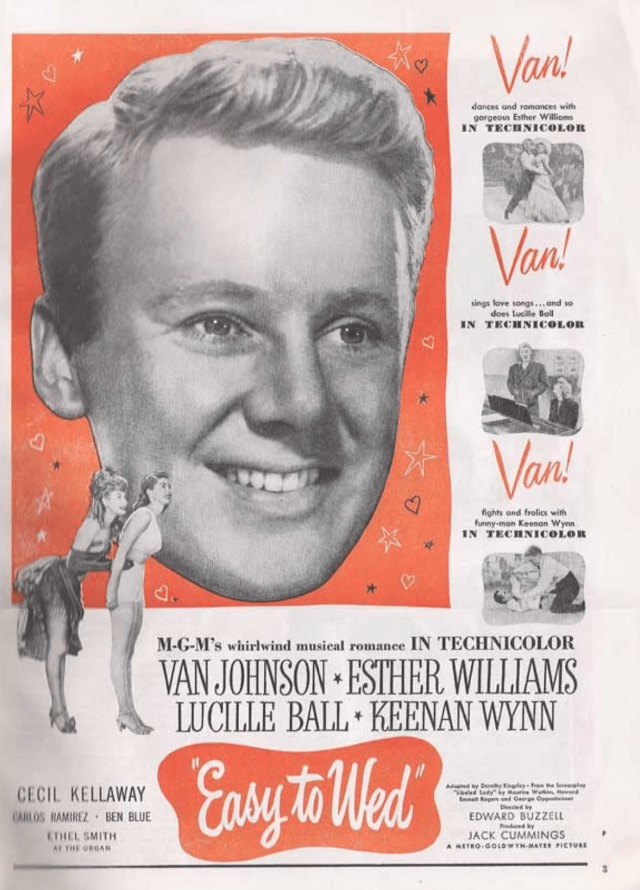
As the dawn of August arrives, so does the Esther Williams blogathon! Like last year, I have decided to review another movie from Esther’s filmography. But this time, I selected the 1946 title, Easy to Wed! Similar to the previous year, Easy to Wed was recommended to me. However, this film was suggested by a reader named Becky. That’s not the only reason why I’m reviewing the movie. I’m also participating in The Sixth Van Johnson Blogathon. Since Van happens to star in Easy to Wed, this is a good segue to that event. In the 1946 film, the characters’ trip to Mexico contained the “summer vibes” one would expect from the season. This is an interesting coincidence, as the movie I’m reviewing for the Van Johnson Blogathon is In The Good Old Summertime! My readers will have to wait a little while for that review. For now, though, it’s time to talk about Easy to Wed!

Easy to Wed poster created by Metro-Goldwyn-Mayer and Loew’s Inc.

Things I liked about the film:

The acting: In Easy to Wed, Esther portrayed Connie, a socialite who is wrongly accused of stealing another woman’s husband. Before she meets Van’s character, Bill, the employees at the New York newspaper that accused Connie label her as “spoiled” and “arrogant”. But when Bill meets Connie, he, and the audience, sees she is the complete opposite. In fact, Esther’s on-screen personality was very sweet! I enjoyed watching Connie and Bill’s interactions. The gentle sweetness of Connie’s personality and the charming yet cunning personality of Bill worked, as opposites attracted. Connie’s wittiness also helped this relationship’s favor. One of my favorite scenes is when Bill is riding on an inflatable raft in Connie’s pool. In an attempt to get him to join her in the pool, Connie tries to deflate the raft. Since she wants to catch Bill off guard, she deflates the raft with her foot during their conversation. Not only do Esther’s and Van’s acting abilities add to this on-screen relationship, so does their on-screen chemistry!

When it comes to Lucille Ball’s filmography, I’ve, so far, stuck with I Love Lucy. Therefore, I had an idea of what to expect in her portrayal of Gladys, the fiancé of Warren. Expectations aside, Lucille’s performance was enjoyable to watch! Not only did she work well with the other cast members, she used comedy to her advantage. During Bill’s stay in Mexico, he learns how to use a duck call whistle. While attempting to make a duck call, Gladys opens the door to Bill’s main sitting room and loudly yells “Happy New Year”. Personally, I found this scene hilarious, as the moment itself was unexpected. Speaking of Warren, let’s talk about Keenan Wynn’s performance. His portrayal reminded me of a more dramatic version of “Rooster” from the 1982 adaptation of Annie. What I mean by that is Warren was a cunning man who had a way with words. Another scene I liked was when Warren visited Bill about the newspaper’s libel suit. Because of how cunning both Warren and Bill are, they went toe-to-toe with each other, never missing a beat. What also helped was the quality of both Van’s and Keenan’s talents!

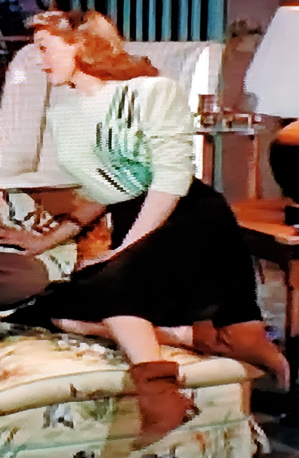
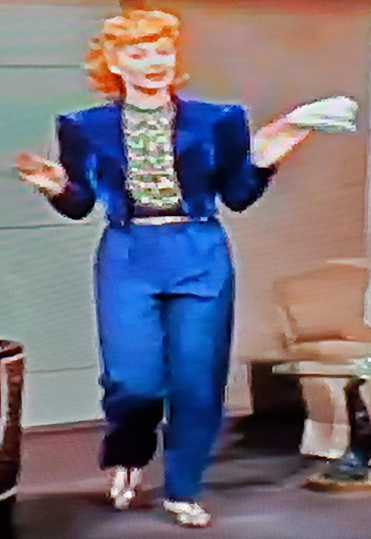
Lucille’s and Esther’s wardrobe: I loved Lucille’s and Esther’s wardrobe in Easy to Wed! However, there were three outfits that absolutely stole the show! Lucille wore the first outfit in the aforementioned duck call scene. A shiny gold top was covered by a velvety blue suit jacket. Deep blue slacks match the jacket, with the outfit complimented by shiny gold shoes. The blue and gold color palette paired beautifully with Lucille’s red hair and blue eyes! During a hunting trip, Connie wore fishing boots over a pair of black pants. A gray turtleneck shirt is under a red and orange plaid jacket. Finished with a maroon cap, the outfit is a classy ensemble that reminded me of the fall season. A few scenes later, Esther wore a light green sweater with cattails on them. A medium length black skirt compliments the cattails on the sweater, as well as Esther’s headband. A pair of brown boots helps pull off a look that would look great during fall or winter.

The “Boneca de Pixe” musical number: Toward the end of Easy to Wed, Connie and Bill perform in a musical number at a party. This number reflected their time together in Mexico. Both Esther and Van sung in Portuguese, dancing alongside each other and a large ensemble of dancers. The dancers’ costumes are so vibrant and colorful, boasting shades of red, yellow, and green. A small orchestra provided the sound, teaming up with Ethel Smith on the organ. Leading into this musical number, Ethel performed an organ solo that was fun to watch! This solo added the energy and excitement this piece needed. Overall, this number made me wish Easy to Wed was a musical.

The Third Esther Williams Blogathon banner created by by Michaela from Love Letters to Old Hollywood

What I didn’t like about the film:

A drawn-out conflict: Easy to Wed’s conflict revolves around Warren and Bill’s plan to prevent the libel suit from going to court. While it was interesting to see this plan unfold, it was drawn out for most of the story. In fact, this conflict was drawn out for so long, its resolution was delivered in a rapid-fire style within the last ten minutes of the movie. Had this script been a little bit tighter, the resolution’s delivery could have been more satisfying.

An inconsistent use of music: As I’ve said before, music can elevate the mood or tone of a given scene. It can also help make a scene more memorable. The film’s first half featured less music than its second half. Because of this, the memorability of some scenes was weaker. One example is when Bill is hosting a dinner party in his hotel’s sitting room. If music had been playing in the background, it would have heightened the anticipation of Connie’s arrival. The accompanying melody would highlight the growing feelings Bill and Connie have for one another as well. Instead, the scene felt mundane, slogging along to the next part in the story.

No subplots: Like I already mentioned, the conflict in Easy to Wed was drawn out for most of the movie. There are no subplots in this film, as the script focuses on the aforementioned conflict. Personally, I wish the story received a subplot. It would have given the audience additional intrigue to carry them through the film. The newspaper’s photographer could have formed a romantic relationship with the female organist. Maybe his camera goes missing and he has to find it. To me, the lack of subplots felt like a missed opportunity.

Since I loved the outfits described in this review, I decided to share screenshots of them, so my readers could see how great these outfits are! Screenshot taken by me, Sally Silverscreen.
Screenshot taken by me, Sally Silverscreen.

My overall impression:

In my opinion, Easy to Wed is a mixed bag. On the one hand, there are things about the movie I liked. The acting was strong, the “Boneca de Pixe” musical number was great, and I loved Lucille’s and Esther’s wardrobe. On the other hand, the script could have been stronger. Tighter writing might have helped the conflict reach a satisfying resolution. The conflict could have also been paired with at least one subplot. As I watched Easy to Wed, I was reminded of another movie with a drawn-out conflict: Anchors Aweigh. Because that movie’s musical numbers were more consistent, the audience had something to occupy their time until the conflict could be resolved. As I mentioned in this review, the music was inconsistent in Easy to Wed. Therefore, parts of the story felt longer than necessary. So far, I’ve seen three of Esther Williams’ films. Out of those titles, Easy to Wed is my least favorite. Hopefully, the next picture of Esther’s I watch will be better.

Overall score: 6.1 out of 10

Have you seen any of the Esther Williams’ films? Are you looking forward to my review of In The Good Old Summertime? Let me know in the comment section!

Have fun at the movies!

Sally Silverscreen

Take 3: The Princess and the Pirate Review + 435 Follower Thank You

Originally, I was going to review The Princess and the Pirate for The Metzinger Sisters’ MGM Blogathon. This is because my DVD copy of the film features the MGM logo on the cover and the film was released in 1944. However, The Metzinger Sisters informed me that the movie was not an MGM picture. Even Wikipedia claimed it was an RKO Radio Pictures production. Confused by this, I chose to review The Princess and the Pirate as my next Blog Follower Dedication Review instead. Bob Hope is a comedian I have heard of over the years. But, up until this point, I had never seen any of his films. Meanwhile, pirate themed movies are no stranger to 18 Cinema Lane. As of late June 2022, I have reviewed Captain Sabertooth and the Treasure of Lama Rama and China Seas. While I found China Seas to be just ok, I was disappointed by Captain Sabertooth and the Treasure of Lama Rama. What do I think of The Princess and the Pirate? Get ready to set sail as we start this review!

Here is a picture of my DVD copy of The Princess and the Pirate. Screenshot taken by me, Sally Silverscreen.

Things I liked about the film:

The acting: As I said in the introduction, Bob Hope is a comedian I have heard of before. But because I had never seen his movies, I didn’t know what to expect. While watching The Princess and the Pirate, I found Bob’s portrayal of Sylvester pleasant to watch! His expressions, emotions, and body language were fluid, allowing Bob to adapt to any on-screen situation. Bob’s impersonations were also a memorable component to his performance. Among the silliness and humor, Bob also showed a romantic side. In a scene where Sylvester and Margaret are sailing in a boat, he learns more about Margaret’s identity. During their conversation, Sylvester’s demeanor is softer, lowering his guard. This sweetness in Bob’s character was nice to see, as it showed how multi-layered Sylvester was!

Virginia Mayo portrayed Princess Margaret. As I watched this movie, her performance reminded me of Elizabeth Swann from the Pirates of the Caribbean trilogy. This is because she wasn’t afraid to stand her ground and help save the day. Margaret encouraging Sylvester to be brave during an on-deck battle is one example. What made Margaret different from Elizabeth is how, like Bob, Virginia showed a romantic side. Her performance of ‘Kiss Me in the Moonlight’ showcases this well. Even though the singing was performed by Louanne Hogan, Margaret’s facial expressions and body movements embodied the feminine songstress that appeared in musicals of the time of the movie’s release. Virginia’s portrayal prevented her character from becoming one dimensional!

One aspect of The Princess and the Pirate I liked was how the film made fun of status quos in the world of pirate films. The character of Featherhead is one example of this. Portrayed by Walter Brennan, this pirate is seen by his peers as being “dumb”. However, Featherhead’s interactions with Sylvester goes against that aforementioned claim. Walter’s performance was consistent and went toe-to-toe with Bob’s talents. While Featherhead is a more comedic character, he was more than being the film’s “comic relief”. Walter’s talents allowed his character to be memorable. Featherhead also helped progress the plot forward.

The humor: At the beginning of the movie, on-screen text explains who a pirate named The Hook is and what his mission will be. During this collection of text, Bob Hope breaks the fourth wall by explaining how he’s not portraying the character of The Hook. I found this part of the movie hilarious because of its unexpected nature! At one point in the story, Sylvester swims in a bathing pool with a character named La Roche. During this scene, Sylvester is hiding a secret he doesn’t want La Roche to discover. So, while in the pool, Sylvester quickly pops in and out of the water so La Roche doesn’t see him. Because of the scene’s consistency and because of the scene’s length, it was, in my opinion, funny!

The costume design: In the pirate films I’ve seen, costume design seems to have been a top priority. The combination of historical accuracy and design detail have created costumes that were exquisite and aesthetically pleasing. Throughout The Princess and the Pirate, I loved Virginia’s wardrobe! Each dress boasted a pastel palette, from a coral and teal gown Margaret wore on the Mary Ann to a pink and purple dress she was seen wearing toward the end of the film. This pastel palette also complimented Virginia’s hair color and skin tone. While at La Roche’s house, Sylvester wore a fancy suit. The suit jacket’s primary colors were white and fuchsia, a costume piece boasting a bright, fun palette. Embroidered flowers covered the jacket, which added beauty to the piece. Like the other pirate films I’ve watched, it looks like the costume design in The Princess and the Pirate was a top priority as well!

Princess tiara image created by Freepik at freepik.com. <a href=’https://www.freepik.com/free-vector/ornamental-princess-crowns_1109199.htm’>Designed by Freepik</a>. <a href=”https://www.freepik.com/free-photos-vectors/gold”>Gold vector created by Freepik</a>. Image found at freepik.com.

What I didn’t like about the film:

The island of Casarouge: In The Princess and the Pirate, Sylvester and Margaret go to the island of Casarouge, which is inhabited by pirates. Personally, this location didn’t sit well with me. Throughout Margaret and Sylvester’s time on Casarouge, the pirates’ actions and behavior are unsavory. Acts like murder, thief, and even drunkenness are on full display. I know not every fictional pirate is as friendly as Captain Jack Sparrow. I’m also aware The Princess and the Pirate was released during the Breen Code era, a time where the inhabitants’ choices would not be celebrated or glorified on film. In fact, while on Casarouge, Sylvester questions everything taking place around him. But The Princess and the Pirate has a, mostly, light-hearted tone, with some situations being played up for laughs. Because of these factors, the actions and behaviors of Casarouge should have been toned down.

The Hook’s buried treasure: When The Hook is first introduced in The Princess and the Pirate, he and his crew were seen burying a chest full of treasure. Throughout the film, a subplot involved searching for a treasure map. Without spoiling the movie, I will say the aforementioned treasure was never physically brought up again in the story. More emphasis was placed on finding the map than reclaiming the treasure chest. This made me wonder why the film’s creative team would include this in their story if they had no intention to follow through on it?

A confusing time period: While watching The Princess and the Pirate, the costume and set designs felt reminiscent of the Pirates of the Caribbean trilogy. This led me to believe the story was taking place in the 1700s. Yet Bob Hope’s dialog mentioned things that came to be after the presented time period. When crossing paths with The Hook, Sylvester claims the pirate’s hook would make a great beer can opener. However, I know beer cans did not exist until the 18th century had concluded. I’m not sure if these references were the result of Bob Hope’s comedy or the screenwriters wanting the dialog to be more reflective of the time of the movie’s release. No matter the reason, I found it confusing.

Paper Boats in the Sea image created by Freepik at freepik.com. <a href=’https://www.freepik.com/free-vector/background-of-paper-boats-with-hand-drawn-waves_1189898.htm’>Designed by Freepik</a>. <a href=”https://www.freepik.com/free-photos-vectors/background”>Background vector created by Freepik</a>. Image found at freepik.com.

My overall impression:

The Princess and the Pirate is a movie I’ve been meaning to review. Ever since I acquired my DVD copy of the film, I have been trying to find the perfect opportunity to write about it. Thanks to you, my followers, that time has come! Thank you for taking the time to read what I have to say and for paying 18 Cinema Lane a visit! Your interest in my blog means a lot to me. Now, on to my overall impression of The Princess and the Pirate. There are pirate stories that are stronger than this one. But, for it was, I enjoyed the 1944 movie! While I won’t give anything away, I want to mention there is a “bait and switch” ending. But because The Princess and the Pirate made fun of status quos in pirate films, this type of ending worked. What also worked was the acting and the humor. Since this was my first time watching any of Bob Hope’s films, I found this to be a good introduction to his filmography. In the future, I’d like to check out more of his movies.

Overall score: 7.6 out of 10

Have you seen any of Bob Hope’s movies? If so, which ones would you recommend? Let me know in the comment section below!

Have fun at the movies!

Sally Silverscreen

Take 3: Harvey (1950) Review

This month’s Genre Grandeur is one I have been anticipating! That’s because of the film I selected for the event! January’s theme is ‘Comedies that feature characters who are either Stoners or Drunk’. After doing some research on the internet, I discovered the 1950 movie, Harvey, would be eligible! Harvey is a film I have been wanting to see for several years. Led by the beloved James “Jimmy” Stewart, so many good things have been said about this film. I was also interested in seeing Harvey because of its release date. Recently, I read an editorial by Jillian Atchley titled ‘It’s A Wonderful Life, James Stewart, and George Bailey’. In the article, Jillian explains there are two kinds of James Stewart films; pre-war and post-war. The post-war films, such as It’s A Wonderful Life, contain depth. I’d also add the post-war films feature higher stakes. Since Harvey was released four years after It’s A Wonderful Life, I was curious to see how deep this story would go. I also wanted to see how James would approach a character who is friends with an imaginary rabbit.

Harvey (1950) poster created by Universal Pictures

Things I liked about the film:

The acting: I have seen some of James Stewart’s movies prior to watching Harvey. What I’ve noticed about his roles in films like The Philadelphia Story, Mr. Smith Goes to Washington, It’s A Wonderful Life, and Rear Window is how there is a certain amount of charm included in his character’s personality. While portraying Elwood P. Dowd, James’ on-screen personality was different from what I’d seen before. In Harvey, Elwood is more laid-back. He also has a gentler persona, not having a care in the world. But there was one point in the movie where Elwood became somewhat philosophical. When asked by Dr. Lyman Sanderson and Miss Kelly how he first met Harvey, Elwood gives a thorough answer that is thoughtful and reminiscent. His answers to Lyman’s and Kelly’s questions not only captivate them, but the audience as well. This conversation shows there is more to Elwood when you look past the drinking and fascination with Harvey.

There were other performances in Harvey I enjoyed seeing. One of them came from Josephine Hull. Portraying Elwood’s sister, Veta, Josephine’s performance reminded me, to an extent, of Frances Bavier’s portrayal of Aunt Bee Taylor from The Andy Griffith Show. Let me explain myself; like Aunt Bee, Veta has her concerns and worries. You can hear the tension in her voice and see the fear in her eyes, illustrating how much Veta had on her plate. But, like Aunt Bee, Veta had her heart in the right place. All she wanted was for her brother to be a functioning and contributing member of society. Even if her actions weren’t always agreeable, Veta put her brother’s needs before her own. Because of her performance’s consistency, Josephine became an actress I looked forward to seeing on screen!

The set design: When I thought of Harvey, impressive set design was not what came to mind. So, when I first saw the set design in this movie, I was pleasantly surprised! A great location is the Dowd family home, which I wish was given more screen-time. While the house boasts a classic Victorian exterior, its interior was shown the most. In the house’s foyer, the stone staircase immediately caught my eye. Bearing a carved design, this staircase felt like it belonged in a castle! Another part of the home that features carved designs are the door frames. Marble fireplaces and stained-glass windows added exquisite details that highlighted the elegance and charm of the house! Another location I loved was Charlie’s! From some character’s descriptions, the bar sounded like a cheap or sleazy place. But when its interior was shown, it actually looked kind of cozy! The wood paneled walls were covered in framed photos. As a viewer, this gave me the impression the establishment is proud of their history. The booth Elwood sits at also gives off a cozy feel! The dark wood, tall backed seats surround a smaller, dark wood table. Above this seating arrangement was a small Tiffany style ceiling light.

Collection of white rabbit images created by freepik at freepik.com Hand drawn vector created by freepik – www.freepik.com

What I didn’t like about the film:

Lack of comedy: According to IMDB, Harvey is partially classified as a comedy. As I’ve said before, comedy is a subjective genre. But personally, I didn’t find this movie very funny. In fact, I only chuckled once during this hour and forty-four-minute film. I could see the jokes the screenwriters were trying to deliver. Unfortunately, none of these jokes stuck the landing. On IMDB, Harvey is also partially classified as a drama. While watching this movie, it felt like the creative team involved leaned too much into the drama genre. There’s typically nothing wrong with having comedic and dramatic elements in a singular story. In the case of Harvey, the balance between these two elements was not there.

Medical negligence: In real life or fiction, members of the medical profession are human. They are not only capable of helping others, but also capable of making mistakes. However, there is a very fine line between making mistakes and committing medical negligence. In an effort to help Elwood, Veta takes him to a mental hospital called Chumley’s Rest. But due to a registration mix-up, Veta gets admitted into the hospital instead. The idea of mistaken identity and being forced to do something against your will sounds terrifying. Paired with the fact this situation is supposed to be played for laughs makes it worse. Because of this and because of how avoidable the situation was, it didn’t sit well with me.

No explanations for Harvey: As the title suggests, a portion of this story revolves around Elwood’s friendship with Harvey, a 6 foot 3 ½ inch, invisible white rabbit. Throughout the movie, I was waiting for an explanation of what Harvey was. I even waited to see if Harvey would show up on screen. Sadly, none of these things happened. Even though suggestions about Harvey’s purpose were given, no definitive answers were presented. Was Harvey truly an imaginary friend? Was he a mythical creature only Elwood could see? Was Harvey used as a tactic by Elwood to test people’s trust? As I continue to write this review, I still don’t know what Harvey is.

Decisions being flip-flopped: There’s nothing wrong with showing a character changing their mind about something. After all, that prevents them from being static. If a character is going to change their mind on something, you need to show the process of that viewpoint being changed. In the case of Harvey, that process was, sometimes, omitted. When visiting the Dowd family home in search of Elwood, Marvin Wilson, an employee from Chumley’s Rest, takes a romantic fancy to Myrtle Mae, Elwood’s niece. During Marvin’s visit, Myrtle expresses no interest in his romantic advances. But when they meet up again, later in the film, Myrtle suddenly wants to pursue a relationship with Marvin. Her change of opinion feels abrupt, with no lead-up to that decision. The omission of decision transitions sometimes left me frustrated.

Heartbeat image created by Freepik at freepik.com. <a href=’https://www.freepik.com/free-vector/medical-logo_763775.htm’>Designed by Freepik</a>. <a href=”https://www.freepik.com/free-photos-vectors/logo”>Logo vector created by Freepik</a>. Image found at freepik.com.

My overall impression:

“What is the point of this movie”? I’m not asking this to be disrespectful or mean-spirited. I’m asking this because I’m genuinely curious to figure out what that point is. Sometimes, a film’s purpose or intended message is either obvious or easier to figure out. But with Harvey, I don’t know what the creative team was trying to say. Was this movie meant to be a cinematic PSA about how those with mental health related issues should be treated with dignity and respect? Is the film supposed to be an exploration of how some adults lose their sense of imagination the older they become? How am I expected to care about the filmmakers’ message when I don’t have a clear idea what it is? Besides being confusing, Harvey was, for me, disappointing. Because of James Stewart’s involvement in this project and because of the inclusion of a 6 foot 3 ½ inch, invisible white rabbit, I thought the movie was going to be whimsical and charming, with a sense of ‘magical realism’. Unfortunately, the 1950 film was none of those things. The lack of comedy and medical negligence did not help either. In all my years of watching movies, I never thought I’d see a James Stewart film I didn’t like. But, as of January 23rd, 2022, here I am.

Overall score: 5 out of 10

Have you seen Harvey? Which film from James Stewart’s filmography would you recommend I review next? Let me know in the comment section!

Have fun at the movies!

Sally Silverscreen

If you’re interested in reading Jillian’s editorial, here is the link:

The Top 10 Worst Movies I Saw in 2021

When it comes to my best and worst of the year lists, 2021 is a little different. For one, this is the first year where I don’t have any Dishonorable Mentions. This is because I didn’t see enough movies to justify having this portion on the list. For another, my list has the least number of movies that were “so bad they were bad”. The reason is most of the films on this year’s list were disappointments. When I look back on my movie viewing in 2021, I feel most of the titles I saw and/or reviewed were either ok or fine/decent. Sure, I did see several films I liked. But some of those will be discussed on my best of the year list. Speaking of lists, let’s start counting down the top ten worst movies I saw in 2021!

Two disclaimers:

  1. As I’ve said in past lists, I did not write this list to be mean-spirited or negative. It’s simply a way to expressive my own, honest opinion.
  2. Some of the movies on this list have been reviewed on my blog. I will include a link to my reviews of these films.
<a href=”http://<a href=’https://www.freepik.com/vectors/background’>Background vector created by pikisuperstar – http://www.freepik.com</a>&quot; data-type=”URL” data-id=”<a href=’https://www.freepik.com/vectors/background’>Background vector created by pikisuperstar – http://www.freepik.comColorful 2021 image created by Pikisuperstar at freepik.com.

10. I Dream of Jeanie (1952)

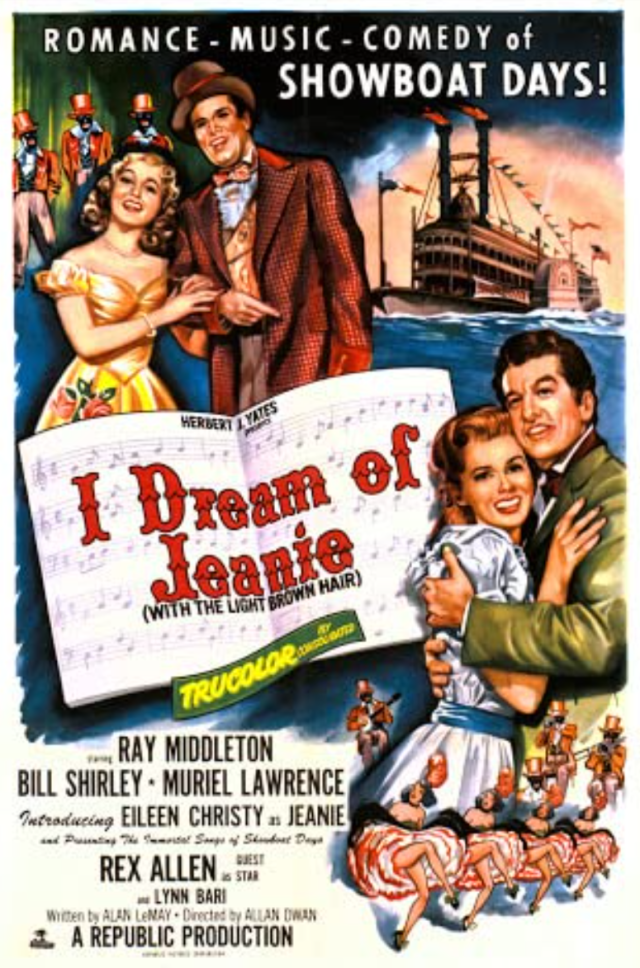
This movie made me wish I had saved an hour and twenty-nine-minutes by reading Stephen Foster’s Wikipedia page. For a “biopic”, I Dream of Jeanie wasn’t very informative. While I did learn a few things, the story didn’t capture an almost complete picture of the famous composer. It also showcased him in a not-so-favorable light. Because he was portrayed as a desperate push-over, Stephen was a character that exuded sympathy to the audience. What did not help was how the film placed more focus on other characters and events as well, such as the oh so annoying Edwin P. Christy. Speaking of Edwin, this movie would be called “The Edwin P. Christy Show” if given an honest title.

Take 3: I Dream of Jeanie (1952) Review

9. Country at Heart

This movie is notorious among the Hallmark fans for having more than one release date between 2019 to 2020. Too bad it wasn’t worth the wait. What could have been an interesting story turned out to be another tale of a woman from the city coming back to her small hometown. This is also one of those films where the protagonist says they are going to do something, but ends up spending most of the movie not doing the aforementioned thing. Country at Heart’s biggest flaw, though, lay in the singing abilities of the main character, Shayna. Throughout the story, Shayna’s talents were treated as if she were the next great undiscovered talent. But, in reality, her talents were, at best, fine. I don’t know if Jessy Schram sang in the movie or if there was a singing double. However, this part of the film dissuaded me from buying what the movie was selling.

8. The Trap (1959)

What a weird coincidence for another movie from the ‘50s to end up on my worst list. Even though The Trap is classified as a drama, the creative team placed more emphasis on the drama within the story. When you have gangsters in your film, this is not the genre you want to place your movie in. Since my warning came way too late, the 1959 title was a boring combination of a Suddenly rip-off and a road trip picture. Adding insult to injury, the excitement and action you’d expect from a gangster film was so far and few between. I’m honestly surprised I didn’t fall asleep during this movie, as I wanted to on more than one occasion.

Take 3: The Trap (1959) Review

7. Jane Doe: Ties That Bind

It is possible to make a good movie revolving around a debate. The Hallmark Hall of Fame film, Sweet Nothing in My Ear, is a beautiful example of this. With Jane Doe: Ties That Bind, however, adding a debate to a mystery story doesn’t work. This is because it goes against the very nature of the mystery genre, which emphasizes finding a concrete resolution to the story’s conflict. Unfortunately for the 2007 movie, a debate was the most focused part of the script. Because of that decision, the debate overshadowed the mystery itself. When everything was said and done, the debate wasn’t resolved. If I could summarize this film in one meme, it would be the one where the woman asks “You did this for what”?

6. Hometown Hero

It’s a shame that not one, but two PixL movies ended up on my list, especially since I rarely talk about their films on my blog. The reason why Hometown Hero is considered one of the worst movies I saw this year is because of how bland it was. This caused me not to care about any of the characters or their stories. It also doesn’t help that the main actor and actress had such weak on-screen chemistry, it felt like their characters were becoming good friends instead of romantic significant others. Similar to what I said about choice number seven, I would choose the meme of the woman asking “Where’s the flavor”? if I needed to summarize Hometown Hero in one meme.

I Dream of Jeanie (1952) poster created by Republic Pictures

5. The Price of Fitting In

Lifetime has an infamous history of creating PSA/“after school special”/cautionary tale movies, which cover a variety of serious, real world subjects. When I came across this 2021 title, I was curious to see what new topics and issues would be discussed in this film, especially considering it’s been a long while since Lifetime created a movie of this nature. But unlike the network’s other PSA/“after school special”/cautionary tale productions from decades past, The Price of Fitting In suffers from an identity crisis. The script spends the entire movie trying to figure out what type of story it wants to adopt. This led several parts of the narrative to either be underdeveloped or unresolved. The Price of Fitting In does recognize how a robotics team can experience similar peer-related situations like other extracurriculars, so I’ll give the movie credit where it’s due. I just wish that idea had belonged in a better film.

4. Raising Arizona

The best way to describe how I feel about this movie is by using an analogy: You’re listening to someone tell a joke. But when it’s time to deliver the punchline, that person forgets what it is. So instead, they either try to come up with a new punchline on the spot or they attempt to figure out what the original punchline was.  In Raising Arizona, the comedic moments lasted so long, the punchline got lost in translation. Some of the jokes didn’t make sense because of this. The characters were not charming or likable enough to make their dysfunctionality tolerable for the audience. If anything, they were one-dimensional and uninteresting. The only part of the movie that prevented me from DNFing (did not finish) it was Leonard Smalls. He was such a mysterious and intriguing character, that I wish I watched a movie about a character like Leonard.

3. Durango

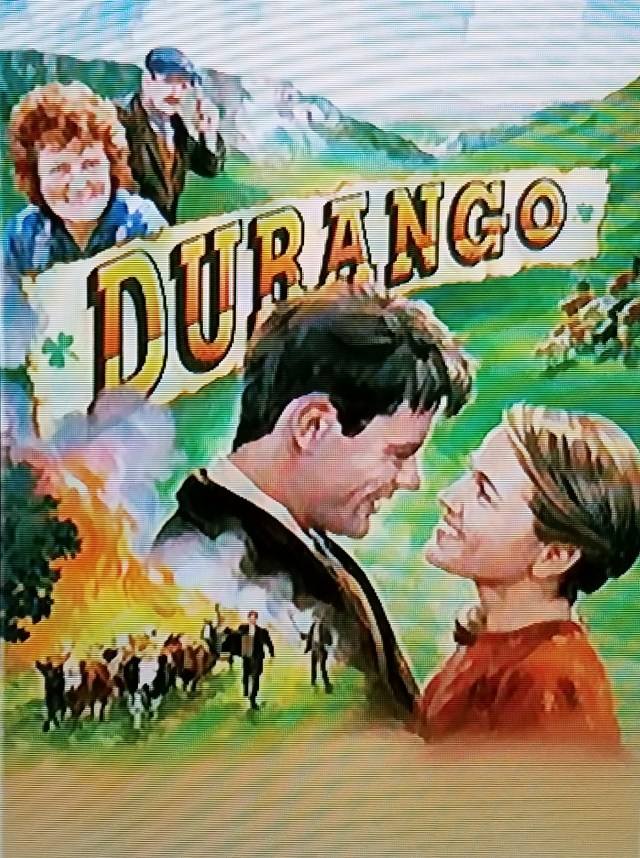
As I said in my review from July, Hallmark Hall of Fame’s Durango is “the first western set in Ireland”, according to IMDB. For the first of its kind, it was a step in the wrong direction. Stories in the western genre are known for having higher stakes, giving the audience an excuse to stay invested in the characters’ well-being. Durango didn’t get that memo because most of the stakes were so low, the characters’ plans worked out too perfectly. Despite never reading the book this Hallmark Hall of Fame title is based on, I can tell how weak this script was. What was also weak was Matt Keeslar’s performance and his on-screen chemistry with Nancy St. Alban. Watching this movie on Hallmark Drama was a blessing in disguise. I may not have saved some time, but at least I saved some money.

Take 3: Hallmark Hall of Fame’s Durango Review

2. Chasing Leprechauns

Yet another Hallmark movie set in Ireland joins the list. Since the network doesn’t create many St. Patrick’s Day themed movies, it is frustrating when a story relating to this particular holiday doesn’t stick the landing. With Chasing Leprechauns, the creative team wanted to include a whimsical element without making the movie too whimsical. Like I said in my review of the 2012 film, those involved with the project wanted to have their cake and eat it too. When I look at the movie’s poster, it feels like false advertising. For one, Chasing Leprechauns is a drab looking picture, not the lush, green paradise the poster wants you to believe. For another, there are no leprechauns in the story, despite the word ‘leprechauns’ being in the title. Hallmark is known for releasing some of their movies on DVD. As far as I know, Chasing Leprechauns was never made available for purchase. Maybe its poor quality is the reason why?

Take 3: Chasing Leprechauns Review

Remember when I said there were two PixL movies on my worst list? Well, The Cookie Mobster is the second film. For those who are not familiar with PixL, this is an entertainment company that typically creates “rom-coms” similar to those on Hallmark Channel. Because of that, this 2014 film was way too ambitious for the company’s own good. The light-hearted tone of the scouting troop’s story and the darker tone of the former gangster’s story ended up clashing with each other. Adding to that, the screenwriters didn’t display an understanding for several of the movie’s subjects. The weak script caused me to question the story’s validity, which took away any opportunity for me to stay invested in the story. The more I think about The Cookie Mobster, the more I wish it had been created by INSP or Hallmark Movies & Mysteries.

Since I’m talking about Durango again, I’m re-posting my screenshot of the film’s poster. Screenshot taken by me, Sally Silverscreen.

Have fun in 2022!

Sally Silverscreen

Take 3: Bathing Beauty Review

Since I participated in last year’s Esther Williams Blogathon, it made sense for me to join the 100 Years of Esther Williams Blogathon. Hosted again by Michaela from Love Letters to Old Hollywood, I wanted to review one of Esther’s films this time. I try to watch and write about as many movie recommendations as I can. Because Rebecca from Taking Up Room suggested I check out Bathing Beauty, that’s the film I chose to review! In 2020, for a different blogathon, I saw my first film of Esther’s; 1949’s Take Me Out to the Ball Game. That film gave Esther only one swimming scene, with the majority of her scenes taking place on land. With a movie titled Bathing Beauty, I was excited to see more of Esther’s swimming routines! Also, in 2020, I saw my first movie of Red Skelton’s; 1953’s The Clown. So, I was looking forward to talking about one of his earlier films! Now, let’s dive into this review of Bathing Beauty!

Bathing Beauty poster created by Metro-Goldwyn-Mayer

Things I liked about the film:

The costume designs: One thing I noticed while watching Bathing Beauty was the use of vibrant colors. This can definitely be seen within the film’s costume designs! At the very beginning of the film, Esther wore a hot pink swimsuit with a matching bow. The show-stopping piece, however, was her over-the-shoulder cape! This cream-colored piece was adorned in colorful flower appliques, adding touches of bright green, yellow, and pink. Besides pink, red was a common color found among the costumes. The students at Victoria College wore a uniform that consisted of a khaki dress. Red berets and neck ties provided a pop of color, not only pairing nicely with the khaki material, but also complimenting light and dark hair colors. During the performance of “I Cried for You”, Helen Forrest wore a rusty red colored dress. While the shape and style of the dress itself was simple, there was a sparkly belt and neckline. This small detail helped Helen’s dress appear elegant and appealing to the eye.

Red Skelton’s comedy: As I mentioned in my review of The Clown, I am familiar with Red Skelton as an entertainer. This knowledge caused me to be disappointed by the limited use of comedy in that film. Because Bathing Beauty is a romantic comedy, the material gave Red Skelton more opportunities to showcase his comedic talents. The ballet lesson from The Clown also appeared in Bathing Beauty. This time, Red’s character, Steve, took the lesson because it was a part of the college curriculum. Even after a year of first seeing it, this scene is still hilarious! The slapstick nature of Red’s comedy and the graceful reputation of ballet creates a funny oxymoron. Sometimes, Red’s comedy could be heard within the script. While at a local bar, Steve and a fellow patron explain their problems using nearby fruit. When Steve chooses to represent himself through a pineapple, he makes a comment about how he needs a haircut. Little comments like that one help include comedy into conversations among the characters!

The cinematography: An element within Bathing Beauty that stood out was the cinematography! It surprised me how good it was, especially for a film released in 1944! Anytime Esther swam underwater, those scenes were captured very well, presenting a clear view of what was happening under the surface. This added to the appeal of the swimming/water related scenes within the movie. In one scene, Esther’s character, Caroline, kisses Steve by the poolside. As she slowly dips under the water, Steve’s face follows her, with a close-up shot of his face shown under the water as well. Keeping in mind the limited technology of the ‘40s, these scenes were, to an extent, ahead of their time. A few scenes featured Harry James and His Music Makers. During these scenes, Harry was captured in close-up and medium shots. The camera also moved with him, presenting the illusion that Harry was floating among the orchestra. Because he was the star of those performances, this was a interesting way of highlighting Harry’s importance in those scenes!

100 Years of Esther Williams blogathon banner created by Michaela from Love Letters to Old Hollywood.

What I didn’t like about the film:

A somewhat misleading title: This movie is not only called Bathing Beauty, but it also stars Esther Williams. Therefore, certain expectations are placed on the film for those reasons. While we do see Esther in the pool, this was shown for two scenes: toward the beginning and end of the movie. The rest of the film shows Esther spending more time on land. Even when Basil Rathbone’s character, George, mentions a water pageant on several occasions, this was not the main focus of the overall story. After having Take Me Out to the Ball Game as my introduction to Esther’s filmography, I was left a little disappointed.

Red and Esther’s on-screen chemistry: While I have seen at least one film of Esther’s and Red’s, this was my first time seeing a movie starring both of them. Throughout the movie, they had nice on-chemistry. However, I thought Red had stronger on-screen chemistry with Jean Porter. Portraying one of the students at Victoria College, Jean displayed an on-screen personality that was similar to Red’s, coming across as easy-going and spunky. During the musical number, “I’ll Take the High Note”, Red and Jean performed so well together. I wanted Steve and Caroline to work out their relationship issues. But because of “I’ll Take the High Note”, I wish Jean and Red had led a film together.

A weak connection between the story and musical numbers: Musicals can be an enjoyable experience. Songs and instrumentals can progress a story forward, as well as help the audience get to know the story’s characters. With Bathing Beauty, there were several musical numbers sprinkled throughout the film. But anytime a musical number took place, it caused the story to pause. Even though these musical numbers were entertaining, the only one that directly connected to the film’s narrative was “I’ll Take the High Note”. This is because the number was a part of an assignment Steve had to complete in order to pass his music class. As I mentioned earlier, a water pageant is brought up on multiple occasions. However, this was the only water related spectacle in the movie. Because Esther was one of the stars of the film and because the story takes place in two states surrounding water (California and New Jersey), this feels, to an extent, like a missed opportunity for more water related numbers.

String of musical notes image created by Freepik at freepik.com. <a href=’https://www.freepik.com/free-vector/pentagram-vector_710290.htm’>Designed by Freepik</a> <a href=”https://www.freepik.com/free-photos-vectors/background”>Backgroundvector created by Freepik</a>. Image found at freepik.com.

My overall impression:

The end of any Olympics is an exciting time. A closing ceremony filled with spectacle and awe give athletes, fans, and people from that host country something to look forward to. As this year’s Tokyo Olympics come to a close, I can’t help but think of blogathons being similar to the Olympics. Think of it like this: the athletes that represent a particular country share one common goal. That goal is to bring home as many medals as realistically possible. The Olympics themselves have a start and end date, taking place in a different location. While there are typically no prizes involved in blogathons, participants share a common goal: talk about and celebrate the chosen subject. In this case, that subject is Esther Williams. Like the Olympics, Michaela’s event is an annual one that has a clear start and end date. Yes, it is known that Esther never went to the Olympics as planned. But I’d like to think she became a champion in her own right. An Olympic podium turned into an aqua-musical stage. Gold medals became a thirty-three project filmography. Instead of hearing the National Anthem after an Olympic win, show tunes are the chosen sound within Esther’s performances. I’d also like to think Esther paved the way for swimmers that came after her. Maybe aquamusicals haven’t made a comeback, but swimmers have been able to find own their success, almost like Esther did.

Overall score: 7.6 out of 10

Have you seen any of Esther Williams’ films? If so, which one would you want me to review next? Tell me in the comment section below!

Have fun at the movies!

Sally Silverscreen