Comparing with the Critics – Worst of 1985 – The Bride

This review is from my series, Comparing with the Critics. If you’d like to learn more about the series, click on the link below.

Introducing my new series, Comparing with the Critics!

The summer of 1985 was a disappointing time for Gene Siskel and Roger Ebert. They were so let down by that particular time of the year, At The Movies dedicated an entire episode to discussing the worst movies of the summer. The Bride, which was released on August 16th, was the first film featured in this episode. It left such a bad impression on Roger and Gene, it also appeared on the ‘Worst of 1985’ episode of the show. In each of these episodes, Roger describes The Bride as “an ambitious film that lost it’s way” and a movie that “shot for the stars and failed miserably”. Because I hadn’t even heard of The Bride before starting my Comparing with the Critics series, I couldn’t agree or disagree with Roger’s sentiments. From the way the movie was described, it seemed to answer the question of what would happen if Victor Frankenstein’s female creation fell in love with him? This is a question that is infrequently asked in Frankenstein related media. As someone who has read Mary Shelley’s source material, I was curious to see how the film’s creative team would answer this question. But now that I have seen The Bride, I’m disappointed by how this question was approached. Unlike Gene and Roger, though, I wouldn’t go so far to say the movie is bad.

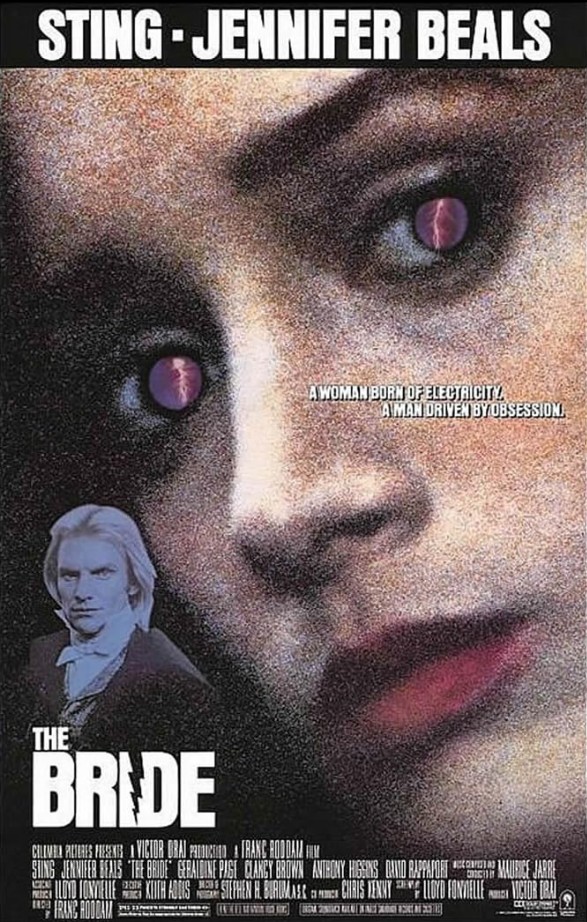
The Bride poster created by Colgems Productions Ltd., Delphi III Productions, Lee International Studios, and Columbia Pictures

After showing a clip from The Bride in At The Movies’ Worst Movies of the Summer episode, Roger claims the film “didn’t know whether it wanted to be a serious movie about the philosophical issues raised by the whole Frankenstein legend or whether it just wanted to be a glamourous, sleek remake”. I personally believe the movie’s creative team knew exactly what they were doing, accomplishing two goals in one picture. Throughout The Bride, there are two parallel stories; the first about Frankenstein and his female creation (Eva) and the second about Frankenstein’s male creation (Viktor) and Rinaldo. These stories show Viktor and Eva learning about the world around them as well as interacting with those they depend on. Every time Rinaldo introduces Viktor, he always refers to Viktor as “his friend”. Meanwhile, Frankenstein calls Eva “his ward”. The stories in The Bride were, in my opinion, intended to take a specific approach to the Nature vs. Nurture debate, presenting how two creations created by the same man could journey to the same outcome.

In Mary Shelley’s original source material, there aren’t really any heroes in that story. That’s because it focuses on the main message of some good intentions possibly leading to bad results. In The Bride, Viktor receives a “hero’s journey”, where he not only gets to fall in love, he also gets to save the day. His name, according to Rinaldo, even means “He will win”. As I mentioned in this review’s introduction, I have read Mary Shelley’s novel. From what I remember, Frankenstein destroys his female creation and his male creation is presented in the story as more of a cautionary tale. With that said, I think this creative liberty added an interesting dynamic to The Bride!

Hand-written letter image created by Veraholera at freepik.com. <a href=”https://www.freepik.com/free-photos-vectors/background”>Background vector created by Veraholera – Freepik.com</a>. <a href=’https://www.freepik.com/free-vector/love-letter-pattern_1292902.htm’>Designed by Freepik</a>. Image found at freepik.com.

While talking about The Bride’s two parallel stories, Gene says the story of Viktor and Rinaldo “was much more interesting than Frankenstein and the monster”. I find myself agreeing with Gene, especially since this story included a “hero’s journey” and a conflict that needed to be resolved. But another reason why I liked Rinaldo and Viktor’s story is David Rappaport’s portrayal of Rinaldo. When Rinaldo first meets Viktor, he’s surprisingly not intimidated by Viktor’s size. Instead, Rinaldo’s confidence helps Viktor find a sense of belonging as well as build a friendship between himself and Viktor. Rinaldo’s charisma shows the audience his good intentions, always striving to give Viktor a better life than Frankenstein did. As he’s giving Viktor a new shirt, Rinaldo is horrified by the scars on Viktor’s back. The sight immediately brings concern to Rinaldo’s face, his saddened tone of voice concluding how Viktor must have been mistreated. The scene I just described shows how David’s performance gave Rinaldo a genuineness that allowed him to be a likeable character. Though this film is titled The Bride, Rinaldo became this movie’s MVP!

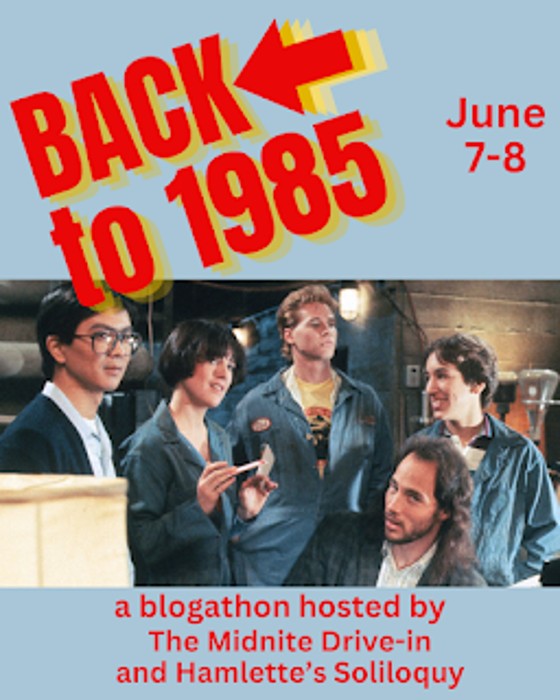
Back to 1985 Blogathon banner created by Quiggy from The Midnite Drive-In and Hamlette from Hamlette’s Soliloquy

Both Roger and Gene agreed that Viktor and Eva should have spent more screen-time together. Roger proclaims “if we’re gonna have those parallel stories for two hours, let’s have a pay-off at the end”, with Gene adding “a pay-off for half an hour, not for five minutes”. Like I talked about earlier in this review, I believe the creative team’s intention for The Bride was to present a specific approach to the Nature vs. Nurture debate, as well as giving Viktor a “hero’s journey”. However, my biggest criticism with these parallel stories was the editing. The way these stories were sewn together made the movie feel disjointed. This is because some parts of the story were longer than others. One scene shows Eva studying a series of pictures by herself for only a few seconds. The very next scene shows Viktor and Rinaldo on their journey to the circus, with the scene itself lasting several minutes. Frankenstein and Eva receiving shorter screen-time sometimes prevented the audience from seeing interesting interactions between these two characters. This creative decision also gave Eva and Frankenstein’s story less intrigue.

Group of clowns image created by Freepik at freepik.com. Image by Freepik

When I was introduced to The Bride, I was given the impression the film was trying to answer the question of what if Victor Frankenstein’s female creation fell in love with him. This made me curious to see how the movie’s creative team would answer this question. But like I said in my review’s introduction, I’m disappointed by how this question was approached. That’s because the film’s creative team didn’t answer or explore the question at all. They bring up an equally interesting and infrequently asked question of what if Frankenstein fell in love with his female creation? However, so much time was spent focusing on Eva learning about the world around her, the aforementioned question was given little time for exploration or discussion. When it came to Frankenstein’s love for Eva, it simply came across as possessive and controlling. As I’ve been saying throughout this review, Viktor was given a “hero’s journey”. This means the story always intended to have Eva fall in love with Viktor, not Frankenstein. Even though I liked the creative decision of Viktor’s “hero’s journey”, I’m still disappointed by the potential questions that were left unanswered.

Comparing with the Critics banner created by me, Sally Silverscreen. TV show title cards created by WTTW National Productions, WTTW, Public Broadcasting Service (PBS), Lifetime Television, Tribune Entertainment, Buena Vista Television, and Disney-ABC Domestic Television

Toward the beginning of At The Movies’ Worst Movies of the Summer episode, Gene claims the summer of 1985 “happened to be one of the dullest, most juvenile, most homogenized summer movie seasons in recent memory”. Out of the movies that premiered during that time, I’ve only seen six pictures in their entirety, including The Bride. Personally, I didn’t find any of these films to be bad or disappointing. Specifically speaking about The Bride, I thought it was a fine, serviceable, interesting enough title. Though I was disappointed the movie’s creative team didn’t answer the question of what if Victor Frankenstein’s female creation fell in love with him, there were aspects of the film I liked. While the acting was one of the strengths of The Bride, David Rappaport’s portrayal of Rinaldo shined the brightest! Rinaldo was such a likable character, he became my favorite! Another strength of this film was Viktor receiving a “hero’s journey”. Even though it was a creative liberty, it added an interesting dynamic to The Bride’s story. It was also interesting to see the creative team’s approach to the Nature vs. Nurture debate. I apologize for sounding like a broken record, but this is yet another Comparing with the Critics review where I disagreed with Roger and Gene. As I continue with my series, I have to wonder how often this will keep happening?

This review was brought to you by

Sally Silverscreen

Take 3: The End of the Affair (1955) Review

When you have a show as iconic and successful as I Love Lucy, well-known guest stars are likely to pay the show a visit. On the aforementioned show itself, a collection of guest stars graced the screen, crossing paths with Lucy, Ricky, and their friends. One of those stars was Van Johnson, an actor I’m familiar with due to reviewing some of his films and his episodes of Murder, She Wrote. Since I haven’t written about any project from Van’s filmography since 2022, I found the I Love Lucy Blogathon as the perfect opportunity to check out another of his movies! A film of Van’s I’ve been meaning to review for years is the 1955 presentation, The End of the Affair. Recommended by Maddy from Maddy Loves Her Classic Films, I was intrigued by the mystery woven into the synopsis. Who is this third man Deborah Kerr’s character may be having a relationship with? The only way I was going to find an answer to that question is by watching The End of the Affair and sharing my honest opinion about it!

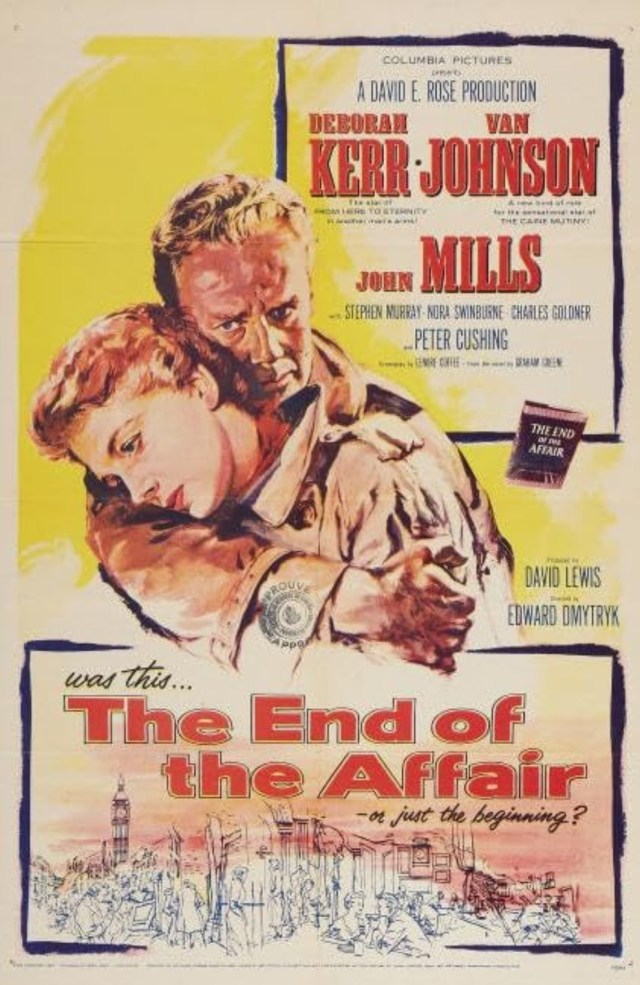
The End of the Affair (1955) poster created by Coronado Productions and Columbia Pictures

Things I liked about the film:

The acting: Like I mentioned in this review’s introduction, I have written about some of Van Johnson’s films as well as his episodes of Murder, She Wrote. What I’ve noticed from these projects is how Van has strong adaptability to his character’s experiences. This was also the case in The End of the Affair. While spending time with Deborah Kerr’s character, Sarah, Van’s character, Maurice, is all smiles and appears to be in a good mood. But when a neighbor named Mrs. Tomkins unexpectedly arrives to give Sarah some food, Maurice’s mood quickly changes. His eyes are downcast, not even looking at the neighbor. Maurice’s mouth displays a worried look as he frets over his secret relationship with Sarah being discovered. Even his tone of voice with Sarah is sharp, desperately trying to contain his feelings. This scene is just one example of Van’s versatility when it comes to his acting talents!

I was pleasantly surprised to discover Peter Cushing starred in The End of the Affair! Based on what I know about Peter’s career from his filmography, he either portrayed a character in a horror movie or he appeared for a limited period of time in a film. Comparing The End of the Affair with other projects of Peter’s I’ve seen, he was given a slightly larger role in the 1955 movie. My other observation is how his character, Henry, had a consistently friendly personality. Even when he suspects Sarah of having an affair, Henry’s demeanor is that of concern, with a worried look on his face. Speaking of Sarah, I want to discuss Deborah Kerr’s performance. In The End of the Affair, there were times when Deborah’s face said so much without the use of dialogue. A great example is when Sarah and Maurice reconnect after being apart for a year. During their walk together, fear shown through Sarah’s eyes. Her mouth was even tightly pursed, revealing little to no information to Maurice. In this scene, Sarah appears to keeping a secret, a secret she’s afraid might be discovered.

The mise-en-scène: Mise-en- scène is how a film’s scene is presented to the audience. One example from The End of the Affair is how mirrors were sometimes used as a form of foreshadowing. Toward the beginning of the film, Maurice spots Sarah hugging another man. She and the man can be seen through a near-by mirror. Because the creative team emphasized this interaction, Maurice’s suspicions of Sarah are hinted at. Later in the movie, when Sarah disappears from Maurice’s life, he calls her home, hoping she’ll pick up the phone. But every time Sarah is unavailable, the camera consistently shows a close-up of Maurice’s face, emphasizing his building frustration. This built-up frustration makes Maurice’s suspicions of Sarah grow even more. Because of how well mise-en-scène was utilized by the film’s creative team, the story was able to maintain a certain degree of intrigue.

The character of Albert Parkis: In movies like The End of the Affair, where serious topics are brought up, the detective character will usually carry a persona that matches the tone of the film. But in the 1955 movie, Albert Parkis provided a bright light to a darker story. Portrayed by John Mills, Albert was the private investigator hired by Maurice to solve the mystery of Sarah’s whereabouts. Any time he appeared on screen, Albert had such a cheerful, friendly personality. He sometimes brought his son along on investigations, in order to teach him how to solve mysteries. Albert’s interactions with Maurice were so lively, they were a joy to watch unfold. I wish Albert Parkis was given a larger role in The End of the Affair, as his involvement in the story was limited.

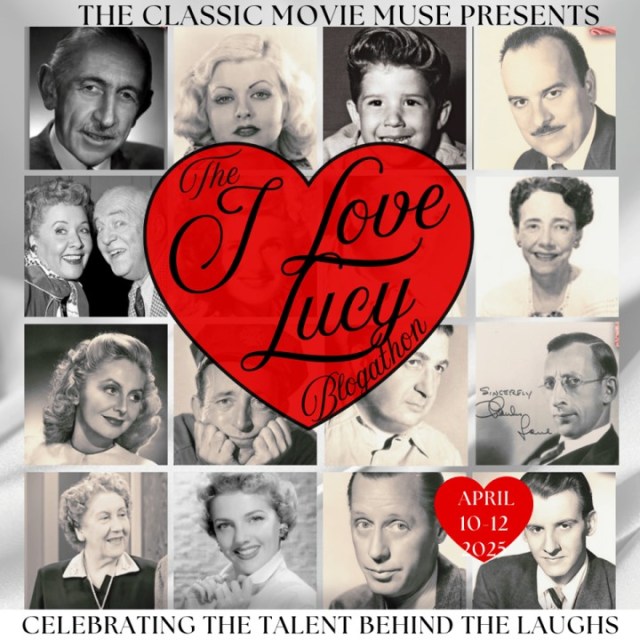
The I Love Lucy Blogathon banner created by Ari from The Classic Movie Muse

What I didn’t like about the film:

The “insta-love” trope: As I said earlier in this review, Maurice and Sarah share a secret romantic relationship. Their affair provides the basis for the film’s overarching conflict. But it was difficult for me to determine Van and Deborah’s on-screen chemistry. This flaw was due to the movie’s creative team choosing to adopt the “insta-love” trope. The beginning of the film shows Maurice being introduced to Sarah. In this introduction, Maurice hopes Sarah will provide insight to a book he’s writing. Several minutes later, they are starting to form their relationship. Sarah and Maurice even share a kiss within the first fifteen minutes of the story. With their relationship moving so quickly, I didn’t find myself as emotionally invested in Maurice and Sarah’s story as I could have been.

The underutilization of John Mills: When I talked about Albert Parkis, I said I wish he was given a larger role in The End of the Affair, as his involvement in the story was limited. This means the acting talents of John Mills were underutilized. On the film’s poster, you will see John Mills’ name listed as one of the top three billed actors in the production. However, this poster is somewhat misleading, as Peter Cushing receives more screen-time than John. After reviewing The Chalk Garden, I was looking forward to seeing another movie from John’s filmography. I was even curious about how John’s character’s story connected to Deborah’s character’s story. While I found out how these stories connected, I was disappointed by John’s limited involvement in the project.

A randomly produced reveal: The major conflict of The End of the Affair is figuring out the identity of the third man Sarah may be having a relationship with. I will not spoil this movie, in case any of my readers haven’t seen it yet. But what I will say is the mystery’s reveal was randomly produced. When Sarah’s secret is discovered, the answers are given toward the end of the story. Since there is no build-up leading into the reveal, the reveal itself almost feels like a major tonal shift. To prevent this flaw, information or clues related to the reveal should have been sprinkled throughout the movie. That way, the transition between the mystery and its reveal could have been smoother.

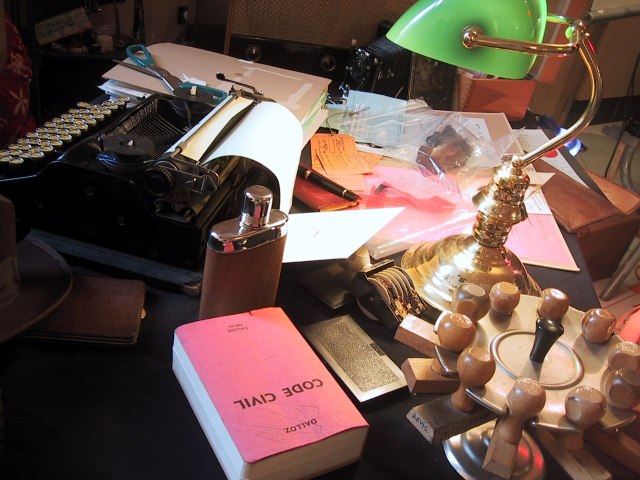
Vintage detective desk photo created by Olivier Bourgeois at freeimages.com. Photo by <a href=”/photographer/ornicar69-54520″>Olivier Bourgeois</a> from <a href=”https://freeimages.com/”>FreeImages</a&gt; Image found at freeimages.com.

My overall impression:

Van Johnson is one of the reasons why I selected The End of the Affair, as he was a guest star on I Love Lucy. When it comes to his movies, I thought those I saw were mostly ok. The 1955 project is no different. I was disappointed by the underutilization of John Mills’ acting talents, as well as the adoption of the “insta-love” trope. The mystery’s randomly produced reveal felt like a major tonal shift. However, The End of the Affair does have its strengths. The acting alone was one of the highlights of the film, from Van’s versatility to Deborah’s ability to convey ideas without using dialogue. The way mise-en-scène was used by the creative team allowed the story to maintain a certain degree of intrigue. I also liked Albert Parkis as a character. When it comes to character-driven stories involving serious topics, I find The Chalk Garden and Hallmark Hall of Fame’s A Tale of Two Cities as stronger titles. But, so far, I’ve only seen a handful of Van’s movies, so maybe I need to keep looking for a film of his I like.

Overall score: 6.1 out of 10

Have you seen The End of the Affair? Which is your favorite movie from Van Johnson’s filmography? Tell me in the comment section!

Have fun at the movies!

Sally Silverscreen
Take 3: The Deep End of the Ocean Review

In the We Heart Siblings Stories Week event, hosted by Hamlette (from Hamlette’s Soliloquy), I wanted to review a movie that was more underrated. While searching for the perfect title, I discovered a list on IMDB about the best movies about siblings. On that list, the 1999 movie, The Deep End of the Ocean, was featured. Back in 2021, when I reviewed Taming Andrew, I remember Gill, from Realweegiemidget Reviews, recommending The Deep End of the Ocean for a future review. Since I try to write about a recommended picture every now and then and since the 1999 film fit the blogathon’s criteria, I found the perfect title to discuss! Similar to Taming Andrew, The Deep End of the Ocean revolves around a family whose child was kidnapped and eventually returned. Since the missing child in the 1999 movie has siblings, those children’s perspective are included in the story. So, without further delay, let’s begin this review of The Deep End of the Ocean.

The Deep End of the Ocean poster created by Columbia Pictures, Mandalay Entertainment, Via Rosa Productions, and Sony Pictures Releasing

Things I like about the film:

The acting: If a story includes a teenage character, it can be easy for that character to be written as an angsty or rebellious stereotype. But in The Deep End of the Ocean, Vincent never seemed like a stereotype or caricature.  Through Jonathan Jackson’s performance, Vincent came across as a realistic individual, trying his best to bottle up his emotions while putting on a brave face. After Ben/Sam was identified as Beth and Pat’s son, Vincent reveals to Beth how he has seen Ben/Sam around their neighborhood. When Beth questions him about this occurrence, Vincent’s demeanor is very nonchalant. His face displays a relaxed look and the tone of his voice sounds annoyed. But as the conversation continued, Vincent’s tone changed to irritation, his words sharply leaving his mouth. His eyes also took on an intense stare, which sometimes happens when Vincent is included in more dramatic scenes. This portrayal of Vincent was consistent with his younger self, keeping his feelings to himself while also trying to keep his family together. The subtle expressions from Jonathan Jackson do a good job at showing how emotions can trickle out of a character who has bottled up their emotions for so long.

Treat Williams is an actor I’m familiar with because of his inclusion in the Hallmark community. Through his involvement in projects such as Chesapeake Shores, his emotions and expressions have always come across as genuine. This is also the case for his portrayal of Pat in The Deep End of the Ocean. One morning, Pat brings up the idea of growing their family with his wife, Beth. At the start of this conversation, Pat appears happy, even adopting a playful tone in his voice. When Beth, portrayed by Michelle Pfeiffer, explains why she doesn’t want more children, Pat gradually becomes frustrated. This frustration grows into anger, with both Pat and Beth yelling at each other. The way this argument unfolds feels realistic, each character bringing up good points with a sense of honesty. Because of the acting abilities and on-screen chemistry of Michelle and Treat, scenes like this one don’t feel over-the-top or melodramatic.

Because this story revolves around the disappearance of Ben/Sam, I need to talk about Ryan Merriman’s performance. When I reviewed Taming Andrew, I said casting a young actor or actress who could, talent-wise, carry most of the movie is essential when a story revolves around a young character. The difference between Taming Andrew and The Deep End of the Ocean is how the whole family deals with Ben’s/Sam’s kidnapping in the 1999 movie, allowing Ryan is carry only part of the film. Despite this, Ryan still brought a good performance to the table, with a variety of emotions and expressions displayed. A great example was when Ben/Sam plays basketball with Vincent. The game starts off as a friendly duel, all smiles and playful banter. As the game continues, Ben/Sam becomes confused and even afraid as Vincent’s demeanor changes. Slowly but surely, Vincent allows his frustrations and irritation to get the better of him, going so far as to accidently hit Ben/Sam in the face. Ryan’s acting talents help Ben’s/Sam’s interactions with various characters create an interesting dynamic within the story.

Showing the process of searching and locating a missing person: As I just mentioned in this review, the difference between Taming Andrew and The Deep End of the Ocean is how the whole family deals with Ben’s/Sam’s kidnapping in the 1999 movie. Another major difference between the two films is how The Deep End of the Ocean shows the entire process of searching and locating a missing person. When Ben/Sam is first reported missing, the story addresses the sense of urgency in the 24 hours to about a week after Ben/Sam is kidnapped. A clock is routinely shown to indicate how much time has passed. A television interview and a cover of People magazine show the desperation Ben’s/Sam’s family has in finding Ben/Sam. Even the community surrounding Ben’s/Sam’s family come together to create posters and make phone calls. Even though Ben/Sam is found almost ten years later, this part of the process is also taken seriously, from addressing the need for a search warrant to placing Ben/Sam in a foster home before reintroducing him to his family. Because this entire process was shown in the movie, it gives the audience a sense of closure.

Featuring different perspectives: Like I’ve been saying in this review, The Deep End of the Ocean addresses how the whole family deals with Ben’s/Sam’s kidnapping. Each member of Ben’s/Sam’s family handles his disappearance differently throughout the course of the story. Beth is filled with grief over the situation. From giving up on her photography career to staying in bed most of the day, she carries a great sadness in her mind and heart. Meanwhile, Pat tries desperately to find the silver lining in life. He continues to work at a local restaurant while maintaining his dream of opening his own restaurant. Young Vincent is troubled by what happened, as well as becoming overshadowed by his little brother. He bottles up his feelings and tries to hold his family together. With the strength of the acting performances and the screenwriting, the dynamic among the family becomes fascinating to watch.

The We Heart Sibling Stories Week banner created by Hamlette from Hamlette’s Soliloquy

What I didn’t like about the film:

An underutilized perspective: When Ben/Sam was kidnapped, Kerry was just a baby. Years later, Kerry is confused by her mother’s, Beth’s, reaction after a chance encounter with Ben/Sam. This is because she has no recollection of the events surrounding her brother’s disappearance. Because of everything I just said, Kerry’s perspective didn’t add much to the overall story. In order to utilize Kerry’s perspective, I wish she was written as either a teenager or slightly younger than Vincent at the time of Ben’s/Sam’s kidnapping.

A few continuity errors: After the time jump from the late ‘80s to “nine years later”, Vincent is reintroduced as a sixteen-year-old with long hair. In the very next scene he’s featured in, Vincent is shown with short hair. No explanation is provided for the sudden change in hair style and none of the other members in Vincent’s family seem to notice this change. Yes, Officer Candy Bliss mentioned to Beth how Vincent needs a haircut. But that doesn’t explain this error in continuity. Even though this flaw was a minor one in The Deep End of the Ocean, the specific continuity issue I described is a glaring one.

A random dramatic moment: Toward the end of The Deep End of the Ocean, Vincent is arrested. To me, this dramatic moment felt random. I’m aware how this film is based on a book I haven’t read. But according to what the movie shows, Vincent never came across as a character who was a trouble-maker or someone seeking attention. Jonathan Jackson’s portrayal of Vincent shows this is a character that is not a stereotypical teenager displaying “teenage angst”. With the inclusion of Vincent’s arrest, however, it almost seems like that part of the story is contributing to the angsty and rebellious teenager stereotype.

Restaurant waitress and guest image created by Freepik at freepik.com. <a href=”https://www.freepik.com/free-photos-vectors/food”>Food vector created by freepik – http://www.freepik.com</a>. Image found at freepik.com.

My overall impression:

Throughout this review, I’ve been comparing and contrasting Taming Andrew and The Deep End of the Ocean. That’s because I was recommended The Deep End of the Ocean when I reviewed Taming Andrew. After seeing (and writing about) both films, it seems the only similarity these titles have is how the story revolves around a missing child being reunited with their family. If anything, The Deep End of the Ocean shares similar ideas and themes with The Face on the Milk Carton. Speaking specifically about the 1999 movie, this is a production I could take seriously. The acting performances were strong, creating a dynamic among the characters that was interesting to watch unfold. The screenwriting allowed the story and subjects within them to be honestly and respectfully told. But because of how serious the subject matter is, The Deep End of the Ocean does not have a high re-watchability rate. However, the film provides a mostly complete picture of the emotional rollercoaster the story’s family experienced.

Overall score: 7.3 out of 10

Have you seen The Deep End of the Ocean? Have you read the movie’s source material? Tell me in the comment section below!

Have fun at the movies!

Sally Silverscreen
Take 3: A Walk in the Spring Rain Review

Every beloved film star has at least one movie on their IMDB filmography that has earned the distinction of being a “classic”, “iconic” or “fan favorite”. But for every “classic” title, there’s also that one film that is under-rated or unheard of. In the case of Ingrid Bergman, one of those movies is A Walk in the Spring Rain! Prior to The Wonderful World of Cinema’s 6th Wonderful Ingrid Bergman Blogathon, I had never heard of the 1970 picture. However, that’s the great part of participating in a blogathon; discovering films that are “new-to-you”! As I said in my review of Evel Knievel, I haven’t had the best of luck, this year, finding a movie from the 1970s I like. By expanding my cinematic horizons, I am hoping to solve that problem. Where does A Walk in the Spring Rain rank among the other ‘70s movies I’ve reviewed this year, so far? Keep reading my review in order to find out!

A Walk in the Spring Rain poster created by Columbia Pictures and Pingree Productions

Things I liked about the film:

The chemistry between the cast: When watching characters interact with one another, the believability of those interactions depends on the strength of the cast’s acting talents. Though the cast in A Walk in the Spring Rain was smaller, this believability could be felt. In a scene between the protagonist, Libby, and her daughter, Ellen, the interaction appeared realistic, presenting the idea of a mother and daughter discussing a personal matter. Concerned about her mother’s apparent unhappiness, Ellen (portrayed by Katherine Crawford), seems genuinely worried, that worry with a touch of sadness consistently shown on her face. Meanwhile, Libby (portrayed by Ingrid Bergman) is distraught over personal turmoil. Her face shows her distress, tears in her eyes and sadness spread over her face. She even goes so far as to violently push a tea cup off the kitchen table in an act of sudden anger. During their stay in Tennessee, Libby and her husband, Roger, meet a local man named Will. One evening, the three go frog hunting, with Roger and Libby trying moonshine for the first time. This scene shows the on-screen chemistry between Ingrid Bergman, Fritz Weaver, and Anthony Quinn. Their smiles, laughter, and jovial demeanor radiates off the screen. It feels like they are three close friends who are picking things up where they last left off.

The set design: In A Walk in the Spring Rain, Libby and Roger rent a cabin in Tennessee. This cabin featured design choices that I found memorable! The main focal point in the living room is a fireplace. Surrounded by exposed stone and a dark wood mantle, good décor complimented the darker shades of both wood and stone. The living room was not the only room where exposed stone was found. In the kitchen, an antique stove guarded a wall of exposed stone. Also in the kitchen, a dark wood corner shelf housed the fine china and fancy dinnerware. This shelving unit was a unique way to make the best use of the room’s available space!

The scenery: A Walk in the Spring Rain was filmed in Tennessee, specifically at Great Smoky Mountains National Park. The story takes place during two seasons: winter and spring. Despite the difference in seasons, the scenery was very picturesque, stealing the show from time to time! In some establishing shots, Tennessee’s snowy landscape was beautifully captured on film. The scenery honestly looked like a Christmas greeting card. In a scene where Will shows Libby the first blooms of the season, a tree with small, magenta flowers provides a nice pop of color amid the background of green foliage and rolling hills. Even when characters are driving through the country-side, these surroundings were pretty to look at!

The 6th Wonderful Ingrid Bergman Blogathon created by Virginie from The Wonderful World of Cinema

What I didn’t like about the film:

A meandering story: According to a synopsis I read for A Walk in the Spring Rain, Libby and Will have an affair. This affair didn’t fully come into fruition until fifty-three minutes into an hour and thirty-eight-minute movie. That forced the audience to wait more than half the film for the inevitable to happen. Even though Will and Libby flirted with one another leading up to the affair, these interactions were brief. While waiting for the affair to happen, the script focused on other parts of the story, such as the Merediths adopting baby goats.

The run-time: Like I mentioned in my previous point about the film’s meandering story, A Walk in the Spring Rain has a run-time of an hour and thirty-eight-minutes. Because of how drawn out the story was, that hour and thirty-eight-minutes felt longer. There were several stretched out scenes serving the movie’s run-time. One example is a ten-to-fifteen-minute scene of Libby and Roger’s trip to Gatlinburg, with the majority of this scene showing the Merediths walking down a tourist heavy street. Had scenes like this one been trimmed, A Walk in the Spring Rain’s run-time might have been about an hour and ten minutes.

Drawn-out subplots: There were some subplots in A Walk in the Spring Rain that were drawn out, likely to satisfy the movie’s run-time. One of these subplots revolved around the Merediths’ daughter, Ellen. Ellen desires to go to law school. However, Libby and Roger feel her decision would disrupt her family. While this subplot does get resolved, it takes the entire movie for the resolution to happen. Because of this, the resolution feels anticlimactic.

Image by macrovector on Freepik

My overall impression:

In the introduction of this review, I said I had never heard of A Walk in the Spring Rain prior to The 6th Wonderful Ingrid Bergman Blogathon. Looking back on this movie, I think I know why. If I could describe the 1970 film in one word, it would be ‘bland’. The drawn-out, meandering story causes the movie to feel longer than an hour and thirty-eight-minutes. Great Smoky Mountains National Park provides this story with beautiful scenery. But as I’ve said in past reviews, “the scenery can’t save you”. The cast in A Walk in the Spring Rain is solid, maintaining strong on-screen chemistry. However, when a project has a weak script, there’s only so much the cast can do to salvage that script. I know this film was released toward the end of Ingrid’s career. But, honestly, she, as well as the rest of the cast, deserved better material.

Overall score: 5 out of 10

Have you seen or heard of A Walk in the Spring Rain? Are there any of Ingrid Bergman’s films you’d like to see me review? Let me know in the comment section!

Have fun at the movies!

Sally Silverscreen
Take 3: Tommy Review

For my third year participating in the Rule, Britannia Blogathon, I, at first, considered reviewing an adaptation based on a book I’ve read. This would be similar to when I wrote about the 2002 adaptation of Nicholas Nickleby. But the more I thought about it, the more I realized I had a perfect opportunity on my hands. That opportunity was the chance to review the 1975 film, Tommy! Years ago, long before I became a movie blogger, I saw a trailer for Tommy on Turner Classic Movies (TCM). On the one hand, the story itself seemed interesting; a man with disabilities living his best life and making his dreams come true. But, on the other hand, the visuals within this trailer appeared “bonkers”, making the movie seem intimidating. After reading some reviews, I came to the conclusion Tommy is a polarizing film. This isn’t the first time I have written about a movie that received mixed reviews. Two years ago, for another blogathon, I reviewed the 2011 Hallmark film, The Cabin. Historically, this is considered one of the most polarizing titles the network has ever created. When I got around to seeing it, I found The Cabin so bad, it was disappointing.

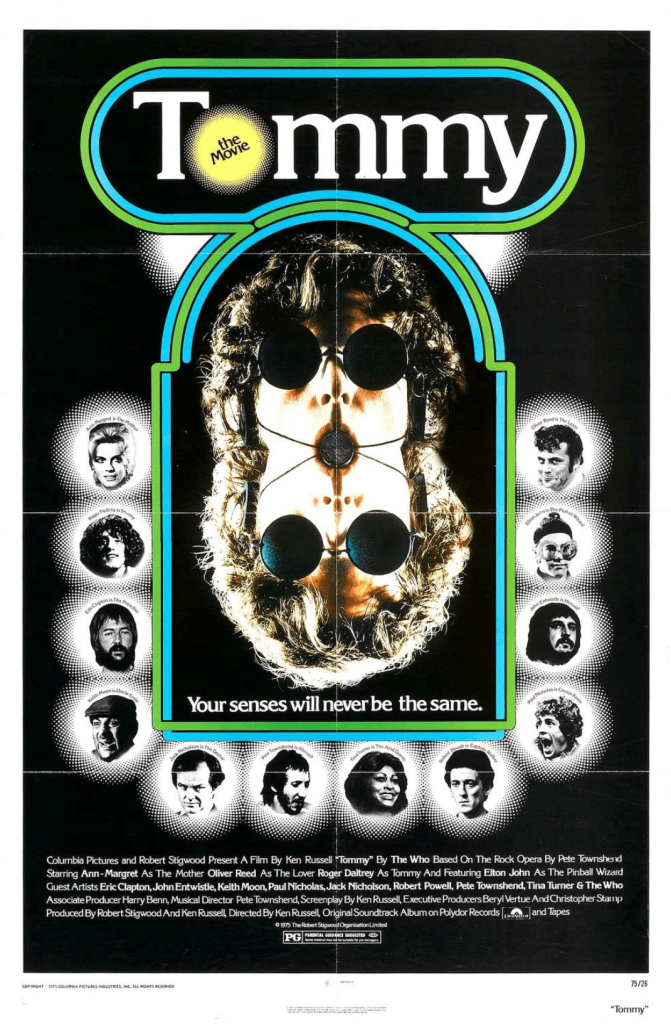
Tommy poster created by Robert Stigwood, Organization Ltd., Hemdale Film Corporation, and Columbia Pictures

Things I liked about the film:

The acting: Prior to watching Tommy, I had seen Bye Bye Birdie. In the 1963 film, Ann-Margret gave an expressive portrayal of Kim MacAfee. The 1975 movie shows Ann-Margret in a completely different role, which allowed her to expand her acting abilities. Portraying the titular character’s mother, Nora, Ann-Margret gave a well-rounded performance! Because this story incorporates heavier subjects, her portrayal contains the emotional intensity required for a story of this nature. While watching television, Nora sees her son on TV. As she’s watching, a sense of guilt grows within her. This guilt causes Nora to appear disgusted, a grimace slowly overcoming her face. She attempts to change the channel in order not to see Tommy, only for the TV to magically switch to Tommy’s image. Angry about her plan not working, Nora throws her champagne bottle at the television, which results in a flood of laundry detergent, beans, and chocolate. Relieved to instantly receive the items she just saw in television commercials, Nora suddenly is taken over by pleasure. A smile appears on her face as she rolls around on the floor in the commercial materials.

When discussing a movie heavily revolving around a titular character, it’s important to talk about the actor or actress portraying that character. In the case of Tommy, that role was given to Roger Daltrey. Based on some reviews I’ve read of Tommy, it seems like Roger had little to no acting experience prior to working on this movie. Despite this, his performance was such a strong addition to the story! Roger’s portrayal had the emotionality and versatility to make Tommy a character worth rooting for. These aspects also held my interest in Tommy’s journey. In one scene, Tommy stays over at Cousin Kevin’s house. During his stay, Kevin tries to burn Tommy with a cigarette. As Tommy is sitting tied up in a chair, his face instantly changes from exhaustion and writhing in pain. This change in facial expressions is seamless, Roger never missing an emotional beat.

While I have heard good things about Tina Turner’s acting performances, this was the first time I had seen any of them. Tommy shows Tina portraying The Acid Queen. Even though her performance was limited to one scene, she gave so much energy to her role. While her portrayal was over-the-top, it fit the tone and vibe the movie was going for. With all that said, I honestly wish Tina had received more appearances in this film.

Ann-Margret’s wardrobe: Even though I knew Ann-Margret would be starring in Tommy, I was pleasantly surprised by how much I liked her wardrobe! Each outfit she wore complimented her so well, while also looking great on-screen! Toward the beginning of the movie, as Nora and her husband, Captain Walker, are running through the war-torn streets of England, she wore an asymmetrical, sky-blue gown. The dress itself was simple, but it was elegant enough to not be plain. Ann-Margret’s strawberry blonde hair paired beautifully with the color of the dress. Later in the movie, Nora wears a silver, mesh pant suit. Accompanied by shiny, silver sandals and a white furry cape, this ensemble boasted a posh look. While the outfit felt very reflective of the 1970s, it was a divine version of that type of outfit. Ann-Margret definitely pulled off this film’s wardrobe in style!

The symbolism: In some reviews I read about Tommy, it was mentioned how there was symbolism found among the over-the-top, flashier imagery. Since I knew before watching the movie there was going to be this type of imagery, it allowed me to focus on what the film’s creative team was trying to say through their story. In a desperate attempt to cure her son, Nora takes Tommy to The Church of Marilyn Monroe. Other patrons with disabilities are also in attendance, from a woman with a guide dog to multiple people utilizing wheelchairs. Marilyn’s likeness can be seen throughout the facility, with the most notable being a giant statue of Marilyn in the iconic flown skirt pose. I interpreted the scene as a piece of commentary on how people who claim to be religious and/or contain the ability to cure everyone with anything can, sometimes, take advantage of those in vulnerable positions. Those people could be considered “false prophets”. So, choosing Marilyn as the film’s church icon is interesting, as Marilyn’s name and image were all a fabricated version of Norma Jean.

The 9th Annual Rule, Britannia Blogathon banner created by Terence from A Shroud of Thoughts

What I didn’t like about the film:

Some villains not receiving their comeuppance: There were several characters in Tommy’s life that failed him. While a few of these characters did receive their comeuppance, most of them did not. Whenever Tommy went to stay at Cousin Kevin’s house, Kevin would physically abuse and torment Tommy. Kevin only appeared in a sequence of scenes showing Tommy mistreated by him. Because of this, Kevin’s comeuppance was never shown. I’m not sure if this creative decision was made because there wasn’t enough time to show each character’s comeuppance or if it was meant to show how unfair life can be.

Some confusing parts of the story: At one point in Tommy’s story, his parents take him to see The Specialist, in an attempt to figure out why Tommy has several disabilities. During this appointment, Nora and The Specialist continuously flirt with each other. After this scene, this interaction and The Specialist himself are not brought up again. I was unsure if Nora planned on leaving Frank to start a relationship with The Specialist or if she was flirting with The Specialist simply to encourage him to lower her son’s medical bills. Either way, the movie does not provide a clear explanation.

An unclear time-line: This story starts during and shortly after World War II. The script heavily implies Tommy was born sometime in 1945. Most of this story takes place when Tommy is an adult. If Tommy were, say, twenty during the film’s events, that would mean the story takes place in 1965. With that said, why do the wardrobe, set design, and special effects look like they came straight out of the 1970s? I know this film was released in 1975. But because Tommy’s age is not specified, the movie’s time-line is unclear.

Music and stage image created by Topntp26 at freepik.com. <a href=’https://www.freepik.com/free-photo/music-sign_1179519.htm’>Designed by Topntp26</a>. <a href=”https://www.freepik.com/free-photos-vectors/vintage”>Vintage image created by Topntp26 – Freepik.com</a>. Image found at freepik.com.

My overall impression:

The way I feel about Tommy is similar to how I feel about Queen of the Damned. Is this one of my favorite films? No. Is it one of the best movies I’ve seen this year? Also, no. But, for what it was, I enjoyed it. Yes, the visuals can be “bonkers”. When you look past all of that, though, you will see the film’s creative team had something interesting to say. The story itself was easier to follow. The symbolism and messages associated with it appeared to be given a lot of thought and effort. Therefore, artistic merit can be found in this movie. The story of Tommy is a heartbreaking one. However, it is also a somewhat uplifting story. I won’t spoil the film for those who may be interested in seeing it. I will say when a climatic event happens, the moment itself feels earned.

Overall score: 7.3 out of 10

Have you seen Tommy? Are there any musical films you’d like to see me review? Let me know in the comment section below!

Have fun at the movies!

Sally Silverscreen

Take 3: The Bridge on the River Kwai Review

William Holden is an actor who I am familiar with. I have seen some of the films on his filmography and have even reviewed a few. So, when I came across the announcement post for The 5th Golden Boy Blogathon, I saw it as a great opportunity to explore William’s filmography some more! As I was signing up, though, I noticed how The Bridge on the River Kwai hadn’t been selected yet. Surprised by this, I found another good opportunity to check out a “classic”! For years, I had heard of the 1957 film. It is even featured on the American Film Institute’s list of The 100 Greatest American Movies Of All Time. At the publication of this review, I have seen twenty-nine of the movies on this list, in their entirety. Some of these titles have been enjoyable, but there are others I wasn’t a fan of. Where does The Bridge on the River Kwai fall on that spectrum? Keep reading to find out!

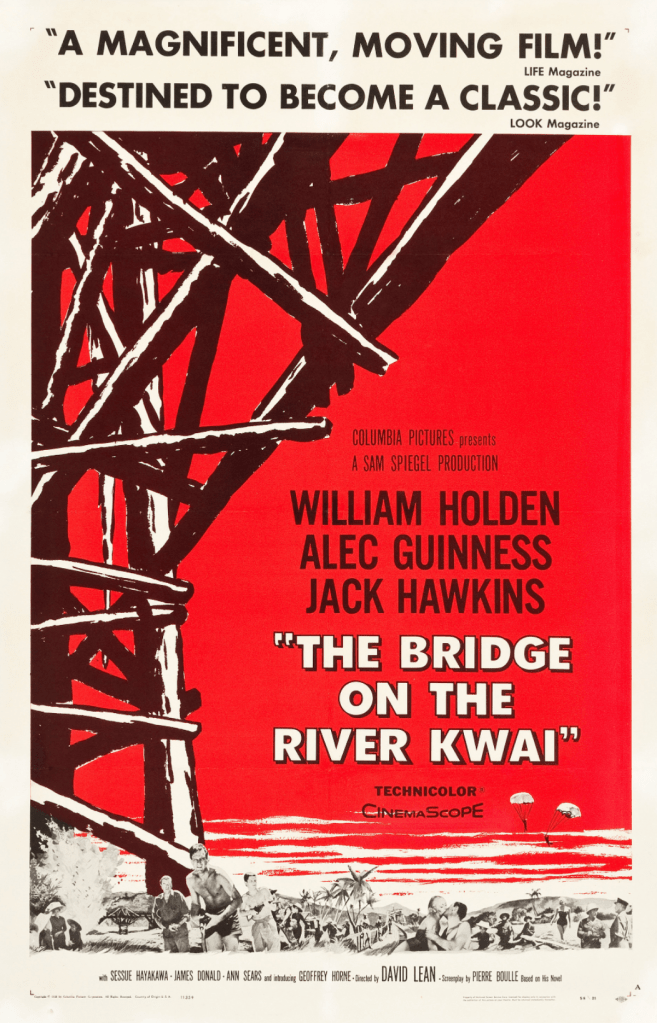
The Bridge on the River Kwai poster created by Horizon Pictures and Columbia Pictures

Things I liked about the film:

The acting: Since William Holden is one of the reasons why I chose to watch The Bridge on the River Kwai, I’ll talk about his performance first. This is not the first war film William has starred in. Four years prior to the release of The Bridge on the River Kwai, he appeared in Stalag 17. What makes his portrayal of Shears different from Sgt. J.J. Sefton is the material allowed William to expand his acting abilities. While on a beach at a nearby hospital, Shears is flirting with a female nurse. In this scene, William turns on the charm, sharing nice on-screen chemistry with Ann Sears. In the next scene, Shears carries a serious demeanor as he is called upon for a military mission. Out of Williams’ films I have seen, his character presents one of two personas: the “charmer” or the serious, no-nonsense man. In The Bridge on the River Kwai, Shears displayed both.

One of my favorite scenes is when Colonels Nicholson and Saito are attempting to make a negotiation. Colonel Saito, portrayed by Sessue Hayakawa, wants every member of Nicholson’s team to work on the bridge. Colonel Nicholson, portrayed by Alec Guinness, refuses this order. Prior to this scene, Nicholson stood his ground. He was even locked in a small hut because of his refusal. But Nicholson persevered, even carrying a dignified persona that ends up boosting the morale of his team. He consistently maintains this persona, especially during his meeting with Colonel Saito. This dignified, confident demeanor of Nicholson angers Saito. Up until that point, Saito presents himself in a professional manner. He is no-nonsense and doesn’t allow anyone to step out of line. But in his meeting with Nicholson, his anger becomes visible. Both Sessue and Alec gave different performances, portraying two different military leaders. Yet the strength of their acting abilities allowed them to go toe-to-toe with one another.

The scenery: The Bridge on the River Kwai had such magnificent scenery, it honestly stole the show! There are two locations I loved so much, I wanted to talk about them in my review. The first location is the hospital I just mentioned. The Mount Lavinia Hotel was the stand-in for the hospital. When looking at the exterior and grounds, one could see why this location was chosen. The trimmed lawn was a great contrast to the small white structure. The manicured gardens surrounding the hospital created a pleasant outdoor space. In the scene the hospital was featured in, a nearby beach was primarily showcased. The clear blue waters and bright sandy shore paired with the garden-esque surroundings illustrated a tropical oasis!

The second location is Major Warden’s office! Any time a scene took place in his office, glass windows in wooden frames were always open. This allowed the audience to see the beautiful view! Major Warden’s office overlooked a river. Sloping green hills sat on the sides of this river, contributing to the visually appealing view. Similar to the aforementioned hospital, Warden’s office also oversaw a trimmed lawn and manicured gardens. The spacious surroundings of this location presented the audience a peaceful atmosphere!

The music: There were some scenes in The Bridge on the River Kwai that included little to no dialogue. This decision led the film’s creative team to use music to elevate a scene’s tone. While stumbling through the jungle, Shears notices a group of vultures sitting on a nearby tree. As he walks through this environment, quiet orchestral music becomes louder. A “bird” appears out of nowhere, adding to the scene’s tension. The music gets even louder when Shears crosses paths with the “bird”. When the “bird” is revealed as a bird-shaped kite, the music stops. The tension and suspense of this scenario was accomplished by a combination of music and visuals!

The 5th Golden Boy Blogathon banner created by Virginie from The Wonderful World of Cinema, Emily from The Flapper Dame, and Michaela from Love Letters to Old Hollywood

What I didn’t like about the film:

A confusing first half: During the first half of The Bridge on the River Kwai, I was confused by what was happening in the story. This confusion was caused by the lack of explanations. At the prisoner camp, Colonel Saito continuously mentioned the importance of the titular bridge. He stresses how the bridge needs to be built on a specific day, even going so far as to claim he’ll commit suicide if the bridge isn’t built. What Colonel Saito failed to mentioned is the bridge’s purpose. Even though an explanation was eventually provided, it is given at the film’s half-way point. Had this information been given sooner, so much confusion could have been avoided.

A limited amount of urgency: In war films or films that involve a significant amount of action, a strong sense of urgency can be felt throughout the story. This sense of urgency encourages the audience to care about the safety and wellbeing of the characters. But because some scenes in The Bridge on the River Kwai were drawn out, the sense of urgency was limited. Toward the end of the movie, a climactic moment involving the story’s major players takes place. While I won’t spoil the movie, I will say this moment was drawn out a little longer than necessary. The action moved at a slower pace, which also effected the urgency. It seems like this creative decision was made to build suspense. However, it left me, at times, frustrated.

Inconsistent halves: Earlier in this review, I said William Holden was one of the reasons why I chose to watch The Bridge on the River Kwai. Interestingly, his character’s story was the one I found the most engaging. This movie features two major storylines: Colonel Nicholson’s team in the prisoner camp and Shears’ experiences in the military. Since Shears’ story was prominently featured in the film’s second half, I found that half the most interesting. With Shears’ story, there was a strong conflict and an even stronger part of the plot. Meanwhile, Colonel Nicholson’s story seemed to remain at a standstill. Like I also mentioned in this review, the film’s first half was confusing due to the lack of explanations. If The Bridge on the River Kwai had just focused on Shears’ story, the film as a whole would have been more intriguing.

Military plane image created by Brgfx at freepik.com. <a href=”https://www.freepik.com/free-photos-vectors/background”>Background vector created by brgfx – http://www.freepik.com</a>. Image found at freepik.com.

My overall impression:

Why is The Bridge on the River Kwai on AFI’s list of The 100 Greatest American Movies Of All Time? I’m not asking this to be disrespectful or mean. I’m asking out of curiosity. When I think of lists like AFI’s, I think of movies that fit one of two categories: those that represent the time they were released and those that brought something new to the cinematic table. With The Bridge on the River Kwai, I can’t see this film fitting into either category. As I mentioned in this review, Stalag 17 was released four years prior to The Bridge on the River Kwai. Heaven Knows, Mr. Allison was also released in 1957. With that said, what makes those two films less deserving of being on AFI’s list than The Bridge on the River Kwai? Off the top of my head, I can’t think of any cinematic advancements The Bridge on the River Kwai had to offer. The more films I watch from AFI’s list and the more I think of lists of this nature, I wonder what the criteria is? Was there criteria to begin with or is the list purely subjective? As I explore more “classics”, those are questions I will keep in mind.

Overall score: 7-7.1 out of 10

Have you watched any of William Holden’s movies? If so, which one would you like me to review next? Please tell me in the comment section!

Have fun at the movies!

Sally Silverscreen

Twentieth Century vs. Queen of the Damned at the Against the Crowd Blogathon

I’ve been participating in blogathons for three years. For most of those events, a variety of content was welcome, highlighting the broad nature of a chosen theme. The Against the Crowd Blogathon is a different type of event for me, as editorial style articles are preferred. I discovered this blogathon on the blog, Realweegiemidget Reviews, as Gill included it in a list of upcoming events. When I looked at past entries, I knew I could bring something new to the table. This blogathon asks their participants to share two movies; a movie you love that everyone hates and a movie everyone loves that you hate. For my entry, I chose to talk about two films I have reviewed before. While I will bring up points I brought up in my reviews, the purpose of this post is to explain why I like or don’t like a movie. This article is not meant to be disrespectful or mean-spirited. Everything I say will be solely based on my opinion.

Against the Crowd Blogathon 2021 banner created by Dell from Dell on Movies

A Film Everyone Loves, But You Hate

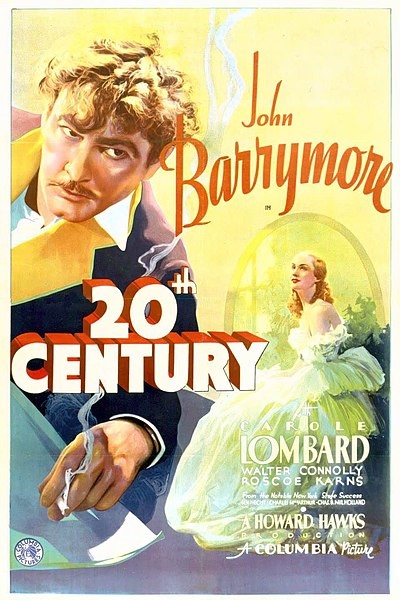
Twentieth Century poster created by Columbia Pictures.
Twentieth Century Rotten Tomatos score created by Rotten Tomatos

Remember on Seinfeld, when Elaine was the odd one out for not liking The English Patient? Well, the way she feels about that movie is the way I feel about Twentieth Century. Receiving a “fresh” critic score of 86% and a 7.4 out of 10 on IMDB, this film is considered beloved among cinephiles. Even legendary critic Leonard Maltin likes Twentieth Century. In his 1989 edition of TV Movies & Video Guide, Leonard not only gave the movie four out of four stars, but also called it a “super screwball comedy”. But the genre classification of this particular title is one of the reasons why I found this movie so bad, it was appalling.

When I reviewed Twentieth Century last November, I pointed out how the movie was labeled a “romantic comedy”. As someone who has watched my fair share of Hallmark Channel productions, I know the typical components of the “rom-com” genre. With the 1934 title, it doesn’t feel like a “rom-com”. That is because it is missing one key ingredient: likable characters. All of the characters are horrible to varying degrees. But the worst one is Oscar. He is so selfish, from “firing” his friends on multiple occasions to trying to break up an established relationship. Oscar is also abusive toward his girlfriend, Lilly. Throughout their relationship, Oscar is possessive and controlling. He goes so far as to physically hurt Lilly, even using his mortality as a manipulation tactic to keep her with him. To me, none of that screams “romantic” or “funny”. It is actually downright despicable. By placing Twentieth Century in the “rom-com” genre, the awfulness of the characters and their situations are completely undermined.

Take 3: Twentieth Century Review

The Top 10 Worst Movies I Saw in 2020

A Film You Love, But Everyone Hates

Queen of the Damned poster created by Warner Bros. Pictures. Image found at https://www.warnerbros.com/queen-damned

Isn’t it ironic how, for this blogathon, I chose two movies that feature a predominant abusive relationship? While I wouldn’t go so far as to say I love Queen of the Damned, I do enjoy it for what it is. In fact, I wrote two editorials related to the film, with one of them becoming my most popular editorial I’ve ever written. That article is about how unhealthy Lestat and Akasha’s relationship is. Unlike Twentieth Century, the characters surrounding this relationship realize how terrible it is. Akasha, who I explained in my editorial as the reason for the relationship’s problematic nature, also faces accountability for her behaviors and choices.

In my review of The Karate Kid Part II, I talked about how the sequel didn’t feel like a carbon copy of the first film. Despite having only seen the Interview with the Vampire trailer, I can tell Queen of the Damned’s creative team tried to give their project its own identity. As I said in my review, the 2002 project focuses on the new-school/modern gothic style. It also presents Lestat as a more likable protagonist. I did like how voice-overs from both Jesse and Lestat could be heard throughout the story. Like I said in my review, they provided depth to the script. To me, this movie is better than its soundtrack, an opinion that I’m sure is very unpopular. I also like Lestat and Jesse’s relationship.

Take 3: Queen of the Damned Review (Halloween Double Feature Part 2)

Toxic Valentine: Why Lestat and Akasha’s relationship is very problematic in Queen of the Damned (2002)

What is the Net Worth of the Characters from the ‘Queen of the Damned’ film?

Have fun at the movies!

Sally Silverscreen
Take 3: Twentieth Century Review

Originally, I was going to write a double feature for The Sixth Annual Barrymore Trilogy Blogathon by reviewing Twentieth Century and Young at Heart. However, due to technical difficulties on my end, I was only able to find the time to publish one review. Because I’ve written about five of Frank Sinatra’s movies this year, I chose to take a break by selecting Twentieth Century. Back in January, I watched and reviewed In Name Only for The Carole Lombard Memorial Blogathon. At the time, it was my first time seeing any film from Carole’s filmography. Despite this, I ended up liking the film! As I have mentioned before, I try to feature movies on my blog that were recommended by visitors and followers of 18 Cinema Lane. Twentieth Century was suggested by Patricia from Caftan Woman and Vincent from Carole & Co.

Twentieth Century poster created by Columbia Pictures.

Things I liked about the film:

The acting: In my review of In Name Only, I praised Carole’s portrayal of Julie Eden, as her on-screen personality was down-to-earth and her overall performance contained the right amount of emotion. Carole portrays Lily in Twentieth Century, a character who is very different from Julie in In Name Only. This is because Lily experiences frustration on several occasions. One example is when Lily is forced to stay late at rehearsal because Oscar wants her to scream. Lily’s emotions spill over, causing her to yell and burst into tears because of her pent-up frustration. These emotions were able to be felt through the screen because of how good Carole Lombard’s talents were in this film! Speaking of Oscar, I liked watching John Barrymore’s performance in Twentieth Century! It showed a transition from a theater director who seemed to have his heart in the right place to a man who let power and influence get to his head. After Lily’s first performance on stage, Oscar visits her in her dressing room. The way he speaks to her indicates he is putting all his attention on her. But when you look and listen closely, there are hints of his possessive mentality. A good example is when Oscar tells Lily she was a diamond who needed some polishing.

The set design: While watching Twentieth Century, there was some impressive set design I noticed! Toward the beginning of the film, Oscar’s office was shown. Dark wood walls surrounded the space, with a medium shot signifying the room’s high ceiling. Eye-catching details helped give the space a unique identity, such as the inclusion of a suit of armor and stained-glass windows. Details in other scenes stood out, stealing the show whenever they appeared on screen. Lily’s bed is just one example, a massive piece of furniture that was shaped like a boat. It’s white woodwork and bedding is paired beautifully with dark wood carvings on the bed. On the train, there are sketches of animals located near the ceiling of the sitting room area. The style of the sketches looked like they came from a storybook from Medieval times.

Carole’s wardrobe:  I really liked seeing Carole’s wardrobe in Twentieth Century! However, there were two outfits that were the most memorable! On the night of Lily’s first performance, she wears an off the shoulder sparkly white dress. Despite the film being presented in black-and-white, the sparkly nature of the dress shown through beautifully! The second outfit was a silk pair of pajamas, complete with fine detailing on the shirt. The pajamas complimented Carole very well, highlighting her true beauty!

Masks of comedy and tragedy images created by freepik at freepik.com. <a href=”https://www.freepik.com/free-photos-vectors/background”>Background vector created by freepik – http://www.freepik.com</a>. Image found at freepik.com.

What I didn’t like about the film:

The mystery: In Twentieth Century, there was an on-going mystery revolving around the appearance of religious stickers on the train. The mystery itself felt randomly placed in the overall story, offering no strong significance within the plot. Had the religious stickers served as a reminder to not lose personal beliefs and values in the quest for fame and fortune, that would have added a meaningful moral to the movie. Sadly, it was a small piece just to keep the plot moving forward. When the guilty party is finally revealed, it seems like the script is providing them with excuses for their destruction of public and personal property. This can be heard through the characters’ dialogue; from the train security saying the guilty party has a “sickness” to describing the guilty party as “a little crazy, but harmless”.

An awful group of characters: I understand characters from any movie are not going to be everyone’s “cup of tea”. However, there is a fine line between personal preference and the characters themselves being awful. Twentieth Century is a perfect example of this, featuring a host of characters that are unlikeable to varying degrees. Oscar treats everyone around him horribly. He “fires” his friends on multiple occasions and he is abusive toward Lily, even after their relationship ends. Despite this, Oscar’s friends still try to help him fix his relationship with Lily, even going so far as to blame her for Oscar’s failures. Meanwhile, Lily turns into a diva after she becomes a movie star. It got to the point where I found myself not caring about the characters’ outcomes because their ugly personalities made me lost investment in them.

Lily and Oscar’s abusive relationship: I briefly mentioned in my previous point that Oscar is abusive toward Lily, even after their relationship ends. In the beginning, when Lily was starting out as an actress, Oscar gives the impression of having her best interests in mind. An example of this is when, after Lily expresses her frustrations over staying late at rehearsal, Oscar reminds her of her dream and how he’ll help her reach that dream. As Lily’s career grows, so does Oscar’s jealousy and obsession. He not only controls Lily’s life, but he also physically harms her, poking her with a pin just to get her to scream on stage. Oscar even goes so far as to threaten suicide if Lily does not stay with him. Even though Lily ends the relationship, Oscar is still obsessed with her. One of his worst actions in Twentieth Century is faking his own death just to trick Lily into signing his contract.

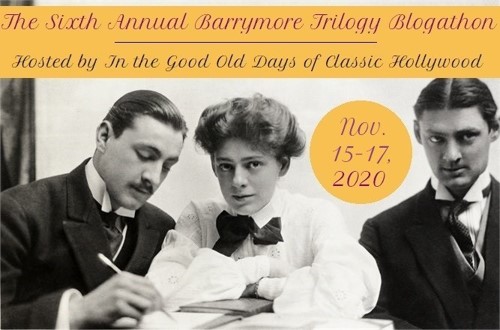
The Sixth Annual Barrymore Trilogy Blogathon banner created by Crystal from In the Good Old Days of Classic Hollywood.

My overall impression:

Back in January, when I reviewed Marriage on the Rocks, I said the film made me feel uncomfortable because of the movie’s one-sided view on marriage and divorce. Watching Twentieth Century made me appalled for several reasons. The abusive nature of Lily and Oscar’s relationship is just one example, especially since it exists throughout the whole film. It also doesn’t help that Oscar doesn’t face any accountability for his actions and behavior.  Another issue is the characters themselves, as all of them are horrible to certain degrees. Despite being poorly treated by Oscar, Oscar’s friends still support him. They even encourage Oscar to get back together with Lily. According to IMDB and Wikipedia, Twentieth Century is labeled as a “romantic comedy”. I will admit there were a handful of moments I found funny. But the aforementioned relationship, random mystery, terrible characters, and the story being ninety one minutes of those same characters complaining about their personal issues overshadows all of the movie’s strengths.

Overall score: 4.4 out of 10

Have you seen any of Carole Lombard’s or John Barrymore’s films? If so, which one do you like the most? Please let me know in the comment section!

Have fun at the movies!

Sally Silverscreen
Take 3: Finding Forrester Review

One of the available categories for the Leap Year Blogathon was to talk about “any movie or TV show you’ve always wanted to review but never had the chance to”. This is the approach I’ve chosen to take with Rebecca’s event. As I was scrolling through my DVR, I came across a movie called Finding Forrester. Ever since I read the film’s synopsis on BYUtv’s website several years ago, I have wanted to see this movie because the story sounded interesting. I even recorded it on my DVR in the hopes of watching it someday. Well, it looks like 2020 is the time when I’m finally getting around to talking about this film! I’ll be honest, I haven’t seen a lot of Sean Connery’s movies. The Russia House and The Great Train Robbery are the only films I’ve seen with Sean as one of the leads. While I thought the former was ok, I enjoyed the latter more than I thought I would. Now that this is the third picture of Sean’s I’ve watched, it’ll be interesting to see where Finding Forrester ranks among the other two films.

Finding Forrester poster
Finding Forrester poster created by Sony Pictures Releasing and Columbia Pictures. Image found at https://www.sonypictures.com/movies/findingforrester.

Things I liked about the film:

The acting: Finding Forrester is a story that grounds itself in reality. Because of this, the acting performances in this film come across as realistic portrayals. What this means is all the characters feel like real people. The genuine expressions and behaviors of each character shine through because of the quality of the actors’ talents. How the characters interact with each other is evident of this, especially within the friendship of Jamal and William. Depth was added to the characters because of the interactions they share. The dialogue was well-executed by the actors, causing the conversations to sound authentic. What works in this cast’s favor are the various personalities presented and the character development that takes place. A sense of intrigue is brought forth as a result of all of these elements.


The cinematography: Whenever this film’s creative team wanted the audience to focus on a particular person or object, they would adopt medium shots or close-ups to place a greater emphasis on that subject. During basketball tryouts, Jamal was playing against a senior team member from the private school. The rivalry between these two characters is the highlight of this scene, so medium shots are used to present them to the audience. When Jamal is removing his notebooks from his backpack, after the bag was retrieved from William’s apartment, close-ups implemented the importance of writing that serves as a consistent idea throughout the film. In two scenes, the reflection of Jamal can be seen from William’s binoculars. This is meant to foreshadow the connection these characters will share through their friendship. These cinematic techniques helped make the cinematography stand out in this project!


The incorporation of knowledge: Like writing, the idea of knowledge is consistent in Finding Forrester. The way it was incorporated into this story was seamless and showed how important it can be to any individual. One example is when Jamal is explaining a brief history of the BMW to William’s acquaintance. This information not only helped Jamal stand up for himself, but it also educated the audience about one of the world’s most iconic car companies. The knowledge that William and Jamal share about writing is another great example. During a debate about the rules of writing, they are able to express their ideas and view the perspective of the other person. This scene shows that, with knowledge, one can be a part of something greater than themselves. It also shows that knowledge can create a connection between people.

Leap Year Blogathon banner
The Leap Year Blogathon banner created by Rebecca from Taking Up Room. Image found at https://takinguproom.wordpress.com/2019/12/06/announcing-the-leap-year-blogathon/.

What I didn’t like about the film:

The lighting: Most of the lighting in Finding Forrester is dim. This allows the overall color palette to appear darker on screen. However, it also makes it difficult to see what is happening in the film. The scenes taking place in William’s apartment experienced this issue. Because of the dimmed lighting, it was sometimes difficult to see Jamal’s and William’s face in these scenes. Half of this movie is centered around Jamal and William’s friendship, which means that half of the overall picture features the dim surroundings of William’s apartment.


Scenes that become padding: There are several scenes in Finding Forrester that become padding. One example is when Jamal’s friends are shown spending time together at a restaurant. This moment had no bearing on the story and didn’t progress the plot forward. It also doesn’t have a strong need to exist in the narrative. Scenes like these felt like they were placed in the movie for the sake of satisfying the run-time. If some of these scenes were cut, the film would have been shorter and the script could have been a bit tighter.

05
Typewriter image created by Freepik at freepik.com. <a href=’https://www.freepik.com/free-vector/typewriter-and-paper-sheet_713020.htm’>Designed by Freepik</a>. <a href=”https://www.freepik.com/free-photos-vectors/vintage”>Vintage vector created by Freepik</a>. Image found at freepik.com.

My overall impression:

Someone I know once told me that knowledge is one of the most valuable possessions a person can own. When it’s earned, it can never be taken away from you. This is expressed very well in Finding Forrester, a solid and satisfying picture! While this movie is more of a character study, this concept works in the film’s favor. The delivery of the script and acting performances gave me an opportunity to stay invested in the characters and their interactions. The messages of integrity, self-worth, and knowledge have the potential to be relatable among audience members. They can also inspire people to pursue their talents and believe in their strengths. Finding Forrester is a movie that I’m glad I made the time to see. I’d like to thank Rebecca for giving me this opportunity through her Leap Year Blogathon!


Overall score: 8.2 out of 10


Is there a movie you’ve always to see, but never made time for? What are your plans for Leap Year? Share your thoughts in the comment section!


Have fun at the movies!

Sally Silverscreen
Take 3: Platinum Blonde Review + 150 Follower Thank You

Last month, I received 150 followers! But because of how much time and energy was devoted to writing my editorial for Pale Writer’s Gothic Horror Blogathon, I decided to publish this review in early November. The movie I selected, Platinum Blonde, was released on Halloween in 1931. Since I reviewed Vampyr for my previous blog follower dedication review, I chose Platinum Blonde because, based on the synopsis, it gives the impression that it has a lighter tone. It’s also the first movie of Jean Harlow’s that I’ve ever seen. I discovered this actress through The Jean Harlow Blogathon, hosted by the blogs Musings of a Classic Film Addict and The Wonderful World of Cinema. Even though I didn’t participate in this blogathon, I was introduced to Jean and her contributions to the world of film. Before I begin this review, I want to thank each and every one of my followers! I’m not only impressed by how quickly I reached this milestone, but also by your continued support of 18 Cinema Lane!

Picture1
Platinum Blonde poster image created by Columbia Pictures. Image found at commons.wikimedia.org/wiki/File:PlatBlonde.jpg

Things I liked about the film:

The acting: I was very impressed by the acting performances in Platinum Blonde! This is because all of the portrayals were consistent and expressive. One good example is Robert Williams’ performance. Throughout the film, his portrayal of Stew Smith was charismatic. He almost always had something witty to say and also had an appealing persona. Robert had good on-screen chemistry with both of his female co-stars as well. Jean Harlow had a pleasant on-screen presence while portraying Ann Schuyler. Her personality was charming and she helped create a character that was different from stereotypical expectations. Jean also had a good on-screen relationship with her co-stars. I really liked seeing this film’s supporting cast! Louise Closser Hale was a standout as Mrs. Schuyler! She was very expressive and her performance was memorable from start to finish! This cast would not have been the same without her.


The set design: Most of this story takes place in and around the Schuyler home. Despite this lack of variety in locations, the interior and exterior of the house was spectacular! The layout of the entryway and foyer reminded me of Norma Desmond’s house from Sunset Blvd., from the metal gate to the large, curving staircase. Everything in the Schuyler house was massive in scale. This environment represented how larger than life the family is. Even the small details found in the home highlighted this lavish lifestyle very well. One perfect example is the carved artwork on Ann and Stew’s headboard. While the exterior was shown on screen for a limited amount of time, it had a pleasant presence on film! In the scene where Ann and Stew share a kiss for the first time, the backyard appeared as a private oasis. From the lighted fountain to the flower arrangements, this space looked very inviting.


The cinematography: I wasn’t expecting anything special in Platinum Blonde when it came to the cinematography. But I was pleasantly surprised by the cinematography I did find in this film. In some scenes, when a character would walk up the stairs, the view from the camera looked down on the characters. This presented an illusion that the environment surrounding these individuals was grand in scale. Another scene that had interesting cinematography was when Mrs. Schuyler and the butler, Smythe, were on the balcony looking down on the living room. Because the camera angle came from a ground level perspective, it gave the audience the idea that most of Ann’s family looked down on Stew, both literally and figuratively. It also alluded to the differences in socio-economic standing.

OYHKOT0
Newspaper image created by Zlatko_plamenov at freepik.com. <a href=’https://www.freepik.com/free-psd/newspaper-mockup_1386098.htm’>Designed by Freepik</a>. <a href=”https://www.freepik.com/free-photos-vectors/mockup”>Mockup psd created by Zlatko_plamenov – Freepik.com</a>. Image found at freepik.com.

What I didn’t like about the film:

Under-utilized characters: At the beginning of the film, the character of Bingy Baker was introduced. I thought he would experience one hilarious situation after another while also finding true love. Sadly, this particular character received a very minor role. It also seemed like he was there just for the sake of comic relief. Bingy is an example of how some characters in this movie were under-utilized. If this character were removed from the story, it wouldn’t have made much of a difference.


An unexplained conflict: The start of the film features a conflict about Ann’s brother’s, Michael’s, relationship with a dancer. This is how Stew came to be introduced to the Schuyler family. While the characters kept saying that the situation was bad, they failed to explain why it was bad. With the conflict of Ann and Stew getting married, the audience was given reasons why this was a problem through the visualization of certain events. But this was not the case for Michael’s conflict, as it evidently seemed to be swept under the rug.


A somewhat unhealthy relationship: As I already mentioned, Platinum Blonde’s major conflict revolved around Ann and Stew’s relationship. While there were times when it seemed like they cared about one another, there were also times when their relationship came across as unhealthy. For most of the film, Ann and Stew do not make compromises. The audience gets to see them talking to one another, but these two characters don’t communicate about important martial issues, such as which place they will call “home”. At one point, one member of this relationship becomes hypocritical toward their spouse. Even though this film was created in the early ‘30s, I still found elements of this relationship to be kind of concerning.

101994-OM0XMB-226
Money image created by Freepik at freepik.com. <a href=’https://www.freepik.com/free-vector/bills-and-coins-in-isometric-design_1065328.htm’>Designed by Freepik</a>. <a href=”https://www.freepik.com/free-photos-vectors/business”>Business vector created by Freepik</a>. Image found at freepik.com.

My overall impression:

On Wikipedia, Platinum Blonde is labeled as a “romantic comedy”. But, in reality, the movie is a cautionary “fish out of water” tale. The reason why I chose to review this film is because I thought it would be lighter in tone. However, Platinum Blonde wasn’t as light-hearted as I expected. Sure, there was at least one romance and some humorous moments. But it wasn’t enough to live up to the title of “romantic comedy”. Despite this disappointment, I did like some elements of this movie. One of these was the cinematography. Because of the camera angles, the scenery was not only complimented, but ideas and themes were able to visually present themselves. Platinum Blonde wasn’t the worst thing to be put to film, but it definitely could have been stronger.


Overall score: 6 out of 10


Are you a fan of Jean Harlow? Which film from the ‘30s do you want me to review? Tell me in the comment section!


Have fun at the movies!

Sally Silverscreen