Comparing with the Critics – Best of 1988 – Wings of Desire

This review is from my series, Comparing with the Critics. If you’d like to learn more about the series, click on the link below.

Introducing my new series, Comparing with the Critics!

Five years ago, I advocated for the release of The Crow: City of Angels’ Tim Pope cut. This version of the movie was not only supposed to be 160-minutes, it was also supposed to tell a different story from its predecessor. The Crow: City of Angels’ intended conflict showed the protagonist, Ashe, choosing between reuniting with his son, Danny, in the afterlife or staying on Earth to form a romantic relationship with Sarah, who appeared in The Crow. When Roger Ebert brought up Wings of Desire in Siskel & Ebert’s Best of 1988 episode, he said the film was “about an angel who wants to be a human because he would rather have real, physical feelings than live forever”. His explanation of Wings of Desire reminded me of The Crow: City of Angels’ intended conflict I described. Since I don’t know if and/or when the Tim Pope cut of The Crow: City of Angels will be released, Wings of Desire will be my unofficial placeholder in terms of storytelling. The other reason why I chose Wings of Desire for my Comparing with the Critics series’ Best of 1988 review is because it was on Roger’s list of the ten best films of 1988, even though both he and Gene Siskel liked it. I approached this film with an open mind because I had never seen or heard of it prior to my series. Now that I have seen Wings of Desire, I think calling it one of the best movies of the year is giving the film a little too much credit.
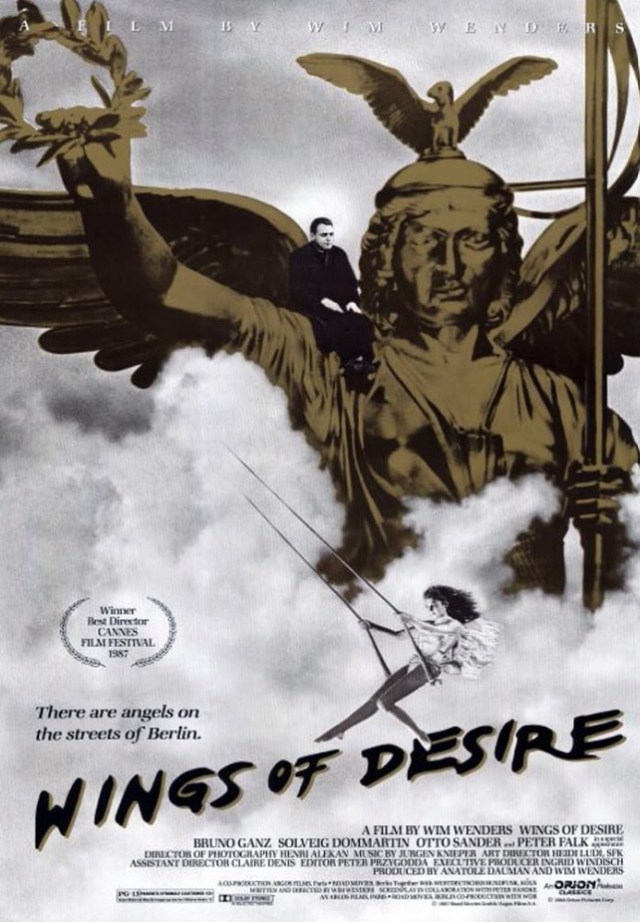
Wings of Desire poster created by Road Movies Filmproduktion, Argos Films, Westdeutscher Rundfunk (WDR), Wim Wenders Stiftung, Orion Classics, Basis-Film Verleih, and Filmverlag der Autoren

As I said in the introduction of this review, both Roger and Gene liked Wings of Desire. In an episode of Siskel & Ebert, they gave the film a thumbs-up. Roger commented on how the movie “has a mood to it. It takes the time to establish that mood”. Meanwhile, Gene points out that Wings of Desire “gives more than equal time to the angels’ thoughts”. What Roger and Gene said was achieved through mise-en-scène and music. A great example is when Damiel (portrayed by Bruno Ganz) is at a crossroads over whether he truly wants to become human or remain an angel. The majority of the scene is presented through “shaky cam”, giving the illusion Damiel is quickly turning his head and moving in circles. Sharp, quick violin sounds play over the scene, heightening Damiel’s panic and confusion. Shots of humans crying or looking frightened are interspersed throughout the scene. This creative choice reflects Damiel’s thoughts and feelings. Whenever “shaky cam” is incorporated into a movie, it is usually met with criticism due to how the film-making technique distorts a scene to the point of becoming unwatchable. However, the use of “shaky cam” in Wings of Desire is one of the few times where it works. This is because that creative decision was utilized purposefully to enhance the emotional aspect of the story.

Since there are angels in Wings of Desire, I thought adding this angel picture to my review made sense. Screenshot taken by me, Sally Silverscreen.

Wings of Desire is mostly presented in black-and-white imagery. But there are a handful of scenes shown in color. This creative choice differentiates the perspective between the angels and the humans. Damiel and Cassiel, two angels from the film’s main cast of characters, see the human world in black-and-white, as they are outsiders looking in. The humans’ environment is visually represented in color, showcasing life in 1980s West Berlin. Black-and-white and color imagery’s incorporation into Wings of Desire is purposeful as it addresses concepts like a sense of belonging, unique points of view, and what it means to be a part of a community. Wings of Desire’s creative decision reminded me of Schindler’s List, a black-and-white movie that occasionally utilized color to emphasize certain ideas.

Map of Germany image created by Macrovector at freepik.com. Background vector created by macrovector – www.freepik.com. Image found at freepik.com.

Another visual aspect of the movie I liked was Marion’s wardrobe. In Wings of Desire, Marion (portrayed by Solveig Dommartin) is a trapeze artist who is afraid her dream may be coming to an end due to the circus’ struggling finances. Her performances give her an excuse to wear gorgeous costumes! When she is first introduced in the story, Marion wears a long-sleeved leotard with an attached skirt. This costume is made up of a beige velour-like material and covered in diamond-esque gems. The shoulders of the costume feature a shiny applique. To give circus attendants the impression Marion is a flying angel, she wears large, white wings while performing in the air. The exquisiteness of Marion’s costumes makes me wish they were shown in color more consistently. I also wish Wings of Desire’s costume designer, Monika Jacobs, was nominated for, at least, one award.

Group of clowns image created by Freepik at freepik.com. Image by Freepik

After a clip of Wings of Desire was presented on Siskel & Ebert, Gene declares “the juiciest part of this picture is how close we get to everyday people, their joys, their heartbreaks”. He also says, “director, Wim Wenders, does a real remarkable thing here; he praises life as it is lived, yet making sense out of life’s confusions to the point where we enjoy being alive in a fresh way”. While I agree with Gene about the realistic portrayal of the humans’ lives, I wish the dialogue had sounded more realistic. Every time a character speaks, they deliver philosophical speeches instead of conversations. This made the characters sound like they were spending more time expressing ideas than putting ideas into action. Though looking back on Wings of Desire, I wonder if that was intended commentary on how people spend less time solving problems and more time talking about them?

Breaking heart image created by Kjpargeter at freepik.com. <a href=’https://www.freepik.com/free-vector/broken-heart-valentine-background_1041991.htm’>Designed by Freepik</a>. <a href=”https://www.freepik.com/free-photos-vectors/background”>Background vector created by Kjpargeter – Freepik.com</a>. Image found at freepik.com.

Like I mentioned earlier in my review, Damiel and Cassiel are outsiders looking in on the human world. Despite this, both angels observe, listen, and occasionally intervene in the humans’ lives. That means Wings of Desire’s audience can hear the thoughts of the humans Cassiel and Damiel cross paths with. But because the angels are disconnected from the human world, story ideas are either loosely connected or not connected at all. A man’s parents concerned over his musical ambitions serve as one example, with the concerns themselves brought up but never resolved. There are four main plots within Wings of Desire. However, only three of them were related to each other. Plus, these three plots didn’t connect until toward the end of the movie. Waiting for the bridges of the plots to form felt tedious, in my opinion.
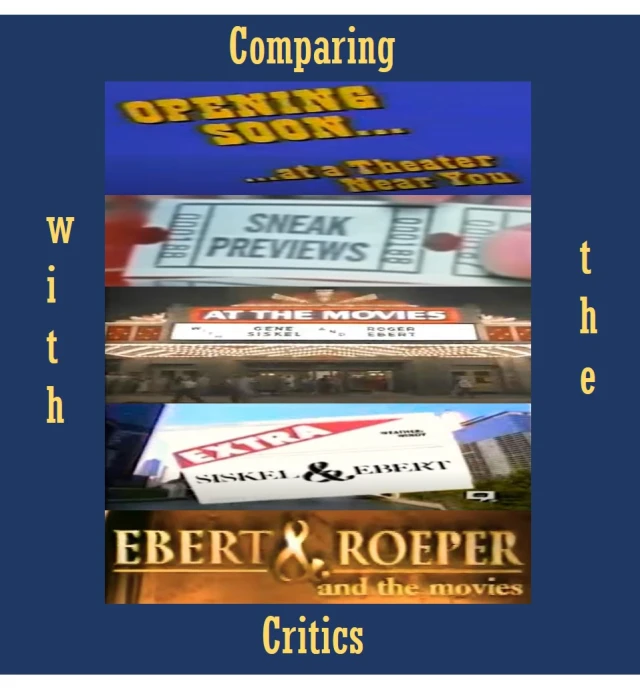
Comparing with the Critics banner created by me, Sally Silverscreen. TV show title cards created by WTTW National Productions, WTTW, Public Broadcasting Service (PBS), Lifetime Television, Tribune Entertainment, Buena Vista Television, and Disney-ABC Domestic Television

In the introduction of this review, I said calling Wings of Desire one of the best movies of the year is giving the film a little too much credit. It’s not a bad movie, I just didn’t like or love it as much as Roger and Gene did. Wings of Desire is a fine, interesting film that kept me invested in what was happening on screen. The movie also has artistic merit due to creative decisions purposefully incorporated into the project. But major flaws lie in the script. I wish dialogue between characters sounded more conversational, as it would have complimented the realistic depiction of life in 1980s West Berlin. Story ideas should have developed stronger connections to one another, especially among the four main plots. Waiting for three of those main plots to connect was, in my opinion, tedious. During their discussion of Wings of Desire on their show, Siskel & Ebert, Gene tells Roger how Wim Wenders “doesn’t sweeten life to the point that it’s false”. Looking back on my experience watching the movie, I can see, and even appreciate, Gene’s point. Wings of Desire captures Germany before the Berlin Wall would eventually fall.  The Wall itself is even featured in a few scenes. Through visuals, text, and even musical selection, the edge of change I addressed in my 1988 introduction of Comparing with the Critics was brought to life on the big screen. The creative team behind Wings of Desire played a small role in history, even if they didn’t know it at that time.

This review was brought to you by

Sally Silverscreen
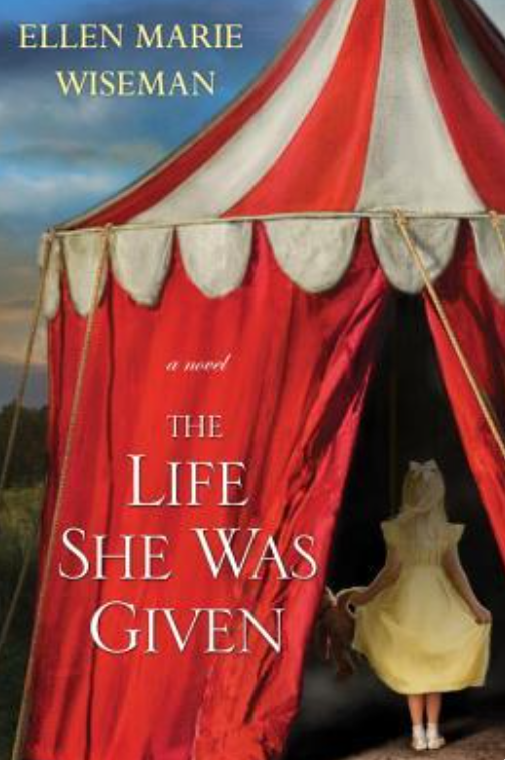
Buzzwordathon 2023: Review of ‘The Life She Was Given’ by Ellen Marie Wiseman

In my post about what readers can look forward to on my blog this year, I shared my results of 2022’s Buzzwordathon readathon. Because I had four fails and didn’t finish reading December’s book before the end of the year, I chose to participate in 2023’s Buzzwordathon in an attempt to improve my results. Though I’m publishing my review for January’s selection in February, I did complete the book in the month of January. That book is The Life She Was Given by Ellen Marie Wiseman, as the theme for January was ‘life and death’. This means the words ‘life’ or ‘death’ had to be featured in the title.

The Life She Was Given book cover found on Goodreads

One component that can affect my reading experience is the quality of descriptive imagery. This part of the story is what helps readers picture characters, events, and locations in their mind. Throughout The Life She Was Given, Ellen uses comparisons to elaborate on an intended point. An example is when she described the physical appearance of Merrick, an employee of The Barlow Brothers’ Circus. When one of the protagonists, Lilly, meets Merrick for the first time, “his face reminded Lilly of pictures she’d seen of the moon, with craters and dents and rocky parts”. In fact, Merrick was sometimes referred to as “the moon-faced man”. By comparing his face with the uneven surface of the moon, Ellen is not only describing Merrick in greater detail, she also writes how a child would view the world around them.

Group of clowns image created by Freepik at freepik.com. Image by Freepik

What drew me into wanting to read The Life She Was Given was the mystery surrounding Blackwood Manor, the home inherited by the book’s other protagonist, Julia. While the mystery itself was intriguing and held my attention, it wasn’t prioritized within Julia’s chapters. Instead, more focus was given to taking care of the horses on the Manor’s farm. Readers learn more about Claude, the man in charge of the farm, and Fletcher, the veterinarian, as well as their connection to Blackwood Manor. But because the mystery was not emphasized in most of Julia’s chapters, it took Julia almost the entire book to solve the mystery.

White horse image created by Gabor Palla at freeimages.com. “FreeImages.com/Gabor Palla.”

The Life She Was Given is a tough book to get through. This is not a poorly written piece of literature and I thought the book itself was just fine. The reason why The Life She Was Given is a tough book to get through is because of some of the topics included, which are heavier in nature. Some of these topics are abuse, violence, and mistreatment of animals. Ellen incorporates these subjects into her story in an honest way, not sugar-coating anything or holding back any punches. If you choose to read this book, please be aware of this fact before you start reading.

Overall score: 3.6 out of 5 stars

Have fun during Buzzwordathon!

Sally Silverscreen

Disclaimer: As I said in my review, The Life She Was Given contains heavier subjects, such as abuse, violence, and mistreatment of animals. Other content some readers may find offensive are the following:

Characters swearing at several moments in the story

Lilly being placed in some concerning situations, such as underage drinking

Dialogue reflective of the 1930s and 1950s

One chapter featuring a horse giving birth

Mentions are characters dying, including a drunk driving accident

Reference to alcoholism

Take 3: When the Circus Came to Town Review

For many film fans, Christopher Plummer will best be remembered as Captain von Trapp, from The Sound of Music. A poised and serious man, Captain von Trapp is a leader who stood his ground, even if that meant leaving behind everything he and his family have ever known. In the 1981, made-for-TV movie, When the Circus Came to Town, Christopher portrays a character who is seen as a leader. But this time, the leadership role is much different. For The Charismatic Christopher Plummer Blogathon, I wanted to go off the beaten path when it came to Christopher’s filmography. If it wasn’t for this event, I never would have heard of this television film. When I read the synopsis for When the Circus Came to Town, the story sounded heart-felt and somewhat inspirational, as it revolves around a woman who joins a circus in order to seek a change in her life. But is my entry for the blogathon as “razzle-dazzle” as the circus appears to be? Keep reading the greatest review on earth in order to find out!

When the Circus Came to Town advisement created by Entheos Unlimited Productions, Meteor Films, and CBS 

Things I liked about the film:

The acting: While watching When the Circus Came to Town, I kept wondering if Christopher Plummer had ever been cast in a Western. That’s because his portrayal of Duke, the circus ringmaster, felt reminiscent of the cowboys who are unfazed by their lifestyle. When Duke and Mary, portrayed by Elizabeth Montgomery, meet for the first time, Christopher’s tone of voice and the way his character speaks to Mary are nonchalant and matter-of-fact. His whole demeanor exudes a “been there, done there” attitude, a man who has been on the road for far too long. But when Christopher needed to turn on the charm, he effectively brought showmanship to his character. The film’s very first scene is a perfect example of this, as Christopher carries his character with charm and confidence.

As I mentioned in the introduction, When the Circus Came to Town revolves around Mary, a woman who joins a circus in order to seek a change in her life. Elizabeth portrayed this character, showcasing Mary’s transformation from a quiet woman who tried not make waves to a confident lady who was not afraid to take a leap of faith. At her father’s funeral, some of the attendants were asking Mary questions. Overwhelmed by the uncertainty of her future and frustrated by other people answering questions for her, she excuses herself from the conversation. But before she leaves, Mary answers every question given to her at the reception. The way she answers these questions is matter-of-fact, with a sharpness in her tone of voice. This scene seemed like foreshadowing, confidence ready to burst forth in Mary’s heart.

When Mary was interested in joining the circus, she met Louie, one of the circus’ clowns. Portrayed by Tommy Madden, Louie had a charismatic and easy-going personality. He even had a good sense of humor, allowing nothing to stand in his way. Louie was the kind of friend an audience member would wish they could have in their life, a one-in-a-million kind of person. Tommy’s on-screen chemistry with Elizabeth was pleasant! This made me look forward to Louie and Mary’s interactions, as these characters appeared to get along well with each other.

The dialogue: Dialogue in made-for-TV movies can be hit or miss. Sometimes, characters’ conversations sound like they came directly from real-life. Other times, the dialogue can make viewers think, “No one talks like that”. In When the Circus Came to Town, there were times when the dialogue was more profound than I expected. When Mary first meets Louie, she confesses how she ran away from home. After Louie jokingly asks her if she’s too old to run away, Mary says in a sad, serious tone, “I had to wait for everybody to die so I could do it”. Up until this point in the story, Mary has felt she hasn’t lived life on her own terms. She has either put the needs of others before her own or she, simply, went through life’s motions. This has made Mary question who she really is and what she truly wants out of life. Her aforementioned quote, to me, spoke volumes. It also showed how much thought went into the dialogue.

A peek behind the circus’ curtain: When any industry is prominently featured in a story, a film’s creative team has an opportunity to give the audience a chance to glimpse some of its realities. One of these realities is showing a behind the scenes look at what it takes to make that industry work. The titular circus in When the Circus Came to Town sometimes displays the practice, care, and determination it takes to make something like a circus appear effortless. Mary’s first job was cleaning the animals’ cages. While the job itself wasn’t showstopping, it was an important one. This also highlights how every role is a necessary one, especially since it takes so many people to put on a show.

The Charismatic Christopher Plummer Blogathon created by Gill from Realweegiemidget Reviews and Gabriela from Pale Writer

What I didn’t like about the film:

Christopher Plummer and Elizabeth Montgomery’s on-screen chemistry: Elizabeth and Christopher did a good job with the acting material they were given, as their individual performances were strong. Unfortunately, their on-screen chemistry was weak. The way Duke was written was part of this problem. The circus’ ringmaster was a womanizer who was a little too friendly with the alcohol. Duke was also a more static character, not displaying a strong desire to change his ways. This left me wondering why Mary would try to attract Duke’s attention, especially since Louie had the better personality?

No overarching plot: Like I said in the introduction, When the Circus Came to Town’s story revolved around Mary joining the circus. However, that part of the story is the hook, the part that encourages the audience to become interested in the film. What this movie was missing was an overarching plot, the part of the story that keeps the audience invested. Once Mary joined the circus, the script bounced around between Mary, Louie, Duke, and Jessy, the circus’ accountant. There was one part of the story that addressed the circus’ financial woes. Even though this could have served as an overarching conflict/plot, it was introduced in the last twenty-eight minutes of the movie. To me, this was a missed opportunity.

A limited distribution of character development: When the Circus Came to Town had the same flaw Top Gun: Maverick did: there was a limited supply of character development. In my point where I talked about no overarching plot, I said the story bounced around between Mary, Louie, Duke, and Jessy. These four characters received the most character development in the story. The other characters, especially those from the circus, either didn’t receive any character development or just enough for the audience to become familiar with them. When a film has a larger cast, I know it can be difficult to give each cast member and their character attention. Personally, I think there was not enough time to address all these characters and stories.

Group of clowns image created by Freepik at freepik.com. Image by Freepik

My overall impression:

Ringmasters have, sometimes, referred to their circus as “the greatest show on earth”. This bold statement has signified the circus company’s confidence and satisfaction in their final product; the show itself. That aforementioned quote can’t be said about When the Circus Came to Town. This is not a bad film, as it does contain strengths. Some of these are the acting performances and the profound dialogue. If I had to be honest, though, this story would have worked better as either a multi-part mini-series or a television show. The 1981, made-for-TV production featured so many moving parts. An hour and thirty six minutes is, in my opinion, not enough time to address all of that. Reflecting on When the Circus Came to Town and The Sound of Music, Christopher Plummer was cast as a leader. Out of his projects I’ve seen, this seems like pure coincidence. However, I’d like to point out Christopher’s portrayals in both When the Circus Came to Town and The Sound of Music highlight his acting versatility.

Overall score: 6 out of 10

Have you seen any of Christopher Plummer’s films? Are there any you’d like me to review? Please tell me in the comment section!

Have fun at the movies!

Sally Silverscreen

Take 3: Vampire Circus Review

Blogathons are a great opportunity to be introduced to new genres, films, and talents. For me, that has certainly been the case for The Third Hammer-Amicus Blogathon. Because this was my first time watching any Hammer-Amicus production, I had to research which title I would write about for the event. On Wikipedia, I stumbled across the 1972 film, Vampire Circus. The film’s title immediately caught my attention, as I’ve never seen a vampire led circus before. Movies revolving around vampires are no stranger to 18 Cinema Lane. As of October 2021, I have reviewed five vampire films, with Vampire Circus now being the sixth title. These projects have received favorable reviews, with each one being enjoyable to varying degrees. How will Vampire Circus fare among the other vampire films I’ve seen? Keep reading, as the show is about to begin!

Vampire Circus poster created by Rank Film Distributors and 20th Century Fox.

Things I liked about the film:

The acting: As I said in the introduction, this was my first time watching any Hammer-Amicus production. But during my experience viewing Vampire Circus, I could tell the actors and actresses involved were invested in their roles! Whenever a circus is incorporated into a story, the ringleader is usually a man. So, it was interesting to see a woman leading a circus in Vampire Circus. Confidence and a no-nonsense attitude are the traits I associate with a circus ringleader. While portraying the Gypsy Woman, Adrienne Corri effectively brought those traits to her character! Adrienne also had the ability to command attention from the audience. This is due to the strong on-screen personality she presented.

While watching Vampire Circus, I was impressed by the performances of the younger actors and actresses. Two of these stand-out performances came from John Moulder-Brown and Lynne Frederick! Portraying Anton Kersh and Dora Müller, these actors had surprisingly good on-screen chemistry. They also performed well together and individually. John and Lynne’s interactions felt believable, like their characters truly cared about each other. It made me wish they had starred in a production of Romeo and Juliet!

The historical accuracy: Vampire Circus takes place in the 19th century, which contains the years 1801 to 1900. As soon as the movie started, I noticed the creative team’s focus on making their production look historically accurate! Two of the characters, Anna Müller and Jenny Schilt, wear dresses that appear like they came directly from that time period, reminding me of stories like Pride and Prejudice and American Girl’s Caroline series. The costumes for the male characters are also reminiscent of these stories. The props and set designs were historically accurate as well! A good example were the circus wagons. Their structural build reflected the classic circus images seen on antique posters and art work. The signs for “Circus of Night” and the “Hall of Mirrors” presented an art style that was present during that time. With all these elements coming together, I felt transported to the 19th century!

Introducing the “photogenic vampire”: I have heard people give Anne Rice’s Vampire Chronicles series credit to creating the concept of “photogenic vampires”. But personally, I think Vampire Circus deserves that credit, as the movie was released before Interview with the Vampire was published. The vampires in Vampire Circus appeared beautiful, looking like potential supermodels. A perfect example is Emil, who was also a circus performer. One of the young women in the town of Stetl, Rosa, develops a crush on Emil after the circus’ first performance. When you take one look at Emil, it is easy to see why Rosa would be interested in him. This simple creative decision allowed Vampire Circus to make a significant contribution to the world of vampire stories!

The Third Hammer-Amicus Blogathon banner created by Gill from Realweegiemidget Reviews and Barry from Cinematic Catharsis

What I didn’t like about the film:

Confusing parts of the story: The Bürgermeister’s daughter, Rosa, is attracted to Emil, one of the circus performers. In one scene, she is telling her mother how Emil is not like other guys, as he has traveled the world and is more cultured because of it. But in earlier scenes, we don’t get to see these characters converse with one another. All that is provided to the audience is Emil and Rosa meeting at the circus for the first time and seeing them have intercourse shortly after they met. How would Rosa know all that information about Emil if she barely spoke with him? Did she and Emil talk with each other off-screen? This is just one part of the story that I feel needed context.

The underutilization of animals: When the circus comes to the town of Stetl, they bring three animals: a panther, a tiger, and a chimpanzee. Throughout the film, the chimpanzee and tiger stayed in their cages. Meanwhile, the panther was seen out of its cage about two or three times. In the world of film, animals are a part of a production to either be showcased as naturally as possible or to be shown doing something cool. In Vampire Circus, when there was an opportunity to prominently feature the tiger, a dancing woman painted as a tiger took its place. With all that said, it makes me wonder why there were animals in the movie at all?

Inconsistent traits among the vampires: In fiction, there are many different vampires who carry a variety of skills and traits. Within Vampire Circus, however, the traits of the vampires felt inconsistent. Two of the vampires in the story, Heinrich and Helga, are sensitive toward crucifixes. But when a crucifix is presented to the Strongman, he ends up crushing it with no sensitivities. Does this mean the Strongman wasn’t a vampire or was he simply not bothered by crucifixes? Over the course of the story, Emil is revealed to be a shapeshifter. At various moments in the film, he transforms into a panther, the same panther the circus brings to town. Meanwhile, as I mentioned before, the tiger and chimpanzee stayed in their cages. Was Emil the only shapeshifter in the circus? Were the animals simply animals?

Happy vampire image created by Freepik at freepik.com. <a href=’https://www.freepik.com/free-vector/several-vampires-ready-for-halloween_1317599.htm’>Designed by Freepik</a>. <a href=”https://www.freepik.com/free-photos-vectors/party”>Party vector created by Freepik</a>. Image found at freepik.com.

My overall impression:

Vampire Circus introduced the concept of “photogenic vampires”. For this, I will give the film credit where it is due. But when I think about this 1972 production, I’m confused of what its intention was. On the one hand, all the actors and actresses seemed invested in the roles they were given. But, on the other hand, a stuffed animal could be plainly seen during a scene where a group of characters were attacked in a forest. Was this movie supposed to be “so bad it’s good” or a horror movie with a pinch of humor? There were also parts of the story that I found confusing. However, the film was interesting enough to keep me invested in what was happening on screen. Therefore, I found Vampire Circus to be just ok.

Overall score: 6 out of 10

Have you seen any Hammer-Amicus films? Are there any vampire films you enjoy watching? Please tell me in the comment section!

Have fun at the movies!

Sally Silverscreen