Take 3: Blackbeard, the Pirate Review

Pirate films are rarely covered on 18 Cinema Lane. In fact, the only three I’ve reviewed are The Princess and the Pirate (which I liked), Captain Sabertooth and the Treasure of Lama Rama (which I found disappointing), and China Seas (which was just ok). This is one of the reasons why I chose to write about the 1952 movie, Blackbeard, the Pirate! The other reason is Linda Darnell’s involvement, as she is the subject of the Linda Darnell Centennial Blogathon, hosted by Musings of a Classic Film Addict! Blackbeard, the Pirate is the second film of Linda’s I covered on my blog. The first one was The Song of Bernadette, which was also reviewed for a blogathon. The 1943 film was one of the best I saw last year! But because Linda’s role was smaller in that movie, I had to remind myself which character she portrayed. Since her role in Blackbeard, the Pirate was bigger, it was easier for me to remember her performance!

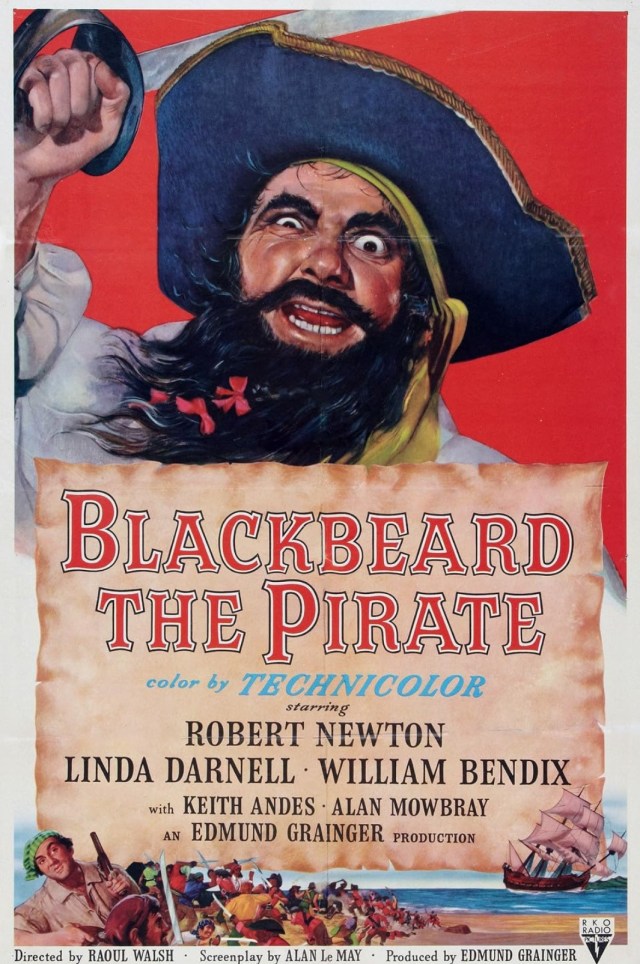
Blackbeard, the Pirate poster created by RKO Radio Pictures

Things I liked about the film:

The acting: Since Linda Darnell is one of the reasons why I reviewed Blackbeard, the Pirate, I’ll talk about her performance first. Linda was cast as the lead female protagonist, portraying a character named Edwina. Throughout the film, she consistently carried her character with confidence that radiated off the screen! Edwina was also a head-strong character, going toe-to-toe with characters like Blackbeard and sharing banter with them. Speaking of Blackbeard, Robert Newton shined in this role! What made his portrayal work was how animated and energetic it was. That consistent energy made Blackbeard interesting to watch! Linda shared a lot of scenes with Keith Andes, who portrayed Robert Maynard. I liked his performance for two reasons. The first reason is how calm Robert appeared while under pressure, a protagonist who didn’t let his feelings get the better of him. The second reason is how Keith’s on-screen chemistry with Linda was nice!

Clever dialogue: There were some moments in Blackbeard, the Pirate where I found the dialogue cleverly written! A great example is when Edwina meets Blackbeard for the first time. During this introductory encounter, Blackbeard asks Edwina what her name is. She then says Blackbeard’s name, in disbelief because she’s standing in his presence. Blackbeard replies by telling Edwina she can’t have the name ‘Blackbeard’, as that is his name. That scene was not only funny, it was also an interesting glimpse into Blackbeard’s perspective!

Historical accuracy: Most pirate films take place prior to the 19th century. This means the historical accuracy of the project can make or break that story. In the case of Blackbeard, the Pirate, it looked like the creative team cared about the presentation of their film! There are many ways historical accuracy can be featured in a movie. One way is through the cast’s wardrobe. While trying to escape from Blackbeard, Edwina asks Robert to untie her dress. This is so she can navigate around the ship in less layers. This scene reveals how Edwina was wearing a corset, an article of clothing that was common in the 17th century. Edwina’s outfit alone showed how much research was done to make this project look and feel historically accurate!

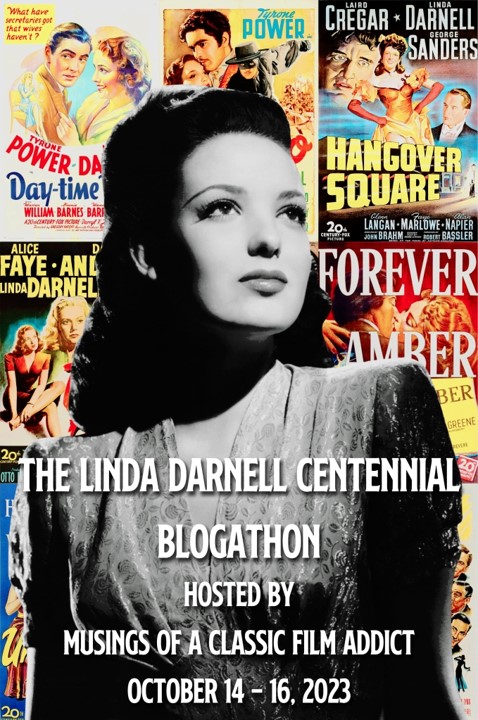
The Linda Darnell Centennial Blogathon poster created by Samantha from Musings of a Classic Film Addict

What I didn’t like about the film:

A misleading synopsis: According to a synopsis I read, Blackbeard, the Pirate is about Sir Henry Morgan’s attempt to capture Blackbeard and stop his pirating ways. This synopsis turns out to be a lie, as Henry doesn’t appear until fifty-seven minutes into this hour and thirty-eight-minute movie. Even while Henry is involved in the story, he isn’t given much to do. It made me wonder why Henry was included in the film in the first place?

An unclear story: Like any genre, there are several types of stories that can be told in a pirate film. But in Blackbeard, the Pirate, the movie’s creative team tried to tell several types of stories in one production. These include a quest for treasure, a “cat and mouse” chase between Henry and Blackbeard, and the hero rescuing the female protagonist from the villain. The creative team’s attempt to incorporate different types of stories prevented their movie from developing its own identity. The story itself isn’t clearly defined because of this creative choice.

A meandering protagonist: I’ve stated before how some Hallmark movies will center around a protagonist who says they’re going to do something, but spends most of the movie not doing the thing they said they were going to do. This isn’t just an issue in Hallmark films, as that was also an issue in Blackbeard, the Pirate. Through a voiceover toward the beginning of the movie, Robert claims he wants to bring Henry to the authorities, as he wants to receive the reward money. Unfortunately, Robert doesn’t make any attempts to capture Henry. In fact, he does everything but make Henry face accountability for his past actions. This meandering subplot is the result of the creative team trying to tell too many types of stories at once.

Ship steering wheel pattern image created by Jemastock at freepik.com. <a href=”https://www.freepik.com/free-photos-vectors/background”>Background vector created by jemastock – http://www.freepik.com</a>. Image found at freepik.com.

My overall impression:

I mentioned in my review’s introduction how I don’t talk about pirate films often. So, it’s disappointing when one of these movies turn out less than stellar. Blackbeard, the Pirate was, sadly, underwhelming. This was due to the weak screenwriting. Too many story ideas were incorporated into one script, preventing the film from adopting its own identity. That creative decision also caused the protagonist to not reach his goal. However, there were aspects of the movie I liked, such as the acting and the historical accuracy. But, in my opinion, the cast deserved better material. I’d like to check out more films from Linda’s filmography. Hopefully, I’ll find a movie better than Blackbeard, the Pirate.

Overall score: 5.3 out of 10

Have you seen Blackbeard, the Pirate? Are there any pirate films you like to watch? Let me know in the comment section!

Have fun at the movies!

Sally Silvrescreen

Take 3: The Third Man Review

When the terms “American Film Institute”, “classic”, and “Austria” are put in the same sentence, most people would think of the 1965 film, The Sound of Music. While that movie has become a beloved staple in cinema, there’s another title that fits the aforementioned criteria; 1949’s The Third Man. This film also fits the criteria for Hometowns to Hollywood’s Celluloid Road Trip Blogathon: International Edition. I’ve seen several movies from American Film Institute’s list of the top one hundred films of all time. Some of these films have, in my opinion, earned their respective places on that list. Other films have left me confused, questioning why a given film is on the list in the first place. While American Film Institute’s list comes across as objective, I have learned that almost any movie list is subjective. Therefore, I’m checking out The Third Man for myself, determining if I think the 1949 film should be on American Film Institute’s list!

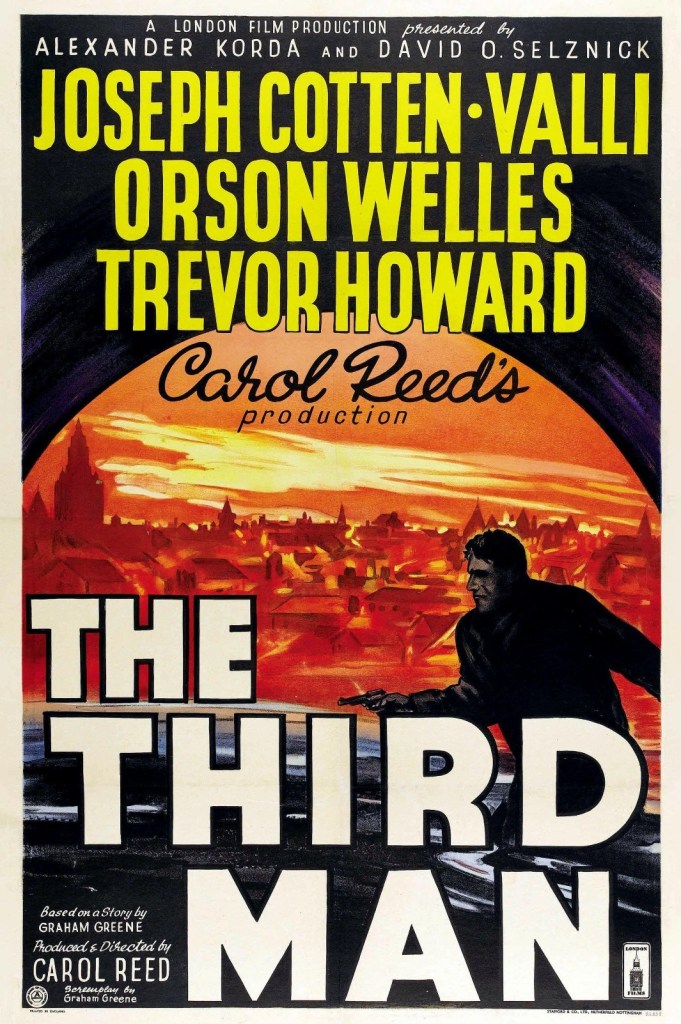
The Third Man poster created by London Film Productions, StudioCanal International, and Selznick Releasing Organization

Things I liked about the film:

The acting: In The Third Man, Ernst Deutsch portrayed Baron Kurtz, a friend of Harry Lime. Despite appearing in the film for a limited period of time, Ernst, in my opinion, stole the show! Anytime he appeared on screen, Ernst’s facial expressions were very fluid and expressive, allowing his character’s reactions to be on point. His performance makes me wish he had more appearances in The Third Man! Individual portrayals were not the only memorable performances, as I liked the on-screen chemistry between Joseph Cotten and Alida Valli. One scene shows Holly and Anna discussing Holly’s friend, Harry. This scene gave Alida and Joseph the opportunity to give their characters genuine emotion, from Anna shedding tears over how the world grew up around Harry to Holly smiling over a past memory of his friend. Their performances made their characters feel like they were meant to be together.

The set design: As mentioned in the introduction, The Third Man takes place in Austria. With the story set in Vienna, the landscape is urban, boasting a European charm that is reflective in the set design. Toward the beginning of the film, Holly goes to a restaurant in the middle of the city. The crown jewel of this location is the marble columns holding up the ceiling. Carved detailing bordered the edges on the ceiling, adding quaint elegance to the restaurant. Even the police station featured elegant design choices, such as the patterned wallpaper. The set design of The Third Man serves as a visual example of timeless beauty, still holding up 74 years later!

An honest glimpse of post-World War II Europe: The story of The Third Man takes place after World War II. Through visual presentation and the dialogue, the state of Vienna, Austria is showcased in an honest way. In one scene, Holly is being chased through the city. During this chase, Holly runs over rubble and hides in an abandoned car. Holly’s hiding place, as well as the rubble, are remnants of the war. Featuring these remnants prominently in the chase scene highlights the aftermath Vienna, Austria faced.

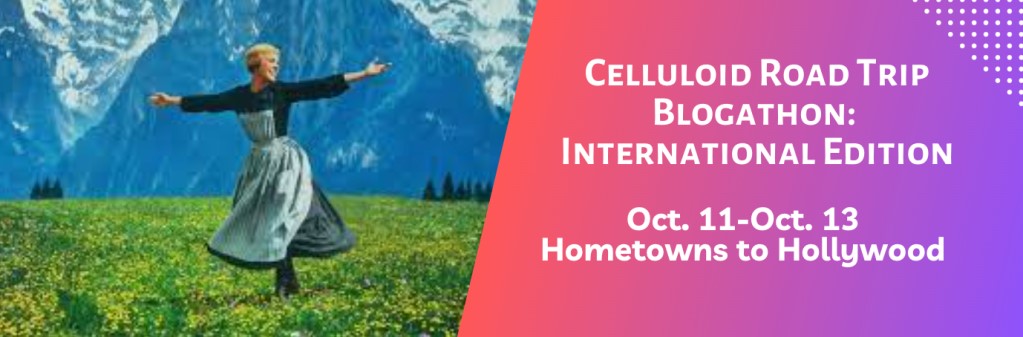
The Celluloid Road Trip Blogathon: International Edition banner created by Annette from Hometowns to Hollywood

What I didn’t like about the film:

Tilted angles: The role of a cinematographer is to present a scene in visually appealing ways. Creative decisions relating to cinematography can make a scene memorable, allowing the audience to bring up specific moments. In The Third Man, several scenes stood out because of cinematography, as these scenes were delivered at a tilted angle. However, there was no reason for those scenes to be presented that way. In fact, the tilted angles came randomly. It felt like those scenes were filmed that way simply for the sake of it.

Tonally unfit music: Acoustic guitar served as the only soundtrack for The Third Man. While this sound was pleasant to hear in some scenes, it was jarring to hear in other scenes. When the police, in one scene, dig up a grave in order to solve a mystery, the acoustic guitar sound gave off a cheerful tone. Yet, the scene itself was very serious in tone, as the film’s mystery is a murder mystery. This is just one example of the music being tonally unfit.

Inconsistent sense of urgency: As I just mentioned, the mystery in The Third Man is a murder mystery. In these types of stories, there is typically a strong sense of urgency, as the protagonist wants to stop the guilty party from hurting other people. But in The Third Man, the sense of urgency was inconsistent. Chase scenes and the climax are where the urgency was present. However, these moments were far and few between. Most scenes featured characters talking with one another. While there can be urgency included in these moments, urgency was not prioritized in the script.

My overall impression:

In 2008, the American Film Institute released a revised list of their one hundred films of all time. On this list, The Third Man was replaced by other titles. However, it does make me wonder why this film was on American Film Institute’s original list in the first place? As I stated in my review of The Bridge on the River Kwai, movies that appear on lists such as American Film Institute’s should, in my opinion, fit one of two categories; those that represent the time they were released and those that brought something new to the cinematic table. The only explanation I can think of is how The Third Man shows Europe post-World War II. Yet Roman Holiday takes place in Italy post-World War II and never appeared on any of American Film Institute’s lists. As for bringing something new to the cinematic table, I can’t think of how The Third Man achieved that. Similar to The Bridge on the River Kwai, this movie has left me confused.

Overall score: 6-6.1 out of 10

Have you seen The Third Man? How many movies from American Film Institute’s lists have you watched? Please share your thoughts in the comment section below!

Have fun at the movies!

Sally Silverscreen
Take 3: No Country for Old Men Review

Recently, I wrote about a movie that was recommended by one of my readers. That film was the 1998 romantic comedy, You’ve Got Mail, a title I chose to review for a recent blogathon! But that’s not the only film recommendation I’m talking about for a blogging event this month. Because September’s Genre Grandeur theme is ‘Movies That Take Place in Mexico’, I had to research titles that would be eligible for the event. When I discovered one of these movies was No Country for Old Men, I remembered how Annlyel, from Annlyel Online, had once recommended the film to me. Finding another good opportunity to review a recommended title, I selected the 2007 film for this edition of Genre Grandeur! No Country for Old Men is a movie I had heard of, as it was nominated for several awards during “awards season”. But since I hadn’t seen the film until this blogathon, I couldn’t form an opinion on it. Now that I have checked out No Country for Old Men, I can finally share my thoughts on the 2007 picture!

No Country for Old Men poster created by Paramount Vantage, Miramax, Scott Rudin Productions, and Mike Zoss Productions

Things I liked about the film:

The scenery: In some scenes, the story takes place in a desert. Through screen-writing and cinematography, the desert looked photogenic on film! One of my favorite shots is when Llewelyn is returning to his truck. While he does this, a huge gray storm-cloud is slowly overtaking the sand-colored desert in the background. Thunder can also be heard. This shot looked striking on screen, as well as serving a visual representation of what was to come in the story.

Showing instead of telling: The script of No Country for Old Men doesn’t rely on dialogue. This is to emphasize the visual presentation of the story. Choosing to show instead of tell also allows the audience to figure things out for themselves. Throughout the story, Llewelyn is being chased by Anton. During this chase, it is unknown how Anton knows where Llewelyn is. Until Llewelyn makes a discovery that explains Anton’s knowledge of his whereabouts. This discovery and its connection to Anton are visually presented, with no dialogue included. The audience is given the opportunity to piece the story together because of this creative decision.

Hiding causes of suspense: As I already explained, No Country for Old Men emphasizes showing instead of telling. Another way this is accomplished is by hiding characters that cause suspense. When Llewelyn discovers a crime scene, he sees another truck is parked next to his truck, with characters entering and exiting their vehicle. Because this takes place at dawn, only the silhouette of the characters and their truck is shown. Later in the movie, Llewelyn is being chased through a small town. During the chase, the film’s antagonist can be seen in the reflection of a nearby store window. But only their silhouette is shown in this window, causing suspense to take place in the story. Both suspense and intrigue were incorporated into the film because of the use of showing instead of telling!

Joshua Tree National Park in California image created by Welcomia at freepik.com. <a href=”https://www.freepik.com/free-photos-vectors/tree”>Tree photo created by welcomia – http://www.freepik.com</a>. Image found at freepik.com.

What I didn’t like about the film:

The run-time: No Country for Old Men is a movie that boasts a run-time of a little over two hours. While a competently written, directed, and acted story can be captured in a two-hour time-frame, I don’t think it was necessary for the 2007 film to be this long. Scenes were either drawn-out or added for the sake of satisfying this run-time. This creative decision caused the story to take longer to get to its intended point. In my opinion, No Country for Old Men could have benefitted from having a shorter run-time, say an hour and twenty or thirty minutes. The story would have reached its point sooner and the script would have been a bit tighter.

Almost no sense of urgency: Like I just mentioned in this review, No Country for Old Men has a run-time that, in my opinion, is longer than necessary. The film’s run-time caused the story to contain almost no sense of urgency, making suspense and intrigue far and few between. No Country for Old Men has a “cat and mouse” type narrative, with the protagonist constantly trying to get away from the antagonist. The chase between these characters felt like it was taking place in slow motion because of the drawn-out story. This resulted in the picture, sometimes, feeling boring.

Some things left unexplained: While I appreciate the script respecting the audience’s intelligence by allowing them to figure things out for themselves, there are some parts of the story I wish had been explained. One example is when Anton stops at a gas station. He explains to the gas station’s owner how he has a special coin that he’s carried for 22 years, stressing how his coin was meant to be at that specific place in time. Throughout the movie, however, there are no explanations provided for the coin’s significance. In fact, Anton never brings up that coin again after his stop at the gas station.

Money image created by Freepik at freepik.com. <a href=’https://www.freepik.com/free-vector/bills-and-coins-in-isometric-design_1065328.htm’>Designed by Freepik</a>. <a href=”https://www.freepik.com/free-photos-vectors/business”>Business vector created by Freepik</a>. Image found at freepik.com.

My overall impression:

Throughout cinema, there have been movies that have received an abundance of praise. Some of these films have left me confused, questioning why it has achieved its positive recognition. For me, No Country for Old Men is one of these movies. While it’s not a bad title, it does leave me wondering why it won Best Picture, let alone get nominated at all? The film has a run-time of a little over two hours. Instead of benefitting the story, the run-time caused the movie to feel too drawn-out and, sometimes, boring. There are strengths within No Country for Old Men, such as utilizing the storytelling technique of showing instead of telling. However, these strengths do not outweigh the flaws. Looking back on the movies from the western genre I’ve reviewed, I haven’t found a film from this genre I actually liked. Similar to made-for-tv movies from the 1970s and my choice for a “so bad it’s good” title, I guess it’s time to go back to square one and continue the quest.

Overall score: 6 out of 10

Have you seen No Country for Old Men? Are there any movies from the western genre you’d like to see me review? Please tell me in the comment below!

Have fun at the movies!

Sally Silverscreen
Take 3: You’ve Got Mail Review

Every so often, I try to review a movie that has been recommended by one of my readers or a fellow blogger. It’s a wonderful opportunity when I can write about a recommended film for a blogging event. This is what happened when I joined the Everything Is Copy Blogathon! When I learned Rebecca’s, from Taking Up Room’s, event centered around the Ephron family, I realized no one had chosen You’ve Got Mail as their blogathon entry. Since the movie was recommended by Janis from Momshie Diaries, I found the perfect excuse to finally see the film in its entirety! You’ve Got Mail is far from the first romantic comedy (rom-com) I’ve talked about on 18 Cinema Lane. Several Hallmark Channel films have received their own review, ranging from terrible to the best I’ve ever seen. So, where does You’ve Got Mail rank among those Hallmark titles? Log in to this review to find out!

You’ve Got Mail poster created by Warner Bros.

Things I liked about the film:

Tom and Meg’s on-screen chemistry: An ingredient to a successful rom-com is casting an actor and actress who share strong on-screen chemistry. This ingredient creates an on-screen relationship that feels believable. In You’ve Got Mail, Tom Hanks and Meg Ryan portray Joe Fox and Kathleen Kelly; two literary business owners who have different perspectives on the world of bookselling. Yet, whenever they’re together, Kathleen and Joe share a spark between them, learning over time how they have more in common than they initially believed. The on-screen chemistry between Meg and Tom makes it feel like their characters have known each other for many years. It also helps how Tom and Meg brought a strong sense of likability to their characters. Even though Joe was a businessman who felt there was a time and a place for “big box stores”, his personality was more jovial than some of the businessmen who appear in a typical Hallmark Channel rom-com. Meanwhile, Kathleen’s personality was fun and fancy-free, trying to find a silver lining during autumn in New York City.

The set design: One of the conflicts in You’ve Got Mail was a bigger, chain bookstore affecting the business of a smaller, locally owned book shop. The interior design of the bigger bookstore was meant to imply how impersonal that store’s shopping experience was. But I actually liked the interior design of both stores! At the smaller book shop, the pale yellow walls paired nicely with warm wood shelves. With string lights circling near the store’s ceiling, the space itself felt cozy and quaint. At the bigger bookstore, white supporting columns, dark gray granite countertops, and shiny silver railings boasted a modern space that looked and felt heavenly. Quirky décor, such as a large, spinning silver globe and a replica of the Statue of Liberty reading a book prevented the store from being dull. Even the bookstore’s bakery section was promoted as a hip gathering space, a curved countertop with tall stools providing an area for readers to come together and enjoy each other’s company. Both spaces looked inviting and appeared photogenic!

The dialogue: The strength of dialogue can create or break a script. While the dialogue can be elevated through delivery, its believability and memorability lie in the writing talent. Within You’ve Got Mail, there was dialogue that I thought was cleverly written! One example was when Kathleen and Joe met each other at a restaurant. Using advice from her anonymous pen pal, Kathleen shared what was on her mind with Joe. Frustrated by Joe’s inability to see how his bookstore prevented other bookstores from thriving, Kathleen told Joe his brain was replaced by a cash register and his heart was taken over by the bottom line. While her statement was meant to be insulting, Kathleen’s quote was an eloquent way of illustrating how she saw Joe. Her quote also stressed how her love of literature helped her choose words that made her opinion sound mature and intelligent.

The Everything Is Copy Blogathon banner created by Rebecca from Taking Up Room

What I didn’t like about the film:

Forgettable secondary characters: In a rom-com, the main male and female character are not the only characters who can make a story work. A collection of secondary characters who interact with the protagonists can add humor, wit, and even thoughtful insight to the film. The story of You’ve Got Mail revolved so heavily around Kathleen and Joe, all of the movie’s secondary characters seemed like an afterthought. This group of actors and actresses did a good job with the material they were given. But the characters they portrayed weren’t as 3-dimensional as Joe and Kathleen. Some rom-coms will give at least one secondary character a subplot. However, no subplots were given to the secondary characters in You’ve Got Mail. Even when there was the possibility for a secondary character to receive their own piece of the story, this opportunity didn’t lead anywhere. It felt like You’ve Got Mail was the world according to Joe and Kathleen, where every other character was simply given permission to exist in it.

The protagonists’ love interests: I have seen some Hallmark rom-coms where the main male and female characters are already in a romantic relationship, only for these characters to end their previously established relationships in order to fall in love with each other. This trope is not limited to Hallmark’s films, as it appeared in You’ve Got Mail. At the beginning of the movie, the story established Kathleen is living with her boyfriend, Frank. Meanwhile, Joe is considering proposing to his girlfriend, Patricia. Because You’ve Got Mail is a rom-com, there is a greater likelihood Kathleen and Joe will fall in love. I’ve also mentioned in this review how, in my opinion, Tom and Meg had strong on-screen chemistry. Therefore, Joe and Kathleen’s previously established relationships feel pointless.

The run-time: You’ve Got Mail has a run-time of one hundred and twenty minutes. This is almost the same run-time as a typical Hallmark movie. Like I mentioned in this review, none of the story’s secondary characters were given a subplot, as the film revolved heavily around Joe and Kathleen. You’ve Got Mail’s plot includes anonymous pen pals desiring to connect in the real world. With the story being so simple and easier to follow, the movie’s run-time feels excessive. Some scenes are drawn out to likely satisfy the film’s run-time. In my opinion, You’ve Got Mail should have shown the anonymous pen pals meeting sooner. That way, they could not only help each other with their professional dilemmas, but the story itself could have become a contemporary retelling of Pride and Prejudice.

Envelope with hearts image created by Freepik at freepik.com. <a href=’https://www.freepik.com/free-photo/hearts-and-pink-envelope-for-mothers-day_1950691.htm’>Designed by Freepik</a>. <a href=”https://www.freepik.com/free-photos-vectors/love”>Love image created by Freepik</a>. Image found at freepik.com.

My overall impression:

Before and after the release of You’ve Got Mail, rom-coms have found their place in the world of film. Like any genre, there’s a variety of titles, some good and some bad. For me, You’ve Got Mail falls somewhere in the middle. The main romance was well written, directed, and acted. This combination allowed the protagonists to form a relationship that felt believable and charming. While the dialogue and set design certainly helped this picture, it wasn’t enough to outweigh the film’s flaws. From none of the secondary characters receiving their own subplot to the run-time, these things held the movie back from being a stronger story. With the film titled, You’ve Got Mail, and with the anonymous pen pals exchanging emails and instant messages, I’m surprised none of the story’s bookstores brought up the possibility of selling their merchandise online. In fact, I’m shocked the internet wasn’t a bigger topic/theme in this movie! I would say that was a missed opportunity. But with the film itself being just fine, I guess I don’t have much to complain about.

Overall score: 7.2 out of 10

Have you seen You’ve Got Mail? What’s your favorite rom-com? Tell me in the comment section below!

Have fun at the movies!

Sally Silverscreen

Why Kili is the MVP of Tolkien’s Middle-Earth

MVP, an abbreviation of “most valuable player” or “most valuable person”, is typically used in the world of sports. When a team member goes above and beyond for their respective team, they usually earn this title. Last year, when I was introduced to The Hobbit trilogy, the Company reminded me of a football team. With Gandalf in the role of coach and Thorin in the quarterback position, Kili is the one who, in my opinion, would be the Company’s MVP. In my “Flaming Hot…5 Reasons Why” tag post I published earlier this year, I stated Kili is my favorite character from The Hobbit trilogy. I even mentioned in that post how I felt Kili was the MVP of Middle-Earth. But claiming Kili is the MVP of Tolkien’s Middle-Earth is not purely based on personal bias. In fact, I will use examples from the trilogy to prove that Kili has, in my eyes, earned the title of MVP!

Image of Kili created by New Line Cinema, Metro-Goldwyn-Mayer Pictures, WingNut Films, and Warner Bros. Pictures

Humbleness

When I watched The Hobbit trilogy for the first time, I did not know Kili was a prince. I didn’t even know he and Thorin were related. So, imagine my shock when Thorin told Kili and Fili they were his “sister’s sons” in The Hobbit: The Battle of the Five Armies! Kili’s humbleness is the reason for my shock. Up until that aforementioned moment between Thorin and his nephews, Kili never brought up his royal lineage. Even in The Hobbit: The Desolation of Smaug, when he was interacting with Tauriel in Rivendell’s dungeon, Kili didn’t use his royal connections to impress her. Yes, he did bring up his mom in his and Tauriel’s conversation. But Kili never stated how he and his mom were related to Thorin.

Kili’s humbleness goes beyond his royal heritage. In The Hobbit: The Desolation of Smaug, after his leg became injured, Kili didn’t want any help from the Company. Anytime his health was questioned, Kili would say “I’m fine”. When Thorin instructed Kili to stay in Lake Town because of his injury, Kili was frustrated he couldn’t continue on the journey. Even when he was forced to flee from Lake Town in The Hobbit: The Battle of the Five Armies, Kili wanted to walk by himself, not wanting to rely on anyone for support. This sequence of events shows how Kili didn’t want to be treated differently from the other members of the Company. He also didn’t want his injury to hold the Company back. Kili, simply, wanted to do his part and help his uncle and the Company in any way he could.

Image of Kili created by New Line Cinema, Metro-Goldwyn-Mayer (MGM), WingNut Films, and Warner Bros.

Having More Than One Skill

Throughout The Hobbit trilogy, each member of the Company had a skill to share, which allowed the Company to get closer to their ultimate goal. For Kili, he ended up having more than one skill to offer. Not only was he a swordsman, he was also an archer. In order to master just one of these skills, it requires many hours of training and a large amount of dedication. To master both sets of skills, Kili had to double his training hours and work twice as hard. The Hobbit trilogy consistently presents Kili’s talents, giving him opportunities to prove his worth as a competent swordsman and archer. One example is when Kili faced Orcs, as using his archery skills allowed him to showcase his mastery of hand eye coordination.

Image of Kili created by New Line Cinema, Metro-Goldwyn-Mayer Pictures, WingNut Films, and Warner Bros. Pictures
Image of Kili and Fili created New Line Cinema, Metro-Goldwyn-Mayer Pictures, WingNut Films, and Warner Bros. Pictures

Becoming the Voice of Reason

Kili was not known as “the voice of reason” in The Hobbit trilogy. He did not often make statements that would make others think “he has a point”. But in The Hobbit: The Battle of the Five Armies, Kili found the courage to become “the voice of reason”, being one of the few people to stand up to Thorin during his “dragon sickness” period. While in Erebor, Thorin ordered the Company to build a fortress, in order to prevent Erebor from being taken again. Kili points out how Thorin is not the only one who has lost his home, stating “The people of Lake Town have nothing. They came to us in need, they have lost everything”. Despite Thorin failing to acknowledge Kili’s point by reminding his nephew how he lost Erebor, Kili wasn’t dissuaded by his uncle’s stubbornness. After Thorin snapped out of his “dragon sickness”, Kili stands up to his uncle again, saying “I will not hide behind a wall of stone while others fight OUR BATTLES FOR US! It is not in my blood, Thorin”. This time, Thorin agreed with his nephew, leading the Company into battle. When he became “the voice of reason”, Kili was honest and told Thorin what he needed to hear. Even though he was “the voice of reason” for a short period of time, Kili’s statements provided a glimpse into the kind of leader he could have been.

Image of The Company created by New Line Cinema, Metro-Goldwyn-Mayer (MGM), WingNut Films, 3Foot7, and Warner Bros.

Taking One for the Team

When attempting to escape the Rivendell dungeon in The Hobbit: The Desolation of Smaug, the Company needed to open an underwater gate. Kili volunteered to open the gate, climbing out of the water and onto the top of the gate, where the gate’s lever was located. During this process, an Orc shot Kili in the leg, causing Kili to be the only member of the Company to become seriously injured. After the Company’s escape, Tauriel and the audience learn the arrow that shot Kili contained fatal poisons. As the story of The Hobbit: The Desolation of Smaug continued, Kili’s health deteriorated, bringing him on the verge of death. Yet, when a group of Orcs invaded Lake Town, Kili and Tauriel worked together to defeat an Orc. These two scenarios show how Kili took one for the team, risking his health and safety by putting the well-being of others before himself.

A Tolkien Blog Party banner created by Hamlette from The Edge of the Precipice

In the 1971 biopic, Evel Knievel, Evel Knievel states “heroes know who they are”. He made this statement to make a point how true heroes don’t need to show off their hero status. The more I think about Evel’s quote, the more the quote fits who Kili is. Kili never flaunted his royal title because he didn’t think doing so would be necessary. What Kili did instead was let his actions and choices speak for themselves. As I said in the introduction, the Company in The Hobbit trilogy reminded me of a football team. With Kili as the MVP, that means he’d be the one to not only receive a brand-new truck at the end of the game, but also proclaim his team was going to a theme park at the end of the season. But anyone who knows Kili’s story would know Kili didn’t get to do any of these things. As I conclude this editorial, I would like to say that whenever I think of the abbreviation, MVP, I will think of Kili carrying the title of “most valuable prince”.

Have fun in Middle-Earth!

Sally Silverscreen

Take 3: A Walk in the Spring Rain Review

Every beloved film star has at least one movie on their IMDB filmography that has earned the distinction of being a “classic”, “iconic” or “fan favorite”. But for every “classic” title, there’s also that one film that is under-rated or unheard of. In the case of Ingrid Bergman, one of those movies is A Walk in the Spring Rain! Prior to The Wonderful World of Cinema’s 6th Wonderful Ingrid Bergman Blogathon, I had never heard of the 1970 picture. However, that’s the great part of participating in a blogathon; discovering films that are “new-to-you”! As I said in my review of Evel Knievel, I haven’t had the best of luck, this year, finding a movie from the 1970s I like. By expanding my cinematic horizons, I am hoping to solve that problem. Where does A Walk in the Spring Rain rank among the other ‘70s movies I’ve reviewed this year, so far? Keep reading my review in order to find out!

A Walk in the Spring Rain poster created by Columbia Pictures and Pingree Productions

Things I liked about the film:

The chemistry between the cast: When watching characters interact with one another, the believability of those interactions depends on the strength of the cast’s acting talents. Though the cast in A Walk in the Spring Rain was smaller, this believability could be felt. In a scene between the protagonist, Libby, and her daughter, Ellen, the interaction appeared realistic, presenting the idea of a mother and daughter discussing a personal matter. Concerned about her mother’s apparent unhappiness, Ellen (portrayed by Katherine Crawford), seems genuinely worried, that worry with a touch of sadness consistently shown on her face. Meanwhile, Libby (portrayed by Ingrid Bergman) is distraught over personal turmoil. Her face shows her distress, tears in her eyes and sadness spread over her face. She even goes so far as to violently push a tea cup off the kitchen table in an act of sudden anger. During their stay in Tennessee, Libby and her husband, Roger, meet a local man named Will. One evening, the three go frog hunting, with Roger and Libby trying moonshine for the first time. This scene shows the on-screen chemistry between Ingrid Bergman, Fritz Weaver, and Anthony Quinn. Their smiles, laughter, and jovial demeanor radiates off the screen. It feels like they are three close friends who are picking things up where they last left off.

The set design: In A Walk in the Spring Rain, Libby and Roger rent a cabin in Tennessee. This cabin featured design choices that I found memorable! The main focal point in the living room is a fireplace. Surrounded by exposed stone and a dark wood mantle, good décor complimented the darker shades of both wood and stone. The living room was not the only room where exposed stone was found. In the kitchen, an antique stove guarded a wall of exposed stone. Also in the kitchen, a dark wood corner shelf housed the fine china and fancy dinnerware. This shelving unit was a unique way to make the best use of the room’s available space!

The scenery: A Walk in the Spring Rain was filmed in Tennessee, specifically at Great Smoky Mountains National Park. The story takes place during two seasons: winter and spring. Despite the difference in seasons, the scenery was very picturesque, stealing the show from time to time! In some establishing shots, Tennessee’s snowy landscape was beautifully captured on film. The scenery honestly looked like a Christmas greeting card. In a scene where Will shows Libby the first blooms of the season, a tree with small, magenta flowers provides a nice pop of color amid the background of green foliage and rolling hills. Even when characters are driving through the country-side, these surroundings were pretty to look at!

The 6th Wonderful Ingrid Bergman Blogathon created by Virginie from The Wonderful World of Cinema

What I didn’t like about the film:

A meandering story: According to a synopsis I read for A Walk in the Spring Rain, Libby and Will have an affair. This affair didn’t fully come into fruition until fifty-three minutes into an hour and thirty-eight-minute movie. That forced the audience to wait more than half the film for the inevitable to happen. Even though Will and Libby flirted with one another leading up to the affair, these interactions were brief. While waiting for the affair to happen, the script focused on other parts of the story, such as the Merediths adopting baby goats.

The run-time: Like I mentioned in my previous point about the film’s meandering story, A Walk in the Spring Rain has a run-time of an hour and thirty-eight-minutes. Because of how drawn out the story was, that hour and thirty-eight-minutes felt longer. There were several stretched out scenes serving the movie’s run-time. One example is a ten-to-fifteen-minute scene of Libby and Roger’s trip to Gatlinburg, with the majority of this scene showing the Merediths walking down a tourist heavy street. Had scenes like this one been trimmed, A Walk in the Spring Rain’s run-time might have been about an hour and ten minutes.

Drawn-out subplots: There were some subplots in A Walk in the Spring Rain that were drawn out, likely to satisfy the movie’s run-time. One of these subplots revolved around the Merediths’ daughter, Ellen. Ellen desires to go to law school. However, Libby and Roger feel her decision would disrupt her family. While this subplot does get resolved, it takes the entire movie for the resolution to happen. Because of this, the resolution feels anticlimactic.

Image by macrovector on Freepik

My overall impression:

In the introduction of this review, I said I had never heard of A Walk in the Spring Rain prior to The 6th Wonderful Ingrid Bergman Blogathon. Looking back on this movie, I think I know why. If I could describe the 1970 film in one word, it would be ‘bland’. The drawn-out, meandering story causes the movie to feel longer than an hour and thirty-eight-minutes. Great Smoky Mountains National Park provides this story with beautiful scenery. But as I’ve said in past reviews, “the scenery can’t save you”. The cast in A Walk in the Spring Rain is solid, maintaining strong on-screen chemistry. However, when a project has a weak script, there’s only so much the cast can do to salvage that script. I know this film was released toward the end of Ingrid’s career. But, honestly, she, as well as the rest of the cast, deserved better material.

Overall score: 5 out of 10

Have you seen or heard of A Walk in the Spring Rain? Are there any of Ingrid Bergman’s films you’d like to see me review? Let me know in the comment section!

Have fun at the movies!

Sally Silverscreen

Take 3: Evel Knievel (1971) Review

When it comes to movies from the 1970s, I haven’t had the best of luck, this year, finding a film I actually like. While I thought Days of Heaven and The White Buffalo were ok, I wasn’t impressed with The Last Child and Double Nickels. However, I was still determined to search for a movie from the ‘70s I enjoyed. During this search, I stumbled upon the 1971 film, Evel Knievel, a biopic about the stuntman of the same name. Since August’s theme of Genre Grandeur is ‘bikers, bikes, and motorcycles’, I had a great excuse to check this movie out! Choosing the 1971 title for Genre Grandeur also gave me an excuse to learn more about Evel Knievel. Before watching this film, I was familiar with who Evel is and why he was famous. But that basic information was all I knew. Besides broadening my cinematic horizons, I used my entry for Genre Grandeur to learn something new.

Evel Knievel (1971) poster created by The Fanfare Corporation, Fanfare Films, and American Broadcasting Company (ABC)

Things I liked about the film:

The acting: In my review of RKO 281, I talked about Liev Schreiber bringing humanity to his portrayal of Orson Welles, finding the heart of the “genius” and putting some genuine emotion behind it. This was successfully done to highlight Orson as more than just a legend. During his career, Evel Knievel became a celebrity, performing stunts that most people would never dream of attempting. Similar to Liev Schreiber, George Hamilton found the man behind the famous name and presented the human side of him. Toward the beginning of the film, Evel is at a local bar, talking to his friends how “something big” is going to happen in town. From furrowing his eyebrows to showing a good-hearted smirk, Evel talks about this upcoming, unknown event with ease and confidence. Through George’s performance, Evel is shown as more than just the famous stuntman, adding a sense of charm to his portrayal.

Throughout the film, Evel interacts with his wife, Linda. Portrayed by Sue Lyon, Linda and Evel’s encounters were pleasant to watch! This is because George and Sue had nice on-screen chemistry! Evel and Linda kind of reminded me of Abby and Bill from Days of Heaven. In the 1978 movie, it felt like Bill and Abby truly got along with one another, with a shared gentleness understood between them. The 1971 shows Linda and Evel respecting one another and, more often than not, being on the same page.

Despite appearing in the movie for a short period of time, Dub Taylor left a memorable impression as Turquoise Smith! The ring-master of a local rodeo, Turquoise had a larger-than-life personality. But this personality never felt over-the-top, thanks to the way Dub portrayed Turquoise. Even when there was a tragedy at the rodeo, Turquoise maintained professionalism and showmanship. Because of the quality of Dub’s acting talents, these components of the character remained consistent.

The stunt footage: During Evel Knievel, a montage of stunt footage is featured. This footage shows Evel performing various stunts throughout his career, with some stunts more successful than others. The montage is used as a bridge between his early years and “present day”, as the footage emphasizes the dedication and willpower Evel put into his stunts. Since the movie is a bio-pic about a real-life person that existed at one point in time, the montage added contextual depth to the story. It also provides a nice connection between the film and the actual Evel Knievel.

The messages and themes: As I said in this review’s introduction, I chose to write about Evel Knievel because I wanted to learn more about the titular man. However, I was surprised by the messages and themes that came out of this story. While reflecting on his relationship with Linda, Evel recalls a time when he visited Linda at her high school. During this encounter, Evel explains why he doesn’t play basketball. He feels that in basketball, you don’t have much to lose, as all the stakes are lower. He also confesses how he doesn’t want a lettermen sweater, as Evel doesn’t need to prove he’s a hero. With this, he tells Linda, “heroes know who they are”. Letterman sweaters/jackets have been known for being something high schoolers can earn through academic and athletic achievement. But until watching Evel Knievel, I’ve gained a newfound perspective on this subject.

Illustrated image of Arizona desert created by pikisuperstar at freepik.com. Background vector created by pikisuperstar – www.freepik.com

What I didn’t like about the film:

Transitions between past and “present”: The story of Evel Knievel is told through Evel’s recollections of his past as he’s preparing for an upcoming stunt. But the way the film jumped between past and “present” was confusing. During one of Evel’s recollections, he remembers a tragedy that took place toward the beginning of his career. As soon as the tragedy occurs, the story is brought back to the “present”, showing Evel nervous about the upcoming stunt and dealing with an injured leg. It took me a little while to realize the story had transitioned between the past and “present”, as the scene changed so abruptly. Personally, I think the story should have been told through a chronological order.

The past more interesting than the “present”: Like I mentioned in my previous point about the story’s transitions between past and “present”, Evel is preparing for an upcoming stunt in the “present”. But aside from seeing Linda and Evel interact and the aforementioned stunt, I didn’t find the “present” interesting. In fact, I found Evel’s recollections of his past more interesting, as it was an opportunity for me to learn more about Evel Knievel. Even though the stunt in the “present” is shown, it doesn’t take place until the story’s last ten minutes. So, the audience is forced to wait almost the entire movie for that moment.

An omission of a “where are they now” segment: In most biopics, there is a segment toward the end of the movie which explains what happened to the story’s key people after the events of the movie. But this segment was omitted from Evel Knievel. During the “present”, Evel talks about how he wants to perform a stunt in the Grand Canyon. I was hoping there would be a sense of closure about whether this stunt actually took place. Sadly, no explanation about the fruition of this stunt was provided. I don’t know where Evel’s career was at the time of the film’s release. However, I still think a “where are they now” segment should have been included.

Children holding American flags during a sunset image created by rawpixel.com at freepik.com. <a href=”https://www.freepik.com/free-photos-vectors/people”>People photo created by rawpixel.com – http://www.freepik.com</a>. Image found at freepik.com.

My overall impression:

I’ve seen some movies where I felt the subject would have been better served through a documentary, as the subject itself is quite fascinating. This is how I felt while watching Evel Knievel. I was able to learn more about the “king of stuntmen” through his recollections of his past. In fact, I found the past more interesting than the “present”, as I was kind of bored by the weak conflict. Despite the confusing jumps between past and “present”, Evel Knievel provided an introduction to the titular man. As this is one of the reasons why I watched the film, the 1971 title does its job. When it comes to biopics, Evel Knievel doesn’t really reinvent the wheel, with the story being pretty straight-forward. The acting, stunt footage, and messages and themes prevent the movie from becoming unmemorable.

Overall score: 6.1 out of 10

Have you seen or heard of Evel Knievel? Which biopic do you think is well-made? Tell me in the comment section!

Have fun at the movies!

Sally Silverscreen
Awaiting My Upcoming Blogathon; Familyathon!

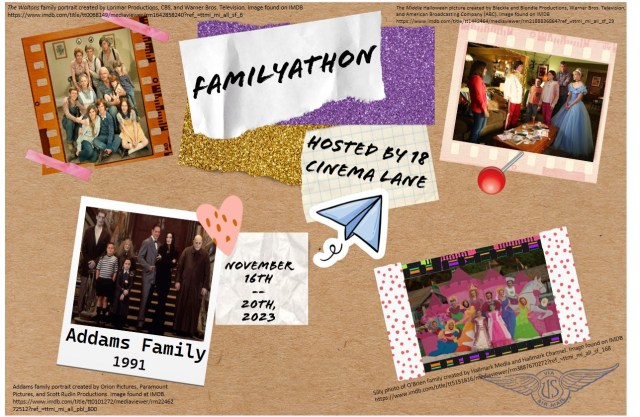
As I was coming up with a theme for my next blogathon, I first reflected on late Autumn to early Winter, the time when the event will take place. Several holidays where family gathers together take place during this time of year. This common theme inspired my new blogathon, which is called “Familyathon”! November 16th to 20th is when the event will take place. Since the subject of ‘family’ is so broad, I’ll list some ideas on potential topics:

  • Themes relating to the subject of ‘family’ (ex: how of the theme of ‘family’ is woven into the Fast & Furious franchise)
  • Stories revolving around a family (ex: I Remember Mama, The Middle, etc.)
  • Characters joining a family (ex: birth, marriage, adoption, etc.)
  • Characters departing from a family (ex: someone going to college, someone moving out of the neighborhood, etc.)
  • Families losing a family member (ex: a family member passing away, a family member going missing, etc.)
  • Stories about siblings (ex: What Ever Happened to Baby Jane?, etc.)
  • Stories of “found family” (a group of unrelated people forming their own family)
  • The subject of ‘family’ from a pet’s perspective (ex: Homeward Bound: The Incredible Journey, etc.)
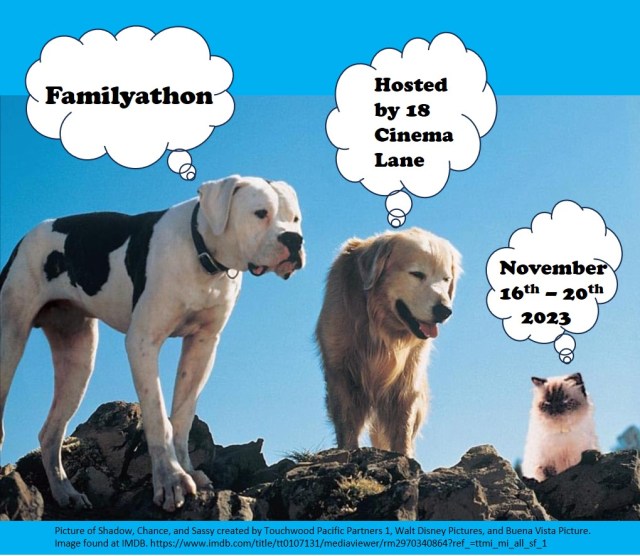
Familyathon blogathon banner created by Sally Silverscreen of 18 Cinema Lane

If you’re interested in joining Familyathon and have an idea in mind, here are the official rules every participant must follow:

  1. Please be respectful toward other participants and the subject(s) you’re writing about
  1. Please let me know in advance if you plan on publishing your post(s) earlier or later than the allotted time-frame (November 16th to 20th).
  2. Only new posts will be eligible for the event.
  3. Duplicate entries will not be allowed, as the subject of ‘family’ is broad.
  4. Each participant can only submit a total of three entries.
  5. All entries must be original work.
  6. Subjects from any genre, year, or country are allowed.
  7. If you’re interested in participating, please share your idea(s) in the comment section below.
  8. Choose one of the four banners and let others know about Familyathon!

Participants of Familyathon

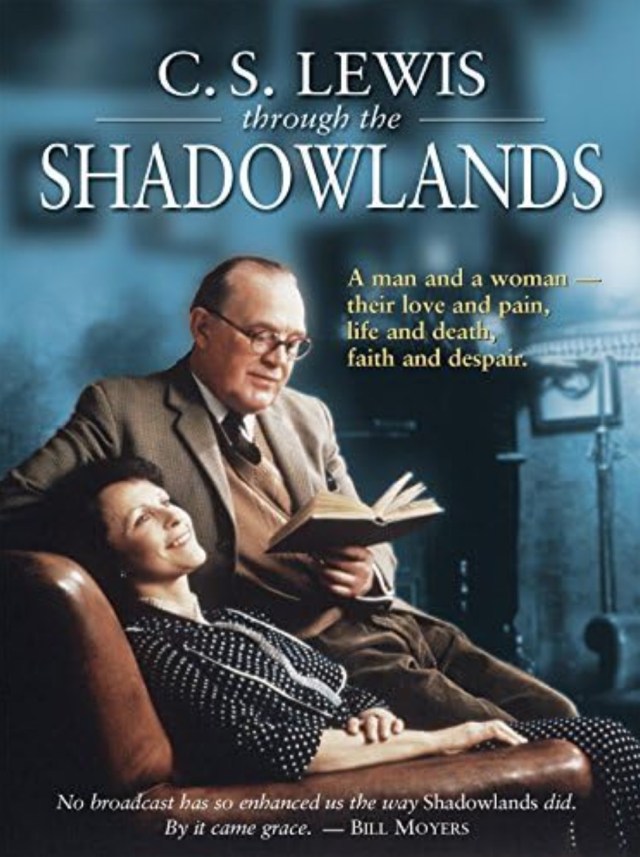
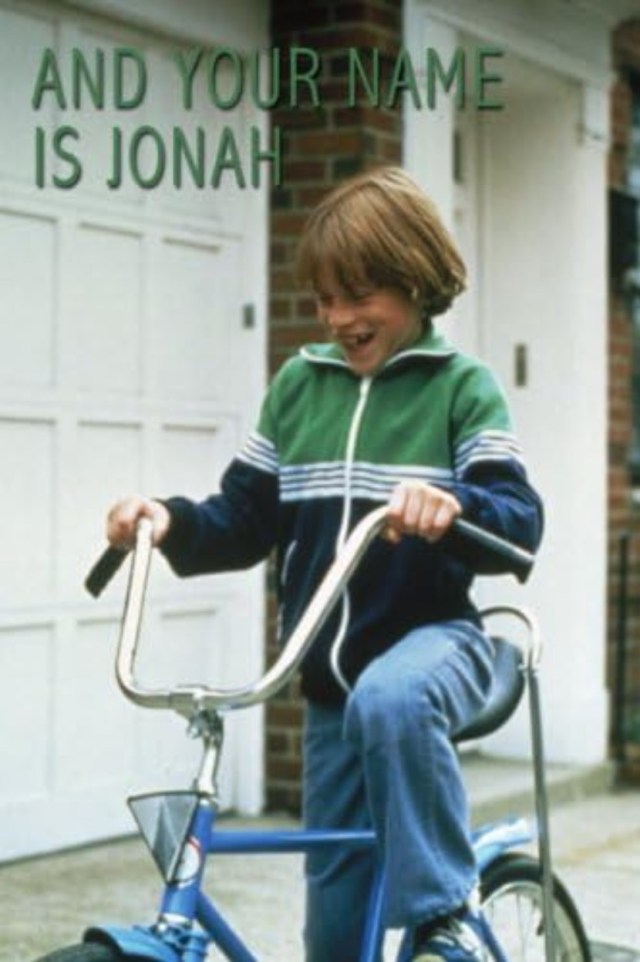
Sally from 18 Cinema Lane – Review of …and Your Name Is Jonah (1979)

Gill from Realweegiemidget Reviews — A list article of the theme of family from the Fast and Furious franchise

Rebecca from Taking Up Room — Review for Life Begins for Andy Hardy (1941)

Hamlette from Hamlette’s Soliloquy — Review of Mr. Mom (1983)

Ruth from Silver Screenings — Review of Old Yeller (1957)

Quiggy from Midnite Drive-In — Review of The Godfather (1972)

Erica from Poppity Talks Classic Film — Review of Sabrina (1954)

Grace Avender — A list of Grace’s top five favorite families

Katherine — An article about Katherine’s three favorite film families

Familyathon blogathon banner created by Sally Silverscreen of 18 Cinema Lane

Have fun at the blogathon!

Sally Silverscreen

Take 3: Days of Heaven Review

Have you ever stumbled upon a film that was “new to you” and think, “I’ve never even heard of this”? That was my experience discovering the 1978 movie, Days of Heaven. Prior to the Legends of Western Cinema Week Blogathon, I had never heard anyone talk about the aforementioned Western. With the blogathon fast approaching, Days of Heaven crossed my path at the right time! This is my fourth year participating in the Legends of Western Cinema Week. Looking back on the programs I reviewed for the event, I realized the stories fell into one of two categories: cowboys seeking justice or some aspect of farming. While Days of Heaven belongs in the latter category, the primary perspective focuses on the actual farming. This is different from a movie like O Pioneers!, where the story’s priority was the relationships between the characters. How does Days of Heaven rank among the films I reviewed for the Legends of Western Cinema Week? Before traveling on those “happy trails”, let’s read my review!

Days of Heaven poster created by Paramount Pictures

Things I liked about the film:

The scenery: The majority of Days of Heaven takes place in the wheat fields of Texas. Despite how monotonous that type of location may sound, the wheat fields offered up many glimpses of natural beauty! My favorite shot in the movie was when a storm cloud approached the story’s wheat fields. Large, gray clouds dominated the sky, appearing larger than life on screen. The presence of these clouds provided a small window into the blue sky above the fields. The golden yellow of the wheat was a pop of bright hue against the sky’s blue and gray palette. This shot was so beautifully captured, it, honestly, looked like a painting!

The historical accuracy: Days of Heaven is set in the 1910s. Like any historical period film, it’s important for the story to feel immersive due to its historical accuracy. Based on what the movie presented, the creative team behind Days of Heaven paid attention to how historically accurate their project looked! The finer details visually prove that point! In a scene where the story’s protagonists, Bill, Abby, and Linda, go swimming, their swimsuits are reflective of the clothing styles of the early 1900s. While Bill wore what would be described as a short-sleeved unitard, Linda and Abby wore swimming dresses, complete with stockings. When it came to transportation, the trains and tractors appeared to be coal powered. Even their exterior designs looked industrial, considered antique be the standards of today. The historical accuracy paired with the aforementioned scenery made Days of Heaven an appealing film to look at!

Richard Gere and Brooke Adams’ on-screen chemistry: As I mentioned in my previous point about the movie’s historical accuracy, Bill and Abby are two of the protagonists in Days of Heaven. Portrayed by Richard Gere and Brooke Adams, these characters are in a romantic relationship. When Abby and Bill are together in a romantic context, the on-screen chemistry between Brooke and Richard was sweet. It felt like the on-screen couple truly got along with one another. During their interactions, there was a gentleness shared and understood between them. Whether walking in the water or cuddling on top of a train, Abby and Bill’s relationship was pleasant to watch because of Brooke and Richard’s acting abilities. Without spoiling Days of Heaven, I will say Bill and Abby’s relationship was not consistent throughout the story. This is a shame, as I liked seeing these characters together.

Legends of Western Cinema Week 2023 banner created by Olivia from Meanwhile, in Rivendell, Heidi from Along the Brandywine, and Hamlette from Hamlette’s Soliloquy

What I didn’t like about the film:

An unclear motive: According to the film’s synopsis, Bill, his younger sister, Linda, and his girlfriend, Abby, plan to con a farmer out of his money and wheat fields. Throughout the movie, however, their motive for conning The Farmer (what Sam Shepard’s character is referred to) is not made clear. I understand Bill, Abby, and Linda don’t like working under someone’s thumb. But the man who they try to con doesn’t seem to deserve a comeuppance. In fact, The Farmer, more often than not, is respectful toward Abby, even going so far as to allow Bill and Linda to live in his house, in order to keep Abby’s “family” together. In a series of voice-overs, Linda claims The Farmer is dying of an unnamed illness. Later in the film, though, she states how The Farmer’s health is staying the same, neither improving or regressing. Yet again, it is never made clear if The Farmer’s health issues are the reason for the con. I wonder why I was supposed to care about Bill, Linda, and Abby’s conning scheme when I don’t even know why The Farmer was being conned in the first place?

A drawn-out story: Days of Heaven has a run-time of about an hour and thirty minutes. Yet the story itself was drawn-out longer than necessary. This issue was caused by establishing shots littered throughout the movie, which served as the production’s padding. I know establishing shots are meant to set up a given scene. But if the creative team of Days of Heaven had cut some of the film’s establishing shots, the run-time would have been trimmed down to about an hour and ten to twenty minutes.

Distance from characters: Through a combination of acting talent, screenwriting, and direction, a movie’s audience can not only be introduced to a character, they can also get to know that character as the story progresses. In Days of Heaven, however, it feels like the characters are kept at a distance from the audience. Sure, the characters share pieces of information about themselves. But this information only allows the audience to become familiar with them. Because of the aforementioned distance, the audience is prevented from connecting with the characters. That disconnection also prevents emotional investment in the story.

Image by Freepik

My overall impression:

The first movie I reviewed for a blogathon this year was Black Narcissus. In my review of the 1947 movie, I said that while Black Narcissus was a competently made film, it was one of the most confusing movies I’d ever seen, due to the story providing little to no explanations. I feel similarly about Days of Heaven. The film itself is very photogenic, from the scenery to the presentation of the story’s historical accuracy. But the story was confusing. No motive for why Bill, Abby, and Linda are conning The Farmer is made clear in the script. Emphasis on style over substance affected any connection the audience could have had with the characters. Throughout the movie, several questions arose that weren’t really answered, such as how The Farmer knew a group of circus performers who came to visit his home. This added to the story’s confusion. As a film, I thought it was just ok. But as a Western, it provides a perspective that is different from the typical cowboy or cattle farmer.

Overall score: 6 out of 10

Have you seen Days of Heaven? Which Westerns would you like to see me review? Tell me in the comment section!

Have fun in Texas!

Sally Silverscreen