Take 3: The Reluctant Debutante Review

Out of all the decades covered on 18 Cinema Lane, the 1950s make such infrequent appearances. I did review the 1954 film, Dial M for Murder, last month. But my review before that was from last December, when I wrote about 1957’s The Curse of Frankenstein. This infrequency is one of the reasons why I’m reviewing the 1958 film, The Reluctant Debutante! Another reason is John Saxon’s involvement in the project. When I joined Realweegiemidget Reviews’ and Cinematic Catharsis’ blogathon, I wasn’t familiar with John Saxon as an actor. So, while exploring his filmography, I came across the 1958 movie. I was surprised to discover Angela Lansbury also starred in The Reluctant Debutante. Since I’ve seen few of Angela’s live-action films, there was yet another reason for me to review this production.

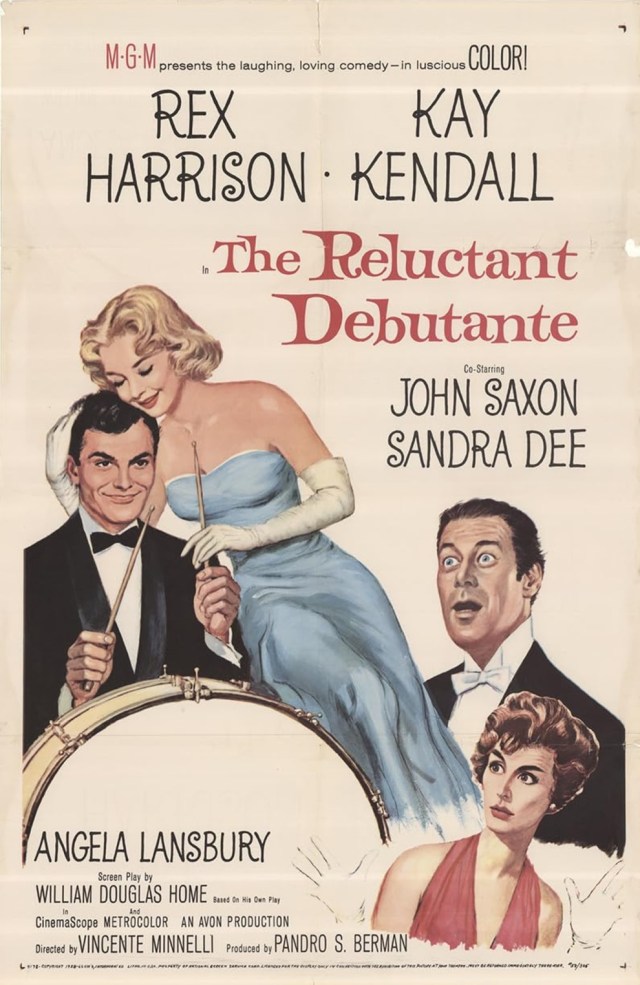
The Reluctant Debutante poster created by Avon Productions and Metro-Goldwyn-Mayer (MGM)

Things I liked about the film:

The acting: As I said in this review’s introduction, John Saxon is one of the reasons why I’m reviewing The Reluctant Debutante. Even though I wasn’t familiar with him as an actor, I liked his portrayal of David Parkson! Whenever he appeared in the movie, David always looked confident. Paired with that confidence was charisma, which helped David become such a memorable and likable character! What worked in John’s favor was the consistency of his performance. Having good on-screen camaraderie with Sandra Dee also worked in John’s favor. In the few scenes David and Jane, Sandra’s character, spent together, they appeared to get along so well. They also seemed to be on the same page when it came to several topics, such as the symbolism behind dancing and exploring the world. I, honestly, wish Sandra and John were given more appearances in The Reluctant Debutante because both of their performances were strong!

Like I also mentioned in this review’s introduction, Angela Lansbury’s involvement is another reason why I wrote about The Reluctant Debutante! Despite having limited appearances in the story, I really enjoyed watching Angela’s portrayal of Mabel Claremont! The best way I can describe this character is “the life of the party”. From the very first scene she appeared in, Mabel had such an exuberant personality. There was such a brightness to Mabel, I could understand why other characters might want to invite her to their events. Similar to John Saxon’s performance, Angela’s portrayal of Mabel was consistent. Mabel is another character I wish received more screen-time!

The on-screen chemistry: Rex Harrison and Kay Kendall portrayed Jane’s parents, Jimmy and Sheila, in The Reluctant Debutante. Shortly after these characters were introduced, I could immediately sense Kay and Rex’s on-screen chemistry! Throughout the story, Sheila and Jimmy’s marriage felt believable, like they were always meant to be together. When it came to the “debutante season”, Jimmy was the casual participant and Sheila became more involved in the process. Though they had their reasons for their “debutante season” beliefs, they still found a way to come together when it came to what was important, such as the well being of their daughter. Based on everything I said, Sheila and Jimmy displayed the “opposites attract” trope. With the strength of Kay and Rex’s acting abilities, both individually and together, this trope worked in Jimmy and Sheila’s favor!

The wardrobe: Debutante balls are known for showcasing exquisite fashion! When it came to the wardrobe department, The Reluctant Debutante did not disappoint! At a ball toward the beginning of the movie, Mabel wore a long-sleeved gown. This scoop-neck gown was covered in a lacy, deep-blue material, complimenting Angela’s light blonde hair. Adding extra sparkle was a large diamond necklace, a diamond tiara, and diamond earrings. One of my favorite dresses was Jane’s light-blue gown! Tiny bows found their place on the gown’s skirt. Sandra sometimes wore this dress with a light-blue satin cape and white gloves, which added elegance to the overall ensemble. Another outfit I liked is more casual in style. While at a restaurant with David Parkson, Jane wore a beige and brown plaid jumper dress over a beige blouse. Paired with this outfit was a khaki trench coat and a beige hat.

The John Saxon Blogathon banner created by Gill from Realweegiemidget Reviews and Barry from Cinematic Catharsis

What I didn’t like about the film:

A premise driven story: In the past, I’ve explained the difference between a premise driven and a plot driven story. In the case of The Reluctant Debutante, this story was premise driven. According to IMDB, the movie is about Jane and her parents participating in “Debutante season”. That part of the story was prioritized throughout the film. Taking a behind the scenes look at the debutante world is interesting. Halfway through the movie, though, I found myself asking, “Where’s the plot”? What The Reluctant Debutante was missing was a conflict, something to make the audience ask, “and then what happened”. This conflict could have ranged from Sheila and Jimmy organizing Jane’s debutante ball to Mabel convincing the Queen to continue the tradition of “debutante season”.

Drawn-out jokes: IMDB classifies The Reluctant Debutante as a comedy. Despite this label, I didn’t find myself laughing while watching the film. This weakness was due to the story’s jokes being drawn-out. A perfect example is how Sheila and Jimmy’s plans to overprotect Jane don’t go as expected. At one ball, Jimmy and Sheila are trying to find Jane. They race around the ballroom frantically looking for their daughter. Toward the end of the event, they discover Jane left with David Parkson. The very next scene revolves around Sheila and Jimmy worrying about Jane’s whereabouts, even going so far as to hiding in the kitchen and eavesdropping when Jane arrives home. I understand The Reluctant Debutante’s creative team was trying to tell a “comedy of errors” kind of story. In this movie, however, it took a long time for the errors to be resolved. In my aforementioned example, it took two whole scenes for Jane to be reunited with her parents. Watching The Reluctant Debutante felt like listening to a comedian spending too much time reaching their joke’s intended punchline.

Overlooked story ideas: While sightseeing in London, Mabel’s daughter, Clarissa, explains the “debutante season” to Jane. During this explanation, Clarissa tells Jane 1958 will be the last year for the “season” due to the Queen believing the practice outdated. Outside of Jane and Clarissa’s conversation, however, this detail isn’t brought up. Plus, none of the characters act as if the tradition of the “season” is ending anytime soon. I wish this part of the story had played a bigger role in The Reluctant Debutante. As I mentioned earlier in this review, it could have served as one of the story’s conflicts. It also would have given other characters, like Mabel and Clarissa, more involvement in the film.

Image of high school students dancing at prom created by Jan Sundstedt at freeimages.com. Photo by <a href=”/photographer/jansun-33414″>Jan Sundstedt</a> from <a href=”https://freeimages.com/”>FreeImages</a&gt;. Image found at freeimages.com.

My overall impression:

Movies from the 1950s are reviewed so infrequently on 18 Cinema Lane. So, when I find a film from the ‘50s to write about, I always root for that film to be good. With The Reluctant Debutante, however, I can’t say this movie is good. If anything, I was disappointed by it. The 1958 production was a premise driven story, a type of story that, in my opinion, contains less intrigue. The jokes lasted so long, it made the movie feel longer than one hour and thirty-four minutes. At one point, I almost fell asleep watching The Reluctant Debutante. Though I kept watching because the cast gave such strong performances. From Kay and Rex’s on-screen chemistry to Angela’s character being “the life of the party”, the acting was one of the few things I liked about the film. There’re even characters that should have received more screen-time, like David Parkson and Jane. During The Reluctant Debutante’s opening credits, I learned the movie was based on a play. What I also learned is how some plays were not meant to be adapted into a film.

Overall score: 5.5 out of 10

Have you seen The Reluctant Debutante? Which movie from the 1950s is your favorite? Let me know in the comment section!

Have fun at the movies!

Sally Silverscreen
Take 3: Dial M for Murder Review

For this movie review, I chose to write about the 1954 film, Dial M for Murder, for two reasons. The first is how I selected this specific title for The 6th Wonderful Grace Kelly Blogathon, as Grace Kelly stars in the film. The second reason is how, prior to this review, I had never seen Dial M for Murder. Grace and Alfred are no strangers to 18 Cinema Lane. As of mid-November, 2024, I have reviewed two of Grace’s films; High Society (which I thought was fine) and To Catch a Thief (which I found just ok). Meanwhile, four of Alfred Hitchcock’s movies have been covered on my blog. Out of those titles, Strangers on a Train is, in my opinion, still the best one. But how does Dial M for Murder compare to any of Alfred’s films featured on 18 Cinema Lane? Find out by reading my review!

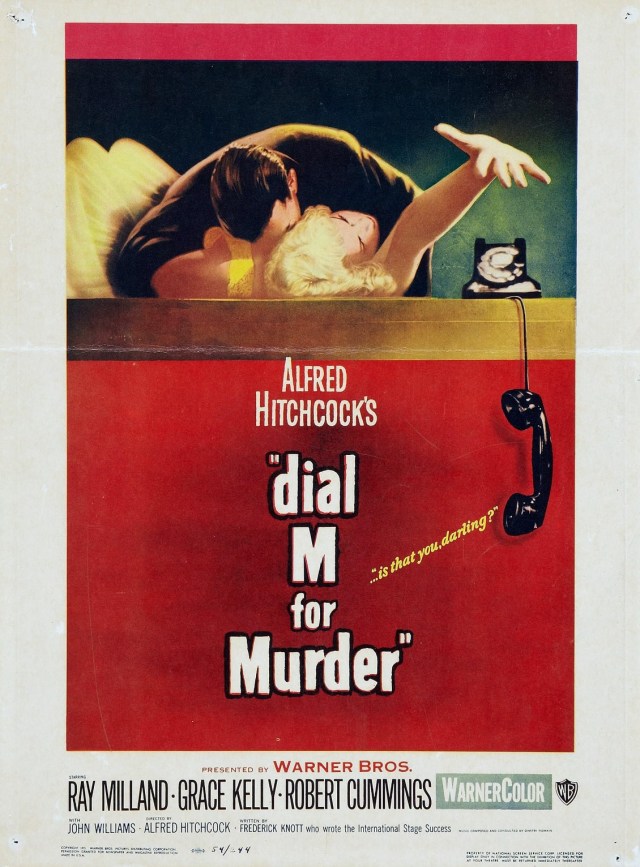
Dial M for Murder poster created by Warner Bros.

Things I liked about the film:

The acting: Since Grace Kelly is the reason why I chose to review Dial M for Murder, I will talk about her performance first. Out of her movies I’ve seen, I’ve noticed how her character portrayals have appeared at ease. Her performance in Dial M for Murder is no different, as her adopted mannerisms and reactions came across as realistic! While sharing a conversation with Mark (portrayed by Robert Cummings), Grace’s character, Margot, seems comfortable in his presence. She effortlessly moves around her apartment and, at times, stands close to him. But when she talks with Mark about how her husband, Tony, has changed, Margot appears to stare into the distance. The combination of her aforementioned stare and frown indicates how Tony’s behavior has troubled her. It also shows the audience how effective Grace’s acting talents are!

As I just said in this review, Robert Cummings portrays Mark, a close friend of Margot. Though they shared only a few scenes together, Grace and Robert displayed nice on-screen chemistry! The strength of Robert’s and Grace’s acting abilities helped their characters appear to truly get along with each other. While I liked Robert’s performance in Dial M for Murder, I was also impressed with Ray Milland’s performance! Similar to Grace’s portrayal of Margot, Ray’s portrayal of Tony showcases how adaptable his acting skills are. For example, Tony looks annoyed while at a restaurant with Mark. From the tone in his voice to constantly checking his watch, Tony clearly appears impatient. A few scenes later, as he’s on the phone with Margot, his demeanor quickly changes to concern due to what he hears over the phone. Throughout his performance, Ray effortlessly brought his character to life!

The use of lighting: Over the course of his career, Alfred Hitchcock has received the title of “Master of Suspense”. One reason why he was given this title is because of how he utilizes lighting to stir up a mood, present visually interesting concepts, or add suspense. In one scene, someone enters Margot and Tony’s apartment. This moment takes place at night, so the only light comes from the fireplace in the living room. An orange glow only providing light to certain areas of the room creates a suspenseful environment, giving the intruder places to hide. I brought up earlier in this review how Mark and Margot shared a conversation. Their conversation takes place in Tony and Margot’s apartment. Right before Tony returns home, Margot’s and Mark’s shadow departs from each other, keeping the closeness of their relationship a secret.

The use of color: Dial M for Murder’s opening credits reveal how the film’s creative team used “WarnerColor” in their project. I’m glad this movie was presented in color because it gave the creative team opportunities to utilize this visual technique to their advantage! Sometimes, the color red was incorporated into a character’s wardrobe. This ranged from Margot wearing a red dress at the beginning of the movie to Tony sporting deep red suspenders. One of the pieces of décor in Margot and Tony’s apartment were dark green curtains. In these examples, color was chosen to draw the audience’s attention to a person, object, or location in the room.

The 6th Wonderful Grace Kelly Blogathon banner created by Virginie from The Wonderful World of Cinema and Emily from The Flapper Dame

What I didn’t like about the film:

Exposition heavy: At the beginning of the movie, Margot shares with Mark how she recently lost her purse. She also tells him when her purse was returned, a letter Mark wrote her was missing. But shortly after Margot made this confession, an exposition heavy scene revealed the letter’s whereabouts, as well as who the story’s perpetrator was. Because this information was revealed so early in the movie, it took away a lot of the story’s suspense. So much exposition given within the film’s first ten minutes may also overwhelm the audience, possibly missing important information if they don’t actively pay attention to the dialogue.

A mystery that isn’t interactive: While talking about Dial M for Murder’s exposition heavy story, I said the perpetrator was revealed so early in the movie. This creative choice takes away the audience’s opportunity to solve the mystery of whodunit alongside the characters. What Dial M for Murder became was a story of how the perpetrator would get caught, similar to programs like Columbo and Diagnosis Murder. That creative decision forces the audience to simply watch the characters solve the story’s mystery. With everything I said, the mystery in Dial M for Murder wasn’t interactive.

A less intimidating antagonist: In some of Alfred Hitchcock’s movies, the antagonist is an intimidating person for a variety of reasons. Their intimidation can add suspense and intensity to a given film’s story. I will not spoil Dial M for Murder. However, I can honestly say I did not find the movie’s antagonist intimidating. Throughout the story, the antagonist kept making dumb decisions, which distracted from their attempts to be an intimidating character. It also didn’t help how the exposition heaviness of the film’s first ten minutes took away a lot of the story’s suspense. If anything, the antagonist in Dial M for Murder was annoying.

Colorful image of key created by orchidart at freepik.com. Flower vector created by orchidart – www.freepik.com

My overall impression:

As of the publication of this review, I have seen eight of Alfred Hitchcock’s films. While I was disappointed by The 39 Steps, I ended up liking Strangers on a Train. When it comes to Dial M for Murder, though, the movie lies somewhere in the middle. Grace Kelly’s performance was, once again, one of the best parts of the production! Her portrayal of Margot was so strong, her reactions and expressions appeared realistic! The use of lighting and color gave Alfred and his creative team ways to present visually creative ideas. But what held Dial M for Murder back from being a more intriguing project is how the first ten minutes of the story was exposition heavy, with this decision impacting the film’s suspense. The mystery not being interactive also takes away some of Dial M for Murder’s intrigue. Alfred’s film felt reminiscent of shows like Columbo and Diagnosis Murder, where the audience simply waits for the perpetrator to get caught. Personally, I prefer mystery stories where I’m left guessing whodunit.

Overall score: 6-6.1 out of 10

Have you seen Dial M for Murder? Which movie of Alfred Hitchcock’s would you like to see me review next? Tell me in the comment section!

Have fun at the movies!

Sally Silverscreen
Take 3: The Comedy of Terrors (1963) Review

In my review of the Diagnosis Murder episode, “Guardian Angel”, I mentioned how I’ve accepted movie recommendations from my readers. These recommendations have, sometimes, made great selections for blogathons. Four years ago, when I reviewed House of the Long Shadows, Patricia (from Caftan Woman) suggested several films starring Vincent Price. One of those titles was 1963’s The Comedy of Terrors. Since then, I have been waiting for the right time to create a review for this movie. With The Comedy of Terrors fitting the criteria for the 3rd Annual Spooky Classic Movie Blogathon, I knew I had found a perfect entry for the event!It’s become an unofficial tradition on 18 Cinema Lane to review at least one of Vincent’s movies every year. Since 2019, when I wrote about The Whales of August, eleven of Vincent’s films have received a review on my blog. While some of his movies have been more enjoyable than others, I can honestly say I haven’t seen a movie of his that I would consider “bad”. So, how does Comedy of Terrors compare to Vincent’s other films? Find out by reading my review!

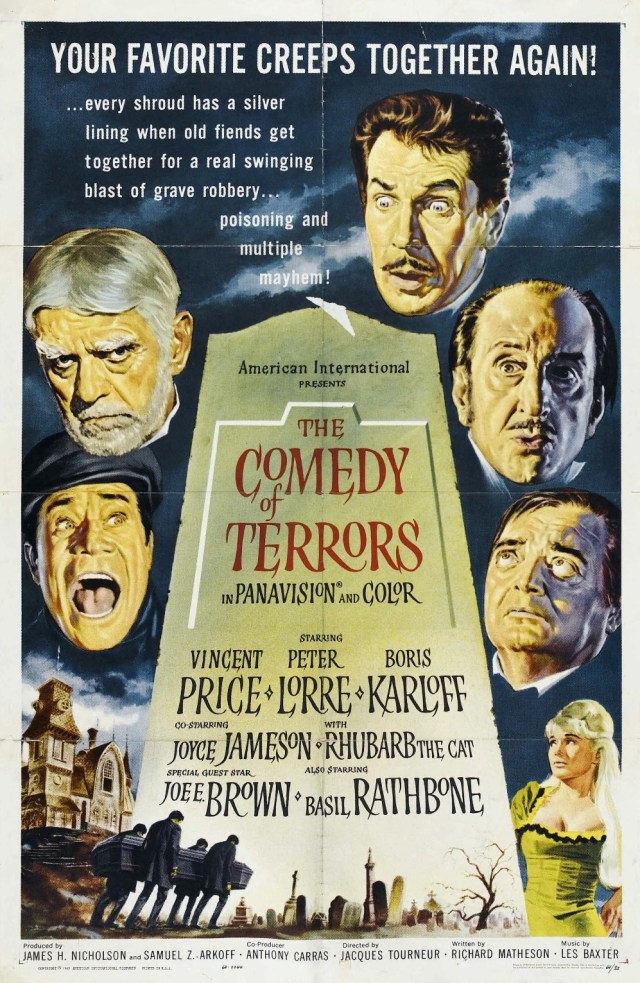
The Comedy of Terrors (1963) poster created by Alta Vista Productions and American International Pictures (AIP)

Things I liked about the film:

The acting: When you see Vincent Price’s name attached to a given film, there’s a chance you’re going to see Vincent give a solid acting performance. That was certainly the case in The Comedy of Terrors! What makes Vincent such a strong actor is his adaptability. Portraying an undertaker named Trumbull, Vincent successfully transformed his expressions and emotions based on his character’s situation. One evening, Trumbull was counting a large collection of coins. He displays a big smile on his face and also appears in a relaxed sitting position. When his wife, Amaryllis, comes into the room and asks him a question, Trumbull’s demeanor quickly changes. His sharp tone suggests deep irritation, with a disapproving frown to match. This change in attitude is consistent with Trumbull’s dislike for Amaryllis.

Prior to reviewing The Comedy of Terrors, I had seen two of Basil Rathbone’s movies; The Great Mouse Detective and Bathing Beauty. Because only one of these movies was a live-action production, I didn’t know what to expect from his portrayal of Mr. Black. However, I was impressed with Basil’s performance in The Comedy of Terrors! Some scenes show Mr. Black reciting one of Shakespeare’s plays. The first time the audience sees Mr. Black reciting Shakespeare’s work is when Felix (portrayed by Peter Lorre) breaks into Mr. Black’s home. In this particular scene, Mr. Black displays an animated demeanor throughout his reenactment. The way he confidently recited Shakespeare’s words gave this reenactment a sense of grandeur. Reflecting on Basil’s performance in The Comedy of Terrors and looking at his IMDB filmography, I wish he has starred in an adaptation of Shakespeare’s work.

An immersive world: A make-or-break factor of any movie is how that picture is presented. For period/historical fiction films, the accuracy and attention to detail can help that movie’s world feel immersive. Because The Comedy of Terrors takes place during the Victorian era, everything in the film has to appear accordingly. This was achieved in the 1963 film, as the aforementioned elements of attention to detail and accuracy were applied! When I talked about Vincent’s performance, I mentioned Trumbull was an undertaker. An ornate coffin was presented any time Trumbull hosted a funeral. The shiny, black coffin was constructed by sharp angles and was decorated with gold designs. This prop was a simple, yet visually appealing way of addressing the wealth of Trumbull’s clientele. One scene shows Trumbull and Felix breaking into someone’s home. Without meeting the homeowner, the audience can tell how this character lives a comfortable life. Decorative lamps and wall sconces are included in characters’ bedrooms. A series of statues make a strong appearance when Felix and Trumbull first walk into the house. There is even gold trim on one of the doors. From the set design to the costume design, the world within The Comedy of Terrors was immersive!

Peter Lorre and Joyce Jameson’s on-screen chemistry: Earlier in my review, I said Felix was portrayed by Peter Lorre. I also stated how Trumbull doesn’t like Amaryllis (portrayed by Joyce Jameson). Amaryllis is hurt by Trumbull’s negativity toward her. Meanwhile, Felix is upset by how Amaryllis is treated by Trumbull. The shared dislike Felix and Amaryllis have toward Trumbull create an affection for one another. Though they shared only a few scenes together, I was pleasantly surprised by Joyce and Peter’s on-screen chemistry! The warm, caring demeanor between Felix and Amaryllis came across as believable. This was made possible by the strength of Joyce’s and Peter’s performance. With that said, I think Peter and Joyce not receiving more scenes together was a missed opportunity.

The 3rd Annual Spooky Classic Movie Blogathon banner created by Kristen from Hoofers and Honeys

What I didn’t like about the film:

Jokes that are too long: Comedy, like film, is subjective. One aspect to this subjectivity is the length of the jokes. In my opinion, the jokes in The Comedy of Terrors were too long. It seems like the screenwriters had difficulty finding their intended punchline or realizing they reached their punchline long ago. A running joke in The Comedy of Terrors is how Amaryllis is a terrible singer, despite her claims of a possible opera career. Had she sung a portion of a song once or twice, it would have been enough to get the intended point across. But the fact Amaryllis almost sang whole songs three or four times caused the joke to last too long and quickly become old.

Parts of the story that don’t make sense: I mentioned earlier in this review how Felix broke into Mr. Black’s home. To get into Mr. Black’s house, Felix had to climb onto the roof and into an upstairs window. But during this excursion, a cat named Cleopatra joins Felix and Trumbull, watching Felix trespass into Mr. Black’s property. It’s explained in the film why Felix needed to find an alternative entrance. What isn’t explained is why Cleopatra didn’t enter the house. I’m not sure how Cleopatra could have assisted Trumbull and Felix. However, it would have been easier for a cat to climb on a roof and enter through a window. This is just one part of the story that, to me, didn’t make sense.

An underutilized cat: In past reviews, I have been critical when an actor or actress was underutilized. But in the case of The Comedy of Terrors, the creative team underutilized a cat. As I mentioned in my point about parts of the story that don’t make sense, a cat named Cleopatra joined Trumbull and Felix on their excursion. Even though Cleopatra was adorable, the cat was not a significant part of the overall story. There were even times when I wondered why a cat was included in the movie at all. Had Cleopatra been written out of The Comedy of Terrors, the story itself would not change much.

Orange cat image created by Freestockcenter at freepik.com. <a href=’https://www.freepik.com/free-photo/ginger-cat_883376.htm’>Designed by Freestockcenter</a>. <a href=”https://www.freepik.com/free-photos-vectors/gold”>Gold image created by Freestockcenter – Freepik.com</a>. Image found at freepik.com.

My overall impression:

In this review’s introduction, I said I haven’t seen a movie of Vincent Price’s that I would consider “bad”. While this statement is still true, The Comedy of Terrors is one of his weaker pictures. The flaws of the 1963 production include jokes that are too long and parts of the story that don’t make sense. But there are aspects of the movie I liked. The Comedy of Terrors is an immersive film, making viewers feel transported to the Victorian era. Attention to detail and historical accuracy helped the creative team achieve that illusion. Vincent’s performance was one of the strongest parts of this film! His adaptability made his portrayal of Trumbull captivating to watch. Now that I’ve finally seen The Comedy of Terrors, I can, honestly, say this picture emphasizes style more than substance. Out of Vincent’s eleven movies I’ve seen, this one is just ok.

Overall score: 6.1 out of 10

Have you seen The Comedy of Terrors? Which film of Vincent Price’s should I review next? Please tell me in the comment section below!

Have fun at the movies!

Sally Silverscreen

Sally Watches…Diagnosis Murder (The Sequel)!

From time to time, I have accepted movie recommendations from my readers. Some of these recommendations were chosen for past reviews, such as when Jillian (from The Classic Film Connection) suggested I check out Fried Green Tomatoes. But on a few occasions, I have taken television show recommendations. After Jillian gave me another suggestion; the Diagnosis Murder episode, “Guardian Angel”, I was waiting for the right time to finally write about it. Remembering the show starred Dick and Barry Van Dyke, I decided to review the episode for Taking Up Room’s We Are Family Blogathon! As the title of this review suggests, this is not the first time I’ve written about an episode of Diagnosis Murder. Back in 2022, I reviewed the 1998 episode, “An Education in Murder”. While I found that episode to be just fine, I was willing to watch more episodes of the show with an open mind. Did I like “Guardian Angel” more than “An Education in Murder”? To solve this mystery, you have to read my review!

Episode Name: Guardian Angel

Season 1, Episode 14

Premiere Date: April 1st, 1994

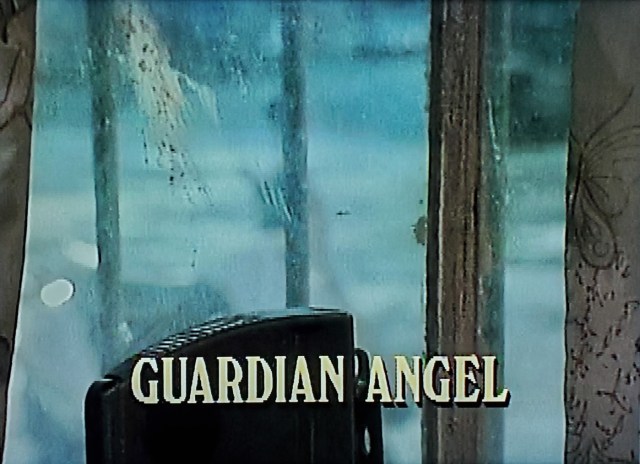
The title card for “Guardian Angel”. Screenshot taken by me, Sally Silverscreen.

What I liked about this episode:

On television shows or in movies, there is sometimes that one performance that is so strong, it carries the entire production. That kind of performance came from Catherine Hicks in “Guardian Angel”! Portraying the murder victim’s wife, Lauren, Catherine brought emotional variety to her role. This versatility allowed Catherine to adapt to any situation her character was experiencing. In a scene showing Dr. Mark Sloan paying Lauren a visit at her house, Lauren shares a personal story with Dr. Sloan. As she tells her story, Lauren’s expressions and emotions fluctuate, helping to make Lauren’s reflection come across as realistic. The aforementioned emotional variety and adaptability made Catherine’s performance captivating to watch! I honestly wish she had been, at least, nominated for her role in this episode.

What I didn’t like about this episode:

Toward the beginning of “Guardian Angel”, it is revealed Lauren knows a man named Strand. She not only calls him in the middle of the night, she also visits his apartment. As I watched “Guardian Angel”, I was waiting for an explanation about Strand and Lauren’s connection. Unfortunately, this explanation never came. Is Strand Lauren’s son from a previous relationship? Perhaps Strand is an undercover journalist working for Lauren’s husband’s political opponent? These unanswered questions left a hole in the episode’s plot. Not relating Lauren and Strand’s connection to the main conflict was also a missed opportunity. As of the publication of this review, the mystery of how Strand and Lauren know each other is still unsolved.

The mystery itself:

The mystery in “Guardian Angel” and “An Education in Murder” share two major similarities. The first is how the audience learns early in the story who the guilty party is. The second is how the audience is forced to just watch Dr. Mark Sloan figure out the mystery’s culprit. This approach to story-telling takes away the interactivity of solving the mystery alongside the protagonist. How Dr. Mark Sloan reached certain conclusions in “Guardian Angel” was a bit far-fetched. For these conclusions, the bridge between point A and B was missing. It also doesn’t help how there were few physical clues.

The We Are Family Blogathon banner created by Rebecca from Taking Up Room

The other factors from this episode:

  • Earlier in this review, I mentioned how Lauren called Strand in the middle of the night. During this phone call, however, Lauren poses as a newspaper reporter. “Guardian Angel” establishes how Strand is obsessed with Lauren’s family. Not only does Strand have a collage of pictures and newspaper articles on his apartment wall, he also attends events Lauren and her husband were either invited to or hosting. With that said, I find it hard to believe Strand wouldn’t recognize Lauren’s voice during the aforementioned phone call, especially since Lauren wasn’t trying to disguise her voice.
  • I haven’t seen many episodes of Diagnosis Murder. But based on the episodes I have seen, I’ve noticed how Dr. Mark Sloan treats people fairly. In “Guardian Angel”, a man named Lewis was admitted into the hospital due to being hit by a car. Dr. Mark Sloan tells Lewis how he treats patients, not charity cases, at his hospital. After learning Lewis only has about five hundred dollars to his name, Dr. Mark Sloan advocates for Lewis to be registered into a “senior program”.
  • When I reviewed “An Education in Murder”, I wondered how often younger characters appeared on Diagnosis Murder. While I still don’t have the answer to that question, I think it’s an interesting coincidence how I’m reviewing another episode where Dr. Mark Sloan provides guidance to a younger character. Lauren has a teenage daughter named Melissa. When Dr. Mark Sloan discovers Melissa received an eating disorder diagnosis, he pays her a visit at a nearby hospital. During this visit, Dr. Mark Sloan breaks the ice by discussing music with Melissa. He also learns why she was diagnosed with an eating disorder. Dr. Mark Sloan’s willingness to mentor younger characters makes me believe he missed his calling as a teacher.
  • In some of my Murder, She Wrote episode reviews, I marveled over the set design and locations featured on the show. These places were so visually appealing, they became showstoppers in their respective episodes. It looks like “Guardian Angel” took a page from Murder, She Wrote’s playbook when it came to location scouting! I don’t know if Lauren’s house is a set or a real-life structure. However, this house was one of the most photogenic facilities I’ve ever seen on a television show! The exterior of the house boasted brick and deep brown wood. Details such as arched windows and small steepled roofs present a cozy, cottage-like appearance to this building. The interior of Lauren’s house is equally photogenic! Though only two rooms were shown in “Guardian Angel”, they looked like they came straight out of a castle. In the living room, the focal point is an impressive dark wood and marble fireplace, complete with carved designs just under the mantle. Meanwhile, the large dining room displays a cozy elegance. This aesthetic is made possible by combining printed cream curtains, a gold chandelier, and a large brick and wood fireplace.
This is the episode’s only clear shot of the exterior of Lauren’s house. Despite that, Lauren’s house displays an elegant, cottage-like appearance. Screenshot taken by me, Sally Silverscreen.
Though it can be difficult to decipher the carvings on the fireplace, the carvings add to the fireplace’s impressiveness. Screenshot taken by me, Sally Silverscreen.
Even though Dr. Mark Sloan and Lauren spend only one scene in the dining room, the space itself boasts a sophisticated, yet quaint style. Screenshot taken by me, Sally Silverscreen.

My overall thoughts:

Two years ago, when I shared my overall thoughts on “An Education in Murder”, I said the amount of stories in that episode never felt overwhelming. I also said each plot was connected to the mystery. These same claims cannot be made about “Guardian Angel”. In the 1994 episode, there is so much happening in the story, certain parts are either not clearly explained or not explained at all. As I mentioned in this review, the connection between Strand and Lauren was never revealed. What is also not revealed is why Strand was obsessed with Lauren’s family. “Guardian Angel” is another mystery where the audience discovers who the guilty party is early in the episode. It’s also another mystery where the audience simply watches Dr. Mark Sloan solving the case. But for all the faults of this Diagnosis Murder episode, there were aspects of the episode I liked. One of these aspects was Catherine Hicks’ portrayal of Lauren. “Guardian Angel” is not one of the worst episodes reviewed on 18 Cinema Lane. Similar to “An Education in Murder”, though, I was left desiring more.

Rating: A 3.2 out of 5

Have fun in Los Angeles!

Sally Silverscreen

The Cabot Cove-thon Blogathon Has Been Brought to You by Our Sponsor; 18 Cinema Lane

Hello everyone! Now that Cabot Cove-thon has come to an end, I’d like to thank those who participated in the event! While this year’s blogathon received a smaller turn-out, I was impressed by the diversity of the entries. It elaborated my point about how Murder, She Wrote is a multifaceted program. There will be a new blogathon held in 2025! But, as of early October 2024, the event’s theme and dates are pending. Blogathon news will be announced sometime between early to mid 2025. With all that said, 18 Cinema Lane will get back to its regularly scheduled programming!

Cabot Cove-thon banner created by me, Sally Silverscreen. Original picture found on IMDB.

Have fun in Cabot Cove!

Sally Silverscreen
The Cabot Cove-thon Blogathon is Here to Commemorate 40 Years of ‘Murder, She Wrote’!

Welcome to my blogathon, Cabot Cove-thon! With Murder, She Wrote‘s first episode premiering on September 30th, 1984, this event is commemorating the show’s 40th anniversary! In Murder, She Wrote‘s twelve season lifespan, viewers watched as Jessica successfully cracked each case, whether in her hometown, Cabot Cove, or beyond her own backyard. The show also proved to its audience how diverse the mystery genre can be; telling stories, expressing ideas, and showcasing talent that make each episode unique. The participants of Cabot Cove-thon created articles that highlight the multifaceted nature of Murder, She Wrote. From observing Angela Lansbury’s film career to discussing the show’s theme park presence, let the Cabot Cove-thon Blogathon begin!

Cabot Cove-thon banner created by me, Sally Silverscreen. Original picture found on IMDB.

18 Cinema Lane — Why Universal Orlando Resort Should Host ‘Murder, She Wrote’ Weekend, Sally Reads…’Murder, She Wrote: Dying to Retire’ by Jessica Fletcher and Donald Bain

Taking Up Room — Miss Angela Cruises the Nile

The Very Special Blog — Happy 40th Anniversary to Murder, She Wrote!

Why Universal Orlando Resort Should Host ‘Murder, She Wrote’ Weekend

*This editorial was written before Hurricane Helene*

For the Cabot Cove-thon, I originally wanted to write an editorial about the Universal Studios Florida attraction, Murder, She Wrote Mystery Theatre. This show having a presence in any theme park, let alone Universal Studios, was an intriguing concept to discuss during my blogathon. But the more I learned about Murder, She Wrote Mystery Theatre from the Youtube channel, Poseidon Entertainment, the more I discovered that once guests consumed the information from Jessica and the actors associated with the Mystery Theatre, they had little reason to return. A behind-the-scenes look at how to create an episode of Murder, She Wrote from the post-production stage is both fascinating and educational. However, with the aforementioned details from Poseidon Entertainment in mind, I wondered how I could improve Murder, She Wrote Mystery Theatre. If Murder, She Wrote were to return to Universal Studios’ theme park, bringing the show back as an event instead of an attraction would give fans and park guests a reason to come back. This is how I created the idea of Universal Orlando Resort hosting a fan event called Murder, She Wrote Weekend! In this editorial, I will explain why Universal Orlando Resort should host Murder, She Wrote Weekend by providing a basic concept of the event’s schedule. My editorial is, simply, proposing an idea, so any decisions related to event creation will be determined by Universal Orlando Resort themselves.

Cabot Cove-thon banner created by me, Sally Silverscreen. Original picture found on IMDB.

Friday

The beauty of having Universal Orlando Resort host Murder, She Wrote Weekend are the amenities and accommodations at their disposal. One of them are the soon to be ten hotels on their property. Each hotel has its own unique identity, offering their guests a variety of experiences. These unique identities could work in the favor of Murder, She Wrote Weekend, as the chosen hotel could play a role in the event’s theme. Murder, She Wrote has created some episodes related to music. In the season nine episode, “The Sound of Murder”, Jessica witnesses the filming of a rock music video. With the themes of rock n’ roll and music, the Hard Rock Hotel would serve as the perfect venue.

Using the Hard Rock Hotel as this editorial’s example, attendants of Murder, She Wrote Weekend would check in on Friday. At the front desk, hotel information as well as weekend itinerary, badges, and goodie bags will be presented. There will be a large gap in time between check-in and the first official event. This will give attendants an opportunity to rest, explore Universal Orlando Resort, or create a schedule for the weekend. When it’s time for the first official event, attendants will gather in the theater of either Velvet Sessions or Velvet Unplugged for a trivia contest. Trivia will include a variety of topics connected to Murder, She Wrote’s twelve season history. Attendants who win the trivia contest could receive prizes such as a signed script from the show, a shopping spree at the Tribute Store Plaza (if the store was open at the time of Murder, She Wrote Weekend), or an expenses paid trip to Blair House Inn (the house that portrayed Jessica’s home on Murder, She Wrote).

Since Murder, She Wrote: The Highland Fling Murders is about Jessica traveling to Scotland, I figured this photo would be an appropriate choice for my editorial. Screenshot taken by me, Sally Silverscreen.

Saturday

The first official day of Murder, She Wrote Weekend will begin with a panel in the morning. This panel could focus on a topic related to the show, the mystery genre, or the event’s theme. According to the synopsis for “The Sound of Murder”, “Jessica records one of her novels for the blind”. So, in this editorial’s example, the panel on Saturday would revolve around the topic of audiobooks. The panel itself would consist of five people: an executive of a publishing firm, an author whose book was transformed into an audiobook, an audiobook’s narrator, the president of an audiobook company, and an employee of a recording studio. This diverse group of people would hold a discussion on what it takes to create an audiobook, exploring this topic from different perspectives. Toward the end of the panel, attendants will receive an opportunity to ask the panelists questions.

Another amenity Universal Orlando Resort has at their disposal are their theme parks. With Universal Studios Florida and Islands of Adventure, a water park known as Volcano Bay, and their Epic Universe on the horizon, Universal Orlando Resort provides guests with a bundle of attractions to make their day action-packed and fun-filled. Attendants of Murder, She Wrote Weekend can take advantage of their time in the parks by participating in a scavenger hunt. Clues related to Murder, She Wrote would be hidden throughout the parks. During this activity, participants will encounter various attractions, giving them a reason to stay in the parks after the scavenger hunt is over. Winners of the scavenger hunt will earn a prize, like a commemorative pin. Murder, She Wrote Weekend attendants also have the option of a Murder, She Wrote themed escape room. Similar to Universal CityWalk’s Universal’s Great Movie Escape, attendants can be transported to the world of Jessica Fletcher as they try to escape locations relevant to the show, such as Jessica’s living room. Winners of the escape room can also earn a commemorative prize like the aforementioned scavenger hunt. To close out Murder, She Wrote Weekend’s first day, a screening of a Murder, She Wrote episode and/or an upcoming movie from the mystery genre will take place at Universal CityWalk’s Universal Cinemark cinema.

In the Murder, She Wrote episode, “Murder Takes the Bus“, Jessica travels on, you guessed it, a bus. Screenshot taken by me, Sally Silverscreen.

Sunday

The schedule for the second and final day of Murder, She Wrote Weekend is similar to Saturday’s schedule, except for two major differences. While Sunday will begin with a panel, this panel, in my editorial’s example, will feature a collection of actors, producers, screenwriters, and directors who worked on Murder, She Wrote. Like the aforementioned panel on Saturday, attendants of Murder, She Wrote Weekend will be able to ask the panelists questions toward the end of the panel. But this time, the attendants will have the chance to take photographs with the panelists in a meet & greet. The second major difference is the event that will conclude Murder, She Wrote Weekend. This event would either be a costume party (where attendants are invited to dress up as characters from Murder, She Wrote, programs from Universal Studios, or from ‘80s and ‘90s productions) or a mystery dinner theatre presentation. If attendants of Murder, She Wrote Weekend already participated in the scavenger hunt and escape room I talked about earlier in this editorial, they will have the opportunity to explore Universal Orlando Resort at their leisure.

As I have already mentioned, Universal Orlando Resort has a bundle of attractions in their parks. At Universal CityWalk, a collection of shops, restaurants, and entertainment options are located under Universal Orlando Resort’s umbrella. These attractions and facilities are another amenity Universal Orlando Resort can use to their advantage, especially if they hosted Murder, She Wrote Weekend. When bringing up ideas for trivia contest prizes, I mentioned the Tribute Store Plaza. This store, which operates during limited times, sells merchandise that represent a specific theme. In the case of Murder, She Wrote Weekend, the store could sell products related to Murder, She Wrote; from Cabot Cove postcards to a typewriter that mirrors Jessica’s. “The Sound of Murder” takes place in New York City. Keeping this editorial’s example in mind, Cold Stone Creamery could create a Murder, She Wrote Weekend exclusive flavor based on New York cheesecake. The Toothsome Chocolate Emporium & Savory Feast Kitchen could also capitalize on Murder, She Wrote Weekend by crafting a blueberry pie flavored milkshake in honor of Jessica Fletcher’s home in Cabot Cove, Maine.

Since Murder, She Wrote: The Queen’s Jewels is about Jessica traveling on a cruise trip, I figured this photo would be an appropriate choice for my editorial. Screenshot taken by me, Sally Silverscreen.

2024 became the year when fan events failed. Two notable examples are the Bluey event in Las Vegas that disappointed families and Glasgow’s unimpressive Willy Wonka & the Chocolate Factory themed event. But for every fan event that attracts attention for the wrong reasons, there is a desire to see a fan event succeed. With the resources and amenities at their disposal, Universal Orlando Resort has the potential to host a Murder, She Wrote themed event that meets and even exceeds expectations. It also helps how Universal Orlando Resort is familiar with Murder, She Wrote’s IP (intellectual property), as this show has had a presence in Universal Studios Florida. Murder, She Wrote benefits from having a twelve-season lifespan. The abundance of stories, ideas, and famous faces can provide ideas for a Murder, She Wrote themed event. At the beginning of my editorial, I pointed out how bringing the show back as an event instead of an attraction would give fans and park guests a reason to come back to the parks. Hosting a Murder, She Wrote themed event would also create a new tradition and celebrate the legacy of Jessica Fletcher.

Have fun in Cabot Cove!

Sally Silverscreen

Featured references:

Poseidon Entertainment’s video, “A Deep Dive Into Classic Universal Studios Florida (Part 1)

(segment about Murder, She Wrote Mystery Theatre is featured from 28:12 to 31:46)

http://www.blairhouse.com

orlandoinformer.com/blog/the-tribute-store-plaza-universal-studios-florida/

universalorlando.com

IMDB synopsis for “The Sound of Murder” — http://www.imdb.com/title/tt0653664/?ref_=ttep_ep10

Comparing with the Critics – Worst of 1988 – Willow

This review is from my series, Comparing with the Critics. If you’d like to learn more about the series, click on the link below.

Introducing my new series, Comparing with the Critics!

Siskel & Ebert and 18 Cinema Lane share one thing in common: the fantasy genre is underrepresented. This is a reason why I not only chose to participate in the Barbarians at the Gates Blogathon, it’s also a reason why I selected Willow for this review of Comparing with the Critics. But another reason why I picked Willow is how the film was featured in Siskel & Ebert’s Worst of 1988 episode. After hearing good things over the years about the movie, even some people giving it the coveted title of “classic”, I was shocked to see Willow included among the worst of 1988. But since I didn’t see the film before the Barbarians at the Gates Blogathon, I couldn’t agree or disagree with Siskel and Ebert. Film is subjective, with this subjectivity being the reason why I created the Comparing with the Critics series. So far, I disagreed with the critics on Network and Harry & Son, yet agreed with them on Amadeus. With that said, I’d have to say I disagree, yet again, with Ebert and Siskel. While Willow has its flaws, its placement in the Worst of 1988 episode is unjustified.

Willow poster created by Metro-Goldwyn-Mayer (MGM), Lucasfilm, and Imagine Entertainment

Before going over his complete list of the worst films from 1988, Gene Siskel introduces the episode’s segment on Willow. He calls the film “a heavy duty and quite dreary production”. I will admit there are darker moments within the story. However, the movie was more humorous than I expected it to be! Most of the humor came from Madmartigan, portrayed by Val Kilmer. Because of the screenwriting and Val’s versatile performance, the comedic timing was effectively executed. One of the funniest scenes in Willow is when Madmartigan and Willow are traveling on a sled down a snowy hill. During this trip, Madmartigan falls off the sled. But instead of being left behind, Madmartigan rolls down the hill, becoming a giant snow ball. When Madmartigan was introduced in Willow as the story’s comic relief, I knew he was going to be a character I would like. His personality, along with the dialogue shared between him and Willow, presented someone who captivated my attention and kept me invested in his story. It also helps that Madmartigan is hilarious, as he is the reason why I burst out laughing several times while watching Willow!

Madmartigan and Sorsha picture created by Metro-Goldwyn-Mayer (MGM), Lucasfilm, and Imagine Entertainment

Gene Siskel is not the only critic who disliked Willow. Though he didn’t put the movie on his list of the worst films of 1988, Roger Ebert expressed his disapproval over how the story seemed similar to Star Wars, claiming children who liked the movie “hadn’t seen it a hundred times before”. I can only speak for myself, but Star Wars never crossed my mind as I watched Willow. But some moments did feel reminiscent of The Wizard of Oz. The film clip included in the Worst of 1988 episode shows Cherlindrea, a fairy queen, revealing to Willow the purpose of his journey. She even gives him a wand to help him accomplish his mission. The scene reminded me of when Glinda explained to Dorothy how she could return home. The iconic ruby slippers became a tool to help Dorothy along her way to Emerald City. Story ideas are bound to get repeated over time. Therefore, moments in Willow feeling reminiscent of The Wizard of Oz didn’t bother me. Instead, it showed me how a film’s creative team can take a familiar story idea and add their own unique perspective on it!

The Barbarians at the Gates Blogathon banner created by Quiggy from The Midnite Drive-In and Hamlette from Hamlette’s Soliloquy

Another criticism Gene had about Willow was the film’s setting, stating “I’m tired of seeing epic pictures set in forests with lots of people running around and, uh, hitting each other over the head”. Personally, I was not bothered by this, as I felt the setting fit the story Willow’s creative team was trying to tell. What did bother me was how the build-up of Madmartigan and Sorsha going from enemies to lovers happened too quickly. Incorporating the “enemies to lovers” trope works in a fantasy story like Willow, where there is at least one battle and a major theme is good versus evil. It should be noted how Val Kilmer and Joanne Whalley had nice on-screen chemistry, as well as Sorsha and Madmartigan appearing photogenic together. I still wish the aforementioned build-up had been more gradual. As the story progressed, Sorsha evolved from villain to hero. Unfortunately, this evolution was too abrupt. While Sorsha’s change of heart gave her some character development, it left some questions unanswered. Perhaps a scene explaining this transformation didn’t find its way into the movie?

Snowy mountain image created by Freepik at freepik.com. <a href=’https://www.freepik.com/free-vector/landscape-background-of-snow-track-and-mountains_968656.htm’>Designed by Freepik</a>. <a href=”https://www.freepik.com/free-photos-vectors/background”>Background vector created by Freepik</a>. Image found at freepik.com.

In past reviews, I criticized films for containing parts of a story that didn’t make sense. Willow is a film that doesn’t avoid this flaw. Bavmorda is the villain of the story. When the heroes attempt to defeat Bavmorda, she uses a spell to transform the heroes into pigs, with Willow and a sorceress named Fin Raziel being the only exceptions. This spell takes place in a short amount of time, with the afflicted heroes becoming pigs all at once. When Fin Raziel reverses the spell, this proves to be a lengthy process, as she uses her magic on one person at a time. This creative choice left me wondering why Fin Raziel wouldn’t use her magic on all the heroes all at once similar to Bavmorda? To me, it didn’t make sense, especially since the heroes didn’t have the luxury of time.

Comparing with the Critics banner created by me, Sally Silverscreen. TV show title cards created by WTTW National Productions, WTTW, Public Broadcasting Service (PBS), Lifetime Television, Tribune Entertainment, Buena Vista Television, and Disney-ABC Domestic Television

During their discussion of Willow in Siskel & Ebert’s Worst of 1988 episode, Roger reminds Gene how, despite the movie’s bad reviews, it became the top selling video and was successful at the box office. Had I seen Willow sooner, I might have contributed to the movie’s statistics. This is another Comparing with the Critics review where I found myself disagreeing with Siskel and Ebert. That’s because I had a genuinely good time watching Willow! I brought up in this review how the project has its flaws. But the story was simplistic and straight-forward, which made it easier to follow what was happening on screen. Even though Willow was the movie’s protagonist, it was Madmartigan who stole the show! In fact, I’d say he was the MVP of this story, as his personality and comedic timing left a good impression. There were moments in the film that felt reminiscent of The Wizard of Oz. However, I saw those moments as ways for Willow’s creative team to bring their own unique perspective to familiar story ideas. I have to say I’m glad I chose to review Willow for this edition of Comparing with the Critics! Now if you’ll excuse me, I have to watch the Siskel & Ebert 1988 Holiday Video Gift Guide episode in the hopes something Willow related can be included in my Movie Blogger’s Christmas Wish List.

This review was brought to you by

Sally Silverscreen
Take 3: Cricket on the Hearth (1967) Review

You probably think it’s strange how, after a week and a half long hiatus, my first review back on my blog would be for a Christmas film (in the middle of August). However, I have a very good explanation for this choice. The first reason is how the 1967 animated movie, Cricket on the Hearth, is what I selected for Realweegiemidget Reviews’ (Aaron) Spellingverse Blogathon, as Aaron Spelling was one of the film’s executive producers. The second reason is how animated movies are reviewed so infrequently on my blog. In fact, Cricket on the Hearth is the first animated film to be reviewed on 18 Cinema Lane in 2024. When I chose to participate in the (Aaron) Spellingverse Blogathon, I knew I wanted to write about a made-for-tv movie. So, when I discovered the 1967 film on Aaron’s IMDB filmography, I felt I found the perfect movie for the blogathon, especially for the previously mentioned reasons! But did Cricket on the Hearth end up being the perfect choice to write about? Keep reading my review to find out!

Cricket on the Hearth (1967) title card created by Rankin/Bass Productions, Thomas/Spelling Productions, and National Broadcasting Company (NBC)

Things I liked about the film:

The animation: Some of the best animated movies boast bright, colorful hues. These hues can be utilized in various ways, from creating imaginative worlds to providing interesting visual contrasts. Cricket on the Hearth was a very kaleidoscopic production! Scenes either burst with a bundle of color or at least one bold color sparkled against a darker background. Presenting Cricket Crocket in a mustard yellow suit jacket and shoes, paired with an orange vest and a red bowtie, was a smart creative decision. It forces the audience to focus on Cricket Crocket, especially when he’s standing on a dark wood table or a deep green top hat. The toys in Caleb’s toy shop come to life during the song, ‘Smiles Go With Tears’. Despite the title’s contraction, the song’s tone is joyful because the song is about someone shedding tears due to being happy. The joyful nature of ‘Smiles Go With Tears’ is wonderfully depicted in the presentation of the toys. From a doll’s bubble-gum pink dress and bonnet to a pair of bright yellow and blue elephants, this scene was great to look at!

While looking for a place to live, Caleb considers moving into a poor house. Because Cricket Crocket is perched on Caleb’s top hat, Cricket Crocket hangs upside down in order to face Caleb. While looking upside down, Cricket Crocket sees a nearby toy factory. As he is readjusting himself, the image of the toy factory flips from appearing upside down to becoming right-side up. Animated films from the 1960s, especially those that were made-for-tv productions, were created with limited resources compared to animated pictures from the twenty-first century. Therefore, scenes like the one I just described seem ahead of its time.

The songs: Before reviewing Cricket on the Hearth, I had never seen the 1967 movie. So, I was pleasantly surprised when I discovered the movie was a musical! The songs featured in this film sounded like relics of the late ‘60s, the time when Cricket on the Hearth was released. But these sounds, from emotional ballads to cheery tunes, felt nostalgic. Danny Thomas, who voices Caleb, sings a ballad titled ‘Through My Eyes’. Throughout this song, Caleb expresses his desire for his daughter, Bertha, to see the world how he wishes he could present it to her. The combination of Danny’s vocals and the orchestral music felt reminiscent of Judy Garland’s ‘Somewhere Over the Rainbow’ and Louis Armstrong’s ‘What a Wonderful World’, songs that exude a sense of hope and contain timeless elements. Another song of Danny’s I liked was ‘The First Christmas’! Before this song, Caleb wonders how he will provide the kind of Christmas Bertha hopes for. He learns how to resolve his conflict as the song carries on. The lyrics of ‘The First Christmas’ illustrate how Christmas doesn’t have to look the same for those who celebrate the holiday. The inclusion of the Norman Luboff Chorus added gravitas to this song!

The religious aspects of Christmas: Based on what I know about Charles Dickens and his stories, A Christmas Carol, one of his most well-known pieces of literature, is typically not known for addressing the religious aspects of Christmas. Though it was briefly incorporated in Cricket on the Hearth, I was pleasantly surprised by the recognition of Christmas’ religious aspects! As I previously said while talking about ‘The First Christmas’, the lyrics of the song illustrate how Christmas doesn’t have to look the same for those who celebrate the holiday. This point is emphasized by reminding the audience how Jesus had very little in terms of decorations and presents during the First Christmas. By the end of the song, the message is made clear; it’s not about what you have, but who you spend Christmas with that’s important. Before closing out the movie, Danny quotes a poem by Edmund Cooke. The quote itself goes “Tis not the weight of jewel or plate, or the fondle of silk or fur, ‘tis the spirit in which the gift is rich, as the gifts of the Wise Men were. And we are not told whose gift was gold or whose was the gift of myrrh”. Edmund’s poem brings up an excellent point, as the Nativity story does not specify which gift came from which Wise Man. This quote also highlights the point made earlier about Christmas being about who you spend the holiday with.

The (Aaron) Spellingverse Blogathon banner created by Gill from Realweegiemidget Reviews

What I didn’t like about the film:

Scenes that serve as padding: In order to satisfy a film’s run-time, a film’s creative team will, sometimes, choose to pad the story out by incorporating additional scenes or establishing shots. This creative decision was utilized in Cricket on the Hearth, mostly in between songs. During the song, ‘Through My Eyes’, a scene of Bertha dancing in a ballgown lasts for almost thirty seconds. The song itself takes up two minutes and twenty-three seconds of the movie’s run-time. I don’t think Cricket on the Hearth needed padding, especially since it lasted a little over forty-nine minutes.

The randomness of the ‘Fish and Chips’ song: I liked the featured songs in Cricket on the Hearth. However, there is one song that, in the context of the story, felt random. A cat named Moll, voiced by Abbe Lane, sings a song about the finer things in life called ‘Fish and Chips’. This song is sung to a jazzy, ragtime tune. During the performance, Moll dances in a red, low-cut, sleeveless dress and even attempts to flirt with the male characters in her audience. The animation in this scene didn’t look bad. Abbe Lane also did a good job with the material given to her. But the story appearing to take place somewhere in the 1800s and with the movie’s tone being mostly heartwarmingly gentle, Moll’s ‘Fish and Chips’ song feels out of place in Cricket on the Hearth.

Parts of the story that don’t make sense: For this part of my review, I will spoil Cricket on the Hearth. If you have not seen the 1967 film and are interested in watching it, please skip ahead to the part of my review titled ‘My overall impression’.

Cricket on the Hearth’s antagonist, Tackleton, has a pet bird named Uriah. More often than not, Tackleton and Uriah are inseparable. After Tackleton orders Uriah to get rid of Cricket Crocket, Uriah and two of his friends kidnap Cricket Crocket and try to sell him to a sea captain. During the scene of Uriah’s attempted business transaction, it is heavily implied Uriah and his friends died. Fast forward toward the end of the movie, Tackleton is upset by Bertha’s rejection of his marriage proposal. In fact, he’s more upset about Bertha’s rejection than the absence of his bird. If Tackleton and Uriah were as inseparable as they appeared to be earlier in the movie, wouldn’t Tackleton wonder what happened to Uriah? Wouldn’t Tackleton ask the other characters if they know where Uriah is? This is just one part of Cricket on the Hearth that, to me, didn’t make sense.

Three Wise Men themed wish list paper image created by Freepik at freepik.com. <a href=”https://www.freepik.com/free-photos-vectors/christmas”>Christmas vector created by freepik – http://www.freepik.com</a>. Image found at freepik.com.

My overall impression:

As I watched Cricket on the Hearth, I was reminded of The Best Christmas Pageant Ever, the 1983 Christmas movie I reviewed last December. Both films are not only made-for-tv productions, they both feel more like television specials than movies. It’s expected to suspend some disbelief in stories from animated films. But Cricket on the Hearth tried to suspend disbelief to the point parts of the story didn’t make sense. Despite the movie being under an hour long, some scenes, including those in between songs, served as unnecessary padding. Throughout Cricket on the Hearth, however, I could tell the movie’s creative team tried their best to make their project as special as possible. The songs were not only well performed, the music and visuals provided a good combination for the song itself. Though briefly incorporated, I also liked the recognition of Christmas’ religious aspects. I have not read Cricket on the Hearth’s source material. But based on what I know about Charles Dickens’ work, this story seems different from his other adaptations, as Cricket on the Hearth relies more on elements of fantasy and magical realism.

Overall score: 6.5 out of 10

Have you seen or read Cricket on the Hearth? Which adaptation of Charles Dickens’ stories would you like to see me review? Please tell me in the comment section!

Have fun at the movies!

Sally Silverscreen