Vincent Price is an actor who has become as much of a household name as the Michael Jackson song he provided the voice-over for, Thriller. Prior to my involvement in the Vincent Price Blogathon, the only film of Vincent’s I have seen is one that is very different from what he is known for: The Whales of August. Last August (me reviewing The Whales of August in August was not intentional), I reviewed that film for the A Month Without the Code Blogathon. Even though I liked Vincent’s performance in that movie, I found the movie itself to be mundane. So, for this current blogathon, I wanted to watch one of Vincent’s films that contained more horror. When I discovered House of the Long Shadows, I was intrigued by the movie’s synopsis. For those of you who have visited my blog before, you would know I enjoy a good mystery from time to time. Because of this film’s mysterious nature, I had hopes to get, at least, some enjoyment out of this project!
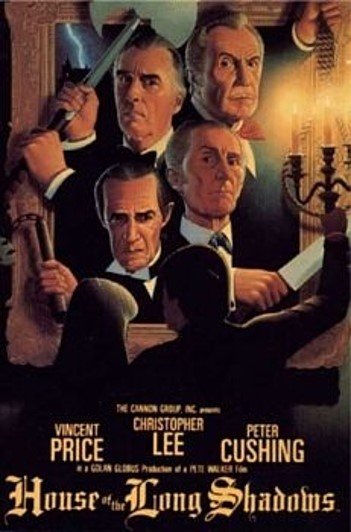
House of the Long Shadows poster created by London-Cannon Films and Cannon. Image found at en.wikipedia.org/wiki/File:LongShadows.jpg
Things I liked about the film:
The acting: Prior to watching House of the Long Shadows, I haven’t seen many of the projects from Desi Arnaz Jr.’s filmography. In fact, I’ve only watched his guest appearances on I Love Lucy and his special appearance on The Brady Bunch. Despite this, I was impressed with his lead performance in the film! His casual yet effortless acting style worked with how the character was written. Desi’s acting abilities fit the role of the protagonist, Kenneth Magee! I also liked Julie Peasgood’s portrayal of Mary Norton! Her expressions and emotions really highlighted the sense of urgency her character was experiencing. A scene where Julie sold me on what Mary was going through is when Mary first comes to the Manor to warn Kenneth of the unseen dangers he will face. Because this blogathon is dedicated to Vincent Price, his performance should not be overlooked. As I said in the introduction, the only other film of his that I’ve seen is The Whales of August. The great thing about House of the Long Shadows is how Vincent is given more material to work with as an actor. This allowed him and his character to have a more commanding presence!
The use of music: The music that can be heard in the film’s background does a really good job at keeping the movie’s tone consistent. Throughout Kenneth’s stay at the Manor, scores that sound mysterious, sinister, and even sad are played at various moments of the movie. At times when the tone changes, the music never skips a beat and adapts with the events of the story. A great example is when Kenneth is driving to the train station. When the weather is fair and the sky is sunny, light-hearted music can be heard during Kenneth’s drive. As soon as the skies turn dark and stormy, ominous music takes the place of the previous tune.
The element of mystery: For those who haven’t yet seen House of the Long Shadows, I won’t spoil the story. What I will say is the mystery element of the film was well-written! The narrative is presented in a way that allows the audience to solve the mystery alongside Kenneth and Mary. This creates an interactive and shared experience between the characters and the viewers. It also maintains a sense of intrigue throughout the movie. As the story unfolds, it makes the audience wonder what will happen next.
A limited use of horror: Vincent Price is an actor who is known for starring in horror-esque films. This detail made me believe House of the Long Shadows would be a horror movie. While there are elements of horror to be found, they primarily existed in the film’s second half. The story as a whole placed more emphasis on the element of mystery. This made the movie not as scary as I expected.
Diane and Andrew’s subplot: In House of the Long Shadows, there is a subplot involving a young couple named Diane and Andrew. They are in the area of the Manor due to a vacation gone wrong. While watching this movie, I found their subplot to not be integrated in the overall story as well as the other characters’ stories. If anything, it felt like it was there for the sake of being there.
The limited use of lighting: I understand the limited use of lighting was adopted to emphasis the atmosphere of the Manor. Where this succeeds on that regard, it also hides the beauty of the Manor itself. One of the most striking features of this location is the grand staircase. It had visually appealing details, such as the gold ornamentations along the iron bars of the stairs. Unfortunately, it was difficult to see this part of the Manor clearly because there was little to no lighting in this space.
Vincent Price: a name that is, more often than not, associated with projects featuring ghosts, ghouls, and things that go bump in the night. While this has become a part of Vincent’s legacy, it’s important to remember what he offered to the horror genre, as well as the world of film, as an actor. When I watched his performance in House of the Long Shadows, Vincent’s performance reminded me of Bela Lugosi’s performance in the 1931 film, Dracula! Even though both actors are on screen for a certain amount of time, they use their acting abilities to control the camera’s focus and command its undivided attention. As for the film itself, House of the Long Shadows is truly a hidden gem! Despite being different from what I expected, it’s a movie I think fans of mystery, horror and Vincent himself will enjoy! Maybe the final words of this review are nowhere near as memorable as Vincent’s closing monologue in Thriller. But they do have a special place in this post.
Overall score: 7.8 out of 10
Have you seen any of Vincent Price’s films? If so, which one is your favorite? Tell me in the comment section!
Before I start this review, I’d like to remind everyone that Thursday, April 9th, is the last day to cast your vote for the Best Supporting Actor of the 2nd Annual Gold Sally Awards! The next poll will be posted on the April 10th! Here is the link to the poll:
Originally, I had planned on reviewing To Kill a Mockingbird for Pure Entertainment Preservation Society’s A Month Without the Code Blogathon. Since The 2020 Classic Literature On Film Blogathon was given an April participation date and because I was reading To Kill a Mockingbird at the time of the event’s announcement, I decided to review the film adaptation a lot sooner than I expected. For years, I had heard great things about the novel. The now famous quotes have been plastered all over the internet, sounding deep and thought-provoking against backgrounds of characters’ pictures from the film. No literary list would be complete without To Kill a Mockingbird’s inclusion. What caused me to pick up a copy, and eventually see the movie, was the trial where Atticus defends Tom Robinson. This situation taking place in a time that is very different from today brought up a lot of questions. How would Atticus approach the case? Was Tom innocent? How different was the court system back then? For a while, this book was sitting on my bookshelf, waiting for the day when it would be read. Because of this blogathon, the day to read the book and see the movie has finally come!
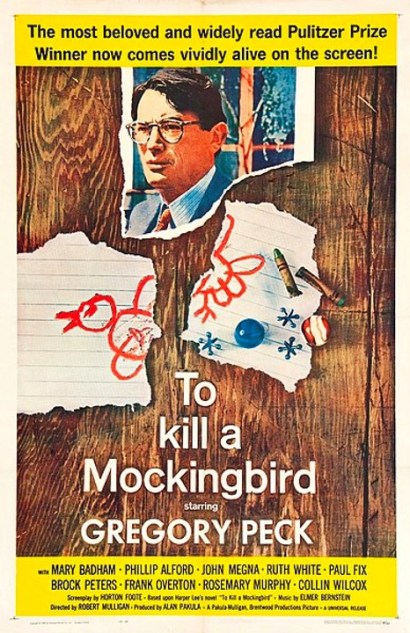
To Kill a Mockingbird poster created by Brentwood Productions, Pakula-Mulligan, and Universal Pictures. Image found at commons.wikimedia.org/wiki/File:To_Kill_a_Mockingbird_(1963_US_theatrical_poster).jpg
Things I liked about the film:
The acting: In my review of Mystery 101: An Education in Murder, I talked about how the characters in that movie appeared as if they came from real-life. This is partly the result of the quality of the actors’ performances. The aforementioned strengths are shared by both films. While watching To Kill a Mockingbird, I noticed how all the performances felt realistic. The actors brought enough emotion and animation to their roles, in order to bring their characters to life. I enjoyed watching the performances in this film. However, the two standouts came from Collin Wilcox Paxton (who portrayed Mayella Ewell) and Brock Peters (who portrayed Tom Robinson). Even though they appeared on screen for a limited amount of time, they were able to bring so much emotion and power to their roles. These elements allowed Collin and Brock to elevate their characters as well as the source material.
How the source material was presented: Looking back on the book, the story itself was 20% about the trial and 80% about the “slice of life” perspective Scout offers to the readers. This imbalance is what caused me to not enjoy the book as much as I had expected. The film’s creative team makes an effort to create a balance between these two ideas by removing scenes that would have felt like padding. In the book, the majority of a chapter is devoted to the Halloween carnival/play and what caused that event to take place. The movie, however, only shows Jem and Scout arriving and leaving the school. The way some scenes were presented in the movie highlighted Atticus’ abilities as a lawyer more effectively than in the book. When Atticus to talking to Scout about compromises and trying to see things from another person’s perspective, the scene places more emphasis on Atticus himself delivering the message, showing the values he follows as a lawyer. In the book, it feels like these lessons are rehashing information most readers already know.
Moments of suspense: There were some scenes containing suspenseful moments that were periodically placed in the film. One of these moments takes place in the scene when Atticus visits Helen Robinson for the first time. While Jem is sitting in Atticus’ car, Bob Ewell drunkenly approaches the vehicle. Because this is the first time Bob is introduced on screen and because he is presented in a disorderly state, Bob’s decisions and actions are very unpredictable. Scenes like this one maintained the overall story’s intrigue. It maintained my investment in the film as well. These scenes featuring suspenseful moments also allowed the creative team to adopt story-telling elements like the use of shadows and dramatic music.
The trial taking place at a later time: As I said in the introduction, the trial where Atticus defends Tom Robinson is what made me want to read the book. When I did read it, I was disappointed to discover the trial itself took place sixteen out of thirty-one chapters into the story. In the movie, the trial appears at the halfway point. In this case, I fault the source material more than the film’s creative team. Even though I had to wait an hour for the trial to be presented on screen, the creative team did try their best to get to that point as soon as possible.
Some unclear details: Some details in this movie were unclear, especially if someone didn’t read the book before they saw the movie. In the book, Jem and Scout are introduced to Reverend Sykes when they attend Mass at Calpurnia’s church. When the trial takes place, they agree to sit with Reverend Sykes in the balcony section of the courthouse. Because the church service was omitted from the movie, there’s no clear explanation provided for how Jem and Scout know Reverend Sykes. It might have helped if details like this one were given some context.
The voice-over: The book is told from the perspective of an adult reflecting on their childhood. However, the movie presented the events as if they are taking place in “present-time”. Because of this decision, it allows the events to speak for themselves. This makes the voice-over seem like an unnecessary component. The voice-over was also not consistently included in the movie, causing its presence to not feel justified.
There are very few times when I feel a film adaptation is better than its literary source material. In fact, the two previous instances that I can think of are Hallmark Hall of Fame’s The Beach House and Hallmark Channel’s Rome in Love. After watching To Kill a Mockingbird, I have now found a third adaptation to add to that list. I’m not a fan of “slice of life” stories, hence why I didn’t enjoy the book as much as I had expected. While these aspects of the “slice of life” story were incorporated into the movie, the creative team’s main focus was about getting straight to the point a lot sooner. The film’s visual nature worked in the favor of certain elements from the source material. Suspenseful moments in certain scenes are one great example. Reading about those moments in a book does cause a level of uncertainty. Watching them take place on screen makes those moments seem real and intensifies that uncertainty. If I had known my feelings about this movie before reading the book, I honestly would have skipped the book and gone straight to the movie.
Overall score: 8.1 out of 10
Have you read any classic literature? If so, did you see its film adaptation, if it has one? Let me know in the comment section!
I’m not going to lie, my submission for the Out to Sea Blogathon required a good amount of thought. I consulted with the blogathon’s creator, Debbie from Moon in Gemini, to find an appropriate film to talk about. After searching my DVR, I ended up choosing a Hallmark film from 2011 called Honeymoon for One. While the ocean doesn’t play a role in this story, other bodies of water can be found. In this movie, there are several scenes that take place in a river, one where a waterfall is featured, and another where the protagonists sit next to what looks like a lake. As the days of the blogathon came closer, I realized that St. Patrick’s Day was two weeks after the event. Because Honeymoon for One takes place in Ireland, this film became a better choice for the blogathon than I expected! I’ve seen pieces of this movie before, but never in its entirety. This blogathon has given me the chance to finally see all of Honeymoon for One!
What a funny coincidence that the second Hallmark film from 2011 I’ve reviewed has a poster that is a screenshot. Screenshot taken by me, Sally Silverscreen.Things I liked about the film:
The acting: Back in 2016, I saw the Hallmark Channel film, All Yours. One of the reasons why I enjoyed that picture is because of the acting, including Nicollette Sheridan’s performance. Like that movie, I liked seeing her portrayal of the protagonist, Eve, in Honeymoon for One! The well-roundedness of her performance is what made it work, giving her an opportunity to express a variety of emotions for different situations. The scene where Eve spends her first night in Ireland is a perfect example of everything I just said. I also liked seeing Greg Wise’s portrayal of Sean! He did a fine job carrying an Irish accent and he was expressive in subtle ways. Greg’s interactions with the film’s other characters showcases these ideas well. Speaking of accents, Katie Bannon also did a fine job carrying an Irish accent! Her portrayal of Sean’s daughter, Kathleen, was so endearing. It also helps that her on-screen relationships felt genuine. One great example is when Kathleen is interacting with Sean and Eve at a local art fair.
The scenery: Filmed in Ireland, the scenery in Honeymoon for One definitely stole the show! The country’s natural beauty shined through in every scene that took place there. Eve visits the Irish countryside, which was gorgeous to look at. Various shades of green and even hues of brown and red could be seen in the foliage throughout the characters’ surroundings. The aforementioned locations featuring water were breathtaking, its video footage likely not doing them justice. Even the hotel and Sean and Kathleen’s house were impressive! The interior and exterior of these locations were visually appealing. Just one example is the hotel’s honeymoon suite, where its spacious layout and white décor looked fit for royalty. The country town that was occasionally shown in the film appeared quaint and inviting. The landscape alone provided one good argument why one should take a trip to Ireland!
Similarities between American and Irish culture: In movies like The Cabin, the incorporation of another country’s culture is meant to show how it is different or unique from that of the American protagonist(s). Honeymoon for One chooses to focus on the similarities between American and Irish culture instead. At various moments, Eve tries different outdoor activities, like horse-riding and fishing. These activities can be found in both countries, highlighting how they have a respective place in both cultures. While taking a day trip through the countryside, Sean explains to Eve why he doesn’t want a new golf course to be built, stating that he’d like to protect the landscape and its wildlife for Kathleen. Standing up for what you believe in and looking out for your family are values that both Americans and the Irish share. Even cuisine has its similarities! Burgers are brought up by some of the characters, with Eve and her Irish friends enjoying the treat. Honeymoon for One does a good job at showing how people from all over the world can, more often than not, find common ground!
A weak conflict: The main plot of Honeymoon for One revolves around the protagonist and the aftermath of her break-up. There’s nothing inherently wrong with this kind of story. However, because this is a Hallmark “rom-com”, you already have an idea of what’s going to happen. Smaller conflicts were sprinkled in the story, such as Sean’s efforts to preserve the Irish countryside. But these conflicts weren’t explored enough to infuse intrigue into the overall plot. In the end, this story was too predictable for my liking.
The “protagonist’s ex showing up unannounced” cliché: In Honeymoon for One, Eve’s ex, Greg, shows up in Ireland unannounced. This part of the film ended up being drawn out for so long, that it felt like Greg overstayed his welcome. I understand Greg’s presence on Eve’s trip was meant to serve as the main plot’s conflict. But, as I already mentioned, this is a Hallmark “rom-com”. Sean appears as a better candidate to receive the protagonist’s love and Eve expresses little to no interest in getting back with Greg. These factors make this cliché’s inclusion in the story pointless.
The “it’s not what you think” cliché: At one point in the movie, Eve assumes that Sean is dating another woman after meeting her at his house. Kathleen’s persuasion is what causes Eve to hear the real story from Sean’s perspective. Like the aforementioned “protagonist’s ex showing up unannounced” cliché, this cliché also felt pointlessly included in the story. Because of the nature of this film, we know that things are going to work out for the better. Also, an intelligent and hard-working businesswoman like Eve making assumptions that quickly and easily seems petty for her character. I know this was supposed to be a conflict for Eve and Sean’s relationship. I also understand that Eve went through a terrible break-up. But for protagonists who appear over the age of thirty-five, it would have more respectful toward their integrity show them dealing with this issue in a mature and civil way.
It’s always exciting when Hallmark creates a movie that involves traveling to a new location! This gives the audience an excuse to see a part of the world that may be different from their own. But, at the end of the day, the most important part of any film is the story it visually tells. Personally, I think this story could have been stronger. The film’s main conflict was weak, which made the movie more predictable than it needed to be. There were other conflicts in the movie, but they didn’t receive enough attention. I also feel the uses of the “protagonist’s ex showing up unannounced” cliché and the “it’s not what you think” cliché were unnecessary. However, the movie does have its merits. Like I said in this review, the scenery was the showstopper of this project! It brought visual interest to the film and it was great to look at. Even though I’m glad I picked this movie for the Out to Sea Blogathon, I think there are Hallmark films featuring the Irish backdrop that are better than this one.
Overall score: 6-6.1 out of 10
Have you ever been to Ireland? What movie featuring an ocean is your favorite? Tell me in the comment section!
On WordPress, I’ve gained a reputation among fellow bloggers as being the “Hallmark expert”. While I personally don’t see myself as an expert in this blogging space, I do appreciate people’s high regard toward my knowledge of Hallmark productions. During my years of watching Hallmark films, I’ve learned that a good number of movies are filmed in Canada. Also, every scripted television show from the network either currently films in Canada or has filmed in Canada before. Production websites like What’s Filming and Creative B.C. continually feature Hallmark titles on their websites, with productions for movies usually taking place within a month’s time. Others have taken notice of this particular creative choice, with publications like Refinery29 bringing it up in one of their Hallmark related articles. But what causes the company to choose Canada as a prime filming destination over other locations? How beneficial is it anyway? This editorial will explore some reasons why Hallmark has chosen Canada as their best friend when it comes to movie and television production. Negative results that could be caused by Hallmark’s choice will also be discussed. Hallmark has filmed their movies in a variety of locations, but Canada seems to be their favorite.
Every movie or television show has a budget that a creative team is required to work within. If there is an opportunity to save money, any creative team is likely to take advantage of it. With the creation of tax incentives, certain states or countries can appear more viable to companies and studios than other locations. Canada first introduced their tax incentives for the television and film industry in 1995, with more tax incentives coming into existence two years later. While it’s unclear when Hallmark started to film their programs in Canada, recent trends would indicate the company first made this decision sometime around 2010. In the past few years, Hallmark has created more than fifty movies a year. These projects, according to Shane Snoke and Kays Alatrakchi from quora.com, can carry a price tag between $300,000 to $2 million. To figure out how much Hallmark would likely pay annually for their films, let’s look at the amount of films the company created for Hallmark Channel and Hallmark Movies & Mysteries last year. On the first network, Hallmark released 64 films. The second network aired 41 films. Let’s say that each movie cost $1 million to make. In total, Hallmark would end up spending $105,000,000 each year among both channels. With this big of a price tag, it makes sense for the company to look for ways to save any amount of money they can.
Because every province of Canada has their own tax incentives for the film and television industry, it’s difficult to determine the exact amount of money Hallmark saves on each Canadian filmed production. But there is no denying that wherever a movie or television show is created, Hallmark ends up saving a significant amount of money. The company can apply those savings toward other programs. One example of how this money could have been used is for the creation of Hallmark Drama. Coordinating a television channel is a time-consuming and costly endeavor. Because Hallmark’s third channel first aired in late 2017, it’s likely that Hallmark collected these funds over time in order to fund that project. Another time-consuming and costly endeavor are television shows. A deciding factor for a show’s renewal is whether its respective network can afford to keep it going. With three continuing series on Hallmark Channel, Hallmark needs all the money they can get to keep these shows running. All three series have chosen Canada for their filming needs. This makes Hallmark’s financial goals more attainable.
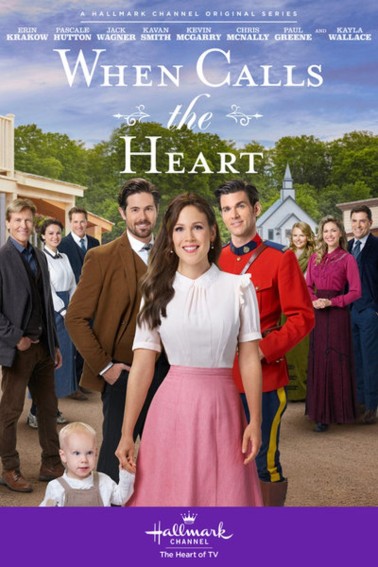
The longest running and one of the most popular television shows in Hallmark history is When Calls the Heart. Ever since the show about the Canadian Frontier first premiered in 2014, it has cultivated a loyal and devoted fanbase famously known as the “Hearties”. The success of the series has inspired fans to create a special event called “Hearties Family Reunion”. Started in 2016, this event gives “hearties” an opportunity to celebrate their favorite show. It has also given them a chance to travel to the show’s Canadian roots. Some of the activities that took place at last year’s event include a Q&A segment with the cast, a tour of the Hope Valley set, and even a special movie night. While “Hallmark isn’t officially involved” with the formation of the “Hearties Family Reunion”, according to Meghan Overdeep from Southern Living, Crown Media was one of the sponsors for the 2019 event.
One of the reasons why When Calls the Heart has lasted as long as it has is because of the community that formed among the fans. The “Hearties Family Reunion” official website acknowledges this by stating, “Hearties are a community”. To recognize this sentiment, regional mini-parties were a part of the schedule at last year’s event. These parties were intended to help fans connect with other fans from their geographical location. One example is a regional party dedicated to the fans who live in the Southern and/or Midwest regions of the United States. Based on the website’s photos and the continuation of the event, it seems like it has been met with positive responses. One testimonial comes from Ruth, who is the creator of the blog, My Devotional Thoughts. She attended the event in 2017 and even wrote an article about her experience. The focus of that blog post was to highlight her interviews during the event. By reading Ruth’s article, you can hear the enthusiasm in her writing. In fact, when recounting her time at the “Hearties Family Reunion”, she says, “I am forever grateful to everyone who worked to make this a weekend I shall never forget”. With responses like Ruth’s, I wouldn’t be surprised if this event returned in 2020!
Actors and actresses come from various locations of the world. When a state or country has tax incentives that benefit the film and television industry, performers from those locations can sometimes find success with the companies that film there. Hallmark’s decision to film in Canada has helped several actors and actresses grow their careers through their involvement in Hallmark’s productions. Andrew Francis is an actor from Vancouver, British Columbia. He made his Hallmark debut in the 2011 movie, Trading Christmas. In that nine-year time frame, Andrew starred in twelve Hallmark movies, had a recurring role on Cedar Cove, and is a regular cast member on Chesapeake Shores. Another British Columbia native, Pascale Hutton, has also achieved success through Hallmark. After her first Hallmark movie, A Family Thanksgiving from 2010, she has gone on to star in a total of twelve Hallmark films. Similar to Andrew, Pascale became a regular cast member on the aforementioned show, When Calls the Heart. She also made a guest appearance on Hallmark’s first spin-off, When Hope Calls.
Canadian actors are not the only talents that have developed on-going careers through Hallmark. Crew members who work behind the camera have also benefited from Hallmark’s partnership with Canada. Michael Robison is a director from Toronto, Ontario. According to his filmography on IMDB, he has been directing since the late ‘80s. Despite working with Hallmark for only three years, Michael has directed thirteen movies, including the upcoming Hallmark Movies & Mysteries film, Mystery 101: An Education in Murder. These opportunities have allowed him to grow his career as a director. Another Ontario talent whose career has excelled with Hallmark is Ivan Hayden, who is from the London area. A multi-talented individual, Ivan currently has twenty-six producing credits on IMDB. Fifteen of these credits are for Hallmark films, including the 2020 “Spring Fever” film, Just My Type. Like Michael Robison, Ivan has been working on Hallmark projects since 2017. Also, like Michael, Ivan accomplished so much in such a short amount of time.
Missed Opportunities for Other States and Countries
As I have been mentioning in this editorial, states and countries besides Canada may have tax incentives. This factor can encourage companies and studios to work in those locations. By Hallmark continually choosing to work with Canada, it means that other states and countries with tax incentives miss out on beautiful business partnerships. Michigan is just one example. On Michigan Economic Development Corporation’s official website, an entire division of the state’s economy is shown to be dedicated to the film industry. Hallmark rarely creates their programs in the Great Lakes state. Because of this, the state isn’t able to work with a well-known client like Hallmark. Hallmark’s decision also denies the company the chance to take advantage of Michigan’s tax incentives. This situation causes both parties to lose out on great business opportunities.
Even though Hallmark films a lot of their programs in Canada, there are few opportunities for Canadians to see these programs. That’s because all three of Hallmark’s channels are shown exclusively in the United States. Despite Canadian fans asking Hallmark’s business leaders on social media for access to their networks, nothing has been done about this specific situation as of March 2020. There have been some solutions made to alleviate this problem. Released in 2007, the Super Channel is a Canadian network that has given its viewers an opportunity to watch some of Hallmark’s programs. This is made possible through one of their divisions; Super Channel Heart & Home. Another current solution has been the invention of the streaming service, Hallmark Movies Now. This service can be accessed on various devices and through different media outlets.
As I just mentioned, Hallmark’s channels are shown exclusively in the United States. This means that businesses based in the United States have an advantage when it comes to product placement and sponsorships. One of Hallmark’s sponsors has been the coffee company, Folgers. Even though this particular product is available in both the United States and Canada, the company is headquartered in Ohio and was founded in California. This makes Folgers a United States based business. It also provides more opportunities for Folgers to advertise with Hallmark. Canadian stores like Chapters/Indigo and services like Pizza Pizza haven’t had commercials featured on any of Hallmark’s channels or their products showcased in any of Hallmark’s programs, as of March 2020. Hallmark’s partnership with Canada seems to have overlooked Canadian businesses.
There is no such thing as a perfect business. The decisions that any business makes are not going to be everyone’s cup of tea. Even when a business does make a good choice, it can sometimes lead to undesirable results. This is the case with Hallmark and their partnership with Canada. There have been positives that have come from this choice where both parties have benefited. Canada’s tax incentives have the power to fund the country’s economy and help Hallmark save money. But, after evaluating the pros and cons of Hallmark’s business decision, it appears somewhat one sided. So many of Hallmark’s programs are filmed in a variety of Canadian locations. Yet, Canadians are not able to watch most of the programs that are created in their home country. As I mentioned in this editorial, there are ways for Canadians to watch Hallmark’s movies and shows. However, they aren’t able to watch the newer productions from Hallmark, especially the mystery films from Hallmark Movies & Mysteries. Hopefully, as time goes on, Hallmark will recognize Canada as more than just a pretty filming location.
One of the available categories for the Leap Year Blogathon was to talk about “any movie or TV show you’ve always wanted to review but never had the chance to”. This is the approach I’ve chosen to take with Rebecca’s event. As I was scrolling through my DVR, I came across a movie called Finding Forrester. Ever since I read the film’s synopsis on BYUtv’s website several years ago, I have wanted to see this movie because the story sounded interesting. I even recorded it on my DVR in the hopes of watching it someday. Well, it looks like 2020 is the time when I’m finally getting around to talking about this film! I’ll be honest, I haven’t seen a lot of Sean Connery’s movies. The Russia House and The Great Train Robbery are the only films I’ve seen with Sean as one of the leads. While I thought the former was ok, I enjoyed the latter more than I thought I would. Now that this is the third picture of Sean’s I’ve watched, it’ll be interesting to see where Finding Forrester ranks among the other two films.
The acting: Finding Forrester is a story that grounds itself in reality. Because of this, the acting performances in this film come across as realistic portrayals. What this means is all the characters feel like real people. The genuine expressions and behaviors of each character shine through because of the quality of the actors’ talents. How the characters interact with each other is evident of this, especially within the friendship of Jamal and William. Depth was added to the characters because of the interactions they share. The dialogue was well-executed by the actors, causing the conversations to sound authentic. What works in this cast’s favor are the various personalities presented and the character development that takes place. A sense of intrigue is brought forth as a result of all of these elements.
The cinematography: Whenever this film’s creative team wanted the audience to focus on a particular person or object, they would adopt medium shots or close-ups to place a greater emphasis on that subject. During basketball tryouts, Jamal was playing against a senior team member from the private school. The rivalry between these two characters is the highlight of this scene, so medium shots are used to present them to the audience. When Jamal is removing his notebooks from his backpack, after the bag was retrieved from William’s apartment, close-ups implemented the importance of writing that serves as a consistent idea throughout the film. In two scenes, the reflection of Jamal can be seen from William’s binoculars. This is meant to foreshadow the connection these characters will share through their friendship. These cinematic techniques helped make the cinematography stand out in this project!
The incorporation of knowledge: Like writing, the idea of knowledge is consistent in Finding Forrester. The way it was incorporated into this story was seamless and showed how important it can be to any individual. One example is when Jamal is explaining a brief history of the BMW to William’s acquaintance. This information not only helped Jamal stand up for himself, but it also educated the audience about one of the world’s most iconic car companies. The knowledge that William and Jamal share about writing is another great example. During a debate about the rules of writing, they are able to express their ideas and view the perspective of the other person. This scene shows that, with knowledge, one can be a part of something greater than themselves. It also shows that knowledge can create a connection between people.
The lighting: Most of the lighting in Finding Forrester is dim. This allows the overall color palette to appear darker on screen. However, it also makes it difficult to see what is happening in the film. The scenes taking place in William’s apartment experienced this issue. Because of the dimmed lighting, it was sometimes difficult to see Jamal’s and William’s face in these scenes. Half of this movie is centered around Jamal and William’s friendship, which means that half of the overall picture features the dim surroundings of William’s apartment.
Scenes that become padding: There are several scenes in Finding Forrester that become padding. One example is when Jamal’s friends are shown spending time together at a restaurant. This moment had no bearing on the story and didn’t progress the plot forward. It also doesn’t have a strong need to exist in the narrative. Scenes like these felt like they were placed in the movie for the sake of satisfying the run-time. If some of these scenes were cut, the film would have been shorter and the script could have been a bit tighter.
Someone I know once told me that knowledge is one of the most valuable possessions a person can own. When it’s earned, it can never be taken away from you. This is expressed very well in Finding Forrester, a solid and satisfying picture! While this movie is more of a character study, this concept works in the film’s favor. The delivery of the script and acting performances gave me an opportunity to stay invested in the characters and their interactions. The messages of integrity, self-worth, and knowledge have the potential to be relatable among audience members. They can also inspire people to pursue their talents and believe in their strengths. Finding Forrester is a movie that I’m glad I made the time to see. I’d like to thank Rebecca for giving me this opportunity through her Leap Year Blogathon!
Overall score: 8.2 out of 10
Is there a movie you’ve always to see, but never made time for? What are your plans for Leap Year? Share your thoughts in the comment section!
Because I wrote an editorial for the Ultimate 2000s Blogathon, I decided to write a movie review for the Ultimate 2010s Blogathon. The Adventurer: The Curse of the Midas Box is a film I had never heard of until I researched titles for this event. Since it was released in early 2014, I knew it would be a good entry! While learning more about the film, it sounded like a mix between The Librarian trilogy and Sherlock Holmes. Because I enjoy both of those stories, I figured I might get some enjoyment out of this movie! As I’ve stated on countless occasions, I try to use my blog to give lesser-known films the “standing ovation” they might deserve. Talking about The Adventurer: The Curse of the Midas Box definitely fits that goal of mine! But is this movie truly worthy of a “standing ovation”? Please join me on this journey as we’re about to find out in this review!
The Adventurer: The Curse of the Midas Box poster created by Entertainment Motion Pictures (E-MOTION), Arcadia Motion Pictures, Matador Pictures, Telefonica Producciones, The Kraken Films, Nix Films, International Pictures Two, Cronos Entertainment AIE, Cinema One, Afrodita Audiovisual, A.I.E., uFilm, Le Tax Shelter du Gouvernement Federal de Belgique, Mogambo, Propulsion, Umedia, and The Film Arcade. Image found at en.wikipedia.org/wiki/File:Adventurer_the_curse_of_the_midas_box_poster.jpg
Things I liked about the film:
The acting: The cast in The Adventurer: The Curse of the Midas Box was solid! I had never heard of Aneurin Barnard prior to watching this film. However, I was impressed with his portrayal of Mariah! His performance was expressive in a subtle way. A good example is when Mariah is explaining to Sacha why he wants to find his brother, Felix. The audience can tell that Mariah is about to cry, but Aneurin primarily relies on expressing those feelings of sadness and loneliness through his eyes. I was also not familiar with Mella Carron before seeing this movie. Like Aneurin, I was impressed with her performance as Sacha! Her overall portrayal was well-rounded. Similar to Aneurin’s performance, she was also expressive in subtle ways. One example is when she’s sharing her problems with Mariah. When she is talking about her father’s troubling behavior, Sacha’s eyes fill with tears, showing how much this situation upsets her. I thought Sam Neill portrayed a convincing villain! I’ve only seen a few of Sam’s films, so I have only seen him portray protagonists or characters that were not villainous. While bringing the character of Otto to life, Sam’s demeanor was arrogant and cunning. These are the qualities you’d likely find in a villain, as these kinds of characters sometimes see themselves as being better than everyone else.
Historical accuracy: The Adventurer: The Curse of the Midas Box takes place in 1885. While watching this movie, I noticed how everything looked and felt like that period in time. The wardrobe and set designs definitely fit within the world the film’s creative team created. The metalwork within the hotel seemed like it came straight from the 1880s. Even the font on posters and signs looked accurate to that time period. The ways this aspect of the film was handled shows that no detail was ignored during any part of the movie’s creative process.
The element of mystery: In The Adventurer: The Curse of the Midas Box, there was a mystery within the main plot. This mystery element was one of the most interesting parts of the film! It allowed me to stay invested in what was happening in the story and to the characters. The mystery also created a sense of wonder as to what would happen next. This element brought intrigue to the overall story!
Lack of lighting: While the cinematography was mostly good in this film, there were some scenes that had little to no lighting. They were so dark, I had difficulty seeing what was on screen. One example is toward the beginning of the movie, when Mariah and Felix are having a conversation outside. This scene was so poorly lit, Mariah face was hidden by the darkness. Whenever this happened, I found it to be frustrating.
A misleading title: As I said in my Halloween Double Feature, a film’s title can act as a promise to a film’s audience. When a creative team makes an effort to put a subject in their movie’s title, they need to deliver on that “promise” to their audience. For The Adventurer: The Curse of the Midas Box, I didn’t really feel like there was an adventure taking place in the story, despite the film being called The Adventurer. There were some scenes that had a sense of adventure to them. But it never seemed like the characters were going on a journey or allowing the audience to go on a quest with them. The majority of this movie took place in one location. This made the story feel condensed. All these elements presented the overall narrative like it belonged to a mystery movie and not an adventure one.
Two separate mysteries: Like I previously stated, I liked the mystery element within this movie. However, I think it was a mistake to feature more than one mystery in the film. In this story, there is a second mystery that exists while the main mystery is being solved. For most of the film, these mysteries were separate from one another. While they eventually connected, this didn’t happen until it was almost time for the film’s climax. The second mystery also felt like it combined with the first mystery out of plot convenience. I thought both mysteries were intriguing. But they should have been in their own separate films.
The Adventurer: The Curse of the Midas Box is a fine, enjoyable film! There were things about it that I liked, such as the acting and the historical accuracy within the project. However, I can think of movies with adventure stories that were executed better than this one. The fact that this film was light of the adventure was, for me, a disappointment. It also doesn’t help that the film’s title features the word “adventurer”. If you do plan on watching this movie, approach it with the notion that you’re going to watch a mystery movie. That way, the condensed nature of the story and the limited amount of adventure will make more sense. I’m not sure if this film was given a sequel. If it was, I’ll definitely consider reviewing it on 18 Cinema Lane!
Overall score: 7 out of 10
Have you ever heard of The Adventurer: The Curse of the Midas Box? What movie from the 2010s is your favorite? Let me know in the comment section!
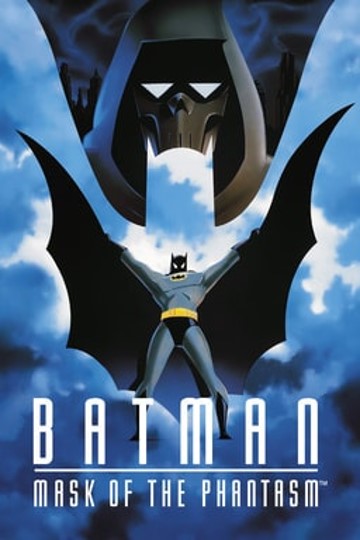
For February’s Genre Grandeur, the selected theme was “Animated Comic Book/Strip Movies”. Chosen by Bubbawheat from Flights, Tights, and Movie Nights, this theme required some thought. To search for a possible title, I headed to Bubbawheat’s blog and discovered the list of “every superhero and comic book movie in chronological order”. While scrolling through the list, I came across one movie that I had heard of, but had never seen: Batman: Mask of the Phantasm. This cinematic Batman entry has acquired a great amount of praise over its twenty plus year existence. However, it also has a reputation of not performing well at the box office. Any movie fan knows that box office performance does not always equal quality. But what is the quality of Batman: Mask of the Phantasm? Is it truly as good as other people say it is? Has it become overrated through the power of nostalgia? These are the questions I’ll answer in this review!
The voice acting: When it comes to animated films, the audience’s attention is so focused on what’s happening on screen, that they don’t think twice about the voice acting. Even though it seems like a small piece of the overall project, it actually can make or break the characters’ and their memorability. Batman: Mask of the Phantasm had an exceptional cast! Each actor brought more than enough emotion to match the facial expressions presented in the movie. These two components felt they were paired perfectly, with the voices themselves feeling like they belonged to that character! The casting itself couldn’t have been better! All of the actors effortlessly embodied their character through their voice talents. They were able to successfully gave life to their roles and enhance their memorability!
The animation: Batman: Mask of the Phantasm is filled with great animation! Its 2-D style still holds up twenty-seven years later! What works in this movie’s favor is the color palette found throughout the project. Most Batman stories adopt a dark color scheme, to showcase the destruction and dismay that has overcome Gotham City. While Batman: Mask of the Phantasm does feature darker colors, the way lighter colors are paired with them is visually interesting. A great example is when a criminal named Buzz Bronski visits the cemetery. The entire scene is filled with the hues of black, gray, and dark blue. The red roses on a wreath are one of the few light colors that can be found in that scene. This makes the wreath pop with color and forces the audience’s attention toward the flowers. It also gives the film a style similar to movies with a “film noir” label.
The music: Another element in animated films that sometimes gets overlooked is the music. For Batman: Mask of the Phantasm, a piece of music that really stood out was the official score. Composed by Shirley Walker, this score was powerful and helped the overall production gain its own identity. An orchestral composition and an operatic choir make this piece of music, as well as the overall film, feel grand in scale. This score was used during the opening credits, with similar tunes featured in two climatic moments of the film. Batman movies have historically incorporated orchestral scores into their projects. The score from The Dark Knight is one of the most iconic pieces of music in film history. Shirley Walker’s musical contributions to Batman: Mask of the Phantasm help keep that tradition alive.
The writing: I was really impressed by the writing in Batman: Mask of the Phantasm, as it was clever and well thought-out! The film’s overarching mystery is a perfect example of this. It’s the kind of mystery that allows the audience to take a journey alongside Bruce/Batman. They get to experience events and situations when Bruce/Batman does. At times when a surprise comes, it catches the audience off-guard, as they are so invested in Batman winning over evil that they don’t see a surprise coming. Despite the movie’s darker tone, there was room in the script for humor to be included. One great example is when a party guest believes that the word “engagement” starts with the letter i. Because of how the joke was written and the delivery of the voice actor’s performance, the joke itself was executed flawlessly!
An unclear timeline: Throughout Batman: Mask of the Phantasm, it was difficult to determine when this film took place. In a flashback scene, Bruce and Andrea visit the Gotham World’s Fair, mirroring World’s Fairs that have taken place in decades past (for a point of reference, a World’s Fair was featured in Captain America: The First Avenger). That same flashback scene showed Andrea using a car-phone, an invention known for its popularity in the ‘80s. At two separate moments in the movie, Bruce uses a computer to solve the film’s overarching mystery. Batman stories, more often than not, make a conscious effort to ground themselves in reality. Since this film was released in 1993, the story should have taken place in the early ‘90s, in order to reflect its “current” setting.
Too many flashbacks: Flashback scenes are meant to provide additional context to the film’s plot. They are placed at certain points in the story, so they can present their full impact on the audience. In Batman: Mask of the Phantasm, several flashback scenes were shown, explaining the nature of certain relationships and giving clues to the film’s mystery. However, I feel there were too many of them. More than three flashback scenes existed in this narrative. At times, it seemed like every other scene in the movie was a flashback. It also didn’t help that some of them were a little too long. One example is when Bruce meets Andrea’s father for the first time. I liked the scenes themselves, but they made the flow of the film a little clunky.
Batman: Mask of the Phantasm is not just a solid Batman film. It’s also a solid animated film in general! For my first time watching an animated movie starring the world’s favorite ‘Caped Crusader’, I really enjoyed what I saw! It contained a lot of elements I look for in good animated projects, such as the quality in animation and the story itself. What’s great about this film is how Bruce/Batman was allowed to be a detective within the story. This aspect of the character is not often seen in cinema, as Warner Bros. has usually placed more emphasis on making Batman an action-hero. In Batman: Mask of the Phantasm, it was nice to see Bruce/Batman use multiple talents to save the day. This is definitely one of the better of the Batman cinematic entries! It has stood the test of time and is an enjoyable picture! I want to thank Bubbawheat and MovieRob for giving me a chance to finally see this film! Looking back on it, I have to wonder, where has Batman: Mask of the Phantasm been all my life?
Overall score: 8.4 out of 10
Do you have a favorite Batman film? Is there an animated movie you’d like me to talk about? Share your thoughts in the comment section!
Before I start the introduction of this review, I want to remind everyone that you have until Thursday, February 20th, to cast your vote for the Gold Sally Awards’ Best On-Screen! Here is the link to the poll:
As the 2nd So Bad It’s Good Blogathon rolls around, my quest to find a “so bad it’s good” movie continues. Last year, I reviewed All Dogs Go to Heaven 2 in the hopes of finding a film that deserved the aforementioned title. However, the film itself was just ok. This year, I decided to pick a less-than-stellar movie from Hallmark. There have been some good Hallmark projects made over the years. But not all of them are created equal. In fact, some of them are downright polarizing. Originally, I was going to review Three Wise Women, a Hallmark production from 2010. Due to technical difficulties, the movie disappeared from my DVR. So, I chose a back-up option instead. The Cabin is a Hallmark movie from 2011 that is equally as polarizing as Three Wise Women. People who have seen this movie either genuinely enjoy it or they genuinely don’t. Because I had never seen the film prior to 2020, I figured the So Bad It’s Good Blogathon would be an appropriate time to see where my opinions fell on this particular spectrum.
If you’re wondering why the faces on the poster look washed out, it’s because the photo is a screenshot from my television. Screenshot taken by me, Sally Silverscreen.Things I liked about the film:
The scenery: According to IMDB, The Cabin was filmed in Ireland, even though the movie takes place in Scotland. Despite this, I absolutely loved the scenery! Everything was captured so well on film, accentuating the natural features of each location. When both families spend time in a local town, all of the buildings looked so quaint and inviting. A church and castle are also featured in this film, with picturesque grounds to match their stunning nature. The castle was a massive gray structure paired with a small garden of hedges. The greens of this garden nicely complimented the color of the castle. The foyer of the castle was shown, boasting an impressive interior with interesting features, such as a large fireplace and colorful floor tiles. Similar to the castle, a gray stoned church was complimented by the greens of the grass in the cemetery. The foliage surrounding the cabins and in the forest definitely stole the show! Their rich greens and browns were attention-grabbing and appealing to the eye. The creative team behind this movie made the most of their surroundings!
The inclusion of Scottish culture: As I already mentioned, The Cabin takes place in Scotland. Because of this, pieces of Scottish culture are incorporated in the story. Elements like attire, food, and activities are showcased on screen. The reason why both families go to Scotland is to participate in an event called the “Meeting of the Macs”, a series of games that are inspired by traditional Scottish sports. Throughout the movie, each family takes the time to experience what Scotland has to offer, from trying the local cuisine to attending a dance party. Toward the end of the film, all of the male characters from each family are seen wearing a traditional kilt. The way these components of the Scottish culture were woven into the film not only served as an introduction for the audience, but was also executed in a respectful and appreciative way.
Lack of consistency: In romantic comedies, the consistency of the lead characters and their relationship can help gain fans within the audience. The Cabin, however, lacked that important ingredient. During the duration of the film, Lea Thompson and Steven Brand’s characters, Lily and Conor, are constantly arguing and making up. This is exhausting to watch and it makes it difficult to determine if Lea and Steven have any on-screen chemistry. This part of the movie was more distracting than it needed to be.
Weak acting: Half of the cast in The Cabin gave a performance that ranged from fine to good. The other half ended up giving weak performances. One of them came from Lea Thompson, whose portrayal of Lily consisted of smiling, arguing, and looking confused. This is not the kind of well-rounded performance I’ve usually come to expect from the leading actresses in Hallmark projects. Most of the young actors in this cast also gave weak performances, as they often appeared flat and unexpressive. I understand that casting younger actors in films can be hit or miss. But, in this case, it just didn’t work.
Two plot ideas that should have been separate: The Cabin contained two good plot ideas; a family going to Scotland for vacation and a family competing in a series of games. Both of these ideas had the ability to stand on their own, providing conflicts and series of events to compliment the story itself. Because of this, these plot ideas should have been placed in their own respective movies. During the first half of the film, the narrative was so dedicated to showing the families sightseeing in Scotland, that little attention was given to the “Meeting of the Macs” event. In the second half of the film, the story revolved around the exercise/training montages of the families to the point where the sights of Scotland were practically ignored. Since these ideas ended up clashing for attention, both of them were given a disadvantage.
The audio: Background noise and music can bring a sense of realism or emotion to a scene through various sounds. However, it’s called “background” noise or music for a reason, as it is loud enough to be heard, but quiet enough to not overpower the character’s speech. In The Cabin, the audio was so loud that I found it difficult to understand what some of the characters were saying. Because of this, I had to rewind the movie a few times just to hear or try to guess what was being said. The more I rewound the film, the tiresome it became.
Limited presence of the games: Throughout this review, I’ve mentioned the “Meeting of the Macs” event, the athletic competition that provides the reason for the families’ presence in Scotland. Before watching this film, I had expected the event to have a consistent presence in the story. Sadly, that was not the case. The first segment of the games, the preliminaries, didn’t appear until forty minutes into the movie. The final event doesn’t show up until the last twenty minutes of the film. For the rest of the project, the narrative focuses on other things, from one of Lily and Conor’s many arguments to one of the children dealing with a personal issue. While the games themselves were interesting, it wasn’t enough to make up for the script’s other flaws.
The Cabin is one of the most polarizing films in Hallmark history. Some people truly enjoy it, while other people don’t. Now that I have finally seen it, I can honestly say that I belong in the latter camp. This is not a well-constructed film. It has far more negatives than positives, with those negatives being painfully obvious. But in this movie’s defense, I have seen Hallmark productions that are worse than The Cabin. If anything, I would place it in Dishonorable Mentions. It’s not a good movie, but there were two things about it that I liked. Truthfully, I can’t say this film is worthy of the “so bad it’s good” title. This is because I didn’t enjoy the movie, for better or worse. So, it looks like I’ll have to go back to square one in my quest to find a project that I would personally consider “so bad it’s good”.
Overall score: 5.5 out of 10
Have you any Hallmark films that were less-than-stellar? What is the most polarizing film you’ve seen? Please share your thoughts in the comment section!
When Gill from Realweegiemidget Reviews announced that her blogathon would focus on James Garner, I found the perfect excuse to talk about one of his Hallmark Hall of Fame movies! For this review, I chose to write about the first one he starred in called Promise. This entry from the Hallmark Hall of Fame collection is one of the most beloved. It has not only received critical praise, but several awards as well. Movies that achieve a lot of praise can be hit or miss. I either find myself not liking the film as much as other people (in the case of The Christmas Card) or I gain understanding for why people like the movie so much (in the case of The Nine Lives of Christmas). With Promise, I wanted to judge it for myself. Is it worth its praise or is it overrated? I was lucky enough to find a copy of this movie on DVD, so I could bring this review to my readers and followers!
When getting this DVD, I was surprised by how rarer it was to find than other Hallmark Hall of Fame titles. Screenshot taken by me, Sally Silverscreen.Things I liked about the film:
The acting: The acting in Promise was definitely one of the best parts of this film! Throughout the movie, James Garner and James Woods go toe-to-toe with their acting prowess. What brought believability to these respective roles were the versatility and emotionality of Garner and Woods. When it comes to the acting, the best scene in this movie is when Bob discovers D.J. having a psychological catatonic break. James Garner’s portrayal of Bob was heart-breaking, as his voice was battling sobs and his eyes were full of fear. As for James Woods’ portrayal of D.J., he was so listless and still that I honestly thought this character had died. Piper Laurie did a really good job bringing the character of Annie to life! What worked in her favor was the on-screen personality she presented. Since it was so sweet and gentle, it made Annie a likable individual. Even though she had a limited presence in Promise, Barbara Niven portrayed her character, Joan, wonderfully! The great thing about Barbara’s acting abilities is how expressive she is. A perfect example is when Joan spots D.J. watching her and Bob having an intimate moment, as she quickly changes from a passionate and flirty attitude to screaming in fear.
The set design: There were some interesting creative choices made when it came to the set design. For the interior design, I really liked the look of the restaurant where Bob visits his co-workers. The use of red and gold was magnificent, from the rich red carpet to the way the light illuminated off the gold details on the wall. There were also some visually appealing choices made for the film’s exterior design. On Annie’s porch, there was a large, white, multi-paned window at one end of it. It made that space feel like an outdoor room! It also provided a unique look from the other porches that were featured in this film. At one point in the movie, D.J. and Bob discover an abandoned castle. The way this castle looked was mysterious, but not scary. It reminded me of the abandoned places that are shown in urban exploring videos. Because of the look and feel of this place, it made me want to explore the castle alongside Bob and D.J.!
The scenery: Another appealing element of Promise was the scenery! My favorite place in this movie was the lake Bob and D.J. visit. This location was shown at different times of the day. It was even shown in the rain. But the lake always appeared serene and peaceful. Mixed with the forest’s foliage, it looked like an inviting environment! Long shots were used to showcase various landscapes. The field in front of D.J. and Bob’s mother’s house is one of them. The way this location was framed brought up the feelings of possibility and hope. This fit within the context of the story.
The secondary storyline: In Promise, Bob tries to sell his and D.J.’s mother’s house. This part served as a secondary storyline. I wasn’t a fan of this narrative for a few reasons. Personally, I didn’t find it to be very interesting. Also, it felt distant from the main plot. I’m glad this story didn’t adopt a cliché similar to the “woman from the city coming back to her small hometown” cliché. However, I wish this movie kept its focus on Bob and D.J.’s story.
The discussion of Mental Illness: Promise’s discussion of Mental Illness is similar to A Time to Remember’s discussion of Alzheimer’s. I commend this film and its creative team for addressing the ways Mental Illness can affect an individual and the people around them. But I honestly think this discussion could have been executed better. For starters, D.J. ends up being a supporting character in the story instead of an equal co-lead. This does a disservice not only to D.J., but also to members of the audience who have been affected by Mental Illness in some fashion. Within the first half of the movie, D.J. is called “crazy” by Bob because he has Schizophrenia and because his beliefs happen to be different from his brother’s. I understand that stories like this are meant to feature unlikable protagonists, in an effort to showcase their personal growth throughout the movie. However, Bob’s attitude and views toward D.J. were unfair and they did not sit well with me. In one scene, D.J. explains to Bob what having Schizophrenia is like. While this monologue was well written and delivered, I think this explanation would have been a little more effective if the audience could see at least one of D.J.’s hallucinations and/or hear the audio from his “voices”. It would have shown and told the audience an idea of how Schizophrenia affects someone.
The editing: As I was watching Promise, the overall film felt uneven. This was caused by some scenes ending too quickly. One example is the scene where D.J. tells Bob that he feels normal again. Right after he says this, the next scene immediately starts. This not only felt abrupt, but there also wasn’t a smooth transition provided. The presentation of these scenes was the equivalent of stop-and-go traffic.
As the cover of Promise’s DVD says, this movie is “the most-honored television movie of all time”. However, I thought the film was just ok. This is certainly not one of the worst projects Hallmark Hall of Fame has created. Elements like the acting, set design, and scenery prevent it from being unenjoyable. However, I can think of other Hallmark Hall of Fame stories that are stronger than this one. The primary focus of Promise should have remained on Bob and D.J.’s story. It also should have given D.J. an equal portion of the narrative as Bob. This way, he could have a bigger voice and more perspective to share in the film. Since this is one of four Hallmark Hall of Fame movies James Garner starred in, I would be interested to see how those movies compare to Promise. I have Decoration Day on my DVR, so I might have to review it in the near future!
Overall score: 6.9 out of 10
Have you seen any Hallmark Hall of Fame movies? Are there any Hallmark Hall of Fame films you’d like me to review? Share your thoughts in the comment section!
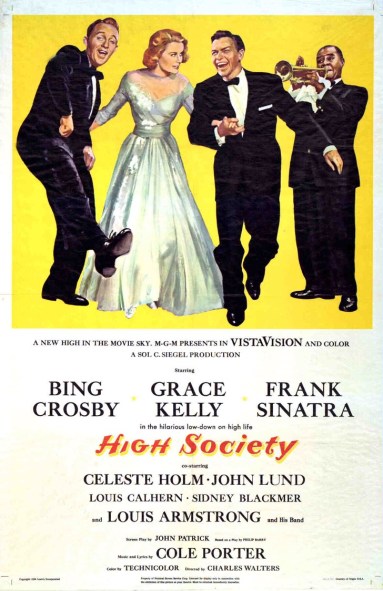
I interrupt my Youth-Led Film Double Feature to bring you my review for The Wedding Bells Blogathon! One day, as I was searching Turner Classic Movies’ (TCM’s) schedule, I came across a film called High Society. Through its description, I learned it was a musical remake of The Philadelphia Story. Since I have enjoyed that movie, I figured there was a good chance I might like this picture from 1956. In my review of Marriage on the Rocks, I mentioned I would be reviewing the movie later this month. I also said in that review that I did not like Marriage on the Rocks. High Society is now the second film of Frank Sinatra’s and Grace Kelly’s that I’ve seen! While I knew that Frank and Bing Crosby had musical talents, it would be interesting to see what Grace had to offer to a movie musical. Now, as you’re waiting for the wedding to start, please take a moment to read this review of High Society.
The acting: It’s no secret that Grace Kelly is one of the most versatile actresses to ever exist! Her performance in High Society helps her maintain that reputation. Grace has the ability to adapt her emotions to any scene. When Grace’s character, Tracy, is talking with her father by the pool, she can go from angry to crying with sadness within a matter of minutes. Because of her experience working with various actors and actresses, Grace never had difficulty keeping up with her co-stars. Speaking of co-stars, I have seen Frank Sinatra and Bing Crosby in at least one film prior to watching High Society (Frank in Marriage on the Rocks and Bing in scenes from White Christmas). Similar to what I said in my Marriage on the Rocks review, both Frank and Bing appeared at ease in their respective roles. This allowed them to bring a natural charm to their characters, C. K. Dexter-Haven and Mike Connor. What also helped was how their singing talents complimented their acting talents. Even though he portrayed himself in the film, Louis Armstrong did a good job with the material he was given. He had a delightful on-screen personality and great musicality. These things made me enjoy Louis’s presence in the movie!
The sets: In High Society, the sets were absolutely gorgeous! Not only did they fit the environment the film’s creative team wanted to create, but these sets also looked magnificent on film! The great part about them are the textures, colors, and materials that were used in each space. In one of the Lord family’s sitting rooms, the sea green walls worked really well with the white wood paneling and crown molding. Another great set was Tracy’s uncle’s library. While the dark wood walls and bookshelves were beautifully crafted, it’s the hidden bar within the bookshelves that steals the show. The sets in High Society certainly made the movie visually appealing!
The musical numbers: For the most part, I enjoyed the musical numbers in High Society. They sounded pleasant and were, more often than not, lively. My favorite musical number is “Who Wants to Be a Millionaire?”, as it was one of the funniest scenes in the movie. In this number, Frank and Celeste Holm, the actress who portrayed Liz Imbrie, had really good on-screen chemistry and comedic timing. Frank and Celeste’s singing voices also sounded great together. I was pleasantly surprised by Grace’s singing abilities in the duet, “True Love”. She sounded excellent alongside Bing Crosby and the song itself sounded nice. I’m not sure how much singing experience Grace had prior to being cast in this movie. But it’s nice to see her trying different things and going out of her comfort zone.
Unacknowledged commentary: In my Rich Kids review, I shared that one of the film’s messages was how wealth didn’t equal invincibility. This message can also be found in High Society, as Tracy shows Mike various houses in her neighborhood that are either boarded up or for sale due to homeowners no longer affording them. While this commentary added something interesting to the story, there was no room in the script for it to be explored or discussed. I understand there’s only so much you can do in an hour and fifty-one minutes. However, it was disappointing to see this commentary get ignored.
Few dance numbers: When I learned that High Society was a musical remake of The Philadelphia Story, I was excited for the song-and-dance fest that would take place. But, as I was watching the movie, I discovered it only contained two dance numbers. These numbers were a short solo performed by Frank and a short duet performed by Frank and Grace. Since White Christmas premiered two years prior, I’m surprised Bing wasn’t given at least a waltz with Grace, especially since that film featured both singing and dancing. Personally, I had expected more dance sequences in High Society. But I’m guessing there was no room in the budget to recruit a choreographer.
Dialogue-heavy scenes that felt a little drawn out: Within musicals, dialogue-heavy scenes are meant to give the audience a break from the high energy that can sometimes come from the musical numbers. However, in the case of High Society, these scenes felt a little drawn out. The scene where Mike and Liz meet the Lord family is one example. The pace of the scenes feel slower than I hoped. It also caused the film’s overall pace to seem uneven. Issues with pace and length of scenes are some reasons why I think this script was weaker than it could have been.
High Society is a fine, enjoyable film! While it’s not one of my favorite musicals, I certainly liked it for what it was. It was also far more entertaining than Marriage on the Rocks! Because High Society is a remake of The Philadelphia Story, there are bound to be similarities between the two. However, there are also differences that give each movie their own identity. For the 1956 picture, this was the incorporation of the message that even wealthy people can experience hardship. Combined with the song, “Who Wants to Be a Millionaire?”, the film tells its audience to count their blessings and to focus less on what they don’t have. This shows that the film’s creative team not only wanted to bring something new to the story, but also respect the source material that came before it. As I end this review, I’d like to quote Louis Armstrong by saying “end of story”.
Overall score: 7.2 out of 10
Which movie musical is your favorite? Are there any you’d like me to review? Let me know in the comment section!




![20200305_204322[1]](https://18cinemalane.com/wp-content/uploads/2020/03/20200305_2043221-e1583538599677.jpg?w=457)











![20200212_203558[1]](https://18cinemalane.com/wp-content/uploads/2020/02/20200212_2035581-e1581974487772.jpg?w=451)


![20200205_100611[1]](https://18cinemalane.com/wp-content/uploads/2020/02/20200205_1006111-e1580939306164.jpg?w=429&h=603)