Comparing with the Critics – Best of 1986 – The Fly

This review is from my series, Comparing with the Critics. If you’d like to learn more about the series, click on the link below.

Introducing my new series, Comparing with the Critics!

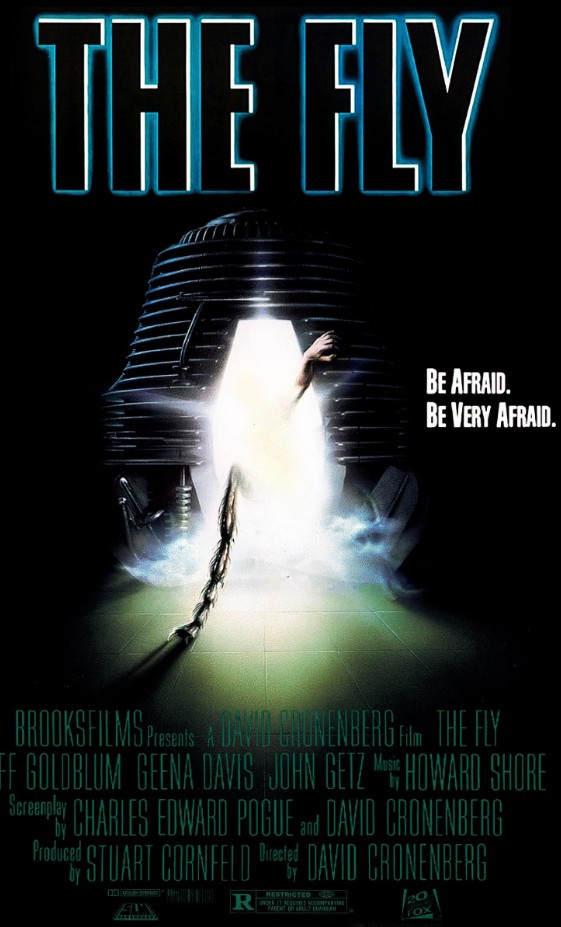
Out of the movies Roger Ebert and Gene Siskel picked in Siskel & Ebert & the Movies’ ‘Best of 1986’ episode, I believe Eddie Munson would choose The Fly. As I explained in my 1986 introduction of Comparing with the Critics, Eddie’s story teaches that, sometimes, there’s more than meets the eye. Plus, Eddie’s imagination and creativity not only works in his favor as a Dungeon Master, it’s also helped his friends during their time in the Upside Down. From the way Gene and Roger described The Fly in the aforementioned ‘Best of 1986’ episode, it seemed like a different kind of horror and sci-fi film. Roger claims “the poignancy” of The Fly “is interesting in a horror film”. Meanwhile Gene not only states “there was, if you think about it, a certain nobility to The Fly”, he also says “the movie is beautifully made”. Films from the horror and sci-fi genre are infrequently covered on 18 Cinema Lane. In fact, the only sci-fi and/or horror movies included in the Comparing with the Critics series, so far, are The Bride and Mad Max Beyond Thunderdome, which were both released in 1985. But what can be appreciated is the creativity and imagination woven into those two genres, whether it’s how the duel in the Thunderdome was filmed in Mad Max Beyond Thunderdome or giving Viktor a “hero’s journey” in The Bride. Though The Fly ended up on Roger’s top twenty best films of the year list, it did earn a place on Gene’s ten best films of ’86 list at number ten. However, despite not seeing every or most of the movies from 1986, The Fly would not be on my list of the top ten best films of that year. I also don’t think the film would be on Eddie’s top ten best films list either.

The Fly (1986) poster created by 20th Century Fox, Brooksfilms, Province of British Columbia Production Services Tax Credit, and SLM Production Group

While sharing his thoughts on The Fly, Roger tells Gene, “Goldblum, I think, deserves an Academy Award nomination”. While I agree with Roger’s sentiments on Jeff Goldblum’s portrayal of Seth Brundle, I also believe Geena Davis (who portrayed Veronica “Ronnie” Quaife) deserved a nomination from the Academy. Individually, Geena’s and Jeff’s performance was solid. From the tearful heartbreak Ronnie displays as Seth becomes unrecognizable to Seth’s erratic behavior over the course of the story, Jeff and Geena made their characters interesting to watch. But together, Geena and Jeff share very nice on-screen chemistry! In The Fly’s very first scene, Seth and Ronnie meet at a scientific event. Their interaction contains a sense of awkwardness, as they don’t yet know how they feel about the other person. But because Ronnie and Seth appear comfortable with who they are as individuals, the conversation isn’t embarrassing or cringey. Instead, it kind of comes across as flirty. Incorporating smiles, Seth’s widening eyes, and Ronnie’s glances away from Seth add to their growing feelings for each other. Even tilts of the head indicate how equally engaged they are in their interaction. The more I saw Seth and Ronnie together, the more I wished Jeff and Geena starred in another movie together portraying a couple!

Movie award essentials image created by Freepik at freepik.com. <a href=”https://www.freepik.com/free-photos-vectors/background”>Background psd created by freepik – http://www.freepik.com</a>. Image found at freepik.com. 

Gene tells Roger during their discussion of The Fly how he doesn’t believe science fiction movies, but was able to believe The Fly. One of the reasons why, according to Gene, is “it has to do with makeup”. The Academy certainly agreed with Gene, as The Fly won the Best Makeup category at the 59th Academy Awards. I also agree with Gene and the Academy. The idea of a human transforming into a fly sounds pretty disturbing and grotesque. Through the makeup design of Stephan Dupuis and Chris Walas, that aforementioned transformation was brought to life on screen in a believably horrifying way. At the start of Seth’s transformation, he develops little hairs on his back and his face appears discolored. But as the story progresses, so does his transformation. Seth’s teeth become pointy before falling out. His fingers morph together as his hands turn into the feet of a fly. Seth’s body even develops lumpy growths that make him look like a complete stranger. What adds to the horrifying nature of the makeup design is not just how believable the transformation itself appears, but also how realistic the effects look.

The “Eddie’s Year” Blogathon banner created by me, Sally Silverscreen. Original image created by 21 Laps Entertainment, Monkey Massacre, Netflix, and Upside Down Pictures.

During their coverage of The Fly in the ‘Best of 1986’ episode of Siskel & Ebert & the Movies, Roger comments on the believability of the movie. He tells Gene how “the screenplay was written and acted smart”. Roger also appreciated how Seth wasn’t a scientist “who speaks in cliches out of the thirties”. To add to Roger’s compliments, I’ll say that I liked how the story’s scientific ideas were woven into the script. Throughout The Fly, the topic of teleportation is discussed by Ronnie and Seth. What started as a magazine interview turns into a collaborative book. Over time, the focused topic changes to genetic fusion between Seth and a fly. Ronnie’s discovery and Seth’s computer lead to this specific topic being brought up. The way these scientific subjects were written into the story, as well as the dialogue, sounded intelligent enough to make the characters seem like they knew what they were talking about. As a viewer, I wasn’t confused by these concepts or didn’t feel like homework before watching the movie was required.

Scared audience image created by Katemangostar at freepik.com. <a href=’https://www.freepik.com/free-photo/terrified-friends-watching-horror-movie-in-cinema_1027311.htm’>Designed by Freepik</a>. <a href=”https://www.freepik.com/free-photos-vectors/people”>People image created by Katemangostar – Freepik.com</a>. Image found at freepik.com.

As Gene sings the praises of The Fly, he refers to the movie as “a great adventure”. In my experience watching adventure stories unfold on screen, there’s usually a sense of urgency. This urgency can be the reason for reaching a particular destination, exploring a specific location, or finding a person or object. A featured scene from The Fly on Siskel & Ebert & the Movies’ ‘Best of 1986’ episode shows Seth revealing to Ronnie his continual transformation toward becoming a fly. That scene made me believe there would be a race against the clock to either slow down or reverse Seth’s transformation process. Sadly, the script did not provide a race against the clock because the movie lacked a sense of urgency. In fact, The Fly contains a slow-burn story where Seth slowly becomes a fly over the course of most of the film. The 1986 movie is one of those movies where the audience waits for the inevitable to happen. Because the title of the film, The Fly, gives the inevitable away, it makes the film itself predictable. This predictability removes some of the story’s suspense and intrigue.

Comparing with the Critics banner created by me, Sally Silverscreen. TV show title cards created by WTTW National Productions, WTTW, Public Broadcasting Service (PBS), Lifetime Television, Tribune Entertainment, Buena Vista Television, and Disney-ABC Domestic Television

In the introduction of this review, I stated how The Fly would not be on my list of the top ten best films of 1986. I also said I didn’t think the film would be on Eddie’s top ten best films list either. The reasons are the movie’s lack of urgency and predictability. I could honestly picture Eddie either falling asleep during the movie or leaving the theater during the film. As I said in my review, The Fly is a slow-burn story and its predictability removes some of the story’s suspense and intrigue. But I don’t believe The Fly is a bad movie. The individual and combined performances of Jeff Goldblum and Geena Davis made their characters interesting to watch, as well as gave their characters nice on-screen chemistry. Chris and Stephan’s makeup effects effectively elaborated on the horrifying concept of a human becoming a fly. I also liked how the story’s scientific ideas were woven into the script. But despite all that praise, I didn’t like or love The Fly as much as Gene or Roger did.

This review was brought to you by

Sally Silverscreen

Comparing with the Critics – Worst of 1986 – King Kong Lives

This review is from my series, Comparing with the Critics. If you’d like to learn more about the series, click on the link below.

Introducing my new series, Comparing with the Critics!

In the 1986 introduction of Comparing with the Critics, I said Eddie Munson would see Roger Ebert’s and Gene Siskel’s warnings about King Kong Lives as a challenge. That’s because this movie was deemed so bad, no clips from it were featured on ‘The Worst Movies of 1986’ episode of Siskel & Ebert & the Movies. According to Roger and Gene, they received letters from King Kong Lives’ film company stating no clips of the movie were allowed to be shown on Gene and Roger’s national show, yet could be shown on their local show in Chicago. Wikipedia states the film company, DEG (De Laurentiis Entertainment Group), forbade the critics from showing clips on Siskel & Ebert & the Movies “unless they promised to give positive reviews”. Because neither Roger or Gene complied with DEG’s request, they used the experience as a warning to their audience not to see King Kong Lives, with Gene saying, “If you don’t believe me or Roger, believe the film company that, think about it, couldn’t find a single scene that it wanted you to see”. From my experience watching the “Best of” and “Worst of” episodes of Gene and Roger’s show, a featured movie with no clips presented for it is extremely rare. That’s why King Kong Lives not only became so memorable to me, but why I wanted to review the movie, wondering if it was truly that bad. But now that I’ve seen King Kong Lives, saying it’s so bad it justified the refusal of featuring clips on Siskel & Ebert & the Movies is a stretch.

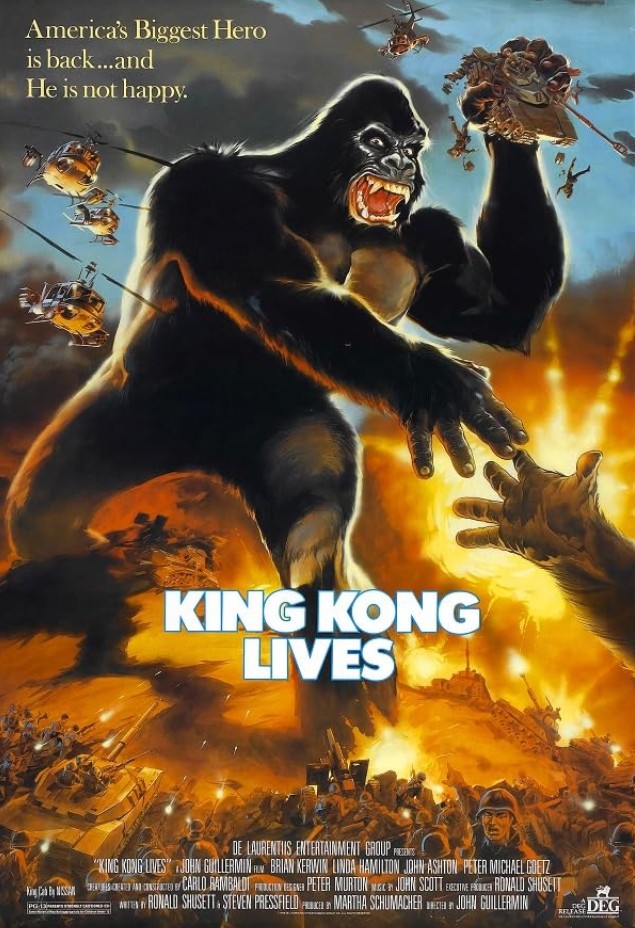
King Kong Lives poster created by De Laurentiis Entertainment Group (DEG)

Gene claims King Kong Lives, which is a sequel to King Kong from 1976, “should have been a classy production”. I’m not sure “classy” is the right word to describe this film. What I will say is King Kong Lives is interesting. One of the factors that made the movie interesting was the use of suits to bring King Kong and Lady Kong to life. In order for King Kong to be saved, Lady Kong is incorporated into the story to provide a blood transfusion for King Kong. Over the course of the film, Lady Kong and King Kong develop a romantic relationship. Through the performances of Peter Elliott and George Antoni/Yiasoumi, King Kong and Lady Kong’s interactions became such a pleasant surprise! The blend of body language, tilts of the head, and movements of the eyes and mouth effectively expressed emotions, thoughts, and feelings without any dialogue. The actual construction of the suits allowed King Kong and Lady Kong to appear believably realistic. With all that said, I found Lady Kong and King Kong’s relationship adorable!

Heart image created by Dashu83 at freepik.com. <a href=”https://www.freepik.com/free-photos-vectors/background”>Backgroundimage created by Dashu83 – Freepik.com</a>. <a href=’https://www.freepik.com/free-photo/happy-valentines-day-and-heart-card-with-happy-valentines-day-and-heart_1747001.htm’>Designed by Freepik</a>. Image found at freepik.com.

When Hank “Mitch” Mitchell (portrayed by Brian Kerwin) is introduced in King Kong Lives, he gives the impression of being hungry for money and fame. This is because Mitch agreed to give Lady Kong to the Atlantic Institute. But as the movie goes on, Mitch subverts expectations by showing how he genuinely cares about Lady Kong’s wellbeing. One example is Mitch’s observation of how King Kong appeared to be treated better than Lady Kong. He’s even concerned about the wellbeing of Dr. Amy Franklin (portrayed by Linda Hamilton). When Amy tells Mitch how she’s spent her evening keeping an eye on King Kong after his heart surgery, Mitch encourages Amy to get some sleep. Mitch’s empathy and compassion toward Lady Kong, Amy, and even King Kong made him such a likeable character!

Heartbeat image created by Freepik at freepik.com. <a href=’https://www.freepik.com/free-vector/medical-logo_763775.htm’>Designed by Freepik</a>. <a href=”https://www.freepik.com/free-photos-vectors/logo”>Logo vector created by Freepik</a>. Image found at freepik.com.

Speaking of Brian Kerwin and Linda Hamilton, I’d like to take some time to talk about their performance. Over the course of King Kong Lives, Amy and Mitch’s attraction for one another grows. The on-screen chemistry between Linda and Brian was, in my opinion, very sweet. The relationship between Mitch and Amy felt genuine because of the combined performance of Brian and Linda. But, individually, they gave solid performances as well. When Lady Kong arrives at the Atlantic Institute through a plane trip, some photographers attempt to break into the plane to take Lady Kong’s picture. Mitch pulls those photographers out of the plane, taking note of how stressed Lady Kong appears. In that moment, Amy gains respect for Mitch as he puts Lady Kong’s needs before his own desires. When Mitch looks at Amy, she nods toward him, a look of understanding in her eyes. Later in King Kong Lives, Amy performs heart surgery on King Kong. As Mitch watches the operation unfold, he is consistently shown grimacing or appearing worried. From the look in his eyes to the movements of his mouth, Mitch’s reactions throughout the surgery appear believable. The examples I provided illustrate how both Linda and Brian put genuine effort into their performances!

The “Eddie’s Year” Blogathon banner created by me, Sally Silverscreen. Original image created by 21 Laps Entertainment, Monkey Massacre, Netflix, and Upside Down Pictures.

Prior to watching and reviewing King Kong Lives, I had never seen a King Kong movie. Therefore, my knowledge of the King Kong Cinematic Universe is very limited. Based on what I do know about King Kong, he is, sometimes, presented as a threat to humans. This depiction was chosen for the 1976 film, with clips from that film shown at the beginning of King Kong Lives. With that said, I was really confused why the Atlantic Institute would spend the time, energy, and money (seven million dollars to be exact) to keep King Kong alive? I was hoping an explanation would be provided through the dialogue. But, unfortunately, no explanations were included in the script. It seems like the creative team behind King Kong Lives expected their audience to already know why certain events were happening. But when certain things happen, such as a change in attitude toward King Kong, explanations that make sense within the world of that film’s story need to be shared. Lack of explanations in King Kong Lives is my biggest criticism of the movie.

Adhesive bandage image created by aopsan at freepik.com. Background photo created by aopsan – www.freepik.com

During their discussion of King Kong Lives, Roger recounts his experience seeing the movie at a theater. He tells Gene about a swinging door located behind the theater’s back row of seats. The children who attended Roger’s screening of King Kong Lives found that swinging door more entertaining than the film itself because, according to Roger, “there was nothing on the screen that was even slightly entertaining to them”. Though I found the film interesting enough to keep me invested in the story, I can understand why those children would find the movie boring. When someone chooses to watch a King Kong picture, they typically expect King Kong to be destructive. While he was destructive in King Kong Lives, those moments were far and few between. From my limited knowledge of the King Kong Cinematic Universe, King Kong Lives tells a different kind of story from previous films, including its directly connected predecessor from 1976. I appreciate this newer approach to the lore of King Kong instead of repeating the same ideas. On the other hand, however, it seems like King Kong Lives’s creative team may have told a story that felt too different to the audience.

Comparing with the Critics banner created by me, Sally Silverscreen. TV show title cards created by WTTW National Productions, WTTW, Public Broadcasting Service (PBS), Lifetime Television, Tribune Entertainment, Buena Vista Television, and Disney-ABC Domestic Television

As a movie blogger, I totally understand Roger’s and Gene’s decision to refuse DEG’s request of showing clips of King Kong Lives on their Chicago show, but not their national show. In fact, I commend the critics for sticking to their morals and integrity. But DEG’s refusal to have clips of their film shown on Siskel & Ebert & the Movies did more harm to their film than good. Not only did this decision deny Gene’s and Roger’s audience an opportunity to choose for themselves whether they wanted to see the movie, it also made King Kong Lives, in my opinion, seem worse than it was. To me, the 1986 picture is a fine, interesting-enough presentation that kept me invested in the story. It took the King Kong lore in a newer direction than its predecessors, even addressing unique ideas, such as what it would take to save King Kong. But the lack of explanations left me confused why certain events were happening. In fact, the more I think King Kong Lives, the more questions I have about the King Kong Cinematic Universe. Are the King Kongs in the series’ later films a direct descendent of King Kongs from earlier chapters? Is there an overarching story woven into the series? Which events are officially a part of canon? Though these questions won’t get answers in this review, there is one thing I will say. King Kong Lives is another movie I disagree with the critics on.

This review was brought to you by

Sally Silverscreen

Take 3: Gods and Generals Review

Out of the movies from Robert Duvall’s filmography, I’ve written about To Kill a Mockingbird (which I liked), The Terry Fox Story (which I also liked), and Network (which I wasn’t a fan of). While looking through his filmography for Taking Up Room’s Robert Duvall Tribute Blogathon, I discovered he starred in the 2003 movie, Gods and Generals. I hadn’t seen this film prior to the event. But because of its association with the Movieguide Awards, I had heard of it before. At the 2004 Movieguide Awards, Stephen Lang won an acting award called the ‘Grace Award for Movies’ for his portrayal of General Stonewall Jackson. Gods and Generals also won the ‘Faith & Freedom Award for Movies’ at the 2004 Movieguide Awards. I wasn’t able to find any information about the other nominees for those aforementioned categories. Therefore, I cannot comment on who should or should not have won. But, through my review, I want to determine if, in my opinion, Gods and Generals deserved to be nominated. Selecting the 2003 film also gave me an excuse to review another title of Robert’s.

Gods and Generals poster created by Ted Turner Pictures, Antietam Filmworks, Esparza / Katz Productions, Rehme Productions, Mace Neufeld Productions, and Warner Bros.

Things I liked about the film:

The acting: Since Robert Duvall is the reason why I’m reviewing Gods and Generals, I’ll talk about his acting performance first. In the 2003 movie, Robert portrays General Robert E. Lee. Throughout the movie, I noticed the consistent calmness he brought to his performance. At the beginning of Gods and Generals, General Robert E. Lee turns down an invitation. The tone of voice he adopts is very articulate and matter of fact. There’s a gentleness in his eyes that shows he holds no ill-feelings or disrespect toward receiving the invitation in the first place. Robert’s approach to portraying General Robert E. Lee appeared to have genuine thought and effort put into it. Meanwhile, I liked Jeff Daniels’ portrayal of Lieutenant Colonel Joshua Lawrence Chamberlain! Jeff brought a tenderness that made Lieutenant Colonel Joshua Lawrence Chamberlain interesting to watch. One of the most captivating scenes in Gods and Generals is when Lieutenant Colonel Joshua Lawrence Chamberlain and his wife, Fanny, discuss his upcoming departure to the United States Army. Their interaction is very bittersweet, yet tender. Their gentle tone of voice holds the love they share for each other. Both Fanny (portrayed by Mira Sorvino) and Lieutenant Colonel Joshua Lawrence Chamberlain carry sadness on their faces, especially in their eyes, unsure what their future will hold. Jeff’s and Mira’s acting abilities effectively sold the believability of Lieutenant Colonel Joshua Lawrence Chamberlain and Fanny’s relationship!

I brought up in this review’s introduction how, at the 2004 Movieguide Awards, Stephen Lang won an acting award called the ‘Grace Award for Movies’ for his portrayal of General Stonewall Jackson. Now that I’ve seen his performance for myself, I can, honestly, say his nomination was well deserved! Stephen brought versatility to his portrayal of General Stonewall Jackson, allowing his performance to be well-rounded. Because of Stephen’s acting talents, scenes he (as General Stonewall Jackson) appeared in were emotionally effective. A great example is when General Stonewall Jackson and his wife, Anna, read the Bible together before he leaves for the Battle of Manassas. The gentle, yet loving tone of voice from both General Stonewall Jackson and Anna (portrayed by Kali Rocha) showed how seriously they took their relationship. The look in their eyes was that of longing, longing for more time together as well as longing to be loved by each other. Anna and General Stonewall Jackson’s interaction in that scene showcased a moment of tenderness, reflection, and true love. This was achieved because of the strength of Stephen’s and Kali’s acting abilities!

Historical accuracy: What can ultimately make or break a historical movie is its historical accuracy. If the creative team behind a historical film effectively executes that production’s historical accuracy, the film in question can present the illusion of immersion. This illusion was achieved in Gods and Generals! From the set design to the costume design and even the finest of details, everything looked and felt like the Civil War era. I was impressed how simple items, like a doll or a piano, appeared to have come straight out of that time-period. Other elements, like the dialect, helped bring authenticity to the production. Looking back on Gods and Generals, the creative team’s research into the Civil War era is very evident!

How long shots were utilized: Long shots can be incorporated into a film for a variety of reasons. In “sword & sandal” films, long shots capture the scope of larger set designs. Films featuring armies, teams, or crowds will showcase the size of those groups through long shots. In Gods and Generals, however, long shots were utilized to present establishing shots (shots that establish a story’s location). One example is when Fredericksburg, Virginia is introduced in the story. The long shot used captured an aerial view of the town. Through this perspective, hues of black, white, green, blue, brown, and even purple appeared to nicely blend together. How the town was shown on screen looked like a watercolor painting! Presenting places like Fredericksburg, Virginia with a long shot helped add visually appealing images to Gods and Generals.

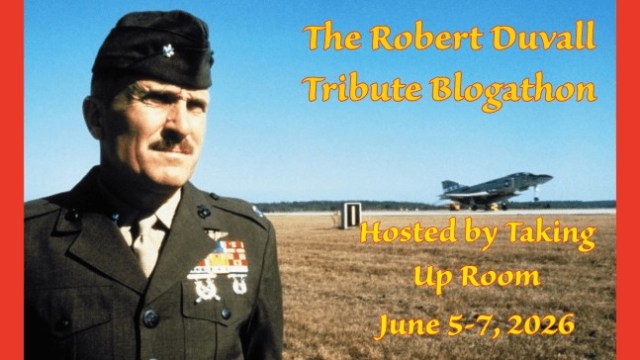
The Robert Duvall Tribute Blogathon banner created by Rebecca from Taking Up Room

What I didn’t like about the film:

The run-time: IMDB lists Gods and Generals’s run-time as a little over three-and-a-half-hours. After seeing the movie, however, I felt like I spent three and a half years watching it. I recognize depicting a historical event through film takes time, whether it be battles or certain individuals interacting with one another. For a historical story like Gods and Generals, there are a lot of moving parts involved. But some scenes in the 2003 film were either drawn out too long or seemed unnecessary. One example is a scene where a soldier (who also happened to be a background character) explained to his fellow soldiers what they should do with his belongings if he dies on the battlefield. Personally, I think Gods and Generals should have been presented as a mini-series. Therefore, the story’s key individuals and events would have received their due diligence.

A dialogue-heavy film: In any movie, including historical pictures, dialogue plays an important role in storytelling. Through dialogue, ideas are expressed, emotions are shared, and characters give pieces of their heart to each other and the audience. But if a movie is dialogue-heavy, it forces the audience to actively pay attention to what they’re watching or else they’ll miss important context. Gods and Generals is a dialogue-heavy film, featuring long stretches of time where characters engage in conversations with one another. What also works against Gods and Generals is its little over three-and-a-half-hour run-time I already brought up in this review. While there were battles and action-heavy scenes throughout the movie, they were far and few between compared to the dialogue-heavy scenes. Having an ebb and flow of action and dialogue-heavy scenes would have maintained a steadier pace.

Underutilizing Robert Duvall and Jeff Daniels: Robert Duvall’s involvement in Gods and Generals is the reason why I wanted to review the film. As I mentioned earlier in this review, I liked Jeff Daniels’ portrayal of Lieutenant Colonel Joshua Lawrence Chamberlain. But compared to Stephen Lang and his portrayal of General Stonewall Jackson, it seemed like the acting talents of Jeff and Robert were utilized sparingly. In fact, it got to the point where the movie became ‘The General Stonewall Jackson Show’, with everyone else simply participating in it. Listing Robert, Stephen, and Jeff as Gods and Generals’s top-billed actors feels a bit misleading because of Jeff’s and Robert’s underutilization. This decision also does Robert’s and Jeff’s acting talents a disservice.

Horse with saddle photo created by Topntp26 at freepik.com. <a href=’https://www.freepik.com/free-photo/stallion-black-equine-race-sky_1104246.htm’>Designed by Freepik</a>. <a href=”https://www.freepik.com/free-photos-vectors/background”>Background image created by Topntp26 – Freepik.com</a>. Image found at freepik.com.

My overall impression:

The way I feel about Gods and Generals is similar to how I feel about the 1994 film, Scarlett. Both projects were competently made, each respective creative team clearly knowing what they were doing. The acting and historical accuracy were the strengths of each movie. But the screenwriting causes Scarlett and Gods and Generals to be a mixed bag. The 2003 film having a run-time of a little over three-and-a-half-hours is, in my opinion, excessive. Not only is Gods and Generals a dialogue-heavy movie, I also felt Robert Duvall’s and Jeff Daniels’ acting talents were underutilized. But what I will say is, for me, Stephen Lang stole the show! His performance was so solid, his Movieguide Awards nomination was well deserved. I’d honestly recommend just watching his scenes because the versatility Stephen brought to his portrayal of General Stonewall Jackson made his performance worth watching the film.

Overall score: 6 out of 10

Have you seen Gods and Generals? Which movie from Robert Duvall’s filmography would you like to see me review next? Let me know in the comment section below!

Have fun at the movies!

Sally Silverscreen
We Now Commemorate 40 Years of “Eddie Munson’s Year” With The “Eddie’s Year” Blogathon!

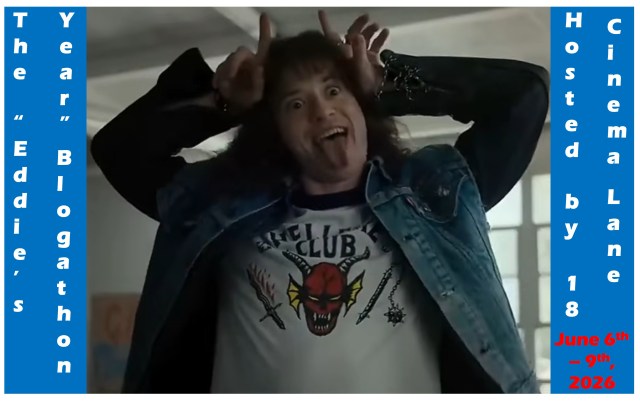
Welcome to my “Eddie’s Year” Blogathon! 1986 is the year when Eddie Munson, from Stranger Things, had planned on graduating from Hawkins High School. This is the reason why Eddie’s fans refer to 1986 as “Eddie’s year”. Because 2026 is the 40th anniversary of “Eddie’s year”, this blogathon is commemorating the occasion! Participants of The “Eddie’s Year” Blogathon wrote movie reviews and articles celebrating this special anniversary. So, without further ado, let the The “Eddie’s Year” Blogathon begin!

The “Eddie’s Year” Blogathon banner created by me, Sally Silverscreen. Original image created by 21 Laps Entertainment, Monkey Massacre, Netflix, and Upside Down Pictures.

18 Cinema Lane – Comparing with the Critics – Worst of 1986 – King Kong Lives, Comparing with the Critics – Best of 1986 – The Fly

Silver Screenings — Joyful Anarchy: Ferris Bueller’s Day Off (1986)

MovieRob –The Eddie’s Year Blogathon – Clockwise (1986), The Eddie’s Year Blogathon – Beverly Hills Madam (1986), The Eddie’s Year Blogathon – Link (1986), The Eddie’s Year Blogathon – The Whistle Blower (1986)

Moon in Gemini – The Eddie’s Year Blogathon: Ruthless People

The Wonderful World of Cinema – The Many Treasures of ‘True Stories’ (David Byrne, 1986)

Dubsism – Story Time With J-Dub Episode 18: How Some Guy Named Roy Ended Europe’s Longest War

Movies Meet Their Match – Movie Review: Labyrinth (1986)

Taking Up Room – Pretty In Pink

Take 3: The Misfits (1961) Review

Marilyn Monroe is a woman who needs no introduction. One of the most popular actresses of all time, almost everyone knows who Marilyn is, even if they’ve never seen any of her movies. I remember a time when I would go to a store and find memorabilia with Marilyn’s picture or likeness on it, from metal wall signs to Christmas ornaments. I even recall a church named after her in the 1975 movie, Tommy. But when the Marilyn Monroe – 100th Birthday Anniversary Blogathon was announced, I remembered one of her films was recommended to me. That film is 1961’s The Misfits, suggested by Eric Binford (from Diary of a Movie Maniac)! On my blog’s Year-Long Bingo Card, one of the squares is labeled “Review a movie from the Western genre”. This became another reason why I chose to review The Misfits, as the movie is classified as a “contemporary western”. However, I had no idea Marilyn ever starred in a western genre picture until I selected the 1961 title for the blogathon. My aforementioned reasons, including the fact I don’t review western genre movies often, finally gave me an opportunity to write about The Misfits!

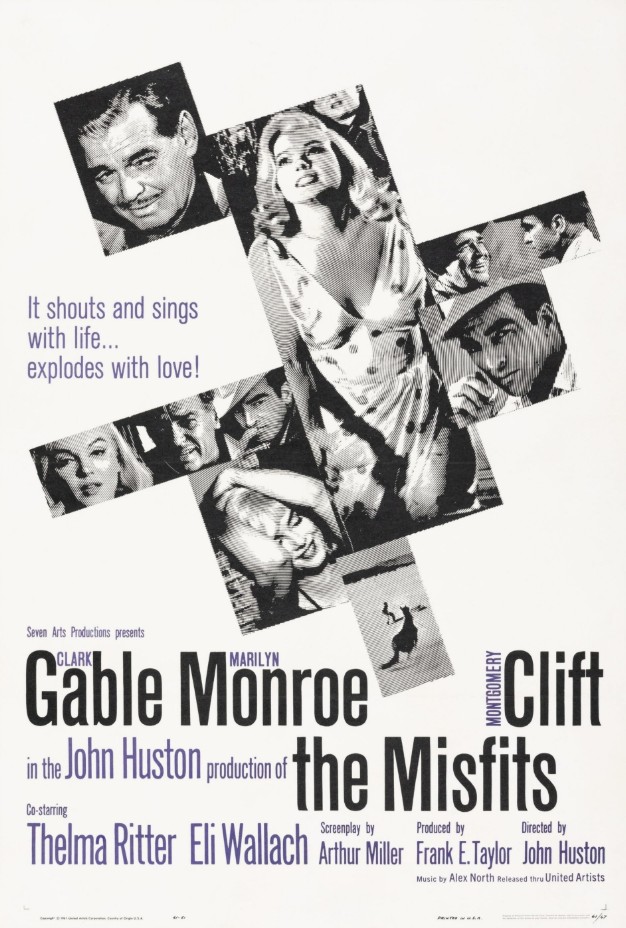
The Misfits (1961) poster created by United Artists and Seven Arts Productions

Things I liked about the film:

The acting: Throughout my years of watching and reviewing movies, I’ve heard Marilyn Monroe receive titles like “icon” and “sex symbol”. But as I reflect on her performance in The Misfits, I feel those titles do her acting talents a huge disservice. Toward the beginning of the 1961 film, Marilyn’s character, Roslyn, is questioning what her life will look like after her recent divorce. She’s hunched over her drink and her hands are folded, appearing as if she’s lost in thought. Roslyn’s eyes show how she’s trying to make a thousand decisions in a single moment, but not in a way that makes her look overwhelmed. She’s carefully processing what her new steps will be, coming up with a strategy that will prevent her from repeating her mistakes. As I watched this scene unfold, I was so focused on Roslyn and what decisions she was going to make, I had completely forgotten I was watching an actress portray a character. This is just one example of how Marilyn’s performance was one of the best parts of The Misfits!

Clark Gable is an actor I am definitely familiar with. Not only have I seen Gone with the Wind, I reviewed China Seas back in 2021. His portrayal of Gaylord in The Misfits is quite different from his two previously mentioned roles. That’s because it didn’t feel like Gaylord had something to prove, yet was emotionally versatile. One of the saddest scenes is when Gaylord is trying to find his children. As he drunkenly stumbles throughout and out of the saloon, he calls out his children’s names. A mixture of pain, confusion, and longing can be heard in his voice. Even his eyes were filled to the brim with sadness. In that scene, I, honestly, couldn’t help feeling sorry for Gaylord. Clark’s solid performance certainly contributed to that.

While I’m on the subject of the acting performances in The Misfits, I want to bring up Eli Wallach and Montgomery Clift. As I watched this movie, I was impressed by Eli’s portrayal of Gaylord’s friend, Guido, as well as Montgomery’s portrayal of a rodeo rider named Perce. One stand-out moment was when Guido is talking to Roslyn about his deceased wife. His voice quivers during the conversation and his eyes even appear on the verge of tears. Eli’s performance presents one of those times where a character can say so much as they say very little. In a different conversation with Roslyn, Perce shares his life story with her. Throughout his reflections, his wide eyes look like they’re searching for something. But it’s not because he’s lost, it’s because he’s trying to find something to focus on after a recent head injury. Montgomery’s expressive eyes are one of the reasons why his performance was captivating to watch!

The dialogue: Sometimes, a movie’s dialogue can be so thoughtfully written, it sounds profound without trying too hard to be. That was definitely the case for The Misfits! Honestly, it’s difficult to choose a favorite quote because several quotes were so thought-provoking. But I will provide a few examples to prove my previously stated point. At one moment in the movie, Isabelle, Roslyn’s former landlady and current friend, claims to know Nevada’s slogan. She says it’s “Anything goes, but don’t complain if it went”. Poignant reminders of how unpredictable life is and how some things were or were not meant to be are shared in that one line. During a conversation with Roslyn, Guido tells her, “You have the gift for life, Roslyn. The rest of us, we’re just looking for a place to hide and watch it all go by”. This piece of dialogue simply, yet effectively, differentiates between people who allow life to pass them by and those who fearlessly grab the steering wheel.

Providing creativity to the western genre: When it comes to means of travel within the western genre, horseback riding, horse drawn carriages/wagons, and trains are typically shown on screen. These modes of travel provide a stone in the western genre’s foundation, making the genre itself what it is. But what if I told you there was a plane in The Misfits? In the 1961 movie, Guido says he was a pilot in the war, likely referring to World War II. He uses his piloting skills to not only fly a plane, but to also wrangle a group of wild horses with that same plane. I bring this up because, prior to reviewing The Misfits, I had never seen, let alone heard of, a plane in a western genre film. Incorporating any aircraft into the movie added creativity to the western genre. It also gave The Misfits a unique identity.

Marilyn Monroe – 100th Birthday Anniversary Blogathon banner created by Kristen from Hoofers and Honeys

What I didn’t like about the film:

Guido’s unaddressed jealousy: At Guido’s house, Roslyn and Gaylord share a dance together. When Guido sees Gaylord and Roslyn together, the look on Guido’s face appears to be that of jealousy. But throughout The Misfits, this apparent jealousy wasn’t addressed. I honestly thought it was going to lead to a love triangle or Guido and Gaylord fighting for Roslyn’s love. Looking back on the 1961 movie, I wonder what the purpose was of showing Guido looking jealous if that feeling didn’t play a role in the story? Guido’s apparent jealousy could have led to an interesting conflict within the script had that feeling been acknowledged.

The run-time: IMDB lists The Misfits’ run-time as a little over two hours. Personally, I think that run-time is a bit excessive. Not only is the story pretty straightforward and easier to follow, the cast is smaller, which helps the audience remember who is who. These elements should have led to a tighter script. Plus, some scenes were drawn out too long, such as when Gaylord, Guido, and Perce wrangle the wild horses. If scenes like the one I brought up were trimmed down, the run-time of The Misfits could (and should) have been, at least, an hour and thirty to forty minutes. Important points in the story could have been reached sooner as well.

Perce’s underutilized backstory: In my opinion, Perce was the most interesting character in The Misfits. His backstory, along with his phone conversation with his mother, made him intriguing. I was genuinely curious about where Perce’s part of the story would go. But, unfortunately, his backstory became underutilized. During a conversation with Roslyn, Perce brings up how he was denied inheriting his father’s ranch. This could have provided Perce with a motive to carry his story forward. After his conversation with Roslyn, however, this detail is barely brought up again. In fact, Perce’s backstory becomes an afterthought as the movie progresses.

Joshua Tree National Park in California image created by Welcomia at freepik.com. <a href=”https://www.freepik.com/free-photos-vectors/tree”>Tree photo created by welcomia – http://www.freepik.com</a>. Image found at freepik.com.

My overall impression:

Have you ever watched a movie where you didn’t know what the movie’s creative team was trying to say? That was my experience watching The Misfits. I think I know what the film was supposed to tell me. But I don’t know for certain if that’s what The Misfits’ creative team wanted to tell their audience. However, I don’t believe the 1961 movie is bad. In fact, I thought it was just ok. The acting performances, including Marilyn Monroe’s, were certainly worth watching. Not only was the dialogue, at times, thought-provoking, the inclusion of a plane added creativity to the western genre. But there were flaws that held The Misfits back from being a stronger movie. I didn’t like how Perce’s backstory was underutilized and how Guido’s jealousy was unaddressed. Plus, the run-time was, in my opinion, a bit excessive. Despite those flaws, I am thankful to have received an opportunity to finally watch (and review) The Misfits!

Overall score: 6 out of 10

Have you seen The Misfits? Which film from Marilyn Monroe’s filmography would you like to see me review next? Let me know in the comment section!

Have fun at the movies!

Sally Silverscreen
Take 3: Titan A.E. (2000) Review

Participating in this month’s Genre Grandeur feels, to me, like déjà vu. That’s because the theme is “Movies Featuring Reluctant Heroes”, the same theme (and month) when I participated in Genre Grandeur back in 2020. Back then, I reviewed the 2014 film, Captain Sabertooth and the Treasure of Lama Rama. That movie ended up being the most disappointing one I saw that year. For this month’s (and year’s) Genre Grandeur, I decided to select 2000’s Titan A.E., a title I actually have seen before. However, it’s been so long since I’ve seen it, I have vague recollections of the film. On my blog’s Year-Long Bingo Card, there are two squares labeled “Review an animated film” and “Science Fiction”. That, along with how Titan A.E. fits this month’s Genre Grandeur theme, gave me an excuse to revisit the 26-year-old movie!

Titan A.E. (2000) poster created by 20th Century Fox Animation, David Kirschner Productions, Fox Animation Studios, 20th Century Fox, and Walt Disney Studios

Things I liked about the film:

The use of color: As I said in the introduction of this review, I have vague recollections of Titan A.E. because it’s been so long since I’ve seen the film. Because of that, I’d forgotten how colorful this movie is. Using color, as well as understanding how to use color, can contribute to a movie’s visual appeal. With the creative team behind Titan A.E. possessing and executing that understanding, the film’s visual appeal was achieved! In one beautiful example, Cale and his team travel to a planet called Sesharrim. As they sail through the planet, they are greeted by a landscape of rich reds. The deep purple waters are right under bright yellow balloons of light. The combination of hues on Sesharrim created an environment promoting peace and serenity.

Incorporation of clever ideas: At the beginning of Titan A.E., Cale (the film’s protagonist and reluctant hero) receives a gold ring from his father before they part ways. Since that moment, Cale (as well as the audience) believes this ring is, simply, a treasured memento. But when he meets a character named Joseph Korso, Cale learns his ring provides a map to a life-saving spacecraft called Titan. Cale receives another surprise when he discovers his ring also contains a compass. The movie’s “MacGuffin” is Titan, as the characters spend most of the story looking for it. But in stories like Titan A.E., so much focus in placed on the “MacGuffin” itself, the bridge to the “MacGuffin” is usually overlooked. In the 2000 film, however, Cale’s ring becomes a tool used to help the characters reach their goal. The purpose of Cale’s ring was not only such a clever idea for a simple piece of jewelry, it’s just one example of the incorporation of clever ideas in Titan A.E.!

Blend of 2-D and 3-D animation: Titan A.E.’s claim to fame is blending 2-D animation (hand-drawn animation) and 3-D animation (computer created images). This major creative decision brought something unique to the table of animation, as well as film! What it also did was visually complement the story’s conflict. In the world of Titan A.E., the Drejs are a villainous group of aliens who want to control the universe by outnumbering the humans. The Drejs are presented as bright blue, 3-D animated characters, while the human characters were created with 2-D animation. In one example, after Cale meets Korso, the Drejs track Cale down. Because the majority of that scene is presented through 2-D animation, it forces the audience to focus on the Drejs, with their color and animated appearance highlighting their distinctness. But what that scene also shows is how the blend of 2-D and 3-D animation gave Titan A.E. visual depth.

Colorful galaxy image created by Freepik at freepik.com. <a href=’https://www.freepik.com/free-vector/lovely-hand-drawn-galaxy-background_2943080.htm’>Designed by Freepik</a>. <a href=”https://www.freepik.com/free-photos-vectors/background”>Background vector created by Freepik</a>. Image found at freepik.com.

What I didn’t like about the film:

The Drejs: Like I already mentioned in my review, the Drejs are a villainous group of aliens who want to outnumber the humans. But while I was watching Titan A.E., I never felt they were a strong threat to Cale and his team. That’s because the Drejs had such a limited presence in the film. In fact, their presence was so limited, it felt like the Drejs appeared in the movie for the sake of plot convenience. These flaws prevented the Drejs from being effective villains.

The run-time: According to IMDB, Titan A.E.’s run-time is an hour and thirty-four minutes. As I watched the movie, however, it felt a bit longer than its run-time. The reason for this is how a few scenes were unnecessarily drawn out. For example, a scene where Cale is driving a spacecraft in a non-dangerous environment seemed to last about five minutes. While the scene contained plot development, most of the scene felt like padding. Had that scene been trimmed down, its intended point could have been reached sooner. The script could have been a bit tighter as well.

Inconsistent character development: In any story, character development is an important component. This part of storytelling allows the audience to truly get to know the characters, which gives them a reason to stay invested in what the characters are doing on screen. When it came to the human characters in Titan A.E., I thought the character development was well done, as I learned more about them as the movie went on. But when it came to the alien characters, like Gune and Stith, I felt like I only became familiar with them. The inconsistent character development in Titan A.E. not only prevented me from truly getting to know every member of Cale’s team, the camaraderie between these characters wasn’t as strong as it could have been.

Movie items image created by Freepik at freepik.com. <a href=’https://www.freepik.com/free-vector/flat-modern-cinema-elements_847506.htm’>Designed by Freepik</a>. <a href=”https://www.freepik.com/free-photos-vectors/frame”>Frame vector created by Freepik</a>. Image found at freepik.com.

My overall impression:

When a movie performs poorly at the box office, one of the potential reasons may be it was “ahead of its time”. If someone wanted to apply this reasoning to Titan A.E., I’d buy that reasoning at full price. As I mentioned in this review, the 2000 presentation is known for blending 2-D animation (hand-drawn animation) and 3-D animation (computer created images). Even though this creative risk hurt the film’s financial earnings, it did show the world the possibilities animation (let alone filmmaking) had to offer. It also showed how 2-D and 3-D animation can complete one another instead of compete against each other. Though looking at how the cinematic landscape has changed in twenty-six years, 3-D animation has become so common, 2-D animation has ended up becoming scarce. As for my opinion of Titan A.E., I thought it was a fine, interesting enough movie. But for all the reasons I brought up, I believe this film deserves more love and appreciation.

Overall score: 7.2 out of 10

Have you seen Titan A.E.? Which underrated animated movie do you wish received more love and appreciation? Let me know in the comment section!

Have fun at the movies!

Sally Silverscreen

You Still Have Time to Join The “Eddie’s Year” Blogathon!

Are you a fan of Eddie Munson from Stranger Things? Would you like to learn more about 1986? Do ’80s movies make you feel nostalgic? Then The “Eddie’s Year” Blogathon is the event for you! Because the blogathon is taking place between June 6th-9th, you still have time to join! There’s also many topics to choose from, as I tried to make the event’s theme as broad as possible. If you’re interested in participating in The “Eddie’s Year” Blogathon, click on the link below to learn more about the blogathon.

Celebrating 40 Years of “Eddie Munson’s Year” With The “Eddie’s Year” Blogathon

The “Eddie’s Year” Blogathon banner created by me, Sally Silverscreen. Original image created by 21 Laps Entertainment, Monkey Massacre, Netflix, and Upside Down Pictures.

Take 3: Witness for the Prosecution (1957) Review

April’s theme for the Genre Grandeur blogathon is “Courtroom Dramas”. Upon researching eligible titles for this review, I came across one I have heard of before. That title was 1957’s Witness for the Prosecution! Though this adaptation was recommended to me by Emily (from The Flapper Dame) and Eric Binford (from Diary of a Movie Maniac), it’s not the first time I’ve seen (and reviewed) any Witness for the Prosecution adaptation. Back in 2022, I wrote about 1982’s version from the Hallmark Hall of Fame collection. In that review, I criticized Wilfred (the film’s protagonist) spending more time on the story’s court case than the mystery wrapped around it. I believed that creative decision decreased the audience’s engagement. This is one of the reasons why I thought Hallmark Hall of Fame’s adaptation of Witness for the Prosecution was just ok. But will I feel similarly about the 1957 version of this story? In order to solve this mystery, you’ll have to read my review!

Witness for the Prosecution (1957) poster created by Edward Small Productions and United Artists

Things I liked about the film:

The acting: When I wrote about the Hallmark Hall of Fame presentation of Witness for the Prosecution, I praised the acting performances of Diana Rigg, Deborah Kerr, and Beau Bridges. Not only did Beau and Deborah utilize a variety of expressions and emotions, Diana’s portrayal of Christine was consistent. The acting performances in the 1957 adaptation of Witness for the Prosecution were also a highlight! But if I could use one word to describe them, it would be “animated”. Throughout 1957’s Witness for the Prosecution, Wilfrid (the movie’s protagonist) is a grumpy man who stubbornly likes to do things his way. However, the strength of Charles Laughton’s portrayal prevented Wilfrid from becoming a one-dimensional character. In a scene where Wilfrid rides on an elevating stair chair, Wilfrid smiles with a sneaky look in his eyes, scheming a way to foil Miss Plimsoll’s plans. Meanwhile, Tyrone Power gave a very well-rounded portrayal of Leonard Vole! One of the best examples of this statement is when Leonard finds out about his inheritance from the murder victim, Emily Jane French. Leonard’s eyes become very wide as he excitedly reacts to his new-found wealth. This excitement can also be heard in his voice. Then, without hesitation, Leonard’s face falls as he realizes this recently discovered information gives him a motive for murder. Concern replaced excitement in Leonard’s voice and fear even found a reason to exist in his eyes.

As I just mentioned in this review, Diana Rigg’s portrayal of Christine in Hallmark Hall of Fame’s Witness for the Prosecution was consistent. This was also the case for Marlene Dietrich’s portrayal of Christine in 1957’s Witness for the Prosecution. But like I said in this review, the cast’s performances in the 1957 movie were “animated”. That animation was woven into Marlene’s portrayal as well. Throughout Witness for the Prosecution, Christine carried herself with a poised confidence, refusing to let anything get to her. A perfect example is when she outsmarted Wilfrid’s “monocle test”. During Leonard’s trial, however, Christine’s emotions burst into the courtroom. Sometimes, she yelled out her answers with an intensely serious look on her face. There was even a scene where tears spilled from her eyes. Marlene’s performance added enjoyment to my movie-viewing experience!

The set design: One of the strengths from 1982’s Witness for the Prosecution was the set design. In my review of that film, I described the court room as well as Wilfred’s office, with the latter being my favorite set in the Hallmark Hall of Fame presentation. But in the 1957 version of Witness for the Prosecution, my favorite set was Emily Jane French’s living room! The room consisted of two closely situated spaces; a sitting area by a large window and a sitting area by a fireplace. The sitting area by the window featured at least one wicker chair, a hanging plant, and a magazine rack. Meanwhile, the sitting area by the fireplace proudly displayed African artifacts on the walls. The white walls surrounding the living room and the décor’s lighter hues helped the artifacts stand out. Mosaic tiles with a flower design added daintiness to the fireplace itself. Two matching wicker cabinets and a transparent shelf provided storage to the living room. The lower ceiling in the living room helped incorporate a sense of coziness. With everything I described, I wish Emily’s living room was featured more in 1957’s Witness for the Prosecution.

Showing as well as telling: A flaw I talked about in my review for Hallmark Hall of Fame’s Witness for the Prosecution was how dialogue heavy the story was. The emphasis of telling over showing left me disappointed. But this flaw was remedied in Witness for the Prosecution from 1957! Flashbacks presented how Leonard met Emily and Christine, which added context to the dialogue. Later in 1957’s Witness for the Prosecution, Wilfrid discovers evidence that could impact Leonard’s case. This discovery is actually shown on screen, with the mystery surrounding who gave Wilfrid the evidence and where that person got the evidence from providing intrigue. A handful of Wilfrid’s pills cleverly show the progression of time during Leonard’s case. Though the 1957 version of Witness for the Prosecution relies on dialogue, the creative decision to show and tell made the movie more engaging than Hallmark Hall of Fame’s adaptation!

Sketch of London image created by Archjoe at freepik.com. <a href=’https://www.freepik.com/free-vector/hand-drawn-houses-of-parliament_1133950.htm’>Designed by Archjoe</a>. <a href=”https://www.freepik.com/free-photos-vectors/background”>Background vector created by Archjoe – Freepik.com</a>. Image found at freepik.com.

What I didn’t like about the film:

Prolonged involvement: In my review of Hallmark Hall of Fame’s adaptation of Witness for the Prosecution, I was critical of Wilfred’s inactive detective role. The 1982 film placed more emphasis on showing Wilfred resolving Leonard’s case than solving the mystery surrounding the case. Witness for the Prosecution from 1957 still places emphasis on showing Wilfrid resolving Leonard’s case. But this time, he doesn’t officially get involved in Leonard’s case until about forty minutes into the hour and fifty-six-minute film. I understand any mystery movie, let alone a courtroom drama, requires build-up. However, in my opinion, the build-up in 1957’s Witness for the Prosecution lasted too long.

An underutilized character: Before Wilfrid officially becomes Leonard’s solicitor, Leonard meets Wilfrid with his solicitor, Mr. Mayhew. If Mr. Mayhew hadn’t given Wilfrid the information about Leonard’s case, Wilfrid would have never known about Leonard’s case. But after Wilfrid becomes Leonard’s solicitor, Mr. Mayhew disappears from the story. I was disappointed by his underutilization because he could have, somehow, continued contributing to Leonard’s case. This underutilization also does a disservice to the actor who portrayed Mr. Mayhew, Henry Daniell.

A predictable detail: Leonard is questioned about Christine when he first meets Wilfrid. During this questioning, Leonard shares an important detail about her that affects the movie’s later events. But as soon as Leonard brought this detail up, I knew how it would impact the story’s outcome. In fact, I saw a plot twist coming because that aforementioned detail about Christine was revealed earlier in the movie. Due to how soon Wilfrid (and the audience) found out about Christine’s detail, it kind of made the movie’s ending predictable.

Courtroom image created by Macrovector at freepik.com. <a href=”https://www.freepik.com/free-photos-vectors/isometric”>Isometric vector created by macrovector – http://www.freepik.com</a>. Image found at freepik.com.

My overall impression:

In the introduction of this review, I asked if I’d feel similarly about 1957’s Witness for the Prosecution as I did Hallmark Hall of Fame’s version of the story. Now that I’ve seen (and reviewed) both adaptations, I can honestly say I like the 1957 film over the one from 1982! One improvement was the creative decision to show as well as tell, which added intrigue and engagement to the movie. It also helps how the purpose of Wilfrid’s “magical monocle” was brought up in the dialogue. Witness for the Prosecution from 1957 shares some of the same strengths as the Hallmark Hall of Fame presentation, such as the acting performances and the set design. However, the 1957 version of the story has its flaws. Because of how soon a detail about Christine was revealed, it kind of made the film’s ending predictable. I not only wasn’t a fan of how underutilized Mr. Mayhew became, I also didn’t like how Wilfrid got involved in Leonard’s case about forty minutes into the hour and fifty-six-minute movie. I’m glad I was recommended the 1957 production of Witness for the Prosecution! It gave me another chance to witness a different approach to one of Agatha Christie’s stories.

Overall score: 7.3-7.4 out of 10

Have you seen 1957’s Witness for the Prosecution? Are there any adaptations of Agatha Christie’s work you’d like to see me review? Please tell me in the comment section!

Have fun at the movies!

Sally Silverscreen
Comparing with the Critics – Worst of 1980 – When Time Ran Out…

This review is from my series, Comparing with the Critics. If you’d like to learn more about the series, click on the link below.

Introducing my new series, Comparing with the Critics!

My first review for my Comparing with the Critics series was the 1976 picture, Network. Not only is this one of William Holden’s films, I reviewed Network for the 6th Golden Boy Blogathon: A William Holden Celebration. Two years later, I’m doing it again; participating in the 7th Golden Boy Blogathon: A William Holden Celebration and selecting one of William’s movies for my Comparing with the Critics series. As the title states, that film is 1980’s When Time Ran Out…. I had heard of this movie because it was featured in Sneak Previews’ ‘The Worst Movies of 1980’ episode. In this episode, the overarching theme, according to Gene Siskel, was examining “some of the year’s lousiest films in terms of what they reveal about what’s wrong with the American film industry”. When it came to When Time Ran Out…, the problem was “some producers, Irwin Allen being one of them, who have a very low opinion of the audience. They think they can fool the audience and rope them into the same story over and over again”. I will admit I don’t watch as many “disaster” movies as Gene and Roger Ebert did when they were hosting their show. But based on the “disaster” films I’ve seen (and even reviewed), I don’t believe When Time Ran Out… should be considered one of the worst movies of 1980.

When Time Ran Out… poster created by International Cinema and Warner Bros.

A Lifetime movie I remember liking is 2009’s The Christmas Hope. Though it’s been years since I’ve seen the film, I do recall the interconnectivity between the characters, with each connection becoming more intriguing as the story went on. Interconnectivity between characters is an aspect from When Time Ran Out… I liked. When the story starts, the cast of characters are introduced living their own lives and dealing with their own situations. William Holden portrays Shelby Gilmore, a man who owns multiple hotels, including the Kalaleu Gilmore. Paul Newman also stars in When Time Ran Out… as Hank Anderson, whose work on oil rigs leads him to suspect a local volcano may erupt. Hank’s story connects with Shelby’s story because Hank warns Shelby, as well as Shelby’s business partner, Bob Spangler, about the volcano’s potential eruption. Each character’s connection, along with the cast’s on-screen chemistry, kept me invested in the movie while waiting for the eruption of the volcano. I was not only interested in how each character’s path crossed, but also how the volcano and its aftermath would affect the characters.

Image of Hawaiian poster created by Freepik at freepik.com. <a href=”https://www.freepik.com/free-photos-vectors/poster”>Poster vector created by freepik – http://www.freepik.com</a>. Image found at freepik.com.

Gene claims the problem with When Time Ran Out… is how “some producers” “think they can fool the audience and rope them into the same story over and over again”. As I admitted in this review’s introduction, I don’t watch as many “disaster” movies as Gene and Roger Ebert did when they were hosting their show. However, based on my experience watching When Time Ran Out…, I noticed how the story prioritized the characters’ reactions to the disaster instead of the spectacle of the disaster itself. While the erupting volcano is shown on screen, it isn’t sensationalized like one might expect from a “disaster” movie. The decision to prioritize characters’ reactions shows viewers how natural disasters can indeed have consequences. Some characters get hurt and even die, stressing how no one is invincible while nature has a mind of its own. The threat of a volcanic eruption alone can impact multiple industries, ranging from hospitability, natural resources, and scientific. When the story of When Time Ran Out… progressed, various responses to the eruption were on display. One example is how some of Kalaleu Gilmore’s guests are so desperate to leave the island, they board a helicopter and try to fly it themselves. Everything I just said made this “disaster” picture feel realistic.

The 7th Golden Boy Blogathon: A William Holden Celebration banner created by Emily from The Flapper Dame and Virginie from The Wonderful World of Cinema

During the segment about When Time Ran Out… in Sneak Previews’ ‘The Worst Movies of 1980’ episode, Roger says “the whole movie is made out of basic scenes we’ve seen dozens of times before”. Meanwhile, Gene criticizes the repetitive nature of When Time Ran Out…’s script as “cruel manipulation”, elaborating by saying “when the audience walks into a film like this and they see that there’s nothing there but that same old formula, I think they feel burned, I think they feel bad about movies in general.” While I agree with Gene and Roger that When Time Ran Out… possesses flaws, I disagree about the types of flaws the movie contains. I understand witnessing the connectivity between characters gave the script build-up to the inevitable volcanic eruption. However, the eruption itself took place at about the film’s halfway point, forcing the audience to wait half the movie for the eruption to happen. This creative decision also caused some of the characters’ resolutions to be wrapped up a little too conveniently for the sake of the run-time. I wish some more of the characters’ reactions to the eruption’s aftermath had been included in the script.

Comparing with the Critics banner created by me, Sally Silverscreen. TV show title cards created by WTTW National Productions, WTTW, Public Broadcasting Service (PBS), Lifetime Television, Tribune Entertainment, Buena Vista Television, and Disney-ABC Domestic Television

In When Time Ran Out…, Shelby talks to Bob about “son of a famous father syndrome”, sharing how he always felt like he was under his father’s thumb. When his father passed away, Shelby says he felt a huge weight lifted off his shoulders. But when he found success, he believed it was hollow because his father wasn’t there to witness his success. Bob disagrees with Shelby’s view of success, saying how sweet success is. I find this discussion between Shelby and Bob ironic, as it takes place in a film Roger claimed was “a major box office flop”. When it comes to When Time Ran Out… itself, I found the film fine, intriguing, and interesting-enough. Due to the connections between the characters, I was invested in how they responded to the eruption and its aftermath. I also appreciate the creative team’s decision to adopt a more realistic approach to the eruption. That creative choice provides a strong reminder how unpredictable nature can sometimes be. Yes, When Time Ran Out… has its flaws. But because I don’t consistently watch “disaster” films, I didn’t pick up on the repetitiveness Roger and Gene did. Similar to when I reviewed Network, the 1980 picture is one I disagree with Gene and Roger on.

This review was brought to you by

Sally Silverscreen
Sally Watches…Murder, She Wrote (Absence Makes the Heart Grow Fonder)!

For this year’s Favourite TV Show Episode Blogathon, I decided to talk about a show I haven’t discussed in a while. Reflecting on the programs covered on 18 Cinema Lane, I made a surprising discovery. The last time I reviewed any episodes of Murder, She Wrote was all the way back in 2020, when I wrote about Van Johnson’s episodes of the show. To make up for lost time, I selected three episodes of Murder, She Wrote for the 12th Annual Favourite TV Show Episode Blogathon! But, for this year’s event, the episodes I chose correlate with the dates of the blogathon. In fact, each Murder, She Wrote episode is reviewed in order of the blogathon’s dates. Also, each episode review will cover what I liked about the episode, what I didn’t like about the episode, the mystery itself, the other factors from the episode, and my overall thoughts. So, now let’s begin this review of these episodes of Murder, She Wrote!

Name: The Dream Team

Season 11, Episode 18

Premiere Date: March 19th, 1995

Screenshot of ‘The Dream Team’ title card taken by me, Sally Silverscreen.

What I liked about this episode:

Any time I’ve reviewed television show episodes, I have rarely addressed the dialogue as a strength of the episode. But in the case of this Murder, She Wrote episode, ‘The Dream Team’, the dialogue was cleverly written! Before attending a presentation about a development project from a company called Marina Americana, Jessica gives Seth some books about lighthouses. These books are intended to help Seth craft a strong argument for saving Cabot Cove’s lighthouse, which is an important landmark in the town. When Jessica brings up how the books could provide information for the hook of Seth’s argument, Seth says, “The hook I showed you last night will do just fine, thank you”. Sheriff Mort Metzger replies to Seth, “Maybe for the worm hanging from it”. At the presentation, Jessica’s nephew, Grady, reveals his colleague, J. Peter Carmody, plans to restore the lighthouse. Caught off-guard by this revelation, Metzger says, “Yeah, I think he [J. Peter Carmody] was rendered speechless by the Doc’s party trick; putting both feet in his mouth at the same time”. Along with being cleverly written, these quotes I brought up were hilarious!

What I didn’t like about this episode:

The beginning of a typical Murder, She Wrote episode will take the time to establish the characters and their potential motives. This creative decision gives the audience options in figuring out whodunit, as well as provide the story with red herrings. The establishment of characters and their motives in ‘The Dream Team’ took about half the episode. With the titular murder taking place at the episode’s halfway point, the audience is only given half the episode to help Jessica solve the case. Personally, I prefer stories that give viewers more time to figure the mystery out.

The mystery itself:

There are two interconnected stories in ‘The Dream Team’; the murder of a developer’s wife and the Marina Americana development project. But in this almost hour-long episode, more emphasis was placed on whether the development project would come to fruition. It also doesn’t help how, as I mentioned earlier, the audience was only given half the episode to figure the mystery out. In some Murder, She Wrote episodes, the guilty party will be revealed based on at least one small detail most viewers may miss. Though this was the case for ‘The Dream Team’, several smaller clues led up to the culprit’s reveal. Overall, I wish there was a balance between both stories and the audience was given more time to help Jessica solve the case.

The other factors from this episode:

  • As Seth explains his thoughts on the Marina Americana development project, Jessica expresses her impatience over how long Seth takes to get to his point. Seth then tells Jessica, “Now that you’re living in New York, you’re becoming as impatient as the rest of those people down there”. In several episodes of Murder, She Wrote, Jessica lived in New York, though this new living arrangement was only meant to be temporary. By having Seth address this part of Murder, She Wrote’s story, it was a good way to incorporate the show’s continuity.
  • While we’re on the subject of Seth, I want to address his desire to save Cabot Cove’s lighthouse. At the beginning of ‘The Dream Team’, Seth is against the Marina Americana development project because he fears the lighthouse will be destroyed. He goes so far as to create flyers in an attempt to make the developers feel guilty about risking the lighthouse’s future. However, the amount of time, money, and resources Seth puts toward those flyers could have gone toward actually restoring the lighthouse he claims to care about. If anything, Seth prioritizes talking about the problem instead of trying to solve it.
  • Grady is one of the developers of the Marina Americana development project. But when the fruition of the project is in jeopardy, so is Grady’s job. When he shares this information with Jessica, he says, “It’s so damn frustrating. I really believed in this project and, well obviously, so did a lot of other people”. What Grady said brings up an excellent point about how a neighborhood’s residents are not the only people impacted by any change within a neighborhood. In fact, I hadn’t come to this realization until I heard Grady’s quote.

My overall thoughts:

The way I feel about ‘The Dream Team’ is similar to how I feel about ‘The Legacy of Borbey House’; disappointment that Cabot Cove’s maintenance received precedence over the mystery itself. Also, like ‘The Legacy of Borbey House’, the entire first half of ‘The Dream Team’ was devoted to establishing characters and their potential motives. This left only half the episode for the audience to help Jessica solve the mystery. However, I did find the dialogue cleverly written. The examples I provided in this review were hilarious as well. I not only liked the inclusion of Murder, She Wrote’s continuity, I also found Grady’s quote thought-provoking. What I also found thought-provoking was the idea of Cabot Cove changing. As I watched ‘The Dream Team’, I thought about what would happen if Cabot Cove were a real town. Would it adapt with the times or would it stay frozen in time?

Rating: A 3 out of 5

The 12th Annual Favourite TV Show Episode Blogathon banner created by Terence from A Shroud of Thoughts

Name: Dead to Rights

Season 9, Episode 18

Premiere Date: March 21st, 1993

Screenshot of ‘Dead to Rights’ title card taken by me, Sally Silverscreen.

What I liked about this episode:

In this episode of Murder, She Wrote, ‘Dead to Rights’, Jessica’s former researcher, Dana Ballard, is accused of murdering her new boss. A major reason for this accusation is how she constantly lies. Dana goes so far as to impersonate Jessica, as well as change Jessica’s answering machine message, in order to be selected for a new job. But one person who sees past Dana’s lying is Missy, the wife of Dana’s new boss, Ethan. During a conversation between the two women, Dana shows off a sweet, even a bit naïve, personality, acting as if she’s oblivious of Missy’s suspicions. When Missy confronts Dana about her suspicions, Dana effortlessly transforms into an irritated, manipulative woman. Because of the screenwriting and Molly Hagan’s (the actress who portrayed Dana) performance, the creative team behind ‘Dead to Rights’ did a good job at establishing Dana as a potential suspect. However, I would like to point out the script provides a reason for Dana’s lying; “borderline psychosis” (as Jessica put it).

What I didn’t like about this episode:

As I just mentioned in this review, Dana is accused of murdering her new boss, Ethan. While this gave Jessica a personal reason for solving the case, the majority of the story focused on proving Dana’s innocence. ‘Dead to Rights’ did a good job at establishing characters and their potential motives. However, this build-up became an afterthought as the episode progressed due to the aforementioned focus on the truth about Dana. Similar to ‘The Dream Team’, the guilty party in ‘Dead to Rights’ was revealed based on a small detail. Had the script provided a balance between proving Dana’s innocence and figuring out who was guilty, the story might have been stronger.

The mystery itself:

Like I’ve already stated in my review, most of the story focused on proving Dana’s innocence. I also stated how the mystery’s guilty party was revealed based on a small detail. Another aspect of the mystery I’d like to bring up is how Jessica works with a lawyer named Vincent to solve the case. Typically, Murder, She Wrote shows Jessica collaborating with police officers, detectives, or investigators when it comes to catching whodunit. So, seeing Jessica engage with the more legal side of the mystery genre was a good change of pace for her!

The other factors from this episode:

  • Some scenes in ‘Dead to Rights’ show a large train display the length of the entire wall in Ethan’s office. This train display not only surrounds a miniature town, a large painted backdrop of a desert landscape covered the wall behind the train display. Even though the train display and everything surrounding it was impressive, its inclusion in ‘Dead to Rights’ was random. None of the characters acknowledged the display itself. Plus, Ethan’s reason for the display being in his office was never provided.
  • Toward the beginning of the episode, on-screen text reveals how most of the story takes place in Portland, Maine. But in an establishing shot of a hotel’s exterior (implying that’s the hotel Jessica is staying at), Maine’s state flag is not displayed on the hotel. Instead, the state flags for Maryland, Virginia, and Washington D.C. are prominently featured on the hotel’s exterior. In past reviews of Murder, She Wrote, I have complimented the show’s creative team for its location scouting because of how visually appealing the locations themselves have been. So, I’m surprised this film-making mistake went overlooked.
  • During Jessica’s and Vincent’s investigation, Vincent turns to a woman named Wanda for assistance. A few scenes show Vincent and Jessica visiting Wanda at her home. Her office/living room is filled with a collection of décor; from a cylindrical fish tank to a colorful pinball game. Because Wanda had such a quirky personality, the creative team behind ‘Dead to Rights’ did a good job utilizing these pieces of décor to paint a picture of who Wanda is. The décor itself also made Wanda’s home look like a cool space!

My overall thoughts:

At best, ‘Dead to Rights’ is an ok episode. But, at worst, the story was weaker than I had hoped. So much emphasis was placed on proving Dana’s innocence, the build-up of the characters and their potential motives became an afterthought as the episode went on. What I also found frustrating was how the guilty party was revealed based on a small detail I think most viewers might overlook. However, there are aspects of ‘Dead to Rights’ I liked. The combination of Molly Hagan’s performance and the screenwriting effectively established Dana Ballard as a potential suspect. The episode’s creative team did a good job showcasing Wanda’s personality through the set design. However, there were some questionable creative choices, like Ethan’s train display and the lack of Maine state flags on the hotel. Now I wonder what other production errors from Murder, She Wrote actually appeared on the show?

Rating: A 3 out of 5

As I point out in this screenshot, the on-screen text clearly states most of the story takes place in Portland, Maine. Screenshot taken by me, Sally Silverscreen.
In this establishing shot, these flags would indicate the hotel is not located near Maine. Screenshot taken by me, Sally Silverscreen.

Name: No Accounting for Murder

Season 3, Episode 19

Premiere Date: March 22nd, 1987

Screenshot of ‘No Accounting for Murder’ title card taken by me, Sally Silverscreen.

What I liked about this episode:

One of the strengths of Murder, She Wrote has been the set design. This episode, ‘No Accounting for Murder’ is a perfect example of this statement! The accounting firm Grady works for is one of the most opulent looking businesses I’ve ever seen in entertainment media. The office of a colleague named Paul Carlisle boasts stunning design choices, including gold wallpaper that sparkled in the light, a white upholstered office chair, and gold décor. Even the accounting firm’s lobby fit the opulent style found in Paul’s office! Deep wood pillars and window frames provide a nice contrast to the light-colored carpet and wallpaper. Similar to Paul’s office, the sofa in the lobby was also upholstered. A gold table lamp adds a touch of elegance to the space. Once again, the creative team behind Murder, She Wrote knew what they were doing when it came to designing this particular set!

What I didn’t like about this episode:

When I reviewed ‘The Dream Team’ and ‘Dead to Rights’, I talked about how the characters and their potential motives were established within the story. But in ‘No Accounting for Murder’, some of the characters aren’t given a potential motive. The characters that do have a potential motive receive it as the story went along instead of toward the beginning of the episode. What also didn’t help was how the culprit was revealed because of a small detail mentioned by one of the characters. The fact only some characters were given a potential motive caused the script to lack red herrings.

The mystery itself:

There are two mysteries within ‘No Accounting for Murder’; the murder of one of Grady’s colleagues, Ralph Whitman, and the “ghost” inhabiting the accounting firm. Unlike the stories in ‘The Dream Team’, the stories in ‘No Accounting for Murder’ didn’t feel connected. In fact, each story felt like it belonged in their own separate episode. Personally, I thought the “ghost” story was more intriguing, as there were more mysterious elements to it. By the episode’s conclusion, however, I was disappointed by the unsatisfactory resolution of that story.

The other factors from this episode:

  • In ‘No Accounting for Murder’, Jessica works alongside Lieutenant Timothy Hanratty while trying to solve the case. In a car ride through New York City, Timothy brings up some of Jessica’s past cases and even wonders why she hasn’t received a gold badge from her own police department yet. Jessica replies by saying, “It’s just a quirk of mine, really. The way I see things, you know?” When Jessica said this, I thought about other detectives, both amateur and professional, from entertainment media. They seem to possess a gift for observation, picking up on little details buried among facts, clues, and speculation. What these characters bring to their respective tables is just extraordinary. Any time I’ve watched Murder, She Wrote, I believed Jessica just happened to be that good at being a detective. But after watching ‘No Accounting for Murder’, I now see Jessica possessing a brilliance, similar to other detectives from television and film.
  • Last year, when I reviewed the Touched by An Angel episode, ‘Sympathy for the Devil’, I brought up one of the most unintentionally funny moments of the show; when Ty Duncan called his son “Chicken Boy” as an insult. In the Murder, She Wrote, episode, ‘No Accounting for Murder’, an unintentionally funny moment took place during a confrontation between Paul and the murder victim’s wife, Lana Whitman. As an insult, Lana calls Paul an “arrogant horse’s batootie”. Because of how goofy this insult sounded, I ended up bursting out laughing.
  • While watching ‘No Accounting for Murder’, I spotted a familiar face among the cast of characters. Ron Masak portrayed a salesman named Marty Giles, who happened to be a potential suspect. Fans of Murder, She Wrote would recognize Ron as Sheriff Mort Metzger, one of the most beloved residents of Cabot Cove. This discovery was such a surprise for me, as I didn’t know Ron had portrayed other characters on Murder, She Wrote besides Metzger. This makes me wonder how often actors and actresses portrayed more than one character on Murder, She Wrote?

My overall thoughts:

Like ‘The Dream Team’ and ‘Dead to Rights’, ‘No Accounting for Murder’ was just ok. Even though I liked the accounting firm’s set design, I didn’t like how some of the characters didn’t receive a potential motive. I also didn’t like how the mystery stories felt disconnected. However, the “ghost” story was intriguing enough to keep me invested in the episode, despite its resolution being unsatisfactory. ‘No Accounting for Murder’ has made me see Jessica in a slightly different way, leaving me appreciative of what she has to offer to the mystery genre’s table. It was nice to see Ron Masak appear in this episode as well. But as I look back on the episodes of Murder, She Wrote I’ve written about, ‘No Accounting for Murder’ will not be reflected on as fondly as other episodes.

Rating: A 3 out of 5

Design details like the sparkling gold wallpaper and the velvety green curtains add opulence to the set. Screenshot taken by me, Sally Silverscreen.
The opulence I mentioned while discussing Paul’s office is also reflected in the lobby of the accounting firm. Screenshot taken by me, Sally Silverscreen.

What are your thoughts on these episodes of Murder, She Wrote? Are there any episodes you’d like to see me review? Tell me in the comment section!

Have fun in Cabot Cove!

Sally Silverscreen