I apologize to my readers for my lack of blog posts these past two weeks. I’ve been working on an editorial I’m publishing on Halloween. Researching, writing, and curating that editorial has taken up a lot of time. But I wasn’t going to miss out on participating in Taking Up Room’s Secret Places and Trippy Houses Blogathon, especially since my selected film is a perfect choice for Halloween! When I learned one of the eligible subjects was “strange neighbors”, I was reminded how I was recommended the 2010 movie, Let Me In. Suggested by John L. Harmon, I had heard it was one of the better vampire films in the world of cinema. Since I had heard of the movie, but never saw it, I couldn’t agree or disagree with that statement. But now that I’ve finally seen Let Me In, I can now give my honest opinion about the film!
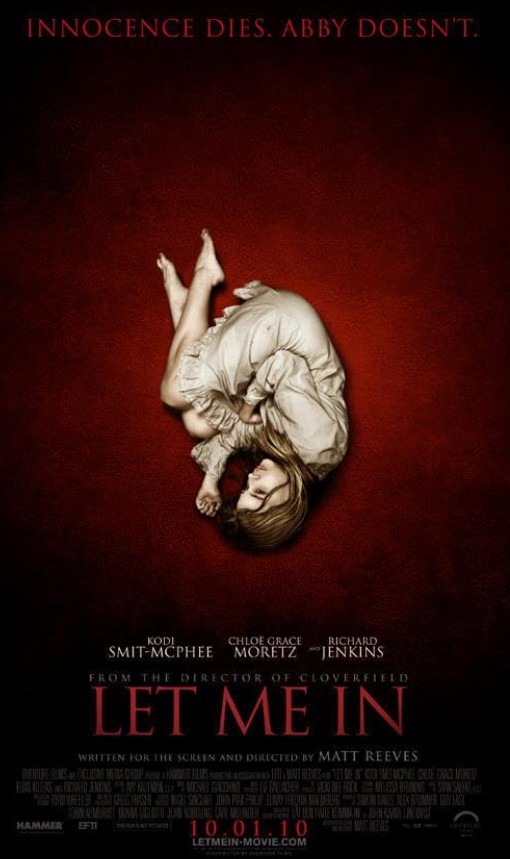
Let Me In(2010) poster created by Overture Films, Exclusive Media Group, Hammer Films, EFTI, and Relativity Media
Things I liked about the film:
The mise-en-scène: As I explained in my review of 1955’s The End of the Affair, mise-en- scène is how a film’s scene is presented to the audience. Throughout Let Me In, the way mise-en- scène was utilized presented scenes in visually creative ways. At the very beginning of the movie, a snowy forest was shown during the night. The only source of light comes from two police cars and an ambulance. A long shot slowly becomes a close-up shot, giving the audience a reason to focus on the bright vehicles. Anytime Owen and Abby look through the peephole of their apartment door, the shot is shown in a fish-eye lens. This film-making technique puts the audience in Abby and Owen’s perspective, allowing them to see what the children are seeing. It also emphasizes how, despite their differences, Owen and Abby have shared experiences like seeing who is at their door.
How music was incorporated: Music can be an effective component of film-making. It can elevate a scene’s emotions or set a scene’s tone. In Let Me In’s opening scene I just referenced in this review, a rhythmic drumbeat is one of the first sounds the audience can hear. That specific sound creates a sense of urgency, signifying danger is on the horizon. When Abby moves into Owen’s apartment building, gentle angelic-sounding singing can be heard. This is symbolic of how Owen sees Abby; an angel who will provide a light in his darkness. The two examples from Let Me In I discussed add additional context to the scenes themselves. How the film’s creative team incorporated music into the 2010 picture shows the understanding they had for how music can work in their project’s favor.
Disguising Abby’s vampire identity: Before watching Let Me In, I knew it was a vampire movie. But I was pleasantly surprised by how Abby’s vampire identity was disguised. Most of Abby and Owen’s interactions take place at night, at first seeming like just a coincidence. When Owen notices Abby isn’t wearing shoes, she states how she doesn’t feel cold. Abby even tells Owen she’s stronger than he thinks. These verbal and visual clues creatively signified how Abby was a vampire. But because of the clues’ subtlety, it leaves the audience guessing why, on the surface, Abby seems so strange. New twists on vampire cliches, like vampires avoiding sunlight, made Let Me In more unique from other vampire films.
The audio: When I reviewed Fist of Fury, I talked about the film’s audio being one of the major flaws. I had to turn up my television’s volume in order to hear what the characters were saying. Let Me In shares this same issue. Once again, I had to raise my television’s volume just to hear the dialogue, as the characters’ speech was quiet. As I suggested in my review of the Hallmark Hall of Fame movie, Face to Face, Let Me In’s creative team should have used ADR (automated dialog replacement).
The bullying subplot: One of the subplots in Let Me In involves Owen dealing with bullies. This subplot gave Owen a conflict to resolve, with the conflict eventually reaching a resolution. But because the script prioritized Abby and Owen’s friendship, the bullying subplot wasn’t consistently focused on. In fact, Owen stands up to his bullies about an hour into this hour and fifty-six minute movie. The inconsistency of the bullying subplot also drew that story out longer than necessary.
Underutilized religious undertones: In a scene taking place at a hospital, President Ronald Reagan is delivering a speech on television. During the speech, he talks about evil being present in the world and how people are joined together by Scripture. Owen’s mother says prayers during mealtime and features religious relics in her apartment. These are some examples of the religious undertones in Let Me In. With the movie set in early 1983, I thought the “Satanic Panic” was going to play a large role in this story, especially with Abby being a vampire. However, the religious undertones present in the script were underutilized, not providing any commentary or interesting perspective. In fact, it felt like this part of the film was there just for the sake of being there.
Vampires are no stranger to 18 Cinema Lane. Out of the vampire movies I’ve seen (and reviewed), these projects have shown that this type of story can be as creative as film-makers want it to be. 2010’s Let Me In is an interesting and creative vampire film! Abby’s vampire identity was disguised in very clever ways, even putting new twists on vampire cliches. How mise-en-scène and music were incorporated into the movie showcases the creative team’s more unique approach to a familiar type of story. While Let Me In has its merits, it also has its flaws. Religious undertones that could have provided commentary or an interesting perspective to the script were underutilized instead. Poor audio and an overshadowed subplot also didn’t help. But the 2010 project does stand out from other vampire titles. If you don’t mind a slow-burn story that primarily focuses on the power of friendship, then I’d say give Let Me In a chance.
Overall score: 7 out of 10
Have you seen Let Me In? What kinds of movies do you like to watch around Halloween? Let me know in the comment section!
Hi everyone! Similar to restaurants, movie theaters, and other food establishments, it’s closing time for The Food & Film Blogathon. This event was a success, as the turn-out this year was larger ! To everyone who participated in The Food & Film Blogathon, thank you for your contribution. Whether it was a movie review or an editorial, the union between film and food was showcased in many different ways. I will host a new blogathon in 2026! But the event’s details won’t be revealed until sometime next February. Until then, you can check out my upcoming reviews, editorials, and lists!
The Food & Film Blogathon banner created by me, Sally Silverscreen. Original picture found on IMDB.
When one of my readers recommends a movie to me, I add that title to my film recommendation board on Pinterest and then write about it in one of my reviews. A movie that has been featured on the board for a while is 1942’s To Be or Not to Be. This presentation was suggested by Patricia (from Caftan Woman), Vincent (from Carole & Co.) and Allen Rizzi. Originally, I was going to select it for an upcoming Blog Follower Dedication Review. But when I learned about Hoofers and Honeys’ Carole Lombard Blogathon, I found a good reason to write about the movie sooner! While I received recommendations of Carole’s films, I’ve only reviewed two of those which she received a starring role. The first picture, In Name Only, was fine and likable. Meanwhile, Twentieth Century, is one of the worst movies I’ve ever seen. Now that To Be or Not to Be is the third film of Carole’s I’m discussing on 18 Cinema Lane, it’ll be interesting to see where I rank this title compared to Twentieth Century and In Name Only.
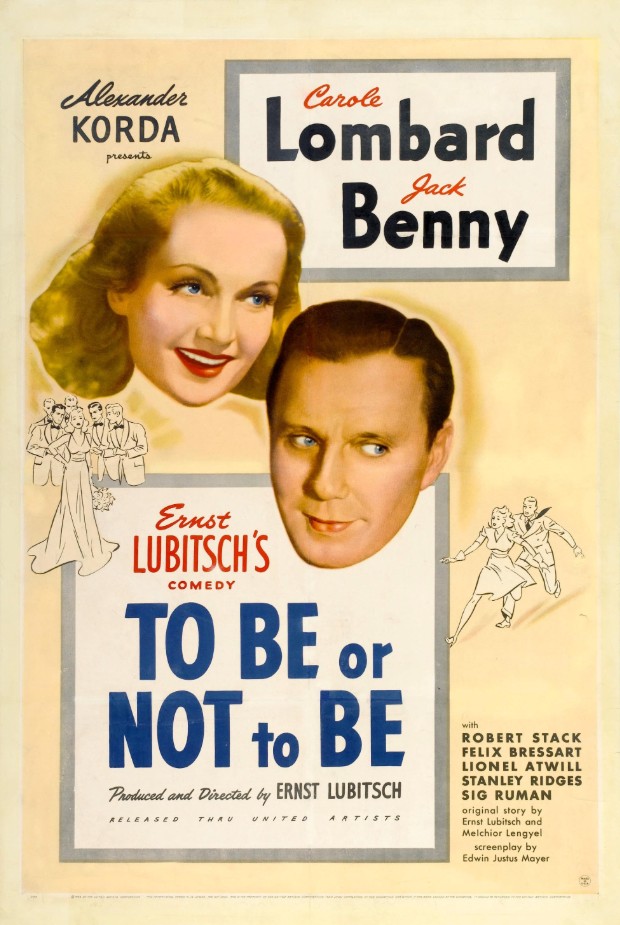
To Be or Not to Be(1942) poster created by Romaine Film Corporation and United Artists
Things I liked about the film:
The on-screen chemistry of Carole Lombard and Robert Stack: In To Be or Not to Be, Carole Lombard portrays a Polish actress named Maria Tura. Toward the beginning of the movie, Maria develops an attraction for a Lieutenant named Stanislav Sobinski. Portrayed by Robert Stack, Stanislav is enthusiastic to meet Maria, especially since he’s never met an actress before. Though they shared very few scenes together, the on-screen chemistry between Carole and Robert was pleasant! The scene where Stanislav and Maria first meet is a perfect example, as their interaction felt so realistic. During the conversation, Maria confidently talks about her career, carrying an easy-going personality. But when Stanislav asks her about a farm she brought up in an interview, she is caught off guard, but uses her acting skills to adapt to what Stanislav told her. Meanwhile, Stanislav is so happy to see Maria. A genuinely bright smile is displayed on his face and his eyes light up. Because of the strength of Carole’s and Robert’s acting abilities, they sold the idea of their characters sharing a mutual relationship.
Clever writing: While good writing receives praise and accolades, clever writing can, sometimes, become underappreciated. This is why I take the time to address when a movie’s script contains clever writing. That was certainly the case for To Be or Not to Be, as I was impressed with some of the writing in the film. A great example can be heard during a conversation between Maria and her husband, Joseph. She accuses him of seeking opportunities to steal attention away from her. Maria even claims, “if we should ever have a baby, I’m not so sure I’d be the mother”. Joseph reassuringly tells his wife, “I’m satisfied to be the father”. The aforementioned conversation could have been straightforward, which would have made it sound typical. But the screenwriting, as well as Jack Benny’s delivery, allowed scenes like this one to be memorable!
How war was incorporated in the film: Some of the opening shots in To Be or Not to Be focus on shops in Warsaw, Poland, specifically the names of those who own these shops. When, later in the movie, war breaks out in Poland, those same shops are burned down, torn to shreds, or collapsed. The names on those shops are also destroyed. These shots are a good representation of how war ruins not just buildings, but livelihoods, daily routines, and human connections. One of the actors who performs alongside Maria and Joseph is Greenberg. When he first observes the destruction in his neighborhood, he quotes Shylock’s monologue from the play, The Merchant Venice. This quote spoken against the backdrop of Poland during World War II changes the context of the quote itself, making it seem relevant to the story of To Be or Not to Be. Through visuals and the script, the film’s creative team addressed the seriousness of war and its impact on anyone of any profession.
A dialogue heavy story: Dialogue is an important component of any movie. It helps the audience learn more about the characters, discover potential plot twists, and follow along with the story. But in the case of To Be or Not to Be, the script was very dialogue heavy. There were long stretches of time where characters shared conversations with each other. This is the result of how much the creative team relied on telling instead of showing. If one isn’t actively paying attention to the story, they may miss important details. Had play performances or more action-focused scenes been evenly sprinkled throughout To Be or Not to Be, it would have created a balance between what the characters say and what the characters do.
The run-time: IMDB lists To Be or Not to Be’s run-time as an hour and thirty-nine minutes. This run-time, to me, seemed much longer. The long stretches of time of characters’ conversations I already mentioned made the film feel drawn-out. There are also parts of the story that don’t lead anywhere, such as Maria’s concerns about Joseph trying to steal attention away from her. If the script had been trimmed down, the run-time of To Be or Not to Be could have been an hour and thirty minutes or less.
Inconsistent sense of urgency: As I discussed earlier in this review, To Be or Not to Be takes place in Poland during World War II. The characters are directly impacted by this global conflict, even going undercover to stop the Nazis. These parts of the story create a sense of urgency. But this sense of urgency isn’t consistent within the 1942 presentation. That flaw was caused by the dialogue-heavy scenes I referenced in my review. These scenes’ length of time takes away from moments where immediate situations can be resolved. The imminent threat of war is also placed to the side because of the dialogue-heavy scenes. Having a more consistent sense of urgency would have strengthened the suspense and intrigue in To Be or Not to Be.
Theater seats image created by weatherbox at freeimages.com. “FreeImages.com/weatherbox.”
My overall impression:
Last year, I reviewed For Me and My Gal, a film I ended up liking. One of the reasons why I gave that movie a good review is because of how World War I was incorporated into the script. With a steady progression and subtle changes, realism was woven into a musical like For Me and My Gal. I’d actually prefer that movieover To Be or Not to Be. Though To Be or Not to Be is a fine, interesting film, the run-time felt longer than an hour and thirty-nine minutes. The story’s sense of urgency was inconsistent and the script was too dialogue-heavy. However, there are merits within the 1942 title. I wish Carole and Robert shared more screen-time together because their on-screen chemistry was pleasant. How war was incorporated in the film allowed the creative team to show the seriousness of war and its impact on anyone of any profession. I also liked the movie’s clever writing. Compared to the other films of Carole’s I’ve written about, Twentieth Century and In Name Only, To Be or Not to Be is somewhere in the middle. With over seventy movies on her IMDB filmography, I have plenty more projects of Carole’s to check out!
Overall score: 7 out of 10
Have you seen To Be or Not to Be? Would you like to see me review more of Carole Lombard’s movies? Let me know in the comment section!
Whenever I participate or host a blogathon, I try to approach the selected topic from a unique perspective. For The Food & Film Blogathon, I wanted to observe the relationship between film and food through cinematic promotion. More often than not, food has been an advertiser when encouraging people to check out a particular title. Sometimes, creativity and ingenuity have shined through these promotions, leaving a memorable impression and even helping a film succeed at the box office. But as I was researching this promotional connection of food and film, I noticed how some food-related movie “gimmicks” could be improved. These “gimmicks” are not entirely weak or unsuccessful. In fact, some of them have held a special place in the hearts of customers. However, as I’ll explain in this editorial, these food-related movie “gimmicks” could be more productive and sustainable. Before I continue, I want to point out how my editorial is intended to be constructive, not mean-spirited or negative.
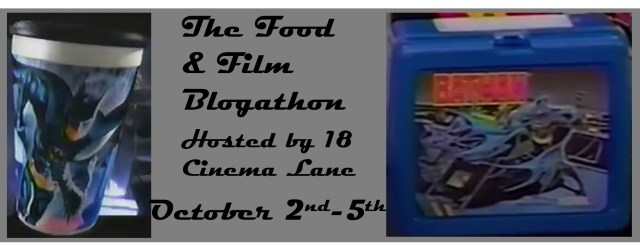
The Food & Film Blogathon banner created by me, Sally Silverscreen. Original pictures found in the video, “Fast Food Movie Tie-Ins and the History of the Summer Blockbuster!”, from the Youtube channel, PNP Videocast.
Popcorn Buckets and Reuseable Cups
When patrons enter the halls of their local movie theater, they are constantly bombarded with promotions for not just currently playing films, but upcoming films as well. From trailers on the big screen to posters and standees in the lobby, the cinema becomes an arena as studios battle for the attention of potential audience members. Two other forms of in-theater marketing are popcorn buckets and reuseable cups. Creativity and clever presentations build upon the basic design of a cup or bucket in an attempt to capture the spirit of the movie it’s promoting. But after movie-goers leave the theater, there are few opportunities to reuse the popcorn bucket. This increases the chances of popcorn buckets either clogging up landfills, collecting dust at thrift stores, or even getting buried in the desert like the Atari game, E.T. the Extra-Terrestrial. It also doesn’t help how popcorn buckets can, sometimes, be expensive. One infamous example is The Fantastic Four: First Steps’ Galactus popcorn bucket, which received a retail price of $80. Meanwhile, reuseable cups have a slightly longer shelf life than popcorn buckets. Though they can be expensive as well. I’ve seen a 24 oz. cup promoting the movie, Smurfs, listed for $29.99.
How to Fix It
Picture it: AMC theaters, a handful of days throughout the year (yes, that reference of The Golden Girls was intentional). If movie-goers bring their popcorn buckets and/or reuseable cups to their local theater’s concession stand, they can save a certain percentage off their concession purchases. This percentage could be low enough for theaters to not lose money, but enough for movie-goers to save some money. If these sale days were enforced, it would be a win-win for both movie-goers and theaters. Patrons are given a reason to consider purchasing a popcorn bucket and/or reuseable cup, seeing it as more of an investment and less as a collector’s item or “gimmick”. They also are encouraged to seek out the concession stand, as they would have a legitimate reason to save money during their movie-going experience. Because of concession stand sale days, theaters can sell more popcorn buckets and reuseable cups in the long run, which would increase their revenue. The aforementioned sale days would welcome repeat customers as well, adding even more revenue to the theater’s financial intake.
On the left is the infamous Galactus popcorn bucket, which was sold for $80. On the right is the Smurfs cup I referenced in this editorial, which received a retail price of $29.99.
Specialty Food Items
For the sake of this editorial, specialty food items directly connect to the movie they’re promoting. This can range from products bearing a character’s likeness to meals sharing a name that is significant to the film. An example that has received praise on the internet is The Batman Calzony from Little Caesars. In 2022, the pizza chain created a pizza shaped like Batman’s logo. The culinary creation was introduced leading up to the release of the movie, The Batman. Though this promotion existed for a short period of time, it left a positive impression. The video, ‘A Look at Bizarre Movie Tie-In Restaurant Foods’ from the Youtube channel, Seeker of The Lost, features comments in its comment section from viewers who either remember and/or love The Batman Calzony. One commenter even demanded the pizza be brought back.
How to Fix It
Like the aforementioned commenter from Seeker of The Lost’s video, I, too, think The Batman Calzony should be brought back. However, the context of the comeback can be either of three ways. Batman has had an established place in the pop cultural landscape for over fifty years. Whether it’s the comics or the films, there is sure to be a milestone anniversary Little Caesars could capitalize on, giving them a legitimate reason to bring back The Batman Calzony. I’ve heard a sequel to The Batman is in the works. That movie’s premiere could see The Batman Calzony’s return. If Little Caesars wanted to create a Halloween tradition, they could consider bringing back the pizza for Halloween. Not only are bats a popular Halloween motif, Batman has received his own Halloween costume over the years. Bringing back The Batman Calzony would give new customers a second chance to try the pizza. It would also make those who love the pizza repeat customers. Meanwhile, Little Caesars has an opportunity to create additional revenue, especially if The Batman Calzony was brought back annually or even biannually. Associating the pizza as part of a tradition would help Little Caesars build positive promotion and recognition of their brand.
Because of The Batman Calzony‘s unique shape (as well as its name), it is directly connected to the film it’s promoting, The Batman.
Limited-Edition Food Items
Limited-edition food items differ from specialty food items, as they don’t directly correlate with the movie they’re advertising. This allows the limited-edition food items to be sold in various contexts. 1998 saw the release of Disney Pixar’s A Bug’s Life. As part of the film’s promotion, McDonald’s found a reason to sell Apple Cinnamon McNuggets dipping sauce. But when the dipping sauce is removed from A Bug’s Life’s advertising equation, it can be sold in other promotions. A decade prior, in 1987, the Apple Cinnamon dipping sauce was incorporated into McDonald’s Holiday McNuggets seasonal campaign. Since these two promotions, though, McDonald’s has not brought this dipping sauce back.
How to Fix It
Based on my research for this editorial, McDonald’s hasn’t created any food items related to the Fall/Autumn season. While the Baked Apple Pie is a popular product on McDonald’s menu, it isn’t used to capitalize on Fall/Autumn. With apples and cinnamon typically associated with this time of year, McDonald’s could bring their Apple Cinnamon McNuggets dipping sauce back through a seasonal promotion. They could also create other Fall/Autumn themed food items to compliment the Apple Cinnamon dipping sauce’s return, such as an Apple Cinnamon milkshake. Creating a seasonal campaign around the re-release of their Apple Cinnamon dipping sauce would give McDonald’s good marketing and financial opportunities to take advantage of the Fall/Autumn season. It would also be a win for their customers, as those who love the dipping sauce receive a chance to revisit it and new customers are introduced to the dipping sauce.
Based on my research, a commerical from the Youtube channel, Media Closet, is one of the few references I could find of the Apple Cinnamon McNuggets dipping sauce’s inclusion in A Bug’s Life‘s McDonald’s promotion. Original picture found in the video, “1990s – McDonald’s A Bug’s Life Promo – Holiday Commercial”, from the Youtube channel, Media Closet.
Missing the Finer Details
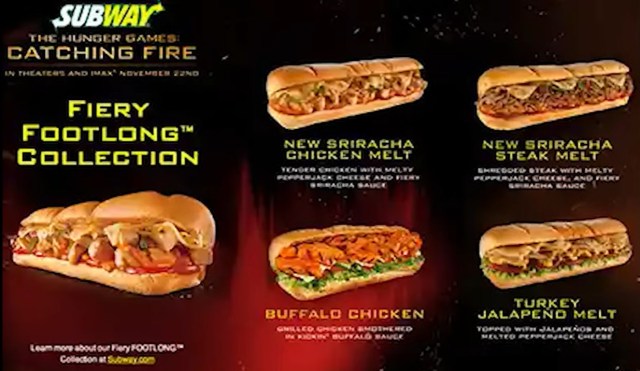
Advertising plays a big role in the business of making movies. But movie marketing campaigns are not created equally. Some of them miss the finer details of the film they’re promoting. A perfect example is when Subway debuted their Fiery Footlong Collection to capitalize on the premiere of 2013’s The Hunger Games: Catching Fire. Through this collection, Subway introduced two new sandwiches; Sriracha Chicken Melt and Sriracha Steak Melt. The other two sandwiches, Buffalo Chicken and Turkey Jalapeno Melt, had been sold prior to the collection. Though Subway’s intention was to focus on the film’s theme of fire, the overall promotion came across as out of touch. This is because The Hunger Games: Catching Fire addresses topics like “inequality” and “food shortages”.
How to Fix It
The example I presented of Subway’s marketing misfire (cue the comedic drum sound) is not the first (or last) time a film’s marketing campaign missed finer, important details of the film itself. But blunders like this can be prevented. Working as a communicative bridge between a movie’s creative team and a marketing firm should be an official liaison. First, the liaison would talk with a movie’s creative team about the important elements of their project they’d want to see reflected in its promotional campaign, like certain themes within the script. Then, the liaison would take these notes to a marketing firm and work with them to weave the creative team’s important elements into the promotional campaign. If a liaison connected a movie’s creative team and a marketing firm, everyone involved in a film’s marketing campaign would be on the same page. More cinematic promotions would possess a deeper understanding for the promoted movies.
As I said in this editorial, Subway focused on the theme of fire for their promotion of The Hunger Games: Catching Fire. Hence the reason why all of the sub sandwiches have spicier flavors. Original picture found in the video, “A Look at Bizarre Movie Tie-In Restaurant Foods”, from the Youtube channel, Seeker of The Lost.
“Gimmicks” Becoming “Lost Media”
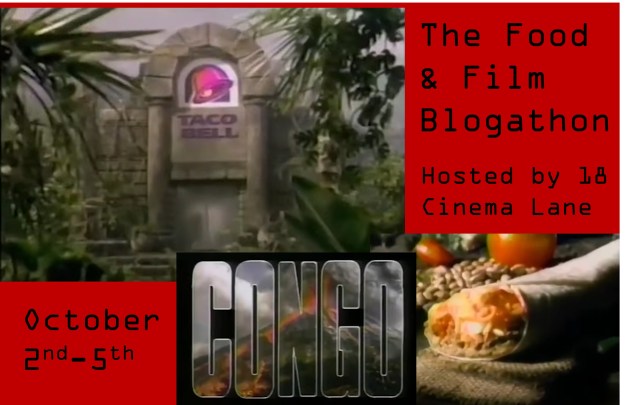
I once heard someone claim that food was a “temporary art form” and “old franchise food” was, over time, “lost to the ages”. Reflecting on what that person said, as well as the subject of this editorial, it seems like food associated with film promotion is its own form of “lost media”. Movie “gimmicks”, specifically those that are food-related, exist for an extremely short period of time. Once a movie has left theaters, that respective “gimmick” is gone. When it comes to food-related movie “gimmicks” in particular, only pictures, videos, and even memories are left. Some may even fade into obscurity. While there are a few that have been brought back on the meal, like Taco Bell’s Volcano Burrito (which later turned into the Volcano Double Beef Burrito), this has been the exception to the rule.
How to Fix It
In the comments section of Seeker of The Lost’s video, ‘A Look at Bizarre Movie Tie-In Restaurant Foods’, one person said it’d be sweet to have the recipes to the video’s featured foods collected in a cookbook. I have to agree with that commenter, especially since it would be a good way to restore and preserve these food-related movie “gimmicks”! Throughout the cookbook, meals associated with film promotion would have recipes chronicled in order of their respective movie’s release year. The cookbook can also feature interviews, perspectives, and tidbits of information from either those on a film’s creative team, a marketing firm that worked on a movie’s promotional campaign, or from a restaurant/food company or movie theater. Fans of any of the selected “gimmicks” would gain an opportunity to bring the food items back to life. Those who didn’t get to try a “gimmick” the first time around would receive a second chance to try these foods. The cookbook would also be a unique addition to any movie or food enthusiasts’ collection.
The Food & Film Blogathon banner created by me, Sally Silverscreen. Original pictures found in the video, “A Look at Bizarre Movie Tie-In Restaurant Foods”, from the Youtube channel, Seeker of The Lost.
If you want a movie to succeed, you have to promote it to your potential audience. While there are many ways to do this, food is one of the most tried-and-true of these advertising tactics. Because each movie is unique, food-related movie “gimmicks” are unique as well. As I mentioned in my editorial’s introduction, creativity and ingenuity have shined through these promotions. Food-related cinematic marketing is not perfect though. Mishaps have taken place, better decisions could have been made, and finer details were missed. With the ideas and suggestions featured in this editorial, food-related movie “gimmicks” can, hopefully, become more sustainable and productive. Reflecting on everything I’ve said, I’m curious to see how food-related film promotion evolves over time. It would also be interesting to see how marketing trends have impacted food-related movie “gimmicks” through the years.
Videos — “A Look at Bizarre Movie Tie-In Restaurant Foods” from Seeker of The Lost and “1990s – McDonald’s A Bug’s Life Promo – Holiday Commercial” from Media Closet
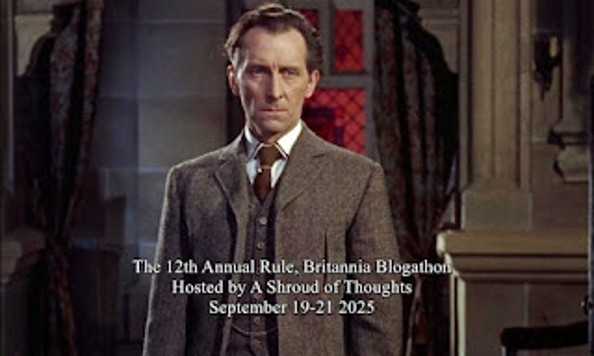
2025 is my fourth year participating in the Rule, Britannia Blogathon. Two of my previously chosen films, Nicholas Nickleby and Kingdom of Heaven, were released in the 2000s. Meanwhile, Tommy premiered in 1975. For this year’s event, I selected a film that is much older than the ones I mentioned. That movie is 1949’s Kind Hearts and Coronets! I was recommended the film by Eric Binford from Diary of a Movie Maniac. Reflecting on my blogathon participation this year, so far, I have made a stronger effort to select films that were recommendations from my readers. Most of the recommended titles I selected for these blogging events were ok or fine. The only exception was She Wore a Yellow Ribbon, which I found disappointing. How will Kind Hearts and Coronets compare with the other titles? Keep reading my review to find out!
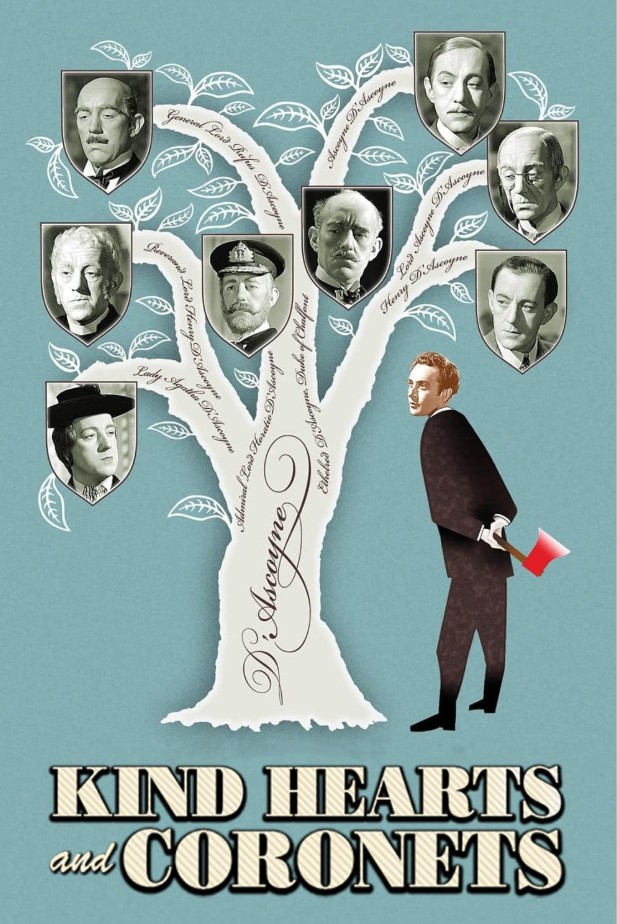
Kind Hearts and Coronetsposter created by Ealing Studios, Michael Balcon Productions, General Film Distributors (GFD), and Eagle-Lion Films
Things I liked about the film:
The acting: Dennis Price portrays Louis in Kind Hearts and Coronets. Throughout the story, Louis consistently carries a calm, collected persona. Even a prison warden points out how calm Louis is before his execution. Along with the aforementioned persona, Louis possesses a certain charm that allows his true intentions to be undetected. These qualities fool the other characters into welcoming him into their lives and giving him exactly what he wants. The strength of Dennis’ acting abilities effectively showed how Louis could fake it until he made it. One of the characters fooled by Louis was Edith. Despite becoming a widow, she never let grief consume her. Instead, Edith had a gentle persona and was kind to everyone. During a conversation she shares with Louis, she sympathizes with his estrangement from his family. The tone in her voice indicates how hurt she is to learn this about Louis’ life. Even the look on her face shows sadness and concern. Similar to Dennis’ performance, Valerie Hobson (the actress who portrayed Edith) presented a consistent portrayal of Edith. However, the acting overall was well done!
The dialogue: When the dialogue in a script is good, it can make conversations between characters sound natural. But when the dialogue is really good, it can leave a memorable impression on the audience. In Kind Hearts and Coronets, there was some dialogue that I thought was well-written! One example is when Edith learns how Louis and his mother were estranged from the D’Ascoyne family. Disgusted to discover Louis’ rejection, Edith says “they think too much of the rights of the nobility and too little of its duties”. Through that quote, she eloquently stated how family connections should have been a top priority. In another scene, Louis is giving his friend, Sibella, compliments. He tells her she has “a face that a man could see in his dreams for the whole of his life”. During this conversation, Louis could have simply said Sibella had a beautiful or pretty face. The creative team’s effort to provide some of the dialogue with quality, however, made Louis’ compliment sound like genuine thought was put into it.
Historical accuracy: Kind Hearts and Coronets takes place in England during the Edwardian era. This means the film’s creative team needed to adopt attention to detail in order to make their production look as historically accurate as possible. Through the set and costume design, that goal was achieved, making the movie feel immersive! The women’s wardrobe serves as one example. Sometimes, Edith and Sibella wear hats when out in public. These hats are larger in size and boast intricate designs. Using materials like flowers, ribbon, and even lace, the hats symbolize the wealth Sibella and Edith possess. They also perfectly represent the fashion in the world of Kind Hearts and Coronets.
Lack of suspense and intrigue: According to IMDB, Kind Hearts and Coronets is about “a distant poor relative of the Duke D’Ascoyne plots to inherit the title by murdering the eight other heirs who stand ahead of him in the line of succession”. Keeping this synopsis in mind, I expected a story where Louis’ scheme provided suspense and intrigue came from how Louis would face accountability for his actions. But as I watched the 1949 movie, I found the story lacking these elements. What the script focused on instead was the “slice of life”, mundane parts of Louis’ life. In fact, so much emphasis was placed on this aspect of the story, potential suspense and intrigue were an afterthought.
Little emphasis on the story’s moral: In Kind Hearts and Coronets, Edith quotes Lord Tennyson by stating “Kind hearts are more than coronets, and simple faith than Norman blood?” Based on that quote, I thought the moral of the film would be if Louis had just chosen kindness, maybe he could have enjoyed a duke title instead of facing repercussions for his choices. Sadly, this assumed moral was barely referenced throughout the story. Such little focus was placed on the moral of practicing kindness, I don’t even know what the moral of this story was supposed to be. Looking back on Kind Hearts and Coronets, I’m not entirely sure what this movie was trying to say.
The cliffhanger ending: For this part of my review, I will spoil Kind Hearts and Coronets. If you haven’t seen this movie and are planning on watching it, skip ahead to the part of my review titled “My overall impression”.
Louis is charged for the murder of Sibella’s husband, Lionel. Before his scheduled execution, Louis is told Lionel actually committed suicide, leaving behind a note. This discovery leads Louis to be released from prison. Upon leaving the prison, a writer approaches Louis with an offer to publish his memoir. This is when Louis realizes in horror he left his self-written life story, including his murder confessions, back in his jail cell. Then the movie ends. Louis’ realization was suspenseful, providing intrigue for who will discover Louis’ story. This suspense and intrigue could have been overarching elements throughout the movie. Therefore, I found the cliffhanger ending frustrating.
As a movie blogger, I have reviewed films I tried to like, only to be met with disappointment. Sadly, Kind Hearts and Coronets is one of those films. IMDB classifies the 1949 movie as a “comedy”. But I didn’t laugh at all while watching it. In fact, I almost fell asleep as I watched Kind Hearts and Coronets. I was let down by the story’s lack of intrigue and suspense. What doesn’t help either is how little focus was placed on the moral to the point where I didn’t know what the moral was supposed to be. While I won’t spoil the ending, I will say it left me frustrated. There were strengths within Kind Hearts and Coronets, however. The acting overall was well-done, some of the dialogue was well-written, and I liked the film’s historical accuracy. When the script is weak, though, there’s only so much these strengths can do to save the film.
Overall score: 5.2 out of 10
Have you seen Kind Hearts and Coronets? What productions from the United Kingdom would like to check out? Let me know in the comment section!
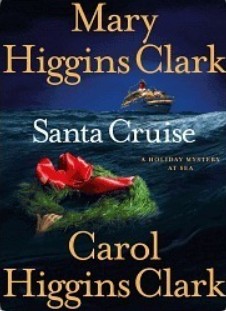
When I signed up for Midnite Drive-In’s Hit The Road Blogathon, one of the basic rules was to choose “a movie, TV show or book” that had something to do with travel. Since I figured I’d be one of the few participants selecting a book for the event, I found an opportunity to write a book review! On 18 Cinema Lane, I occasionally talk about books in an effort to bring a sense of variety to my blog’s content. My last book review was published last September, when I wrote about Murder, She Wrote: Dying to Retire by Jessica Fletcher and Donald Bain. This is ironic, as that book revolved around Jessica traveling to Florida.For theHit The Road Blogathon, I selected another mystery story; Santa Cruise: A Holiday Mystery at Sea by Mary Higgins Clark and Carol Higgins Clark! Years ago, I saw this book’s film adaptation, 2013’s The Mystery Cruise. Though I was not a fan of the film, I still wanted to read its source material, as I had heard of the book before seeing the movie. Is this a case where the book is better than the film? Keep reading my review to solve this mystery!
If you’re going to write a story that involves travel, the journey or destination needs to sound appealing. Whether the travels of characters are exciting or the characters arrive somewhere intriguing, the reader may stay invested in what is happening in the story. In Santa Cruise: A Holiday Mystery at Sea, the protagonist, Alvirah, won an all-expenses paid cruise through a charity auction. She, along with her husband, Willy, and their friends embark on an oceanic adventure where there is never a dull moment. Mary and Carol worked well together to create a setting that felt realistic. Descriptive imagery and attention to detail worked in the favor of the story’s world-building. One example is when rooms on the ship, Royal Mermaid, are described. While observing Alvirah and Willy’s room, one of their friends, Nora, states “The closet is practically a room unto itself”. This statement alone provides context for the size of the space. It also addresses the luxurious nature of not just the room itself, but the ship as a whole.
Mystery stories, sometimes, include a group of characters. If these characters are working together to solve a mystery, it’s important for them to maintain a sense of camaraderie. This way, genuineness can be felt as the characters come together to reach a common goal. Throughout Santa Cruise: A Holiday Mystery at Sea, solving mysteries was a team effort among Alvirah, Willy, and their friends, the Reillys. It helped how these characters possessed their own set of skills and life experiences, allowing them to bring something unique to the table. It also helps how they knew each other before the events of the story. Because of how well-written the dialogue was, readers can pick up on how Willy, Alvirah, and the Reillys got along. Toward the beginning of the book, Alvirah is encouraging her friends, Regan and Jack, to join her and Willy on the cruise. Bringing up the couple’s already known vacation plans, Alvirah says, “I just heard from Jack’s own lips that he’s on vacation for two weeks”. She addresses this in an effort to give them a once-in-a-lifetime experience, keeping the best interests of her friends in mind. Because she recognizes Alvirah’s good intentions, Regan replies to Jack, “we’ve never been on a cruise together. I think it would be fun”.
Two of the villains in Santa Cruise: A Holiday Mystery at Sea are Bull’s-Eye and Highbridge. These criminals are on the run to avoid being sentenced for their crimes. There were times while reading this book where I had difficulty telling these characters apart. That’s because their personalities were not distinct enough. Another flaw of Santa Cruise: A Holiday Mystery at Sea was how some mysteries were solved before the reader could figure it out for themselves. During the titular Santa Cruise, two Santa suits go missing, becoming one of the story’s overarching mysteries. But shortly after this mystery is introduced, the “whodunit” is already revealed. This felt reminiscent of an episode of Columbo, where the audience is forced to observe the protagonist solving the mystery themselves instead of interacting with the story by figuring out the mystery alongside the characters.
Santa Cruise: A Holiday Mystery at Sea is, in my opinion, a fine book that is interesting and entertaining enough. Carol and Mary use attention to detail and descriptive imagery in their favor to build a literary world that feels realistic. They also utilize dialogue to create strong camaraderie between the protagonists and their friends. However, I wish the story’s villains were given more distinct personalities, as it could have allowed them to stand out more. Having more interactive mysteries for the readers would have helped as well. There were parts of the story that were, sometimes, repetitive. Examples include referencing the number fifteen and the same events being brought up over and over again. Despite these flaws, the book does have a steady to faster pace, which makes Santa Cruise: A Holiday Mystery at Sea a quicker read.
Disclaimer: Santa Cruise: A Holiday Mystery at Sea is a mystery story that occasionally features violence and characters receiving injuries. There’s also brief references to grief.
Are you looking for a fun blogathon that combines the subjects of food and film? Join my upcoming blogathon, The Food & Film Blogathon! Taking place from October 2nd to October 5th, there’s still time to join the event! With the connection between food and film providing a broad theme, plenty of topics are available to choose. If you’re interested in participating in The Food & Film Blogathon, click on the link below to learn more about the blogathon.
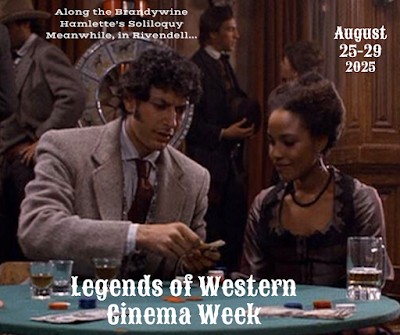
I have been participating in the Legends of Western Cinema Week Blogathon since 2020. Because films from the western genre aren’t covered on 18 Cinema Lane often, this blogathon has given me a reason to seek out titles from the western genre to review. But when the Legends of Western Cinema Week ends, another blogathon begins; the Hit The Road Blogathon. Since I wanted to participate in both events, I decided to review one film for both blogathons. That film is 1949’s She Wore a Yellow Ribbon! The movie perfectly fits the themes of both events, as it is not only considered a “classical western” (according to IMDB), multiple characters travel by horse throughout the story. She Wore a Yellow Ribbon was also recommended to me by Eric Binford from Diary of a Movie Maniac. While this is the fourth movie of John Wayne’s I’ve seen, this is only the third one I’ve reviewed. The other two titles, El Dorado and Allegheny Uprising, were, in my opinion, just ok. How does She Wore a Yellow Ribbon compare to these other films? Keep reading my review to find out!
The acting: Whenever I discuss the acting in a given movie, I will usually talk about a scene that showcases the strength of the acting performances. My favorite example from She Wore a Yellow Ribbon takes place toward the beginning of the film. John Wayne portrays Captain Nathan Brittles, a man who goes on one last mission before he retires. During an evening visit to the local cemetery, Nathan talks to the graves of his wife, Mary, and his daughters, Elizabeth and Jane. While he talks to his deceased family, he consistently has a sad look in his eyes. Yet, the inflection of his voice changes depending on the type of news he has to share. Joanne Dru’s character, Olivia Dandridge, also visits the cemetery to give Nathan some potted flowers. Olivia’s persona is kind and gentle throughout this scene. Her conversation with Nathan perfectly displays the on-screen camaraderie between Joanne Dru and John Wayne. Because of this on-screen camaraderie and how strong John’s and Joanne’s acting performance was, I wish they shared more screen time.
The scenery: Most of She Wore a Yellow Ribbon takes place outdoors, with the movie being filmed in Utah and Arizona (according to IMDB). Looking back on the 1949 picture, I can definitely see why the film’s creative team would want to take advantage of the story’s natural landscape. Large, rustic red rocks impressively stood against a blue sky filled with white clouds. There were greens spots where foliage popped within the rocky terrain. The most memorable presentation of the scenery was during a storm. The bright, blue lightning blinked against the two-toned gray sky and the sand-colored ground provided a bright hue to the space. She Wore a Yellow Ribbon was a pretty looking film because of its scenery!
The dialogue: In She Wore a Yellow Ribbon, Corporal Quayne’s life is spared after being rescued from an attack. Olivia shares with Lieutenant Flint Cohill how happy she is Corporal Quayne survived. Lieutenant Cohill asks her why she cares about Corporal Quayne, especially since she doesn’t know him or is aware if he frequents the Lieutenant’s Bar. Olivia responds to this question by saying just because a man frequents the Lieutenant’s Bar doesn’t automatically make him a gentleman. Lieutenant Cohill then accuses Olivia of caring about Corporal Quayne’s well-being because his survival fits the happy ending she can write home about. This conversation between Olivia and Lieutenant Cohill was thought-provoking, as it addresses motivations for caring about others, as well as how someone’s personal situation can fuel another person’s narrative. That is just one example of the well-written nature of the dialogue!
Limited amount of action: A movie from the western genre, especially one starring John Wayne, carries a set of expectations. One of those expectations is the amount of action within the story. Scenes of battles, duels, and even bar fights will typically be sprinkled through a western genre story to maintain the suspense and intrigue of what’s happening on screen. But in She Wore a Yellow Ribbon, the action was far and few between. The majority of the story consisted of characters either having conversations with one another or riding from place to place. When an action scene does happen, it lasts for a very short period of time. These creative decisions caused She Wore a Yellow Ribbon to lack intrigue and suspense.
Not truly getting to know the characters: So much of She Wore a Yellow Ribbon’s story focuses on Captain Nathan Brittles and his impending retirement. While the audience receives the opportunity to learn more about Captain Brittles and understand his motivations, it comes at the expense of getting to truly know the other characters. One character I felt was overlooked was Top Sergeant Quincannon. He was retiring around the same time as Captain Brittles. But the script never addresses how the story’s patrol mission impacted Top Sergeant Quincannon and his career. Instead, the film prioritizes his enjoyment of drinking alcohol. Because of this emphasis, I only became familiar with Top Sergeant Quincannon instead of truly getting to know him.
The run-time: She Wore a Yellow Ribbon has a run-time of an hour and forty-four minutes. As I watched the movie, however, it felt longer than this stated run-time. Part of this flaw stems from the insertion of scenes just for the sake of satisfying the film’s length. Toward the end of the movie, there is a bar fight involving Top Sergeant Quincannon. This scene lasts about five minutes and, in my opinion, feels out of place. That’s because the scene is intended to be comedic, even though She Wore a Yellow Ribbon is not a comedy or a light-hearted story. The movie’s run-time could have been shorter had the bar fight scene either been omitted or trimmed down.
She Wore a Yellow Ribbon is the third film I’ve reviewed this month where the scenery was a stand-out strength. In the case of the 1949 picture, the natural landscape of Utah and Arizona was presented through long and medium shots, capturing the grand scale of the desert’s rock formations and large expanse of rustic red and sand-colored land. But as I’ve said in past reviews, “the scenery can’t save you”. If a movie contains a weak script, there’s only so much the pretty landscape can do to salvage that script. In my opinion, She Wore a Yellow Ribbon is an underwhelming picture. What I expected to be an action-packed, suspenseful, and even intriguing story turned out to be a drawn-out tale that felt longer than necessary. It also doesn’t help how I wasn’t able to truly get to know the characters, but only become familiar with them. Even though the 1949 film does feature strengths, like the acting and the dialogue, there were times while watching the movie where I almost fell asleep. With a filmography of over one hundred projects, I’ll, hopefully, find a title of John Wayne’s I actually like.
Overall score: 5.2 out of 10
Have you seen She Wore a Yellow Ribbon? What film from John Wayne’s filmography do you like watching? Please tell me in the comment section!
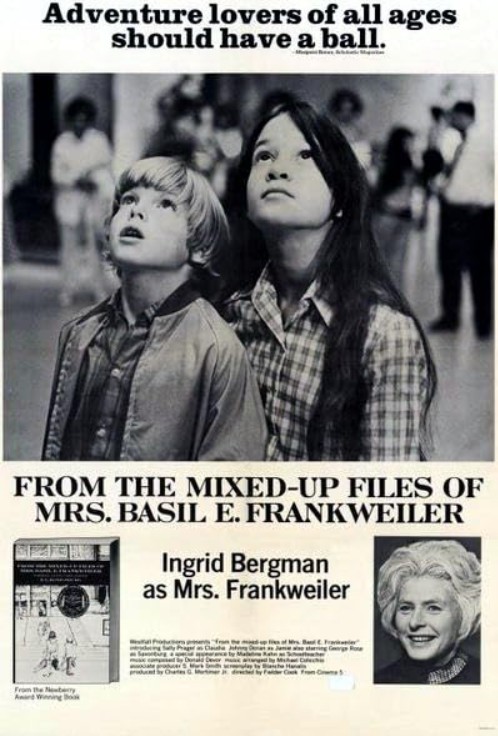
All the way back in 2019, I reviewed the 1995 adaptation of From the Mixed-Up Files of Mrs. Basil E. Frankweiler. After I shared my thoughts on the film, Gill, from Realweegiemidget Reviews, recommended the 1973 adaptation, which is sometimes titled The Hideaways. Whenever Virginie, from The Wonderful World of Cinema, has hosted the Ingrid Bergman Blogathon, I have wanted to check out the 1973 adaptation, due to Ingrid Bergman starring in the film. Now, for the 110 Years of Ingrid Bergman Blogathon, I finally received the opportunity to write about the movie! While I still haven’t read the book, I am familiar with the story because I covered the 1995 adaptation on 18 Cinema Lane. Back in 2019, I said the film was just ok, as one of my biggest criticisms was the underutilization of Lauren Bacall’s acting talents. Will I give similar criticisms to the 1973 adaptation of From the Mixed-Up Files of Mrs. Basil E. Frankweiler? To solve this mystery, keep reading my review!
Sally Prager’s and Johnny Doran’s acting performance: Starring in From the Mixed-Up Files of Mrs. Basil E. Frankweiler as the protagonists, Claudia and Jamie Kincaid, Sally Prager and Johnny Doran carry about 95% of the film. Because of how strong their performances were, they successfully carried the movie by presenting their characters believably! One example takes place toward the beginning of the film. Jamie is telling his sister, Claudia, about a movie he had recently seen. As he talks about the movie, his speech becomes increasingly animated. Even after Claudia kicks him out of her room, Jamie talks even louder, his excitement never faltering. After Jamie and Claudia arrive in New York City, they go to the Metropolitan Museum of Art. When Jamie asks her why she wants to go to the museum, Claudia enthusiastically describes the museum as a castle like the tales of King Arthur. This scene perfectly showcases how Sally effectively portrayed Claudia as precocious; containing enough self-awareness to know exactly what she wants, yet displaying that sense of wonder one would expect from a child her age.
The cinematography: When I reviewed the 1995 adaptation of From the Mixed-Up Files of Mrs. Basil E. Frankweiler, I complimented the film’s cinematography. That adaptation’s creative team made some interesting choices when presenting certain scenes, like using close-ups to present the museum’s artifacts. The 1973 adaptation of From the Mixed-Up Files of Mrs. Basil E. Frankweiler features good cinematography as well! Similar to the 1995 adaptation, some scenes were shown from Claudia and Jamie’s perspective. While hiding on the school bus, Jamie constantly peeks from behind the seat to see if the bus driver has spotted them. A few shots look like they’re from Jamie’s point of view, with the camera peering around the seat to catch a glimpse of the bus driver. When Jamie and Claudia are at the Metropolitan Museum of Art, they look over the railing at the museum’s employees and security guards in the lobby. Once again, the scene is presented from the point of view of the children. The camera peers over the museum’s railing, looking down at the security guards and employees. Shots like the ones I described make the audience feel like they’re with the characters, creating the illusion of immersion.
The dialogue: A pleasant surprise in 1973’s From the Mixed-Up Files of Mrs. Basil E. Frankweiler was the dialogue! Some lines were so well-written, they became a memorable part of the movie. In one scene, as Jamie navigates through the museum, a janitor asks him where he came from. Speaking confidently in a matter-of-fact way, Jamie tells the janitor, “My mother said I came from Heaven”. I not only found this response a clever comeback, it was also a creative way to answer the question. Another scene shows Jamie sharing with Claudia one of the reasons why he ran away with her. While spending a night in the museum, Jamie tells his sister how concerned he was by the thought of her traveling alone, as he believed she would be afraid. Claudia responds to her brother’s belief by saying, “Being self-sufficient doesn’t automatically make a person brave”. This quote showcases an eloquent way of addressing how anyone at any age can be afraid of something.
Angelic statue image created by Marcelo Gerpe at freeimages.com. “FreeImages.com/Marcelo Gerpe.”
What I didn’t like about the film:
Telling instead of showing: In both adaptations of From the Mixed-Up Files of Mrs. Basil E. Frankweiler, Jamie and Claudia go to Mrs. Basil E. Frankweiler’s house, searching for an angel statue’s legitimacy. From what I remember of the 1995 movie, a scene shows Claudia and Jamie looking for answers about the statue by rummaging through Mrs. Basil E. Frankweiler’s mixed-up files. The 1973 version, on the other hand, has Mrs. Basil E. Frankweiler telling the answer of the mystery instead of showing the children putting the mystery’s pieces together. Because the creative team behind the 1973 adaptation chose telling over showing, some of the excitement of seeing the protagonists achieve their goal was taken away.
Less emphasis on the mystery: An overarching part of From the Mixed-Up Files of Mrs. Basil E. Frankweiler’s story is the mystery surrounding an angelic statue. However, this mystery received less emphasis in both the 1973 and 1995 adaptations. Specifically speaking about the 1973 version, the story focused more on Claudia and Jamie’s adventures in New York City. In fact, the angel statue doesn’t make an appearance until 44 minutes in an hour and forty-five-minute film. Like I said in my review of the 1995 version, this creative decision took a lot of intrigue out of the film, causing the story not to be as engaging or interactive.
The underutilization of Ingrid Bergman: During this review’s introduction, I brought up one of my biggest criticisms of 1995’s From the Mixed-Up Files of Mrs. Basil E. Frankweiler; the underutilization of Lauren Bacall’s acting talents. Sadly, I have the same criticism for the 1973 version. Just like the 1995 adaptation, Ingrid Bergman is the top-billed actor in the adaptation from 1973. Yet she doesn’t appear in the story until an hour and fourteen minutes in an hour and forty-five-minute movie. I recognize the 1973 version of From the Mixed-Up Files of Mrs. Basil E. Frankweiler premiered toward the end of Ingrid’s career. I also acknowledge the story prioritizes the adventures of Claudia and Jamie Kincaid. But as I said about Lauren Bacall in my review of the 1995 movie, this underutilization not only does Ingrid’s acting talents a disservice, it also comes across as misleading.
For the 5th Annual Gold Sally Awards, I introduced the Nosferatu vs. Dracula Award. This award is given to two movies that feel like you’re watching the same one. Looking back on my experience watching the 1973 adaptation of From the Mixed-Up Files of Mrs. Basil E. Frankweiler and reflecting on my review of the 1995 adaptation, the Nosferatu vs. Dracula Award will likely be brought back for 2026’s edition of the Gold Sally Awards. The 1973 movie shares a lot of the same strengths and flaws as the 1995 version. These similarities made me feel like I was watching the same film twice. I knew what to expect from the story, due to seeing From the Mixed-Up Files of Mrs. Basil E. Frankweiler from 1995. However, I still wish both adaptations contained stronger differentiations between them. The films I’ve seen of Ingrid Bergman’s from the 1970s have, in my opinion, been underwhelming. While I found A Walk in the Spring Rain a flavorless picture, I think A Matter of Time and now From the Mixed-Up Files of Mrs. Basil E. Frankweiler are just ok.
Overall score: 6 out of 10
Have you seen 1973’s From the Mixed-Up Files of Mrs. Basil E. Frankweiler? Which book adaptation do you wish starred a “classic” film star? Tell me in the comment section!
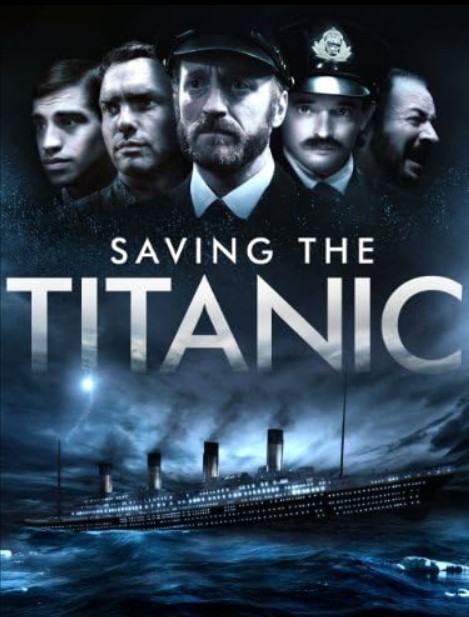
When it comes to the Titanic, the sinking of the “unsinkable” ship and the tragedy that followed are the two most emphasized parts of the watercraft’s history. During the one hundred and thirteen years since the infamous disaster, multiple survivors (either real or fictional) have shared their stories through various forms of media. However, I have observed how the majority of these recollections have been from the perspectives of the passengers. While the passengers’ point of view is important, it seems like the media rarely captures the perspective of Titanic’s employees. This is the reason I chose to review Saving the Titanic for The Titanic In Pop Culture Blogathon. Whenever I participate in a blogathon, I will sometimes review a made-for-TV film. This decision is made because television movies are rarely included in blogging events. I also try to write about a subject that presents a blogathon’s theme in a more unique way. As I already mentioned, Saving the Titanic addresses a point of view that seems less frequent. So, without further delay, let’s begin my review of the 2012 TV production.
Saving the Titanicposter created by Gebrueder Beetz Filmproduktion, Tile Films, and Public Broadcasting Service (PBS)
Things I liked about the film:
How the lower budget was utilized: Made-for-TV movies have historically received lower budgets. According to IMDB, the estimated budget for Saving the Titanic was €1,600,000 (or $1.8 million). Despite the limited funds, the creative team behind the 2012 television production saw this aspect as a challenge instead of a hinderance. The story revolves around the Titanic’s electricians, engineers, and “firemen” (those who feed fire to the ship’s boilers). Because their roles take place below deck, there’s only a few locations where the employees either reside or work. This allowed the movie’s creative team to recycle sets, featuring a handful of locations in multiple scenes. Medium and close-up shots of the employees and the ship’s machinery not only encourage the audience to focus on how the Titanic operated, they also show how frugal the creative team was with the space they were given. Because of the clever ways the budget was utilized in Saving the Titanic, it was easy to forget how low the budget was.
Use of mixed media: If I had to classify Saving the Titanic, I would call it a “docudrama”. While the majority of the film is a dramatization of the events surrounding the Titanic, the movie features mixed media, which is sometimes found in documentaries. From time to time, blueprints of the Titanic would appear onscreen as a voice-over explained the significance of each featured area. Real-life photographs emphasized how actual lives were impacted by every aspect of the ship. Even the Titanic’s first distress call was typed out on screen, giving the audience an idea of what nautical communication looked like in the 1910s. The inclusion of mixed media created an enriching viewing experience. That element highlights how the Titanic is as multi-faceted as the stories surrounding it.
Learning something new: Over the years, I’ve learned a lot about the Titanic. From discovering the ship did, indeed, have a swimming pool to what the last dinner was served in first class, I thought I knew a satisfying amount of information. But by watching Saving the Titanic, I learned even more about the titular ship, partly due to the perspective of the employees. The fourth funnel on the ship was fake. However, this design choice was a blessing in disguise for one of Titanic’s crew members. A greaser named Alfred White refuses to climb to the top of the fourth funnel due to his fear of heights. Later in the movie, he is ordered by Joseph Bell to report everything happening above deck. This order helps Alfred overcome his fear and accomplish his task, as he had to climb up the same funnel he refused to climb before. Had it not been for Alfred’s part of the story, I might have never known only three of Titanic’s funnels were functional.
No explanation for surviving crew members: Toward the beginning of Saving the Titanic, a small group of Titanic’s surviving crew members are at the White Star Line Office. Two of those crew members are featured throughout the film, Alfred White and Frederick Barrett. On screen text revealed the movie was “based on testimonies from surviving crew of RMS Titanic”. So, I was curious about what happened to Frederick and Alfred after they arrived in New York. Unfortunately, the film doesn’t address this information. Instead, the end of the film acknowledged the deceased crew members, such as Joseph Bell. Even though recognizing the crew members who perished is important, I wish the crew members who survived were recognized as well.
Thick accents: When I reviewed Crimes of Fashion: Killer Clutch last year, I pointed out how difficult it was to understand characters who spoke with thick French accents. Saving the Titanic has a similar issue. A voice-over explains how the majority of Titanic’s employees came from Southampton. This means the ship’s crew members spoke to one another with English accents in varying degrees of thickness. For employees with thick accents, I, once again, found it difficult to understand what they were saying. While this wasn’t a consistent issue, it was enough for me to point it out.
Frederick Barrett’s “plot twist”: For this part of my review, I will spoil Saving the Titanic. If you have not seen this movie and are planning on watching it, skip ahead to the part of my review titled “My overall impression”.
Throughout his time on the Titanic, Frederick Barrett is very secretive about his past. When he is asked about his life before boarding the famous ship, his answers are vague. In a tense moment while the Titanic is sinking, Frederick explains to Joseph Bell how his wife cheated on him. He wanted to kill his wife and her lover, but chose to join the Titanic’s crew instead. As I mentioned earlier in this review, Saving the Titanic was “based on testimonies from surviving crew of RMS Titanic”. Therefore, the crew members featured in the film were actual people. The way the aforementioned part of Frederick’s story was presented felt like the movie’s creative team wanted to include a plot twist in a real-life story. Not only was this delivery unnecessary, I, personally, think there were better ways to write facts about Frederick’s life into the script.
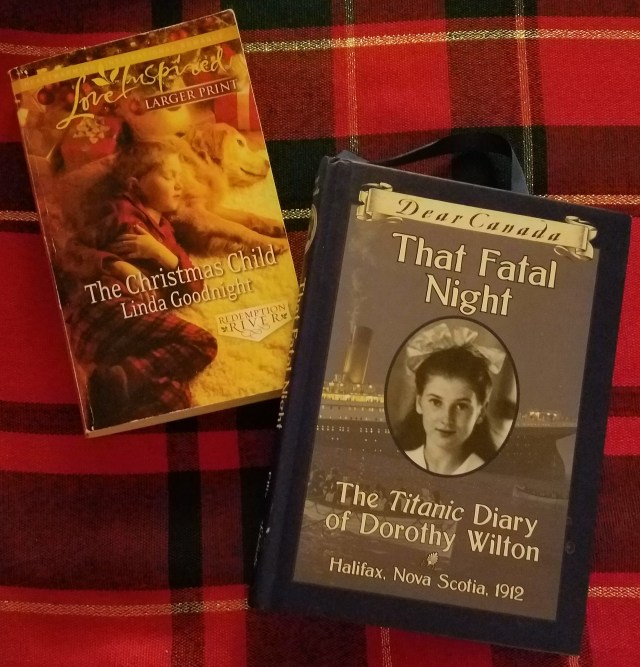
Since I’m reviewing a movie about the Titanic and its history, I thought including a picture of That Fatal Night: The Titanic Diary of Dorothy Wilton was appropriate. Screenshot taken by me, Sally Silverscreen.
My overall impression:
At the beginning of Saving the Titanic, Frederick Barrett is being interviewed about the Titanic disaster. Members of White Star Line tell Frederick they want to reassure the public of White Star Line’s nautical quality by bringing up heroes who helped rescue lives on that infamous April night. But, later in the film, Frederick calls out White Star Line’s members for trying to find heroes to fit the company’s narrative. He also refers to himself as a survivor, not a hero. The story of the Titanic is wrapped in tragedy, fear, and cruel irony. So much emphasis is placed on these aspects of the Titanic’s history, it may be easy to forget there were, indeed, people boarding the ship who were heroes in someone else’s eyes. Whether they are known or not, these people guided someone toward a lifeboat, fetched a life vest for a passenger who might not have received one, or simply tried to ease a frightened crew member’s anxiety. Saving the Titanic brings up some of those names and allows their stories to be told. Like I mentioned in my review’s introduction, the 2012 television presentation addresses a point of view that seems less frequent, which is Titanic’s employees in this case. Though the movie is flawed, I am thankful a production like this exists. It not only teaches viewers about the Titanic from a different perspective, it also shares a side of the story that seems rarely covered in media.
Overall score: 7.1 out of 10
Have you seen Saving the Titanic? Are there aspects of the Titanic’s story you’d like to hear more from? Please tell me in the comment section.














 18 Cinema Lane