When I reviewed the 1982 Hallmark Hall of Fame movie, Witness for the Prosecution, back in July, I stated how I didn’t think I’d ever see the film. This was due to the movie’s lack of DVD or VHS release. But this is not the only Hallmark Hall of Fame production I didn’t think I would ever receive the opportunity to watch. One of these titles is the 1985 film adaptation, The Corsican Brothers. Similar to Witness for the Prosecution, the 1985 title didn’t receive a VHS or DVD release, as far as I know. Also similar to Witness for the Prosecution, I was able to locate the full movie on Youtube! Besides these similarities, both films star Donald Pleasence. In fact, Donald’s involvement in The Corsican Brothers is one of the reasons why I chose to review this film, as I’m participating in The Devilishly Delightful Donald Pleasence Blogathon!
The Corsican Brothersposter created by Hallmark Hall of Fame Productions, Norman Rosemont Productions, and CBS
Things I liked about the film:
The scenery: Within the movie’s introduction, there is a shot of the ocean surrounding Corsica. As the introduction continues, rocky terrains, rolling hills, and a city on a mountain are also showcased. The natural beauty of this island was captured well on film, making outdoor scenes visually appealing. When scenes took place in the town, quaint looking buildings met cobble stoned streets. A fountain was located in the town’s square. From a visual perspective, the town looked peaceful. It resembled Wanda’s hometown in the Hallmark Hall of Fame movie, In Love and War!
The historical accuracy: According to the film’s introduction, the story begins in 1820. Though the majority of the story revolves around Louis and Lucien’s life as adults, the film still takes place in the 19th century. While watching The Corsican Brothers, I was impressed by the historical accuracy shown on screen! Furniture is one example of this. In a scene where the camera pans over a section of a study room, a green embroidered chair with bolted upholstery was featured. An oil lamp was also included in the room. The windows boasted a lattice design, which highlighted an old-world charm to the titular characters’ home. These details provided a nice blend of the characters’ past and present!
The underutilization of Donald Pleasence: As I stated in the introduction, Donald Pleasence is one of the reasons why I chose to review this adaptation of The Corsican Brothers. As this is his second Hallmark Hall of Fame production I’ve seen and reviewed, I was eager to witness more of his acting talents. But, to my disappointment, Donald only appeared in about three and a half scenes. He did a good job with the acting material he was given. However, it made me wonder why he was cast in this movie in the first place, especially if the role didn’t allow his talents to be fully showcased?
Unexplained parts of the story: I have never read this film’s source material. Despite this, I expected The Corsican Brothers to be like other adaptations of Alexandre Dumas’ stories; exciting tales full of adventure and intrigue. With the 1985 Hallmark Hall of Fame project, however, I was, more often than not, confused by what was happening on screen. At the beginning of the movie, a voice-over talks about how the region of Corsica is overruled by a multi-generational long vendetta. What this voice-over forgets to mention is how and why this vendetta started. From time to time, a mysterious woman appeared in Corsica, giving some of the characters fates. No explanations are provided for who this woman is or why she wants to get involved in the story’s events.
Little to no sense of urgency: In the adaptations of Alexandre Dumas’ stories I’ve seen, a common ingredient is a sense of urgency. Since there is a sense of adventure found in these stories, an added element of urgency gives the audience a reason to stay invested in the characters and their journey. With The Corsican Brothers, though, this sense of urgency was almost non-existent. I’d say about fifty percent of this movie showed Louis attending fancy events in Paris. Even when parts of the story were meant to be exciting, they either came across as anti-climactic or were not shown on screen. A good example is the trial in Paris that Louis is a part of.
Limited use of lighting: In a few scenes, events took place at night. But because of the limited use of lighting, it was difficult to see what was happening on screen. It got to the point where I couldn’t see characters’ faces. I am aware cinematic technology in the mid-80s was not as advanced as it is today, especially when it comes to made-for-tv films. Had the creative team of The Corsican Brothers incorporated a little more light to the nighttime scenes, it would have remedied the issue.
When creating a book-to-film adaption, you should strive to create a movie that satisfies both the casual viewer and readers of the source material. As I stated in this review, I have never read The Corsican Brothers. Instead of being invested in the characters and their stories, I was, more often than not, confused by the events on screen. It felt like the creative team behind the movie expected the audience to have read the book prior to watching their presentation. Story related flaws are not the only flaws that stood out to me. Limited use of lighting made nighttime scenes difficult to see. The underutilization of Donald Pleasence also didn’t help. Not all Hallmark Hall of Fame movies are created equal, as some are bound to be better than others. Sadly, The Corsican Brothers isn’t one of the better ones.
Overall score: 5.5 out of 10
Have you seen The Corsican Brothers? What’s your favorite adaptation of Alexandre Dumas’ literary work? Let me know in the comment section!
This month, 18 Cinema Lane received 445 followers! Therefore, a Blog Follower Dedication Review is in order! Since October is typically known as the Halloween season, I wanted to select a film that was appropriate for this time of year. But I’m also participating in Genre Grandeur, where the theme this month is ‘Movies Directed by the Main Actor/Actress’. So, as the title of this review says, I have chosen to write aboutA Quiet Place! Prior to this review, I had heard of the 2018 film. Mixed results are what I have heard; either viewers have loved the movie or they thought the story’s logistics didn’t make sense. I’ve also heard A Quiet Place is a horror film that thinks outside the box. This is another reason why I chose to review this movie, as I don’t often talk about titles from the horror genre.
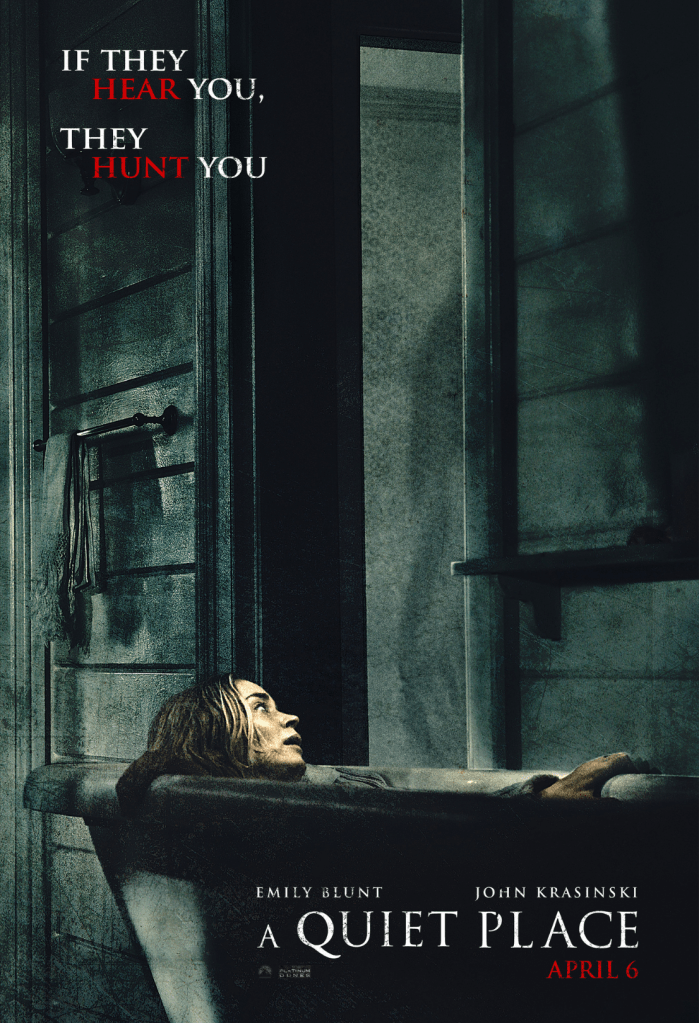
A Quiet Placeposter created by Platinum Dunes, Sunday Night Productions, and Paramount Pictures
Things I liked about the film:
The family dynamic: John Krasinski and Emily Blunt are two actors I am familiar with, primarily for their comedic performances. With John, I have seen clips of The Office, while one of Emily’s most notable performances was in The Devil Wears Prada. As I’ve said before on 18 Cinema Lane, I’ve seen more comedic actors successfully transition to dramatic acting. John’s and Emily’s performance definitely stuck the landing, as they were both able to convey a variety of emotions through facial expressions and body language! Portraying John and Emily’s on-screen children were Noah Jupe, Millicent Simmonds, and Cade Woodward. Adding their strong performances, the Abbott family had a really good family dynamic that felt believable and genuine. Toward the beginning of the film, Cade’s character, Beau, really wants a toy space shuttle. However, the toy makes noise, which is a no-no within the Abbott family’s world. Through sign language and facial expressions, John’s character, Lee, explains how Beau can’t have the toy. Beau’s response was a look of pure sadness and confusion on his face. Another memorable scene was when Regan refused a new cochlear implant. Throughout the film, Lee attempts to create a functioning cochlear implant for his daughter. When he gives Regan the implant, Lee is optimistic it will work this time, wide eyes and even a smile conveying this optimism. Regan is not impressed with the new implant, as she’s frustrated at the idea of another implant not working. She not only expresses frustration on her face, she even pushes away her father’s hand.
The atmosphere: As I mentioned in my point about the family dynamic, noise is a no-no in the Abbott family’s world. That’s because unidentified extraterrestrial creatures have taken over their environment, destroying anyone or anything that makes noise. Right in the very first scene, the audience can see how these creatures have driven people away from a small town. It looks like what most people would call a “ghost town”; cars frozen in the street and leaves slowly blowing through the air. The store where the Abbott family visits appears to be an urban explorer’s dream. Natural light from the store’s windows provides the facility’s only source of light. Products are strewn on the floor, waiting for someone to finally pick them up. Cinematography and inclusion of light help create a film that feels very atmospheric!
Use of sound: Even though the Abbott family try to create as little sound as possible, the film itself was not devoid of sound. At various moments in the story, natural sound could be heard whenever the family traveled from place to place. One notable example is when Noah’s character, Marcus, and Lee walk near a river. Sounds could also be heard through headphones or earbuds. In a scene where Lee and Emily’s character, Evelyn, are slow dancing, Evelyn puts one of her earbuds in Lee’s ear. Not only can the song be heard through the earbud, the song is amplified so the audience can hear it too. It serves as a reminder how sound, even noise, plays a role in our lives.
A film that doesn’t feel like a horror film: Like I said in my introduction, A Quiet Place is a horror film. Even the poster bears the hallmarks of a typical horror production. But, to me, A Quiet Place didn’t feel like a horror movie. Sure, there were terrifying moments in the story. But, if anything, the film felt like a dystopian/apocalyptic film with sci-fi elements. As I watched A Quiet Place, it reminded me of a more creative version of Signs.
Questions that are left unanswered: While I appreciate the film’s creative team respecting the audience’s intelligence, there were some questions I wish were answered. For instance, why did the Abbott family choose not to wear shoes? During Lee and Marcus’ hike, they cross paths with an elderly couple. Who were they and why did the elderly man want the creatures to capture him? Couldn’t the couple join the Abbott family and seek safety together?
The science’s confusing logic: As Marcus and Lee attempt to catch fish in a river, Lee explains how it’s ok to make small sounds. While big sounds are bad, they can be cancelled out with bigger sounds. With this logic in mind, why aren’t the extraterrestrial creatures congregating near the river? Why would they even bother trying to capture people, animals, and objects that make noise? Statements like Lee’s made the story somewhat confusing.
Before I share my overall impression of A Quiet Place, I’d like to thank all of 18 Cinema Lane’s followers! You are the reason why I continue to write and publish so many Blog Follower Dedication Reviews! Now, on to my thoughts on A Quiet Place. I will admit this is a fine, ambitious film that is one of the more unique titles of this nature. However, some aspects of the project could have been stronger. Like I said in my review of Night of the Comet, you need to explain the science in your science fiction story, especially in a way that satisfies the audience. While some of the science in A Quiet Place was explained, other parts of the story were confusing. The movie, to me, felt less like a horror movie and more like a dystopian/apocalyptic film with sci-fi elements. This makes the film’s marketing, as well as its horror classification, somewhat misleading. I am aware there is a sequel to A Quiet Place. Because I thought the movie was just fine, I’m not rushing to see the sequel anytime soon.
Overall score: 7 out of 10
Have you seen A Quiet Place? What movie do you like to watch around Halloween? Please tell me in the comment section below!
One of the first movies I reviewed this year was the 1950 film, Harvey. Since publishing my review back in January, that movie has become the most disappointing one I’ve seen this year, so far. Jillian, from The Classic Film Connection, recommended I give this story a second chance by checking out the 1972 Hallmark Hall of Fame production. Since this title is a remake and since I’m participating in The “Take Two!” Blogathon (which focuses on remakes), I found the perfect opportunity to watch this movie! When I reviewed 1950’s Harvey, I questioned what the point of the story was. This is because I was confused by what the movie’s creative team was trying to say through their project. Will I be less confused by the 1972 adaptation? Keep reading if you want to find out!
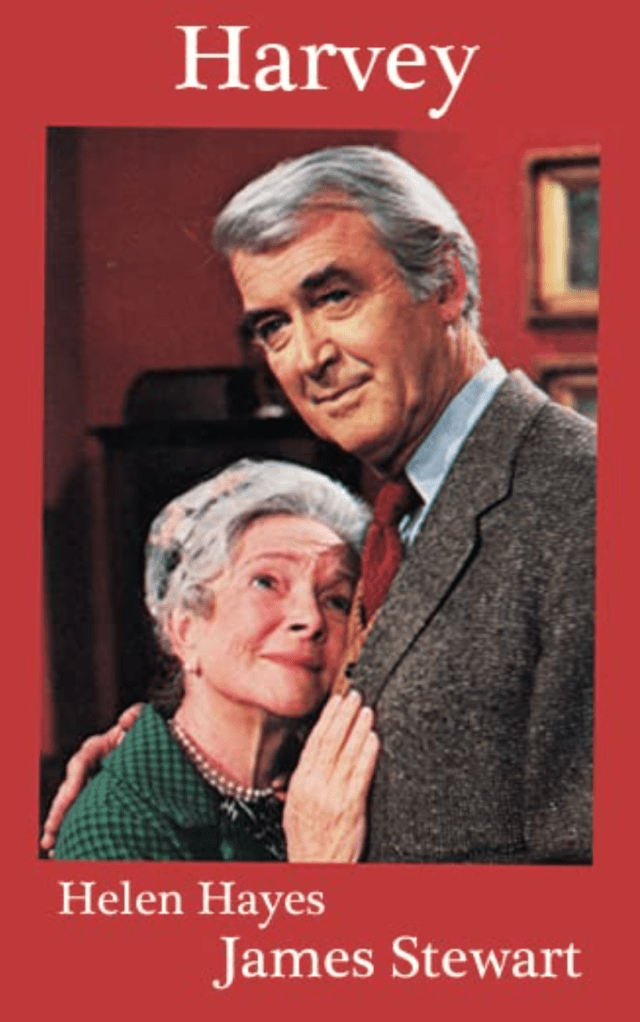
Harvey(1972) poster created by Foote, Cone and Belding Productions, Hallmark Hall of Fame Productions, Talent Associates-Norton Simon, and National Broadcasting Company (NBC)
Things I liked about the film:
Changes from the original film: As I said in my review of the 1950 film, there were things about Harvey I didn’t like. One of them was the medical negligence Veta experiences at Chumley’s Rest. In the 1972 version, that specific scene plays out differently. When Veta is being interviewed by Dr. Lyman Sanderson, he notices how distressed Veta appears. Her body language, tone of voice, and tears are noted by the doctor as he listens to what Veta has to say. This leads Dr. Lyman to admit Veta into the hospital for her well-being. The mix-up is presented as an example of good intentions leading to bad results. The film’s dramatic tone also helps elaborate how terrifying Veta’s experience would be.
A sense of magical realism: An element I thought was lacking in the 1950 version of Harvey was a sense of ‘magical realism’. Because the story featured a 6 foot 3 ½ inch, invisible white rabbit, I thought that aforementioned element would be automatically included in the film. In the 1972 adaptation, there was a stronger sense of ‘magical realism’ within the overall story. At the hospital, a hat with two holes on top is found in Dr. Lyman Sanderson’s office. The staff question who this hat could possibly belong to. Since the holes on the hat would allow rabbit ears to stick out, the hat itself implies Harvey does exist. This along with other strange occurrences in the story show how the film’s creative team put more effort into including ‘magical realism’.
The acting: When I reviewed the 1950 version of Harvey, I talked about James Stewart’s portrayal of Elwood P. Dowd, saying it was “laid-back” and “somewhat philosophical”. Reprising this role in the 1972 version of the story, James brought these same elements to his performance. But this time, his portrayal of Elwood reminded me of Mister Rogers from Mister Rogers Neighborhood. What I mean by this is Elwood came across as the type of man you’d want to spend hours having a conversation with. Elwood’s approachable and pleasant persona make him such a fascinating individual. If Elwood P. Dowd existed in the real world, I’d like to think he’d come up with an interesting TED Talk!
Despite appearing in the film for a limited period of time, I liked Madeline Kahn’s portrayal of Nurse Ruth Kelly! Her pleasant on-screen personality allowed her to stand out and give a memorable performance! Her interactions with the other characters also came across as realistic. After Veta was admitted to the hospital, Dr. Lyman has difficulty finding her. In a state of panic, he thinks Veta escaped. Sensing Dr. Lyman’s panic, Ruth becomes concerned. Her face has fallen from the smile she usually carries and her tone of voice contains a sense of dread. There’s even an ounce of timidness to her overall demeanor. Scenes like this one make me wish Madeline was given more on-screen appearances.
Most of the story being rehashed: When creating a remake of a pre-established story, it’s important to do two things: respect the source material that came before your project and bring your own voice to the table. In the case of Hallmark Hall of Fame’s version of Harvey, more emphasis was placed on respecting the original film. While this idea isn’t a bad one, the 1972 movie’s creative team didn’t allow themselves to create a unique identity for their project. The sets in this film looked almost exactly like they did in the 1950 film. The story, more often than not, followed the 1950 movie’s narrative, making very few deviations. While watching the 1972 version of Harvey, I wondered, at times, why this remake exists?
A televised version of a play: In my review of Hallmark Hall of Fame’s Foxfire, I talked about how that title felt more like a televised play. This is because the 1987 film contained a smaller cast and a condensed story. The 1972 adaptation of Harvey also felt like a televised version of a play. Fewer locations are a reason why. In the 1950 version, Elwood is shown taking Harvey to Charlie’s Pub. Elwood simply recalls this experience in the 1972 version. What’s also important to note is how the 1972 story takes place in either the hospital or the Dowd family home.
The underutilization of Betty Chumley: At one point in the 1972 story, Elwood makes plans with Dr. Chumley’s wife, Betty, to meet at Charlie’s Pub and share drinks. But because this trip was never shown on-screen, Betty received one less on-screen appearance. Within the story, she only appeared in two scenes. Personally, I think Betty should have had a stronger significance in the film.
After publishing my review of the 1950 version of Harvey, Jillian, from The Classic Film Connection, explained how the story’s point was “about the right to be uniquely yourself and live life on your own terms”. Now that I’ve seen the 1972 version of this story, I think the Hallmark Hall of Fame film did a better job at executing this idea. What worked in the movie’s favor was how the story was just a drama instead of trying to be both a drama and comedy. Scenes like Veta’s hospital admittance elaborated how terrifying her situation would be. There was also a sense of ‘magical realism’, something I thought was lacking in the 1950 film. However, the majority of the 1972 movie was a copy of the 1950 movie. In 1993, Hallmark Hall of Fame released the film, To Dance With the White Dog. Based on what I know about the story, it sounds like a version of Harvey. But this time, a man sees a white dog only he can see. Maybe I’ll write about that movie in a future review.
Overall score: 6.1 out of 10
Have you seen any version of Harvey? Are there any Hallmark Hall of Fame movies you’d like to see me review? Let me know in the comment section below!
Do you like TV? Do you like talking about television? Then you’ll love The World Television Day Blogathon! If you’re interested in joining this fun, exciting event, you still have a month to sign up. All the information about the blogathon can be found at this link:
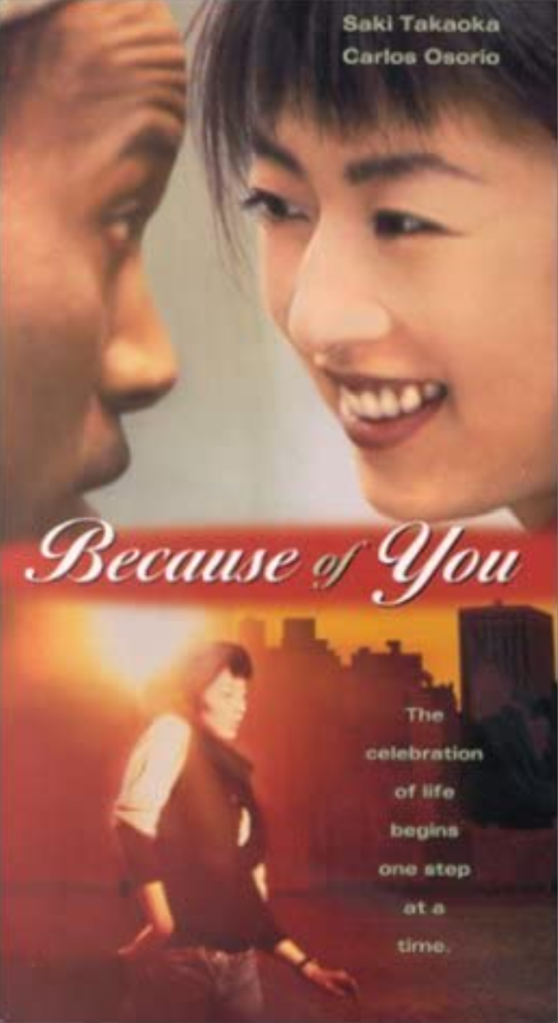
Kyoko/Because of You is a movie I first planned to review back in May. But as I explained in my review of The Pit and the Pendulum, my DVD copy of Kyoko/Because of You didn’t arrive in time for the blogathon I was participating in. Thanks to this month’s Genre Grandeur, I now have an excuse to finally check this movie out! ‘New York Films That Take Place Prior to 9/11’ was selected for September’s Genre Grandeurtheme. Not only wasKyoko/Because of You released in 1996, the protagonist takes a trip to New York. When I first came across this movie on IMDB, the synopsis immediately caught my attention. It sounded heartfelt, almost like a Hallmark Hall of Fame production. Since this movie is a lesser-known title, it gave me a chance to try to find a hidden gem!
The acting: I’m not familiar with Saki Takaoka’s filmography. Despite this, I thought her portrayal of the titular character was pleasant to watch! From scene to scene, Saki displayed genuine emotion. One great example is when Jose is telling her about a lampshade his mom loved. When the scene begins, Kyoko has a smile on her face, happy to be spending time with her mentor. But as Jose is sharing his story, Kyoko’s face slowly falls, highlighting just how sad his story is. At the end of Jose’s story, Kyoko smiles again and tells him she’ll help find this lampshade, making her response bittersweet.
Kyoko’s mentor, Jose, is portrayed by Carlos Osorio. For the majority of the film, Jose is dealing with the effects of not only AIDS, but also Dementia. Despite these struggles, the humanity of this character shown through, thanks to Carlos’ acting talents. Before Kyoko leaves to purchase a souvenir, Jose asks to keep the van door open, as he wants to feel the breeze. Jose’s face has a wistful look about it, like he is reminiscing on simpler times. When Kyoko returns, Jose is angry at a young man named Angel. He not only yells at Angel, Jose also uses his cane to protect himself.
While in New York, Kyoko meets a limousine driver named Ralph. Portrayed by Scott Whitehurst, Ralph was one of the best characters in this movie! He was so charismatic and such a good friend to Kyoko. During their first interaction, Ralph encourages Kyoko to take a ride in his limousine. Using charm to his advantage, Ralph’s encouragement sounded more like a sales pitch. Despite this, the pleasant demeanor and friendliness of Scott’s body language and facial expressions indicated his good intentions.
Various sides of New York: In any movie taking place in a well-known, beloved location, there are two angles a creative team can take their project: glamourize and glorify it or show the not-so-pretty sides of that location. When it came to New York in Kyoko/Because of You, the presentation of New York seemed balanced. Yes, there is a shot of Radio City Music Hall. But well-known landmarks were not the only places featured in this part of the story. While looking for Jose, Kyoko visits a dance studio and a local bar. While the dance studio visit was brief, the local bar is where Kyoko shows off her dance skills. Since New York is such a large city, it hosts a landscape of multiple restaurants and cultural hubs. The film shows how various communities can make their home in the Big Apple.
The soundtrack: Throughout the film, Latin tunes can be heard in the background. While the tunes themselves were pleasant, I liked how they contained a strong connection to the story. Jose is from Cuba, sharing through a voice-over how dancing plays a huge role in his culture. Both Jose and Kyoko are Latin dancers, with the music emphasizing their shared interest. What’s also good about the music is its consistency, as Latin music was the principal sound for this movie.
Dancing has a limited presence: In the synopsis for Kyoko/Because of You, it states Jose taught Kyoko to dance when she was younger. With that in mind, I was expecting dance to be one of the film’s key themes. Sadly, there wasn’t much dancing within the story. In this hour and twenty-five-minute movie, there were two dance solos and three duets. Even though this film wasn’t a musical, I still found this disappointing.
The bait-and-switch: Because Kyoko travels to New York and because the New York City skyline is featured on the film’s poster, I assumed the majority of the story would take place in New York City. Even though the Big Apple is featured in the movie, only about a third of the film is set there. The rest of the movie becomes a road trip story, with some shots of a moving vehicle used as padding. Since I watched this film partly because of its New York City backdrop, this was somewhat misleading.
Drawn out scenes: As I just mentioned, some shots of a moving vehicle were used as padding. They were also used to satisfy the film’s run-time. One example is when Kyoko is driving out of New York. In this shot, she is driving her vehicle on a bridge, which lasts for about thirty seconds. Scenes like that one should have been cut shorter, giving more time to the plot.
The story of someone reconnecting with their mentor could be heartwarming. While that potential was there for Kyoko/Because of You, it didn’t contain as much heart as I expected. The majority of this story focused on the road trip instead of the bond between Kyoko and Jose. Yes, I know Jose was experiencing Dementia. But it seems like the road trip, from a story-telling perspective, tried to make up for Jose’s disintegrating memory. The acting performances were nice to watch. I also enjoyed the dance routines. However, I wish dance had been a key theme in this movie. New York is such a diverse landscape, especially when it comes to dancing. Therefore, this felt, to me, like a missed opportunity. I’m glad I finally got a chance to review Kyoko/Because of You. But it’s not the hidden gem I thought it could be.
Overall score: 6.1 out of 10
Have you seen Kyoko/Because of You? Which ‘dance films’ do you like? Tell me in the comment section!
I know what you’re thinking, “What does Anna and the King have to do with the number five”? Well, I’m glad you asked! As Rebecca has stated in the announcement post for the Fifth Broadway Bound Blogathon, all entries had to have something to do with the number five, to commemorate the event’s fifth anniversary. For my selection, Anna and the King, which stars Bai Ling, was released in 1999, five years after The Crow premiered. From what I’ve heard, The Crow was Bai Ling’s first American/English film. Last year, when I reviewed the 1956 adaptation of The King and I, I mentioned Anna and the King was a non-musical version of the story. As I write this review, I realize I haven’t seen many non-musical film adaptations of musicals. Sure, I’ve heard of these types of productions. But, off the top of my head, a non-musical adaptation doesn’t immediately come to mind. So, with this review, I will expand my cinematic horizons!
Anna and the King poster created by Fox 2000 Pictures, Lawrence Bender Productions, and 20th Century Fox
Things I liked about the film:
The acting: Anna and the King is a drama film with a more serious tone. Therefore, Jodie Foster’s portrayal of Anna is sterner in nature. However, Anna also comes across as being fair. A great example of this is when she is disciplining both her son and King Mongkut’s eldest son. In the evening, when the royal family is bringing Anna dinner, Jodie presents a mild-mannered sweetness that feels genuine. As she’s realizing the dinner is for her and not King Mongkut’s son, Anna never displays any meanness toward her student, as she truly wants to teach him a valuable lesson. King Mongkut himself is also a stern, yet fair character. Chow Yun-fat balances the seriousness and loving sides of his character consistently throughout the film. In one of their many conversations, King Mongkut is asked by Anna if his wives ever get jealous of one another. Even though this question is a personal one, King Mongkut never appears offended. Instead, his calm, collected, and approachable demeanor make the conversation less awkward than it could have gotten. One of these aforementioned wives is Tuptim. Portrayed by Bai Ling, Tuptim is an emotional character that expresses herself in subtle ways. It’s not until she faces a life-or-death moment where more of her emotions are drawn forward. While I won’t spoil Anna and the King for those of my readers who might be interested in seeing it, Bai delivers on the emotional intensity needed for a moment like the one I just mentioned. But even outside of that moment, Bai knows how to use emotion in her and her character’s favor.
The set design: Anna and the King is a beautiful looking film! One of the reasons why is its set design. Everywhere you look, exquisite detail and impressive structure helped elevate the world around Anna and King Mongkut. The royal family takes a trip in a massive river boat. This boat was a deep blue with gold etched artwork. At the head of the boat, a set of giant golden dragons adorn this beautiful mode of transportation. On the walls of King Mongkut’s palace, a full-length mural consistently coats the interior perimeter of rooms and even a hallway. The mural itself appears painted, depicting the natural landscape of Siam. Smaller elements like the ones I mentioned added to the overall beauty of the set design!
The costume design: Similar to the 1956 adaptation, the costume design in Anna and the King was simply elegant! One notable example was Anna’s reception gown. At this event, Anna wore a full length, white gown. The off the shoulder bodice and sparkly skirt was not only eye-catching, it also felt reminiscent of Belle’s gown from the 1991 animated film, Beauty and the Beast. At this same reception, King Mongkut’s wives also wear beautiful gowns. Tuptim’s was especially pretty, a simple yet classy red dress. What also complimented Tuptim’s ensemble was a sparkly gold and bronze crown that adorned her dark hair. The exquisiteness of the costume design carried the spirit of The King and I story!
The war story-line: Because Anna and the King is a non-musical version of The King and I, there needs to be something to replace the musical numbers. In the 1999 adaptation, that replacement was a subplot about a war between the Siamese and the Burmese. While it was interesting to explore the tense side of ruling a country, I found this subplot to be the weakest one. That subplot was drawn-out, getting resolved at the very end of the movie. With the run-time being two hours and twenty-eight minutes, the war story-line felt longer than it really was.
Under-utilized characters: Anna and the King contains a larger cast of characters. Therefore, some of them are bound to receive less screen-time than others. Tuptim was, once again, one of those characters. After seeing how under-utilized Rita Moreno’s talents were in the 1956 adaptation, I was hoping Bai Ling would receive more screen time. Sadly, she only appeared in a handful of scenes. In the 1956 adaptation, Tuptim created a play based on Uncle Tom’s Cabin, giving her a reason to stay on screen a little bit longer. Because there is noUncle Tom’s Cabin play in the 1999 adaptation and because only King Mongkut’s oldest son reads Uncle Tom’s Cabin, Tuptim, in Anna and the King, has less reasons to stay on screen.
No musical Easter eggs: Before I wrote this review, I was well aware Anna and the King was not a musical film. But because the film is an adaptation of a musical, it was a missed opportunity to not include musical related Easter eggs. In the 1956 adaptation, King Mongkut says “Et cetera, et cetera, et cetera” on multiple occasions, whenever he had something important to say. In the 1999 adaptation, however, King Mongkut never says the aforementioned quote. One of the songs from the 1956 adaptation is ‘Shall We Dance?’. During both versions of this story, King Mongkut and Anna dance with one another. However, it would have been nice to hear one of them say “shall we dance.”
Anna and the King is a fine, competently made film. The movie’s creative team clearly knew what they doing, displaying the clear direction they wanted to take their adaptation. But compared to the 1956 musical, I find myself liking the musical more. Without the musical numbers, it feels like the story is missing something. Even though the 1999 adaptation found a replacement for the lack of musical numbers, I was wishing they hadn’t been omitted. I would have even accepted Easter eggs related to the musical, such as quotes from the songs woven into the dialogue. But despite its shortcomings, Anna and the King does attempt to make meaningful changes that were not in the 1956 musical. One of these changes is giving Anna’s son, Louis, and some of King Mongkut’s children their own unique personalities and a little more involvement in the overall story. As for Bai Ling’s involvement in the film, I wish she was given more on-screen appearances. But because Anna and the King is based on The King and I, which also showed Tuptim in only a handful of scenes, maybe I was naïve to think more material was available?
Overall score: 7.2 out of 10
Have you seen Anna and the King or The King and I? Can you think of any musicals that received a non-musical adaptation? Let me know in the comment section!
The Hallmark Hall of Fame adaptation of Redwood Curtain is based on a Broadway play. It was also released in 1995. With these facts in mind, I found Redwood Curtain to be the perfect subject for the Fifth Broadway Bound Blogathon. Prior to this event, I saw the movie and read the play. This lent itself to an interesting idea. Discussions about film adaptations often feature films adapted from books, short stories, or poems. Movies born from plays aren’t often included in the conversation. So, I decided to write an editorial highlighting the similarities and differences between the Redwood Curtain play and film. This article contains spoilers for the story of Redwood Curtain.
On the stage, Redwood Curtain contains three characters: Lyman, Geri, and Geneva. While there are other characters in the story, they’re only mentioned within the dialogue. Geri’s father, Laird, is one of these characters. According to the script, Laird was a desk-jockey lieutenant in the Vietnam War. This means he “didn’t see a day’s fighting, to come completely unglued in the war.” Laird taught Geri how to play the piano simply to entertain dinner guests. He also developed a dependence on alcohol and died two years prior to the play’s events. Laird is even described as a “drunk.” Because Laird never physically appears in the play, all the information about him is hearsay.
John Lithgow portrays Laird in the film adaptation. The film version of Laird did fight in the Vietnam War, though his specific role was never mentioned. Like in the play, he develops a dependence on alcohol. However, this dependence was Laird’s attempt to cope with war-related trauma. Toward the end of the movie, Geneva shares with Geri how Laird wanted to be a pianist, but didn’t feel he was talented enough. So, he became invested in Geri’s piano career, appearing to live vicariously through his daughter. His presence in the movie shows the audience the strained, yet close relationship between Geri and Laird. Laird’s death within the film’s first half and Geri’s discovery that Laird is her biological father are presented as bittersweet moments.
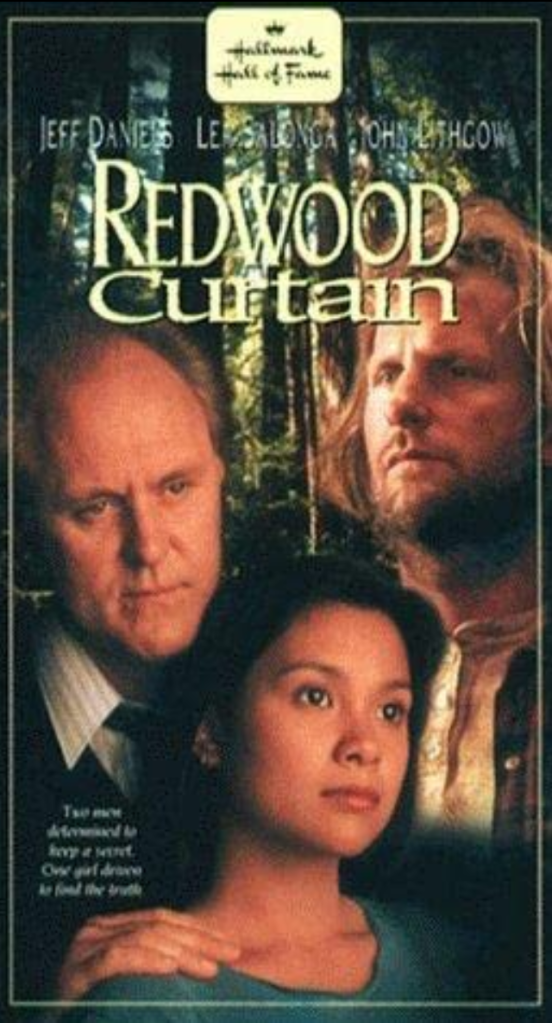
Redwood Curtain poster created by Chris/Rose Productions, Hallmark Hall of Fame Productions, American Broadcasting Company (ABC), and Republic Pictures (II)
Expanding the World
The majority of Redwood Curtain’s story in the play takes place in Arcata’s redwood forest. A few scenes happen in Geneva’s house, Geneva’s car, or a local coffee house. Geri’s first encounter with Lyman is when the play starts, with the lead-up to this moment woven into the dialogue. Events such as Laird’s death take place off stage, prior to the play’s story. The creative team behind a play is given a limited amount of space and time to work with. Therefore, designating a few key locations makes sense among these limitations. In the Redwood Curtain play, Geneva’s house is described as “a large and very fine Victorian house.” The script states her house contains a music room as well. When presenting this play at a theater, only the home’s sitting room and music room would be staged and the style of the house would be heavily implied through décor and set structure.
A plus side to film-making is the freedom to take the story wherever the film-maker chooses. If a movie’s creative team desires to adapt a stage play, that story has the opportunity to grow beyond the boundaries of a stage. In the case of the Redwood Curtain film, the events from the play are contained in the story’s second half. That means the movie’s first half takes place in and around the Riordan family home. This inclusion not only expands the world the characters exist in, but also gives the audience a glimpse into Geri’s world that they wouldn’t have seen otherwise. Filming on location provides benefits to visual storytelling. However, that creative decision has its own limitations. Using Geneva’s house in the movie as an example, a location scout might not be able to secure a location similar to one described in the source material. Even if they succeeded, there’s a process in order to film at a residential building, especially if it’s someone’s real-life home. That’s probably why Geneva’s house is presented as a smaller log cabin with a large deck, but no music room.
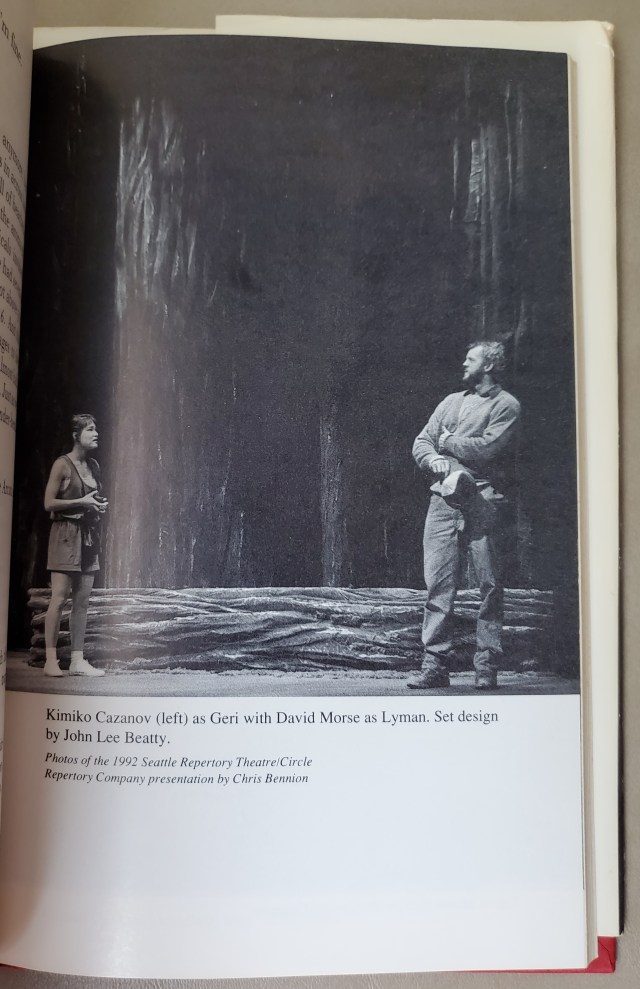
A picture of the Redwood Curtain play from my copy of the play’s script. Screenshot taken by me, Sally Silverscreen
Geri’s Motive
In both the play and movie, Geri attempts to search for her biological father. This attempt is the story’s main conflict. Geri’s reason for her search was different in each version of Redwood Curtain. In the play, Geri knew some information about her past. Prior to the start of the play, Geri discovered Lyman tried to help her and her biological mother get to the United States. The script mentions that Geri began her search when she was twelve. Her search turns into an obsession, to the point of abandoning her musical endeavors. In fact, the play’s synopsis states Redwood Curtain “is a story of obsession and discovery.” Though the information Geri received was partly true, she eventually learns more through her interactions with Lyman.
The movie version of Geri has three motives for her search. Wanting to receive answers about her past was the first motive. The film’s script heavily implies Geri did not know much about her past until the events of the movie. Yes, she was aware she was adopted. But Geri’s belief that Lyman was her biological father stemmed from a photo and a note bearing the name ‘Raymond Farrow’ that Laird gave his daughter after he died. At various moments in the movie, Geri expresses how she feels she doesn’t belong. She even shares these thoughts with the Riordan’s house-keeper, Matilda. These feelings fuel Geri’s journey of self-discovery and finding her biological family. Her third and final motive is her music, which plays a crucial role in Geri’s life. Geri believes if she finds her biological father, she will be able to incorporate more emotion into her musical pieces.
As I’ve said before on my blog, a film’s title can serve as a promise to the audience. In the case of Redwood Curtain, the audience should expect not only to see redwoods, but also to receive an explanation of what the “redwood curtain” is. The “redwood curtain,” in both the play and movie, is the redwood forest itself, where Vietnam veterans choose to live their lives. This is one of the reasons Geri meets with Lyman in the forest. While Geri learns about the “redwood curtain” in each version of the story, the way she learns about it is different. An Arcata Union reporter provides the explanation for the “redwood curtain” to Geri in the play. In the movie, she is given this same explanation by a gentleman working at Arcata’s veterans’ office.
As I mentioned above, the majority of Redwood Curtain’s story in the play takes place in Arcata’s redwood forest. The redwood forest in the movie only appears in the story’s second half. Because of how often or little this location appears in the story, its association with the characters and the themes connected to it depend on these appearances. Topics relating to the environment are brought up throughout the play. When Lyman asks Geri why she’s visiting Arcata, she tells him she’s studying horticulture and botany at the local college. Geri also claims to have magical powers, which allow her to do things such as control the weather. Within the play, Geneva talks about how her family’s portion of the redwood forest is being bought out by investors. While this part of the story is also in the movie, it is discussed in more detail in the play, from Geneva bringing up the specifics of the sale itself to describing Arcata’s weather. The theme of family connects with the redwood forest in the movie. The Riordan family owns a portion of the redwood forest. While Geri stays at Geneva’s house, Geneva shows her niece a wall of family photos. These photos showcase various members of the Riordan family in the redwood forest. The number of photos and whether or not the photos are in black-and-white indicate how the forest has been in the family for generations.
When I brought up the movie version of Laird, I mentioned how he depended on alcohol to cope with war-related trauma. I also mentioned how Geri learns about the “redwood curtain” at Arcata’s veterans’ office. These are just two examples of how the movie includes the subject of veterans’ well-being. In the history of Hallmark films, veterans have been presented with a sense of reverence and respect. Veteran-related issues have also been included in Hallmark’s programming. An example is a veteran struggling with trauma in Signed, Sealed, Delivered: Lost Without You. Even though the film adaptation of Redwood Curtain was released a decade before Hallmark debuted the Hallmark Channel, this tradition can be seen and felt in this Hallmark Hall of Fame presentation. At Laird’s funeral, Geri shares with Geneva how she wished the family had addressed Laird’s alcohol dependency sooner. Geneva reminds her niece how Laird had a problem related to his experiences in the war. Geri says the family’s politeness and willingness to skirt the issue are what enabled Laird’s struggles. The points Geri makes to her aunt highlight how seriously these topics are taken in this adaptation.
While veteran-related issues are brought up in the play, it was never enough to be one of the story’s main topics. Compared to the movie, there isn’t the same amount of reverence for veterans. During her first interaction with Lyman, Geri’s personality is pessimistic and bitter. When Lyman asks Geri about the translation of her hometown’s name, Geri responds by saying, “Well, you’re not Spanish. You must belong to the other half of the country’s population.” After Geri learns Laird was her biological father, she says, “You’re right, Lyman, he was the saddest man I’ve ever known.” Geri also says, “And I thought I was joking when I said to follow in my father’s footsteps I had to mope and pine and drink myself to death. Not a very promising path he’s laid out for me to follow.” With the way veterans’ well-being wasn’t addressed, it made the play seem less hopeful. It also seemed like none of the characters were willing to find any solutions.
As mentioned above, I said Lyman, Geri, and Geneva were the only three characters to physically appear in the play. These three characters also serve prominent roles in the movie. Geri’s personality in the play was pessimistic and bitter. She was also disrespectful when talking to Lyman or talking about Laird. In the movie, however, Geri was a more empathetic character. While interacting with Matilda in the Riordan family kitchen, Laird recalls a memory of Geri when she was younger. In this memory, Laird was tearing up as he was chopping onions. Upon seeing this, Geri asks if Laird is sad because the onions are hurt.
Lyman, in both the play and movie, shares parts of his life story with Geri. In the play, though, more of this information is given. Toward the end of the movie, Lyman tells Geri how, before the war, he would fix and race cars with his dad. He also talks about how he never dated a crush he had. Lyman in the play not only drag-raced vehicles, he also worked in his dad’s garage. He recalls owning a Mustang Boss 302 and never having a girlfriend. Geneva’s family’s portion of the redwood forest was being bought out by investors. As a result of this, Geneva, in the play, is planning on moving to Key Biscayne, Florida, with her husband, Barney. In the movie, however, Geneva expresses no interest in moving out of Arcata. In fact, after one of Geri’s piano performances, Geneva tells Laird how she plans on fighting to keep her land. She and Barney are also divorced.
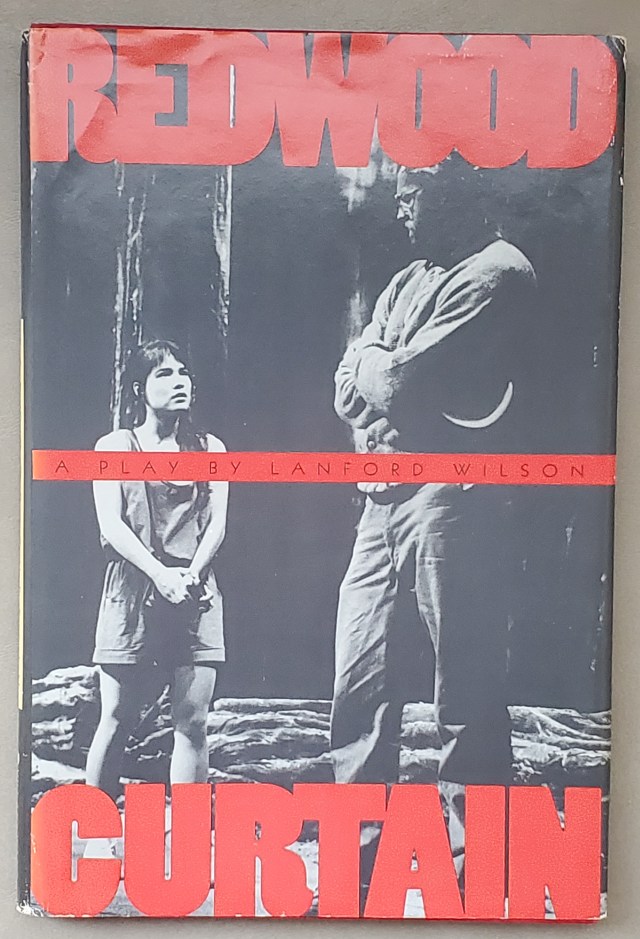
The cover of my copy of the play’s script. Screenshot taken by me, Sally Silverscreen
After I watched and read Redwood Curtain, I ended up liking the movie adaptation over the source material. What worked in the Hallmark Hall of Fame presentation’s favor was how the story was expanded. Not only were more locations added to the characters’ world, more context was given than the play provided. Even though there were more characters added to the film, the cast as a whole was smaller. Through their interactions, the audience gets a more intimate look into the characters’ relationships. The changes to the characters from the play made them more likable, especially Geri. Both the screenwriting and acting allowed Geri to be one of the strongest protagonists in Hallmark movie history. Redwood Curtain reminded me of another Hallmark Hall of Fame movie based on a play: The Boys Next Door. Similar to Redwood Curtain, The Boys Next Door contained multiple locations and provided context to each of the key characters. Since I have seen the 1996 adaptation, but have never read the play, perhaps another comparison and contrast editorial is in order.
For my third year participating in the Rule, Britannia Blogathon, I, at first, considered reviewing an adaptation based on a book I’ve read. This would be similar to when I wrote about the 2002 adaptation of Nicholas Nickleby. But the more I thought about it, the more I realized I had a perfect opportunity on my hands. That opportunity was the chance to review the 1975 film, Tommy! Years ago, long before I became a movie blogger, I saw a trailer for Tommy on Turner Classic Movies (TCM). On the one hand, the story itself seemed interesting; a man with disabilities living his best life and making his dreams come true. But, on the other hand, the visuals within this trailer appeared “bonkers”, making the movie seem intimidating. After reading some reviews, I came to the conclusion Tommy is a polarizing film. This isn’t the first time I have written about a movie that received mixed reviews. Two years ago, for another blogathon, I reviewed the 2011 Hallmark film, The Cabin. Historically, this is considered one of the most polarizing titles the network has ever created. When I got around to seeing it, I found The Cabin so bad, it was disappointing.
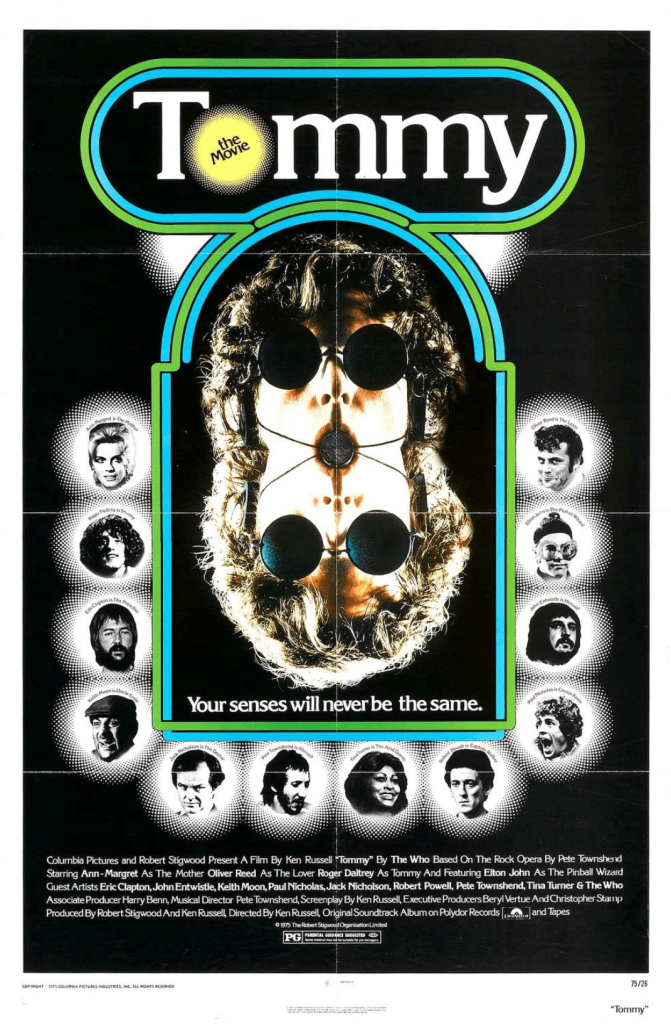
Tommyposter created by Robert Stigwood, Organization Ltd., Hemdale Film Corporation, and Columbia Pictures
Things I liked about the film:
The acting: Prior to watching Tommy, I had seen Bye Bye Birdie. In the 1963 film, Ann-Margret gave an expressive portrayal of Kim MacAfee. The 1975 movie shows Ann-Margret in a completely different role, which allowed her to expand her acting abilities. Portraying the titular character’s mother, Nora, Ann-Margret gave a well-rounded performance! Because this story incorporates heavier subjects, her portrayal contains the emotional intensity required for a story of this nature. While watching television, Nora sees her son on TV. As she’s watching, a sense of guilt grows within her. This guilt causes Nora to appear disgusted, a grimace slowly overcoming her face. She attempts to change the channel in order not to see Tommy, only for the TV to magically switch to Tommy’s image. Angry about her plan not working, Nora throws her champagne bottle at the television, which results in a flood of laundry detergent, beans, and chocolate. Relieved to instantly receive the items she just saw in television commercials, Nora suddenly is taken over by pleasure. A smile appears on her face as she rolls around on the floor in the commercial materials.
When discussing a movie heavily revolving around a titular character, it’s important to talk about the actor or actress portraying that character. In the case of Tommy, that role was given to Roger Daltrey. Based on some reviews I’ve read of Tommy, it seems like Roger had little to no acting experience prior to working on this movie. Despite this, his performance was such a strong addition to the story! Roger’s portrayal had the emotionality and versatility to make Tommy a character worth rooting for. These aspects also held my interest in Tommy’s journey. In one scene, Tommy stays over at Cousin Kevin’s house. During his stay, Kevin tries to burn Tommy with a cigarette. As Tommy is sitting tied up in a chair, his face instantly changes from exhaustion and writhing in pain. This change in facial expressions is seamless, Roger never missing an emotional beat.
While I have heard good things about Tina Turner’s acting performances, this was the first time I had seen any of them. Tommy shows Tina portraying The Acid Queen. Even though her performance was limited to one scene, she gave so much energy to her role. While her portrayal was over-the-top, it fit the tone and vibe the movie was going for. With all that said, I honestly wish Tina had received more appearances in this film.
Ann-Margret’s wardrobe: Even though I knew Ann-Margret would be starring in Tommy, I was pleasantly surprised by how much I liked her wardrobe! Each outfit she wore complimented her so well, while also looking great on-screen! Toward the beginning of the movie, as Nora and her husband, Captain Walker, are running through the war-torn streets of England, she wore an asymmetrical, sky-blue gown. The dress itself was simple, but it was elegant enough to not be plain. Ann-Margret’s strawberry blonde hair paired beautifully with the color of the dress. Later in the movie, Nora wears a silver, mesh pant suit. Accompanied by shiny, silver sandals and a white furry cape, this ensemble boasted a posh look. While the outfit felt very reflective of the 1970s, it was a divine version of that type of outfit. Ann-Margret definitely pulled off this film’s wardrobe in style!
The symbolism: In some reviews I read about Tommy, it was mentioned how there was symbolism found among the over-the-top, flashier imagery. Since I knew before watching the movie there was going to be this type of imagery, it allowed me to focus on what the film’s creative team was trying to say through their story. In a desperate attempt to cure her son, Nora takes Tommy to The Church of Marilyn Monroe. Other patrons with disabilities are also in attendance, from a woman with a guide dog to multiple people utilizing wheelchairs. Marilyn’s likeness can be seen throughout the facility, with the most notable being a giant statue of Marilyn in the iconic flown skirt pose. I interpreted the scene as a piece of commentary on how people who claim to be religious and/or contain the ability to cure everyone with anything can, sometimes, take advantage of those in vulnerable positions. Those people could be considered “false prophets”. So, choosing Marilyn as the film’s church icon is interesting, as Marilyn’s name and image were all a fabricated version of Norma Jean.
Some villains not receiving their comeuppance: There were several characters in Tommy’s life that failed him. While a few of these characters did receive their comeuppance, most of them did not. Whenever Tommy went to stay at Cousin Kevin’s house, Kevin would physically abuse and torment Tommy. Kevin only appeared in a sequence of scenes showing Tommy mistreated by him. Because of this, Kevin’s comeuppance was never shown. I’m not sure if this creative decision was made because there wasn’t enough time to show each character’s comeuppance or if it was meant to show how unfair life can be.
Some confusing parts of the story: At one point in Tommy’s story, his parents take him to see The Specialist, in an attempt to figure out why Tommy has several disabilities. During this appointment, Nora and The Specialist continuously flirt with each other. After this scene, this interaction and The Specialist himself are not brought up again. I was unsure if Nora planned on leaving Frank to start a relationship with The Specialist or if she was flirting with The Specialist simply to encourage him to lower her son’s medical bills. Either way, the movie does not provide a clear explanation.
An unclear time-line: This story starts during and shortly after World War II. The script heavily implies Tommy was born sometime in 1945. Most of this story takes place when Tommy is an adult. If Tommy were, say, twenty during the film’s events, that would mean the story takes place in 1965. With that said, why do the wardrobe, set design, and special effects look like they came straight out of the 1970s? I know this film was released in 1975. But because Tommy’s age is not specified, the movie’s time-line is unclear.
The way I feel about Tommy is similar to how I feel about Queen of the Damned. Is this one of my favorite films? No. Is it one of the best movies I’ve seen this year? Also, no. But, for what it was, I enjoyed it. Yes, the visuals can be “bonkers”. When you look past all of that, though, you will see the film’s creative team had something interesting to say. The story itself was easier to follow. The symbolism and messages associated with it appeared to be given a lot of thought and effort. Therefore, artistic merit can be found in this movie. The story of Tommy is a heartbreaking one. However, it is also a somewhat uplifting story. I won’t spoil the film for those who may be interested in seeing it. I will say when a climatic event happens, the moment itself feels earned.
Overall score: 7.3 out of 10
Have you seen Tommy? Are there any musical films you’d like to see me review? Let me know in the comment section below!
When I published my review of Murder, She Wrote: The Queen’s Jewels for August’s Buzzwordathon, I announced I would be hosting a new blogathon this November. I also said more details were to follow. Well, the time has come to reveal more information about the event! As I mentioned in the aforementionedreview, the theme is ‘World Television Day’. Because this particular holiday takes place on November 21st, my blogathon will happenbetweenNovember 19th and November 22nd. Television is such a broad topic, so here is a list of ideas if you are interested in participating:
Television Shows (favorite or least favorite, specific episodes, talent involved, etc.)
TV Movies and Mini-Series
Films based on or inspired a show (Downton Abbey: A New Era, Jimmy Neutron: Boy Genius, etc.)
Books based on or inspired a TV show (Murder,She Wrote, etc.)
Songs used in TV productions
Sports Events (Super Bowl, Olympics, etc.)
Televised Contests (pageants, Eurovision, etc.)
Historical Events (Challenger Disaster, etc.)
Podcasts or Youtube videos about TV shows
History of Television
Lost/Found Media related to TV (Sesame Street’s infamous Wicked Witch episode, etc.)
Public Service Announcements (PSA) or Public Information Films (PIF)
Commercials, Trailers, or TV Spots
Created by Sally Silverscreen at Adobe Creative Cloud Express
Once you’ve selected an idea, take a moment to read the official rules:
Please be respectful toward other participants and the subject(s) you’re writing about (especially if you choose to write about historical events on television).
Please let me know in advance if you plan on publishing your post(s) earlier or later than the allotted time-frame (November 19th to 22nd).
Only new posts will be eligible for the event.
Because of how broad the subject of television is, I will not be allowing duplicate entries.
There is a three-entry limit for each participant.
All entries must be original work.
Subjects from any genre, year, or country are allowed.
If you’re interested in participating, please share your idea(s) in the comment section below.
Pick one of the four banners and spread the word about the World Television Day Blogathon!
Created by Sally Silverscreen at Adobe Creative Cloud Express
World Television Day Participants
Sally from 18 Cinema Lane — The Flamingo Rising: Book vs. Movie, Top 10 or 15 Characters Who Didn’t Reach Their Full Potential
Rebecca from Taking Up Room — List of Top 10 Gilmore Girls episodes
Andrew from The Stop Button — Review of Jericho Mile (1979 made-for-tv movie)
oldbooksandmovies from Old Books and Movies — Ten Favorite Songs Preformed Live on TV During the Golden Age (1948-1959), Raymond Burr’s two appearances on the Jack Benny Show
Created by Sally Silverscreen at Adobe Creative Cloud Express
Created by Sally Silverscreen at Adobe Creative Cloud Express
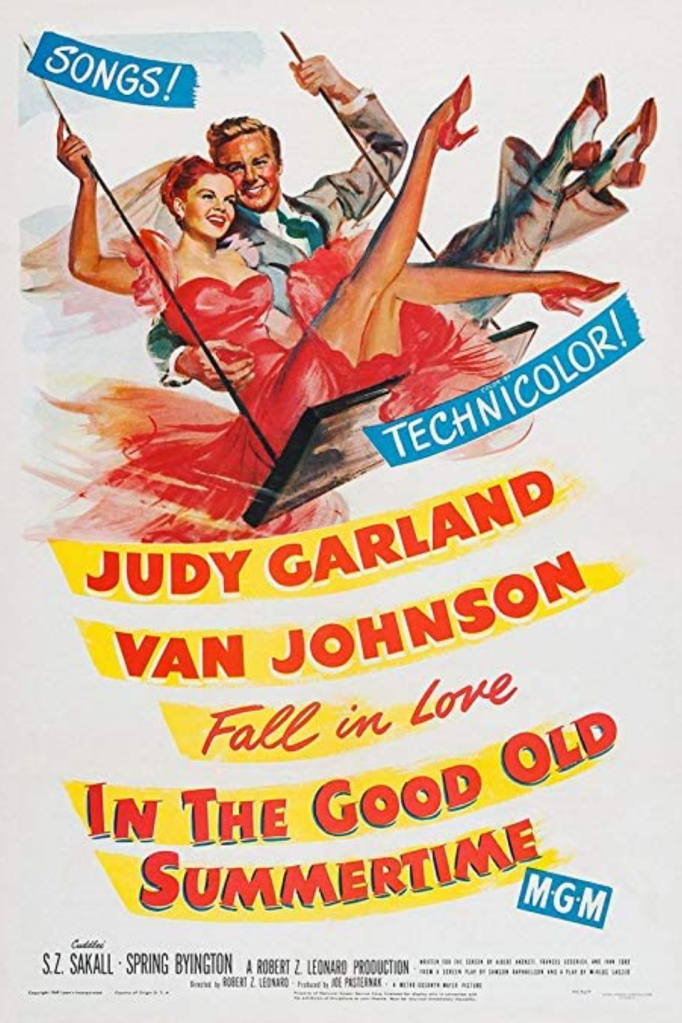
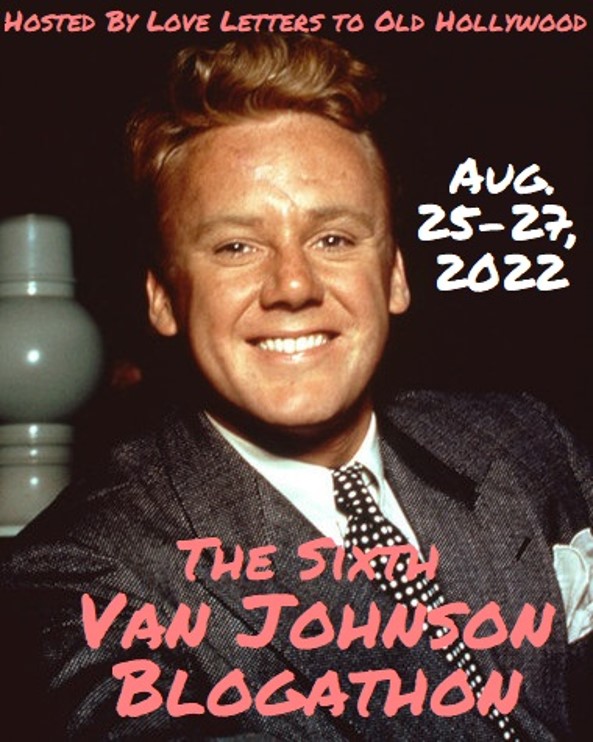
Earlier this month, I said I would review In The Good Old Summertime for the Van Johnson Blogathon. Now, with the arrival of the aforementioned event, it’s time to talk about this film! There are two reasons why I selected the 1949 movie. The first is it was recommended to me by Becky, the same reader who suggested Easy to Wed. The second was how the summer season is winding down. Because the movie is titled, In The Good Old Summertime, I figured it would serve as a sort of last hurrah. As of 2022, the 1949 title is the fourth one of Van Johnson’s I’ve seen. While I found both Plymouth Adventure and Easy to Wed just ok, I was not a fan of Where Angels Go, Trouble Follows. Therefore, it’ll be interesting to see what I thought of In The Good Old Summertime!
The acting: As I said in the introduction, In The Good Old Summertime is the fourth film of Van Johnson’s I have seen. Therefore, I knew what to expect from Van, talent wise. While portraying Andrew, Van utilized emotions well. A great example is when Andrew and Veronica are attempting to sell some sheet music to a customer. The sheet music in question was “Put Your Arms Around Me, Honey”. During this song, Andrew looks threatened, like he knows Veronica is doing a better job at selling the music than he would have. Because of the quality of his acting talents, Van was able to make scenes like this one feel believable.
In The Good Old Summertime is the fifth movie of Judy Garland’s I have watched. Looking back on those films, I have noticed how Judy is a more versatile actress than I feel she gets credit for. While waiting for hersecret admirer, Veronica, Judy’s character, appears visibly nervous. She’s glancing around the restaurant and constantly readjusting her flower and poetry book. When Andrew arrives, Veronica’s unpleasant feelings toward her co-worker grow stronger. Her face appears troubled, frustrated over the fact he won’t leave. At some points during this interaction, Veronica raises her voice. When she eventually returns home, Veronica appears deflated, her night not going as she expected.
I am not familiar with Spring Byington as an actress. Despite this, I enjoyed her portrayal of Nellie Burke! Her on-screen personality was so pleasant. Even when she was upset at Otto Oberkugen, she was still a character worth rooting for. Spring and S.Z. Sakall had good on-screen chemistry. One good example is when Nellie is trying to explain a misunderstanding. During this conversation, Otto reveals his insecurities as a musician. This explanation comes across as genuine, as a businessman trying to save face. Meanwhile, through gentleness and kind words, Nellie reassures Otto he is the only man she cares about. It was nice to see two older characters fall in love, especially since this type of romance story doesn’t seem as common as those featuring younger couples. Through the acting performances and screenwriting, Spring and S.Z. brought forth a couple that was interesting to watch!
The musical numbers: At Otto’s music store, a harp is introduced among the instrumental stock. In order to sell the harp to a potential customer, Veronica plays the harp to a song called “Meet Me Tonight in Dreamland”. With the combination of Judy’s vocals and the harp instrumental sound, the song exuded the dreamlike tone the film’s creative team was striving for. Even with the inclusion of a piano, these sounds complimented one another. The aforementioned song, “Put Your Arms Around Me, Honey”, was performed in two tempos. At Veronica’s suggestion, the first tempo is slower, providing a romantic tone. But with the second, faster tempo, a jollier tone is presented. Because of this musical, creative decision, it was interesting to hear how one change can make a song sound so different.
The historical accuracy: In The Good Old Summertime takes place around the late 1800s to early 1900s. With that said, there are many aspects of this movie that appeared historically accurate! One of these areas was the wardrobe. Louise Parkson, portrayed by Marcia Van Dyke, is Andrew’s friend. She is attempting to win a prestigious audition. When this audition arrives, Louise wore a white dress with a full, floor length skirt. The sleeves are medium length, covering Louise’s upper arms. The dress also had a higher neckline. These design choices represented modesty in women’s fashion from that time.
The underutilization of Buster Keaton: I haven’t seen many of Buster Keaton’s films. But based on what I know about his filmography, he seems like he’s a comedic actor who utilizes physical comedy. In In The Good Old Summertime, however, Buster wasn’t given much material to work with. There were two scenes where Buster’s character, Hickey, trips and falls. But these felt like weak attempts at giving Buster something to do. If anything, it seems like Buster was cast in the film just for the sake of it.
A drawn-out plot: The story of In The Good Old Summertime revolves around Veronica’s and Andrew’s search for their respective pen-pals. While this plot can lend itself to a good story, it was drawn-out throughout the entire movie. It got to the point where, after Veronica’s secret admirer was revealed, she was being manipulated into believing the secret admirer is someone else. This was likely done to keep the plot going. But it just felt too cruel for my liking.
No strong subplots: So much time was given to the aforementioned main plot in In The Good Old Summertime. As a result, there were no strong subplots. Some aspects of the narrative could have lent themselves to good side stories. But because the script focused so much on the main plot, these ideas weren’t able to reach their full potential. For example, Otto is experiencing difficulty selling some harps. This felt like a running joke that didn’t lead anywhere. An interesting story idea would have been if a wealthy customer was looking for a specific harp. Otto would then spend the rest of the movie trying to locate this instrument.
This is the third time I have participated in the Van Johnson Blogathon. While I reviewed Van’s episodes of Murder, She Wrote the first time around, I wrote about Plymouth Adventure last year. Both Plymouth Adventure and In The Good Old Summertime have one thing in common: there were ok. With the 1949 film, I enjoyed the musical numbers. They were not only entertaining, but creative as well. But there were times where I felt more effort was placed in the musical numbers than the script. This movie adopted the “enemiesto lovers” trope, which could work in a story. Unfortunately, this part of the script was drawn-out. While watching In The Good Old Summertime, I kept thinking back to Meet Me in St. Louis. The 1944 musical not only takes place in the early 1900s, but also stars Judy Garland. Personally, I think In The Good Old Summertime is a weaker version of Meet Me in St. Louis.
Overall score: 6.9 out of 10
Have you seen any of Van Johnson’s films? If so, which one is your favorite? Let me know in the comment section!
















 18 Cinema Lane