Take 3: Space Jam (1996) Review

Some of my readers will know Michael Jordan as the reason why they cared about the Chicago Bulls. Other readers are familiar with Michael because of the infamous meme where Michael says in a calm and friendly way, “Stop it. Get some help”. Then there are my readers who are fans of Michael because of his appearance in the 1996 movie, Space Jam. Michael’s involvement in this film is one of the reasons why I’m reviewing it, as “movies where a star is playing themselves” is June’s theme for Genre Grandeur. Another reason why I chose to write about Space Jam is how I don’t often receive the opportunity to talk about animated films on 18 Cinema Lane. While I am familiar with this movie and what it’s about, I had never seen it in its entirety before. Now that I have checked out Space Jam, I can now give an honest opinion about it. So, sit back in your courtside seats, as this review is about to begin!
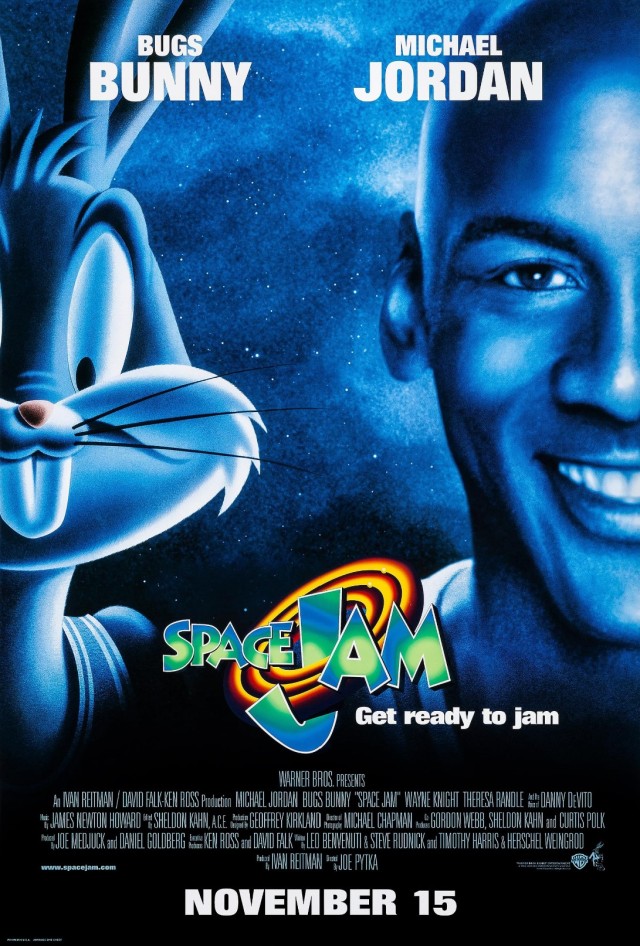
Space Jam (1996) poster created by Warner Bros. Family Entertainment, Northern Lights Entertainment, Courtside Seats Productions, and Warner Bros.

Things I like about the film:

The animation: In the 1990s, a trend in animation was the adoption of bright colors. Whether it was the Disney Renaissance or the first creatures in the world of Pokémon, bold hues and color schemes dominated both big and small screens. Space Jam follows this trend in various ways. One great example is the locations in the film’s animated world. There is a shot in the movie of the gym where Michael and the Looney Tunes train for their upcoming basketball game. The gym itself boasts a bright coral exterior, with the building set against a blue sky and a green, grassy lawn. The film’s colors emphasize the fun and energetic nature of it’s animated landscape. They also provide pops of color that make animated characters and their world interesting to look at.

Before the release of Space Jam, the Looney Tunes were an animated collection with their distinct histories, stories, and even voice acting performances. When bringing these characters into one overarching story, it could have been difficult to adapt them from one medium to another. Yet, every Looney Tunes character featured in the movie looked, sounded, and acted consistently with their pre-established shows. This crucial creative decision allowed the story to maintain a strong sense of continuity. It also gave audience members of all ages an opportunity to enjoy watching the Looney Tunes and their antics.

The messages and themes: At the beginning of Space Jam, Michael Jordan decides to take a break from the world of basketball to pursue a baseball career. According to the movie’s introduction, baseball is a sport Michael cared about. Yet, joining Major League Baseball (MLB) was a new direction in Michael’s career. His baseball endeavors aren’t as fruitful as his basketball endeavors. Yet, there are people surrounding Michael who are supportive of his decision. What this part of the story showed me was how one shouldn’t be afraid to try new things. Even when someone has a forte and has achieved their full potential, it could be beneficial to expand their horizons. That message can be a valuable lesson for younger viewers and a message older viewers can appreciate!

The humor: Animation and humor typically go hand in hand. Space Jam is no exception, as there were moments within this story I found genuinely funny. One way humor was incorporated into the film was through the dialogue. After Bugs Bunny and Daffy Duck retrieve Michael’s basketball attire, Daffy said they should name their team ‘The Ducks’. Bugs then responds by asking “Why would a Mickey Mouse corporation name their team ‘The Ducks’”? This question was meant to poke fun at Disney’s program, The Mighty Ducks. What added to the humor of this conversation was how the dialogue fit the personality of these characters.

What I didn’t like about the film:

Parts of the story that don’t make sense: In Space Jam, several basketball athletes have mysteriously lost their athletic abilities. This causes concern amongst the league’s other basketball teams. It gets to the point where the basketball season ends early. Here’s where the story doesn’t make sense: the film shows the National Basketball Association’s (NBA’s) season taking place at the same time as the Major League Baseball’s (MLB’s) season. A typical MLB season will take place between April to October, while the NBA runs their season from about fall to early summer. The only time these leagues’ schedules overlap is when the NBA Finals happen. With all that said, the basketball season in Space Jam would almost be over, with the Finals on the horizon. Yet, none of the characters bring up the Finals. This is just one example where the story doesn’t make sense.

A disjointed story: As I just mentioned, some basketball athletes have mysteriously lost their athletic abilities in Space Jam. Meanwhile, the Looney Tunes recruit Michael Jordan to compete in a basketball game in space. Because Michael spends most of the movie in the animated world, his story and the story of the basketball athletes feel like two separate stories, with a very loose connection to one another. When the film goes back and forth between the stories, the transitions are abrupt, with little segue provided. These creative decisions led Space Jam to feel disjointed.

The underutilization of Lola Bunny: Lola Bunny has found a place for herself in the world of Looney Tunes. From what I remember, she was prominently featured in Space Jam’s marketing. Yet in the movie, prior to the basketball game itself, Lola appears in only two scenes. Her first appearance took place forty minutes into an hour and twenty-seven-minute film. I’m unsure when Lola made her debut in the Looney Tunes universe. But if Space Jam was meant to be her introduction, I was disappointed by how unceremonious it was.

Collection of white rabbit images created by freepik at freepik.com Hand drawn vector created by freepik – www.freepik.com

My overall impression:

There are two categories for films that are products of their time; those that are dated on arrival and those that serve as a visual time capsule for when the movie was released. Space Jam belongs in the latter category, presenting a slice of the ‘90s through a combination of animation, athletics, and intergalactic silliness. Speaking of the animation, I was surprised by how the character designs, background designs, and blend with live-action mostly aged well. Though innovative at the time, this blend serves as an example of the creativity ‘90s animation has to offer. It was also interesting to see Michael Jordan’s career incorporated into the story, showing the audience how anyone, even the most celebrated of athletes, can try new things. Space Jam is, in my opinion, a fine film. Even though I won’t reflect on this movie as fondly as other films, I am glad I finally saw it in its entirety.

Overall score: 7.1 out of 10

Have you watched Space Jam? Which animated film from the 1990s do you like? Tell me in the comment section below!

Have fun at the movies!

Sally Silverscreen
Take 3: Amazing Grace and Chuck Review (Atticus and Boo Double Feature Part 2)

As I stated in my review of The Terry Fox Story, I chose to review two movies for the Atticus and Boo Blogathon; one from Gregory Peck’s filmography and one from Robert Duvall’s filmography. Both films were released in the ‘80s and they both have something to do with athletics. In the second part of this double feature, I’ll be writing about the 1987 movie, Amazing Grace and Chuck! This is a movie I had not heard about until this year. However, I found the concept of an athlete giving up their sport because of their views on nuclear weapons interesting. I also thought it would be interesting to see Gregory Peck portray a fictional President. As you may know, I enjoy finding movies that are “hidden gems”. Because Amazing Grace and Chuck is an ‘80s film that has, more often than not, flown under the radar, I took advantage of the opportunity to talk about it on 18 Cinema Lane!

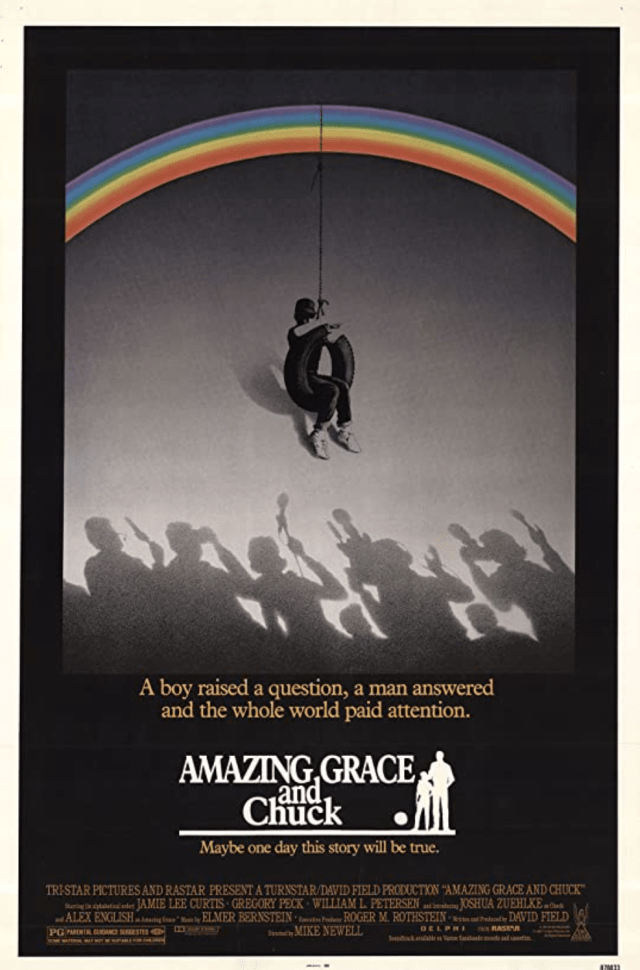
Amazing Grace and Chuck poster created by TriStar Pictures.

Things I liked about the film:

The acting: Like my review of The Terry Fox Story, I will talk about Gregory Peck’s performance first. I liked seeing his portrayal of the President, even though he was in the film for a short amount of time. The same professionalism Gregory brought to his role in To Kill a Mockingbird could be seen in Amazing Grace and Chuck! Not only that, but he also carried himself in a classy manner. Another stand-out performance came from Joshua Zuehlke! In this movie, he did a good job showing what a child would likely experience when dealing with such a complicated topic. One of his best scenes was when Chuck’s father is telling his son about how their family’s lives have changed because of Chuck’s decision to walk away from baseball. While Joshua doesn’t say anything in this scene, his facial expressions of sadness and concern tell the audience everything they need to know. Over the course of the story, Chuck develops a friendship with a basketball athlete named Amazing Grace. This friendship shows that each cast member had good on-screen chemistry with one another and how good of an actor Alex English was in this movie! What made Amazing Grace a memorable character was Alex’s charisma. With a bright smile and an easy-going demeanor, Alex gave Amazing Grace a great on-screen personality that helped him be likable!

The scenery: A pleasant surprise in Amazing Grace and Chuck was the scenery! Most of the story takes place in Livingston, Montana. According to IMDB, parts of the movie were filmed in Livingston and Bozeman. The natural landscapes of the Treasure State take center stage when scenes take place outdoors. Mountains and hills proudly stand tall in the background. In a sweeping overhead shot, a color scheme of green and yellow with a splash of purple could be found in the foliage below. Before a nuclear weapon was shown on screen for the first time, a field represented the calm before the storm. Parts of this movie was also filmed in Boston, Massachusetts. In this particular location, there was some photogenic areas! One great example is when Lynn Taylor, Amazing Grace’s manager, is sitting on the side of a river. This spot presented a visual contrast to its city roots, promoting tranquility among the hustle and bustle of Boston.

An educational approach: When a real-life, debatable topic is featured in a film, both sides of the issue are presented. It can be interesting to see the various perspectives of any subject. But when a movie’s creative team makes this decision, they assume their audience is already educated on the film’s topic. In Amazing Grace and Chuck, the subject of nuclear weapons was introduced as Chuck and his classmates go on a field trip to see a missile. During the trip, facts were delivered to the children and the audience. However, it never felt like the tour guide was talking down to anyone. What it did instead was address the issue and show why it was important. When Chuck quits baseball, it simply shows someone expressing their beliefs. This presentational style is one that I don’t often see in films of this nature.

The Atticus and Boo Blogathon banner created by Rebecca from Taking Up Room.

What I didn’t like about the film:

More telling than showing: Throughout the film, characters told one another how bad things were getting. However, the audience never got to see these things happening. In one scene, the President tells Chuck how there was a protest at a soccer game. He also tells Chuck there is an ice cream stand dedicated to him. The events are not shown on screen, so the audience is forced to take the characters’ word for it. If the audience were given the opportunity to see these events, it would have shown the magnitude of Chuck’s choice to quit baseball.

A whole lot of nothing: The story of Amazing Grace and Chuck revolves around two athletes who choose to quit their beloved sports until all nuclear weapons are dismantled. While this overarching conflict does get resolved, it doesn’t happen until the last ten to fifteen minutes of the movie. For the majority of the film, it seems like the characters are waiting for something for happen instead of actually trying to make things happen. The audience can see other athletes who have joined the cause making international calls. But this was one scene in an hour and fifty-four-minute movie. In fact, it feels like more emphasis was placed on Amazing Grace’s attempts to renovate a run-down barn than on the film’s overarching conflict.

Things happening too quickly: There are several times when things happened too quickly in Amazing Grace and Chuck. At one point in the story, Amazing Grace and Chuck are kidnapped by two football athletes. The moment itself happened suddenly with no forewarning or build-up. When it’s revealed these football athletes support Chuck’s cause, it is implied they personally know Amazing Grace. However, it is never explained how these athletes know the basketball star. Because of the lack of explanations, moments appear too quickly in the story with little to no context.

Military plane image created by Brgfx at freepik.com. <a href=”https://www.freepik.com/free-photos-vectors/background”>Background vector created by brgfx – http://www.freepik.com</a>. Image found at freepik.com.

My overall impression:

While watching Amazing Grace and Chuck, I could tell the film’s creative team had their hearts in the right place. At the same time, it seemed like their minds thought the film would make a bigger statement than it did. As I said in the introduction, this is a movie I hadn’t heard of until this year. It also doesn’t help when the characters seem like they aren’t doing much to find a resolution to their conflict. Something that worked against this story’s favor was featuring a complicated topic that does not have an easy answer. Watching characters build their way toward a solution can be engaging to see. Throughout the movie, I felt like I was watching two separate movies that were loosely woven together. Chuck’s story and Amazing Grace’s story could have existed in their own universes; one about a child trying to make a difference in the world and the other about a superstar athlete choosing to remind himself of what is really important in life. There are two kinds of films from the past; those that stand the test of time and those that are a product of their time. Amazing Grace and Chuck, in this case, leans more toward the latter.

Overall score: 6 — 6.1 out of 10

What are your thoughts on this double feature? If you have seen Amazing Grace and Chuck or The Terry Fox Story, which film is your favorite? Please tell me in the comment section!

Have fun at the movies!

Sally Silverscreen