Take 3: Roman Holiday Review

Reviewing Roman Holiday is a full circle moment for me. Back in 2019, the Hallmark Channel movie, Rome in Love became one of the top three best films I saw that year. That movie was about a woman starring in a remake of Roman Holiday. I also read the book Rome in Love was based on. When I signed up for the Journey to Italy Blogathon, I was surprised no one had chosen the 1953 production. Because Roman Holiday is considered a “classic”, I would have expected the movie to be one of the first to be selected. So, I was grateful for the opportunity to check out the film! Audrey Hepburn and Gregory Peck are no strangers to 18 Cinema Lane. Some of their films have been covered on my blog. In fact, there’s been a few pictures I’ve liked; such as Funny Face, The Nun’s Story, and To Kill a Mockingbird. How does Roman Holiday compare to those movies? Find out in this review!
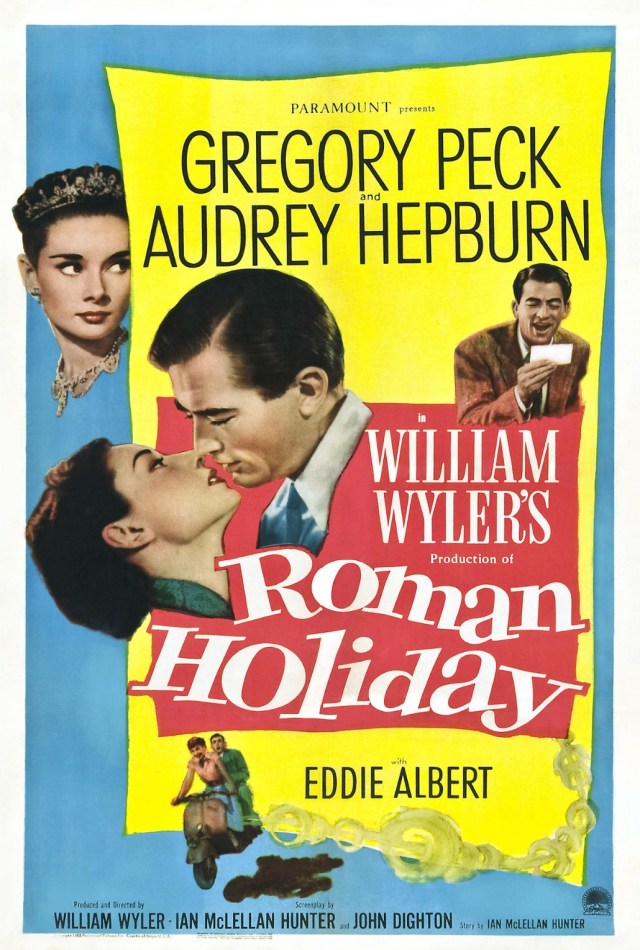
Roman Holiday poster created by Paramount Pictures

Things I liked about the film:

The acting: Roman Holiday introduced cinema’s audience to Audrey Hepburn as a lead actress. Not only that, the 1953 presentation earned Audrey an Oscar. Thinking about her portrayal of Princess Ann, I can understand why Audrey was, at least, nominated for an Academy Award! Even though this was her first starring role, Audrey proved her talents were strong enough to appear convincing. A great example happened when Princess Ann was sleepily wandering around Rome. Through her wanderings, Princess Ann meets Joe Bradley (portrayed by Gregory Peck). The stumbling and mumbling of Princess Ann make her look drunk. Even Joe thinks Princess Ann had too much to drink, due to her speech sounding slurred and her eyelids consistently rising and falling. In Audrey’s performance, Princess Ann proves looks can, indeed, be deceiving.

One of my favorite scenes in Roman Holiday takes place toward the beginning of the story. During a ball, Princess Ann’s shoe is visible on the floor. The shoe was noticed by Countess Vereberg (portrayed by Margaret Rawlings) and General Provno (portrayed by Tullio Carminati). But the way these characters looked at each other and the shoe communicated the shock and embarrassment they were feeling. With the use of eye movements and facial expressions, this exchange was such a hilarious moment! Another performance I liked was Gregory Peck’s portrayal of Joe Bradley! A newspaper reporter from the United States, Joe had a consistent confidence that made him sure of himself. His reactions appeared believable; from a surprised look at seeing Princess Ann’s portrait in the paper to the joy on his face while dancing on a boat. Gregory used a variety of emotions throughout the film. This is one of the reasons Joe became a likable character!

The Italian setting: During the opening credits of Roman Holiday, it’s revealed the production was filmed in Rome, Italy. Through the cinematography and screenwriting, Princess Ann’s time in Italy served as an introduction to the film’s audience. Several iconic landmarks were featured; including the Colosseum, the Trevi Fountain, and the Mouth of Truth. There were even some lesser-known areas from The Eternal City included in the story. During Princess Ann’s day in Rome, she and Joe visit a wall of granted wishes. As explained through dialogue, if someone’s wish came true, they must place a commemorative plaque on the wall. Unfortunately, I couldn’t find any confirmation this wall actually exists. But if it is real, I loved this tradition!

Avoiding the “it’s not what you think” cliché: In Roman Holiday, Joe Bradley makes a bet with his boss to conduct an interview with Princess Ann, including photos to prove the interview took place. This, along with Joe keeping his identity a secret, provided the perfect excuse to include the “it’s not what you think” cliché. However, the film’s creative team didn’t utilize this predictable piece of story-telling. Instead, Joe changes his mind about the bet, which gave him some character development. Even Joe’s friend, Irving Radovich, reconsiders submitting his photographs of Princess Ann’s adventure. After watching my fair share of rom-coms where the same tropes and clichés are incorporated, I appreciate Roman Holiday thinking outside the box!

The Journey to Italy Blogathon banner created by Gill from Realweegiemidget Reviews and Kristina from Speakeasy.

What I didn’t like about the film:

A drawn-out story: Roman Holiday has a run-time of one hour and fifty-eight minutes. While watching the movie, that run-time was felt. The story of Princess Ann running away to go on an adventure was drawn-out. One reason is how some moments are longer than necessary. A perfect example is when Princess Ann meets a group of reporters. Each introduction was a slow procession that seemed to last about a minute and a half. Another example is when Princess Ann’s governess reads an itinerary. She slowly reads each event listed on Princess Ann’s schedule, making that part of that scene feel like almost a minute had crawled. To avoid this flaw, the script needed to be tighter.

Little sense of urgency: As I already brought up in this review, Princess Ann runs away to go on an adventure. While Princess Ann was having the time of her life, those in her life were frantically trying to find her. But very few scenes stressed this point. In fact, only three scenes addressed the urgency of bringing Princess Ann home. By providing the story with little sense of urgency, the seriousness of Princess Ann going missing was downplayed. Though I recognize how Roman Holiday is primarily Princess Ann’s story, her actions having consequences were mostly ignored.

Almost no one recognizing Princess Ann: The reason Princess Ann spends time in Italy is because the country was included in her “goodwill tour”. Shortly after running away, Princess Ann’s portrait is printed in every Italian newspaper, according to Joe Bradley’s boss. However, throughout Princess Ann’s adventure, only two people recognize her; Joe and his friend, Irving Radovich. Even before Princess Ann receives a hair-cut, no one acknowledges her true identity. I know fictional stories like Roman Holiday require a suspension of disbelief. But I couldn’t take that part of the movie seriously.

Princess tiara image created by Freepik at freepik.com. <a href=’https://www.freepik.com/free-vector/ornamental-princess-crowns_1109199.htm’>Designed by Freepik</a>. <a href=”https://www.freepik.com/free-photos-vectors/gold”>Gold vector created by Freepik</a>. Image found at freepik.com.

My overall impression:

Before reviewing Roman Holiday, I had heard so many good things about the movie. As I said in the introduction, the film is considered a “classic”. This is definitely not a bad picture. But I wanted to like it more than I did. Roman Holiday’s run-time feels as long as it is. At almost two hours, the story is drawn-out, partly due to moments that last longer than necessary. Having little sense of urgency not only downplays the seriousness of Princess Ann running away, it also mostly ignored Princess Ann’s actions having consequences. However, I believe the 1953 production has merit. The acting was one of the strongest aspects of this movie. Like I said in my review, I can understand why Audrey was, at least, nominated for an Academy Award! I actually think Roman Holiday should have been included in American Film Institute’s 100 Movies list. According to IMDB, it was “the first American film to be made in its entirety in Italy”. While I’m thankful for the chance to have finally seen Roman Holiday, I prefer Audrey’s pictures like The Nun’s Story and Funny Face. For Gregory Peck, I still believe To Kill a Mockingbird is the stronger movie.

Overall score: 6.1 out of 10

Have you seen Roman Holiday? Which films from Audrey Hepburn’s or Gregory Peck’s filmography do you like? Please tell me in the comment section!

Have fun in Italy!

Sally Silverscreen
Take 3: Funny Face Review (Fred Astaire and Gene Kelly Blogathon Part 2)

For the second part of my Fred Astaire and Gene Kelly double feature, I’ve chosen to review the 1957 film, Funny Face! Last September, when 18 Cinema Lane received 135 followers, I reviewed my first Fred Astaire movie. That was The Sky’s the Limit, which I thought was just ok. Speaking of firsts, reviewing Funny Face is a first for 18 Cinema Lane, as it is the first musical film starring Aubrey Hepburn I’ve seen! Even though I have seen Breakfast at Tiffany’s and The Nun’s Story, those films would be classified as dramas. Since this was my first time seeing Audrey perform in a different genre, I was curious to see if she would be able to hold her own. When I read the synopsis for Funny Face, it sounded similar to another musical starring Audrey: My Fair Lady. Because I haven’t seen that movie, I can’t make a comparison between it and Funny Face.

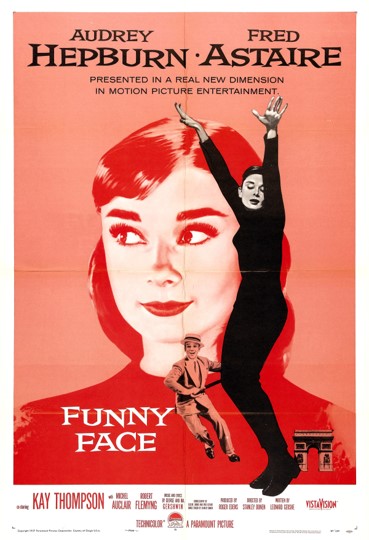
Funny Face poster created by Paramount Pictures.

Things I liked about the film:

The acting: The one word I’d use to describe the cast in Funny Face is comfortable. I chose this word because every actor and actress appeared comfortable in their role! This presented the characters as if they were real-life people dealing with real-life situations. Watching Audrey’s performance in this movie reminded me of her performance in The Nun’s Story for this reason: her character grows over the course of the movie. In Funny Face, Jo opens her heart and mind to a new chapter in her life that she never thought she’d embark on. She steps out of her comfort zone to not only follow her dream of meeting her favorite philosopher, but she also creates new dreams for herself. Audrey’s ability to adapt to any scenario helped her make Jo’s journey seem believable! As I mentioned in the introduction, I saw The Sky’s the Limit last September. Personally, I liked Fred’s character in Funny Face more than his character in the 1943 film. This is because Dick Avery had a better personality. He came across as easy-going and approachable, someone who you would want to tour Paris with. This made Dick Avery worth rooting for! Kay Thompson stood out to me as Maggie Prescott! While her character was no-nonsense and straight-forward in what she wanted, she was never cold-hearted or mean for the sake of it. This is different from other characters of this specific type. What’s also different is how Maggie was allowed to be silly, as could be seen when she and Dick are attempting to find Jo at the home of Jo’s favorite philosopher. This gave Kay an opportunity to apply her acting abilities to various situations!

The use of color: I love how color was used in Funny Face! Whenever scenes had a primarily plain color palette, like white or beige, objects or pieces of clothing were added to bring a pop of color to the space. The opening scene is such a great example! Each door of Quality magazine’s office was painted a bright shade of various colors, providing visual appeal to a mostly white lobby and hallway. Maggie’s office adopted a beige hue for about 85% of that location. However, certain pieces of fabric and even an assistant’s green coat add bold colors to a place that would have remained dull without them. This decision to use color was very detail oriented and showed how the film’s creative team really paid attention to how their project would be presented!

The musical numbers: Funny Face’s musical numbers were not only entertaining to watch, they also incorporated creative ideas that made them memorable. The very first musical number, “Think Pink!”, showed a montage of the different ways the color pink could be worn. Through the use of colorful visuals, it helped illustrate the point Maggie was trying to stress to her assistants as well as the audience. “Bonjour, Paris!” showed Maggie, Dick, and Jo simultaneously in a split screen shot. I have never seen a musical use a split screen before, so this detail is the one I remember the most! Each performer in these musical numbers looked like they truly enjoyed what they were doing! “Basal Metabolism” showed Audrey Hepburn having fun performing her dance trio. She appeared in her element and joy radiated from her routine. This definitely added to the overall enjoyment of Funny Face’s musical numbers!

Illustration of Paris, France created by Freepik at freepik.com. <a href=”https://www.freepik.com/free-photos-vectors/travel”>Travel vector created by freepik – http://www.freepik.com</a>. Image found at freepik.com.

What I didn’t like about the film:

No major conflict: While watching Funny Face, I noticed something was missing from this movie. That would be a major conflict, which I think would have made the story a little more interesting. Smaller conflicts, like finding a new face for Quality magazine, kept the film moving forward. But, because a major conflict was absent, it made situations feel like they worked out too easily in the characters’ favor. One idea could have shown Dick struggling to decide if he should continue to be a fashion photographer or become a stage performer. If this would have been a conflict in the story, it would have presented a mystery as to which career path Dick will choose.

A prolonged transformation: Like I said in the introduction, I haven’t seen My Fair Lady. Therefore, I can’t compare the two movies. What I will say about Funny Face is how Jo’s transformation doesn’t happen until the film’s halfway point. In the first half of the story, Jo’s perspective starts to change, allowing her to expand her intellectual horizons. But the physical transformation, from bookworm to fashion model, happens a lot later than most movies of this nature. When a character makes a dramatic change to their appearance, that moment may be the audience’s most anticipated moment. If they are forced to wait too long, they may start to lose interest.

An attraction that happened too quickly: In my review of The Crow: City of Angels, I pointed out how, to me, Ashe and Sarah’s attraction for one another was a flaw of that movie because it came about so quickly. The attraction between Jo and Dick in Funny Face makes the same error, as it also happens too quickly. Minutes after meeting for the first time, Jo and Dick share a kiss. Shortly after this encounter, Jo sings “How Long Has This Been Going On?”, a song about falling in love. If this song had been sung later in the film, after she had spent more time with Dick, the song itself would have been more impactful. Even though it is somewhat predictable for Jo and Dick to form a relationship, it should have taken its time to come to fruition.

With Glamour & Panache: A Fred Astaire & Gene Kelly Musicals Blogathon banner created by Heidi from Along the Brandywine.

My overall impression:

Funny Face is a film I had heard of for years, but had never seen. Whenever I heard about classic films or even movies starring Aubrey Hepburn, this film has, more often than not, been brought up. Now that I have seen Funny Face, I have developed an understanding for why this is the case. This is not just a good musical or a good Audrey Hepburn title. It is a good movie in general! Creative ideas within this project help it stand out. Some examples include using a split screen and incorporating objects with color into scenes with plain color palettes. Musical numbers were well-choreographed, featuring performers that appeared to enjoy the material they were given. Every actor and actress seemed comfortable in their roles, giving their characters a life of their own. While Funny Face does have its strengths, it has its weaknesses as well. Just one example is how Jo’s transformation happens much later in the film. Despite having seen only two of Fred Astaire’s movies, I’d pick Funny Face over The Sky’s the Limit. I would even choose Funny Face over Take Me Out to the Ball Game!

Overall score: 7.8 out of 10

Have you seen Funny Face? Which Fred Astaire musical is your favorite? Please share your thoughts in the comment section!

Have fun at the movies!

Sally Silverscreen

Take 3: The Nun’s Story Review (A Month Without the Code — #4)

When I was choosing films to review for the A Month Without the Code blogathon, one of the movies that I wanted to see was The Nun’s Story. This is a film that I had never heard of until I read Debbie’s (from the blog, Moon in Gemini) review. After reading that article, I found the story of The Nun’s Story to be fascinating. I was especially curious to see how the concept of someone joining a Religious Order would be included. In movies that feature characters who are members of a Religious Order, the process of becoming a member is not often shown. Since The Nun’s Story was going to air on Audrey Hepburn’s day during the Summer Under the Stars marathon on Turner Classic Movies (TCM), this inspired me to make the decision to talk about Non-Code films for both the A Month Without the Code and Summer Under the Stars blogathon! Before watching The Nun’s Story, I saw Breakfast at Tiffany’s, which was the only film of Audrey’s that I had seen. Choosing this film for these blogathons has given me the opportunity to watch more of Audrey’s movies!

The Nun's Story poster
The Nun’s Story poster created by Warner Bros. Image found at https://www.warnerbros.com/news/articles/2019/07/12/60-years-nuns-story.

Things I liked about the film:

The acting: As I said in the introduction, the only other film of Audrey’s that I’ve seen is Breakfast at Tiffany’s. Her role in The Nun’s Story is very different from her aforementioned film. For one thing, there were times when her character, Gaby, was supposed to be silent due to the rules of the congregation. Audrey used this part of the script to her advantage by relying on her facial expressions as much as possible. An example of this is when Gaby is told that she will have to purposefully fail her exam in order for another Sister to pass. Audrey’s reaction allowed her character to say so much while using so few words. While watching this film, there was one performance that I felt needed to be addressed. During the story, Gaby is assigned to work in a psychiatric hospital, where she encounters a patient known as “Archangel Gabriel”. This character was portrayed by Colleen Dewhurst. Despite the fact that her screen-time was limited and that she was given very few lines, Colleen relied on facial expressions and emotions to bring her character to life. A perfect example is the scene where “Archangel Gabriel” asks Gaby for a glass of water.

The process of becoming a Nun: When it comes to movies featuring members of the Religious Order, the process of becoming a member is rarely featured. In The Nun’s Story, this process is thoroughly explored, allowing for this part of the story to be interesting and informative. It wasn’t just limited to a certain section of the film. The process is even observed after Gaby becomes a Nun. When she finally gets to do service work in the Congo, she still finds herself facing challenges and obstacles. This shows that being human is an on-going process, complete with personal growth and reflection. It also makes the character of Gaby relatable.

The messages and themes: Throughout this film, there were lots of messages and themes that I found relatable, even if Gaby’s specific experience isn’t relatable. An overarching example is the twists and turns that happen in Gaby’s life before her dream of volunteering in the Congo is realized. Life is unpredictable, with a limited amount of aspects being in our control. In The Nun’s Story, Gaby faces several situations that prevent her from achieving her dream. However, she never gave up and continued to work very hard toward her goals. Other messages and themes that are found in this movie were personal responsibility, honesty, and taking time to care for one’s self.

A Month Without the Code banner
A Month Without the Code Blogathon banner created by Tiffany and Rebekah Brannan from Pure Entertainment Preservation Society. Image found at https://pureentertainmentpreservationsociety.wordpress.com/2019/07/31/announcing-amonthwithoutthecode65/.

What I didn’t like about the film:

A limited amount of character development: Even though The Nun’s Story had a large cast, the film’s character development was very limited. For the character of Gaby, there is some character development to be found. However, because the story focuses more on Gaby’s journey of becoming a Nun, her character development seemed to sit on the side-lines. For the rest of the characters, their character development was either at a minimum or nonexistent. While the audience gets to become familiar with the characters, they never really get to know them.

Some segments being shorter than others: Because the narrative of The Nun’s Story focused on Gaby’s journey of becoming a Nun and her volunteer work in the Congo, other aspects of the story were shown in shorter segments. The beginning of World War II is a good example of this. Even though enough was shown to give audiences the intended point, it wasn’t explored as much as other parts of the film. If anything, it just felt like another stepping stone in Gaby’s journey.

Summer Under the Stars banner
Summer Under the Stars Blogathon banner created by Kristen from Journeys in Classic Film and Samantha from Musings of a Classic Film Addict. Image found at https://journeysinclassicfilm.com/2019/07/08/the-2019-tcm-summer-under-the-stars-blogathon/.

My overall impression:

Before and after Turner Classic Movie’s (TCM’s) presentation of The Nun’s Story, Ben Mankiewicz shared that Audrey’s favorite role in her career was her role in The Nun’s Story. After watching the movie, I can kind of understand why she would be so fond of this role. It’s very different from her other roles and the story itself is much more serious than some of her other films. Because of this, it allowed Audrey to become an even more well-rounded actress by exploring various acting methods. The Nun’s Story features a narrative that is rarely seen in films of its kind: the process of becoming a member of the Religious Order. Since this story filled a void that no one else had, it helped the movie bring a sense of uniqueness to cinema. Out of all the films I’ve seen for “A Month Without the Code”, I’d say that The Nun’s Story is one of the “cleaner” ones! It was even given a Production Code Administration seal of approval, the same one that was seen in the opening credits of many Breen Code films! There are only two things that I found that would have to be changed or eliminated if this film were released during the Breen Code era. The first is the underlying racism that can be found when Gaby goes to the Congo. Because this story takes place in the 1930s, I’m guessing that the inclusion of this topic was meant to provide commentary about the views of that time-period. The second is naked babies being shown on-screen. Since this happened in only one scene, these babies were not featured for very long.

Overall score: 7.8 out of 10

Have you seen The Nun’s Story? Which movie of Audrey’s would you like to see me review? Please share your thoughts in the comment section!

Have fun at the movies!

Sally Silverscreen

If you want to read Debbie’s article about The Nun’s Story, visit this link:

A Woman at War With Herself: The Nun’s Story (1959)