Revisiting my Hallmark Hall of Fame Tier Rank List!

Three years ago, I created a tier rank list of every Hallmark Hall of Fame movie I’d seen. These films were categorized by my overall impression of each presentation. In honor of 18 Cinema Lane turning five, I promised my readers I would revisit one of my past articles. I’ve seen more Hallmark Hall of Fame movies since I published my original tier rank list, so that’s the article I’ve selected! Along with adding more Hallmark Hall of Fame productions, I changed the names of each tier category. This decision was made to better reflect whether a film is worth its retail price of twenty dollars a DVD compared to its quality. The new tier category names are the following:

Bottom of the Barrel – Not Even Worth a Dime

Ok – Catch it on TV/Youtube

Decent/Fine – Bought It at a Garage Sale for a Dollar

Good – Get It On Sale for Half Off

Great – Where Do I Pay Full Price?

For each movie I added or moved to a different tier, I will share my thoughts on them. If I wrote about a movie on my blog, I will add the link to this article.

Screenshot taken by me, Sally Silverscreen

Bottom of the Barrel – Not Even Worth a Dime

Durango

Reviewed for the Legends of Western Cinema Week Blogathon, I stated Durango should have been a David and Goliath story. That’s because a David and Goliath reference was placed within the last nineteen minutes of the movie, the creative team’s attempt to include a higher stake into the story. But this attempt didn’t work because the majority of the film had lower stakes. The protagonist and his plan to transport cattle worked out perfectly, too perfectly for the standards of the western genre. This takes away any room for concern the audience could have for the characters and their well-being.

Take 3: Hallmark Hall of Fame’s Durango Review

Journey

As I explained in my list of the top ten worst movies I saw in 2022, the audience was not given a reason to care about the characters and their story in Journey. This flaw was achieved because the film’s creative team didn’t provide explanations for the characters’ choices. It also did not help how annoying Grandpa Marcus was, his photography hobby becoming an obsession. A major theme of Journey is memories being irreplaceable. That theme was poorly delivered in Journey, as Marcus’ hobby creates a plot hole within the story. Also, I’ve seen Hallmark Hall of Fame movies express this theme better, such as The Lost Valentine.

A Place for Annie

When it comes to movies that are products of their time, they can fit into one of two categories: movies that serve as visual time capsules and those that are dated on arrival. A Place for Annie, sadly, falls into the latter category. The majority of the story focuses on the medical information of HIV/AIDS that was known during the late ‘80s to mid ‘90s. That focus causes the film to show its age more obviously. The way foster care/adoption is discussed in this story is so oversimplified, I couldn’t take that part of the movie seriously. Similar to what I said about Journey, the theme of adoption is expressed better in other Hallmark Hall of Fame stories, like Redwood Curtain.

The Corsican Brothers

Alexandre Dumas’ stories are, more often than not, filled with adventure, intrigue, and suspense. But in the case of The Corsican Brothers, these elements were lacking. Granted, I still haven’t read the book this movie is based on. Though I do wonder how similar the 1985 adaptation is to the source material? If the original story primarily revolves around Louis attending fancy events in Paris, that would explain why the adaptation is so underwhelming. However, the original story could explain some of the confusing parts of the movie, such as the woman giving some of the characters fates.

Take 3: Hallmark Hall of Fame’s The Corsican Brothers Review

Ok – Catch it on TV/Youtube

The Summer of Ben Tyler

The 1996 movie, The Summer of Ben Tyler, feels like Hallmark Hall of Fame wanted to create their own version of To Kill a Mockingbird. Upon reflection of this film, it doesn’t seem like the creative team displayed a strong understanding for what made Harper Lee’s story work. If anything, it feels like ideas are copied from Harper’s novel and pasted into the Hallmark Hall of Fame presentation, making The Summer of Ben Tyler a little too similar to To Kill a Mockingbird. This is a case of if you’ve seen one movie, you’ve basically seen the other. So, if you’ve seen the adaptation of To Kill a Mockingbird, you’ve already seen The Summer of Ben Tyler.

Decoration Day

The way I feel about Decoration Day is similar to Promise; the majority of the story is very “slice-of-life”. To me, this makes both films less memorable than other Hallmark Hall of Fame titles. However, I did find Gee Pennywell’s dilemma over receiving the Congressional Medal of Honor the most interesting part of the movie. In fact, I wish Decoration Day had solely revolved around that dilemma.

Foxfire

Hallmark Hall of Fame has a history of adapting plays into films. Sometimes, a movie’s creative team will take advantage of the expansive nature of cinema, allowing the story to move beyond the boundaries of the stage. For Foxfire, though, the story was confined to the four walls of Annie’s house. A smaller cast and a condensed story also caused the 1987 Hallmark Hall of Fame project will feel more like a televised play. If I choose to watch Hallmark Hall of Fame film, I expect to watch a film. Foxfire subverted my expectations, but in a disappointing way.

Take 3: Hallmark Hall of Fame’s Foxfire Review

Calm at Sunset

Calm at Sunset is one of those movies where better, more interesting ideas were woven into the fabric of this story. One example is when the protagonist spots a cruise ship and imagines the types of people aboard that ship. Honestly, I wish Calm at Sunset was about that cruise ship instead. Similar to what I said about The Corsican Brothers, I haven’t read the book this movie is based on, so I don’t know which parts of the production came straight from the source material. If the book is pretty close to the film, it would explain why the adaptation was lackluster.

Witness for the Prosecution

Based on the adaptations of Agatha Christie’s books I’ve seen, the protagonist will play an active role in solving the mystery. Witness for the Prosecution is the exception to this statement, as Wilfred focuses more on the legal case he’s working to resolve. In a story where the protagonist doesn’t actively solve the story’s mystery, it can be difficult to get the audience invested in the story itself. Because Wilfred’s case is the primary focus of the story, the film is more dialogue heavy, putting emphasis on telling instead of showing. Hallmark Hall of Fame’s Witness for the Prosecution is a mystery that is light on the mystery.

Take 3: Hallmark Hall of Fame’s Witness for the Prosecution (1982) Review

The Flamingo Rising

In my editorial about the adaptation of The Flamingo Rising, I explained how the story should have been adapted into a television show or a multi-part mini-series. This is because the story itself is drawn out over the course of the protagonist’s life. Reflecting on the adaption, it felt like Hallmark Hall of Fame tried to fit The Flamingo Rising into their brand of storytelling. In this attempt, several parts of the source material were omitted or changed due to them not being “Hallmark appropriate”. As I did in the aforementioned editorial, I questioned why Hallmark Hall of Fame would choose to adapt Larry Baker’s story over a story that was more “Hallmark appropriate”?

Four Reasons Why ‘The Flamingo Rising’s Adaptation is Different from its Book

O Pioneers!

Having read the source material and seen the adaptation of O Pioneers!, I can say the movie is respectful toward the book. With that said, if you’ve seen the film, you’ve already read the novel. Speaking of the adaptation, I said in my review how the story should have been adapted into a mini-series or a television show. With so many characters and so many parts of the story, maybe O Pioneers! would have benefitted from receiving more time. The 1992 Hallmark Hall of Fame presentation is a western that didn’t leave a memorable impression on me.

Take 3: Hallmark Hall of Fame’s O Pioneers! Review

Harvey

I’ve stated before on 18 Cinema Lane how the 1972 adaptation of Harvey is better than the original from 1950. While this statement is still true, the 1972 and 1950 versions of this story felt like a copy of one another. It makes me wonder why Hallmark Hall of Fame would choose to adapt Harvey if they knew they were going to make a lot of the same creative decisions as the original film? Despite the similarities, I did like the changes in the 1972 adaptation. One example is how the made-for-tv movie chose a dramatic tone for their version of the story instead of being both a drama and comedy.

Take 3: Hallmark Hall of Fame’s Harvey (1972) Review

Decent/Fine – Bought It at a Garage Sale for a Dollar

The Locket

For a movie titled The Locket, the locket itself is treated as an afterthought. What the story focuses on instead is the protagonist and his hardships. But from what I remember, the 2002 project addressed the importance of elder care. Since that topic is rarely brought up in Hallmark’s programming, I appreciate that creative decision. Marguerite Moreau is one of the reasons why I chose to watch The Locket. Her performance was so good, she ended up outshining the other actors in the movie! Unfortunately, Marguerite was kind of under-utilized in this film, as her on-screen appearances were not as consistent as I expected.

Take 3: Hallmark Hall of Fame’s The Locket Review + 225 & 230 Follower Thank You

Saint Maybe

I said in my review of Saint Maybe how the adaptation is faithful to the source material. However, there are changes the film made from the book. One notable example is how religion/faith is downplayed in the Hallmark Hall of Fame presentation. Meanwhile, religion/faith played a significant role in the novel. For years, Saint Maybe was included in Hallmark Movies & Mysteries’ ‘Miracles of Christmas’ marathon. Now that I have seen the adaptation, I understand why the network would make this decision. Personally, I wouldn’t call Saint Maybe a Christmas story/movie, as the story itself takes place over several years.

Take 3: Anne Tyler’s Saint Maybe Review (National Read a Book Day Double Feature Part 1)

The Lost Child

The Lost Child serves as a good introduction to Native American culture, specifically the Navajo culture. Through dialogue and character interactions, the audience receives a glimpse into life on a Navajo reservation. For the story itself, The Lost Child didn’t leave a strong impression on me. The most interesting part of the film, Rebecca’s search of her family, wasn’t emphasized as much as her adjustment to reservation life. Also, Rebecca’s search for her twin brother was abandoned after she meets her biological family.

Take 3: Hallmark Hall of Fame’s The Lost Child Review + 395 Follower Thank You

Loving Leah

I’ve finally seen Loving Leah in its entirety! The way I feel about the 2009 movie is similar to The Lost Child; it’s a good introduction to Jewish religion and culture. Throughout the story, the audience receives a glimpse into the many aspects of Jewish life. Like The Lost Child, Loving Leah didn’t leave as strong of an impression as other Hallmark Hall of Fame titles. From what I remember, the story was a little too drawn out. But from what I also remember, it was nice to see the protagonists’ relationship unfold. With all that said, the movie was pleasant!

Good – Get It On Sale for Half Off

An American Story/After the Glory

Since publishing my review of An American Story/After the Glory, it has become one of my most popular reviews, garnering 1,838 views and counting! The innovative and compelling nature of the project is likely the reason why this particular title is so well-received on 18 Cinema Lane! Like I said in my review, An American Story/After the Glory felt kind of ahead of its time. This feeling is achieved by incorporating the discussion of veterans’ mental health into the script. The way veteran related topics are included in the story is reverent and respectful. An American Story/After the Glory is definitely one of Hallmark’s better military themed productions!

Take 3: Hallmark Hall of Fame’s After the Glory Review + 195 Follower Thank You

The Love Letter

The Love Letter is one of Hallmark Hall of Fame’s more unique titles, as fantastical elements are rarely found in this collection of films. Yet this part of the story worked in the 1998 movie, helping to create a love story that was simple yet intriguing! The characters were not only well written, but also well-acted! Since the protagonists were multi-dimensional, their connection throughout the film was interesting to watch. I also liked the historical accuracy in The Love Letter, as the attention to detail was handled with care!

Take 3: Hallmark Hall of Fame’s The Love Letter Review

Redwood Curtain

In my five years of movie blogging, I have discovered very few films that were better than their respective source material. Hallmark Hall of Fame’s Redwood Curtain is one of those films, as I found myself liking it over the play! The movie’s creative team took advantage of the expansive nature of cinema, broadening the horizons in Geri’s life. More characters were added to the story, giving them characterization that the play didn’t provide. Geri’s personality was more likable in the movie, which made me like her as a character. Redwood Curtain is a Hallmark Hall of Fame presentation I wish was re-released on DVD.

‘Redwood Curtain’: From Stage to Screen

Great – Where Do I Pay Full Price?

Caroline?

As of the publication of this list, Caroline? is, so far, the best movie I’ve all year! That’s because the 1990 production is a close to perfect example of what a Hallmark Hall of Fame presentation can and should be. From the younger actors’ performances to the differentiation of time, I could tell there was a lot of effort and care put into this project! Even though the story of a long-lost family member’s return is nothing new, the way Caroline? was written was creative, allowing this story to have its own identity. This movie is one I wish more Hallmark fans acknowledged!

Take 3: Hallmark Hall of Fame’s Caroline? Review + 460 Follower Thank You

A Tale of Two Cities

During my blogging years, I have seen Charles Dickens adaptations I have liked. The 1980 version of A Tale of Two Cities is definitely one of those films! Despite the movie being two hours and thirty-six minutes, the story never felt too long. The immersive nature of the story helped the pacing, as I was invested in what was happening on screen. This Hallmark Hall of Fame production was so good, it makes me want to read the source material! It’s also another film from this collection that deserves more recognition!

Take 3: Hallmark Hall of Fame’s A Tale of Two Cities Review

Have fun at the movies!

Sally Silverscreen

My Conclusion to the National Read a Book Day Double Feature

For the remaining days of October, I will try my best to “clean house”. This means I will be publishing articles that I’ve been meaning to post for some time. One of these posts is my conclusion to last month’s National Read a Book Day Double Feature! In September, I sought to answer the question, Would these adaptations [of Saint Maybe and At Home in Mitford] encourage the viewers to read their source material or any other book? Now that I’ve seen and reviewed both films, I’ve come to the realization how difficult it is to answer this question.

Library image created by Freepik at freepik.com. <a href=’https://www.freepik.com/free-photo/stack-of-books-on-library-desk_2509490.htm’>Designed by Freepik</a>. <a href=”https://www.freepik.com/free-photos-vectors/school”>School image created by Freepik</a>. Image found at freepik.com.

While reading some of Saint Maybe’s reviews on IMDB, one of them stood out to me. Its title read “Made me want to read the book”. Written by someone named bkgmoonstar, they claim the movie was missing too much detail. After they read the novel, they said “the movie was actually quite faithful to the book”. This review represents the opinion of just one reader. There are many readers who choose to read a given book for various reasons. They also have their own preferences and literary interests.

Interior view of library image created by Macrovector at freepik.com. <a href=”https://www.freepik.com/free-photos-vectors/business”>Business vector created by macrovector – http://www.freepik.com</a>. Image found at freepik.com.

Like readers, there are many movie-goers with their own tastes in cinema. Some of the films of their choosing may be an adaptation. But even if they enjoy an adaptation, it doesn’t mean they’ll reach for the source material. This decision could be made for a variety of reasons. When I asked my aforementioned question in my reviews of Saint Maybe and At Home in Mitford, I wasn’t really able to give a definitive answer. That’s because the only reader I can speak for is myself. Therefore, if I had to answer the question, I think it all depends who you ask.

Have fun at the movies!

Sally Silverscreen

If you want to read the other articles associated with this double feature, I’ll provide the links here:

The National Read a Book Day’s Double Feature Introduction

Take 3: Anne Tyler’s Saint Maybe Review (National Read a Book Day Double Feature Part 1)

Take 3: At Home in Mitford Review (National Read a Book Day Double Feature Part 2)

Take 3: Anne Tyler’s Saint Maybe Review (National Read a Book Day Double Feature Part 1)

Happy National Read a Book Day! I want to let you know there will be spoilers for both the book and movie in this review. If you want to check out this double feature’s introduction, you can visit this link:

The National Read a Book Day’s Double Feature Introduction

Anne Tyler’s Saint Maybe poster created by Hallmark Hall of Fame Productions and CBS
1. How did you come to know of this film?

If you’ve been following my blog, you would know that my least favorite Hallmark Hall of Fame movie is Back When We Were Grownups. Like a lot of Hallmark Hall of Fame productions, the 2004 film was based on pre-existing source material; a novel written by Anne Tyler. Over the years, I discovered that two other Hallmark Hall of Fame movies have been based on Anne’s work: Breathing Lessons and Saint Maybe. Before this double feature, I had never seen either film. All I knew about Hallmark’s 1998 adaptation was that a man took in a deceased relative’s children and that the story had something to do with forgiveness. I also remember how the film would sometimes air during Hallmark Movies & Mysteries’ ‘Miracles of Christmas’ marathon.

2. How did you acquire this movie’s respective source material?

I purchased a second-hand copy of Saint Maybe at an estate sale earlier this year. As soon as I saw the book on a shelf, it reminded me of my Hallmark Hall of Fame Reading Challenge. Back in 2019, I created a reading challenge based on the books or plays that were adapted into Hallmark Hall of Fame titles. Since I’d like to read as many of these works as I realistically can, I purchased the book with that intention.

3. Have you read Anne Tyler‘s work before? What are thoughts on her writing?

As I said in the introduction, this was my first time reading anything by Anne Tyler. Based on what I read and based on what I saw in Back When We Were Grownups, I’m going to guess her forte is writing about larger families that are somewhat dysfunctional. Out of those two stories, I liked Saint Maybe more than Back When We Were Grownups. There was heart incorporated in the narrative and the Bedloe family had a legitimate reason for their dysfunctionality. I was also surprised by the inclusion of religion/faith. But I didn’t like how the chapters were too long. What Anne should have done instead is write shorter chapters and include them in separate sections for each character. I, personally, am not a fan of “slice of life” stories. About eighty percent of Saint Maybe is just that: a “slice of life” story. With all that said, I thought the novel was well-meaning and fine.

4. Was the movie different from its source material? If so, how?

For the most part, Saint Maybe was faithful to the source material, especially when it came to the most important parts of the story. But there were changes found in the adaptation. One of these changes was Agatha’s personality. In the book, when Agatha was introduced in the story as a young child, she came across as distant and matter-of-fact. As she grows up, Agatha comes to despise religion, as she feels religion was forced upon her life. The movie version of Agatha adopts the personality Thomas had in the book, coming across as sweet and mild-mannered. She grows up to be a friendly doctor who has no known opinion on religion. While she does criticize The Church of the Second Chance, she does this because she wants Ian to live his best life. Her criticism has nothing to do with religion itself.

Another difference between the movie and its source material is how Ian figures out the identity of Agatha and Thomas’ father. Agatha, in the book, is very protective over a jewelry box she claims belonged to her mother. Ian stumbles across this box by accident and finds Agatha’s and Thomas’ birth certificates among the jewelry and other items. These certificates reveal their father’s last name; Dulsimore. Ian learns this information differently in the movie. Similar to the book, Thomas and Agatha own a doll named Dulcimer. While Agatha is at Ian’s parents’ house, the audience can see her trying to remove something from the back of the doll. However, this information isn’t revealed until later in the movie. When the Bedloe family hires Rita diCarlo to organize their house, a lot of items end up getting thrown out. One of these items was Dulcimer the doll. As Ian is leaving the house, he sees the doll in a garbage bag. When he picks it up, he finds a slip of paper hidden in the doll’s back, revealing the doll’s name was also the last name of Agatha and Thomas’ father.

5. Do you think the movie was better than the book or was the book better than the movie?

Like its source material, I thought the movie adaptation of Saint Maybe was fine. Therefore, this is a difficult question to answer. But I will try to answer this question as best as I can by saying this: If you want to see a story about a family dealing with a personal tragedy, I’d recommend the movie. This is because the movie gets straight to the story’s point a lot sooner than the book did. If you’re interested in a story where the protagonist overcomes guilt and sin through religion/faith, I’d recommend the book. As I’ll explain later in this review, the movie didn’t feature religion/faith as much as in the book.

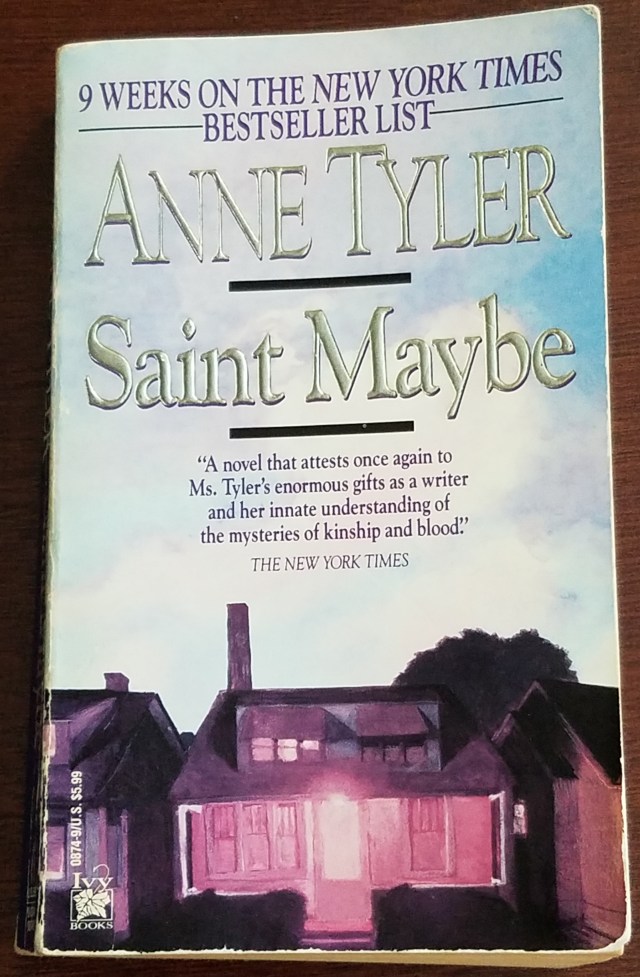
This is the copy of Saint Maybe I purchased earlier this year. Screenshot taken by me, Sally Silverscreen.
6. Saint Maybe and At Home in Mitford share some similarities, such as how both books were published in the 1990s. Are there any other similarities you can think of?

As I said in answer number three, I was surprised by the inclusion of religion/faith in Saint Maybe. Even though the movie and its source material are titled Saint Maybe, I wasn’t expecting religion/faith to play a large role in the text. But religion/faith is a cornerstone of both Saint Maybe and At Home in Mitford.  References to God, the Bible, and Christianity can be found in each book. However, the way both authors incorporated these ideas into their stories is very distinct.Throughout Saint Maybe, the congregation of The Church of the Second Chance obeyed a rule that forbade them from consuming sugar. While this rule seems ridiculous on the surface, it is used as a metaphor for sin. Reverend Emmett, the leader of The Church of the Second Chance, explains that if one actively avoids sugar, they are actively avoiding sin. If someone tries to make excuses for consuming sugar, they are making excuses for committing sin.

7. Should Hallmark adapt Anne Tyler‘s other work? If so, why?

As of early September 2021, Hallmark has not made any announcements on whether they are bringing back the Hallmark Hall of Fame collection. But if Hallmark does choose to create more Hallmark Hall of Fame titles and would like to adapt more of Anne Tyler’s novels, there are plenty of stories for them to choose from. According to Goodreads, twenty-four books written by Anne Tyler have not been adapted into a Hallmark production. Since I’ve never read any of those books, I can’t say which one is more deserving of receiving an adaptation. But if I had to pick at least one title Hallmark should adapt into a film, it would either be A Patchwork Planet or Digging to America. This is based on each book’s synopsis, as I have not read either book.

Personally, I wouldn’t be opposed to seeing Hallmark adapt more of Anne Tyler’s stories. Based on my experience with Saint Maybe, the movie was mostly faithful to the source material. So, with the right creative team involved, maybe another Anne Tyler story could be lucky enough to receive similar treatment. Because three of Anne Tyler’s books have been adapted into Hallmark Hall of Fame titles, it appears Hallmark has had a good working relationship with the author. I’m not sure how much creative control Anne had on either film. But if Hallmark wants to work with Anne again, I’m pretty sure an agreement between both parties could be reached.

8. Is there anything about Saint Maybe you liked or didn’t like?

Saint Maybe is a story that takes place over the course of several years. In the movie, there were subtle clues revealing which time period was portrayed on screen. One establishing shot showed a boy riding his banana seat bicycle down the sidewalk. This brief image indicated how that specific part of the story took place in the 1970s, as banana seat bicycles were popular within that decade. During the movie, Ian adopted a pair of large rimmed glasses. Because this style of glasses was common in the 1980s, Ian’s accessory is very telling of how much time had passed since the beginning of the film. Movies are a visual form of story-telling. So, I liked how the film’s creative team took the initiative to show the passage of time in a creative way.

 My favorite part of the book was when Daphne tried to set up Ian with her fifth-grade teacher, Miss Pennington. It was in this chapter that I started to like Daphne as a character, her free-spirited personality being introduced to me as the reader. Unfortunately, this part of the book wasn’t translated to the screen. I was disappointed by the omission of the book’s seventh chapter. The audience could have witnessed the evolution of Daphne’s personality, gaining an understanding of why she became who she was by the end of the story. Instead, there was a huge time jump from five-year-old girl to free-spirited woman. Because of missing context, this left questions without answers. But I recognize there is only so much story you can tell in eighty-four minutes.

Antique car image created by Freepik at freepik.com. <a href=’https://www.freepik.com/free-vector/red-classic-car_803652.htm’>Designed by Freepik</a>. <a href=”https://www.freepik.com/free-photos-vectors/vintage”>Vintage vector created by Freepik</a>. Image found at freepik.com.
9. Did you develop any thoughts and/or questions while watching this film?

While I didn’t develop any questions, I was surprised by how religion/faith was downplayed in Saint Maybe’s film adaptation. Yes, Ian’s introduction to The Church of the Second Chance was similar to the book. Agatha and Thomas tell Ian what they learned at summer camp, which was run by The Church of the Second Chance. Toward the end of the film, the Bedloe family are seen going to church. Other than these moments, religion/faith didn’t have an influence over the character’s lives. The Sugar Rule I talked about in answer number six was never brought up in the script. Reverend Emmett’s beliefs on how his congregation was led didn’t appear in any of the character’s dialogue. Even Reverend Emmett himself showed up in two or three scenes, having a much smaller presence than he did in the book. Saint Maybe’s film adaptation was released in 1998, a time when shows like Touched by An Angel were finding success on mainstream television. In hindsight, Hallmark choosing not to ride Touched by An Angel’s coattails kind of seems like a missed opportunity.

10. Would Saint Maybe encourage viewers to read either its source material or any other book?

I think it depends on what type of story someone wants to consume. As I said in answer number five, I’d recommend the book if you’re interested in a story where religion/faith is one of the key themes. But if you like films from the drama genre, those that explore relationships between characters, then the film adaptation is for you. I’ve said before that I am not a fan of “slice of life” stories. Like I mentioned in answer number three, Saint Maybe is primarily a “slice of life” story. If I hadn’t read the book beforehand, I would probably choose the movie over the text.

11. After watching this movie, is there anything you can take away from your movie viewing experience?

I now understand why Saint Maybe was sometimes shown during Hallmark Movies & Mysteries’ ‘Miracles of Christmas’ marathon. Several scenes took place during Christmas-time, with decorations associated with the holiday shown in the background. But I wouldn’t necessarily call Saint Maybe a Christmas story/movie. I said in answer number eight that this story took place over the course of several years. The themes and messages within the text are not exclusive to the Christmas season. In 2019, I created a tier rank list of every Hallmark Hall of Fame movie I’ve ever seen. Since posting that list, I have renamed each category. For Saint Maybe, I’d place this film adaptation in the category titled ‘Bought It at a Garage Sale for a Dollar’. The movie itself was fine, but I wouldn’t pay $20 if it was sold on DVD.

Have fun at the movies!

Sally Silverscreen

The National Read a Book Day’s Double Feature Introduction

Back in March, I published my review of The Abominable Dr. Phibes. That post became my 500th. Every time I publish 100 posts, I host a special double feature. For months, I was trying to find the right theme for these reviews. Remembering how my first milestone double feature was published on Halloween, I decided to commemorate another holiday. However, I wanted to choose a holiday that is lesser known. After doing some research on the internet, I learned National Read a Book Day is celebrated on September 6th. This caused me to remember how I not only had the 2017 movie, At Home in Mitford, on my DVR, but I also owned a copy of the book it is based on. Then I remembered I had a copy of Saint Maybe, the same book that was adapted into a Hallmark Hall of Fame film. That was when the idea for this double feature was born! With every double feature, I try to answer a thought-provoking question related to both films. Since I read both aforementioned books before watching each movie, I am asking the following question:

Would these adaptations encourage the viewers to read their source material or any other book?

Prior to this double feature, I had never read anything by Jan Karon or Anne Tyler. I also have never seen the Hallmark Hall of Fame adaptation of Saint Maybe before. But this will be my second time watching At Home in Mitford, as I first saw the film when it released in 2017. Similar to my PB & J double feature, there are no pre-movie thoughts and/or questions this time.

Happy reading place image created by Freepik at freepik.com. <a href=”https://www.freepik.com/free-photos-vectors/background”>Background vector created by freepik – http://www.freepik.com</a>. Image found at freepik.com.

Have fun at the movies!

Sally Silverscreen