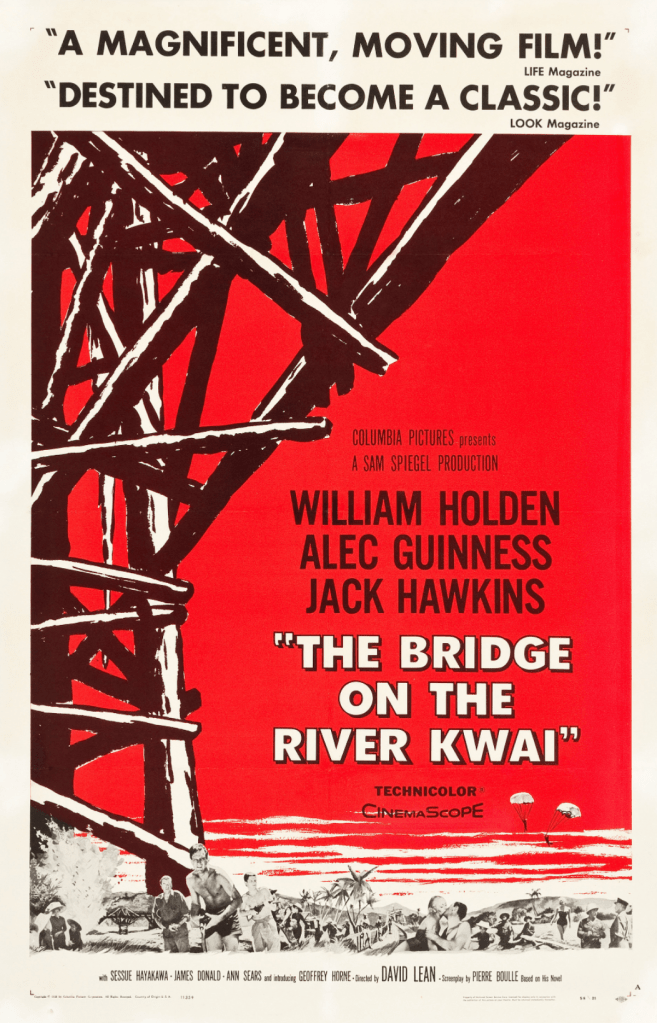
William Holden is an actor who I am familiar with. I have seen some of the films on his filmography and have even reviewed a few. So, when I came across the announcement post for The 5th Golden Boy Blogathon, I saw it as a great opportunity to explore William’s filmography some more! As I was signing up, though, I noticed how The Bridge on the River Kwai hadn’t been selected yet. Surprised by this, I found another good opportunity to check out a “classic”! For years, I had heard of the 1957 film. It is even featured on the American Film Institute’s list of The 100 Greatest American Movies Of All Time. At the publication of this review, I have seen twenty-nine of the movies on this list, in their entirety. Some of these titles have been enjoyable, but there are others I wasn’t a fan of. Where does The Bridge on the River Kwai fall on that spectrum? Keep reading to find out!
Things I liked about the film:
The acting: Since William Holden is one of the reasons why I chose to watch The Bridge on the River Kwai, I’ll talk about his performance first. This is not the first war film William has starred in. Four years prior to the release of The Bridge on the River Kwai, he appeared in Stalag 17. What makes his portrayal of Shears different from Sgt. J.J. Sefton is the material allowed William to expand his acting abilities. While on a beach at a nearby hospital, Shears is flirting with a female nurse. In this scene, William turns on the charm, sharing nice on-screen chemistry with Ann Sears. In the next scene, Shears carries a serious demeanor as he is called upon for a military mission. Out of Williams’ films I have seen, his character presents one of two personas: the “charmer” or the serious, no-nonsense man. In The Bridge on the River Kwai, Shears displayed both.
One of my favorite scenes is when Colonels Nicholson and Saito are attempting to make a negotiation. Colonel Saito, portrayed by Sessue Hayakawa, wants every member of Nicholson’s team to work on the bridge. Colonel Nicholson, portrayed by Alec Guinness, refuses this order. Prior to this scene, Nicholson stood his ground. He was even locked in a small hut because of his refusal. But Nicholson persevered, even carrying a dignified persona that ends up boosting the morale of his team. He consistently maintains this persona, especially during his meeting with Colonel Saito. This dignified, confident demeanor of Nicholson angers Saito. Up until that point, Saito presents himself in a professional manner. He is no-nonsense and doesn’t allow anyone to step out of line. But in his meeting with Nicholson, his anger becomes visible. Both Sessue and Alec gave different performances, portraying two different military leaders. Yet the strength of their acting abilities allowed them to go toe-to-toe with one another.
The scenery: The Bridge on the River Kwai had such magnificent scenery, it honestly stole the show! There are two locations I loved so much, I wanted to talk about them in my review. The first location is the hospital I just mentioned. The Mount Lavinia Hotel was the stand-in for the hospital. When looking at the exterior and grounds, one could see why this location was chosen. The trimmed lawn was a great contrast to the small white structure. The manicured gardens surrounding the hospital created a pleasant outdoor space. In the scene the hospital was featured in, a nearby beach was primarily showcased. The clear blue waters and bright sandy shore paired with the garden-esque surroundings illustrated a tropical oasis!
The second location is Major Warden’s office! Any time a scene took place in his office, glass windows in wooden frames were always open. This allowed the audience to see the beautiful view! Major Warden’s office overlooked a river. Sloping green hills sat on the sides of this river, contributing to the visually appealing view. Similar to the aforementioned hospital, Warden’s office also oversaw a trimmed lawn and manicured gardens. The spacious surroundings of this location presented the audience a peaceful atmosphere!
The music: There were some scenes in The Bridge on the River Kwai that included little to no dialogue. This decision led the film’s creative team to use music to elevate a scene’s tone. While stumbling through the jungle, Shears notices a group of vultures sitting on a nearby tree. As he walks through this environment, quiet orchestral music becomes louder. A “bird” appears out of nowhere, adding to the scene’s tension. The music gets even louder when Shears crosses paths with the “bird”. When the “bird” is revealed as a bird-shaped kite, the music stops. The tension and suspense of this scenario was accomplished by a combination of music and visuals!

What I didn’t like about the film:
A confusing first half: During the first half of The Bridge on the River Kwai, I was confused by what was happening in the story. This confusion was caused by the lack of explanations. At the prisoner camp, Colonel Saito continuously mentioned the importance of the titular bridge. He stresses how the bridge needs to be built on a specific day, even going so far as to claim he’ll commit suicide if the bridge isn’t built. What Colonel Saito failed to mentioned is the bridge’s purpose. Even though an explanation was eventually provided, it is given at the film’s half-way point. Had this information been given sooner, so much confusion could have been avoided.
A limited amount of urgency: In war films or films that involve a significant amount of action, a strong sense of urgency can be felt throughout the story. This sense of urgency encourages the audience to care about the safety and wellbeing of the characters. But because some scenes in The Bridge on the River Kwai were drawn out, the sense of urgency was limited. Toward the end of the movie, a climactic moment involving the story’s major players takes place. While I won’t spoil the movie, I will say this moment was drawn out a little longer than necessary. The action moved at a slower pace, which also effected the urgency. It seems like this creative decision was made to build suspense. However, it left me, at times, frustrated.
Inconsistent halves: Earlier in this review, I said William Holden was one of the reasons why I chose to watch The Bridge on the River Kwai. Interestingly, his character’s story was the one I found the most engaging. This movie features two major storylines: Colonel Nicholson’s team in the prisoner camp and Shears’ experiences in the military. Since Shears’ story was prominently featured in the film’s second half, I found that half the most interesting. With Shears’ story, there was a strong conflict and an even stronger part of the plot. Meanwhile, Colonel Nicholson’s story seemed to remain at a standstill. Like I also mentioned in this review, the film’s first half was confusing due to the lack of explanations. If The Bridge on the River Kwai had just focused on Shears’ story, the film as a whole would have been more intriguing.

My overall impression:
Why is The Bridge on the River Kwai on AFI’s list of The 100 Greatest American Movies Of All Time? I’m not asking this to be disrespectful or mean. I’m asking out of curiosity. When I think of lists like AFI’s, I think of movies that fit one of two categories: those that represent the time they were released and those that brought something new to the cinematic table. With The Bridge on the River Kwai, I can’t see this film fitting into either category. As I mentioned in this review, Stalag 17 was released four years prior to The Bridge on the River Kwai. Heaven Knows, Mr. Allison was also released in 1957. With that said, what makes those two films less deserving of being on AFI’s list than The Bridge on the River Kwai? Off the top of my head, I can’t think of any cinematic advancements The Bridge on the River Kwai had to offer. The more films I watch from AFI’s list and the more I think of lists of this nature, I wonder what the criteria is? Was there criteria to begin with or is the list purely subjective? As I explore more “classics”, those are questions I will keep in mind.
Overall score: 7-7.1 out of 10
Have you watched any of William Holden’s movies? If so, which one would you like me to review next? Please tell me in the comment section!
Have fun at the movies!
Sally Silverscreen