Revisiting my Hallmark Hall of Fame Tier Rank List!

Three years ago, I created a tier rank list of every Hallmark Hall of Fame movie I’d seen. These films were categorized by my overall impression of each presentation. In honor of 18 Cinema Lane turning five, I promised my readers I would revisit one of my past articles. I’ve seen more Hallmark Hall of Fame movies since I published my original tier rank list, so that’s the article I’ve selected! Along with adding more Hallmark Hall of Fame productions, I changed the names of each tier category. This decision was made to better reflect whether a film is worth its retail price of twenty dollars a DVD compared to its quality. The new tier category names are the following:

Bottom of the Barrel – Not Even Worth a Dime

Ok – Catch it on TV/Youtube

Decent/Fine – Bought It at a Garage Sale for a Dollar

Good – Get It On Sale for Half Off

Great – Where Do I Pay Full Price?

For each movie I added or moved to a different tier, I will share my thoughts on them. If I wrote about a movie on my blog, I will add the link to this article.

Screenshot taken by me, Sally Silverscreen

Bottom of the Barrel – Not Even Worth a Dime

Durango

Reviewed for the Legends of Western Cinema Week Blogathon, I stated Durango should have been a David and Goliath story. That’s because a David and Goliath reference was placed within the last nineteen minutes of the movie, the creative team’s attempt to include a higher stake into the story. But this attempt didn’t work because the majority of the film had lower stakes. The protagonist and his plan to transport cattle worked out perfectly, too perfectly for the standards of the western genre. This takes away any room for concern the audience could have for the characters and their well-being.

Take 3: Hallmark Hall of Fame’s Durango Review

Journey

As I explained in my list of the top ten worst movies I saw in 2022, the audience was not given a reason to care about the characters and their story in Journey. This flaw was achieved because the film’s creative team didn’t provide explanations for the characters’ choices. It also did not help how annoying Grandpa Marcus was, his photography hobby becoming an obsession. A major theme of Journey is memories being irreplaceable. That theme was poorly delivered in Journey, as Marcus’ hobby creates a plot hole within the story. Also, I’ve seen Hallmark Hall of Fame movies express this theme better, such as The Lost Valentine.

A Place for Annie

When it comes to movies that are products of their time, they can fit into one of two categories: movies that serve as visual time capsules and those that are dated on arrival. A Place for Annie, sadly, falls into the latter category. The majority of the story focuses on the medical information of HIV/AIDS that was known during the late ‘80s to mid ‘90s. That focus causes the film to show its age more obviously. The way foster care/adoption is discussed in this story is so oversimplified, I couldn’t take that part of the movie seriously. Similar to what I said about Journey, the theme of adoption is expressed better in other Hallmark Hall of Fame stories, like Redwood Curtain.

The Corsican Brothers

Alexandre Dumas’ stories are, more often than not, filled with adventure, intrigue, and suspense. But in the case of The Corsican Brothers, these elements were lacking. Granted, I still haven’t read the book this movie is based on. Though I do wonder how similar the 1985 adaptation is to the source material? If the original story primarily revolves around Louis attending fancy events in Paris, that would explain why the adaptation is so underwhelming. However, the original story could explain some of the confusing parts of the movie, such as the woman giving some of the characters fates.

Take 3: Hallmark Hall of Fame’s The Corsican Brothers Review

Ok – Catch it on TV/Youtube

The Summer of Ben Tyler

The 1996 movie, The Summer of Ben Tyler, feels like Hallmark Hall of Fame wanted to create their own version of To Kill a Mockingbird. Upon reflection of this film, it doesn’t seem like the creative team displayed a strong understanding for what made Harper Lee’s story work. If anything, it feels like ideas are copied from Harper’s novel and pasted into the Hallmark Hall of Fame presentation, making The Summer of Ben Tyler a little too similar to To Kill a Mockingbird. This is a case of if you’ve seen one movie, you’ve basically seen the other. So, if you’ve seen the adaptation of To Kill a Mockingbird, you’ve already seen The Summer of Ben Tyler.

Decoration Day

The way I feel about Decoration Day is similar to Promise; the majority of the story is very “slice-of-life”. To me, this makes both films less memorable than other Hallmark Hall of Fame titles. However, I did find Gee Pennywell’s dilemma over receiving the Congressional Medal of Honor the most interesting part of the movie. In fact, I wish Decoration Day had solely revolved around that dilemma.

Foxfire

Hallmark Hall of Fame has a history of adapting plays into films. Sometimes, a movie’s creative team will take advantage of the expansive nature of cinema, allowing the story to move beyond the boundaries of the stage. For Foxfire, though, the story was confined to the four walls of Annie’s house. A smaller cast and a condensed story also caused the 1987 Hallmark Hall of Fame project will feel more like a televised play. If I choose to watch Hallmark Hall of Fame film, I expect to watch a film. Foxfire subverted my expectations, but in a disappointing way.

Take 3: Hallmark Hall of Fame’s Foxfire Review

Calm at Sunset

Calm at Sunset is one of those movies where better, more interesting ideas were woven into the fabric of this story. One example is when the protagonist spots a cruise ship and imagines the types of people aboard that ship. Honestly, I wish Calm at Sunset was about that cruise ship instead. Similar to what I said about The Corsican Brothers, I haven’t read the book this movie is based on, so I don’t know which parts of the production came straight from the source material. If the book is pretty close to the film, it would explain why the adaptation was lackluster.

Witness for the Prosecution

Based on the adaptations of Agatha Christie’s books I’ve seen, the protagonist will play an active role in solving the mystery. Witness for the Prosecution is the exception to this statement, as Wilfred focuses more on the legal case he’s working to resolve. In a story where the protagonist doesn’t actively solve the story’s mystery, it can be difficult to get the audience invested in the story itself. Because Wilfred’s case is the primary focus of the story, the film is more dialogue heavy, putting emphasis on telling instead of showing. Hallmark Hall of Fame’s Witness for the Prosecution is a mystery that is light on the mystery.

Take 3: Hallmark Hall of Fame’s Witness for the Prosecution (1982) Review

The Flamingo Rising

In my editorial about the adaptation of The Flamingo Rising, I explained how the story should have been adapted into a television show or a multi-part mini-series. This is because the story itself is drawn out over the course of the protagonist’s life. Reflecting on the adaption, it felt like Hallmark Hall of Fame tried to fit The Flamingo Rising into their brand of storytelling. In this attempt, several parts of the source material were omitted or changed due to them not being “Hallmark appropriate”. As I did in the aforementioned editorial, I questioned why Hallmark Hall of Fame would choose to adapt Larry Baker’s story over a story that was more “Hallmark appropriate”?

Four Reasons Why ‘The Flamingo Rising’s Adaptation is Different from its Book

O Pioneers!

Having read the source material and seen the adaptation of O Pioneers!, I can say the movie is respectful toward the book. With that said, if you’ve seen the film, you’ve already read the novel. Speaking of the adaptation, I said in my review how the story should have been adapted into a mini-series or a television show. With so many characters and so many parts of the story, maybe O Pioneers! would have benefitted from receiving more time. The 1992 Hallmark Hall of Fame presentation is a western that didn’t leave a memorable impression on me.

Take 3: Hallmark Hall of Fame’s O Pioneers! Review

Harvey

I’ve stated before on 18 Cinema Lane how the 1972 adaptation of Harvey is better than the original from 1950. While this statement is still true, the 1972 and 1950 versions of this story felt like a copy of one another. It makes me wonder why Hallmark Hall of Fame would choose to adapt Harvey if they knew they were going to make a lot of the same creative decisions as the original film? Despite the similarities, I did like the changes in the 1972 adaptation. One example is how the made-for-tv movie chose a dramatic tone for their version of the story instead of being both a drama and comedy.

Take 3: Hallmark Hall of Fame’s Harvey (1972) Review

Decent/Fine – Bought It at a Garage Sale for a Dollar

The Locket

For a movie titled The Locket, the locket itself is treated as an afterthought. What the story focuses on instead is the protagonist and his hardships. But from what I remember, the 2002 project addressed the importance of elder care. Since that topic is rarely brought up in Hallmark’s programming, I appreciate that creative decision. Marguerite Moreau is one of the reasons why I chose to watch The Locket. Her performance was so good, she ended up outshining the other actors in the movie! Unfortunately, Marguerite was kind of under-utilized in this film, as her on-screen appearances were not as consistent as I expected.

Take 3: Hallmark Hall of Fame’s The Locket Review + 225 & 230 Follower Thank You

Saint Maybe

I said in my review of Saint Maybe how the adaptation is faithful to the source material. However, there are changes the film made from the book. One notable example is how religion/faith is downplayed in the Hallmark Hall of Fame presentation. Meanwhile, religion/faith played a significant role in the novel. For years, Saint Maybe was included in Hallmark Movies & Mysteries’ ‘Miracles of Christmas’ marathon. Now that I have seen the adaptation, I understand why the network would make this decision. Personally, I wouldn’t call Saint Maybe a Christmas story/movie, as the story itself takes place over several years.

Take 3: Anne Tyler’s Saint Maybe Review (National Read a Book Day Double Feature Part 1)

The Lost Child

The Lost Child serves as a good introduction to Native American culture, specifically the Navajo culture. Through dialogue and character interactions, the audience receives a glimpse into life on a Navajo reservation. For the story itself, The Lost Child didn’t leave a strong impression on me. The most interesting part of the film, Rebecca’s search of her family, wasn’t emphasized as much as her adjustment to reservation life. Also, Rebecca’s search for her twin brother was abandoned after she meets her biological family.

Take 3: Hallmark Hall of Fame’s The Lost Child Review + 395 Follower Thank You

Loving Leah

I’ve finally seen Loving Leah in its entirety! The way I feel about the 2009 movie is similar to The Lost Child; it’s a good introduction to Jewish religion and culture. Throughout the story, the audience receives a glimpse into the many aspects of Jewish life. Like The Lost Child, Loving Leah didn’t leave as strong of an impression as other Hallmark Hall of Fame titles. From what I remember, the story was a little too drawn out. But from what I also remember, it was nice to see the protagonists’ relationship unfold. With all that said, the movie was pleasant!

Good – Get It On Sale for Half Off

An American Story/After the Glory

Since publishing my review of An American Story/After the Glory, it has become one of my most popular reviews, garnering 1,838 views and counting! The innovative and compelling nature of the project is likely the reason why this particular title is so well-received on 18 Cinema Lane! Like I said in my review, An American Story/After the Glory felt kind of ahead of its time. This feeling is achieved by incorporating the discussion of veterans’ mental health into the script. The way veteran related topics are included in the story is reverent and respectful. An American Story/After the Glory is definitely one of Hallmark’s better military themed productions!

Take 3: Hallmark Hall of Fame’s After the Glory Review + 195 Follower Thank You

The Love Letter

The Love Letter is one of Hallmark Hall of Fame’s more unique titles, as fantastical elements are rarely found in this collection of films. Yet this part of the story worked in the 1998 movie, helping to create a love story that was simple yet intriguing! The characters were not only well written, but also well-acted! Since the protagonists were multi-dimensional, their connection throughout the film was interesting to watch. I also liked the historical accuracy in The Love Letter, as the attention to detail was handled with care!

Take 3: Hallmark Hall of Fame’s The Love Letter Review

Redwood Curtain

In my five years of movie blogging, I have discovered very few films that were better than their respective source material. Hallmark Hall of Fame’s Redwood Curtain is one of those films, as I found myself liking it over the play! The movie’s creative team took advantage of the expansive nature of cinema, broadening the horizons in Geri’s life. More characters were added to the story, giving them characterization that the play didn’t provide. Geri’s personality was more likable in the movie, which made me like her as a character. Redwood Curtain is a Hallmark Hall of Fame presentation I wish was re-released on DVD.

‘Redwood Curtain’: From Stage to Screen

Great – Where Do I Pay Full Price?

Caroline?

As of the publication of this list, Caroline? is, so far, the best movie I’ve all year! That’s because the 1990 production is a close to perfect example of what a Hallmark Hall of Fame presentation can and should be. From the younger actors’ performances to the differentiation of time, I could tell there was a lot of effort and care put into this project! Even though the story of a long-lost family member’s return is nothing new, the way Caroline? was written was creative, allowing this story to have its own identity. This movie is one I wish more Hallmark fans acknowledged!

Take 3: Hallmark Hall of Fame’s Caroline? Review + 460 Follower Thank You

A Tale of Two Cities

During my blogging years, I have seen Charles Dickens adaptations I have liked. The 1980 version of A Tale of Two Cities is definitely one of those films! Despite the movie being two hours and thirty-six minutes, the story never felt too long. The immersive nature of the story helped the pacing, as I was invested in what was happening on screen. This Hallmark Hall of Fame production was so good, it makes me want to read the source material! It’s also another film from this collection that deserves more recognition!

Take 3: Hallmark Hall of Fame’s A Tale of Two Cities Review

Have fun at the movies!

Sally Silverscreen
Take 3: Hallmark Hall of Fame’s Witness for the Prosecution (1982) Review

In my list of the Top 10 Movies I’d Love to Review, I mentioned finding Oliver 2: Let’s Twist Again on Diana Rigg’s IMDB filmography. During that trip on IMDB, I found another film I could review for the Other Than A Bond Girl Blogathon. As the title of this review says, that movie is the 1982 Hallmark Hall of Fame presentation, Witness for the Prosecution! I’ve gone on record to state how I’d like to watch as many Hallmark Hall of Fame titles as realistically possible. If I’m going to be honest, I didn’t think I would ever see Witness for the Prosecution. That’s because the film not only didn’t receive a DVD release, but it doesn’t seem to have received a VHS release either. So, imagine my shock when I found the full movie on Youtube! Mysteries are, arguably, the most popular genre on my blog. This is also not the first time I’ve reviewed an Agatha Christie adaptation. Back in April, I wrote about the 2022 film, Death on the Nile. In that review, I said the movie had a weaker execution than its 2017 predecessor, Murder on the Orient Express. How will Witness for the Prosecution fare against these aforementioned adaptations? All rise, as this review is now in session!

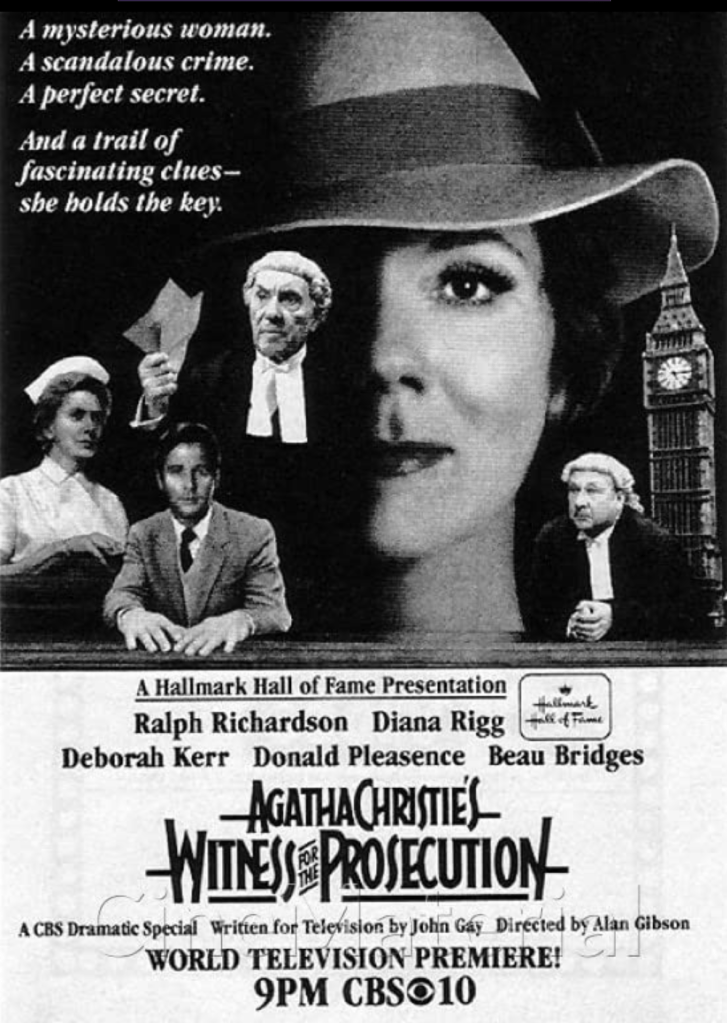
Hallmark Hall of Fame’s Witness for the Prosecution poster created by CBS Entertainment Production, Hallmark Hall of Fame Productions, Rosemont Productions, and United Artists Television

Things I liked about the film:

The acting: Diana Rigg is one of the eligible Bond Girls for the Other Than A Bond Girl Blogathon. Therefore, I will talk about her performance first. In Witness for the Prosecution, Diana portrayed Christine Vole, the wife of the accused party. Throughout the film, she carried her character as a woman from stories in the 1920s. What I mean by this is Christine held her own with confidence, never shaken by the probing of those involved in the legal side of the case. Even when she took the stand, Christine adopted a serious demeanor, as if putting on a “poker face” and refusing to show her deck of cards too early. These acting choices and the consistency of her performance allowed Diana to pull off a captivating and memorable portrayal!

Deborah Kerr is an actress I’ve talked about before on 18 Cinema Lane. While I have seen and reviewed five of her films, none of them were from the mystery genre. Despite this, Deborah held her own, acting wise, among the cast! She portrays Nurse Plimsoll in Witness for the Prosecution. While watching the 1982 production, her performance reminded me a bit of Donna Reed’s portrayal of Mary from It’s a Wonderful Life. Nurse Plimsoll cares about the health and well-being of the film’s protagonist, Sir Wilfred Robarts. Though Wilfred finds her overall nursing approach annoying, Nurse Plimsoll doesn’t give up on her mission. Even though she is stricter than other on-screen nurses, her heart is always in the right place. This can be seen through Deborah’s facial expressions, body language, and emotions.

Even though the cast as a whole was strong, there was one performance that stole the show. This came from Beau Bridges! Witness for the Prosecution shows Beau portraying an American named Leonard. Because his case is presented in a British/U.K. court system, he is a “fish out of water”. The situation itself provides an interesting dynamic for the cast, including Beau, to work with. It also gave Beau an opportunity to utilize a variety of emotions. During the case, one of the witnesses causes Leonard to have an emotional reaction. At the start of the witness’ questioning, Leonard presents a calm “resting face”. But as the questioning continues, he slowly becomes sadder, adopting a growing frown and his eyes filling with tears. This transformation was gradual, allowing Beau to adapt to the on-screen situation.

The set design: The majority of Witness for the Prosecution takes place within a British/U.K. court room. Despite the limited locations, there were some examples of set design that I liked! Inside the court room, the ceiling was domed, with clear glass exposing a view of the sky. Surrounding the dome are etched, white arches. With a green light shown on these arches, they gave the appearance of boasting an antique limestone material, which complimented the dark wood of the court room’s walls and furniture. In the lobby of the court room, painted murals are shown near the ceiling. The lobby’s walls appear to be covered in a two-tone marble material, with the floor revealing a black-and-white tile design. My favorite set in Witness for the Prosecution was Wilfred’s office! The room’s color scheme was brown, beige, and red. When this set was first introduced, a large, dark wood bookcase proudly stood. It was guarded by a dark wood table and two dark brown armchairs. While the walls were beige, the curtains on the window were red, giving the room a pop of color. The more time Wilfred spent in this space, the more the sophisticated, professional, and intelligent appearance of the office complimented his personality.

An in-depth look at the British/U.K. court system: As I mentioned in my point about the film’s set design, the majority of this story takes place in a British/U.K. court room. That part of the movie exposed the audience to the British/U.K. court system. Even though Witness for the Prosecution is not the “end all, be all” when it comes to this specific court system’s portrayal in entertainment media, it gives viewers a chance to compare and contrast it to other court systems in other productions. The layout of the court room itself provides one example. Toward the front of the court room, the witness stand is located at the judge’s right-hand side. This part of the court room is separate from the judge’s stand. Meanwhile, in court room productions taking place in the United States, the witness stand can either be located at the judge’s left or right-hand side. It is also connected to the judge’s stand.  

The Other Than A Bond Girl Blogathon banner created by Gabriela from Pale Writer and Gill from Realweegiemidget Reviews

What I didn’t like about the film:

The magical monocle: While working on the case, Wilfred wore a monocle when he was questioning the accused party and his wife. As he questioned them, a light shone through the monocle and directly landed on Leonard and Christine. But these were the only two times Wilfred used the magical monocle. The purpose of the monocle or Wilfred’s reason for using it was never explained. Was this monocle truly magical or was the monocle used as foreshadowing? I wish this part of Wilfred’s character was more consistent.

A dialogue heavy story: With any movie or tv show episode featuring a court case, there’s going to be a certain amount of dialogue within the story. But because Witness for the Prosecution mostly revolved around a court case, the 1982 production feels more dialogue heavy compared to Death on the Nile and Murder on the Orient Express. Before watching Witness for the Prosecution, I had expected more showing than telling when it came to the mystery. Instead of watching the characters making discoveries related to the mystery, I heard about it through the questioning in court. Because of this creative decision, I didn’t find the movie’s mystery as engaging as it could have been.

An inactive detective: In a story where a detective, amateur or professional, is the protagonist, the audience expects to see this character actively solve their respective film’s mystery. Sadly, the viewers won’t witness that in Witness for the Prosecution. Wilfred is a lawyer defending Leonard in his case. However, Wilfred places more emphasis in resolving the case than playing detective. Even though this movie’s mystery was solved, it felt like Wilfred was served the answer on a silver platter instead of discovering it himself. Similar to what I said about the dialogue-heavy story, I didn’t find the mystery engaging because of Wilfred’s inactive detective role.

Sketch of London image created by Archjoe at freepik.com. <a href=’https://www.freepik.com/free-vector/hand-drawn-houses-of-parliament_1133950.htm’>Designed by Archjoe</a>. <a href=”https://www.freepik.com/free-photos-vectors/background”>Background vector created by Archjoe – Freepik.com</a>. Image found at freepik.com.

My overall impression:

Hallmark Hall of Fame’s Witness for the Prosecution shares a similar plot with 1997’s Red Corner: an American man is accused of murder, with his case in a court system outside of the United States. But where Red Corner succeeded and Witness for the Prosecution didn’t is how Shen, Jack’s lawyer in Red Corner, not only played a role in the court case, but also went above and beyond in attempting to solve the mystery surrounding the case. This allowed Red Corner’s story to be intriguing and engaging for the audience. With the 1982 production, Wilfred spends more time on the court case than the mystery wrapped around it. This decreases the audience’s engagement. The dialogue heavy nature of Witness for the Prosecution’s story also affected the mystery’s intrigue. Hallmark Hall of Fame’s presentation is the third Agatha Christie adaptation I’ve seen, which I wasn’t overly thrilled with. I still want to, one day, read her literary work. But based on my reactions to the three adaptations I have watched so far, I’m starting to wonder if I’ll find an Agatha Christie story I like?

Overall score: 6.1-6.2 out of 10

Have you seen any of Agatha Christie’s adaptations? Do you have a favorite Agatha Christie story? Let me know in the comment section!

Have fun at the movies!

Sally Silverscreen

Take 3: Death on the Nile (2022) Review + 415 Follower Thank You

When I reviewed Curious Caterer: Dying for Chocolate for my last Blog Follower Dedication Review, I figured by writing about a mystery film, I would be giving the readers what they wanted. Well, for my 415 Blog Follower Dedication Review, I decided to give my readers yet another mystery, as both reviews for Curious Caterer: Dying for Chocolate and Cut, Color, Murder have been quite successful. This time, though, the movie in question is a more current mystery production from the big screen. Recently, my family rented the 2022 adaptation, Death on the Nile. This is the follow-up title to the 2017 adaptation, Murder on the Orient Express. On 18 Cinema Lane, I have gone on record to state I was not a fan of Murder on the Orient Express’ ending. I would say why, but then I’d have to spoil that movie for my readers. With that said, I watched the 2022 film with an open mind, hoping the ending would be better. But was that enough to be stronger than the 2017 title? Join me as I review Death on the Nile!

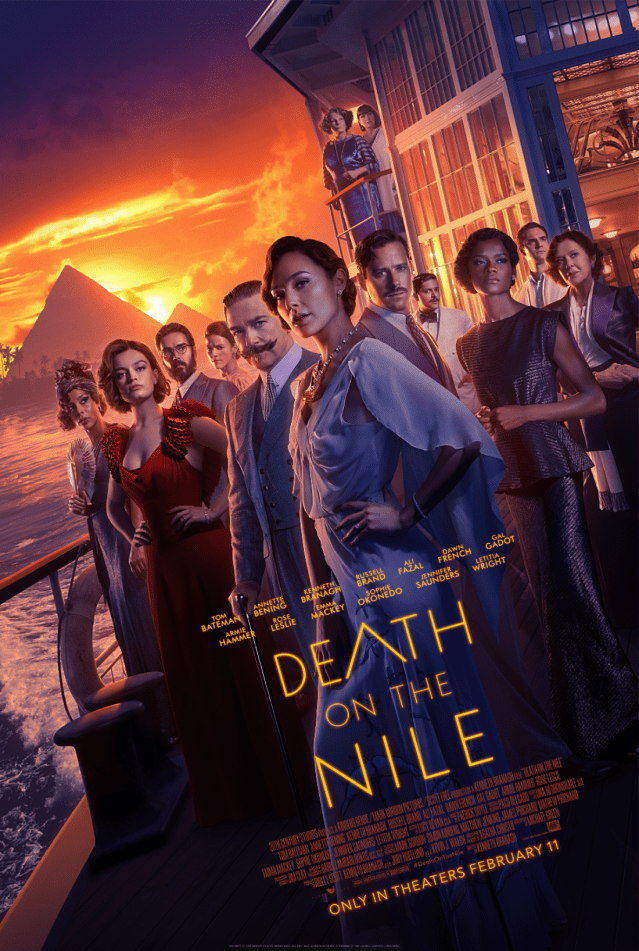
Death on the Nile (2022) poster created by Kinberg Genre, Mark Gordon Pictures, Scott Free Productions, TSG Entertainment, and 20th Century Studios

Things I liked about the film:

The acting: Sometimes, in ensemble films, there is at least one performance that steals the show. In the case of Death on the Nile, I can’t say that happened, as everyone’s performance was equally strong. So instead, I’m going to talk about how all of the actors and actresses appeared at ease in their roles. Every interaction among the characters seemed natural. Despite the talent being on different journeys in their career, there was a shared chemistry to be found. Gal Gadot did not star in Murder on the Orient Express alongside Kenneth Branagh. However, when they interacted together, it felt like their characters, Linnet and Hercule, had known each other longer than their total screen time. Even actors and actresses whose characters developed their own relationships created a believable on-screen connection. Bouc is a close friend of Hercule’s, but wasn’t brought up or featured in Murder on the Orient Express. Rosalie is a character who made her debut in Death on the Nile. Despite never meeting prior to this film, Rosalie and Bouc formed a romantic relationship that felt genuine. Their bright smiles and warm embraces present the impression they were always meant to be together. It’s interactions like Bouc and Rosalie’s that allowed the overall acting performances to be enjoyable to watch!

An atmospheric setting: The majority of Death on the Nile takes place in Egypt, specifically on the Nile River. Despite a cruise ship being the primary setting for the story, the characters make an excursion to an ancient Egyptian tomb. I’m not sure if Death on the Nile was filmed on-location, on a set, or if everything was green-screened. No matter where the movie was filmed, this particular location was very atmospheric! The structure was covered in a warm sandstone, reflecting the nearby natural landscape. The interior walls were covered in hieroglyphics, only seen through torch light or a flashlight. Before the characters entered the tombs, a long, overhead shot showcased their entry. Even though a structure like this one would likely never be done justice through filmography, it emphasized the scope of a location of that scale!

The Egyptian tombs were not the only atmospheric location in this film. When it comes to the S.S. Karnak, the creative team knew what style they wanted to execute. Boy, did they stick the landing! This ship was posh, bearing the word “elegant” like a badge of honor. The floor was a dark wood, which nicely contrasted the white shiplap walls. Polished glass windows surrounded a grand sitting area, separating patrons into an isolated, beautiful world. Even this aforementioned sitting area was a sight to behold! A detailed oriental rug hosted an island to a set of plush armchairs and a sofa. An elegant bar overlooked both the seating arrangements and the windowed walls, which showcased a perfect view of the river. When I first saw this ship on screen, it looked, to me, like a miniature version of the Titanic.

The use of black and white imagery: Within the mystery genre, black and white imagery has been, in my experience, used rarely in more recently released titles. Even in Death on the Nile, this kind of imagery had a limited incorporation in the movie. But the use of black and white imagery is what stood out to me. This film’s very first scene is captured in black and white. However, it took place during World War I, with the rest of the story taking place in 1937. The distinction of past and present through imagery was clever and visually interesting. This creative tactic was used again later in the story. But this time, color was included to force the audience to focus on that scene’s particular aspects. Like I said about the previous scene, it was an interesting and clever way to use black and white imagery!

Magnifying fingerprints image created by Balintseby at freepik.com. <a href=”https://www.freepik.com/free-photos-vectors/glass”>Glass vector created by Balintseby – Freepik.com</a>. <a href=’https://www.freepik.com/free-vector/fingerprint-investigation_789253.htm’>Designed by Freepik</a>. Image found at freepik.com.

What I didn’t like about the film:

The mystery’s delayed start time: One of my least favorite aspects of the mystery genre is when the mystery starts at a later time in the story. This is because I prefer mysteries to be more interactive and get to the heart of the matter sooner. Unfortunately, Death on the Nile did not ask me what I wanted, as the mystery in this movie started at the halfway point. That means the audience was given half a movie to attempt to solve the mystery alongside Hercule. To me, this felt reminiscent of episodes of Murder, She Wrote, where the first half of the story is devoted to the mystery’s build-up. This creative decision caused a much slower start to the movie, as well as a delay in suspense.

A mystery overshadowed by relationship drama: Drama among the characters can work in a mystery’s favor, as it provides possible motives and suspects. Various types of relationships can also create tension within the overall story. But in Death on the Nile, the relationship drama ended up overshadowing the mystery. In fact, it dominated the film’s first half. While characters fell in and out of love, or simply reflected on love, one of my family members asked, “Isn’t someone supposed to get murdered in this story”? I could easily sense this family member’s impatience, as I too felt my good will toward the movie slipping away with each of the characters’ romantic embrace. I have never read any of Agatha Christie’s books, so I’m not sure if these relationships are straight from the source material. However, this part of the story was over-emphasized.

A past detail that doesn’t lead anywhere: Death on the Nile starts with showing Hercule during World War I. In that time, it is revealed he developed romantic feelings for a woman named Katherine. For the rest of the movie, though, this part of the story was never revisited. If Katherine was brought up, Hercule only talked about her in passing. Hercule’s past relationship and his time during World War I getting ignored was confusing to me. Why include these details if there was no plan to follow through on them? It felt like they were added to the story simply for the sake of being there.

Egyptian hieroglyphic image created by wirestock at freepik.com. Luxor photo created by wirestock – www.freepik.com

My overall impression:

Before I share my overall impression of Death on the Nile, I would like to thank my followers for helping make this review a reality! In four years, my blog has achieved far more success than I ever imagined. All of that is thanks to you. Now, back to sharing my overall impression. While the ending/resolution in Death on the Nile was stronger than Murder on the Orient Express’ was, the overall execution was weaker than the 2017 adaptation. The 2022 film contained a similar flaw to Knives Out: the drama among the characters overshadowed the mystery. Having the mystery start at the movie’s halfway point didn’t help Death on the Nile’s case either. Like Murder on the Orient Express, though, the cast was strong in Death on the Nile. In fact, it was difficult for me to choose a favorite performance. The locations in the 2022 production were atmospheric as well. At the publication of this review, I’m not sure if Kenneth Branagh has plans to adapt more of Agatha Christie’s books. It depends, at this point, if the potential is there.

Overall score: 6.1 out of 10

Have you seen any adaptations of Agatha Christie’s work? Have you read any of Agatha’s books? Don’t hesitate to comment in the comment section below!

Have fun at the movies!

Sally Silverscreen